


@simplestack
25💻 Software Engineering, Tech & Sci-Fi ⛓️💥 Blockchain is Freedom
hive.blog/@simplestackVOTING POWER100.00%
DOWNVOTE POWER100.00%
RESOURCE CREDITS100.00%
REPUTATION PROGRESS0.00%
Net Worth
0.006USD
HIVE
0.000HIVE
HBD
0.006HBD
Own HP
0.001HP
Detailed Balance
| HIVE | ||
| balance | 0.000HIVE | HIVE |
| market_balance | 0.000HIVE | HIVE |
| savings_balance | 0.000HIVE | HIVE |
| reward_hive_balance | 0.000HIVE | HIVE |
| HIVE POWER | ||
| Own HP | 0.001HP | HP |
| Delegated Out | 0.000HP | HP |
| Delegation In | 0.000HP | HP |
| Effective Power | 0.001HP | HP |
| Reward HP (pending) | 0.000HP | HP |
| HBD | ||
| hbd_balance | 0.006HBD | HBD |
| hbd_conversions | 0.000HBD | HBD |
| hbd_market_balance | 0.000HBD | HBD |
| savings_hbd_balance | 0.000HBD | HBD |
| reward_hbd_balance | 0.000HBD | HBD |
{
  "balance": "0.000 HIVE",
  "savings_balance": "0.000 HIVE",
  "reward_hive_balance": "0.000 HIVE",
  "vesting_shares": "1.358611 VESTS",
  "delegated_vesting_shares": "0.000000 VESTS",
  "received_vesting_shares": "0.000000 VESTS",
  "hbd_balance": "0.006 HBD",
  "savings_hbd_balance": "0.000 HBD",
  "reward_hbd_balance": "0.000 HBD"
}
Account Info
| name | simplestack |
| id | 2562792 |
| rank | 0 |
| reputation | 0 |
| created | 2025-03-24T16:43:12 |
| recovery_account | dbuzz |
| proxy | None |
| invited_by | null |
| post_count | 101 |
| comment_count | 0 |
| lifetime_vote_count | 0 |
| witnesses_voted_for | 0 |
| last_post | 2025-04-10T01:54:12 |
| last_root_post | 2025-04-10T01:54:12 |
| last_vote_time | 2025-04-11T01:05:36 |
| proxied_vsf_votes | 0, 0, 0, 0 |
| can_vote | 1 |
| voting_power | 10,000 |
| delayed_votes | None |
| governance_vote_expiration_ts | 1969-12-31T23:59:59 |
| balance | 0.000 HIVE |
| savings_balance | 0.000 HIVE |
| hbd_balance | 0.006 HBD |
| savings_hbd_balance | 0.000 HBD |
| vesting_shares | 1.358611 VESTS |
| delegated_vesting_shares | 0.000000 VESTS |
| received_vesting_shares | 0.000000 VESTS |
| reward_vesting_balance | 0.000000 VESTS |
| vesting_balance | 0.000 HIVE |
| vesting_withdraw_rate | 0.000000 VESTS |
| next_vesting_withdrawal | 1969-12-31T23:59:59 |
| withdrawn | 0 |
| to_withdraw | 0 |
| withdraw_routes | 0 |
| savings_withdraw_requests | 0 |
| last_account_recovery | 1970-01-01T00:00:00 |
| reset_account | null |
| last_owner_update | 1970-01-01T00:00:00 |
| last_account_update | 2025-03-30T16:46:21 |
| mined | No |
| hbd_seconds | 0 |
| hbd_last_interest_payment | 1970-01-01T00:00:00 |
| savings_hbd_last_interest_payment | 1970-01-01T00:00:00 |
{
"id": 2562792,
"name": "simplestack",
"owner": {
"weight_threshold": 1,
"account_auths": [],
"key_auths": [
[
"STM5k7KviGZo6gce9tAoeeCHwJBGrmEXhQzY55ZzZrki1bco9dSFg",
1
]
]
},
"active": {
"weight_threshold": 1,
"account_auths": [],
"key_auths": [
[
"STM65aHfKyybnF2KTrzz9dZrDfxhvyq5CtT6394bAePZYDZyL8wk9",
1
]
]
},
"posting": {
"weight_threshold": 1,
"account_auths": [],
"key_auths": [
[
"STM8FhmFsrDVSgQJm7LaauZuk1itVAe5VkCuEeunpr8We3RRFBmje",
1
]
]
},
"memo_key": "STM8XjU5gUC17m2W4amxx58mjyjyWexrSLh6S3Hc6gYDWJgwgPUa5",
"json_metadata": "{\"beneficiaries\":[],\"profile\":{\"nsfw\":\"\"}}",
"posting_json_metadata": "{\"profile\":{\"name\":\"Simple Stack\",\"about\":\"💻 Software Engineering, Tech & Sci-Fi ⛓️💥 Blockchain is Freedom\",\"location\":\"Multiverse\",\"website\":\"https://www.linkedin.com/in/edwardcasanova/\",\"profile_image\":\"https://files.peakd.com/file/peakd-hive/simplestack/peakd_logo_512x512.png\",\"cover_image\":\"https://files.peakd.com/file/peakd-hive/simplestack/peakd_background_1920x240.png\",\"version\":2,\"collections\":\"enabled\"}}",
"proxy": "",
"previous_owner_update": "1970-01-01T00:00:00",
"last_owner_update": "1970-01-01T00:00:00",
"last_account_update": "2025-03-30T16:46:21",
"created": "2025-03-24T16:43:12",
"mined": false,
"recovery_account": "dbuzz",
"last_account_recovery": "1970-01-01T00:00:00",
"reset_account": "null",
"comment_count": 0,
"lifetime_vote_count": 0,
"post_count": 101,
"can_vote": true,
"voting_manabar": {
"current_mana": 774839068947,
"last_update_time": 1744333536
},
"downvote_manabar": {
"current_mana": 193748516940,
"last_update_time": 1744333536
},
"voting_power": 10000,
"balance": "0.000 HIVE",
"savings_balance": "0.000 HIVE",
"hbd_balance": "0.006 HBD",
"hbd_seconds": "0",
"hbd_seconds_last_update": "1970-01-01T00:00:00",
"hbd_last_interest_payment": "1970-01-01T00:00:00",
"savings_hbd_balance": "0.000 HBD",
"savings_hbd_seconds": "0",
"savings_hbd_seconds_last_update": "1970-01-01T00:00:00",
"savings_hbd_last_interest_payment": "1970-01-01T00:00:00",
"savings_withdraw_requests": 0,
"reward_hbd_balance": "0.000 HBD",
"reward_hive_balance": "0.000 HIVE",
"reward_vesting_balance": "0.000000 VESTS",
"reward_vesting_hive": "0.000 HIVE",
"vesting_shares": "1.358611 VESTS",
"delegated_vesting_shares": "0.000000 VESTS",
"received_vesting_shares": "0.000000 VESTS",
"vesting_withdraw_rate": "0.000000 VESTS",
"post_voting_power": "1.358611 VESTS",
"next_vesting_withdrawal": "1969-12-31T23:59:59",
"withdrawn": 0,
"to_withdraw": 0,
"withdraw_routes": 0,
"pending_transfers": 0,
"curation_rewards": 0,
"posting_rewards": 0,
"proxied_vsf_votes": [
0,
0,
0,
0
],
"witnesses_voted_for": 0,
"last_post": "2025-04-10T01:54:12",
"last_root_post": "2025-04-10T01:54:12",
"last_vote_time": "2025-04-11T01:05:36",
"post_bandwidth": 0,
"pending_claimed_accounts": 0,
"governance_vote_expiration_ts": "1969-12-31T23:59:59",
"delayed_votes": [],
"open_recurrent_transfers": 0,
"vesting_balance": "0.000 HIVE",
"reputation": 0,
"transfer_history": [],
"market_history": [],
"post_history": [],
"vote_history": [],
"other_history": [],
"witness_votes": [],
"tags_usage": [],
"guest_bloggers": [],
"rank": 0
}Withdraw Routes
| Incoming | Outgoing |
|---|---|
Empty | Empty |
{
  "incoming": [],
  "outgoing": []
}From Date
To Date
simplestacksent 463.387 HIVE to @bdhivesteem- "104069092"2025/09/24 18:36:12
simplestacksent 463.387 HIVE to @bdhivesteem- "104069092"
2025/09/24 18:36:12
| to | bdhivesteem |
| from | simplestack |
| memo | 104069092 |
| amount | 463.387 HIVE |
| Transaction Info | Block #99715741/Trx c7db4a49d5908399be922129f7f8d1d4d441dcde |
View Raw JSON Data
{
  "op": [
    "transfer",
    {
      "to": "bdhivesteem",
      "from": "simplestack",
      "memo": "104069092",
      "amount": "463.387 HIVE"
    }
  ],
  "block": 99715741,
  "trx_id": "c7db4a49d5908399be922129f7f8d1d4d441dcde",
  "op_in_trx": 0,
  "timestamp": "2025-09-24T18:36:12",
  "virtual_op": false,
  "trx_in_block": 9
}simplestacksent 1.000 HIVE to @bdhivesteem- "104069092"2025/09/24 18:25:27
simplestacksent 1.000 HIVE to @bdhivesteem- "104069092"
2025/09/24 18:25:27
| to | bdhivesteem |
| from | simplestack |
| memo | 104069092 |
| amount | 1.000 HIVE |
| Transaction Info | Block #99715526/Trx 39d00389ed84f72b324f687d902b2d66dfcd01e6 |
View Raw JSON Data
{
  "op": [
    "transfer",
    {
      "to": "bdhivesteem",
      "from": "simplestack",
      "memo": "104069092",
      "amount": "1.000 HIVE"
    }
  ],
  "block": 99715526,
  "trx_id": "39d00389ed84f72b324f687d902b2d66dfcd01e6",
  "op_in_trx": 0,
  "timestamp": "2025-09-24T18:25:27",
  "virtual_op": false,
  "trx_in_block": 17
}simplestackreceived 35.843 HIVE from power down installment (36.726 HP)2025/08/04 14:41:18
simplestackreceived 35.843 HIVE from power down installment (36.726 HP)
2025/08/04 14:41:18
| deposited | 35.843 HIVE |
| withdrawn | 59614.823778 VESTS |
| to account | simplestack |
| from account | simplestack |
| Transaction Info | Block #98243681/Virtual Operation 4294967295:4 |
View Raw JSON Data
{
  "op": [
    "fill_vesting_withdraw",
    {
      "deposited": "35.843 HIVE",
      "withdrawn": "59614.823778 VESTS",
      "to_account": "simplestack",
      "from_account": "simplestack"
    }
  ],
  "block": 98243681,
  "trx_id": "0000000000000000000000000000000000000000",
  "op_in_trx": 4,
  "timestamp": "2025-08-04T14:41:18",
  "virtual_op": true,
  "trx_in_block": 4294967295
}simplestackreceived 35.822 HIVE from power down installment (36.726 HP)2025/07/28 14:41:18
simplestackreceived 35.822 HIVE from power down installment (36.726 HP)
2025/07/28 14:41:18
| deposited | 35.822 HIVE |
| withdrawn | 59614.823781 VESTS |
| to account | simplestack |
| from account | simplestack |
| Transaction Info | Block #98042316/Virtual Operation 4294967295:4 |
View Raw JSON Data
{
  "op": [
    "fill_vesting_withdraw",
    {
      "deposited": "35.822 HIVE",
      "withdrawn": "59614.823781 VESTS",
      "to_account": "simplestack",
      "from_account": "simplestack"
    }
  ],
  "block": 98042316,
  "trx_id": "0000000000000000000000000000000000000000",
  "op_in_trx": 4,
  "timestamp": "2025-07-28T14:41:18",
  "virtual_op": true,
  "trx_in_block": 4294967295
}thepatriotblogupvoted (15.00%) @simplestack / why-gleam-wins-over-f2025/07/26 15:46:54
thepatriotblogupvoted (15.00%) @simplestack / why-gleam-wins-over-f
2025/07/26 15:46:54
| voter | thepatriotblog |
| author | simplestack |
| weight | 1500 (15.00%) |
| permlink | why-gleam-wins-over-f |
| Transaction Info | Block #97986111/Trx c7a8c692cf89ee180ecb0552bf61ef54c96ea433 |
View Raw JSON Data
{
  "op": [
    "vote",
    {
      "voter": "thepatriotblog",
      "author": "simplestack",
      "weight": 1500,
      "permlink": "why-gleam-wins-over-f"
    }
  ],
  "block": 97986111,
  "trx_id": "c7a8c692cf89ee180ecb0552bf61ef54c96ea433",
  "op_in_trx": 0,
  "timestamp": "2025-07-26T15:46:54",
  "virtual_op": false,
  "trx_in_block": 11
}annetimisticupvoted (100.00%) @simplestack / why-gleam-wins-over-f2025/07/25 07:43:06
annetimisticupvoted (100.00%) @simplestack / why-gleam-wins-over-f
2025/07/25 07:43:06
| voter | annetimistic |
| author | simplestack |
| weight | 10000 (100.00%) |
| permlink | why-gleam-wins-over-f |
| Transaction Info | Block #97947678/Trx 5ff3222713210d5719b7a9c9ae296fbe5c9bf394 |
View Raw JSON Data
{
  "op": [
    "vote",
    {
      "voter": "annetimistic",
      "author": "simplestack",
      "weight": 10000,
      "permlink": "why-gleam-wins-over-f"
    }
  ],
  "block": 97947678,
  "trx_id": "5ff3222713210d5719b7a9c9ae296fbe5c9bf394",
  "op_in_trx": 0,
  "timestamp": "2025-07-25T07:43:06",
  "virtual_op": false,
  "trx_in_block": 14
}simplestackreceived 35.802 HIVE from power down installment (36.726 HP)2025/07/21 14:41:18
simplestackreceived 35.802 HIVE from power down installment (36.726 HP)
2025/07/21 14:41:18
| deposited | 35.802 HIVE |
| withdrawn | 59614.823781 VESTS |
| to account | simplestack |
| from account | simplestack |
| Transaction Info | Block #97841058/Virtual Operation 4294967295:12 |
View Raw JSON Data
{
  "op": [
    "fill_vesting_withdraw",
    {
      "deposited": "35.802 HIVE",
      "withdrawn": "59614.823781 VESTS",
      "to_account": "simplestack",
      "from_account": "simplestack"
    }
  ],
  "block": 97841058,
  "trx_id": "0000000000000000000000000000000000000000",
  "op_in_trx": 12,
  "timestamp": "2025-07-21T14:41:18",
  "virtual_op": true,
  "trx_in_block": 4294967295
}simplestackreceived 35.782 HIVE from power down installment (36.726 HP)2025/07/14 14:41:18
simplestackreceived 35.782 HIVE from power down installment (36.726 HP)
2025/07/14 14:41:18
| deposited | 35.782 HIVE |
| withdrawn | 59614.823781 VESTS |
| to account | simplestack |
| from account | simplestack |
| Transaction Info | Block #97639741/Virtual Operation 4294967295:6 |
View Raw JSON Data
{
  "op": [
    "fill_vesting_withdraw",
    {
      "deposited": "35.782 HIVE",
      "withdrawn": "59614.823781 VESTS",
      "to_account": "simplestack",
      "from_account": "simplestack"
    }
  ],
  "block": 97639741,
  "trx_id": "0000000000000000000000000000000000000000",
  "op_in_trx": 6,
  "timestamp": "2025-07-14T14:41:18",
  "virtual_op": true,
  "trx_in_block": 4294967295
}simplestackreceived 35.762 HIVE from power down installment (36.726 HP)2025/07/07 14:41:18
simplestackreceived 35.762 HIVE from power down installment (36.726 HP)
2025/07/07 14:41:18
| deposited | 35.762 HIVE |
| withdrawn | 59614.823781 VESTS |
| to account | simplestack |
| from account | simplestack |
| Transaction Info | Block #97438372/Virtual Operation 4294967295:3 |
View Raw JSON Data
{
  "op": [
    "fill_vesting_withdraw",
    {
      "deposited": "35.762 HIVE",
      "withdrawn": "59614.823781 VESTS",
      "to_account": "simplestack",
      "from_account": "simplestack"
    }
  ],
  "block": 97438372,
  "trx_id": "0000000000000000000000000000000000000000",
  "op_in_trx": 3,
  "timestamp": "2025-07-07T14:41:18",
  "virtual_op": true,
  "trx_in_block": 4294967295
}v-36upvoted (100.00%) @simplestack / why-gleam-wins-over-f2025/07/01 15:33:45
v-36upvoted (100.00%) @simplestack / why-gleam-wins-over-f
2025/07/01 15:33:45
| voter | v-36 |
| author | simplestack |
| weight | 10000 (100.00%) |
| permlink | why-gleam-wins-over-f |
| Transaction Info | Block #97266825/Trx 70a321b1256c802f355454cecfe0067041120d08 |
View Raw JSON Data
{
  "op": [
    "vote",
    {
      "voter": "v-36",
      "author": "simplestack",
      "weight": 10000,
      "permlink": "why-gleam-wins-over-f"
    }
  ],
  "block": 97266825,
  "trx_id": "70a321b1256c802f355454cecfe0067041120d08",
  "op_in_trx": 0,
  "timestamp": "2025-07-01T15:33:45",
  "virtual_op": false,
  "trx_in_block": 12
}simplestackreceived 35.741 HIVE from power down installment (36.726 HP)2025/06/30 14:41:18
simplestackreceived 35.741 HIVE from power down installment (36.726 HP)
2025/06/30 14:41:18
| deposited | 35.741 HIVE |
| withdrawn | 59614.823781 VESTS |
| to account | simplestack |
| from account | simplestack |
| Transaction Info | Block #97237010/Virtual Operation 4294967295:2 |
View Raw JSON Data
{
  "op": [
    "fill_vesting_withdraw",
    {
      "deposited": "35.741 HIVE",
      "withdrawn": "59614.823781 VESTS",
      "to_account": "simplestack",
      "from_account": "simplestack"
    }
  ],
  "block": 97237010,
  "trx_id": "0000000000000000000000000000000000000000",
  "op_in_trx": 2,
  "timestamp": "2025-06-30T14:41:18",
  "virtual_op": true,
  "trx_in_block": 4294967295
}simplestackreceived 35.719 HIVE from power down installment (36.726 HP)2025/06/23 14:41:18
simplestackreceived 35.719 HIVE from power down installment (36.726 HP)
2025/06/23 14:41:18
| deposited | 35.719 HIVE |
| withdrawn | 59614.823781 VESTS |
| to account | simplestack |
| from account | simplestack |
| Transaction Info | Block #97035680/Virtual Operation 4294967295:6 |
View Raw JSON Data
{
  "op": [
    "fill_vesting_withdraw",
    {
      "deposited": "35.719 HIVE",
      "withdrawn": "59614.823781 VESTS",
      "to_account": "simplestack",
      "from_account": "simplestack"
    }
  ],
  "block": 97035680,
  "trx_id": "0000000000000000000000000000000000000000",
  "op_in_trx": 6,
  "timestamp": "2025-06-23T14:41:18",
  "virtual_op": true,
  "trx_in_block": 4294967295
}simplestackreceived 35.698 HIVE from power down installment (36.726 HP)2025/06/16 14:41:18
simplestackreceived 35.698 HIVE from power down installment (36.726 HP)
2025/06/16 14:41:18
| deposited | 35.698 HIVE |
| withdrawn | 59614.823781 VESTS |
| to account | simplestack |
| from account | simplestack |
| Transaction Info | Block #96834390/Virtual Operation 4294967295:2 |
View Raw JSON Data
{
  "op": [
    "fill_vesting_withdraw",
    {
      "deposited": "35.698 HIVE",
      "withdrawn": "59614.823781 VESTS",
      "to_account": "simplestack",
      "from_account": "simplestack"
    }
  ],
  "block": 96834390,
  "trx_id": "0000000000000000000000000000000000000000",
  "op_in_trx": 2,
  "timestamp": "2025-06-16T14:41:18",
  "virtual_op": true,
  "trx_in_block": 4294967295
}simplestackreceived 35.678 HIVE from power down installment (36.726 HP)2025/06/09 14:41:18
simplestackreceived 35.678 HIVE from power down installment (36.726 HP)
2025/06/09 14:41:18
| deposited | 35.678 HIVE |
| withdrawn | 59614.823781 VESTS |
| to account | simplestack |
| from account | simplestack |
| Transaction Info | Block #96633062/Virtual Operation 4294967295:2 |
View Raw JSON Data
{
  "op": [
    "fill_vesting_withdraw",
    {
      "deposited": "35.678 HIVE",
      "withdrawn": "59614.823781 VESTS",
      "to_account": "simplestack",
      "from_account": "simplestack"
    }
  ],
  "block": 96633062,
  "trx_id": "0000000000000000000000000000000000000000",
  "op_in_trx": 2,
  "timestamp": "2025-06-09T14:41:18",
  "virtual_op": true,
  "trx_in_block": 4294967295
}simplestackreceived 35.658 HIVE from power down installment (36.726 HP)2025/06/02 14:41:18
simplestackreceived 35.658 HIVE from power down installment (36.726 HP)
2025/06/02 14:41:18
| deposited | 35.658 HIVE |
| withdrawn | 59614.823781 VESTS |
| to account | simplestack |
| from account | simplestack |
| Transaction Info | Block #96431685/Virtual Operation 4294967295:3 |
View Raw JSON Data
{
  "op": [
    "fill_vesting_withdraw",
    {
      "deposited": "35.658 HIVE",
      "withdrawn": "59614.823781 VESTS",
      "to_account": "simplestack",
      "from_account": "simplestack"
    }
  ],
  "block": 96431685,
  "trx_id": "0000000000000000000000000000000000000000",
  "op_in_trx": 3,
  "timestamp": "2025-06-02T14:41:18",
  "virtual_op": true,
  "trx_in_block": 4294967295
}simplestackreceived 35.637 HIVE from power down installment (36.726 HP)2025/05/26 14:41:18
simplestackreceived 35.637 HIVE from power down installment (36.726 HP)
2025/05/26 14:41:18
| deposited | 35.637 HIVE |
| withdrawn | 59614.823781 VESTS |
| to account | simplestack |
| from account | simplestack |
| Transaction Info | Block #96230305/Virtual Operation 4294967295:2 |
View Raw JSON Data
{
  "op": [
    "fill_vesting_withdraw",
    {
      "deposited": "35.637 HIVE",
      "withdrawn": "59614.823781 VESTS",
      "to_account": "simplestack",
      "from_account": "simplestack"
    }
  ],
  "block": 96230305,
  "trx_id": "0000000000000000000000000000000000000000",
  "op_in_trx": 2,
  "timestamp": "2025-05-26T14:41:18",
  "virtual_op": true,
  "trx_in_block": 4294967295
}simplestackreceived 35.617 HIVE from power down installment (36.726 HP)2025/05/19 14:41:18
simplestackreceived 35.617 HIVE from power down installment (36.726 HP)
2025/05/19 14:41:18
| deposited | 35.617 HIVE |
| withdrawn | 59614.823781 VESTS |
| to account | simplestack |
| from account | simplestack |
| Transaction Info | Block #96028905/Virtual Operation 4294967295:5 |
View Raw JSON Data
{
  "op": [
    "fill_vesting_withdraw",
    {
      "deposited": "35.617 HIVE",
      "withdrawn": "59614.823781 VESTS",
      "to_account": "simplestack",
      "from_account": "simplestack"
    }
  ],
  "block": 96028905,
  "trx_id": "0000000000000000000000000000000000000000",
  "op_in_trx": 5,
  "timestamp": "2025-05-19T14:41:18",
  "virtual_op": true,
  "trx_in_block": 4294967295
}simplestackreceived 35.597 HIVE from power down installment (36.726 HP)2025/05/12 14:41:18
simplestackreceived 35.597 HIVE from power down installment (36.726 HP)
2025/05/12 14:41:18
| deposited | 35.597 HIVE |
| withdrawn | 59614.823781 VESTS |
| to account | simplestack |
| from account | simplestack |
| Transaction Info | Block #95827514/Virtual Operation 4294967295:2 |
View Raw JSON Data
{
  "op": [
    "fill_vesting_withdraw",
    {
      "deposited": "35.597 HIVE",
      "withdrawn": "59614.823781 VESTS",
      "to_account": "simplestack",
      "from_account": "simplestack"
    }
  ],
  "block": 95827514,
  "trx_id": "0000000000000000000000000000000000000000",
  "op_in_trx": 2,
  "timestamp": "2025-05-12T14:41:18",
  "virtual_op": true,
  "trx_in_block": 4294967295
}simplestackstarted power down of 477.438 HP2025/05/05 14:41:21
simplestackstarted power down of 477.438 HP
2025/05/05 14:41:21
| account | simplestack |
| vesting shares | 774992.709150 VESTS |
| Transaction Info | Block #95626122/Trx 7c9e7873eddbd3c79bed3b0e02b74b6824ccd31b |
View Raw JSON Data
{
  "op": [
    "withdraw_vesting",
    {
      "account": "simplestack",
      "vesting_shares": "774992.709150 VESTS"
    }
  ],
  "block": 95626122,
  "trx_id": "7c9e7873eddbd3c79bed3b0e02b74b6824ccd31b",
  "op_in_trx": 0,
  "timestamp": "2025-05-05T14:41:21",
  "virtual_op": false,
  "trx_in_block": 7
}2025/05/02 04:37:33
2025/05/02 04:37:33
| body | Drugs can harm a man's body and mind. They cause sickness, addiction, and make it hard to live a good life. TRT can help hypogonadal men improve testosterone levels, which may reduce diabetes risk and enhance insulin sensitivity for better health. The oral testosterone treatment can improve insulin sensitivity and blood sugar control in hypogonadal men, reducing the risk of developing diabetes. <https://www.rethinktestosterone.com/blog/drugs-that-affect-testosterone> --- [Posted](/@simplestack/why-fighting-ai-content-is-like-the-drug-war#@waivio_richard-holder/re-simplestack-why-fighting-ai-content-is-like-the-drug-war-20250502t043732317z) by Waivio guest: [@waivio_richard-holder](/@waivio_richard-holder) |
| title | |
| author | guest10 |
| permlink | re-simplestack-why-fighting-ai-content-is-like-the-drug-war-20250502t043732317z |
| json metadata | {"community":"waivio","app":"waivio/1.0.0","format":"markdown","timeOfPostCreation":1746160655318,"tags":["ai"],"users":[],"links":["https://www.rethinktestosterone.com/blog/drugs-that-affect-testosterone"],"image":[],"wobj":{"wobjects":[]},"comment":{"userId":"waivio_richard-holder","social":"google"},"signature":"204f6f25a72c7df9ac7082ed61b7ba04d1c91139747d840513b0dcdae3d3f849ea623dd147d60a4f809c544a7fab966119c96f06ae91f3e464345fe5cad96a4735"} |
| parent author | simplestack |
| parent permlink | why-fighting-ai-content-is-like-the-drug-war |
| Transaction Info | Block #95527758/Trx 28000aae32c657cea465967b35a8f8f436fa4b2e |
View Raw JSON Data
{
  "op": [
    "comment",
    {
      "body": "Drugs can harm a man's body and mind. They cause sickness, addiction, and make it hard to live a good life. TRT can help hypogonadal men improve testosterone levels, which may reduce diabetes risk and enhance insulin sensitivity for better health. The oral testosterone treatment can improve insulin sensitivity and blood sugar control in hypogonadal men, reducing the risk of developing diabetes.\n\n<https://www.rethinktestosterone.com/blog/drugs-that-affect-testosterone>\n\n---\n\n[Posted](/@simplestack/why-fighting-ai-content-is-like-the-drug-war#@waivio_richard-holder/re-simplestack-why-fighting-ai-content-is-like-the-drug-war-20250502t043732317z) by Waivio guest: [@waivio_richard-holder](/@waivio_richard-holder)",
      "title": "",
      "author": "guest10",
      "permlink": "re-simplestack-why-fighting-ai-content-is-like-the-drug-war-20250502t043732317z",
      "json_metadata": "{\"community\":\"waivio\",\"app\":\"waivio/1.0.0\",\"format\":\"markdown\",\"timeOfPostCreation\":1746160655318,\"tags\":[\"ai\"],\"users\":[],\"links\":[\"https://www.rethinktestosterone.com/blog/drugs-that-affect-testosterone\"],\"image\":[],\"wobj\":{\"wobjects\":[]},\"comment\":{\"userId\":\"waivio_richard-holder\",\"social\":\"google\"},\"signature\":\"204f6f25a72c7df9ac7082ed61b7ba04d1c91139747d840513b0dcdae3d3f849ea623dd147d60a4f809c544a7fab966119c96f06ae91f3e464345fe5cad96a4735\"}",
      "parent_author": "simplestack",
      "parent_permlink": "why-fighting-ai-content-is-like-the-drug-war"
    }
  ],
  "block": 95527758,
  "trx_id": "28000aae32c657cea465967b35a8f8f436fa4b2e",
  "op_in_trx": 0,
  "timestamp": "2025-05-02T04:37:33",
  "virtual_op": false,
  "trx_in_block": 20
}simplestackblockchain operation: delayed voting2025/04/25 22:09:09
simplestackblockchain operation: delayed voting
2025/04/25 22:09:09
| voter | simplestack |
| votes | 774994067761 |
| Transaction Info | Block #95347768/Virtual Operation 4294967295:2 |
View Raw JSON Data
{
  "op": [
    "delayed_voting",
    {
      "voter": "simplestack",
      "votes": 774994067761
    }
  ],
  "block": 95347768,
  "trx_id": "0000000000000000000000000000000000000000",
  "op_in_trx": 2,
  "timestamp": "2025-04-25T22:09:09",
  "virtual_op": true,
  "trx_in_block": 4294967295
}simplestackupdated payout for what-kevin-oleary-can-teach-you-about-grifting-in-tech2025/04/17 01:54:12
simplestackupdated payout for what-kevin-oleary-can-teach-you-about-grifting-in-tech
2025/04/17 01:54:12
| author | simplestack |
| permlink | what-kevin-oleary-can-teach-you-about-grifting-in-tech |
| Transaction Info | Block #95093557/Virtual Operation 4294967295:2 |
View Raw JSON Data
{
  "op": [
    "comment_payout_update",
    {
      "author": "simplestack",
      "permlink": "what-kevin-oleary-can-teach-you-about-grifting-in-tech"
    }
  ],
  "block": 95093557,
  "trx_id": "0000000000000000000000000000000000000000",
  "op_in_trx": 2,
  "timestamp": "2025-04-17T01:54:12",
  "virtual_op": true,
  "trx_in_block": 4294967295
}simplestackupdated payout for how-trumps-tariffs-may-crumble-us-tech2025/04/16 19:30:24
simplestackupdated payout for how-trumps-tariffs-may-crumble-us-tech
2025/04/16 19:30:24
| author | simplestack |
| permlink | how-trumps-tariffs-may-crumble-us-tech |
| Transaction Info | Block #95085919/Virtual Operation 4294967295:6 |
View Raw JSON Data
{
  "op": [
    "comment_payout_update",
    {
      "author": "simplestack",
      "permlink": "how-trumps-tariffs-may-crumble-us-tech"
    }
  ],
  "block": 95085919,
  "trx_id": "0000000000000000000000000000000000000000",
  "op_in_trx": 6,
  "timestamp": "2025-04-16T19:30:24",
  "virtual_op": true,
  "trx_in_block": 4294967295
}simplestackupdated payout for lets-understand-cpu-vs-memory-nodejs-examples2025/04/16 16:43:45
simplestackupdated payout for lets-understand-cpu-vs-memory-nodejs-examples
2025/04/16 16:43:45
| author | simplestack |
| permlink | lets-understand-cpu-vs-memory-nodejs-examples |
| Transaction Info | Block #95082589/Virtual Operation 4294967295:2 |
View Raw JSON Data
{
  "op": [
    "comment_payout_update",
    {
      "author": "simplestack",
      "permlink": "lets-understand-cpu-vs-memory-nodejs-examples"
    }
  ],
  "block": 95082589,
  "trx_id": "0000000000000000000000000000000000000000",
  "op_in_trx": 2,
  "timestamp": "2025-04-16T16:43:45",
  "virtual_op": true,
  "trx_in_block": 4294967295
}simplestackupdated payout for everyone-wants-the-senior-nobody-wants-to-nourish-one2025/04/16 14:59:06
simplestackupdated payout for everyone-wants-the-senior-nobody-wants-to-nourish-one
2025/04/16 14:59:06
| author | simplestack |
| permlink | everyone-wants-the-senior-nobody-wants-to-nourish-one |
| Transaction Info | Block #95080499/Virtual Operation 4294967295:2 |
View Raw JSON Data
{
  "op": [
    "comment_payout_update",
    {
      "author": "simplestack",
      "permlink": "everyone-wants-the-senior-nobody-wants-to-nourish-one"
    }
  ],
  "block": 95080499,
  "trx_id": "0000000000000000000000000000000000000000",
  "op_in_trx": 2,
  "timestamp": "2025-04-16T14:59:06",
  "virtual_op": true,
  "trx_in_block": 4294967295
}2025/04/15 20:54:12
2025/04/15 20:54:12
| author | simplestack |
| permlink | a-simple-guide-to-traefik-router-observability--concrete-examples-using-docker-swarm--aws |
| Transaction Info | Block #95058827/Virtual Operation 4294967295:2 |
View Raw JSON Data
{
  "op": [
    "comment_payout_update",
    {
      "author": "simplestack",
      "permlink": "a-simple-guide-to-traefik-router-observability--concrete-examples-using-docker-swarm--aws"
    }
  ],
  "block": 95058827,
  "trx_id": "0000000000000000000000000000000000000000",
  "op_in_trx": 2,
  "timestamp": "2025-04-15T20:54:12",
  "virtual_op": true,
  "trx_in_block": 4294967295
}2025/04/15 17:30:27
2025/04/15 17:30:27
| author | simplestack |
| permlink | locking-down-your-website-with-traefik-a-beginner-friendly-guide-to-tls |
| Transaction Info | Block #95054757/Virtual Operation 4294967295:2 |
View Raw JSON Data
{
  "op": [
    "comment_payout_update",
    {
      "author": "simplestack",
      "permlink": "locking-down-your-website-with-traefik-a-beginner-friendly-guide-to-tls"
    }
  ],
  "block": 95054757,
  "trx_id": "0000000000000000000000000000000000000000",
  "op_in_trx": 2,
  "timestamp": "2025-04-15T17:30:27",
  "virtual_op": true,
  "trx_in_block": 4294967295
}simplestackupdated payout for dsa-medium-graph-keys-and-rooms-python-typescript-and-go2025/04/15 15:07:00
simplestackupdated payout for dsa-medium-graph-keys-and-rooms-python-typescript-and-go
2025/04/15 15:07:00
| author | simplestack |
| permlink | dsa-medium-graph-keys-and-rooms-python-typescript-and-go |
| Transaction Info | Block #95051892/Virtual Operation 4294967295:422 |
View Raw JSON Data
{
  "op": [
    "comment_payout_update",
    {
      "author": "simplestack",
      "permlink": "dsa-medium-graph-keys-and-rooms-python-typescript-and-go"
    }
  ],
  "block": 95051892,
  "trx_id": "0000000000000000000000000000000000000000",
  "op_in_trx": 422,
  "timestamp": "2025-04-15T15:07:00",
  "virtual_op": true,
  "trx_in_block": 4294967295
}simplestackupdated payout for the-price-dan-price-paid-for-trying-to-change-the-tech-world2025/04/14 21:58:18
simplestackupdated payout for the-price-dan-price-paid-for-trying-to-change-the-tech-world
2025/04/14 21:58:18
| author | simplestack |
| permlink | the-price-dan-price-paid-for-trying-to-change-the-tech-world |
| Transaction Info | Block #95031340/Virtual Operation 4294967295:3 |
View Raw JSON Data
{
  "op": [
    "comment_payout_update",
    {
      "author": "simplestack",
      "permlink": "the-price-dan-price-paid-for-trying-to-change-the-tech-world"
    }
  ],
  "block": 95031340,
  "trx_id": "0000000000000000000000000000000000000000",
  "op_in_trx": 3,
  "timestamp": "2025-04-14T21:58:18",
  "virtual_op": true,
  "trx_in_block": 4294967295
}simplestackupdated payout for what-is-proxyprotocol-in-traefik--concrete-examples2025/04/14 19:04:27
simplestackupdated payout for what-is-proxyprotocol-in-traefik--concrete-examples
2025/04/14 19:04:27
| author | simplestack |
| permlink | what-is-proxyprotocol-in-traefik--concrete-examples |
| Transaction Info | Block #95027865/Virtual Operation 4294967295:3 |
View Raw JSON Data
{
  "op": [
    "comment_payout_update",
    {
      "author": "simplestack",
      "permlink": "what-is-proxyprotocol-in-traefik--concrete-examples"
    }
  ],
  "block": 95027865,
  "trx_id": "0000000000000000000000000000000000000000",
  "op_in_trx": 3,
  "timestamp": "2025-04-14T19:04:27",
  "virtual_op": true,
  "trx_in_block": 4294967295
}simplestackupdated payout for why-transportlifecycle-exists-in-traefik--concrete-examples2025/04/14 18:27:21
simplestackupdated payout for why-transportlifecycle-exists-in-traefik--concrete-examples
2025/04/14 18:27:21
| author | simplestack |
| permlink | why-transportlifecycle-exists-in-traefik--concrete-examples |
| Transaction Info | Block #95027125/Virtual Operation 4294967295:4 |
View Raw JSON Data
{
  "op": [
    "comment_payout_update",
    {
      "author": "simplestack",
      "permlink": "why-transportlifecycle-exists-in-traefik--concrete-examples"
    }
  ],
  "block": 95027125,
  "trx_id": "0000000000000000000000000000000000000000",
  "op_in_trx": 4,
  "timestamp": "2025-04-14T18:27:21",
  "virtual_op": true,
  "trx_in_block": 4294967295
}simplestackupdated payout for why-reuseport-is-needed-in-traefik2025/04/14 17:35:33
simplestackupdated payout for why-reuseport-is-needed-in-traefik
2025/04/14 17:35:33
| author | simplestack |
| permlink | why-reuseport-is-needed-in-traefik |
| Transaction Info | Block #95026090/Virtual Operation 4294967295:3 |
View Raw JSON Data
{
  "op": [
    "comment_payout_update",
    {
      "author": "simplestack",
      "permlink": "why-reuseport-is-needed-in-traefik"
    }
  ],
  "block": 95026090,
  "trx_id": "0000000000000000000000000000000000000000",
  "op_in_trx": 3,
  "timestamp": "2025-04-14T17:35:33",
  "virtual_op": true,
  "trx_in_block": 4294967295
}simplestackupdated payout for why-elon-and-trump-are-the-villains-crypto-needs2025/04/14 17:06:45
simplestackupdated payout for why-elon-and-trump-are-the-villains-crypto-needs
2025/04/14 17:06:45
| author | simplestack |
| permlink | why-elon-and-trump-are-the-villains-crypto-needs |
| Transaction Info | Block #95025514/Virtual Operation 4294967295:293 |
View Raw JSON Data
{
  "op": [
    "comment_payout_update",
    {
      "author": "simplestack",
      "permlink": "why-elon-and-trump-are-the-villains-crypto-needs"
    }
  ],
  "block": 95025514,
  "trx_id": "0000000000000000000000000000000000000000",
  "op_in_trx": 293,
  "timestamp": "2025-04-14T17:06:45",
  "virtual_op": true,
  "trx_in_block": 4294967295
}simplestackupdated payout for why-gleam-wins-over-f2025/04/14 01:15:57
simplestackupdated payout for why-gleam-wins-over-f
2025/04/14 01:15:57
| author | simplestack |
| permlink | why-gleam-wins-over-f |
| Transaction Info | Block #95006521/Virtual Operation 4294967295:2 |
View Raw JSON Data
{
  "op": [
    "comment_payout_update",
    {
      "author": "simplestack",
      "permlink": "why-gleam-wins-over-f"
    }
  ],
  "block": 95006521,
  "trx_id": "0000000000000000000000000000000000000000",
  "op_in_trx": 2,
  "timestamp": "2025-04-14T01:15:57",
  "virtual_op": true,
  "trx_in_block": 4294967295
}simplestackupdated payout for sudo-rogue-v104-git-commit-am-genesis2025/04/12 19:22:54
simplestackupdated payout for sudo-rogue-v104-git-commit-am-genesis
2025/04/12 19:22:54
| author | simplestack |
| permlink | sudo-rogue-v104-git-commit-am-genesis |
| Transaction Info | Block #94970702/Virtual Operation 4294967295:2 |
View Raw JSON Data
{
  "op": [
    "comment_payout_update",
    {
      "author": "simplestack",
      "permlink": "sudo-rogue-v104-git-commit-am-genesis"
    }
  ],
  "block": 94970702,
  "trx_id": "0000000000000000000000000000000000000000",
  "op_in_trx": 2,
  "timestamp": "2025-04-12T19:22:54",
  "virtual_op": true,
  "trx_in_block": 4294967295
}2025/04/11 14:58:24
2025/04/11 14:58:24
| author | simplestack |
| permlink | dsa-medium-binary-search-tree-delete-node-in-a-bst-python-typescript-and-go |
| Transaction Info | Block #94936660/Virtual Operation 4294967295:2 |
View Raw JSON Data
{
  "op": [
    "comment_payout_update",
    {
      "author": "simplestack",
      "permlink": "dsa-medium-binary-search-tree-delete-node-in-a-bst-python-typescript-and-go"
    }
  ],
  "block": 94936660,
  "trx_id": "0000000000000000000000000000000000000000",
  "op_in_trx": 2,
  "timestamp": "2025-04-11T14:58:24",
  "virtual_op": true,
  "trx_in_block": 4294967295
}politicalhiveeffective vote applied for @simplestack / how-trumps-tariffs-may-crumble-us-tech2025/04/11 03:29:27
politicalhiveeffective vote applied for @simplestack / how-trumps-tariffs-may-crumble-us-tech
2025/04/11 03:29:27
| voter | politicalhive |
| author | simplestack |
| weight | 314086350 |
| rshares | 628172701 |
| permlink | how-trumps-tariffs-may-crumble-us-tech |
| pending payout | 0.000 HBD |
| total vote weight | 1066097220 |
| Transaction Info | Block #94922897/Trx 083e3eb42e2fc3ce70ccba51e2f676ad344222f7 |
View Raw JSON Data
{
  "op": [
    "effective_comment_vote",
    {
      "voter": "politicalhive",
      "author": "simplestack",
      "weight": 314086350,
      "rshares": 628172701,
      "permlink": "how-trumps-tariffs-may-crumble-us-tech",
      "pending_payout": "0.000 HBD",
      "total_vote_weight": 1066097220
    }
  ],
  "block": 94922897,
  "trx_id": "083e3eb42e2fc3ce70ccba51e2f676ad344222f7",
  "op_in_trx": 1,
  "timestamp": "2025-04-11T03:29:27",
  "virtual_op": true,
  "trx_in_block": 2
}politicalhiveupvoted (62.00%) @simplestack / how-trumps-tariffs-may-crumble-us-tech2025/04/11 03:29:27
politicalhiveupvoted (62.00%) @simplestack / how-trumps-tariffs-may-crumble-us-tech
2025/04/11 03:29:27
| voter | politicalhive |
| author | simplestack |
| weight | 6200 (62.00%) |
| permlink | how-trumps-tariffs-may-crumble-us-tech |
| Transaction Info | Block #94922897/Trx 083e3eb42e2fc3ce70ccba51e2f676ad344222f7 |
View Raw JSON Data
{
  "op": [
    "vote",
    {
      "voter": "politicalhive",
      "author": "simplestack",
      "weight": 6200,
      "permlink": "how-trumps-tariffs-may-crumble-us-tech"
    }
  ],
  "block": 94922897,
  "trx_id": "083e3eb42e2fc3ce70ccba51e2f676ad344222f7",
  "op_in_trx": 0,
  "timestamp": "2025-04-11T03:29:27",
  "virtual_op": false,
  "trx_in_block": 2
}holovision.casheffective vote applied for @simplestack / how-trumps-tariffs-may-crumble-us-tech2025/04/11 03:16:45
holovision.casheffective vote applied for @simplestack / how-trumps-tariffs-may-crumble-us-tech
2025/04/11 03:16:45
| voter | holovision.cash |
| author | simplestack |
| weight | 752010870 |
| rshares | 1504021740 |
| permlink | how-trumps-tariffs-may-crumble-us-tech |
| pending payout | 0.000 HBD |
| total vote weight | 752010870 |
| Transaction Info | Block #94922643/Trx bbee74f6f673a07b4e6b95a402ca57d913fa29c1 |
View Raw JSON Data
{
  "op": [
    "effective_comment_vote",
    {
      "voter": "holovision.cash",
      "author": "simplestack",
      "weight": 752010870,
      "rshares": 1504021740,
      "permlink": "how-trumps-tariffs-may-crumble-us-tech",
      "pending_payout": "0.000 HBD",
      "total_vote_weight": 752010870
    }
  ],
  "block": 94922643,
  "trx_id": "bbee74f6f673a07b4e6b95a402ca57d913fa29c1",
  "op_in_trx": 1,
  "timestamp": "2025-04-11T03:16:45",
  "virtual_op": true,
  "trx_in_block": 15
}holovision.cashupvoted (61.00%) @simplestack / how-trumps-tariffs-may-crumble-us-tech2025/04/11 03:16:45
holovision.cashupvoted (61.00%) @simplestack / how-trumps-tariffs-may-crumble-us-tech
2025/04/11 03:16:45
| voter | holovision.cash |
| author | simplestack |
| weight | 6100 (61.00%) |
| permlink | how-trumps-tariffs-may-crumble-us-tech |
| Transaction Info | Block #94922643/Trx bbee74f6f673a07b4e6b95a402ca57d913fa29c1 |
View Raw JSON Data
{
  "op": [
    "vote",
    {
      "voter": "holovision.cash",
      "author": "simplestack",
      "weight": 6100,
      "permlink": "how-trumps-tariffs-may-crumble-us-tech"
    }
  ],
  "block": 94922643,
  "trx_id": "bbee74f6f673a07b4e6b95a402ca57d913fa29c1",
  "op_in_trx": 0,
  "timestamp": "2025-04-11T03:16:45",
  "virtual_op": false,
  "trx_in_block": 15
}simplestackcustom json: notify2025/04/11 01:08:00
simplestackcustom json: notify
2025/04/11 01:08:00
| id | notify |
| json | ["setLastRead",{"date":"2025-04-11T01:05:55"}] |
| required auths | [] |
| required posting auths | ["simplestack"] |
| Transaction Info | Block #94920072/Trx 45685607fec024c68a45036ed588212d8d122a9d |
View Raw JSON Data
{
  "op": [
    "custom_json",
    {
      "id": "notify",
      "json": "[\"setLastRead\",{\"date\":\"2025-04-11T01:05:55\"}]",
      "required_auths": [],
      "required_posting_auths": [
        "simplestack"
      ]
    }
  ],
  "block": 94920072,
  "trx_id": "45685607fec024c68a45036ed588212d8d122a9d",
  "op_in_trx": 0,
  "timestamp": "2025-04-11T01:08:00",
  "virtual_op": false,
  "trx_in_block": 11
}simplestackeffective vote applied for @josehany / suhddd2025/04/11 01:05:39
simplestackeffective vote applied for @josehany / suhddd
2025/04/11 01:05:39
| voter | simplestack |
| author | josehany |
| weight | 104998814 |
| rshares | 104998814 |
| permlink | suhddd |
| pending payout | 0.000 HBD |
| total vote weight | 104998814 |
| Transaction Info | Block #94920025/Trx 530bf394741ed0a7d1be419a7c293f04d9441474 |
View Raw JSON Data
{
  "op": [
    "effective_comment_vote",
    {
      "voter": "simplestack",
      "author": "josehany",
      "weight": 104998814,
      "rshares": 104998814,
      "permlink": "suhddd",
      "pending_payout": "0.000 HBD",
      "total_vote_weight": 104998814
    }
  ],
  "block": 94920025,
  "trx_id": "530bf394741ed0a7d1be419a7c293f04d9441474",
  "op_in_trx": 1,
  "timestamp": "2025-04-11T01:05:39",
  "virtual_op": true,
  "trx_in_block": 8
}simplestackupvoted (1.00%) @josehany / suhddd2025/04/11 01:05:39
simplestackupvoted (1.00%) @josehany / suhddd
2025/04/11 01:05:39
| voter | simplestack |
| author | josehany |
| weight | 100 (1.00%) |
| permlink | suhddd |
| Transaction Info | Block #94920025/Trx 530bf394741ed0a7d1be419a7c293f04d9441474 |
View Raw JSON Data
{
  "op": [
    "vote",
    {
      "voter": "simplestack",
      "author": "josehany",
      "weight": 100,
      "permlink": "suhddd"
    }
  ],
  "block": 94920025,
  "trx_id": "530bf394741ed0a7d1be419a7c293f04d9441474",
  "op_in_trx": 0,
  "timestamp": "2025-04-11T01:05:39",
  "virtual_op": false,
  "trx_in_block": 8
}magic.byteeffective vote applied for @simplestack / everyone-wants-the-senior-nobody-wants-to-nourish-one2025/04/10 16:53:21
magic.byteeffective vote applied for @simplestack / everyone-wants-the-senior-nobody-wants-to-nourish-one
2025/04/10 16:53:21
| voter | magic.byte |
| author | simplestack |
| weight | 0 (0.00%) |
| rshares | 0 |
| permlink | everyone-wants-the-senior-nobody-wants-to-nourish-one |
| pending payout | 0.000 HBD |
| total vote weight | 0 |
| Transaction Info | Block #94910191/Trx d85356f14ce675072c92f633a4e091c58437655c |
View Raw JSON Data
{
  "op": [
    "effective_comment_vote",
    {
      "voter": "magic.byte",
      "author": "simplestack",
      "weight": 0,
      "rshares": 0,
      "permlink": "everyone-wants-the-senior-nobody-wants-to-nourish-one",
      "pending_payout": "0.000 HBD",
      "total_vote_weight": 0
    }
  ],
  "block": 94910191,
  "trx_id": "d85356f14ce675072c92f633a4e091c58437655c",
  "op_in_trx": 1,
  "timestamp": "2025-04-10T16:53:21",
  "virtual_op": true,
  "trx_in_block": 12
}magic.byteupvoted (100.00%) @simplestack / everyone-wants-the-senior-nobody-wants-to-nourish-one2025/04/10 16:53:21
magic.byteupvoted (100.00%) @simplestack / everyone-wants-the-senior-nobody-wants-to-nourish-one
2025/04/10 16:53:21
| voter | magic.byte |
| author | simplestack |
| weight | 10000 (100.00%) |
| permlink | everyone-wants-the-senior-nobody-wants-to-nourish-one |
| Transaction Info | Block #94910191/Trx d85356f14ce675072c92f633a4e091c58437655c |
View Raw JSON Data
{
  "op": [
    "vote",
    {
      "voter": "magic.byte",
      "author": "simplestack",
      "weight": 10000,
      "permlink": "everyone-wants-the-senior-nobody-wants-to-nourish-one"
    }
  ],
  "block": 94910191,
  "trx_id": "d85356f14ce675072c92f633a4e091c58437655c",
  "op_in_trx": 0,
  "timestamp": "2025-04-10T16:53:21",
  "virtual_op": false,
  "trx_in_block": 12
}simplestackupdated payout for dsa-easy-binary-search-tree-search-in-a-binary-search-tree2025/04/10 14:13:12
simplestackupdated payout for dsa-easy-binary-search-tree-search-in-a-binary-search-tree
2025/04/10 14:13:12
| author | simplestack |
| permlink | dsa-easy-binary-search-tree-search-in-a-binary-search-tree |
| Transaction Info | Block #94906990/Virtual Operation 4294967295:2 |
View Raw JSON Data
{
  "op": [
    "comment_payout_update",
    {
      "author": "simplestack",
      "permlink": "dsa-easy-binary-search-tree-search-in-a-binary-search-tree"
    }
  ],
  "block": 94906990,
  "trx_id": "0000000000000000000000000000000000000000",
  "op_in_trx": 2,
  "timestamp": "2025-04-10T14:13:12",
  "virtual_op": true,
  "trx_in_block": 4294967295
}lolz.byteeffective vote applied for @simplestack / a-simple-guide-to-traefik-router-observability--concrete-examples-using-docker-swarm--aws2025/04/10 11:13:03
lolz.byteeffective vote applied for @simplestack / a-simple-guide-to-traefik-router-observability--concrete-examples-using-docker-swarm--aws
2025/04/10 11:13:03
| voter | lolz.byte |
| author | simplestack |
| weight | 0 (0.00%) |
| rshares | 0 |
| permlink | a-simple-guide-to-traefik-router-observability--concrete-examples-using-docker-swarm--aws |
| pending payout | 0.000 HBD |
| total vote weight | 0 |
| Transaction Info | Block #94903391/Trx 2875adfb94355fdbee63307caf9201600793e5be |
View Raw JSON Data
{
  "op": [
    "effective_comment_vote",
    {
      "voter": "lolz.byte",
      "author": "simplestack",
      "weight": 0,
      "rshares": 0,
      "permlink": "a-simple-guide-to-traefik-router-observability--concrete-examples-using-docker-swarm--aws",
      "pending_payout": "0.000 HBD",
      "total_vote_weight": 0
    }
  ],
  "block": 94903391,
  "trx_id": "2875adfb94355fdbee63307caf9201600793e5be",
  "op_in_trx": 1,
  "timestamp": "2025-04-10T11:13:03",
  "virtual_op": true,
  "trx_in_block": 20
}2025/04/10 11:13:03
2025/04/10 11:13:03
| voter | lolz.byte |
| author | simplestack |
| weight | 10000 (100.00%) |
| permlink | a-simple-guide-to-traefik-router-observability--concrete-examples-using-docker-swarm--aws |
| Transaction Info | Block #94903391/Trx 2875adfb94355fdbee63307caf9201600793e5be |
View Raw JSON Data
{
  "op": [
    "vote",
    {
      "voter": "lolz.byte",
      "author": "simplestack",
      "weight": 10000,
      "permlink": "a-simple-guide-to-traefik-router-observability--concrete-examples-using-docker-swarm--aws"
    }
  ],
  "block": 94903391,
  "trx_id": "2875adfb94355fdbee63307caf9201600793e5be",
  "op_in_trx": 0,
  "timestamp": "2025-04-10T11:13:03",
  "virtual_op": false,
  "trx_in_block": 20
}lolz.byteeffective vote applied for @simplestack / lets-understand-cpu-vs-memory-nodejs-examples2025/04/10 04:03:06
lolz.byteeffective vote applied for @simplestack / lets-understand-cpu-vs-memory-nodejs-examples
2025/04/10 04:03:06
| voter | lolz.byte |
| author | simplestack |
| weight | 0 (0.00%) |
| rshares | 0 |
| permlink | lets-understand-cpu-vs-memory-nodejs-examples |
| pending payout | 0.000 HBD |
| total vote weight | 0 |
| Transaction Info | Block #94894801/Trx c09c71e511dacc8c219839498931e2c27ee6c862 |
View Raw JSON Data
{
  "op": [
    "effective_comment_vote",
    {
      "voter": "lolz.byte",
      "author": "simplestack",
      "weight": 0,
      "rshares": 0,
      "permlink": "lets-understand-cpu-vs-memory-nodejs-examples",
      "pending_payout": "0.000 HBD",
      "total_vote_weight": 0
    }
  ],
  "block": 94894801,
  "trx_id": "c09c71e511dacc8c219839498931e2c27ee6c862",
  "op_in_trx": 1,
  "timestamp": "2025-04-10T04:03:06",
  "virtual_op": true,
  "trx_in_block": 5
}lolz.byteupvoted (100.00%) @simplestack / lets-understand-cpu-vs-memory-nodejs-examples2025/04/10 04:03:06
lolz.byteupvoted (100.00%) @simplestack / lets-understand-cpu-vs-memory-nodejs-examples
2025/04/10 04:03:06
| voter | lolz.byte |
| author | simplestack |
| weight | 10000 (100.00%) |
| permlink | lets-understand-cpu-vs-memory-nodejs-examples |
| Transaction Info | Block #94894801/Trx c09c71e511dacc8c219839498931e2c27ee6c862 |
View Raw JSON Data
{
  "op": [
    "vote",
    {
      "voter": "lolz.byte",
      "author": "simplestack",
      "weight": 10000,
      "permlink": "lets-understand-cpu-vs-memory-nodejs-examples"
    }
  ],
  "block": 94894801,
  "trx_id": "c09c71e511dacc8c219839498931e2c27ee6c862",
  "op_in_trx": 0,
  "timestamp": "2025-04-10T04:03:06",
  "virtual_op": false,
  "trx_in_block": 5
}magic.byteeffective vote applied for @simplestack / locking-down-your-website-with-traefik-a-beginner-friendly-guide-to-tls2025/04/10 02:43:21
magic.byteeffective vote applied for @simplestack / locking-down-your-website-with-traefik-a-beginner-friendly-guide-to-tls
2025/04/10 02:43:21
| voter | magic.byte |
| author | simplestack |
| weight | 0 (0.00%) |
| rshares | 0 |
| permlink | locking-down-your-website-with-traefik-a-beginner-friendly-guide-to-tls |
| pending payout | 0.000 HBD |
| total vote weight | 0 |
| Transaction Info | Block #94893208/Trx 2ac2e830dcd297af7120906172fa73a75c141e3a |
View Raw JSON Data
{
  "op": [
    "effective_comment_vote",
    {
      "voter": "magic.byte",
      "author": "simplestack",
      "weight": 0,
      "rshares": 0,
      "permlink": "locking-down-your-website-with-traefik-a-beginner-friendly-guide-to-tls",
      "pending_payout": "0.000 HBD",
      "total_vote_weight": 0
    }
  ],
  "block": 94893208,
  "trx_id": "2ac2e830dcd297af7120906172fa73a75c141e3a",
  "op_in_trx": 1,
  "timestamp": "2025-04-10T02:43:21",
  "virtual_op": true,
  "trx_in_block": 5
}2025/04/10 02:43:21
2025/04/10 02:43:21
| voter | magic.byte |
| author | simplestack |
| weight | 10000 (100.00%) |
| permlink | locking-down-your-website-with-traefik-a-beginner-friendly-guide-to-tls |
| Transaction Info | Block #94893208/Trx 2ac2e830dcd297af7120906172fa73a75c141e3a |
View Raw JSON Data
{
  "op": [
    "vote",
    {
      "voter": "magic.byte",
      "author": "simplestack",
      "weight": 10000,
      "permlink": "locking-down-your-website-with-traefik-a-beginner-friendly-guide-to-tls"
    }
  ],
  "block": 94893208,
  "trx_id": "2ac2e830dcd297af7120906172fa73a75c141e3a",
  "op_in_trx": 0,
  "timestamp": "2025-04-10T02:43:21",
  "virtual_op": false,
  "trx_in_block": 5
}josehanyreplied to @simplestack / suhddd2025/04/10 02:24:42
josehanyreplied to @simplestack / suhddd
2025/04/10 02:24:42
| body | That's true, when you grow up exploring the real world, your mind changes and you look for changes too, we just want to keep real people around. |
| title | |
| author | josehany |
| permlink | suhddd |
| json metadata | {"app":"hiveblog/0.1"} |
| parent author | simplestack |
| parent permlink | re-josehany-stwfk3 |
| Transaction Info | Block #94892835/Trx 6623ed8447ed59949806dc915a5a087c8bb09733 |
View Raw JSON Data
{
  "op": [
    "comment",
    {
      "body": "That's true, when you grow up exploring the real world, your mind changes and you look for changes too, we just want to keep real people around.",
      "title": "",
      "author": "josehany",
      "permlink": "suhddd",
      "json_metadata": "{\"app\":\"hiveblog/0.1\"}",
      "parent_author": "simplestack",
      "parent_permlink": "re-josehany-stwfk3"
    }
  ],
  "block": 94892835,
  "trx_id": "6623ed8447ed59949806dc915a5a087c8bb09733",
  "op_in_trx": 0,
  "timestamp": "2025-04-10T02:24:42",
  "virtual_op": false,
  "trx_in_block": 0
}simplestackpublished a new post: what-kevin-oleary-can-teach-you-about-grifting-in-tech2025/04/10 01:54:15
simplestackpublished a new post: what-kevin-oleary-can-teach-you-about-grifting-in-tech
2025/04/10 01:54:15
| body | <center>  </center> Kevin O'Leary, the self-proclaimed "Mr. Wonderful" of Shark Tank fame, presents himself as a business oracle whose sharp tongue and sharper instincts have guided him to stratospheric success. Yet beneath the carefully crafted persona lies a trail of business catastrophes, questionable ethics, and remarkable talent for failing upward. This article dives into the real lessons O'Leary's career offers - not the platitudes he espouses on television, but the actual blueprint of how he built his fortune while leaving companies in ruins. His story reveals how charisma, ruthlessness, and strategic positioning can sometimes be more valuable than actual business acumen. # The SoftKey Saga: Building a House of Cards Ever wondered how to build a multi-billion dollar company without creating anything of lasting value? Kevin O'Leary wrote the playbook. In 1986, O'Leary co-founded SoftKey Software, positioning it as the first software company to apply consumer goods marketing principles to the software industry. What does that mean in plain English? Essentially, he figured out how to package mediocre software products and sell them at rock-bottom prices - often practically giving them away through rebates. As his competitor Doug Carlston of Brøderbund recalled, "Our best-selling product was called Print Shop. They had a competing product called PrintMaster. They offered it for $29.95 and ours was selling for $59.95. (But) theirs were selling with a $30 rebate so basically they were selling it for free." How did O'Leary manage this pricing strategy? By slashing R&D budgets from 24% to 11% of expenses. (Because who needs innovation when you're focused on short-term gains, right?) SoftKey's approach wasn't about creating quality software - it was about, as O'Leary himself reportedly said, "Put it in a box and sell it". # The Acquisition Machine: Growth Without Substance What do you do when your business model isn't generating organic growth? You buy other companies to create the illusion of expansion - and that's exactly what O'Leary mastered. SoftKey embarked on an acquisition spree, gobbling up more than 20 companies including industry leaders like TLC, Minnesota Educational Computing Corp., Mindscape, and Brøderbund. Through these acquisitions, SoftKey emerged as the second-largest consumer software company globally after Microsoft, with 3,000 employees and sales of $840 million by 1998. But beneath this impressive growth lurked a troubling reality: the company posted a net loss of $105 million that same year. Was this just the cost of expansion, or something more sinister? Forensic accountant Alan Mak explains the risk of this approach: "It's not organic growth but acquired growth". The strategy involves incurring high debt or diluting share value - neither of which builds sustainable business value. # The Art of Financial Illusion: Cooking Books Without Getting Burned Ever notice how some executives can make terrible numbers look good quarter after quarter? O'Leary appears to have been a master of this dark art. Brøderbund's CEO Doug Carlston described SoftKey's pattern: "You run pretty good quarter to quarter results and then you buy three companies and you take a huge loss and attribute it to goodwill write offs. And then you go right back to showing nice steady quarter to quarter gains." In 1996, the Center for Financial Research and Analysis (CFRA) examined SoftKey and found alarming issues: overstated earnings, excessive debt load, suspicious firing of its auditors (Arthur Andersen), and conflicts of interest with people on its audit committee. These findings were so concerning that when SoftKey acquired The Learning Company (TLC), TLC's board insisted on cash rather than SoftKey shares as payment. > Not exactly a vote of confidence in O'Leary's financial reporting, is it? # The Mattel Meltdown: Finding the Perfect Sucker What's the endgame when you've built a house of cards? Find someone willing to buy it before it collapses - which brings us to perhaps O'Leary's most "successful" business move. In 1999, O'Leary managed to sell The Learning Company (which SoftKey had acquired and renamed itself after) to Mattel for a staggering $4.2 billion. Industry analysts had warned Mattel CEO Jill Barad against the purchase, with one calling TLC a "house of cards". But the warnings went unheeded. The results were catastrophic. According to Bernard Stolar, who was hired in January 2000 to revive TLC, the division was losing $1 million per day. Within six months of the acquisition, Mattel had lost $2 billion in shareholder value, and eventually, the toy giant would sell TLC for just $27 million in 2000 - a 99.3% loss on their investment. Meanwhile, O'Leary walked away with $11 million. > Masterful timing, wouldn't you say? # Allegations of Business Misconduct: The Lawsuits Mattel Didn't Want You to See The aftermath of the Mattel-TLC debacle wasn't just about poor business decisions - it involved serious allegations of misconduct. A 2002 lawsuit filed by law firm Milberg Weiss Bershad Hynes & Lerach LLP alleged that O'Leary and TLC's CEO Michael Perik had artificially inflated the company's numbers through various questionable methods. These included: - Maintaining large uncollectible accounts receivable - Creating secret return obligations with major customers - Delaying reporting of returned merchandise to make quarterly numbers look better - Parking product with distributors and liquidators - Shipping excessive product to customers far beyond their needs to record them as sales - Renting excessive floor space with retailers to give the appearance of increased market share Though these allegations were never tested in court - the lawsuit was settled by Mattel for $122 million in 2003, the 12th largest shareholder settlement in US corporate history at that time- they paint a troubling picture of O'Leary's business practices. # Reputation Rehabilitation: From Business Disaster to TV Star How does one recover from being at the center of one of the worst acquisitions in corporate history? Reinvent yourself on television, of course! After the Mattel debacle, O'Leary pivoted to television, becoming a regular on various networks as a business commentator and eventually landing roles on "Dragon's Den" and later "Shark Tank". His sharp-tongued, no-nonsense persona made for entertaining television, regardless of his actual business track record. What's the lesson here? Being entertaining trumps being successful. O'Leary understood the art of never being boring on TV - delivering quotable one-liners and harsh critiques that made for compelling viewing, even if his own business history was checkered with failures. # O'Leary Funds: Management Fees Over Performance Not content with television success alone, O'Leary launched O'Leary Funds despite having no substantial background in investment management. The result? A lesson in how to profit from managing other people's money regardless of performance. In perhaps the most telling example of style over substance, O'Leary reportedly paid dividends to his investors with their own cash - grinding down their principal while collecting management fees. This approach allowed him to claim attractive dividend yields while the actual fund performance told a different story. > Remember: in the investment world, fees are forever, but performance is optional. # The Cryptocurrency Contradiction: O'Leary's FTX Fiasco If there's one area where O'Leary truly excels, it's in the art of the pivot. Take his stance on cryptocurrency - one day denouncing Bitcoin as "garbage," and the next day embracing it as part of his portfolio. The culmination of this flexibility came with his role as spokesperson for FTX, for which he was reportedly paid approximately $15 million. When the exchange collapsed in what appears to have been one of the largest financial frauds in history, O'Leary's response was simple: "I don't know". For someone who makes his living projecting certainty and business acumen, the claim of ignorance seems particularly convenient. The lesson? When things go well, take credit; when they implode, claim ignorance. # The Psychopath's Playbook: Why Being Ruthless Pays Off What does O'Leary's career teach us about the traits that lead to certain kinds of success? Research has suggested that some business environments reward traits associated with psychopathy: charm, fearlessness, focus on personal gain, and lack of empathy. O'Leary's business history - from the slashing of R&D budgets to the selling of a doomed company at a premium - demonstrates how these traits can sometimes be assets in the cutthroat world of business. His ability to walk away from corporate disasters unscathed, with millions in his pocket and his reputation somehow intact, shows a remarkable talent for self-preservation at all costs. Is this something to emulate? That depends on how you define success - and what you're willing to sacrifice to achieve it. # The O'Leary Paradox Kevin O'Leary's career presents a fascinating paradox: a man celebrated for business acumen whose biggest success came from selling a failing company at a premium price, and whose subsequent career has been built largely on the perception of success rather than its reality. What's the ultimate lesson here? Perhaps it's that in today's media-saturated world, the narrative you create about yourself can become more valuable than your actual accomplishments. O'Leary didn't succeed by building sustainable businesses - he succeeded by convincing others he had the secret to success, then monetizing that perception. The best way to respond to the Kevin O'Learys of the world? Ignore them dispassionately. The less attention we give to those who prioritize self-promotion over substance, the less power they have to shape our understanding of what true success looks like. And that might be the most valuable lesson of all. --- *If you liked this content I’d appreciate an upvote or a comment. That helps me improve the quality of my posts as well as getting to know more about you, my dear reader.* *Muchas gracias!* *Follow me for more content like this.* *[X](https://twitter.com/edca3911) | [PeakD](https://peakd.com/@simplestack) | [Rumble](https://rumble.com/user/simplestack) | [YouTube](https://www.youtube.com/@simple-stack-by-ed) | [Linked In](https://www.linkedin.com/in/edwardcasanova/) | [GitHub](https://github.com/ed3899) | [PayPal.me](https://paypal.me/edca3899?country.x=MX&locale.x=es_XC) | [Medium](https://medium.com/@ed.wacc1995/subscribe)* *Down below you can find other ways to tip my work.* ``` BankTransfer: "710969000019398639", // CLABE BAT: "0x33CD7770d3235F97e5A8a96D5F21766DbB08c875", ETH: "0x33CD7770d3235F97e5A8a96D5F21766DbB08c875", BTC: "33xxUWU5kjcPk1Kr9ucn9tQXd2DbQ1b9tE", ADA: "addr1q9l3y73e82hhwfr49eu0fkjw34w9s406wnln7rk9m4ky5fag8akgnwf3y4r2uzqf00rw0pvsucql0pqkzag5n450facq8vwr5e", DOT: "1rRDzfMLPi88RixTeVc2beA5h2Q3z1K1Uk3kqqyej7nWPNf", DOGE: "DRph8GEwGccvBWCe4wEQsWsTvQvsEH4QKH", DAI: "0x33CD7770d3235F97e5A8a96D5F21766DbB08c875" ``` |
| title | What Kevin O'Leary Can Teach You About Grifting in Tech |
| author | simplestack |
| permlink | what-kevin-oleary-can-teach-you-about-grifting-in-tech |
| json metadata | {"app":"peakd/2025.4.3","format":"markdown","description":"Mr. Wonderful Is Here To Make You Rich","portfolio":true,"tags":["tech","business","money","crypto","scam","grift","heist","kevinoleary","investing","news"],"users":["simplestack","simple-stack-by-","ed.wacc1995"],"image":["https://files.peakd.com/file/peakd-hive/simplestack/Eoc1GB19gR6BsLNwGEVGZfiVYgT8t7XwDTMxkGg9gZqXYhSQumHmN1BS7PGfTPWBZh7.png"]} |
| parent author | |
| parent permlink | tech |
| Transaction Info | Block #94892227/Trx 8db55341ef434373d3994c46858d0e8e42428469 |
View Raw JSON Data
{
"op": [
"comment",
{
"body": "<center>\n\n</center>\n\nKevin O'Leary, the self-proclaimed \"Mr. Wonderful\" of Shark Tank fame, presents himself as a business oracle whose sharp tongue and sharper instincts have guided him to stratospheric success. Yet beneath the carefully crafted persona lies a trail of business catastrophes, questionable ethics, and remarkable talent for failing upward. This article dives into the real lessons O'Leary's career offers - not the platitudes he espouses on television, but the actual blueprint of how he built his fortune while leaving companies in ruins. His story reveals how charisma, ruthlessness, and strategic positioning can sometimes be more valuable than actual business acumen.\n\n# The SoftKey Saga: Building a House of Cards\n\nEver wondered how to build a multi-billion dollar company without creating anything of lasting value? Kevin O'Leary wrote the playbook.\n\nIn 1986, O'Leary co-founded SoftKey Software, positioning it as the first software company to apply consumer goods marketing principles to the software industry. What does that mean in plain English? Essentially, he figured out how to package mediocre software products and sell them at rock-bottom prices - often practically giving them away through rebates.\n\nAs his competitor Doug Carlston of Brøderbund recalled, \"Our best-selling product was called Print Shop. They had a competing product called PrintMaster. They offered it for $29.95 and ours was selling for $59.95. (But) theirs were selling with a $30 rebate so basically they were selling it for free.\"\n\nHow did O'Leary manage this pricing strategy? By slashing R&D budgets from 24% to 11% of expenses. (Because who needs innovation when you're focused on short-term gains, right?) SoftKey's approach wasn't about creating quality software - it was about, as O'Leary himself reportedly said, \"Put it in a box and sell it\".\n\n# The Acquisition Machine: Growth Without Substance\n\nWhat do you do when your business model isn't generating organic growth? You buy other companies to create the illusion of expansion - and that's exactly what O'Leary mastered.\n\nSoftKey embarked on an acquisition spree, gobbling up more than 20 companies including industry leaders like TLC, Minnesota Educational Computing Corp., Mindscape, and Brøderbund. Through these acquisitions, SoftKey emerged as the second-largest consumer software company globally after Microsoft, with 3,000 employees and sales of $840 million by 1998.\n\nBut beneath this impressive growth lurked a troubling reality: the company posted a net loss of $105 million that same year. Was this just the cost of expansion, or something more sinister?\n\nForensic accountant Alan Mak explains the risk of this approach: \"It's not organic growth but acquired growth\". The strategy involves incurring high debt or diluting share value - neither of which builds sustainable business value.\n\n# The Art of Financial Illusion: Cooking Books Without Getting Burned\n\nEver notice how some executives can make terrible numbers look good quarter after quarter? O'Leary appears to have been a master of this dark art.\n\nBrøderbund's CEO Doug Carlston described SoftKey's pattern: \"You run pretty good quarter to quarter results and then you buy three companies and you take a huge loss and attribute it to goodwill write offs. And then you go right back to showing nice steady quarter to quarter gains.\"\n\nIn 1996, the Center for Financial Research and Analysis (CFRA) examined SoftKey and found alarming issues: overstated earnings, excessive debt load, suspicious firing of its auditors (Arthur Andersen), and conflicts of interest with people on its audit committee. These findings were so concerning that when SoftKey acquired The Learning Company (TLC), TLC's board insisted on cash rather than SoftKey shares as payment.\n\n> Not exactly a vote of confidence in O'Leary's financial reporting, is it?\n\n# The Mattel Meltdown: Finding the Perfect Sucker\n\nWhat's the endgame when you've built a house of cards? Find someone willing to buy it before it collapses - which brings us to perhaps O'Leary's most \"successful\" business move.\n\nIn 1999, O'Leary managed to sell The Learning Company (which SoftKey had acquired and renamed itself after) to Mattel for a staggering $4.2 billion. Industry analysts had warned Mattel CEO Jill Barad against the purchase, with one calling TLC a \"house of cards\". But the warnings went unheeded.\n\nThe results were catastrophic. According to Bernard Stolar, who was hired in January 2000 to revive TLC, the division was losing $1 million per day. Within six months of the acquisition, Mattel had lost $2 billion in shareholder value, and eventually, the toy giant would sell TLC for just $27 million in 2000 - a 99.3% loss on their investment.\n\nMeanwhile, O'Leary walked away with $11 million. \n\n> Masterful timing, wouldn't you say?\n\n# Allegations of Business Misconduct: The Lawsuits Mattel Didn't Want You to See\n\nThe aftermath of the Mattel-TLC debacle wasn't just about poor business decisions - it involved serious allegations of misconduct.\n\nA 2002 lawsuit filed by law firm Milberg Weiss Bershad Hynes & Lerach LLP alleged that O'Leary and TLC's CEO Michael Perik had artificially inflated the company's numbers through various questionable methods. These included:\n\n- Maintaining large uncollectible accounts receivable\n- Creating secret return obligations with major customers\n- Delaying reporting of returned merchandise to make quarterly numbers look better\n- Parking product with distributors and liquidators\n- Shipping excessive product to customers far beyond their needs to record them as sales\n- Renting excessive floor space with retailers to give the appearance of increased market share\n\nThough these allegations were never tested in court - the lawsuit was settled by Mattel for $122 million in 2003, the 12th largest shareholder settlement in US corporate history at that time- they paint a troubling picture of O'Leary's business practices.\n\n# Reputation Rehabilitation: From Business Disaster to TV Star\n\nHow does one recover from being at the center of one of the worst acquisitions in corporate history? Reinvent yourself on television, of course!\n\nAfter the Mattel debacle, O'Leary pivoted to television, becoming a regular on various networks as a business commentator and eventually landing roles on \"Dragon's Den\" and later \"Shark Tank\". His sharp-tongued, no-nonsense persona made for entertaining television, regardless of his actual business track record.\n\nWhat's the lesson here? Being entertaining trumps being successful. O'Leary understood the art of never being boring on TV - delivering quotable one-liners and harsh critiques that made for compelling viewing, even if his own business history was checkered with failures.\n\n# O'Leary Funds: Management Fees Over Performance\n\nNot content with television success alone, O'Leary launched O'Leary Funds despite having no substantial background in investment management. The result? A lesson in how to profit from managing other people's money regardless of performance.\n\nIn perhaps the most telling example of style over substance, O'Leary reportedly paid dividends to his investors with their own cash - grinding down their principal while collecting management fees. This approach allowed him to claim attractive dividend yields while the actual fund performance told a different story.\n\n> Remember: in the investment world, fees are forever, but performance is optional.\n\n# The Cryptocurrency Contradiction: O'Leary's FTX Fiasco\n\nIf there's one area where O'Leary truly excels, it's in the art of the pivot. Take his stance on cryptocurrency - one day denouncing Bitcoin as \"garbage,\" and the next day embracing it as part of his portfolio.\n\nThe culmination of this flexibility came with his role as spokesperson for FTX, for which he was reportedly paid approximately $15 million. When the exchange collapsed in what appears to have been one of the largest financial frauds in history, O'Leary's response was simple: \"I don't know\".\n\nFor someone who makes his living projecting certainty and business acumen, the claim of ignorance seems particularly convenient. The lesson? When things go well, take credit; when they implode, claim ignorance.\n\n# The Psychopath's Playbook: Why Being Ruthless Pays Off\n\nWhat does O'Leary's career teach us about the traits that lead to certain kinds of success? Research has suggested that some business environments reward traits associated with psychopathy: charm, fearlessness, focus on personal gain, and lack of empathy.\n\nO'Leary's business history - from the slashing of R&D budgets to the selling of a doomed company at a premium - demonstrates how these traits can sometimes be assets in the cutthroat world of business. His ability to walk away from corporate disasters unscathed, with millions in his pocket and his reputation somehow intact, shows a remarkable talent for self-preservation at all costs.\n\nIs this something to emulate? That depends on how you define success - and what you're willing to sacrifice to achieve it.\n\n# The O'Leary Paradox\n\nKevin O'Leary's career presents a fascinating paradox: a man celebrated for business acumen whose biggest success came from selling a failing company at a premium price, and whose subsequent career has been built largely on the perception of success rather than its reality.\n\nWhat's the ultimate lesson here? Perhaps it's that in today's media-saturated world, the narrative you create about yourself can become more valuable than your actual accomplishments. O'Leary didn't succeed by building sustainable businesses - he succeeded by convincing others he had the secret to success, then monetizing that perception.\n\nThe best way to respond to the Kevin O'Learys of the world? Ignore them dispassionately. The less attention we give to those who prioritize self-promotion over substance, the less power they have to shape our understanding of what true success looks like.\n\nAnd that might be the most valuable lesson of all.\n\n---\n\n*If you liked this content I’d appreciate an upvote or a comment. That helps me improve the quality of my posts as well as getting to know more about you, my dear reader.*\n\n*Muchas gracias!*\n\n*Follow me for more content like this.*\n\n*[X](https://twitter.com/edca3911) | [PeakD](https://peakd.com/@simplestack) | [Rumble](https://rumble.com/user/simplestack) | [YouTube](https://www.youtube.com/@simple-stack-by-ed) | [Linked In](https://www.linkedin.com/in/edwardcasanova/) | [GitHub](https://github.com/ed3899) | [PayPal.me](https://paypal.me/edca3899?country.x=MX&locale.x=es_XC) | [Medium](https://medium.com/@ed.wacc1995/subscribe)*\n\n*Down below you can find other ways to tip my work.*\n\n```\nBankTransfer: \"710969000019398639\", // CLABE\nBAT: \"0x33CD7770d3235F97e5A8a96D5F21766DbB08c875\",\nETH: \"0x33CD7770d3235F97e5A8a96D5F21766DbB08c875\",\nBTC: \"33xxUWU5kjcPk1Kr9ucn9tQXd2DbQ1b9tE\",\nADA: \"addr1q9l3y73e82hhwfr49eu0fkjw34w9s406wnln7rk9m4ky5fag8akgnwf3y4r2uzqf00rw0pvsucql0pqkzag5n450facq8vwr5e\",\nDOT: \"1rRDzfMLPi88RixTeVc2beA5h2Q3z1K1Uk3kqqyej7nWPNf\",\nDOGE: \"DRph8GEwGccvBWCe4wEQsWsTvQvsEH4QKH\",\nDAI: \"0x33CD7770d3235F97e5A8a96D5F21766DbB08c875\"\n```",
"title": "What Kevin O'Leary Can Teach You About Grifting in Tech",
"author": "simplestack",
"permlink": "what-kevin-oleary-can-teach-you-about-grifting-in-tech",
"json_metadata": "{\"app\":\"peakd/2025.4.3\",\"format\":\"markdown\",\"description\":\"Mr. Wonderful Is Here To Make You Rich\",\"portfolio\":true,\"tags\":[\"tech\",\"business\",\"money\",\"crypto\",\"scam\",\"grift\",\"heist\",\"kevinoleary\",\"investing\",\"news\"],\"users\":[\"simplestack\",\"simple-stack-by-\",\"ed.wacc1995\"],\"image\":[\"https://files.peakd.com/file/peakd-hive/simplestack/Eoc1GB19gR6BsLNwGEVGZfiVYgT8t7XwDTMxkGg9gZqXYhSQumHmN1BS7PGfTPWBZh7.png\"]}",
"parent_author": "",
"parent_permlink": "tech"
}
],
"block": 94892227,
"trx_id": "8db55341ef434373d3994c46858d0e8e42428469",
"op_in_trx": 0,
"timestamp": "2025-04-10T01:54:15",
"virtual_op": false,
"trx_in_block": 6
}magic.byteeffective vote applied for @simplestack / dsa-medium-graph-keys-and-rooms-python-typescript-and-go2025/04/09 19:33:21
magic.byteeffective vote applied for @simplestack / dsa-medium-graph-keys-and-rooms-python-typescript-and-go
2025/04/09 19:33:21
| voter | magic.byte |
| author | simplestack |
| weight | 0 (0.00%) |
| rshares | 0 |
| permlink | dsa-medium-graph-keys-and-rooms-python-typescript-and-go |
| pending payout | 0.000 HBD |
| total vote weight | 0 |
| Transaction Info | Block #94884617/Trx bea9b9cb465b092c0bb763121c92a9a016ec2359 |
View Raw JSON Data
{
  "op": [
    "effective_comment_vote",
    {
      "voter": "magic.byte",
      "author": "simplestack",
      "weight": 0,
      "rshares": 0,
      "permlink": "dsa-medium-graph-keys-and-rooms-python-typescript-and-go",
      "pending_payout": "0.000 HBD",
      "total_vote_weight": 0
    }
  ],
  "block": 94884617,
  "trx_id": "bea9b9cb465b092c0bb763121c92a9a016ec2359",
  "op_in_trx": 1,
  "timestamp": "2025-04-09T19:33:21",
  "virtual_op": true,
  "trx_in_block": 33
}magic.byteupvoted (100.00%) @simplestack / dsa-medium-graph-keys-and-rooms-python-typescript-and-go2025/04/09 19:33:21
magic.byteupvoted (100.00%) @simplestack / dsa-medium-graph-keys-and-rooms-python-typescript-and-go
2025/04/09 19:33:21
| voter | magic.byte |
| author | simplestack |
| weight | 10000 (100.00%) |
| permlink | dsa-medium-graph-keys-and-rooms-python-typescript-and-go |
| Transaction Info | Block #94884617/Trx bea9b9cb465b092c0bb763121c92a9a016ec2359 |
View Raw JSON Data
{
  "op": [
    "vote",
    {
      "voter": "magic.byte",
      "author": "simplestack",
      "weight": 10000,
      "permlink": "dsa-medium-graph-keys-and-rooms-python-typescript-and-go"
    }
  ],
  "block": 94884617,
  "trx_id": "bea9b9cb465b092c0bb763121c92a9a016ec2359",
  "op_in_trx": 0,
  "timestamp": "2025-04-09T19:33:21",
  "virtual_op": false,
  "trx_in_block": 33
}simplestackpublished a new post: how-trumps-tariffs-may-crumble-us-tech2025/04/09 19:30:27
simplestackpublished a new post: how-trumps-tariffs-may-crumble-us-tech
2025/04/09 19:30:27
| body | <center>  </center> Do you think just because your business operates primarily in the digital realm, you won't feel the impact of trade wars? Think again. While we often perceive Big Tech as existing purely in the digital cloud, the physical infrastructure supporting our digital world is very much grounded in international supply chains. Every app, every cloud service, and every digital platform ultimately runs on hardware - servers, microchips, RAM, storage devices, and networking equipment. These critical components don't magically appear in American data centers. Where does this hardware actually come from? The uncomfortable truth is that very little of it is manufactured entirely within US borders. The global tech manufacturing ecosystem spans Japan, China, Taiwan, South Korea, and dozens of other countries now targeted by Trump's tariffs. Taiwan Semiconductor Manufacturing Company (TSMC) produces over 50% of the world's semiconductors, while China assembles countless components used in server farms that power everything from Netflix to AWS. --- Trump's tariffs, announced on April 2, 2025, and effective from April 5, target over 90 countries with a baseline 10% tariff and higher rates for specific nations, such as 104% total on Chinese goods and 42% on Taiwanese imports. These tariffs significantly increase the cost of hardware components like servers, microchips, RAM, and storage, which are predominantly manufactured in Asia. For example, a server costing $10,000 could see thousands added due to tariffs, directly affecting Big Tech companies like AWS, Azure, and Google Cloud. Given the cost pressures, it seems likely that Big Tech will pass these increases to consumers, leading to higher prices for cloud services (e.g., AWS EC2 instances), SaaS products (e.g., Salesforce), and consumer electronics (e.g., Apple iPhones). This could exacerbate inflation, with research suggesting potential economic stimulus measures like quantitative easing to stabilize the economy. > Get excited, we are about to get a 5k iPhone --- When we click "upload to the cloud," we're actually sending data to massive server farms that consume enormous amounts of energy and require constant hardware upgrades. These physical infrastructures face direct exposure to tariff-related price increases. Consider the typical server lifecycle in a major tech company. Components are sourced globally, assembled in various countries, shipped across oceans, installed in data centers, and eventually replaced - usually every 3–5 years. At each stage, tariffs can add costs: the components themselves, the transportation fuel, the specialized installation labor, and even the cooling systems required to keep everything running. Do you really think Big Tech won't feel compelled to increase their prices when their operational costs surge? What happens when Amazon's AWS, Microsoft's Azure, or Google Cloud face 20–30% increases in hardware costs? The answer is obvious: those costs get passed down the line. First to the enterprise customers, then to the SaaS companies running on those platforms, and eventually to end users. The entire digital ecosystem faces a cascade of price increases. --- Think about your company's software stack. How many SaaS tools do you subscribe to monthly? Customer relationship management, project management, communication platforms, development tools - each of these services relies on cloud infrastructure that will be directly impacted by hardware cost increases. When cloud providers raise prices, SaaS companies face a difficult choice: absorb the costs and reduce profitability, or pass them on to customers. History suggests they'll do the latter, potentially triggering widespread subscription price increases across the digital economy. --- The tariff situation couldn't come at a worse time for tech companies racing to build artificial intelligence capabilities. These companies are already competing for limited GPU resources, driving prices higher even before tariff impacts. NVIDIA's data center revenue has exploded in recent years, largely due to AI development demands. What happens when their manufacturing costs increase due to tariffs on components from China, Taiwan, and elsewhere? The prices of already expensive GPUs will climb even higher, potentially slowing AI innovation precisely when companies are investing most heavily in it. --- When economic conditions deteriorate, governments typically respond with stimulus measures - quantitative easing, infrastructure spending, or direct subsidies. These approaches increase money supply and, when combined with supply chain disruptions from tariffs, create perfect conditions for inflation spikes. Tech companies, already dealing with hardware cost increases, would then face higher capital costs, wage pressures, and reduced consumer spending power. This creates a particularly challenging environment for growth-oriented tech firms dependent on continuous expansion. --- The fundamental assumption underlying aggressive tariff policies is that other countries need American markets more than America needs global supply chains. But is this still true in an interconnected world economy? China has spent decades positioning the yuan for export advantage, deliberately keeping its currency's value favorable for foreign buyers. When faced with American tariffs, will Chinese manufacturers simply accept reduced sales, or will they find alternative markets and strategies to maintain their manufacturing dominance? The dollar's global strength depends partly on its role in international trade. If major economies begin conducting more transactions in alternative currencies to avoid dollar-dominated trade restrictions, the long-term consequences for American purchasing power could be severe. --- One particularly interesting dynamic is playing out in the tech talent market. As remote work has normalized, companies are increasingly looking toward Latin American developers who offer strong skills at competitive rates. When [LATAM Devs](https://peakd.com/softwaredevelopment/@simplestack/how-latam-devs-are-beating-us-devs?ref=simplestack) become economically advantageous due to rising costs in the US, we could see an acceleration of this trend. Let's be realistic: would a senior US developer accept less than $4,000 monthly when they've grown accustomed to six-figure salaries? Meanwhile, highly skilled developers from Mexico, Brazil, Argentina and Colombia often work for fraction of that cost while delivering comparable or better quality. As tariffs increase domestic business costs, outsourcing becomes increasingly attractive. --- There's another factor few analysts consider: what happens when Mexican cartels, already sophisticated smuggling operations, begin trafficking tariff-affected Chinese goods alongside their existing business lines? The borderland economy could transform in ways that further complicate American economic policy. The US appears to be alienating its two closest neighbors, Canada and Mexico, at precisely the time when regional economic cooperation would be most beneficial. Both countries are critical trading partners and potential manufacturing alternatives to Asia, yet current policies seem designed to create friction rather than collaboration. --- The stated goal behind tariffs is often to bring manufacturing back to American shores. But is this realistic without decades-long policy consistency? Manufacturing facilities require massive capital investments, specialized workforce development, and stable regulatory environments. What happens after Trump's term ends? Companies making billion-dollar factory investments need certainty that extends beyond a single presidential term. Without that, many will likely wait out the current administration rather than commit to reshoring. --- Perhaps the most concerning long-term challenge for US Big Tech isn't hardware costs, but human capital. GenZ, the generation now entering the workforce, displays markedly different values and preferences than previous generations. Many young developers show strong preferences for companies aligned with their social values. As [Why TikTok's Success Makes GenZ Devs Happy And Terrifies US BigTech](https://peakd.com/tiktok/@simplestack/why-tiktoks-success-makes-genz-devs-happy-and-terrifies-us-bigtech?ref=simplestack) demonstrates, they're comfortable with global platforms and less instinctively loyal to American tech giants. --- America's educational system is already struggling to produce enough STEM graduates to meet current tech industry demands. How will it suddenly scale to support a massive manufacturing renaissance? The technical skills required for advanced manufacturing don't materialize overnight. > Don't forget the heavy cost of education, uncertainty of a job and all other factors into account Even more concerning is the workforce gap created by aggressive deportation policies. Industries across America rely on immigrant labor - documented and undocumented - for everything from agriculture to construction to service roles. Removing these workers creates labor shortages that ripple throughout the economy, affecting even high-tech industries indirectly. > Tech Hubs such as Silicon Valley could be facing their ends with prices skyrocketing --- Even if tariffs were eventually removed, would prices return to previous levels? History suggests otherwise. Once companies have acclimated customers to higher price points, they rarely voluntarily reduce them when costs decrease. The [Everyone Wants The Senior, Nobody Wants To Nourish One mentality pervades corporate America](https://peakd.com/softwareengineering/@simplestack/everyone-wants-the-senior-nobody-wants-to-nourish-one?ref=simplestack) - maximizing short-term gains often takes precedence over sustainable growth. This suggests that any price increases implemented during tariff periods would likely persist long after tariffs end. --- The current trajectory places America in opposition to much of the global economy - a precarious position for an interconnected tech sector dependent on international supply chains, global talent, and worldwide markets. Trump certainly knows how to create drama and attention, as his past interactions with figures like Elon Musk have shown. [Why Elon and Trump Are The Villains Crypto Needs](https://peakd.com/bitcoin/@simplestack/why-elon-and-trump-are-the-villains-crypto-needs?ref=simplestack) illustrates how these personalities can fundamentally alter market dynamics through sheer force of influence. But beyond the spectacle lies a sobering reality: US Big Tech faces unprecedented challenges from policies that may undermine the very foundations of their global dominance. The coming years will reveal whether America's technological leadership can withstand these self-imposed stresses. In the meantime, perhaps we should indeed sit back and observe this economic experiment unfold - though for those whose livelihoods depend on a healthy tech ecosystem, this particular show might be more horror than entertainment. --- *If you liked this content I’d appreciate an upvote or a comment. That helps me improve the quality of my posts as well as getting to know more about you, my dear reader.* *Muchas gracias!* *Follow me for more content like this.* *[X](https://twitter.com/edca3911) | [PeakD](https://peakd.com/@simplestack) | [Rumble](https://rumble.com/user/simplestack) | [YouTube](https://www.youtube.com/@simple-stack-by-ed) | [Linked In](https://www.linkedin.com/in/edwardcasanova/) | [GitHub](https://github.com/ed3899) | [PayPal.me](https://paypal.me/edca3899?country.x=MX&locale.x=es_XC) | [Medium](https://medium.com/@ed.wacc1995/subscribe)* *Down below you can find other ways to tip my work.* ``` BankTransfer: "710969000019398639", // CLABE BAT: "0x33CD7770d3235F97e5A8a96D5F21766DbB08c875", ETH: "0x33CD7770d3235F97e5A8a96D5F21766DbB08c875", BTC: "33xxUWU5kjcPk1Kr9ucn9tQXd2DbQ1b9tE", ADA: "addr1q9l3y73e82hhwfr49eu0fkjw34w9s406wnln7rk9m4ky5fag8akgnwf3y4r2uzqf00rw0pvsucql0pqkzag5n450facq8vwr5e", DOT: "1rRDzfMLPi88RixTeVc2beA5h2Q3z1K1Uk3kqqyej7nWPNf", DOGE: "DRph8GEwGccvBWCe4wEQsWsTvQvsEH4QKH", DAI: "0x33CD7770d3235F97e5A8a96D5F21766DbB08c875" ``` |
| title | How Trump's Tariffs May Crumble US Tech |
| author | simplestack |
| permlink | how-trumps-tariffs-may-crumble-us-tech |
| json metadata | {"app":"peakd/2025.4.3","format":"markdown","description":"Did You Think The Cloud Was Exempt?","tags":["tech","business","politics","money","crypto","tariffs","trump","elon","markets","economy"],"users":["simplestack","simple-stack-by-","ed.wacc1995"],"image":["https://files.peakd.com/file/peakd-hive/simplestack/AKDhGVW5JUJsZDWu63RxadWBG9rjALQYHsoqyigWqgBU49BNQwtgq4tqd5apmAN.png"]} |
| parent author | |
| parent permlink | tech |
| Transaction Info | Block #94884559/Trx 9e3c1ec98d47403eb1f5feffac16a707aa1f4804 |
View Raw JSON Data
{
"op": [
"comment",
{
"body": "<center>\n\n</center>\n\nDo you think just because your business operates primarily in the digital realm, you won't feel the impact of trade wars? Think again.\n\nWhile we often perceive Big Tech as existing purely in the digital cloud, the physical infrastructure supporting our digital world is very much grounded in international supply chains. Every app, every cloud service, and every digital platform ultimately runs on hardware - servers, microchips, RAM, storage devices, and networking equipment. These critical components don't magically appear in American data centers.\n\nWhere does this hardware actually come from? The uncomfortable truth is that very little of it is manufactured entirely within US borders. The global tech manufacturing ecosystem spans Japan, China, Taiwan, South Korea, and dozens of other countries now targeted by Trump's tariffs. Taiwan Semiconductor Manufacturing Company (TSMC) produces over 50% of the world's semiconductors, while China assembles countless components used in server farms that power everything from Netflix to AWS.\n\n---\n\nTrump's tariffs, announced on April 2, 2025, and effective from April 5, target over 90 countries with a baseline 10% tariff and higher rates for specific nations, such as 104% total on Chinese goods and 42% on Taiwanese imports. These tariffs significantly increase the cost of hardware components like servers, microchips, RAM, and storage, which are predominantly manufactured in Asia. For example, a server costing $10,000 could see thousands added due to tariffs, directly affecting Big Tech companies like AWS, Azure, and Google Cloud.\n\nGiven the cost pressures, it seems likely that Big Tech will pass these increases to consumers, leading to higher prices for cloud services (e.g., AWS EC2 instances), SaaS products (e.g., Salesforce), and consumer electronics (e.g., Apple iPhones). This could exacerbate inflation, with research suggesting potential economic stimulus measures like quantitative easing to stabilize the economy.\n\n> Get excited, we are about to get a 5k iPhone\n\n---\n\nWhen we click \"upload to the cloud,\" we're actually sending data to massive server farms that consume enormous amounts of energy and require constant hardware upgrades. These physical infrastructures face direct exposure to tariff-related price increases.\n\nConsider the typical server lifecycle in a major tech company. Components are sourced globally, assembled in various countries, shipped across oceans, installed in data centers, and eventually replaced - usually every 3–5 years. At each stage, tariffs can add costs: the components themselves, the transportation fuel, the specialized installation labor, and even the cooling systems required to keep everything running.\n\nDo you really think Big Tech won't feel compelled to increase their prices when their operational costs surge? What happens when Amazon's AWS, Microsoft's Azure, or Google Cloud face 20–30% increases in hardware costs?\n\nThe answer is obvious: those costs get passed down the line. First to the enterprise customers, then to the SaaS companies running on those platforms, and eventually to end users. The entire digital ecosystem faces a cascade of price increases.\n\n---\n\nThink about your company's software stack. How many SaaS tools do you subscribe to monthly? Customer relationship management, project management, communication platforms, development tools - each of these services relies on cloud infrastructure that will be directly impacted by hardware cost increases.\n\nWhen cloud providers raise prices, SaaS companies face a difficult choice: absorb the costs and reduce profitability, or pass them on to customers. History suggests they'll do the latter, potentially triggering widespread subscription price increases across the digital economy.\n\n---\n\nThe tariff situation couldn't come at a worse time for tech companies racing to build artificial intelligence capabilities. These companies are already competing for limited GPU resources, driving prices higher even before tariff impacts.\n\nNVIDIA's data center revenue has exploded in recent years, largely due to AI development demands. What happens when their manufacturing costs increase due to tariffs on components from China, Taiwan, and elsewhere? The prices of already expensive GPUs will climb even higher, potentially slowing AI innovation precisely when companies are investing most heavily in it.\n\n---\n\nWhen economic conditions deteriorate, governments typically respond with stimulus measures - quantitative easing, infrastructure spending, or direct subsidies. These approaches increase money supply and, when combined with supply chain disruptions from tariffs, create perfect conditions for inflation spikes.\n\nTech companies, already dealing with hardware cost increases, would then face higher capital costs, wage pressures, and reduced consumer spending power. This creates a particularly challenging environment for growth-oriented tech firms dependent on continuous expansion.\n\n---\n\nThe fundamental assumption underlying aggressive tariff policies is that other countries need American markets more than America needs global supply chains. But is this still true in an interconnected world economy?\n\nChina has spent decades positioning the yuan for export advantage, deliberately keeping its currency's value favorable for foreign buyers. When faced with American tariffs, will Chinese manufacturers simply accept reduced sales, or will they find alternative markets and strategies to maintain their manufacturing dominance?\n\nThe dollar's global strength depends partly on its role in international trade. If major economies begin conducting more transactions in alternative currencies to avoid dollar-dominated trade restrictions, the long-term consequences for American purchasing power could be severe.\n\n---\n\nOne particularly interesting dynamic is playing out in the tech talent market. As remote work has normalized, companies are increasingly looking toward Latin American developers who offer strong skills at competitive rates. When [LATAM Devs](https://peakd.com/softwaredevelopment/@simplestack/how-latam-devs-are-beating-us-devs?ref=simplestack) become economically advantageous due to rising costs in the US, we could see an acceleration of this trend.\n\nLet's be realistic: would a senior US developer accept less than $4,000 monthly when they've grown accustomed to six-figure salaries? Meanwhile, highly skilled developers from Mexico, Brazil, Argentina and Colombia often work for fraction of that cost while delivering comparable or better quality. As tariffs increase domestic business costs, outsourcing becomes increasingly attractive.\n\n---\n\nThere's another factor few analysts consider: what happens when Mexican cartels, already sophisticated smuggling operations, begin trafficking tariff-affected Chinese goods alongside their existing business lines? The borderland economy could transform in ways that further complicate American economic policy.\n\nThe US appears to be alienating its two closest neighbors, Canada and Mexico, at precisely the time when regional economic cooperation would be most beneficial. Both countries are critical trading partners and potential manufacturing alternatives to Asia, yet current policies seem designed to create friction rather than collaboration.\n\n---\n\nThe stated goal behind tariffs is often to bring manufacturing back to American shores. But is this realistic without decades-long policy consistency? Manufacturing facilities require massive capital investments, specialized workforce development, and stable regulatory environments.\n\nWhat happens after Trump's term ends? Companies making billion-dollar factory investments need certainty that extends beyond a single presidential term. Without that, many will likely wait out the current administration rather than commit to reshoring.\n\n---\n\nPerhaps the most concerning long-term challenge for US Big Tech isn't hardware costs, but human capital. GenZ, the generation now entering the workforce, displays markedly different values and preferences than previous generations.\n\nMany young developers show strong preferences for companies aligned with their social values. As [Why TikTok's Success Makes GenZ Devs Happy And Terrifies US BigTech](https://peakd.com/tiktok/@simplestack/why-tiktoks-success-makes-genz-devs-happy-and-terrifies-us-bigtech?ref=simplestack) demonstrates, they're comfortable with global platforms and less instinctively loyal to American tech giants.\n\n---\n\nAmerica's educational system is already struggling to produce enough STEM graduates to meet current tech industry demands. How will it suddenly scale to support a massive manufacturing renaissance? The technical skills required for advanced manufacturing don't materialize overnight.\n\n> Don't forget the heavy cost of education, uncertainty of a job and all other factors into account\n\nEven more concerning is the workforce gap created by aggressive deportation policies. Industries across America rely on immigrant labor - documented and undocumented - for everything from agriculture to construction to service roles. Removing these workers creates labor shortages that ripple throughout the economy, affecting even high-tech industries indirectly.\n\n> Tech Hubs such as Silicon Valley could be facing their ends with prices skyrocketing\n\n---\n\nEven if tariffs were eventually removed, would prices return to previous levels? History suggests otherwise. Once companies have acclimated customers to higher price points, they rarely voluntarily reduce them when costs decrease.\n\nThe [Everyone Wants The Senior, Nobody Wants To Nourish One mentality pervades corporate America](https://peakd.com/softwareengineering/@simplestack/everyone-wants-the-senior-nobody-wants-to-nourish-one?ref=simplestack) - maximizing short-term gains often takes precedence over sustainable growth. This suggests that any price increases implemented during tariff periods would likely persist long after tariffs end.\n\n---\n\nThe current trajectory places America in opposition to much of the global economy - a precarious position for an interconnected tech sector dependent on international supply chains, global talent, and worldwide markets.\n\nTrump certainly knows how to create drama and attention, as his past interactions with figures like Elon Musk have shown. [Why Elon and Trump Are The Villains Crypto Needs](https://peakd.com/bitcoin/@simplestack/why-elon-and-trump-are-the-villains-crypto-needs?ref=simplestack) illustrates how these personalities can fundamentally alter market dynamics through sheer force of influence.\n\nBut beyond the spectacle lies a sobering reality: US Big Tech faces unprecedented challenges from policies that may undermine the very foundations of their global dominance. The coming years will reveal whether America's technological leadership can withstand these self-imposed stresses.\n\nIn the meantime, perhaps we should indeed sit back and observe this economic experiment unfold - though for those whose livelihoods depend on a healthy tech ecosystem, this particular show might be more horror than entertainment.\n\n---\n\n*If you liked this content I’d appreciate an upvote or a comment. That helps me improve the quality of my posts as well as getting to know more about you, my dear reader.*\n\n*Muchas gracias!*\n\n*Follow me for more content like this.*\n\n*[X](https://twitter.com/edca3911) | [PeakD](https://peakd.com/@simplestack) | [Rumble](https://rumble.com/user/simplestack) | [YouTube](https://www.youtube.com/@simple-stack-by-ed) | [Linked In](https://www.linkedin.com/in/edwardcasanova/) | [GitHub](https://github.com/ed3899) | [PayPal.me](https://paypal.me/edca3899?country.x=MX&locale.x=es_XC) | [Medium](https://medium.com/@ed.wacc1995/subscribe)*\n\n*Down below you can find other ways to tip my work.*\n\n```\nBankTransfer: \"710969000019398639\", // CLABE\nBAT: \"0x33CD7770d3235F97e5A8a96D5F21766DbB08c875\",\nETH: \"0x33CD7770d3235F97e5A8a96D5F21766DbB08c875\",\nBTC: \"33xxUWU5kjcPk1Kr9ucn9tQXd2DbQ1b9tE\",\nADA: \"addr1q9l3y73e82hhwfr49eu0fkjw34w9s406wnln7rk9m4ky5fag8akgnwf3y4r2uzqf00rw0pvsucql0pqkzag5n450facq8vwr5e\",\nDOT: \"1rRDzfMLPi88RixTeVc2beA5h2Q3z1K1Uk3kqqyej7nWPNf\",\nDOGE: \"DRph8GEwGccvBWCe4wEQsWsTvQvsEH4QKH\",\nDAI: \"0x33CD7770d3235F97e5A8a96D5F21766DbB08c875\"\n```",
"title": "How Trump's Tariffs May Crumble US Tech",
"author": "simplestack",
"permlink": "how-trumps-tariffs-may-crumble-us-tech",
"json_metadata": "{\"app\":\"peakd/2025.4.3\",\"format\":\"markdown\",\"description\":\"Did You Think The Cloud Was Exempt?\",\"tags\":[\"tech\",\"business\",\"politics\",\"money\",\"crypto\",\"tariffs\",\"trump\",\"elon\",\"markets\",\"economy\"],\"users\":[\"simplestack\",\"simple-stack-by-\",\"ed.wacc1995\"],\"image\":[\"https://files.peakd.com/file/peakd-hive/simplestack/AKDhGVW5JUJsZDWu63RxadWBG9rjALQYHsoqyigWqgBU49BNQwtgq4tqd5apmAN.png\"]}",
"parent_author": "",
"parent_permlink": "tech"
}
],
"block": 94884559,
"trx_id": "9e3c1ec98d47403eb1f5feffac16a707aa1f4804",
"op_in_trx": 0,
"timestamp": "2025-04-09T19:30:27",
"virtual_op": false,
"trx_in_block": 29
}magic.byteeffective vote applied for @simplestack / why-transportlifecycle-exists-in-traefik--concrete-examples2025/04/09 17:13:24
magic.byteeffective vote applied for @simplestack / why-transportlifecycle-exists-in-traefik--concrete-examples
2025/04/09 17:13:24
| voter | magic.byte |
| author | simplestack |
| weight | 0 (0.00%) |
| rshares | 0 |
| permlink | why-transportlifecycle-exists-in-traefik--concrete-examples |
| pending payout | 0.000 HBD |
| total vote weight | 0 |
| Transaction Info | Block #94881823/Trx a75c05ab0e6e331dd653fbb25fd8306944d6becb |
View Raw JSON Data
{
  "op": [
    "effective_comment_vote",
    {
      "voter": "magic.byte",
      "author": "simplestack",
      "weight": 0,
      "rshares": 0,
      "permlink": "why-transportlifecycle-exists-in-traefik--concrete-examples",
      "pending_payout": "0.000 HBD",
      "total_vote_weight": 0
    }
  ],
  "block": 94881823,
  "trx_id": "a75c05ab0e6e331dd653fbb25fd8306944d6becb",
  "op_in_trx": 1,
  "timestamp": "2025-04-09T17:13:24",
  "virtual_op": true,
  "trx_in_block": 1
}magic.byteupvoted (100.00%) @simplestack / why-transportlifecycle-exists-in-traefik--concrete-examples2025/04/09 17:13:24
magic.byteupvoted (100.00%) @simplestack / why-transportlifecycle-exists-in-traefik--concrete-examples
2025/04/09 17:13:24
| voter | magic.byte |
| author | simplestack |
| weight | 10000 (100.00%) |
| permlink | why-transportlifecycle-exists-in-traefik--concrete-examples |
| Transaction Info | Block #94881823/Trx a75c05ab0e6e331dd653fbb25fd8306944d6becb |
View Raw JSON Data
{
  "op": [
    "vote",
    {
      "voter": "magic.byte",
      "author": "simplestack",
      "weight": 10000,
      "permlink": "why-transportlifecycle-exists-in-traefik--concrete-examples"
    }
  ],
  "block": 94881823,
  "trx_id": "a75c05ab0e6e331dd653fbb25fd8306944d6becb",
  "op_in_trx": 0,
  "timestamp": "2025-04-09T17:13:24",
  "virtual_op": false,
  "trx_in_block": 1
}simplestackpublished a new post: lets-understand-cpu-vs-memory-nodejs-examples2025/04/09 16:43:48
simplestackpublished a new post: lets-understand-cpu-vs-memory-nodejs-examples
2025/04/09 16:43:48
| body | <center>  </center> Imagine your computer is like a super-smart person who can do all sorts of amazing things, like playing your favorite games and showing you funny videos. To do these things, the computer needs a brain to think and a place to quickly remember information. These important parts are called the CPU and the memory. Let's explore what they do using a fun analogy. # Let's Meet the Computer's Super Brain! (The CPU) Just like you have a brain to think and learn, your computer has a super speedy brain called the CPU, which stands for Central Processing Unit. It's the boss inside the computer, always thinking about what to do and making sure everything runs smoothly. Think of a very clever chef in a busy kitchen. This chef is like the CPU! They decide what yummy food to make (which programs to run) and how to cook it (how to perform calculations). The CPU is a small chip inside the computer, but it's made of billions of tiny switches that can turn on and off really fast, like flipping a light switch. These switches help the CPU do all sorts of math and make decisions. The CPU isn't just a simple piece of silicon; it's a complex arrangement of these incredibly small switches that work together to perform calculations. Similar to how a chef has different skills for preparing food, the CPU has different sections inside that help it do its job. One part, called the control unit, is like the chef reading a recipe and telling the other parts what to do. Another part, the arithmetic logic unit (ALU), is like the chef doing the actual cooking tasks, such as adding ingredients or deciding if something needs more spice. # The Computer's Speedy Workbench! (RAM Memory) Now, imagine the chef needs a place to keep all the ingredients and tools they are using right now to cook a special dish. This special place is like the computer's memory, called RAM, which stands for Random Access Memory. Think of RAM as a super-fast workbench right next to our busy chef. The chef puts things like chopped vegetables, spices, and their favorite knife on this workbench so they can grab them quickly without having to run to the pantry or fridge every time. RAM is a special type of memory that lets the computer access any piece of information very quickly, like the chef being able to reach any spot on their workbench instantly. RAM is like the chef's short-term memory or immediate workspace. It's temporary, which means when you turn off the computer (or the chef finishes cooking), the workbench gets cleared. # The Chef and the Workbench: Best Friends in the Kitchen! Our busy chef (CPU) and the speedy workbench (RAM) work together all the time. When you want your computer to do something, like open a game or watch a video, the computer takes the instructions and the important information from its long-term storage (like the chef's recipe book in the pantry) and puts a copy of it onto the fast RAM workbench. This way, the chef (CPU) can quickly look at the instructions and grab the ingredients (data) they need from the workbench (RAM) without waiting for the slow pantry (hard drive). It's like the chef having everything at their fingertips! The chef might use some ingredients, chop them up, and then put them back on the workbench or use them in the dish. Similarly, the CPU takes data from RAM, works on it, and might put the results back into RAM. The CPU doesn't directly go to the slow long-term storage for every little thing. It relies on RAM to hold the information it needs most often for quick access, like a chef using a cutting board instead of constantly going to the fridge. This makes the whole process much faster. # Making the Chef Really Think! (CPU Example in Node.js) Let's see our computer chef in action with a little example using something called Node.js (it's like a special way to give instructions to the computer). Imagine we want the computer to count all the way up to a very big number, like 1000! Here's how we can tell it to do that: ``` for (let i = 1; i <= 1000; i++) { // The chef is counting each number here! console.log("The chef counted:", i); } console.log("The chef finished counting!"); ``` When this code runs, the CPU (our chef) will work very hard, counting each number from 1 to 1000, one after the other. It's like the chef having to count every single apple in a giant basket - they have to think and count each one! The for part in the code tells the chef to repeat the counting action many times. The bigger the number we ask the chef to count to, the harder and longer the chef (CPU) has to work. This simple code shows how the CPU is responsible for performing calculations and following instructions. When the computer is doing something like counting, playing a game with lots of action, or drawing a picture, the CPU is working very hard, just like our chef when they have a lot of cooking to do. This shows how busy the CPU gets when it has many tasks to complete. # The Chef's Little Notes! (RAM Example in Node.js) Now, let's see how the computer remembers things using RAM. Imagine our chef wants to remember their favorite colors or the number of eggs they need for a cake. They might write a little note on their workbench to help them remember. We can do something similar in our computer code: ``` let favoriteColor = "blue"; const numberOfEggs = 3; console.log("The chef's favorite color is:", favoriteColor); console.log("The chef needs", numberOfEggs, "eggs."); ``` Here, favoriteColor and numberOfEggs are like little names or labels the chef puts on pieces of information on their workbench (RAM). The computer remembers that favoriteColor is "blue" and numberOfEggs is 3. The let and const are like different kinds of notes. let means the chef might change their favorite color later, but const means the number of eggs for this cake will always be 3. This code shows how RAM is used to store information that the computer needs to access quickly. The words favoriteColor and numberOfEggs are stored in RAM, allowing the CPU to easily find these values when it needs them, just like the chef glancing at their notes on the workbench. This is how the computer keeps track of things it's currently working with. # The Big Difference: Thinking Power vs. Quick Remembering! So, what's the main difference between our super brainy chef (CPU) and the speedy workbench (RAM)? The chef is all about thinking, planning, and doing the main work of cooking (processing information). The workbench (RAM) is all about holding the ingredients and tools the chef needs right now so they can work quickly and efficiently. The chef is very clever and can do lots of different things, but they need the workbench to have the right stuff ready. The workbench is super fast at giving the chef what they need, but it can't do the cooking itself. The CPU is the active worker, performing calculations and following instructions, while RAM is the helpful temporary storage that gives the CPU the things it needs. They have different jobs but are both very important for the computer to work, just like a chef and their well-organized workbench. <center> 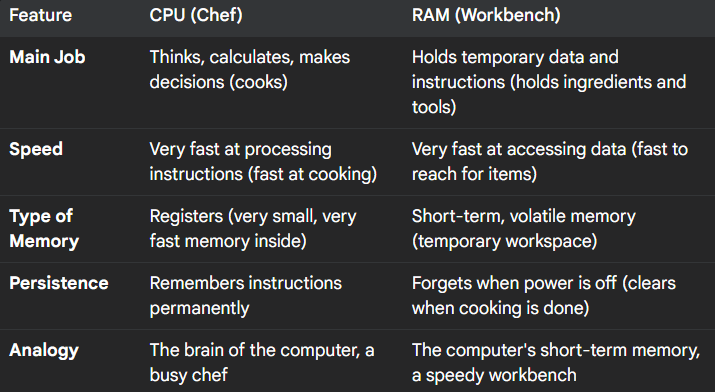 </center> # Why Does the Computer Need Both? Just like our chef needs both their clever brain to follow recipes and a handy workbench to hold ingredients, your computer needs both a fast CPU to think and work and speedy RAM to help it remember things quickly. The CPU can't do its amazing things without RAM to hold the information it needs right away, and RAM would just be an empty workbench without the CPU to tell it what to do. Together, the CPU and RAM make your computer fast and able to do all the fun things you love, like playing games, watching videos, and exploring the internet! --- *If you liked this content I’d appreciate an upvote or a comment. That helps me improve the quality of my posts as well as getting to know more about you, my dear reader.* *Muchas gracias!* *Follow me for more content like this.* *[X](https://twitter.com/edca3911) | [PeakD](https://peakd.com/@simplestack) | [Rumble](https://rumble.com/user/simplestack) | [YouTube](https://www.youtube.com/@simple-stack-by-ed) | [Linked In](https://www.linkedin.com/in/edwardcasanova/) | [GitHub](https://github.com/ed3899) | [PayPal.me](https://paypal.me/edca3899?country.x=MX&locale.x=es_XC) | [Medium](https://medium.com/@ed.wacc1995/subscribe)* *Down below you can find other ways to tip my work.* ``` BankTransfer: "710969000019398639", // CLABE BAT: "0x33CD7770d3235F97e5A8a96D5F21766DbB08c875", ETH: "0x33CD7770d3235F97e5A8a96D5F21766DbB08c875", BTC: "33xxUWU5kjcPk1Kr9ucn9tQXd2DbQ1b9tE", ADA: "addr1q9l3y73e82hhwfr49eu0fkjw34w9s406wnln7rk9m4ky5fag8akgnwf3y4r2uzqf00rw0pvsucql0pqkzag5n450facq8vwr5e", DOT: "1rRDzfMLPi88RixTeVc2beA5h2Q3z1K1Uk3kqqyej7nWPNf", DOGE: "DRph8GEwGccvBWCe4wEQsWsTvQvsEH4QKH", DAI: "0x33CD7770d3235F97e5A8a96D5F21766DbB08c875" ``` |
| title | Let's Understand CPU vs Memory (+Node.js Examples) |
| author | simplestack |
| permlink | lets-understand-cpu-vs-memory-nodejs-examples |
| json metadata | {"app":"peakd/2025.4.3","format":"markdown","description":"The Basics Never Get Old","portfolio":true,"tags":["nodejs","javascript","computerscience","cpu","ram","softwareengineering","softwaredevelopment","tech","computerarchitecture","computerbasics"],"users":["simplestack","simple-stack-by-","ed.wacc1995"],"image":["https://files.peakd.com/file/peakd-hive/simplestack/AKuuRTKoX8fhtjwXAQdFrUuXTRYPqLmEAhuFhGa3cKT7cgjr9u8FoYJoBNRth8Q.png","https://files.peakd.com/file/peakd-hive/simplestack/23t7DiySZiTtJCoLU5gUQM7j4yvXhbGKrHA7cB21mqdL7HV2ostc6C2RGu3s8YFtNvVP1.png"]} |
| parent author | |
| parent permlink | nodejs |
| Transaction Info | Block #94881231/Trx 29061d79d1a1809a18844a865215dcf233242861 |
View Raw JSON Data
{
"op": [
"comment",
{
"body": "<center>\n\n</center>\n\nImagine your computer is like a super-smart person who can do all sorts of amazing things, like playing your favorite games and showing you funny videos. To do these things, the computer needs a brain to think and a place to quickly remember information. These important parts are called the CPU and the memory. Let's explore what they do using a fun analogy.\n\n# Let's Meet the Computer's Super Brain! (The CPU)\n\nJust like you have a brain to think and learn, your computer has a super speedy brain called the CPU, which stands for Central Processing Unit. It's the boss inside the computer, always thinking about what to do and making sure everything runs smoothly. Think of a very clever chef in a busy kitchen. This chef is like the CPU! They decide what yummy food to make (which programs to run) and how to cook it (how to perform calculations).\n\nThe CPU is a small chip inside the computer, but it's made of billions of tiny switches that can turn on and off really fast, like flipping a light switch. These switches help the CPU do all sorts of math and make decisions. The CPU isn't just a simple piece of silicon; it's a complex arrangement of these incredibly small switches that work together to perform calculations. Similar to how a chef has different skills for preparing food, the CPU has different sections inside that help it do its job.\n\nOne part, called the control unit, is like the chef reading a recipe and telling the other parts what to do. Another part, the arithmetic logic unit (ALU), is like the chef doing the actual cooking tasks, such as adding ingredients or deciding if something needs more spice.\n\n# The Computer's Speedy Workbench! (RAM Memory)\n\nNow, imagine the chef needs a place to keep all the ingredients and tools they are using right now to cook a special dish. This special place is like the computer's memory, called RAM, which stands for Random Access Memory.\n\nThink of RAM as a super-fast workbench right next to our busy chef. The chef puts things like chopped vegetables, spices, and their favorite knife on this workbench so they can grab them quickly without having to run to the pantry or fridge every time.\n\nRAM is a special type of memory that lets the computer access any piece of information very quickly, like the chef being able to reach any spot on their workbench instantly. RAM is like the chef's short-term memory or immediate workspace. It's temporary, which means when you turn off the computer (or the chef finishes cooking), the workbench gets cleared.\n\n# The Chef and the Workbench: Best Friends in the Kitchen!\n\nOur busy chef (CPU) and the speedy workbench (RAM) work together all the time. When you want your computer to do something, like open a game or watch a video, the computer takes the instructions and the important information from its long-term storage (like the chef's recipe book in the pantry) and puts a copy of it onto the fast RAM workbench.\n\nThis way, the chef (CPU) can quickly look at the instructions and grab the ingredients (data) they need from the workbench (RAM) without waiting for the slow pantry (hard drive). It's like the chef having everything at their fingertips! The chef might use some ingredients, chop them up, and then put them back on the workbench or use them in the dish. Similarly, the CPU takes data from RAM, works on it, and might put the results back into RAM. The CPU doesn't directly go to the slow long-term storage for every little thing. It relies on RAM to hold the information it needs most often for quick access, like a chef using a cutting board instead of constantly going to the fridge. This makes the whole process much faster.\n\n# Making the Chef Really Think! (CPU Example in Node.js)\n\nLet's see our computer chef in action with a little example using something called Node.js (it's like a special way to give instructions to the computer). Imagine we want the computer to count all the way up to a very big number, like 1000! Here's how we can tell it to do that:\n\n```\nfor (let i = 1; i <= 1000; i++) {\n // The chef is counting each number here!\n console.log(\"The chef counted:\", i);\n}\nconsole.log(\"The chef finished counting!\");\n```\n\nWhen this code runs, the CPU (our chef) will work very hard, counting each number from 1 to 1000, one after the other. It's like the chef having to count every single apple in a giant basket - they have to think and count each one! The for part in the code tells the chef to repeat the counting action many times. The bigger the number we ask the chef to count to, the harder and longer the chef (CPU) has to work.\n\nThis simple code shows how the CPU is responsible for performing calculations and following instructions. When the computer is doing something like counting, playing a game with lots of action, or drawing a picture, the CPU is working very hard, just like our chef when they have a lot of cooking to do. This shows how busy the CPU gets when it has many tasks to complete.\n\n\n\n# The Chef's Little Notes! (RAM Example in Node.js)\n\nNow, let's see how the computer remembers things using RAM. Imagine our chef wants to remember their favorite colors or the number of eggs they need for a cake. They might write a little note on their workbench to help them remember. We can do something similar in our computer code:\n\n```\nlet favoriteColor = \"blue\";\nconst numberOfEggs = 3;\n\nconsole.log(\"The chef's favorite color is:\", favoriteColor);\nconsole.log(\"The chef needs\", numberOfEggs, \"eggs.\");\n```\n\nHere, favoriteColor and numberOfEggs are like little names or labels the chef puts on pieces of information on their workbench (RAM). The computer remembers that favoriteColor is \"blue\" and numberOfEggs is 3. The let and const are like different kinds of notes. let means the chef might change their favorite color later, but const means the number of eggs for this cake will always be 3. This code shows how RAM is used to store information that the computer needs to access quickly. The words favoriteColor and numberOfEggs are stored in RAM, allowing the CPU to easily find these values when it needs them, just like the chef glancing at their notes on the workbench. This is how the computer keeps track of things it's currently working with.\n\n# The Big Difference: Thinking Power vs. Quick Remembering!\n\nSo, what's the main difference between our super brainy chef (CPU) and the speedy workbench (RAM)? The chef is all about thinking, planning, and doing the main work of cooking (processing information). The workbench (RAM) is all about holding the ingredients and tools the chef needs right now so they can work quickly and efficiently.\n\nThe chef is very clever and can do lots of different things, but they need the workbench to have the right stuff ready. The workbench is super fast at giving the chef what they need, but it can't do the cooking itself. The CPU is the active worker, performing calculations and following instructions, while RAM is the helpful temporary storage that gives the CPU the things it needs. They have different jobs but are both very important for the computer to work, just like a chef and their well-organized workbench.\n\n<center>\n\n</center>\n\n# Why Does the Computer Need Both?\n\nJust like our chef needs both their clever brain to follow recipes and a handy workbench to hold ingredients, your computer needs both a fast CPU to think and work and speedy RAM to help it remember things quickly. The CPU can't do its amazing things without RAM to hold the information it needs right away, and RAM would just be an empty workbench without the CPU to tell it what to do.\n\nTogether, the CPU and RAM make your computer fast and able to do all the fun things you love, like playing games, watching videos, and exploring the internet!\n\n---\n\n*If you liked this content I’d appreciate an upvote or a comment. That helps me improve the quality of my posts as well as getting to know more about you, my dear reader.*\n\n*Muchas gracias!*\n\n*Follow me for more content like this.*\n\n*[X](https://twitter.com/edca3911) | [PeakD](https://peakd.com/@simplestack) | [Rumble](https://rumble.com/user/simplestack) | [YouTube](https://www.youtube.com/@simple-stack-by-ed) | [Linked In](https://www.linkedin.com/in/edwardcasanova/) | [GitHub](https://github.com/ed3899) | [PayPal.me](https://paypal.me/edca3899?country.x=MX&locale.x=es_XC) | [Medium](https://medium.com/@ed.wacc1995/subscribe)*\n\n*Down below you can find other ways to tip my work.*\n\n```\nBankTransfer: \"710969000019398639\", // CLABE\nBAT: \"0x33CD7770d3235F97e5A8a96D5F21766DbB08c875\",\nETH: \"0x33CD7770d3235F97e5A8a96D5F21766DbB08c875\",\nBTC: \"33xxUWU5kjcPk1Kr9ucn9tQXd2DbQ1b9tE\",\nADA: \"addr1q9l3y73e82hhwfr49eu0fkjw34w9s406wnln7rk9m4ky5fag8akgnwf3y4r2uzqf00rw0pvsucql0pqkzag5n450facq8vwr5e\",\nDOT: \"1rRDzfMLPi88RixTeVc2beA5h2Q3z1K1Uk3kqqyej7nWPNf\",\nDOGE: \"DRph8GEwGccvBWCe4wEQsWsTvQvsEH4QKH\",\nDAI: \"0x33CD7770d3235F97e5A8a96D5F21766DbB08c875\"\n```",
"title": "Let's Understand CPU vs Memory (+Node.js Examples)",
"author": "simplestack",
"permlink": "lets-understand-cpu-vs-memory-nodejs-examples",
"json_metadata": "{\"app\":\"peakd/2025.4.3\",\"format\":\"markdown\",\"description\":\"The Basics Never Get Old\",\"portfolio\":true,\"tags\":[\"nodejs\",\"javascript\",\"computerscience\",\"cpu\",\"ram\",\"softwareengineering\",\"softwaredevelopment\",\"tech\",\"computerarchitecture\",\"computerbasics\"],\"users\":[\"simplestack\",\"simple-stack-by-\",\"ed.wacc1995\"],\"image\":[\"https://files.peakd.com/file/peakd-hive/simplestack/AKuuRTKoX8fhtjwXAQdFrUuXTRYPqLmEAhuFhGa3cKT7cgjr9u8FoYJoBNRth8Q.png\",\"https://files.peakd.com/file/peakd-hive/simplestack/23t7DiySZiTtJCoLU5gUQM7j4yvXhbGKrHA7cB21mqdL7HV2ostc6C2RGu3s8YFtNvVP1.png\"]}",
"parent_author": "",
"parent_permlink": "nodejs"
}
],
"block": 94881231,
"trx_id": "29061d79d1a1809a18844a865215dcf233242861",
"op_in_trx": 0,
"timestamp": "2025-04-09T16:43:48",
"virtual_op": false,
"trx_in_block": 2
}2025/04/09 15:15:06
2025/04/09 15:15:06
| author | simplestack |
| permlink | dsa-medium-binary-tree-maximum-level-sum-of-a-binary-tree-python-typescript-and-go |
| Transaction Info | Block #94879458/Virtual Operation 4294967295:4 |
View Raw JSON Data
{
  "op": [
    "comment_payout_update",
    {
      "author": "simplestack",
      "permlink": "dsa-medium-binary-tree-maximum-level-sum-of-a-binary-tree-python-typescript-and-go"
    }
  ],
  "block": 94879458,
  "trx_id": "0000000000000000000000000000000000000000",
  "op_in_trx": 4,
  "timestamp": "2025-04-09T15:15:06",
  "virtual_op": true,
  "trx_in_block": 4294967295
}simplestackpublished a new post: everyone-wants-the-senior-nobody-wants-to-nourish-one2025/04/09 14:59:09
simplestackpublished a new post: everyone-wants-the-senior-nobody-wants-to-nourish-one
2025/04/09 14:59:09
| body | <center>  </center> We live in an age in which a learning mentality is marketized as awesome and a must, but when the music starts nobody wants to be a teacher. In today's tech landscape, we're faced with a curious contradiction: companies constantly promote a culture of learning and growth, yet when it comes to actually investing in developing junior talent, many fall mysteriously silent. As someone who's navigated both the writing and coding worlds for years, I've observed this phenomenon with increasing concern. The tech industry seems caught in an endless cycle of demanding experienced seniors while simultaneously refusing to create pathways for juniors to become those coveted seniors. --- Have you ever scrolled through job boards and laughed out loud at the requirements? I certainly have. Job listings requesting "10+ years of experience" have become the norm rather than the exception in today's tech hiring landscape. Even more ridiculous are those posts demanding 5+ years of experience in technologies that barely existed a year ago. One particularly amusing trend is the infamous "Full Stack Engineer" posting that somehow expects candidates to master every programming language under the sun, plus handle DevOps responsibilities as a side hobby. These job descriptions read more like wishlists for mythical coding unicorns than realistic hiring criteria. This trend isn't just amusing - it's symptomatic of a deeper problem. Companies are increasingly reluctant to invest time and resources in developing talent, preferring instead to poach pre-made seniors from competitors. The tech hiring landscape in 2025 continues to favor experienced professionals who can deliver results from day one over those with potential who need guidance. --- Just when you think you've found that perfect entry-level or mid-level position that matches your skills, the compensation package reveals the ugly truth. Many of these roles offer either embarrassingly low salaries or, worse yet, are completely unpaid "internships" or "for exposure" opportunities. This devaluation of junior talent comes at a time when the overall tech job market is showing signs of recovery. While companies are targeting an average of nearly 300 open software engineer roles (a 12% year-over-year increase), these opportunities aren't evenly distributed across experience levels. The focus remains heavily skewed toward senior talent, creating a frustrating catch-22 for newcomers: you need experience to get hired, but you can't get experience without being hired. > Could the seniors be maintaining the gates closed so as to control the demand and development of talent unconsciously protecting their own jobs? --- Is this senior-obsessed hiring trend a sign of an industry in decline or simply a marker of its maturation? The evidence points to both interpretations. On one hand, the tech sector has recently emerged from a multi-year downturn characterized by widespread job cuts and a shift from high-volume hiring to more focused quality recruitment. Companies had to become more selective about who they bring on board, prioritizing immediate impact over long-term talent development. On the other hand, mature industries typically develop robust pipelines for developing junior talent into future leaders. The lack of such structures in many tech companies suggests a short-sighted approach rather than true maturity. > What do you think? Are we witnessing the beginning of a tech industry decline, or is this just a temporary correction in hiring practices? --- Artificial intelligence isn't just changing the products we build - it's transforming how we hire the people who build them. With 88% of companies globally already integrating AI into their recruitment processes, we're seeing a major shift from traditional hiring methods to more technology-driven approaches. This AI-driven recruitment landscape presents both opportunities and challenges for junior developers. On the positive side, AI can potentially reduce human bias in hiring processes. On the negative side, many AI screening tools are trained to identify patterns matching successful past employees - who were primarily seniors. The AI recruitment market is expected to reach $590.5 million by the end of 2024, up from $540.4 million in 2022. This growth indicates that AI's influence on hiring decisions will only increase, making it crucial for junior developers to understand how to navigate these systems. > I find it ironic that we're using AI to find candidates who can build better AI, yet those systems might be filtering out the very innovators who could create the next breakthrough. --- A new generation of developers - sometimes affectionately (or derisively) called "vibe coders" - is entering the workforce with expectations shaped by coding bootcamps, YouTube tutorials, and the promise of six-figure remote jobs. They're passionate, creative, and eager to make their mark on the industry. Unfortunately, many will face a rude awakening when confronted with the current market reality. The emphasis on senior-level experience and the reluctance to invest in junior development creates a significant gap between expectations and opportunities. This disconnect isn't entirely the fault of new developers. The tech industry has marketed itself as accessible and meritocratic, with countless success stories of self-taught programmers landing dream jobs. What these stories often leave out is the struggle, the rejection, and the increasingly high bar for entry. --- Despite the overall trend, some companies still recognize junior developers as potential gemstones waiting to be polished. These organizations stand out for their commitment to providing the right resources for growth and development. The best companies for junior talent share several key characteristics: - They provide access to coaching and professional development courses - They incentivize managers based on how well they develop junior talent - They create appropriate opportunities that allow for learning and even failure without catastrophic consequences These companies understand that cultivating junior talent isn't just about altruism - it's good business. As the saying goes, "What gets measured, gets done." By making talent development a measurable goal for managers, these organizations ensure that junior growth receives the attention it deserves. --- What could the industry look like if companies shifted focus from chasing after seniors to growing valuable assets in-house? The benefits would be substantial. First, there's the loyalty factor. Employees who have been nurtured from junior to senior positions typically develop stronger company loyalty than those who are hired directly into senior roles. This increased retention reduces the substantial costs associated with turnover. Second, homegrown seniors have deep institutional knowledge that external hires lack. They understand company systems, culture, and processes at a fundamental level, making them more effective in their roles. Third, developing junior talent creates a sustainable pipeline of future leaders who are aligned with company values and vision. This approach provides more stability than constantly competing for a limited pool of senior talent in an increasingly competitive market. > Every senior developer was once a junior. Someone had to take a chance on them. Why have so many forgotten this simple truth? --- The key to successful talent development lies in balancing learning opportunities with the need for productivity. No company can afford to focus exclusively on either extreme - all learning with no productivity, or all productivity with no learning. Effective talent development strategies start juniors with low-stakes opportunities - projects that are useful but not mission-critical - and gradually increase responsibility as they demonstrate capability. This progressive approach minimizes risk while maximizing growth. Companies need to recognize that even the most senior developers have gaps in their knowledge and require continuous learning. The distinction isn't whether learning is necessary, but rather how much guidance and structure different experience levels need. --- Remember Lightning McQueen from Pixar's "Cars"? Before he became a champion, he had Rusteeze - a modest sponsor that believed in him when he was nothing. The tech industry needs more Rusteeze-like companies. These aren't necessarily the Googles or Apples of the world. They're often mid-sized companies or startups that can't compete on salary but offer something equally valuable: genuine mentorship, growth opportunities, and a chance to build something meaningful. For many developers, especially juniors, finding their "Rusteeze" can be the difference between a thriving career and one that stalls before it truly begins. These companies may not offer the highest salaries or the most prestigious names on a resume, but they provide the foundation for long-term success. --- To the junior developers reading this: as you navigate your career, remember and praise those who help you along the way. When you eventually reach those senior positions - and many of you will - remember what it felt like to be starting out. The tech industry suffers from collective amnesia, with too many seniors forgetting their own beginnings. Break this cycle by acknowledging the mentors, companies, and opportunities that shaped your journey. Never bite the hand that fed you. Your first employer may not be perfect, your first mentor may have flaws, but their willingness to take a chance on you deserves respect. The best way to honor that investment is to pay it forward when you have the opportunity to mentor others. --- The tech industry's fixation on hiring senior talent while neglecting junior development isn't sustainable. As the hiring landscape continues to evolve in 2025, companies that invest in nurturing their own senior talent will gain a competitive advantage through increased loyalty, deeper institutional knowledge, and reduced recruitment costs. For the industry to thrive, we need balance - companies willing to invest in junior talent, seniors willing to mentor, and a hiring process that values potential as much as experience. AI will continue to reshape recruitment, but the human elements of mentorship and development remain irreplaceable. The next time you see a job posting asking for 10 years of experience in a 3-year-old technology, remember that somewhere, a company exists that values growth over perfection. Those are the companies building not just products, but the future leaders of our industry. As we navigate this changing landscape, let's commit to creating an industry where learning isn't just marketized but genuinely supported - where everyone wants the senior but also understands their responsibility in helping create them. --- *If you liked this content I’d appreciate an upvote or a comment. That helps me improve the quality of my posts as well as getting to know more about you, my dear reader.* *Muchas gracias!* *Follow me for more content like this.* *[X](https://twitter.com/edca3911) | [PeakD](https://peakd.com/@simplestack) | [Rumble](https://rumble.com/user/simplestack) | [YouTube](https://www.youtube.com/@simple-stack-by-ed) | [Linked In](https://www.linkedin.com/in/edwardcasanova/) | [GitHub](https://github.com/ed3899) | [PayPal.me](https://paypal.me/edca3899?country.x=MX&locale.x=es_XC) | [Medium](https://medium.com/@ed.wacc1995/subscribe)* *Down below you can find other ways to tip my work.* ``` BankTransfer: "710969000019398639", // CLABE BAT: "0x33CD7770d3235F97e5A8a96D5F21766DbB08c875", ETH: "0x33CD7770d3235F97e5A8a96D5F21766DbB08c875", BTC: "33xxUWU5kjcPk1Kr9ucn9tQXd2DbQ1b9tE", ADA: "addr1q9l3y73e82hhwfr49eu0fkjw34w9s406wnln7rk9m4ky5fag8akgnwf3y4r2uzqf00rw0pvsucql0pqkzag5n450facq8vwr5e", DOT: "1rRDzfMLPi88RixTeVc2beA5h2Q3z1K1Uk3kqqyej7nWPNf", DOGE: "DRph8GEwGccvBWCe4wEQsWsTvQvsEH4QKH", DAI: "0x33CD7770d3235F97e5A8a96D5F21766DbB08c875" ``` |
| title | Everyone Wants The Senior, Nobody Wants To Nourish One |
| author | simplestack |
| permlink | everyone-wants-the-senior-nobody-wants-to-nourish-one |
| json metadata | {"app":"peakd/2025.4.3","format":"markdown","description":"We live in an age in which a learning mentality is marketized as awesome and a must, but when the music starts...","portfolio":true,"tags":["softwareengineering","softwaredevelopment","juniordev","seniordev","computerscience","jobs","business","money","economy","tech"],"users":["simplestack","simple-stack-by-","ed.wacc1995"],"image":["https://files.peakd.com/file/peakd-hive/simplestack/AJkMHkM2FnzjNZu3ZexV4Q7V2pbae4YaehenXUqDDuMUneavZT968vWkfqPzRD4.png"]} |
| parent author | |
| parent permlink | softwareengineering |
| Transaction Info | Block #94879140/Trx d202df507368db372310910514fd2b3d4163b54f |
View Raw JSON Data
{
"op": [
"comment",
{
"body": "<center>\n\n</center>\n\nWe live in an age in which a learning mentality is marketized as awesome and a must, but when the music starts nobody wants to be a teacher.\n\nIn today's tech landscape, we're faced with a curious contradiction: companies constantly promote a culture of learning and growth, yet when it comes to actually investing in developing junior talent, many fall mysteriously silent. As someone who's navigated both the writing and coding worlds for years, I've observed this phenomenon with increasing concern. The tech industry seems caught in an endless cycle of demanding experienced seniors while simultaneously refusing to create pathways for juniors to become those coveted seniors.\n\n---\n\nHave you ever scrolled through job boards and laughed out loud at the requirements? I certainly have. Job listings requesting \"10+ years of experience\" have become the norm rather than the exception in today's tech hiring landscape. Even more ridiculous are those posts demanding 5+ years of experience in technologies that barely existed a year ago.\n\nOne particularly amusing trend is the infamous \"Full Stack Engineer\" posting that somehow expects candidates to master every programming language under the sun, plus handle DevOps responsibilities as a side hobby. These job descriptions read more like wishlists for mythical coding unicorns than realistic hiring criteria.\n\nThis trend isn't just amusing - it's symptomatic of a deeper problem. Companies are increasingly reluctant to invest time and resources in developing talent, preferring instead to poach pre-made seniors from competitors. The tech hiring landscape in 2025 continues to favor experienced professionals who can deliver results from day one over those with potential who need guidance.\n\n---\n\nJust when you think you've found that perfect entry-level or mid-level position that matches your skills, the compensation package reveals the ugly truth. Many of these roles offer either embarrassingly low salaries or, worse yet, are completely unpaid \"internships\" or \"for exposure\" opportunities.\n\nThis devaluation of junior talent comes at a time when the overall tech job market is showing signs of recovery. While companies are targeting an average of nearly 300 open software engineer roles (a 12% year-over-year increase), these opportunities aren't evenly distributed across experience levels. The focus remains heavily skewed toward senior talent, creating a frustrating catch-22 for newcomers: you need experience to get hired, but you can't get experience without being hired.\n\n> Could the seniors be maintaining the gates closed so as to control the demand and development of talent unconsciously protecting their own jobs?\n\n---\n\nIs this senior-obsessed hiring trend a sign of an industry in decline or simply a marker of its maturation? The evidence points to both interpretations.\n\nOn one hand, the tech sector has recently emerged from a multi-year downturn characterized by widespread job cuts and a shift from high-volume hiring to more focused quality recruitment. Companies had to become more selective about who they bring on board, prioritizing immediate impact over long-term talent development.\n\nOn the other hand, mature industries typically develop robust pipelines for developing junior talent into future leaders. The lack of such structures in many tech companies suggests a short-sighted approach rather than true maturity.\n\n> What do you think? Are we witnessing the beginning of a tech industry decline, or is this just a temporary correction in hiring practices?\n\n---\n\nArtificial intelligence isn't just changing the products we build - it's transforming how we hire the people who build them. With 88% of companies globally already integrating AI into their recruitment processes, we're seeing a major shift from traditional hiring methods to more technology-driven approaches.\n\nThis AI-driven recruitment landscape presents both opportunities and challenges for junior developers. On the positive side, AI can potentially reduce human bias in hiring processes. On the negative side, many AI screening tools are trained to identify patterns matching successful past employees - who were primarily seniors.\n\nThe AI recruitment market is expected to reach $590.5 million by the end of 2024, up from $540.4 million in 2022. This growth indicates that AI's influence on hiring decisions will only increase, making it crucial for junior developers to understand how to navigate these systems.\n\n> I find it ironic that we're using AI to find candidates who can build better AI, yet those systems might be filtering out the very innovators who could create the next breakthrough.\n\n---\n\nA new generation of developers - sometimes affectionately (or derisively) called \"vibe coders\" - is entering the workforce with expectations shaped by coding bootcamps, YouTube tutorials, and the promise of six-figure remote jobs. They're passionate, creative, and eager to make their mark on the industry.\n\nUnfortunately, many will face a rude awakening when confronted with the current market reality. The emphasis on senior-level experience and the reluctance to invest in junior development creates a significant gap between expectations and opportunities.\n\nThis disconnect isn't entirely the fault of new developers. The tech industry has marketed itself as accessible and meritocratic, with countless success stories of self-taught programmers landing dream jobs. What these stories often leave out is the struggle, the rejection, and the increasingly high bar for entry.\n\n---\n\nDespite the overall trend, some companies still recognize junior developers as potential gemstones waiting to be polished. These organizations stand out for their commitment to providing the right resources for growth and development.\n\nThe best companies for junior talent share several key characteristics:\n\n- They provide access to coaching and professional development courses\n- They incentivize managers based on how well they develop junior talent\n- They create appropriate opportunities that allow for learning and even failure without catastrophic consequences\n\nThese companies understand that cultivating junior talent isn't just about altruism - it's good business. As the saying goes, \"What gets measured, gets done.\" By making talent development a measurable goal for managers, these organizations ensure that junior growth receives the attention it deserves.\n\n---\n\nWhat could the industry look like if companies shifted focus from chasing after seniors to growing valuable assets in-house? The benefits would be substantial.\n\nFirst, there's the loyalty factor. Employees who have been nurtured from junior to senior positions typically develop stronger company loyalty than those who are hired directly into senior roles. This increased retention reduces the substantial costs associated with turnover.\n\nSecond, homegrown seniors have deep institutional knowledge that external hires lack. They understand company systems, culture, and processes at a fundamental level, making them more effective in their roles.\n\nThird, developing junior talent creates a sustainable pipeline of future leaders who are aligned with company values and vision. This approach provides more stability than constantly competing for a limited pool of senior talent in an increasingly competitive market.\n\n> Every senior developer was once a junior. Someone had to take a chance on them. Why have so many forgotten this simple truth?\n\n---\n\nThe key to successful talent development lies in balancing learning opportunities with the need for productivity. No company can afford to focus exclusively on either extreme - all learning with no productivity, or all productivity with no learning.\n\nEffective talent development strategies start juniors with low-stakes opportunities - projects that are useful but not mission-critical - and gradually increase responsibility as they demonstrate capability. This progressive approach minimizes risk while maximizing growth.\n\nCompanies need to recognize that even the most senior developers have gaps in their knowledge and require continuous learning. The distinction isn't whether learning is necessary, but rather how much guidance and structure different experience levels need.\n\n---\n\nRemember Lightning McQueen from Pixar's \"Cars\"? Before he became a champion, he had Rusteeze - a modest sponsor that believed in him when he was nothing. The tech industry needs more Rusteeze-like companies.\n\nThese aren't necessarily the Googles or Apples of the world. They're often mid-sized companies or startups that can't compete on salary but offer something equally valuable: genuine mentorship, growth opportunities, and a chance to build something meaningful.\n\nFor many developers, especially juniors, finding their \"Rusteeze\" can be the difference between a thriving career and one that stalls before it truly begins. These companies may not offer the highest salaries or the most prestigious names on a resume, but they provide the foundation for long-term success.\n\n---\n\nTo the junior developers reading this: as you navigate your career, remember and praise those who help you along the way. When you eventually reach those senior positions - and many of you will - remember what it felt like to be starting out.\n\nThe tech industry suffers from collective amnesia, with too many seniors forgetting their own beginnings. Break this cycle by acknowledging the mentors, companies, and opportunities that shaped your journey.\n\nNever bite the hand that fed you. Your first employer may not be perfect, your first mentor may have flaws, but their willingness to take a chance on you deserves respect. The best way to honor that investment is to pay it forward when you have the opportunity to mentor others.\n\n---\n\nThe tech industry's fixation on hiring senior talent while neglecting junior development isn't sustainable. As the hiring landscape continues to evolve in 2025, companies that invest in nurturing their own senior talent will gain a competitive advantage through increased loyalty, deeper institutional knowledge, and reduced recruitment costs.\n\nFor the industry to thrive, we need balance - companies willing to invest in junior talent, seniors willing to mentor, and a hiring process that values potential as much as experience. AI will continue to reshape recruitment, but the human elements of mentorship and development remain irreplaceable.\n\nThe next time you see a job posting asking for 10 years of experience in a 3-year-old technology, remember that somewhere, a company exists that values growth over perfection. Those are the companies building not just products, but the future leaders of our industry.\n\nAs we navigate this changing landscape, let's commit to creating an industry where learning isn't just marketized but genuinely supported - where everyone wants the senior but also understands their responsibility in helping create them.\n\n---\n\n*If you liked this content I’d appreciate an upvote or a comment. That helps me improve the quality of my posts as well as getting to know more about you, my dear reader.*\n\n*Muchas gracias!*\n\n*Follow me for more content like this.*\n\n*[X](https://twitter.com/edca3911) | [PeakD](https://peakd.com/@simplestack) | [Rumble](https://rumble.com/user/simplestack) | [YouTube](https://www.youtube.com/@simple-stack-by-ed) | [Linked In](https://www.linkedin.com/in/edwardcasanova/) | [GitHub](https://github.com/ed3899) | [PayPal.me](https://paypal.me/edca3899?country.x=MX&locale.x=es_XC) | [Medium](https://medium.com/@ed.wacc1995/subscribe)*\n\n*Down below you can find other ways to tip my work.*\n\n```\nBankTransfer: \"710969000019398639\", // CLABE\nBAT: \"0x33CD7770d3235F97e5A8a96D5F21766DbB08c875\",\nETH: \"0x33CD7770d3235F97e5A8a96D5F21766DbB08c875\",\nBTC: \"33xxUWU5kjcPk1Kr9ucn9tQXd2DbQ1b9tE\",\nADA: \"addr1q9l3y73e82hhwfr49eu0fkjw34w9s406wnln7rk9m4ky5fag8akgnwf3y4r2uzqf00rw0pvsucql0pqkzag5n450facq8vwr5e\",\nDOT: \"1rRDzfMLPi88RixTeVc2beA5h2Q3z1K1Uk3kqqyej7nWPNf\",\nDOGE: \"DRph8GEwGccvBWCe4wEQsWsTvQvsEH4QKH\",\nDAI: \"0x33CD7770d3235F97e5A8a96D5F21766DbB08c875\"\n```",
"title": "Everyone Wants The Senior, Nobody Wants To Nourish One",
"author": "simplestack",
"permlink": "everyone-wants-the-senior-nobody-wants-to-nourish-one",
"json_metadata": "{\"app\":\"peakd/2025.4.3\",\"format\":\"markdown\",\"description\":\"We live in an age in which a learning mentality is marketized as awesome and a must, but when the music starts...\",\"portfolio\":true,\"tags\":[\"softwareengineering\",\"softwaredevelopment\",\"juniordev\",\"seniordev\",\"computerscience\",\"jobs\",\"business\",\"money\",\"economy\",\"tech\"],\"users\":[\"simplestack\",\"simple-stack-by-\",\"ed.wacc1995\"],\"image\":[\"https://files.peakd.com/file/peakd-hive/simplestack/AJkMHkM2FnzjNZu3ZexV4Q7V2pbae4YaehenXUqDDuMUneavZT968vWkfqPzRD4.png\"]}",
"parent_author": "",
"parent_permlink": "softwareengineering"
}
],
"block": 94879140,
"trx_id": "d202df507368db372310910514fd2b3d4163b54f",
"op_in_trx": 0,
"timestamp": "2025-04-09T14:59:09",
"virtual_op": false,
"trx_in_block": 17
}magic.byteeffective vote applied for @simplestack / what-is-proxyprotocol-in-traefik--concrete-examples2025/04/09 07:33:15
magic.byteeffective vote applied for @simplestack / what-is-proxyprotocol-in-traefik--concrete-examples
2025/04/09 07:33:15
| voter | magic.byte |
| author | simplestack |
| weight | 0 (0.00%) |
| rshares | 0 |
| permlink | what-is-proxyprotocol-in-traefik--concrete-examples |
| pending payout | 0.000 HBD |
| total vote weight | 0 |
| Transaction Info | Block #94870233/Trx 140edf0b32ccea6e6d14e5a8ea407174b9e2600a |
View Raw JSON Data
{
  "op": [
    "effective_comment_vote",
    {
      "voter": "magic.byte",
      "author": "simplestack",
      "weight": 0,
      "rshares": 0,
      "permlink": "what-is-proxyprotocol-in-traefik--concrete-examples",
      "pending_payout": "0.000 HBD",
      "total_vote_weight": 0
    }
  ],
  "block": 94870233,
  "trx_id": "140edf0b32ccea6e6d14e5a8ea407174b9e2600a",
  "op_in_trx": 1,
  "timestamp": "2025-04-09T07:33:15",
  "virtual_op": true,
  "trx_in_block": 15
}magic.byteupvoted (100.00%) @simplestack / what-is-proxyprotocol-in-traefik--concrete-examples2025/04/09 07:33:15
magic.byteupvoted (100.00%) @simplestack / what-is-proxyprotocol-in-traefik--concrete-examples
2025/04/09 07:33:15
| voter | magic.byte |
| author | simplestack |
| weight | 10000 (100.00%) |
| permlink | what-is-proxyprotocol-in-traefik--concrete-examples |
| Transaction Info | Block #94870233/Trx 140edf0b32ccea6e6d14e5a8ea407174b9e2600a |
View Raw JSON Data
{
  "op": [
    "vote",
    {
      "voter": "magic.byte",
      "author": "simplestack",
      "weight": 10000,
      "permlink": "what-is-proxyprotocol-in-traefik--concrete-examples"
    }
  ],
  "block": 94870233,
  "trx_id": "140edf0b32ccea6e6d14e5a8ea407174b9e2600a",
  "op_in_trx": 0,
  "timestamp": "2025-04-09T07:33:15",
  "virtual_op": false,
  "trx_in_block": 15
}lolz.byteeffective vote applied for @simplestack / dsa-medium-graph-keys-and-rooms-python-typescript-and-go2025/04/09 06:42:57
lolz.byteeffective vote applied for @simplestack / dsa-medium-graph-keys-and-rooms-python-typescript-and-go
2025/04/09 06:42:57
| voter | lolz.byte |
| author | simplestack |
| weight | 0 (0.00%) |
| rshares | 0 |
| permlink | dsa-medium-graph-keys-and-rooms-python-typescript-and-go |
| pending payout | 0.000 HBD |
| total vote weight | 0 |
| Transaction Info | Block #94869228/Trx af6a3ea15494018141c9d9d5f34ccb6e4354b2ed |
View Raw JSON Data
{
  "op": [
    "effective_comment_vote",
    {
      "voter": "lolz.byte",
      "author": "simplestack",
      "weight": 0,
      "rshares": 0,
      "permlink": "dsa-medium-graph-keys-and-rooms-python-typescript-and-go",
      "pending_payout": "0.000 HBD",
      "total_vote_weight": 0
    }
  ],
  "block": 94869228,
  "trx_id": "af6a3ea15494018141c9d9d5f34ccb6e4354b2ed",
  "op_in_trx": 1,
  "timestamp": "2025-04-09T06:42:57",
  "virtual_op": true,
  "trx_in_block": 25
}lolz.byteupvoted (100.00%) @simplestack / dsa-medium-graph-keys-and-rooms-python-typescript-and-go2025/04/09 06:42:57
lolz.byteupvoted (100.00%) @simplestack / dsa-medium-graph-keys-and-rooms-python-typescript-and-go
2025/04/09 06:42:57
| voter | lolz.byte |
| author | simplestack |
| weight | 10000 (100.00%) |
| permlink | dsa-medium-graph-keys-and-rooms-python-typescript-and-go |
| Transaction Info | Block #94869228/Trx af6a3ea15494018141c9d9d5f34ccb6e4354b2ed |
View Raw JSON Data
{
  "op": [
    "vote",
    {
      "voter": "lolz.byte",
      "author": "simplestack",
      "weight": 10000,
      "permlink": "dsa-medium-graph-keys-and-rooms-python-typescript-and-go"
    }
  ],
  "block": 94869228,
  "trx_id": "af6a3ea15494018141c9d9d5f34ccb6e4354b2ed",
  "op_in_trx": 0,
  "timestamp": "2025-04-09T06:42:57",
  "virtual_op": false,
  "trx_in_block": 25
}2025/04/08 20:54:15
2025/04/08 20:54:15
| body | <center>  </center> Imagine you're managing a bustling airport. You need to know not just which planes are landing and taking off, but also their origins, destinations, and if any are experiencing delays. In the world of software, observability is similar. It's about having the tools to understand the inner workings of your system by examining its outputs, allowing you to answer questions about its behavior, even questions you didn't anticipate needing to ask. At the heart of Traefik's traffic management are routers. These components act as intelligent directors, examining incoming requests and deciding which service should handle them based on predefined rules. Just as an air traffic controller monitors the movement of aircraft across different runways, understanding the activity of your Traefik routers is essential for ensuring your application's overall health and responsiveness. Traefik provides several key observability features that can be configured at the router level, offering a granular view into your application's traffic flow. Let's explore these features in a way that's as easy to grasp as explaining it to a curious five-year-old. # Seeing What Your Routers Are Doing: Observability Features ## Access Logs: Keeping a Record Think of access logs as a detailed diary for each of your Traefik routers. Every time a request comes in and is processed by a specific router, an entry is made in this diary. This entry contains important information like the exact time the request arrived, the internet address of the person or system that made the request, what they were asking for (the specific web page or API endpoint), and what happened with their request (was it successful, or did an error occur?). To put it simply, it's like writing down every car that passes through our airport's main gate, noting the time, where it came from, and where it was headed. By default, access logs are likely enabled based on the global settings of the EntryPoints that your routers are connected to. However, Traefik gives you the power to specifically control whether a particular router generates these logs. You might want to disable access logs for a very high-traffic route that you don't need detailed information on, or you might want to explicitly enable them for a specific router you're actively troubleshooting. Here's how you can disable access logs for a router named my-router that handles requests to the path /foo using YAML configuration: ``` http: routers: my-router: rule: "Path(`/foo`)" service: service-foo observability: accessLogs: false ``` This ability to configure logging at the router level offers precise control. If you're experiencing issues with a particular feature accessed through a specific route, enabling detailed access logs just for that router can provide focused information without overwhelming you with logs from the entire system. Conversely, for very high-traffic, non-critical routes, you might choose to disable logging to conserve resources. > You can send these logs elsewhere. Elastic Search or AWS CloudWatch # Metrics: Getting the Numbers Metrics are like taking regular health checkups for your Traefik routers. Instead of just recording every single event like access logs, metrics provide numerical summaries of your router's activity over time. This could include things like the total number of requests the router has handled, the average time it takes to respond to requests, and the number of errors that have occurred. Think of it as counting how many planes land and take off every hour, and how long passengers have to wait at security checkpoints. Just like access logs, metrics can be enabled or disabled for individual routers using the metrics option under the observability section in the router's configuration. Here's how you would disable metrics for our my-router in YAML: ``` http: routers: my-router: rule: "Path(`/foo`)" service: service-foo observability: metrics: false ``` However, there's a crucial point to understand about metrics in Traefik: even if you enable metrics at the router level, they won't actually be generated unless the global metrics collection is also enabled. This is controlled by options like addEntryPointsLabels, addRoutersLabels, and addServicesLabels in Traefik's main configuration. These global settings act like a master switch for metrics. If the master switch is off, individual routers won't be able to send their metric data. This global dependency is important to remember because a developer might enable metrics for a specific router and then be puzzled when no metrics data appears. The reason is likely that the overall metrics collection hasn't been activated in Traefik's broader configuration. > Tools like Prometheus, AWS CloudWatch or SigNoz can help with metric agreggation # Tracing: Following the Path Tracing takes observability a step further by allowing you to follow the complete journey of a single request as it travels through Traefik and potentially to other services that are involved in handling that request. Imagine putting a special tracking device on a specific plane as it arrives at our airport, goes through baggage handling, gets refueled, and then departs. Tracing in Traefik lets you visualize this entire path for a web request, helping you identify any delays or issues at each stage. You can enable or disable tracing for a specific router using the tracing option within the observability section of its configuration. Here's how to disable it for my-router in YAML: ``` http: routers: my-router: rule: "Path(`/foo`)" service: service-foo observability: tracing: false ``` Traefik leverages OpenTelemetry, an open standard for observability, for its tracing capabilities. This is significant because it means that the tracing data generated by Traefik can be easily integrated with a wide variety of popular tracing backends, such as Jaeger or Zipkin. When a request involves multiple microservices, it can be challenging to pinpoint the exact location of a problem. Tracing provides a detailed timeline of the request's journey across all involved components, making it much easier to diagnose and resolve issues. > Tools like Jaeger can connect here # Q&A ## Where Do Traefik Logs Live? By default, Traefik writes its access logs to the standard output (stdout). If you're running Traefik in a containerized environment like Docker, this means you'll typically find the access logs mixed in with the other logs generated by the container. The same applies to Traefik's own internal logs, which include information about startup, configuration, and events. However, Traefik offers the flexibility to configure it to write these logs to specific files. You can achieve this by using the filePath option. For access logs, you'll find this option under the accessLog section in your static configuration. For Traefik's internal logs, the filePath option is located under the log section. Here's an example of how to configure both access logs and Traefik logs to write to files in YAML: ``` accessLog: filePath: "/var/log/traefik/access.log" log: filePath: "/var/log/traefik/traefik.log" ``` Additionally, you can control the format of the logs using the format option under both accessLog and log. The default format is common (Common Log Format), but you can also choose json for a more structured output. While the default of writing logs to stdout is convenient for basic setups and container orchestration platforms, configuring filePath becomes crucial for production environments. Writing logs to files allows for persistent storage and enables integration with dedicated log management systems for analysis and long-term retention. The choice between standard formats like CLF and structured formats like JSON depends on your specific needs for processing and analyzing the log data. ## Do I Need a Special Place to Keep My Logs? Yes, especially if you are running Traefik within a containerized environment like Docker. Containers are often designed to be ephemeral, meaning they can be easily stopped, started, and replaced. When a container stops or is removed, any data stored within its filesystem, including logs written directly into the container, is typically lost. To ensure that your Traefik logs persist even if the container restarts or is redeployed, you should utilize persistent volumes. Persistent volumes provide a way to store data outside the container's lifecycle, either on the host machine or in a named volume managed by the container runtime. Here's an example of how you might configure a persistent volume for Traefik logs using docker-compose.yml: ``` version: '3.7' services: traefik: image: traefik:v2.10 ports: - "80:80" - "443:443" - "8080:8080" volumes: - "/var/run/docker.sock:/var/run/docker.sock:ro" -./traefik_logs:/var/log/traefik # Mount a host directory to the container's log directory command: - "--api.insecure=true" - "--providers.docker=true" - "--providers.docker.exposedbydefault=false" - "--accesslog.filepath=/var/log/traefik/access.log" - "--log.filepath=/var/log/traefik/traefik.log" volumes: traefik_logs: # Define the named volume (optional, can also use bind mounts as above) ``` In this example, we are mounting a directory named traefik_logs on the host machine (represented by ./traefik_logs) to the /var/log/traefik directory inside the Traefik container. If you've configured Traefik to write logs to files within /var/log/traefik, these logs will now be stored on the host and will persist even if the Traefik container is restarted or replaced. Furthermore, when using persistent volumes for logs, it's essential to consider log rotation. Over time, log files can grow very large and consume significant disk space. Log rotation is a process of automatically archiving and deleting old log files to manage disk usage. You can typically configure log rotation using tools available on your operating system or within your container environment. > You can also leverage Docker native AWS driver to redirect these logs to AWS CloudWatch. Many other drivers are available as well. ## How Would This Look on Docker Swarm? When deploying Traefik in a Docker Swarm environment, configuration is primarily done through labels applied to the Traefik service definition within your docker-compose.yml file or a dedicated Swarm deployment file. Observability settings for individual routers are also configured using labels, specifically within the deploy.labels section of the service definition. To enable or disable access logs, metrics, or tracing for a specific router in Docker Swarm, you would use labels with the following structure : - traefik.http.routers.<router_name>.observability.accessLogs=true/false - traefik.http.routers.<router_name>.observability.metrics=true/false - traefik.http.routers.<router_name>.observability.tracing=true/false For example, if you have a router named my-app-router, you could disable access logs for it by adding the following label under the deploy.labels section of your Traefik service: ``` deploy: labels: - "traefik.http.routers.my-app-router.observability.accessLogs=false" ``` Regarding log storage in Docker Swarm, the same principles of persistent volumes apply as in standalone Docker setups. You would define a volume in your docker-compose.yml file and mount it to the Traefik service. Here's an example demonstrating this: ``` version: '3.7' services: traefik: image: traefik:v2.10 ports: - "80:80" - "443:443" - "8080:8080" volumes: - "/var/run/docker.sock:/var/run/docker.sock:ro" - traefik_logs:/var/log/traefik deploy: labels: - "traefik.enable=true" - "traefik.http.routers.traefik-dashboard.rule=Host(`traefik.localhost`)" - "traefik.http.routers.traefik-dashboard.service=api@internal" - "traefik.http.routers.my-app-router.rule=PathPrefix(`/my-app`)" - "traefik.http.routers.my-app-router.service=my-app-service@docker" - "traefik.http.routers.my-app-router.observability.accessLogs=true" volumes: traefik_logs: ``` In this Swarm example, we've defined a named volume traefik_logs and mounted it to the /var/log/traefik directory within the Traefik service. This ensures that any logs written to this directory by Traefik will be persisted across service updates or restarts in the Swarm cluster. Remember that you also need to configure Traefik to actually write the logs to this path using the accesslog.filePath and log.filePath options in your static configuration. # Putting It All Together: A Practical Example Let's look at a simplified docker-compose.yml example for a Docker Swarm setup with a basic web application and Traefik, demonstrating router-level observability: ``` version: '3.7' services: reverse-proxy: image: traefik:v2.10 ports: - "80:80" - "443:443" volumes: - "/var/run/docker.sock:/var/run/docker.sock:ro" - traefik_logs:/var/log/traefik deploy: labels: - "traefik.enable=true" - "traefik.http.routers.my-app.rule=Host(`myapp.localhost`)" - "traefik.http.routers.my-app.service=my-app-service@docker" - "traefik.http.routers.my-app.entrypoints=web" - "traefik.http.routers.my-app.observability.accessLogs=true" - "traefik.http.routers.my-app.observability.metrics=false" - "traefik.http.routers.my-app.observability.tracing=false" - "traefik.http.services.my-app-service.loadbalancer.server.port=8080" command: - "--api.insecure=true" - "--providers.docker=true" - "--providers.docker.swarmmode=true" - "--accesslog.filepath=/var/log/traefik/access.log" my-app: image: nginx:latest ports: - "8080" deploy: labels: - "traefik.enable=true" - "traefik.http.services.my-app-service.loadbalancer.server.port=80" volumes: traefik_logs: ``` In this example: - We have a reverse-proxy service running Traefik. It exposes ports 80 and 443 and mounts the Docker socket to discover other services. It also mounts a named volume traefik_logs to /var/log/traefik and is configured to write access logs to /var/log/traefik/access.log. - The my-app service is a simple Nginx web server. - In the reverse-proxy service's deploy.labels, we define a router named my-app that listens for requests to myapp.localhost on the web entrypoint and forwards them to the my-app-service. We've explicitly enabled access logs for this router but disabled metrics and tracing. - The my-app service also has labels to indicate to Traefik that it should be exposed and that its service is running on port 80. This practical example demonstrates how you can enable access logs for a specific router in a Docker Swarm environment while leaving other observability features disabled for that particular route. --- *If you liked this content I’d appreciate an upvote or a comment. That helps me improve the quality of my posts as well as getting to know more about you, my dear reader.* *Muchas gracias!* *Follow me for more content like this.* *[X](https://twitter.com/edca3911) | [PeakD](https://peakd.com/@simplestack) | [Rumble](https://rumble.com/user/simplestack) | [YouTube](https://www.youtube.com/@simple-stack-by-ed) | [Linked In](https://www.linkedin.com/in/edwardcasanova/) | [GitHub](https://github.com/ed3899) | [PayPal.me](https://paypal.me/edca3899?country.x=MX&locale.x=es_XC) | [Medium](https://medium.com/@ed.wacc1995/subscribe)* *Down below you can find other ways to tip my work.* ``` BankTransfer: "710969000019398639", // CLABE BAT: "0x33CD7770d3235F97e5A8a96D5F21766DbB08c875", ETH: "0x33CD7770d3235F97e5A8a96D5F21766DbB08c875", BTC: "33xxUWU5kjcPk1Kr9ucn9tQXd2DbQ1b9tE", ADA: "addr1q9l3y73e82hhwfr49eu0fkjw34w9s406wnln7rk9m4ky5fag8akgnwf3y4r2uzqf00rw0pvsucql0pqkzag5n450facq8vwr5e", DOT: "1rRDzfMLPi88RixTeVc2beA5h2Q3z1K1Uk3kqqyej7nWPNf", DOGE: "DRph8GEwGccvBWCe4wEQsWsTvQvsEH4QKH", DAI: "0x33CD7770d3235F97e5A8a96D5F21766DbB08c875" ``` |
| title | A Simple Guide to Traefik Router Observability (+ Concrete Examples Using Docker Swarm + AWS) |
| author | simplestack |
| permlink | a-simple-guide-to-traefik-router-observability--concrete-examples-using-docker-swarm--aws |
| json metadata | {"app":"peakd/2025.4.2","format":"markdown","description":"Imagine you're managing a bustling airport. You need to know not just which planes are landing and taking off...","portfolio":true,"tags":["devops","traefik","dockerswarm","aws","logs","docker","observability","telemetry","tracing","k8s"],"users":["internal","docker","simplestack","simple-stack-by-","ed.wacc1995"],"image":["https://files.peakd.com/file/peakd-hive/simplestack/AKArStuTTboy7cy6ArWQXbFVLsxSvjFUkp8JtVEn24Gq8gQ4YUN4FvsC27kU9be.png"]} |
| parent author | |
| parent permlink | devops |
| Transaction Info | Block #94857472/Trx 46f95bedea0075dc1edf00bfa830b8a4f9b15448 |
View Raw JSON Data
{
"op": [
"comment",
{
"body": "<center>\n\n</center>\n\nImagine you're managing a bustling airport. You need to know not just which planes are landing and taking off, but also their origins, destinations, and if any are experiencing delays.\n\nIn the world of software, observability is similar. It's about having the tools to understand the inner workings of your system by examining its outputs, allowing you to answer questions about its behavior, even questions you didn't anticipate needing to ask.\n\nAt the heart of Traefik's traffic management are routers. These components act as intelligent directors, examining incoming requests and deciding which service should handle them based on predefined rules. Just as an air traffic controller monitors the movement of aircraft across different runways, understanding the activity of your Traefik routers is essential for ensuring your application's overall health and responsiveness.\n\nTraefik provides several key observability features that can be configured at the router level, offering a granular view into your application's traffic flow. Let's explore these features in a way that's as easy to grasp as explaining it to a curious five-year-old.\n\n# Seeing What Your Routers Are Doing: Observability Features\n\n## Access Logs: Keeping a Record\n\nThink of access logs as a detailed diary for each of your Traefik routers. Every time a request comes in and is processed by a specific router, an entry is made in this diary. This entry contains important information like the exact time the request arrived, the internet address of the person or system that made the request, what they were asking for (the specific web page or API endpoint), and what happened with their request (was it successful, or did an error occur?).\n\nTo put it simply, it's like writing down every car that passes through our airport's main gate, noting the time, where it came from, and where it was headed.\n\nBy default, access logs are likely enabled based on the global settings of the EntryPoints that your routers are connected to. However, Traefik gives you the power to specifically control whether a particular router generates these logs. You might want to disable access logs for a very high-traffic route that you don't need detailed information on, or you might want to explicitly enable them for a specific router you're actively troubleshooting.\n\nHere's how you can disable access logs for a router named my-router that handles requests to the path /foo using YAML configuration:\n\n```\nhttp:\n routers:\n my-router:\n rule: \"Path(`/foo`)\"\n service: service-foo\n observability:\n accessLogs: false\n```\n\nThis ability to configure logging at the router level offers precise control. If you're experiencing issues with a particular feature accessed through a specific route, enabling detailed access logs just for that router can provide focused information without overwhelming you with logs from the entire system. Conversely, for very high-traffic, non-critical routes, you might choose to disable logging to conserve resources.\n\n> You can send these logs elsewhere. Elastic Search or AWS CloudWatch\n\n# Metrics: Getting the Numbers\n\nMetrics are like taking regular health checkups for your Traefik routers. Instead of just recording every single event like access logs, metrics provide numerical summaries of your router's activity over time. This could include things like the total number of requests the router has handled, the average time it takes to respond to requests, and the number of errors that have occurred.\n\nThink of it as counting how many planes land and take off every hour, and how long passengers have to wait at security checkpoints.\n\nJust like access logs, metrics can be enabled or disabled for individual routers using the metrics option under the observability section in the router's configuration. Here's how you would disable metrics for our my-router in YAML:\n\n```\nhttp:\n routers:\n my-router:\n rule: \"Path(`/foo`)\"\n service: service-foo\n observability:\n metrics: false\n```\n\nHowever, there's a crucial point to understand about metrics in Traefik: even if you enable metrics at the router level, they won't actually be generated unless the global metrics collection is also enabled. This is controlled by options like addEntryPointsLabels, addRoutersLabels, and addServicesLabels in Traefik's main configuration. These global settings act like a master switch for metrics. If the master switch is off, individual routers won't be able to send their metric data. This global dependency is important to remember because a developer might enable metrics for a specific router and then be puzzled when no metrics data appears. The reason is likely that the overall metrics collection hasn't been activated in Traefik's broader configuration.\n\n> Tools like Prometheus, AWS CloudWatch or SigNoz can help with metric agreggation\n\n# Tracing: Following the Path\n\nTracing takes observability a step further by allowing you to follow the complete journey of a single request as it travels through Traefik and potentially to other services that are involved in handling that request. Imagine putting a special tracking device on a specific plane as it arrives at our airport, goes through baggage handling, gets refueled, and then departs. Tracing in Traefik lets you visualize this entire path for a web request, helping you identify any delays or issues at each stage.\n\nYou can enable or disable tracing for a specific router using the tracing option within the observability section of its configuration. Here's how to disable it for my-router in YAML:\n\n```\nhttp:\n routers:\n my-router:\n rule: \"Path(`/foo`)\"\n service: service-foo\n observability:\n tracing: false\n```\n\nTraefik leverages OpenTelemetry, an open standard for observability, for its tracing capabilities. This is significant because it means that the tracing data generated by Traefik can be easily integrated with a wide variety of popular tracing backends, such as Jaeger or Zipkin. When a request involves multiple microservices, it can be challenging to pinpoint the exact location of a problem. Tracing provides a detailed timeline of the request's journey across all involved components, making it much easier to diagnose and resolve issues.\n\n> Tools like Jaeger can connect here\n\n# Q&A\n\n## Where Do Traefik Logs Live?\n\nBy default, Traefik writes its access logs to the standard output (stdout). If you're running Traefik in a containerized environment like Docker, this means you'll typically find the access logs mixed in with the other logs generated by the container. The same applies to Traefik's own internal logs, which include information about startup, configuration, and events.\n\nHowever, Traefik offers the flexibility to configure it to write these logs to specific files. You can achieve this by using the filePath option. For access logs, you'll find this option under the accessLog section in your static configuration. For Traefik's internal logs, the filePath option is located under the log section.\n\nHere's an example of how to configure both access logs and Traefik logs to write to files in YAML:\n\n```\naccessLog:\n filePath: \"/var/log/traefik/access.log\"\n\nlog:\n filePath: \"/var/log/traefik/traefik.log\"\n```\n\nAdditionally, you can control the format of the logs using the format option under both accessLog and log. The default format is common (Common Log Format), but you can also choose json for a more structured output.\n\nWhile the default of writing logs to stdout is convenient for basic setups and container orchestration platforms, configuring filePath becomes crucial for production environments. Writing logs to files allows for persistent storage and enables integration with dedicated log management systems for analysis and long-term retention. The choice between standard formats like CLF and structured formats like JSON depends on your specific needs for processing and analyzing the log data.\n\n## Do I Need a Special Place to Keep My Logs?\n\nYes, especially if you are running Traefik within a containerized environment like Docker. Containers are often designed to be ephemeral, meaning they can be easily stopped, started, and replaced. When a container stops or is removed, any data stored within its filesystem, including logs written directly into the container, is typically lost.\n\nTo ensure that your Traefik logs persist even if the container restarts or is redeployed, you should utilize persistent volumes. Persistent volumes provide a way to store data outside the container's lifecycle, either on the host machine or in a named volume managed by the container runtime.\n\nHere's an example of how you might configure a persistent volume for Traefik logs using docker-compose.yml:\n\n```\nversion: '3.7'\nservices:\n traefik:\n image: traefik:v2.10\n ports:\n - \"80:80\"\n - \"443:443\"\n - \"8080:8080\"\n volumes:\n - \"/var/run/docker.sock:/var/run/docker.sock:ro\"\n -./traefik_logs:/var/log/traefik # Mount a host directory to the container's log directory\n command:\n - \"--api.insecure=true\"\n - \"--providers.docker=true\"\n - \"--providers.docker.exposedbydefault=false\"\n - \"--accesslog.filepath=/var/log/traefik/access.log\"\n - \"--log.filepath=/var/log/traefik/traefik.log\"\n\nvolumes:\n traefik_logs: # Define the named volume (optional, can also use bind mounts as above)\n```\n\nIn this example, we are mounting a directory named traefik_logs on the host machine (represented by ./traefik_logs) to the /var/log/traefik directory inside the Traefik container. If you've configured Traefik to write logs to files within /var/log/traefik, these logs will now be stored on the host and will persist even if the Traefik container is restarted or replaced.\n\nFurthermore, when using persistent volumes for logs, it's essential to consider log rotation. Over time, log files can grow very large and consume significant disk space. Log rotation is a process of automatically archiving and deleting old log files to manage disk usage. You can typically configure log rotation using tools available on your operating system or within your container environment.\n\n> You can also leverage Docker native AWS driver to redirect these logs to AWS CloudWatch. Many other drivers are available as well.\n\n## How Would This Look on Docker Swarm?\n\nWhen deploying Traefik in a Docker Swarm environment, configuration is primarily done through labels applied to the Traefik service definition within your docker-compose.yml file or a dedicated Swarm deployment file. Observability settings for individual routers are also configured using labels, specifically within the deploy.labels section of the service definition.\n\nTo enable or disable access logs, metrics, or tracing for a specific router in Docker Swarm, you would use labels with the following structure :\n\n- traefik.http.routers.<router_name>.observability.accessLogs=true/false\n- traefik.http.routers.<router_name>.observability.metrics=true/false\n- traefik.http.routers.<router_name>.observability.tracing=true/false\n\nFor example, if you have a router named my-app-router, you could disable access logs for it by adding the following label under the deploy.labels section of your Traefik service:\n\n```\ndeploy:\n labels:\n - \"traefik.http.routers.my-app-router.observability.accessLogs=false\"\n```\n\nRegarding log storage in Docker Swarm, the same principles of persistent volumes apply as in standalone Docker setups. You would define a volume in your docker-compose.yml file and mount it to the Traefik service. Here's an example demonstrating this:\n\n```\nversion: '3.7'\nservices:\n traefik:\n image: traefik:v2.10\n ports:\n - \"80:80\"\n - \"443:443\"\n - \"8080:8080\"\n volumes:\n - \"/var/run/docker.sock:/var/run/docker.sock:ro\"\n - traefik_logs:/var/log/traefik\n deploy:\n labels:\n - \"traefik.enable=true\"\n - \"traefik.http.routers.traefik-dashboard.rule=Host(`traefik.localhost`)\"\n - \"traefik.http.routers.traefik-dashboard.service=api@internal\"\n - \"traefik.http.routers.my-app-router.rule=PathPrefix(`/my-app`)\"\n - \"traefik.http.routers.my-app-router.service=my-app-service@docker\"\n - \"traefik.http.routers.my-app-router.observability.accessLogs=true\"\nvolumes:\n traefik_logs:\n```\n\nIn this Swarm example, we've defined a named volume traefik_logs and mounted it to the /var/log/traefik directory within the Traefik service. This ensures that any logs written to this directory by Traefik will be persisted across service updates or restarts in the Swarm cluster. Remember that you also need to configure Traefik to actually write the logs to this path using the accesslog.filePath and log.filePath options in your static configuration.\n\n# Putting It All Together: A Practical Example\n\nLet's look at a simplified docker-compose.yml example for a Docker Swarm setup with a basic web application and Traefik, demonstrating router-level observability:\n\n```\nversion: '3.7'\nservices:\n reverse-proxy:\n image: traefik:v2.10\n ports:\n - \"80:80\"\n - \"443:443\"\n volumes:\n - \"/var/run/docker.sock:/var/run/docker.sock:ro\"\n - traefik_logs:/var/log/traefik\n deploy:\n labels:\n - \"traefik.enable=true\"\n - \"traefik.http.routers.my-app.rule=Host(`myapp.localhost`)\"\n - \"traefik.http.routers.my-app.service=my-app-service@docker\"\n - \"traefik.http.routers.my-app.entrypoints=web\"\n - \"traefik.http.routers.my-app.observability.accessLogs=true\"\n - \"traefik.http.routers.my-app.observability.metrics=false\"\n - \"traefik.http.routers.my-app.observability.tracing=false\"\n - \"traefik.http.services.my-app-service.loadbalancer.server.port=8080\"\n command:\n - \"--api.insecure=true\"\n - \"--providers.docker=true\"\n - \"--providers.docker.swarmmode=true\"\n - \"--accesslog.filepath=/var/log/traefik/access.log\"\n\n my-app:\n image: nginx:latest\n ports:\n - \"8080\"\n deploy:\n labels:\n - \"traefik.enable=true\"\n - \"traefik.http.services.my-app-service.loadbalancer.server.port=80\"\n\nvolumes:\n traefik_logs:\n```\n\nIn this example:\n\n- We have a reverse-proxy service running Traefik. It exposes ports 80 and 443 and mounts the Docker socket to discover other services. It also mounts a named volume traefik_logs to /var/log/traefik and is configured to write access logs to /var/log/traefik/access.log.\n- The my-app service is a simple Nginx web server.\n- In the reverse-proxy service's deploy.labels, we define a router named my-app that listens for requests to myapp.localhost on the web entrypoint and forwards them to the my-app-service. We've explicitly enabled access logs for this router but disabled metrics and tracing.\n- The my-app service also has labels to indicate to Traefik that it should be exposed and that its service is running on port 80.\n\nThis practical example demonstrates how you can enable access logs for a specific router in a Docker Swarm environment while leaving other observability features disabled for that particular route.\n\n---\n\n*If you liked this content I’d appreciate an upvote or a comment. That helps me improve the quality of my posts as well as getting to know more about you, my dear reader.*\n\n*Muchas gracias!*\n\n*Follow me for more content like this.*\n\n*[X](https://twitter.com/edca3911) | [PeakD](https://peakd.com/@simplestack) | [Rumble](https://rumble.com/user/simplestack) | [YouTube](https://www.youtube.com/@simple-stack-by-ed) | [Linked In](https://www.linkedin.com/in/edwardcasanova/) | [GitHub](https://github.com/ed3899) | [PayPal.me](https://paypal.me/edca3899?country.x=MX&locale.x=es_XC) | [Medium](https://medium.com/@ed.wacc1995/subscribe)*\n\n*Down below you can find other ways to tip my work.*\n\n```\nBankTransfer: \"710969000019398639\", // CLABE\nBAT: \"0x33CD7770d3235F97e5A8a96D5F21766DbB08c875\",\nETH: \"0x33CD7770d3235F97e5A8a96D5F21766DbB08c875\",\nBTC: \"33xxUWU5kjcPk1Kr9ucn9tQXd2DbQ1b9tE\",\nADA: \"addr1q9l3y73e82hhwfr49eu0fkjw34w9s406wnln7rk9m4ky5fag8akgnwf3y4r2uzqf00rw0pvsucql0pqkzag5n450facq8vwr5e\",\nDOT: \"1rRDzfMLPi88RixTeVc2beA5h2Q3z1K1Uk3kqqyej7nWPNf\",\nDOGE: \"DRph8GEwGccvBWCe4wEQsWsTvQvsEH4QKH\",\nDAI: \"0x33CD7770d3235F97e5A8a96D5F21766DbB08c875\"\n```",
"title": "A Simple Guide to Traefik Router Observability (+ Concrete Examples Using Docker Swarm + AWS)",
"author": "simplestack",
"permlink": "a-simple-guide-to-traefik-router-observability--concrete-examples-using-docker-swarm--aws",
"json_metadata": "{\"app\":\"peakd/2025.4.2\",\"format\":\"markdown\",\"description\":\"Imagine you're managing a bustling airport. You need to know not just which planes are landing and taking off...\",\"portfolio\":true,\"tags\":[\"devops\",\"traefik\",\"dockerswarm\",\"aws\",\"logs\",\"docker\",\"observability\",\"telemetry\",\"tracing\",\"k8s\"],\"users\":[\"internal\",\"docker\",\"simplestack\",\"simple-stack-by-\",\"ed.wacc1995\"],\"image\":[\"https://files.peakd.com/file/peakd-hive/simplestack/AKArStuTTboy7cy6ArWQXbFVLsxSvjFUkp8JtVEn24Gq8gQ4YUN4FvsC27kU9be.png\"]}",
"parent_author": "",
"parent_permlink": "devops"
}
],
"block": 94857472,
"trx_id": "46f95bedea0075dc1edf00bfa830b8a4f9b15448",
"op_in_trx": 0,
"timestamp": "2025-04-08T20:54:15",
"virtual_op": false,
"trx_in_block": 9
}simplestackupdated payout for why-trump-and-elon-hate-remote-work2025/04/08 20:16:39
simplestackupdated payout for why-trump-and-elon-hate-remote-work
2025/04/08 20:16:39
| author | simplestack |
| permlink | why-trump-and-elon-hate-remote-work |
| Transaction Info | Block #94856720/Virtual Operation 4294967295:2 |
View Raw JSON Data
{
  "op": [
    "comment_payout_update",
    {
      "author": "simplestack",
      "permlink": "why-trump-and-elon-hate-remote-work"
    }
  ],
  "block": 94856720,
  "trx_id": "0000000000000000000000000000000000000000",
  "op_in_trx": 2,
  "timestamp": "2025-04-08T20:16:39",
  "virtual_op": true,
  "trx_in_block": 4294967295
}simplestackpublished a new post: locking-down-your-website-with-traefik-a-beginner-friendly-guide-to-tls2025/04/08 17:30:30
simplestackpublished a new post: locking-down-your-website-with-traefik-a-beginner-friendly-guide-to-tls
2025/04/08 17:30:30
| body | <center>  </center> Have you ever wanted to send a secret message to a friend, one that only they could understand? On the internet, when your computer talks to a website, it's sending messages back and forth. Just like your secret message, you wouldn't want anyone else to be able to read this information, especially if it's something private like your password or credit card details. This is where TLS comes in. Think of TLS as a secret code, a special language that only your computer and the website can understand, ensuring that all the information shared remains private. Imagine you're sending that secret message in an envelope. TLS is like a special lock you put on that envelope. When you send it, it's all wrapped up securely so that only your friend, the website in this case, has the special key to unlock it and read what's inside. Another way to picture it is like a secret handshake. Before your computer and the website start sharing information, they do this special handshake to make sure they both trust each other. This handshake sets up the secret code they'll use for all their future conversations. # What Exactly is TLS? Keeping the Bad Guys Out TLS stands for Transport Layer Security. It's like a more modern and secure version of an older system called SSL, which stands for Secure Sockets Layer. You'll often hear people use these terms interchangeably, and when you see "HTTPS" at the beginning of a website address, that "S" means the website is using TLS (or sometimes still SSL) to keep your connection secure. The transition from SSL to TLS represents an evolution towards stronger security practices, but the older term "SSL" persists in common usage. Why is this important? Well, TLS has a few key benefits. First, it keeps your information confidential. When you browse a website that uses TLS, all the data exchanged between your computer and the website is encrypted, meaning it's scrambled into a secret code. This prevents anyone else on the internet from eavesdropping and stealing your sensitive information like passwords, credit card numbers, or personal messages. Second, TLS helps with authentication. It makes sure that you're actually talking to the real website you intended to visit and not a fake one trying to trick you. This verification process builds trust in the connection. Finally, TLS ensures data integrity. It guarantees that the information sent between your computer and the website hasn't been tampered with or altered during its journey. Let's go back to our secret message analogy. TLS makes sure the envelope is locked so no one can read it (confidentiality). It also verifies that the message is being delivered to the right person and not an imposter (authentication). And it ensures that the message inside hasn't been opened and changed by someone else along the way (integrity). These three elements are fundamental to secure online communication. # Traefik: Your Website's Smart Gatekeeper Now, let's talk about Traefik. Imagine Traefik as a very efficient and intelligent traffic controller for your website. When someone tries to visit your website, their request first goes to Traefik. Traefik then figures out where that request needs to go among your various web applications. One of the crucial roles Traefik plays is in managing security, and this is where TLS comes into the picture. Traefik can handle the secure connection (HTTPS) for all your websites and applications. When Traefik is configured to handle TLS, it takes on the responsibility of the "secret code" part of the communication. This means your actual web applications don't need to worry about the complexities of encrypting and decrypting data. Traefik handles the secure connection, decrypts the incoming requests, and then forwards them to your applications. This process is known as TLS termination, and it simplifies the security setup for your web services. # Putting Up Stronger Locks: Understanding TLS Options in Traefik Traefik offers a great deal of flexibility in how it manages these secure connections. It allows you to customize the behavior of TLS through various settings known as "TLS Options". Think of these options as different ways to make the security lock on your website even stronger and more tailored to your needs. One important set of options involves setting the Minimum and Maximum TLS Version. You can tell Traefik to only allow connections that use a certain version of TLS or higher, such as TLS 1.2 or the more recent and secure TLS 1.3. This is like saying, "Only use the newest and most robust type of lock available." Older versions of TLS might have known security weaknesses, so enforcing the use of more recent versions is a critical security practice. Conversely, while you can specify a maximum version, it's generally advised against disabling TLS 1.3, as it incorporates the latest security enhancements. Another key aspect of TLS configuration involves Cipher Suites. These are the specific algorithms used to perform the encryption, the actual "secret code" itself. Traefik allows you to choose which cipher suites it should support. It's important to select strong and modern cipher suites that are resistant to known attacks. Think of it as choosing a very complex and unbreakable code for your secret messages. The Curve Preferences option lets you specify the order in which Traefik should prefer certain types of mathematical curves during the process of setting up the secure connection. These curves are part of the Elliptic Curve Diffie-Hellman (ECDHE) key exchange, a secure method for two parties to agree on a shared secret. Prioritizing more secure curves enhances the handshake process. Strict SNI Checking is another valuable option. SNI, or Server Name Indication, is like when you call a large office building and tell the receptionist which company you're trying to reach. When you connect to an HTTPS server that hosts multiple websites, your browser sends the name of the website you're trying to visit as part of the initial connection. Enabling strict SNI checking ensures that Traefik will only respond if the server name provided by the client matches one of the configured certificates. This prevents the server from accidentally presenting the wrong security certificate, which could lead to security warnings in the user's browser. ALPN Protocols, or Application-Layer Protocol Negotiation, allows you to define a list of supported protocols (like HTTP/2 or HTTP/1.1) that Traefik will offer during the TLS handshake, in order of preference. This negotiation allows the client and server to agree on the most efficient protocol to use for communication, potentially improving website performance. For highly sensitive applications, Traefik also supports Client Authentication, often referred to as mutual TLS (mTLS). This is like having a double identification check. Not only does the website present a certificate to your computer to prove its identity, but your computer also needs to present a certificate to the website to prove its identity. This ensures that both parties in the communication are who they claim to be, adding an extra layer of security. Here's an example of how you might configure some of these TLS options in Traefik using a YAML configuration file: ``` tls: options: default: minVersion: VersionTLS12 cipherSuites: - TLS_ECDHE_RSA_WITH_AES_128_GCM_SHA256 sniStrict: true ``` In this example, we've defined a set of default TLS options. We've specified that the minimum acceptable TLS version should be 1.2, we've chosen a specific secure cipher suite for encryption, and we've enabled strict SNI checking. This ensures a baseline level of security for all TLS connections handled by Traefik that use these default options. To summarize, here's a table of some common TLS options in Traefik: <center> 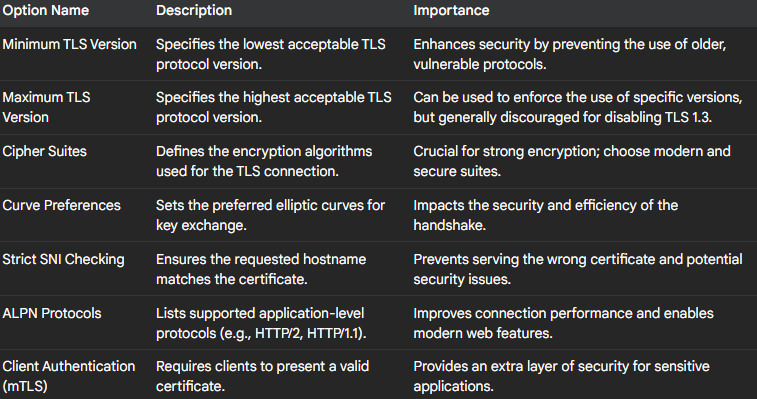 </center> # Getting Your Free Security Certificate: Traefik's certResolver and Let's Encrypt Obtaining a TLS certificate for your website used to be a somewhat complicated and often costly process. However, thanks to initiatives like Let's Encrypt, getting a valid certificate is now free and much simpler. Traefik has a powerful feature called certResolver that can automatically handle the entire process of obtaining and managing these TLS certificates, especially with providers like Let's Encrypt. Think of certResolver as your automated certificate manager. It can communicate directly with Let's Encrypt (or other certificate authorities) to request and renew certificates for your website without you having to do it manually. So, how does it work? Imagine you want your website to have that "HTTPS" badge, showing it's secure. You need a TLS certificate, which is like a digital ID card for your website. Let's Encrypt is like a free online ID card office. Traefik's certResolver acts like your personal assistant who goes to this office, fills out all the necessary paperwork, and gets the ID card (certificate) for your website automatically. To ensure that you actually own the domain name you're requesting a certificate for, Let's Encrypt uses different methods called "challenges". Here are some of the most common ones: - HTTP Challenge: Let's Encrypt asks Traefik to place a special file with a specific content on your website at a well-known location. Let's Encrypt then tries to access this file. If they can successfully access it and the content matches what they expect, they know you have control over the domain. - DNS Challenge: For this challenge, you need to add a specific record to your domain's DNS (Domain Name System) settings. Let's Encrypt then checks if this record exists and has the correct value to verify your ownership of the domain. This method is often preferred for obtaining wildcard certificates, which secure all subdomains of a domain (e.g., *.example.com). - TLS Challenge: In this method, Traefik proves its control over the domain by responding to Let's Encrypt over a TLS connection established on port 443. Here's a basic example of how you might configure a certResolver in Traefik using the HTTP challenge with Let's Encrypt in a YAML configuration file : ``` certificatesResolvers: myhttpchallenge: acme: email: "[email protected]" storage: "acme.json" httpChallenge: entryPoint: web ``` Let's break down this configuration: - certificatesResolvers: This is the main section where you define your certificate resolvers. - myhttpchallenge: This is the name we've given to our certificate resolver. You can choose any descriptive name you like. - acme: This indicates that we want to use the ACME (Automatic Certificate Management Environment) protocol, which is the protocol Let's Encrypt uses. - email: Here, you should provide your valid email address. Let's Encrypt will use this to contact you if there are any issues with your certificates, such as upcoming expiration. - storage: This specifies the location where Traefik will store the certificates it obtains from Let's Encrypt. acme.json is a common convention for this file. It's crucial to ensure that this file persists across Traefik restarts. If Traefik loses access to this file, it might try to request new certificates every time it starts, which could quickly lead to hitting Let's Encrypt's rate limits. - httpChallenge: This section tells Traefik that we want to use the HTTP challenge to prove ownership of our domain to Let's Encrypt. - entryPoint: web: This specifies the entry point that Let's Encrypt should use to reach our server on port 80 (usually the standard port for HTTP) to perform the HTTP challenge. It's worth noting that the DNS challenge is another popular option, especially when you need wildcard certificates to secure multiple subdomains. Configuring the DNS challenge often involves providing Traefik with specific credentials for your DNS provider so that Traefik can automatically add and remove the necessary DNS records during the challenge process. # Telling Traefik Which Doors to Lock: Using the domains Option Once you've configured a certResolver, you need to tell Traefik which specific domain names should use this resolver to obtain a TLS certificate. This is where the domains option comes into play. Within the TLS configuration of a router, you can specify the main domain name and any additional alternative domain names (also known as Subject Alternative Names or SANs) that should be included in the certificate. For instance, if you want your website to be accessible at both example.com and www.example.com, you would configure both of these in the domains section. Here's an example of how you might use the domains option in a Traefik router configuration using YAML: ``` http: routers: my-website: rule: "Host(`example.com`) | | Host(`www.example.com`)" entryPoints: - websecure tls: certResolver: myhttpchallenge domains: - main: "example.com" sans: - "www.example.com" ``` Let's break down this example: - http.routers: This section defines our HTTP routers. - my-website: This is the name we've given to this particular router. - rule: "Host(\example.com`) | | Host(`www.example.com`)": This rule tells Traefik that this router should handle incoming HTTP requests for either theexample.comor thewww.example.com` domain. - entryPoints: - websecure: This specifies that this router should use the websecure entry point, which is typically configured to listen on port 443 for HTTPS traffic. - tls: This section configures the TLS settings for this router. - certResolver: myhttpchallenge: Here, we're telling this router to use the certificate resolver named myhttpchallenge that we configured in the previous section to obtain its TLS certificate. - domains: This is where we specify the domain names that should be included in the certificate. - main: "example.com": This defines the primary domain name for the certificate. - sans: - "www.example.com": This specifies a Subject Alternative Name. The generated certificate will also be valid for www.example.com. You can include multiple SANs in this list if your website is accessible through other domain names as well. It's important to remember that for Let's Encrypt to successfully issue a certificate for the domains you specify in the domains option, each of those domain names (both the main domain and any SANs) must have a DNS record that points to the IP address of your Traefik instance. This allows Let's Encrypt to verify that you indeed control these domains during the challenge process. While we've focused on configuring TLS at the router level, it's also possible to configure TLS settings, including the certResolver and domains, at the entry point level. This can be a convenient way to enforce HTTPS for all routers that are associated with that particular entry point, simplifying the overall configuration in some scenarios. # Conclusion: A Safer Website for Everyone Properly configuring TLS in Traefik is a fundamental step in securing your web applications and ensuring a safe and trustworthy experience for your users. By implementing TLS, you protect sensitive information from prying eyes, establish the authenticity of your website, and maintain the integrity of the data exchanged. Traefik's powerful features, such as the ability to customize TLS connections through various options, the automated certificate management provided by certResolver (especially with Let's Encrypt), and the precise control over secured domains offered by the domains option, make it easier than ever to implement robust HTTPS for your websites. Taking the time to understand and configure these features will not only enhance the security of your online presence but also build trust with your visitors, ultimately contributing to a better user experience. So, go ahead, put on those strong locks, and make the internet a little bit safer for everyone. --- *If you liked this content I’d appreciate an upvote or a comment. That helps me improve the quality of my posts as well as getting to know more about you, my dear reader.* *Muchas gracias!* *Follow me for more content like this.* *[X](https://twitter.com/edca3911) | [PeakD](https://peakd.com/@simplestack) | [Rumble](https://rumble.com/user/simplestack) | [YouTube](https://www.youtube.com/@simple-stack-by-ed) | [Linked In](https://www.linkedin.com/in/edwardcasanova/) | [GitHub](https://github.com/ed3899) | [PayPal.me](https://paypal.me/edca3899?country.x=MX&locale.x=es_XC) | [Medium](https://medium.com/@ed.wacc1995/subscribe)* *Down below you can find other ways to tip my work.* ``` BankTransfer: "710969000019398639", // CLABE BAT: "0x33CD7770d3235F97e5A8a96D5F21766DbB08c875", ETH: "0x33CD7770d3235F97e5A8a96D5F21766DbB08c875", BTC: "33xxUWU5kjcPk1Kr9ucn9tQXd2DbQ1b9tE", ADA: "addr1q9l3y73e82hhwfr49eu0fkjw34w9s406wnln7rk9m4ky5fag8akgnwf3y4r2uzqf00rw0pvsucql0pqkzag5n450facq8vwr5e", DOT: "1rRDzfMLPi88RixTeVc2beA5h2Q3z1K1Uk3kqqyej7nWPNf", DOGE: "DRph8GEwGccvBWCe4wEQsWsTvQvsEH4QKH", DAI: "0x33CD7770d3235F97e5A8a96D5F21766DbB08c875" ``` |
| title | Locking Down Your Website with Traefik: A Beginner-Friendly Guide to TLS |
| author | simplestack |
| permlink | locking-down-your-website-with-traefik-a-beginner-friendly-guide-to-tls |
| json metadata | {"app":"peakd/2025.4.2","format":"markdown","description":"Don't be afraid, it is way simpler that it sounds","portfolio":true,"tags":["devops","tls","ssl","traefik","cert","https","dockerswarm","kubernetes","letsencrypt","cryptography"],"users":["example.com","simplestack","simple-stack-by-","ed.wacc1995"],"image":["https://files.peakd.com/file/peakd-hive/simplestack/AJkLtvChgEVLz9r92CNVjC6VyRPfgCWdj79NieXWr6UpL7iNLobyngieHyHYRiw.png","https://files.peakd.com/file/peakd-hive/simplestack/23swq4bs3zDUB8UBoZ3cEfjmkqUoWzdr6TMPZWtcdub9sDqmNYTPBmkXivTaYeh8Cjoxc.png"]} |
| parent author | |
| parent permlink | devops |
| Transaction Info | Block #94853399/Trx 544bdce3afce5c44d4194fb6b3e84b2ca83da6ea |
View Raw JSON Data
{
"op": [
"comment",
{
"body": "<center>\n\n</center>\n\nHave you ever wanted to send a secret message to a friend, one that only they could understand? On the internet, when your computer talks to a website, it's sending messages back and forth. Just like your secret message, you wouldn't want anyone else to be able to read this information, especially if it's something private like your password or credit card details. This is where TLS comes in. Think of TLS as a secret code, a special language that only your computer and the website can understand, ensuring that all the information shared remains private.\n\nImagine you're sending that secret message in an envelope. TLS is like a special lock you put on that envelope. When you send it, it's all wrapped up securely so that only your friend, the website in this case, has the special key to unlock it and read what's inside. Another way to picture it is like a secret handshake. Before your computer and the website start sharing information, they do this special handshake to make sure they both trust each other. This handshake sets up the secret code they'll use for all their future conversations.\n\n# What Exactly is TLS? Keeping the Bad Guys Out\n\nTLS stands for Transport Layer Security. It's like a more modern and secure version of an older system called SSL, which stands for Secure Sockets Layer. You'll often hear people use these terms interchangeably, and when you see \"HTTPS\" at the beginning of a website address, that \"S\" means the website is using TLS (or sometimes still SSL) to keep your connection secure. The transition from SSL to TLS represents an evolution towards stronger security practices, but the older term \"SSL\" persists in common usage.\n\nWhy is this important? Well, TLS has a few key benefits. First, it keeps your information confidential. When you browse a website that uses TLS, all the data exchanged between your computer and the website is encrypted, meaning it's scrambled into a secret code. This prevents anyone else on the internet from eavesdropping and stealing your sensitive information like passwords, credit card numbers, or personal messages. Second, TLS helps with authentication. It makes sure that you're actually talking to the real website you intended to visit and not a fake one trying to trick you. This verification process builds trust in the connection. Finally, TLS ensures data integrity. It guarantees that the information sent between your computer and the website hasn't been tampered with or altered during its journey.\n\nLet's go back to our secret message analogy. TLS makes sure the envelope is locked so no one can read it (confidentiality). It also verifies that the message is being delivered to the right person and not an imposter (authentication). And it ensures that the message inside hasn't been opened and changed by someone else along the way (integrity). These three elements are fundamental to secure online communication.\n\n# Traefik: Your Website's Smart Gatekeeper\n\nNow, let's talk about Traefik. Imagine Traefik as a very efficient and intelligent traffic controller for your website. When someone tries to visit your website, their request first goes to Traefik. Traefik then figures out where that request needs to go among your various web applications. One of the crucial roles Traefik plays is in managing security, and this is where TLS comes into the picture. Traefik can handle the secure connection (HTTPS) for all your websites and applications.\n\nWhen Traefik is configured to handle TLS, it takes on the responsibility of the \"secret code\" part of the communication. This means your actual web applications don't need to worry about the complexities of encrypting and decrypting data. Traefik handles the secure connection, decrypts the incoming requests, and then forwards them to your applications. This process is known as TLS termination, and it simplifies the security setup for your web services.\n\n# Putting Up Stronger Locks: Understanding TLS Options in Traefik\n\nTraefik offers a great deal of flexibility in how it manages these secure connections. It allows you to customize the behavior of TLS through various settings known as \"TLS Options\". Think of these options as different ways to make the security lock on your website even stronger and more tailored to your needs.\n\nOne important set of options involves setting the Minimum and Maximum TLS Version. You can tell Traefik to only allow connections that use a certain version of TLS or higher, such as TLS 1.2 or the more recent and secure TLS 1.3. This is like saying, \"Only use the newest and most robust type of lock available.\" Older versions of TLS might have known security weaknesses, so enforcing the use of more recent versions is a critical security practice. Conversely, while you can specify a maximum version, it's generally advised against disabling TLS 1.3, as it incorporates the latest security enhancements.\n\nAnother key aspect of TLS configuration involves Cipher Suites. These are the specific algorithms used to perform the encryption, the actual \"secret code\" itself. Traefik allows you to choose which cipher suites it should support. It's important to select strong and modern cipher suites that are resistant to known attacks. Think of it as choosing a very complex and unbreakable code for your secret messages.\n\nThe Curve Preferences option lets you specify the order in which Traefik should prefer certain types of mathematical curves during the process of setting up the secure connection. These curves are part of the Elliptic Curve Diffie-Hellman (ECDHE) key exchange, a secure method for two parties to agree on a shared secret. Prioritizing more secure curves enhances the handshake process.\n\nStrict SNI Checking is another valuable option. SNI, or Server Name Indication, is like when you call a large office building and tell the receptionist which company you're trying to reach. When you connect to an HTTPS server that hosts multiple websites, your browser sends the name of the website you're trying to visit as part of the initial connection. Enabling strict SNI checking ensures that Traefik will only respond if the server name provided by the client matches one of the configured certificates. This prevents the server from accidentally presenting the wrong security certificate, which could lead to security warnings in the user's browser.\n\nALPN Protocols, or Application-Layer Protocol Negotiation, allows you to define a list of supported protocols (like HTTP/2 or HTTP/1.1) that Traefik will offer during the TLS handshake, in order of preference. This negotiation allows the client and server to agree on the most efficient protocol to use for communication, potentially improving website performance.\n\nFor highly sensitive applications, Traefik also supports Client Authentication, often referred to as mutual TLS (mTLS). This is like having a double identification check. Not only does the website present a certificate to your computer to prove its identity, but your computer also needs to present a certificate to the website to prove its identity. This ensures that both parties in the communication are who they claim to be, adding an extra layer of security.\n\nHere's an example of how you might configure some of these TLS options in Traefik using a YAML configuration file:\n\n```\ntls:\n options:\n default:\n minVersion: VersionTLS12\n cipherSuites:\n - TLS_ECDHE_RSA_WITH_AES_128_GCM_SHA256\n sniStrict: true\n```\n\nIn this example, we've defined a set of default TLS options. We've specified that the minimum acceptable TLS version should be 1.2, we've chosen a specific secure cipher suite for encryption, and we've enabled strict SNI checking. This ensures a baseline level of security for all TLS connections handled by Traefik that use these default options.\n\nTo summarize, here's a table of some common TLS options in Traefik:\n\n<center>\n\n</center>\n\n# Getting Your Free Security Certificate: Traefik's certResolver and Let's Encrypt\n\nObtaining a TLS certificate for your website used to be a somewhat complicated and often costly process. However, thanks to initiatives like Let's Encrypt, getting a valid certificate is now free and much simpler.\n\nTraefik has a powerful feature called certResolver that can automatically handle the entire process of obtaining and managing these TLS certificates, especially with providers like Let's Encrypt. Think of certResolver as your automated certificate manager. It can communicate directly with Let's Encrypt (or other certificate authorities) to request and renew certificates for your website without you having to do it manually.\n\nSo, how does it work? Imagine you want your website to have that \"HTTPS\" badge, showing it's secure. You need a TLS certificate, which is like a digital ID card for your website. Let's Encrypt is like a free online ID card office. Traefik's certResolver acts like your personal assistant who goes to this office, fills out all the necessary paperwork, and gets the ID card (certificate) for your website automatically.\n\nTo ensure that you actually own the domain name you're requesting a certificate for, Let's Encrypt uses different methods called \"challenges\". Here are some of the most common ones:\n\n- HTTP Challenge: Let's Encrypt asks Traefik to place a special file with a specific content on your website at a well-known location. Let's Encrypt then tries to access this file. If they can successfully access it and the content matches what they expect, they know you have control over the domain.\n- DNS Challenge: For this challenge, you need to add a specific record to your domain's DNS (Domain Name System) settings. Let's Encrypt then checks if this record exists and has the correct value to verify your ownership of the domain. This method is often preferred for obtaining wildcard certificates, which secure all subdomains of a domain (e.g., *.example.com).\n- TLS Challenge: In this method, Traefik proves its control over the domain by responding to Let's Encrypt over a TLS connection established on port 443.\n\nHere's a basic example of how you might configure a certResolver in Traefik using the HTTP challenge with Let's Encrypt in a YAML configuration file :\n\n```\ncertificatesResolvers:\n myhttpchallenge:\n acme:\n email: \"[email protected]\"\n storage: \"acme.json\"\n httpChallenge:\n entryPoint: web\n```\n\n\nLet's break down this configuration:\n\n- certificatesResolvers: This is the main section where you define your certificate resolvers.\n- myhttpchallenge: This is the name we've given to our certificate resolver. You can choose any descriptive name you like.\n- acme: This indicates that we want to use the ACME (Automatic Certificate Management Environment) protocol, which is the protocol Let's Encrypt uses.\n- email: Here, you should provide your valid email address. Let's Encrypt will use this to contact you if there are any issues with your certificates, such as upcoming expiration.\n- storage: This specifies the location where Traefik will store the certificates it obtains from Let's Encrypt. acme.json is a common convention for this file. It's crucial to ensure that this file persists across Traefik restarts. If Traefik loses access to this file, it might try to request new certificates every time it starts, which could quickly lead to hitting Let's Encrypt's rate limits.\n- httpChallenge: This section tells Traefik that we want to use the HTTP challenge to prove ownership of our domain to Let's Encrypt.\n- entryPoint: web: This specifies the entry point that Let's Encrypt should use to reach our server on port 80 (usually the standard port for HTTP) to perform the HTTP challenge.\n\nIt's worth noting that the DNS challenge is another popular option, especially when you need wildcard certificates to secure multiple subdomains. Configuring the DNS challenge often involves providing Traefik with specific credentials for your DNS provider so that Traefik can automatically add and remove the necessary DNS records during the challenge process.\n\n# Telling Traefik Which Doors to Lock: Using the domains Option\n\nOnce you've configured a certResolver, you need to tell Traefik which specific domain names should use this resolver to obtain a TLS certificate. This is where the domains option comes into play.\n\nWithin the TLS configuration of a router, you can specify the main domain name and any additional alternative domain names (also known as Subject Alternative Names or SANs) that should be included in the certificate. For instance, if you want your website to be accessible at both example.com and www.example.com, you would configure both of these in the domains section.\n\nHere's an example of how you might use the domains option in a Traefik router configuration using YAML:\n\n```\nhttp:\n routers:\n my-website:\n rule: \"Host(`example.com`) |\n| Host(`www.example.com`)\"\n entryPoints:\n - websecure\n tls:\n certResolver: myhttpchallenge\n domains:\n - main: \"example.com\"\n sans:\n - \"www.example.com\"\n```\n\nLet's break down this example:\n\n- http.routers: This section defines our HTTP routers.\n- my-website: This is the name we've given to this particular router.\n- rule: \"Host(\\example.com`) | | Host(`www.example.com`)\": This rule tells Traefik that this router should handle incoming HTTP requests for either theexample.comor thewww.example.com` domain.\n- entryPoints: - websecure: This specifies that this router should use the websecure entry point, which is typically configured to listen on port 443 for HTTPS traffic.\n- tls: This section configures the TLS settings for this router.\n- certResolver: myhttpchallenge: Here, we're telling this router to use the certificate resolver named myhttpchallenge that we configured in the previous section to obtain its TLS certificate.\n- domains: This is where we specify the domain names that should be included in the certificate.\n- main: \"example.com\": This defines the primary domain name for the certificate.\n- sans: - \"www.example.com\": This specifies a Subject Alternative Name. The generated certificate will also be valid for www.example.com. You can include multiple SANs in this list if your website is accessible through other domain names as well.\n\nIt's important to remember that for Let's Encrypt to successfully issue a certificate for the domains you specify in the domains option, each of those domain names (both the main domain and any SANs) must have a DNS record that points to the IP address of your Traefik instance. This allows Let's Encrypt to verify that you indeed control these domains during the challenge process.\n\nWhile we've focused on configuring TLS at the router level, it's also possible to configure TLS settings, including the certResolver and domains, at the entry point level. This can be a convenient way to enforce HTTPS for all routers that are associated with that particular entry point, simplifying the overall configuration in some scenarios.\n\n# Conclusion: A Safer Website for Everyone\n\nProperly configuring TLS in Traefik is a fundamental step in securing your web applications and ensuring a safe and trustworthy experience for your users. By implementing TLS, you protect sensitive information from prying eyes, establish the authenticity of your website, and maintain the integrity of the data exchanged.\n\nTraefik's powerful features, such as the ability to customize TLS connections through various options, the automated certificate management provided by certResolver (especially with Let's Encrypt), and the precise control over secured domains offered by the domains option, make it easier than ever to implement robust HTTPS for your websites. Taking the time to understand and configure these features will not only enhance the security of your online presence but also build trust with your visitors, ultimately contributing to a better user experience. So, go ahead, put on those strong locks, and make the internet a little bit safer for everyone.\n\n---\n\n*If you liked this content I’d appreciate an upvote or a comment. That helps me improve the quality of my posts as well as getting to know more about you, my dear reader.*\n\n*Muchas gracias!*\n\n*Follow me for more content like this.*\n\n*[X](https://twitter.com/edca3911) | [PeakD](https://peakd.com/@simplestack) | [Rumble](https://rumble.com/user/simplestack) | [YouTube](https://www.youtube.com/@simple-stack-by-ed) | [Linked In](https://www.linkedin.com/in/edwardcasanova/) | [GitHub](https://github.com/ed3899) | [PayPal.me](https://paypal.me/edca3899?country.x=MX&locale.x=es_XC) | [Medium](https://medium.com/@ed.wacc1995/subscribe)*\n\n*Down below you can find other ways to tip my work.*\n\n```\nBankTransfer: \"710969000019398639\", // CLABE\nBAT: \"0x33CD7770d3235F97e5A8a96D5F21766DbB08c875\",\nETH: \"0x33CD7770d3235F97e5A8a96D5F21766DbB08c875\",\nBTC: \"33xxUWU5kjcPk1Kr9ucn9tQXd2DbQ1b9tE\",\nADA: \"addr1q9l3y73e82hhwfr49eu0fkjw34w9s406wnln7rk9m4ky5fag8akgnwf3y4r2uzqf00rw0pvsucql0pqkzag5n450facq8vwr5e\",\nDOT: \"1rRDzfMLPi88RixTeVc2beA5h2Q3z1K1Uk3kqqyej7nWPNf\",\nDOGE: \"DRph8GEwGccvBWCe4wEQsWsTvQvsEH4QKH\",\nDAI: \"0x33CD7770d3235F97e5A8a96D5F21766DbB08c875\"\n```",
"title": "Locking Down Your Website with Traefik: A Beginner-Friendly Guide to TLS",
"author": "simplestack",
"permlink": "locking-down-your-website-with-traefik-a-beginner-friendly-guide-to-tls",
"json_metadata": "{\"app\":\"peakd/2025.4.2\",\"format\":\"markdown\",\"description\":\"Don't be afraid, it is way simpler that it sounds\",\"portfolio\":true,\"tags\":[\"devops\",\"tls\",\"ssl\",\"traefik\",\"cert\",\"https\",\"dockerswarm\",\"kubernetes\",\"letsencrypt\",\"cryptography\"],\"users\":[\"example.com\",\"simplestack\",\"simple-stack-by-\",\"ed.wacc1995\"],\"image\":[\"https://files.peakd.com/file/peakd-hive/simplestack/AJkLtvChgEVLz9r92CNVjC6VyRPfgCWdj79NieXWr6UpL7iNLobyngieHyHYRiw.png\",\"https://files.peakd.com/file/peakd-hive/simplestack/23swq4bs3zDUB8UBoZ3cEfjmkqUoWzdr6TMPZWtcdub9sDqmNYTPBmkXivTaYeh8Cjoxc.png\"]}",
"parent_author": "",
"parent_permlink": "devops"
}
],
"block": 94853399,
"trx_id": "544bdce3afce5c44d4194fb6b3e84b2ca83da6ea",
"op_in_trx": 0,
"timestamp": "2025-04-08T17:30:30",
"virtual_op": false,
"trx_in_block": 1
}2025/04/08 17:20:51
2025/04/08 17:20:51
| author | simplestack |
| permlink | dsa-medium-general-print-a-diamond-shape-typescript-python-and-rust |
| Transaction Info | Block #94853207/Virtual Operation 4294967295:2 |
View Raw JSON Data
{
  "op": [
    "comment_payout_update",
    {
      "author": "simplestack",
      "permlink": "dsa-medium-general-print-a-diamond-shape-typescript-python-and-rust"
    }
  ],
  "block": 94853207,
  "trx_id": "0000000000000000000000000000000000000000",
  "op_in_trx": 2,
  "timestamp": "2025-04-08T17:20:51",
  "virtual_op": true,
  "trx_in_block": 4294967295
}simplestackupdated payout for dsa-medium-binary-tree-binary-tree-right-side-view2025/04/08 16:28:48
simplestackupdated payout for dsa-medium-binary-tree-binary-tree-right-side-view
2025/04/08 16:28:48
| author | simplestack |
| permlink | dsa-medium-binary-tree-binary-tree-right-side-view |
| Transaction Info | Block #94852167/Virtual Operation 4294967295:2 |
View Raw JSON Data
{
  "op": [
    "comment_payout_update",
    {
      "author": "simplestack",
      "permlink": "dsa-medium-binary-tree-binary-tree-right-side-view"
    }
  ],
  "block": 94852167,
  "trx_id": "0000000000000000000000000000000000000000",
  "op_in_trx": 2,
  "timestamp": "2025-04-08T16:28:48",
  "virtual_op": true,
  "trx_in_block": 4294967295
}lolz.byteeffective vote applied for @simplestack / why-reuseport-is-needed-in-traefik2025/04/08 16:24:15
lolz.byteeffective vote applied for @simplestack / why-reuseport-is-needed-in-traefik
2025/04/08 16:24:15
| voter | lolz.byte |
| author | simplestack |
| weight | 0 (0.00%) |
| rshares | 0 |
| permlink | why-reuseport-is-needed-in-traefik |
| pending payout | 0.000 HBD |
| total vote weight | 0 |
| Transaction Info | Block #94852076/Trx bc5356826b8c5f92a80155b6bfe17d24a5e3e9f2 |
View Raw JSON Data
{
  "op": [
    "effective_comment_vote",
    {
      "voter": "lolz.byte",
      "author": "simplestack",
      "weight": 0,
      "rshares": 0,
      "permlink": "why-reuseport-is-needed-in-traefik",
      "pending_payout": "0.000 HBD",
      "total_vote_weight": 0
    }
  ],
  "block": 94852076,
  "trx_id": "bc5356826b8c5f92a80155b6bfe17d24a5e3e9f2",
  "op_in_trx": 1,
  "timestamp": "2025-04-08T16:24:15",
  "virtual_op": true,
  "trx_in_block": 6
}lolz.byteupvoted (100.00%) @simplestack / why-reuseport-is-needed-in-traefik2025/04/08 16:24:15
lolz.byteupvoted (100.00%) @simplestack / why-reuseport-is-needed-in-traefik
2025/04/08 16:24:15
| voter | lolz.byte |
| author | simplestack |
| weight | 10000 (100.00%) |
| permlink | why-reuseport-is-needed-in-traefik |
| Transaction Info | Block #94852076/Trx bc5356826b8c5f92a80155b6bfe17d24a5e3e9f2 |
View Raw JSON Data
{
  "op": [
    "vote",
    {
      "voter": "lolz.byte",
      "author": "simplestack",
      "weight": 10000,
      "permlink": "why-reuseport-is-needed-in-traefik"
    }
  ],
  "block": 94852076,
  "trx_id": "bc5356826b8c5f92a80155b6bfe17d24a5e3e9f2",
  "op_in_trx": 0,
  "timestamp": "2025-04-08T16:24:15",
  "virtual_op": false,
  "trx_in_block": 6
}simplestackupdated payout for re-anggreklestari-su1s0v2025/04/08 16:19:42
simplestackupdated payout for re-anggreklestari-su1s0v
2025/04/08 16:19:42
| author | simplestack |
| permlink | re-anggreklestari-su1s0v |
| Transaction Info | Block #94851985/Virtual Operation 4294967295:3 |
View Raw JSON Data
{
  "op": [
    "comment_payout_update",
    {
      "author": "simplestack",
      "permlink": "re-anggreklestari-su1s0v"
    }
  ],
  "block": 94851985,
  "trx_id": "0000000000000000000000000000000000000000",
  "op_in_trx": 3,
  "timestamp": "2025-04-08T16:19:42",
  "virtual_op": true,
  "trx_in_block": 4294967295
}Manabar
Voting Power100.00%
Downvote Power100.00%
Resource Credits100.00%
Reputation Progress0.00%
{
  "voting_manabar": {
    "current_mana": 774839068947,
    "last_update_time": 1744333536
  },
  "downvote_manabar": {
    "current_mana": 193748516940,
    "last_update_time": 1744333536
  },
  "rc_account": {
    "account": "simplestack",
    "rc_manabar": {
      "current_mana": 4842105833,
      "last_update_time": 1758738969
    },
    "max_rc_creation_adjustment": {
      "amount": "5044404814",
      "precision": 6,
      "nai": "@@000000037"
    },
    "max_rc": 5045763425,
    "delegated_rc": 0,
    "received_delegated_rc": 0
  }
}
Account Metadata
| POSTING JSON METADATA | |
| profile | {"name":"Simple Stack","about":"💻 Software Engineering, Tech & Sci-Fi ⛓️💥 Blockchain is Freedom","location":"Multiverse","website":"https://www.linkedin.com/in/edwardcasanova/","profile_image":"https://files.peakd.com/file/peakd-hive/simplestack/peakd_logo_512x512.png","cover_image":"https://files.peakd.com/file/peakd-hive/simplestack/peakd_background_1920x240.png","version":2,"collections":"enabled"} |
| JSON METADATA | |
| beneficiaries | [] |
| profile | {"nsfw":""} |
{
"posting_json_metadata": {
"profile": {
"name": "Simple Stack",
"about": "💻 Software Engineering, Tech & Sci-Fi ⛓️💥 Blockchain is Freedom",
"location": "Multiverse",
"website": "https://www.linkedin.com/in/edwardcasanova/",
"profile_image": "https://files.peakd.com/file/peakd-hive/simplestack/peakd_logo_512x512.png",
"cover_image": "https://files.peakd.com/file/peakd-hive/simplestack/peakd_background_1920x240.png",
"version": 2,
"collections": "enabled"
}
},
"json_metadata": {
"beneficiaries": [],
"profile": {
"nsfw": ""
}
}
}Auth Keys
Owner
Single Signature
Public Keys
STM5k7KviGZo6gce9tAoeeCHwJBGrmEXhQzY55ZzZrki1bco9dSFg1/1
Active
Single Signature
Public Keys
STM65aHfKyybnF2KTrzz9dZrDfxhvyq5CtT6394bAePZYDZyL8wk91/1
Posting
Single Signature
Public Keys
STM8FhmFsrDVSgQJm7LaauZuk1itVAe5VkCuEeunpr8We3RRFBmje1/1
Memo
STM8XjU5gUC17m2W4amxx58mjyjyWexrSLh6S3Hc6gYDWJgwgPUa5
{
  "owner": {
    "weight_threshold": 1,
    "account_auths": [],
    "key_auths": [
      [
        "STM5k7KviGZo6gce9tAoeeCHwJBGrmEXhQzY55ZzZrki1bco9dSFg",
        1
      ]
    ]
  },
  "active": {
    "weight_threshold": 1,
    "account_auths": [],
    "key_auths": [
      [
        "STM65aHfKyybnF2KTrzz9dZrDfxhvyq5CtT6394bAePZYDZyL8wk9",
        1
      ]
    ]
  },
  "posting": {
    "weight_threshold": 1,
    "account_auths": [],
    "key_auths": [
      [
        "STM8FhmFsrDVSgQJm7LaauZuk1itVAe5VkCuEeunpr8We3RRFBmje",
        1
      ]
    ]
  },
  "memo": "STM8XjU5gUC17m2W4amxx58mjyjyWexrSLh6S3Hc6gYDWJgwgPUa5"
}
Witness Votes
0 / 30
No active witness votes.
[]