

@davelevy
51IT Worker, Brit, Londoner, innovator, experienced, economist, SQL, opensource, traveller, married, father - comments mine, not anyone else's
steemit.com/@davelevyVOTING POWER100.00%
DOWNVOTE POWER100.00%
RESOURCE CREDITS100.00%
REPUTATION PROGRESS21.22%
Net Worth
0.982USD
STEEM
14.928STEEM
SBD
0.087SBD
Effective Power
5.006SP
├── Own SP
1.275SP
└── Incoming DelegationsDeleg
+3.731SP
Detailed Balance
| STEEM | ||
| balance | 0.007STEEM | STEEM |
| market_balance | 0.000STEEM | STEEM |
| savings_balance | 0.000STEEM | STEEM |
| reward_steem_balance | 14.921STEEM | STEEM |
| STEEM POWER | ||
| Own SP | 1.275SP | SP |
| Delegated Out | 0.000SP | SP |
| Delegation In | 3.731SP | SP |
| Effective Power | 5.006SP | SP |
| Reward SP (pending) | 15.306SP | SP |
| SBD | ||
| sbd_balance | 0.001SBD | SBD |
| sbd_conversions | 0.000SBD | SBD |
| sbd_market_balance | 0.000SBD | SBD |
| savings_sbd_balance | 0.000SBD | SBD |
| reward_sbd_balance | 0.086SBD | SBD |
{
  "balance": "0.007 STEEM",
  "savings_balance": "0.000 STEEM",
  "reward_steem_balance": "14.921 STEEM",
  "vesting_shares": "2073.089581 VESTS",
  "delegated_vesting_shares": "0.000000 VESTS",
  "received_vesting_shares": "6068.851947 VESTS",
  "sbd_balance": "0.001 SBD",
  "savings_sbd_balance": "0.000 SBD",
  "reward_sbd_balance": "0.086 SBD",
  "conversions": []
}
Account Info
| name | davelevy |
| id | 168171 |
| rank | 1,034,612 |
| reputation | 817457901600 |
| created | 2017-05-23T15:54:57 |
| recovery_account | steem |
| proxy | None |
| post_count | 67 |
| comment_count | 0 |
| lifetime_vote_count | 0 |
| witnesses_voted_for | 0 |
| last_post | 2026-05-24T14:14:39 |
| last_root_post | 2026-05-24T14:14:39 |
| last_vote_time | 2026-02-09T09:36:45 |
| proxied_vsf_votes | 0, 0, 0, 0 |
| can_vote | 1 |
| voting_power | 0 |
| delayed_votes | 0 |
| balance | 0.007 STEEM |
| savings_balance | 0.000 STEEM |
| sbd_balance | 0.001 SBD |
| savings_sbd_balance | 0.000 SBD |
| vesting_shares | 2073.089581 VESTS |
| delegated_vesting_shares | 0.000000 VESTS |
| received_vesting_shares | 6068.851947 VESTS |
| reward_vesting_balance | 25433.544482 VESTS |
| vesting_balance | 0.000 STEEM |
| vesting_withdraw_rate | 0.000000 VESTS |
| next_vesting_withdrawal | 1969-12-31T23:59:59 |
| withdrawn | 0 |
| to_withdraw | 0 |
| withdraw_routes | 0 |
| savings_withdraw_requests | 0 |
| last_account_recovery | 1970-01-01T00:00:00 |
| reset_account | null |
| last_owner_update | 1970-01-01T00:00:00 |
| last_account_update | 2026-05-24T14:25:06 |
| mined | No |
| sbd_seconds | 0 |
| sbd_last_interest_payment | 1970-01-01T00:00:00 |
| savings_sbd_last_interest_payment | 1970-01-01T00:00:00 |
{
  "active": {
    "account_auths": [],
    "key_auths": [
      [
        "STM8UmpY726PGQ1QvHBBJyy5WaPBHWnM3wkhHDjnJxFdG8a4c4gV5",
        1
      ]
    ],
    "weight_threshold": 1
  },
  "balance": "0.007 STEEM",
  "can_vote": true,
  "comment_count": 0,
  "created": "2017-05-23T15:54:57",
  "curation_rewards": 2,
  "delegated_vesting_shares": "0.000000 VESTS",
  "downvote_manabar": {
    "current_mana": 2035485382,
    "last_update_time": 1779311547
  },
  "guest_bloggers": [],
  "id": 168171,
  "json_metadata": "{\"profile\":{\"profile_image\":\"https://davelevy.info/images/dave/dave-circle.png\",\"name\":\"Dave\",\"about\":\"IT Worker, Brit, Londoner, innovator, experienced, economist, SQL, opensource, traveller, married, father, sailor - comments mine, not anyone else's\",\"location\":\"London, usually\",\"website\":\"http://davelevy.info\"}}",
  "last_account_recovery": "1970-01-01T00:00:00",
  "last_account_update": "2026-05-24T14:25:06",
  "last_owner_update": "1970-01-01T00:00:00",
  "last_post": "2026-05-24T14:14:39",
  "last_root_post": "2026-05-24T14:14:39",
  "last_vote_time": "2026-02-09T09:36:45",
  "lifetime_vote_count": 0,
  "market_history": [],
  "memo_key": "STM8YoVi3yMMpMo9ZPkGBNRRrLMv19tJTM2bvLTKzUSaSx8tYotRt",
  "mined": false,
  "name": "davelevy",
  "next_vesting_withdrawal": "1969-12-31T23:59:59",
  "other_history": [],
  "owner": {
    "account_auths": [],
    "key_auths": [
      [
        "STM8PfhgqGvYaDQVwCbehpcCP29D6d9onBUvBkmjDUbGKxWy1nzpG",
        1
      ]
    ],
    "weight_threshold": 1
  },
  "pending_claimed_accounts": 0,
  "post_bandwidth": 0,
  "post_count": 67,
  "post_history": [],
  "posting": {
    "account_auths": [],
    "key_auths": [
      [
        "STM5K4YMkthkiDrz1ti27sDtpHm2v6zc56QZx9VkSYT1eZ5hbK1mE",
        1
      ]
    ],
    "weight_threshold": 1
  },
  "posting_json_metadata": "{\"profile\":{\"profile_image\":\"https://davelevy.info/wp-content/uploads/2016/06/dave-circle-750d.png\",\"name\":\"Dave\",\"about\":\"IT Worker, Brit, Londoner, innovator, experienced, economist, SQL, opensource, traveller, married, father - comments mine, not anyone else's\",\"location\":\"London, usually\",\"website\":\"http://davelevy.info\",\"version\":2}}",
  "posting_rewards": 30468,
  "proxied_vsf_votes": [
    0,
    0,
    0,
    0
  ],
  "proxy": "",
  "received_vesting_shares": "6068.851947 VESTS",
  "recovery_account": "steem",
  "reputation": "817457901600",
  "reset_account": "null",
  "reward_sbd_balance": "0.086 SBD",
  "reward_steem_balance": "14.921 STEEM",
  "reward_vesting_balance": "25433.544482 VESTS",
  "reward_vesting_steem": "15.306 STEEM",
  "savings_balance": "0.000 STEEM",
  "savings_sbd_balance": "0.000 SBD",
  "savings_sbd_last_interest_payment": "1970-01-01T00:00:00",
  "savings_sbd_seconds": "0",
  "savings_sbd_seconds_last_update": "1970-01-01T00:00:00",
  "savings_withdraw_requests": 0,
  "sbd_balance": "0.001 SBD",
  "sbd_last_interest_payment": "1970-01-01T00:00:00",
  "sbd_seconds": "0",
  "sbd_seconds_last_update": "2018-10-10T09:53:15",
  "tags_usage": [],
  "to_withdraw": 0,
  "transfer_history": [],
  "vesting_balance": "0.000 STEEM",
  "vesting_shares": "2073.089581 VESTS",
  "vesting_withdraw_rate": "0.000000 VESTS",
  "vote_history": [],
  "voting_manabar": {
    "current_mana": "8141941528",
    "last_update_time": 1779311547
  },
  "voting_power": 0,
  "withdraw_routes": 0,
  "withdrawn": 0,
  "witness_votes": [],
  "witnesses_voted_for": 0,
  "rank": 1034612
}
Withdraw Routes
| Incoming | Outgoing |
|---|---|
Empty | Empty |
{
  "incoming": [],
  "outgoing": []
}From Date
To Date
davelevyreceived 0.082 STEEM, 0.083 SP author reward for @davelevy / is-labour-about-to-press-reset-again2026/05/31 14:14:42
davelevyreceived 0.082 STEEM, 0.083 SP author reward for @davelevy / is-labour-about-to-press-reset-again
2026/05/31 14:14:42
| author | davelevy |
| permlink | is-labour-about-to-press-reset-again |
| sbd payout | 0.000 SBD |
| steem payout | 0.082 STEEM |
| vesting payout | 135.094797 VESTS |
| Transaction Info | Block #106533071/Virtual Operation #4 |
View Raw JSON Data
{
  "block": 106533071,
  "op": [
    "author_reward",
    {
      "author": "davelevy",
      "permlink": "is-labour-about-to-press-reset-again",
      "sbd_payout": "0.000 SBD",
      "steem_payout": "0.082 STEEM",
      "vesting_payout": "135.094797 VESTS"
    }
  ],
  "op_in_trx": 0,
  "timestamp": "2026-05-31T14:14:42",
  "trx_id": "0000000000000000000000000000000000000000",
  "trx_in_block": 4294967295,
  "virtual_op": 4
}remlaps-liteupvoted (100.00%) @davelevy / is-labour-about-to-press-reset-again2026/05/24 14:25:27
remlaps-liteupvoted (100.00%) @davelevy / is-labour-about-to-press-reset-again
2026/05/24 14:25:27
| author | davelevy |
| permlink | is-labour-about-to-press-reset-again |
| voter | remlaps-lite |
| weight | 10000 (100.00%) |
| Transaction Info | Block #106332518/Trx 7ad18ba08322a8c75c6a3207fef57e5b681398d8 |
View Raw JSON Data
{
  "block": 106332518,
  "op": [
    "vote",
    {
      "author": "davelevy",
      "permlink": "is-labour-about-to-press-reset-again",
      "voter": "remlaps-lite",
      "weight": 10000
    }
  ],
  "op_in_trx": 0,
  "timestamp": "2026-05-24T14:25:27",
  "trx_id": "7ad18ba08322a8c75c6a3207fef57e5b681398d8",
  "trx_in_block": 6,
  "virtual_op": 0
}davelevyupdated their account properties2026/05/24 14:25:06
davelevyupdated their account properties
2026/05/24 14:25:06
| account | davelevy |
| extensions | [] |
| json metadata | |
| posting json metadata | {"profile":{"profile_image":"https://davelevy.info/wp-content/uploads/2016/06/dave-circle-750d.png","name":"Dave","about":"IT Worker, Brit, Londoner, innovator, experienced, economist, SQL, opensource, traveller, married, father - comments mine, not anyone else's","location":"London, usually","website":"http://davelevy.info","version":2}} |
| Transaction Info | Block #106332511/Trx 878c4d6b9a47718b317c08b76a52179e637c0e21 |
View Raw JSON Data
{
  "block": 106332511,
  "op": [
    "account_update2",
    {
      "account": "davelevy",
      "extensions": [],
      "json_metadata": "",
      "posting_json_metadata": "{\"profile\":{\"profile_image\":\"https://davelevy.info/wp-content/uploads/2016/06/dave-circle-750d.png\",\"name\":\"Dave\",\"about\":\"IT Worker, Brit, Londoner, innovator, experienced, economist, SQL, opensource, traveller, married, father - comments mine, not anyone else's\",\"location\":\"London, usually\",\"website\":\"http://davelevy.info\",\"version\":2}}"
    }
  ],
  "op_in_trx": 0,
  "timestamp": "2026-05-24T14:25:06",
  "trx_id": "878c4d6b9a47718b317c08b76a52179e637c0e21",
  "trx_in_block": 2,
  "virtual_op": 0
}remlapsupvoted (100.00%) @davelevy / is-labour-about-to-press-reset-again2026/05/24 14:24:57
remlapsupvoted (100.00%) @davelevy / is-labour-about-to-press-reset-again
2026/05/24 14:24:57
| author | davelevy |
| permlink | is-labour-about-to-press-reset-again |
| voter | remlaps |
| weight | 10000 (100.00%) |
| Transaction Info | Block #106332508/Trx 0cf37f5d252cbad4b4ceed96e53290a36b77987a |
View Raw JSON Data
{
  "block": 106332508,
  "op": [
    "vote",
    {
      "author": "davelevy",
      "permlink": "is-labour-about-to-press-reset-again",
      "voter": "remlaps",
      "weight": 10000
    }
  ],
  "op_in_trx": 0,
  "timestamp": "2026-05-24T14:24:57",
  "trx_id": "0cf37f5d252cbad4b4ceed96e53290a36b77987a",
  "trx_in_block": 10,
  "virtual_op": 0
}davelevyupdated their account properties2026/05/24 14:22:00
davelevyupdated their account properties
2026/05/24 14:22:00
| account | davelevy |
| extensions | [] |
| json metadata | |
| posting json metadata | {"profile":{"profile_image":"https://cdn.steemitimages.com/DQmTV8Rpbvd8MPZwxbUBkuwcCftUueCf5TQVjnaUuVtFc5E/DFL-Think-256circ.jpg","name":"Dave","about":"IT Worker, Brit, Londoner, innovator, experienced, economist, SQL, opensource, traveller, married, father - comments mine, not anyone else's","location":"London, usually","website":"http://davelevy.info","version":2}} |
| Transaction Info | Block #106332449/Trx 14577a3d474dc26ab5d0d5a085dfaa375eaaedfa |
View Raw JSON Data
{
  "block": 106332449,
  "op": [
    "account_update2",
    {
      "account": "davelevy",
      "extensions": [],
      "json_metadata": "",
      "posting_json_metadata": "{\"profile\":{\"profile_image\":\"https://cdn.steemitimages.com/DQmTV8Rpbvd8MPZwxbUBkuwcCftUueCf5TQVjnaUuVtFc5E/DFL-Think-256circ.jpg\",\"name\":\"Dave\",\"about\":\"IT Worker, Brit, Londoner, innovator, experienced, economist, SQL, opensource, traveller, married, father - comments mine, not anyone else's\",\"location\":\"London, usually\",\"website\":\"http://davelevy.info\",\"version\":2}}"
    }
  ],
  "op_in_trx": 0,
  "timestamp": "2026-05-24T14:22:00",
  "trx_id": "14577a3d474dc26ab5d0d5a085dfaa375eaaedfa",
  "trx_in_block": 0,
  "virtual_op": 0
}davelevyupdated their account properties2026/05/24 14:20:09
davelevyupdated their account properties
2026/05/24 14:20:09
| account | davelevy |
| extensions | [] |
| json metadata | |
| posting json metadata | {"profile":{"profile_image":"https://davelevy.info/wp-content/uploads/2016/06/dave-circle-750d.png","name":"Dave","about":"IT Worker, Brit, Londoner, innovator, experienced, economist, SQL, opensource, traveller, married, father - comments mine, not anyone else's","location":"London, usually","website":"http://davelevy.info","version":2}} |
| Transaction Info | Block #106332413/Trx 809c79c19977f2c23f740927ec39fcdb59863f76 |
View Raw JSON Data
{
  "block": 106332413,
  "op": [
    "account_update2",
    {
      "account": "davelevy",
      "extensions": [],
      "json_metadata": "",
      "posting_json_metadata": "{\"profile\":{\"profile_image\":\"https://davelevy.info/wp-content/uploads/2016/06/dave-circle-750d.png\",\"name\":\"Dave\",\"about\":\"IT Worker, Brit, Londoner, innovator, experienced, economist, SQL, opensource, traveller, married, father - comments mine, not anyone else's\",\"location\":\"London, usually\",\"website\":\"http://davelevy.info\",\"version\":2}}"
    }
  ],
  "op_in_trx": 0,
  "timestamp": "2026-05-24T14:20:09",
  "trx_id": "809c79c19977f2c23f740927ec39fcdb59863f76",
  "trx_in_block": 2,
  "virtual_op": 0
}davelevyupdated their account properties2026/05/24 14:19:54
davelevyupdated their account properties
2026/05/24 14:19:54
| account | davelevy |
| extensions | [] |
| json metadata | |
| posting json metadata | {"profile":{"profile_image":"https://davelevy.info/wp-content/uploads/2016/06/dave-circle-750d.png","name":"Dave","about":"IT Worker, Brit, Londoner, innovator, experienced, economist, SQL, opensource, traveller, married, father, sailor - comments mine, not anyone else's","location":"London, usually","website":"http://davelevy.info","version":2}} |
| Transaction Info | Block #106332408/Trx c28ca4da73560c70c13b267e2a0ba0acc6ed717a |
View Raw JSON Data
{
  "block": 106332408,
  "op": [
    "account_update2",
    {
      "account": "davelevy",
      "extensions": [],
      "json_metadata": "",
      "posting_json_metadata": "{\"profile\":{\"profile_image\":\"https://davelevy.info/wp-content/uploads/2016/06/dave-circle-750d.png\",\"name\":\"Dave\",\"about\":\"IT Worker, Brit, Londoner, innovator, experienced, economist, SQL, opensource, traveller, married, father, sailor - comments mine, not anyone else's\",\"location\":\"London, usually\",\"website\":\"http://davelevy.info\",\"version\":2}}"
    }
  ],
  "op_in_trx": 0,
  "timestamp": "2026-05-24T14:19:54",
  "trx_id": "c28ca4da73560c70c13b267e2a0ba0acc6ed717a",
  "trx_in_block": 0,
  "virtual_op": 0
}davelevycustom json: notify2026/05/24 14:19:27
davelevycustom json: notify
2026/05/24 14:19:27
| id | notify |
| json | ["setLastRead",{"date":"2026-05-24T14:19:27"}] |
| required auths | [] |
| required posting auths | ["davelevy"] |
| Transaction Info | Block #106332399/Trx c2f29e158797822ebf65fb35b2424f18df24805f |
View Raw JSON Data
{
  "block": 106332399,
  "op": [
    "custom_json",
    {
      "id": "notify",
      "json": "[\"setLastRead\",{\"date\":\"2026-05-24T14:19:27\"}]",
      "required_auths": [],
      "required_posting_auths": [
        "davelevy"
      ]
    }
  ],
  "op_in_trx": 0,
  "timestamp": "2026-05-24T14:19:27",
  "trx_id": "c2f29e158797822ebf65fb35b2424f18df24805f",
  "trx_in_block": 5,
  "virtual_op": 0
}davelevypublished a new post: is-labour-about-to-press-reset-again2026/05/24 14:16:03
davelevypublished a new post: is-labour-about-to-press-reset-again
2026/05/24 14:16:03
| author | davelevy |
| body | @@ -471,16 +471,121 @@ lines.%0A%0A +%0A!%5Bimage.png%5D(https://cdn.steemitimages.com/DQmRA5zohRVXFxpwNdPWHP52pZQ1fbP9q3efz4jNr6kPRPU/image.png)%0A%0A%0A In my re |
| json metadata | {"tags":["rejoineu","labourparty"],"links":["https://fabians.org.uk/wp-content/uploads/2026/03/Pressing-Reset-final-with-box.pdf","https://www.chartist.org.uk/lack-of-ambition/","https://www.consilium.europa.eu/en/press/press-releases/2026/03/30/eu-uk-relations-council-greenlights-talks-on-electricity-and-cohesion-deals-as-well-as-uk-s-participation-in-erasmusplus-for-2027/"],"app":"steemit/0.2","format":"markdown","image":["https://cdn.steemitimages.com/DQmRA5zohRVXFxpwNdPWHP52pZQ1fbP9q3efz4jNr6kPRPU/image.png"]} |
| parent author | |
| parent permlink | ukpolitics |
| permlink | is-labour-about-to-press-reset-again |
| title | Is Labour about to ‘press reset’ again |
| Transaction Info | Block #106332331/Trx df575861178e65c48e3b67942d8b47c7a9d7d54c |
View Raw JSON Data
{
  "block": 106332331,
  "op": [
    "comment",
    {
      "author": "davelevy",
      "body": "@@ -471,16 +471,121 @@\n lines.%0A%0A\n+%0A!%5Bimage.png%5D(https://cdn.steemitimages.com/DQmRA5zohRVXFxpwNdPWHP52pZQ1fbP9q3efz4jNr6kPRPU/image.png)%0A%0A%0A\n In my re\n",
      "json_metadata": "{\"tags\":[\"rejoineu\",\"labourparty\"],\"links\":[\"https://fabians.org.uk/wp-content/uploads/2026/03/Pressing-Reset-final-with-box.pdf\",\"https://www.chartist.org.uk/lack-of-ambition/\",\"https://www.consilium.europa.eu/en/press/press-releases/2026/03/30/eu-uk-relations-council-greenlights-talks-on-electricity-and-cohesion-deals-as-well-as-uk-s-participation-in-erasmusplus-for-2027/\"],\"app\":\"steemit/0.2\",\"format\":\"markdown\",\"image\":[\"https://cdn.steemitimages.com/DQmRA5zohRVXFxpwNdPWHP52pZQ1fbP9q3efz4jNr6kPRPU/image.png\"]}",
      "parent_author": "",
      "parent_permlink": "ukpolitics",
      "permlink": "is-labour-about-to-press-reset-again",
      "title": "Is Labour about to ‘press reset’ again"
    }
  ],
  "op_in_trx": 0,
  "timestamp": "2026-05-24T14:16:03",
  "trx_id": "df575861178e65c48e3b67942d8b47c7a9d7d54c",
  "trx_in_block": 3,
  "virtual_op": 0
}davelevypublished a new post: is-labour-about-to-press-reset-again2026/05/24 14:14:39
davelevypublished a new post: is-labour-about-to-press-reset-again
2026/05/24 14:14:39
| author | davelevy |
| body | I reviewed “Pressing Reset” , [the recent Fabian pamphlet](https://fabians.org.uk/wp-content/uploads/2026/03/Pressing-Reset-final-with-box.pdf) on the state of play within the mainstream of the Parliamentary Labour Party on relations with the EU. This was [published](https://www.chartist.org.uk/lack-of-ambition/) on the Chartist Magazine’s website. I conclude that the Parliamentary Labour Party is still not ready to abandon cherry-picking, and abandon Starmer’s red lines. In my review, I highlight Stella Creasy’s contribution where she makes a cogent argument for a Swiss style deal, made easier by the EU having recently updated the Swiss agreement. She recognises that to make progress, the UK is going to have to give something on freedom of movement. Liam Byrne makes an argument for an Economic Security Union, which he claims is definitely not just the single market renamed. It is in fact more comprehensive than the single market . In the review, I say, “Byrne argues that a broader agenda will make agreement easier and that the UK must stop asking for favours and offer a true partnership.”. This is a contribution from a heavy weight to be welcomed. The final two chapters look at what’s happening in the EU. Jannike Wachowiak of UKICE writes about what the EU wants. He starts by saying that, “Brits spend an inordinate amount of time discussing what they want from the EU. They spend far less, however, pondering what the EU and its member states might want from them.” In the review, I say, “Wachowiak argues that the consensus within the EU is that the TCA works well for them. He also argues that the EU still maintains an opposition to cherry-picking, and while there is some evidence that this is not as strong as it once was, it is clear that the EU will not agree to a better deal for an ex-member than that offered to other members and members of the EEA. Again, he argues the UK needs to put more on the table, and it needs to be what the EU and its member states want.” As part of my conclusion, I say, >From reading the pamphlet, I have heard that some argue that we can’t rejoin, because the EU has changed. This is true, but it seems we haven’t. We are still acting like a nation of shopkeepers, and unless we raise our ambitions, the EU is planning in further changes which will make it even harder to participate as a partner 3rd country or even as members unless we decide that membership of these programmes is more beneficial than a Scrooge-like analysis of the costs and benefits of each programme. Also >… the biggest disappointment in the pamphlet. If Labour doesn’t lead [opinion] and drop its red lines, the cost of Brexit will increase, and the relationship will stagnate as the EU concentrates on other things. Jannike Wachowiak and Jude Kirton Darling’s articles make it clear that we need to put more on the table and see the EU as a coalition of values and culture rather than exclusively a trade club or a defence market. Despite all this, [starting conversations about contributing to the cohesion fund](https://www.consilium.europa.eu/en/press/press-releases/2026/03/30/eu-uk-relations-council-greenlights-talks-on-electricity-and-cohesion-deals-as-well-as-uk-s-participation-in-erasmusplus-for-2027/) and HMG’s commitment to legislate to allow dynamic alignment are hopeful. However, without pressure, this government may make verbal compromises with its red lines but express no desire to genuinely commit to the European Union and thus the EU may just move on, addressing the issues that are more important to them. |
| json metadata | {"tags":["ukpolitics","rejoineu","labourparty"],"links":["https://fabians.org.uk/wp-content/uploads/2026/03/Pressing-Reset-final-with-box.pdf","https://www.chartist.org.uk/lack-of-ambition/","https://www.consilium.europa.eu/en/press/press-releases/2026/03/30/eu-uk-relations-council-greenlights-talks-on-electricity-and-cohesion-deals-as-well-as-uk-s-participation-in-erasmusplus-for-2027/"],"app":"steemit/0.2","format":"markdown"} |
| parent author | |
| parent permlink | ukpolitics |
| permlink | is-labour-about-to-press-reset-again |
| title | Is Labour about to ‘press reset’ again |
| Transaction Info | Block #106332304/Trx 50bac008e0748c853a2f884b02cc23ca789e63bd |
View Raw JSON Data
{
  "block": 106332304,
  "op": [
    "comment",
    {
      "author": "davelevy",
      "body": "I reviewed “Pressing Reset” , [the recent Fabian pamphlet](https://fabians.org.uk/wp-content/uploads/2026/03/Pressing-Reset-final-with-box.pdf) on the state of play within the mainstream of the Parliamentary Labour Party on relations with the EU. This was [published](https://www.chartist.org.uk/lack-of-ambition/) on the Chartist Magazine’s website. I conclude that the Parliamentary Labour Party is still not ready to abandon cherry-picking, and abandon Starmer’s red lines.\n\nIn my review, I highlight Stella Creasy’s contribution where she makes a cogent argument for a Swiss style deal, made easier by the EU having recently updated the Swiss agreement. She recognises that to make progress, the UK is going to have to give something on freedom of movement. Liam Byrne makes an argument for an Economic Security Union, which he claims is definitely not just the single market renamed. It is in fact more comprehensive than the single market .  In the review, I say, “Byrne argues that a broader agenda will make agreement easier and that the UK must stop asking for favours and offer a true partnership.”. This is a contribution from a heavy weight to be welcomed.\n\nThe final two chapters look at what’s happening in the EU. Jannike Wachowiak of UKICE writes about what the EU wants. He starts by saying that, “Brits spend an inordinate amount of time discussing what they want from the EU. They spend far less, however, pondering what the EU and its member states might want from them.”  In the review, I say, “Wachowiak argues that the consensus within the EU is that the TCA works well for them. He also argues that the EU still maintains an opposition to cherry-picking, and while there is some evidence that this is not as strong as it once was, it is clear that the EU will not agree to a better deal for an ex-member than that offered to other members and members of the EEA. Again, he argues the UK needs to put more on the table, and it needs to be what the EU and its member states want.”\n\nAs part of my conclusion, I say,\n\n>From reading the pamphlet, I have heard that some argue that we can’t rejoin, because  the EU has changed. This is true, but it seems we haven’t. We are still acting like a nation of shopkeepers, and unless we raise our ambitions, the EU is planning in further changes which will make it even harder to participate as a partner 3rd country or even as members unless we decide that membership of these programmes is more beneficial than a Scrooge-like analysis of the costs and benefits of each programme.\n\nAlso\n\n>… the biggest disappointment in the pamphlet. If Labour doesn’t lead [opinion] and drop its red lines, the cost of Brexit will increase, and the relationship will stagnate as the EU concentrates on other things.\n\nJannike Wachowiak and Jude Kirton Darling’s articles make it clear that we need to put more on the table and see the EU as a coalition of values and culture rather than exclusively a trade club or a defence market.\n\nDespite all this, [starting conversations about contributing to the cohesion fund](https://www.consilium.europa.eu/en/press/press-releases/2026/03/30/eu-uk-relations-council-greenlights-talks-on-electricity-and-cohesion-deals-as-well-as-uk-s-participation-in-erasmusplus-for-2027/) and HMG’s commitment to legislate to allow dynamic alignment are hopeful.\n\nHowever, without pressure, this government may make verbal compromises with its red lines but express no desire to genuinely commit to the European Union and thus the EU may just move on, addressing the issues that are more important to them.",
      "json_metadata": "{\"tags\":[\"ukpolitics\",\"rejoineu\",\"labourparty\"],\"links\":[\"https://fabians.org.uk/wp-content/uploads/2026/03/Pressing-Reset-final-with-box.pdf\",\"https://www.chartist.org.uk/lack-of-ambition/\",\"https://www.consilium.europa.eu/en/press/press-releases/2026/03/30/eu-uk-relations-council-greenlights-talks-on-electricity-and-cohesion-deals-as-well-as-uk-s-participation-in-erasmusplus-for-2027/\"],\"app\":\"steemit/0.2\",\"format\":\"markdown\"}",
      "parent_author": "",
      "parent_permlink": "ukpolitics",
      "permlink": "is-labour-about-to-press-reset-again",
      "title": "Is Labour about to ‘press reset’ again"
    }
  ],
  "op_in_trx": 0,
  "timestamp": "2026-05-24T14:14:39",
  "trx_id": "50bac008e0748c853a2f884b02cc23ca789e63bd",
  "trx_in_block": 4,
  "virtual_op": 0
}2026/05/20 21:12:27
2026/05/20 21:12:27
| delegatee | davelevy |
| delegator | steem |
| vesting shares | 6068.851947 VESTS |
| Transaction Info | Block #106225871/Trx cf4f9f80018294a90ae7c4d54b903a5b21777446 |
View Raw JSON Data
{
  "block": 106225871,
  "op": [
    "delegate_vesting_shares",
    {
      "delegatee": "davelevy",
      "delegator": "steem",
      "vesting_shares": "6068.851947 VESTS"
    }
  ],
  "op_in_trx": 0,
  "timestamp": "2026-05-20T21:12:27",
  "trx_id": "cf4f9f80018294a90ae7c4d54b903a5b21777446",
  "trx_in_block": 3,
  "virtual_op": 0
}2026/05/17 23:16:30
2026/05/17 23:16:30
| delegatee | davelevy |
| delegator | steem |
| vesting shares | 23394.434629 VESTS |
| Transaction Info | Block #106142279/Trx 3fb64d74958342e640b96d566a850982160b1156 |
View Raw JSON Data
{
  "block": 106142279,
  "op": [
    "delegate_vesting_shares",
    {
      "delegatee": "davelevy",
      "delegator": "steem",
      "vesting_shares": "23394.434629 VESTS"
    }
  ],
  "op_in_trx": 0,
  "timestamp": "2026-05-17T23:16:30",
  "trx_id": "3fb64d74958342e640b96d566a850982160b1156",
  "trx_in_block": 6,
  "virtual_op": 0
}2026/05/11 23:54:12
2026/05/11 23:54:12
| delegatee | davelevy |
| delegator | steem |
| vesting shares | 15257.803414 VESTS |
| Transaction Info | Block #105970998/Trx 4c8bf579872cc2fcbb762f4b196f293539a6c440 |
View Raw JSON Data
{
  "block": 105970998,
  "op": [
    "delegate_vesting_shares",
    {
      "delegatee": "davelevy",
      "delegator": "steem",
      "vesting_shares": "15257.803414 VESTS"
    }
  ],
  "op_in_trx": 0,
  "timestamp": "2026-05-11T23:54:12",
  "trx_id": "4c8bf579872cc2fcbb762f4b196f293539a6c440",
  "trx_in_block": 1,
  "virtual_op": 0
}2026/04/25 22:39:06
2026/04/25 22:39:06
| delegatee | davelevy |
| delegator | steem |
| vesting shares | 23431.981896 VESTS |
| Transaction Info | Block #105509962/Trx 5da9206723e1588f2869c52f8f15a7afb5e05ba7 |
View Raw JSON Data
{
  "block": 105509962,
  "op": [
    "delegate_vesting_shares",
    {
      "delegatee": "davelevy",
      "delegator": "steem",
      "vesting_shares": "23431.981896 VESTS"
    }
  ],
  "op_in_trx": 0,
  "timestamp": "2026-04-25T22:39:06",
  "trx_id": "5da9206723e1588f2869c52f8f15a7afb5e05ba7",
  "trx_in_block": 0,
  "virtual_op": 0
}2026/04/18 17:51:30
2026/04/18 17:51:30
| delegatee | davelevy |
| delegator | steem |
| vesting shares | 15283.910952 VESTS |
| Transaction Info | Block #105303082/Trx 4640c575cfe511adb1272f5727342a7c69fdbb92 |
View Raw JSON Data
{
  "block": 105303082,
  "op": [
    "delegate_vesting_shares",
    {
      "delegatee": "davelevy",
      "delegator": "steem",
      "vesting_shares": "15283.910952 VESTS"
    }
  ],
  "op_in_trx": 0,
  "timestamp": "2026-04-18T17:51:30",
  "trx_id": "4640c575cfe511adb1272f5727342a7c69fdbb92",
  "trx_in_block": 1,
  "virtual_op": 0
}davelevyreceived 0.073 STEEM, 0.074 SP author reward for @davelevy / reseting-the-eu-relationship-one-very-slow-step-at-a-time2026/02/25 20:20:54
davelevyreceived 0.073 STEEM, 0.074 SP author reward for @davelevy / reseting-the-eu-relationship-one-very-slow-step-at-a-time
2026/02/25 20:20:54
| author | davelevy |
| permlink | reseting-the-eu-relationship-one-very-slow-step-at-a-time |
| sbd payout | 0.000 SBD |
| steem payout | 0.073 STEEM |
| vesting payout | 119.605807 VESTS |
| Transaction Info | Block #103815036/Virtual Operation #4 |
View Raw JSON Data
{
  "block": 103815036,
  "op": [
    "author_reward",
    {
      "author": "davelevy",
      "permlink": "reseting-the-eu-relationship-one-very-slow-step-at-a-time",
      "sbd_payout": "0.000 SBD",
      "steem_payout": "0.073 STEEM",
      "vesting_payout": "119.605807 VESTS"
    }
  ],
  "op_in_trx": 0,
  "timestamp": "2026-02-25T20:20:54",
  "trx_id": "0000000000000000000000000000000000000000",
  "trx_in_block": 4294967295,
  "virtual_op": 4
}remlaps-liteupvoted (100.00%) @davelevy / reseting-the-eu-relationship-one-very-slow-step-at-a-time2026/02/18 20:34:03
remlaps-liteupvoted (100.00%) @davelevy / reseting-the-eu-relationship-one-very-slow-step-at-a-time
2026/02/18 20:34:03
| author | davelevy |
| permlink | reseting-the-eu-relationship-one-very-slow-step-at-a-time |
| voter | remlaps-lite |
| weight | 10000 (100.00%) |
| Transaction Info | Block #103614225/Trx 27ccca30781b42200348022969320ad47996273a |
View Raw JSON Data
{
  "block": 103614225,
  "op": [
    "vote",
    {
      "author": "davelevy",
      "permlink": "reseting-the-eu-relationship-one-very-slow-step-at-a-time",
      "voter": "remlaps-lite",
      "weight": 10000
    }
  ],
  "op_in_trx": 0,
  "timestamp": "2026-02-18T20:34:03",
  "trx_id": "27ccca30781b42200348022969320ad47996273a",
  "trx_in_block": 0,
  "virtual_op": 0
}remlapsupvoted (100.00%) @davelevy / reseting-the-eu-relationship-one-very-slow-step-at-a-time2026/02/18 20:33:42
remlapsupvoted (100.00%) @davelevy / reseting-the-eu-relationship-one-very-slow-step-at-a-time
2026/02/18 20:33:42
| author | davelevy |
| permlink | reseting-the-eu-relationship-one-very-slow-step-at-a-time |
| voter | remlaps |
| weight | 10000 (100.00%) |
| Transaction Info | Block #103614218/Trx fda891303ba56ed8f5953dc5d36639f7f8fe7fcc |
View Raw JSON Data
{
  "block": 103614218,
  "op": [
    "vote",
    {
      "author": "davelevy",
      "permlink": "reseting-the-eu-relationship-one-very-slow-step-at-a-time",
      "voter": "remlaps",
      "weight": 10000
    }
  ],
  "op_in_trx": 0,
  "timestamp": "2026-02-18T20:33:42",
  "trx_id": "fda891303ba56ed8f5953dc5d36639f7f8fe7fcc",
  "trx_in_block": 0,
  "virtual_op": 0
}davelevypublished a new post: reseting-the-eu-relationship-one-very-slow-step-at-a-time2026/02/18 20:20:54
davelevypublished a new post: reseting-the-eu-relationship-one-very-slow-step-at-a-time
2026/02/18 20:20:54
| author | davelevy |
| body | My Union branch has passed a motion for GMB Congress calling for the Labour Government to rejoin the single market and customs union now, and for the Party to ask for a mandate to rejoin at the next election. Is this needed? I am of the view that the speed of the “Reset” is glacial and that without a change in attitude they will not achieve anything of significance or notice before the end of the parliament.  <center>CC European Parliament 2019 BY</center> Of the five point plan, two are stuck, and the refusal to consider ‘freedom of movement’ while seeking a “swiss style” deal are massive inhibitors to concluding agreement in areas that should be simple. Despite my pessimism, both sides claim some progress has been quietly made over the last month. This is reported optimistically by google gemini. However, [the Commission statement](https://ec.europa.eu/commission/presscorner/detail/en/statement_25_3103) does not itemise any progress outside the agenda set at the May 25 Summit. There was also a meeting of the joint specialised committees, between the Government and the Commission, producing a statement. https://bit.ly/4rxLX4T which reviewed the recent past, noting the UK’s agreement to re-enter Erasmus+ and its [possible] resolution of the UK breach of the Withdrawal Agreement terms on citizens’ rights, together with the 9 month old agreement to regularise the fishing arrangements. They have already claimed credit for all this. Its all old news. On trade, they again note progress and anticipate more, yet much of the focus is GB/NI trade and the EU’s right of inspection. This is another point of diplomatic friction and a source, together with the issue of citizens’ rights, of the infringement proceedings. When considering the Trade & Co-operation Agreement, the meeting anticipated further work on energy co-operation and finalising the agreements on Youth exchange, SPS and a common emissions trading scheme. They talked about global steel overcapacity, economic and supply chain security, and parties’ respective industrial policy measures. They also discussed the development and implementation of their respective Carbon Border Adjustment Mechanisms. These are reporting of agenda items, not completed actions. They reference a third UK-EU dialogue on Cyber issues in December 2025 and discussed the next steps towards progressing cooperation on cyber security although the meeting of which they write, seems equally inconclusive. Also, they looked at the potential implications of the (EU’s) Artificial Intelligence and Cyber Resilience Acts and agreed to continue to talk. They also anticipated the Treaty reviews, which one might hope will be conducted more quickly than progress on the reset. In fact, the slow pace of agreement, does not auger well for the treaty review process. Some say this is the fault of the EU, but mood and good relations are not enough and the UK’s red lines and sector-by-sector approach are provocations for any bad behaviour by the EU. <center> ooOOOoo</center> Originally published at [https://davelevy.info](https://davelevy.info/more-ontte-reset-progress-over-xmas/) on February 7, 2026. |
| json metadata | {"tags":["ukpolitics","brexit","rejoineu"],"image":["https://cdn.steemitimages.com/DQmRpTKqQ3AM8mdVBDki1wdJfwq9BSzTMhkMA6XTzUMj3Ye/image.png"],"links":["https://ec.europa.eu/commission/presscorner/detail/en/statement_25_3103","https://bit.ly/4rxLX4T","https://davelevy.info/more-ontte-reset-progress-over-xmas/"],"app":"steemit/0.2","format":"markdown"} |
| parent author | |
| parent permlink | ukpolitics |
| permlink | reseting-the-eu-relationship-one-very-slow-step-at-a-time |
| title | Reseting the EU relationship, one very slow step at a time |
| Transaction Info | Block #103613962/Trx 900fea3ac947d3e8f8b6a40eaa05acfb09e8675e |
View Raw JSON Data
{
"block": 103613962,
"op": [
"comment",
{
"author": "davelevy",
"body": "My Union branch has passed a motion for GMB Congress calling for the Labour Government to rejoin the single market and customs union now, and for the Party to ask for a mandate to rejoin at the next election. Is this needed? I am of the view that the speed of the “Reset” is glacial and that without a change in attitude they will not achieve anything of significance or notice before the end of the parliament.\n\n\n<center>CC European Parliament 2019 BY</center>\n\nOf the five point plan, two are stuck, and the refusal to consider ‘freedom of movement’ while seeking a “swiss style” deal are massive inhibitors to concluding agreement in areas that should be simple.\n\nDespite my pessimism, both sides claim some progress has been quietly made over the last month. This is reported optimistically by google gemini. However, [the Commission statement](https://ec.europa.eu/commission/presscorner/detail/en/statement_25_3103) does not itemise any progress outside the agenda set at the May 25 Summit.\n\nThere was also a meeting of the joint specialised committees, between the Government and the Commission, producing a statement. https://bit.ly/4rxLX4T which reviewed the recent past, noting the UK’s agreement to re-enter Erasmus+ and its [possible] resolution of the UK breach of the Withdrawal Agreement terms on citizens’ rights, together with the 9 month old agreement to regularise the fishing arrangements. They have already claimed credit for all this. Its all old news.\n\nOn trade, they again note progress and anticipate more, yet much of the focus is GB/NI trade and the EU’s right of inspection. This is another point of diplomatic friction and a source, together with the issue of citizens’ rights, of the infringement proceedings.\n\nWhen considering the Trade & Co-operation Agreement, the meeting anticipated further work on energy co-operation and finalising the agreements on Youth exchange, SPS and a common emissions trading scheme. They talked about global steel overcapacity, economic and supply chain security, and parties’ respective industrial policy measures. They also discussed the development and implementation of their respective Carbon Border Adjustment Mechanisms. These are reporting of agenda items, not completed actions.\n\nThey reference a third UK-EU dialogue on Cyber issues in December 2025 and discussed the next steps towards progressing cooperation on cyber security although the meeting of which they write, seems equally inconclusive. Also, they looked at the potential implications of the (EU’s) Artificial Intelligence and Cyber Resilience Acts and agreed to continue to talk.\n\nThey also anticipated the Treaty reviews, which one might hope will be conducted more quickly than progress on the reset.\n\nIn fact, the slow pace of agreement, does not auger well for the treaty review process.\n\nSome say this is the fault of the EU, but mood and good relations are not enough and the UK’s red lines and sector-by-sector approach are provocations for any bad behaviour by the EU.\n\n<center> ooOOOoo</center>\n\nOriginally published at [https://davelevy.info](https://davelevy.info/more-ontte-reset-progress-over-xmas/) on February 7, 2026.",
"json_metadata": "{\"tags\":[\"ukpolitics\",\"brexit\",\"rejoineu\"],\"image\":[\"https://cdn.steemitimages.com/DQmRpTKqQ3AM8mdVBDki1wdJfwq9BSzTMhkMA6XTzUMj3Ye/image.png\"],\"links\":[\"https://ec.europa.eu/commission/presscorner/detail/en/statement_25_3103\",\"https://bit.ly/4rxLX4T\",\"https://davelevy.info/more-ontte-reset-progress-over-xmas/\"],\"app\":\"steemit/0.2\",\"format\":\"markdown\"}",
"parent_author": "",
"parent_permlink": "ukpolitics",
"permlink": "reseting-the-eu-relationship-one-very-slow-step-at-a-time",
"title": "Reseting the EU relationship, one very slow step at a time"
}
],
"op_in_trx": 0,
"timestamp": "2026-02-18T20:20:54",
"trx_id": "900fea3ac947d3e8f8b6a40eaa05acfb09e8675e",
"trx_in_block": 0,
"virtual_op": 0
}davelevyreceived 0.070 STEEM, 0.072 SP author reward for @davelevy / bye-bye-morgan-and-next2026/02/16 09:34:06
davelevyreceived 0.070 STEEM, 0.072 SP author reward for @davelevy / bye-bye-morgan-and-next
2026/02/16 09:34:06
| author | davelevy |
| permlink | bye-bye-morgan-and-next |
| sbd payout | 0.000 SBD |
| steem payout | 0.070 STEEM |
| vesting payout | 116.406047 VESTS |
| Transaction Info | Block #103543705/Virtual Operation #4 |
View Raw JSON Data
{
  "block": 103543705,
  "op": [
    "author_reward",
    {
      "author": "davelevy",
      "permlink": "bye-bye-morgan-and-next",
      "sbd_payout": "0.000 SBD",
      "steem_payout": "0.070 STEEM",
      "vesting_payout": "116.406047 VESTS"
    }
  ],
  "op_in_trx": 0,
  "timestamp": "2026-02-16T09:34:06",
  "trx_id": "0000000000000000000000000000000000000000",
  "trx_in_block": 4294967295,
  "virtual_op": 4
}remlaps-liteupvoted (100.00%) @davelevy / bye-bye-morgan-and-next2026/02/09 12:23:36
remlaps-liteupvoted (100.00%) @davelevy / bye-bye-morgan-and-next
2026/02/09 12:23:36
| author | davelevy |
| permlink | bye-bye-morgan-and-next |
| voter | remlaps-lite |
| weight | 10000 (100.00%) |
| Transaction Info | Block #103345893/Trx 7c13425682a91c03a77438c237a9dba62d52cbc9 |
View Raw JSON Data
{
  "block": 103345893,
  "op": [
    "vote",
    {
      "author": "davelevy",
      "permlink": "bye-bye-morgan-and-next",
      "voter": "remlaps-lite",
      "weight": 10000
    }
  ],
  "op_in_trx": 0,
  "timestamp": "2026-02-09T12:23:36",
  "trx_id": "7c13425682a91c03a77438c237a9dba62d52cbc9",
  "trx_in_block": 0,
  "virtual_op": 0
}remlapsupvoted (100.00%) @davelevy / bye-bye-morgan-and-next2026/02/09 12:23:18
remlapsupvoted (100.00%) @davelevy / bye-bye-morgan-and-next
2026/02/09 12:23:18
| author | davelevy |
| permlink | bye-bye-morgan-and-next |
| voter | remlaps |
| weight | 10000 (100.00%) |
| Transaction Info | Block #103345887/Trx 1af9b5ec0550a2d703e3d5040c309994a55b36fc |
View Raw JSON Data
{
  "block": 103345887,
  "op": [
    "vote",
    {
      "author": "davelevy",
      "permlink": "bye-bye-morgan-and-next",
      "voter": "remlaps",
      "weight": 10000
    }
  ],
  "op_in_trx": 0,
  "timestamp": "2026-02-09T12:23:18",
  "trx_id": "1af9b5ec0550a2d703e3d5040c309994a55b36fc",
  "trx_in_block": 0,
  "virtual_op": 0
}davelevyupvoted (100.00%) @davelevy / bye-bye-morgan-and-next2026/02/09 09:36:45
davelevyupvoted (100.00%) @davelevy / bye-bye-morgan-and-next
2026/02/09 09:36:45
| author | davelevy |
| permlink | bye-bye-morgan-and-next |
| voter | davelevy |
| weight | 10000 (100.00%) |
| Transaction Info | Block #103342560/Trx 92b2d2dda57879c5704f678da5108a93245de28b |
View Raw JSON Data
{
  "block": 103342560,
  "op": [
    "vote",
    {
      "author": "davelevy",
      "permlink": "bye-bye-morgan-and-next",
      "voter": "davelevy",
      "weight": 10000
    }
  ],
  "op_in_trx": 0,
  "timestamp": "2026-02-09T09:36:45",
  "trx_id": "92b2d2dda57879c5704f678da5108a93245de28b",
  "trx_in_block": 2,
  "virtual_op": 0
}davelevypublished a new post: bye-bye-morgan-and-next2026/02/09 09:34:06
davelevypublished a new post: bye-bye-morgan-and-next
2026/02/09 09:34:06
| author | davelevy |
| body | So McSweeney is [permitted to resign](https://www.theguardian.com/politics/2026/feb/08/morgan-mcsweeney-resigns-as-keir-starmer-chief-of-staff) ‘from government’ and in his apology seeks to constrain his downfall to his support for Mandelson as US ambassador. His departure gives Labour the opportunity to find its heart again as McSweeney did so much to remove it, building a party that as Martin Forde [predicted, in his inquiry report](https://www.theguardian.com/politics/2022/jul/19/forde-report-labour-racism-sexism-bullying-claims), where factional loyalty counted for more than public service.  <center> from unsplash</center> Clive Lewis [writes on Facebook](https://www.facebook.com/100044203639228/posts/1457319809084793/?rdid=e1GWEUw4TTBULcfX), saying, among other things, > … That mindset hollowed Labour out. It replaced a party rooted in working-class life with a professional political caste fluent in donor networks, private dinners and elite reassurance, while communities were told to accept decline as the price of ‘responsible’ government. Politics became about managing optics and markets, not challenging vested interests or redistributing power. >McSweeney’s departure changes none of that on its own. Unless Labour confronts the culture that rewarded closeness to wealth, blurred ethical lines and treated democratic accountability as an inconvenience, this will amount to little more than damage limitation.Remove one operator and the system that produced him remains. And unless that system is dismantled, Labour will continue to lose its moral authority, its social base, and ultimately its right to govern, leaving the ground clear for forces far worse to exploit the wreckage. The whole piece is worth reading. I very much agree with Clive, this is an opportunity, one that was always coming, to turn the government and the Party round. The Party bureaucracy and elements of the PLP need clearing out, without it, my Party’s future looks very dim. Richard Burgon, also [says](https://x.com/richardburgon/status/2020513930146148408?s=48), that this is only a necessary first step. <center> . . . </center> Originally published at [https://davelevy.info](https://davelevy.info/one-down-more-to-fall/) on February 9, 2026. |
| json metadata | {"tags":["ukpolitics","labourparty","morganmcsweeney"],"image":["https://cdn.steemitimages.com/DQme8uY1waupkuVuiDyJgDhptahNa3L2gyYNsmYKPekywsE/jordhan-madec-AD5ylD2T0UY-unsplash.jpg"],"links":["https://www.theguardian.com/politics/2026/feb/08/morgan-mcsweeney-resigns-as-keir-starmer-chief-of-staff","https://www.theguardian.com/politics/2022/jul/19/forde-report-labour-racism-sexism-bullying-claims","https://www.facebook.com/100044203639228/posts/1457319809084793/?rdid=e1GWEUw4TTBULcfX","https://x.com/richardburgon/status/2020513930146148408?s=48","https://davelevy.info/one-down-more-to-fall/"],"app":"steemit/0.2","format":"markdown"} |
| parent author | |
| parent permlink | ukpolitics |
| permlink | bye-bye-morgan-and-next |
| title | Bye Bye Morgan, and next? |
| Transaction Info | Block #103342507/Trx d780ca910dafb5547515302f3ae548fe78a44c58 |
View Raw JSON Data
{
"block": 103342507,
"op": [
"comment",
{
"author": "davelevy",
"body": "So McSweeney is [permitted to resign](https://www.theguardian.com/politics/2026/feb/08/morgan-mcsweeney-resigns-as-keir-starmer-chief-of-staff) ‘from government’ and in his apology seeks to constrain his downfall to his support for Mandelson as US ambassador. His departure gives Labour the opportunity to find its heart again as McSweeney did so much to remove it, building a party that as Martin Forde [predicted, in his inquiry report](https://www.theguardian.com/politics/2022/jul/19/forde-report-labour-racism-sexism-bullying-claims), where factional loyalty counted for more than public service.\n\n\n<center> from unsplash</center>\n\nClive Lewis [writes on Facebook](https://www.facebook.com/100044203639228/posts/1457319809084793/?rdid=e1GWEUw4TTBULcfX), saying, among other things,\n\n> … That mindset hollowed Labour out. It replaced a party rooted in working-class life with a professional political caste fluent in donor networks, private dinners and elite reassurance, while communities were told to accept decline as the price of ‘responsible’ government. Politics became about managing optics and markets, not challenging vested interests or redistributing power.\n\n>McSweeney’s departure changes none of that on its own. Unless Labour confronts the culture that rewarded closeness to wealth, blurred ethical lines and treated democratic accountability as an inconvenience, this will amount to little more than damage limitation.Remove one operator and the system that produced him remains. And unless that system is dismantled, Labour will continue to lose its moral authority, its social base, and ultimately its right to govern, leaving the ground clear for forces far worse to exploit the wreckage.\n\nThe whole piece is worth reading.\n\nI very much agree with Clive, this is an opportunity, one that was always coming, to turn the government and the Party round. The Party bureaucracy and elements of the PLP need clearing out, without it, my Party’s future looks very dim.\n\nRichard Burgon, also [says](https://x.com/richardburgon/status/2020513930146148408?s=48), that this is only a necessary first step.\n\n<center> . . . </center>\n\nOriginally published at [https://davelevy.info](https://davelevy.info/one-down-more-to-fall/) on February 9, 2026.",
"json_metadata": "{\"tags\":[\"ukpolitics\",\"labourparty\",\"morganmcsweeney\"],\"image\":[\"https://cdn.steemitimages.com/DQme8uY1waupkuVuiDyJgDhptahNa3L2gyYNsmYKPekywsE/jordhan-madec-AD5ylD2T0UY-unsplash.jpg\"],\"links\":[\"https://www.theguardian.com/politics/2026/feb/08/morgan-mcsweeney-resigns-as-keir-starmer-chief-of-staff\",\"https://www.theguardian.com/politics/2022/jul/19/forde-report-labour-racism-sexism-bullying-claims\",\"https://www.facebook.com/100044203639228/posts/1457319809084793/?rdid=e1GWEUw4TTBULcfX\",\"https://x.com/richardburgon/status/2020513930146148408?s=48\",\"https://davelevy.info/one-down-more-to-fall/\"],\"app\":\"steemit/0.2\",\"format\":\"markdown\"}",
"parent_author": "",
"parent_permlink": "ukpolitics",
"permlink": "bye-bye-morgan-and-next",
"title": "Bye Bye Morgan, and next?"
}
],
"op_in_trx": 0,
"timestamp": "2026-02-09T09:34:06",
"trx_id": "d780ca910dafb5547515302f3ae548fe78a44c58",
"trx_in_block": 1,
"virtual_op": 0
}davelevyreceived 0.077 STEEM, 0.078 SP author reward for @davelevy / untimely-atlanticism-a-note-on-the-uk-us-tech-prosperity-deal2026/02/05 13:35:39
davelevyreceived 0.077 STEEM, 0.078 SP author reward for @davelevy / untimely-atlanticism-a-note-on-the-uk-us-tech-prosperity-deal
2026/02/05 13:35:39
| author | davelevy |
| permlink | untimely-atlanticism-a-note-on-the-uk-us-tech-prosperity-deal |
| sbd payout | 0.000 SBD |
| steem payout | 0.077 STEEM |
| vesting payout | 126.339447 VESTS |
| Transaction Info | Block #103232365/Virtual Operation #4 |
View Raw JSON Data
{
  "block": 103232365,
  "op": [
    "author_reward",
    {
      "author": "davelevy",
      "permlink": "untimely-atlanticism-a-note-on-the-uk-us-tech-prosperity-deal",
      "sbd_payout": "0.000 SBD",
      "steem_payout": "0.077 STEEM",
      "vesting_payout": "126.339447 VESTS"
    }
  ],
  "op_in_trx": 0,
  "timestamp": "2026-02-05T13:35:39",
  "trx_id": "0000000000000000000000000000000000000000",
  "trx_in_block": 4294967295,
  "virtual_op": 4
}remlaps-liteupvoted (100.00%) @davelevy / untimely-atlanticism-a-note-on-the-uk-us-tech-prosperity-deal2026/01/29 22:59:51
remlaps-liteupvoted (100.00%) @davelevy / untimely-atlanticism-a-note-on-the-uk-us-tech-prosperity-deal
2026/01/29 22:59:51
| author | davelevy |
| permlink | untimely-atlanticism-a-note-on-the-uk-us-tech-prosperity-deal |
| voter | remlaps-lite |
| weight | 10000 (100.00%) |
| Transaction Info | Block #103042433/Trx 1020f25cbfd58664496fed6a11a5fb5645bfb6c4 |
View Raw JSON Data
{
  "block": 103042433,
  "op": [
    "vote",
    {
      "author": "davelevy",
      "permlink": "untimely-atlanticism-a-note-on-the-uk-us-tech-prosperity-deal",
      "voter": "remlaps-lite",
      "weight": 10000
    }
  ],
  "op_in_trx": 0,
  "timestamp": "2026-01-29T22:59:51",
  "trx_id": "1020f25cbfd58664496fed6a11a5fb5645bfb6c4",
  "trx_in_block": 0,
  "virtual_op": 0
}remlapsupvoted (100.00%) @davelevy / untimely-atlanticism-a-note-on-the-uk-us-tech-prosperity-deal2026/01/29 22:59:18
remlapsupvoted (100.00%) @davelevy / untimely-atlanticism-a-note-on-the-uk-us-tech-prosperity-deal
2026/01/29 22:59:18
| author | davelevy |
| permlink | untimely-atlanticism-a-note-on-the-uk-us-tech-prosperity-deal |
| voter | remlaps |
| weight | 10000 (100.00%) |
| Transaction Info | Block #103042422/Trx b5095b3a848f7acf05f72a0ec474eceb7390ced6 |
View Raw JSON Data
{
  "block": 103042422,
  "op": [
    "vote",
    {
      "author": "davelevy",
      "permlink": "untimely-atlanticism-a-note-on-the-uk-us-tech-prosperity-deal",
      "voter": "remlaps",
      "weight": 10000
    }
  ],
  "op_in_trx": 0,
  "timestamp": "2026-01-29T22:59:18",
  "trx_id": "b5095b3a848f7acf05f72a0ec474eceb7390ced6",
  "trx_in_block": 5,
  "virtual_op": 0
}davelevyupvoted (100.00%) @davelevy / untimely-atlanticism-a-note-on-the-uk-us-tech-prosperity-deal2026/01/29 13:36:54
davelevyupvoted (100.00%) @davelevy / untimely-atlanticism-a-note-on-the-uk-us-tech-prosperity-deal
2026/01/29 13:36:54
| author | davelevy |
| permlink | untimely-atlanticism-a-note-on-the-uk-us-tech-prosperity-deal |
| voter | davelevy |
| weight | 10000 (100.00%) |
| Transaction Info | Block #103031212/Trx 5fec1d8c7e1612b36f821d787f1a81a802001dff |
View Raw JSON Data
{
  "block": 103031212,
  "op": [
    "vote",
    {
      "author": "davelevy",
      "permlink": "untimely-atlanticism-a-note-on-the-uk-us-tech-prosperity-deal",
      "voter": "davelevy",
      "weight": 10000
    }
  ],
  "op_in_trx": 0,
  "timestamp": "2026-01-29T13:36:54",
  "trx_id": "5fec1d8c7e1612b36f821d787f1a81a802001dff",
  "trx_in_block": 0,
  "virtual_op": 0
}davelevypublished a new post: untimely-atlanticism-a-note-on-the-uk-us-tech-prosperity-deal2026/01/29 13:35:39
davelevypublished a new post: untimely-atlanticism-a-note-on-the-uk-us-tech-prosperity-deal
2026/01/29 13:35:39
| author | davelevy |
| body | I wrote a response to the US/UK Technology deal which [was eventually published in the Chartist Magazine](https://www.chartist.org.uk/untimely-atlanticism/). They entitled it, “Untimely Atlanticism” with a sub title, “US AI data centres drain power and offer little for UK jobs while in Europe opportunities call “.  <center>datacentre by ismail enesay khan via unsplash</center> In the Chartist article I say, >One of the few substantial outcomes from Donald Trump’s second visit to the UK is the announcement of a UK-US Tech deal, also named the UK-US Tech Prosperity Deal. [TechUK states](https://www.techuk.org/resource/uk-us-tech-prosperity-deal-what-is-it-and-what-it-means-for-tech.html) that the key areas for co-operation are Artificial Intelligence, civil nuclear technology, quantum technologies and network technology & cyber-security. >The most eye-catching proposals are to enable the US Big Tech companies to build some very large data centres to host nodes in their AI configurations. The [Government press release](https://www.gov.uk/government/news/us-uk-pact-will-boost-advances-in-drug-discovery-create-tens-of-thousands-of-jobs-and-transform-lives) argues that this will help research significant bioscience advances. >The scale of some of these data centre builds is enormous. The proposed [Microsoft/Nscale data centre](https://www.cnbc.com/2025/09/17/ai-startup-nscale-from-uk-is-blowing-away-nvidia-ceo-jensen-huang.html) is planned to be 50 megawatts with a burst capability of 90 megawatts; these metrics do not include the power draw necessary to run the cooling systems. Google Gemini reports that 50 megawatts could be expected to power 30,000 homes. >AI systems and their Data Centres aren’t a public good; the rules-bases, i.e. the knowledge is owned by the software company, and the data centres compete with people for power, water, land, and capital. The US corporate domination of the sector also acts as a talent sink. >It is suggested that the deal is worth £31bn of inward investment, but the core IT assets are US-owned and supplied. So these UK-based data centres will be stuffed full of US-manufactured computers. I wonder what the net financial flow is in reality. >While they claim that over 5000 jobs will be created and nominate the North East as a location for the new data centres, it doesn’t take very many people to run a data centre and much of the expertise in designing and building them is located abroad. >A final worry is that, in reality, AI has no value. It’s being used to create memes and low-value artefacts. It’s also important to understand what makes it an AI solution, as opposed to just more distributed computing complexes. AI would seem to be the layering of heuristic neural networks on top of big data storage and processing systems. The industry has been using these IT architectures, doing this for a decade or so without calling it AI. It has also been doing complex modelling of weather and physics on supercomputers for even longer. >Furthermore, given that the outputs of AI systems are based on the captured knowledge, which is current (and popular) today, it remains unclear how AI will innovate. Their protagonists suggest that they can replace labour in white collar work, but this is questionable, and if they do, how will invention occur? >More and more people are suggesting the lack of value means that this is a bubble which Is consuming capital and denying it to other, more potentially worthwhile initiatives. The big-tech monopolies are polluting the necessary creative destruction. >At the end of the day, this looks like yet another of Trump’s shakedowns; much of the investment will be spent in the USA, and most of the profits will also be repatriated there. >Another option alluded to in the CNBC article is greater European co-operation. The UK has rejoined the European High Performance Computing Joint Undertaking, and coincidentally reversed Reeves’ 2024 cuts in the supercomputing programme. The EU is now talking about an EU IT stack with which the UK could easily cooperate, and both would increase the UK’s cyber-sovereignty. >In IT, as in defence, the UK’s future is becoming a choice between the USA and the European Union; this treaty is just another piece of untimely Atlanticism, just as is the decision to buy more US fighter planes and their tactical nuclear payload. |
| json metadata | {"tags":["ukpolitics","ai","trade","datacentre"],"image":["https://cdn.steemitimages.com/DQmYCz84wbirRUu1e8WLG8W94nzWUJxoKtvrn1hgaF2x78B/image.png"],"links":["https://www.chartist.org.uk/untimely-atlanticism/","https://www.techuk.org/resource/uk-us-tech-prosperity-deal-what-is-it-and-what-it-means-for-tech.html","https://www.gov.uk/government/news/us-uk-pact-will-boost-advances-in-drug-discovery-create-tens-of-thousands-of-jobs-and-transform-lives","https://www.cnbc.com/2025/09/17/ai-startup-nscale-from-uk-is-blowing-away-nvidia-ceo-jensen-huang.html"],"app":"steemit/0.2","format":"markdown"} |
| parent author | |
| parent permlink | ukpolitics |
| permlink | untimely-atlanticism-a-note-on-the-uk-us-tech-prosperity-deal |
| title | Untimely Atlanticism, a note on the UK-US Tech Prosperity Deal |
| Transaction Info | Block #103031187/Trx 199f3ed81d96a70b11d98b1d7e96ae86b9ff5700 |
View Raw JSON Data
{
"block": 103031187,
"op": [
"comment",
{
"author": "davelevy",
"body": "I wrote a response to the US/UK Technology deal which [was eventually published in the Chartist Magazine](https://www.chartist.org.uk/untimely-atlanticism/). They entitled it, “Untimely Atlanticism” with a sub title, “US AI data centres drain power and offer little for UK jobs while in Europe opportunities call “. \n\n\n<center>datacentre by ismail enesay khan via unsplash</center>\n\nIn the Chartist article I say,\n\n>One of the few substantial outcomes from Donald Trump’s second visit to the UK is the announcement of a UK-US Tech deal, also named the UK-US Tech Prosperity Deal. [TechUK states](https://www.techuk.org/resource/uk-us-tech-prosperity-deal-what-is-it-and-what-it-means-for-tech.html) that the key areas for co-operation are Artificial Intelligence, civil nuclear technology, quantum technologies and network technology & cyber-security.\n\n>The most eye-catching proposals are to enable the US Big Tech companies to build some very large data centres to host nodes in their AI configurations. The [Government press release](https://www.gov.uk/government/news/us-uk-pact-will-boost-advances-in-drug-discovery-create-tens-of-thousands-of-jobs-and-transform-lives) argues that this will help research significant bioscience advances.\n\n>The scale of some of these data centre builds is enormous. The proposed [Microsoft/Nscale data centre](https://www.cnbc.com/2025/09/17/ai-startup-nscale-from-uk-is-blowing-away-nvidia-ceo-jensen-huang.html) is planned to be 50 megawatts with a burst capability of 90 megawatts; these metrics do not include the power draw necessary to run the cooling systems. Google Gemini reports that 50 megawatts could be expected to power 30,000 homes.\n\n>AI systems and their Data Centres aren’t a public good; the rules-bases, i.e. the knowledge is owned by the software company, and the data centres compete with people for power, water, land, and capital. The US corporate domination of the sector also acts as a talent sink.\n\n>It is suggested that the deal is worth £31bn of inward investment, but the core IT assets are US-owned and supplied. So these UK-based data centres will be stuffed full of US-manufactured computers. I wonder what the net financial flow is in reality.\n\n>While they claim that over 5000 jobs will be created and nominate the North East as a location for the new data centres, it doesn’t take very many people to run a data centre and much of the expertise in designing and building them is located abroad.\n\n>A final worry is that, in reality, AI has no value. It’s being used to create memes and low-value artefacts. It’s also important to understand what makes it an AI solution, as opposed to just more distributed computing complexes. AI would seem to be the layering of heuristic neural networks on top of big data storage and processing systems. The industry has been using these IT architectures, doing this for a decade or so without calling it AI. It has also been doing complex modelling of weather and physics on supercomputers for even longer.\n\n>Furthermore, given that the outputs of AI systems are based on the captured knowledge, which is current (and popular) today, it remains unclear how AI will innovate. Their protagonists suggest that they can replace labour in white collar work, but this is questionable, and if they do, how will invention occur?\n\n>More and more people are suggesting the lack of value means that this is a bubble which Is consuming capital and denying it to other, more potentially worthwhile initiatives. The big-tech monopolies are polluting the necessary creative destruction.\n\n>At the end of the day, this looks like yet another of Trump’s shakedowns; much of the investment will be spent in the USA, and most of the profits will also be repatriated there. \n\n>Another option alluded to in the CNBC article is greater European co-operation. The UK has rejoined the European High Performance Computing Joint Undertaking, and coincidentally reversed Reeves’ 2024 cuts in the supercomputing programme. The EU is now talking about an EU IT stack with which the UK could easily cooperate, and both would increase the UK’s cyber-sovereignty.\n\n>In IT, as in defence, the UK’s future is becoming a choice between the USA and the European Union; this treaty is just another piece of untimely Atlanticism, just as is the decision to buy more US fighter planes and their tactical nuclear payload.",
"json_metadata": "{\"tags\":[\"ukpolitics\",\"ai\",\"trade\",\"datacentre\"],\"image\":[\"https://cdn.steemitimages.com/DQmYCz84wbirRUu1e8WLG8W94nzWUJxoKtvrn1hgaF2x78B/image.png\"],\"links\":[\"https://www.chartist.org.uk/untimely-atlanticism/\",\"https://www.techuk.org/resource/uk-us-tech-prosperity-deal-what-is-it-and-what-it-means-for-tech.html\",\"https://www.gov.uk/government/news/us-uk-pact-will-boost-advances-in-drug-discovery-create-tens-of-thousands-of-jobs-and-transform-lives\",\"https://www.cnbc.com/2025/09/17/ai-startup-nscale-from-uk-is-blowing-away-nvidia-ceo-jensen-huang.html\"],\"app\":\"steemit/0.2\",\"format\":\"markdown\"}",
"parent_author": "",
"parent_permlink": "ukpolitics",
"permlink": "untimely-atlanticism-a-note-on-the-uk-us-tech-prosperity-deal",
"title": "Untimely Atlanticism, a note on the UK-US Tech Prosperity Deal"
}
],
"op_in_trx": 0,
"timestamp": "2026-01-29T13:35:39",
"trx_id": "199f3ed81d96a70b11d98b1d7e96ae86b9ff5700",
"trx_in_block": 0,
"virtual_op": 0
}davelevycustom json: notify2026/01/29 13:14:39
davelevycustom json: notify
2026/01/29 13:14:39
| id | notify |
| json | ["setLastRead",{"date":"2026-01-29T13:14:38"}] |
| required auths | [] |
| required posting auths | ["davelevy"] |
| Transaction Info | Block #103030767/Trx b3236b4283d5c3bed682d90e016c852861d6a365 |
View Raw JSON Data
{
  "block": 103030767,
  "op": [
    "custom_json",
    {
      "id": "notify",
      "json": "[\"setLastRead\",{\"date\":\"2026-01-29T13:14:38\"}]",
      "required_auths": [],
      "required_posting_auths": [
        "davelevy"
      ]
    }
  ],
  "op_in_trx": 0,
  "timestamp": "2026-01-29T13:14:39",
  "trx_id": "b3236b4283d5c3bed682d90e016c852861d6a365",
  "trx_in_block": 0,
  "virtual_op": 0
}davelevyreceived 0.080 STEEM, 0.081 SP author reward for @davelevy / on-uk-public-debt-yields-and-affordability2026/01/09 09:35:09
davelevyreceived 0.080 STEEM, 0.081 SP author reward for @davelevy / on-uk-public-debt-yields-and-affordability
2026/01/09 09:35:09
| author | davelevy |
| permlink | on-uk-public-debt-yields-and-affordability |
| sbd payout | 0.000 SBD |
| steem payout | 0.080 STEEM |
| vesting payout | 131.515570 VESTS |
| Transaction Info | Block #102451839/Virtual Operation #4 |
View Raw JSON Data
{
  "block": 102451839,
  "op": [
    "author_reward",
    {
      "author": "davelevy",
      "permlink": "on-uk-public-debt-yields-and-affordability",
      "sbd_payout": "0.000 SBD",
      "steem_payout": "0.080 STEEM",
      "vesting_payout": "131.515570 VESTS"
    }
  ],
  "op_in_trx": 0,
  "timestamp": "2026-01-09T09:35:09",
  "trx_id": "0000000000000000000000000000000000000000",
  "trx_in_block": 4294967295,
  "virtual_op": 4
}davelevyreceived 0.092 STEEM, 0.094 SP author reward for @davelevy / the-single-market2026/01/07 10:30:36
davelevyreceived 0.092 STEEM, 0.094 SP author reward for @davelevy / the-single-market
2026/01/07 10:30:36
| author | davelevy |
| permlink | the-single-market |
| sbd payout | 0.000 SBD |
| steem payout | 0.092 STEEM |
| vesting payout | 152.908219 VESTS |
| Transaction Info | Block #102395456/Virtual Operation #5 |
View Raw JSON Data
{
  "block": 102395456,
  "op": [
    "author_reward",
    {
      "author": "davelevy",
      "permlink": "the-single-market",
      "sbd_payout": "0.000 SBD",
      "steem_payout": "0.092 STEEM",
      "vesting_payout": "152.908219 VESTS"
    }
  ],
  "op_in_trx": 0,
  "timestamp": "2026-01-07T10:30:36",
  "trx_id": "0000000000000000000000000000000000000000",
  "trx_in_block": 4294967295,
  "virtual_op": 5
}remlaps-liteupvoted (100.00%) @davelevy / on-uk-public-debt-yields-and-affordability2026/01/02 20:28:27
remlaps-liteupvoted (100.00%) @davelevy / on-uk-public-debt-yields-and-affordability
2026/01/02 20:28:27
| author | davelevy |
| permlink | on-uk-public-debt-yields-and-affordability |
| voter | remlaps-lite |
| weight | 10000 (100.00%) |
| Transaction Info | Block #102263694/Trx abaeaab293fce6f115417ae70cbd6e71e59548fa |
View Raw JSON Data
{
  "block": 102263694,
  "op": [
    "vote",
    {
      "author": "davelevy",
      "permlink": "on-uk-public-debt-yields-and-affordability",
      "voter": "remlaps-lite",
      "weight": 10000
    }
  ],
  "op_in_trx": 0,
  "timestamp": "2026-01-02T20:28:27",
  "trx_id": "abaeaab293fce6f115417ae70cbd6e71e59548fa",
  "trx_in_block": 1,
  "virtual_op": 0
}remlapsupvoted (100.00%) @davelevy / on-uk-public-debt-yields-and-affordability2026/01/02 20:28:06
remlapsupvoted (100.00%) @davelevy / on-uk-public-debt-yields-and-affordability
2026/01/02 20:28:06
| author | davelevy |
| permlink | on-uk-public-debt-yields-and-affordability |
| voter | remlaps |
| weight | 10000 (100.00%) |
| Transaction Info | Block #102263687/Trx ea4774a39fdd6b63617bd5ec16160a671d65eb58 |
View Raw JSON Data
{
  "block": 102263687,
  "op": [
    "vote",
    {
      "author": "davelevy",
      "permlink": "on-uk-public-debt-yields-and-affordability",
      "voter": "remlaps",
      "weight": 10000
    }
  ],
  "op_in_trx": 0,
  "timestamp": "2026-01-02T20:28:06",
  "trx_id": "ea4774a39fdd6b63617bd5ec16160a671d65eb58",
  "trx_in_block": 0,
  "virtual_op": 0
}davelevyupvoted (100.00%) @davelevy / the-single-market2026/01/02 09:35:30
davelevyupvoted (100.00%) @davelevy / the-single-market
2026/01/02 09:35:30
| author | davelevy |
| permlink | the-single-market |
| voter | davelevy |
| weight | 10000 (100.00%) |
| Transaction Info | Block #102250655/Trx f0ea43b4abf25a6cbec0cc3077951d33521a13f4 |
View Raw JSON Data
{
  "block": 102250655,
  "op": [
    "vote",
    {
      "author": "davelevy",
      "permlink": "the-single-market",
      "voter": "davelevy",
      "weight": 10000
    }
  ],
  "op_in_trx": 0,
  "timestamp": "2026-01-02T09:35:30",
  "trx_id": "f0ea43b4abf25a6cbec0cc3077951d33521a13f4",
  "trx_in_block": 3,
  "virtual_op": 0
}davelevyupvoted (100.00%) @davelevy / on-uk-public-debt-yields-and-affordability2026/01/02 09:35:24
davelevyupvoted (100.00%) @davelevy / on-uk-public-debt-yields-and-affordability
2026/01/02 09:35:24
| author | davelevy |
| permlink | on-uk-public-debt-yields-and-affordability |
| voter | davelevy |
| weight | 10000 (100.00%) |
| Transaction Info | Block #102250653/Trx 1857482b005f57ab5731925d37dd490e11920a37 |
View Raw JSON Data
{
  "block": 102250653,
  "op": [
    "vote",
    {
      "author": "davelevy",
      "permlink": "on-uk-public-debt-yields-and-affordability",
      "voter": "davelevy",
      "weight": 10000
    }
  ],
  "op_in_trx": 0,
  "timestamp": "2026-01-02T09:35:24",
  "trx_id": "1857482b005f57ab5731925d37dd490e11920a37",
  "trx_in_block": 0,
  "virtual_op": 0
}davelevypublished a new post: on-uk-public-debt-yields-and-affordability2026/01/02 09:35:09
davelevypublished a new post: on-uk-public-debt-yields-and-affordability
2026/01/02 09:35:09
| author | davelevy |
| body | The government and Labour MPs seem fascinated by bond yields. They present the fact that UK yields are high is seen as a short cut to arguing that the Government can’t afford the interest rates on bonds and arguing that the last word on the deficit has to be held by the markets.  <center>from unsplash</center> This article looks at what the ‘yield’ actually is, argues it is the outcome of policy decisions, that rising yields have no effect or at least very little effect on public finances. It also argues that quantitative tightening makes the affordability of the deficit worse and that alternative debt management operations would ease the situation. It also suggests that the credit default swap price is a better indicator of the market assessment of the viability of public finances. ## What is a bond? Firstly, let’s examine what is a government bond also known as Gilts. A government bond is a certificate proving a loan to the government. It is issued with a face value (or principal), a payment schedule (consisting of a payment value, and frequency, usually described as an annual interest rate), and a duration. The payments are often referred to as coupons due to the original paper format of UK government bonds. The government will redeem the bond at the end of its life at its face value. While they have a face value, on issue, the government may receive more or less than the face value of the bond depending on the coupon value, the current market interest rate, itself based on the Bank of England’s interest rate, and the markets expectations of future interest rates. <h2>What is a yield?</h2> The yield is a mathematical relationship between the price and the coupon. The coupon is the periodic payment made to the bondholder i.e. the interest on the loan. Changes in bond yields are in fact a reflection of a change in price. As prices fall, because the coupon payment does not change, the yield increases. If prices rise, then the yield falls. About 75% of UK debt Is a fixed coupon, a change in price of the bonds does not impact the interest payments made by the government to the bond holders. The remaining 25% are index linked to the RPI, the measure of price inflation, so again, the fiscal deficit does not impact interest payments. ## Public Debt Management ### National Debt & Inflation It might be desirable if the government bought back some of these index linked bonds, although they only become a burden during periods of rising inflation. One advantage of having these bonds is that the difference in yield between these inflation-linked gilts and conventional (fixed-rate) gilts of similar maturity provides a market-implied forecast of future RPI inflation. The markets also use interest rate swaps as a means of hedging the inflation risk, and thus exposing the market’s view as to the future rates of inflation. ### National Debt and price volatility It might also be useful to buy back [some of] the foreign held bonds at least to manage the ratio. Foreign held debt is also about 25% of the total and is seen as more price sensitive then domestically held debt. The proportion of foreign held government debt has increased significantly over the last twenty years, under the Tories. 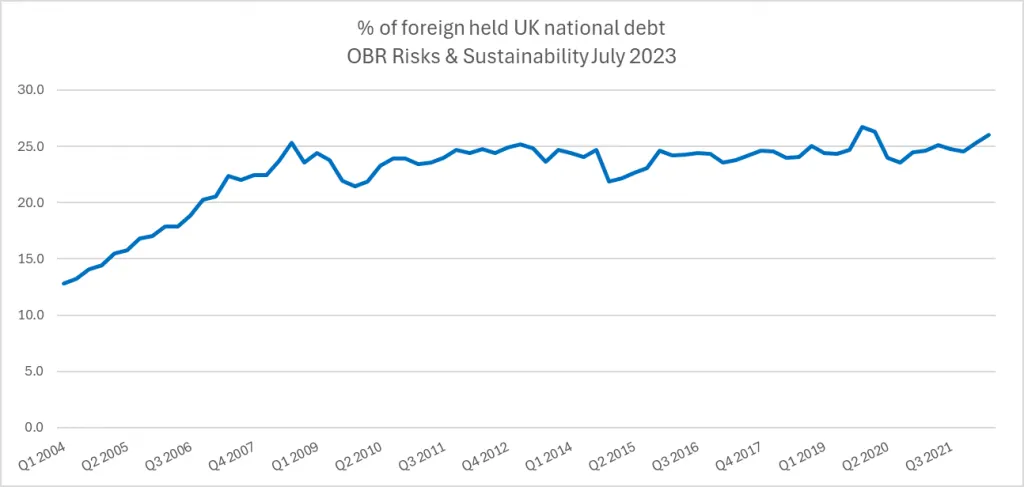 <center>by dfl195, from OBR data</center> <h3>Savings and domestic demand</h3> The domestic demand for UK Bonds is based on the ability to save. Richer people save proportionately more than the more numerous poorer parts of society, and they save proportionately more of their incremental income. It’s hard to disaggregate savings by household income from the data I can find, but easing the cost-of-living crises to allow more people to save, even if only through pensions, would help in creating a domestic demand for government bonds. This policy goal also suggests restricting the amount of cash that can be held in ISAs is a mistake, as it’s simpler to do and the banks will convert such cash holdings into bonds. <h3>Quantitative Tightening</h3> Another problem with government policy is “quantitative tightening”. They are swapping their QE Assets for bank cash and now paying interest on those deposits. i.e. it’s a reverse tax, which subsidises bank profits and reduces the budget “head room” thus squeezing government current account expenditure because of the Chancellor’s “fiscal rules”. <h3>Falling Bond Prices</h3> There is an undesirable impact of falling bond prices. Falling prices impact those organisations who use them as collateral for loans or other transactions requiring it. These are, most visibly, Banks and pension funds and the high cost of getting this wrong was illustrated by the potential crisis the Truss administration. The Bank of England, presumably, under strong encouragement from the Treasury, the Bank of England is going to reduce the mandatory capital adequacy ratios of the biggest six banks and the Nationwide building society. This needs to be done with care. The thresholds and inspection regime were established during the regulatory reforms after the 2008 crash. <h3>Counter inflation measures</h3> Another problem is that the Government believes that increasing interest rates is counter inflationary. There are two theories as to why this might be so, and one has been discredited, and the other is inappropriate for dealing with cost-push inflation. The first is the Friedmanite quantitative theory of money, that an increase in prices was the result of too much money in the economy and so a counter inflation policy was to increase interest rates to reduce it and/or to use credit controls. Today’s iteration of this theory requires inflation to be stoked by demand, and increasing interest rates, reduces consumer demand, by reducing effective residual disposable income. (This could be done by taxation in which case the Government would get the money, whereas by increasing interest rates, the Banks get it, an adverse policy outcome, compounded by a refusal to levy a banking windfall tax. ) I would also argue that the inflation spike in the Autumn of 2022 was a cost-push spike caused by output shortages caused by COVID and profiteering in the energy sector. <h3>Bankruptcy</h3> The Government can’t run out of sterling. The true market threat is denial of funds, which is what occurred in Greece. The UK debt to GDP ratio is, just, under 100%. This is low by international standards. The debt to GDP ratio is exceeded by a number of OECD economies. The best measure of this threat would be the sterling credit default swap price which places the likelihood of UK default at ~0.3%. This is good for the leading western economies, again about standard. 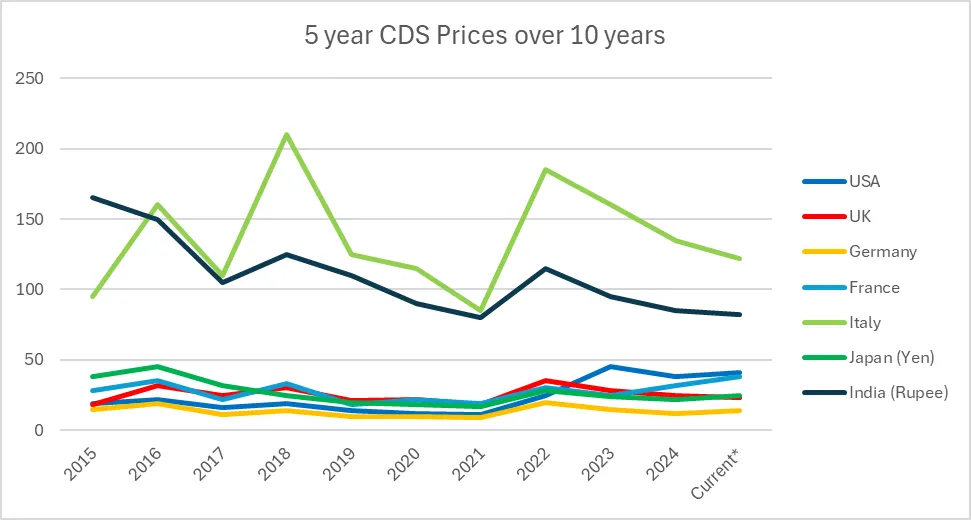 <center>by dfl195, from gemini data</center> From google gemini, https://gemini.google.com/app/9679972ac86a8ddc , they say, a table showing the approximate 5-year Sovereign CDS spreads (in basis points, where 100 bps = 1%) at the end of each year. ### The financial rules Compounding all this deliberate confusion is the deficit fetishism embedded in Reeves’ financial rules. Simon Wren-Lewis, the economist in Corbyn’s leadership team thought to be the most influential supporter of financial rules argues they were needed to protect investment. Reeves’ rules are designed to “break-even” on a yearly budget by the end of the Parliament. The only way this might happen is by growing the economy and increasing the GDP. Even within the constraints of monetarist economics, more relaxed rules could be adopted and as I argue above, the fear of default is infinitesimally low. If growth is the target, then the key tool for delivering growth should be the Industrial Policy to which I offer a critique an article of the Chartist and summarise on this blog. In that article, I examine the Industrial Policy, praising its comprehensive nature and suggesting that capital mobilisation via the City is unlikely to be successful as it hasn’t been before and that there seems to be a low ability to innovate the economy in the UK. Yet another of the problems with the rules and the failure in the budgets is that GDP growth is dependent on human capital and yet the Government view is that investment in human capital is current account expenditure and is not the focus of education spending. This both embeds a weakness in the policies and illustrates the arbitrary nature of the rules. ## Are the bond markets a problem to the Labour Government? Yes and No, but high yields are not a reasonable factor for determining the deficit. - Yields are an outcome and caused by changes in price; their impact on the funding the deficit is limited and price changes are not caused by a deficit, but in a limited way by the expectation of inflation. - The cost of government borrowing is mainly fixed and where variable, is based on the inflation. - The markets do not consider the governments default risk to be particularly high. - The debt management policies being pursued are not aimed at reducing the cost of borrowing. - The so-called rules are the toughest since they were invented as an ideological tool to justify austerity. There’s room to rewrite them. - The industrial programme is insufficiently activist to repair the economy. <center>ooOOOoo</center> Originally published at [https://davelevy.info](https://davelevy.info/on-public-debt-yields-and-its-affordability/) on January 2, 2026. |
| json metadata | {"tags":["ukpolitics","fiscalpolicy"],"image":["https://cdn.steemitimages.com/DQmfM2fPKmkG91WwWjo12J583hZnEwyR9s2HTamwZGgwmwr/image.png","https://cdn.steemitimages.com/DQmPH1YRJn7EqGgBLV7UHPk667jejYfK87yuzDNEGWLWzQH/image.png","https://cdn.steemitimages.com/DQmRNdoEW4yJc2LnAcHU1jhhhi3SMBcMNmWFjnKtYrN6quT/image.png"],"links":["https://gemini.google.com/app/9679972ac86a8ddc","https://davelevy.info/on-public-debt-yields-and-its-affordability/"],"app":"steemit/0.2","format":"markdown"} |
| parent author | |
| parent permlink | ukpolitics |
| permlink | on-uk-public-debt-yields-and-affordability |
| title | On UK public debt, yields and affordability |
| Transaction Info | Block #102250648/Trx d9b51f6f25f7d9ee5543394361d7914785f40ad3 |
View Raw JSON Data
{
"block": 102250648,
"op": [
"comment",
{
"author": "davelevy",
"body": "The government and Labour MPs seem fascinated by bond yields. They present the fact that UK yields are high is seen as a short cut to arguing that the Government can’t afford the interest rates on bonds and arguing that the last word on the deficit has to be held by the markets.\n\n\n<center>from unsplash</center>\n\nThis article looks at what the ‘yield’ actually is, argues it is the outcome of policy decisions, that rising yields have no effect or at least very little effect on public finances. It also argues that quantitative tightening makes the affordability of the deficit worse and that alternative debt management operations would ease the situation. It also suggests that the credit default swap price is a better indicator of the market assessment of the viability of public finances.\n## What is a bond?\n\nFirstly, let’s examine what is a government bond also known as Gilts. A government bond is a certificate proving a loan to the government. It is issued with a face value (or principal), a payment schedule (consisting of a payment value, and frequency, usually described as an annual interest rate), and a duration. The payments are often referred to as coupons due to the original paper format of UK government bonds. The government will redeem the bond at the end of its life at its face value. While they have a face value, on issue, the government may receive more or less than the face value of the bond depending on the coupon value, the current market interest rate, itself based on the Bank of England’s interest rate, and the markets expectations of future interest rates.\n\n<h2>What is a yield?</h2>\n\nThe yield is a mathematical relationship between the price and the coupon. The coupon is the periodic payment made to the bondholder i.e. the interest on the loan. Changes in bond yields are in fact a reflection of a change in price. As prices fall, because the coupon payment does not change, the yield increases. If prices rise, then the yield falls.\n\nAbout 75% of UK debt Is a fixed coupon, a change in price of the bonds does not impact the interest payments made by the government to the bond holders. The remaining 25% are index linked to the RPI, the measure of price inflation, so again, the fiscal deficit does not impact interest payments.\n\n## Public Debt Management\n### National Debt & Inflation\n\nIt might be desirable if the government bought back some of these index linked bonds, although they only become a burden during periods of rising inflation. One advantage of having these bonds is that the difference in yield between these inflation-linked gilts and conventional (fixed-rate) gilts of similar maturity provides a market-implied forecast of future RPI inflation. The markets also use interest rate swaps as a means of hedging the inflation risk, and thus exposing the market’s view as to the future rates of inflation.\n\n### National Debt and price volatility\n\nIt might also be useful to buy back [some of] the foreign held bonds at least to manage the ratio. Foreign held debt is also about 25% of the total and is seen as more price sensitive then domestically held debt. The proportion of foreign held government debt has increased significantly over the last twenty years, under the Tories.\n\n\n<center>by dfl195, from OBR data</center>\n\n<h3>Savings and domestic demand</h3>\n\nThe domestic demand for UK Bonds is based on the ability to save. Richer people save proportionately more than the more numerous poorer parts of society, and they save proportionately more of their incremental income. \n\nIt’s hard to disaggregate savings by household income from the data I can find, but easing the cost-of-living crises to allow more people to save, even if only through pensions, would help in creating a domestic demand for government bonds. This policy goal also suggests restricting the amount of cash that can be held in ISAs is a mistake, as it’s simpler to do and the banks will convert such cash holdings into bonds.\n\n<h3>Quantitative Tightening</h3>\n\nAnother problem with government policy is “quantitative tightening”. They are swapping their QE Assets for bank cash and now paying interest on those deposits. i.e. it’s a reverse tax, which subsidises bank profits and reduces the budget “head room” thus squeezing government current account expenditure because of the Chancellor’s “fiscal rules”.\n\n<h3>Falling Bond Prices</h3>\n\nThere is an undesirable impact of falling bond prices. Falling prices impact those organisations who use them as collateral for loans or other transactions requiring it. These are, most visibly, Banks and pension funds and the high cost of getting this wrong was illustrated by the potential crisis the Truss administration.\n\nThe Bank of England, presumably, under strong encouragement from the Treasury, the Bank of England is going to reduce the mandatory capital adequacy ratios of the biggest six banks and the Nationwide building society. This needs to be done with care. The thresholds and inspection regime were established during the regulatory reforms after the 2008 crash.\n\n<h3>Counter inflation measures</h3>\n\nAnother problem is that the Government believes that increasing interest rates is counter inflationary. There are two theories as to why this might be so, and one has been discredited, and the other is inappropriate for dealing with cost-push inflation. The first is the Friedmanite quantitative theory of money, that an increase in prices was the result of too much money in the economy and so a counter inflation policy was to increase interest rates to reduce it and/or to use credit controls. Today’s iteration of this theory requires inflation to be stoked by demand, and increasing interest rates, reduces consumer demand, by reducing effective residual disposable income. (This could be done by taxation in which case the Government would get the money, whereas by increasing interest rates, the Banks get it, an adverse policy outcome, compounded by a refusal to levy a banking windfall tax. ) I would also argue that the inflation spike in the Autumn of 2022 was a cost-push spike caused by output shortages caused by COVID and profiteering in the energy sector.\n\n<h3>Bankruptcy</h3>\n\nThe Government can’t run out of sterling. The true market threat is denial of funds, which is what occurred in Greece. The UK debt to GDP ratio is, just, under 100%. This is low by international standards. The debt to GDP ratio is exceeded by a number of OECD economies. The best measure of this threat would be the sterling credit default swap price which places the likelihood of UK default at ~0.3%. This is good for the leading western economies, again about standard.\n\n\n<center>by dfl195, from gemini data</center>\n\nFrom google gemini, https://gemini.google.com/app/9679972ac86a8ddc , they say, a table showing the approximate 5-year Sovereign CDS spreads (in basis points, where 100 bps = 1%) at the end of each year.\n\n### The financial rules\n\nCompounding all this deliberate confusion is the deficit fetishism embedded in Reeves’ financial rules. Simon Wren-Lewis, the economist in Corbyn’s leadership team thought to be the most influential supporter of financial rules argues they were needed to protect investment. Reeves’ rules are designed to “break-even” on a yearly budget by the end of the Parliament. The only way this might happen is by growing the economy and increasing the GDP. Even within the constraints of monetarist economics, more relaxed rules could be adopted and as I argue above, the fear of default is infinitesimally low.\n\nIf growth is the target, then the key tool for delivering growth should be the Industrial Policy to which I offer a critique an article of the Chartist and summarise on this blog. In that article, I examine the Industrial Policy, praising its comprehensive nature and suggesting that capital mobilisation via the City is unlikely to be successful as it hasn’t been before and that there seems to be a low ability to innovate the economy in the UK. Yet another of the problems with the rules and the failure in the budgets is that GDP growth is dependent on human capital and yet the Government view is that investment in human capital is current account expenditure and is not the focus of education spending. This both embeds a weakness in the policies and illustrates the arbitrary nature of the rules. \n\n## Are the bond markets a problem to the Labour Government?\n\nYes and No, but high yields are not a reasonable factor for determining the deficit.\n\n- Yields are an outcome and caused by changes in price; their impact on the funding the deficit is limited and price changes are not caused by a deficit, but in a limited way by the expectation of inflation.\n- The cost of government borrowing is mainly fixed and where variable, is based on the inflation.\n- The markets do not consider the governments default risk to be particularly high.\n- The debt management policies being pursued are not aimed at reducing the cost of borrowing.\n- The so-called rules are the toughest since they were invented as an ideological tool to justify austerity. There’s room to rewrite them.\n- The industrial programme is insufficiently activist to repair the economy.\n\n<center>ooOOOoo</center>\n\nOriginally published at [https://davelevy.info](https://davelevy.info/on-public-debt-yields-and-its-affordability/) on January 2, 2026.",
"json_metadata": "{\"tags\":[\"ukpolitics\",\"fiscalpolicy\"],\"image\":[\"https://cdn.steemitimages.com/DQmfM2fPKmkG91WwWjo12J583hZnEwyR9s2HTamwZGgwmwr/image.png\",\"https://cdn.steemitimages.com/DQmPH1YRJn7EqGgBLV7UHPk667jejYfK87yuzDNEGWLWzQH/image.png\",\"https://cdn.steemitimages.com/DQmRNdoEW4yJc2LnAcHU1jhhhi3SMBcMNmWFjnKtYrN6quT/image.png\"],\"links\":[\"https://gemini.google.com/app/9679972ac86a8ddc\",\"https://davelevy.info/on-public-debt-yields-and-its-affordability/\"],\"app\":\"steemit/0.2\",\"format\":\"markdown\"}",
"parent_author": "",
"parent_permlink": "ukpolitics",
"permlink": "on-uk-public-debt-yields-and-affordability",
"title": "On UK public debt, yields and affordability"
}
],
"op_in_trx": 0,
"timestamp": "2026-01-02T09:35:09",
"trx_id": "d9b51f6f25f7d9ee5543394361d7914785f40ad3",
"trx_in_block": 1,
"virtual_op": 0
}remlaps-liteupvoted (100.00%) @davelevy / the-single-market2025/12/31 16:03:33
remlaps-liteupvoted (100.00%) @davelevy / the-single-market
2025/12/31 16:03:33
| author | davelevy |
| permlink | the-single-market |
| voter | remlaps-lite |
| weight | 10000 (100.00%) |
| Transaction Info | Block #102200914/Trx 0a7f7decee2644d652d76bb75bb610b6a4ba1708 |
View Raw JSON Data
{
  "block": 102200914,
  "op": [
    "vote",
    {
      "author": "davelevy",
      "permlink": "the-single-market",
      "voter": "remlaps-lite",
      "weight": 10000
    }
  ],
  "op_in_trx": 0,
  "timestamp": "2025-12-31T16:03:33",
  "trx_id": "0a7f7decee2644d652d76bb75bb610b6a4ba1708",
  "trx_in_block": 0,
  "virtual_op": 0
}remlapsupvoted (100.00%) @davelevy / the-single-market2025/12/31 16:03:03
remlapsupvoted (100.00%) @davelevy / the-single-market
2025/12/31 16:03:03
| author | davelevy |
| permlink | the-single-market |
| voter | remlaps |
| weight | 10000 (100.00%) |
| Transaction Info | Block #102200904/Trx 9402ab7c91797e13432eccd7f4f5a4acd11405e9 |
View Raw JSON Data
{
  "block": 102200904,
  "op": [
    "vote",
    {
      "author": "davelevy",
      "permlink": "the-single-market",
      "voter": "remlaps",
      "weight": 10000
    }
  ],
  "op_in_trx": 0,
  "timestamp": "2025-12-31T16:03:03",
  "trx_id": "9402ab7c91797e13432eccd7f4f5a4acd11405e9",
  "trx_in_block": 0,
  "virtual_op": 0
}fadiaupvoted (100.00%) @davelevy / the-single-market2025/12/31 11:10:42
fadiaupvoted (100.00%) @davelevy / the-single-market
2025/12/31 11:10:42
| author | davelevy |
| permlink | the-single-market |
| voter | fadia |
| weight | 10000 (100.00%) |
| Transaction Info | Block #102195074/Trx 6ed66a4ed5a5d7cba3c4f2d32621aab1227a482e |
View Raw JSON Data
{
  "block": 102195074,
  "op": [
    "vote",
    {
      "author": "davelevy",
      "permlink": "the-single-market",
      "voter": "fadia",
      "weight": 10000
    }
  ],
  "op_in_trx": 0,
  "timestamp": "2025-12-31T11:10:42",
  "trx_id": "6ed66a4ed5a5d7cba3c4f2d32621aab1227a482e",
  "trx_in_block": 2,
  "virtual_op": 0
}davelevypublished a new post: the-single-market2025/12/31 10:30:36
davelevypublished a new post: the-single-market
2025/12/31 10:30:36
| author | davelevy |
| body | The number of senior labour movement figures have argued over the Christmas break that the UK should seek to rejoin the European Union’s customs union. They leave out a call to rejoin the single market.  <center>from unsplash</center> The customs union relates to tariffs, the single market governs common non tariff import barriers on goods & services. The single market also deals with freedom of movement of capital and labour. I question whether joining the customs union is sufficient to deliver the increased growth that is proponents and the country seems to want. Obviously, the single market opens the issues of free movement of people and trade sovereignty (as does the customs union). Now that it’s understood, British people seemed to want to return to the free movement and there is no national sovereignty in international trade. I believe that the UK should join the customs union and single market now, and that Labour should put a rejoin promise in the next manifesto. The near-fetishist concentration on in trade and economics suggests that most of our parliamentarians are not yet ready to be good citizens within the European Union. It is necessary that they change their minds, and Labour must play its part bringing this about. The UK was and will be a better place to live within the European Union. <center>ooOOooo</center> Originally published at [https://davelevy.info](https://davelevy.info/the-single-market-2/) on December 29, 2025. |
| json metadata | {"tags":["ukpolitics","rejoineu","labourparty","starmeradministration"],"image":["https://cdn.steemitimages.com/DQmdMECFdpuhePVZV9vgWMyApsAHpUqpv3AyC1BTSZ6gWZM/image.png"],"links":["https://davelevy.info/the-single-market-2/"],"app":"steemit/0.2","format":"markdown"} |
| parent author | |
| parent permlink | ukpolitics |
| permlink | the-single-market |
| title | The single market |
| Transaction Info | Block #102194277/Trx 9a67b6fe68f9173a74cd3e2056e798afdb3e904c |
View Raw JSON Data
{
"block": 102194277,
"op": [
"comment",
{
"author": "davelevy",
"body": "The number of senior labour movement figures have argued over the Christmas break that the UK should seek to rejoin the European Union’s customs union. They leave out a call to rejoin the single market.\n\n\n\n<center>from unsplash</center>\n\nThe customs union relates to tariffs, the single market governs common non tariff import barriers on goods & services. The single market also deals with freedom of movement of capital and labour.\n\nI question whether joining the customs union is sufficient to deliver the increased growth that is proponents and the country seems to want.\n\nObviously, the single market opens the issues of free movement of people and trade sovereignty (as does the customs union). Now that it’s understood, British people seemed to want to return to the free movement and there is no national sovereignty in international trade.\n\nI believe that the UK should join the customs union and single market now, and that Labour should put a rejoin promise in the next manifesto.\n\nThe near-fetishist concentration on in trade and economics suggests that most of our parliamentarians are not yet ready to be good citizens within the European Union. It is necessary that they change their minds, and Labour must play its part bringing this about.\n\nThe UK was and will be a better place to live within the European Union.\n\n<center>ooOOooo</center>\n\nOriginally published at [https://davelevy.info](https://davelevy.info/the-single-market-2/) on December 29, 2025.",
"json_metadata": "{\"tags\":[\"ukpolitics\",\"rejoineu\",\"labourparty\",\"starmeradministration\"],\"image\":[\"https://cdn.steemitimages.com/DQmdMECFdpuhePVZV9vgWMyApsAHpUqpv3AyC1BTSZ6gWZM/image.png\"],\"links\":[\"https://davelevy.info/the-single-market-2/\"],\"app\":\"steemit/0.2\",\"format\":\"markdown\"}",
"parent_author": "",
"parent_permlink": "ukpolitics",
"permlink": "the-single-market",
"title": "The single market"
}
],
"op_in_trx": 0,
"timestamp": "2025-12-31T10:30:36",
"trx_id": "9a67b6fe68f9173a74cd3e2056e798afdb3e904c",
"trx_in_block": 0,
"virtual_op": 0
}davelevyupvoted (100.00%) @davelevy / on-the-autumn-statement-20262025/12/31 10:24:42
davelevyupvoted (100.00%) @davelevy / on-the-autumn-statement-2026
2025/12/31 10:24:42
| author | davelevy |
| permlink | on-the-autumn-statement-2026 |
| voter | davelevy |
| weight | 10000 (100.00%) |
| Transaction Info | Block #102194159/Trx b6086d126de3ac3729357d456d8524dd72645af7 |
View Raw JSON Data
{
  "block": 102194159,
  "op": [
    "vote",
    {
      "author": "davelevy",
      "permlink": "on-the-autumn-statement-2026",
      "voter": "davelevy",
      "weight": 10000
    }
  ],
  "op_in_trx": 0,
  "timestamp": "2025-12-31T10:24:42",
  "trx_id": "b6086d126de3ac3729357d456d8524dd72645af7",
  "trx_in_block": 0,
  "virtual_op": 0
}davelevycustom json: notify2025/12/31 00:57:06
davelevycustom json: notify
2025/12/31 00:57:06
| id | notify |
| json | ["setLastRead",{"date":"2025-12-31T00:57:06"}] |
| required auths | [] |
| required posting auths | ["davelevy"] |
| Transaction Info | Block #102182829/Trx 8d00d8c2151967adb32166cf7dc2851a1150ee15 |
View Raw JSON Data
{
  "block": 102182829,
  "op": [
    "custom_json",
    {
      "id": "notify",
      "json": "[\"setLastRead\",{\"date\":\"2025-12-31T00:57:06\"}]",
      "required_auths": [],
      "required_posting_auths": [
        "davelevy"
      ]
    }
  ],
  "op_in_trx": 0,
  "timestamp": "2025-12-31T00:57:06",
  "trx_id": "8d00d8c2151967adb32166cf7dc2851a1150ee15",
  "trx_in_block": 4,
  "virtual_op": 0
}davelevypublished a new post: on-the-autumn-statement-20262025/12/31 00:55:57
davelevypublished a new post: on-the-autumn-statement-2026
2025/12/31 00:55:57
| author | davelevy |
| body | A quick note on the budget, remembering I wasn’t as [critical of last year’s as some](https://davelevy.info/a-budget-that-needs-improvement-exceeds-expectations/), at least not on macro-economic grounds. I was obviously against the failure to abolish the two child cap, but also against the failure to properly fund universities, students, and local government.  <center><i>from free malaysia today cc 2024 by</i></center> So this budget is, to me, a bit meh and I [agree with Fisher](https://x.com/FisherAndrew79/status/1993684671960326640?s=20) why wait for a year? Still nothing on HE or Local Government finance, and the wealth taxation is very weak and poorly focused. No capital gains tax equalisation, no financial transaction tax. The freezing of tax free allowance amounts is probably more damaging to those on the margin of the upper rate tax band but as I read it, it’s a piece of accounting magic. There were no plans to change it for the next two tax years anyway, and they can change their minds, although some of the impact will occur after the next election. Also the FT reports that [leading business people consider it insufficiently stimulating of growth](https://www.ft.com/content/887dc5af-cc19-4478-90ab-6c7bf5fc5d4c), which in their case is probably not code for, “We need to rejoin the single market and customs union.”, although there are many, including me and [Liz Webster](https://x.com/LizWebsterSBF/status/1993579033536118815?s=20), that are saying so; our macro-economic arguments recently augmented by [a report](https://www.nber.org/papers/w34459) from the US non-partisan National Bureau of Economic Research and by Ryan Bourne’s [recanting of his pro-Brexit position](https://x.com/LizWebsterSBF/status/1994052219834872250). <center>ooOOOoo</center> Originally published at [https://davelevy.info](https://davelevy.info/on-the-autumn-statement-2026/) on November 28, 2025. |
| json metadata | {"tags":["ukpolitics","autumnstatement2026","rejoineu"],"image":["https://cdn.steemitimages.com/DQmPzqK1LAEvKsthRnc38Rwne1mASDhvArzpW5EPnRGQUoF/image.png"],"links":["https://davelevy.info/a-budget-that-needs-improvement-exceeds-expectations/","https://x.com/FisherAndrew79/status/1993684671960326640?s=20","https://www.ft.com/content/887dc5af-cc19-4478-90ab-6c7bf5fc5d4c","https://x.com/LizWebsterSBF/status/1993579033536118815?s=20","https://www.nber.org/papers/w34459","https://x.com/LizWebsterSBF/status/1994052219834872250","https://davelevy.info/on-the-autumn-statement-2026/"],"app":"steemit/0.2","format":"markdown"} |
| parent author | |
| parent permlink | ukpolitics |
| permlink | on-the-autumn-statement-2026 |
| title | On the autumn statement 2026 |
| Transaction Info | Block #102182806/Trx 034f8f188f1d78d7140dd6caf878bbb8817a690c |
View Raw JSON Data
{
"block": 102182806,
"op": [
"comment",
{
"author": "davelevy",
"body": "A quick note on the budget, remembering I wasn’t as [critical of last year’s as some](https://davelevy.info/a-budget-that-needs-improvement-exceeds-expectations/), at least not on macro-economic grounds. I was obviously against the failure to abolish the two child cap, but also against the failure to properly fund universities, students, and local government.\n\n\n\n<center><i>from free malaysia today cc 2024 by</i></center>\n\nSo this budget is, to me, a bit meh and I [agree with Fisher](https://x.com/FisherAndrew79/status/1993684671960326640?s=20) why wait for a year? Still nothing on HE or Local Government finance, and the wealth taxation is very weak and poorly focused. No capital gains tax equalisation, no financial transaction tax.\n\nThe freezing of tax free allowance amounts is probably more damaging to those on the margin of the upper rate tax band but as I read it, it’s a piece of accounting magic. There were no plans to change it for the next two tax years anyway, and they can change their minds, although some of the impact will occur after the next election.\n\nAlso the FT reports that [leading business people consider it insufficiently stimulating of growth](https://www.ft.com/content/887dc5af-cc19-4478-90ab-6c7bf5fc5d4c), which in their case is probably not code for, “We need to rejoin the single market and customs union.”, although there are many, including me and [Liz Webster](https://x.com/LizWebsterSBF/status/1993579033536118815?s=20), that are saying so; our macro-economic arguments recently augmented by [a report](https://www.nber.org/papers/w34459) from the US non-partisan National Bureau of Economic Research and by Ryan Bourne’s [recanting of his pro-Brexit position](https://x.com/LizWebsterSBF/status/1994052219834872250).\n\n<center>ooOOOoo</center>\n\nOriginally published at [https://davelevy.info](https://davelevy.info/on-the-autumn-statement-2026/) on November 28, 2025.",
"json_metadata": "{\"tags\":[\"ukpolitics\",\"autumnstatement2026\",\"rejoineu\"],\"image\":[\"https://cdn.steemitimages.com/DQmPzqK1LAEvKsthRnc38Rwne1mASDhvArzpW5EPnRGQUoF/image.png\"],\"links\":[\"https://davelevy.info/a-budget-that-needs-improvement-exceeds-expectations/\",\"https://x.com/FisherAndrew79/status/1993684671960326640?s=20\",\"https://www.ft.com/content/887dc5af-cc19-4478-90ab-6c7bf5fc5d4c\",\"https://x.com/LizWebsterSBF/status/1993579033536118815?s=20\",\"https://www.nber.org/papers/w34459\",\"https://x.com/LizWebsterSBF/status/1994052219834872250\",\"https://davelevy.info/on-the-autumn-statement-2026/\"],\"app\":\"steemit/0.2\",\"format\":\"markdown\"}",
"parent_author": "",
"parent_permlink": "ukpolitics",
"permlink": "on-the-autumn-statement-2026",
"title": "On the autumn statement 2026"
}
],
"op_in_trx": 0,
"timestamp": "2025-12-31T00:55:57",
"trx_id": "034f8f188f1d78d7140dd6caf878bbb8817a690c",
"trx_in_block": 1,
"virtual_op": 0
}davelevyreceived 1.059 STEEM, 1.074 SP author reward for @davelevy / labour-s-macroeconomics-20232025/12/08 20:59:33
davelevyreceived 1.059 STEEM, 1.074 SP author reward for @davelevy / labour-s-macroeconomics-2023
2025/12/08 20:59:33
| author | davelevy |
| permlink | labour-s-macroeconomics-2023 |
| sbd payout | 0.000 SBD |
| steem payout | 1.059 STEEM |
| vesting payout | 1746.513839 VESTS |
| Transaction Info | Block #101546186/Virtual Operation #4 |
View Raw JSON Data
{
  "block": 101546186,
  "op": [
    "author_reward",
    {
      "author": "davelevy",
      "permlink": "labour-s-macroeconomics-2023",
      "sbd_payout": "0.000 SBD",
      "steem_payout": "1.059 STEEM",
      "vesting_payout": "1746.513839 VESTS"
    }
  ],
  "op_in_trx": 0,
  "timestamp": "2025-12-08T20:59:33",
  "trx_id": "0000000000000000000000000000000000000000",
  "trx_in_block": 4294967295,
  "virtual_op": 4
}davelevyreceived 12.177 STEEM, 12.338 SP author reward for @davelevy / 2l8wnw-innovation-happens-elsewhere2025/12/07 21:41:09
davelevyreceived 12.177 STEEM, 12.338 SP author reward for @davelevy / 2l8wnw-innovation-happens-elsewhere
2025/12/07 21:41:09
| author | davelevy |
| permlink | 2l8wnw-innovation-happens-elsewhere |
| sbd payout | 0.000 SBD |
| steem payout | 12.177 STEEM |
| vesting payout | 20066.532588 VESTS |
| Transaction Info | Block #101518273/Virtual Operation #13 |
View Raw JSON Data
{
  "block": 101518273,
  "op": [
    "author_reward",
    {
      "author": "davelevy",
      "permlink": "2l8wnw-innovation-happens-elsewhere",
      "sbd_payout": "0.000 SBD",
      "steem_payout": "12.177 STEEM",
      "vesting_payout": "20066.532588 VESTS"
    }
  ],
  "op_in_trx": 0,
  "timestamp": "2025-12-07T21:41:09",
  "trx_id": "0000000000000000000000000000000000000000",
  "trx_in_block": 4294967295,
  "virtual_op": 13
}moeckiupvoted (65.00%) @davelevy / labour-s-macroeconomics-20232025/12/01 22:07:30
moeckiupvoted (65.00%) @davelevy / labour-s-macroeconomics-2023
2025/12/01 22:07:30
| author | davelevy |
| permlink | labour-s-macroeconomics-2023 |
| voter | moecki |
| weight | 6500 (65.00%) |
| Transaction Info | Block #101346344/Trx e8a5cf061f7341f7da71f021505e3adbb35d119f |
View Raw JSON Data
{
  "block": 101346344,
  "op": [
    "vote",
    {
      "author": "davelevy",
      "permlink": "labour-s-macroeconomics-2023",
      "voter": "moecki",
      "weight": 6500
    }
  ],
  "op_in_trx": 0,
  "timestamp": "2025-12-01T22:07:30",
  "trx_id": "e8a5cf061f7341f7da71f021505e3adbb35d119f",
  "trx_in_block": 0,
  "virtual_op": 0
}luciuscatoupvoted (80.00%) @davelevy / labour-s-macroeconomics-20232025/12/01 21:05:39
luciuscatoupvoted (80.00%) @davelevy / labour-s-macroeconomics-2023
2025/12/01 21:05:39
| author | davelevy |
| permlink | labour-s-macroeconomics-2023 |
| voter | luciuscato |
| weight | 8000 (80.00%) |
| Transaction Info | Block #101345107/Trx b942b9ab78a6bbedf48ca2b4e87e2623f1f3af34 |
View Raw JSON Data
{
  "block": 101345107,
  "op": [
    "vote",
    {
      "author": "davelevy",
      "permlink": "labour-s-macroeconomics-2023",
      "voter": "luciuscato",
      "weight": 8000
    }
  ],
  "op_in_trx": 0,
  "timestamp": "2025-12-01T21:05:39",
  "trx_id": "b942b9ab78a6bbedf48ca2b4e87e2623f1f3af34",
  "trx_in_block": 1,
  "virtual_op": 0
}davelevypublished a new post: labour-s-macroeconomics-20232025/12/01 20:59:33
davelevypublished a new post: labour-s-macroeconomics-2023
2025/12/01 20:59:33
| author | davelevy |
| body | This was written two years ago in the autumn, following Labour's last conference in opposition. I think it's aged quite well.  <center>by me!</center> I was in Liverpool for Labour’s Conference this year, with a balcony credential i.e. I could enter the conference, fringe rooms and exhibition hall. As I was not a delegate, I spent a bit more time in the fringe and the bars, and much less time in the hall. Last year I was able to report on nearly every debate, I cannot do that this year, but I observed both Reeves ( [video](https://www.youtube.com/live/_RA_EGWUtxM?si=lbLduFL7QqKwd6CP&t=775) | [text](https://labour.org.uk/updates/press-releases/rachel-reeves-speech-at-labour-conference/)) and Starmer’s ( [video](https://www.youtube.com/live/ZhJ3AFxflLo?si=LL0PJCnWIwcl6fmj&t=580) | [text](https://labour.org.uk/updates/press-releases/keir-starmers-speech-at-labour-conference/)) speeches and the platform’s control-freakery. Interesting highlights include Reeves’ promise that she will chase the beneficiaries of the covid procurements (and other corruptions in the government procurement chain). I am concerned about the promise to reduce consultancy fees, because while some consultancy projects are wasteful and of questionable value, many are caused by the fact that the Civil Service and local government won’t pay the going rate for scarce skills. Reeves continues to play her, “I am an economist card”, but there are those of us who feel that it means she is tied to one and only one theory of macro-economic management. This fear was reinforced by a video of Mark Carney, the previous Bank of England Governor, (now PM of Canada) who wished her well. Both of these speeches if anything was slightly to the left of speeches made previously, or at least since Reeves’ secureonomics speech in NYC; I thought I had commented on the latter speech but it seems not. I did [make some notes](https://davelevy.info/wiki/backtracking-on-macro/), in which I quote, [Prof. Simon Wren Lewis](https://twitter.com/sjwrenlewis/status/1667091086366457858?s=20), as saying, > “What is arbitrary is having a target for debt to be falling regardless of whether that debt arises from current spending or investment” which I believe sums up his argument well. I also quote Richard Murphy on independence of the Bank of England, and James Meadway who argues that taxes must be raised and that conceding to debt fetishism traps Labour’s policy freedoms. He argues for clarity on tax, clarity on the financial rules and detail on the investment plan. It’s possible, that conceding the need to reduce debt will enable attacks on the policy not defend it. I have some sympathy with Murphy, and have come to agree with Meadway. Starmer announced the increase in housing new starts target by proposing changes to the planning permission process to make Nimbyism harder. This line from the speech is excellent, >[his] party would, in 2024, have to emulate its achievements in 1997 — “to rebuild a crumbling public realm” — 1964 — modernise an economy “left behind by the pace of technology” — and in 1945 — “to build a new Britain out of the trauma of collective sacrifice”. He argues that the next Labour Government will need to do all three. But I wonder if waste and brown field sites are enough to do what’s needed. Certainly, the corruption in the government supply chain if cleaned up should create some space in terms of fiscal management, but whether it’s enough is highly questionable. Admittedly they are hoping to replace the most profligate government in history and so eliminating waste may yield some benefits, but whether it can be recovered without a reduction in service levels will be more difficult to predict. The economist, in an article entitled, [“Britain’s Labour Party embraces supply-side social democracy“](https://www.economist.com/britain/2023/10/11/britains-labour-party-embraces-supply-side-social-democracy) is happy, but with the acceptance of QMT they would be. In many ways, I sort of think that the headline sums up the macroeconomics of the current Labour Party; it’s a new supply side regime which is fine, but if they ignore demand, including export demand, then a mixed economy’s growth driven by the private sector will choke. There’s no point in pump priming investment if the new plant’s output can’t be sold (or otherwise used). One tool to increase demand, would be to tax the rich and give to the poor, whether, through increasing the minimum wage and public sector wages or through increasing benefits since the poor spend more of any incremental income than the rich. Rachel Wearmouth in her review, [highlights](https://www.newstatesman.com/politics/labour/2023/10/the-seven-lessons-of-labour-conference) Reeves increased credibility within Starmer’s team, notes the increased weight and support of business opinion; the article is subtitled with the prediction that the succession will be between Reeves and Streeting; the latter seems to have chosen the hard route, Labour always elects the most left wing person they think will win. Ultimately while they have the goal to deliver high growth, and growth is the best, maybe the only way to rectify the public finances, how this can be done without reversing Brexit and inflating aggregate demand is a question to be answered. They choose to be restricted to supply side measures only and even funding these supply side measures will remain difficult while they maintain the harshest aspects of their fiscal responsibility rules and their promises on tax i.e. no increases in VAT, income tax and no new wealth taxes. The Growth target is a worthy goal but lacks the means of achieving them. This could easily be corrected even if you think that fiscal rules are necessary. Between the two speeches, conference [debated and carried a motion entitled critical infrastructure](https://www.bbc.co.uk/news/uk-politics-67056005) which called on the next Labour Government to renationalise energy and the railways. Of course, the shadow cabinet immediately repudiated this policy. It’s fortunate for them they were able to keep the anti-privatisation in the NHS motion off the order paper. It’s highly likely that if the SHA motion had been debated, like the nationalisations, it would have been carried. I say fortunate, they had to break the rules in order to keep it off the order paper. The leadership will be very happy with the conference, at least they did not say go back to your constituencies and prepare for government. For various reasons this took several days to write and post, I originally backdated it to the day of Rachel Wearmouth’s article i.e. 13th October. Six days later Labour won two crushing by-election victories in middle England, bookending the Conference which had opened shortly after Labour won the Rutherglen and Hamilton West by-election in Scotland; the leadership will argue with good evidence they are doing something right. |
| json metadata | {"tags":["ukpolitics","labourparty","labourprogramme23","rachelreeves"],"image":["https://cdn.steemitimages.com/DQmUFfDKM7MN5ejDN6gaHeuFTS6uCNdip99qV7gzF2H634o/0_htWnXcPnjn3hsh9l.webp"],"links":["https://www.youtube.com/live/_RA_EGWUtxM?si=lbLduFL7QqKwd6CP&t=775","https://labour.org.uk/updates/press-releases/rachel-reeves-speech-at-labour-conference/","https://www.youtube.com/live/ZhJ3AFxflLo?si=LL0PJCnWIwcl6fmj&t=580","https://labour.org.uk/updates/press-releases/keir-starmers-speech-at-labour-conference/","https://davelevy.info/wiki/backtracking-on-macro/","https://twitter.com/sjwrenlewis/status/1667091086366457858?s=20","https://www.economist.com/britain/2023/10/11/britains-labour-party-embraces-supply-side-social-democracy","https://www.newstatesman.com/politics/labour/2023/10/the-seven-lessons-of-labour-conference","https://www.bbc.co.uk/news/uk-politics-67056005"],"app":"steemit/0.2","format":"markdown"} |
| parent author | |
| parent permlink | ukpolitics |
| permlink | labour-s-macroeconomics-2023 |
| title | Labour’s macroeconomics (2023) |
| Transaction Info | Block #101344986/Trx 1423ff1df822f0c00f0737721fbdba53b04b884e |
View Raw JSON Data
{
"block": 101344986,
"op": [
"comment",
{
"author": "davelevy",
"body": "This was written two years ago in the autumn, following Labour's last conference in opposition. I think it's aged quite well. \n\n \n\n<center>by me!</center>\n\nI was in Liverpool for Labour’s Conference this year, with a balcony credential i.e. I could enter the conference, fringe rooms and exhibition hall. As I was not a delegate, I spent a bit more time in the fringe and the bars, and much less time in the hall. Last year I was able to report on nearly every debate, I cannot do that this year, but I observed both Reeves ( [video](https://www.youtube.com/live/_RA_EGWUtxM?si=lbLduFL7QqKwd6CP&t=775) | [text](https://labour.org.uk/updates/press-releases/rachel-reeves-speech-at-labour-conference/)) and Starmer’s ( [video](https://www.youtube.com/live/ZhJ3AFxflLo?si=LL0PJCnWIwcl6fmj&t=580) | [text](https://labour.org.uk/updates/press-releases/keir-starmers-speech-at-labour-conference/)) speeches and the platform’s control-freakery. \n\nInteresting highlights include Reeves’ promise that she will chase the beneficiaries of the covid procurements (and other corruptions in the government procurement chain). I am concerned about the promise to reduce consultancy fees, because while some consultancy projects are wasteful and of questionable value, many are caused by the fact that the Civil Service and local government won’t pay the going rate for scarce skills.\n\nReeves continues to play her, “I am an economist card”, but there are those of us who feel that it means she is tied to one and only one theory of macro-economic management. This fear was reinforced by a video of Mark Carney, the previous Bank of England Governor, (now PM of Canada) who wished her well.\n\nBoth of these speeches if anything was slightly to the left of speeches made previously, or at least since Reeves’ secureonomics speech in NYC; I thought I had commented on the latter speech but it seems not. I did [make some notes](https://davelevy.info/wiki/backtracking-on-macro/), in which I quote, [Prof. Simon Wren Lewis](https://twitter.com/sjwrenlewis/status/1667091086366457858?s=20), as saying,\n\n> “What is arbitrary is having a target for debt to be falling regardless of whether that debt arises from current spending or investment”\n\nwhich I believe sums up his argument well. I also quote Richard Murphy on independence of the Bank of England, and James Meadway who argues that taxes must be raised and that conceding to debt fetishism traps Labour’s policy freedoms. He argues for clarity on tax, clarity on the financial rules and detail on the investment plan. It’s possible, that conceding the need to reduce debt will enable attacks on the policy not defend it. I have some sympathy with Murphy, and have come to agree with Meadway.\n\nStarmer announced the increase in housing new starts target by proposing changes to the planning permission process to make Nimbyism harder.\n\nThis line from the speech is excellent, \n\n>[his] party would, in 2024, have to emulate its achievements in 1997 — “to rebuild a crumbling public realm” — 1964 — modernise an economy “left behind by the pace of technology” — and in 1945 — “to build a new Britain out of the trauma of collective sacrifice”.\n\nHe argues that the next Labour Government will need to do all three.\n\nBut I wonder if waste and brown field sites are enough to do what’s needed. Certainly, the corruption in the government supply chain if cleaned up should create some space in terms of fiscal management, but whether it’s enough is highly questionable. Admittedly they are hoping to replace the most profligate government in history and so eliminating waste may yield some benefits, but whether it can be recovered without a reduction in service levels will be more difficult to predict.\n\nThe economist, in an article entitled, [“Britain’s Labour Party embraces supply-side social democracy“](https://www.economist.com/britain/2023/10/11/britains-labour-party-embraces-supply-side-social-democracy) is happy, but with the acceptance of QMT they would be. In many ways, I sort of think that the headline sums up the macroeconomics of the current Labour Party; it’s a new supply side regime which is fine, but if they ignore demand, including export demand, then a mixed economy’s growth driven by the private sector will choke. There’s no point in pump priming investment if the new plant’s output can’t be sold (or otherwise used).\n\nOne tool to increase demand, would be to tax the rich and give to the poor, whether, through increasing the minimum wage and public sector wages or through increasing benefits since the poor spend more of any incremental income than the rich.\n\nRachel Wearmouth in her review, [highlights](https://www.newstatesman.com/politics/labour/2023/10/the-seven-lessons-of-labour-conference) Reeves increased credibility within Starmer’s team, notes the increased weight and support of business opinion; the article is subtitled with the prediction that the succession will be between Reeves and Streeting; the latter seems to have chosen the hard route, Labour always elects the most left wing person they think will win.\n\nUltimately while they have the goal to deliver high growth, and growth is the best, maybe the only way to rectify the public finances, how this can be done without reversing Brexit and inflating aggregate demand is a question to be answered. They choose to be restricted to supply side measures only and even funding these supply side measures will remain difficult while they maintain the harshest aspects of their fiscal responsibility rules and their promises on tax i.e. no increases in VAT, income tax and no new wealth taxes.\n\nThe Growth target is a worthy goal but lacks the means of achieving them. This could easily be corrected even if you think that fiscal rules are necessary.\n\nBetween the two speeches, conference [debated and carried a motion entitled critical infrastructure](https://www.bbc.co.uk/news/uk-politics-67056005) which called on the next Labour Government to renationalise energy and the railways. Of course, the shadow cabinet immediately repudiated this policy. It’s fortunate for them they were able to keep the anti-privatisation in the NHS motion off the order paper. It’s highly likely that if the SHA motion had been debated, like the nationalisations, it would have been carried. I say fortunate, they had to break the rules in order to keep it off the order paper.\n\nThe leadership will be very happy with the conference, at least they did not say go back to your constituencies and prepare for government.\n\nFor various reasons this took several days to write and post, I originally backdated it to the day of Rachel Wearmouth’s article i.e. 13th October. Six days later Labour won two crushing by-election victories in middle England, bookending the Conference which had opened shortly after Labour won the Rutherglen and Hamilton West by-election in Scotland; the leadership will argue with good evidence they are doing something right.",
"json_metadata": "{\"tags\":[\"ukpolitics\",\"labourparty\",\"labourprogramme23\",\"rachelreeves\"],\"image\":[\"https://cdn.steemitimages.com/DQmUFfDKM7MN5ejDN6gaHeuFTS6uCNdip99qV7gzF2H634o/0_htWnXcPnjn3hsh9l.webp\"],\"links\":[\"https://www.youtube.com/live/_RA_EGWUtxM?si=lbLduFL7QqKwd6CP&t=775\",\"https://labour.org.uk/updates/press-releases/rachel-reeves-speech-at-labour-conference/\",\"https://www.youtube.com/live/ZhJ3AFxflLo?si=LL0PJCnWIwcl6fmj&t=580\",\"https://labour.org.uk/updates/press-releases/keir-starmers-speech-at-labour-conference/\",\"https://davelevy.info/wiki/backtracking-on-macro/\",\"https://twitter.com/sjwrenlewis/status/1667091086366457858?s=20\",\"https://www.economist.com/britain/2023/10/11/britains-labour-party-embraces-supply-side-social-democracy\",\"https://www.newstatesman.com/politics/labour/2023/10/the-seven-lessons-of-labour-conference\",\"https://www.bbc.co.uk/news/uk-politics-67056005\"],\"app\":\"steemit/0.2\",\"format\":\"markdown\"}",
"parent_author": "",
"parent_permlink": "ukpolitics",
"permlink": "labour-s-macroeconomics-2023",
"title": "Labour’s macroeconomics (2023)"
}
],
"op_in_trx": 0,
"timestamp": "2025-12-01T20:59:33",
"trx_id": "1423ff1df822f0c00f0737721fbdba53b04b884e",
"trx_in_block": 0,
"virtual_op": 0
}moeckiupvoted (71.00%) @davelevy / 2l8wnw-innovation-happens-elsewhere2025/12/01 16:17:12
moeckiupvoted (71.00%) @davelevy / 2l8wnw-innovation-happens-elsewhere
2025/12/01 16:17:12
| author | davelevy |
| permlink | 2l8wnw-innovation-happens-elsewhere |
| voter | moecki |
| weight | 7100 (71.00%) |
| Transaction Info | Block #101339352/Trx 6bf319ebce5e8d07f0d947f82df3c075198eb541 |
View Raw JSON Data
{
  "block": 101339352,
  "op": [
    "vote",
    {
      "author": "davelevy",
      "permlink": "2l8wnw-innovation-happens-elsewhere",
      "voter": "moecki",
      "weight": 7100
    }
  ],
  "op_in_trx": 0,
  "timestamp": "2025-12-01T16:17:12",
  "trx_id": "6bf319ebce5e8d07f0d947f82df3c075198eb541",
  "trx_in_block": 0,
  "virtual_op": 0
}realrobinhoodupvoted (100.00%) @davelevy / 2l8wnw-innovation-happens-elsewhere2025/12/01 03:37:00
realrobinhoodupvoted (100.00%) @davelevy / 2l8wnw-innovation-happens-elsewhere
2025/12/01 03:37:00
| author | davelevy |
| permlink | 2l8wnw-innovation-happens-elsewhere |
| voter | realrobinhood |
| weight | 10000 (100.00%) |
| Transaction Info | Block #101324185/Trx 20af20b79b0769bc5afb2839a5d045e207733557 |
View Raw JSON Data
{
  "block": 101324185,
  "op": [
    "vote",
    {
      "author": "davelevy",
      "permlink": "2l8wnw-innovation-happens-elsewhere",
      "voter": "realrobinhood",
      "weight": 10000
    }
  ],
  "op_in_trx": 0,
  "timestamp": "2025-12-01T03:37:00",
  "trx_id": "20af20b79b0769bc5afb2839a5d045e207733557",
  "trx_in_block": 1,
  "virtual_op": 0
}steemchillerupvoted (100.00%) @davelevy / 2l8wnw-innovation-happens-elsewhere2025/12/01 03:36:51
steemchillerupvoted (100.00%) @davelevy / 2l8wnw-innovation-happens-elsewhere
2025/12/01 03:36:51
| author | davelevy |
| permlink | 2l8wnw-innovation-happens-elsewhere |
| voter | steemchiller |
| weight | 10000 (100.00%) |
| Transaction Info | Block #101324182/Trx 3dcadd2e33535793d95beb95630362c93397ab62 |
View Raw JSON Data
{
  "block": 101324182,
  "op": [
    "vote",
    {
      "author": "davelevy",
      "permlink": "2l8wnw-innovation-happens-elsewhere",
      "voter": "steemchiller",
      "weight": 10000
    }
  ],
  "op_in_trx": 0,
  "timestamp": "2025-12-01T03:36:51",
  "trx_id": "3dcadd2e33535793d95beb95630362c93397ab62",
  "trx_in_block": 0,
  "virtual_op": 0
}remlaps-liteupvoted (100.00%) @davelevy / 2l8wnw-innovation-happens-elsewhere2025/11/30 22:46:18
remlaps-liteupvoted (100.00%) @davelevy / 2l8wnw-innovation-happens-elsewhere
2025/11/30 22:46:18
| author | davelevy |
| permlink | 2l8wnw-innovation-happens-elsewhere |
| voter | remlaps-lite |
| weight | 10000 (100.00%) |
| Transaction Info | Block #101318379/Trx f03a8f304588bc376c2059c3597418af97bdc6ae |
View Raw JSON Data
{
  "block": 101318379,
  "op": [
    "vote",
    {
      "author": "davelevy",
      "permlink": "2l8wnw-innovation-happens-elsewhere",
      "voter": "remlaps-lite",
      "weight": 10000
    }
  ],
  "op_in_trx": 0,
  "timestamp": "2025-11-30T22:46:18",
  "trx_id": "f03a8f304588bc376c2059c3597418af97bdc6ae",
  "trx_in_block": 0,
  "virtual_op": 0
}remlapsupvoted (100.00%) @davelevy / 2l8wnw-innovation-happens-elsewhere2025/11/30 22:46:00
remlapsupvoted (100.00%) @davelevy / 2l8wnw-innovation-happens-elsewhere
2025/11/30 22:46:00
| author | davelevy |
| permlink | 2l8wnw-innovation-happens-elsewhere |
| voter | remlaps |
| weight | 10000 (100.00%) |
| Transaction Info | Block #101318373/Trx c8d77e3e89401ecee7b1c13da1e3aad54e5c9ce5 |
View Raw JSON Data
{
  "block": 101318373,
  "op": [
    "vote",
    {
      "author": "davelevy",
      "permlink": "2l8wnw-innovation-happens-elsewhere",
      "voter": "remlaps",
      "weight": 10000
    }
  ],
  "op_in_trx": 0,
  "timestamp": "2025-11-30T22:46:00",
  "trx_id": "c8d77e3e89401ecee7b1c13da1e3aad54e5c9ce5",
  "trx_in_block": 1,
  "virtual_op": 0
}davelevypublished a new post: 2l8wnw-innovation-happens-elsewhere2025/11/30 21:41:09
davelevypublished a new post: 2l8wnw-innovation-happens-elsewhere
2025/11/30 21:41:09
| author | davelevy |
| body | “The innovators dilemma” is a book by Clayton Christensen, first published in 1997. In it, he explores the paradox that successful companies that do everything right can still fail. The source of this failure, or that observed by the book, is new entrants to markets pushing market disrupting technologies and products, allied to a management inertia avoiding the necessary changes. ## Strategy I was working at Sun Microsystems which briefly became the largest [computer] server vendor in the world, four years later it had gone. I was present at a sales conference when sales staff were criticising the introduction of intel based and other rack optimised blade servers as they competed with Sun’s midrange and super servers. The speaker replied, that if Sun did not introduce these products their competitors would. This is what happened and while Sun arguably had products that could compete, its sales force never learned to sell them and/or chose to push the more expensive and outdated technology. In Sun’s case, it should also be noted that a long term competitor IBM funded the development of Linux which was one of the disruptive technologies that undermined Sun; in this case it wasn’t new entrants. The example we i.e. Sun people studied, or at least those of us that were interested in learning, was that of Kodak whose near monopoly on film was destroyed by digitisation. The problem is partly one of management and strategy renewal. Tiredness will affect all organisations led by a small cadre of leaders. It is one of the reasons that the leading management consultancies use or emulate a partner structure, which if done well provides a scalable leadership. In such a networked leadership structure, parts can fail and the organisation survives. I have also been influenced by a McKinsey Quarterly article, [“Distortions and deceptions in strategic decisions”](https://www.mckinsey.com/business-functions/strategy-and-corporate-finance/our-insights/distortions-and-deceptions-in-strategic-decisions), which examined the role of human bias in investment decisions. This is more important in organisations with a hierarchic and deferential management such as most British corporates and public sector organisations. ## Decision making While preparing my evidence to the London borough of Lewisham ‘s democracy review I reviewed the article and made [a little blog post](https://davelevy.info/risk-bias-and-planning/). In that article I quoted McKinsey in saying that to remove such bias companies needed to establish a culture of constructive debate. In my original post on the McKinsey article, I said, >Despite identifying over-optimism as a frequent occurrence once a proposal has been made, the decision not to proceed is often taken in private and so collaborative decision making cannot neutralise these human shortcomings. One suggestion is to ask the proposer, what their next best proposal is. McKinsey concludes the article with, >Companies can’t afford to ignore the human factor in the making of strategic decisions. They can greatly improve their chances of making good ones by becoming more aware of the way cognitive biases can mislead them, by reviewing their decision-making processes, and by establishing a culture of constructive debate. While in this post, I have focused on eliminating human bias, the McKinsey article also argues that portfolio management techniques help hedge against single or even multiple project failures just as scalable and networked management structure protect against single points of failure. What made me remember the article was its listing of what they call tools to isolate any human bias to me most importantly, is the demand that managers show more of their cards: some companies, for instance, demand that investment recommendations include alternatives, or “next-best” ideas. This was always an essential stage in the Prince 2 project management methodology that I was taught. At the time, I wondered how many of these lessons need to be applied to local authority planning decisions and with the recent news from Brimingham, I can add major IT procurements or even railway line extensions. ## Politics Even political parties, I say, even, on thinking about it, most obviously political parties can suffer from the innovator’s dilemma and cognitive bias. The innovation problem for political parties was brought to my attention in an unfinished white Paper by Emmanuelle Avril of the Université Sorbonne Nouvelle and in the text she quotes the Innovator’s Dilemma. The paper is called, [The (Unintended) Consequences of New Labour: Party Leadership vs Party Management in the British Labour Party](https://davelevy.info/wiki/wp-content/uploads/2017/04/PSA-2015-Avril-party-management.pdf). and was presented to the Political Studies Association 2015 conference, in March so before the election. The abstract states, >The Labour Party illustrates the paradox of highly efficient management tools and techniques leading to systemic failure. Since the mid-90s, in the pursuit of electoral success, leadership of the Labour Party has been subsumed in management of the party. Despite rhetorical emphasis on consensus-building and transparency, the party structure has evolved towards increased centralization and control, with strategic planning limited to delivery of the leadership’s dictates. Such emphasis on results rather than on behaviour in the management of change in the party has had a damaging impact on the organisation, leading, first, to loss of trust and demoralization among members, and, second, to the erosion of party loyalty and civic pride among voters. This paper draws from the fields of political science as well as organisational studies to explore the impact of recent Labour Leaders on the quality of party processes as well as on party reputation. It is based on the long-term participant observation of the Labour Party at local and regional levels, as well as national events such as annual conferences. This paper starts by identifying the distinctive features of New Labour’s party management. It then examines the “unintended consequences” of this brand of party management, showing this model to be mainly self-defeating. The final section provides a general assessment of the impact of this brand of management on organisational learning and innovation. The conclusion points to some of the main weaknesses of the New Labour leadership model and identifies the potential to re-engage with members – and, therefore, with voters – through more transparent, open and responsive structures. Innovation happens elsewhere and is inexorable. |
| json metadata | {"tags":["ukpolitics","innovation","economics","strategy"],"links":["https://www.mckinsey.com/business-functions/strategy-and-corporate-finance/our-insights/distortions-and-deceptions-in-strategic-decisions","https://davelevy.info/risk-bias-and-planning/","https://davelevy.info/wiki/wp-content/uploads/2017/04/PSA-2015-Avril-party-management.pdf"],"app":"steemit/0.2","format":"markdown"} |
| parent author | |
| parent permlink | ukpolitics |
| permlink | 2l8wnw-innovation-happens-elsewhere |
| title | Innovation happens elsewhere! |
| Transaction Info | Block #101317078/Trx 9374339fe32a8a6a3beed2147c2a66bec3e747f2 |
View Raw JSON Data
{
  "block": 101317078,
  "op": [
    "comment",
    {
      "author": "davelevy",
      "body": "“The innovators dilemma” is a book by Clayton Christensen, first published in 1997. In it, he explores the paradox that successful companies that do everything right can still fail. The source of this failure, or that observed by the book, is new entrants to markets pushing market disrupting technologies and products, allied to a management inertia avoiding the necessary changes.\n\n## Strategy\n\nI was working at Sun Microsystems which briefly became the largest [computer] server vendor in the world, four years later it had gone. I was present at a sales conference when sales staff were criticising the introduction of intel based and other rack optimised blade servers as they competed with Sun’s midrange and super servers. The speaker replied, that if Sun did not introduce these products their competitors would. This is what happened and while Sun arguably had products that could compete, its sales force never learned to sell them and/or chose to push the more expensive and outdated technology. In Sun’s case, it should also be noted that a long term competitor IBM funded the development of Linux which was one of the disruptive technologies that undermined Sun; in this case it wasn’t new entrants. The example we i.e. Sun people studied, or at least those of us that were interested in learning, was that of Kodak whose near monopoly on film was destroyed by digitisation.\n\nThe problem is partly one of management and strategy renewal. Tiredness will affect all organisations led by a small cadre of leaders. It is one of the reasons that the leading management consultancies use or emulate a partner structure, which if done well provides a scalable leadership. In such a networked leadership structure, parts can fail and the organisation survives.\n\nI have also been influenced by a McKinsey Quarterly article, [“Distortions and deceptions in strategic decisions”](https://www.mckinsey.com/business-functions/strategy-and-corporate-finance/our-insights/distortions-and-deceptions-in-strategic-decisions), which examined the role of human bias in investment decisions. This is more important in organisations with a hierarchic and deferential management such as most British corporates and public sector organisations.\n\n## Decision making\n\nWhile preparing my evidence to the London borough of Lewisham ‘s democracy review I reviewed the article and made [a little blog post](https://davelevy.info/risk-bias-and-planning/). In that article I quoted McKinsey in saying that to remove such bias companies needed to establish a culture of constructive debate. In my original post on the McKinsey article, I said,\n\n>Despite identifying over-optimism as a frequent occurrence once a proposal has been made, the decision not to proceed is often taken in private and so collaborative decision making cannot neutralise these human shortcomings. One suggestion is to ask the proposer, what their next best proposal is.\n\nMcKinsey concludes the article with,\n\n>Companies can’t afford to ignore the human factor in the making of strategic decisions. They can greatly improve their chances of making good ones by becoming more aware of the way cognitive biases can mislead them, by reviewing their decision-making processes, and by establishing a culture of constructive debate.\n\nWhile in this post, I have focused on eliminating human bias, the McKinsey article also argues that portfolio management techniques help hedge against single or even multiple project failures just as scalable and networked management structure protect against single points of failure.\n\nWhat made me remember the article was its listing of what they call tools to isolate any human bias to me most importantly, is the demand that managers show more of their cards: some companies, for instance, demand that investment recommendations include alternatives, or “next-best” ideas. This was always an essential stage in the Prince 2 project management methodology that I was taught. At the time, I wondered how many of these lessons need to be applied to local authority planning decisions and with the recent news from Brimingham, I can add major IT procurements or even railway line extensions.\n\n## Politics\n\nEven political parties, I say, even, on thinking about it, most obviously political parties can suffer from the innovator’s dilemma and cognitive bias. The innovation problem for political parties was brought to my attention in an unfinished white Paper by Emmanuelle Avril of the Université Sorbonne Nouvelle and in the text she quotes the Innovator’s Dilemma. The paper is called, [The (Unintended) Consequences of New Labour: Party Leadership vs Party Management in the British Labour Party](https://davelevy.info/wiki/wp-content/uploads/2017/04/PSA-2015-Avril-party-management.pdf). and was presented to the Political Studies Association 2015 conference, in March so before the election. The abstract states, \n\n>The Labour Party illustrates the paradox of highly efficient management tools and techniques leading to systemic failure. Since the mid-90s, in the pursuit of electoral success, leadership of the Labour Party has been subsumed in management of the party. Despite rhetorical emphasis on consensus-building and transparency, the party structure has evolved towards increased centralization and control, with strategic planning limited to delivery of the leadership’s dictates. Such emphasis on results rather than on behaviour in the management of change in the party has had a damaging impact on the organisation, leading, first, to loss of trust and demoralization among members, and, second, to the erosion of party loyalty and civic pride among voters. This paper draws from the fields of political science as well as organisational studies to explore the impact of recent Labour Leaders on the quality of party processes as well as on party reputation. It is based on the long-term participant observation of the Labour Party at local and regional levels, as well as national events such as annual conferences. This paper starts by identifying the distinctive features of New Labour’s party management. It then examines the “unintended consequences” of this brand of party management, showing this model to be mainly self-defeating. The final section provides a general assessment of the impact of this brand of management on organisational learning and innovation. The conclusion points to some of the main weaknesses of the New Labour leadership model and identifies the potential to re-engage with members – and, therefore, with voters – through more transparent, open and responsive structures.\n\nInnovation happens elsewhere and is inexorable.",
      "json_metadata": "{\"tags\":[\"ukpolitics\",\"innovation\",\"economics\",\"strategy\"],\"links\":[\"https://www.mckinsey.com/business-functions/strategy-and-corporate-finance/our-insights/distortions-and-deceptions-in-strategic-decisions\",\"https://davelevy.info/risk-bias-and-planning/\",\"https://davelevy.info/wiki/wp-content/uploads/2017/04/PSA-2015-Avril-party-management.pdf\"],\"app\":\"steemit/0.2\",\"format\":\"markdown\"}",
      "parent_author": "",
      "parent_permlink": "ukpolitics",
      "permlink": "2l8wnw-innovation-happens-elsewhere",
      "title": "Innovation happens elsewhere!"
    }
  ],
  "op_in_trx": 0,
  "timestamp": "2025-11-30T21:41:09",
  "trx_id": "9374339fe32a8a6a3beed2147c2a66bec3e747f2",
  "trx_in_block": 1,
  "virtual_op": 0
}2025/11/29 01:20:51
2025/11/29 01:20:51
| delegatee | davelevy |
| delegator | steem |
| vesting shares | 15447.115950 VESTS |
| Transaction Info | Block #101263984/Trx e809bbe5e8b397b0f32ee736af90dc1a51de4b72 |
View Raw JSON Data
{
  "block": 101263984,
  "op": [
    "delegate_vesting_shares",
    {
      "delegatee": "davelevy",
      "delegator": "steem",
      "vesting_shares": "15447.115950 VESTS"
    }
  ],
  "op_in_trx": 0,
  "timestamp": "2025-11-29T01:20:51",
  "trx_id": "e809bbe5e8b397b0f32ee736af90dc1a51de4b72",
  "trx_in_block": 0,
  "virtual_op": 0
}davelevyreceived 0.113 STEEM, 0.116 SP author reward for @davelevy / once-upon-a-time-in-he2025/09/26 20:03:21
davelevyreceived 0.113 STEEM, 0.116 SP author reward for @davelevy / once-upon-a-time-in-he
2025/09/26 20:03:21
| author | davelevy |
| permlink | once-upon-a-time-in-he |
| sbd payout | 0.000 SBD |
| steem payout | 0.113 STEEM |
| vesting payout | 188.824126 VESTS |
| Transaction Info | Block #99447641/Virtual Operation #4 |
View Raw JSON Data
{
  "block": 99447641,
  "op": [
    "author_reward",
    {
      "author": "davelevy",
      "permlink": "once-upon-a-time-in-he",
      "sbd_payout": "0.000 SBD",
      "steem_payout": "0.113 STEEM",
      "vesting_payout": "188.824126 VESTS"
    }
  ],
  "op_in_trx": 0,
  "timestamp": "2025-09-26T20:03:21",
  "trx_id": "0000000000000000000000000000000000000000",
  "trx_in_block": 4294967295,
  "virtual_op": 4
}davelevypublished a new post: data-driven-campaigning-how-and-why-do-political-parties-do-it2025/09/19 22:46:18
davelevypublished a new post: data-driven-campaigning-how-and-why-do-political-parties-do-it
2025/09/19 22:46:18
| author | davelevy |
| body | <h2>“Other people have good ideas”</h2> I attended a lecture in Jan 24; The lecture was videoed and the video has been [posted on Youtube](https://youtu.be/GCpQa9S-k9Q?si=rGmLpW3bgsW7_dxY). I’ve made some notes, some about what the lecturers said and some about the thoughts they provoked. The key speaker was Professor Kate Dommett (X:@katedommett) of Sheffield University. She has written a book with a similar title, and I have [found this page](https://peters.co.uk/book-page/9780197570227/Dommett%2C-Katharine-and-Kefford%2C-Glenn/Data-driven-campaigning-and-political-parties), although I am not sure if it’s a review or an advertisement. However, the book seems well sourced, and covers numerous geographies. We ask if Data driven campaigning is to be feared? Recent interest about the behaviour of political data scientists is almost certainly sparked by Carroll Cadwalladyr’s work exposing both Facebook and Cambridge Analytica’s criminal behaviour with respect to privacy during the referendum campaign. Professor Dommett [references the ICO report into the affair](https://ico.org.uk/action-weve-taken/investigation-into-data-analytics-for-political-purposes/). I have covered [the affair in my blog](https://davelevy.info/bigdata-big-money-and-democracy/) [and [on Medium](https://drive.google.com/file/d/1H4n2PzZlK5eSZx-3t4XKL_0bibaBzOA0/view?usp=sharing)] and also made [mirrors of critical articles published by Cadwalladyr]() in the Guardian. From the ICO’s report to Parliament, >We sent 11 warning letters requiring action by the main political parties, backed by our intention to issue assessment notices for audits later this year. >We have concluded that there are risks in relation to the processing of personal data by many political parties. Particular concerns include the purchasing of marketing lists and lifestyle information from data brokers without sufficient due diligence, a lack of fair processing and the use of third party data analytics companies, with insufficient checks around consent. The ICO report was sent to the DCMS select committee which used it as part of its evidence. The committee issued [a report, “Disinformation and ‘fake news’”](https://committees.parliament.uk/committee/378/digital-culture-media-and-sport-committee/news/103668/fake-news-report-published-17-19/), dated Feb 2019. Damien Collins, the committee’s then Chair said on the landing page, >“Democracy is at risk from the malicious and relentless targeting of citizens with disinformation and personalised ‘dark adverts’ from unidentifiable sources, delivered through the major social media platforms we use everyday. Much of this is directed from agencies working in foreign countries, including Russia. Professor Dommett summarised the lecture as asking and answering the following questions. What is DCC? What do people do? Why do people do different things? Why are we concerned now? She classifies political data as publicly available, personally disclosed, obtained from monitoring, and inferred. Her conclusion is that this is not scary, however I remain concerned about data obtained via monitoring and inference. She states that party-political tech, outside the US, is poor, a conclusion backed up by [“Systems Update Required”](https://web.archive.org/web/20210308100351/https:/commonknowledge.coop/Labour%20Together%20GE2019%20review%20-%20Common%20Knowledge%20Submission%201%20of%202%20-%20Ground%20game%20and%20digital%20estate.pdf), which looks at the dreadful IT operation of the Labour Party for the 2019 general election. The US is a different place, which matters because many of the skills and software used for data-driven campaigning comes from the USA and they are not constrained by the GDPR. Actually, most software comes from the USA. She suggests that Trump was the originator of micro targeting; I would suggest that it was Obama’s first campaign where micro targeting was used for the first time, although anecdotally it would seem primarily for fund raising. She argues that the UK political parties do not micro target and that group targeting is a sophisticated as it gets. The reasons for variations are based on differences in regulation, political strategy of the parties, and on the electoral system and structure. Obviously in the UK far more effort is applied to voters in marginal seats, and as a counter point to that, in Australia, for instance, due to compulsory voting, there is very little emphasis on the GOTV operations. It would be interesting to see if in Australia more work was done on persuasion. The reason I look at persuasion and GOTV as separate is that I have come to the conclusion, that political campaigning breaks into these two functions. It is an argument conducted in the Labour Party in many constituencies, amongst its activists, about good campaigning practice. It also would seem that Labour, at least, has limited interest in persuading people to change their mind; their strategy would seem to be based on giving people what they want or at least giving marginal seat voters what Labour thinks they want. I have looked at what [academia says about the effectiveness of doorstep work](https://davelevy.info/wiki/is-voter-id-gotv-worthwhile/) versus other B2C techniques and consider if its worth it. My conclusion is that while your opponents do it, you have to. Labour’s volunteer driven doorstep operation counters the costly direct mails of the Conservatives. The second speaker was Miriam Sorace, who works as a researcher/teacher at the University of Kent and is currently working for the Labour Party. She grew up in Slovenia. I mentioned this, firstly because she did, but also during my work on the report on the Conference on the Future of Europe (CoFoE) I’ve come to the obvious conclusion the cultural focus of political speech and campaigning in Eastern Europe has been formed by the 45 years of dictatorship. I’m of the view that this experience needs to be heard, although they’re not necessarily right on all issues. While there is strong resistance to the state control of the media, there is little recognition that private monopoly ownership is equally unacceptable. She also presented her central belief that campaigning needs to reach the undecided and is primarily about mobilisation aka GOTV. She claims that DCC is about mobilisation because, “humans are confirmation bias machines”. This means that the fear of fake information manipulating people is overrated since people find some lies either hard or easy to believe. i.e. it’s the manipulation that doesn’t occur. She also argues that prestige counts by which she means the records and reputations of those politicians making claims are important. This takes us back to Labour’s doorstep campaigns with its Voter Id and GOTV operations. This has been complicated by the introduction of the “postal vote on demand” since the deadline is unclear. I am a big fan of understanding why what one does works; to me, this requires understanding some theory. I ask, and examine the evidence, if doorstep campaigning is worth it in an article on my wiki, [Is voter-id/gotv worthwhile?](https://davelevy.info/wiki/is-voter-id-gotv-worthwhile/) and appreciate the efforts of people like Dr Sorace to apply science and theory to problem solving. Erin Meyer [identifies](https://erinmeyer.com/books/the-culture-map/) applications vs principles as one of the eight dimensions of business communication. i.e. what we do vs. why we do it. I have often been frustrated by the dismissal of well researched and scientifically proven proposals with the airy, “let’s use our common sense”. Meyer suggests that the British are neutral on this spectrum; that’s not my experience. I felt this came close to, [ethos, logos and pathos](https://davelevy.info/rhetoric/) [or on [Medium](https://medium.com/p/14f5d54b5d2f)]. I misremembered it as including virtue as one of qualities that make up the pillars of rhetoric. What she said also reminded me of the [“Need for enemies” (Fergusson, 2016)](https://davelevy.info/the-need-for-enemies-2/) which suggests that politicians have little motivation for eradicating the problems for which they have a reputation of being able to solve. However, this all underestimates the secret empowerment of prejudice. i.e. you can’t reason people out of a position they haven’t reasoned themselves into. The third speaker was Louise Edwards of the Electoral Commission She started with some statistics: about £50 million was spent on the last general election, there were 400 parties and 130 campaigning organisations. Many of the parties were hyper local. Since Labour spent about £8½m, that’s an awful lot of money being spent by others. The Tories spent £16m. Most complaints were about disinformation. Campaign is generally good and so is the public trust. I don’t know how she can say this after the referendum remembering that the High Court ruled the crimes committed by the leave side would have voided the election if it has been a statutory mandate and the changes made by the Tories to election law. It is clear to me, from casual study of the press, that the Electoral Commission do not have the powers, particularly the powers of sanction, required to deter criminality. The EC spokesman said they were only interested in money, that foreign influence was the remit of the security and intelligence services, and I was reminded that the ONS can be used to fact check government ministers. Louise shared that in the Netherlands there is a code of conduct for elections which unlike the UK requires politicians to tell the truth. She also reminded us that the UK’s interpretation of freedom of speech permits politicians to lie, although [not about their opponents](https://www.theguardian.com/uk/2010/nov/05/phil-woolas-ejected-parliament-election) it would seem. GDPR, not only requires accuracy and inferred data cannot be determined if accurate or not, it requires that people are not profiled by machines and political views are ‘special data’. In conclusion, inadequate regulation is a problem and needs to be addressed. The opaque operations of the political parties is a problem, as is the question of foreign funding. To me this is part of the problem, there is no one regulator, the EC has no effective power of punishment, the ICO is not interested in regulating the Parties, and the ONS can only correct government ministers and does not have a rapid rebuttal capability and was shown to be ineffective during the referendum. <center>ooOOOoo</center> Here are some informal footnotes, some of which come as responses to the Q&A, The panel was exclusively female. The meeting chair challenged Miriam Sorace on the question of the confirmation bias, my notes say they hope that her statement is not true as it excludes or diminishes the need for persuasion based on truth.  Dommett emphasised the impact of non-voters, i.e. abstainers, either conscious or not, and the existence of safe seats within the UK. I note that marginal seat campaigning is no good in mayoral elections because people learn that their vote doesn’t count and fail to acknowledge when systems and boundaries change. Political parties’ focus on marginal seats or more accurately their ignoring of safe seats, their own and their opponents, legitimises apathy. It was suggested that Gen AI might be the technology that enables microtargeting as one of the key constraints to doing this is the speed of developing content. Gen AI would help do this. I got to ask a question, it was something like this, “The GDPR requires information to be lawfully obtained and accurate, how can inference attacks and/or the combination of lawfully and fairly obtained information with the information purchased from third parties be guaranteed to be accurate and lawfully obtained? Is this not an area where more regulation is required? (In retrospect the law may be good enough and it comes back to the ICO’s lack of will.) I sneak in a second question on the lack of transparency in particular how Facebook is used, I quoted the Copeland by-election and I wondered what the Tories had been saying about the Labour candidate and their commitment to nuclear power given the leader of the Labour Party was alleged to be an opponent of it. I also had a pop at the belief that people weren’t persuadable; they clearly are unless the falling Tory popularity is based exclusively on demographics. It’s a deeply pessimistic view, if true there is no point talking about policy and this takes me back to where I opened, “other people have good ideas”. Professor Dommett’s comments on effective technology reminded me of the document, “Systems update required” commissioned by Labour Together, to which I refer and link above. I blogged about it, in an article called [“What does Systems Update required say about Labour’s IT?”](https://davelevy.info/what-does-system-update-required-say-about-labours-it/) [or on [Medium](https://medium.com/p/a169495006c7)]. In order to complete this part of the article, I returned to my article and extracted this quote from the it, >Labour no longer has leadership in the doorstep/campaigning apps and these, it would seem, are no longer considered competitive advantage; many progressive parties use either open source or third party programs to do this work. (I argue elsewhere and frequently, …, that one should only build software where the organisation’s functionality is unique and gives competitive advantage). The most economic statement of my views on buy vs build is in [my linkedin article, entitled, “Software Programme Management”](https://www.linkedin.com/pulse/software-programme-management-david-levy/) [or a précis/pointer [on Medium](https://medium.com/@deptford-dave/some-thoughts-on-is-programme-management-26633ff1dfbd)]. In it, I say, repeating and supporting Dan Remenyi, >Another insight is that it one has to understand if the business process is unique or commodity, …. A unique business process is likely to require unique software, where functions deemed ‘factory’ or ‘support’ may be best suited to be delivered by off the shelf software. An additional dimension of Remenyi’s thinking is that while, if one requires unique function, software should be developed, if not, it should be bought and that the optimum process as defined by the software author should be adopted. |
| json metadata | {"tags":["ukpolitics","labourparty","gotv","politicaltechnology"],"users":["katedommett"],"image":["https://cdn.steemitimages.com/DQmPHpisP6AQJzzptZ1U5oDuYtqNMWwupynpfTCHQvZMLs4/datavoting-kaleidico-unsplash-w750.jpg"],"links":["https://youtu.be/GCpQa9S-k9Q?si=rGmLpW3bgsW7_dxY","https://peters.co.uk/book-page/9780197570227/Dommett%2C-Katharine-and-Kefford%2C-Glenn/Data-driven-campaigning-and-political-parties","https://ico.org.uk/action-weve-taken/investigation-into-data-analytics-for-political-purposes/","https://davelevy.info/bigdata-big-money-and-democracy/","https://drive.google.com/file/d/1H4n2PzZlK5eSZx-3t4XKL_0bibaBzOA0/view?usp=sharing","https://committees.parliament.uk/committee/378/digital-culture-media-and-sport-committee/news/103668/fake-news-report-published-17-19/","https://web.archive.org/web/20210308100351/https:/commonknowledge.coop/Labour%20Together%20GE2019%20review%20-%20Common%20Knowledge%20Submission%201%20of%202%20-%20Ground%20game%20and%20digital%20estate.pdf","https://davelevy.info/wiki/is-voter-id-gotv-worthwhile/","https://erinmeyer.com/books/the-culture-map/","https://davelevy.info/rhetoric/","https://medium.com/p/14f5d54b5d2f","https://davelevy.info/the-need-for-enemies-2/","https://www.theguardian.com/uk/2010/nov/05/phil-woolas-ejected-parliament-election","https://davelevy.info/what-does-system-update-required-say-about-labours-it/","https://medium.com/p/a169495006c7","https://www.linkedin.com/pulse/software-programme-management-david-levy/","https://medium.com/@deptford-dave/some-thoughts-on-is-programme-management-26633ff1dfbd"],"app":"steemit/0.2","format":"markdown"} |
| parent author | |
| parent permlink | ukpolitics |
| permlink | data-driven-campaigning-how-and-why-do-political-parties-do-it |
| title | Data-driven campaigning: how and why do political parties do it? |
| Transaction Info | Block #99250066/Trx 2421bae0fd0b8bb2f8bdc08ecd3ecb52df1b64f6 |
View Raw JSON Data
{
"block": 99250066,
"op": [
"comment",
{
"author": "davelevy",
"body": "<h2>“Other people have good ideas”</h2>\n\nI attended a lecture in Jan 24; The lecture was videoed and the video has been [posted on Youtube](https://youtu.be/GCpQa9S-k9Q?si=rGmLpW3bgsW7_dxY). I’ve made some notes, some about what the lecturers said and some about the thoughts they provoked. \n\nThe key speaker was Professor Kate Dommett (X:@katedommett) of Sheffield University. She has written a book with a similar title, and I have [found this page](https://peters.co.uk/book-page/9780197570227/Dommett%2C-Katharine-and-Kefford%2C-Glenn/Data-driven-campaigning-and-political-parties), although I am not sure if it’s a review or an advertisement. However, the book seems well sourced, and covers numerous geographies.\n\nWe ask if Data driven campaigning is to be feared? Recent interest about the behaviour of political data scientists is almost certainly sparked by Carroll Cadwalladyr’s work exposing both Facebook and Cambridge Analytica’s criminal behaviour with respect to privacy during the referendum campaign. Professor Dommett [references the ICO report into the affair](https://ico.org.uk/action-weve-taken/investigation-into-data-analytics-for-political-purposes/). I have covered [the affair in my blog](https://davelevy.info/bigdata-big-money-and-democracy/) [and [on Medium](https://drive.google.com/file/d/1H4n2PzZlK5eSZx-3t4XKL_0bibaBzOA0/view?usp=sharing)] and also made [mirrors of critical articles published by Cadwalladyr]() in the Guardian.\n\nFrom the ICO’s report to Parliament,\n\n>We sent 11 warning letters requiring action by the main political parties, backed by our intention to issue assessment notices for audits later this year.\n\n>We have concluded that there are risks in relation to the processing of personal data by many political parties. Particular concerns include the purchasing of marketing lists and lifestyle information from data brokers without sufficient due diligence, a lack of fair processing and the use of third party data analytics companies, with insufficient checks around consent.\n\nThe ICO report was sent to the DCMS select committee which used it as part of its evidence. The committee issued [a report, “Disinformation and ‘fake news’”](https://committees.parliament.uk/committee/378/digital-culture-media-and-sport-committee/news/103668/fake-news-report-published-17-19/), dated Feb 2019. Damien Collins, the committee’s then Chair said on the landing page,\n\n>“Democracy is at risk from the malicious and relentless targeting of citizens with disinformation and personalised ‘dark adverts’ from unidentifiable sources, delivered through the major social media platforms we use everyday. Much of this is directed from agencies working in foreign countries, including Russia.\n\nProfessor Dommett summarised the lecture as asking and answering the following questions. What is DCC? What do people do? Why do people do different things? Why are we concerned now?\n\nShe classifies political data as publicly available, personally disclosed, obtained from monitoring, and inferred. Her conclusion is that this is not scary, however I remain concerned about data obtained via monitoring and inference.\n\nShe states that party-political tech, outside the US, is poor, a conclusion backed up by [“Systems Update Required”](https://web.archive.org/web/20210308100351/https:/commonknowledge.coop/Labour%20Together%20GE2019%20review%20-%20Common%20Knowledge%20Submission%201%20of%202%20-%20Ground%20game%20and%20digital%20estate.pdf), which looks at the dreadful IT operation of the Labour Party for the 2019 general election. The US is a different place, which matters because many of the skills and software used for data-driven campaigning comes from the USA and they are not constrained by the GDPR. Actually, most software comes from the USA. She suggests that Trump was the originator of micro targeting; I would suggest that it was Obama’s first campaign where micro targeting was used for the first time, although anecdotally it would seem primarily for fund raising. She argues that the UK political parties do not micro target and that group targeting is a sophisticated as it gets.\n\nThe reasons for variations are based on differences in regulation, political strategy of the parties, and on the electoral system and structure. Obviously in the UK far more effort is applied to voters in marginal seats, and as a counter point to that, in Australia, for instance, due to compulsory voting, there is very little emphasis on the GOTV operations. It would be interesting to see if in Australia more work was done on persuasion.\n\nThe reason I look at persuasion and GOTV as separate is that I have come to the conclusion, that political campaigning breaks into these two functions. It is an argument conducted in the Labour Party in many constituencies, amongst its activists, about good campaigning practice. It also would seem that Labour, at least, has limited interest in persuading people to change their mind; their strategy would seem to be based on giving people what they want or at least giving marginal seat voters what Labour thinks they want. I have looked at what [academia says about the effectiveness of doorstep work](https://davelevy.info/wiki/is-voter-id-gotv-worthwhile/) versus other B2C techniques and consider if its worth it. My conclusion is that while your opponents do it, you have to. Labour’s volunteer driven doorstep operation counters the costly direct mails of the Conservatives.\n\nThe second speaker was Miriam Sorace, who works as a researcher/teacher at the University of Kent and is currently working for the Labour Party. She grew up in Slovenia. I mentioned this, firstly because she did, but also during my work on the report on the Conference on the Future of Europe (CoFoE) I’ve come to the obvious conclusion the cultural focus of political speech and campaigning in Eastern Europe has been formed by the 45 years of dictatorship. I’m of the view that this experience needs to be heard, although they’re not necessarily right on all issues. While there is strong resistance to the state control of the media, there is little recognition that private monopoly ownership is equally unacceptable.\n\nShe also presented her central belief that campaigning needs to reach the undecided and is primarily about mobilisation aka GOTV. She claims that DCC is about mobilisation because, “humans are confirmation bias machines”. This means that the fear of fake information manipulating people is overrated since people find some lies either hard or easy to believe. i.e. it’s the manipulation that doesn’t occur. She also argues that prestige counts by which she means the records and reputations of those politicians making claims are important.\n\nThis takes us back to Labour’s doorstep campaigns with its Voter Id and GOTV operations. This has been complicated by the introduction of the “postal vote on demand” since the deadline is unclear. I am a big fan of understanding why what one does works; to me, this requires understanding some theory. I ask, and examine the evidence, if doorstep campaigning is worth it in an article on my wiki, [Is voter-id/gotv worthwhile?](https://davelevy.info/wiki/is-voter-id-gotv-worthwhile/) and appreciate the efforts of people like Dr Sorace to apply science and theory to problem solving. Erin Meyer [identifies](https://erinmeyer.com/books/the-culture-map/) applications vs principles as one of the eight dimensions of business communication. i.e. what we do vs. why we do it. I have often been frustrated by the dismissal of well researched and scientifically proven proposals with the airy, “let’s use our common sense”. Meyer suggests that the British are neutral on this spectrum; that’s not my experience.\n\nI felt this came close to, [ethos, logos and pathos](https://davelevy.info/rhetoric/) [or on [Medium](https://medium.com/p/14f5d54b5d2f)]. I misremembered it as including virtue as one of qualities that make up the pillars of rhetoric. What she said also reminded me of the [“Need for enemies” (Fergusson, 2016)](https://davelevy.info/the-need-for-enemies-2/) which suggests that politicians have little motivation for eradicating the problems for which they have a reputation of being able to solve. However, this all underestimates the secret empowerment of prejudice. i.e. you can’t reason people out of a position they haven’t reasoned themselves into.\n\nThe third speaker was Louise Edwards of the Electoral Commission\n\nShe started with some statistics: about £50 million was spent on the last general election, there were 400 parties and 130 campaigning organisations. Many of the parties were hyper local. Since Labour spent about £8½m, that’s an awful lot of money being spent by others. The Tories spent £16m.\n\nMost complaints were about disinformation.\n\nCampaign is generally good and so is the public trust. I don’t know how she can say this after the referendum remembering that the High Court ruled the crimes committed by the leave side would have voided the election if it has been a statutory mandate and the changes made by the Tories to election law. It is clear to me, from casual study of the press, that the Electoral Commission do not have the powers, particularly the powers of sanction, required to deter criminality.\n\nThe EC spokesman said they were only interested in money, that foreign influence was the remit of the security and intelligence services, and I was reminded that the ONS can be used to fact check government ministers.\n\nLouise shared that in the Netherlands there is a code of conduct for elections which unlike the UK requires politicians to tell the truth. She also reminded us that the UK’s interpretation of freedom of speech permits politicians to lie, although [not about their opponents](https://www.theguardian.com/uk/2010/nov/05/phil-woolas-ejected-parliament-election) it would seem.\n\nGDPR, not only requires accuracy and inferred data cannot be determined if accurate or not, it requires that people are not profiled by machines and political views are ‘special data’.\n\nIn conclusion, inadequate regulation is a problem and needs to be addressed. The opaque operations of the political parties is a problem, as is the question of foreign funding.\n\nTo me this is part of the problem, there is no one regulator, the EC has no effective power of punishment, the ICO is not interested in regulating the Parties, and the ONS can only correct government ministers and does not have a rapid rebuttal capability and was shown to be ineffective during the referendum.\n\n<center>ooOOOoo</center>\n\nHere are some informal footnotes, some of which come as responses to the Q&A,\n\nThe panel was exclusively female.\n\nThe meeting chair challenged Miriam Sorace on the question of the confirmation bias, my notes say they hope that her statement is not true as it excludes or diminishes the need for persuasion based on truth.\n\n\n\n\nDommett emphasised the impact of non-voters, i.e. abstainers, either conscious or not, and the existence of safe seats within the UK. I note that marginal seat campaigning is no good in mayoral elections because people learn that their vote doesn’t count and fail to acknowledge when systems and boundaries change. Political parties’ focus on marginal seats or more accurately their ignoring of safe seats, their own and their opponents, legitimises apathy.\n\nIt was suggested that Gen AI might be the technology that enables microtargeting as one of the key constraints to doing this is the speed of developing content. Gen AI would help do this.\n\nI got to ask a question, it was something like this, “The GDPR requires information to be lawfully obtained and accurate, how can inference attacks and/or the combination of lawfully and fairly obtained information with the information purchased from third parties be guaranteed to be accurate and lawfully obtained? Is this not an area where more regulation is required? (In retrospect the law may be good enough and it comes back to the ICO’s lack of will.) I sneak in a second question on the lack of transparency in particular how Facebook is used, I quoted the Copeland by-election and I wondered what the Tories had been saying about the Labour candidate and their commitment to nuclear power given the leader of the Labour Party was alleged to be an opponent of it. I also had a pop at the belief that people weren’t persuadable; they clearly are unless the falling Tory popularity is based exclusively on demographics. It’s a deeply pessimistic view, if true there is no point talking about policy and this takes me back to where I opened, “other people have good ideas”.\n\nProfessor Dommett’s comments on effective technology reminded me of the document, “Systems update required” commissioned by Labour Together, to which I refer and link above. I blogged about it, in an article called [“What does Systems Update required say about Labour’s IT?”](https://davelevy.info/what-does-system-update-required-say-about-labours-it/) [or on [Medium](https://medium.com/p/a169495006c7)]. In order to complete this part of the article, I returned to my article and extracted this quote from the it,\n\n>Labour no longer has leadership in the doorstep/campaigning apps and these, it would seem, are no longer considered competitive advantage; many progressive parties use either open source or third party programs to do this work. (I argue elsewhere and frequently, …, that one should only build software where the organisation’s functionality is unique and gives competitive advantage).\n\nThe most economic statement of my views on buy vs build is in [my linkedin article, entitled, “Software Programme Management”](https://www.linkedin.com/pulse/software-programme-management-david-levy/) [or a précis/pointer [on Medium](https://medium.com/@deptford-dave/some-thoughts-on-is-programme-management-26633ff1dfbd)]. In it, I say, repeating and supporting Dan Remenyi,\n\n>Another insight is that it one has to understand if the business process is unique or commodity, …. A unique business process is likely to require unique software, where functions deemed ‘factory’ or ‘support’ may be best suited to be delivered by off the shelf software. An additional dimension of Remenyi’s thinking is that while, if one requires unique function, software should be developed, if not, it should be bought and that the optimum process as defined by the software author should be adopted.",
"json_metadata": "{\"tags\":[\"ukpolitics\",\"labourparty\",\"gotv\",\"politicaltechnology\"],\"users\":[\"katedommett\"],\"image\":[\"https://cdn.steemitimages.com/DQmPHpisP6AQJzzptZ1U5oDuYtqNMWwupynpfTCHQvZMLs4/datavoting-kaleidico-unsplash-w750.jpg\"],\"links\":[\"https://youtu.be/GCpQa9S-k9Q?si=rGmLpW3bgsW7_dxY\",\"https://peters.co.uk/book-page/9780197570227/Dommett%2C-Katharine-and-Kefford%2C-Glenn/Data-driven-campaigning-and-political-parties\",\"https://ico.org.uk/action-weve-taken/investigation-into-data-analytics-for-political-purposes/\",\"https://davelevy.info/bigdata-big-money-and-democracy/\",\"https://drive.google.com/file/d/1H4n2PzZlK5eSZx-3t4XKL_0bibaBzOA0/view?usp=sharing\",\"https://committees.parliament.uk/committee/378/digital-culture-media-and-sport-committee/news/103668/fake-news-report-published-17-19/\",\"https://web.archive.org/web/20210308100351/https:/commonknowledge.coop/Labour%20Together%20GE2019%20review%20-%20Common%20Knowledge%20Submission%201%20of%202%20-%20Ground%20game%20and%20digital%20estate.pdf\",\"https://davelevy.info/wiki/is-voter-id-gotv-worthwhile/\",\"https://erinmeyer.com/books/the-culture-map/\",\"https://davelevy.info/rhetoric/\",\"https://medium.com/p/14f5d54b5d2f\",\"https://davelevy.info/the-need-for-enemies-2/\",\"https://www.theguardian.com/uk/2010/nov/05/phil-woolas-ejected-parliament-election\",\"https://davelevy.info/what-does-system-update-required-say-about-labours-it/\",\"https://medium.com/p/a169495006c7\",\"https://www.linkedin.com/pulse/software-programme-management-david-levy/\",\"https://medium.com/@deptford-dave/some-thoughts-on-is-programme-management-26633ff1dfbd\"],\"app\":\"steemit/0.2\",\"format\":\"markdown\"}",
"parent_author": "",
"parent_permlink": "ukpolitics",
"permlink": "data-driven-campaigning-how-and-why-do-political-parties-do-it",
"title": "Data-driven campaigning: how and why do political parties do it?"
}
],
"op_in_trx": 0,
"timestamp": "2025-09-19T22:46:18",
"trx_id": "2421bae0fd0b8bb2f8bdc08ecd3ecb52df1b64f6",
"trx_in_block": 4,
"virtual_op": 0
}remlaps-liteupvoted (100.00%) @davelevy / once-upon-a-time-in-he2025/09/19 21:07:48
remlaps-liteupvoted (100.00%) @davelevy / once-upon-a-time-in-he
2025/09/19 21:07:48
| author | davelevy |
| permlink | once-upon-a-time-in-he |
| voter | remlaps-lite |
| weight | 10000 (100.00%) |
| Transaction Info | Block #99248101/Trx e2fcd1d2a1a3ccddb53904a02619bb365abf9e22 |
View Raw JSON Data
{
  "block": 99248101,
  "op": [
    "vote",
    {
      "author": "davelevy",
      "permlink": "once-upon-a-time-in-he",
      "voter": "remlaps-lite",
      "weight": 10000
    }
  ],
  "op_in_trx": 0,
  "timestamp": "2025-09-19T21:07:48",
  "trx_id": "e2fcd1d2a1a3ccddb53904a02619bb365abf9e22",
  "trx_in_block": 1,
  "virtual_op": 0
}remlapsupvoted (100.00%) @davelevy / once-upon-a-time-in-he2025/09/19 21:07:30
remlapsupvoted (100.00%) @davelevy / once-upon-a-time-in-he
2025/09/19 21:07:30
| author | davelevy |
| permlink | once-upon-a-time-in-he |
| voter | remlaps |
| weight | 10000 (100.00%) |
| Transaction Info | Block #99248095/Trx 770e2d5b3d0d706497b4fe0f57bc9d6a0004e7ae |
View Raw JSON Data
{
  "block": 99248095,
  "op": [
    "vote",
    {
      "author": "davelevy",
      "permlink": "once-upon-a-time-in-he",
      "voter": "remlaps",
      "weight": 10000
    }
  ],
  "op_in_trx": 0,
  "timestamp": "2025-09-19T21:07:30",
  "trx_id": "770e2d5b3d0d706497b4fe0f57bc9d6a0004e7ae",
  "trx_in_block": 1,
  "virtual_op": 0
}davelevypublished a new post: once-upon-a-time-in-he2025/09/19 20:03:21
davelevypublished a new post: once-upon-a-time-in-he
2025/09/19 20:03:21
| author | davelevy |
| body | On my way home from labour conference 23, I visited the People’s History Museum. It was a bit of a vanity trip as I was looking for any documentation related to NOLS’s adoption of a comprehensive, as in wide ranging, education policy. I was on the NOLS national committee, elected at their 76 conference and was given responsibility for the Education policy portfolio. I found the reference to my election in the Labour Party’s conference report, for 1977. As said, I held the education portfolio for that year and I led the organisation, with much help from the other officers, in developing a comprehensive policy which was presented to conference 77. My being allocated responsibility for education was not necessarily one of choice, since most of us at the time were interested in macroeconomics, industrial and labour relations policy or international solidarity issues, where Chile solidarity and the Anti-Apartheid campaigns loomed large and also what was to become the EU continued to be a live issue from the 75 referendum. I remember that I was keen to engage with the Labour Government and its great debate on education. It seemed crucial to establish that education should benefit its students and was not just an investment for human capital in what in retrospect could be seen to be a dying economy. I found a copy of Labour Student dated Spring 78 reporting on that 77 conference, in which my successor, John Merry wrote a review of the new education policy. I summarise from Merry’s article, as I could not find the papers, that the key demands were, 1. Education as a right for all, and its purpose is to develop potential of students 1. Education must serve all needs, not just business, and education to be democratically managed. 1. The ending of discriminatory access; our concern was that the children of the working class had access to Higher Education; at the time 4% of the school leavers went to university and the same number entered the Polys. Merry, criticised the Labour government plans because the binary higher education system mirrored the class structure, and arguably continued the 11+ split where Universities were designed for non-technical high quality education, and the Polytechnics for technical high quality education and the FE’s for non-high quality education. It took another 25 years to abolish the binary divide, and FE policy [remains a problem](https://davelevy.info/out-of-sight-with-the-fabians/) to this day. The Blair administration’s 50% university entrance target a has changed the constituency of youth. When browsing the records of the 80s, one of the fascinating things I notice is that how the language was oriented towards young workers. The proportion of young people in higher education was very small, even if one didn’t share the workerism of the Militant, building a mass organisation required such an orientation. 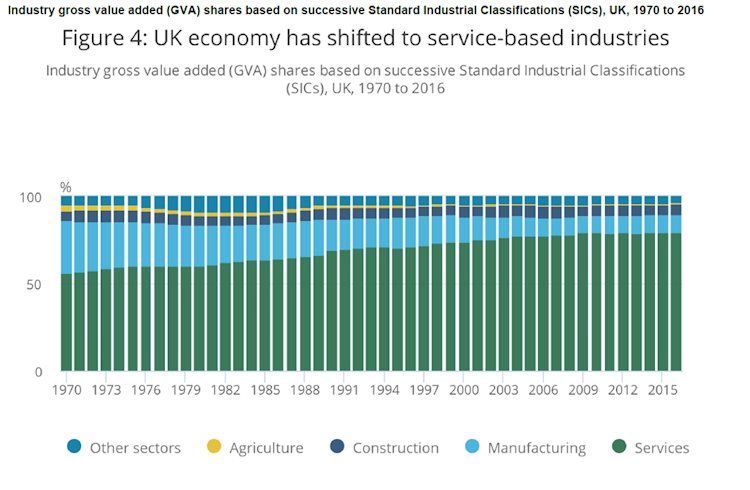 On the question of democratic control, Merry wrote, >We do not believe that education is an industry to be nationalised under workers control but rather is a social service in which workers and present recipients have an important but not complete role to play. Today I have much more sympathy with elements of the Militant line, at least they tried to find a means where, local workers demands could be ameliorated and shaped by consulting with other workers and the government; Clause IV’s demands on control were possibly developed in contradiction to both, the workerism/faux-soviet demands of the Militant and the student vanguardism of elements of the left who were demanding massive student representation on the governing bodies of the universities and polytechnics. NOLS’s practice at the time was also to permit a minority paper to be presented to the conference. He also said, “We oppose courses purely aimed at training people to play a subordinate role in a capitalist firm.”. This was probably aimed at the recently founded [Manpower Services Commission](https://en.wikipedia.org/wiki/Manpower_Services_Commission) and its Youth Opportunities Programme.  <center>from Unsplash</center> The conference paper would seem to have focused on Higher and Further education as students, we were attempting to ensure that we reflected the learning from our position in society. We can also see from the changes in the economy and the development of macroeconomic theory that the role of investment in education is much more important than we thought at the time and while there was some cynicism in expanding the target of university entrance numbers, it is/was an important reform as was the more high minded abolition of the binary divide. We needed [Romer](https://en.wikipedia.org/wiki/Paul_Romer), and [Mitchell](https://www.billmitchell.org/) to establish theoretical frameworks where maximising potential is preparing people to participate in the economy. I was ahead of my time but the focus of Labour’s consideration of education policy turned to primary and secondary education with the introduction of national curriculum, academy schools and league tables. I don’t think they helped as they all contributed to the de-professionalisation of teachers and teaching. The lesson I reflect on today is a rule I learnt many years later; the amount of process and measurement doesn’t necessarily bring about good outcomes. This article was originally published on [my blog](https://davelevy.info/once-upon-time-about-he-policy/) on 13th Oct 2023. |
| json metadata | {"tags":["ukpolitics","highereducation","nols77","history"],"image":["https://cdn.steemitimages.com/DQmZ6y8AZQFrNcjYoMv4ErKrZ5Mrsqcm2t92zUDNEx6itHq/uk-gdp-bysector-1970-2016-commonslib.png","https://cdn.steemitimages.com/DQmQNozM2BgiPizytTTcG8pMn81xGK9yG71ucYhq37t7iDs/classroom-nationalcancerinstitute-unsplash-w750.jpg"],"links":["https://davelevy.info/out-of-sight-with-the-fabians/","https://en.wikipedia.org/wiki/Manpower_Services_Commission","https://en.wikipedia.org/wiki/Paul_Romer","https://www.billmitchell.org/","https://davelevy.info/once-upon-time-about-he-policy/"],"app":"steemit/0.2","format":"markdown"} |
| parent author | |
| parent permlink | ukpolitics |
| permlink | once-upon-a-time-in-he |
| title | Once upon a time in HE |
| Transaction Info | Block #99246817/Trx fdebae0c038183b9cdb1b3d20e6fc74f68a061fb |
View Raw JSON Data
{
"block": 99246817,
"op": [
"comment",
{
"author": "davelevy",
"body": "On my way home from labour conference 23, I visited the People’s History Museum. It was a bit of a vanity trip as I was looking for any documentation related to NOLS’s adoption of a comprehensive, as in wide ranging, education policy. I was on the NOLS national committee, elected at their 76 conference and was given responsibility for the Education policy portfolio. I found the reference to my election in the Labour Party’s conference report, for 1977. As said, I held the education portfolio for that year and I led the organisation, with much help from the other officers, in developing a comprehensive policy which was presented to conference 77. My being allocated responsibility for education was not necessarily one of choice, since most of us at the time were interested in macroeconomics, industrial and labour relations policy or international solidarity issues, where Chile solidarity and the Anti-Apartheid campaigns loomed large and also what was to become the EU continued to be a live issue from the 75 referendum.\n\nI remember that I was keen to engage with the Labour Government and its great debate on education. It seemed crucial to establish that education should benefit its students and was not just an investment for human capital in what in retrospect could be seen to be a dying economy.\n\nI found a copy of Labour Student dated Spring 78 reporting on that 77 conference, in which my successor, John Merry wrote a review of the new education policy. I summarise from Merry’s article, as I could not find the papers, that the key demands were,\n\n1. Education as a right for all, and its purpose is to develop potential of students\n1. Education must serve all needs, not just business, and education to be democratically managed.\n1. The ending of discriminatory access; our concern was that the children of the working class had access to Higher Education; at the time 4% of the school leavers went to university and the same number entered the Polys.\n\nMerry, criticised the Labour government plans because the binary higher education system mirrored the class structure, and arguably continued the 11+ split where Universities were designed for non-technical high quality education, and the Polytechnics for technical high quality education and the FE’s for non-high quality education. It took another 25 years to abolish the binary divide, and FE policy [remains a problem](https://davelevy.info/out-of-sight-with-the-fabians/) to this day.\n\nThe Blair administration’s 50% university entrance target a has changed the constituency of youth. When browsing the records of the 80s, one of the fascinating things I notice is that how the language was oriented towards young workers. The proportion of young people in higher education was very small, even if one didn’t share the workerism of the Militant, building a mass organisation required such an orientation.\n\n\n\n\nOn the question of democratic control, Merry wrote,\n\n>We do not believe that education is an industry to be nationalised under workers control but rather is a social service in which workers and present recipients have an important but not complete role to play.\n\nToday I have much more sympathy with elements of the Militant line, at least they tried to find a means where, local workers demands could be ameliorated and shaped by consulting with other workers and the government; Clause IV’s demands on control were possibly developed in contradiction to both, the workerism/faux-soviet demands of the Militant and the student vanguardism of elements of the left who were demanding massive student representation on the governing bodies of the universities and polytechnics. NOLS’s practice at the time was also to permit a minority paper to be presented to the conference.\n\nHe also said, “We oppose courses purely aimed at training people to play a subordinate role in a capitalist firm.”. This was probably aimed at the recently founded [Manpower Services Commission](https://en.wikipedia.org/wiki/Manpower_Services_Commission) and its Youth Opportunities Programme.\n\n\n\n<center>from Unsplash</center>\n\nThe conference paper would seem to have focused on Higher and Further education as students, we were attempting to ensure that we reflected the learning from our position in society. We can also see from the changes in the economy and the development of macroeconomic theory that the role of investment in education is much more important than we thought at the time and while there was some cynicism in expanding the target of university entrance numbers, it is/was an important reform as was the more high minded abolition of the binary divide.\n\nWe needed [Romer](https://en.wikipedia.org/wiki/Paul_Romer), and [Mitchell](https://www.billmitchell.org/) to establish theoretical frameworks where maximising potential is preparing people to participate in the economy. I was ahead of my time but the focus of Labour’s consideration of education policy turned to primary and secondary education with the introduction of national curriculum, academy schools and league tables. I don’t think they helped as they all contributed to the de-professionalisation of teachers and teaching. The lesson I reflect on today is a rule I learnt many years later; the amount of process and measurement doesn’t necessarily bring about good outcomes.\n\nThis article was originally published on [my blog](https://davelevy.info/once-upon-time-about-he-policy/) on 13th Oct 2023.",
"json_metadata": "{\"tags\":[\"ukpolitics\",\"highereducation\",\"nols77\",\"history\"],\"image\":[\"https://cdn.steemitimages.com/DQmZ6y8AZQFrNcjYoMv4ErKrZ5Mrsqcm2t92zUDNEx6itHq/uk-gdp-bysector-1970-2016-commonslib.png\",\"https://cdn.steemitimages.com/DQmQNozM2BgiPizytTTcG8pMn81xGK9yG71ucYhq37t7iDs/classroom-nationalcancerinstitute-unsplash-w750.jpg\"],\"links\":[\"https://davelevy.info/out-of-sight-with-the-fabians/\",\"https://en.wikipedia.org/wiki/Manpower_Services_Commission\",\"https://en.wikipedia.org/wiki/Paul_Romer\",\"https://www.billmitchell.org/\",\"https://davelevy.info/once-upon-time-about-he-policy/\"],\"app\":\"steemit/0.2\",\"format\":\"markdown\"}",
"parent_author": "",
"parent_permlink": "ukpolitics",
"permlink": "once-upon-a-time-in-he",
"title": "Once upon a time in HE"
}
],
"op_in_trx": 0,
"timestamp": "2025-09-19T20:03:21",
"trx_id": "fdebae0c038183b9cdb1b3d20e6fc74f68a061fb",
"trx_in_block": 0,
"virtual_op": 0
}2025/07/15 10:48:09
2025/07/15 10:48:09
| delegatee | davelevy |
| delegator | steem |
| vesting shares | 15611.989192 VESTS |
| Transaction Info | Block #97339208/Trx 6d3e4067cb92d5cb6cf3160369e2907820a22653 |
View Raw JSON Data
{
  "block": 97339208,
  "op": [
    "delegate_vesting_shares",
    {
      "delegatee": "davelevy",
      "delegator": "steem",
      "vesting_shares": "15611.989192 VESTS"
    }
  ],
  "op_in_trx": 0,
  "timestamp": "2025-07-15T10:48:09",
  "trx_id": "6d3e4067cb92d5cb6cf3160369e2907820a22653",
  "trx_in_block": 0,
  "virtual_op": 0
}davelevypublished a new post: 39jygm-ralph-miliband-on-labour-s-last-year-in-opposition2025/07/15 09:38:57
davelevypublished a new post: 39jygm-ralph-miliband-on-labour-s-last-year-in-opposition
2025/07/15 09:38:57
| author | davelevy |
| body | But that was in 1963, sixty years ago. Due to some personal reappraisals of my politics, I have been looking at the writing of Ralph Miliband and was pointed at an article he wrote in the run up to the 1964 election, called [“If Labour wins”](https://newleftreview.org/issues/ii142/articles/ralph-miliband-if-labour-wins), republished in the New Left Review. I found it worth reading to observe the parallels between then and now. Wilson’s Labour were leading in the polls, the Tories had suffered the setbacks of Suez, and the Profumo affair and replaced a popular and powerful leader with a patrician land owner who was not even an MP arguable a stalemate choice between the then two leading Tory candidates.  from unsplash This article contains a number of quotes from the article, as they speak for themselves, although of course I can’t help but comment. I have collected the quotes and comments into pieces on culture and comedy, economics, foreign affairs, corruption, campaigning and hope and the Labour left. <h2>On culture & comedy</h2> Miliband says, >Culturally, perhaps above all, nothing comparable to the iconoclastic vitality and mordancy of the arts and satires of the early sixties has been visible since He was presumably talking of [the satire boom](https://en.wikipedia.org/wiki/Satire_boom) of the early sixties and for those of us looking back from the 2020s, we can now see that Blair’s New Labour was also preceded by its own comedy revolution, an evolution of the [Alternative Comedy](https://en.wikipedia.org/wiki/Alternative_comedy) movement, which was arguably spawned by Thatcherism; the Wikipedia article however doesn’t mention Bremner, Bird and Fortune, nor Ben Elton, the Young Ones and Spitting Images, all of them providing an undercurrent of opposition to the Tories. Humour is in many ways the deadliest weapon, and it is notably not present today. I looked at seventies comedy in an article, called [“You gotta laugh (or not!)“](https://davelevy.info/you-gotta-laugh-or-not/), [or [on Medium]](https://medium.com/p/ca948d650900), written just prior to the 2019 election in which I quote some quite serious sources to back up my argument that, >There was also a series of shows which had the effect of patronising, demonising and bowlderising the working class and its politics, such as The Likely Lads & Liver Girls where we are meant to identify with aspiration and laugh at the hold-outs. There were another series of shows including “Till death us do part” & “Citizen Smith” which infantilised working class organisation, culture and politics and the possible instruments of change. Some of it is unwatchable today because of the racism. >It was mostly shit, and tool of the ruling class aimed at weakening the principles of solidarity amongst the working class, let’s remember it was a decade that ended with the winter of discontent and Thatcher”s 1979 victory >What’s worrying today is that in the run up to 1997, all comedy was anti-tory, with shows such as Spitting Images, [Bremner, Bird and Fortune](https://youtu.be/f6a_weyzkY4). It’s not so true today. <h2>Economics</h2> On economics, for those expecting more nationalisations and a Soviet style command economy, Miliband writes, >Labour’s ideal [economic/industrial policy] would appear to be a British version of the French économie concertée, in which private industry, labour and the state are each to play their part within a general framework of ‘indicative’ planning. The history he predicted came to pass but if you look hard enough in today’s Labour front bench’s speeches, they plan to resurrect the NEDC and the little neddies. Also, >The Labour leadership is quite naturally perturbed at Britain’s comparatively sluggish economic performance over the past decade, at its falling share of world trade, the inadequacy and misdirection of investment, and the waste of material and human skills and resources. Today, we can add the decades long balance of trade deficit. It would seem but one of the results of Thatcherism is the deprecation of a holistic economics strategy. I would argue that fiscal and monetary policy are considered in isolation from trade, industrial restructuring, innovation and even a regional policy, which at the moment holds the appalling name of “levelling up” and is now, under the Tories, still fixated on the “supply side”, being driven by the establishment of freeports. The various attempted friendly names for the governments management of local government, usually by the use of the name communities do not disguise the fact that for decades this government function has been about a bullying governance with little or zero effort in dealing with inequality or service delivery. Wilson was proposing resurrecting the department of economic affairs, which one assumes would have dealt with macro fiscal policy, but probably not monetary policy but it would have included industrial regional and probably trade policy, which takes us to Europe. Miliband says, >… a new problem had taken centre stage, that of Britain’s proposed entry into the European Economic Community. The Party divided on this question, and was abandoned by its leader when Gaitskell, after a lengthy delay, came out against the Common Market. This is a split that still haunts the Labour Party; today Britain’s fall as a world power, brutally illustrated by the Suez crisis and even more obvious today, means that today’s Party is doomed to fail to answer questions of growth, trade and defence unless they address rejoining the single market at least, although a comprehensive defence/security solution will require rejoining the EU and accepting the governance of the CJEU and the Charter of Fundamental Rights. <h2>Foreign Affairs</h2> Miliband makes some predictions on the coming Labour Government’s foreign policy. Possibly this section of the paper is exposed to the biggest historical changes, Miliband writes, >In the endemic conflict between the capitalist and Communist spheres, Wilson and his colleagues will remain firmly aligned with the United States. This is at the end of a longish section on foreign policy, where Miliband argues that the UK is now exclusively subservient to the USA. Frankly, it was the lesson of Suez which should have ended the UK’s ambitions as a global military power. He also suggests that non-alignment was an option as the nations of the global south tried to articulate an independence from the US/Soviet cold war. In fact Wilson withdrew Britain’s forces from East of Suez and, of course, the Soviet Union no longer exists although its successor suggests that at various stages the Communist dream became something else, something that the gangster successors are quite happy to pursue. <h2>Corruption</h2> On the accountability of the Tory Party to its class interests, Miliband says, >… there accretes around the Tory Party a multitude of vested interests, many of a wholly parasitical kind, of which a Conservative government must take careful account, but towards which Labour might prove less tender. Thus land speculators, large landlords, get-rich-quick financiers may have a thinner time under a Labour government than during the recent golden years, which should still, however, leave them with plenty of fat. Labour would be especially concerned to help and encourage those parts of capitalist industry which showed enterprise and dynamism; and it is in this sense that Labour may justly claim to be the solicitous friend of ‘neo-capitalism’. Today we have the rampant corruption in the Tory Party, its corruption of the planning processes and public procurement chain, all in the interests of the primacy of dilletante/vulture capitalism. Enterprises that make and invent things are no longer considered when designing policy; this is strange given Sunak’s fandom of Paul Romer and their prioritisation of the development of ideas as the basis of the next technological revolution. Brexit and the Tory Party is the result of the political needs of finance capital over business; summed up by Boris Johnson’s epithet, “Fuck Business”. Today, we have to ask if Miliband’s comments that Labour will be the solicitous friend of ‘neo-capitalism’ remains true because once it might have been the result of a social democratic analysis; today this is no longer true. Austerity kills domestic demand, and Brexit is killing exports; British industry has no-one to sell to. <h2>On Campaigning and Hope</h2> Even in 1964, Labour was pinning its hope on campaigning expertise, >… the Labour Party has entrusted its pre-electoral campaign to experts in public relations. The least that can be said about their efforts to date is that the propagation of socialist ideals does not seem terribly important to these phrase merchants and their prefabricated effects. Nor, to be fair, does it seem to be the main preoccupation of their clients. … >The ambiguity that now, as in the past, stamps Labour’s message is no match for the degree of discontent and desire for renewal in Britain today … The disgust provoked by the Tories is not accompanied by any feelings of enthusiasm or relief aroused by Labour The last sentence proved to be prophetic, despite the poll leads, Wilson only won with a four seat majority when the election came, the Liberals held nine seats and there were no other parties represented in Parliament. <h2>Labour’s Left</h2> On the strength of the Labour Left, Miliband observes, that like today, >The left of the party—in the unions, constituencies and House of Commons—from which this kind of pressure ought to come, has rarely been so acquiescent as it is now. And while predicting a Labour win, possibly a bigger one than actually occurred, again he observes, >... the Labour left is historically prone to illusions in this matter—it is clear that the only guarantee of being listened to is the force that the left is capable of mustering to make itself heard. While Starmer says he has, within the country and the party, to play the role of Kinnock, Smith & Blair, there is much fear that actually Kinnock’s record will prevail and the lessons of Wilson’s 1st administration will also come to pass. At least Wilson, in both his administrations, did things that his electorate wanted before asking for a decent mandate, Blair started with the bad medicine and Starmer promises the same. We should note that the next Parliament, will consist of many more parties than three; the parliamentary arithmetic may become as interesting as it was in 2010. Labour’s problems are more than complacency. Miliband again, >The disgust provoked by the Tories is not accompanied by any feelings of enthusiasm or relief aroused by Labour Simon Hannah, in his book, “A Party with socialists in it” says about the first Wilson administration, >The flagging end of the first Wilson government revealed a revisionist party, wholly reliant on Keynesian demand management, trapped in an economic straitjacket that provoked working class resistance while undermining its own ability to implement more progressive social-economic policies. Around 200,000 members left the party during this period. Ken Livingstone described the experience of joining in 1968 as being like ‘a rat who was boarding a sinking ship’. Wilson still hoped to win in 1970 – in some polls he was even 7 points ahead on the eve of the election – but he was defeated by Ted Heath … As Crossman commented in his diary about the collapse in support from the Labour electorate, “We have given them three years of hell and high taxes. They have seen the failure of devaluation and felt the soaring cost of living’. Labour had alienated its own voting base. I am more interested in Crossman’s observation on losing the support of its natural supporters, than the arithmetic symmetry on Party membership. The “false hope being worse than no hope” quote, seems to be about getting their excuses in first, a dangerous tactic. <center>ooOOOoo</center> Hannah, Simon. A Party with Socialists in It: A History of the Labour Left. Pluto Press, 2018. JSTOR, https://doi.org/10.2307/j.ctt21215hf. Accessed 6 Aug. 2023. Originally written and [posted on davelevy.info](https://davelevy.info/ralph-miliband-on-labours-last-year-in-opposition/) on 6th Aug 2023. |
| json metadata | {"tags":["ukpolitics","labourparty","ralphmilliband"],"image":["https://cdn.steemitimages.com/DQmRGcA98SXsUWcUkXoihBVzJTY7brqC6UdTy1L1EsGVCqR/image.png"],"links":["https://newleftreview.org/issues/ii142/articles/ralph-miliband-if-labour-wins","https://en.wikipedia.org/wiki/Satire_boom","https://en.wikipedia.org/wiki/Alternative_comedy","https://davelevy.info/you-gotta-laugh-or-not/","https://medium.com/p/ca948d650900","https://youtu.be/f6a_weyzkY4","https://doi.org/10.2307/j.ctt21215hf","https://davelevy.info/ralph-miliband-on-labours-last-year-in-opposition/"],"app":"steemit/0.2","format":"markdown"} |
| parent author | |
| parent permlink | ukpolitics |
| permlink | 39jygm-ralph-miliband-on-labour-s-last-year-in-opposition |
| title | Ralph Miliband on Labour’s last year in opposition |
| Transaction Info | Block #97337827/Trx 137d512534ae280255a588b8aa04be04a275552e |
View Raw JSON Data
{
"block": 97337827,
"op": [
"comment",
{
"author": "davelevy",
"body": "But that was in 1963, sixty years ago. Due to some personal reappraisals of my politics, I have been looking at the writing of Ralph Miliband and was pointed at an article he wrote in the run up to the 1964 election, called [“If Labour wins”](https://newleftreview.org/issues/ii142/articles/ralph-miliband-if-labour-wins), republished in the New Left Review. I found it worth reading to observe the parallels between then and now. Wilson’s Labour were leading in the polls, the Tories had suffered the setbacks of Suez, and the Profumo affair and replaced a popular and powerful leader with a patrician land owner who was not even an MP arguable a stalemate choice between the then two leading Tory candidates.\n\n\nfrom unsplash\n\nThis article contains a number of quotes from the article, as they speak for themselves, although of course I can’t help but comment. I have collected the quotes and comments into pieces on culture and comedy, economics, foreign affairs, corruption, campaigning and hope and the Labour left. \n<h2>On culture & comedy</h2>\nMiliband says,\n\n>Culturally, perhaps above all, nothing comparable to the iconoclastic vitality and mordancy of the arts and satires of the early sixties has been visible since\n\nHe was presumably talking of [the satire boom](https://en.wikipedia.org/wiki/Satire_boom) of the early sixties and for those of us looking back from the 2020s, we can now see that Blair’s New Labour was also preceded by its own comedy revolution, an evolution of the [Alternative Comedy](https://en.wikipedia.org/wiki/Alternative_comedy) movement, which was arguably spawned by Thatcherism; the Wikipedia article however doesn’t mention Bremner, Bird and Fortune, nor Ben Elton, the Young Ones and Spitting Images, all of them providing an undercurrent of opposition to the Tories. Humour is in many ways the deadliest weapon, and it is notably not present today. I looked at seventies comedy in an article, called [“You gotta laugh (or not!)“](https://davelevy.info/you-gotta-laugh-or-not/), [or [on Medium]](https://medium.com/p/ca948d650900), written just prior to the 2019 election in which I quote some quite serious sources to back up my argument that,\n\n>There was also a series of shows which had the effect of patronising, demonising and bowlderising the working class and its politics, such as The Likely Lads & Liver Girls where we are meant to identify with aspiration and laugh at the hold-outs. There were another series of shows including “Till death us do part” & “Citizen Smith” which infantilised working class organisation, culture and politics and the possible instruments of change. Some of it is unwatchable today because of the racism.\n\n>It was mostly shit, and tool of the ruling class aimed at weakening the principles of solidarity amongst the working class, let’s remember it was a decade that ended with the winter of discontent and Thatcher”s 1979 victory\n\n>What’s worrying today is that in the run up to 1997, all comedy was anti-tory, with shows such as Spitting Images, [Bremner, Bird and Fortune](https://youtu.be/f6a_weyzkY4). It’s not so true today.\n\n<h2>Economics</h2>\n\nOn economics, for those expecting more nationalisations and a Soviet style command economy, Miliband writes,\n\n>Labour’s ideal [economic/industrial policy] would appear to be a British version of the French économie concertée, in which private industry, labour and the state are each to play their part within a general framework of ‘indicative’ planning.\n\nThe history he predicted came to pass but if you look hard enough in today’s Labour front bench’s speeches, they plan to resurrect the NEDC and the little neddies. Also,\n\n>The Labour leadership is quite naturally perturbed at Britain’s comparatively sluggish economic performance over the past decade, at its falling share of world trade, the inadequacy and misdirection of investment, and the waste of material and human skills and resources.\n\nToday, we can add the decades long balance of trade deficit. It would seem but one of the results of Thatcherism is the deprecation of a holistic economics strategy. I would argue that fiscal and monetary policy are considered in isolation from trade, industrial restructuring, innovation and even a regional policy, which at the moment holds the appalling name of “levelling up” and is now, under the Tories, still fixated on the “supply side”, being driven by the establishment of freeports. The various attempted friendly names for the governments management of local government, usually by the use of the name communities do not disguise the fact that for decades this government function has been about a bullying governance with little or zero effort in dealing with inequality or service delivery. Wilson was proposing resurrecting the department of economic affairs, which one assumes would have dealt with macro fiscal policy, but probably not monetary policy but it would have included industrial regional and probably trade policy, which takes us to Europe. Miliband says,\n\n>… a new problem had taken centre stage, that of Britain’s proposed entry into the European Economic Community. The Party divided on this question, and was abandoned by its leader when Gaitskell, after a lengthy delay, came out against the Common Market.\n\nThis is a split that still haunts the Labour Party; today Britain’s fall as a world power, brutally illustrated by the Suez crisis and even more obvious today, means that today’s Party is doomed to fail to answer questions of growth, trade and defence unless they address rejoining the single market at least, although a comprehensive defence/security solution will require rejoining the EU and accepting the governance of the CJEU and the Charter of Fundamental Rights.\n\n<h2>Foreign Affairs</h2>\n\nMiliband makes some predictions on the coming Labour Government’s foreign policy. Possibly this section of the paper is exposed to the biggest historical changes, Miliband writes,\n\n>In the endemic conflict between the capitalist and Communist spheres, Wilson and his colleagues will remain firmly aligned with the United States.\n\nThis is at the end of a longish section on foreign policy, where Miliband argues that the UK is now exclusively subservient to the USA. Frankly, it was the lesson of Suez which should have ended the UK’s ambitions as a global military power. He also suggests that non-alignment was an option as the nations of the global south tried to articulate an independence from the US/Soviet cold war. In fact Wilson withdrew Britain’s forces from East of Suez and, of course, the Soviet Union no longer exists although its successor suggests that at various stages the Communist dream became something else, something that the gangster successors are quite happy to pursue.\n\n<h2>Corruption</h2>\n\nOn the accountability of the Tory Party to its class interests, Miliband says,\n\n>… there accretes around the Tory Party a multitude of vested interests, many of a wholly parasitical kind, of which a Conservative government must take careful account, but towards which Labour might prove less tender. Thus land speculators, large landlords, get-rich-quick financiers may have a thinner time under a Labour government than during the recent golden years, which should still, however, leave them with plenty of fat. Labour would be especially concerned to help and encourage those parts of capitalist industry which showed enterprise and dynamism; and it is in this sense that Labour may justly claim to be the solicitous friend of ‘neo-capitalism’.\n\nToday we have the rampant corruption in the Tory Party, its corruption of the planning processes and public procurement chain, all in the interests of the primacy of dilletante/vulture capitalism.\n\nEnterprises that make and invent things are no longer considered when designing policy; this is strange given Sunak’s fandom of Paul Romer and their prioritisation of the development of ideas as the basis of the next technological revolution. Brexit and the Tory Party is the result of the political needs of finance capital over business; summed up by Boris Johnson’s epithet, “Fuck Business”. Today, we have to ask if Miliband’s comments that Labour will be the solicitous friend of ‘neo-capitalism’ remains true because once it might have been the result of a social democratic analysis; today this is no longer true. Austerity kills domestic demand, and Brexit is killing exports; British industry has no-one to sell to.\n\n<h2>On Campaigning and Hope</h2>\n\nEven in 1964, Labour was pinning its hope on campaigning expertise,\n\n>… the Labour Party has entrusted its pre-electoral campaign to experts in public relations. The least that can be said about their efforts to date is that the propagation of socialist ideals does not seem terribly important to these phrase merchants and their prefabricated effects. Nor, to be fair, does it seem to be the main preoccupation of their clients. …\n\n>The ambiguity that now, as in the past, stamps Labour’s message is no match for the degree of discontent and desire for renewal in Britain today … The disgust provoked by the Tories is not accompanied by any feelings of enthusiasm or relief aroused by Labour\n\nThe last sentence proved to be prophetic, despite the poll leads, Wilson only won with a four seat majority when the election came, the Liberals held nine seats and there were no other parties represented in Parliament.\n\n<h2>Labour’s Left</h2>\n\nOn the strength of the Labour Left, Miliband observes, that like today,\n\n>The left of the party—in the unions, constituencies and House of Commons—from which this kind of pressure ought to come, has rarely been so acquiescent as it is now.\n\nAnd while predicting a Labour win, possibly a bigger one than actually occurred, again he observes,\n\n>... the Labour left is historically prone to illusions in this matter—it is clear that the only guarantee of being listened to is the force that the left is capable of mustering to make itself heard.\n\nWhile Starmer says he has, within the country and the party, to play the role of Kinnock, Smith & Blair, there is much fear that actually Kinnock’s record will prevail and the lessons of Wilson’s 1st administration will also come to pass. At least Wilson, in both his administrations, did things that his electorate wanted before asking for a decent mandate, Blair started with the bad medicine and Starmer promises the same. We should note that the next Parliament, will consist of many more parties than three; the parliamentary arithmetic may become as interesting as it was in 2010. Labour’s problems are more than complacency. Miliband again,\n\n \n>The disgust provoked by the Tories is not accompanied by any feelings of enthusiasm or relief aroused by Labour\n\n\nSimon Hannah, in his book, “A Party with socialists in it” says about the first Wilson administration,\n\n>The flagging end of the first Wilson government revealed a revisionist party, wholly reliant on Keynesian demand management, trapped in an economic straitjacket that provoked working class resistance while undermining its own ability to implement more progressive social-economic policies. Around 200,000 members left the party during this period. Ken Livingstone described the experience of joining in 1968 as being like ‘a rat who was boarding a sinking ship’. Wilson still hoped to win in 1970 – in some polls he was even 7 points ahead on the eve of the election – but he was defeated by Ted Heath … As Crossman commented in his diary about the collapse in support from the Labour electorate, “We have given them three years of hell and high taxes. They have seen the failure of devaluation and felt the soaring cost of living’. Labour had alienated its own voting base.\n\nI am more interested in Crossman’s observation on losing the support of its natural supporters, than the arithmetic symmetry on Party membership. The “false hope being worse than no hope” quote, seems to be about getting their excuses in first, a dangerous tactic.\n\n<center>ooOOOoo</center>\n\nHannah, Simon. A Party with Socialists in It: A History of the Labour Left. Pluto Press, 2018. JSTOR, https://doi.org/10.2307/j.ctt21215hf. Accessed 6 Aug. 2023.\n\nOriginally written and [posted on davelevy.info](https://davelevy.info/ralph-miliband-on-labours-last-year-in-opposition/) on 6th Aug 2023.",
"json_metadata": "{\"tags\":[\"ukpolitics\",\"labourparty\",\"ralphmilliband\"],\"image\":[\"https://cdn.steemitimages.com/DQmRGcA98SXsUWcUkXoihBVzJTY7brqC6UdTy1L1EsGVCqR/image.png\"],\"links\":[\"https://newleftreview.org/issues/ii142/articles/ralph-miliband-if-labour-wins\",\"https://en.wikipedia.org/wiki/Satire_boom\",\"https://en.wikipedia.org/wiki/Alternative_comedy\",\"https://davelevy.info/you-gotta-laugh-or-not/\",\"https://medium.com/p/ca948d650900\",\"https://youtu.be/f6a_weyzkY4\",\"https://doi.org/10.2307/j.ctt21215hf\",\"https://davelevy.info/ralph-miliband-on-labours-last-year-in-opposition/\"],\"app\":\"steemit/0.2\",\"format\":\"markdown\"}",
"parent_author": "",
"parent_permlink": "ukpolitics",
"permlink": "39jygm-ralph-miliband-on-labour-s-last-year-in-opposition",
"title": "Ralph Miliband on Labour’s last year in opposition"
}
],
"op_in_trx": 0,
"timestamp": "2025-07-15T09:38:57",
"trx_id": "137d512534ae280255a588b8aa04be04a275552e",
"trx_in_block": 0,
"virtual_op": 0
}2025/04/29 19:17:30
2025/04/29 19:17:30
| delegatee | davelevy |
| delegator | steem |
| vesting shares | 3508.274078 VESTS |
| Transaction Info | Block #95137494/Trx e3c44d637d97ff358c513f4b2bea4573f0b60c87 |
View Raw JSON Data
{
  "block": 95137494,
  "op": [
    "delegate_vesting_shares",
    {
      "delegatee": "davelevy",
      "delegator": "steem",
      "vesting_shares": "3508.274078 VESTS"
    }
  ],
  "op_in_trx": 0,
  "timestamp": "2025-04-29T19:17:30",
  "trx_id": "e3c44d637d97ff358c513f4b2bea4573f0b60c87",
  "trx_in_block": 2,
  "virtual_op": 0
}2025/04/20 09:29:30
2025/04/20 09:29:30
| delegatee | davelevy |
| delegator | steem |
| vesting shares | 15719.357947 VESTS |
| Transaction Info | Block #94867206/Trx 1004049eb90e59363d1700f6f648602b6c080739 |
View Raw JSON Data
{
  "block": 94867206,
  "op": [
    "delegate_vesting_shares",
    {
      "delegatee": "davelevy",
      "delegator": "steem",
      "vesting_shares": "15719.357947 VESTS"
    }
  ],
  "op_in_trx": 0,
  "timestamp": "2025-04-20T09:29:30",
  "trx_id": "1004049eb90e59363d1700f6f648602b6c080739",
  "trx_in_block": 3,
  "virtual_op": 0
}davelevycustom json: notify2025/02/03 09:57:24
davelevycustom json: notify
2025/02/03 09:57:24
| id | notify |
| json | ["setLastRead",{"date":"2025-02-03T09:57:24"}] |
| required auths | [] |
| required posting auths | ["davelevy"] |
| Transaction Info | Block #92685529/Trx a613bf1d26be289b0bab52186648c3e89acbfa6c |
View Raw JSON Data
{
  "block": 92685529,
  "op": [
    "custom_json",
    {
      "id": "notify",
      "json": "[\"setLastRead\",{\"date\":\"2025-02-03T09:57:24\"}]",
      "required_auths": [],
      "required_posting_auths": [
        "davelevy"
      ]
    }
  ],
  "op_in_trx": 0,
  "timestamp": "2025-02-03T09:57:24",
  "trx_id": "a613bf1d26be289b0bab52186648c3e89acbfa6c",
  "trx_in_block": 2,
  "virtual_op": 0
}davelevypublished a new post: intergenerational-equity2025/01/28 18:21:27
davelevypublished a new post: intergenerational-equity
2025/01/28 18:21:27
| author | davelevy |
| body | Originally published at [https://davelevy.info](https://davelevy.info/intergenerational-equity/) on June 30, 2023.  <center>by Nikola Knezevic, from Unsplash</center> In [this article](https://www.ft.com/content/4ec2ec87-5f7e-48b2-94b6-e616da36cf88), in the FT, Sarah O’Connor argues that the impact of high interest rates is less effective at demand suppression than has historically been the case. The exclusion of the young from the housing market and the impact of older people having finished paying off their mortgages has led to reduction in the number of households with mortgages, from 40% to 30%. It interests me, that the author argues the purpose of increasing interest rates is demand suppression and yet its effectiveness as a demand suppression tool is less than it once was. The fact that older home owners have paid off their mortgages and that the recent housing prices have made it harder to get on the housing ladder, means that the interest rate increases are being born by workers in their 30’s and 40’s. A side effect of the squeeze on demand is increased unemployment and fewer vacancies; this policy as a narrower cohort of victims who are suffering a Tory double whammy of super inflated costs, and a squeeze on jobs and wages which means that people can’t get better ones to earn more. This is unfair and will come to be seen as such. It prefers, once again, the older, wealthier, and retired cohorts in our society. The fact is the intergenerational contract has been broken for decades but this is another nail in the coffin. The flagship policy as the harbinger of the ending of that contract is economic tuition fees and student loans. Broadly based higher education has external economies of scale i.e. it should be subsidised; marketising university funding weakens the sectors ability to innovate and in some subjects survive. The current university/student finance regime militates against both and yet Labour, plan to compound this stupidity, by imposing a graduate tax meaning that graduates will be paying higher levels of tax at the times they can least afford it. This is unfair, and will act as a disincentive to disadvantaged groups in society to undertake higher education; it may also encourage such graduates to emigrate to a lower tax regime and while they have currently made it difficult to go to Europe, there are plenty of places where they can go. Intergenerational equity needs a life-time view. Interest rate policy and university/student finace policies do not support such intergenerational equity. On the effectiveness of interest rates as an anti-inflation tool, demand suppression is only an effective anti-inflation tool if the inflation is in fact caused by excess demand, that it is “demand pull” inflation. There are two other causes of inflation, the first is characterised as “cost push” and is caused by the increase in the price of input factors. Increasing interest rates adds to this type of inflation rather than diminishing it. The third cause is external shocks. I would argue that this is what has happened to the UK economy although the impact of increasing food prices and increasing energy prices is exacerbated by domestic policy choices, i.e. the increased barriers on imports especially food imports caused by Brexit, and the ludicrous so-called internal energy market which is part of the UK’s energy market regulation regime. The Government had the option of squeezing profits, not incomes. <center> . . . </center> Phil BC [reminds me](http://averypublicsociologist.blogspot.com/2023/07/making-sense-of-tory-corbynism.html) that one of the reasons that the Tories [pursue this vendetta](https://www.mirror.co.uk/news/politics/rishi-sunak-told-meeting-hed-30370275) against the young, or at least pursue policies that prefer older workers and pensioners is purely political. i.e. the young don’t vote Conservative. I believe he also argues, in his book, Falling Down, and on his blog, that it’s too late to change course. Once it was said that if under 30 you didn’t vote left then you had no heart, but if over 30 you continued to do so, you had no brain. This piece of wisdom would seem to be outdated, although possibly over influential on Labour’s strategists. Burton-Cartledge, Phil 2021. Falling Down: The Conservative Party and the Decline of Tory Britain. Verso. <center> . . . </center> |
| json metadata | {"tags":["ukpolitics","housing","voting","education","highereducation"],"image":["https://cdn.steemitimages.com/DQmUbSv1XEwxQqXSNVJaZzvVxbp1sdhwuxCHezb129MMpYe/0_KsnC4cCtMrji9mxs.webp"],"links":["https://davelevy.info/intergenerational-equity/","https://www.ft.com/content/4ec2ec87-5f7e-48b2-94b6-e616da36cf88","http://averypublicsociologist.blogspot.com/2023/07/making-sense-of-tory-corbynism.html","https://www.mirror.co.uk/news/politics/rishi-sunak-told-meeting-hed-30370275"],"app":"steemit/0.2","format":"markdown"} |
| parent author | |
| parent permlink | ukpolitics |
| permlink | intergenerational-equity |
| title | Intergenerational Equity |
| Transaction Info | Block #92523183/Trx a40eae6fd793b028ea204887a15ce3d6aeb85a56 |
View Raw JSON Data
{
"block": 92523183,
"op": [
"comment",
{
"author": "davelevy",
"body": "Originally published at [https://davelevy.info](https://davelevy.info/intergenerational-equity/) on June 30, 2023.\n\n\n<center>by Nikola Knezevic, from Unsplash</center>\n\nIn [this article](https://www.ft.com/content/4ec2ec87-5f7e-48b2-94b6-e616da36cf88), in the FT, Sarah O’Connor argues that the impact of high interest rates is less effective at demand suppression than has historically been the case. The exclusion of the young from the housing market and the impact of older people having finished paying off their mortgages has led to reduction in the number of households with mortgages, from 40% to 30%. It interests me, that the author argues the purpose of increasing interest rates is demand suppression and yet its effectiveness as a demand suppression tool is less than it once was.\n\nThe fact that older home owners have paid off their mortgages and that the recent housing prices have made it harder to get on the housing ladder, means that the interest rate increases are being born by workers in their 30’s and 40’s. A side effect of the squeeze on demand is increased unemployment and fewer vacancies; this policy as a narrower cohort of victims who are suffering a Tory double whammy of super inflated costs, and a squeeze on jobs and wages which means that people can’t get better ones to earn more.\n\nThis is unfair and will come to be seen as such. It prefers, once again, the older, wealthier, and retired cohorts in our society.\n\nThe fact is the intergenerational contract has been broken for decades but this is another nail in the coffin.\n\nThe flagship policy as the harbinger of the ending of that contract is economic tuition fees and student loans. Broadly based higher education has external economies of scale i.e. it should be subsidised; marketising university funding weakens the sectors ability to innovate and in some subjects survive. The current university/student finance regime militates against both and yet Labour, plan to compound this stupidity, by imposing a graduate tax meaning that graduates will be paying higher levels of tax at the times they can least afford it. This is unfair, and will act as a disincentive to disadvantaged groups in society to undertake higher education; it may also encourage such graduates to emigrate to a lower tax regime and while they have currently made it difficult to go to Europe, there are plenty of places where they can go.\n\nIntergenerational equity needs a life-time view. Interest rate policy and university/student finace policies do not support such intergenerational equity.\n\nOn the effectiveness of interest rates as an anti-inflation tool, demand suppression is only an effective anti-inflation tool if the inflation is in fact caused by excess demand, that it is “demand pull” inflation. There are two other causes of inflation, the first is characterised as “cost push” and is caused by the increase in the price of input factors. Increasing interest rates adds to this type of inflation rather than diminishing it. The third cause is external shocks. I would argue that this is what has happened to the UK economy although the impact of increasing food prices and increasing energy prices is exacerbated by domestic policy choices, i.e. the increased barriers on imports especially food imports caused by Brexit, and the ludicrous so-called internal energy market which is part of the UK’s energy market regulation regime.\n\nThe Government had the option of squeezing profits, not incomes.\n\n<center> . . . </center>\n\nPhil BC [reminds me](http://averypublicsociologist.blogspot.com/2023/07/making-sense-of-tory-corbynism.html) that one of the reasons that the Tories [pursue this vendetta](https://www.mirror.co.uk/news/politics/rishi-sunak-told-meeting-hed-30370275) against the young, or at least pursue policies that prefer older workers and pensioners is purely political. i.e. the young don’t vote Conservative. I believe he also argues, in his book, Falling Down, and on his blog, that it’s too late to change course. Once it was said that if under 30 you didn’t vote left then you had no heart, but if over 30 you continued to do so, you had no brain. This piece of wisdom would seem to be outdated, although possibly over influential on Labour’s strategists.\n\nBurton-Cartledge, Phil 2021. Falling Down: The Conservative Party and the Decline of Tory Britain. Verso.\n\n<center> . . . </center>",
"json_metadata": "{\"tags\":[\"ukpolitics\",\"housing\",\"voting\",\"education\",\"highereducation\"],\"image\":[\"https://cdn.steemitimages.com/DQmUbSv1XEwxQqXSNVJaZzvVxbp1sdhwuxCHezb129MMpYe/0_KsnC4cCtMrji9mxs.webp\"],\"links\":[\"https://davelevy.info/intergenerational-equity/\",\"https://www.ft.com/content/4ec2ec87-5f7e-48b2-94b6-e616da36cf88\",\"http://averypublicsociologist.blogspot.com/2023/07/making-sense-of-tory-corbynism.html\",\"https://www.mirror.co.uk/news/politics/rishi-sunak-told-meeting-hed-30370275\"],\"app\":\"steemit/0.2\",\"format\":\"markdown\"}",
"parent_author": "",
"parent_permlink": "ukpolitics",
"permlink": "intergenerational-equity",
"title": "Intergenerational Equity"
}
],
"op_in_trx": 0,
"timestamp": "2025-01-28T18:21:27",
"trx_id": "a40eae6fd793b028ea204887a15ce3d6aeb85a56",
"trx_in_block": 0,
"virtual_op": 0
}2024/12/06 23:26:48
2024/12/06 23:26:48
| delegatee | davelevy |
| delegator | steem |
| vesting shares | 15887.046121 VESTS |
| Transaction Info | Block #91006481/Trx b5f9daeddd60b9b45e921a30f6019686ef4467ac |
View Raw JSON Data
{
  "block": 91006481,
  "op": [
    "delegate_vesting_shares",
    {
      "delegatee": "davelevy",
      "delegator": "steem",
      "vesting_shares": "15887.046121 VESTS"
    }
  ],
  "op_in_trx": 0,
  "timestamp": "2024-12-06T23:26:48",
  "trx_id": "b5f9daeddd60b9b45e921a30f6019686ef4467ac",
  "trx_in_block": 5,
  "virtual_op": 0
}davelevyreceived 0.050 STEEM, 0.052 SP author reward for @davelevy / at-gmb-congress-immigration-racism-and-europe2024/11/16 18:12:42
davelevyreceived 0.050 STEEM, 0.052 SP author reward for @davelevy / at-gmb-congress-immigration-racism-and-europe
2024/11/16 18:12:42
| author | davelevy |
| permlink | at-gmb-congress-immigration-racism-and-europe |
| sbd payout | 0.000 SBD |
| steem payout | 0.050 STEEM |
| vesting payout | 84.761646 VESTS |
| Transaction Info | Block #90425582/Virtual Operation #5 |
View Raw JSON Data
{
  "block": 90425582,
  "op": [
    "author_reward",
    {
      "author": "davelevy",
      "permlink": "at-gmb-congress-immigration-racism-and-europe",
      "sbd_payout": "0.000 SBD",
      "steem_payout": "0.050 STEEM",
      "vesting_payout": "84.761646 VESTS"
    }
  ],
  "op_in_trx": 0,
  "timestamp": "2024-11-16T18:12:42",
  "trx_id": "0000000000000000000000000000000000000000",
  "trx_in_block": 4294967295,
  "virtual_op": 5
}davelevyreceived 0.107 STEEM, 0.113 SP author reward for @davelevy / starmer-s-speech-on-refugees2024/11/14 14:25:09
davelevyreceived 0.107 STEEM, 0.113 SP author reward for @davelevy / starmer-s-speech-on-refugees
2024/11/14 14:25:09
| author | davelevy |
| permlink | starmer-s-speech-on-refugees |
| sbd payout | 0.000 SBD |
| steem payout | 0.107 STEEM |
| vesting payout | 183.113652 VESTS |
| Transaction Info | Block #90363580/Virtual Operation #4 |
View Raw JSON Data
{
  "block": 90363580,
  "op": [
    "author_reward",
    {
      "author": "davelevy",
      "permlink": "starmer-s-speech-on-refugees",
      "sbd_payout": "0.000 SBD",
      "steem_payout": "0.107 STEEM",
      "vesting_payout": "183.113652 VESTS"
    }
  ],
  "op_in_trx": 0,
  "timestamp": "2024-11-14T14:25:09",
  "trx_id": "0000000000000000000000000000000000000000",
  "trx_in_block": 4294967295,
  "virtual_op": 4
}davelevyreceived 0.158 STEEM, 0.166 SP author reward for @davelevy / reading-labour-s-tea-leaves2024/11/10 16:26:45
davelevyreceived 0.158 STEEM, 0.166 SP author reward for @davelevy / reading-labour-s-tea-leaves
2024/11/10 16:26:45
| author | davelevy |
| permlink | reading-labour-s-tea-leaves |
| sbd payout | 0.000 SBD |
| steem payout | 0.158 STEEM |
| vesting payout | 269.659936 VESTS |
| Transaction Info | Block #90251413/Virtual Operation #6 |
View Raw JSON Data
{
  "block": 90251413,
  "op": [
    "author_reward",
    {
      "author": "davelevy",
      "permlink": "reading-labour-s-tea-leaves",
      "sbd_payout": "0.000 SBD",
      "steem_payout": "0.158 STEEM",
      "vesting_payout": "269.659936 VESTS"
    }
  ],
  "op_in_trx": 0,
  "timestamp": "2024-11-10T16:26:45",
  "trx_id": "0000000000000000000000000000000000000000",
  "trx_in_block": 4294967295,
  "virtual_op": 6
}mahmud552upvoted (10.00%) @davelevy / at-gmb-congress-immigration-racism-and-europe2024/11/09 18:54:36
mahmud552upvoted (10.00%) @davelevy / at-gmb-congress-immigration-racism-and-europe
2024/11/09 18:54:36
| author | davelevy |
| permlink | at-gmb-congress-immigration-racism-and-europe |
| voter | mahmud552 |
| weight | 1000 (10.00%) |
| Transaction Info | Block #90225637/Trx 9fa8a1b991026ac3e4e78a7dde7b7db08684368e |
View Raw JSON Data
{
  "block": 90225637,
  "op": [
    "vote",
    {
      "author": "davelevy",
      "permlink": "at-gmb-congress-immigration-racism-and-europe",
      "voter": "mahmud552",
      "weight": 1000
    }
  ],
  "op_in_trx": 0,
  "timestamp": "2024-11-09T18:54:36",
  "trx_id": "9fa8a1b991026ac3e4e78a7dde7b7db08684368e",
  "trx_in_block": 1,
  "virtual_op": 0
}remlaps-liteupvoted (50.00%) @davelevy / at-gmb-congress-immigration-racism-and-europe2024/11/09 18:21:18
remlaps-liteupvoted (50.00%) @davelevy / at-gmb-congress-immigration-racism-and-europe
2024/11/09 18:21:18
| author | davelevy |
| permlink | at-gmb-congress-immigration-racism-and-europe |
| voter | remlaps-lite |
| weight | 5000 (50.00%) |
| Transaction Info | Block #90224973/Trx d21c34a3fc2564f175540c8c5c9384bfd1b7f999 |
View Raw JSON Data
{
  "block": 90224973,
  "op": [
    "vote",
    {
      "author": "davelevy",
      "permlink": "at-gmb-congress-immigration-racism-and-europe",
      "voter": "remlaps-lite",
      "weight": 5000
    }
  ],
  "op_in_trx": 0,
  "timestamp": "2024-11-09T18:21:18",
  "trx_id": "d21c34a3fc2564f175540c8c5c9384bfd1b7f999",
  "trx_in_block": 0,
  "virtual_op": 0
}remlapsupvoted (50.00%) @davelevy / at-gmb-congress-immigration-racism-and-europe2024/11/09 18:21:00
remlapsupvoted (50.00%) @davelevy / at-gmb-congress-immigration-racism-and-europe
2024/11/09 18:21:00
| author | davelevy |
| permlink | at-gmb-congress-immigration-racism-and-europe |
| voter | remlaps |
| weight | 5000 (50.00%) |
| Transaction Info | Block #90224967/Trx 4a253b5ae5fb868c55d091997fac0699a2e54b9e |
View Raw JSON Data
{
  "block": 90224967,
  "op": [
    "vote",
    {
      "author": "davelevy",
      "permlink": "at-gmb-congress-immigration-racism-and-europe",
      "voter": "remlaps",
      "weight": 5000
    }
  ],
  "op_in_trx": 0,
  "timestamp": "2024-11-09T18:21:00",
  "trx_id": "4a253b5ae5fb868c55d091997fac0699a2e54b9e",
  "trx_in_block": 1,
  "virtual_op": 0
}davelevypublished a new post: at-gmb-congress-immigration-racism-and-europe2024/11/09 18:12:42
davelevypublished a new post: at-gmb-congress-immigration-racism-and-europe
2024/11/09 18:12:42
| author | davelevy |
| body | At the GMB Congress, my Region, London, organised a fringe meeting on the “ The rise of the far right and worker’s rights “. This was jointly organised with the Labour Movement for Europe who had planned to put their President, Stella Creasy, up to speak. I had originally planned to use the meeting and Congress as a last attempt to get better policy for the Labour Party on trade and relations with the EU but the announcement of the election obviously changed this, and meant that Stella could not make it. 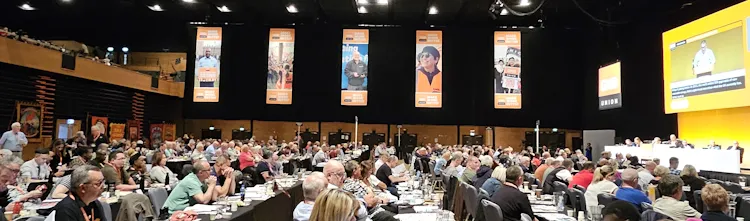 <center>by dfl1955 CC 2024 BY-SA</center> My speech to the fringe, spoke of workers rights, sovereignty and its constraints and looked at the European Parliament results which has occurred on the previous weekend. You will find below my speech notes, although I did not use them all as I was unable to time the speech in practice and had too cut the speech short. My notes for the speech I gave are below, ### Workers Rights & the EU We have spent time this week looking at the sustained attack on workers rights in the UK, however, the 14 years of Tory misrule started with a low bar. Much of the UK’s mandatory, minimum terms and conditions were based on EU regulations and directives, the regulation of working hours, maternity leave and pay, holidays entitlements and many more. The Tories have used their newfound sovereignty to attack Unions, workers and the right to organise. Hopefully we won’t need to see what the European Court on Human Rights has to say as these laws will be repealed but we should remember that social chapter and justice pillar opt-outs were negotiated by a Labour Government to ensure that EU and its court was not engaged in review of Britain’s Trade Union or immigration laws; the EU’s Charter of Fundamental rights was, is and would be a stronger protection for workers’ rights than the European Convention. Furthermore with respect to worker’s rights, we are fortunate that the Future Trade and Co-operation Treaty wrote in a right to retaliate by the EU if rights such as a mandatory social wage were withdrawn, or subsidies were offered by the UK. While things can only get better, EU membership was both a significant protection and often a source for all our Human Rights nitjust our rights as workers ### Sovereignty and its constraints Many, more high minded people and commentators, consider the debate on entry/leaving and rejoining to be one about Wealth vs Sovereignty — I haven’t seen any sovereignty, and the expert consensus is that leaving has been bad for the macro- and consumer economy. And while the Tories have twice threatened to jeopardise the level playing field required by the FTCA, they stepped back from the more extreme proposals in Retained EU Law (Revocation and Reform) Bill , probably because they feared the EU’s retaliation But we remain in a position where the UK workers right to organise is the weakest in the OECD. The inconvenient truth is that we can’t be uniquely sovereign if we want to trade and travel. I sometimes say to myself when negotiating chat protocols that you can’t mandate what other people use and if you want to talk to them you need to use their chosen tools. The same is true with trade and travel if you want to trade or want to travel, a common set of rules need to be agreed which will generally be a compromise. In my work with Another Europe, and Citizens take over Europe, a campaigning organisation for democracy within the European Union, I have observed that the EU’s subsidiarity agreements are only between the union and the member states, we need greater localism where decisions are taken as close as possible to the people that it affects, with the EU and the UK. The constitutions of the EU & UK isolate their citizens and feed into the meme of governing elites. We can and must do better. Citizens are not sovereign in either regime. The acquisition of power from the EU has not been felt by the people of the UK and as has been pointed out by other delegates at Congress 24, Brexit has undermined devolution and may yet undermine the Union. The sovereignty promised has only accrued to the House of Commons and even then, political reality constrains their actions, although not real reality if we are to look at the Safety of Rwanda (Asylum and Immigration) Act 2024. Part of the answer to those who argue we need sovereignty from Brussels is we need to recognise that the European parliament is elected the basis of one person one vote and its decisions the result of a democratic process; one we are currently excluded from. This next bit is a bit of a diversion, but I spoke in favour of the CEC Statement on a New Deal with Europe, specifically welcoming the GMB’s support for the EU Commission’s proposal for a Youth Mobility scheme giving reciprocal access to young workers and students to work here and in the EU. This would be a fabulous opportunity to re-establish the capability for our young people to meet other Europeans and work & study abroad and in the UK with them, increasing or maintaining both countries sense of international solidarity. It would be of fantastic benefit for our, or my, children and grandchildren. The European Union is clearly interested in developing this cooperation. ### The EU election results The press are focusing on the success of Melloni, Le Pen and the AfD in Germany. Some argue that Brexit somehow inoculates the UK from the European Hard Right. It doesn’t. In the UK the Hard Right are already in Parliament, and their ideas and ideology needs to be opposed, vigorously. In Europe, Von Der Leyen should not have been President, and for progressives and workers this has not been a good commission. Sadly, I can see little likelihood of anyone better; the question will be who she allies with and what it costs, with the German Free Democrats already demanding promises on EU debt and immigration. We’ll have to see, but the progressive votes are there to exclude Melloni’s European Conservatives and Reformists. <i>The results in Germany are disappointing for the Left as the SPD vote has slumped and the AFD is the second largest German caucus in the next European Parliament.</i> <b>Let’s hope today’s Germany is copying us from 2019, where 2019 was the apogee of Faragism and not acting as a harbinger for what will happens in the UK when a timid Social Democratic government fails to address the cost of living crisis and promotes public debt management policies before the ending of austerity. N.B.</b><i> This was written during the election; 2019 was not the apogee of Faragism.</i> Over time, over the last 100 years, the nature of the far right has changed, from uniformed genocidal murderers to corrupt, besuited grifters. The political goals have not changed they seek to divide and “other” humanity and destroy our organisations of autonomy and solidarity. ### You can’t triangulate with fascists! And in the UK, it has surprised me that this meeting is taking place during an election. I had hoped to use the meeting to influence Labour’s manifesto, and while it is clearly too late for that, I am pleased that the GMB has established demands for the FTCA sunset review. These demands are beyond what Labour is promising in the election. It was never going to be enough. The implosion of the conservative party is visible for all to see although did not start with Rishi Sunak. It’s hard to say when, but Boris Johnson’s expulsion of the social liberals/remainers and his illegal proroguing of Parliament are important events on their slide from conservatism to populism. The prorogue was a tactic that many authoritarians would admire. With Farage standing and likely to win in Clacton, I have friends advising me they may get six seats in Eastern Region. He like Melloni, Le Pen & Weidel use immigration as their ideological battering ram on democracy and decency. What unites them is a racism, aimed at immigrants and refugees. ### You can’t triangulate with racists! They’ll always ask for more. The PES in the have asked or challenged the European People’s Party in the European Parliament to shun the European Conservatives & Reformists as will the German Government and we should be asking those British Conservatives who reject the racism and cruelty of the current party to speak up, and we should welcome their criticisms. We should not, and neither should our leaders, by triangulating with, and giving credibility to the racism inherent in the immigration debate. <center> . . . </center> Originally published at [https://davelevy.info](https://davelevy.info/the-gmb-lme/) on June 15, 2024. |
| json metadata | {"tags":["ukpolitics","racism","immigration","farright","europeanunion"],"image":["https://cdn.steemitimages.com/DQmeDHwwXHrc5Zw41Z6bUy2CiMXmMWM35FQFNKpSR4TJEvS/0_i4bcy2v68CVNOt38.webp"],"links":["https://davelevy.info/the-gmb-lme/"],"app":"steemit/0.2","format":"markdown"} |
| parent author | |
| parent permlink | ukpolitics |
| permlink | at-gmb-congress-immigration-racism-and-europe |
| title | At GMB Congress, immigration, racism and europe |
| Transaction Info | Block #90224801/Trx 2561d7a86fee6e0a3fc188d6104641abd5eb604e |
View Raw JSON Data
{
"block": 90224801,
"op": [
"comment",
{
"author": "davelevy",
"body": "At the GMB Congress, my Region, London, organised a fringe meeting on the “ The rise of the far right and worker’s rights “. This was jointly organised with the Labour Movement for Europe who had planned to put their President, Stella Creasy, up to speak. I had originally planned to use the meeting and Congress as a last attempt to get better policy for the Labour Party on trade and relations with the EU but the announcement of the election obviously changed this, and meant that Stella could not make it.\n\n\n\n<center>by dfl1955 CC 2024 BY-SA</center>\n\nMy speech to the fringe, spoke of workers rights, sovereignty and its constraints and looked at the European Parliament results which has occurred on the previous weekend. You will find below my speech notes, although I did not use them all as I was unable to time the speech in practice and had too cut the speech short.\n\nMy notes for the speech I gave are below,\n\n### Workers Rights & the EU\n\nWe have spent time this week looking at the sustained attack on workers rights in the UK, however, the 14 years of Tory misrule started with a low bar.\n\nMuch of the UK’s mandatory, minimum terms and conditions were based on EU regulations and directives, the regulation of working hours, maternity leave and pay, holidays entitlements and many more. The Tories have used their newfound sovereignty to attack Unions, workers and the right to organise.\n\nHopefully we won’t need to see what the European Court on Human Rights has to say as these laws will be repealed but we should remember that social chapter and justice pillar opt-outs were negotiated by a Labour Government to ensure that EU and its court was not engaged in review of Britain’s Trade Union or immigration laws; the EU’s Charter of Fundamental rights was, is and would be a stronger protection for workers’ rights than the European Convention.\n\nFurthermore with respect to worker’s rights, we are fortunate that the Future Trade and Co-operation Treaty wrote in a right to retaliate by the EU if rights such as a mandatory social wage were withdrawn, or subsidies were offered by the UK.\n\nWhile things can only get better, EU membership was both a significant protection and often a source for all our Human Rights nitjust our rights as workers\n\n### Sovereignty and its constraints\n\nMany, more high minded people and commentators, consider the debate on entry/leaving and rejoining to be one about Wealth vs Sovereignty — I haven’t seen any sovereignty, and the expert consensus is that leaving has been bad for the macro- and consumer economy.\n\nAnd while the Tories have twice threatened to jeopardise the level playing field required by the FTCA, they stepped back from the more extreme proposals in Retained EU Law (Revocation and Reform) Bill , probably because they feared the EU’s retaliation\n\nBut we remain in a position where the UK workers right to organise is the weakest in the OECD.\n\nThe inconvenient truth is that we can’t be uniquely sovereign if we want to trade and travel.\n\nI sometimes say to myself when negotiating chat protocols that you can’t mandate what other people use and if you want to talk to them you need to use their chosen tools. The same is true with trade and travel if you want to trade or want to travel, a common set of rules need to be agreed which will generally be a compromise.\n\nIn my work with Another Europe, and Citizens take over Europe, a campaigning organisation for democracy within the European Union, I have observed that the EU’s subsidiarity agreements are only between the union and the member states, we need greater localism where decisions are taken as close as possible to the people that it affects, with the EU and the UK.\n\nThe constitutions of the EU & UK isolate their citizens and feed into the meme of governing elites. We can and must do better. Citizens are not sovereign in either regime. The acquisition of power from the EU has not been felt by the people of the UK and as has been pointed out by other delegates at Congress 24, Brexit has undermined devolution and may yet undermine the Union.\n\nThe sovereignty promised has only accrued to the House of Commons and even then, political reality constrains their actions, although not real reality if we are to look at the Safety of Rwanda (Asylum and Immigration) Act 2024.\n\nPart of the answer to those who argue we need sovereignty from Brussels is we need to recognise that the European parliament is elected the basis of one person one vote and its decisions the result of a democratic process; one we are currently excluded from.\n\nThis next bit is a bit of a diversion, but I spoke in favour of the CEC Statement on a New Deal with Europe, specifically welcoming the GMB’s support for the EU Commission’s proposal for a Youth Mobility scheme giving reciprocal access to young workers and students to work here and in the EU. This would be a fabulous opportunity to re-establish the capability for our young people to meet other Europeans and work & study abroad and in the UK with them, increasing or maintaining both countries sense of international solidarity. It would be of fantastic benefit for our, or my, children and grandchildren. The European Union is clearly interested in developing this cooperation.\n\n### The EU election results\n\nThe press are focusing on the success of Melloni, Le Pen and the AfD in Germany.\n\nSome argue that Brexit somehow inoculates the UK from the European Hard Right. It doesn’t.\n\nIn the UK the Hard Right are already in Parliament, and their ideas and ideology needs to be opposed, vigorously.\n\nIn Europe, Von Der Leyen should not have been President, and for progressives and workers this has not been a good commission. Sadly, I can see little likelihood of anyone better; the question will be who she allies with and what it costs, with the German Free Democrats already demanding promises on EU debt and immigration.\n\nWe’ll have to see, but the progressive votes are there to exclude Melloni’s European Conservatives and Reformists.\n\n<i>The results in Germany are disappointing for the Left as the SPD vote has slumped and the AFD is the second largest German caucus in the next European Parliament.</i> <b>Let’s hope today’s Germany is copying us from 2019, where 2019 was the apogee of Faragism and not acting as a harbinger for what will happens in the UK when a timid Social Democratic government fails to address the cost of living crisis and promotes public debt management policies before the ending of austerity. N.B.</b><i> This was written during the election; 2019 was not the apogee of Faragism.</i>\n\nOver time, over the last 100 years, the nature of the far right has changed, from uniformed genocidal murderers to corrupt, besuited grifters.\n\nThe political goals have not changed they seek to divide and “other” humanity and destroy our organisations of autonomy and solidarity.\n\n### You can’t triangulate with fascists!\n\nAnd in the UK, it has surprised me that this meeting is taking place during an election. I had hoped to use the meeting to influence Labour’s manifesto, and while it is clearly too late for that, I am pleased that the GMB has established demands for the FTCA sunset review. These demands are beyond what Labour is promising in the election. It was never going to be enough.\n\nThe implosion of the conservative party is visible for all to see although did not start with Rishi Sunak. It’s hard to say when, but Boris Johnson’s expulsion of the social liberals/remainers and his illegal proroguing of Parliament are important events on their slide from conservatism to populism. The prorogue was a tactic that many authoritarians would admire.\n\nWith Farage standing and likely to win in Clacton, I have friends advising me they may get six seats in Eastern Region. He like Melloni, Le Pen & Weidel use immigration as their ideological battering ram on democracy and decency. What unites them is a racism, aimed at immigrants and refugees.\n\n### You can’t triangulate with racists! They’ll always ask for more.\n\nThe PES in the have asked or challenged the European People’s Party in the European Parliament to shun the European Conservatives & Reformists as will the German Government and we should be asking those British Conservatives who reject the racism and cruelty of the current party to speak up, and we should welcome their criticisms.\n\nWe should not, and neither should our leaders, by triangulating with, and giving credibility to the racism inherent in the immigration debate.\n\n<center> . . . </center>\n\nOriginally published at [https://davelevy.info](https://davelevy.info/the-gmb-lme/) on June 15, 2024.",
"json_metadata": "{\"tags\":[\"ukpolitics\",\"racism\",\"immigration\",\"farright\",\"europeanunion\"],\"image\":[\"https://cdn.steemitimages.com/DQmeDHwwXHrc5Zw41Z6bUy2CiMXmMWM35FQFNKpSR4TJEvS/0_i4bcy2v68CVNOt38.webp\"],\"links\":[\"https://davelevy.info/the-gmb-lme/\"],\"app\":\"steemit/0.2\",\"format\":\"markdown\"}",
"parent_author": "",
"parent_permlink": "ukpolitics",
"permlink": "at-gmb-congress-immigration-racism-and-europe",
"title": "At GMB Congress, immigration, racism and europe"
}
],
"op_in_trx": 0,
"timestamp": "2024-11-09T18:12:42",
"trx_id": "2561d7a86fee6e0a3fc188d6104641abd5eb604e",
"trx_in_block": 9,
"virtual_op": 0
}Manabar
Voting Power100.00%
Downvote Power100.00%
Resource Credits100.00%
Reputation Progress21.22%
{
  "voting_manabar": {
    "current_mana": "8141941528",
    "last_update_time": 1779311547
  },
  "downvote_manabar": {
    "current_mana": 2035485382,
    "last_update_time": 1779311547
  },
  "rc_account": {
    "account": "davelevy",
    "max_rc": "10162690501",
    "max_rc_creation_adjustment": {
      "amount": "2020748973",
      "nai": "@@000000037",
      "precision": 6
    },
    "rc_manabar": {
      "current_mana": "10162690501",
      "last_update_time": 1780236882
    }
  }
}
Account Metadata
| POSTING JSON METADATA | |
| profile | {"profile_image":"https://davelevy.info/wp-content/uploads/2016/06/dave-circle-750d.png","name":"Dave","about":"IT Worker, Brit, Londoner, innovator, experienced, economist, SQL, opensource, traveller, married, father - comments mine, not anyone else's","location":"London, usually","website":"http://davelevy.info","version":2} |
| JSON METADATA | |
| profile | {"profile_image":"https://davelevy.info/images/dave/dave-circle.png","name":"Dave","about":"IT Worker, Brit, Londoner, innovator, experienced, economist, SQL, opensource, traveller, married, father, sailor - comments mine, not anyone else's","location":"London, usually","website":"http://davelevy.info"} |
{
  "posting_json_metadata": {
    "profile": {
      "profile_image": "https://davelevy.info/wp-content/uploads/2016/06/dave-circle-750d.png",
      "name": "Dave",
      "about": "IT Worker, Brit, Londoner, innovator, experienced, economist, SQL, opensource, traveller, married, father - comments mine, not anyone else's",
      "location": "London, usually",
      "website": "http://davelevy.info",
      "version": 2
    }
  },
  "json_metadata": {
    "profile": {
      "profile_image": "https://davelevy.info/images/dave/dave-circle.png",
      "name": "Dave",
      "about": "IT Worker, Brit, Londoner, innovator, experienced, economist, SQL, opensource, traveller, married, father, sailor - comments mine, not anyone else's",
      "location": "London, usually",
      "website": "http://davelevy.info"
    }
  }
}
Auth Keys
Owner
Single Signature
Public Keys
STM8PfhgqGvYaDQVwCbehpcCP29D6d9onBUvBkmjDUbGKxWy1nzpG1/1
Active
Single Signature
Public Keys
STM8UmpY726PGQ1QvHBBJyy5WaPBHWnM3wkhHDjnJxFdG8a4c4gV51/1
Posting
Single Signature
Public Keys
STM5K4YMkthkiDrz1ti27sDtpHm2v6zc56QZx9VkSYT1eZ5hbK1mE1/1
Memo
STM8YoVi3yMMpMo9ZPkGBNRRrLMv19tJTM2bvLTKzUSaSx8tYotRt
{
  "owner": {
    "account_auths": [],
    "key_auths": [
      [
        "STM8PfhgqGvYaDQVwCbehpcCP29D6d9onBUvBkmjDUbGKxWy1nzpG",
        1
      ]
    ],
    "weight_threshold": 1
  },
  "active": {
    "account_auths": [],
    "key_auths": [
      [
        "STM8UmpY726PGQ1QvHBBJyy5WaPBHWnM3wkhHDjnJxFdG8a4c4gV5",
        1
      ]
    ],
    "weight_threshold": 1
  },
  "posting": {
    "account_auths": [],
    "key_auths": [
      [
        "STM5K4YMkthkiDrz1ti27sDtpHm2v6zc56QZx9VkSYT1eZ5hbK1mE",
        1
      ]
    ],
    "weight_threshold": 1
  },
  "memo": "STM8YoVi3yMMpMo9ZPkGBNRRrLMv19tJTM2bvLTKzUSaSx8tYotRt"
}
Witness Votes
0 / 30
No active witness votes.
[]