

VOTING POWER100.00%
DOWNVOTE POWER100.00%
RESOURCE CREDITS100.00%
REPUTATION PROGRESS0.00%
Net Worth
0.059USD
STEEM
0.007STEEM
SBD
0.047SBD
Effective Power
5.007SP
├── Own SP
0.629SP
└── Incoming DelegationsDeleg
+4.378SP
Detailed Balance
| STEEM | ||
| balance | 0.000STEEM | STEEM |
| market_balance | 0.000STEEM | STEEM |
| savings_balance | 0.000STEEM | STEEM |
| reward_steem_balance | 0.007STEEM | STEEM |
| STEEM POWER | ||
| Own SP | 0.629SP | SP |
| Delegated Out | 0.000SP | SP |
| Delegation In | 4.378SP | SP |
| Effective Power | 5.007SP | SP |
| Reward SP (pending) | 0.025SP | SP |
| SBD | ||
| sbd_balance | 0.000SBD | SBD |
| sbd_conversions | 0.000SBD | SBD |
| sbd_market_balance | 0.000SBD | SBD |
| savings_sbd_balance | 0.000SBD | SBD |
| reward_sbd_balance | 0.047SBD | SBD |
{
  "balance": "0.000 STEEM",
  "savings_balance": "0.000 STEEM",
  "reward_steem_balance": "0.007 STEEM",
  "vesting_shares": "1022.778577 VESTS",
  "delegated_vesting_shares": "0.000000 VESTS",
  "received_vesting_shares": "7120.881229 VESTS",
  "sbd_balance": "0.000 SBD",
  "savings_sbd_balance": "0.000 SBD",
  "reward_sbd_balance": "0.047 SBD",
  "conversions": []
}
Account Info
| name | itsallfolklore |
| id | 719764 |
| rank | 1,263,785 |
| reputation | 906191952 |
| created | 2018-02-05T12:00:57 |
| recovery_account | steem |
| proxy | None |
| post_count | 30 |
| comment_count | 0 |
| lifetime_vote_count | 0 |
| witnesses_voted_for | 0 |
| last_post | 2018-07-22T00:28:51 |
| last_root_post | 2018-07-22T00:28:51 |
| last_vote_time | 2018-07-16T20:37:51 |
| proxied_vsf_votes | 0, 0, 0, 0 |
| can_vote | 1 |
| voting_power | 0 |
| delayed_votes | 0 |
| balance | 0.000 STEEM |
| savings_balance | 0.000 STEEM |
| sbd_balance | 0.000 SBD |
| savings_sbd_balance | 0.000 SBD |
| vesting_shares | 1022.778577 VESTS |
| delegated_vesting_shares | 0.000000 VESTS |
| received_vesting_shares | 7120.881229 VESTS |
| reward_vesting_balance | 50.900991 VESTS |
| vesting_balance | 0.000 STEEM |
| vesting_withdraw_rate | 0.000000 VESTS |
| next_vesting_withdrawal | 1969-12-31T23:59:59 |
| withdrawn | 0 |
| to_withdraw | 0 |
| withdraw_routes | 0 |
| savings_withdraw_requests | 0 |
| last_account_recovery | 1970-01-01T00:00:00 |
| reset_account | null |
| last_owner_update | 1970-01-01T00:00:00 |
| last_account_update | 2018-02-20T18:40:18 |
| mined | No |
| sbd_seconds | 0 |
| sbd_last_interest_payment | 1970-01-01T00:00:00 |
| savings_sbd_last_interest_payment | 1970-01-01T00:00:00 |
{
  "active": {
    "account_auths": [],
    "key_auths": [
      [
        "STM5FfAc3nCREzvD9TeVXXRZkQdQ1m41c3ENy2LJpJyFuG4Bfyi3M",
        1
      ]
    ],
    "weight_threshold": 1
  },
  "balance": "0.000 STEEM",
  "can_vote": true,
  "comment_count": 0,
  "created": "2018-02-05T12:00:57",
  "curation_rewards": 0,
  "delegated_vesting_shares": "0.000000 VESTS",
  "downvote_manabar": {
    "current_mana": 2035914951,
    "last_update_time": 1779068019
  },
  "guest_bloggers": [],
  "id": 719764,
  "json_metadata": "{\"profile\":{\"profile_image\":\"https://imgur.com/1m361iV\",\"cover_image\":\"https://imgur.com/1m361iV\",\"name\":\"itsallfolklore\"}}",
  "last_account_recovery": "1970-01-01T00:00:00",
  "last_account_update": "2018-02-20T18:40:18",
  "last_owner_update": "1970-01-01T00:00:00",
  "last_post": "2018-07-22T00:28:51",
  "last_root_post": "2018-07-22T00:28:51",
  "last_vote_time": "2018-07-16T20:37:51",
  "lifetime_vote_count": 0,
  "market_history": [],
  "memo_key": "STM5AgA384bPb7cr43mqMLpJ75WRRmmHY7mnakZKiZFa5LgHjaUCp",
  "mined": false,
  "name": "itsallfolklore",
  "next_vesting_withdrawal": "1969-12-31T23:59:59",
  "other_history": [],
  "owner": {
    "account_auths": [],
    "key_auths": [
      [
        "STM5zvXy3753WHgkbChyGDtEBNWvNGZJDNiGnGhmx1BHxg4tnUCEM",
        1
      ]
    ],
    "weight_threshold": 1
  },
  "pending_claimed_accounts": 0,
  "post_bandwidth": 0,
  "post_count": 30,
  "post_history": [],
  "posting": {
    "account_auths": [],
    "key_auths": [
      [
        "STM6JXvDeBh4RUkmmJsVxTAS5RhXrjbjY8Yhm6JPNpLBeo1rosTQC",
        1
      ]
    ],
    "weight_threshold": 1
  },
  "posting_json_metadata": "{\"profile\":{\"profile_image\":\"https://imgur.com/1m361iV\",\"cover_image\":\"https://imgur.com/1m361iV\",\"name\":\"itsallfolklore\"}}",
  "posting_rewards": 49,
  "proxied_vsf_votes": [
    0,
    0,
    0,
    0
  ],
  "proxy": "",
  "received_vesting_shares": "7120.881229 VESTS",
  "recovery_account": "steem",
  "reputation": 906191952,
  "reset_account": "null",
  "reward_sbd_balance": "0.047 SBD",
  "reward_steem_balance": "0.007 STEEM",
  "reward_vesting_balance": "50.900991 VESTS",
  "reward_vesting_steem": "0.025 STEEM",
  "savings_balance": "0.000 STEEM",
  "savings_sbd_balance": "0.000 SBD",
  "savings_sbd_last_interest_payment": "1970-01-01T00:00:00",
  "savings_sbd_seconds": "0",
  "savings_sbd_seconds_last_update": "1970-01-01T00:00:00",
  "savings_withdraw_requests": 0,
  "sbd_balance": "0.000 SBD",
  "sbd_last_interest_payment": "1970-01-01T00:00:00",
  "sbd_seconds": "0",
  "sbd_seconds_last_update": "1970-01-01T00:00:00",
  "tags_usage": [],
  "to_withdraw": 0,
  "transfer_history": [],
  "vesting_balance": "0.000 STEEM",
  "vesting_shares": "1022.778577 VESTS",
  "vesting_withdraw_rate": "0.000000 VESTS",
  "vote_history": [],
  "voting_manabar": {
    "current_mana": "8143659806",
    "last_update_time": 1779068019
  },
  "voting_power": 0,
  "withdraw_routes": 0,
  "withdrawn": 0,
  "witness_votes": [],
  "witnesses_voted_for": 0,
  "rank": 1263785
}
Withdraw Routes
| Incoming | Outgoing |
|---|---|
Empty | Empty |
{
  "incoming": [],
  "outgoing": []
}From Date
To Date
steemdelegated 4.378 SP to @itsallfolklore2026/05/18 01:33:39
steemdelegated 4.378 SP to @itsallfolklore
2026/05/18 01:33:39
| delegatee | itsallfolklore |
| delegator | steem |
| vesting shares | 7120.881229 VESTS |
| Transaction Info | Block #106145008/Trx e3929b154ea441d3f4d4a306b8650e26bbac3ac2 |
View Raw JSON Data
{
  "block": 106145008,
  "op": [
    "delegate_vesting_shares",
    {
      "delegatee": "itsallfolklore",
      "delegator": "steem",
      "vesting_shares": "7120.881229 VESTS"
    }
  ],
  "op_in_trx": 0,
  "timestamp": "2026-05-18T01:33:39",
  "trx_id": "e3929b154ea441d3f4d4a306b8650e26bbac3ac2",
  "trx_in_block": 0,
  "virtual_op": 0
}steemdelegated 2.711 SP to @itsallfolklore2026/05/12 09:10:00
steemdelegated 2.711 SP to @itsallfolklore
2026/05/12 09:10:00
| delegatee | itsallfolklore |
| delegator | steem |
| vesting shares | 4408.670824 VESTS |
| Transaction Info | Block #105982090/Trx a90c08cf11e37e82b0efa8f29e11ead95c9579d0 |
View Raw JSON Data
{
  "block": 105982090,
  "op": [
    "delegate_vesting_shares",
    {
      "delegatee": "itsallfolklore",
      "delegator": "steem",
      "vesting_shares": "4408.670824 VESTS"
    }
  ],
  "op_in_trx": 0,
  "timestamp": "2026-05-12T09:10:00",
  "trx_id": "a90c08cf11e37e82b0efa8f29e11ead95c9579d0",
  "trx_in_block": 0,
  "virtual_op": 0
}steemdelegated 4.386 SP to @itsallfolklore2026/04/26 00:52:27
steemdelegated 4.386 SP to @itsallfolklore
2026/04/26 00:52:27
| delegatee | itsallfolklore |
| delegator | steem |
| vesting shares | 7133.396985 VESTS |
| Transaction Info | Block #105512624/Trx 688d803e9d4dde8975c3b19f0bce101be61e769a |
View Raw JSON Data
{
  "block": 105512624,
  "op": [
    "delegate_vesting_shares",
    {
      "delegatee": "itsallfolklore",
      "delegator": "steem",
      "vesting_shares": "7133.396985 VESTS"
    }
  ],
  "op_in_trx": 0,
  "timestamp": "2026-04-26T00:52:27",
  "trx_id": "688d803e9d4dde8975c3b19f0bce101be61e769a",
  "trx_in_block": 3,
  "virtual_op": 0
}steemdelegated 2.736 SP to @itsallfolklore2026/01/23 11:19:30
steemdelegated 2.736 SP to @itsallfolklore
2026/01/23 11:19:30
| delegatee | itsallfolklore |
| delegator | steem |
| vesting shares | 4450.217643 VESTS |
| Transaction Info | Block #102856035/Trx 9e68994a39feaeebbeef8900b902746ac9dbe54b |
View Raw JSON Data
{
  "block": 102856035,
  "op": [
    "delegate_vesting_shares",
    {
      "delegatee": "itsallfolklore",
      "delegator": "steem",
      "vesting_shares": "4450.217643 VESTS"
    }
  ],
  "op_in_trx": 0,
  "timestamp": "2026-01-23T11:19:30",
  "trx_id": "9e68994a39feaeebbeef8900b902746ac9dbe54b",
  "trx_in_block": 3,
  "virtual_op": 0
}steemdelegated 2.837 SP to @itsallfolklore2024/12/17 06:36:45
steemdelegated 2.837 SP to @itsallfolklore
2024/12/17 06:36:45
| delegatee | itsallfolklore |
| delegator | steem |
| vesting shares | 4614.436840 VESTS |
| Transaction Info | Block #91302395/Trx 14e96ec3909af799296ba7ea5415896819750ca3 |
View Raw JSON Data
{
  "block": 91302395,
  "op": [
    "delegate_vesting_shares",
    {
      "delegatee": "itsallfolklore",
      "delegator": "steem",
      "vesting_shares": "4614.436840 VESTS"
    }
  ],
  "op_in_trx": 0,
  "timestamp": "2024-12-17T06:36:45",
  "trx_id": "14e96ec3909af799296ba7ea5415896819750ca3",
  "trx_in_block": 1,
  "virtual_op": 0
}vickybullison11replied to @itsallfolklore / smkx8f2024/11/07 11:57:48
vickybullison11replied to @itsallfolklore / smkx8f
2024/11/07 11:57:48
| author | vickybullison11 |
| body | A <a href="https://magicalkatrina.com/virtual-magic-show-for-corporate-events">virtual magic show for corporate events</a> offers an exciting and innovative way to engage employees and clients remotely. With interactive performances tailored to a virtual platform, magicians can showcase mind-blowing tricks, illusions, and audience participation, all from the comfort of participants' homes or offices. This unique experience fosters a sense of connection and fun, breaking the ice and creating memorable moments for teams. Ideal for virtual conferences, meetings, or team-building activities, a virtual magic show for corporate events adds a touch of excitement, helping to energize participants and enhance the overall event experience. |
| json metadata | {"links":["https://magicalkatrina.com/virtual-magic-show-for-corporate-events"],"app":"steemit/0.2"} |
| parent author | itsallfolklore |
| parent permlink | magic-metal-smiths |
| permlink | smkx8f |
| title | |
| Transaction Info | Block #90159887/Trx fe3e014671a06fe5c1f672cfdfcea20d80f5825b |
View Raw JSON Data
{
  "block": 90159887,
  "op": [
    "comment",
    {
      "author": "vickybullison11",
      "body": "A <a href=\"https://magicalkatrina.com/virtual-magic-show-for-corporate-events\">virtual magic show for corporate events</a> offers an exciting and innovative way to engage employees and clients remotely. With interactive performances tailored to a virtual platform, magicians can showcase mind-blowing tricks, illusions, and audience participation, all from the comfort of participants' homes or offices. This unique experience fosters a sense of connection and fun, breaking the ice and creating memorable moments for teams. Ideal for virtual conferences, meetings, or team-building activities, a virtual magic show for corporate events adds a touch of excitement, helping to energize participants and enhance the overall event experience.",
      "json_metadata": "{\"links\":[\"https://magicalkatrina.com/virtual-magic-show-for-corporate-events\"],\"app\":\"steemit/0.2\"}",
      "parent_author": "itsallfolklore",
      "parent_permlink": "magic-metal-smiths",
      "permlink": "smkx8f",
      "title": ""
    }
  ],
  "op_in_trx": 0,
  "timestamp": "2024-11-07T11:57:48",
  "trx_id": "fe3e014671a06fe5c1f672cfdfcea20d80f5825b",
  "trx_in_block": 0,
  "virtual_op": 0
}steemdelegated 2.941 SP to @itsallfolklore2023/11/13 22:18:48
steemdelegated 2.941 SP to @itsallfolklore
2023/11/13 22:18:48
| delegatee | itsallfolklore |
| delegator | steem |
| vesting shares | 4783.570372 VESTS |
| Transaction Info | Block #79856581/Trx da805d25472dbea0bab690997f907ece85c7dd1e |
View Raw JSON Data
{
  "block": 79856581,
  "op": [
    "delegate_vesting_shares",
    {
      "delegatee": "itsallfolklore",
      "delegator": "steem",
      "vesting_shares": "4783.570372 VESTS"
    }
  ],
  "op_in_trx": 0,
  "timestamp": "2023-11-13T22:18:48",
  "trx_id": "da805d25472dbea0bab690997f907ece85c7dd1e",
  "trx_in_block": 5,
  "virtual_op": 0
}steemdelegated 4.747 SP to @itsallfolklore2023/09/21 23:22:45
steemdelegated 4.747 SP to @itsallfolklore
2023/09/21 23:22:45
| delegatee | itsallfolklore |
| delegator | steem |
| vesting shares | 7720.849158 VESTS |
| Transaction Info | Block #78349683/Trx c35670a5e90b7f624d193348a6b7ae2f087caaf2 |
View Raw JSON Data
{
  "block": 78349683,
  "op": [
    "delegate_vesting_shares",
    {
      "delegatee": "itsallfolklore",
      "delegator": "steem",
      "vesting_shares": "7720.849158 VESTS"
    }
  ],
  "op_in_trx": 0,
  "timestamp": "2023-09-21T23:22:45",
  "trx_id": "c35670a5e90b7f624d193348a6b7ae2f087caaf2",
  "trx_in_block": 0,
  "virtual_op": 0
}steemdelegated 4.883 SP to @itsallfolklore2022/11/03 12:58:00
steemdelegated 4.883 SP to @itsallfolklore
2022/11/03 12:58:00
| delegatee | itsallfolklore |
| delegator | steem |
| vesting shares | 7942.530596 VESTS |
| Transaction Info | Block #69114770/Trx 3d042f19f0509dd6755717814583d5fa1c0beb64 |
View Raw JSON Data
{
  "block": 69114770,
  "op": [
    "delegate_vesting_shares",
    {
      "delegatee": "itsallfolklore",
      "delegator": "steem",
      "vesting_shares": "7942.530596 VESTS"
    }
  ],
  "op_in_trx": 0,
  "timestamp": "2022-11-03T12:58:00",
  "trx_id": "3d042f19f0509dd6755717814583d5fa1c0beb64",
  "trx_in_block": 0,
  "virtual_op": 0
}steemdelegated 5.019 SP to @itsallfolklore2022/01/17 12:07:39
steemdelegated 5.019 SP to @itsallfolklore
2022/01/17 12:07:39
| delegatee | itsallfolklore |
| delegator | steem |
| vesting shares | 8163.063827 VESTS |
| Transaction Info | Block #60810813/Trx 7cdff7ef1d9856f934a16b74b819fded32d9d635 |
View Raw JSON Data
{
  "block": 60810813,
  "op": [
    "delegate_vesting_shares",
    {
      "delegatee": "itsallfolklore",
      "delegator": "steem",
      "vesting_shares": "8163.063827 VESTS"
    }
  ],
  "op_in_trx": 0,
  "timestamp": "2022-01-17T12:07:39",
  "trx_id": "7cdff7ef1d9856f934a16b74b819fded32d9d635",
  "trx_in_block": 12,
  "virtual_op": 0
}steemdelegated 5.132 SP to @itsallfolklore2021/06/14 01:59:39
steemdelegated 5.132 SP to @itsallfolklore
2021/06/14 01:59:39
| delegatee | itsallfolklore |
| delegator | steem |
| vesting shares | 8346.832485 VESTS |
| Transaction Info | Block #54609130/Trx b42bb2b0639c5871637bf2d69fb0b55084f67662 |
View Raw JSON Data
{
  "block": 54609130,
  "op": [
    "delegate_vesting_shares",
    {
      "delegatee": "itsallfolklore",
      "delegator": "steem",
      "vesting_shares": "8346.832485 VESTS"
    }
  ],
  "op_in_trx": 0,
  "timestamp": "2021-06-14T01:59:39",
  "trx_id": "b42bb2b0639c5871637bf2d69fb0b55084f67662",
  "trx_in_block": 7,
  "virtual_op": 0
}steemdelegated 5.247 SP to @itsallfolklore2020/12/11 12:16:42
steemdelegated 5.247 SP to @itsallfolklore
2020/12/11 12:16:42
| delegatee | itsallfolklore |
| delegator | steem |
| vesting shares | 8534.254459 VESTS |
| Transaction Info | Block #49356538/Trx 13b3c7334f288f86fd54e5efe30f20844a768cc1 |
View Raw JSON Data
{
  "block": 49356538,
  "op": [
    "delegate_vesting_shares",
    {
      "delegatee": "itsallfolklore",
      "delegator": "steem",
      "vesting_shares": "8534.254459 VESTS"
    }
  ],
  "op_in_trx": 0,
  "timestamp": "2020-12-11T12:16:42",
  "trx_id": "13b3c7334f288f86fd54e5efe30f20844a768cc1",
  "trx_in_block": 1,
  "virtual_op": 0
}steemdelegated 1.176 SP to @itsallfolklore2020/12/06 05:53:39
steemdelegated 1.176 SP to @itsallfolklore
2020/12/06 05:53:39
| delegatee | itsallfolklore |
| delegator | steem |
| vesting shares | 1912.543513 VESTS |
| Transaction Info | Block #49208096/Trx 08adae2a340d67d178edb0776586dd6e29a5a312 |
View Raw JSON Data
{
  "block": 49208096,
  "op": [
    "delegate_vesting_shares",
    {
      "delegatee": "itsallfolklore",
      "delegator": "steem",
      "vesting_shares": "1912.543513 VESTS"
    }
  ],
  "op_in_trx": 0,
  "timestamp": "2020-12-06T05:53:39",
  "trx_id": "08adae2a340d67d178edb0776586dd6e29a5a312",
  "trx_in_block": 1,
  "virtual_op": 0
}steemdelegated 5.251 SP to @itsallfolklore2020/12/05 15:54:36
steemdelegated 5.251 SP to @itsallfolklore
2020/12/05 15:54:36
| delegatee | itsallfolklore |
| delegator | steem |
| vesting shares | 8540.462313 VESTS |
| Transaction Info | Block #49191632/Trx fa9dbbee59a16a0434a95c806b57ec8c4c8a92ac |
View Raw JSON Data
{
  "block": 49191632,
  "op": [
    "delegate_vesting_shares",
    {
      "delegatee": "itsallfolklore",
      "delegator": "steem",
      "vesting_shares": "8540.462313 VESTS"
    }
  ],
  "op_in_trx": 0,
  "timestamp": "2020-12-05T15:54:36",
  "trx_id": "fa9dbbee59a16a0434a95c806b57ec8c4c8a92ac",
  "trx_in_block": 2,
  "virtual_op": 0
}steemdelegated 1.181 SP to @itsallfolklore2020/11/02 18:02:42
steemdelegated 1.181 SP to @itsallfolklore
2020/11/02 18:02:42
| delegatee | itsallfolklore |
| delegator | steem |
| vesting shares | 1920.017158 VESTS |
| Transaction Info | Block #48260635/Trx be1d848e5cc9fdb30eabedfdcab4211de4f77e96 |
View Raw JSON Data
{
  "block": 48260635,
  "op": [
    "delegate_vesting_shares",
    {
      "delegatee": "itsallfolklore",
      "delegator": "steem",
      "vesting_shares": "1920.017158 VESTS"
    }
  ],
  "op_in_trx": 0,
  "timestamp": "2020-11-02T18:02:42",
  "trx_id": "be1d848e5cc9fdb30eabedfdcab4211de4f77e96",
  "trx_in_block": 3,
  "virtual_op": 0
}steemdelegated 5.376 SP to @itsallfolklore2020/05/09 06:52:12
steemdelegated 5.376 SP to @itsallfolklore
2020/05/09 06:52:12
| delegatee | itsallfolklore |
| delegator | steem |
| vesting shares | 8743.267672 VESTS |
| Transaction Info | Block #43218363/Trx cb2e418130c6f92a6710092bec7804987b7ab607 |
View Raw JSON Data
{
  "block": 43218363,
  "op": [
    "delegate_vesting_shares",
    {
      "delegatee": "itsallfolklore",
      "delegator": "steem",
      "vesting_shares": "8743.267672 VESTS"
    }
  ],
  "op_in_trx": 0,
  "timestamp": "2020-05-09T06:52:12",
  "trx_id": "cb2e418130c6f92a6710092bec7804987b7ab607",
  "trx_in_block": 0,
  "virtual_op": 0
}steemdelegated 1.201 SP to @itsallfolklore2020/05/08 10:38:39
steemdelegated 1.201 SP to @itsallfolklore
2020/05/08 10:38:39
| delegatee | itsallfolklore |
| delegator | steem |
| vesting shares | 1953.311140 VESTS |
| Transaction Info | Block #43194659/Trx 055cbdd8236a61d488d7c915fa3a1b710e74f58e |
View Raw JSON Data
{
  "block": 43194659,
  "op": [
    "delegate_vesting_shares",
    {
      "delegatee": "itsallfolklore",
      "delegator": "steem",
      "vesting_shares": "1953.311140 VESTS"
    }
  ],
  "op_in_trx": 0,
  "timestamp": "2020-05-08T10:38:39",
  "trx_id": "055cbdd8236a61d488d7c915fa3a1b710e74f58e",
  "trx_in_block": 22,
  "virtual_op": 0
}2020/02/05 14:21:57
2020/02/05 14:21:57
| author | steemitboard |
| body | Congratulations @itsallfolklore! You received a personal award! <table><tr><td>https://steemitimages.com/70x70/http://steemitboard.com/@itsallfolklore/birthday2.png</td><td>Happy Birthday! - You are on the Steem blockchain for 2 years!</td></tr></table> <sub>_You can view [your badges on your Steem Board](https://steemitboard.com/@itsallfolklore) and compare to others on the [Steem Ranking](https://steemitboard.com/ranking/index.php?name=itsallfolklore)_</sub> **Do not miss the last post from @steemitboard:** <table><tr><td><a href="https://steemit.com/steemitboard/@steemitboard/steemitboard-ranking-update-a-better-rich-list-comparator"><img src="https://steemitimages.com/64x128/https://cdn.steemitimages.com/DQmfRVpHQhLDhnjDtqck8GPv9NPvNKPfMsDaAFDE1D9Er2Z/header_ranking.png"></a></td><td><a href="https://steemit.com/steemitboard/@steemitboard/steemitboard-ranking-update-a-better-rich-list-comparator">SteemitBoard Ranking update - A better rich list comparator</a></td></tr></table> ###### [Vote for @Steemitboard as a witness](https://v2.steemconnect.com/sign/account-witness-vote?witness=steemitboard&approve=1) to get one more award and increased upvotes! |
| json metadata | {"image":["https://steemitboard.com/img/notify.png"]} |
| parent author | itsallfolklore |
| parent permlink | mark-twain-and-the-myth-of-the-wild-west |
| permlink | steemitboard-notify-itsallfolklore-20200205t142156000z |
| title | |
| Transaction Info | Block #40555539/Trx cb94d4465b95e0d8eb36b1b5b84174980bdf3521 |
View Raw JSON Data
{
  "block": 40555539,
  "op": [
    "comment",
    {
      "author": "steemitboard",
      "body": "Congratulations @itsallfolklore! You received a personal award!\n\n<table><tr><td>https://steemitimages.com/70x70/http://steemitboard.com/@itsallfolklore/birthday2.png</td><td>Happy Birthday! - You are on the Steem blockchain for 2 years!</td></tr></table>\n\n<sub>_You can view [your badges on your Steem Board](https://steemitboard.com/@itsallfolklore) and compare to others on the [Steem Ranking](https://steemitboard.com/ranking/index.php?name=itsallfolklore)_</sub>\n\n\n**Do not miss the last post from @steemitboard:**\n<table><tr><td><a href=\"https://steemit.com/steemitboard/@steemitboard/steemitboard-ranking-update-a-better-rich-list-comparator\"><img src=\"https://steemitimages.com/64x128/https://cdn.steemitimages.com/DQmfRVpHQhLDhnjDtqck8GPv9NPvNKPfMsDaAFDE1D9Er2Z/header_ranking.png\"></a></td><td><a href=\"https://steemit.com/steemitboard/@steemitboard/steemitboard-ranking-update-a-better-rich-list-comparator\">SteemitBoard Ranking update - A better rich list comparator</a></td></tr></table>\n\n###### [Vote for @Steemitboard as a witness](https://v2.steemconnect.com/sign/account-witness-vote?witness=steemitboard&approve=1) to get one more award and increased upvotes!",
      "json_metadata": "{\"image\":[\"https://steemitboard.com/img/notify.png\"]}",
      "parent_author": "itsallfolklore",
      "parent_permlink": "mark-twain-and-the-myth-of-the-wild-west",
      "permlink": "steemitboard-notify-itsallfolklore-20200205t142156000z",
      "title": ""
    }
  ],
  "op_in_trx": 0,
  "timestamp": "2020-02-05T14:21:57",
  "trx_id": "cb94d4465b95e0d8eb36b1b5b84174980bdf3521",
  "trx_in_block": 5,
  "virtual_op": 0
}steemdelegated 5.453 SP to @itsallfolklore2019/09/29 06:54:15
steemdelegated 5.453 SP to @itsallfolklore
2019/09/29 06:54:15
| delegatee | itsallfolklore |
| delegator | steem |
| vesting shares | 8869.227058 VESTS |
| Transaction Info | Block #36838596/Trx 61fa2c602cdcfe694fac21d9f5023bf2bf15202e |
View Raw JSON Data
{
  "block": 36838596,
  "op": [
    "delegate_vesting_shares",
    {
      "delegatee": "itsallfolklore",
      "delegator": "steem",
      "vesting_shares": "8869.227058 VESTS"
    }
  ],
  "op_in_trx": 0,
  "timestamp": "2019-09-29T06:54:15",
  "trx_id": "61fa2c602cdcfe694fac21d9f5023bf2bf15202e",
  "trx_in_block": 5,
  "virtual_op": 0
}2019/02/05 14:33:03
2019/02/05 14:33:03
| author | steemitboard |
| body | Congratulations @itsallfolklore! You received a personal award! <table><tr><td>https://steemitimages.com/70x70/http://steemitboard.com/@itsallfolklore/birthday1.png</td><td>Happy Birthday! - You are on the Steem blockchain for 1 year!</td></tr></table> <sub>_[Click here to view your Board](https://steemitboard.com/@itsallfolklore)_</sub> > Support [SteemitBoard's project](https://steemit.com/@steemitboard)! **[Vote for its witness](https://v2.steemconnect.com/sign/account-witness-vote?witness=steemitboard&approve=1)** and **get one more award**! |
| json metadata | {"image":["https://steemitboard.com/img/notify.png"]} |
| parent author | itsallfolklore |
| parent permlink | mark-twain-and-the-myth-of-the-wild-west |
| permlink | steemitboard-notify-itsallfolklore-20190205t143302000z |
| title | |
| Transaction Info | Block #30083631/Trx 7f44e99a9a768b88f001cbd9dd199ff3afd1828d |
View Raw JSON Data
{
  "block": 30083631,
  "op": [
    "comment",
    {
      "author": "steemitboard",
      "body": "Congratulations @itsallfolklore! You received a personal award!\n\n<table><tr><td>https://steemitimages.com/70x70/http://steemitboard.com/@itsallfolklore/birthday1.png</td><td>Happy Birthday! - You are on the Steem blockchain for 1 year!</td></tr></table>\n\n<sub>_[Click here to view your Board](https://steemitboard.com/@itsallfolklore)_</sub>\n\n\n> Support [SteemitBoard's project](https://steemit.com/@steemitboard)! **[Vote for its witness](https://v2.steemconnect.com/sign/account-witness-vote?witness=steemitboard&approve=1)** and **get one more award**!",
      "json_metadata": "{\"image\":[\"https://steemitboard.com/img/notify.png\"]}",
      "parent_author": "itsallfolklore",
      "parent_permlink": "mark-twain-and-the-myth-of-the-wild-west",
      "permlink": "steemitboard-notify-itsallfolklore-20190205t143302000z",
      "title": ""
    }
  ],
  "op_in_trx": 0,
  "timestamp": "2019-02-05T14:33:03",
  "trx_id": "7f44e99a9a768b88f001cbd9dd199ff3afd1828d",
  "trx_in_block": 7,
  "virtual_op": 0
}steemdelegated 5.575 SP to @itsallfolklore2018/10/21 03:34:54
steemdelegated 5.575 SP to @itsallfolklore
2018/10/21 03:34:54
| delegatee | itsallfolklore |
| delegator | steem |
| vesting shares | 9067.104706 VESTS |
| Transaction Info | Block #26991162/Trx 80f42e79212c4772a837db5b6e9e0489f10ecd97 |
View Raw JSON Data
{
  "block": 26991162,
  "op": [
    "delegate_vesting_shares",
    {
      "delegatee": "itsallfolklore",
      "delegator": "steem",
      "vesting_shares": "9067.104706 VESTS"
    }
  ],
  "op_in_trx": 0,
  "timestamp": "2018-10-21T03:34:54",
  "trx_id": "80f42e79212c4772a837db5b6e9e0489f10ecd97",
  "trx_in_block": 18,
  "virtual_op": 0
}itsallfolklorereceived 0.007 STEEM, 0.005 SBD, 0.014 SP author reward for @itsallfolklore / mark-twain-and-the-myth-of-the-wild-west2018/07/29 00:28:51
itsallfolklorereceived 0.007 STEEM, 0.005 SBD, 0.014 SP author reward for @itsallfolklore / mark-twain-and-the-myth-of-the-wild-west
2018/07/29 00:28:51
| author | itsallfolklore |
| permlink | mark-twain-and-the-myth-of-the-wild-west |
| sbd payout | 0.005 SBD |
| steem payout | 0.007 STEEM |
| vesting payout | 22.297843 VESTS |
| Transaction Info | Block #24585278/Virtual Operation #7 |
View Raw JSON Data
{
  "block": 24585278,
  "op": [
    "author_reward",
    {
      "author": "itsallfolklore",
      "permlink": "mark-twain-and-the-myth-of-the-wild-west",
      "sbd_payout": "0.005 SBD",
      "steem_payout": "0.007 STEEM",
      "vesting_payout": "22.297843 VESTS"
    }
  ],
  "op_in_trx": 0,
  "timestamp": "2018-07-29T00:28:51",
  "trx_id": "0000000000000000000000000000000000000000",
  "trx_in_block": 4294967295,
  "virtual_op": 7
}ubgupvoted (1.00%) @itsallfolklore / mark-twain-and-the-myth-of-the-wild-west2018/07/22 02:19:18
ubgupvoted (1.00%) @itsallfolklore / mark-twain-and-the-myth-of-the-wild-west
2018/07/22 02:19:18
| author | itsallfolklore |
| permlink | mark-twain-and-the-myth-of-the-wild-west |
| voter | ubg |
| weight | 100 (1.00%) |
| Transaction Info | Block #24386478/Trx 34ea4258cf3db25f96b1e4f86237a91dd0499c42 |
View Raw JSON Data
{
  "block": 24386478,
  "op": [
    "vote",
    {
      "author": "itsallfolklore",
      "permlink": "mark-twain-and-the-myth-of-the-wild-west",
      "voter": "ubg",
      "weight": 100
    }
  ],
  "op_in_trx": 0,
  "timestamp": "2018-07-22T02:19:18",
  "trx_id": "34ea4258cf3db25f96b1e4f86237a91dd0499c42",
  "trx_in_block": 10,
  "virtual_op": 0
}sensationupvoted (100.00%) @itsallfolklore / mark-twain-and-the-myth-of-the-wild-west2018/07/22 01:54:27
sensationupvoted (100.00%) @itsallfolklore / mark-twain-and-the-myth-of-the-wild-west
2018/07/22 01:54:27
| author | itsallfolklore |
| permlink | mark-twain-and-the-myth-of-the-wild-west |
| voter | sensation |
| weight | 10000 (100.00%) |
| Transaction Info | Block #24385982/Trx a1400b7eee3ed117ad4ac7cce9301442dcc80193 |
View Raw JSON Data
{
  "block": 24385982,
  "op": [
    "vote",
    {
      "author": "itsallfolklore",
      "permlink": "mark-twain-and-the-myth-of-the-wild-west",
      "voter": "sensation",
      "weight": 10000
    }
  ],
  "op_in_trx": 0,
  "timestamp": "2018-07-22T01:54:27",
  "trx_id": "a1400b7eee3ed117ad4ac7cce9301442dcc80193",
  "trx_in_block": 19,
  "virtual_op": 0
}moby-dickupvoted (100.00%) @itsallfolklore / mark-twain-and-the-myth-of-the-wild-west2018/07/22 01:43:36
moby-dickupvoted (100.00%) @itsallfolklore / mark-twain-and-the-myth-of-the-wild-west
2018/07/22 01:43:36
| author | itsallfolklore |
| permlink | mark-twain-and-the-myth-of-the-wild-west |
| voter | moby-dick |
| weight | 10000 (100.00%) |
| Transaction Info | Block #24385765/Trx 9a0ae0beb302d6e5603bb1e45625f0d473dd4c73 |
View Raw JSON Data
{
  "block": 24385765,
  "op": [
    "vote",
    {
      "author": "itsallfolklore",
      "permlink": "mark-twain-and-the-myth-of-the-wild-west",
      "voter": "moby-dick",
      "weight": 10000
    }
  ],
  "op_in_trx": 0,
  "timestamp": "2018-07-22T01:43:36",
  "trx_id": "9a0ae0beb302d6e5603bb1e45625f0d473dd4c73",
  "trx_in_block": 2,
  "virtual_op": 0
}itsallfolklorepublished a new post: mark-twain-and-the-myth-of-the-wild-west2018/07/22 01:42:42
itsallfolklorepublished a new post: mark-twain-and-the-myth-of-the-wild-west
2018/07/22 01:42:42
| author | itsallfolklore |
| body | @@ -5883,22 +5883,22 @@ ays his -genius +talent . He dip @@ -6072,68 +6072,170 @@ ture -, f +. F olklore -in origin, literary genius in final manifestation +may have been the story's origin, but its ultimate manifestation in %22Roughing It%22 proved the literary genius of Twain, America's renown man of letters. %0A%0AVo |
| json metadata | {"tags":["twain","folklore","mythology","america","literature"],"image":["https://cdn.steemitimages.com/DQmfPjWxJw3UfQyCNizCmbb6AZhvHBEaGnfPFuVd1Ynq958/image.png","https://cdn.steemitimages.com/DQmcKaXbXpnemHXwG3YKPRXeDeiYpeQkY2jREFbXR8QxQQu/image.png","https://cdn.steemitimages.com/DQmcTosRucWGbPXjEbcMpTKyy1bErw18rS8fzshqxvC6fPS/image.png","https://cdn.steemitimages.com/DQmRfDcnexvnDhC6cHy52itCBUKqkqkyqmyKhKc9rhxfMqf/image.png","https://cdn.steemitimages.com/DQmPJ7Rzberur5XRTZcAci4i7qWbefu4hhaiEWDwyjBYPCq/image.png","https://cdn.steemitimages.com/DQmRBswn5w6uMmgzPgE6w3fCE5TqaLVqMFBF1eBacHZpCAz/image.png"],"app":"steemit/0.1","format":"markdown"} |
| parent author | |
| parent permlink | twain |
| permlink | mark-twain-and-the-myth-of-the-wild-west |
| title | Mark Twain and the Myth of the Wild West |
| Transaction Info | Block #24385747/Trx 43ef2d78f4ee29de94f040fc79bd90ec3aefa9d4 |
View Raw JSON Data
{
  "block": 24385747,
  "op": [
    "comment",
    {
      "author": "itsallfolklore",
      "body": "@@ -5883,22 +5883,22 @@\n ays his \n-genius\n+talent\n . He dip\n@@ -6072,68 +6072,170 @@\n ture\n-, f\n+. F\n olklore \n-in origin, literary genius in final manifestation\n+may have been the story's origin, but its ultimate manifestation in %22Roughing It%22 proved the literary genius of Twain, America's renown man of letters.\n %0A%0AVo\n",
      "json_metadata": "{\"tags\":[\"twain\",\"folklore\",\"mythology\",\"america\",\"literature\"],\"image\":[\"https://cdn.steemitimages.com/DQmfPjWxJw3UfQyCNizCmbb6AZhvHBEaGnfPFuVd1Ynq958/image.png\",\"https://cdn.steemitimages.com/DQmcKaXbXpnemHXwG3YKPRXeDeiYpeQkY2jREFbXR8QxQQu/image.png\",\"https://cdn.steemitimages.com/DQmcTosRucWGbPXjEbcMpTKyy1bErw18rS8fzshqxvC6fPS/image.png\",\"https://cdn.steemitimages.com/DQmRfDcnexvnDhC6cHy52itCBUKqkqkyqmyKhKc9rhxfMqf/image.png\",\"https://cdn.steemitimages.com/DQmPJ7Rzberur5XRTZcAci4i7qWbefu4hhaiEWDwyjBYPCq/image.png\",\"https://cdn.steemitimages.com/DQmRBswn5w6uMmgzPgE6w3fCE5TqaLVqMFBF1eBacHZpCAz/image.png\"],\"app\":\"steemit/0.1\",\"format\":\"markdown\"}",
      "parent_author": "",
      "parent_permlink": "twain",
      "permlink": "mark-twain-and-the-myth-of-the-wild-west",
      "title": "Mark Twain and the Myth of the Wild West"
    }
  ],
  "op_in_trx": 0,
  "timestamp": "2018-07-22T01:42:42",
  "trx_id": "43ef2d78f4ee29de94f040fc79bd90ec3aefa9d4",
  "trx_in_block": 21,
  "virtual_op": 0
}councilupvoted (10.00%) @itsallfolklore / mark-twain-and-the-myth-of-the-wild-west2018/07/22 01:12:30
councilupvoted (10.00%) @itsallfolklore / mark-twain-and-the-myth-of-the-wild-west
2018/07/22 01:12:30
| author | itsallfolklore |
| permlink | mark-twain-and-the-myth-of-the-wild-west |
| voter | council |
| weight | 1000 (10.00%) |
| Transaction Info | Block #24385144/Trx 7ea018f8114fd0ea69c3c03ebcb7560ba76e539e |
View Raw JSON Data
{
  "block": 24385144,
  "op": [
    "vote",
    {
      "author": "itsallfolklore",
      "permlink": "mark-twain-and-the-myth-of-the-wild-west",
      "voter": "council",
      "weight": 1000
    }
  ],
  "op_in_trx": 0,
  "timestamp": "2018-07-22T01:12:30",
  "trx_id": "7ea018f8114fd0ea69c3c03ebcb7560ba76e539e",
  "trx_in_block": 0,
  "virtual_op": 0
}kezymaupvoted (100.00%) @itsallfolklore / mark-twain-and-the-myth-of-the-wild-west2018/07/22 01:02:09
kezymaupvoted (100.00%) @itsallfolklore / mark-twain-and-the-myth-of-the-wild-west
2018/07/22 01:02:09
| author | itsallfolklore |
| permlink | mark-twain-and-the-myth-of-the-wild-west |
| voter | kezyma |
| weight | 10000 (100.00%) |
| Transaction Info | Block #24384937/Trx 414cbb9dcc8894c9501d77fcf751996beb4b4a27 |
View Raw JSON Data
{
  "block": 24384937,
  "op": [
    "vote",
    {
      "author": "itsallfolklore",
      "permlink": "mark-twain-and-the-myth-of-the-wild-west",
      "voter": "kezyma",
      "weight": 10000
    }
  ],
  "op_in_trx": 0,
  "timestamp": "2018-07-22T01:02:09",
  "trx_id": "414cbb9dcc8894c9501d77fcf751996beb4b4a27",
  "trx_in_block": 7,
  "virtual_op": 0
}yeheyupvoted (10.00%) @itsallfolklore / mark-twain-and-the-myth-of-the-wild-west2018/07/22 01:02:09
yeheyupvoted (10.00%) @itsallfolklore / mark-twain-and-the-myth-of-the-wild-west
2018/07/22 01:02:09
| author | itsallfolklore |
| permlink | mark-twain-and-the-myth-of-the-wild-west |
| voter | yehey |
| weight | 1000 (10.00%) |
| Transaction Info | Block #24384937/Trx 3fa55d7de688e4e9d36b6824a29ca460799047a8 |
View Raw JSON Data
{
  "block": 24384937,
  "op": [
    "vote",
    {
      "author": "itsallfolklore",
      "permlink": "mark-twain-and-the-myth-of-the-wild-west",
      "voter": "yehey",
      "weight": 1000
    }
  ],
  "op_in_trx": 0,
  "timestamp": "2018-07-22T01:02:09",
  "trx_id": "3fa55d7de688e4e9d36b6824a29ca460799047a8",
  "trx_in_block": 1,
  "virtual_op": 0
}itsallfolklorepublished a new post: mark-twain-and-the-myth-of-the-wild-west2018/07/22 00:31:24
itsallfolklorepublished a new post: mark-twain-and-the-myth-of-the-wild-west
2018/07/22 00:31:24
| author | itsallfolklore |
| body | 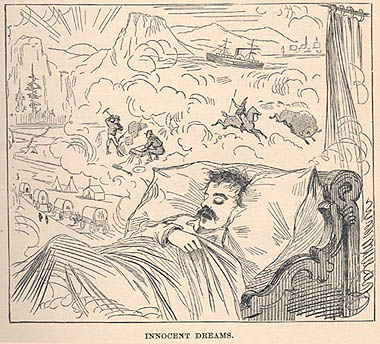 Mark Twain did not invent the Myth of the Wild West, but he certainly exploited and advanced it. Roughing It, one of his earliest books (1872), described his Western sojourn beginning in 1861 during the Civil War. It was a time when it made sense to abandon his profession as a riverboat pilot. He had little interest in fighting and there was a real danger that Union forces would draft him to serve their needs on the Mississippi. And, young Clemens wanted adventure. 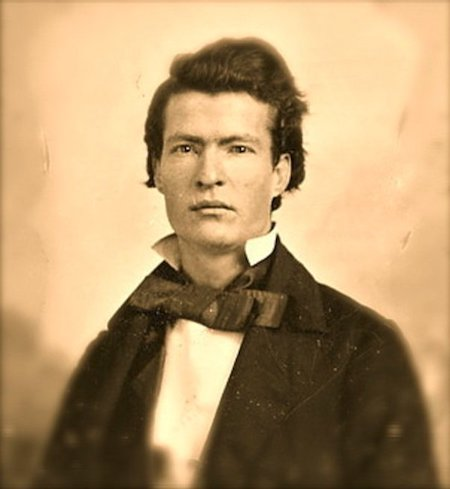 Samuel Clemens (b. 1835) traveled with his older brother Orion (b. 1825), a Lincoln-appointee to serve as secretary-treasurer of the newly-created Nevada Territory. Samuel wanted to avoid work, so he hoped to find a position with the government. There were none, so he tried his hand at lumbering and mining, but both those endeavors proved to involve too much labor. He then decided to try his hand at journalism, which was an easy profession provided that a reporter was not overly committed to the truth. In September 1862, he found employment with Virginia City's Territorial Enterprise. There, he eventually took the pen name, "Mark Twain" - the adoption of which is itself shrouded in folklore: various accounts say that it was a riverboat term meaning that the depth of water was navigable but dangerously close to trouble; others maintain that Clemens found inspiration in a saloon keeper's calling out that he was marking two drinks by his name. 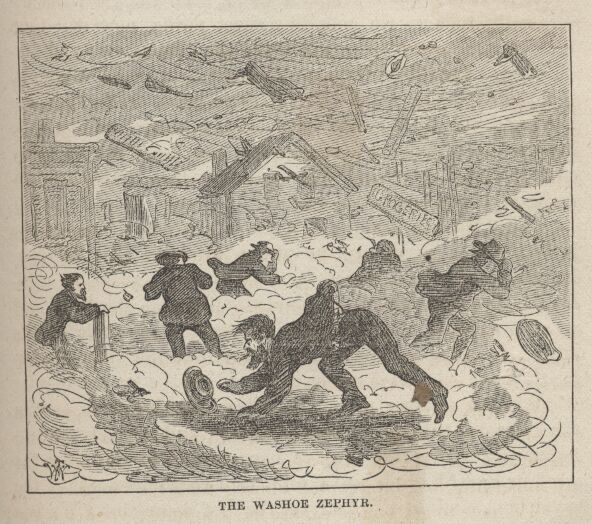 Twain's Virginia City as depicted in Roughing It (1872). Falsehood, deliberately crafted and cultivated, followed Clemens wherever he went, and he was apparently inspired by the Western genre of the Tall Tale. Clemens had long enjoyed telling "stretchers" - accounts that diverged from the truth both for amusement and effect. In the West, he found a place that regularly stepped away from reality and he celebrated the journey! It would be hard to imagine Clemens becoming Mark Twain without the American West: Clemens may have been born in Missouri, but Twain was born in Virginia City, Nevada, a place where the writer could fuse his Southern style of storytelling with the West's playful departure from fact. One of the best examples of Twain exploiting Western folklore involved the account of Horace Greeley's journey across the Sierra. Greeley - founder of the New York Tribune, which promoted the Republican political agenda - is credited with giving fame to the phrase "Go West young man!" In 1859, Greeley decided to travel West to see the region he was advocating. 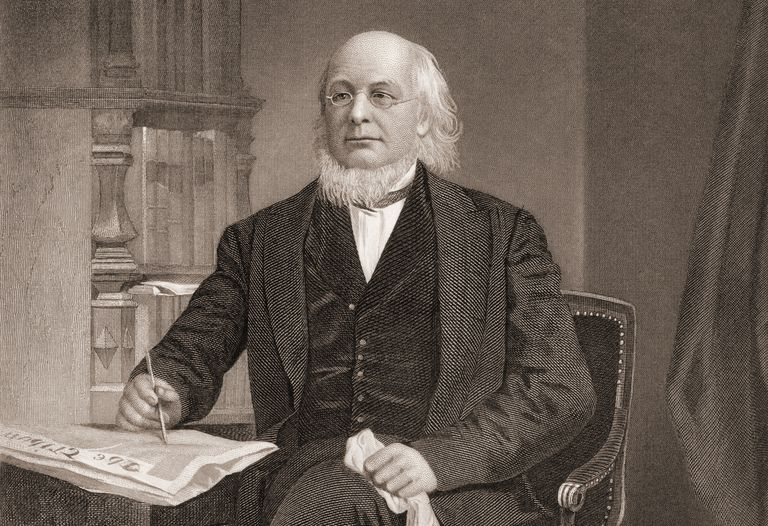 Greeley (1811-1872) found himself at the eastern base of the Sierra, in urgent need to make it over the summit to give a presentation in Placerville, California. The stage company assigned Hank Monk (1826-1883), their best driver, who necessarily took the ascent of the range slowly because of the steep grade. Greeley apparently expressed his concern about arriving in time, but Monk was an expert and knew he could easily make the deadline, so he slowed his team to rankle this Eastern greenhorn. According to the story, Greeley protested frequently and a laconic Monk repeatedly answered that he would get his passenger there on time. Once they reached the summit, Monk snapped his team into action, and they raced down the steep slope, coming perilously close to cliff edges. Greeley cried out to slow the speed of the stage, but Monk kept repeating that the celebrated phrase, "Don't worry Horace, I'll get you there on time." 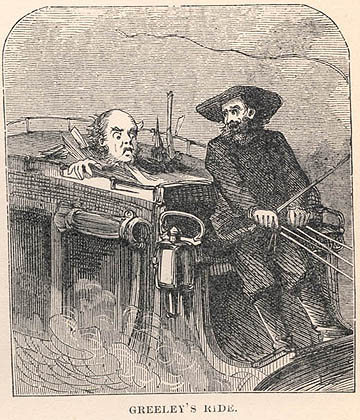 The story became a favorite of Western storytellers, in part because it pitted a Westerner with little education but a tremendous amount of know-how against an effete Eastern snob who didn't understand the way of the West. Ample evidence indicates that the story was extremely popular, and when famed comedian Artemus Ward visited the West, he recorded the yarn, writing it up in his book, aptly named "His Travels" (a sequel to his first collection of comic anecdotes entitled "His Book"). Ward did little to change the story, which was read on the floor of the US House of Representatives as a way to ridicule Greeley who had challenged President U. S. Grant during the 1872 election. 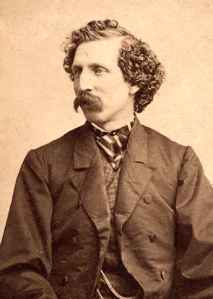 Artemus Ward (Charles Farrar Browne; 1834-1867) was reputed to be President Lincoln's "favorite comic writer." He gave a presentation in Virginia City during Christmas 1863, at which time he met Mark Twain. In the early years of his career as a writer and a lecturer, Twain was frustrated by constantly being compared to Ward - who had played a role in getting his first national publication, the short story, "The Celebrated Jumping Frog of Calaveras County" (1865). Twain adapted the Greeley-Monk story in a different direction, a clear display of his genius. Rather than recount the story as Ward had done, Twain used it on stage and in "Roughing It", emphasizing the dreary nature of an over-used anecdote. For Twain, the story was so often repeated, that when they encountered a man who was about to die of thirst - and they rescued him - he asked if he could repay them by telling them a most amusing story. Twain recounts how he refused to allow the man to tell the story because they had heard it too often, but the poor man was not able to bottle up the story within himself without ill effect and he died on the spot as a result. Twain's use of the Greeley-Monk story displays his genius. He dipped into the well of oral tradition, but he was not satisfied with a simple recounting. Instead, he framed it in a way that placed the narration in the realm of literature, folklore in origin, literary genius in final manifestation Volumes could be written on Twain's interaction with oral tradition; I have addressed the Monky-Greeley narrative in an article that recently appeared in Western Folklore: “Monk, Greeley, Ward, and Twain: The Folkloresque of a Western Legend,” Western Folklore, 76:3 (Summer 2017). |
| json metadata | {"tags":["twain","folklore","mythology","america","literature"],"image":["https://cdn.steemitimages.com/DQmfPjWxJw3UfQyCNizCmbb6AZhvHBEaGnfPFuVd1Ynq958/image.png","https://cdn.steemitimages.com/DQmcKaXbXpnemHXwG3YKPRXeDeiYpeQkY2jREFbXR8QxQQu/image.png","https://cdn.steemitimages.com/DQmcTosRucWGbPXjEbcMpTKyy1bErw18rS8fzshqxvC6fPS/image.png","https://cdn.steemitimages.com/DQmRfDcnexvnDhC6cHy52itCBUKqkqkyqmyKhKc9rhxfMqf/image.png","https://cdn.steemitimages.com/DQmPJ7Rzberur5XRTZcAci4i7qWbefu4hhaiEWDwyjBYPCq/image.png","https://cdn.steemitimages.com/DQmRBswn5w6uMmgzPgE6w3fCE5TqaLVqMFBF1eBacHZpCAz/image.png"],"app":"steemit/0.1","format":"markdown"} |
| parent author | |
| parent permlink | twain |
| permlink | mark-twain-and-the-myth-of-the-wild-west |
| title | Mark Twain and the Myth of the Wild West |
| Transaction Info | Block #24384323/Trx a053ae2bf9f3b9188f0dcb0f094a77ca7e611fd2 |
View Raw JSON Data
{
"block": 24384323,
"op": [
"comment",
{
"author": "itsallfolklore",
"body": "\n\nMark Twain did not invent the Myth of the Wild West, but he certainly exploited and advanced it. Roughing It, one of his earliest books (1872), described his Western sojourn beginning in 1861 during the Civil War. It was a time when it made sense to abandon his profession as a riverboat pilot. He had little interest in fighting and there was a real danger that Union forces would draft him to serve their needs on the Mississippi. And, young Clemens wanted adventure.\n\n\n\nSamuel Clemens (b. 1835) traveled with his older brother Orion (b. 1825), a Lincoln-appointee to serve as secretary-treasurer of the newly-created Nevada Territory. Samuel wanted to avoid work, so he hoped to find a position with the government. There were none, so he tried his hand at lumbering and mining, but both those endeavors proved to involve too much labor. He then decided to try his hand at journalism, which was an easy profession provided that a reporter was not overly committed to the truth.\n\nIn September 1862, he found employment with Virginia City's Territorial Enterprise. There, he eventually took the pen name, \"Mark Twain\" - the adoption of which is itself shrouded in folklore: various accounts say that it was a riverboat term meaning that the depth of water was navigable but dangerously close to trouble; others maintain that Clemens found inspiration in a saloon keeper's calling out that he was marking two drinks by his name. \n\n\n\nTwain's Virginia City as depicted in Roughing It (1872).\n\n\nFalsehood, deliberately crafted and cultivated, followed Clemens wherever he went, and he was apparently inspired by the Western genre of the Tall Tale. Clemens had long enjoyed telling \"stretchers\" - accounts that diverged from the truth both for amusement and effect. In the West, he found a place that regularly stepped away from reality and he celebrated the journey! It would be hard to imagine Clemens becoming Mark Twain without the American West: Clemens may have been born in Missouri, but Twain was born in Virginia City, Nevada, a place where the writer could fuse his Southern style of storytelling with the West's playful departure from fact.\n\nOne of the best examples of Twain exploiting Western folklore involved the account of Horace Greeley's journey across the Sierra. Greeley - founder of the New York Tribune, which promoted the Republican political agenda - is credited with giving fame to the phrase \"Go West young man!\" In 1859, Greeley decided to travel West to see the region he was advocating. \n\n\n\nGreeley (1811-1872) found himself at the eastern base of the Sierra, in urgent need to make it over the summit to give a presentation in Placerville, California. The stage company assigned Hank Monk (1826-1883), their best driver, who necessarily took the ascent of the range slowly because of the steep grade. Greeley apparently expressed his concern about arriving in time, but Monk was an expert and knew he could easily make the deadline, so he slowed his team to rankle this Eastern greenhorn. According to the story, Greeley protested frequently and a laconic Monk repeatedly answered that he would get his passenger there on time. Once they reached the summit, Monk snapped his team into action, and they raced down the steep slope, coming perilously close to cliff edges. Greeley cried out to slow the speed of the stage, but Monk kept repeating that the celebrated phrase, \"Don't worry Horace, I'll get you there on time.\"\n\n\n\nThe story became a favorite of Western storytellers, in part because it pitted a Westerner with little education but a tremendous amount of know-how against an effete Eastern snob who didn't understand the way of the West. Ample evidence indicates that the story was extremely popular, and when famed comedian Artemus Ward visited the West, he recorded the yarn, writing it up in his book, aptly named \"His Travels\" (a sequel to his first collection of comic anecdotes entitled \"His Book\"). Ward did little to change the story, which was read on the floor of the US House of Representatives as a way to ridicule Greeley who had challenged President U. S. Grant during the 1872 election.\n\n\n\nArtemus Ward (Charles Farrar Browne; 1834-1867) was reputed to be President Lincoln's \"favorite comic writer.\" He gave a presentation in Virginia City during Christmas 1863, at which time he met Mark Twain.\n\nIn the early years of his career as a writer and a lecturer, Twain was frustrated by constantly being compared to Ward - who had played a role in getting his first national publication, the short story, \"The Celebrated Jumping Frog of Calaveras County\" (1865). Twain adapted the Greeley-Monk story in a different direction, a clear display of his genius. Rather than recount the story as Ward had done, Twain used it on stage and in \"Roughing It\", emphasizing the dreary nature of an over-used anecdote. For Twain, the story was so often repeated, that when they encountered a man who was about to die of thirst - and they rescued him - he asked if he could repay them by telling them a most amusing story. Twain recounts how he refused to allow the man to tell the story because they had heard it too often, but the poor man was not able to bottle up the story within himself without ill effect and he died on the spot as a result. \n\nTwain's use of the Greeley-Monk story displays his genius. He dipped into the well of oral tradition, but he was not satisfied with a simple recounting. Instead, he framed it in a way that placed the narration in the realm of literature, folklore in origin, literary genius in final manifestation\n\nVolumes could be written on Twain's interaction with oral tradition; I have addressed the Monky-Greeley narrative in an article that recently appeared in Western Folklore: “Monk, Greeley, Ward, and Twain: The Folkloresque of a Western Legend,” Western Folklore, 76:3 (Summer 2017).",
"json_metadata": "{\"tags\":[\"twain\",\"folklore\",\"mythology\",\"america\",\"literature\"],\"image\":[\"https://cdn.steemitimages.com/DQmfPjWxJw3UfQyCNizCmbb6AZhvHBEaGnfPFuVd1Ynq958/image.png\",\"https://cdn.steemitimages.com/DQmcKaXbXpnemHXwG3YKPRXeDeiYpeQkY2jREFbXR8QxQQu/image.png\",\"https://cdn.steemitimages.com/DQmcTosRucWGbPXjEbcMpTKyy1bErw18rS8fzshqxvC6fPS/image.png\",\"https://cdn.steemitimages.com/DQmRfDcnexvnDhC6cHy52itCBUKqkqkyqmyKhKc9rhxfMqf/image.png\",\"https://cdn.steemitimages.com/DQmPJ7Rzberur5XRTZcAci4i7qWbefu4hhaiEWDwyjBYPCq/image.png\",\"https://cdn.steemitimages.com/DQmRBswn5w6uMmgzPgE6w3fCE5TqaLVqMFBF1eBacHZpCAz/image.png\"],\"app\":\"steemit/0.1\",\"format\":\"markdown\"}",
"parent_author": "",
"parent_permlink": "twain",
"permlink": "mark-twain-and-the-myth-of-the-wild-west",
"title": "Mark Twain and the Myth of the Wild West"
}
],
"op_in_trx": 0,
"timestamp": "2018-07-22T00:31:24",
"trx_id": "a053ae2bf9f3b9188f0dcb0f094a77ca7e611fd2",
"trx_in_block": 19,
"virtual_op": 0
}itsallfolklorepublished a new post: mark-twain-and-the-myth-of-the-wild-west2018/07/22 00:28:51
itsallfolklorepublished a new post: mark-twain-and-the-myth-of-the-wild-west
2018/07/22 00:28:51
| author | itsallfolklore |
| body |  Mark Twain did not invent the Myth of the Wild West, but he certainly exploited and advanced it. Roughing It, one of his earliest books (1872), described his Western sojourn beginning in 1861 during the Civil War. It was a time when it made sense to abandon his profession as a riverboat pilot. He had little interest in fighting and there was a real danger that Union forces would draft him to serve their needs on the Mississippi. And, young Clemens wanted adventure.  Samuel Clemens (b. 1835) traveled with his older brother Orion (b. 1825), a Lincoln-appointee to serve as secretary-treasurer of the newly-created Nevada Territory. Samuel wanted to avoid work, so he hoped to find a position with the government. There were none, so he tried his hand at lumbering and mining, but both those endeavors proved to involve too much labor. He then decided to try his hand at journalism, which was an easy profession provided that a reporter was not overly committed to the truth. In September 1862, he found employment with Virginia City's Territorial Enterprise. There, he eventually took the pen name, "Mark Twain" - the adoption of which is itself shrouded in folklore: various accounts say that it was a riverboat term meaning that the depth of water was navigable but dangerously close to trouble; others maintain that Clemens found inspiration in a saloon keeper's calling out that he was marking two drinks by his name.  Twain's Virginia City as depicted in Roughing It (1872). Falsehood, deliberately crafted and cultivated, followed Clemens wherever he went, and he was apparently inspired by the Western genre of the Tall Tale. Clemens had long enjoyed telling "stretchers" - accounts that diverged from the truth both for amusement and effect. In the West, he found a place that regularly stepped away from reality and he celebrated the journey! It would be hard to imagine Clemens becoming Mark Twain without the American West: Clemens may have been born in Missouri, but Twain was born in Virginia City, Nevada, a place where the writer could fuse his Southern style of storytelling with the West's playful departure from fact. One of the best examples of Twain exploiting Western folklore involved the account of Horace Greeley's journey across the Sierra. Greeley - founder of the New York Tribune, which promoted the Republican political agenda - is credited with giving fame to the phrase "Go West young man!" In 1859, Greeley decided to travel West to see the region he was advocating.  Greeley (1811-1872) found himself at the eastern base of the Sierra, in urgent need to make it over the summit to give a presentation in Placerville, California. The stage company assigned Hank Monk (1826-1883), their best driver, who necessarily took the ascent of the range slowly because of the steep grade. Greeley apparently expressed his concern about arriving in time, but Monk was an expert and knew he could easily make the deadline, so he slowed his team to rankle this Eastern greenhorn. According to the story, Greeley protested frequently and a laconic Monk repeatedly answered that he would get his passenger there on time. Once they reached the summit, Monk snapped his team into action, and they raced down the steep slope, coming perilously close to cliff edges. Greeley cried out to slow the speed of the stage, but Monk kept repeating that the celebrated phrase, "Don't worry Horace, I'll get you there on time."  The story became a favorite of Western storytellers, in part because it pitted a Westerner with little education but a tremendous amount of know-how against an effete Eastern snob who didn't understand the way of the West. Ample evidence indicates that the story was extremely popular, and when famed comedian Artemus Ward visited the West, he recorded the yarn, writing it up in his book, aptly named "His Travels" (a sequel to his first collection of comic anecdotes entitled "His Book"). Ward did little to change the story, which was read on the floor of the US House of Representatives as a way to ridicule Greeley who had challenged President U. S. Grant during the 1872 election.  Artemus Ward (Charles Farrar Browne; 1834-1867) was reputed to be President Lincoln's "favorite comic writer." He gave a presentation in Virginia City during Christmas 1863, at which time he met Mark Twain. In the early years of his career as a writer and a lecturer, Twain was frustrated by constantly being compared to Ward - who had played a role in getting his first national publication, the short story, "The Celebrated Jumping Frog of Calaveras County" (1865). Twain adapted the Greeley-Monk story in a different direction, a clear display of his genius. Rather than recount the story as Ward had done, Twain used it on stage and in "Roughing It", emphasizing the dreary nature of an over-used anecdote. For Twain, the story was so often repeated, that when they encountered a man who was about to die of thirst - and they rescued him - he asked if he could repay them by telling them a most amusing story. Twain recounts how he refused to allow the man to tell the story because they had heard it too often, but the poor man was not able to bottle up the story within himself without ill effect and he died on the spot as a result. Twain's use of the Greeley-Monk story displays his genius. He dipped into the well of oral tradition, but he was not satisfied with a simple recounting. Instead, he framed it in a way that placed the narration in the realm of literature, folklore in origin, literary genius in final manifestation Volumes could be written on Twain's interaction with oral tradition; I have addressed the Monky-Greeley narrative in an article that recently appeared in Western Folklore: “Monk, Greeley, Ward, and Twain: The Folkloresque of a Western Legend,” Western Folklore, 76:3 (Summer 2017). |
| json metadata | {"tags":["twain","folklore","mythology","west","literature"],"image":["https://cdn.steemitimages.com/DQmfPjWxJw3UfQyCNizCmbb6AZhvHBEaGnfPFuVd1Ynq958/image.png","https://cdn.steemitimages.com/DQmcKaXbXpnemHXwG3YKPRXeDeiYpeQkY2jREFbXR8QxQQu/image.png","https://cdn.steemitimages.com/DQmcTosRucWGbPXjEbcMpTKyy1bErw18rS8fzshqxvC6fPS/image.png","https://cdn.steemitimages.com/DQmRfDcnexvnDhC6cHy52itCBUKqkqkyqmyKhKc9rhxfMqf/image.png","https://cdn.steemitimages.com/DQmPJ7Rzberur5XRTZcAci4i7qWbefu4hhaiEWDwyjBYPCq/image.png","https://cdn.steemitimages.com/DQmRBswn5w6uMmgzPgE6w3fCE5TqaLVqMFBF1eBacHZpCAz/image.png"],"app":"steemit/0.1","format":"markdown"} |
| parent author | |
| parent permlink | twain |
| permlink | mark-twain-and-the-myth-of-the-wild-west |
| title | Mark Twain and the Myth of the Wild West |
| Transaction Info | Block #24384272/Trx 069c12917f11b892e8a47910300bb6ab3db8a3de |
View Raw JSON Data
{
"block": 24384272,
"op": [
"comment",
{
"author": "itsallfolklore",
"body": "\n\nMark Twain did not invent the Myth of the Wild West, but he certainly exploited and advanced it. Roughing It, one of his earliest books (1872), described his Western sojourn beginning in 1861 during the Civil War. It was a time when it made sense to abandon his profession as a riverboat pilot. He had little interest in fighting and there was a real danger that Union forces would draft him to serve their needs on the Mississippi. And, young Clemens wanted adventure.\n\n\n\nSamuel Clemens (b. 1835) traveled with his older brother Orion (b. 1825), a Lincoln-appointee to serve as secretary-treasurer of the newly-created Nevada Territory. Samuel wanted to avoid work, so he hoped to find a position with the government. There were none, so he tried his hand at lumbering and mining, but both those endeavors proved to involve too much labor. He then decided to try his hand at journalism, which was an easy profession provided that a reporter was not overly committed to the truth.\n\nIn September 1862, he found employment with Virginia City's Territorial Enterprise. There, he eventually took the pen name, \"Mark Twain\" - the adoption of which is itself shrouded in folklore: various accounts say that it was a riverboat term meaning that the depth of water was navigable but dangerously close to trouble; others maintain that Clemens found inspiration in a saloon keeper's calling out that he was marking two drinks by his name. \n\n\n\nTwain's Virginia City as depicted in Roughing It (1872).\n\n\nFalsehood, deliberately crafted and cultivated, followed Clemens wherever he went, and he was apparently inspired by the Western genre of the Tall Tale. Clemens had long enjoyed telling \"stretchers\" - accounts that diverged from the truth both for amusement and effect. In the West, he found a place that regularly stepped away from reality and he celebrated the journey! It would be hard to imagine Clemens becoming Mark Twain without the American West: Clemens may have been born in Missouri, but Twain was born in Virginia City, Nevada, a place where the writer could fuse his Southern style of storytelling with the West's playful departure from fact.\n\nOne of the best examples of Twain exploiting Western folklore involved the account of Horace Greeley's journey across the Sierra. Greeley - founder of the New York Tribune, which promoted the Republican political agenda - is credited with giving fame to the phrase \"Go West young man!\" In 1859, Greeley decided to travel West to see the region he was advocating. \n\n\n\nGreeley (1811-1872) found himself at the eastern base of the Sierra, in urgent need to make it over the summit to give a presentation in Placerville, California. The stage company assigned Hank Monk (1826-1883), their best driver, who necessarily took the ascent of the range slowly because of the steep grade. Greeley apparently expressed his concern about arriving in time, but Monk was an expert and knew he could easily make the deadline, so he slowed his team to rankle this Eastern greenhorn. According to the story, Greeley protested frequently and a laconic Monk repeatedly answered that he would get his passenger there on time. Once they reached the summit, Monk snapped his team into action, and they raced down the steep slope, coming perilously close to cliff edges. Greeley cried out to slow the speed of the stage, but Monk kept repeating that the celebrated phrase, \"Don't worry Horace, I'll get you there on time.\"\n\n\n\nThe story became a favorite of Western storytellers, in part because it pitted a Westerner with little education but a tremendous amount of know-how against an effete Eastern snob who didn't understand the way of the West. Ample evidence indicates that the story was extremely popular, and when famed comedian Artemus Ward visited the West, he recorded the yarn, writing it up in his book, aptly named \"His Travels\" (a sequel to his first collection of comic anecdotes entitled \"His Book\"). Ward did little to change the story, which was read on the floor of the US House of Representatives as a way to ridicule Greeley who had challenged President U. S. Grant during the 1872 election.\n\n\n\nArtemus Ward (Charles Farrar Browne; 1834-1867) was reputed to be President Lincoln's \"favorite comic writer.\" He gave a presentation in Virginia City during Christmas 1863, at which time he met Mark Twain.\n\nIn the early years of his career as a writer and a lecturer, Twain was frustrated by constantly being compared to Ward - who had played a role in getting his first national publication, the short story, \"The Celebrated Jumping Frog of Calaveras County\" (1865). Twain adapted the Greeley-Monk story in a different direction, a clear display of his genius. Rather than recount the story as Ward had done, Twain used it on stage and in \"Roughing It\", emphasizing the dreary nature of an over-used anecdote. For Twain, the story was so often repeated, that when they encountered a man who was about to die of thirst - and they rescued him - he asked if he could repay them by telling them a most amusing story. Twain recounts how he refused to allow the man to tell the story because they had heard it too often, but the poor man was not able to bottle up the story within himself without ill effect and he died on the spot as a result. \n\nTwain's use of the Greeley-Monk story displays his genius. He dipped into the well of oral tradition, but he was not satisfied with a simple recounting. Instead, he framed it in a way that placed the narration in the realm of literature, folklore in origin, literary genius in final manifestation\n\nVolumes could be written on Twain's interaction with oral tradition; I have addressed the Monky-Greeley narrative in an article that recently appeared in Western Folklore: “Monk, Greeley, Ward, and Twain: The Folkloresque of a Western Legend,” Western Folklore, 76:3 (Summer 2017).",
"json_metadata": "{\"tags\":[\"twain\",\"folklore\",\"mythology\",\"west\",\"literature\"],\"image\":[\"https://cdn.steemitimages.com/DQmfPjWxJw3UfQyCNizCmbb6AZhvHBEaGnfPFuVd1Ynq958/image.png\",\"https://cdn.steemitimages.com/DQmcKaXbXpnemHXwG3YKPRXeDeiYpeQkY2jREFbXR8QxQQu/image.png\",\"https://cdn.steemitimages.com/DQmcTosRucWGbPXjEbcMpTKyy1bErw18rS8fzshqxvC6fPS/image.png\",\"https://cdn.steemitimages.com/DQmRfDcnexvnDhC6cHy52itCBUKqkqkyqmyKhKc9rhxfMqf/image.png\",\"https://cdn.steemitimages.com/DQmPJ7Rzberur5XRTZcAci4i7qWbefu4hhaiEWDwyjBYPCq/image.png\",\"https://cdn.steemitimages.com/DQmRBswn5w6uMmgzPgE6w3fCE5TqaLVqMFBF1eBacHZpCAz/image.png\"],\"app\":\"steemit/0.1\",\"format\":\"markdown\"}",
"parent_author": "",
"parent_permlink": "twain",
"permlink": "mark-twain-and-the-myth-of-the-wild-west",
"title": "Mark Twain and the Myth of the Wild West"
}
],
"op_in_trx": 0,
"timestamp": "2018-07-22T00:28:51",
"trx_id": "069c12917f11b892e8a47910300bb6ab3db8a3de",
"trx_in_block": 11,
"virtual_op": 0
}2018/07/16 20:37:51
2018/07/16 20:37:51
| author | heatherthebard |
| permlink | re-itsallfolklore-re-heatherthebard-re-itsallfolklore-bagpipes-20180716t174654568z |
| voter | itsallfolklore |
| weight | 10000 (100.00%) |
| Transaction Info | Block #24235778/Trx 89807d3a13b1e8dd964c59a27366d41d3747dfc2 |
View Raw JSON Data
{
  "block": 24235778,
  "op": [
    "vote",
    {
      "author": "heatherthebard",
      "permlink": "re-itsallfolklore-re-heatherthebard-re-itsallfolklore-bagpipes-20180716t174654568z",
      "voter": "itsallfolklore",
      "weight": 10000
    }
  ],
  "op_in_trx": 0,
  "timestamp": "2018-07-16T20:37:51",
  "trx_id": "89807d3a13b1e8dd964c59a27366d41d3747dfc2",
  "trx_in_block": 29,
  "virtual_op": 0
}2018/07/16 17:46:54
2018/07/16 17:46:54
| author | heatherthebard |
| body | Fantastic! |
| json metadata | {"tags":["britain"],"app":"steemit/0.1"} |
| parent author | itsallfolklore |
| parent permlink | re-heatherthebard-re-itsallfolklore-bagpipes-20180716t104600895z |
| permlink | re-itsallfolklore-re-heatherthebard-re-itsallfolklore-bagpipes-20180716t174654568z |
| title | |
| Transaction Info | Block #24232360/Trx 4f60b38ba64abd50c53824a861aca211d521225b |
View Raw JSON Data
{
  "block": 24232360,
  "op": [
    "comment",
    {
      "author": "heatherthebard",
      "body": "Fantastic!",
      "json_metadata": "{\"tags\":[\"britain\"],\"app\":\"steemit/0.1\"}",
      "parent_author": "itsallfolklore",
      "parent_permlink": "re-heatherthebard-re-itsallfolklore-bagpipes-20180716t104600895z",
      "permlink": "re-itsallfolklore-re-heatherthebard-re-itsallfolklore-bagpipes-20180716t174654568z",
      "title": ""
    }
  ],
  "op_in_trx": 0,
  "timestamp": "2018-07-16T17:46:54",
  "trx_id": "4f60b38ba64abd50c53824a861aca211d521225b",
  "trx_in_block": 33,
  "virtual_op": 0
}2018/07/16 17:46:39
2018/07/16 17:46:39
| author | itsallfolklore |
| permlink | re-heatherthebard-re-itsallfolklore-bagpipes-20180716t104600895z |
| voter | heatherthebard |
| weight | 10000 (100.00%) |
| Transaction Info | Block #24232355/Trx 37825bbb1b5ca022d61835738eb5d1d3f523a222 |
View Raw JSON Data
{
  "block": 24232355,
  "op": [
    "vote",
    {
      "author": "itsallfolklore",
      "permlink": "re-heatherthebard-re-itsallfolklore-bagpipes-20180716t104600895z",
      "voter": "heatherthebard",
      "weight": 10000
    }
  ],
  "op_in_trx": 0,
  "timestamp": "2018-07-16T17:46:39",
  "trx_id": "37825bbb1b5ca022d61835738eb5d1d3f523a222",
  "trx_in_block": 52,
  "virtual_op": 0
}itsallfolkloreupvoted (100.00%) @heatherthebard / re-itsallfolklore-bagpipes-20180716t044555981z2018/07/16 10:46:15
itsallfolkloreupvoted (100.00%) @heatherthebard / re-itsallfolklore-bagpipes-20180716t044555981z
2018/07/16 10:46:15
| author | heatherthebard |
| permlink | re-itsallfolklore-bagpipes-20180716t044555981z |
| voter | itsallfolklore |
| weight | 10000 (100.00%) |
| Transaction Info | Block #24223949/Trx df0de761b00ddf9f3ab8522c7f5438567a5a3786 |
View Raw JSON Data
{
  "block": 24223949,
  "op": [
    "vote",
    {
      "author": "heatherthebard",
      "permlink": "re-itsallfolklore-bagpipes-20180716t044555981z",
      "voter": "itsallfolklore",
      "weight": 10000
    }
  ],
  "op_in_trx": 0,
  "timestamp": "2018-07-16T10:46:15",
  "trx_id": "df0de761b00ddf9f3ab8522c7f5438567a5a3786",
  "trx_in_block": 4,
  "virtual_op": 0
}2018/07/16 10:46:06
2018/07/16 10:46:06
| author | itsallfolklore |
| body | Thanks for the note. I've been tied up with a back-and-forth with copy edits for by forthcoming book on Cornish folklore. And in the midst of that, I found the inspiration (and somehow the time!) to complete an article that serves as an epilogue to the book. Typesetting and indexing are all that remains, at which point, the birthing process yields the baby! |
| json metadata | {"tags":["britain"],"app":"steemit/0.1"} |
| parent author | heatherthebard |
| parent permlink | re-itsallfolklore-bagpipes-20180716t044555981z |
| permlink | re-heatherthebard-re-itsallfolklore-bagpipes-20180716t104600895z |
| title | |
| Transaction Info | Block #24223946/Trx f3ce02cf0adeb9d67baa169a20b65521a9f26b97 |
View Raw JSON Data
{
  "block": 24223946,
  "op": [
    "comment",
    {
      "author": "itsallfolklore",
      "body": "Thanks for the note. I've been tied up with a back-and-forth with copy edits for by forthcoming book on Cornish folklore. And in the midst of that, I found the inspiration (and somehow the time!) to complete an article that serves as an epilogue to the book.  Typesetting and indexing are all that remains, at which point, the birthing process yields the baby!",
      "json_metadata": "{\"tags\":[\"britain\"],\"app\":\"steemit/0.1\"}",
      "parent_author": "heatherthebard",
      "parent_permlink": "re-itsallfolklore-bagpipes-20180716t044555981z",
      "permlink": "re-heatherthebard-re-itsallfolklore-bagpipes-20180716t104600895z",
      "title": ""
    }
  ],
  "op_in_trx": 0,
  "timestamp": "2018-07-16T10:46:06",
  "trx_id": "f3ce02cf0adeb9d67baa169a20b65521a9f26b97",
  "trx_in_block": 24,
  "virtual_op": 0
}2018/07/16 04:45:57
2018/07/16 04:45:57
| author | heatherthebard |
| body | It is really good to see you posting again! 🙂 Welcome back, and thanks for the article! |
| json metadata | {"tags":["britain"],"app":"steemit/0.1"} |
| parent author | itsallfolklore |
| parent permlink | bagpipes |
| permlink | re-itsallfolklore-bagpipes-20180716t044555981z |
| title | |
| Transaction Info | Block #24216744/Trx dea5234ffb9afc7cf07b5d4b060030a388b80bbb |
View Raw JSON Data
{
  "block": 24216744,
  "op": [
    "comment",
    {
      "author": "heatherthebard",
      "body": "It is really good to see you posting again! 🙂 Welcome back, and thanks for the article!",
      "json_metadata": "{\"tags\":[\"britain\"],\"app\":\"steemit/0.1\"}",
      "parent_author": "itsallfolklore",
      "parent_permlink": "bagpipes",
      "permlink": "re-itsallfolklore-bagpipes-20180716t044555981z",
      "title": ""
    }
  ],
  "op_in_trx": 0,
  "timestamp": "2018-07-16T04:45:57",
  "trx_id": "dea5234ffb9afc7cf07b5d4b060030a388b80bbb",
  "trx_in_block": 4,
  "virtual_op": 0
}heatherthebardupvoted (100.00%) @itsallfolklore / bagpipes2018/07/16 04:43:03
heatherthebardupvoted (100.00%) @itsallfolklore / bagpipes
2018/07/16 04:43:03
| author | itsallfolklore |
| permlink | bagpipes |
| voter | heatherthebard |
| weight | 10000 (100.00%) |
| Transaction Info | Block #24216686/Trx 36458df7cab41fbcaf5815d1d6644fa9b209fbc4 |
View Raw JSON Data
{
  "block": 24216686,
  "op": [
    "vote",
    {
      "author": "itsallfolklore",
      "permlink": "bagpipes",
      "voter": "heatherthebard",
      "weight": 10000
    }
  ],
  "op_in_trx": 0,
  "timestamp": "2018-07-16T04:43:03",
  "trx_id": "36458df7cab41fbcaf5815d1d6644fa9b209fbc4",
  "trx_in_block": 25,
  "virtual_op": 0
}pinoyupvoted (10.00%) @itsallfolklore / bagpipes2018/07/15 16:42:09
pinoyupvoted (10.00%) @itsallfolklore / bagpipes
2018/07/15 16:42:09
| author | itsallfolklore |
| permlink | bagpipes |
| voter | pinoy |
| weight | 1000 (10.00%) |
| Transaction Info | Block #24202271/Trx df853d8a128e9b2fdafb93065fda14c0850fb61e |
View Raw JSON Data
{
  "block": 24202271,
  "op": [
    "vote",
    {
      "author": "itsallfolklore",
      "permlink": "bagpipes",
      "voter": "pinoy",
      "weight": 1000
    }
  ],
  "op_in_trx": 0,
  "timestamp": "2018-07-15T16:42:09",
  "trx_id": "df853d8a128e9b2fdafb93065fda14c0850fb61e",
  "trx_in_block": 5,
  "virtual_op": 0
}steemdelegated 18.079 SP to @itsallfolklore2018/07/15 16:16:09
steemdelegated 18.079 SP to @itsallfolklore
2018/07/15 16:16:09
| delegatee | itsallfolklore |
| delegator | steem |
| vesting shares | 29404.570055 VESTS |
| Transaction Info | Block #24201751/Trx 844b07776c484a2116dbb008d595253e933a7736 |
View Raw JSON Data
{
  "block": 24201751,
  "op": [
    "delegate_vesting_shares",
    {
      "delegatee": "itsallfolklore",
      "delegator": "steem",
      "vesting_shares": "29404.570055 VESTS"
    }
  ],
  "op_in_trx": 0,
  "timestamp": "2018-07-15T16:16:09",
  "trx_id": "844b07776c484a2116dbb008d595253e933a7736",
  "trx_in_block": 7,
  "virtual_op": 0
}skjatupvoted (100.00%) @itsallfolklore / bagpipes2018/07/15 16:10:54
skjatupvoted (100.00%) @itsallfolklore / bagpipes
2018/07/15 16:10:54
| author | itsallfolklore |
| permlink | bagpipes |
| voter | skjat |
| weight | 10000 (100.00%) |
| Transaction Info | Block #24201646/Trx ad5b5e824c2d41b0bc81955062a4aea61621f890 |
View Raw JSON Data
{
  "block": 24201646,
  "op": [
    "vote",
    {
      "author": "itsallfolklore",
      "permlink": "bagpipes",
      "voter": "skjat",
      "weight": 10000
    }
  ],
  "op_in_trx": 0,
  "timestamp": "2018-07-15T16:10:54",
  "trx_id": "ad5b5e824c2d41b0bc81955062a4aea61621f890",
  "trx_in_block": 25,
  "virtual_op": 0
}itsallfolklorepublished a new post: bagpipes2018/07/15 16:10:33
itsallfolklorepublished a new post: bagpipes
2018/07/15 16:10:33
| author | itsallfolklore |
| body | 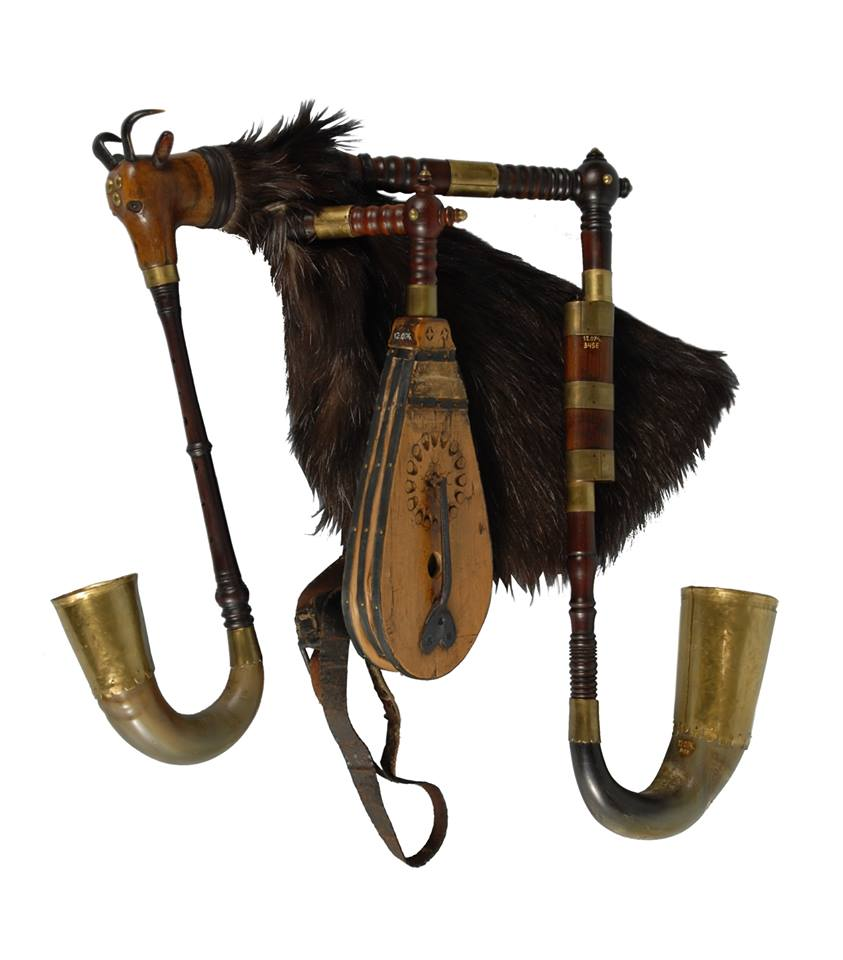 This example of a set of Croatian bagpipes reveals something that is often not widely known, namely that there are dozens of species of this instrument spread from the Celtic fringe of Britain and Ireland, all the way to Iran. Bagpipes can be divided into two groups when it comes to air source: mouth blown or, as is the case here, bellows driven. This Croatian instrument is arranged like the bellows-driven uilleann (Gaelic for elbow) pipes of Ireland. 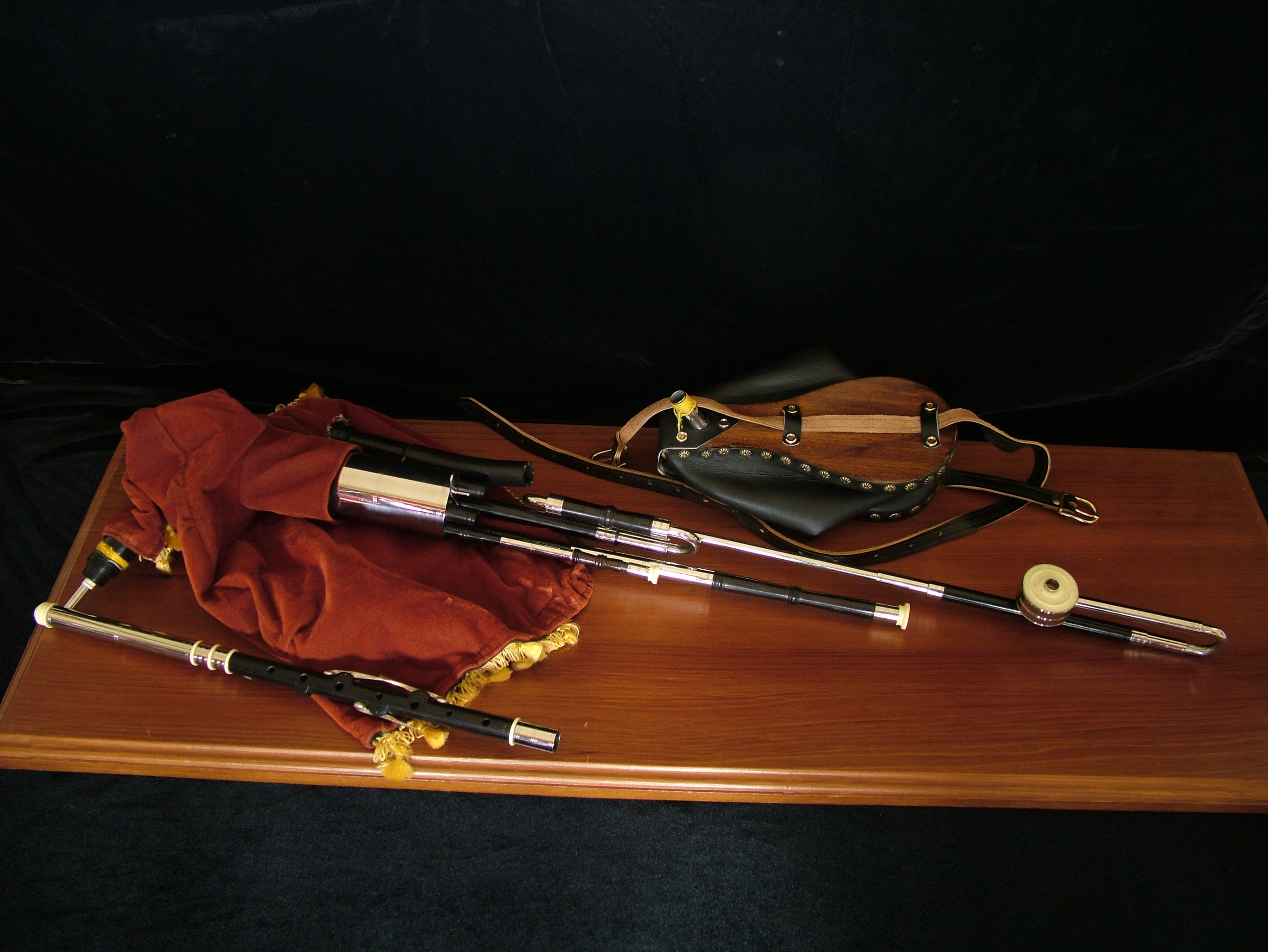 This example of uilleann pipes is a "three-quarters" set, meaning it has a chanter (for the melody - bottom left) and three drones (alto, tenor, and base - middle of image), which are tuned to the same note, humming a constant pitch in three octaves. A full set of uilleann pipes would include an additional set of "regulators," which are drones that can change keys. The Croatian bagpipes illustrated above has only one drone, and this common for many species of bagpipes. The uilleann pipes belong to the same family as this Croatian instrument by virtue of the bellows (top right), which provides the air needed to make the instrument play. 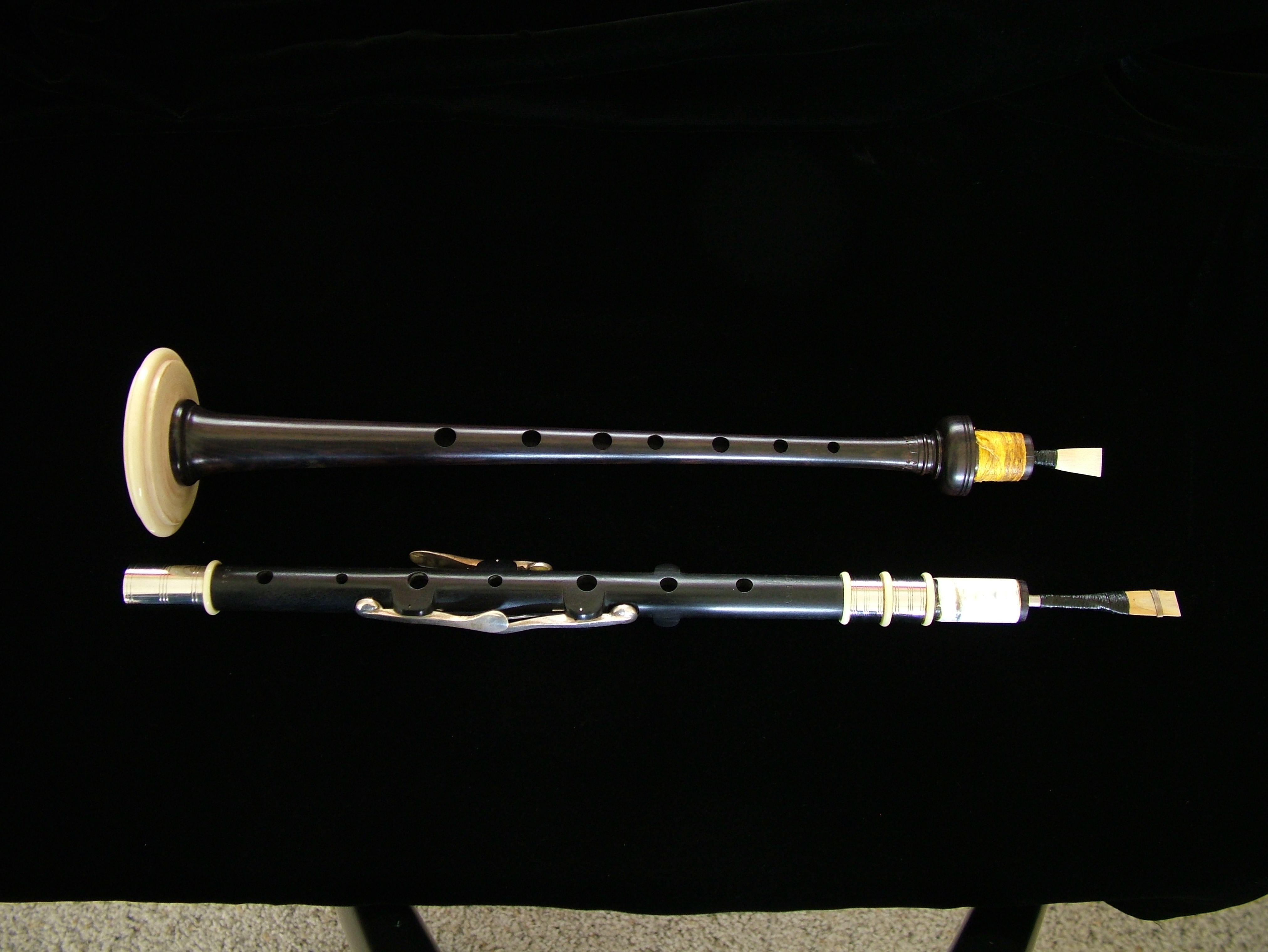 In addition, the Croatian pipes appear to have a chanter that also places it in the same family as the uilleann pipes. Bagpipe chanters are either cylindrical or conical. The cylindrical chanter of an uilleann pipe (see above, bottom of the image) allows the musician to squeeze the bag harder to cause the instrument to sing into a second octave, something of a falsetto voice. This is distinct from conical chanters, as in this example from the Great Highland Bagpipes (see above, top of image) . The conical chanter in this case can only be played one octave (A to A with a G on the bottom). To be certain that the Croatian chanter is cylindrical it would be necessary to look down its bore, but this appears to be the case. 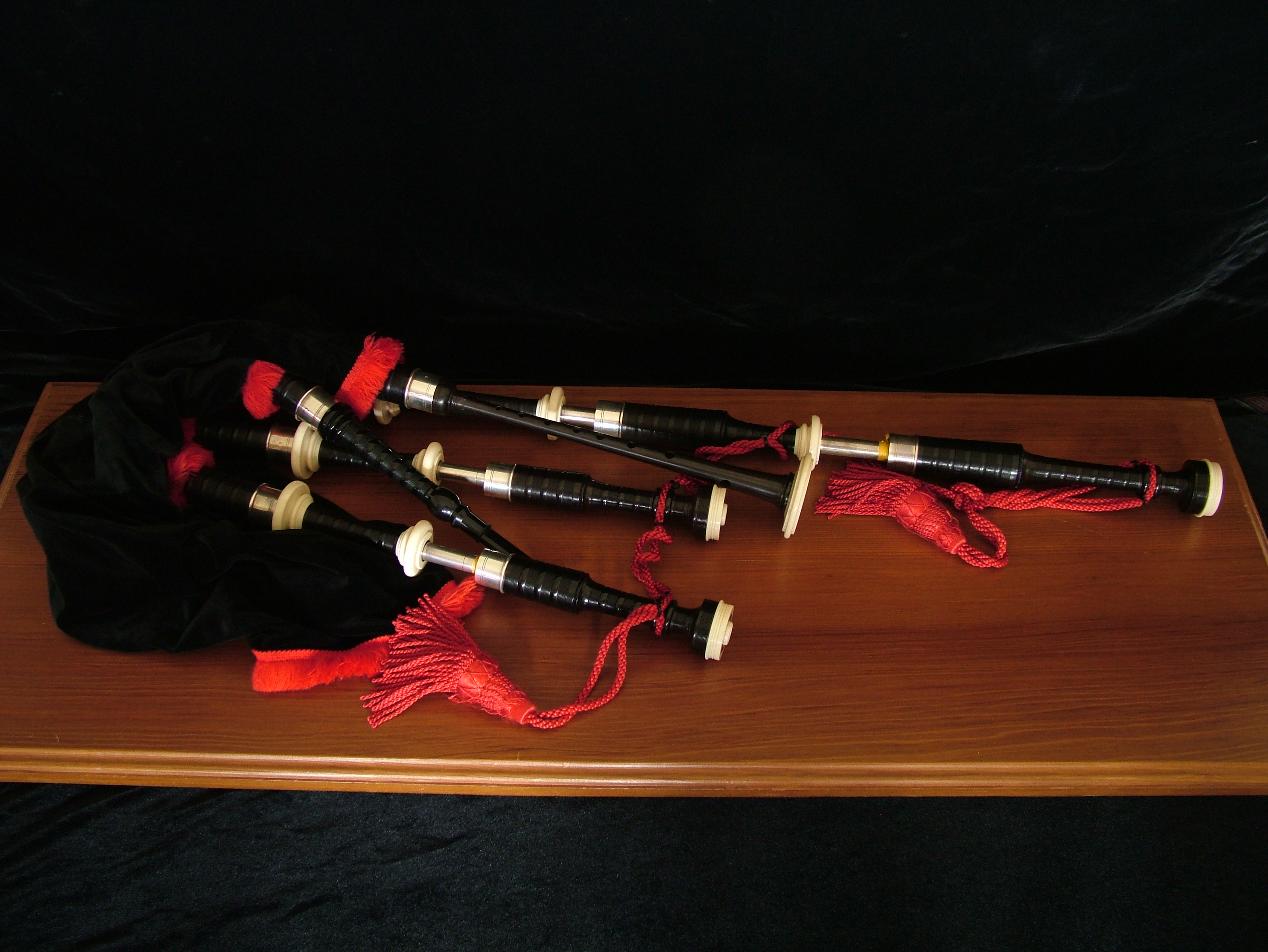 Scotland's mouth-blown Great Highland Bagpipes are internationally famous, eclipsing many of its cousins. This is partly because it is unique in the family of bagpipes in that it was adapted to serve in combat: it is far louder than most others, a volume necessary for it to be heard over the din of battle. In fact, after the Scottish rising of 1745, the government in London outlawed the possession of the Great Highland bagpipes, declaring them to be a weapon of war. 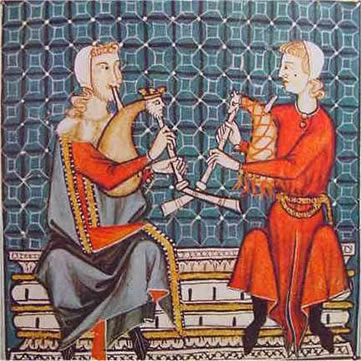 Most bagpipes have a soft enough volume that they can be played with other instruments. That said, the point of most bagpipes is that they can serve as a self-contained "musical group": while the chanter plays a melody, the drones hum along as additional instruments in accompaniment. This is not unlike the way the fiddle was traditionally played: the musician would play two strings simultaneously, one with the fingers moving along so that the string sang the melody while the other drones as a background. 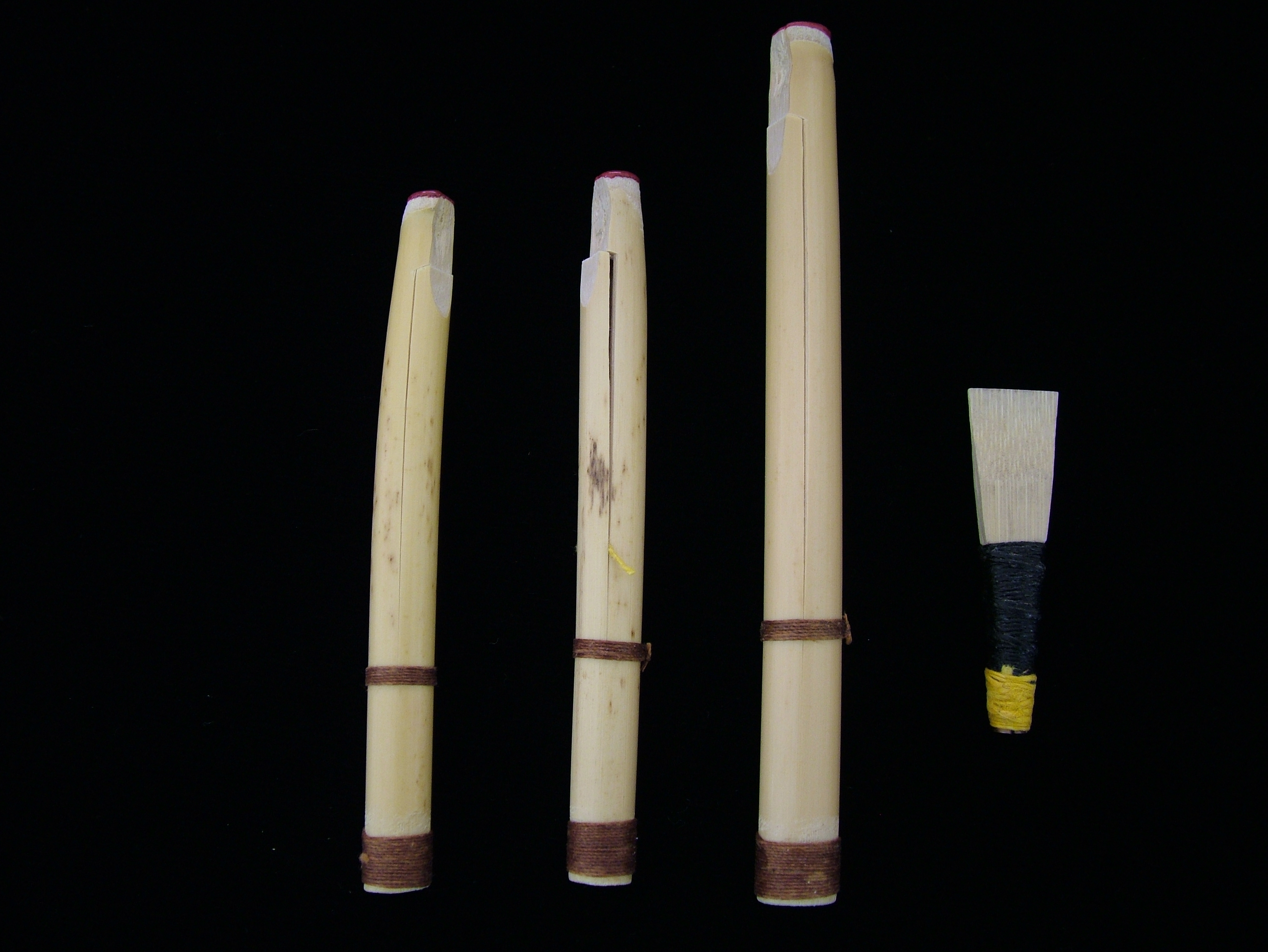 Internationally, bagpipes generally use some form of reed to provide the vibration that the instrument manipulates to produce its sound. Drones reeds often used the entire cane with a "tongue" cut down the side to provide the vibration (see the three reeds above, to the left, from the Great Highland Bagpipe - the base drone reed is the largest). The chanters generally use a "double reed" (see above example, right, again from the Great Highland Bagpipe). The chanter reed consists of two cut reeds tied together; air flows between them so that they vibrate together. The double reed of the chanter places bagpipes in the same family with oboes, bassoons and English horns. All of these are imports from the Middle East, where the double reed is found, used in a way - without a bag - not unlike the medieval shawm (see below). 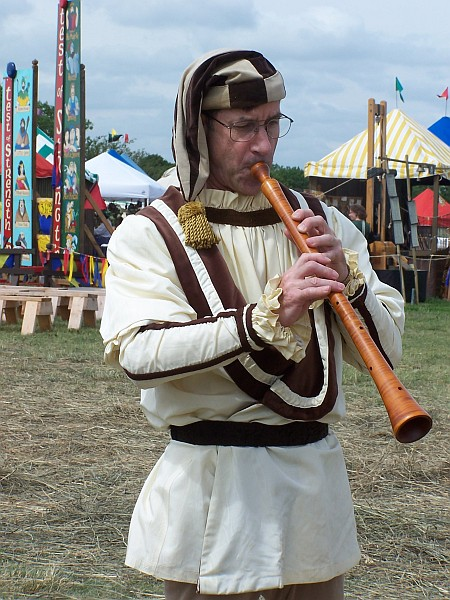 By adding a bag to a chanter, it was possible for the musician to play continuously while taking breaths. In addition, it was possible to add drones, allowing the combination to sound like multiple instruments. A single musician could then serve as an entire "band." The bagpipe appears to have been imported to Europe by the Romans, through contact with the Middle East. Romans apparently brought bagpipes to Britain where indigenous musicians were so impressed that they adopted the instrument and called it their own. Crusaders provided later contact with the Middle East and as a result, the shawm and its relatives - the oboe, bassoon, and English horn - became staples of European music. |
| json metadata | {"tags":["britain","folklore","ireland","scotland","music"],"image":["https://cdn.steemitimages.com/DQmcCs7SVwz9vsKaJFXRD4yGiM1nZiVXLzhYcNL1c1KJEs4/image.png","https://cdn.steemitimages.com/DQmW25RH9FP3x6paWsdEHBtibnizVrv5PuwGF1MhAkkbYdZ/Pipes%20Uilleann.JPG","https://cdn.steemitimages.com/DQmS5FGjH1FGsViqjqCGVur7DpaZEnKAR7PGWDz2aBr9iU7/Pipes%20chanters.JPG","https://cdn.steemitimages.com/DQmeGWJYSfnLUxSo4XWHVCJnBrE4negajo9ERTPGUbCdpCN/Pipes%20Highland.JPG","https://cdn.steemitimages.com/DQmVFsBRhZuTPGEBHpDYs9L7YakGUqqyz26dW3RfX7oLXU3/image.png","https://cdn.steemitimages.com/DQmSpapkHCxuEeoEWbufoTXaG7sP8mbxgmGN8eJFaybZJP4/Pipes%20reeds.JPG","https://cdn.steemitimages.com/DQmVAxXto7kzMJmcWja7doemck3Gz3sWKSY9pYXtzmVSrPb/image.png"],"app":"steemit/0.1","format":"markdown"} |
| parent author | |
| parent permlink | britain |
| permlink | bagpipes |
| title | Bagpipes! |
| Transaction Info | Block #24201639/Trx c9a76ee016abf174a0b7320c86b4bb7d9a3e033e |
View Raw JSON Data
{
"block": 24201639,
"op": [
"comment",
{
"author": "itsallfolklore",
"body": "\n\nThis example of a set of Croatian bagpipes reveals something that is often not widely known, namely that there are dozens of species of this instrument spread from the Celtic fringe of Britain and Ireland, all the way to Iran. Bagpipes can be divided into two groups when it comes to air source: mouth blown or, as is the case here, bellows driven. This Croatian instrument is arranged like the bellows-driven uilleann (Gaelic for elbow) pipes of Ireland.\n\n\n\n\nThis example of uilleann pipes is a \"three-quarters\" set, meaning it has a chanter (for the melody - bottom left) and three drones (alto, tenor, and base - middle of image), which are tuned to the same note, humming a constant pitch in three octaves. A full set of uilleann pipes would include an additional set of \"regulators,\" which are drones that can change keys. The Croatian bagpipes illustrated above has only one drone, and this common for many species of bagpipes. The uilleann pipes belong to the same family as this Croatian instrument by virtue of the bellows (top right), which provides the air needed to make the instrument play.\n\n\n\nIn addition, the Croatian pipes appear to have a chanter that also places it in the same family as the uilleann pipes. Bagpipe chanters are either cylindrical or conical. The cylindrical chanter of an uilleann pipe (see above, bottom of the image) allows the musician to squeeze the bag harder to cause the instrument to sing into a second octave, something of a falsetto voice. This is distinct from conical chanters, as in this example from the Great Highland Bagpipes (see above, top of image) . The conical chanter in this case can only be played one octave (A to A with a G on the bottom). To be certain that the Croatian chanter is cylindrical it would be necessary to look down its bore, but this appears to be the case.\n\n\n\n\nScotland's mouth-blown Great Highland Bagpipes are internationally famous, eclipsing many of its cousins. This is partly because it is unique in the family of bagpipes in that it was adapted to serve in combat: it is far louder than most others, a volume necessary for it to be heard over the din of battle. In fact, after the Scottish rising of 1745, the government in London outlawed the possession of the Great Highland bagpipes, declaring them to be a weapon of war.\n\n\n\nMost bagpipes have a soft enough volume that they can be played with other instruments. That said, the point of most bagpipes is that they can serve as a self-contained \"musical group\": while the chanter plays a melody, the drones hum along as additional instruments in accompaniment. This is not unlike the way the fiddle was traditionally played: the musician would play two strings simultaneously, one with the fingers moving along so that the string sang the melody while the other drones as a background.\n\n\n\nInternationally, bagpipes generally use some form of reed to provide the vibration that the instrument manipulates to produce its sound. Drones reeds often used the entire cane with a \"tongue\" cut down the side to provide the vibration (see the three reeds above, to the left, from the Great Highland Bagpipe - the base drone reed is the largest). The chanters generally use a \"double reed\" (see above example, right, again from the Great Highland Bagpipe). The chanter reed consists of two cut reeds tied together; air flows between them so that they vibrate together. The double reed of the chanter places bagpipes in the same family with oboes, bassoons and English horns. All of these are imports from the Middle East, where the double reed is found, used in a way - without a bag - not unlike the medieval shawm (see below).\n\n\n\nBy adding a bag to a chanter, it was possible for the musician to play continuously while taking breaths. In addition, it was possible to add drones, allowing the combination to sound like multiple instruments. A single musician could then serve as an entire \"band.\" The bagpipe appears to have been imported to Europe by the Romans, through contact with the Middle East. Romans apparently brought bagpipes to Britain where indigenous musicians were so impressed that they adopted the instrument and called it their own. Crusaders provided later contact with the Middle East and as a result, the shawm and its relatives - the oboe, bassoon, and English horn - became staples of European music.",
"json_metadata": "{\"tags\":[\"britain\",\"folklore\",\"ireland\",\"scotland\",\"music\"],\"image\":[\"https://cdn.steemitimages.com/DQmcCs7SVwz9vsKaJFXRD4yGiM1nZiVXLzhYcNL1c1KJEs4/image.png\",\"https://cdn.steemitimages.com/DQmW25RH9FP3x6paWsdEHBtibnizVrv5PuwGF1MhAkkbYdZ/Pipes%20Uilleann.JPG\",\"https://cdn.steemitimages.com/DQmS5FGjH1FGsViqjqCGVur7DpaZEnKAR7PGWDz2aBr9iU7/Pipes%20chanters.JPG\",\"https://cdn.steemitimages.com/DQmeGWJYSfnLUxSo4XWHVCJnBrE4negajo9ERTPGUbCdpCN/Pipes%20Highland.JPG\",\"https://cdn.steemitimages.com/DQmVFsBRhZuTPGEBHpDYs9L7YakGUqqyz26dW3RfX7oLXU3/image.png\",\"https://cdn.steemitimages.com/DQmSpapkHCxuEeoEWbufoTXaG7sP8mbxgmGN8eJFaybZJP4/Pipes%20reeds.JPG\",\"https://cdn.steemitimages.com/DQmVAxXto7kzMJmcWja7doemck3Gz3sWKSY9pYXtzmVSrPb/image.png\"],\"app\":\"steemit/0.1\",\"format\":\"markdown\"}",
"parent_author": "",
"parent_permlink": "britain",
"permlink": "bagpipes",
"title": "Bagpipes!"
}
],
"op_in_trx": 0,
"timestamp": "2018-07-15T16:10:33",
"trx_id": "c9a76ee016abf174a0b7320c86b4bb7d9a3e033e",
"trx_in_block": 3,
"virtual_op": 0
}itsallfolklorepublished a new post: bagpipes2018/07/15 16:07:06
itsallfolklorepublished a new post: bagpipes
2018/07/15 16:07:06
| author | itsallfolklore |
| body |  This example of a set of Croatian bagpipes reveals something that is often not widely known, namely that there are dozens of species of this instrument spread from the Celtic fringe of Britain and Ireland, all the way to Iran. Bagpipes can be divided into two groups when it comes to air source: mouth blown or, as is the case here, bellows driven. This Croatian instrument is arranged like the bellows-driven uilleann (Gaelic for elbow) pipes of Ireland.  This example of uilleann pipes is a "three-quarters" set, meaning it has a chanter (for the melody - bottom left) and three drones (alto, tenor, and base - middle of image), which are tuned to the same note, humming a constant pitch in three octaves. A full set of uilleann pipes would include an additional set of "regulators," which are drones that can change keys. The Croatian bagpipes illustrated above has only one drone, and this common for many species of bagpipes. The uilleann pipes belong to the same family as this Croatian instrument by virtue of the bellows (top right), which provides the air needed to make the instrument play.  In addition, the Croatian pipes appear to have a chanter that also places it in the same family as the uilleann pipes. Bagpipe chanters are either cylindrical or conical. The cylindrical chanter of an uilleann pipe (see above, bottom of the image) allows the musician to squeeze the bag harder to cause the instrument to sing into a second octave, something of a falsetto voice. This is distinct from conical chanters, as in this example from the Great Highland Bagpipes (see above, top of image) . The conical chanter in this case can only be played one octave (A to A with a G on the bottom). To be certain that the Croatian chanter is cylindrical it would be necessary to look down its bore, but this appears to be the case.  Scotland's mouth-blown Great Highland Bagpipes are internationally famous, eclipsing many of its cousins. This is partly because it is unique in the family of bagpipes in that it was adapted to serve in combat: it is far louder than most others, a volume necessary for it to be heard over the din of battle. In fact, after the Scottish rising of 1745, the government in London outlawed the possession of the Great Highland bagpipes, declaring them to be a weapon of war.  Most bagpipes have a soft enough volume that they can be played with other instruments. That said, the point of most bagpipes is that they can serve as a self-contained "musical group": while the chanter plays a melody, the drones hum along as additional instruments in accompaniment. This is not unlike the way the fiddle was traditionally played: the musician would play two strings simultaneously, one with the fingers moving along so that the string sang the melody while the other drones as a background.  Internationally, bagpipes generally use some form of reed to provide the vibration that the instrument manipulates to produce its sound. Drones reeds often used the entire cane with a "tongue" cut down the side to provide the vibration (see the three reeds above, to the left, from the Great Highland Bagpipe - the base drone reed is the largest). The chanters generally use a "double reed" (see above example, right, again from the Great Highland Bagpipe). The chanter reed consists of two cut reeds tied together; air flows between them so that they vibrate together. The double reed of the chanter places bagpipes in the same family with oboes, bassoons and English horns. All of these are imports from the Middle East, where the double reed is found, used in a way - without a bag - not unlike the medieval shawm (see below).  By adding a bag to a chanter, it was possible for the musician to play continuously while taking breaths. In addition, it was possible to add drones, allowing the combination to sound like multiple instruments. A single musician could then serve as an entire "band." The bagpipe appears to have been imported to Europe by the Romans, through contact with the Middle East. Romans apparently brought bagpipes to Britain where indigenous musicians were so impressed that they adopted the instrument and called it their own. Crusaders provided later contact with the Middle East and as a result, the shawm and its relatives - the oboe, bassoon, and English horn - became staples of European music. |
| json metadata | {"tags":["britain","folklore","ireland","scotland","music"],"image":["https://cdn.steemitimages.com/DQmcCs7SVwz9vsKaJFXRD4yGiM1nZiVXLzhYcNL1c1KJEs4/image.png","https://cdn.steemitimages.com/DQmW25RH9FP3x6paWsdEHBtibnizVrv5PuwGF1MhAkkbYdZ/Pipes%20Uilleann.JPG","https://cdn.steemitimages.com/DQmS5FGjH1FGsViqjqCGVur7DpaZEnKAR7PGWDz2aBr9iU7/Pipes%20chanters.JPG","https://cdn.steemitimages.com/DQmeGWJYSfnLUxSo4XWHVCJnBrE4negajo9ERTPGUbCdpCN/Pipes%20Highland.JPG","https://cdn.steemitimages.com/DQmVFsBRhZuTPGEBHpDYs9L7YakGUqqyz26dW3RfX7oLXU3/image.png","https://cdn.steemitimages.com/DQmSpapkHCxuEeoEWbufoTXaG7sP8mbxgmGN8eJFaybZJP4/Pipes%20reeds.JPG","https://cdn.steemitimages.com/DQmVAxXto7kzMJmcWja7doemck3Gz3sWKSY9pYXtzmVSrPb/image.png"],"app":"steemit/0.1","format":"markdown"} |
| parent author | |
| parent permlink | britain |
| permlink | bagpipes |
| title | Bagpipes! |
| Transaction Info | Block #24201570/Trx 8abf36cc190674474d6fa2c23ca51b7d79ddeac7 |
View Raw JSON Data
{
"block": 24201570,
"op": [
"comment",
{
"author": "itsallfolklore",
"body": "\n\nThis example of a set of Croatian bagpipes reveals something that is often not widely known, namely that there are dozens of species of this instrument spread from the Celtic fringe of Britain and Ireland, all the way to Iran. Bagpipes can be divided into two groups when it comes to air source: mouth blown or, as is the case here, bellows driven. This Croatian instrument is arranged like the bellows-driven uilleann (Gaelic for elbow) pipes of Ireland.\n\n\n\n\nThis example of uilleann pipes is a \"three-quarters\" set, meaning it has a chanter (for the melody - bottom left) and three drones (alto, tenor, and base - middle of image), which are tuned to the same note, humming a constant pitch in three octaves. A full set of uilleann pipes would include an additional set of \"regulators,\" which are drones that can change keys. The Croatian bagpipes illustrated above has only one drone, and this common for many species of bagpipes. The uilleann pipes belong to the same family as this Croatian instrument by virtue of the bellows (top right), which provides the air needed to make the instrument play.\n\n\n\nIn addition, the Croatian pipes appear to have a chanter that also places it in the same family as the uilleann pipes. Bagpipe chanters are either cylindrical or conical. The cylindrical chanter of an uilleann pipe (see above, bottom of the image) allows the musician to squeeze the bag harder to cause the instrument to sing into a second octave, something of a falsetto voice. This is distinct from conical chanters, as in this example from the Great Highland Bagpipes (see above, top of image) . The conical chanter in this case can only be played one octave (A to A with a G on the bottom). To be certain that the Croatian chanter is cylindrical it would be necessary to look down its bore, but this appears to be the case.\n\n\n\n\nScotland's mouth-blown Great Highland Bagpipes are internationally famous, eclipsing many of its cousins. This is partly because it is unique in the family of bagpipes in that it was adapted to serve in combat: it is far louder than most others, a volume necessary for it to be heard over the din of battle. In fact, after the Scottish rising of 1745, the government in London outlawed the possession of the Great Highland bagpipes, declaring them to be a weapon of war.\n\n\n\nMost bagpipes have a soft enough volume that they can be played with other instruments. That said, the point of most bagpipes is that they can serve as a self-contained \"musical group\": while the chanter plays a melody, the drones hum along as additional instruments in accompaniment. This is not unlike the way the fiddle was traditionally played: the musician would play two strings simultaneously, one with the fingers moving along so that the string sang the melody while the other drones as a background.\n\n\n\nInternationally, bagpipes generally use some form of reed to provide the vibration that the instrument manipulates to produce its sound. Drones reeds often used the entire cane with a \"tongue\" cut down the side to provide the vibration (see the three reeds above, to the left, from the Great Highland Bagpipe - the base drone reed is the largest). The chanters generally use a \"double reed\" (see above example, right, again from the Great Highland Bagpipe). The chanter reed consists of two cut reeds tied together; air flows between them so that they vibrate together. The double reed of the chanter places bagpipes in the same family with oboes, bassoons and English horns. All of these are imports from the Middle East, where the double reed is found, used in a way - without a bag - not unlike the medieval shawm (see below).\n\n\n\nBy adding a bag to a chanter, it was possible for the musician to play continuously while taking breaths. In addition, it was possible to add drones, allowing the combination to sound like multiple instruments. A single musician could then serve as an entire \"band.\" The bagpipe appears to have been imported to Europe by the Romans, through contact with the Middle East. Romans apparently brought bagpipes to Britain where indigenous musicians were so impressed that they adopted the instrument and called it their own. Crusaders provided later contact with the Middle East and as a result, the shawm and its relatives - the oboe, bassoon, and English horn - became staples of European music.",
"json_metadata": "{\"tags\":[\"britain\",\"folklore\",\"ireland\",\"scotland\",\"music\"],\"image\":[\"https://cdn.steemitimages.com/DQmcCs7SVwz9vsKaJFXRD4yGiM1nZiVXLzhYcNL1c1KJEs4/image.png\",\"https://cdn.steemitimages.com/DQmW25RH9FP3x6paWsdEHBtibnizVrv5PuwGF1MhAkkbYdZ/Pipes%20Uilleann.JPG\",\"https://cdn.steemitimages.com/DQmS5FGjH1FGsViqjqCGVur7DpaZEnKAR7PGWDz2aBr9iU7/Pipes%20chanters.JPG\",\"https://cdn.steemitimages.com/DQmeGWJYSfnLUxSo4XWHVCJnBrE4negajo9ERTPGUbCdpCN/Pipes%20Highland.JPG\",\"https://cdn.steemitimages.com/DQmVFsBRhZuTPGEBHpDYs9L7YakGUqqyz26dW3RfX7oLXU3/image.png\",\"https://cdn.steemitimages.com/DQmSpapkHCxuEeoEWbufoTXaG7sP8mbxgmGN8eJFaybZJP4/Pipes%20reeds.JPG\",\"https://cdn.steemitimages.com/DQmVAxXto7kzMJmcWja7doemck3Gz3sWKSY9pYXtzmVSrPb/image.png\"],\"app\":\"steemit/0.1\",\"format\":\"markdown\"}",
"parent_author": "",
"parent_permlink": "britain",
"permlink": "bagpipes",
"title": "Bagpipes!"
}
],
"op_in_trx": 0,
"timestamp": "2018-07-15T16:07:06",
"trx_id": "8abf36cc190674474d6fa2c23ca51b7d79ddeac7",
"trx_in_block": 49,
"virtual_op": 0
}steemdelegated 5.616 SP to @itsallfolklore2018/06/19 15:30:48
steemdelegated 5.616 SP to @itsallfolklore
2018/06/19 15:30:48
| delegatee | itsallfolklore |
| delegator | steem |
| vesting shares | 9133.467826 VESTS |
| Transaction Info | Block #23462156/Trx d93adf814a37e9244037e877db9d6e993d89f2e8 |
View Raw JSON Data
{
  "block": 23462156,
  "op": [
    "delegate_vesting_shares",
    {
      "delegatee": "itsallfolklore",
      "delegator": "steem",
      "vesting_shares": "9133.467826 VESTS"
    }
  ],
  "op_in_trx": 0,
  "timestamp": "2018-06-19T15:30:48",
  "trx_id": "d93adf814a37e9244037e877db9d6e993d89f2e8",
  "trx_in_block": 2,
  "virtual_op": 0
}2018/06/16 16:11:39
2018/06/16 16:11:39
| author | orionsbeltbuckle |
| body | very cool! thanks for sharing this |
| json metadata | {"tags":["history"],"app":"steemit/0.1"} |
| parent author | itsallfolklore |
| parent permlink | the-original-grateful-dead |
| permlink | re-itsallfolklore-the-original-grateful-dead-20180616t161139697z |
| title | |
| Transaction Info | Block #23376591/Trx 114d797caf03735718031ffc9228e2f323342686 |
View Raw JSON Data
{
  "block": 23376591,
  "op": [
    "comment",
    {
      "author": "orionsbeltbuckle",
      "body": "very cool!  thanks for sharing this",
      "json_metadata": "{\"tags\":[\"history\"],\"app\":\"steemit/0.1\"}",
      "parent_author": "itsallfolklore",
      "parent_permlink": "the-original-grateful-dead",
      "permlink": "re-itsallfolklore-the-original-grateful-dead-20180616t161139697z",
      "title": ""
    }
  ],
  "op_in_trx": 0,
  "timestamp": "2018-06-16T16:11:39",
  "trx_id": "114d797caf03735718031ffc9228e2f323342686",
  "trx_in_block": 9,
  "virtual_op": 0
}steemdelegated 18.136 SP to @itsallfolklore2018/05/19 01:23:09
steemdelegated 18.136 SP to @itsallfolklore
2018/05/19 01:23:09
| delegatee | itsallfolklore |
| delegator | steem |
| vesting shares | 29496.416132 VESTS |
| Transaction Info | Block #22553552/Trx a0238f7565c874b5e5979089f471b9f3c71a68d1 |
View Raw JSON Data
{
  "block": 22553552,
  "op": [
    "delegate_vesting_shares",
    {
      "delegatee": "itsallfolklore",
      "delegator": "steem",
      "vesting_shares": "29496.416132 VESTS"
    }
  ],
  "op_in_trx": 0,
  "timestamp": "2018-05-19T01:23:09",
  "trx_id": "a0238f7565c874b5e5979089f471b9f3c71a68d1",
  "trx_in_block": 24,
  "virtual_op": 0
}heatherthebardupvoted (100.00%) @itsallfolklore / folklore-trump-and-the-screwup-fairy2018/03/20 14:52:42
heatherthebardupvoted (100.00%) @itsallfolklore / folklore-trump-and-the-screwup-fairy
2018/03/20 14:52:42
| author | itsallfolklore |
| permlink | folklore-trump-and-the-screwup-fairy |
| voter | heatherthebard |
| weight | 10000 (100.00%) |
| Transaction Info | Block #20843505/Trx de3c06926faf26523ad790dfeb25bf3471fe4abc |
View Raw JSON Data
{
  "block": 20843505,
  "op": [
    "vote",
    {
      "author": "itsallfolklore",
      "permlink": "folklore-trump-and-the-screwup-fairy",
      "voter": "heatherthebard",
      "weight": 10000
    }
  ],
  "op_in_trx": 0,
  "timestamp": "2018-03-20T14:52:42",
  "trx_id": "de3c06926faf26523ad790dfeb25bf3471fe4abc",
  "trx_in_block": 8,
  "virtual_op": 0
}itsallfolklorepublished a new post: folklore-trump-and-the-screwup-fairy2018/03/20 14:48:54
itsallfolklorepublished a new post: folklore-trump-and-the-screwup-fairy
2018/03/20 14:48:54
| author | itsallfolklore |
| body |  Today on Facebook, this image appeared. It is an expression of folklore as it appears within the context of the internet. This image is a descendent of what Alan Dundes (1934-2005) once called Xerox lore, a genre of the modern "Urban Folklore." Pre-literate people did not use paper in a consistent way to convey traditional culture, and they certainly did not have access to copy machines. That said, as soon as copiers became a standard fixture in offices, people started using them to convey traditional culture, usually in the forms of cartoons and jokes. Here is an example; it's sexist and ageist, but cruelty was often an aspect of this early-modern form of folklore:  With advent of the internet, much of this sort of thing shifted to the new medium. Political humor is often the subject of internet humor. This image appeared in 2000 during the presidential campaign of George W. Bush versus Al Gore: ![76af04fc76b4fa589c5d1a8b1f70673a[1].jpg](https://steemitimages.com/DQmbtpvuPophEJxNgN5HDetuQQL7ahhFk3uCo8bvodJCpAK/76af04fc76b4fa589c5d1a8b1f70673a%5B1%5D.jpg) Because many people had the skill and the access to programming tools that allowed them to express their own creativity, it took little time for an internet cartoon to become a "meme" - an image that reappeared repeatedly with new messages, drawing on the same motif. Thus, the idea that George W. Bush's presidency would be a "mini" version of his father's administration subsequently manifested as a critique of subsequent politicians: ![b732a3c3b171beac50bbb030d705a02c[1].jpg](https://steemitimages.com/DQmQwTGLY5ommqw3VimoQvQCQ5CcjoeEnDqwe5dcgiryTaD/b732a3c3b171beac50bbb030d705a02c%5B1%5D.jpg) Presidents were not the only subject of the meme - candidates could be as well: ![hillary_evil[1].jpg](https://steemitimages.com/DQmWHnqqkA7GnoEEPkgQ4V8k5tcMPhxvRHbCi2xVEGSzSj2/hillary_evil%5B1%5D.jpg) From a folklorist's point of view, it matters little whether an image came from a political campaign, a Russian troll factory, or to paraphrase Trump, "a four-hundred-pound guy sitting on his bed"; what matters is whether people - the folk - pick it up and distribute it. Folklore invariable comes from somewhere else, if it appeals to an audience, it is repeated. Dundes - working with Xeroxed jokes - recognized that in the modern age, folklore was not always passed on orally; the new "folk" was literate and had access to means to communication that reached with new media. When he first began his work with Xerox lore, Dundes could not anticipate the internet or its power to convey folklore, but there can be little question that this new virtual environment serves as a powerful means to distribute folklore. And to demonstrate that a good meme takes on a life of its own, here are two more "Mini Me" images for the new administration:  And: ![30e46b35ce259a0ee8ef46dab7ddf6cf[1].jpg](https://steemitimages.com/DQmdnbasz6iLzBy8e5HhAbA9yQkLXH7fFjPukHPVwZLTTEh/30e46b35ce259a0ee8ef46dab7ddf6cf%5B1%5D.jpg) |
| json metadata | {"tags":["history","folklore","mythology","politics","trump"],"image":["https://steemitimages.com/DQmNagUqvBNXirMDEVLXePmyLjeZU1rVKJQF67D8NAtgkbU/Facebook%203%2020%202018.jpg","https://steemitimages.com/DQmWpP7ucpvhpuJkt8BBJKja9UfR7C3xK2vM2gZSChUHY98/Xerox%20lore.jpg","https://steemitimages.com/DQmbtpvuPophEJxNgN5HDetuQQL7ahhFk3uCo8bvodJCpAK/76af04fc76b4fa589c5d1a8b1f70673a%5B1%5D.jpg","https://steemitimages.com/DQmQwTGLY5ommqw3VimoQvQCQ5CcjoeEnDqwe5dcgiryTaD/b732a3c3b171beac50bbb030d705a02c%5B1%5D.jpg","https://steemitimages.com/DQmWHnqqkA7GnoEEPkgQ4V8k5tcMPhxvRHbCi2xVEGSzSj2/hillary_evil%5B1%5D.jpg","https://steemitimages.com/DQmNgnwACkYcc6j4FjwTLTSAzVRmGZn4xtCQ4T3x99PgzCQ/image.png","https://steemitimages.com/DQmdnbasz6iLzBy8e5HhAbA9yQkLXH7fFjPukHPVwZLTTEh/30e46b35ce259a0ee8ef46dab7ddf6cf%5B1%5D.jpg"],"app":"steemit/0.1","format":"markdown"} |
| parent author | |
| parent permlink | history |
| permlink | folklore-trump-and-the-screwup-fairy |
| title | Folklore, Trump, and the Screwup Fairy |
| Transaction Info | Block #20843429/Trx 422db547b786fa14d121b7c25651d9e220d1b7dc |
View Raw JSON Data
{
"block": 20843429,
"op": [
"comment",
{
"author": "itsallfolklore",
"body": "\n\nToday on Facebook, this image appeared. It is an expression of folklore as it appears within the context of the internet. This image is a descendent of what Alan Dundes (1934-2005) once called Xerox lore, a genre of the modern \"Urban Folklore.\" Pre-literate people did not use paper in a consistent way to convey traditional culture, and they certainly did not have access to copy machines. That said, as soon as copiers became a standard fixture in offices, people started using them to convey traditional culture, usually in the forms of cartoons and jokes. Here is an example; it's sexist and ageist, but cruelty was often an aspect of this early-modern form of folklore:\n\n\n\nWith advent of the internet, much of this sort of thing shifted to the new medium. Political humor is often the subject of internet humor. This image appeared in 2000 during the presidential campaign of George W. Bush versus Al Gore:\n\n![76af04fc76b4fa589c5d1a8b1f70673a[1].jpg](https://steemitimages.com/DQmbtpvuPophEJxNgN5HDetuQQL7ahhFk3uCo8bvodJCpAK/76af04fc76b4fa589c5d1a8b1f70673a%5B1%5D.jpg)\n\nBecause many people had the skill and the access to programming tools that allowed them to express their own creativity, it took little time for an internet cartoon to become a \"meme\" - an image that reappeared repeatedly with new messages, drawing on the same motif. Thus, the idea that George W. Bush's presidency would be a \"mini\" version of his father's administration subsequently manifested as a critique of subsequent politicians: \n\n![b732a3c3b171beac50bbb030d705a02c[1].jpg](https://steemitimages.com/DQmQwTGLY5ommqw3VimoQvQCQ5CcjoeEnDqwe5dcgiryTaD/b732a3c3b171beac50bbb030d705a02c%5B1%5D.jpg)\n\nPresidents were not the only subject of the meme - candidates could be as well: \n\n![hillary_evil[1].jpg](https://steemitimages.com/DQmWHnqqkA7GnoEEPkgQ4V8k5tcMPhxvRHbCi2xVEGSzSj2/hillary_evil%5B1%5D.jpg)\n\nFrom a folklorist's point of view, it matters little whether an image came from a political campaign, a Russian troll factory, or to paraphrase Trump, \"a four-hundred-pound guy sitting on his bed\"; what matters is whether people - the folk - pick it up and distribute it. Folklore invariable comes from somewhere else, if it appeals to an audience, it is repeated. Dundes - working with Xeroxed jokes - recognized that in the modern age, folklore was not always passed on orally; the new \"folk\" was literate and had access to means to communication that reached with new media. When he first began his work with Xerox lore, Dundes could not anticipate the internet or its power to convey folklore, but there can be little question that this new virtual environment serves as a powerful means to distribute folklore.\n\nAnd to demonstrate that a good meme takes on a life of its own, here are two more \"Mini Me\" images for the new administration:\n\n\n\nAnd:\n\n![30e46b35ce259a0ee8ef46dab7ddf6cf[1].jpg](https://steemitimages.com/DQmdnbasz6iLzBy8e5HhAbA9yQkLXH7fFjPukHPVwZLTTEh/30e46b35ce259a0ee8ef46dab7ddf6cf%5B1%5D.jpg)",
"json_metadata": "{\"tags\":[\"history\",\"folklore\",\"mythology\",\"politics\",\"trump\"],\"image\":[\"https://steemitimages.com/DQmNagUqvBNXirMDEVLXePmyLjeZU1rVKJQF67D8NAtgkbU/Facebook%203%2020%202018.jpg\",\"https://steemitimages.com/DQmWpP7ucpvhpuJkt8BBJKja9UfR7C3xK2vM2gZSChUHY98/Xerox%20lore.jpg\",\"https://steemitimages.com/DQmbtpvuPophEJxNgN5HDetuQQL7ahhFk3uCo8bvodJCpAK/76af04fc76b4fa589c5d1a8b1f70673a%5B1%5D.jpg\",\"https://steemitimages.com/DQmQwTGLY5ommqw3VimoQvQCQ5CcjoeEnDqwe5dcgiryTaD/b732a3c3b171beac50bbb030d705a02c%5B1%5D.jpg\",\"https://steemitimages.com/DQmWHnqqkA7GnoEEPkgQ4V8k5tcMPhxvRHbCi2xVEGSzSj2/hillary_evil%5B1%5D.jpg\",\"https://steemitimages.com/DQmNgnwACkYcc6j4FjwTLTSAzVRmGZn4xtCQ4T3x99PgzCQ/image.png\",\"https://steemitimages.com/DQmdnbasz6iLzBy8e5HhAbA9yQkLXH7fFjPukHPVwZLTTEh/30e46b35ce259a0ee8ef46dab7ddf6cf%5B1%5D.jpg\"],\"app\":\"steemit/0.1\",\"format\":\"markdown\"}",
"parent_author": "",
"parent_permlink": "history",
"permlink": "folklore-trump-and-the-screwup-fairy",
"title": "Folklore, Trump, and the Screwup Fairy"
}
],
"op_in_trx": 0,
"timestamp": "2018-03-20T14:48:54",
"trx_id": "422db547b786fa14d121b7c25651d9e220d1b7dc",
"trx_in_block": 10,
"virtual_op": 0
}2018/03/19 16:40:39
2018/03/19 16:40:39
| author | itsallfolklore |
| permlink | did-elves-emigrate-with-people-in-the-crossing-of-the-atlantic |
| voter | coffeelabor |
| weight | 10000 (100.00%) |
| Transaction Info | Block #20816900/Trx ea4b745f83e8ff3c7780f24ef61a6427d1effd7d |
View Raw JSON Data
{
  "block": 20816900,
  "op": [
    "vote",
    {
      "author": "itsallfolklore",
      "permlink": "did-elves-emigrate-with-people-in-the-crossing-of-the-atlantic",
      "voter": "coffeelabor",
      "weight": 10000
    }
  ],
  "op_in_trx": 0,
  "timestamp": "2018-03-19T16:40:39",
  "trx_id": "ea4b745f83e8ff3c7780f24ef61a6427d1effd7d",
  "trx_in_block": 26,
  "virtual_op": 0
}2018/03/18 00:47:12
2018/03/18 00:47:12
| author | itsallfolklore |
| permlink | did-elves-emigrate-with-people-in-the-crossing-of-the-atlantic |
| voter | heatherthebard |
| weight | 10000 (100.00%) |
| Transaction Info | Block #20769037/Trx 2657d6fd622ab2fa03b5cb7c6474a9853ea385db |
View Raw JSON Data
{
  "block": 20769037,
  "op": [
    "vote",
    {
      "author": "itsallfolklore",
      "permlink": "did-elves-emigrate-with-people-in-the-crossing-of-the-atlantic",
      "voter": "heatherthebard",
      "weight": 10000
    }
  ],
  "op_in_trx": 0,
  "timestamp": "2018-03-18T00:47:12",
  "trx_id": "2657d6fd622ab2fa03b5cb7c6474a9853ea385db",
  "trx_in_block": 17,
  "virtual_op": 0
}2018/03/17 23:42:30
2018/03/17 23:42:30
| author | itsallfolklore |
| permlink | did-elves-emigrate-with-people-in-the-crossing-of-the-atlantic |
| voter | pinoy |
| weight | 3000 (30.00%) |
| Transaction Info | Block #20767744/Trx 671d3785c7e97dbd1a99825882be0d77b8fec4ad |
View Raw JSON Data
{
  "block": 20767744,
  "op": [
    "vote",
    {
      "author": "itsallfolklore",
      "permlink": "did-elves-emigrate-with-people-in-the-crossing-of-the-atlantic",
      "voter": "pinoy",
      "weight": 3000
    }
  ],
  "op_in_trx": 0,
  "timestamp": "2018-03-17T23:42:30",
  "trx_id": "671d3785c7e97dbd1a99825882be0d77b8fec4ad",
  "trx_in_block": 16,
  "virtual_op": 0
}2018/03/17 23:11:15
2018/03/17 23:11:15
| author | cheetah |
| body | Hi! I am a robot. I just upvoted you! I found similar content that readers might be interested in: https://www.reddit.com/r/AskHistorians/comments/1w10f0/why_didnt_elves_survive_the_transatlantic_crossing/ |
| json metadata | |
| parent author | itsallfolklore |
| parent permlink | did-elves-emigrate-with-people-in-the-crossing-of-the-atlantic |
| permlink | cheetah-re-itsallfolkloredid-elves-emigrate-with-people-in-the-crossing-of-the-atlantic |
| title | |
| Transaction Info | Block #20767119/Trx 38a1cde2f72b04c04181030ff40f6c1fd472b49d |
View Raw JSON Data
{
  "block": 20767119,
  "op": [
    "comment",
    {
      "author": "cheetah",
      "body": "Hi! I am a robot. I just upvoted you! I found similar content that readers might be interested in:\nhttps://www.reddit.com/r/AskHistorians/comments/1w10f0/why_didnt_elves_survive_the_transatlantic_crossing/",
      "json_metadata": "",
      "parent_author": "itsallfolklore",
      "parent_permlink": "did-elves-emigrate-with-people-in-the-crossing-of-the-atlantic",
      "permlink": "cheetah-re-itsallfolkloredid-elves-emigrate-with-people-in-the-crossing-of-the-atlantic",
      "title": ""
    }
  ],
  "op_in_trx": 0,
  "timestamp": "2018-03-17T23:11:15",
  "trx_id": "38a1cde2f72b04c04181030ff40f6c1fd472b49d",
  "trx_in_block": 9,
  "virtual_op": 0
}2018/03/17 23:11:09
2018/03/17 23:11:09
| author | itsallfolklore |
| permlink | did-elves-emigrate-with-people-in-the-crossing-of-the-atlantic |
| voter | cheetah |
| weight | 8 (0.08%) |
| Transaction Info | Block #20767117/Trx 0943cffe792c651da98b3185246928f18611a0b4 |
View Raw JSON Data
{
  "block": 20767117,
  "op": [
    "vote",
    {
      "author": "itsallfolklore",
      "permlink": "did-elves-emigrate-with-people-in-the-crossing-of-the-atlantic",
      "voter": "cheetah",
      "weight": 8
    }
  ],
  "op_in_trx": 0,
  "timestamp": "2018-03-17T23:11:09",
  "trx_id": "0943cffe792c651da98b3185246928f18611a0b4",
  "trx_in_block": 47,
  "virtual_op": 0
}itsallfolklorepublished a new post: did-elves-emigrate-with-people-in-the-crossing-of-the-atlantic2018/03/17 23:11:00
itsallfolklorepublished a new post: did-elves-emigrate-with-people-in-the-crossing-of-the-atlantic
2018/03/17 23:11:00
| author | itsallfolklore |
| body | There are really two questions here: did elves survive the crossing of the Atlantic? (occasionally they did) and why didn't they usually thrive? (the degree of survival generally can't be called thriving). ![12794093_39b8_625x1000[1].jpg](https://steemitimages.com/DQmdHf8daSxhoK4Qsx1shNEZ3hXgXPrnx1ry5EYZRBxxeFK/12794093_39b8_625x1000%5B1%5D.jpg) There are few examples of survivals. Peter Narvaez, The Good People: New Fairylore Essays (1991) includes an essay dealing with traditional Northern European elf beliefs in Newfoundland. In addition, I conducted research on the survival of the Cornish knockers in the American West: Ronald M. James, “Knockers, Knackers, and Ghosts: Immigrant Folklore in the Western Mines,” Western Folklore Quarterly 51:2 (April 1992). Another article can serve as an example of the sort of thing one can find scattered throughout North America: a recent account by Bill Haglund in the Nevada Journal, Nevada, Iowa - August 29, 2013 describes the survival of troll beliefs in central Iowa. The recent book, Magical Folk: British & Irish Fairies (Simon Young and Ceri Houlbrook, eds.) includes several articles dealing specifically with New World fairies, so that publication also needs to be considered. 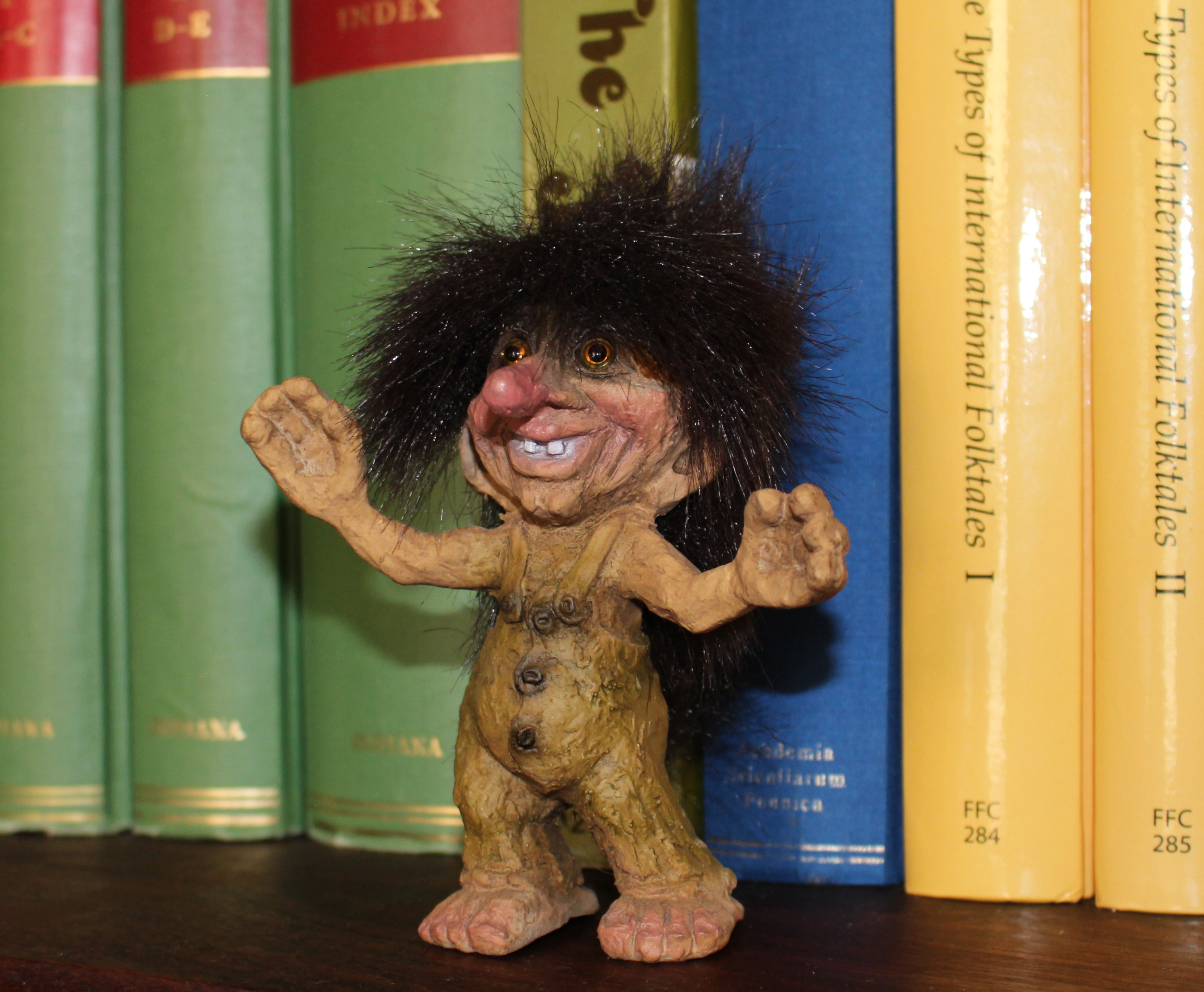 The trolls in central Iowa can actually be regarding as thriving to a certain degree. I believe we can attribute this to concentrated clusters of Norwegian immigrants. The knockers - which became the Western Tommyknocker - is an interesting example of a European elf belief not only crossing the Atlantic and thriving but also diffusing among non-Cornish population. In 2007, I collected an account of a sighting of a Tommyknocker that occurred as late as 1952 in Golconda, Nevada from a Portuguese-American. The tradition survived in part because the Cornish were so well respected as miners that others adopted their technology, their vocabulary, and apparently their beliefs about the underground, eerie environment of the mine. The Newfoundland example can also be regarded as thriving, probably also because of a concentrated immigrant cluster. 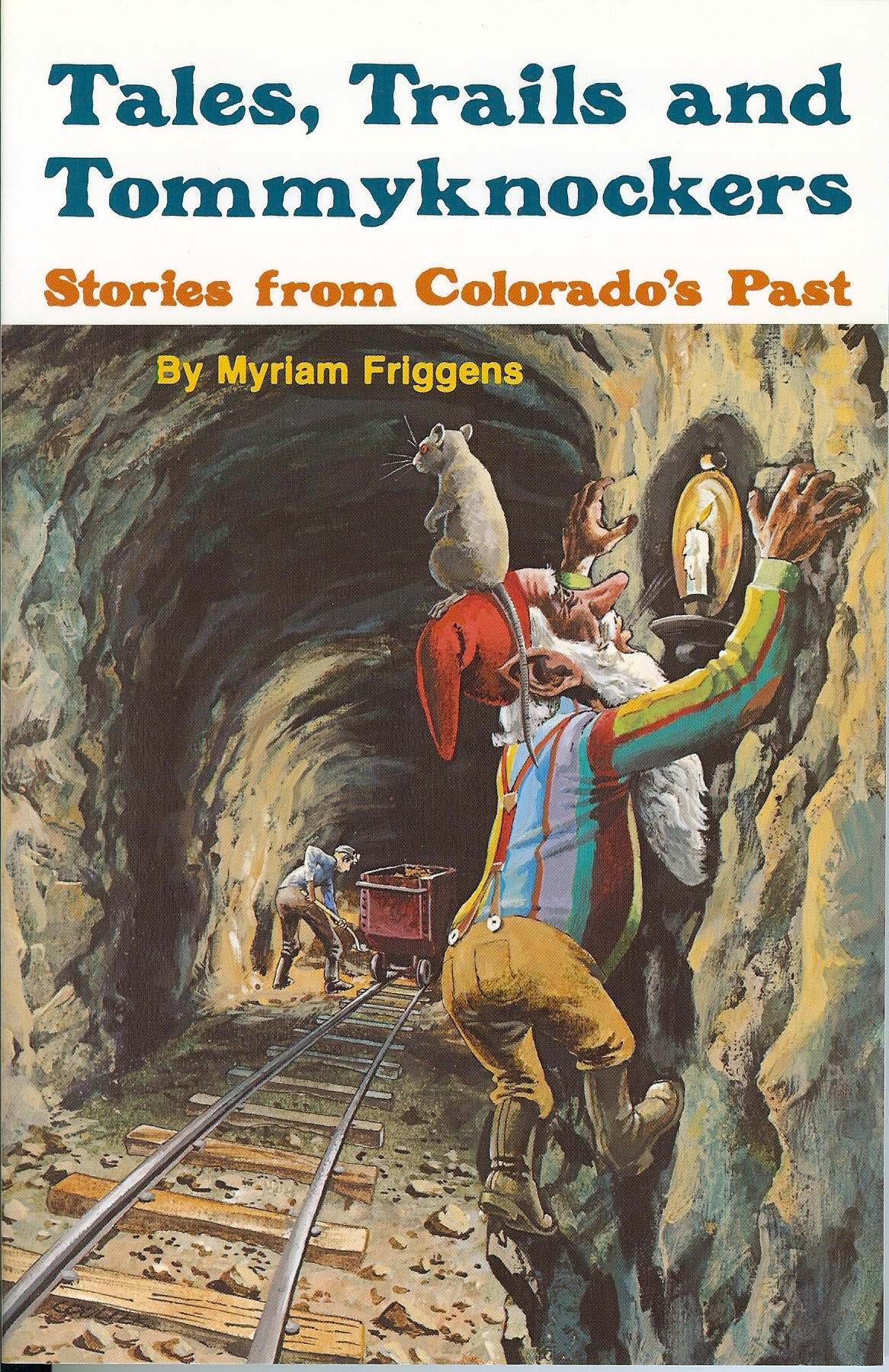 Elf beliefs did not generally thrive, however. This is probably due to a number of factors. Immigrants often went to urban settings, and even in Europe, when rural believers migrated to cities, their beliefs typically receded. Immigrants often diffused among other groups so that they lost an ethnic critical mass in a community, and that also weakened beliefs. Where beliefs survived within the mind of an immigrant, they were not likely to be passed on to a new generation, since children will echo the belief system of their peers more than their parents (the same is general true of dialect). Because North Americans did not have deep roots and they generally regarded themselves as being part of the technological, industrial cutting edge, beliefs in traditional, pre-industrial beliefs had little room to thrive. And finally, beliefs tend to be tied to places: the elves have always lived within that mound over there - that sort of thing. So when immigrants encountered a new environment, it was difficult to conceive of the supernatural beings as having lived in a certain spot since the new arrivals did not have anyone to tell them that this was the case. It's a complex answer to a difficult question, but these were certainly factors in why European supernatural beings did not generally thrive in the New World. 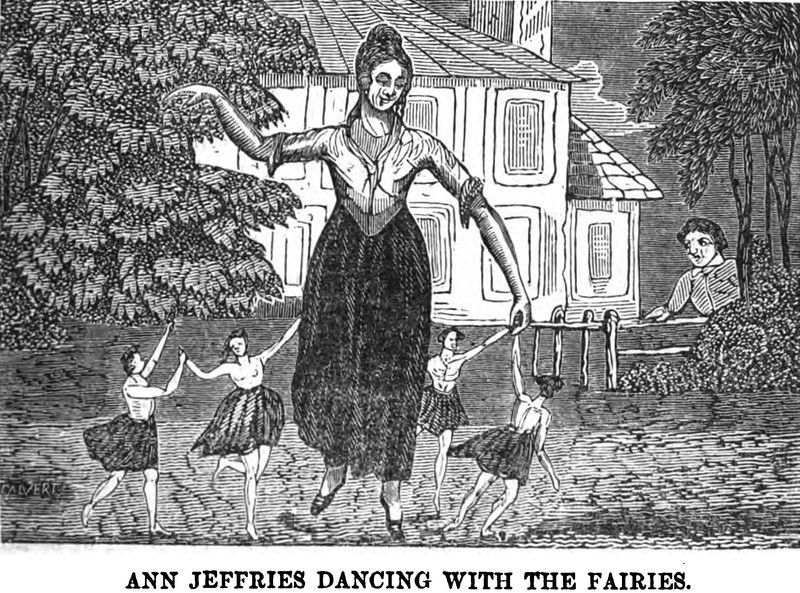 There are, of course, examples of thriving supernatural beings among North Americans, often based on Native American traditions. Here we have a situation where the people who did live in North America were able to communicate to the new arrivals that "something lives over there" or in that lake. These stories did not often make the transition and become an active belief system among the new arrivals. They often were adopted for local tourism and were regarded as "quaint" stories. Sometimes, the new arrivals adopted them completely - the bigfoot tradition is a good example. As indicated, several articles in the new book Magical Folk discusses survivals. It is, however, too easy to cherry pick a few examples as proof that the elves made the transition. Belief did not stop with emigration, but is usually did with the next generation. ![2009_05_04_kobold-759836[1].jpg](https://steemitimages.com/DQmRwPZHfJTpw8GJSWvLFrpWNKWrg3S4NFhaCxuq7N8UvFH/2009_05_04_kobold-759836%5B1%5D.jpg) Everyone has folklore and most if not all people have an active tradition involving supernatural beliefs (ghosts and angels remain active in North America, and we can include extraterrestrials in the spectrum of possible beliefs). So it was predictable that once immigrants "settled in" in their new home that they would have a belief system that included supernatural beings. The only question was regarding what they would believe in. So we have an assortment of supernatural beings in North America: for the most part, European elves (and the various creatures under that broad umbrella) failed to thrive; the widespread traditions involving ghosts and angels thrived; and some indigenous Native American beliefs diffused to the new population and thrived to a certain degree. We can even argue that the elves survived and thrived in a way: extraterrestrials are "little green men" who fly about in the night sky, abduct people, leave circles on the land, and do many other things that the traditional elf did in pre-industrial Europe. 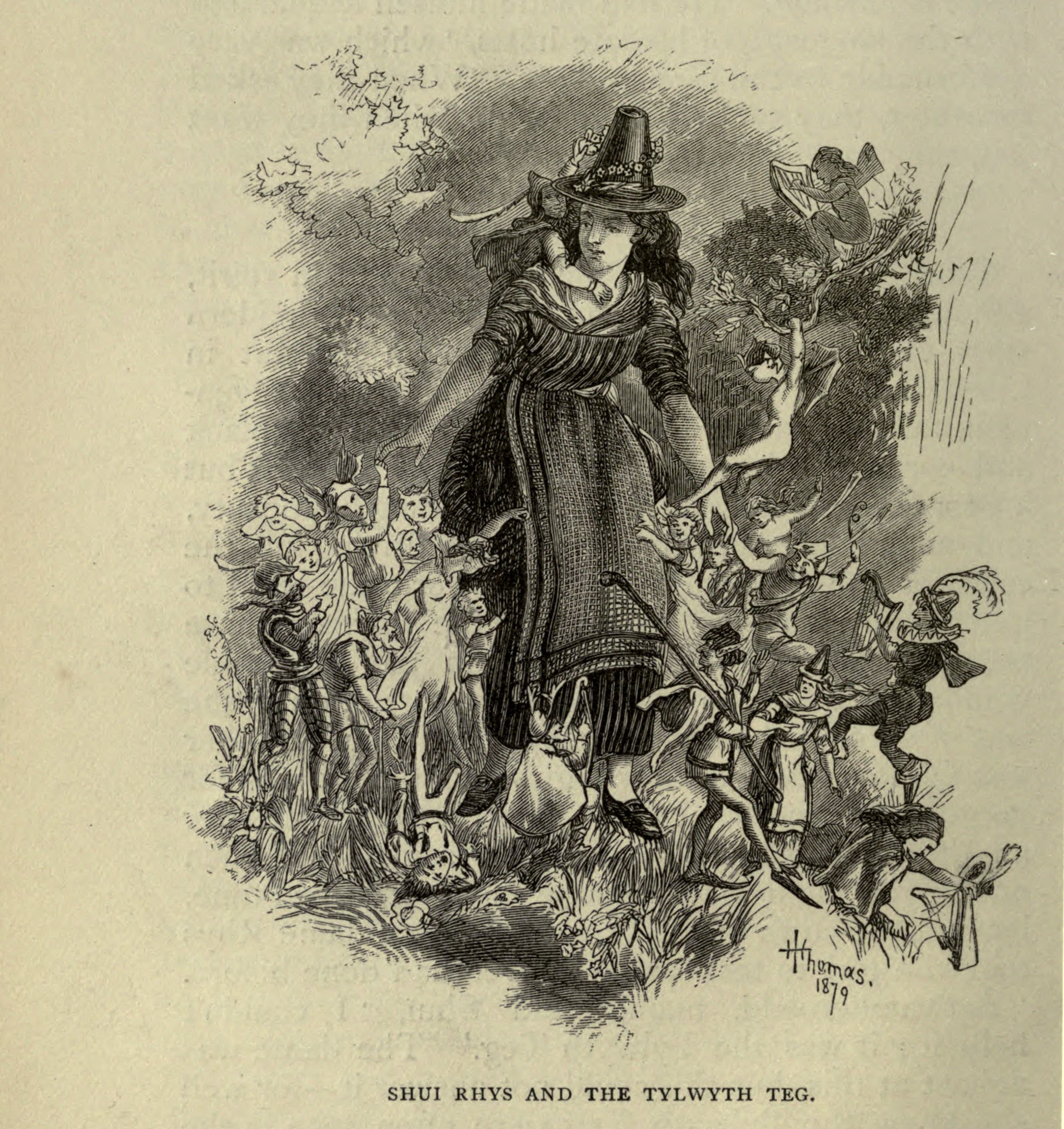 |
| json metadata | {"tags":["history","folklore","mythology","britain","scandinavia"],"image":["https://steemitimages.com/DQmdHf8daSxhoK4Qsx1shNEZ3hXgXPrnx1ry5EYZRBxxeFK/12794093_39b8_625x1000%5B1%5D.jpg","https://steemitimages.com/DQmPQSPDNjHiXt4FNKbqzszhCYqraKGGfRTktihv7oXo1wa/IMG_2731_edited.jpg","https://steemitimages.com/DQmfFaZVoSF7WP6VinVqShS8MUn8inTzASbsu7dxEzV5FHM/Colorado%20knocker.jpg","https://steemitimages.com/DQmdwTW5xRL67c47AEYAGyjKiBHgouuVXhVZEoE4TEjHoDQ/Ann%20Jefferies%20James%20E%20Smith%201837.jpg","https://steemitimages.com/DQmRwPZHfJTpw8GJSWvLFrpWNKWrg3S4NFhaCxuq7N8UvFH/2009_05_04_kobold-759836%5B1%5D.jpg","https://steemitimages.com/DQmbHTfjZaFpHuf9DduCJLCvKYgtcKmqbTpXniK48XwWx3w/britishgoblinswe00sikerich_0088_edited.jpg"],"app":"steemit/0.1","format":"markdown"} |
| parent author | |
| parent permlink | history |
| permlink | did-elves-emigrate-with-people-in-the-crossing-of-the-atlantic |
| title | Did elves emigrate with people in the crossing of the Atlantic? |
| Transaction Info | Block #20767114/Trx 6aa77d106e644142434fcd823725906d86832dc6 |
View Raw JSON Data
{
"block": 20767114,
"op": [
"comment",
{
"author": "itsallfolklore",
"body": "There are really two questions here: did elves survive the crossing of the Atlantic? (occasionally they did) and why didn't they usually thrive? (the degree of survival generally can't be called thriving).\n\n![12794093_39b8_625x1000[1].jpg](https://steemitimages.com/DQmdHf8daSxhoK4Qsx1shNEZ3hXgXPrnx1ry5EYZRBxxeFK/12794093_39b8_625x1000%5B1%5D.jpg)\n\nThere are few examples of survivals. Peter Narvaez, The Good People: New Fairylore Essays (1991) includes an essay dealing with traditional Northern European elf beliefs in Newfoundland. In addition, I conducted research on the survival of the Cornish knockers in the American West: Ronald M. James, “Knockers, Knackers, and Ghosts: Immigrant Folklore in the Western Mines,” Western Folklore Quarterly 51:2 (April 1992). Another article can serve as an example of the sort of thing one can find scattered throughout North America: a recent account by Bill Haglund in the Nevada Journal, Nevada, Iowa - August 29, 2013 describes the survival of troll beliefs in central Iowa. The recent book, Magical Folk: British & Irish Fairies (Simon Young and Ceri Houlbrook, eds.) includes several articles dealing specifically with New World fairies, so that publication also needs to be considered.\n\n\n\nThe trolls in central Iowa can actually be regarding as thriving to a certain degree. I believe we can attribute this to concentrated clusters of Norwegian immigrants. The knockers - which became the Western Tommyknocker - is an interesting example of a European elf belief not only crossing the Atlantic and thriving but also diffusing among non-Cornish population. In 2007, I collected an account of a sighting of a Tommyknocker that occurred as late as 1952 in Golconda, Nevada from a Portuguese-American. The tradition survived in part because the Cornish were so well respected as miners that others adopted their technology, their vocabulary, and apparently their beliefs about the underground, eerie environment of the mine. The Newfoundland example can also be regarded as thriving, probably also because of a concentrated immigrant cluster.\n\n\n\nElf beliefs did not generally thrive, however. This is probably due to a number of factors. Immigrants often went to urban settings, and even in Europe, when rural believers migrated to cities, their beliefs typically receded. Immigrants often diffused among other groups so that they lost an ethnic critical mass in a community, and that also weakened beliefs. Where beliefs survived within the mind of an immigrant, they were not likely to be passed on to a new generation, since children will echo the belief system of their peers more than their parents (the same is general true of dialect). Because North Americans did not have deep roots and they generally regarded themselves as being part of the technological, industrial cutting edge, beliefs in traditional, pre-industrial beliefs had little room to thrive. \n\nAnd finally, beliefs tend to be tied to places: the elves have always lived within that mound over there - that sort of thing. So when immigrants encountered a new environment, it was difficult to conceive of the supernatural beings as having lived in a certain spot since the new arrivals did not have anyone to tell them that this was the case. It's a complex answer to a difficult question, but these were certainly factors in why European supernatural beings did not generally thrive in the New World.\n\n\n\nThere are, of course, examples of thriving supernatural beings among North Americans, often based on Native American traditions. Here we have a situation where the people who did live in North America were able to communicate to the new arrivals that \"something lives over there\" or in that lake. These stories did not often make the transition and become an active belief system among the new arrivals. They often were adopted for local tourism and were regarded as \"quaint\" stories. Sometimes, the new arrivals adopted them completely - the bigfoot tradition is a good example.\n\nAs indicated, several articles in the new book Magical Folk discusses survivals. It is, however, too easy to cherry pick a few examples as proof that the elves made the transition. Belief did not stop with emigration, but is usually did with the next generation. \n\n![2009_05_04_kobold-759836[1].jpg](https://steemitimages.com/DQmRwPZHfJTpw8GJSWvLFrpWNKWrg3S4NFhaCxuq7N8UvFH/2009_05_04_kobold-759836%5B1%5D.jpg)\n\nEveryone has folklore and most if not all people have an active tradition involving supernatural beliefs (ghosts and angels remain active in North America, and we can include extraterrestrials in the spectrum of possible beliefs). So it was predictable that once immigrants \"settled in\" in their new home that they would have a belief system that included supernatural beings. The only question was regarding what they would believe in. So we have an assortment of supernatural beings in North America: for the most part, European elves (and the various creatures under that broad umbrella) failed to thrive; the widespread traditions involving ghosts and angels thrived; and some indigenous Native American beliefs diffused to the new population and thrived to a certain degree. We can even argue that the elves survived and thrived in a way: extraterrestrials are \"little green men\" who fly about in the night sky, abduct people, leave circles on the land, and do many other things that the traditional elf did in pre-industrial Europe.\n\n",
"json_metadata": "{\"tags\":[\"history\",\"folklore\",\"mythology\",\"britain\",\"scandinavia\"],\"image\":[\"https://steemitimages.com/DQmdHf8daSxhoK4Qsx1shNEZ3hXgXPrnx1ry5EYZRBxxeFK/12794093_39b8_625x1000%5B1%5D.jpg\",\"https://steemitimages.com/DQmPQSPDNjHiXt4FNKbqzszhCYqraKGGfRTktihv7oXo1wa/IMG_2731_edited.jpg\",\"https://steemitimages.com/DQmfFaZVoSF7WP6VinVqShS8MUn8inTzASbsu7dxEzV5FHM/Colorado%20knocker.jpg\",\"https://steemitimages.com/DQmdwTW5xRL67c47AEYAGyjKiBHgouuVXhVZEoE4TEjHoDQ/Ann%20Jefferies%20James%20E%20Smith%201837.jpg\",\"https://steemitimages.com/DQmRwPZHfJTpw8GJSWvLFrpWNKWrg3S4NFhaCxuq7N8UvFH/2009_05_04_kobold-759836%5B1%5D.jpg\",\"https://steemitimages.com/DQmbHTfjZaFpHuf9DduCJLCvKYgtcKmqbTpXniK48XwWx3w/britishgoblinswe00sikerich_0088_edited.jpg\"],\"app\":\"steemit/0.1\",\"format\":\"markdown\"}",
"parent_author": "",
"parent_permlink": "history",
"permlink": "did-elves-emigrate-with-people-in-the-crossing-of-the-atlantic",
"title": "Did elves emigrate with people in the crossing of the Atlantic?"
}
],
"op_in_trx": 0,
"timestamp": "2018-03-17T23:11:00",
"trx_id": "6aa77d106e644142434fcd823725906d86832dc6",
"trx_in_block": 22,
"virtual_op": 0
}solthegameshowupvoted (100.00%) @itsallfolklore / the-original-grateful-dead2018/03/13 04:22:30
solthegameshowupvoted (100.00%) @itsallfolklore / the-original-grateful-dead
2018/03/13 04:22:30
| author | itsallfolklore |
| permlink | the-original-grateful-dead |
| voter | solthegameshow |
| weight | 10000 (100.00%) |
| Transaction Info | Block #20629483/Trx 883c7ba708556c868cde210046944b4f70ad09fd |
View Raw JSON Data
{
  "block": 20629483,
  "op": [
    "vote",
    {
      "author": "itsallfolklore",
      "permlink": "the-original-grateful-dead",
      "voter": "solthegameshow",
      "weight": 10000
    }
  ],
  "op_in_trx": 0,
  "timestamp": "2018-03-13T04:22:30",
  "trx_id": "883c7ba708556c868cde210046944b4f70ad09fd",
  "trx_in_block": 11,
  "virtual_op": 0
}coffeelaborupvoted (100.00%) @itsallfolklore / the-origin-of-elves2018/03/12 17:12:00
coffeelaborupvoted (100.00%) @itsallfolklore / the-origin-of-elves
2018/03/12 17:12:00
| author | itsallfolklore |
| permlink | the-origin-of-elves |
| voter | coffeelabor |
| weight | 10000 (100.00%) |
| Transaction Info | Block #20616076/Trx 7f6a8669b27f092bacc14a24a713ecd4b8809667 |
View Raw JSON Data
{
  "block": 20616076,
  "op": [
    "vote",
    {
      "author": "itsallfolklore",
      "permlink": "the-origin-of-elves",
      "voter": "coffeelabor",
      "weight": 10000
    }
  ],
  "op_in_trx": 0,
  "timestamp": "2018-03-12T17:12:00",
  "trx_id": "7f6a8669b27f092bacc14a24a713ecd4b8809667",
  "trx_in_block": 17,
  "virtual_op": 0
}itsallfolklorepublished a new post: the-origin-of-elves2018/03/11 23:17:51
itsallfolklorepublished a new post: the-origin-of-elves
2018/03/11 23:17:51
| author | itsallfolklore |
| body |  Volumes could be written on this and it's not easy to finesse a concise answer. First, let's restrict ourselves to the Northern European supernatural beings with the peculiar characteristic of living in social settings similar to humans and distinct from elsewhere, where people regarded supernatural beings as more likely to appear alone (or in pairs or triplets, but, nevertheless acting in unison). In short, the supernatural beings of Ireland, Britain, Brittany, and Scandinavia are what we are talking about here. For whatever reason - and it is not exactly clear - some of the people in this geographic swath were more likely to perceive supernatural beings as being diminutive. The Danes, for example, had small elf-like trolls, while the counterparts of this type of supernatural beings (not always called trolls), in Sweden, Norway, and Iceland tended to be human sized. Similarly, the Cornish and the people of neighboring Devon had diminutive piskies, who acted much like (and played similar roles in legend) when compared to the fairies and elves of the rest of Britain and of Ireland. That said, human encounters with Danish trolls or with Cornish piskies often involved human-sized supernatural beings, and it only became apparent to the human that "these folks just aren't right," after interacting for a while - or because a human captive warns the person not to eat the food or otherwise that this is the dangerous realm of the supernatural. This issue of size contradicts the stories and beliefs in these two regions that maintain that the supernatural beings are small. The problem, of course, is that the supernatural doesn't always behave itself, and it certainly does not conduct itself according to the rules that govern our "natural" world. ![176[1].png](https://steemitimages.com/DQmVL3QPw8WAdzrkqGmk8Gx1dwEdkBVJmdPPYDRB9SzRsi9/176%5B1%5D.png) The most important thing about the supernatural beings within this entire region is that they usually had some peculiar characteristic that made it clear to people who encountered them that something here just wasn't natural. That feature is not always immediately apparent. The Swedish woman who encounters a charcoal burner in the forest seems nice enough, until he eventually notices that she has a cow tail. Then he understands that he must extract himself from a dangerous situation. Sometimes the feature is the capacity for sudden invisibility. Flexibility in the apparent size of these beings is in keeping with this sort of unnatural characteristic. Flexibility in size is apparent in Ireland, where the sidhe - the Irish fairies - are generally perceived to be human-sized or nearly so - and yet people use the polite term of the "wee folk" to describe these beings. They weren't always "wee", but they were capable of reduced size when it suited them (just as invisibility was important, a feature behind the Icelandic/Norwegian term of the Huldra/hulderfolk - the hidden ones or the hidden folk). Victorian-era children's literature and art revealed a fascination with these supernatural beings, and it mutated them to a considerable extent. Beginning with Perrault and the Brothers Grimm, there was an emerging - and increasingly popular - trend to collect the adult folk literature of the folktale and transform it into printed, abridged "fairytales" for the consumption of urban children of the emerging middle class. ![271[2].png](https://steemitimages.com/DQmSPzyEpbZTnP4MpibybjapPhoQ66EqTMucFV8Dx75CKjN/271%5B2%5D.png) The supernatural beings in question were terrifyingly dangerous, capable of ruining lives and abducting people, keeping them in a godless realm where redemption would never come. For Victorian children's literature, this dangerous aspect of the supernatural beings needed to be diminished, and the supernatural beings needed to be reduced in other ways. Beginning with the publications of Ann Elizabeth Bray in 1838, dealing with Cornish and Devonian Piskies, Victorian literature found a key in diminishing the frightful aspect of the supernatural beings. While the folk in many places conceived of their supernatural beings as capable of small stature, here was a body of folklore that made it the standard for these entities. 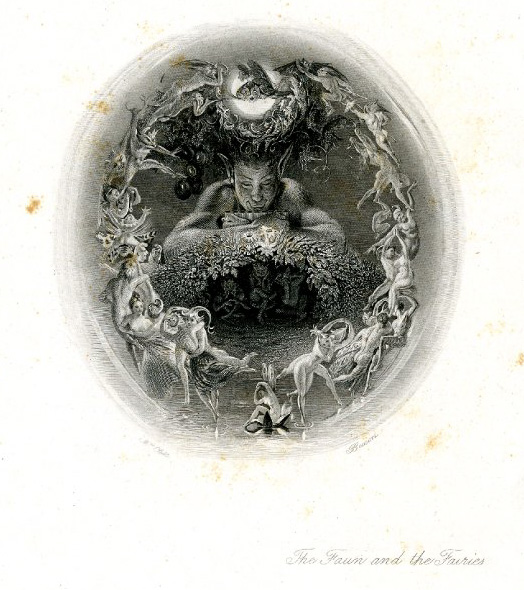 This transformation is over simplified, but you get the point: small statue was common enough throughout the region; at the same time, everyone could conceive of the supernatural beings of capable of human size when interacting with people; and Victorian literature found it convenient to emphasize the small size. |
| json metadata | {"tags":["history","folklore","mythology","britain","scandinavia"],"image":["https://steemitimages.com/DQmbHTfjZaFpHuf9DduCJLCvKYgtcKmqbTpXniK48XwWx3w/britishgoblinswe00sikerich_0088_edited.jpg","https://steemitimages.com/DQmVL3QPw8WAdzrkqGmk8Gx1dwEdkBVJmdPPYDRB9SzRsi9/176%5B1%5D.png","https://steemitimages.com/DQmSPzyEpbZTnP4MpibybjapPhoQ66EqTMucFV8Dx75CKjN/271%5B2%5D.png","https://steemitimages.com/DQmRDeg8gygucuuxJxh9qMFxmWUs8iuYryU5qvaNcfv6WXb/1834%20BM%20Lytton%20Pilgrims%20of%20the%20Rhine_edited.jpg"],"app":"steemit/0.1","format":"markdown"} |
| parent author | |
| parent permlink | history |
| permlink | the-origin-of-elves |
| title | When and why did fairies "shrink"? |
| Transaction Info | Block #20594620/Trx 4779aa1607f0af1c79059a7cc75305e0fa0e13cb |
View Raw JSON Data
{
"block": 20594620,
"op": [
"comment",
{
"author": "itsallfolklore",
"body": "\n\nVolumes could be written on this and it's not easy to finesse a concise answer. First, let's restrict ourselves to the Northern European supernatural beings with the peculiar characteristic of living in social settings similar to humans and distinct from elsewhere, where people regarded supernatural beings as more likely to appear alone (or in pairs or triplets, but, nevertheless acting in unison). In short, the supernatural beings of Ireland, Britain, Brittany, and Scandinavia are what we are talking about here.\n\nFor whatever reason - and it is not exactly clear - some of the people in this geographic swath were more likely to perceive supernatural beings as being diminutive. The Danes, for example, had small elf-like trolls, while the counterparts of this type of supernatural beings (not always called trolls), in Sweden, Norway, and Iceland tended to be human sized.\n\nSimilarly, the Cornish and the people of neighboring Devon had diminutive piskies, who acted much like (and played similar roles in legend) when compared to the fairies and elves of the rest of Britain and of Ireland. That said, human encounters with Danish trolls or with Cornish piskies often involved human-sized supernatural beings, and it only became apparent to the human that \"these folks just aren't right,\" after interacting for a while - or because a human captive warns the person not to eat the food or otherwise that this is the dangerous realm of the supernatural. This issue of size contradicts the stories and beliefs in these two regions that maintain that the supernatural beings are small. The problem, of course, is that the supernatural doesn't always behave itself, and it certainly does not conduct itself according to the rules that govern our \"natural\" world.\n\n![176[1].png](https://steemitimages.com/DQmVL3QPw8WAdzrkqGmk8Gx1dwEdkBVJmdPPYDRB9SzRsi9/176%5B1%5D.png)\n\nThe most important thing about the supernatural beings within this entire region is that they usually had some peculiar characteristic that made it clear to people who encountered them that something here just wasn't natural. That feature is not always immediately apparent. The Swedish woman who encounters a charcoal burner in the forest seems nice enough, until he eventually notices that she has a cow tail. Then he understands that he must extract himself from a dangerous situation. Sometimes the feature is the capacity for sudden invisibility. Flexibility in the apparent size of these beings is in keeping with this sort of unnatural characteristic.\nFlexibility in size is apparent in Ireland, where the sidhe - the Irish fairies - are generally perceived to be human-sized or nearly so - and yet people use the polite term of the \"wee folk\" to describe these beings. They weren't always \"wee\", but they were capable of reduced size when it suited them (just as invisibility was important, a feature behind the Icelandic/Norwegian term of the Huldra/hulderfolk - the hidden ones or the hidden folk).\nVictorian-era children's literature and art revealed a fascination with these supernatural beings, and it mutated them to a considerable extent. Beginning with Perrault and the Brothers Grimm, there was an emerging - and increasingly popular - trend to collect the adult folk literature of the folktale and transform it into printed, abridged \"fairytales\" for the consumption of urban children of the emerging middle class. \n\n![271[2].png](https://steemitimages.com/DQmSPzyEpbZTnP4MpibybjapPhoQ66EqTMucFV8Dx75CKjN/271%5B2%5D.png)\n\nThe supernatural beings in question were terrifyingly dangerous, capable of ruining lives and abducting people, keeping them in a godless realm where redemption would never come. For Victorian children's literature, this dangerous aspect of the supernatural beings needed to be diminished, and the supernatural beings needed to be reduced in other ways. Beginning with the publications of Ann Elizabeth Bray in 1838, dealing with Cornish and Devonian Piskies, Victorian literature found a key in diminishing the frightful aspect of the supernatural beings. While the folk in many places conceived of their supernatural beings as capable of small stature, here was a body of folklore that made it the standard for these entities.\n\n\n\nThis transformation is over simplified, but you get the point: small statue was common enough throughout the region; at the same time, everyone could conceive of the supernatural beings of capable of human size when interacting with people; and Victorian literature found it convenient to emphasize the small size.",
"json_metadata": "{\"tags\":[\"history\",\"folklore\",\"mythology\",\"britain\",\"scandinavia\"],\"image\":[\"https://steemitimages.com/DQmbHTfjZaFpHuf9DduCJLCvKYgtcKmqbTpXniK48XwWx3w/britishgoblinswe00sikerich_0088_edited.jpg\",\"https://steemitimages.com/DQmVL3QPw8WAdzrkqGmk8Gx1dwEdkBVJmdPPYDRB9SzRsi9/176%5B1%5D.png\",\"https://steemitimages.com/DQmSPzyEpbZTnP4MpibybjapPhoQ66EqTMucFV8Dx75CKjN/271%5B2%5D.png\",\"https://steemitimages.com/DQmRDeg8gygucuuxJxh9qMFxmWUs8iuYryU5qvaNcfv6WXb/1834%20BM%20Lytton%20Pilgrims%20of%20the%20Rhine_edited.jpg\"],\"app\":\"steemit/0.1\",\"format\":\"markdown\"}",
"parent_author": "",
"parent_permlink": "history",
"permlink": "the-origin-of-elves",
"title": "When and why did fairies \"shrink\"?"
}
],
"op_in_trx": 0,
"timestamp": "2018-03-11T23:17:51",
"trx_id": "4779aa1607f0af1c79059a7cc75305e0fa0e13cb",
"trx_in_block": 26,
"virtual_op": 0
}itsallfolklorepublished a new post: the-origin-of-elves2018/03/11 20:48:45
itsallfolklorepublished a new post: the-origin-of-elves
2018/03/11 20:48:45
| author | itsallfolklore |
| body |  People often asked about the origin of the belief in trolls, elves and other similar supernatural beings. One of the reasons why this is a difficult question to handle is that cultures nearly universally emerge from prehistory with beliefs and stories dealing with a full array of these sorts of entities. Finding a point or origin in a prehistoric past is nearly impossible and can only be a matter of speculation. The focus of what is certainly the subject of this enquiry is the pre-industrial inheritance of Northern Europe. Medieval Norse literature frequently mentions supernatural beings that seem related to later manifestations. It is not clear if these entities are identical to what nineteenth-century folklore collectors encountered, but there is enough continuity to suggest that they are either the same or there was cultural drift that at least links the supernatural beings expressed in literature and oral tradition in the two periods. Some of the difference may also be the result of different forms of expression: medieval literate writers as opposed to illiterate nineteenth-century storytellers.  One the peculiar things about a certain type of supernatural beings is that regardless of the term used, they seem to hang together with a great deal of continuity. These are the elves (but we can also refer to them as fairies, sidhe, huldrefolk, or in parts of Scandinavia they are also called trolls). These entities are distinct in the way they are believed to live in communities with societies that roughly reflect the human condition. Outside of Britain, Ireland, Brittany, and Scandinavia (with some bleeding over into continental Europe and Russia), this idea is virtually non-existent. Supernatural beings playing the same part in similar legends are usually singular or appear in pairs or threes - but they act singularly. It is reasonable to ask how this concept existed across linguistic lines in a well-defined geographic zone. If the idea diffused, why did it not diffuse elsewhere? Most folklorists would shun the explanation of diffusion because this perception of elves seems to be such a core understanding of the supernatural world that it would be difficult for it diffuse: when it comes to folklore, stories travel easily, but they usually adapt to local belief systems rather than carry foreign belief systems with them.  So by way of not answering this question, we can describe a peculiar aspect of oral tradition related to elves, but we cannot say with authority were it originated. The question of origin for all the supernatural beings at the heart of your question is in a remote past that is difficult to describe or understand. For sources: on trolls, a great piece of work is Elisabeth Hartmann, "Die Trollvorstellungen in den Sagen und Märchen der Skandinavischen Volker" (Tübingen: Eberhard Karls Universität Tübingen, 1936). In general, one of the most respected authorities on the question of similarities shared in Celtic and Scandinavian folklore is the late Bo Almqvist; see his "Viking Ale: Studies on Folklore Contacts between the Northern and the Western Worlds" (Aberystwyth: Boethius, 1991) edited by Éilís Ní Dhuibhne and Séamas Ó Catháin. |
| json metadata | {"tags":["history","folklore","mythology","britain","scandinavia"],"image":["https://steemitimages.com/DQmUNZxuarHam65mhyjgCtdb2tXkrm3N1FhRtNwGrNyR8jy/John_Bauer_1915%20Troll%20sons.jpg","https://steemitimages.com/DQmb5vGXMoWcvBPZkLixTYD2gjykuQMCnGX6b6W5GSAMSJp/Piskies%20from%20Hunt%20cover%20page.jpg","https://steemitimages.com/DQmRDeg8gygucuuxJxh9qMFxmWUs8iuYryU5qvaNcfv6WXb/1834%20BM%20Lytton%20Pilgrims%20of%20the%20Rhine_edited.jpg"],"app":"steemit/0.1","format":"markdown"} |
| parent author | |
| parent permlink | history |
| permlink | the-origin-of-elves |
| title | The origin of elves Part 2 |
| Transaction Info | Block #20591642/Trx 07cbe1c80607c9f70b1a9ce3fd3e0f357261e945 |
View Raw JSON Data
{
"block": 20591642,
"op": [
"comment",
{
"author": "itsallfolklore",
"body": "\n\nPeople often asked about the origin of the belief in trolls, elves and other similar supernatural beings. One of the reasons why this is a difficult question to handle is that cultures nearly universally emerge from prehistory with beliefs and stories dealing with a full array of these sorts of entities. Finding a point or origin in a prehistoric past is nearly impossible and can only be a matter of speculation.\n\nThe focus of what is certainly the subject of this enquiry is the pre-industrial inheritance of Northern Europe. Medieval Norse literature frequently mentions supernatural beings that seem related to later manifestations. It is not clear if these entities are identical to what nineteenth-century folklore collectors encountered, but there is enough continuity to suggest that they are either the same or there was cultural drift that at least links the supernatural beings expressed in literature and oral tradition in the two periods. Some of the difference may also be the result of different forms of expression: medieval literate writers as opposed to illiterate nineteenth-century storytellers.\n\n\n\nOne the peculiar things about a certain type of supernatural beings is that regardless of the term used, they seem to hang together with a great deal of continuity. These are the elves (but we can also refer to them as fairies, sidhe, huldrefolk, or in parts of Scandinavia they are also called trolls). These entities are distinct in the way they are believed to live in communities with societies that roughly reflect the human condition. Outside of Britain, Ireland, Brittany, and Scandinavia (with some bleeding over into continental Europe and Russia), this idea is virtually non-existent. Supernatural beings playing the same part in similar legends are usually singular or appear in pairs or threes - but they act singularly. \n\nIt is reasonable to ask how this concept existed across linguistic lines in a well-defined geographic zone. If the idea diffused, why did it not diffuse elsewhere? Most folklorists would shun the explanation of diffusion because this perception of elves seems to be such a core understanding of the supernatural world that it would be difficult for it diffuse: when it comes to folklore, stories travel easily, but they usually adapt to local belief systems rather than carry foreign belief systems with them.\n\n\n\nSo by way of not answering this question, we can describe a peculiar aspect of oral tradition related to elves, but we cannot say with authority were it originated. The question of origin for all the supernatural beings at the heart of your question is in a remote past that is difficult to describe or understand.\n\nFor sources: on trolls, a great piece of work is Elisabeth Hartmann, \"Die Trollvorstellungen in den Sagen und Märchen der Skandinavischen Volker\" (Tübingen: Eberhard Karls Universität Tübingen, 1936). In general, one of the most respected authorities on the question of similarities shared in Celtic and Scandinavian folklore is the late Bo Almqvist; see his \"Viking Ale: Studies on Folklore Contacts between the Northern and the Western Worlds\" (Aberystwyth: Boethius, 1991) edited by Éilís Ní Dhuibhne and Séamas Ó Catháin.",
"json_metadata": "{\"tags\":[\"history\",\"folklore\",\"mythology\",\"britain\",\"scandinavia\"],\"image\":[\"https://steemitimages.com/DQmUNZxuarHam65mhyjgCtdb2tXkrm3N1FhRtNwGrNyR8jy/John_Bauer_1915%20Troll%20sons.jpg\",\"https://steemitimages.com/DQmb5vGXMoWcvBPZkLixTYD2gjykuQMCnGX6b6W5GSAMSJp/Piskies%20from%20Hunt%20cover%20page.jpg\",\"https://steemitimages.com/DQmRDeg8gygucuuxJxh9qMFxmWUs8iuYryU5qvaNcfv6WXb/1834%20BM%20Lytton%20Pilgrims%20of%20the%20Rhine_edited.jpg\"],\"app\":\"steemit/0.1\",\"format\":\"markdown\"}",
"parent_author": "",
"parent_permlink": "history",
"permlink": "the-origin-of-elves",
"title": "The origin of elves Part 2"
}
],
"op_in_trx": 0,
"timestamp": "2018-03-11T20:48:45",
"trx_id": "07cbe1c80607c9f70b1a9ce3fd3e0f357261e945",
"trx_in_block": 26,
"virtual_op": 0
}heatherthebardupvoted (100.00%) @itsallfolklore / the-origin-of-elves2018/03/11 19:55:54
heatherthebardupvoted (100.00%) @itsallfolklore / the-origin-of-elves
2018/03/11 19:55:54
| author | itsallfolklore |
| permlink | the-origin-of-elves |
| voter | heatherthebard |
| weight | 10000 (100.00%) |
| Transaction Info | Block #20590586/Trx 9154b22e1cf6303afb494f80c446066e3ba07b82 |
View Raw JSON Data
{
  "block": 20590586,
  "op": [
    "vote",
    {
      "author": "itsallfolklore",
      "permlink": "the-origin-of-elves",
      "voter": "heatherthebard",
      "weight": 10000
    }
  ],
  "op_in_trx": 0,
  "timestamp": "2018-03-11T19:55:54",
  "trx_id": "9154b22e1cf6303afb494f80c446066e3ba07b82",
  "trx_in_block": 90,
  "virtual_op": 0
}itsallfolklorepublished a new post: the-origin-of-elves2018/03/11 11:55:45
itsallfolklorepublished a new post: the-origin-of-elves
2018/03/11 11:55:45
| author | itsallfolklore |
| body |  People often asked about the origin of the belief in trolls, elves and other similar supernatural beings. One of the reasons why this is a difficult question to handle is that cultures nearly universally emerge from prehistory with beliefs and stories dealing with a full array of these sorts of entities. Finding a point or origin in a prehistoric past is nearly impossible and can only be a matter of speculation. The focus of what is certainly the subject of this enquiry is the pre-industrial inheritance of Northern Europe. Medieval Norse literature frequently mentions supernatural beings that seem related to later manifestations. It is not clear if these entities are identical to what nineteenth-century folklore collectors encountered, but there is enough continuity to suggest that they are either the same or there was cultural drift that at least links the supernatural beings expressed in literature and oral tradition in the two periods. Some of the difference may also be the result of different forms of expression: medieval literate writers as opposed to illiterate nineteenth-century storytellers.  One the peculiar things about a certain type of supernatural beings is that regardless of the term used, they seem to hang together with a great deal of continuity. These are the elves (but we can also refer to them as fairies, sidhe, huldrefolk, or in parts of Scandinavia they are also called trolls). These entities are distinct in the way they are believed to live in communities with societies that roughly reflect the human condition. Outside of Britain, Ireland, Brittany, and Scandinavia (with some bleeding over into continental Europe and Russia), this idea is virtually non-existent. Supernatural beings playing the same part in similar legends are usually singular or appear in pairs or threes - but they act singularly. It is reasonable to ask how this concept existed across linguistic lines in a well-defined geographic zone. If the idea diffused, why did it not diffuse elsewhere? Most folklorists would shun the explanation of diffusion because this perception of elves seems to be such a core understanding of the supernatural world that it would be difficult for it diffuse: when it comes to folklore, stories travel easily, but they usually adapt to local belief systems rather than carry foreign belief systems with them.  So by way of not answering this question, we can describe a peculiar aspect of oral tradition related to elves, but we cannot say with authority were it originated. The question of origin for all the supernatural beings at the heart of your question is in a remote past that is difficult to describe or understand. For sources: on trolls, a great piece of work is Elisabeth Hartmann, "Die Trollvorstellungen in den Sagen und Märchen der Skandinavischen Volker" (Tübingen: Eberhard Karls Universität Tübingen, 1936). In general, one of the most respected authorities on the question of similarities shared in Celtic and Scandinavian folklore is the late Bo Almqvist; see his "Viking Ale: Studies on Folklore Contacts between the Northern and the Western Worlds" (Aberystwyth: Boethius, 1991) edited by Éilís Ní Dhuibhne and Séamas Ó Catháin. |
| json metadata | {"tags":["history","folklore","mythology","britain","scandinavia"],"image":["https://steemitimages.com/DQmUNZxuarHam65mhyjgCtdb2tXkrm3N1FhRtNwGrNyR8jy/John_Bauer_1915%20Troll%20sons.jpg","https://steemitimages.com/DQmb5vGXMoWcvBPZkLixTYD2gjykuQMCnGX6b6W5GSAMSJp/Piskies%20from%20Hunt%20cover%20page.jpg","https://steemitimages.com/DQmRDeg8gygucuuxJxh9qMFxmWUs8iuYryU5qvaNcfv6WXb/1834%20BM%20Lytton%20Pilgrims%20of%20the%20Rhine_edited.jpg"],"app":"steemit/0.1","format":"markdown"} |
| parent author | |
| parent permlink | history |
| permlink | the-origin-of-elves |
| title | The origin of elves |
| Transaction Info | Block #20581004/Trx 69e9cd7d55fbd5333b22f4042c85c0ce92c7f46b |
View Raw JSON Data
{
"block": 20581004,
"op": [
"comment",
{
"author": "itsallfolklore",
"body": "\n\nPeople often asked about the origin of the belief in trolls, elves and other similar supernatural beings. One of the reasons why this is a difficult question to handle is that cultures nearly universally emerge from prehistory with beliefs and stories dealing with a full array of these sorts of entities. Finding a point or origin in a prehistoric past is nearly impossible and can only be a matter of speculation.\n\nThe focus of what is certainly the subject of this enquiry is the pre-industrial inheritance of Northern Europe. Medieval Norse literature frequently mentions supernatural beings that seem related to later manifestations. It is not clear if these entities are identical to what nineteenth-century folklore collectors encountered, but there is enough continuity to suggest that they are either the same or there was cultural drift that at least links the supernatural beings expressed in literature and oral tradition in the two periods. Some of the difference may also be the result of different forms of expression: medieval literate writers as opposed to illiterate nineteenth-century storytellers.\n\n\n\nOne the peculiar things about a certain type of supernatural beings is that regardless of the term used, they seem to hang together with a great deal of continuity. These are the elves (but we can also refer to them as fairies, sidhe, huldrefolk, or in parts of Scandinavia they are also called trolls). These entities are distinct in the way they are believed to live in communities with societies that roughly reflect the human condition. Outside of Britain, Ireland, Brittany, and Scandinavia (with some bleeding over into continental Europe and Russia), this idea is virtually non-existent. Supernatural beings playing the same part in similar legends are usually singular or appear in pairs or threes - but they act singularly. \n\nIt is reasonable to ask how this concept existed across linguistic lines in a well-defined geographic zone. If the idea diffused, why did it not diffuse elsewhere? Most folklorists would shun the explanation of diffusion because this perception of elves seems to be such a core understanding of the supernatural world that it would be difficult for it diffuse: when it comes to folklore, stories travel easily, but they usually adapt to local belief systems rather than carry foreign belief systems with them.\n\n\n\nSo by way of not answering this question, we can describe a peculiar aspect of oral tradition related to elves, but we cannot say with authority were it originated. The question of origin for all the supernatural beings at the heart of your question is in a remote past that is difficult to describe or understand.\n\nFor sources: on trolls, a great piece of work is Elisabeth Hartmann, \"Die Trollvorstellungen in den Sagen und Märchen der Skandinavischen Volker\" (Tübingen: Eberhard Karls Universität Tübingen, 1936). In general, one of the most respected authorities on the question of similarities shared in Celtic and Scandinavian folklore is the late Bo Almqvist; see his \"Viking Ale: Studies on Folklore Contacts between the Northern and the Western Worlds\" (Aberystwyth: Boethius, 1991) edited by Éilís Ní Dhuibhne and Séamas Ó Catháin.",
"json_metadata": "{\"tags\":[\"history\",\"folklore\",\"mythology\",\"britain\",\"scandinavia\"],\"image\":[\"https://steemitimages.com/DQmUNZxuarHam65mhyjgCtdb2tXkrm3N1FhRtNwGrNyR8jy/John_Bauer_1915%20Troll%20sons.jpg\",\"https://steemitimages.com/DQmb5vGXMoWcvBPZkLixTYD2gjykuQMCnGX6b6W5GSAMSJp/Piskies%20from%20Hunt%20cover%20page.jpg\",\"https://steemitimages.com/DQmRDeg8gygucuuxJxh9qMFxmWUs8iuYryU5qvaNcfv6WXb/1834%20BM%20Lytton%20Pilgrims%20of%20the%20Rhine_edited.jpg\"],\"app\":\"steemit/0.1\",\"format\":\"markdown\"}",
"parent_author": "",
"parent_permlink": "history",
"permlink": "the-origin-of-elves",
"title": "The origin of elves"
}
],
"op_in_trx": 0,
"timestamp": "2018-03-11T11:55:45",
"trx_id": "69e9cd7d55fbd5333b22f4042c85c0ce92c7f46b",
"trx_in_block": 35,
"virtual_op": 0
}coffeelaborupvoted (100.00%) @itsallfolklore / tolkien-and-his-elves2018/03/09 16:50:54
coffeelaborupvoted (100.00%) @itsallfolklore / tolkien-and-his-elves
2018/03/09 16:50:54
| author | itsallfolklore |
| permlink | tolkien-and-his-elves |
| voter | coffeelabor |
| weight | 10000 (100.00%) |
| Transaction Info | Block #20529434/Trx 01e61ca3b2b5b13846994fa67aa184cfe2281c8b |
View Raw JSON Data
{
  "block": 20529434,
  "op": [
    "vote",
    {
      "author": "itsallfolklore",
      "permlink": "tolkien-and-his-elves",
      "voter": "coffeelabor",
      "weight": 10000
    }
  ],
  "op_in_trx": 0,
  "timestamp": "2018-03-09T16:50:54",
  "trx_id": "01e61ca3b2b5b13846994fa67aa184cfe2281c8b",
  "trx_in_block": 40,
  "virtual_op": 0
}coffeelaborupvoted (100.00%) @itsallfolklore / magic-metal-smiths2018/03/09 16:50:48
coffeelaborupvoted (100.00%) @itsallfolklore / magic-metal-smiths
2018/03/09 16:50:48
| author | itsallfolklore |
| permlink | magic-metal-smiths |
| voter | coffeelabor |
| weight | 10000 (100.00%) |
| Transaction Info | Block #20529432/Trx 34c984e34cb68a82061a6db16e16c332e0371d8c |
View Raw JSON Data
{
  "block": 20529432,
  "op": [
    "vote",
    {
      "author": "itsallfolklore",
      "permlink": "magic-metal-smiths",
      "voter": "coffeelabor",
      "weight": 10000
    }
  ],
  "op_in_trx": 0,
  "timestamp": "2018-03-09T16:50:48",
  "trx_id": "34c984e34cb68a82061a6db16e16c332e0371d8c",
  "trx_in_block": 2,
  "virtual_op": 0
}heatherthebardupvoted (100.00%) @itsallfolklore / tolkien-and-his-elves2018/03/08 03:41:30
heatherthebardupvoted (100.00%) @itsallfolklore / tolkien-and-his-elves
2018/03/08 03:41:30
| author | itsallfolklore |
| permlink | tolkien-and-his-elves |
| voter | heatherthebard |
| weight | 10000 (100.00%) |
| Transaction Info | Block #20484865/Trx 229487ac35b692e79e31649d1642862ba0a53a5d |
View Raw JSON Data
{
  "block": 20484865,
  "op": [
    "vote",
    {
      "author": "itsallfolklore",
      "permlink": "tolkien-and-his-elves",
      "voter": "heatherthebard",
      "weight": 10000
    }
  ],
  "op_in_trx": 0,
  "timestamp": "2018-03-08T03:41:30",
  "trx_id": "229487ac35b692e79e31649d1642862ba0a53a5d",
  "trx_in_block": 49,
  "virtual_op": 0
}itsallfolklorepublished a new post: tolkien-and-his-elves2018/03/07 17:11:51
itsallfolklorepublished a new post: tolkien-and-his-elves
2018/03/07 17:11:51
| author | itsallfolklore |
| body | .jpg) The origin of J. R. R. Tolkien’s elves are as varied as the sources he knew and as unfathomable as imagination itself. Tolkien was a well-read medievalist; not surprisingly, he drew heavily from period primary sources. These, in turn, drew on actual folk traditions, although his elves were removed from pre-industrial folklore. One of the most obvious differences separating Tolkien's elves from folklore are those ears. Northern European folklore consistently describes people encountering elves - or whatever they are called in the local language - and not noticing anything strange about these entities. They seem like normal people. It is only after the story unfolds that the protagonist becomes aware that he - or she - is dealing with the supernatural. Tolkien's elves have ears that are dead giveaways, and in the Peter Jackson movies, hair styles are specifically designed to show off this peculiar feature. This is not something one would find in pre-industrial folklore. In addition, elves in tradition are fleeting. There are encounters with them, but most of all, elves resent being spied upon and prefer to exist apart from humanity. They occasionally seek to capture a human - young women and baby boys being preferred - but anyone who sought them out would either find nothing or they would receive a dreadful punishment. Tolkien needed to work around this feature of folklore if his elves were to play a significant role in his stories. His solution in The Hobbit (1937) initially held true to folklore: the elusive elves of Mirkwood capture much of the "feel" of folklore. The final battle that included an army of elves exhibits an epic quality that would have an alien to a folk legend or a folktale, but in general, Tolkien managed the motif in a way that clung closely to the inspiration in oral tradition. In The Lord of the Rings (1954-1955), Tolkien's elves are more in the forefront, yet another step removed from folklore. ![ae1c760c1264270bc0443b8f68baa288--fantasy-art-lord-of-the-rings[1].jpg](https://steemitimages.com/DQmPuQd9eGvC1P5fViShGbmoWVEAsBqkmFZ5r79gNs8HD3S/ae1c760c1264270bc0443b8f68baa288--fantasy-art-lord-of-the-rings%5B1%5D.jpg) One of the more important deviations that Tolkien imposed on the world of his creation was the idea of good and evil, which was largely absent from Northern European folk tradition. The dichotomy was a Church-based importation, and the folk were not quick to embrace it. Tolkien, perhaps because he was a committed Catholic but perhaps also for the facility of his concept of plot and literature, embraced the good-versus-evil approach to his world, and this required some "tweaking" of the legendary traditions that served as his inspiration. Although Icelandic sources include an odd reference to light and dark elves, there is no clear manifestation of such a concept in pre-modern Scandinavian, Icelandic, or British and Irish tradition. Nevertheless, Tolkien - drawing on this or simply setting off on his own - created a dichotomy where his elves were good and their counterpart, the orcs, played the role that one might imagine could have been assumed by "dark elves." In reality, folk traditions regarded all supernatural beings a dangerous even though most were neither good nor evil. They were to be treated with caution and respect, and they were to be avoided if at all possible. ![the-lord-of-the-rings-john-ronald-reuel-tolkien-silmarillion-middle-earth-elven-realms-rivendell-imladris-liv-tyler-arwen-undomiel-prince[1].jpg](https://steemitimages.com/DQmSZDGVXpTpic9NTo49FywZnscUurPkSmr5wwMLFDEhxYh/the-lord-of-the-rings-john-ronald-reuel-tolkien-silmarillion-middle-earth-elven-realms-rivendell-imladris-liv-tyler-arwen-undomiel-prince%5B1%5D.jpg) There is a motif from medieval literature, with limited connections to folklore, that Tolkien exploited in a profound way. This describes a love affair between a human and an elf. Relations could involve either a man or a woman, but Tolkien's preoccupation was with the human suitor of an elfin maiden. With these stories, Tolkien stays close to the inspiration in the primary source literature, even thought the folklore counterpart would not have taken the motif as far. Nowhere is this truer than in Tolkien's story of Beren and Lúthien. Here, he is able to capture the tragic aspects inherent in these relationships. The author/medievalist is, perhaps, at his finest as he explores the poignant, ill-fated nature that underpinned any effort to cross the boundary separating humanity and faerie, all in the name of love. ![9781328791825_hres-678x1024[1].jpg](https://steemitimages.com/DQmZ6gF3CPuA5AuLVdYd43VF3p1LNnTy6EK1hqd1gnGX5Lm/9781328791825_hres-678x1024%5B1%5D.jpg) |
| json metadata | {"tags":["history","folklore","mythology","tolkien","literature"],"image":["https://steemitimages.com/DQmNbnMbu1FirCnvEBQxuhwTboZotjZu262kr6hMSSXbLbo/Galadrial%20(2).jpg","https://steemitimages.com/DQmPuQd9eGvC1P5fViShGbmoWVEAsBqkmFZ5r79gNs8HD3S/ae1c760c1264270bc0443b8f68baa288--fantasy-art-lord-of-the-rings%5B1%5D.jpg","https://steemitimages.com/DQmSZDGVXpTpic9NTo49FywZnscUurPkSmr5wwMLFDEhxYh/the-lord-of-the-rings-john-ronald-reuel-tolkien-silmarillion-middle-earth-elven-realms-rivendell-imladris-liv-tyler-arwen-undomiel-prince%5B1%5D.jpg","https://steemitimages.com/DQmZ6gF3CPuA5AuLVdYd43VF3p1LNnTy6EK1hqd1gnGX5Lm/9781328791825_hres-678x1024%5B1%5D.jpg"],"app":"steemit/0.1","format":"markdown"} |
| parent author | |
| parent permlink | history |
| permlink | tolkien-and-his-elves |
| title | Tolkien and his elves |
| Transaction Info | Block #20472293/Trx b68df72dde15e82d17ef90f33011b9641a6ef863 |
View Raw JSON Data
{
"block": 20472293,
"op": [
"comment",
{
"author": "itsallfolklore",
"body": ".jpg)\n\nThe origin of J. R. R. Tolkien’s elves are as varied as the sources he knew and as unfathomable as imagination itself. Tolkien was a well-read medievalist; not surprisingly, he drew heavily from period primary sources. These, in turn, drew on actual folk traditions, although his elves were removed from pre-industrial folklore. One of the most obvious differences separating Tolkien's elves from folklore are those ears. Northern European folklore consistently describes people encountering elves - or whatever they are called in the local language - and not noticing anything strange about these entities. They seem like normal people. It is only after the story unfolds that the protagonist becomes aware that he - or she - is dealing with the supernatural. Tolkien's elves have ears that are dead giveaways, and in the Peter Jackson movies, hair styles are specifically designed to show off this peculiar feature. This is not something one would find in pre-industrial folklore.\n\nIn addition, elves in tradition are fleeting. There are encounters with them, but most of all, elves resent being spied upon and prefer to exist apart from humanity. They occasionally seek to capture a human - young women and baby boys being preferred - but anyone who sought them out would either find nothing or they would receive a dreadful punishment. Tolkien needed to work around this feature of folklore if his elves were to play a significant role in his stories. His solution in The Hobbit (1937) initially held true to folklore: the elusive elves of Mirkwood capture much of the \"feel\" of folklore. The final battle that included an army of elves exhibits an epic quality that would have an alien to a folk legend or a folktale, but in general, Tolkien managed the motif in a way that clung closely to the inspiration in oral tradition. In The Lord of the Rings (1954-1955), Tolkien's elves are more in the forefront, yet another step removed from folklore.\n\n![ae1c760c1264270bc0443b8f68baa288--fantasy-art-lord-of-the-rings[1].jpg](https://steemitimages.com/DQmPuQd9eGvC1P5fViShGbmoWVEAsBqkmFZ5r79gNs8HD3S/ae1c760c1264270bc0443b8f68baa288--fantasy-art-lord-of-the-rings%5B1%5D.jpg)\n\nOne of the more important deviations that Tolkien imposed on the world of his creation was the idea of good and evil, which was largely absent from Northern European folk tradition. The dichotomy was a Church-based importation, and the folk were not quick to embrace it. Tolkien, perhaps because he was a committed Catholic but perhaps also for the facility of his concept of plot and literature, embraced the good-versus-evil approach to his world, and this required some \"tweaking\" of the legendary traditions that served as his inspiration.\n\nAlthough Icelandic sources include an odd reference to light and dark elves, there is no clear manifestation of such a concept in pre-modern Scandinavian, Icelandic, or British and Irish tradition. Nevertheless, Tolkien - drawing on this or simply setting off on his own - created a dichotomy where his elves were good and their counterpart, the orcs, played the role that one might imagine could have been assumed by \"dark elves.\" In reality, folk traditions regarded all supernatural beings a dangerous even though most were neither good nor evil. They were to be treated with caution and respect, and they were to be avoided if at all possible.\n\n\n![the-lord-of-the-rings-john-ronald-reuel-tolkien-silmarillion-middle-earth-elven-realms-rivendell-imladris-liv-tyler-arwen-undomiel-prince[1].jpg](https://steemitimages.com/DQmSZDGVXpTpic9NTo49FywZnscUurPkSmr5wwMLFDEhxYh/the-lord-of-the-rings-john-ronald-reuel-tolkien-silmarillion-middle-earth-elven-realms-rivendell-imladris-liv-tyler-arwen-undomiel-prince%5B1%5D.jpg)\n\nThere is a motif from medieval literature, with limited connections to folklore, that Tolkien exploited in a profound way. This describes a love affair between a human and an elf. Relations could involve either a man or a woman, but Tolkien's preoccupation was with the human suitor of an elfin maiden. With these stories, Tolkien stays close to the inspiration in the primary source literature, even thought the folklore counterpart would not have taken the motif as far. Nowhere is this truer than in Tolkien's story of Beren and Lúthien. Here, he is able to capture the tragic aspects inherent in these relationships. The author/medievalist is, perhaps, at his finest as he explores the poignant, ill-fated nature that underpinned any effort to cross the boundary separating humanity and faerie, all in the name of love.\n\n![9781328791825_hres-678x1024[1].jpg](https://steemitimages.com/DQmZ6gF3CPuA5AuLVdYd43VF3p1LNnTy6EK1hqd1gnGX5Lm/9781328791825_hres-678x1024%5B1%5D.jpg)",
"json_metadata": "{\"tags\":[\"history\",\"folklore\",\"mythology\",\"tolkien\",\"literature\"],\"image\":[\"https://steemitimages.com/DQmNbnMbu1FirCnvEBQxuhwTboZotjZu262kr6hMSSXbLbo/Galadrial%20(2).jpg\",\"https://steemitimages.com/DQmPuQd9eGvC1P5fViShGbmoWVEAsBqkmFZ5r79gNs8HD3S/ae1c760c1264270bc0443b8f68baa288--fantasy-art-lord-of-the-rings%5B1%5D.jpg\",\"https://steemitimages.com/DQmSZDGVXpTpic9NTo49FywZnscUurPkSmr5wwMLFDEhxYh/the-lord-of-the-rings-john-ronald-reuel-tolkien-silmarillion-middle-earth-elven-realms-rivendell-imladris-liv-tyler-arwen-undomiel-prince%5B1%5D.jpg\",\"https://steemitimages.com/DQmZ6gF3CPuA5AuLVdYd43VF3p1LNnTy6EK1hqd1gnGX5Lm/9781328791825_hres-678x1024%5B1%5D.jpg\"],\"app\":\"steemit/0.1\",\"format\":\"markdown\"}",
"parent_author": "",
"parent_permlink": "history",
"permlink": "tolkien-and-his-elves",
"title": "Tolkien and his elves"
}
],
"op_in_trx": 0,
"timestamp": "2018-03-07T17:11:51",
"trx_id": "b68df72dde15e82d17ef90f33011b9641a6ef863",
"trx_in_block": 15,
"virtual_op": 0
}coffeelaborupvoted (100.00%) @itsallfolklore / mermaids2018/03/07 01:50:30
coffeelaborupvoted (100.00%) @itsallfolklore / mermaids
2018/03/07 01:50:30
| author | itsallfolklore |
| permlink | mermaids |
| voter | coffeelabor |
| weight | 10000 (100.00%) |
| Transaction Info | Block #20453937/Trx 3a60df2edd7893b376b3933db6dd6cbabfc35b34 |
View Raw JSON Data
{
  "block": 20453937,
  "op": [
    "vote",
    {
      "author": "itsallfolklore",
      "permlink": "mermaids",
      "voter": "coffeelabor",
      "weight": 10000
    }
  ],
  "op_in_trx": 0,
  "timestamp": "2018-03-07T01:50:30",
  "trx_id": "3a60df2edd7893b376b3933db6dd6cbabfc35b34",
  "trx_in_block": 67,
  "virtual_op": 0
}coffeelaborupvoted (100.00%) @itsallfolklore / indoeuropeans-and-gods-that-come-in-threes2018/03/07 01:50:27
coffeelaborupvoted (100.00%) @itsallfolklore / indoeuropeans-and-gods-that-come-in-threes
2018/03/07 01:50:27
| author | itsallfolklore |
| permlink | indoeuropeans-and-gods-that-come-in-threes |
| voter | coffeelabor |
| weight | 10000 (100.00%) |
| Transaction Info | Block #20453936/Trx 10ccee36360cd9b1dc0d23bb4bdb4917a86f16f9 |
View Raw JSON Data
{
  "block": 20453936,
  "op": [
    "vote",
    {
      "author": "itsallfolklore",
      "permlink": "indoeuropeans-and-gods-that-come-in-threes",
      "voter": "coffeelabor",
      "weight": 10000
    }
  ],
  "op_in_trx": 0,
  "timestamp": "2018-03-07T01:50:27",
  "trx_id": "10ccee36360cd9b1dc0d23bb4bdb4917a86f16f9",
  "trx_in_block": 20,
  "virtual_op": 0
}2018/03/04 00:02:21
2018/03/04 00:02:21
| author | heatherthebard |
| body | Thanks! |
| json metadata | {"tags":["music"],"app":"steemit/0.1"} |
| parent author | itsallfolklore |
| parent permlink | re-heatherthebard-why-i-record-in-my-kitchen-20180303t234239778z |
| permlink | re-itsallfolklore-re-heatherthebard-why-i-record-in-my-kitchen-20180304t000222390z |
| title | |
| Transaction Info | Block #20365433/Trx 5536c21c3daf21f80d01e5a7107a513bdb1c8e72 |
View Raw JSON Data
{
  "block": 20365433,
  "op": [
    "comment",
    {
      "author": "heatherthebard",
      "body": "Thanks!",
      "json_metadata": "{\"tags\":[\"music\"],\"app\":\"steemit/0.1\"}",
      "parent_author": "itsallfolklore",
      "parent_permlink": "re-heatherthebard-why-i-record-in-my-kitchen-20180303t234239778z",
      "permlink": "re-itsallfolklore-re-heatherthebard-why-i-record-in-my-kitchen-20180304t000222390z",
      "title": ""
    }
  ],
  "op_in_trx": 0,
  "timestamp": "2018-03-04T00:02:21",
  "trx_id": "5536c21c3daf21f80d01e5a7107a513bdb1c8e72",
  "trx_in_block": 54,
  "virtual_op": 0
}2018/03/04 00:02:09
2018/03/04 00:02:09
| author | itsallfolklore |
| permlink | re-heatherthebard-why-i-record-in-my-kitchen-20180303t234239778z |
| voter | heatherthebard |
| weight | 10000 (100.00%) |
| Transaction Info | Block #20365429/Trx 4866b0ea3399e20e1b771918f5f3202676054ce5 |
View Raw JSON Data
{
  "block": 20365429,
  "op": [
    "vote",
    {
      "author": "itsallfolklore",
      "permlink": "re-heatherthebard-why-i-record-in-my-kitchen-20180303t234239778z",
      "voter": "heatherthebard",
      "weight": 10000
    }
  ],
  "op_in_trx": 0,
  "timestamp": "2018-03-04T00:02:09",
  "trx_id": "4866b0ea3399e20e1b771918f5f3202676054ce5",
  "trx_in_block": 39,
  "virtual_op": 0
}2018/03/03 23:43:24
2018/03/03 23:43:24
| author | itsallfolklore |
| body | A nice discussion - well done! As always! |
| json metadata | {"tags":["music"],"app":"steemit/0.1"} |
| parent author | heatherthebard |
| parent permlink | why-i-record-in-my-kitchen |
| permlink | re-heatherthebard-why-i-record-in-my-kitchen-20180303t234239778z |
| title | |
| Transaction Info | Block #20365054/Trx 1a6518776653a3b1408d0b63e1dd8c5a0b587d05 |
View Raw JSON Data
{
  "block": 20365054,
  "op": [
    "comment",
    {
      "author": "itsallfolklore",
      "body": "A nice discussion - well done! As always!",
      "json_metadata": "{\"tags\":[\"music\"],\"app\":\"steemit/0.1\"}",
      "parent_author": "heatherthebard",
      "parent_permlink": "why-i-record-in-my-kitchen",
      "permlink": "re-heatherthebard-why-i-record-in-my-kitchen-20180303t234239778z",
      "title": ""
    }
  ],
  "op_in_trx": 0,
  "timestamp": "2018-03-03T23:43:24",
  "trx_id": "1a6518776653a3b1408d0b63e1dd8c5a0b587d05",
  "trx_in_block": 55,
  "virtual_op": 0
}itsallfolkloreupvoted (100.00%) @heatherthebard / why-i-record-in-my-kitchen2018/03/03 23:43:24
itsallfolkloreupvoted (100.00%) @heatherthebard / why-i-record-in-my-kitchen
2018/03/03 23:43:24
| author | heatherthebard |
| permlink | why-i-record-in-my-kitchen |
| voter | itsallfolklore |
| weight | 10000 (100.00%) |
| Transaction Info | Block #20365054/Trx bbd7bf8fbb7f9582cfe43b9ec733c6f0f10a2264 |
View Raw JSON Data
{
  "block": 20365054,
  "op": [
    "vote",
    {
      "author": "heatherthebard",
      "permlink": "why-i-record-in-my-kitchen",
      "voter": "itsallfolklore",
      "weight": 10000
    }
  ],
  "op_in_trx": 0,
  "timestamp": "2018-03-03T23:43:24",
  "trx_id": "bbd7bf8fbb7f9582cfe43b9ec733c6f0f10a2264",
  "trx_in_block": 34,
  "virtual_op": 0
}itsallfolklorepublished a new post: indoeuropeans-and-gods-that-come-in-threes2018/03/03 22:11:51
itsallfolklorepublished a new post: indoeuropeans-and-gods-that-come-in-threes
2018/03/03 22:11:51
| author | itsallfolklore |
| body |  A first-century sculpture from Homesteads on Hadrian’s Wall is a Roman-era image that refers to the local Celtic religion. These are three manifestations of the same god, Genii Cucullati, the hooded deities generally identified as dealing with healing, fertility, and the afterlife. Many people who spoke Indo-European were pre-occupied by the number three, and their deities frequently appear as trinities. Of all the European groups, this was most true of the Celts. In a discussion of Classical myth and the oral traditions of Europe, it is important to understand something of the Indo-European languages. The exact nature of the Indo-European expansion is a matter of continuous debate. During the nineteenth century, linguists devoted a great deal of time exploring similarities in the group of languages known originally as Indo-Germanic. They quickly identified Latin (and its Romance-language descendants), Greek, Slavic, and the Germanic languages, including English, as part of a common linguistic family. It was easy to add to this Farsi, the language of Iran, and Sanskrit, the language of the ancient Aryan invaders of India. Indo-Germanic was, therefore, a large linguistic group that extended from India to the Germanic world. Later, it was clear that the Celtic languages of Ireland, Scotland, Wales, Cornwall, the Isle of Man, and Brittany were also part of the family, and so linguists changed the name to Indo-European to reflect the larger domain. Other languages have also been added, but this forms the basic core of what we now know as the Indo-European languages. There is, however, controversy regarding what this linguistic distribution means. The original theory held that there was a prehistoric diaspora of the Indo-European people from central Eurasia sometime before or after the beginning of the second millennium BCE. These warrior herders presumably invaded various parts of Eurasia, conquering the local inhabitants and imposing their language and mythology wherever they went. This idea first became discredited for political reasons because Adolph Hitler exploited what many found to be a repugnant notion of racial superiority. In his mind, blond, blue-eyed Aryans demonstrated their superiority by subjugating “lesser peoples” in a distant past. After World War II, many scholars began to question whether people were migrating or if the spread of Indo-European languages and oral traditions merely indicated the diffusion of language and folklore without the movement of people. The recent history of the English language demonstrates that language, free of people, can spread. When people from Japan and Thailand meet to discuss a business transaction, they communicate with a shared language, which is often English, and all of this occurs without anyone of English ancestry present. Similarly, Christianity conquered Europe and the New World without people from the Middle Eastern homeland migrating with it. Islam converted large parts of sub-Saharan Africa and Southeast Asia without the migration of Arabs, and Buddhism spread to China and Japan without the presence of people from India. Aspects of culture as important as language and religion can and do move independently of people. Still, sometimes people also move in large numbers, often with violent results. Europeans migrated to and conquered vast parts of the New World, Africa, and Australia, although with varying long-term effects. Arabs swept across North Africa. Germanic tribes moved into large parts of the Roman Empire, often imposing their language. We may never know what the dispersion of Indo-European languages represented. It probably signified a combination of the spread of language and mythology and of people themselves. The number of people involved may have been limited in some areas and more plentiful in others. From a folklorist’s point of view, the significance of this diffusion resides in the fact that people who spoke Indo-European languages seemed also to share – if at times unevenly – a pantheon of gods and supernatural beings, the names of which are often linguistically related. In addition, there is a common heritage of folktales from India to Ireland that seems to underscore a mutual patrimony. Since oral traditions diffuse without the movement of actual people, the resolution of the question about the spread of Indo-European languages and its relationship to the dispersal of people is of lesser importance to a discussion of folklore. Evidence suggests that Aphrodite, the beautiful goddess of love, Athena, the goddess of wisdom, and Hera, the goddess of motherhood, were on occasion regarded as manifestations of the same supernatural being. The problem for subsequent scribes was not unlike that faced by those who worked with the Christian concept of the Trinity, which maintains that the Father, the Son, and the Holy Spirit are three distinct and yet permanently-linked entities. A scribe attempting to address the subtleties of such a concept would need to choose between addressing the Trinity in superficially separate terms and dealing with the entwined nature of the more intricate concept of unity. Classical authors who dealt with their contemporary belief systems dropped the complexity for whatever reason. Much later tradition describes St. Patrick as attempting to explain the subtleties of the Trinity by showing the Irish a shamrock - a plant with three leaves joined at the middle: three and yet one. It is absurd to imagine the pagan Irish unable to understand such a concept since their pantheon was filled with this sort of thing. In oral tradition, the emphasis lingers strongly to the present: Western Europeans and North Americans frequently insist that "things happen in threes." In Indo-European and Semitic folktales, repetition occurs in threes. This almost has the appearance of being universal, but there are important exceptions. Where there are three repetitions or three brothers in a European folktale, the story in India will feature four, in keeping with the importance of that number in the subcontinent. Similarly, various American Indian cultures feature four or five as the preferred number, and this manifests in its oral tradition. Danish folklorist, Axel Olrik, made the point that literature, with the need for great realism, has fallen away from this rule, leaving oral tradition as the original form of storytelling exhibiting this rigid approach to narrative. |
| json metadata | {"tags":["history","folklore","mythology","britain","celtic"],"image":["https://steemitimages.com/DQmdxpH1C9zi1civVMohTmBihZYGkHy6XSi76iEfbnDi8YF/Housteads%20trinity_edited_edited.jpg"],"app":"steemit/0.1","format":"markdown"} |
| parent author | |
| parent permlink | history |
| permlink | indoeuropeans-and-gods-that-come-in-threes |
| title | Indoeuropeans and gods that come in threes |
| Transaction Info | Block #20363223/Trx f1d00056808c2a5e002d82f87c2bc0cc3026ea11 |
View Raw JSON Data
{
"block": 20363223,
"op": [
"comment",
{
"author": "itsallfolklore",
"body": "\n\nA first-century sculpture from Homesteads on Hadrian’s Wall is a Roman-era image that refers to the local Celtic religion. These are three manifestations of the same god, Genii Cucullati, the hooded deities generally identified as dealing with healing, fertility, and the afterlife. Many people who spoke Indo-European were pre-occupied by the number three, and their deities frequently appear as trinities. Of all the European groups, this was most true of the Celts.\n\nIn a discussion of Classical myth and the oral traditions of Europe, it is important to understand something of the Indo-European languages. The exact nature of the Indo-European expansion is a matter of continuous debate. During the nineteenth century, linguists devoted a great deal of time exploring similarities in the group of languages known originally as Indo-Germanic. They quickly identified Latin (and its Romance-language descendants), Greek, Slavic, and the Germanic languages, including English, as part of a common linguistic family. It was easy to add to this Farsi, the language of Iran, and Sanskrit, the language of the ancient Aryan invaders of India. Indo-Germanic was, therefore, a large linguistic group that extended from India to the Germanic world. Later, it was clear that the Celtic languages of Ireland, Scotland, Wales, Cornwall, the Isle of Man, and Brittany were also part of the family, and so linguists changed the name to Indo-European to reflect the larger domain. Other languages have also been added, but this forms the basic core of what we now know as the Indo-European languages.\n\nThere is, however, controversy regarding what this linguistic distribution means. The original theory held that there was a prehistoric diaspora of the Indo-European people from central Eurasia sometime before or after the beginning of the second millennium BCE. These warrior herders presumably invaded various parts of Eurasia, conquering the local inhabitants and imposing their language and mythology wherever they went. This idea first became discredited for political reasons because Adolph Hitler exploited what many found to be a repugnant notion of racial superiority. In his mind, blond, blue-eyed Aryans demonstrated their superiority by subjugating “lesser peoples” in a distant past.\n\nAfter World War II, many scholars began to question whether people were migrating or if the spread of Indo-European languages and oral traditions merely indicated the diffusion of language and folklore without the movement of people. The recent history of the English language demonstrates that language, free of people, can spread. When people from Japan and Thailand meet to discuss a business transaction, they communicate with a shared language, which is often English, and all of this occurs without anyone of English ancestry present. Similarly, Christianity conquered Europe and the New World without people from the Middle Eastern homeland migrating with it. Islam converted large parts of sub-Saharan Africa and Southeast Asia without the migration of Arabs, and Buddhism spread to China and Japan without the presence of people from India. Aspects of culture as important as language and religion can and do move independently of people. Still, sometimes people also move in large numbers, often with violent results. Europeans migrated to and conquered vast parts of the New World, Africa, and Australia, although with varying long-term effects. Arabs swept across North Africa. Germanic tribes moved into large parts of the Roman Empire, often imposing their language.\n\nWe may never know what the dispersion of Indo-European languages represented. It probably signified a combination of the spread of language and mythology and of people themselves. The number of people involved may have been limited in some areas and more plentiful in others. From a folklorist’s point of view, the significance of this diffusion resides in the fact that people who spoke Indo-European languages seemed also to share – if at times unevenly – a pantheon of gods and supernatural beings, the names of which are often linguistically related. In addition, there is a common heritage of folktales from India to Ireland that seems to underscore a mutual patrimony. Since oral traditions diffuse without the movement of actual people, the resolution of the question about the spread of Indo-European languages and its relationship to the dispersal of people is of lesser importance to a discussion of folklore.\n\nEvidence suggests that Aphrodite, the beautiful goddess of love, Athena, the goddess of wisdom, and Hera, the goddess of motherhood, were on occasion regarded as manifestations of the same supernatural being. The problem for subsequent scribes was not unlike that faced by those who worked with the Christian concept of the Trinity, which maintains that the Father, the Son, and the Holy Spirit are three distinct and yet permanently-linked entities. A scribe attempting to address the subtleties of such a concept would need to choose between addressing the Trinity in superficially separate terms and dealing with the entwined nature of the more intricate concept of unity. Classical authors who dealt with their contemporary belief systems dropped the complexity for whatever reason. \n\nMuch later tradition describes St. Patrick as attempting to explain the subtleties of the Trinity by showing the Irish a shamrock - a plant with three leaves joined at the middle: three and yet one. It is absurd to imagine the pagan Irish unable to understand such a concept since their pantheon was filled with this sort of thing. In oral tradition, the emphasis lingers strongly to the present: Western Europeans and North Americans frequently insist that \"things happen in threes.\" In Indo-European and Semitic folktales, repetition occurs in threes. This almost has the appearance of being universal, but there are important exceptions. Where there are three repetitions or three brothers in a European folktale, the story in India will feature four, in keeping with the importance of that number in the subcontinent. Similarly, various American Indian cultures feature four or five as the preferred number, and this manifests in its oral tradition. Danish folklorist, Axel Olrik, made the point that literature, with the need for great realism, has fallen away from this rule, leaving oral tradition as the original form of storytelling exhibiting this rigid approach to narrative.",
"json_metadata": "{\"tags\":[\"history\",\"folklore\",\"mythology\",\"britain\",\"celtic\"],\"image\":[\"https://steemitimages.com/DQmdxpH1C9zi1civVMohTmBihZYGkHy6XSi76iEfbnDi8YF/Housteads%20trinity_edited_edited.jpg\"],\"app\":\"steemit/0.1\",\"format\":\"markdown\"}",
"parent_author": "",
"parent_permlink": "history",
"permlink": "indoeuropeans-and-gods-that-come-in-threes",
"title": "Indoeuropeans and gods that come in threes"
}
],
"op_in_trx": 0,
"timestamp": "2018-03-03T22:11:51",
"trx_id": "f1d00056808c2a5e002d82f87c2bc0cc3026ea11",
"trx_in_block": 27,
"virtual_op": 0
}tvprogrammupvoted (100.00%) @itsallfolklore / magic-metal-smiths2018/03/02 01:58:18
tvprogrammupvoted (100.00%) @itsallfolklore / magic-metal-smiths
2018/03/02 01:58:18
| author | itsallfolklore |
| permlink | magic-metal-smiths |
| voter | tvprogramm |
| weight | 10000 (100.00%) |
| Transaction Info | Block #20310164/Trx 14d8469c3f6d9c5fe575c4a2e6c86e57a891264b |
View Raw JSON Data
{
  "block": 20310164,
  "op": [
    "vote",
    {
      "author": "itsallfolklore",
      "permlink": "magic-metal-smiths",
      "voter": "tvprogramm",
      "weight": 10000
    }
  ],
  "op_in_trx": 0,
  "timestamp": "2018-03-02T01:58:18",
  "trx_id": "14d8469c3f6d9c5fe575c4a2e6c86e57a891264b",
  "trx_in_block": 5,
  "virtual_op": 0
}neznajkinantonupvoted (100.00%) @itsallfolklore / magic-metal-smiths2018/03/02 01:58:06
neznajkinantonupvoted (100.00%) @itsallfolklore / magic-metal-smiths
2018/03/02 01:58:06
| author | itsallfolklore |
| permlink | magic-metal-smiths |
| voter | neznajkinanton |
| weight | 10000 (100.00%) |
| Transaction Info | Block #20310160/Trx bc69e281f1972af71d6f6da77a1e0893570e993c |
View Raw JSON Data
{
  "block": 20310160,
  "op": [
    "vote",
    {
      "author": "itsallfolklore",
      "permlink": "magic-metal-smiths",
      "voter": "neznajkinanton",
      "weight": 10000
    }
  ],
  "op_in_trx": 0,
  "timestamp": "2018-03-02T01:58:06",
  "trx_id": "bc69e281f1972af71d6f6da77a1e0893570e993c",
  "trx_in_block": 62,
  "virtual_op": 0
}heatherthebardupvoted (100.00%) @itsallfolklore / magic-metal-smiths2018/03/01 17:48:27
heatherthebardupvoted (100.00%) @itsallfolklore / magic-metal-smiths
2018/03/01 17:48:27
| author | itsallfolklore |
| permlink | magic-metal-smiths |
| voter | heatherthebard |
| weight | 10000 (100.00%) |
| Transaction Info | Block #20300382/Trx ba8021f1cb4b79ce8fe27e77818b4af5df1e2b96 |
View Raw JSON Data
{
  "block": 20300382,
  "op": [
    "vote",
    {
      "author": "itsallfolklore",
      "permlink": "magic-metal-smiths",
      "voter": "heatherthebard",
      "weight": 10000
    }
  ],
  "op_in_trx": 0,
  "timestamp": "2018-03-01T17:48:27",
  "trx_id": "ba8021f1cb4b79ce8fe27e77818b4af5df1e2b96",
  "trx_in_block": 22,
  "virtual_op": 0
}itsallfolklorepublished a new post: magic-metal-smiths2018/03/01 15:24:51
itsallfolklorepublished a new post: magic-metal-smiths
2018/03/01 15:24:51
| author | itsallfolklore |
| body |  The Anglo-Saxon Franks Casket dates to roughly 700 CE. The front panel depicts the Adoration of the Magi on the right. Runes above the three men spell the word “Magi.” The star of Bethlehem is above them as they present their gifts to Jesus and the Virgin Mary. The left part of the panel is dedicated to the pre-Christian story of Wayland the Smith. With hammer and tongs, Wayland has crafted a cup from the skull of a prince, whose headless body rests at the smith’s feet. The princess Beadohild accepts a drugged drink from the cup. Wayland or his brother is killing geese to craft magic wings for an escape. The runic inscription around the border is a riddle. It reads, “Fisc flodu ahof on fergenberig. Warþ gasric grom þær he on greut giswom.” This translates, “The flood lifted up the fish onto the mountainous cliff. The king of terror became sad when he swam on the shingle.” The answer on the left side of the front panel reads, “hronæs ban” or “whale bone,” the material used to make the little box. The casket is an excellent example of the Anglo-Saxon use of runes as well as the ability of newly-converted European societies to place Christian images next to pagan myth. The story of Wayland the Smith illustrates the vague nature of the boundaries between deity, elf, and hero, and between legend and myth. Wayland (also spelled Weyland and Weland) was a fantastic metal worker whose legendary exploits were told throughout pre-Christian Northern Europe. Unfortunately, most surviving references to him are fragmentary, but they serve as evidence of his widespread popularity and of the cohesive nature of his tale. His story is told most fully in the thirteenth-century poem from Iceland called the “Völundarkviða,” from which it is possible to make sense of the briefer references in other literature. There is ambiguity, however, in the Norse sources as to what Wayland, or in this case Völundr, was. One Scandinavian document refers to him as álfa lioði and vísi álfa, meaning prince or lord of the elves. Still, for the most part, the literature seems to regard him as a man in an extraordinary distant past. The story of the smith begins with his capture by King Nithhad. To ensure that Wayland stays put, the king cuts the hero’s hamstrings. In revenge, the smith kills the king’s son and fashions a gilded goblet from his skull. He uses this to serve a drugged drink to Beadohild, the king’s daughter, whom he then rapes and impregnates. Wayland, with his extraordinary skill as a craftsman, fashions wings from the feathers of geese he has killed and flies away from imprisonment, leaving disaster in his wake as revenge for his ill treatment. This story is reminiscent of the Greek legend of Daedalus, the extraordinary blacksmith whose exploits included imprisonment on Crete by King Minos. He escaped the island by crafting feathered wings for himself and Icarus, his son. The story of that tragic exploit is well known. Icarus flew too close to the sun, melting the wax that fastened the feathers, and the young man fell to the sea and drowned. The name Daedalus means “bright” or “cunningly wrought” and there are several motifs that link the hero with Hephaestus, the divine smith of the Greek Pantheon. Robert Graves, an authority on Greek myth, suggested that “Hephaestus” means “he who shines by day.” The gods flung Hephaestus from Olympus, and he consequently hobbled as he walked. His Roman counterpart is the lame smith-god Vulcan, a name etymologically related to Wayland/Weland/Völundr. When combining and comparing the various motifs, it appears that there was a widespread story of a remarkable smith who angered a king, was imprisoned and mutilated so he could not walk fast. This hero then fled imprisonment, often by using his skill to craft magic wings. The variants illustrate how easily a character of a popular story can slide between god, elf, and human hero. It is possible that the various oral traditions, spread over expanses of time and space, were self-contradictory. At the same time, it is important to remember that the authors who recorded these stories may or may not have been true to the oral traditions that they heard. It is simply not possible to sort out where the problem of diversity lies, or even if there is a problem. Oral traditions are notoriously amorphous and finding the definitive version of any story is an elusive goal. There is no “correct” account of a story; there are only numerous manifestations. |
| json metadata | {"tags":["history","folklore","mythology","britain","scandinavia"],"image":["https://steemitimages.com/DQmcf1upGRuF4xAUnEPKiUq3844NWxQWSvooc4v6gE6bc9k/Franks%20Casket_edited_edited_edited.jpg"],"app":"steemit/0.1","format":"markdown"} |
| parent author | |
| parent permlink | history |
| permlink | magic-metal-smiths |
| title | Magic Metal Smiths |
| Transaction Info | Block #20297512/Trx 2fa6f3c9e5b3a8a6d06732756a8a59ef6bd8332b |
View Raw JSON Data
{
"block": 20297512,
"op": [
"comment",
{
"author": "itsallfolklore",
"body": "\n\nThe Anglo-Saxon Franks Casket dates to roughly 700 CE. The front panel depicts the Adoration of the Magi on the right. Runes above the three men spell the word “Magi.” The star of Bethlehem is above them as they present their gifts to Jesus and the Virgin Mary. The left part of the panel is dedicated to the pre-Christian story of Wayland the Smith. With hammer and tongs, Wayland has crafted a cup from the skull of a prince, whose headless body rests at the smith’s feet. The princess Beadohild accepts a drugged drink from the cup. Wayland or his brother is killing geese to craft magic wings for an escape. The runic inscription around the border is a riddle. It reads, “Fisc flodu ahof on fergenberig. Warþ gasric grom þær he on greut giswom.” This translates, “The flood lifted up the fish onto the mountainous cliff. The king of terror became sad when he swam on the shingle.” The answer on the left side of the front panel reads, “hronæs ban” or “whale bone,” the material used to make the little box. The casket is an excellent example of the Anglo-Saxon use of runes as well as the ability of newly-converted European societies to place Christian images next to pagan myth.\n\nThe story of Wayland the Smith illustrates the vague nature of the boundaries between deity, elf, and hero, and between legend and myth. Wayland (also spelled Weyland and Weland) was a fantastic metal worker whose legendary exploits were told throughout pre-Christian Northern Europe. Unfortunately, most surviving references to him are fragmentary, but they serve as evidence of his widespread popularity and of the cohesive nature of his tale. His story is told most fully in the thirteenth-century poem from Iceland called the “Völundarkviða,” from which it is possible to make sense of the briefer references in other literature. There is ambiguity, however, in the Norse sources as to what Wayland, or in this case Völundr, was. One Scandinavian document refers to him as álfa lioði and vísi álfa, meaning prince or lord of the elves. Still, for the most part, the literature seems to regard him as a man in an extraordinary distant past.\n\nThe story of the smith begins with his capture by King Nithhad. To ensure that Wayland stays put, the king cuts the hero’s hamstrings. In revenge, the smith kills the king’s son and fashions a gilded goblet from his skull. He uses this to serve a drugged drink to Beadohild, the king’s daughter, whom he then rapes and impregnates. Wayland, with his extraordinary skill as a craftsman, fashions wings from the feathers of geese he has killed and flies away from imprisonment, leaving disaster in his wake as revenge for his ill treatment.\n\nThis story is reminiscent of the Greek legend of Daedalus, the extraordinary blacksmith whose exploits included imprisonment on Crete by King Minos. He escaped the island by crafting feathered wings for himself and Icarus, his son. The story of that tragic exploit is well known. Icarus flew too close to the sun, melting the wax that fastened the feathers, and the young man fell to the sea and drowned.\n\nThe name Daedalus means “bright” or “cunningly wrought” and there are several motifs that link the hero with Hephaestus, the divine smith of the Greek Pantheon. Robert Graves, an authority on Greek myth, suggested that “Hephaestus” means “he who shines by day.” The gods flung Hephaestus from Olympus, and he consequently hobbled as he walked. His Roman counterpart is the lame smith-god Vulcan, a name etymologically related to Wayland/Weland/Völundr. When combining and comparing the various motifs, it appears that there was a widespread story of a remarkable smith who angered a king, was imprisoned and mutilated so he could not walk fast. This hero then fled imprisonment, often by using his skill to craft magic wings. \n\nThe variants illustrate how easily a character of a popular story can slide between god, elf, and human hero. It is possible that the various oral traditions, spread over expanses of time and space, were self-contradictory. At the same time, it is important to remember that the authors who recorded these stories may or may not have been true to the oral traditions that they heard. It is simply not possible to sort out where the problem of diversity lies, or even if there is a problem. Oral traditions are notoriously amorphous and finding the definitive version of any story is an elusive goal. There is no “correct” account of a story; there are only numerous manifestations.",
"json_metadata": "{\"tags\":[\"history\",\"folklore\",\"mythology\",\"britain\",\"scandinavia\"],\"image\":[\"https://steemitimages.com/DQmcf1upGRuF4xAUnEPKiUq3844NWxQWSvooc4v6gE6bc9k/Franks%20Casket_edited_edited_edited.jpg\"],\"app\":\"steemit/0.1\",\"format\":\"markdown\"}",
"parent_author": "",
"parent_permlink": "history",
"permlink": "magic-metal-smiths",
"title": "Magic Metal Smiths"
}
],
"op_in_trx": 0,
"timestamp": "2018-03-01T15:24:51",
"trx_id": "2fa6f3c9e5b3a8a6d06732756a8a59ef6bd8332b",
"trx_in_block": 4,
"virtual_op": 0
}Manabar
Voting Power100.00%
Downvote Power100.00%
Resource Credits100.00%
Reputation Progress0.00%
{
  "voting_manabar": {
    "current_mana": "8143659806",
    "last_update_time": 1779068019
  },
  "downvote_manabar": {
    "current_mana": 2035914951,
    "last_update_time": 1779068019
  },
  "rc_account": {
    "account": "itsallfolklore",
    "max_rc": "10164408779",
    "max_rc_creation_adjustment": {
      "amount": "2020748973",
      "nai": "@@000000037",
      "precision": 6
    },
    "rc_manabar": {
      "current_mana": "10164408779",
      "last_update_time": 1779068019
    }
  }
}
Account Metadata
| POSTING JSON METADATA | |
| profile | {"profile_image":"https://imgur.com/1m361iV","cover_image":"https://imgur.com/1m361iV","name":"itsallfolklore"} |
| JSON METADATA | |
| profile | {"profile_image":"https://imgur.com/1m361iV","cover_image":"https://imgur.com/1m361iV","name":"itsallfolklore"} |
{
  "posting_json_metadata": {
    "profile": {
      "profile_image": "https://imgur.com/1m361iV",
      "cover_image": "https://imgur.com/1m361iV",
      "name": "itsallfolklore"
    }
  },
  "json_metadata": {
    "profile": {
      "profile_image": "https://imgur.com/1m361iV",
      "cover_image": "https://imgur.com/1m361iV",
      "name": "itsallfolklore"
    }
  }
}
Auth Keys
Owner
Single Signature
Public Keys
STM5zvXy3753WHgkbChyGDtEBNWvNGZJDNiGnGhmx1BHxg4tnUCEM1/1
Active
Single Signature
Public Keys
STM5FfAc3nCREzvD9TeVXXRZkQdQ1m41c3ENy2LJpJyFuG4Bfyi3M1/1
Posting
Single Signature
Public Keys
STM6JXvDeBh4RUkmmJsVxTAS5RhXrjbjY8Yhm6JPNpLBeo1rosTQC1/1
Memo
STM5AgA384bPb7cr43mqMLpJ75WRRmmHY7mnakZKiZFa5LgHjaUCp
{
  "owner": {
    "account_auths": [],
    "key_auths": [
      [
        "STM5zvXy3753WHgkbChyGDtEBNWvNGZJDNiGnGhmx1BHxg4tnUCEM",
        1
      ]
    ],
    "weight_threshold": 1
  },
  "active": {
    "account_auths": [],
    "key_auths": [
      [
        "STM5FfAc3nCREzvD9TeVXXRZkQdQ1m41c3ENy2LJpJyFuG4Bfyi3M",
        1
      ]
    ],
    "weight_threshold": 1
  },
  "posting": {
    "account_auths": [],
    "key_auths": [
      [
        "STM6JXvDeBh4RUkmmJsVxTAS5RhXrjbjY8Yhm6JPNpLBeo1rosTQC",
        1
      ]
    ],
    "weight_threshold": 1
  },
  "memo": "STM5AgA384bPb7cr43mqMLpJ75WRRmmHY7mnakZKiZFa5LgHjaUCp"
}
Witness Votes
0 / 30
No active witness votes.
[]