

@oo7harv
52Classical History blogs, specialising in Greco-Roman military history. Check out the History community for more!
steemit.com/@oo7harvVOTING POWER0.00%
DOWNVOTE POWER0.00%
RESOURCE CREDITS100.00%
REPUTATION PROGRESS99.11%
Net Worth
0.000USD
STEEM
0.000STEEM
SBD
0.000SBD
Own SP
0.000SP
Detailed Balance
| STEEM | ||
| balance | 0.000STEEM | STEEM |
| market_balance | 0.000STEEM | STEEM |
| savings_balance | 0.000STEEM | STEEM |
| reward_steem_balance | 0.000STEEM | STEEM |
| STEEM POWER | ||
| Own SP | 0.000SP | SP |
| Delegated Out | 0.000SP | SP |
| Delegation In | 0.000SP | SP |
| Effective Power | 0.000SP | SP |
| Reward SP (pending) | 0.000SP | SP |
| SBD | ||
| sbd_balance | 0.000SBD | SBD |
| sbd_conversions | 0.000SBD | SBD |
| sbd_market_balance | 0.000SBD | SBD |
| savings_sbd_balance | 0.000SBD | SBD |
| reward_sbd_balance | 0.000SBD | SBD |
{
  "balance": "0.000 STEEM",
  "savings_balance": "0.000 STEEM",
  "reward_steem_balance": "0.000 STEEM",
  "vesting_shares": "0.000000 VESTS",
  "delegated_vesting_shares": "0.000000 VESTS",
  "received_vesting_shares": "0.000000 VESTS",
  "sbd_balance": "0.000 SBD",
  "savings_sbd_balance": "0.000 SBD",
  "reward_sbd_balance": "0.000 SBD",
  "conversions": []
}
Account Info
| name | oo7harv |
| id | 1347116 |
| rank | 0 |
| reputation | 997724430205 |
| created | 2019-12-12T20:50:42 |
| recovery_account | steem |
| proxy | None |
| post_count | 302 |
| comment_count | 0 |
| lifetime_vote_count | 0 |
| witnesses_voted_for | 0 |
| last_post | 2021-11-12T12:54:54 |
| last_root_post | 2021-11-12T12:54:54 |
| last_vote_time | 2021-11-12T13:02:51 |
| proxied_vsf_votes | 0, 0, 0, 0 |
| can_vote | 1 |
| voting_power | 0 |
| delayed_votes | 0 |
| balance | 0.000 STEEM |
| savings_balance | 0.000 STEEM |
| sbd_balance | 0.000 SBD |
| savings_sbd_balance | 0.000 SBD |
| vesting_shares | 0.000000 VESTS |
| delegated_vesting_shares | 0.000000 VESTS |
| received_vesting_shares | 0.000000 VESTS |
| reward_vesting_balance | 0.000000 VESTS |
| vesting_balance | 0.000 STEEM |
| vesting_withdraw_rate | 0.000000 VESTS |
| next_vesting_withdrawal | 1969-12-31T23:59:59 |
| withdrawn | 44870872600 |
| to_withdraw | 44870872600 |
| withdraw_routes | 1 |
| savings_withdraw_requests | 0 |
| last_account_recovery | 1970-01-01T00:00:00 |
| reset_account | null |
| last_owner_update | 2022-03-07T15:16:45 |
| last_account_update | 2022-03-07T15:16:45 |
| mined | No |
| sbd_seconds | 0 |
| sbd_last_interest_payment | 2022-03-06T22:00:09 |
| savings_sbd_last_interest_payment | 1970-01-01T00:00:00 |
{
  "active": {
    "account_auths": [],
    "key_auths": [
      [
        "STM6ShrkXGxA22r994Rro3sfiGMwRfneHz6iZFAhiXkZZMoh1GMk8",
        1
      ]
    ],
    "weight_threshold": 1
  },
  "balance": "0.000 STEEM",
  "can_vote": true,
  "comment_count": 0,
  "created": "2019-12-12T20:50:42",
  "curation_rewards": 854,
  "delegated_vesting_shares": "0.000000 VESTS",
  "downvote_manabar": {
    "current_mana": "10328713986",
    "last_update_time": 1636722171
  },
  "guest_bloggers": [],
  "id": 1347116,
  "json_metadata": "{\"profile\":{\"name\":\"YouveBeenGreeked\",\"about\":\"Classical History blogs, specialising in Greco-Roman military history\",\"website\":\"https://www.youtube.com/user/YouveBeenGreeked\",\"location\":\"United Kingdom\",\"cover_image\":\"https://cdn.steemitimages.com/DQmVWqM92fRUEsdqTdemjfBqtndTW9Nc5Fq2hR92PueyqrB/Carthago.jpg\",\"profile_image\":\"http://images3.wikia.nocookie.net/cybernations/images/thumb/f/f0/Redsparta_flag_2.jpg/200px-Redsparta_flag_2.jpg\"}}",
  "last_account_recovery": "1970-01-01T00:00:00",
  "last_account_update": "2022-03-07T15:16:45",
  "last_owner_update": "2022-03-07T15:16:45",
  "last_post": "2021-11-12T12:54:54",
  "last_root_post": "2021-11-12T12:54:54",
  "last_vote_time": "2021-11-12T13:02:51",
  "lifetime_vote_count": 0,
  "market_history": [],
  "memo_key": "STM7YySAfch88f6629bbacDbGgYbbzPwtivAahZqeMfN9RtUQAzrX",
  "mined": false,
  "name": "oo7harv",
  "next_vesting_withdrawal": "1969-12-31T23:59:59",
  "other_history": [],
  "owner": {
    "account_auths": [],
    "key_auths": [
      [
        "STM6xbdg7hCzBn3VMtd6WEug62BavVoRKm6H7BcGWsVKUZ6kj3zwx",
        1
      ]
    ],
    "weight_threshold": 1
  },
  "pending_claimed_accounts": 0,
  "post_bandwidth": 0,
  "post_count": 302,
  "post_history": [],
  "posting": {
    "account_auths": [
      [
        "steempeak.app",
        1
      ]
    ],
    "key_auths": [
      [
        "STM8BN9vnBYSkj8C3EkpUUA3yC7hogQkKKZpm6EseR59CQNGpduyc",
        1
      ]
    ],
    "weight_threshold": 1
  },
  "posting_json_metadata": "{\"profile\":{\"name\":\"YouveBeenGreeked\",\"about\":\"Classical History blogs, specialising in Greco-Roman military history. Check out the History community for more!\",\"website\":\"https://d.tube/#!/c/youvebeengreekd98\",\"location\":\"United Kingdom\",\"cover_image\":\"https://cdn.steemitimages.com/DQmVWqM92fRUEsdqTdemjfBqtndTW9Nc5Fq2hR92PueyqrB/Carthago.jpg\",\"profile_image\":\"http://images3.wikia.nocookie.net/cybernations/images/thumb/f/f0/Redsparta_flag_2.jpg/200px-Redsparta_flag_2.jpg\",\"version\":2}}",
  "posting_rewards": 44119,
  "proxied_vsf_votes": [
    0,
    0,
    0,
    0
  ],
  "proxy": "",
  "received_vesting_shares": "0.000000 VESTS",
  "recovery_account": "steem",
  "reputation": "997724430205",
  "reset_account": "null",
  "reward_sbd_balance": "0.000 SBD",
  "reward_steem_balance": "0.000 STEEM",
  "reward_vesting_balance": "0.000000 VESTS",
  "reward_vesting_steem": "0.000 STEEM",
  "savings_balance": "0.000 STEEM",
  "savings_sbd_balance": "0.000 SBD",
  "savings_sbd_last_interest_payment": "1970-01-01T00:00:00",
  "savings_sbd_seconds": "0",
  "savings_sbd_seconds_last_update": "1970-01-01T00:00:00",
  "savings_withdraw_requests": 0,
  "sbd_balance": "0.000 SBD",
  "sbd_last_interest_payment": "2022-03-06T22:00:09",
  "sbd_seconds": "0",
  "sbd_seconds_last_update": "2022-03-06T22:00:09",
  "tags_usage": [],
  "to_withdraw": "44870872600",
  "transfer_history": [],
  "vesting_balance": "0.000 STEEM",
  "vesting_shares": "0.000000 VESTS",
  "vesting_withdraw_rate": "0.000000 VESTS",
  "vote_history": [],
  "voting_manabar": {
    "current_mana": "44870872600",
    "last_update_time": 1636722171
  },
  "voting_power": 0,
  "withdraw_routes": 1,
  "withdrawn": "44870872600",
  "witness_votes": [],
  "witnesses_voted_for": 0
}
Withdraw Routes
| Incoming | Outgoing | |
|---|---|---|
Empty |
|
{
  "incoming": [],
  "outgoing": [
    {
      "auto_vest": false,
      "from_account": "oo7harv",
      "id": 111227,
      "percent": 10000,
      "to_account": "whiteleggion"
    }
  ]
}From Date
To Date
oo7harvreceived 0.000 STEEM from power down installment (0.000 SP)2022/04/04 15:11:27
oo7harvreceived 0.000 STEEM from power down installment (0.000 SP)
2022/04/04 15:11:27
| deposited | 0.000 STEEM |
| from account | oo7harv |
| to account | oo7harv |
| withdrawn | 0.000000 VESTS |
| Transaction Info | Block #63018808/Virtual Operation #4 |
View Raw JSON Data
{
  "block": 63018808,
  "op": [
    "fill_vesting_withdraw",
    {
      "deposited": "0.000 STEEM",
      "from_account": "oo7harv",
      "to_account": "oo7harv",
      "withdrawn": "0.000000 VESTS"
    }
  ],
  "op_in_trx": 0,
  "timestamp": "2022-04-04T15:11:27",
  "trx_id": "0000000000000000000000000000000000000000",
  "trx_in_block": 4294967295,
  "virtual_op": 4
}oo7harvsent 6.146 STEEM to @whiteleggion from power down installment (6.897 SP)2022/04/04 15:11:27
oo7harvsent 6.146 STEEM to @whiteleggion from power down installment (6.897 SP)
2022/04/04 15:11:27
| deposited | 6.146 STEEM |
| from account | oo7harv |
| to account | whiteleggion |
| withdrawn | 11217.718150 VESTS |
| Transaction Info | Block #63018808/Virtual Operation #3 |
View Raw JSON Data
{
  "block": 63018808,
  "op": [
    "fill_vesting_withdraw",
    {
      "deposited": "6.146 STEEM",
      "from_account": "oo7harv",
      "to_account": "whiteleggion",
      "withdrawn": "11217.718150 VESTS"
    }
  ],
  "op_in_trx": 0,
  "timestamp": "2022-04-04T15:11:27",
  "trx_id": "0000000000000000000000000000000000000000",
  "trx_in_block": 4294967295,
  "virtual_op": 3
}oo7harvreceived 0.000 STEEM from power down installment (0.000 SP)2022/03/28 15:11:27
oo7harvreceived 0.000 STEEM from power down installment (0.000 SP)
2022/03/28 15:11:27
| deposited | 0.000 STEEM |
| from account | oo7harv |
| to account | oo7harv |
| withdrawn | 0.000000 VESTS |
| Transaction Info | Block #62818194/Virtual Operation #4 |
View Raw JSON Data
{
  "block": 62818194,
  "op": [
    "fill_vesting_withdraw",
    {
      "deposited": "0.000 STEEM",
      "from_account": "oo7harv",
      "to_account": "oo7harv",
      "withdrawn": "0.000000 VESTS"
    }
  ],
  "op_in_trx": 0,
  "timestamp": "2022-03-28T15:11:27",
  "trx_id": "0000000000000000000000000000000000000000",
  "trx_in_block": 4294967295,
  "virtual_op": 4
}oo7harvsent 6.143 STEEM to @whiteleggion from power down installment (6.897 SP)2022/03/28 15:11:27
oo7harvsent 6.143 STEEM to @whiteleggion from power down installment (6.897 SP)
2022/03/28 15:11:27
| deposited | 6.143 STEEM |
| from account | oo7harv |
| to account | whiteleggion |
| withdrawn | 11217.718150 VESTS |
| Transaction Info | Block #62818194/Virtual Operation #3 |
View Raw JSON Data
{
  "block": 62818194,
  "op": [
    "fill_vesting_withdraw",
    {
      "deposited": "6.143 STEEM",
      "from_account": "oo7harv",
      "to_account": "whiteleggion",
      "withdrawn": "11217.718150 VESTS"
    }
  ],
  "op_in_trx": 0,
  "timestamp": "2022-03-28T15:11:27",
  "trx_id": "0000000000000000000000000000000000000000",
  "trx_in_block": 4294967295,
  "virtual_op": 3
}oo7harvreceived 0.000 STEEM from power down installment (0.000 SP)2022/03/21 15:11:27
oo7harvreceived 0.000 STEEM from power down installment (0.000 SP)
2022/03/21 15:11:27
| deposited | 0.000 STEEM |
| from account | oo7harv |
| to account | oo7harv |
| withdrawn | 0.000000 VESTS |
| Transaction Info | Block #62617590/Virtual Operation #4 |
View Raw JSON Data
{
  "block": 62617590,
  "op": [
    "fill_vesting_withdraw",
    {
      "deposited": "0.000 STEEM",
      "from_account": "oo7harv",
      "to_account": "oo7harv",
      "withdrawn": "0.000000 VESTS"
    }
  ],
  "op_in_trx": 0,
  "timestamp": "2022-03-21T15:11:27",
  "trx_id": "0000000000000000000000000000000000000000",
  "trx_in_block": 4294967295,
  "virtual_op": 4
}oo7harvsent 6.139 STEEM to @whiteleggion from power down installment (6.897 SP)2022/03/21 15:11:27
oo7harvsent 6.139 STEEM to @whiteleggion from power down installment (6.897 SP)
2022/03/21 15:11:27
| deposited | 6.139 STEEM |
| from account | oo7harv |
| to account | whiteleggion |
| withdrawn | 11217.718150 VESTS |
| Transaction Info | Block #62617590/Virtual Operation #3 |
View Raw JSON Data
{
  "block": 62617590,
  "op": [
    "fill_vesting_withdraw",
    {
      "deposited": "6.139 STEEM",
      "from_account": "oo7harv",
      "to_account": "whiteleggion",
      "withdrawn": "11217.718150 VESTS"
    }
  ],
  "op_in_trx": 0,
  "timestamp": "2022-03-21T15:11:27",
  "trx_id": "0000000000000000000000000000000000000000",
  "trx_in_block": 4294967295,
  "virtual_op": 3
}oo7harvreceived 0.000 STEEM from power down installment (0.000 SP)2022/03/14 15:11:27
oo7harvreceived 0.000 STEEM from power down installment (0.000 SP)
2022/03/14 15:11:27
| deposited | 0.000 STEEM |
| from account | oo7harv |
| to account | oo7harv |
| withdrawn | 0.000000 VESTS |
| Transaction Info | Block #62416978/Virtual Operation #4 |
View Raw JSON Data
{
  "block": 62416978,
  "op": [
    "fill_vesting_withdraw",
    {
      "deposited": "0.000 STEEM",
      "from_account": "oo7harv",
      "to_account": "oo7harv",
      "withdrawn": "0.000000 VESTS"
    }
  ],
  "op_in_trx": 0,
  "timestamp": "2022-03-14T15:11:27",
  "trx_id": "0000000000000000000000000000000000000000",
  "trx_in_block": 4294967295,
  "virtual_op": 4
}oo7harvsent 6.135 STEEM to @whiteleggion from power down installment (6.897 SP)2022/03/14 15:11:27
oo7harvsent 6.135 STEEM to @whiteleggion from power down installment (6.897 SP)
2022/03/14 15:11:27
| deposited | 6.135 STEEM |
| from account | oo7harv |
| to account | whiteleggion |
| withdrawn | 11217.718150 VESTS |
| Transaction Info | Block #62416978/Virtual Operation #3 |
View Raw JSON Data
{
  "block": 62416978,
  "op": [
    "fill_vesting_withdraw",
    {
      "deposited": "6.135 STEEM",
      "from_account": "oo7harv",
      "to_account": "whiteleggion",
      "withdrawn": "11217.718150 VESTS"
    }
  ],
  "op_in_trx": 0,
  "timestamp": "2022-03-14T15:11:27",
  "trx_id": "0000000000000000000000000000000000000000",
  "trx_in_block": 4294967295,
  "virtual_op": 3
}oo7harvupdated their account properties2022/03/07 15:16:45
oo7harvupdated their account properties
2022/03/07 15:16:45
| account | oo7harv |
| active | {"account_auths":[],"key_auths":[["STM6ShrkXGxA22r994Rro3sfiGMwRfneHz6iZFAhiXkZZMoh1GMk8",1]],"weight_threshold":1} |
| json metadata | {"profile":{"name":"YouveBeenGreeked","about":"Classical History blogs, specialising in Greco-Roman military history","website":"https://www.youtube.com/user/YouveBeenGreeked","location":"United Kingdom","cover_image":"https://cdn.steemitimages.com/DQmVWqM92fRUEsdqTdemjfBqtndTW9Nc5Fq2hR92PueyqrB/Carthago.jpg","profile_image":"http://images3.wikia.nocookie.net/cybernations/images/thumb/f/f0/Redsparta_flag_2.jpg/200px-Redsparta_flag_2.jpg"}} |
| memo key | STM7YySAfch88f6629bbacDbGgYbbzPwtivAahZqeMfN9RtUQAzrX |
| owner | {"account_auths":[],"key_auths":[["STM6xbdg7hCzBn3VMtd6WEug62BavVoRKm6H7BcGWsVKUZ6kj3zwx",1]],"weight_threshold":1} |
| posting | {"account_auths":[["steempeak.app",1]],"key_auths":[["STM8BN9vnBYSkj8C3EkpUUA3yC7hogQkKKZpm6EseR59CQNGpduyc",1]],"weight_threshold":1} |
| Transaction Info | Block #62216497/Trx 905567fdd467ce101107e38e1633876020e00873 |
View Raw JSON Data
{
  "block": 62216497,
  "op": [
    "account_update",
    {
      "account": "oo7harv",
      "active": {
        "account_auths": [],
        "key_auths": [
          [
            "STM6ShrkXGxA22r994Rro3sfiGMwRfneHz6iZFAhiXkZZMoh1GMk8",
            1
          ]
        ],
        "weight_threshold": 1
      },
      "json_metadata": "{\"profile\":{\"name\":\"YouveBeenGreeked\",\"about\":\"Classical History blogs, specialising in Greco-Roman military history\",\"website\":\"https://www.youtube.com/user/YouveBeenGreeked\",\"location\":\"United Kingdom\",\"cover_image\":\"https://cdn.steemitimages.com/DQmVWqM92fRUEsdqTdemjfBqtndTW9Nc5Fq2hR92PueyqrB/Carthago.jpg\",\"profile_image\":\"http://images3.wikia.nocookie.net/cybernations/images/thumb/f/f0/Redsparta_flag_2.jpg/200px-Redsparta_flag_2.jpg\"}}",
      "memo_key": "STM7YySAfch88f6629bbacDbGgYbbzPwtivAahZqeMfN9RtUQAzrX",
      "owner": {
        "account_auths": [],
        "key_auths": [
          [
            "STM6xbdg7hCzBn3VMtd6WEug62BavVoRKm6H7BcGWsVKUZ6kj3zwx",
            1
          ]
        ],
        "weight_threshold": 1
      },
      "posting": {
        "account_auths": [
          [
            "steempeak.app",
            1
          ]
        ],
        "key_auths": [
          [
            "STM8BN9vnBYSkj8C3EkpUUA3yC7hogQkKKZpm6EseR59CQNGpduyc",
            1
          ]
        ],
        "weight_threshold": 1
      }
    }
  ],
  "op_in_trx": 0,
  "timestamp": "2022-03-07T15:16:45",
  "trx_id": "905567fdd467ce101107e38e1633876020e00873",
  "trx_in_block": 5,
  "virtual_op": 0
}oo7harvcustom json: ssc-mainnet12022/03/07 15:15:24
oo7harvcustom json: ssc-mainnet1
2022/03/07 15:15:24
| id | ssc-mainnet1 |
| json | {"contractName":"tokens","contractAction":"transfer","contractPayload":{"symbol":"PESOS","quantity":"504.051","to":"whiteleggion","memo":""}} |
| required auths | ["oo7harv"] |
| required posting auths | [] |
| Transaction Info | Block #62216470/Trx 511a5c28e7acddee629a2577e62decc4641bbe71 |
View Raw JSON Data
{
  "block": 62216470,
  "op": [
    "custom_json",
    {
      "id": "ssc-mainnet1",
      "json": "{\"contractName\":\"tokens\",\"contractAction\":\"transfer\",\"contractPayload\":{\"symbol\":\"PESOS\",\"quantity\":\"504.051\",\"to\":\"whiteleggion\",\"memo\":\"\"}}",
      "required_auths": [
        "oo7harv"
      ],
      "required_posting_auths": []
    }
  ],
  "op_in_trx": 0,
  "timestamp": "2022-03-07T15:15:24",
  "trx_id": "511a5c28e7acddee629a2577e62decc4641bbe71",
  "trx_in_block": 5,
  "virtual_op": 0
}oo7harvcustom json: ssc-mainnet12022/03/07 15:15:12
oo7harvcustom json: ssc-mainnet1
2022/03/07 15:15:12
| id | ssc-mainnet1 |
| json | {"contractName":"tokens","contractAction":"transfer","contractPayload":{"symbol":"DBLOG","quantity":"2.231","to":"whiteleggion","memo":""}} |
| required auths | ["oo7harv"] |
| required posting auths | [] |
| Transaction Info | Block #62216466/Trx 0da9683b8fdc819b74f92a4b8fc417c6c5763dd6 |
View Raw JSON Data
{
  "block": 62216466,
  "op": [
    "custom_json",
    {
      "id": "ssc-mainnet1",
      "json": "{\"contractName\":\"tokens\",\"contractAction\":\"transfer\",\"contractPayload\":{\"symbol\":\"DBLOG\",\"quantity\":\"2.231\",\"to\":\"whiteleggion\",\"memo\":\"\"}}",
      "required_auths": [
        "oo7harv"
      ],
      "required_posting_auths": []
    }
  ],
  "op_in_trx": 0,
  "timestamp": "2022-03-07T15:15:12",
  "trx_id": "0da9683b8fdc819b74f92a4b8fc417c6c5763dd6",
  "trx_in_block": 2,
  "virtual_op": 0
}oo7harvcustom json: ssc-mainnet12022/03/07 15:14:57
oo7harvcustom json: ssc-mainnet1
2022/03/07 15:14:57
| id | ssc-mainnet1 |
| json | {"contractName":"tokens","contractAction":"transfer","contractPayload":{"symbol":"CC","quantity":"1.0","to":"whiteleggion","memo":""}} |
| required auths | ["oo7harv"] |
| required posting auths | [] |
| Transaction Info | Block #62216461/Trx 767476d55cd02d1caa1a2b0ef88745ba70970307 |
View Raw JSON Data
{
  "block": 62216461,
  "op": [
    "custom_json",
    {
      "id": "ssc-mainnet1",
      "json": "{\"contractName\":\"tokens\",\"contractAction\":\"transfer\",\"contractPayload\":{\"symbol\":\"CC\",\"quantity\":\"1.0\",\"to\":\"whiteleggion\",\"memo\":\"\"}}",
      "required_auths": [
        "oo7harv"
      ],
      "required_posting_auths": []
    }
  ],
  "op_in_trx": 0,
  "timestamp": "2022-03-07T15:14:57",
  "trx_id": "767476d55cd02d1caa1a2b0ef88745ba70970307",
  "trx_in_block": 7,
  "virtual_op": 0
}oo7harvcustom json: ssc-mainnet12022/03/07 15:14:45
oo7harvcustom json: ssc-mainnet1
2022/03/07 15:14:45
| id | ssc-mainnet1 |
| json | {"contractName":"tokens","contractAction":"transfer","contractPayload":{"symbol":"BPC","quantity":"0.000098","to":"whiteleggion","memo":""}} |
| required auths | ["oo7harv"] |
| required posting auths | [] |
| Transaction Info | Block #62216457/Trx bf55c72a26bbe232bd3d4d930bc5ec61b5a0866a |
View Raw JSON Data
{
  "block": 62216457,
  "op": [
    "custom_json",
    {
      "id": "ssc-mainnet1",
      "json": "{\"contractName\":\"tokens\",\"contractAction\":\"transfer\",\"contractPayload\":{\"symbol\":\"BPC\",\"quantity\":\"0.000098\",\"to\":\"whiteleggion\",\"memo\":\"\"}}",
      "required_auths": [
        "oo7harv"
      ],
      "required_posting_auths": []
    }
  ],
  "op_in_trx": 0,
  "timestamp": "2022-03-07T15:14:45",
  "trx_id": "bf55c72a26bbe232bd3d4d930bc5ec61b5a0866a",
  "trx_in_block": 7,
  "virtual_op": 0
}oo7harvcustom json: ssc-mainnet12022/03/07 15:14:30
oo7harvcustom json: ssc-mainnet1
2022/03/07 15:14:30
| id | ssc-mainnet1 |
| json | {"contractName":"tokens","contractAction":"transfer","contractPayload":{"symbol":"BUILD","quantity":"2.458","to":"whiteleggion","memo":""}} |
| required auths | ["oo7harv"] |
| required posting auths | [] |
| Transaction Info | Block #62216452/Trx 2399f92e3bb2f21cf6b897acb08ca8f08ee331ec |
View Raw JSON Data
{
  "block": 62216452,
  "op": [
    "custom_json",
    {
      "id": "ssc-mainnet1",
      "json": "{\"contractName\":\"tokens\",\"contractAction\":\"transfer\",\"contractPayload\":{\"symbol\":\"BUILD\",\"quantity\":\"2.458\",\"to\":\"whiteleggion\",\"memo\":\"\"}}",
      "required_auths": [
        "oo7harv"
      ],
      "required_posting_auths": []
    }
  ],
  "op_in_trx": 0,
  "timestamp": "2022-03-07T15:14:30",
  "trx_id": "2399f92e3bb2f21cf6b897acb08ca8f08ee331ec",
  "trx_in_block": 4,
  "virtual_op": 0
}oo7harvcustom json: ssc-mainnet12022/03/07 15:14:18
oo7harvcustom json: ssc-mainnet1
2022/03/07 15:14:18
| id | ssc-mainnet1 |
| json | {"contractName":"tokens","contractAction":"transfer","contractPayload":{"symbol":"BPC","quantity":"43.520000","to":"whiteleggion","memo":""}} |
| required auths | ["oo7harv"] |
| required posting auths | [] |
| Transaction Info | Block #62216448/Trx 83fc270673ab9f4fe5008539364679fa95569efb |
View Raw JSON Data
{
  "block": 62216448,
  "op": [
    "custom_json",
    {
      "id": "ssc-mainnet1",
      "json": "{\"contractName\":\"tokens\",\"contractAction\":\"transfer\",\"contractPayload\":{\"symbol\":\"BPC\",\"quantity\":\"43.520000\",\"to\":\"whiteleggion\",\"memo\":\"\"}}",
      "required_auths": [
        "oo7harv"
      ],
      "required_posting_auths": []
    }
  ],
  "op_in_trx": 0,
  "timestamp": "2022-03-07T15:14:18",
  "trx_id": "83fc270673ab9f4fe5008539364679fa95569efb",
  "trx_in_block": 3,
  "virtual_op": 0
}oo7harvset power down withdrawal route to @whiteleggion (100.00%)2022/03/07 15:13:24
oo7harvset power down withdrawal route to @whiteleggion (100.00%)
2022/03/07 15:13:24
| auto vest | false |
| from account | oo7harv |
| percent | 10000 |
| to account | whiteleggion |
| Transaction Info | Block #62216430/Trx 2030725cf4427ea23180717109c315cb2c924994 |
View Raw JSON Data
{
  "block": 62216430,
  "op": [
    "set_withdraw_vesting_route",
    {
      "auto_vest": false,
      "from_account": "oo7harv",
      "percent": 10000,
      "to_account": "whiteleggion"
    }
  ],
  "op_in_trx": 0,
  "timestamp": "2022-03-07T15:13:24",
  "trx_id": "2030725cf4427ea23180717109c315cb2c924994",
  "trx_in_block": 11,
  "virtual_op": 0
}oo7harvstarted power down of 27.588 SP2022/03/07 15:11:27
oo7harvstarted power down of 27.588 SP
2022/03/07 15:11:27
| account | oo7harv |
| vesting shares | 44870.872600 VESTS |
| Transaction Info | Block #62216391/Trx 366721a2414f860db4bf3b9e1cd047823c015c69 |
View Raw JSON Data
{
  "block": 62216391,
  "op": [
    "withdraw_vesting",
    {
      "account": "oo7harv",
      "vesting_shares": "44870.872600 VESTS"
    }
  ],
  "op_in_trx": 0,
  "timestamp": "2022-03-07T15:11:27",
  "trx_id": "366721a2414f860db4bf3b9e1cd047823c015c69",
  "trx_in_block": 10,
  "virtual_op": 0
}oo7harvcustom json: scot_claim_token2022/03/06 22:04:03
oo7harvcustom json: scot_claim_token
2022/03/06 22:04:03
| id | scot_claim_token |
| json | [{"symbol":"POINT"},{"symbol":"BEER"},{"symbol":"APX"},{"symbol":"CCC"},{"symbol":"LIFESTYLE"},{"symbol":"MARLIANS"},{"symbol":"NEOXAG"},{"symbol":"PAL"},{"symbol":"PHOTO"},{"symbol":"UFM"},{"symbol":"WEED"},{"symbol":"ZZAN"}] |
| required auths | [] |
| required posting auths | ["oo7harv"] |
| Transaction Info | Block #62195946/Trx a300f130563b8d3cc2af183f24bf12137794867d |
View Raw JSON Data
{
  "block": 62195946,
  "op": [
    "custom_json",
    {
      "id": "scot_claim_token",
      "json": "[{\"symbol\":\"POINT\"},{\"symbol\":\"BEER\"},{\"symbol\":\"APX\"},{\"symbol\":\"CCC\"},{\"symbol\":\"LIFESTYLE\"},{\"symbol\":\"MARLIANS\"},{\"symbol\":\"NEOXAG\"},{\"symbol\":\"PAL\"},{\"symbol\":\"PHOTO\"},{\"symbol\":\"UFM\"},{\"symbol\":\"WEED\"},{\"symbol\":\"ZZAN\"}]",
      "required_auths": [],
      "required_posting_auths": [
        "oo7harv"
      ]
    }
  ],
  "op_in_trx": 0,
  "timestamp": "2022-03-06T22:04:03",
  "trx_id": "a300f130563b8d3cc2af183f24bf12137794867d",
  "trx_in_block": 2,
  "virtual_op": 0
}oo7harvsent 19.087 STEEM to @darkwarrior332022/03/06 22:00:21
oo7harvsent 19.087 STEEM to @darkwarrior33
2022/03/06 22:00:21
| amount | 19.087 STEEM |
| from | oo7harv |
| memo | |
| to | darkwarrior33 |
| Transaction Info | Block #62195872/Trx 79b1b896753e0a4b13cc34e8f9cfca4e0f2c322d |
View Raw JSON Data
{
  "block": 62195872,
  "op": [
    "transfer",
    {
      "amount": "19.087 STEEM",
      "from": "oo7harv",
      "memo": "",
      "to": "darkwarrior33"
    }
  ],
  "op_in_trx": 0,
  "timestamp": "2022-03-06T22:00:21",
  "trx_id": "79b1b896753e0a4b13cc34e8f9cfca4e0f2c322d",
  "trx_in_block": 5,
  "virtual_op": 0
}oo7harvsent 0.891 SBD to @darkwarrior332022/03/06 22:00:09
oo7harvsent 0.891 SBD to @darkwarrior33
2022/03/06 22:00:09
| amount | 0.891 SBD |
| from | oo7harv |
| memo | |
| to | darkwarrior33 |
| Transaction Info | Block #62195868/Trx 3962c69c889840c9d86a36b6030da19cc730c8bf |
View Raw JSON Data
{
  "block": 62195868,
  "op": [
    "transfer",
    {
      "amount": "0.891 SBD",
      "from": "oo7harv",
      "memo": "",
      "to": "darkwarrior33"
    }
  ],
  "op_in_trx": 0,
  "timestamp": "2022-03-06T22:00:09",
  "trx_id": "3962c69c889840c9d86a36b6030da19cc730c8bf",
  "trx_in_block": 8,
  "virtual_op": 0
}armishsnpourupvoted (100.00%) @oo7harv / 5fvjfo-battle-of-marathon-490-bc-the-first-greco-persian-war2021/11/13 10:36:15
armishsnpourupvoted (100.00%) @oo7harv / 5fvjfo-battle-of-marathon-490-bc-the-first-greco-persian-war
2021/11/13 10:36:15
| author | oo7harv |
| permlink | 5fvjfo-battle-of-marathon-490-bc-the-first-greco-persian-war |
| voter | armishsnpour |
| weight | 10000 (100.00%) |
| Transaction Info | Block #58959140/Trx 395275a1d40da4be6e9676b6107326036f3ce75b |
View Raw JSON Data
{
  "block": 58959140,
  "op": [
    "vote",
    {
      "author": "oo7harv",
      "permlink": "5fvjfo-battle-of-marathon-490-bc-the-first-greco-persian-war",
      "voter": "armishsnpour",
      "weight": 10000
    }
  ],
  "op_in_trx": 0,
  "timestamp": "2021-11-13T10:36:15",
  "trx_id": "395275a1d40da4be6e9676b6107326036f3ce75b",
  "trx_in_block": 15,
  "virtual_op": 0
}oo7harvpublished a new post: 5fvjfo-battle-of-marathon-490-bc-the-first-greco-persian-war2021/11/12 13:05:42
oo7harvpublished a new post: 5fvjfo-battle-of-marathon-490-bc-the-first-greco-persian-war
2021/11/12 13:05:42
| author | oo7harv |
| body | @@ -95,26 +95,16 @@ ge.png)%0A -image.png%0A Check ou @@ -10239,18 +10239,8 @@ ng)%0A -image.png%0A %5BABO |
| json metadata | {"tags":["history","writing","blog","politics","war","greece","photography"],"image":["https://cdn.steemitimages.com/DQmZHo77urjXRHTqPrepo8oBKp1ma7DMzjdtani3xb9HuLW/image.png","https://cdn.steemitimages.com/DQmaDWrw2T1rYZ7BVsA52GuiLzkjWc5LAfmz87ksnPtDf6f/image.png","https://cdn.steemitimages.com/DQmZFyBNnbGPCqvMLs4uCKNQnVMMRCLis4Rdj69Dw6NWUkv/image.png","https://cdn.steemitimages.com/DQmVsoauPbMwNjKsQq2tLrdfDdsYSyz6SrwA7mMeg6Tpuex/image.png","https://cdn.steemitimages.com/DQmSewz3KbtYEoxoHgLaCXjG5tJyKxWUCmrSoci4xcUo8VJ/image.png","https://cdn.steemitimages.com/DQmYRpwowizjZyKjGebh9BfYAyNtjqWaau1XAgK4UWgbjZo/image.png","https://cdn.steemitimages.com/DQmSCct4Dj8U6mvrssvWwRWRJsW8U9hX2saBJUdBPxKaak8/image.png","https://cdn.steemitimages.com/DQmUrGUXhedgLQucdmkzzXNZXGEzSsYVymj3EbNmhSJzHL9/image.png","https://cdn.steemitimages.com/DQmSopUTi4tXj1WrTvH2WAwmUqLvqL56j5SmnoDRmVnCazk/image.png","https://cdn.steemitimages.com/DQmfDodtSuYaVzpdgSTtHjfDEQU2QQxq9M2kQccjy1sKMhP/image.png","https://cdn.steemitimages.com/DQmPhjZXKQfukng5Q5buZeZJoshLuBFceohYxnUqNHYguEc/image.png","https://cdn.steemitimages.com/DQmZ8obegYMkkYW6vXJdS2xBHjJccwbxeUU7Zh5q9Nt5Akc/image.png","https://cdn.steemitimages.com/DQmPf6dprX1Tr6txY2GnsYH2b7i83WjasjSdP5NcSjaKCEA/image.png","https://cdn.steemitimages.com/DQmUk4BcuqwvgEcUgxRmDwrEfxxrzri84Dfy8FY2Weq8qpf/image.png","https://cdn.steemitimages.com/DQmcHVz6FrkvAaxx2z7eXCUbUWNfgu5ade5iDVtX9qWNmyA/image.png","https://cdn.steemitimages.com/DQmXJeKFBQKNEtJvheT7bB45kiEnMwvWwV8eghothuzGDW8/image.png","https://cdn.steemitimages.com/DQmWhLzij9FLvkaE9JNv2BRtiXU8FqJ6ELsCjJXJCBZyhoB/image.png","https://cdn.steemitimages.com/DQmbCA1uJEDWrjyWCcX3LiJBYF6PoiMNXWpKcDxdxxC1GZT/image.png","https://cdn.steemitimages.com/DQmdVhrXPJt9wY6gFDbYUX2y1eHLmZB4VC6E52sSJKzFoqd/image.png","https://cdn.steemitimages.com/DQmSXVfzPBwgR9wGeKVKYjGKWcaH6HrCnM5AA6vWkeF6zj4/image.png","https://cdn.steemitimages.com/DQmU29j8cgn5pQRzQM6QoFhJjA6tUNg4m3mUmcwsqps46Zw/image.png","https://cdn.steemitimages.com/DQmdR9xFuYmSoSEkCX2joBe4jAmv6JYoYCMZSX5GGvTTHzS/image.png","https://cdn.steemitimages.com/DQmbVAk6twmGGU7JsC98PDHQwudpvbLsUyLmtmmRWAT3rLz/image.png","https://cdn.steemitimages.com/DQmPjpFZY76GUfMTDV98hQkSdio8J6XKVXCFFUFZnwsji8B/image.png","https://cdn.steemitimages.com/DQmcUeDhKf4sSgoZ78YgQAHZJvCRLeU1wLjRyReJKZYy54z/image.png","https://cdn.steemitimages.com/DQmeoq3wGBf47M4Nnzs1vfgk7w2ci7azMxipaRrAi5nH4Tg/image.png","https://cdn.steemitimages.com/DQme2Jvd2EeP4JgxM3C2M18vsDDeSNqxMrT8omgbuzaH3u6/image.png","https://cdn.steemitimages.com/DQmcgDhFA2kjqRUTzQ1T95rrRB7c7AJHVrb4d2jRNC8vTiG/image.png","https://img.youtube.com/vi/KgijJ-zdHow/0.jpg","https://img.youtube.com/vi/2cubGxusJhw/0.jpg","https://img.youtube.com/vi/GhrTqGRrP9w/0.jpg","https://img.youtube.com/vi/sDeQOOXhSnQ/0.jpg","https://img.youtube.com/vi/b7WH30_8vos/0.jpg"],"links":["https://steemit.com/hive-133974/@oo7harv/the-ionian-revolt-499-493-bc-the-start-of-the-greco-persian-wars","https://www.publish0x.com/ancient-greek-and-roman-history/the-rise-of-xerxes-486-480-bc-start-of-the-second-invasion-xppjekr","https://www.youtube.com/watch?v=KgijJ-zdHow&list=TLPQMDgxMTIwMjHmnUJmd5UOGQ&index=14","https://www.youtube.com/watch?v=2cubGxusJhw&list=TLPQMDgxMTIwMjHmnUJmd5UOGQ&index=16","https://www.youtube.com/watch?v=GhrTqGRrP9w&list=TLPQMDgxMTIwMjHmnUJmd5UOGQ&index=17","https://www.youtube.com/watch?v=sDeQOOXhSnQ&list=TLPQMDgxMTIwMjHmnUJmd5UOGQ&index=15","https://www.youtube.com/watch?v=b7WH30_8vos&t=641s","https://steemit.com/created/hive-133974","https://twitter.com/HarveyPeirson"],"app":"steemit/0.2","format":"markdown"} |
| parent author | |
| parent permlink | hive-133974 |
| permlink | 5fvjfo-battle-of-marathon-490-bc-the-first-greco-persian-war |
| title | BATTLE OF MARATHON, 490 BC: The First Greco-Persian War |
| Transaction Info | Block #58933480/Trx 4a82b83934330759c6bf66c217292f8d3d154a91 |
View Raw JSON Data
{
  "block": 58933480,
  "op": [
    "comment",
    {
      "author": "oo7harv",
      "body": "@@ -95,26 +95,16 @@\n ge.png)%0A\n-image.png%0A\n Check ou\n@@ -10239,18 +10239,8 @@\n ng)%0A\n-image.png%0A\n %5BABO\n",
      "json_metadata": "{\"tags\":[\"history\",\"writing\",\"blog\",\"politics\",\"war\",\"greece\",\"photography\"],\"image\":[\"https://cdn.steemitimages.com/DQmZHo77urjXRHTqPrepo8oBKp1ma7DMzjdtani3xb9HuLW/image.png\",\"https://cdn.steemitimages.com/DQmaDWrw2T1rYZ7BVsA52GuiLzkjWc5LAfmz87ksnPtDf6f/image.png\",\"https://cdn.steemitimages.com/DQmZFyBNnbGPCqvMLs4uCKNQnVMMRCLis4Rdj69Dw6NWUkv/image.png\",\"https://cdn.steemitimages.com/DQmVsoauPbMwNjKsQq2tLrdfDdsYSyz6SrwA7mMeg6Tpuex/image.png\",\"https://cdn.steemitimages.com/DQmSewz3KbtYEoxoHgLaCXjG5tJyKxWUCmrSoci4xcUo8VJ/image.png\",\"https://cdn.steemitimages.com/DQmYRpwowizjZyKjGebh9BfYAyNtjqWaau1XAgK4UWgbjZo/image.png\",\"https://cdn.steemitimages.com/DQmSCct4Dj8U6mvrssvWwRWRJsW8U9hX2saBJUdBPxKaak8/image.png\",\"https://cdn.steemitimages.com/DQmUrGUXhedgLQucdmkzzXNZXGEzSsYVymj3EbNmhSJzHL9/image.png\",\"https://cdn.steemitimages.com/DQmSopUTi4tXj1WrTvH2WAwmUqLvqL56j5SmnoDRmVnCazk/image.png\",\"https://cdn.steemitimages.com/DQmfDodtSuYaVzpdgSTtHjfDEQU2QQxq9M2kQccjy1sKMhP/image.png\",\"https://cdn.steemitimages.com/DQmPhjZXKQfukng5Q5buZeZJoshLuBFceohYxnUqNHYguEc/image.png\",\"https://cdn.steemitimages.com/DQmZ8obegYMkkYW6vXJdS2xBHjJccwbxeUU7Zh5q9Nt5Akc/image.png\",\"https://cdn.steemitimages.com/DQmPf6dprX1Tr6txY2GnsYH2b7i83WjasjSdP5NcSjaKCEA/image.png\",\"https://cdn.steemitimages.com/DQmUk4BcuqwvgEcUgxRmDwrEfxxrzri84Dfy8FY2Weq8qpf/image.png\",\"https://cdn.steemitimages.com/DQmcHVz6FrkvAaxx2z7eXCUbUWNfgu5ade5iDVtX9qWNmyA/image.png\",\"https://cdn.steemitimages.com/DQmXJeKFBQKNEtJvheT7bB45kiEnMwvWwV8eghothuzGDW8/image.png\",\"https://cdn.steemitimages.com/DQmWhLzij9FLvkaE9JNv2BRtiXU8FqJ6ELsCjJXJCBZyhoB/image.png\",\"https://cdn.steemitimages.com/DQmbCA1uJEDWrjyWCcX3LiJBYF6PoiMNXWpKcDxdxxC1GZT/image.png\",\"https://cdn.steemitimages.com/DQmdVhrXPJt9wY6gFDbYUX2y1eHLmZB4VC6E52sSJKzFoqd/image.png\",\"https://cdn.steemitimages.com/DQmSXVfzPBwgR9wGeKVKYjGKWcaH6HrCnM5AA6vWkeF6zj4/image.png\",\"https://cdn.steemitimages.com/DQmU29j8cgn5pQRzQM6QoFhJjA6tUNg4m3mUmcwsqps46Zw/image.png\",\"https://cdn.steemitimages.com/DQmdR9xFuYmSoSEkCX2joBe4jAmv6JYoYCMZSX5GGvTTHzS/image.png\",\"https://cdn.steemitimages.com/DQmbVAk6twmGGU7JsC98PDHQwudpvbLsUyLmtmmRWAT3rLz/image.png\",\"https://cdn.steemitimages.com/DQmPjpFZY76GUfMTDV98hQkSdio8J6XKVXCFFUFZnwsji8B/image.png\",\"https://cdn.steemitimages.com/DQmcUeDhKf4sSgoZ78YgQAHZJvCRLeU1wLjRyReJKZYy54z/image.png\",\"https://cdn.steemitimages.com/DQmeoq3wGBf47M4Nnzs1vfgk7w2ci7azMxipaRrAi5nH4Tg/image.png\",\"https://cdn.steemitimages.com/DQme2Jvd2EeP4JgxM3C2M18vsDDeSNqxMrT8omgbuzaH3u6/image.png\",\"https://cdn.steemitimages.com/DQmcgDhFA2kjqRUTzQ1T95rrRB7c7AJHVrb4d2jRNC8vTiG/image.png\",\"https://img.youtube.com/vi/KgijJ-zdHow/0.jpg\",\"https://img.youtube.com/vi/2cubGxusJhw/0.jpg\",\"https://img.youtube.com/vi/GhrTqGRrP9w/0.jpg\",\"https://img.youtube.com/vi/sDeQOOXhSnQ/0.jpg\",\"https://img.youtube.com/vi/b7WH30_8vos/0.jpg\"],\"links\":[\"https://steemit.com/hive-133974/@oo7harv/the-ionian-revolt-499-493-bc-the-start-of-the-greco-persian-wars\",\"https://www.publish0x.com/ancient-greek-and-roman-history/the-rise-of-xerxes-486-480-bc-start-of-the-second-invasion-xppjekr\",\"https://www.youtube.com/watch?v=KgijJ-zdHow&list=TLPQMDgxMTIwMjHmnUJmd5UOGQ&index=14\",\"https://www.youtube.com/watch?v=2cubGxusJhw&list=TLPQMDgxMTIwMjHmnUJmd5UOGQ&index=16\",\"https://www.youtube.com/watch?v=GhrTqGRrP9w&list=TLPQMDgxMTIwMjHmnUJmd5UOGQ&index=17\",\"https://www.youtube.com/watch?v=sDeQOOXhSnQ&list=TLPQMDgxMTIwMjHmnUJmd5UOGQ&index=15\",\"https://www.youtube.com/watch?v=b7WH30_8vos&t=641s\",\"https://steemit.com/created/hive-133974\",\"https://twitter.com/HarveyPeirson\"],\"app\":\"steemit/0.2\",\"format\":\"markdown\"}",
      "parent_author": "",
      "parent_permlink": "hive-133974",
      "permlink": "5fvjfo-battle-of-marathon-490-bc-the-first-greco-persian-war",
      "title": "BATTLE OF MARATHON, 490 BC: The First Greco-Persian War"
    }
  ],
  "op_in_trx": 0,
  "timestamp": "2021-11-12T13:05:42",
  "trx_id": "4a82b83934330759c6bf66c217292f8d3d154a91",
  "trx_in_block": 12,
  "virtual_op": 0
}oo7harvremoved vote from (0.00%) @oo7harv / battle-of-marathon-490-bc-the-first-greco-persian-war2021/11/12 13:02:51
oo7harvremoved vote from (0.00%) @oo7harv / battle-of-marathon-490-bc-the-first-greco-persian-war
2021/11/12 13:02:51
| author | oo7harv |
| permlink | battle-of-marathon-490-bc-the-first-greco-persian-war |
| voter | oo7harv |
| weight | 0 (0.00%) |
| Transaction Info | Block #58933423/Trx b4c9bf4bb141f61dd86f69a9b53b66df0dadfa55 |
View Raw JSON Data
{
  "block": 58933423,
  "op": [
    "vote",
    {
      "author": "oo7harv",
      "permlink": "battle-of-marathon-490-bc-the-first-greco-persian-war",
      "voter": "oo7harv",
      "weight": 0
    }
  ],
  "op_in_trx": 0,
  "timestamp": "2021-11-12T13:02:51",
  "trx_id": "b4c9bf4bb141f61dd86f69a9b53b66df0dadfa55",
  "trx_in_block": 13,
  "virtual_op": 0
}partitura.pointupvoted (100.00%) @oo7harv / 5fvjfo-battle-of-marathon-490-bc-the-first-greco-persian-war2021/11/12 12:59:54
partitura.pointupvoted (100.00%) @oo7harv / 5fvjfo-battle-of-marathon-490-bc-the-first-greco-persian-war
2021/11/12 12:59:54
| author | oo7harv |
| permlink | 5fvjfo-battle-of-marathon-490-bc-the-first-greco-persian-war |
| voter | partitura.point |
| weight | 10000 (100.00%) |
| Transaction Info | Block #58933364/Trx b083582ace7f859faf72fa3f1d6977c1f8f2247f |
View Raw JSON Data
{
  "block": 58933364,
  "op": [
    "vote",
    {
      "author": "oo7harv",
      "permlink": "5fvjfo-battle-of-marathon-490-bc-the-first-greco-persian-war",
      "voter": "partitura.point",
      "weight": 10000
    }
  ],
  "op_in_trx": 0,
  "timestamp": "2021-11-12T12:59:54",
  "trx_id": "b083582ace7f859faf72fa3f1d6977c1f8f2247f",
  "trx_in_block": 5,
  "virtual_op": 0
}oo7harvflagged (-100.00%) @oo7harv / battle-of-marathon-490-bc-the-first-greco-persian-war2021/11/12 12:57:27
oo7harvflagged (-100.00%) @oo7harv / battle-of-marathon-490-bc-the-first-greco-persian-war
2021/11/12 12:57:27
| author | oo7harv |
| permlink | battle-of-marathon-490-bc-the-first-greco-persian-war |
| voter | oo7harv |
| weight | -10000 (-100.00%) |
| Transaction Info | Block #58933316/Trx ed15f54e5157240d7ab845195412745d1d1b21e6 |
View Raw JSON Data
{
  "block": 58933316,
  "op": [
    "vote",
    {
      "author": "oo7harv",
      "permlink": "battle-of-marathon-490-bc-the-first-greco-persian-war",
      "voter": "oo7harv",
      "weight": -10000
    }
  ],
  "op_in_trx": 0,
  "timestamp": "2021-11-12T12:57:27",
  "trx_id": "ed15f54e5157240d7ab845195412745d1d1b21e6",
  "trx_in_block": 14,
  "virtual_op": 0
}oo7harvcustom json: notify2021/11/12 12:57:00
oo7harvcustom json: notify
2021/11/12 12:57:00
| id | notify |
| json | ["setLastRead",{"date":"2021-11-12T12:57:00"}] |
| required auths | [] |
| required posting auths | ["oo7harv"] |
| Transaction Info | Block #58933307/Trx cb4a2733945da643d7d94094502a81613b61c244 |
View Raw JSON Data
{
  "block": 58933307,
  "op": [
    "custom_json",
    {
      "id": "notify",
      "json": "[\"setLastRead\",{\"date\":\"2021-11-12T12:57:00\"}]",
      "required_auths": [],
      "required_posting_auths": [
        "oo7harv"
      ]
    }
  ],
  "op_in_trx": 0,
  "timestamp": "2021-11-12T12:57:00",
  "trx_id": "cb4a2733945da643d7d94094502a81613b61c244",
  "trx_in_block": 1,
  "virtual_op": 0
}oo7harvpublished a new post: battle-of-marathon-490-bc-the-first-greco-persian-war2021/11/12 12:56:48
oo7harvpublished a new post: battle-of-marathon-490-bc-the-first-greco-persian-war
2021/11/12 12:56:48
| author | oo7harv |
| body | -- |
| json metadata | {"tags":["a"],"app":"steemit/0.2","format":"markdown"} |
| parent author | |
| parent permlink | writing |
| permlink | battle-of-marathon-490-bc-the-first-greco-persian-war |
| title | -- |
| Transaction Info | Block #58933303/Trx deeff877b3d5f7f82a853f4a5ac3a470ce4f84f1 |
View Raw JSON Data
{
  "block": 58933303,
  "op": [
    "comment",
    {
      "author": "oo7harv",
      "body": "--",
      "json_metadata": "{\"tags\":[\"a\"],\"app\":\"steemit/0.2\",\"format\":\"markdown\"}",
      "parent_author": "",
      "parent_permlink": "writing",
      "permlink": "battle-of-marathon-490-bc-the-first-greco-persian-war",
      "title": "--"
    }
  ],
  "op_in_trx": 0,
  "timestamp": "2021-11-12T12:56:48",
  "trx_id": "deeff877b3d5f7f82a853f4a5ac3a470ce4f84f1",
  "trx_in_block": 2,
  "virtual_op": 0
}oo7harvcustom json: follow2021/11/12 12:55:45
oo7harvcustom json: follow
2021/11/12 12:55:45
| id | follow |
| json | ["reblog",{"account":"oo7harv","author":"oo7harv","permlink":"5fvjfo-battle-of-marathon-490-bc-the-first-greco-persian-war"}] |
| required auths | [] |
| required posting auths | ["oo7harv"] |
| Transaction Info | Block #58933282/Trx 314f179bc554657143a06bb283822840e87d3734 |
View Raw JSON Data
{
  "block": 58933282,
  "op": [
    "custom_json",
    {
      "id": "follow",
      "json": "[\"reblog\",{\"account\":\"oo7harv\",\"author\":\"oo7harv\",\"permlink\":\"5fvjfo-battle-of-marathon-490-bc-the-first-greco-persian-war\"}]",
      "required_auths": [],
      "required_posting_auths": [
        "oo7harv"
      ]
    }
  ],
  "op_in_trx": 0,
  "timestamp": "2021-11-12T12:55:45",
  "trx_id": "314f179bc554657143a06bb283822840e87d3734",
  "trx_in_block": 23,
  "virtual_op": 0
}oo7harvcustom json: follow2021/11/12 12:55:09
oo7harvcustom json: follow
2021/11/12 12:55:09
| id | follow |
| json | ["reblog",{"account":"oo7harv","author":"oo7harv","permlink":"5fvjfo-battle-of-marathon-490-bc-the-first-greco-persian-war"}] |
| required auths | [] |
| required posting auths | ["oo7harv"] |
| Transaction Info | Block #58933270/Trx ec71c75f5368a75e3a02457108232bf56b4836f4 |
View Raw JSON Data
{
  "block": 58933270,
  "op": [
    "custom_json",
    {
      "id": "follow",
      "json": "[\"reblog\",{\"account\":\"oo7harv\",\"author\":\"oo7harv\",\"permlink\":\"5fvjfo-battle-of-marathon-490-bc-the-first-greco-persian-war\"}]",
      "required_auths": [],
      "required_posting_auths": [
        "oo7harv"
      ]
    }
  ],
  "op_in_trx": 0,
  "timestamp": "2021-11-12T12:55:09",
  "trx_id": "ec71c75f5368a75e3a02457108232bf56b4836f4",
  "trx_in_block": 7,
  "virtual_op": 0
}oo7harvpublished a new post: 5fvjfo-battle-of-marathon-490-bc-the-first-greco-persian-war2021/11/12 12:54:54
oo7harvpublished a new post: 5fvjfo-battle-of-marathon-490-bc-the-first-greco-persian-war
2021/11/12 12:54:54
| author | oo7harv |
| body | 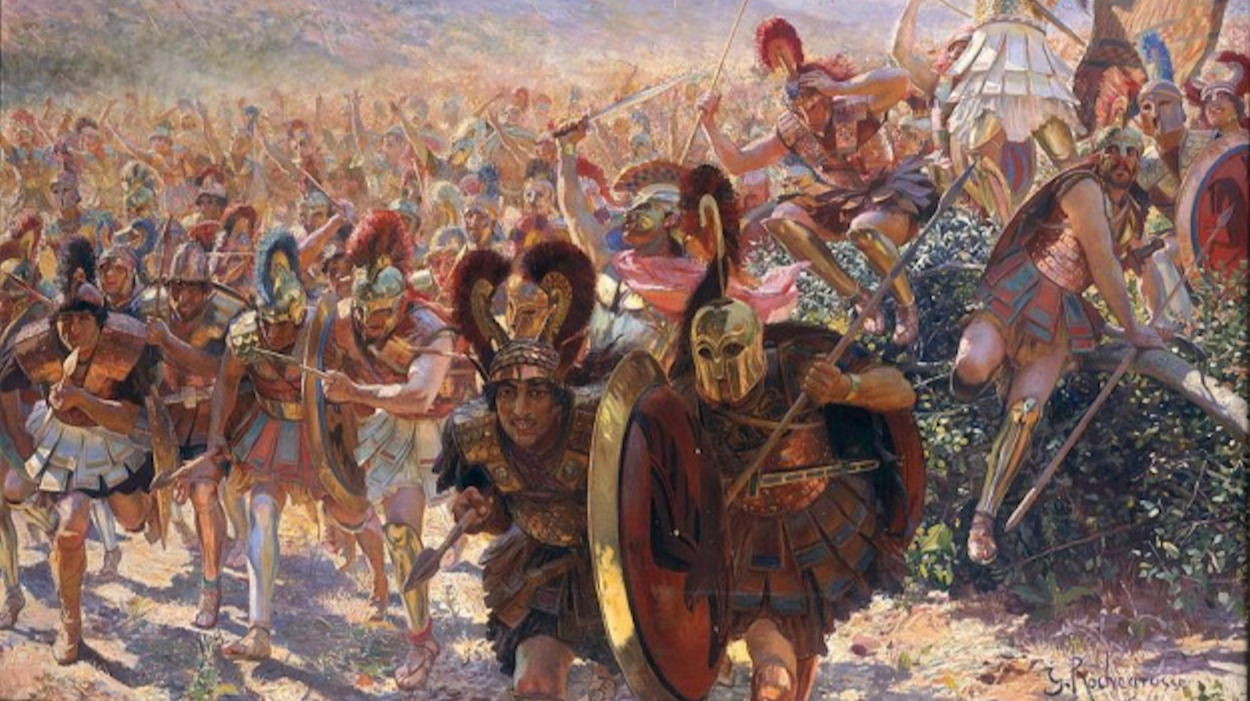 image.png Check out my previous blog on the start of the Greco-Persian Wars and the Ionian Revolt: https://steemit.com/hive-133974/@oo7harv/the-ionian-revolt-499-493-bc-the-start-of-the-greco-persian-wars MILTIADES THE ELDER: TYRANT 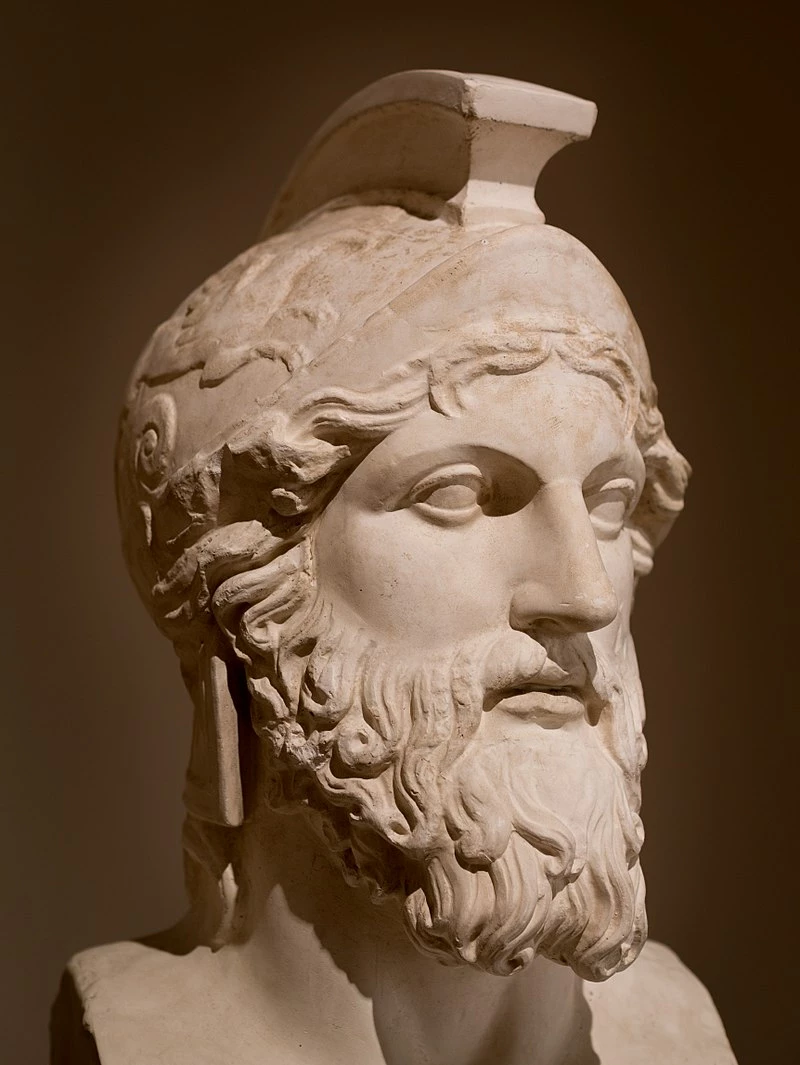 [ABOVE: A Roman copy of a Greek bust of Miltiades the Younger, originally from the 5th−4th centuries BC, now at the Slovenian National Gallery] Until the Ionian Revolt, Miltiades, known often as “The Younger”, ruled over the Chersonese. He was the nephew of Miltiades, known as Miltiades “The Elder”, son of Cypselus; Miltiades the Elder had gained control of the region in Thrace by being invited to intervene in a local war; A Thracian tribe, the Doloncians, were constantly loosing battles against their rival Apsinthian tribe. Fearing defeat, the Doloncians sent their kings to the Pythia at Delphi to ask for aid. They were told to invite the first man who extends to them hospitality into their lands, and make him their Founder. Receiving no aid as they headed south, they eventually reached Athens, and the home of Miltiades. A wealthy and noble man at the time, he saw these foreigners dressed in rags and carrying spears, and gave them the hospitality they sought. The Thracians told him of what the Oracle had told them, asking him if he would go along with the plan. Suffering under the rule of Pisistratus at the time and wishing to get out of it, and after asking the Oracle for advice, Miltiades accepted the offer. 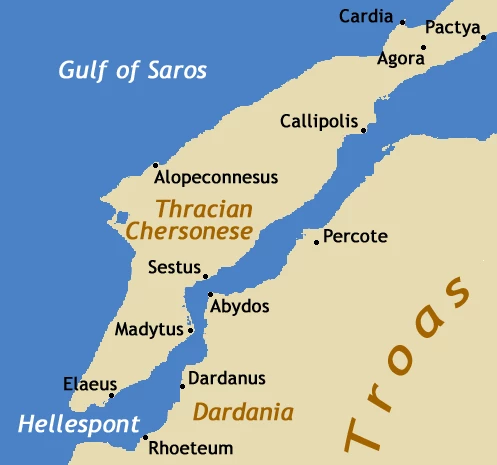 [ABOVE: Map of the Chersonese, modern-day European-Turkey] Following a successful campaign into Thracian lands, Miltiades was made tyrant. As tyrant of the Chersonese, Miltiades ordered the construction of a wall to separate the Doloncians from the Apsinthians. Once this was achieved and the lands were made safer, he fixed his attention to Lampsacus, ordering it attacked. This attack, however, failed, and Miltiades was taken as a captive by the Lampsacenes. Croesus of Lydia, however, recognised Miltiades as a prominent man, and threatened Lampsacus to release him under the threat of being wiped out, to which they complied. Upon Miltiades gaining freedom, however, he was soon killed, dying without a clear heir. His kingdom and property was thus given to his half-brother, Stesagoras, and when he too was killed, the Chersonese was passed to his brother, Miltiades the Younger, nephew of the former Miltiades. This Miltiades the Younger was sent over to the Chersonese by the Pisistratidae. Once there, he stayed in his home, supposedly as a means to honour the death of his brother; the local tribal chiefs joined him in mourning, whereupon they were all arrested. Peace was kept by Miltiades in the area by his 500 mercenaries, and his marriage to the daughter of the local Thracian king. When Persian ships arrived in his lands, he set sail to Athens. MARDONIUS IN IONIA 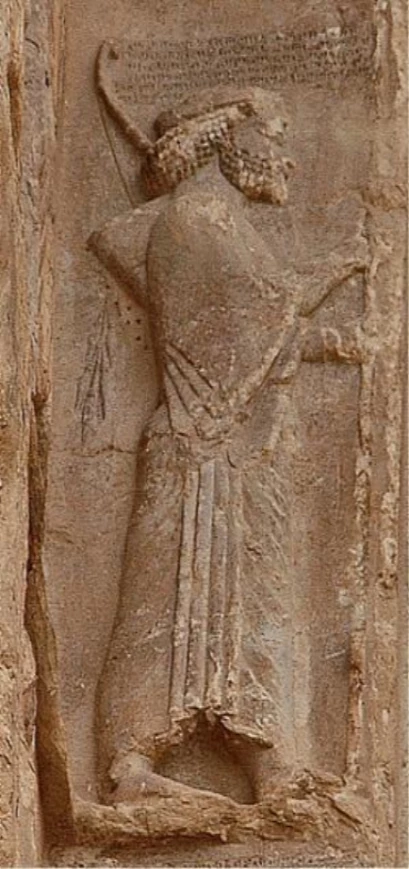 [ABOVE: The Tomb of Darius I, depicting Gobryas, one of the Seven Conspirators and father of Mardonius] It was soon after Miltiades’s goings-on in the Chersonese that a Persian general, Mardonius, (the son of Gobryas) headed for the coast of Asia Minor ahead of a large Persian army and navy. Reaching Cilicia, he headed the navy himself and left the army to march for the Hellespont, which they eventually reached, crossing altogether into Europe and heading straight for Athens and Eritrea. While these were the primary targets of the invasion, any settlements on their way there were also subject to the Persians, subduing the Thasians and enslaving Macedonians on their way south. At Athos, the Persian navy suffered a heavy blow due to storms, supposedly loosing them 300 warships, and 20,000 men were killed by either drowning, hypothermia, hitting rocks, or sharks. The land force too took some casualties on the way after a night attack by the Thracian Brygi tribe, killing several men and injuring Mardonius. They too, however, ended up defeated by the Persian army and enslaved. Suffering heavy casualties forced Mardonius to return to Asia with both the army and the fleet. PERSIAN SUBJUGATION OF THASOS 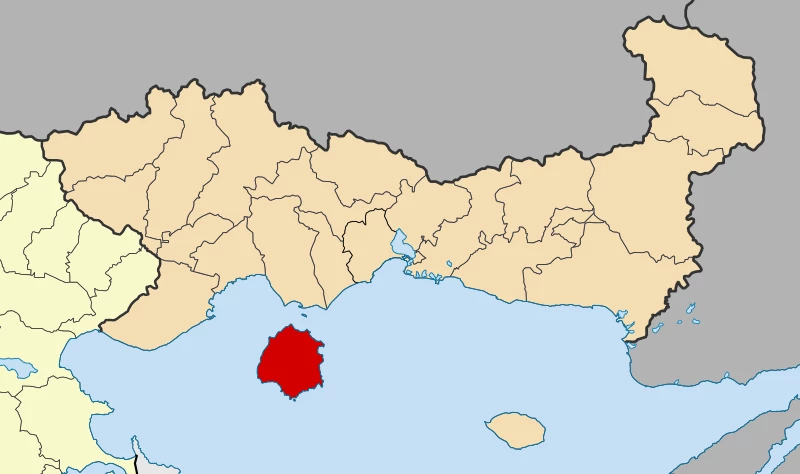 [ABOVE: The Isle of Thasos, southern coast of northern Greece] In the following year, king Darius ordered for the people of the isle of Thasos to demolish their own defensive walls and to dismiss their fleet; Thasos was using Persian gold to construct said longships and walls after claiming they had been besieged by Histiaeus. Thasos agreed to Darius’s demands, bringing their fleet to Abdera and knocking down their new walls. Darius next wished to see if the rest of the Greeks between Asia and Greece would submit or resist. Sending heralds throughout Greece to demand “earth and water”, Darius also ordered for Greek cities in Asia to begin constructing longships and transport vessels. Among the Greeks who gave the earth and water demand were the Aeginetans. This provoked Athens, who accused them of having Athens in mind as a target when agreeing to Darius’s demands. Making the most of this pretext, Athens sent delegations to Sparta, accusing the Aeginetans of betraying the Greeks. Persian messengers sent to Sparta and Athens to ask for their submission were killed; the Athenians threw the Persians off of a cliff, while the Spartans threw their Persian messengers down a well. CLEOMENES OF SPARTA, AND THE ISLE OF AEGINA 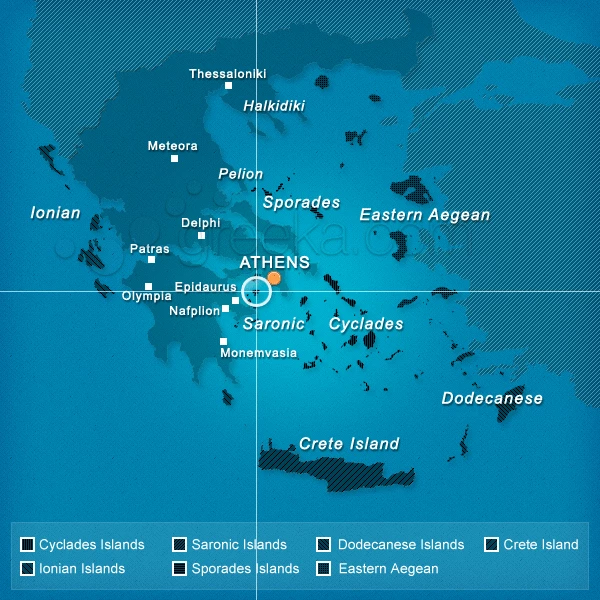 [ABOVE: Location of the Isle of Aegina, south-west of Athens] By this charge, king Cleomenes of Sparta sailed to Aegina to arrest the supposed ringleaders. There, he met resistance from locals who threatened to fight the Spartans, under the claim that Cleomenes was simply bribed by Athens and was thus not acting with permission from the Spartan authorities. However, it was actually a letter sent by Demaratus that made the Aeginetans make these accusations. Either way, Cleomenes left with his delegation, warning the ringleader, Crius, that a great deal of trouble was coming his way, telling him, “you had better have your horns coated with bronze”. 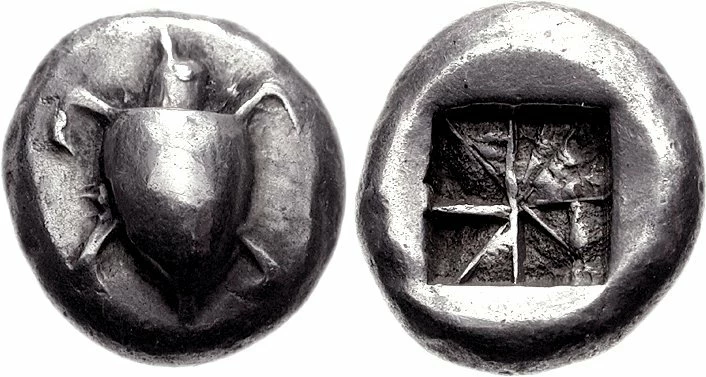 [ABOVE: Silver coins from Aegina, c.550–530 BC, depicting a Sea turtle and an incuse square punch with eight sections] THE FATE OF CLEOMENES While Cleomenes was dealing with the Aegnietans, Demaratus, the other Spartan king, was back in Sparta putting a bad name on his co-monarch. Cleomenes would later have the rival king deposed of by 491 BC, replacing him with his relative, Leotychidas, who Cleomenes took with him to Aegina to deal with the disputes. Two Spartan kings bearing down on Aegina was too much to handle, and resistance to Sparta ended. Ten of the wealthiest and most influential Aeginetans were taken away and given to their worst enemy: Athens. Resistance to Cleomenes, however, had been brewing back at Sparta since Demaratus. Afraid of what his people may end up doing to him, Cleomenes fled to Arcadia, rallying their people against his own. Afraid of what Cleomenes may do to Sparta, the people welcomed back Cleomenes, restoring him to his full title as king. However, not long after his reposition to the throne did Cleomenes fall ill; he became deranged, and would reportedly poke his staff into stranger’s faces unprompted. He was thus placed in stocks, guarded only by a helot. Cleomenes threatened this “guard” to hand him a knife, and upon receiving it Cleomenes started tearing at his own flesh, starting with his shins, then his thighs, hips and then his stomach, at which point he dropped dead. The exact reasoning for such a suicide is still hotly debated; the geographer Pausanias and Herodotus himself both state that it could have resulted from Cleomenes’ destruction of a sacred tree in Eleusis, Attica, thus he did unto himself what he had done to a holy site. According to the Spartans of the time, however, Cleomenes’ spent a very long time living alongside Scythians, and their love for drinking unfiltered neat wine is what drove him insane. THE HEIR OF CLEOMENES Cleomenes was imprisoned in 490 BC and died the following year. Upon his imprisonment, he would be succeeded by his half-brother: King Leonidas. PERSIAN EXPEDITION TOWARDS ERETRIA 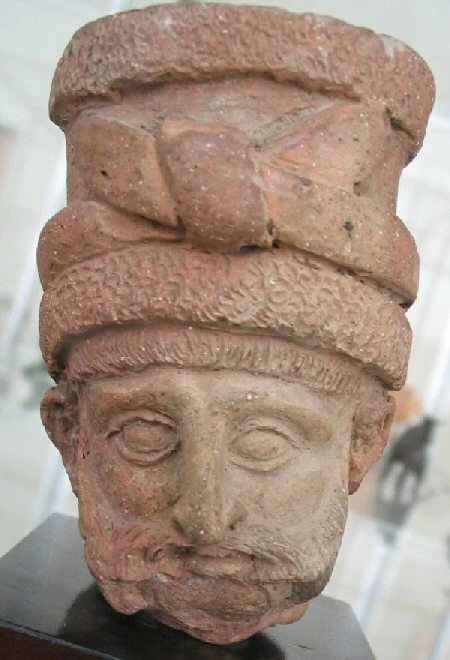 [ABOVE: Bust of an Achaemenid nobleman, believed to be Artaphrenes, from c.520-480 BC] While Athens and Aegina continued to feud with one another, Darius made plans to conquer not only Athens, but all of Greece. In 490 BC, Darius appointed new military commanders in the places of Mardonius: a Mede named Datis, and Artaphrenes, son of Artaphrenes and Darius’ nephew. Their goal for now was to enslave Athens and Eritrea, and bring the captives to him personally. Datis was also accompanied by the former and last tyrant of Athens, Hippias, intent on reinstating him into power under Persia. Leading a large army, the two commanders headed for Greece, bolstering their army’s size with cavalry-transport and naval support on the way. The sea route taken towards Greece was an island-hopping one, starting at Samos. It’s likely they chose this route instead of a land-based invasion across the Hellespont due to their previous troubles in the Aegean around Athos, and the fact that they hadn’t yet subdued the isle of Naxos, which they now intended to take. CAPTURE OF THE CYCLADES ISLANDS 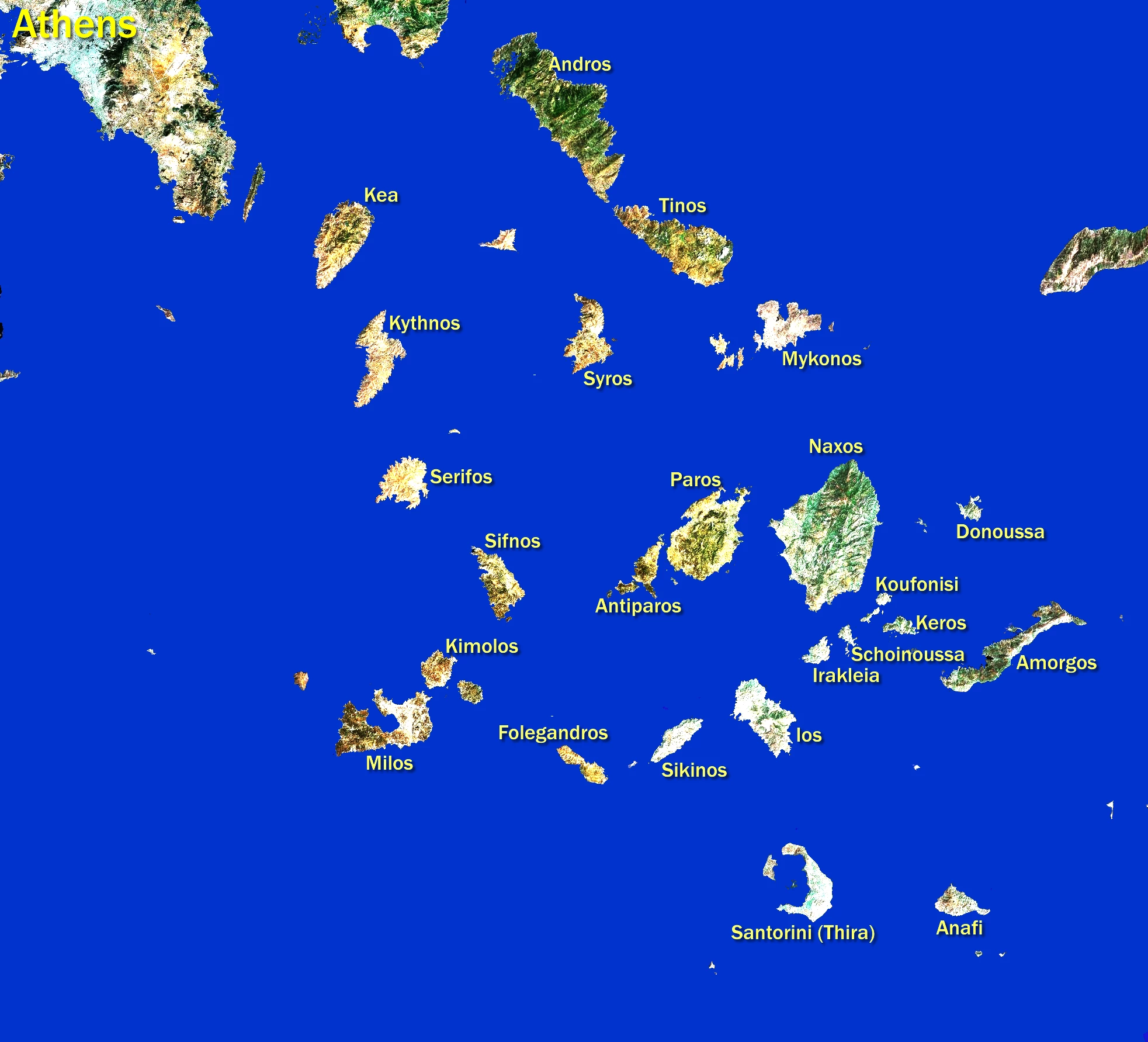 [ABOVE: Satellite image of the Cyclades Islands. (Delos is South-West of Mykonos)] 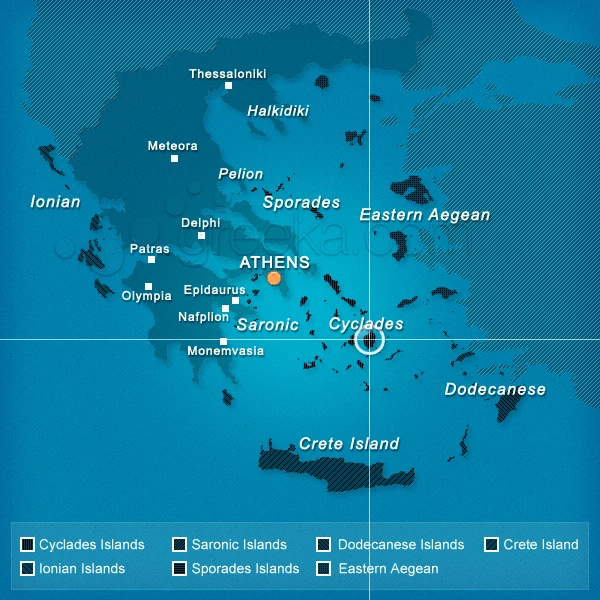 image.png [ABOVE: Location of the Isle of Naxos within the Cyclades] The Naxians didn’t meet the Persians head-on when Datis and Artaphrenes landed there, making for the hills instead. Their quick pace for higher grounds left some behind, and the Persians took several prisoners, burning towns any sacred sanctuaries along the way. With this success, the Persians set off for more Greek islands. DELOS AND KARYSTOS 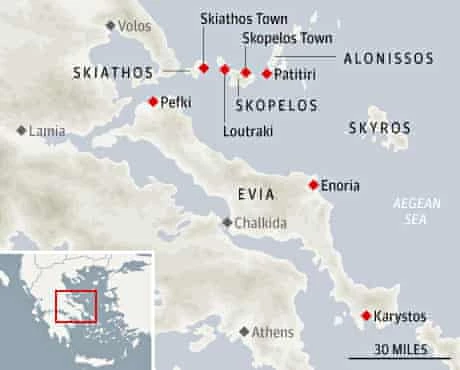 [ABOVE: The city of Karystos, located in the south of the Isle of Euboea] Meanwhile, the Delians of Delos also fled their island home, heading for Tenos. Datis, having some of his forces already stationed nearby, sent some of his fleet ahead of the Delians, to make for Rheneae. Datis sent heralds to the Delians, asking why they had fled, ensuring them that, even without orders from Darius, he would not be there to harm them. Datis then sailed away, not harming the Delians and made straight for Eretria. However, on the way, an earthquake struck Delos. This was taken as a sign of worse things to come for the islands’ inhabitants. Datis landed his ships at several Aegean islands along the way, capturing hundreds of people. The nation of Karystos on the Isle of Euboea put up resistance, but were eventually subdued after a siege. THE SIEGE OF ERETRIA 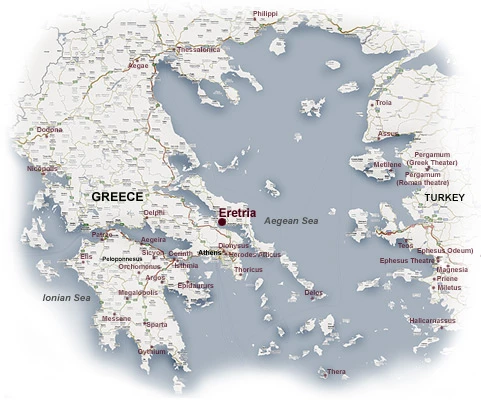 [ABOVE: The Euboean city of Eretria] (SIDE NOTE: The Greek city of Eretria should not be confused with the modern-day African nation of Eritrea. Similar names, but unrelated!) Fearing of what was to come for them, Eretria asked Athens for support. Being sent four-thousand men, the Eritreans didn’t really have any strategy for these reinforcements. Some were willing to surrender cities to Persia, while others were ready to put up a fight in the hills. Aeschines, one of the notable Eretrian leaders, seeing this two-way divide, told the Athenian reinforcements to return to Athens, which they did. Datis soon after landed his ships outside the city, with several Eretrian manning the city walls. Fighting here was fierce. Six days into the fighting, however, two Eretrian nobles eventually surrendered the city over to Datis. As retribution for the burning of Sardis, they burnt the city’s sanctuaries to the ground, and under Darius’s orders, the population was enslaved. The Eretrian slaves taken by Datis to Darius would later be found and spoken to by Herodotus, who was key to most of the history known of this period. Persia’s expedition was so far a huge success. They now set their eyes solely on Athens. DATIS SENDS ENVOYS TO ATHENS Datis was a Mede by descent. He had received the tradition from his ancestors that his Median homeland was established by people originally from Athens, and upon receiving this, he travelled to Athens with an army to demand the return of the sovereignty that belonged to his ancestors. (The myth goes that Medus, the founder of the kingdom of Media, was denied kingship in Athens and so fled east to found his own nation.) Datis’s demands were that if Athens returned the kingdom to him, he would let slide their burning of Sardis, but if they refused then they would meet a worse fate than Eretria. Speaking on behalf of the other ten Athenian general’s concession, Miltiades denied, stating it would be more appropriate for Athens to hold mastery over Media rather than Datis holding mastery over Athens. Datis made ready for battle. MARATHON 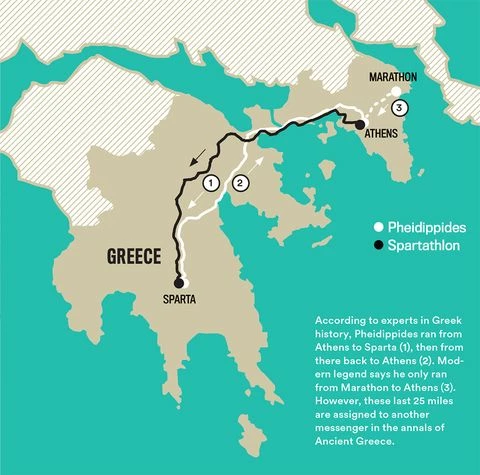 [ABOVE: The location of Marathon in relation to Athens and Sparta] The location the Persians chose to land their forces was the bay of Marathon; it had good proximity to Eretria and had enough flat land to properly utilise their large cavalry forces. Hippias, the former Athenian tyrant, accompanied Datis and Artaphrenes on their expedition, and it was he who recommended the landing at Marathon. Hearing of the oncoming Persian army, Athens sent out ten-thousand men (that is, ten commanders commanding a thousand men each) to meet the Persians. One of these commanders was Miltiades, who took overall command of the entire Athenian army. PHEIDIPPIDES 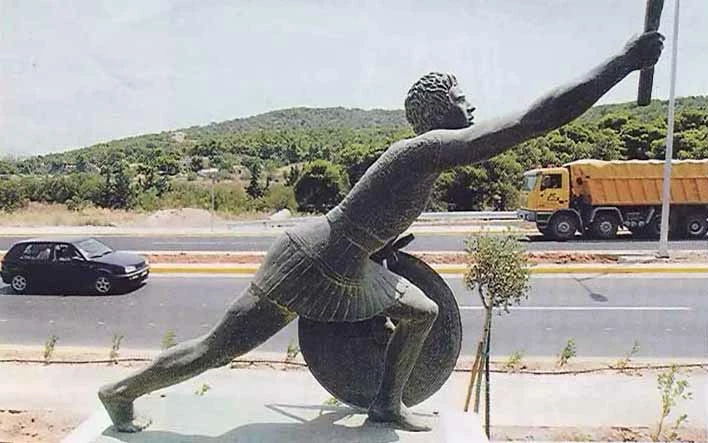 [ABOVE: A modern statue of Pheidippides along the Marathon road, Greece] Before leaving the city, a runner/messenger named Philippides (perhaps more commonly known today as Pheidippides) to Sparta to ask for aid. On his way, he supposedly had an encounter with the God Pan by Mount Parthenium. Allegedly, Pan called for Pheidippides, asking why they had ignored Pan when they were always a friend of Athens. Believing in this experience, the Athenians would later go on to build a sanctuary to Pan on their Acropolis, worshipping him with torch-racing and sacrifices. Reaching Sparta, he asked them for aid, telling them that Eritrea, among other nations, had already fallen to Persia. Sparta agreed to join, but only once their festival, known as the Carneia, came to an end with the next full moon, and they were now allowed to partake in military campaigns in the meantime. Returning to Marathon, Pheidippides had impressively covered around 140 miles in just 36 hours of straight running. 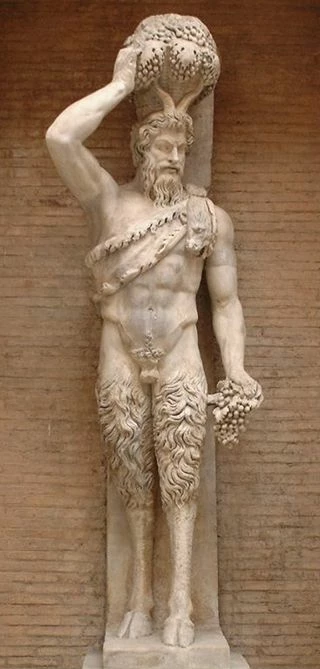 [ABOVE: A statue of the God Pan, in the Capitoline Museum, Rome] HIPPIAS'S HOMECOMING One night before the landing at Marathon, Hippias had a dream in which he slept with his mother. He took this as a sign that he would regain his Athenian throne and die of old age. The next morning, the Eritrean prisoners were unloaded on the island of Aegilia, and the Persian army was unloaded at Marathon. As he jumped ashore, Hippias suffered with a coughing fit, in which he spat out one of his own teeth. He failed to find it after digging in the sand under the sea, and took this as a sign that the only part of Attica they would reclaim was the part where his tooth was. The rest would not be reclaimed. CALLIMICHUS, THE PLATAEANS AND PREPARING FOR BATTLE 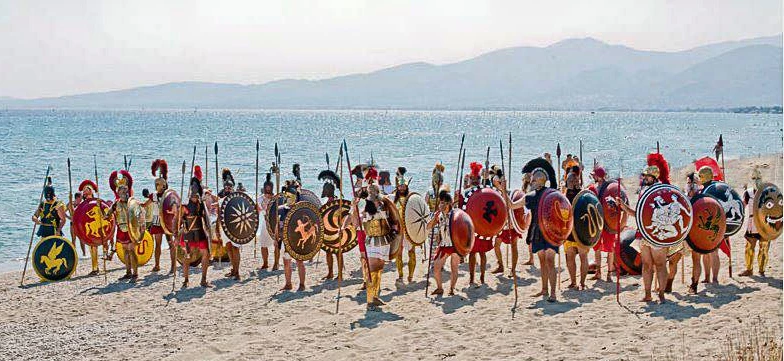 [ABOVE: A modern (2011) reenactment of Greek hoplites at the Bay of Marathon] Meanwhile, the Athenian army had also lined up for battle opposite the Persians, accompanied now by a contingent of one-thousand men from Plataea, a subject state to Athens, bringing the total Greek force up to eleven-thousand. How to deal with the Persians was the subject of the Greek commanders now; Miltiades and others supported a direct attack, yet that may not have been the best strategy since the Greeks were heavily outnumbered. Alternatively, they could keep their defensive position and wait for the bigger Persian army to run out of supplies. Votes were cast by the eleven most senior commanders on what to do, until Callimichus, the elected War-Archon, was approached by Miltiades, and told that the future of Athens now lay in his hands, since Callimichus could cast the eleventh vote. He was eventually swayed over to Miltiades’ idea of a direct attack, who warned him of what the cowardice of several other Greeks who chose flight had resulted in for them. A stand-off of no fighting between the two armies took up four days. 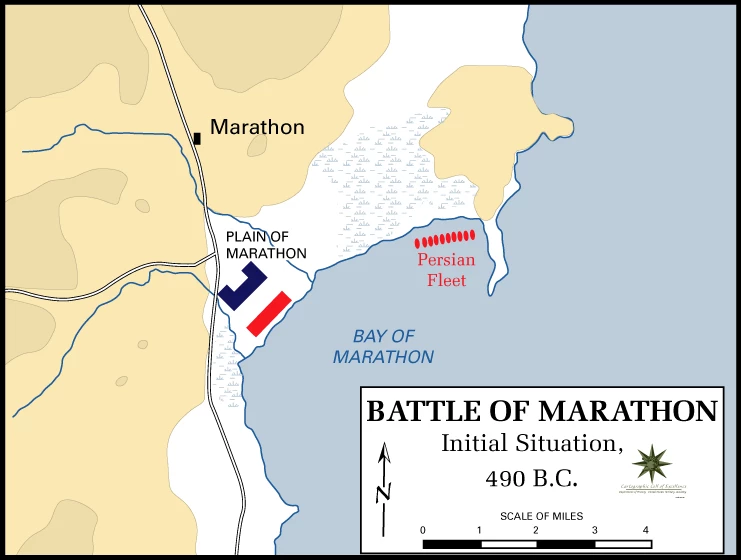 [ABOVE: The initial positioning of both forces before the battle] The Greeks took up battle positions. Callimichus manned the right wing, and the Plataeans manned the left wing. The battle line had to be stretched thin to match the Persian army’s line in length, so as to not be outflanked by them. The Greeks were supposedly outnumbered three-to-one. The outer wings, therefore, were made twice as thick as the rest of the army to better counter any outflanking manoeuvres. Standard Greek hoplite warfare dictated that the normal battle order was a slow, steady march, since each soldier was so heavily equipped, with shields interlocked. At Marathon, however, the Greek army charged at full-speed towards the Persians, the first time a Greek army had used this as a battle tactic, hoping to take them by surprise and suffer less damage at the hands of the several thousand archers the Persians had brought with them. The distance covered by the run was eight stades, roughly half a mile. Suffering only minor losses on the way due to arrow fire, the Greeks rammed into the Persian line, fighting remarkably well. 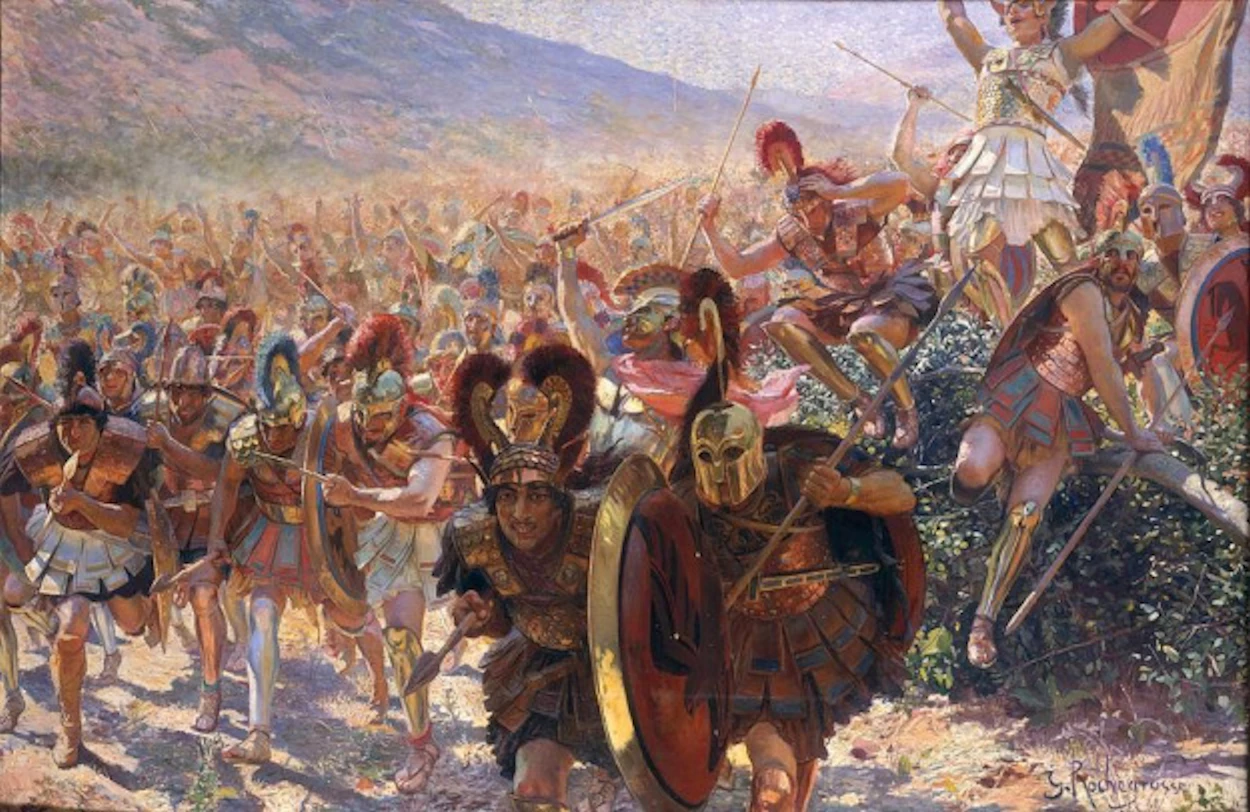 [ABOVE: Greek troops rushing forward at the Battle of Marathon, by Georges Rochegrosse, 1859] THE BATTLE 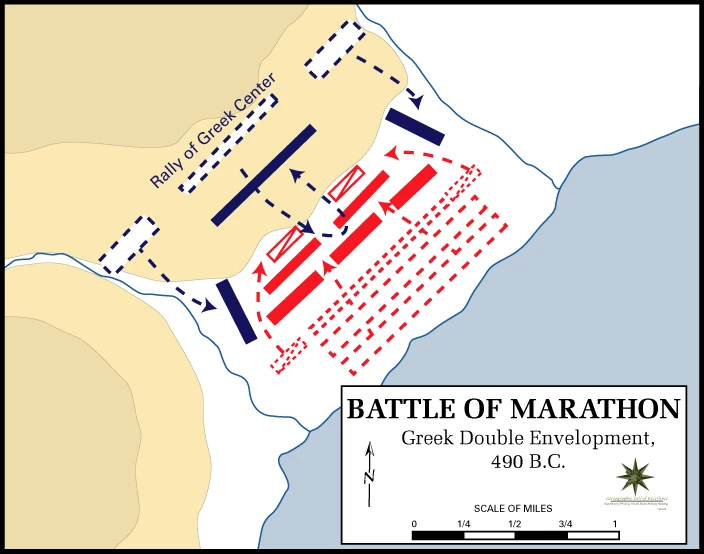 [ABOVE: The Greek line enveloping the larger Persian force] The fighting went on for several hours. The thinner, weaker Greek centre collapsed under the weight of the Persian army, however Callimichus’ right wing and the Plataeans’ left wing, being double the depth of the rest of the Greek line, soon made ground, and began to slowly envelop the Persian army, until they were completely surrounded on three sides. Their only way now was backwards, towards their own ships for a quick get-away. The Greeks pursued the Persians back, and in this pursuit, Callimichus was impaled by spears and died in battle. Allegedly, so many spears impaled him that his body stayed upright even in death. Another casualty included Stesilaus, son of Thrasylaus, and another prominent Athenian named Cynegeirus, son of Euphorion, lost his hand to an axe while reaching for a Persian ship. 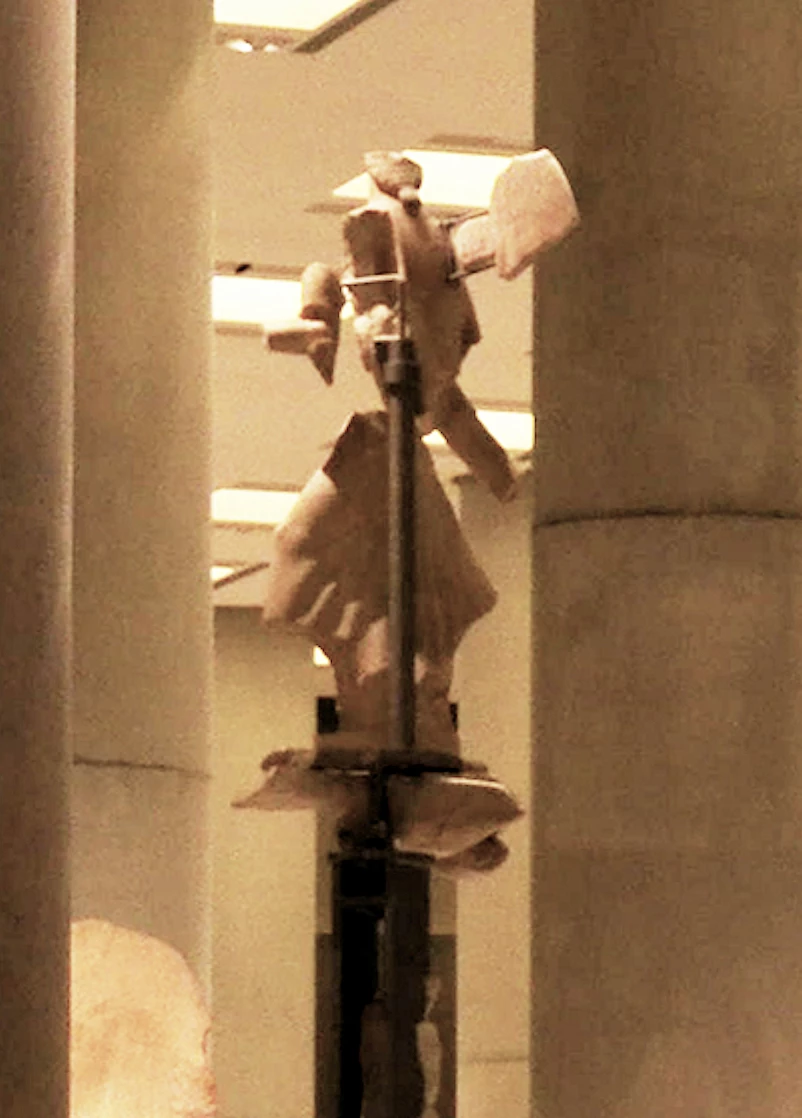 [ABOVE: Reconstitution of the Nike of Callimichus, erected in honour of the Battle of Marathon, later destroyed during the Persian sack of Athens, 480 BC, and now held in the Acropolis Museum, Athens] 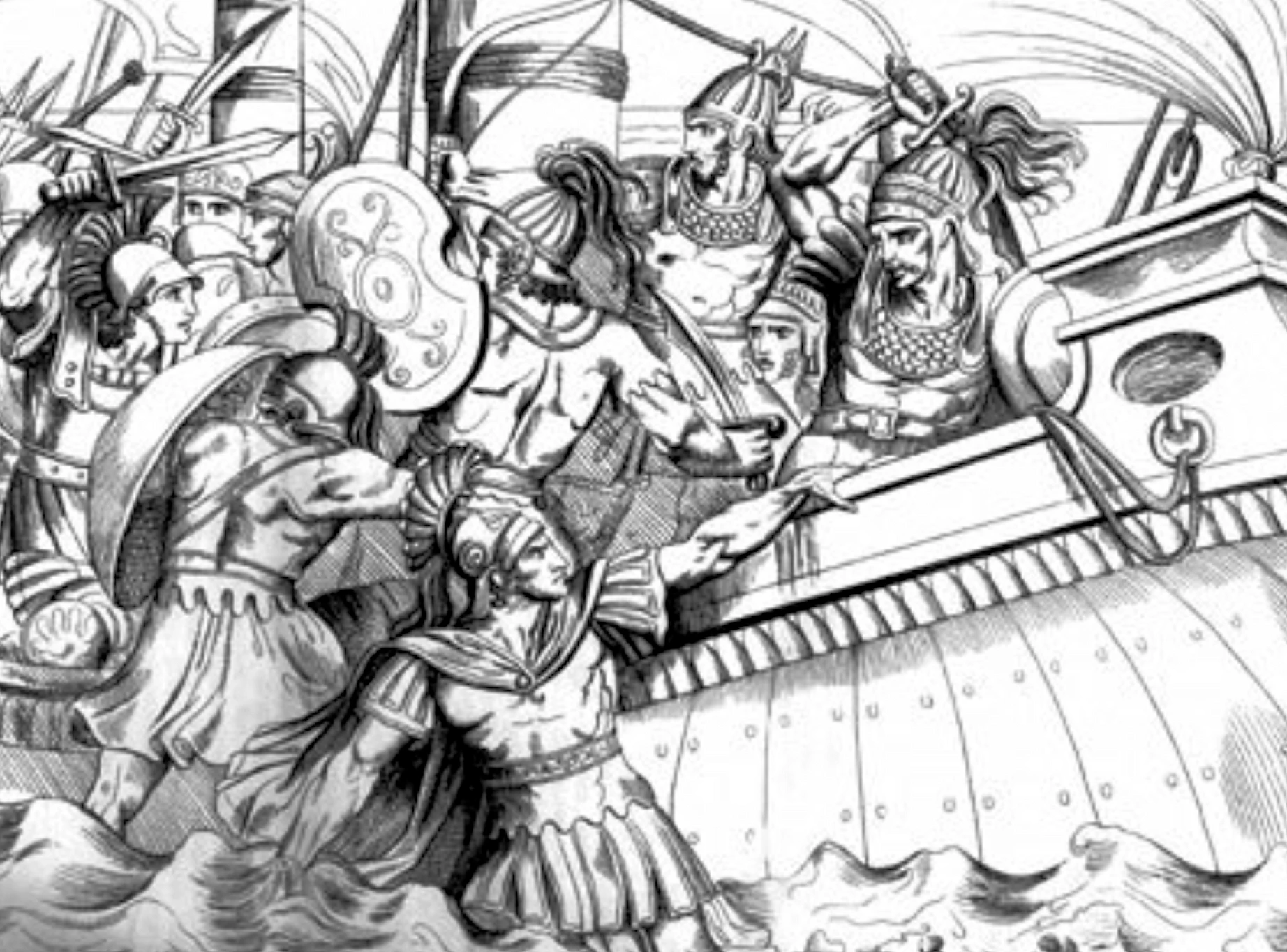 [ABOVE: A 19th century illustration of Cynegeirus grabbing a Persian ship at the Battle of Marathon] 26 MILES Seven Persian ships would be captured by the Greeks, with the rest sailing to Eritrea, to pick up the prisoners left there, and then sailing for Cape Sounio, south of Attica, intent on sailing round the landmass and reaching the undefended city of Athens. Miltiades now had to take his exhausted army, who had collapsed to their knees in their heavy armour under the beaming August sun, and force-march it back to Athens before the Persians could get there. This twenty-six mile march from Marathon to Athens would be a success, and the Persians would fail to land their army, forcing a retreat back to the empire. This twenty-six mile march would also be forever immortalised as people from cities all around the world would later go on to celebrate the twenty-six mile-long Marathon run. To clear something up, the story of Pheidippides the runner running to Athens, shouting "nenikēkamen!" ("We've won!") and then collapsing dead from exhaustion is unfortunately not true; It was invented in the first century AD by Plutarch. It doesn't mean that Pheidippides himself did not exist - it's still one-hundred percent plausible that he was the runner who was sent to Sparta to ask for aid before the battle - but the reason we celebrate the Marathon today really comes from the final 26 mile march of Miltiades and his exhausted men back to Athens. The first Olympic Games to stage the Marathon Run based around the false last run of Pheidippides was in 1896. 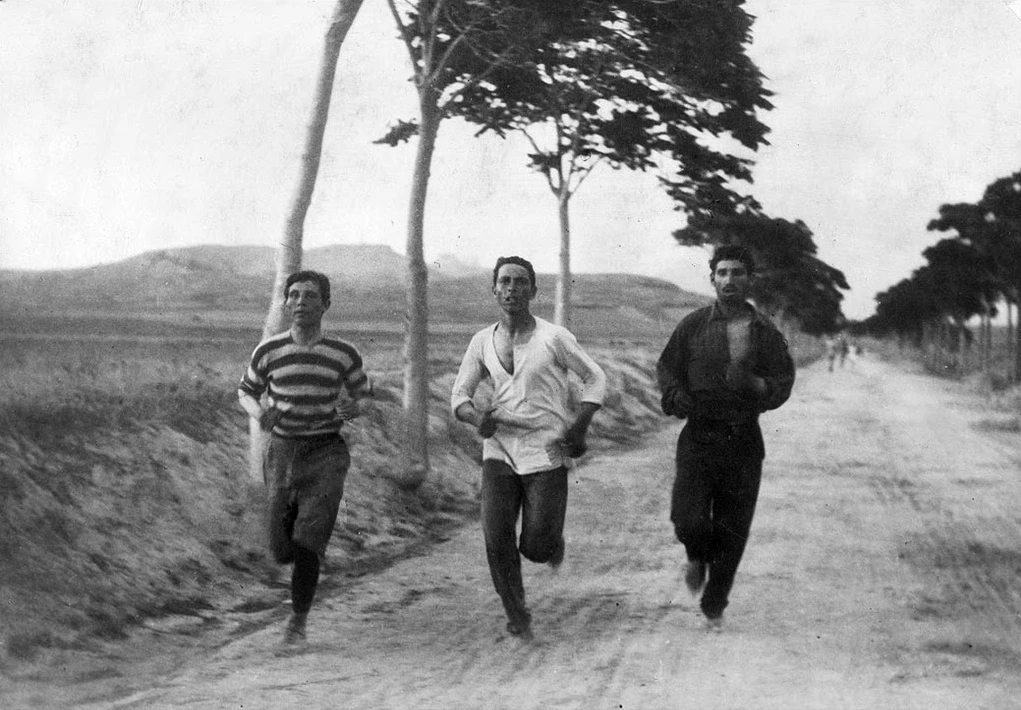 [ABOVE: "1896: Three athletes in training for the marathon at the Olympic Games in Athens", photographed and titled by Burton Holmes] AFTERMATH While the Persians suffered supposedly 6,400 losses, the Greeks only suffered 192. Marathon was a minor setback for the Persians, who had been very successful in their campaign up until Marathon, but it was a huge victory for the Greeks, who had taken off the veil of Persian invincibility and killed several thousands in the process. DATIS On the Persian's way back to Asia, Datis stopped off at Myconos, where he had another dream. What he dreamt of is unknown, but he woke up intent on searching his fleet. He found a gilded image of Apollo in a Phoenician vessel. It had been stolen from Delos by Persian-led soldiers, and Datis ordered it taken back to Delos. The Delians by then had returned back to Delos, and they were instructed to take the statue back to its original homeland at Delium, a territory owned by the Thebans. The statue would not be returned however, and twenty years later, Theban forces would reclaim the image and returned it to Delium after prompting by an oracle. Landing in Asia, Datis and Artaphrenes took the Eritrean prisoners to Darius in Susa, satisfied that the peoples who had first aided the Ionian revolt had now been enslaved. Thus, Darius did them no further harm and settled them in their own settlement to live in peace. THE SPARTANS As for the Spartans, they eagerly arrived to fight the Persians, and marched to Athens in just two days. While too late to reach the battle in time, they were keen to see what a Persian soldier looked like, and so marched to Marathon to inspect the dead. They expressed their praises to Athens for fending off such a large force so swiftly, yet I imagine this was said with an underlying level of loathing since their age-old rival had been the one to claim such a huge victory and not them. The Spartan forces soon returned home. MEMORIAL 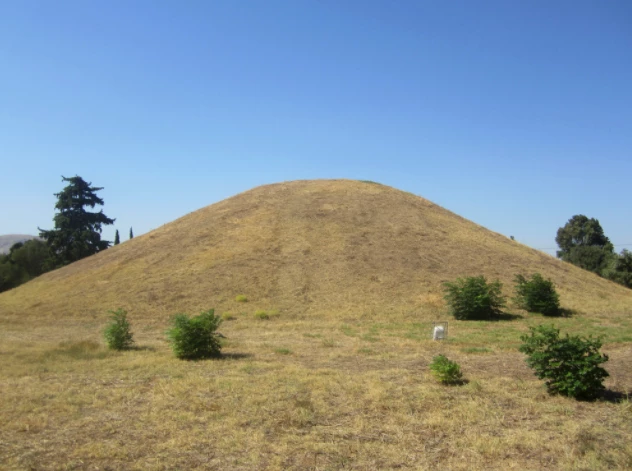 [ABOVE: The mound (soros) where the Athenians buried their dead after Marathon] The 192 fallen Greek soldiers were honoured with a burial: an originally 12 metre-high mound that can still be seen today. Traces of this Greek hero cult have been found; one modern theory states that this 192 is also found on the Parthenon, which has 192 mounted figures on its frieze, carved by Pheidas a couple of decades later. The Plataeans too got to bury their own soldiers in a separate mound. 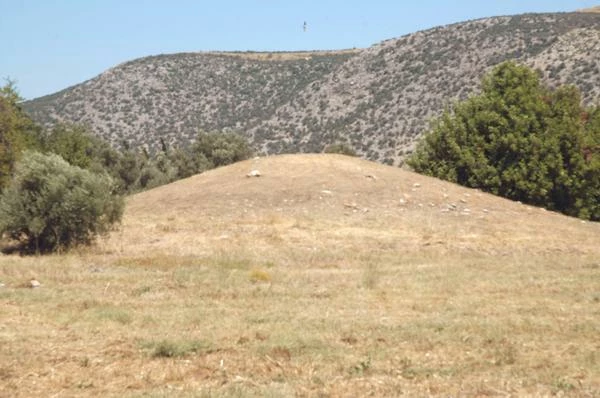 [ABOVE: The mound where the Plataeans buried their dead after Marathon] MILTIADES' ATTEMPT ON PAROS 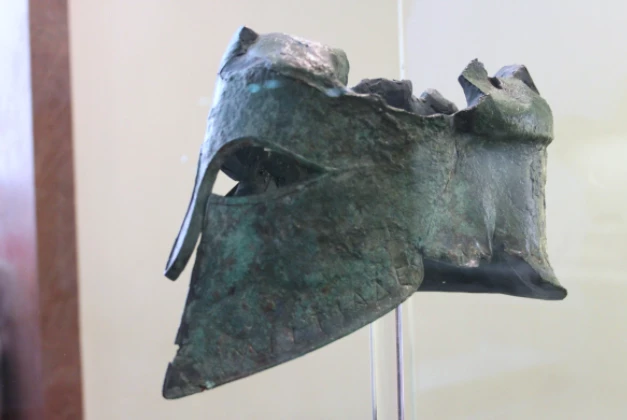 [ABOVE: Miltiades' helmet, given as an offering to the temple of Zeus, Olympia, by Miltiades, with the inscription: "ΜΙΛΤΙΑΔΕΣ ΑΝΕ[Θ]ΕΚΕΝ [Τ]ΟΙ ΔΙ" ("Miltiades dedicates this helmet to Zeus"), now held in the Archaeological Museum of Olympia] Following the Battle of Marathon, Miltiades now had a high reputation to his name, so much so in fact that when he asked the government for seventy warships and an entire army without telling them why exactly, they simply let him have what he wanted. His goal was to capture the isle of Paros. His given reasoning was that Paros sent a trireme in support to the Persians during their invasion of Greece, yet this was merely an excuse; Lysagoras of Paros turned Hydarnes against him during a personal feud, so the reasoning was in fact more personal. Either way, arriving at Paros, Miltiades besieged the city, sending in a herald to ask for 100 talents under the threat that he would otherwise keep the city besieged until it fell. Yet the Parians remained stubborn, rebuilding some of the weaker sections of the wall wherever they could during the siege in the nights to double the walls original height. FAILED EXPEDITION 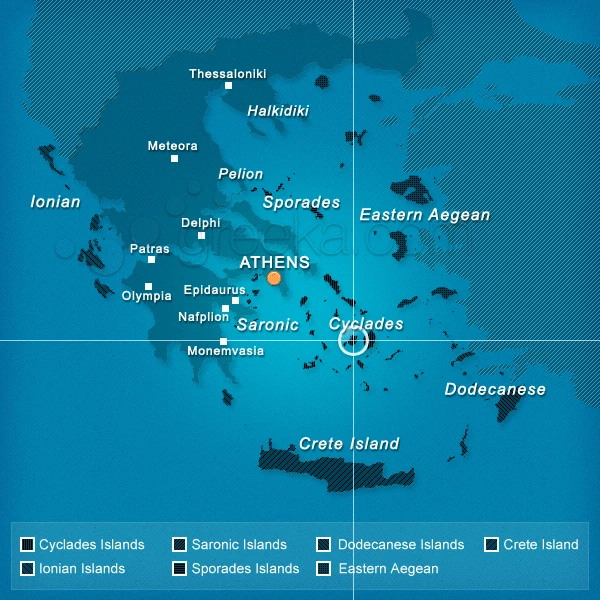 [ABOVE: Location of the Isle of Paros, part of the Cyclades Islands] What follows next varies in sources; Parian sources state that a female Parian captive of Miltiades, a priestess called Timo, asked to meet privately with Miltiades. She advised him on how to take the city, and Miltiades obeyed, making his way over to a hill in front of the city and scaling a small wall surrounding a sanctuary to Demeter. The intention here may have been to interfere with sacred objects held within, but when he reached the sanctuary’s entrance, he was suddenly overcome with fear, and left. Retracing his steps, he made it back to the wall, but caught his leg on the way down, and wrenched his thigh. Miltiades sailed back to Athens, having only besieged the city for twenty-six days and having brought back nothing from his expedition. Parians, meanwhile, were intent on killing Timo for attempting to aid Miltiades, but the Delphic Oracle they sought advice from told them otherwise, claiming she was not guilty and that Miltiades was fated to die a horrible death anyway. DEATH OF MILTIADES Upon returning to Athens, Miltiades was scorned by the city. Scorniing him the most was Xanthippus, who put him on trial and sentenced him to death for deceiving the Athenians. His injured thigh, however, stopped him from appearing in front of the people himself to make his defence, so his friends had to do it for him while he lay down. His friends defended him by referring to Miltiades’ successes against Lemnos, which he had captured and brought under the Athenian fold, and of course his great success at Marathon. This argument worked; the death penalty was lifted for Miltiades, yet he was still forced to pay fifty talents. Before he could pay up, though, he died from his thigh injuries. His son, Cimon, would pay the fifty talents and offer himself up for imprisonment instead, in the hopes that he would get to have his father’s body for himself to bury. OSTRACISM Marathon gave a huge boost of confidence to Athens’s new system of democracy, but equally gave them distrust to its old aristocracy; soon after, the system of Ostracism (from the Greek “ostrakon” meaning “potsherd”, as that was what Ostracism votes were counted on) was introduced and used for the first time in 487 BC, (although ostracism was likely first introduced by Kleisthenes in his reforms) allowing the Athenian people to vote without debate for someone they wised to remove from the city. Later that year, the individual would spend ten years out of Athens, but still retained their citizen and property rights. 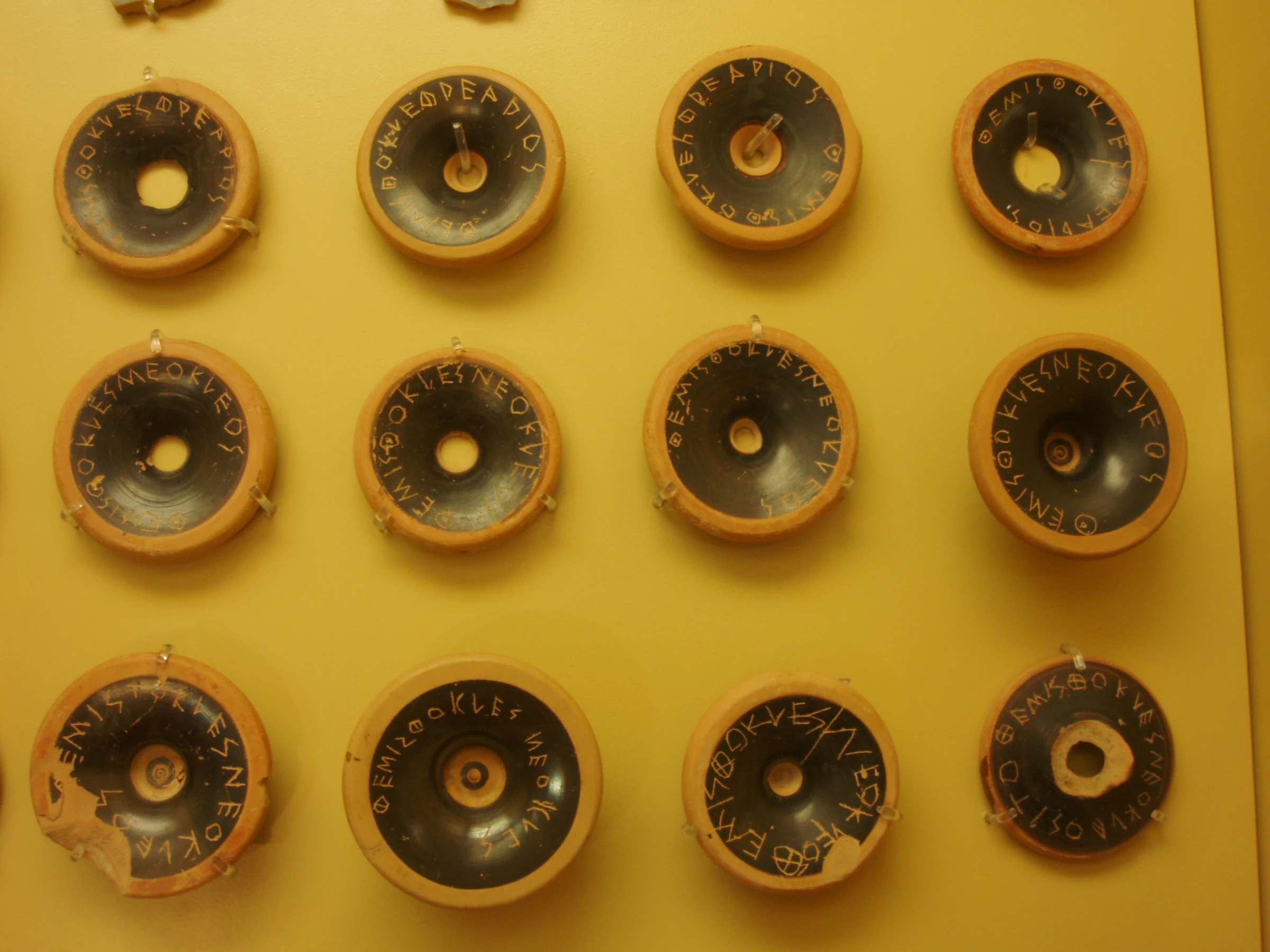 [ABOVE: Ostraka shards from 482 BC] Perhaps the most famous Athenian to be ostracised would also receive the most votes to be so: 1,490 votes for the man who would save Greece in the next Persian invasion to come: Themistocles. ROBERT GRAVES' POEM 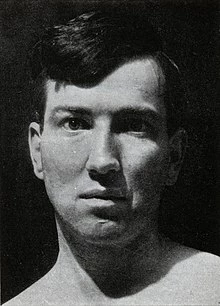 [ABOVE: Robert Graves, photographed in 1929] Robert Graves (b.1895, d.1985) was a First World War soldier and poet who wrote about Marathon. He was likely correct in thinking Persia saw Marathon as a minor setback in their campaign overall. While light-hearted, his poem is well renowned as a major piece of work. The poem speaks through the words of a Persian, and his words show that political “spinning” was still a thing even back then, yet Graves’ own pompousness still shines through: "Truth-loving Persians do not dwell upon The trivial skirmish fought near Marathon. As for the Greek theatrical tradition Which represents that summer’s expedition Not as a mere reconnaissance in force By three brigades of foot and one of horse (Their left flank covered by some obsolete Light craft detached from the main Persian fleet) But as a grandiose, ill-starred attempt To conquer Greece - they treat it with contempt; And only incidentally refute Major Greek claims; by stressing what repute The Persian monarch and the Persian nation Won by this salutary demonstration: Despite a strong defence and adverse weather All arms combined magnificent together." - Robert Graves, “The Persian Version” NEXT BLOG: "THE RISE OF XERXES, 486-480 BC: START OF THE SECOND INVASION" https://www.publish0x.com/ancient-greek-and-roman-history/the-rise-of-xerxes-486-480-bc-start-of-the-second-invasion-xppjekr SOURCES • Herodotus's "Histories" • Diodorus Siculus, "Library of History" • Philip Parker, "World History" • Nic Fields, "Thermopylae 480 BC, Last Stand of the 300" • Oswyn Murray, "Early Greece" • Robin Osborne, "Greece in the Making 1200 - 479 BC" YOUTUBE LINKS (I do NOT own these videos) "Decisive Battles - Marathon (Greece vs Persia", uploaded to YouTube by "Zakerias Rowland-Jones" https://www.youtube.com/watch?v=KgijJ-zdHow&list=TLPQMDgxMTIwMjHmnUJmd5UOGQ&index=14 "Battle of Marathon | Animated History" by "The Armchair Historian" https://www.youtube.com/watch?v=2cubGxusJhw&list=TLPQMDgxMTIwMjHmnUJmd5UOGQ&index=16 "The Battle of Marathon (3D Animated Documentary) 490 BCE" by "Hoc Est Bellum" https://www.youtube.com/watch?v=GhrTqGRrP9w&list=TLPQMDgxMTIwMjHmnUJmd5UOGQ&index=17 "Battle of Marathon - Persia and Greece Collide!" by "Youre History" https://www.youtube.com/watch?v=sDeQOOXhSnQ&list=TLPQMDgxMTIwMjHmnUJmd5UOGQ&index=15 "Miscellaneous Myths: Medea" by "Overly Sarcastic Productions" https://www.youtube.com/watch?v=b7WH30_8vos&t=641s MY HISTORY COMMUNITY: https://steemit.com/created/hive-133974 MY TWITTER: https://twitter.com/HarveyPeirson All feedback - positive and/or critical - is appreciated! All images used are copyright-free Don't forget to rate this post if you enjoyed it Thanks for reading :) |
| json metadata | {"tags":["history","writing","blog","politics","war","greece","photography"],"image":["https://cdn.steemitimages.com/DQmZHo77urjXRHTqPrepo8oBKp1ma7DMzjdtani3xb9HuLW/image.png","https://cdn.steemitimages.com/DQmaDWrw2T1rYZ7BVsA52GuiLzkjWc5LAfmz87ksnPtDf6f/image.png","https://cdn.steemitimages.com/DQmZFyBNnbGPCqvMLs4uCKNQnVMMRCLis4Rdj69Dw6NWUkv/image.png","https://cdn.steemitimages.com/DQmVsoauPbMwNjKsQq2tLrdfDdsYSyz6SrwA7mMeg6Tpuex/image.png","https://cdn.steemitimages.com/DQmSewz3KbtYEoxoHgLaCXjG5tJyKxWUCmrSoci4xcUo8VJ/image.png","https://cdn.steemitimages.com/DQmYRpwowizjZyKjGebh9BfYAyNtjqWaau1XAgK4UWgbjZo/image.png","https://cdn.steemitimages.com/DQmSCct4Dj8U6mvrssvWwRWRJsW8U9hX2saBJUdBPxKaak8/image.png","https://cdn.steemitimages.com/DQmUrGUXhedgLQucdmkzzXNZXGEzSsYVymj3EbNmhSJzHL9/image.png","https://cdn.steemitimages.com/DQmSopUTi4tXj1WrTvH2WAwmUqLvqL56j5SmnoDRmVnCazk/image.png","https://cdn.steemitimages.com/DQmfDodtSuYaVzpdgSTtHjfDEQU2QQxq9M2kQccjy1sKMhP/image.png","https://cdn.steemitimages.com/DQmPhjZXKQfukng5Q5buZeZJoshLuBFceohYxnUqNHYguEc/image.png","https://cdn.steemitimages.com/DQmZ8obegYMkkYW6vXJdS2xBHjJccwbxeUU7Zh5q9Nt5Akc/image.png","https://cdn.steemitimages.com/DQmPf6dprX1Tr6txY2GnsYH2b7i83WjasjSdP5NcSjaKCEA/image.png","https://cdn.steemitimages.com/DQmUk4BcuqwvgEcUgxRmDwrEfxxrzri84Dfy8FY2Weq8qpf/image.png","https://cdn.steemitimages.com/DQmcHVz6FrkvAaxx2z7eXCUbUWNfgu5ade5iDVtX9qWNmyA/image.png","https://cdn.steemitimages.com/DQmXJeKFBQKNEtJvheT7bB45kiEnMwvWwV8eghothuzGDW8/image.png","https://cdn.steemitimages.com/DQmWhLzij9FLvkaE9JNv2BRtiXU8FqJ6ELsCjJXJCBZyhoB/image.png","https://cdn.steemitimages.com/DQmbCA1uJEDWrjyWCcX3LiJBYF6PoiMNXWpKcDxdxxC1GZT/image.png","https://cdn.steemitimages.com/DQmdVhrXPJt9wY6gFDbYUX2y1eHLmZB4VC6E52sSJKzFoqd/image.png","https://cdn.steemitimages.com/DQmSXVfzPBwgR9wGeKVKYjGKWcaH6HrCnM5AA6vWkeF6zj4/image.png","https://cdn.steemitimages.com/DQmU29j8cgn5pQRzQM6QoFhJjA6tUNg4m3mUmcwsqps46Zw/image.png","https://cdn.steemitimages.com/DQmdR9xFuYmSoSEkCX2joBe4jAmv6JYoYCMZSX5GGvTTHzS/image.png","https://cdn.steemitimages.com/DQmbVAk6twmGGU7JsC98PDHQwudpvbLsUyLmtmmRWAT3rLz/image.png","https://cdn.steemitimages.com/DQmPjpFZY76GUfMTDV98hQkSdio8J6XKVXCFFUFZnwsji8B/image.png","https://cdn.steemitimages.com/DQmcUeDhKf4sSgoZ78YgQAHZJvCRLeU1wLjRyReJKZYy54z/image.png","https://cdn.steemitimages.com/DQmeoq3wGBf47M4Nnzs1vfgk7w2ci7azMxipaRrAi5nH4Tg/image.png","https://cdn.steemitimages.com/DQme2Jvd2EeP4JgxM3C2M18vsDDeSNqxMrT8omgbuzaH3u6/image.png","https://cdn.steemitimages.com/DQmcgDhFA2kjqRUTzQ1T95rrRB7c7AJHVrb4d2jRNC8vTiG/image.png","https://img.youtube.com/vi/KgijJ-zdHow/0.jpg","https://img.youtube.com/vi/2cubGxusJhw/0.jpg","https://img.youtube.com/vi/GhrTqGRrP9w/0.jpg","https://img.youtube.com/vi/sDeQOOXhSnQ/0.jpg","https://img.youtube.com/vi/b7WH30_8vos/0.jpg"],"links":["https://steemit.com/hive-133974/@oo7harv/the-ionian-revolt-499-493-bc-the-start-of-the-greco-persian-wars","https://www.publish0x.com/ancient-greek-and-roman-history/the-rise-of-xerxes-486-480-bc-start-of-the-second-invasion-xppjekr","https://www.youtube.com/watch?v=KgijJ-zdHow&list=TLPQMDgxMTIwMjHmnUJmd5UOGQ&index=14","https://www.youtube.com/watch?v=2cubGxusJhw&list=TLPQMDgxMTIwMjHmnUJmd5UOGQ&index=16","https://www.youtube.com/watch?v=GhrTqGRrP9w&list=TLPQMDgxMTIwMjHmnUJmd5UOGQ&index=17","https://www.youtube.com/watch?v=sDeQOOXhSnQ&list=TLPQMDgxMTIwMjHmnUJmd5UOGQ&index=15","https://www.youtube.com/watch?v=b7WH30_8vos&t=641s","https://steemit.com/created/hive-133974","https://twitter.com/HarveyPeirson"],"app":"steemit/0.2","format":"markdown"} |
| parent author | |
| parent permlink | hive-133974 |
| permlink | 5fvjfo-battle-of-marathon-490-bc-the-first-greco-persian-war |
| title | BATTLE OF MARATHON, 490 BC: The First Greco-Persian War |
| Transaction Info | Block #58933265/Trx 817ba58c6adb0a8e8eca2d727a0f0e23cb7bd29b |
View Raw JSON Data
{
"block": 58933265,
"op": [
"comment",
{
"author": "oo7harv",
"body": "\nimage.png\nCheck out my previous blog on the start of the Greco-Persian Wars and the Ionian Revolt:\n\nhttps://steemit.com/hive-133974/@oo7harv/the-ionian-revolt-499-493-bc-the-start-of-the-greco-persian-wars\n\nMILTIADES THE ELDER: TYRANT\n\n[ABOVE: A Roman copy of a Greek bust of Miltiades the Younger, originally from the 5th−4th centuries BC, now at the Slovenian National Gallery]\n\nUntil the Ionian Revolt, Miltiades, known often as “The Younger”, ruled over the Chersonese. He was the nephew of Miltiades, known as Miltiades “The Elder”, son of Cypselus; Miltiades the Elder had gained control of the region in Thrace by being invited to intervene in a local war; A Thracian tribe, the Doloncians, were constantly loosing battles against their rival Apsinthian tribe. Fearing defeat, the Doloncians sent their kings to the Pythia at Delphi to ask for aid. They were told to invite the first man who extends to them hospitality into their lands, and make him their Founder. Receiving no aid as they headed south, they eventually reached Athens, and the home of Miltiades. A wealthy and noble man at the time, he saw these foreigners dressed in rags and carrying spears, and gave them the hospitality they sought. The Thracians told him of what the Oracle had told them, asking him if he would go along with the plan. Suffering under the rule of Pisistratus at the time and wishing to get out of it, and after asking the Oracle for advice, Miltiades accepted the offer.\n\n\n[ABOVE: Map of the Chersonese, modern-day European-Turkey]\n\nFollowing a successful campaign into Thracian lands, Miltiades was made tyrant. As tyrant of the Chersonese, Miltiades ordered the construction of a wall to separate the Doloncians from the Apsinthians. Once this was achieved and the lands were made safer, he fixed his attention to Lampsacus, ordering it attacked. This attack, however, failed, and Miltiades was taken as a captive by the Lampsacenes. Croesus of Lydia, however, recognised Miltiades as a prominent man, and threatened Lampsacus to release him under the threat of being wiped out, to which they complied. Upon Miltiades gaining freedom, however, he was soon killed, dying without a clear heir. His kingdom and property was thus given to his half-brother, Stesagoras, and when he too was killed, the Chersonese was passed to his brother, Miltiades the Younger, nephew of the former Miltiades.\n\nThis Miltiades the Younger was sent over to the Chersonese by the Pisistratidae. Once there, he stayed in his home, supposedly as a means to honour the death of his brother; the local tribal chiefs joined him in mourning, whereupon they were all arrested. Peace was kept by Miltiades in the area by his 500 mercenaries, and his marriage to the daughter of the local Thracian king. When Persian ships arrived in his lands, he set sail to Athens.\n\nMARDONIUS IN IONIA\n\n[ABOVE: The Tomb of Darius I, depicting Gobryas, one of the Seven Conspirators and father of Mardonius]\n\nIt was soon after Miltiades’s goings-on in the Chersonese that a Persian general, Mardonius, (the son of Gobryas) headed for the coast of Asia Minor ahead of a large Persian army and navy. Reaching Cilicia, he headed the navy himself and left the army to march for the Hellespont, which they eventually reached, crossing altogether into Europe and heading straight for Athens and Eritrea. While these were the primary targets of the invasion, any settlements on their way there were also subject to the Persians, subduing the Thasians and enslaving Macedonians on their way south. At Athos, the Persian navy suffered a heavy blow due to storms, supposedly loosing them 300 warships, and 20,000 men were killed by either drowning, hypothermia, hitting rocks, or sharks. The land force too took some casualties on the way after a night attack by the Thracian Brygi tribe, killing several men and injuring Mardonius. They too, however, ended up defeated by the Persian army and enslaved. Suffering heavy casualties forced Mardonius to return to Asia with both the army and the fleet.\n\nPERSIAN SUBJUGATION OF THASOS\n\n[ABOVE: The Isle of Thasos, southern coast of northern Greece]\n\nIn the following year, king Darius ordered for the people of the isle of Thasos to demolish their own defensive walls and to dismiss their fleet; Thasos was using Persian gold to construct said longships and walls after claiming they had been besieged by Histiaeus. Thasos agreed to Darius’s demands, bringing their fleet to Abdera and knocking down their new walls. Darius next wished to see if the rest of the Greeks between Asia and Greece would submit or resist. Sending heralds throughout Greece to demand “earth and water”, Darius also ordered for Greek cities in Asia to begin constructing longships and transport vessels. Among the Greeks who gave the earth and water demand were the Aeginetans. This provoked Athens, who accused them of having Athens in mind as a target when agreeing to Darius’s demands. Making the most of this pretext, Athens sent delegations to Sparta, accusing the Aeginetans of betraying the Greeks. Persian messengers sent to Sparta and Athens to ask for their submission were killed; the Athenians threw the Persians off of a cliff, while the Spartans threw their Persian messengers down a well.\n\nCLEOMENES OF SPARTA, AND THE ISLE OF AEGINA\n\n[ABOVE: Location of the Isle of Aegina, south-west of Athens]\n\nBy this charge, king Cleomenes of Sparta sailed to Aegina to arrest the supposed ringleaders. There, he met resistance from locals who threatened to fight the Spartans, under the claim that Cleomenes was simply bribed by Athens and was thus not acting with permission from the Spartan authorities. However, it was actually a letter sent by Demaratus that made the Aeginetans make these accusations. Either way, Cleomenes left with his delegation, warning the ringleader, Crius, that a great deal of trouble was coming his way, telling him, “you had better have your horns coated with bronze”.\n\n\n[ABOVE: Silver coins from Aegina, c.550–530 BC, depicting a Sea turtle and an incuse square punch with eight sections]\n\nTHE FATE OF CLEOMENES\nWhile Cleomenes was dealing with the Aegnietans, Demaratus, the other Spartan king, was back in Sparta putting a bad name on his co-monarch. Cleomenes would later have the rival king deposed of by 491 BC, replacing him with his relative, Leotychidas, who Cleomenes took with him to Aegina to deal with the disputes. Two Spartan kings bearing down on Aegina was too much to handle, and resistance to Sparta ended. Ten of the wealthiest and most influential Aeginetans were taken away and given to their worst enemy: Athens.\n\nResistance to Cleomenes, however, had been brewing back at Sparta since Demaratus. Afraid of what his people may end up doing to him, Cleomenes fled to Arcadia, rallying their people against his own. Afraid of what Cleomenes may do to Sparta, the people welcomed back Cleomenes, restoring him to his full title as king. However, not long after his reposition to the throne did Cleomenes fall ill; he became deranged, and would reportedly poke his staff into stranger’s faces unprompted. He was thus placed in stocks, guarded only by a helot. Cleomenes threatened this “guard” to hand him a knife, and upon receiving it Cleomenes started tearing at his own flesh, starting with his shins, then his thighs, hips and then his stomach, at which point he dropped dead. The exact reasoning for such a suicide is still hotly debated; the geographer Pausanias and Herodotus himself both state that it could have resulted from Cleomenes’ destruction of a sacred tree in Eleusis, Attica, thus he did unto himself what he had done to a holy site. According to the Spartans of the time, however, Cleomenes’ spent a very long time living alongside Scythians, and their love for drinking unfiltered neat wine is what drove him insane.\n\nTHE HEIR OF CLEOMENES\nCleomenes was imprisoned in 490 BC and died the following year. Upon his imprisonment, he would be succeeded by his half-brother:\nKing Leonidas.\n\nPERSIAN EXPEDITION TOWARDS ERETRIA\n\n[ABOVE: Bust of an Achaemenid nobleman, believed to be Artaphrenes, from c.520-480 BC]\n\nWhile Athens and Aegina continued to feud with one another, Darius made plans to conquer not only Athens, but all of Greece. In 490 BC, Darius appointed new military commanders in the places of Mardonius: a Mede named Datis, and Artaphrenes, son of Artaphrenes and Darius’ nephew. Their goal for now was to enslave Athens and Eritrea, and bring the captives to him personally. Datis was also accompanied by the former and last tyrant of Athens, Hippias, intent on reinstating him into power under Persia. Leading a large army, the two commanders headed for Greece, bolstering their army’s size with cavalry-transport and naval support on the way. The sea route taken towards Greece was an island-hopping one, starting at Samos. It’s likely they chose this route instead of a land-based invasion across the Hellespont due to their previous troubles in the Aegean around Athos, and the fact that they hadn’t yet subdued the isle of Naxos, which they now intended to take.\n\nCAPTURE OF THE CYCLADES ISLANDS\n\n[ABOVE: Satellite image of the Cyclades Islands. (Delos is South-West of Mykonos)]\n\n\nimage.png\n[ABOVE: Location of the Isle of Naxos within the Cyclades]\n\nThe Naxians didn’t meet the Persians head-on when Datis and Artaphrenes landed there, making for the hills instead. Their quick pace for higher grounds left some behind, and the Persians took several prisoners, burning towns any sacred sanctuaries along the way. With this success, the Persians set off for more Greek islands.\n\nDELOS AND KARYSTOS\n\n[ABOVE: The city of Karystos, located in the south of the Isle of Euboea]\n\nMeanwhile, the Delians of Delos also fled their island home, heading for Tenos. Datis, having some of his forces already stationed nearby, sent some of his fleet ahead of the Delians, to make for Rheneae. Datis sent heralds to the Delians, asking why they had fled, ensuring them that, even without orders from Darius, he would not be there to harm them. Datis then sailed away, not harming the Delians and made straight for Eretria. However, on the way, an earthquake struck Delos. This was taken as a sign of worse things to come for the islands’ inhabitants. Datis landed his ships at several Aegean islands along the way, capturing hundreds of people. The nation of Karystos on the Isle of Euboea put up resistance, but were eventually subdued after a siege.\n\nTHE SIEGE OF ERETRIA\n\n[ABOVE: The Euboean city of Eretria]\n\n(SIDE NOTE: The Greek city of Eretria should not be confused with the modern-day African nation of Eritrea. Similar names, but unrelated!)\n\nFearing of what was to come for them, Eretria asked Athens for support. Being sent four-thousand men, the Eritreans didn’t really have any strategy for these reinforcements. Some were willing to surrender cities to Persia, while others were ready to put up a fight in the hills. Aeschines, one of the notable Eretrian leaders, seeing this two-way divide, told the Athenian reinforcements to return to Athens, which they did. Datis soon after landed his ships outside the city, with several Eretrian manning the city walls. Fighting here was fierce. Six days into the fighting, however, two Eretrian nobles eventually surrendered the city over to Datis. As retribution for the burning of Sardis, they burnt the city’s sanctuaries to the ground, and under Darius’s orders, the population was enslaved. The Eretrian slaves taken by Datis to Darius would later be found and spoken to by Herodotus, who was key to most of the history known of this period.\nPersia’s expedition was so far a huge success. They now set their eyes solely on Athens.\n\nDATIS SENDS ENVOYS TO ATHENS\nDatis was a Mede by descent. He had received the tradition from his ancestors that his Median homeland was established by people originally from Athens, and upon receiving this, he travelled to Athens with an army to demand the return of the sovereignty that belonged to his ancestors. (The myth goes that Medus, the founder of the kingdom of Media, was denied kingship in Athens and so fled east to found his own nation.) Datis’s demands were that if Athens returned the kingdom to him, he would let slide their burning of Sardis, but if they refused then they would meet a worse fate than Eretria. Speaking on behalf of the other ten Athenian general’s concession, Miltiades denied, stating it would be more appropriate for Athens to hold mastery over Media rather than Datis holding mastery over Athens. Datis made ready for battle.\n\nMARATHON\n\n[ABOVE: The location of Marathon in relation to Athens and Sparta]\n\nThe location the Persians chose to land their forces was the bay of Marathon; it had good proximity to Eretria and had enough flat land to properly utilise their large cavalry forces. Hippias, the former Athenian tyrant, accompanied Datis and Artaphrenes on their expedition, and it was he who recommended the landing at Marathon. Hearing of the oncoming Persian army, Athens sent out ten-thousand men (that is, ten commanders commanding a thousand men each) to meet the Persians. One of these commanders was Miltiades, who took overall command of the entire Athenian army.\n\nPHEIDIPPIDES\n\n[ABOVE: A modern statue of Pheidippides along the Marathon road, Greece]\n\nBefore leaving the city, a runner/messenger named Philippides (perhaps more commonly known today as Pheidippides) to Sparta to ask for aid. On his way, he supposedly had an encounter with the God Pan by Mount Parthenium. Allegedly, Pan called for Pheidippides, asking why they had ignored Pan when they were always a friend of Athens. Believing in this experience, the Athenians would later go on to build a sanctuary to Pan on their Acropolis, worshipping him with torch-racing and sacrifices. Reaching Sparta, he asked them for aid, telling them that Eritrea, among other nations, had already fallen to Persia. Sparta agreed to join, but only once their festival, known as the Carneia, came to an end with the next full moon, and they were now allowed to partake in military campaigns in the meantime. Returning to Marathon, Pheidippides had impressively covered around 140 miles in just 36 hours of straight running.\n\n\n[ABOVE: A statue of the God Pan, in the Capitoline Museum, Rome]\n\nHIPPIAS'S HOMECOMING\nOne night before the landing at Marathon, Hippias had a dream in which he slept with his mother. He took this as a sign that he would regain his Athenian throne and die of old age. The next morning, the Eritrean prisoners were unloaded on the island of Aegilia, and the Persian army was unloaded at Marathon. As he jumped ashore, Hippias suffered with a coughing fit, in which he spat out one of his own teeth. He failed to find it after digging in the sand under the sea, and took this as a sign that the only part of Attica they would reclaim was the part where his tooth was. The rest would not be reclaimed.\n\nCALLIMICHUS, THE PLATAEANS AND PREPARING FOR BATTLE\n\n[ABOVE: A modern (2011) reenactment of Greek hoplites at the Bay of Marathon]\n\nMeanwhile, the Athenian army had also lined up for battle opposite the Persians, accompanied now by a contingent of one-thousand men from Plataea, a subject state to Athens, bringing the total Greek force up to eleven-thousand. How to deal with the Persians was the subject of the Greek commanders now; Miltiades and others supported a direct attack, yet that may not have been the best strategy since the Greeks were heavily outnumbered. Alternatively, they could keep their defensive position and wait for the bigger Persian army to run out of supplies. Votes were cast by the eleven most senior commanders on what to do, until Callimichus, the elected War-Archon, was approached by Miltiades, and told that the future of Athens now lay in his hands, since Callimichus could cast the eleventh vote. He was eventually swayed over to Miltiades’ idea of a direct attack, who warned him of what the cowardice of several other Greeks who chose flight had resulted in for them. A stand-off of no fighting between the two armies took up four days.\n\n\n[ABOVE: The initial positioning of both forces before the battle]\n\nThe Greeks took up battle positions. Callimichus manned the right wing, and the Plataeans manned the left wing. The battle line had to be stretched thin to match the Persian army’s line in length, so as to not be outflanked by them. The Greeks were supposedly outnumbered three-to-one. The outer wings, therefore, were made twice as thick as the rest of the army to better counter any outflanking manoeuvres. Standard Greek hoplite warfare dictated that the normal battle order was a slow, steady march, since each soldier was so heavily equipped, with shields interlocked. At Marathon, however, the Greek army charged at full-speed towards the Persians, the first time a Greek army had used this as a battle tactic, hoping to take them by surprise and suffer less damage at the hands of the several thousand archers the Persians had brought with them. The distance covered by the run was eight stades, roughly half a mile. Suffering only minor losses on the way due to arrow fire, the Greeks rammed into the Persian line, fighting remarkably well.\n\n\n[ABOVE: Greek troops rushing forward at the Battle of Marathon, by Georges Rochegrosse, 1859]\n\nTHE BATTLE\n\n[ABOVE: The Greek line enveloping the larger Persian force]\n\nThe fighting went on for several hours. The thinner, weaker Greek centre collapsed under the weight of the Persian army, however Callimichus’ right wing and the Plataeans’ left wing, being double the depth of the rest of the Greek line, soon made ground, and began to slowly envelop the Persian army, until they were completely surrounded on three sides. Their only way now was backwards, towards their own ships for a quick get-away. The Greeks pursued the Persians back, and in this pursuit, Callimichus was impaled by spears and died in battle. Allegedly, so many spears impaled him that his body stayed upright even in death. Another casualty included Stesilaus, son of Thrasylaus, and another prominent Athenian named Cynegeirus, son of Euphorion, lost his hand to an axe while reaching for a Persian ship.\n\n\n[ABOVE: Reconstitution of the Nike of Callimichus, erected in honour of the Battle of Marathon, later destroyed during the Persian sack of Athens, 480 BC, and now held in the Acropolis Museum, Athens]\n\n\n[ABOVE: A 19th century illustration of Cynegeirus grabbing a Persian ship at the Battle of Marathon]\n\n26 MILES\nSeven Persian ships would be captured by the Greeks, with the rest sailing to Eritrea, to pick up the prisoners left there, and then sailing for Cape Sounio, south of Attica, intent on sailing round the landmass and reaching the undefended city of Athens. Miltiades now had to take his exhausted army, who had collapsed to their knees in their heavy armour under the beaming August sun, and force-march it back to Athens before the Persians could get there. This twenty-six mile march from Marathon to Athens would be a success, and the Persians would fail to land their army, forcing a retreat back to the empire.\n\nThis twenty-six mile march would also be forever immortalised as people from cities all around the world would later go on to celebrate the twenty-six mile-long Marathon run.\nTo clear something up, the story of Pheidippides the runner running to Athens, shouting \"nenikēkamen!\" (\"We've won!\") and then collapsing dead from exhaustion is unfortunately not true; It was invented in the first century AD by Plutarch. It doesn't mean that Pheidippides himself did not exist - it's still one-hundred percent plausible that he was the runner who was sent to Sparta to ask for aid before the battle - but the reason we celebrate the Marathon today really comes from the final 26 mile march of Miltiades and his exhausted men back to Athens. The first Olympic Games to stage the Marathon Run based around the false last run of Pheidippides was in 1896.\n\n\n[ABOVE: \"1896: Three athletes in training for the marathon at the Olympic Games in Athens\", photographed and titled by Burton Holmes]\n\nAFTERMATH\nWhile the Persians suffered supposedly 6,400 losses, the Greeks only suffered 192. Marathon was a minor setback for the Persians, who had been very successful in their campaign up until Marathon, but it was a huge victory for the Greeks, who had taken off the veil of Persian invincibility and killed several thousands in the process.\n\nDATIS\nOn the Persian's way back to Asia, Datis stopped off at Myconos, where he had another dream. What he dreamt of is unknown, but he woke up intent on searching his fleet. He found a gilded image of Apollo in a Phoenician vessel. It had been stolen from Delos by Persian-led soldiers, and Datis ordered it taken back to Delos. The Delians by then had returned back to Delos, and they were instructed to take the statue back to its original homeland at Delium, a territory owned by the Thebans. The statue would not be returned however, and twenty years later, Theban forces would reclaim the image and returned it to Delium after prompting by an oracle. Landing in Asia, Datis and Artaphrenes took the Eritrean prisoners to Darius in Susa, satisfied that the peoples who had first aided the Ionian revolt had now been enslaved. Thus, Darius did them no further harm and settled them in their own settlement to live in peace.\n\nTHE SPARTANS\nAs for the Spartans, they eagerly arrived to fight the Persians, and marched to Athens in just two days. While too late to reach the battle in time, they were keen to see what a Persian soldier looked like, and so marched to Marathon to inspect the dead. They expressed their praises to Athens for fending off such a large force so swiftly, yet I imagine this was said with an underlying level of loathing since their age-old rival had been the one to claim such a huge victory and not them. The Spartan forces soon returned home.\n\nMEMORIAL\n\n[ABOVE: The mound (soros) where the Athenians buried their dead after Marathon]\n\nThe 192 fallen Greek soldiers were honoured with a burial: an originally 12 metre-high mound that can still be seen today. Traces of this Greek hero cult have been found; one modern theory states that this 192 is also found on the Parthenon, which has 192 mounted figures on its frieze, carved by Pheidas a couple of decades later. The Plataeans too got to bury their own soldiers in a separate mound.\n\n\n[ABOVE: The mound where the Plataeans buried their dead after Marathon]\n\nMILTIADES' ATTEMPT ON PAROS\n\n[ABOVE: Miltiades' helmet, given as an offering to the temple of Zeus, Olympia, by Miltiades, with the inscription: \"ΜΙΛΤΙΑΔΕΣ ΑΝΕ[Θ]ΕΚΕΝ [Τ]ΟΙ ΔΙ\" (\"Miltiades dedicates this helmet to Zeus\"), now held in the Archaeological Museum of Olympia]\n\nFollowing the Battle of Marathon, Miltiades now had a high reputation to his name, so much so in fact that when he asked the government for seventy warships and an entire army without telling them why exactly, they simply let him have what he wanted. His goal was to capture the isle of Paros. His given reasoning was that Paros sent a trireme in support to the Persians during their invasion of Greece, yet this was merely an excuse; Lysagoras of Paros turned Hydarnes against him during a personal feud, so the reasoning was in fact more personal. Either way, arriving at Paros, Miltiades besieged the city, sending in a herald to ask for 100 talents under the threat that he would otherwise keep the city besieged until it fell. Yet the Parians remained stubborn, rebuilding some of the weaker sections of the wall wherever they could during the siege in the nights to double the walls original height.\n\nFAILED EXPEDITION\n\n[ABOVE: Location of the Isle of Paros, part of the Cyclades Islands]\n\nWhat follows next varies in sources; Parian sources state that a female Parian captive of Miltiades, a priestess called Timo, asked to meet privately with Miltiades. She advised him on how to take the city, and Miltiades obeyed, making his way over to a hill in front of the city and scaling a small wall surrounding a sanctuary to Demeter. The intention here may have been to interfere with sacred objects held within, but when he reached the sanctuary’s entrance, he was suddenly overcome with fear, and left. Retracing his steps, he made it back to the wall, but caught his leg on the way down, and wrenched his thigh. Miltiades sailed back to Athens, having only besieged the city for twenty-six days and having brought back nothing from his expedition. Parians, meanwhile, were intent on killing Timo for attempting to aid Miltiades, but the Delphic Oracle they sought advice from told them otherwise, claiming she was not guilty and that Miltiades was fated to die a horrible death anyway.\n\nDEATH OF MILTIADES\nUpon returning to Athens, Miltiades was scorned by the city. Scorniing him the most was Xanthippus, who put him on trial and sentenced him to death for deceiving the Athenians. His injured thigh, however, stopped him from appearing in front of the people himself to make his defence, so his friends had to do it for him while he lay down. His friends defended him by referring to Miltiades’ successes against Lemnos, which he had captured and brought under the Athenian fold, and of course his great success at Marathon. This argument worked; the death penalty was lifted for Miltiades, yet he was still forced to pay fifty talents. Before he could pay up, though, he died from his thigh injuries. His son, Cimon, would pay the fifty talents and offer himself up for imprisonment instead, in the hopes that he would get to have his father’s body for himself to bury.\n\nOSTRACISM\nMarathon gave a huge boost of confidence to Athens’s new system of democracy, but equally gave them distrust to its old aristocracy; soon after, the system of Ostracism (from the Greek “ostrakon” meaning “potsherd”, as that was what Ostracism votes were counted on) was introduced and used for the first time in 487 BC, (although ostracism was likely first introduced by Kleisthenes in his reforms) allowing the Athenian people to vote without debate for someone they wised to remove from the city. Later that year, the individual would spend ten years out of Athens, but still retained their citizen and property rights.\n\n\n[ABOVE: Ostraka shards from 482 BC]\n\nPerhaps the most famous Athenian to be ostracised would also receive the most votes to be so: 1,490 votes for the man who would save Greece in the next Persian invasion to come: Themistocles.\n\nROBERT GRAVES' POEM\n\n[ABOVE: Robert Graves, photographed in 1929]\n\nRobert Graves (b.1895, d.1985) was a First World War soldier and poet who wrote about Marathon. He was likely correct in thinking Persia saw Marathon as a minor setback in their campaign overall. While light-hearted, his poem is well renowned as a major piece of work. The poem speaks through the words of a Persian, and his words show that political “spinning” was still a thing even back then, yet Graves’ own pompousness still shines through:\n\n\"Truth-loving Persians do not dwell upon\nThe trivial skirmish fought near Marathon.\nAs for the Greek theatrical tradition\nWhich represents that summer’s expedition\nNot as a mere reconnaissance in force\nBy three brigades of foot and one of horse\n(Their left flank covered by some obsolete\nLight craft detached from the main Persian fleet)\nBut as a grandiose, ill-starred attempt\nTo conquer Greece - they treat it with contempt;\nAnd only incidentally refute\nMajor Greek claims; by stressing what repute\nThe Persian monarch and the Persian nation\nWon by this salutary demonstration:\nDespite a strong defence and adverse weather\nAll arms combined magnificent together.\"\n\n- Robert Graves, “The Persian Version”\n\nNEXT BLOG: \"THE RISE OF XERXES, 486-480 BC: START OF THE SECOND INVASION\"\nhttps://www.publish0x.com/ancient-greek-and-roman-history/the-rise-of-xerxes-486-480-bc-start-of-the-second-invasion-xppjekr\n\nSOURCES\n• Herodotus's \"Histories\"\n• Diodorus Siculus, \"Library of History\"\n• Philip Parker, \"World History\"\n• Nic Fields, \"Thermopylae 480 BC, Last Stand of the 300\"\n• Oswyn Murray, \"Early Greece\"\n• Robin Osborne, \"Greece in the Making 1200 - 479 BC\"\n\nYOUTUBE LINKS\n(I do NOT own these videos)\n\n\"Decisive Battles - Marathon (Greece vs Persia\", uploaded to YouTube by \"Zakerias Rowland-Jones\"\nhttps://www.youtube.com/watch?v=KgijJ-zdHow&list=TLPQMDgxMTIwMjHmnUJmd5UOGQ&index=14\n\n\"Battle of Marathon | Animated History\" by \"The Armchair Historian\"\nhttps://www.youtube.com/watch?v=2cubGxusJhw&list=TLPQMDgxMTIwMjHmnUJmd5UOGQ&index=16\n\n\"The Battle of Marathon (3D Animated Documentary) 490 BCE\" by \"Hoc Est Bellum\"\nhttps://www.youtube.com/watch?v=GhrTqGRrP9w&list=TLPQMDgxMTIwMjHmnUJmd5UOGQ&index=17\n\n\"Battle of Marathon - Persia and Greece Collide!\" by \"Youre History\"\nhttps://www.youtube.com/watch?v=sDeQOOXhSnQ&list=TLPQMDgxMTIwMjHmnUJmd5UOGQ&index=15\n\n\"Miscellaneous Myths: Medea\" by \"Overly Sarcastic Productions\"\nhttps://www.youtube.com/watch?v=b7WH30_8vos&t=641s\n\nMY HISTORY COMMUNITY:\nhttps://steemit.com/created/hive-133974\n\nMY TWITTER:\nhttps://twitter.com/HarveyPeirson\n\nAll feedback - positive and/or critical - is appreciated!\nAll images used are copyright-free\nDon't forget to rate this post if you enjoyed it\n\nThanks for reading :)",
"json_metadata": "{\"tags\":[\"history\",\"writing\",\"blog\",\"politics\",\"war\",\"greece\",\"photography\"],\"image\":[\"https://cdn.steemitimages.com/DQmZHo77urjXRHTqPrepo8oBKp1ma7DMzjdtani3xb9HuLW/image.png\",\"https://cdn.steemitimages.com/DQmaDWrw2T1rYZ7BVsA52GuiLzkjWc5LAfmz87ksnPtDf6f/image.png\",\"https://cdn.steemitimages.com/DQmZFyBNnbGPCqvMLs4uCKNQnVMMRCLis4Rdj69Dw6NWUkv/image.png\",\"https://cdn.steemitimages.com/DQmVsoauPbMwNjKsQq2tLrdfDdsYSyz6SrwA7mMeg6Tpuex/image.png\",\"https://cdn.steemitimages.com/DQmSewz3KbtYEoxoHgLaCXjG5tJyKxWUCmrSoci4xcUo8VJ/image.png\",\"https://cdn.steemitimages.com/DQmYRpwowizjZyKjGebh9BfYAyNtjqWaau1XAgK4UWgbjZo/image.png\",\"https://cdn.steemitimages.com/DQmSCct4Dj8U6mvrssvWwRWRJsW8U9hX2saBJUdBPxKaak8/image.png\",\"https://cdn.steemitimages.com/DQmUrGUXhedgLQucdmkzzXNZXGEzSsYVymj3EbNmhSJzHL9/image.png\",\"https://cdn.steemitimages.com/DQmSopUTi4tXj1WrTvH2WAwmUqLvqL56j5SmnoDRmVnCazk/image.png\",\"https://cdn.steemitimages.com/DQmfDodtSuYaVzpdgSTtHjfDEQU2QQxq9M2kQccjy1sKMhP/image.png\",\"https://cdn.steemitimages.com/DQmPhjZXKQfukng5Q5buZeZJoshLuBFceohYxnUqNHYguEc/image.png\",\"https://cdn.steemitimages.com/DQmZ8obegYMkkYW6vXJdS2xBHjJccwbxeUU7Zh5q9Nt5Akc/image.png\",\"https://cdn.steemitimages.com/DQmPf6dprX1Tr6txY2GnsYH2b7i83WjasjSdP5NcSjaKCEA/image.png\",\"https://cdn.steemitimages.com/DQmUk4BcuqwvgEcUgxRmDwrEfxxrzri84Dfy8FY2Weq8qpf/image.png\",\"https://cdn.steemitimages.com/DQmcHVz6FrkvAaxx2z7eXCUbUWNfgu5ade5iDVtX9qWNmyA/image.png\",\"https://cdn.steemitimages.com/DQmXJeKFBQKNEtJvheT7bB45kiEnMwvWwV8eghothuzGDW8/image.png\",\"https://cdn.steemitimages.com/DQmWhLzij9FLvkaE9JNv2BRtiXU8FqJ6ELsCjJXJCBZyhoB/image.png\",\"https://cdn.steemitimages.com/DQmbCA1uJEDWrjyWCcX3LiJBYF6PoiMNXWpKcDxdxxC1GZT/image.png\",\"https://cdn.steemitimages.com/DQmdVhrXPJt9wY6gFDbYUX2y1eHLmZB4VC6E52sSJKzFoqd/image.png\",\"https://cdn.steemitimages.com/DQmSXVfzPBwgR9wGeKVKYjGKWcaH6HrCnM5AA6vWkeF6zj4/image.png\",\"https://cdn.steemitimages.com/DQmU29j8cgn5pQRzQM6QoFhJjA6tUNg4m3mUmcwsqps46Zw/image.png\",\"https://cdn.steemitimages.com/DQmdR9xFuYmSoSEkCX2joBe4jAmv6JYoYCMZSX5GGvTTHzS/image.png\",\"https://cdn.steemitimages.com/DQmbVAk6twmGGU7JsC98PDHQwudpvbLsUyLmtmmRWAT3rLz/image.png\",\"https://cdn.steemitimages.com/DQmPjpFZY76GUfMTDV98hQkSdio8J6XKVXCFFUFZnwsji8B/image.png\",\"https://cdn.steemitimages.com/DQmcUeDhKf4sSgoZ78YgQAHZJvCRLeU1wLjRyReJKZYy54z/image.png\",\"https://cdn.steemitimages.com/DQmeoq3wGBf47M4Nnzs1vfgk7w2ci7azMxipaRrAi5nH4Tg/image.png\",\"https://cdn.steemitimages.com/DQme2Jvd2EeP4JgxM3C2M18vsDDeSNqxMrT8omgbuzaH3u6/image.png\",\"https://cdn.steemitimages.com/DQmcgDhFA2kjqRUTzQ1T95rrRB7c7AJHVrb4d2jRNC8vTiG/image.png\",\"https://img.youtube.com/vi/KgijJ-zdHow/0.jpg\",\"https://img.youtube.com/vi/2cubGxusJhw/0.jpg\",\"https://img.youtube.com/vi/GhrTqGRrP9w/0.jpg\",\"https://img.youtube.com/vi/sDeQOOXhSnQ/0.jpg\",\"https://img.youtube.com/vi/b7WH30_8vos/0.jpg\"],\"links\":[\"https://steemit.com/hive-133974/@oo7harv/the-ionian-revolt-499-493-bc-the-start-of-the-greco-persian-wars\",\"https://www.publish0x.com/ancient-greek-and-roman-history/the-rise-of-xerxes-486-480-bc-start-of-the-second-invasion-xppjekr\",\"https://www.youtube.com/watch?v=KgijJ-zdHow&list=TLPQMDgxMTIwMjHmnUJmd5UOGQ&index=14\",\"https://www.youtube.com/watch?v=2cubGxusJhw&list=TLPQMDgxMTIwMjHmnUJmd5UOGQ&index=16\",\"https://www.youtube.com/watch?v=GhrTqGRrP9w&list=TLPQMDgxMTIwMjHmnUJmd5UOGQ&index=17\",\"https://www.youtube.com/watch?v=sDeQOOXhSnQ&list=TLPQMDgxMTIwMjHmnUJmd5UOGQ&index=15\",\"https://www.youtube.com/watch?v=b7WH30_8vos&t=641s\",\"https://steemit.com/created/hive-133974\",\"https://twitter.com/HarveyPeirson\"],\"app\":\"steemit/0.2\",\"format\":\"markdown\"}",
"parent_author": "",
"parent_permlink": "hive-133974",
"permlink": "5fvjfo-battle-of-marathon-490-bc-the-first-greco-persian-war",
"title": "BATTLE OF MARATHON, 490 BC: The First Greco-Persian War"
}
],
"op_in_trx": 0,
"timestamp": "2021-11-12T12:54:54",
"trx_id": "817ba58c6adb0a8e8eca2d727a0f0e23cb7bd29b",
"trx_in_block": 3,
"virtual_op": 0
}partitura.pointupvoted (100.00%) @oo7harv / battle-of-marathon-490-bc-the-first-greco-persian-war2021/11/12 11:34:30
partitura.pointupvoted (100.00%) @oo7harv / battle-of-marathon-490-bc-the-first-greco-persian-war
2021/11/12 11:34:30
| author | oo7harv |
| permlink | battle-of-marathon-490-bc-the-first-greco-persian-war |
| voter | partitura.point |
| weight | 10000 (100.00%) |
| Transaction Info | Block #58931664/Trx 9dbe8703b325e800fdbf9b23f8086639dc866c4b |
View Raw JSON Data
{
  "block": 58931664,
  "op": [
    "vote",
    {
      "author": "oo7harv",
      "permlink": "battle-of-marathon-490-bc-the-first-greco-persian-war",
      "voter": "partitura.point",
      "weight": 10000
    }
  ],
  "op_in_trx": 0,
  "timestamp": "2021-11-12T11:34:30",
  "trx_id": "9dbe8703b325e800fdbf9b23f8086639dc866c4b",
  "trx_in_block": 1,
  "virtual_op": 0
}gruntupvoted (100.00%) @oo7harv / battle-of-marathon-490-bc-the-first-greco-persian-war2021/11/12 11:33:42
gruntupvoted (100.00%) @oo7harv / battle-of-marathon-490-bc-the-first-greco-persian-war
2021/11/12 11:33:42
| author | oo7harv |
| permlink | battle-of-marathon-490-bc-the-first-greco-persian-war |
| voter | grunt |
| weight | 10000 (100.00%) |
| Transaction Info | Block #58931648/Trx 0ff4edc23546b70e8015d6c82dba1b36c6a0328b |
View Raw JSON Data
{
  "block": 58931648,
  "op": [
    "vote",
    {
      "author": "oo7harv",
      "permlink": "battle-of-marathon-490-bc-the-first-greco-persian-war",
      "voter": "grunt",
      "weight": 10000
    }
  ],
  "op_in_trx": 0,
  "timestamp": "2021-11-12T11:33:42",
  "trx_id": "0ff4edc23546b70e8015d6c82dba1b36c6a0328b",
  "trx_in_block": 9,
  "virtual_op": 0
}oo7harvpublished a new post: battle-of-marathon-490-bc-the-first-greco-persian-war2021/11/12 11:31:03
oo7harvpublished a new post: battle-of-marathon-490-bc-the-first-greco-persian-war
2021/11/12 11:31:03
| author | oo7harv |
| body |  Check out my previous blog on the start of the Greco-Persian Wars and the Ionian Revolt: https://steemit.com/hive-133974/@oo7harv/the-ionian-revolt-499-493-bc-the-start-of-the-greco-persian-wars MILTIADES THE ELDER: TYRANT  [ABOVE: A Roman copy of a Greek bust of Miltiades the Younger, originally from the 5th−4th centuries BC, now at the Slovenian National Gallery] Until the Ionian Revolt, Miltiades, known often as “The Younger”, ruled over the Chersonese. He was the nephew of Miltiades, known as Miltiades “The Elder”, son of Cypselus; Miltiades the Elder had gained control of the region in Thrace by being invited to intervene in a local war; A Thracian tribe, the Doloncians, were constantly loosing battles against their rival Apsinthian tribe. Fearing defeat, the Doloncians sent their kings to the Pythia at Delphi to ask for aid. They were told to invite the first man who extends to them hospitality into their lands, and make him their Founder. Receiving no aid as they headed south, they eventually reached Athens, and the home of Miltiades. A wealthy and noble man at the time, he saw these foreigners dressed in rags and carrying spears, and gave them the hospitality they sought. The Thracians told him of what the Oracle had told them, asking him if he would go along with the plan. Suffering under the rule of Pisistratus at the time and wishing to get out of it, and after asking the Oracle for advice, Miltiades accepted the offer.  [ABOVE: Map of the Chersonese, modern-day European-Turkey] Following a successful campaign into Thracian lands, Miltiades was made tyrant. As tyrant of the Chersonese, Miltiades ordered the construction of a wall to separate the Doloncians from the Apsinthians. Once this was achieved and the lands were made safer, he fixed his attention to Lampsacus, ordering it attacked. This attack, however, failed, and Miltiades was taken as a captive by the Lampsacenes. Croesus of Lydia, however, recognised Miltiades as a prominent man, and threatened Lampsacus to release him under the threat of being wiped out, to which they complied. Upon Miltiades gaining freedom, however, he was soon killed, dying without a clear heir. His kingdom and property was thus given to his half-brother, Stesagoras, and when he too was killed, the Chersonese was passed to his brother, Miltiades the Younger, nephew of the former Miltiades. This Miltiades the Younger was sent over to the Chersonese by the Pisistratidae. Once there, he stayed in his home, supposedly as a means to honour the death of his brother; the local tribal chiefs joined him in mourning, whereupon they were all arrested. Peace was kept by Miltiades in the area by his 500 mercenaries, and his marriage to the daughter of the local Thracian king. When Persian ships arrived in his lands, he set sail to Athens. MARDONIUS IN IONIA  [ABOVE: The Tomb of Darius I, depicting Gobryas, one of the Seven Conspirators and father of Mardonius] It was soon after Miltiades’s goings-on in the Chersonese that a Persian general, Mardonius, (the son of Gobryas) headed for the coast of Asia Minor ahead of a large Persian army and navy. Reaching Cilicia, he headed the navy himself and left the army to march for the Hellespont, which they eventually reached, crossing altogether into Europe and heading straight for Athens and Eritrea. While these were the primary targets of the invasion, any settlements on their way there were also subject to the Persians, subduing the Thasians and enslaving Macedonians on their way south. At Athos, the Persian navy suffered a heavy blow due to storms, supposedly loosing them 300 warships, and 20,000 men were killed by either drowning, hypothermia, hitting rocks, or sharks. The land force too took some casualties on the way after a night attack by the Thracian Brygi tribe, killing several men and injuring Mardonius. They too, however, ended up defeated by the Persian army and enslaved. Suffering heavy casualties forced Mardonius to return to Asia with both the army and the fleet. PERSIAN SUBJUGATION OF THASOS  [ABOVE: The Isle of Thasos, southern coast of northern Greece] In the following year, king Darius ordered for the people of the isle of Thasos to demolish their own defensive walls and to dismiss their fleet; Thasos was using Persian gold to construct said longships and walls after claiming they had been besieged by Histiaeus. Thasos agreed to Darius’s demands, bringing their fleet to Abdera and knocking down their new walls. Darius next wished to see if the rest of the Greeks between Asia and Greece would submit or resist. Sending heralds throughout Greece to demand “earth and water”, Darius also ordered for Greek cities in Asia to begin constructing longships and transport vessels. Among the Greeks who gave the earth and water demand were the Aeginetans. This provoked Athens, who accused them of having Athens in mind as a target when agreeing to Darius’s demands. Making the most of this pretext, Athens sent delegations to Sparta, accusing the Aeginetans of betraying the Greeks. Persian messengers sent to Sparta and Athens to ask for their submission were killed; the Athenians threw the Persians off of a cliff, while the Spartans threw their Persian messengers down a well. CLEOMENES OF SPARTA, AND THE ISLE OF AEGINA  [ABOVE: Location of the Isle of Aegina, south-west of Athens] By this charge, king Cleomenes of Sparta sailed to Aegina to arrest the supposed ringleaders. There, he met resistance from locals who threatened to fight the Spartans, under the claim that Cleomenes was simply bribed by Athens and was thus not acting with permission from the Spartan authorities. However, it was actually a letter sent by Demaratus that made the Aeginetans make these accusations. Either way, Cleomenes left with his delegation, warning the ringleader, Crius, that a great deal of trouble was coming his way, telling him, “you had better have your horns coated with bronze”.  [ABOVE: Silver coins from Aegina, c.550–530 BC, depicting a Sea turtle and an incuse square punch with eight sections] THE FATE OF CLEOMENES While Cleomenes was dealing with the Aegnietans, Demaratus, the other Spartan king, was back in Sparta putting a bad name on his co-monarch. Cleomenes would later have the rival king deposed of by 491 BC, replacing him with his relative, Leotychidas, who Cleomenes took with him to Aegina to deal with the disputes. Two Spartan kings bearing down on Aegina was too much to handle, and resistance to Sparta ended. Ten of the wealthiest and most influential Aeginetans were taken away and given to their worst enemy: Athens. Resistance to Cleomenes, however, had been brewing back at Sparta since Demaratus. Afraid of what his people may end up doing to him, Cleomenes fled to Arcadia, rallying their people against his own. Afraid of what Cleomenes may do to Sparta, the people welcomed back Cleomenes, restoring him to his full title as king. However, not long after his reposition to the throne did Cleomenes fall ill; he became deranged, and would reportedly poke his staff into stranger’s faces unprompted. He was thus placed in stocks, guarded only by a helot. Cleomenes threatened this “guard” to hand him a knife, and upon receiving it Cleomenes started tearing at his own flesh, starting with his shins, then his thighs, hips and then his stomach, at which point he dropped dead. The exact reasoning for such a suicide is still hotly debated; the geographer Pausanias and Herodotus himself both state that it could have resulted from Cleomenes’ destruction of a sacred tree in Eleusis, Attica, thus he did unto himself what he had done to a holy site. According to the Spartans of the time, however, Cleomenes’ spent a very long time living alongside Scythians, and their love for drinking unfiltered neat wine is what drove him insane. THE HEIR OF CLEOMENES Cleomenes was imprisoned in 490 BC and died the following year. Upon his imprisonment, he would be succeeded by his half-brother: King Leonidas. PERSIAN EXPEDITION TOWARDS ERETRIA  [ABOVE: Bust of an Achaemenid nobleman, believed to be Artaphrenes, from c.520-480 BC] While Athens and Aegina continued to feud with one another, Darius made plans to conquer not only Athens, but all of Greece. In 490 BC, Darius appointed new military commanders in the places of Mardonius: a Mede named Datis, and Artaphrenes, son of Artaphrenes and Darius’ nephew. Their goal for now was to enslave Athens and Eritrea, and bring the captives to him personally. Datis was also accompanied by the former and last tyrant of Athens, Hippias, intent on reinstating him into power under Persia. Leading a large army, the two commanders headed for Greece, bolstering their army’s size with cavalry-transport and naval support on the way. The sea route taken towards Greece was an island-hopping one, starting at Samos. It’s likely they chose this route instead of a land-based invasion across the Hellespont due to their previous troubles in the Aegean around Athos, and the fact that they hadn’t yet subdued the isle of Naxos, which they now intended to take. CAPTURE OF THE CYCLADES ISLANDS  [ABOVE: Satellite image of the Cyclades Islands. (Delos is South-West of Mykonos)]  [ABOVE: Location of the Isle of Naxos within the Cyclades] The Naxians didn’t meet the Persians head-on when Datis and Artaphrenes landed there, making for the hills instead. Their quick pace for higher grounds left some behind, and the Persians took several prisoners, burning towns any sacred sanctuaries along the way. With this success, the Persians set off for more Greek islands. DELOS AND KARYSTOS  [ABOVE: The city of Karystos, located in the south of the Isle of Euboea] Meanwhile, the Delians of Delos also fled their island home, heading for Tenos. Datis, having some of his forces already stationed nearby, sent some of his fleet ahead of the Delians, to make for Rheneae. Datis sent heralds to the Delians, asking why they had fled, ensuring them that, even without orders from Darius, he would not be there to harm them. Datis then sailed away, not harming the Delians and made straight for Eretria. However, on the way, an earthquake struck Delos. This was taken as a sign of worse things to come for the islands’ inhabitants. Datis landed his ships at several Aegean islands along the way, capturing hundreds of people. The nation of Karystos on the Isle of Euboea put up resistance, but were eventually subdued after a siege. THE SIEGE OF ERETRIA  [ABOVE: The Euboean city of Eretria] (SIDE NOTE: The Greek city of Eretria should not be confused with the modern-day African nation of Eritrea. Similar names, but unrelated!) Fearing of what was to come for them, Eretria asked Athens for support. Being sent four-thousand men, the Eritreans didn’t really have any strategy for these reinforcements. Some were willing to surrender cities to Persia, while others were ready to put up a fight in the hills. Aeschines, one of the notable Eretrian leaders, seeing this two-way divide, told the Athenian reinforcements to return to Athens, which they did. Datis soon after landed his ships outside the city, with several Eretrian manning the city walls. Fighting here was fierce. Six days into the fighting, however, two Eretrian nobles eventually surrendered the city over to Datis. As retribution for the burning of Sardis, they burnt the city’s sanctuaries to the ground, and under Darius’s orders, the population was enslaved. The Eretrian slaves taken by Datis to Darius would later be found and spoken to by Herodotus, who was key to most of the history known of this period. Persia’s expedition was so far a huge success. They now set their eyes solely on Athens. DATIS SENDS ENVOYS TO ATHENS Datis was a Mede by descent. He had received the tradition from his ancestors that his Median homeland was established by people originally from Athens, and upon receiving this, he travelled to Athens with an army to demand the return of the sovereignty that belonged to his ancestors. (The myth goes that Medus, the founder of the kingdom of Media, was denied kingship in Athens and so fled east to found his own nation.) Datis’s demands were that if Athens returned the kingdom to him, he would let slide their burning of Sardis, but if they refused then they would meet a worse fate than Eretria. Speaking on behalf of the other ten Athenian general’s concession, Miltiades denied, stating it would be more appropriate for Athens to hold mastery over Media rather than Datis holding mastery over Athens. Datis made ready for battle. MARATHON  [ABOVE: The location of Marathon in relation to Athens and Sparta] The location the Persians chose to land their forces was the bay of Marathon; it had good proximity to Eretria and had enough flat land to properly utilise their large cavalry forces. Hippias, the former Athenian tyrant, accompanied Datis and Artaphrenes on their expedition, and it was he who recommended the landing at Marathon. Hearing of the oncoming Persian army, Athens sent out ten-thousand men (that is, ten commanders commanding a thousand men each) to meet the Persians. One of these commanders was Miltiades, who took overall command of the entire Athenian army. PHEIDIPPIDES  [ABOVE: A modern statue of Pheidippides along the Marathon road, Greece] Before leaving the city, a runner/messenger named Philippides (perhaps more commonly known today as Pheidippides) to Sparta to ask for aid. On his way, he supposedly had an encounter with the God Pan by Mount Parthenium. Allegedly, Pan called for Pheidippides, asking why they had ignored Pan when they were always a friend of Athens. Believing in this experience, the Athenians would later go on to build a sanctuary to Pan on their Acropolis, worshipping him with torch-racing and sacrifices. Reaching Sparta, he asked them for aid, telling them that Eritrea, among other nations, had already fallen to Persia. Sparta agreed to join, but only once their festival, known as the Carneia, came to an end with the next full moon, and they were now allowed to partake in military campaigns in the meantime. Returning to Marathon, Pheidippides had impressively covered around 140 miles in just 36 hours of straight running.  [ABOVE: A statue of the God Pan, in the Capitoline Museum, Rome] HIPPIAS'S HOMECOMING One night before the landing at Marathon, Hippias had a dream in which he slept with his mother. He took this as a sign that he would regain his Athenian throne and die of old age. The next morning, the Eritrean prisoners were unloaded on the island of Aegilia, and the Persian army was unloaded at Marathon. As he jumped ashore, Hippias suffered with a coughing fit, in which he spat out one of his own teeth. He failed to find it after digging in the sand under the sea, and took this as a sign that the only part of Attica they would reclaim was the part where his tooth was. The rest would not be reclaimed. CALLIMICHUS, THE PLATAEANS AND PREPARING FOR BATTLE  [ABOVE: A modern (2011) reenactment of Greek hoplites at the Bay of Marathon] Meanwhile, the Athenian army had also lined up for battle opposite the Persians, accompanied now by a contingent of one-thousand men from Plataea, a subject state to Athens, bringing the total Greek force up to eleven-thousand. How to deal with the Persians was the subject of the Greek commanders now; Miltiades and others supported a direct attack, yet that may not have been the best strategy since the Greeks were heavily outnumbered. Alternatively, they could keep their defensive position and wait for the bigger Persian army to run out of supplies. Votes were cast by the eleven most senior commanders on what to do, until Callimichus, the elected War-Archon, was approached by Miltiades, and told that the future of Athens now lay in his hands, since Callimichus could cast the eleventh vote. He was eventually swayed over to Miltiades’ idea of a direct attack, who warned him of what the cowardice of several other Greeks who chose flight had resulted in for them. A stand-off of no fighting between the two armies took up four days.  [ABOVE: The initial positioning of both forces before the battle] The Greeks took up battle positions. Callimichus manned the right wing, and the Plataeans manned the left wing. The battle line had to be stretched thin to match the Persian army’s line in length, so as to not be outflanked by them. The Greeks were supposedly outnumbered three-to-one. The outer wings, therefore, were made twice as thick as the rest of the army to better counter any outflanking manoeuvres. Standard Greek hoplite warfare dictated that the normal battle order was a slow, steady march, since each soldier was so heavily equipped, with shields interlocked. At Marathon, however, the Greek army charged at full-speed towards the Persians, the first time a Greek army had used this as a battle tactic, hoping to take them by surprise and suffer less damage at the hands of the several thousand archers the Persians had brought with them. The distance covered by the run was eight stades, roughly half a mile. Suffering only minor losses on the way due to arrow fire, the Greeks rammed into the Persian line, fighting remarkably well.  [ABOVE: Greek troops rushing forward at the Battle of Marathon, by Georges Rochegrosse, 1859] THE BATTLE  [ABOVE: The Greek line enveloping the larger Persian force] The fighting went on for several hours. The thinner, weaker Greek centre collapsed under the weight of the Persian army, however Callimichus’ right wing and the Plataeans’ left wing, being double the depth of the rest of the Greek line, soon made ground, and began to slowly envelop the Persian army, until they were completely surrounded on three sides. Their only way now was backwards, towards their own ships for a quick get-away. The Greeks pursued the Persians back, and in this pursuit, Callimichus was impaled by spears and died in battle. Allegedly, so many spears impaled him that his body stayed upright even in death. Another casualty included Stesilaus, son of Thrasylaus, and another prominent Athenian named Cynegeirus, son of Euphorion, lost his hand to an axe while reaching for a Persian ship.  [ABOVE: Reconstitution of the Nike of Callimichus, erected in honour of the Battle of Marathon, later destroyed during the Persian sack of Athens, 480 BC, and now held in the Acropolis Museum, Athens]  [ABOVE: A 19th century illustration of Cynegeirus grabbing a Persian ship at the Battle of Marathon] 26 MILES Seven Persian ships would be captured by the Greeks, with the rest sailing to Eritrea, to pick up the prisoners left there, and then sailing for Cape Sounio, south of Attica, intent on sailing round the landmass and reaching the undefended city of Athens. Miltiades now had to take his exhausted army, who had collapsed to their knees in their heavy armour under the beaming August sun, and force-march it back to Athens before the Persians could get there. This twenty-six mile march from Marathon to Athens would be a success, and the Persians would fail to land their army, forcing a retreat back to the empire. This twenty-six mile march would also be forever immortalised as people from cities all around the world would later go on to celebrate the twenty-six mile-long Marathon run. To clear something up, the story of Pheidippides the runner running to Athens, shouting "nenikēkamen!" ("We've won!") and then collapsing dead from exhaustion is unfortunately not true; It was invented in the first century AD by Plutarch. It doesn't mean that Pheidippides himself did not exist - it's still one-hundred percent plausible that he was the runner who was sent to Sparta to ask for aid before the battle - but the reason we celebrate the Marathon today really comes from the final 26 mile march of Miltiades and his exhausted men back to Athens. The first Olympic Games to stage the Marathon Run based around the false last run of Pheidippides was in 1896.  [ABOVE: "1896: Three athletes in training for the marathon at the Olympic Games in Athens", photographed and titled by Burton Holmes] AFTERMATH While the Persians suffered supposedly 6,400 losses, the Greeks only suffered 192. Marathon was a minor setback for the Persians, who had been very successful in their campaign up until Marathon, but it was a huge victory for the Greeks, who had taken off the veil of Persian invincibility and killed several thousands in the process. DATIS On the Persian's way back to Asia, Datis stopped off at Myconos, where he had another dream. What he dreamt of is unknown, but he woke up intent on searching his fleet. He found a gilded image of Apollo in a Phoenician vessel. It had been stolen from Delos by Persian-led soldiers, and Datis ordered it taken back to Delos. The Delians by then had returned back to Delos, and they were instructed to take the statue back to its original homeland at Delium, a territory owned by the Thebans. The statue would not be returned however, and twenty years later, Theban forces would reclaim the image and returned it to Delium after prompting by an oracle. Landing in Asia, Datis and Artaphrenes took the Eritrean prisoners to Darius in Susa, satisfied that the peoples who had first aided the Ionian revolt had now been enslaved. Thus, Darius did them no further harm and settled them in their own settlement to live in peace. THE SPARTANS As for the Spartans, they eagerly arrived to fight the Persians, and marched to Athens in just two days. While too late to reach the battle in time, they were keen to see what a Persian soldier looked like, and so marched to Marathon to inspect the dead. They expressed their praises to Athens for fending off such a large force so swiftly, yet I imagine this was said with an underlying level of loathing since their age-old rival had been the one to claim such a huge victory and not them. The Spartan forces soon returned home. MEMORIAL  [ABOVE: The mound (soros) where the Athenians buried their dead after Marathon] The 192 fallen Greek soldiers were honoured with a burial: an originally 12 metre-high mound that can still be seen today. Traces of this Greek hero cult have been found; one modern theory states that this 192 is also found on the Parthenon, which has 192 mounted figures on its frieze, carved by Pheidas a couple of decades later. The Plataeans too got to bury their own soldiers in a separate mound.  [ABOVE: The mound where the Plataeans buried their dead after Marathon] MILTIADES' ATTEMPT ON PAROS  [ABOVE: Miltiades' helmet, given as an offering to the temple of Zeus, Olympia, by Miltiades, with the inscription: "ΜΙΛΤΙΑΔΕΣ ΑΝΕ[Θ]ΕΚΕΝ [Τ]ΟΙ ΔΙ" ("Miltiades dedicates this helmet to Zeus"), now held in the Archaeological Museum of Olympia] Following the Battle of Marathon, Miltiades now had a high reputation to his name, so much so in fact that when he asked the government for seventy warships and an entire army without telling them why exactly, they simply let him have what he wanted. His goal was to capture the isle of Paros. His given reasoning was that Paros sent a trireme in support to the Persians during their invasion of Greece, yet this was merely an excuse; Lysagoras of Paros turned Hydarnes against him during a personal feud, so the reasoning was in fact more personal. Either way, arriving at Paros, Miltiades besieged the city, sending in a herald to ask for 100 talents under the threat that he would otherwise keep the city besieged until it fell. Yet the Parians remained stubborn, rebuilding some of the weaker sections of the wall wherever they could during the siege in the nights to double the walls original height. FAILED EXPEDITION  [ABOVE: Location of the Isle of Paros, part of the Cyclades Islands] What follows next varies in sources; Parian sources state that a female Parian captive of Miltiades, a priestess called Timo, asked to meet privately with Miltiades. She advised him on how to take the city, and Miltiades obeyed, making his way over to a hill in front of the city and scaling a small wall surrounding a sanctuary to Demeter. The intention here may have been to interfere with sacred objects held within, but when he reached the sanctuary’s entrance, he was suddenly overcome with fear, and left. Retracing his steps, he made it back to the wall, but caught his leg on the way down, and wrenched his thigh. Miltiades sailed back to Athens, having only besieged the city for twenty-six days and having brought back nothing from his expedition. Parians, meanwhile, were intent on killing Timo for attempting to aid Miltiades, but the Delphic Oracle they sought advice from told them otherwise, claiming she was not guilty and that Miltiades was fated to die a horrible death anyway. DEATH OF MILTIADES Upon returning to Athens, Miltiades was scorned by the city. Scorniing him the most was Xanthippus, who put him on trial and sentenced him to death for deceiving the Athenians. His injured thigh, however, stopped him from appearing in front of the people himself to make his defence, so his friends had to do it for him while he lay down. His friends defended him by referring to Miltiades’ successes against Lemnos, which he had captured and brought under the Athenian fold, and of course his great success at Marathon. This argument worked; the death penalty was lifted for Miltiades, yet he was still forced to pay fifty talents. Before he could pay up, though, he died from his thigh injuries. His son, Cimon, would pay the fifty talents and offer himself up for imprisonment instead, in the hopes that he would get to have his father’s body for himself to bury. OSTRACISM Marathon gave a huge boost of confidence to Athens’s new system of democracy, but equally gave them distrust to its old aristocracy; soon after, the system of Ostracism (from the Greek “ostrakon” meaning “potsherd”, as that was what Ostracism votes were counted on) was introduced and used for the first time in 487 BC, (although ostracism was likely first introduced by Kleisthenes in his reforms) allowing the Athenian people to vote without debate for someone they wised to remove from the city. Later that year, the individual would spend ten years out of Athens, but still retained their citizen and property rights.  [ABOVE: Ostraka shards from 482 BC] Perhaps the most famous Athenian to be ostracised would also receive the most votes to be so: 1,490 votes for the man who would save Greece in the next Persian invasion to come: Themistocles. ROBERT GRAVES' POEM  [ABOVE: Robert Graves, photographed in 1929] Robert Graves (b.1895, d.1985) was a First World War soldier and poet who wrote about Marathon. He was likely correct in thinking Persia saw Marathon as a minor setback in their campaign overall. While light-hearted, his poem is well renowned as a major piece of work. The poem speaks through the words of a Persian, and his words show that political “spinning” was still a thing even back then, yet Graves’ own pompousness still shines through: "Truth-loving Persians do not dwell upon The trivial skirmish fought near Marathon. As for the Greek theatrical tradition Which represents that summer’s expedition Not as a mere reconnaissance in force By three brigades of foot and one of horse (Their left flank covered by some obsolete Light craft detached from the main Persian fleet) But as a grandiose, ill-starred attempt To conquer Greece - they treat it with contempt; And only incidentally refute Major Greek claims; by stressing what repute The Persian monarch and the Persian nation Won by this salutary demonstration: Despite a strong defence and adverse weather All arms combined magnificent together." - Robert Graves, “The Persian Version” NEXT BLOG: "THE RISE OF XERXES, 486-480 BC: START OF THE SECOND INVASION" https://www.publish0x.com/ancient-greek-and-roman-history/the-rise-of-xerxes-486-480-bc-start-of-the-second-invasion-xppjekr SOURCES • Herodotus's "Histories" • Diodorus Siculus, "Library of History" • Philip Parker, "World History" • Nic Fields, "Thermopylae 480 BC, Last Stand of the 300" • Oswyn Murray, "Early Greece" • Robin Osborne, "Greece in the Making 1200 - 479 BC" YOUTUBE LINKS (I do NOT own these videos) TV's "Decisive Battles - Marathon (Greece vs Persia", uploaded to YouTube by "Zakerias Rowland-Jones" https://www.youtube.com/watch?v=KgijJ-zdHow&list=TLPQMDgxMTIwMjHmnUJmd5UOGQ&index=14 "Battle of Marathon | Animated History" by "The Armchair Historian" https://www.youtube.com/watch?v=2cubGxusJhw&list=TLPQMDgxMTIwMjHmnUJmd5UOGQ&index=15 "The Battle of Marathon (3D Animated Documentary) 490 BCE" by "Hoc Est Bellum" https://www.youtube.com/watch?v=GhrTqGRrP9w&list=TLPQMDgxMTIwMjHmnUJmd5UOGQ&index=16 "Battle of Marathon - Persia and Greece Collide!" by "Youre History" https://www.youtube.com/watch?v=sDeQOOXhSnQ&list=TLPQMDgxMTIwMjHmnUJmd5UOGQ&index=14 "Miscellaneous Myths: Medea" by "Overly Sarcastic Productions" https://www.youtube.com/watch?v=b7WH30_8vos&t=641s MY HISTORY COMMUNITY: https://steemit.com/created/hive-133974 MY TWITTER: https://twitter.com/HarveyPeirson All feedback - positive and/or critical - is appreciated! All images used are copyright-free Don't forget to rate this post if you enjoyed it Thanks for reading :) |
| json metadata | {"tags":["history","greece","marathon","politics","war","iran","blog"],"image":["https://cdn.steemitimages.com/DQmZHo77urjXRHTqPrepo8oBKp1ma7DMzjdtani3xb9HuLW/image.png","https://cdn.steemitimages.com/DQmaDWrw2T1rYZ7BVsA52GuiLzkjWc5LAfmz87ksnPtDf6f/image.png","https://cdn.steemitimages.com/DQmZFyBNnbGPCqvMLs4uCKNQnVMMRCLis4Rdj69Dw6NWUkv/image.png","https://cdn.steemitimages.com/DQmVsoauPbMwNjKsQq2tLrdfDdsYSyz6SrwA7mMeg6Tpuex/image.png","https://cdn.steemitimages.com/DQmSewz3KbtYEoxoHgLaCXjG5tJyKxWUCmrSoci4xcUo8VJ/image.png","https://cdn.steemitimages.com/DQmYRpwowizjZyKjGebh9BfYAyNtjqWaau1XAgK4UWgbjZo/image.png","https://cdn.steemitimages.com/DQmSCct4Dj8U6mvrssvWwRWRJsW8U9hX2saBJUdBPxKaak8/image.png","https://cdn.steemitimages.com/DQmUrGUXhedgLQucdmkzzXNZXGEzSsYVymj3EbNmhSJzHL9/image.png","https://cdn.steemitimages.com/DQmSopUTi4tXj1WrTvH2WAwmUqLvqL56j5SmnoDRmVnCazk/image.png","https://cdn.steemitimages.com/DQmfDodtSuYaVzpdgSTtHjfDEQU2QQxq9M2kQccjy1sKMhP/image.png","https://cdn.steemitimages.com/DQmPhjZXKQfukng5Q5buZeZJoshLuBFceohYxnUqNHYguEc/image.png","https://cdn.steemitimages.com/DQmZ8obegYMkkYW6vXJdS2xBHjJccwbxeUU7Zh5q9Nt5Akc/image.png","https://cdn.steemitimages.com/DQmPf6dprX1Tr6txY2GnsYH2b7i83WjasjSdP5NcSjaKCEA/image.png","https://cdn.steemitimages.com/DQmUk4BcuqwvgEcUgxRmDwrEfxxrzri84Dfy8FY2Weq8qpf/image.png","https://cdn.steemitimages.com/DQmcHVz6FrkvAaxx2z7eXCUbUWNfgu5ade5iDVtX9qWNmyA/image.png","https://cdn.steemitimages.com/DQmXJeKFBQKNEtJvheT7bB45kiEnMwvWwV8eghothuzGDW8/image.png","https://cdn.steemitimages.com/DQmWhLzij9FLvkaE9JNv2BRtiXU8FqJ6ELsCjJXJCBZyhoB/image.png","https://cdn.steemitimages.com/DQmbCA1uJEDWrjyWCcX3LiJBYF6PoiMNXWpKcDxdxxC1GZT/image.png","https://cdn.steemitimages.com/DQmdVhrXPJt9wY6gFDbYUX2y1eHLmZB4VC6E52sSJKzFoqd/image.png","https://cdn.steemitimages.com/DQmSXVfzPBwgR9wGeKVKYjGKWcaH6HrCnM5AA6vWkeF6zj4/image.png","https://cdn.steemitimages.com/DQmU29j8cgn5pQRzQM6QoFhJjA6tUNg4m3mUmcwsqps46Zw/image.png","https://cdn.steemitimages.com/DQmdR9xFuYmSoSEkCX2joBe4jAmv6JYoYCMZSX5GGvTTHzS/image.png","https://cdn.steemitimages.com/DQmbVAk6twmGGU7JsC98PDHQwudpvbLsUyLmtmmRWAT3rLz/image.png","https://cdn.steemitimages.com/DQmPjpFZY76GUfMTDV98hQkSdio8J6XKVXCFFUFZnwsji8B/image.png","https://cdn.steemitimages.com/DQmcUeDhKf4sSgoZ78YgQAHZJvCRLeU1wLjRyReJKZYy54z/image.png","https://cdn.steemitimages.com/DQmeoq3wGBf47M4Nnzs1vfgk7w2ci7azMxipaRrAi5nH4Tg/image.png","https://cdn.steemitimages.com/DQme2Jvd2EeP4JgxM3C2M18vsDDeSNqxMrT8omgbuzaH3u6/image.png","https://cdn.steemitimages.com/DQmcgDhFA2kjqRUTzQ1T95rrRB7c7AJHVrb4d2jRNC8vTiG/image.png","https://img.youtube.com/vi/KgijJ-zdHow/0.jpg","https://img.youtube.com/vi/2cubGxusJhw/0.jpg","https://img.youtube.com/vi/GhrTqGRrP9w/0.jpg","https://img.youtube.com/vi/sDeQOOXhSnQ/0.jpg","https://img.youtube.com/vi/b7WH30_8vos/0.jpg"],"links":["https://steemit.com/hive-133974/@oo7harv/the-ionian-revolt-499-493-bc-the-start-of-the-greco-persian-wars","https://www.publish0x.com/ancient-greek-and-roman-history/the-rise-of-xerxes-486-480-bc-start-of-the-second-invasion-xppjekr","https://www.youtube.com/watch?v=KgijJ-zdHow&list=TLPQMDgxMTIwMjHmnUJmd5UOGQ&index=14","https://www.youtube.com/watch?v=2cubGxusJhw&list=TLPQMDgxMTIwMjHmnUJmd5UOGQ&index=15","https://www.youtube.com/watch?v=GhrTqGRrP9w&list=TLPQMDgxMTIwMjHmnUJmd5UOGQ&index=16","https://www.youtube.com/watch?v=sDeQOOXhSnQ&list=TLPQMDgxMTIwMjHmnUJmd5UOGQ&index=14","https://www.youtube.com/watch?v=b7WH30_8vos&t=641s","https://steemit.com/created/hive-133974","https://twitter.com/HarveyPeirson"],"app":"steemit/0.2","format":"markdown"} |
| parent author | |
| parent permlink | writing |
| permlink | battle-of-marathon-490-bc-the-first-greco-persian-war |
| title | BATTLE OF MARATHON, 490 BC: The First Greco-Persian War |
| Transaction Info | Block #58931595/Trx 7a0b76b53eb18a4e2731e47ff63eb3e54c3cf708 |
View Raw JSON Data
{
"block": 58931595,
"op": [
"comment",
{
"author": "oo7harv",
"body": "\n\nCheck out my previous blog on the start of the Greco-Persian Wars and the Ionian Revolt:\n\nhttps://steemit.com/hive-133974/@oo7harv/the-ionian-revolt-499-493-bc-the-start-of-the-greco-persian-wars\n\nMILTIADES THE ELDER: TYRANT\n\n[ABOVE: A Roman copy of a Greek bust of Miltiades the Younger, originally from the 5th−4th centuries BC, now at the Slovenian National Gallery]\n\nUntil the Ionian Revolt, Miltiades, known often as “The Younger”, ruled over the Chersonese. He was the nephew of Miltiades, known as Miltiades “The Elder”, son of Cypselus; Miltiades the Elder had gained control of the region in Thrace by being invited to intervene in a local war; A Thracian tribe, the Doloncians, were constantly loosing battles against their rival Apsinthian tribe. Fearing defeat, the Doloncians sent their kings to the Pythia at Delphi to ask for aid. They were told to invite the first man who extends to them hospitality into their lands, and make him their Founder. Receiving no aid as they headed south, they eventually reached Athens, and the home of Miltiades. A wealthy and noble man at the time, he saw these foreigners dressed in rags and carrying spears, and gave them the hospitality they sought. The Thracians told him of what the Oracle had told them, asking him if he would go along with the plan. Suffering under the rule of Pisistratus at the time and wishing to get out of it, and after asking the Oracle for advice, Miltiades accepted the offer.\n\n\n[ABOVE: Map of the Chersonese, modern-day European-Turkey]\n\nFollowing a successful campaign into Thracian lands, Miltiades was made tyrant. As tyrant of the Chersonese, Miltiades ordered the construction of a wall to separate the Doloncians from the Apsinthians. Once this was achieved and the lands were made safer, he fixed his attention to Lampsacus, ordering it attacked. This attack, however, failed, and Miltiades was taken as a captive by the Lampsacenes. Croesus of Lydia, however, recognised Miltiades as a prominent man, and threatened Lampsacus to release him under the threat of being wiped out, to which they complied. Upon Miltiades gaining freedom, however, he was soon killed, dying without a clear heir. His kingdom and property was thus given to his half-brother, Stesagoras, and when he too was killed, the Chersonese was passed to his brother, Miltiades the Younger, nephew of the former Miltiades.\n\nThis Miltiades the Younger was sent over to the Chersonese by the Pisistratidae. Once there, he stayed in his home, supposedly as a means to honour the death of his brother; the local tribal chiefs joined him in mourning, whereupon they were all arrested. Peace was kept by Miltiades in the area by his 500 mercenaries, and his marriage to the daughter of the local Thracian king. When Persian ships arrived in his lands, he set sail to Athens.\n\nMARDONIUS IN IONIA\n\n[ABOVE: The Tomb of Darius I, depicting Gobryas, one of the Seven Conspirators and father of Mardonius]\n\nIt was soon after Miltiades’s goings-on in the Chersonese that a Persian general, Mardonius, (the son of Gobryas) headed for the coast of Asia Minor ahead of a large Persian army and navy. Reaching Cilicia, he headed the navy himself and left the army to march for the Hellespont, which they eventually reached, crossing altogether into Europe and heading straight for Athens and Eritrea. While these were the primary targets of the invasion, any settlements on their way there were also subject to the Persians, subduing the Thasians and enslaving Macedonians on their way south. At Athos, the Persian navy suffered a heavy blow due to storms, supposedly loosing them 300 warships, and 20,000 men were killed by either drowning, hypothermia, hitting rocks, or sharks. The land force too took some casualties on the way after a night attack by the Thracian Brygi tribe, killing several men and injuring Mardonius. They too, however, ended up defeated by the Persian army and enslaved. Suffering heavy casualties forced Mardonius to return to Asia with both the army and the fleet.\n\nPERSIAN SUBJUGATION OF THASOS\n\n[ABOVE: The Isle of Thasos, southern coast of northern Greece]\n\nIn the following year, king Darius ordered for the people of the isle of Thasos to demolish their own defensive walls and to dismiss their fleet; Thasos was using Persian gold to construct said longships and walls after claiming they had been besieged by Histiaeus. Thasos agreed to Darius’s demands, bringing their fleet to Abdera and knocking down their new walls. Darius next wished to see if the rest of the Greeks between Asia and Greece would submit or resist. Sending heralds throughout Greece to demand “earth and water”, Darius also ordered for Greek cities in Asia to begin constructing longships and transport vessels. Among the Greeks who gave the earth and water demand were the Aeginetans. This provoked Athens, who accused them of having Athens in mind as a target when agreeing to Darius’s demands. Making the most of this pretext, Athens sent delegations to Sparta, accusing the Aeginetans of betraying the Greeks. Persian messengers sent to Sparta and Athens to ask for their submission were killed; the Athenians threw the Persians off of a cliff, while the Spartans threw their Persian messengers down a well.\n\nCLEOMENES OF SPARTA, AND THE ISLE OF AEGINA\n\n[ABOVE: Location of the Isle of Aegina, south-west of Athens]\n\nBy this charge, king Cleomenes of Sparta sailed to Aegina to arrest the supposed ringleaders. There, he met resistance from locals who threatened to fight the Spartans, under the claim that Cleomenes was simply bribed by Athens and was thus not acting with permission from the Spartan authorities. However, it was actually a letter sent by Demaratus that made the Aeginetans make these accusations. Either way, Cleomenes left with his delegation, warning the ringleader, Crius, that a great deal of trouble was coming his way, telling him, “you had better have your horns coated with bronze”.\n\n\n[ABOVE: Silver coins from Aegina, c.550–530 BC, depicting a Sea turtle and an incuse square punch with eight sections]\n\nTHE FATE OF CLEOMENES\nWhile Cleomenes was dealing with the Aegnietans, Demaratus, the other Spartan king, was back in Sparta putting a bad name on his co-monarch. Cleomenes would later have the rival king deposed of by 491 BC, replacing him with his relative, Leotychidas, who Cleomenes took with him to Aegina to deal with the disputes. Two Spartan kings bearing down on Aegina was too much to handle, and resistance to Sparta ended. Ten of the wealthiest and most influential Aeginetans were taken away and given to their worst enemy: Athens.\n\nResistance to Cleomenes, however, had been brewing back at Sparta since Demaratus. Afraid of what his people may end up doing to him, Cleomenes fled to Arcadia, rallying their people against his own. Afraid of what Cleomenes may do to Sparta, the people welcomed back Cleomenes, restoring him to his full title as king. However, not long after his reposition to the throne did Cleomenes fall ill; he became deranged, and would reportedly poke his staff into stranger’s faces unprompted. He was thus placed in stocks, guarded only by a helot. Cleomenes threatened this “guard” to hand him a knife, and upon receiving it Cleomenes started tearing at his own flesh, starting with his shins, then his thighs, hips and then his stomach, at which point he dropped dead. The exact reasoning for such a suicide is still hotly debated; the geographer Pausanias and Herodotus himself both state that it could have resulted from Cleomenes’ destruction of a sacred tree in Eleusis, Attica, thus he did unto himself what he had done to a holy site. According to the Spartans of the time, however, Cleomenes’ spent a very long time living alongside Scythians, and their love for drinking unfiltered neat wine is what drove him insane.\n\nTHE HEIR OF CLEOMENES\nCleomenes was imprisoned in 490 BC and died the following year. Upon his imprisonment, he would be succeeded by his half-brother:\nKing Leonidas.\n\nPERSIAN EXPEDITION TOWARDS ERETRIA\n\n[ABOVE: Bust of an Achaemenid nobleman, believed to be Artaphrenes, from c.520-480 BC]\n\nWhile Athens and Aegina continued to feud with one another, Darius made plans to conquer not only Athens, but all of Greece. In 490 BC, Darius appointed new military commanders in the places of Mardonius: a Mede named Datis, and Artaphrenes, son of Artaphrenes and Darius’ nephew. Their goal for now was to enslave Athens and Eritrea, and bring the captives to him personally. Datis was also accompanied by the former and last tyrant of Athens, Hippias, intent on reinstating him into power under Persia. Leading a large army, the two commanders headed for Greece, bolstering their army’s size with cavalry-transport and naval support on the way. The sea route taken towards Greece was an island-hopping one, starting at Samos. It’s likely they chose this route instead of a land-based invasion across the Hellespont due to their previous troubles in the Aegean around Athos, and the fact that they hadn’t yet subdued the isle of Naxos, which they now intended to take.\n\nCAPTURE OF THE CYCLADES ISLANDS\n\n[ABOVE: Satellite image of the Cyclades Islands. (Delos is South-West of Mykonos)]\n\n\n[ABOVE: Location of the Isle of Naxos within the Cyclades]\n\nThe Naxians didn’t meet the Persians head-on when Datis and Artaphrenes landed there, making for the hills instead. Their quick pace for higher grounds left some behind, and the Persians took several prisoners, burning towns any sacred sanctuaries along the way. With this success, the Persians set off for more Greek islands.\n\nDELOS AND KARYSTOS\n\n[ABOVE: The city of Karystos, located in the south of the Isle of Euboea]\n\nMeanwhile, the Delians of Delos also fled their island home, heading for Tenos. Datis, having some of his forces already stationed nearby, sent some of his fleet ahead of the Delians, to make for Rheneae. Datis sent heralds to the Delians, asking why they had fled, ensuring them that, even without orders from Darius, he would not be there to harm them. Datis then sailed away, not harming the Delians and made straight for Eretria. However, on the way, an earthquake struck Delos. This was taken as a sign of worse things to come for the islands’ inhabitants. Datis landed his ships at several Aegean islands along the way, capturing hundreds of people. The nation of Karystos on the Isle of Euboea put up resistance, but were eventually subdued after a siege.\n\nTHE SIEGE OF ERETRIA\n\n[ABOVE: The Euboean city of Eretria]\n\n(SIDE NOTE: The Greek city of Eretria should not be confused with the modern-day African nation of Eritrea. Similar names, but unrelated!)\n\nFearing of what was to come for them, Eretria asked Athens for support. Being sent four-thousand men, the Eritreans didn’t really have any strategy for these reinforcements. Some were willing to surrender cities to Persia, while others were ready to put up a fight in the hills. Aeschines, one of the notable Eretrian leaders, seeing this two-way divide, told the Athenian reinforcements to return to Athens, which they did. Datis soon after landed his ships outside the city, with several Eretrian manning the city walls. Fighting here was fierce. Six days into the fighting, however, two Eretrian nobles eventually surrendered the city over to Datis. As retribution for the burning of Sardis, they burnt the city’s sanctuaries to the ground, and under Darius’s orders, the population was enslaved. The Eretrian slaves taken by Datis to Darius would later be found and spoken to by Herodotus, who was key to most of the history known of this period.\nPersia’s expedition was so far a huge success. They now set their eyes solely on Athens.\n\nDATIS SENDS ENVOYS TO ATHENS\nDatis was a Mede by descent. He had received the tradition from his ancestors that his Median homeland was established by people originally from Athens, and upon receiving this, he travelled to Athens with an army to demand the return of the sovereignty that belonged to his ancestors. (The myth goes that Medus, the founder of the kingdom of Media, was denied kingship in Athens and so fled east to found his own nation.) Datis’s demands were that if Athens returned the kingdom to him, he would let slide their burning of Sardis, but if they refused then they would meet a worse fate than Eretria. Speaking on behalf of the other ten Athenian general’s concession, Miltiades denied, stating it would be more appropriate for Athens to hold mastery over Media rather than Datis holding mastery over Athens. Datis made ready for battle.\n\nMARATHON\n\n[ABOVE: The location of Marathon in relation to Athens and Sparta]\n\nThe location the Persians chose to land their forces was the bay of Marathon; it had good proximity to Eretria and had enough flat land to properly utilise their large cavalry forces. Hippias, the former Athenian tyrant, accompanied Datis and Artaphrenes on their expedition, and it was he who recommended the landing at Marathon. Hearing of the oncoming Persian army, Athens sent out ten-thousand men (that is, ten commanders commanding a thousand men each) to meet the Persians. One of these commanders was Miltiades, who took overall command of the entire Athenian army.\n\nPHEIDIPPIDES\n\n[ABOVE: A modern statue of Pheidippides along the Marathon road, Greece]\n\nBefore leaving the city, a runner/messenger named Philippides (perhaps more commonly known today as Pheidippides) to Sparta to ask for aid. On his way, he supposedly had an encounter with the God Pan by Mount Parthenium. Allegedly, Pan called for Pheidippides, asking why they had ignored Pan when they were always a friend of Athens. Believing in this experience, the Athenians would later go on to build a sanctuary to Pan on their Acropolis, worshipping him with torch-racing and sacrifices. Reaching Sparta, he asked them for aid, telling them that Eritrea, among other nations, had already fallen to Persia. Sparta agreed to join, but only once their festival, known as the Carneia, came to an end with the next full moon, and they were now allowed to partake in military campaigns in the meantime. Returning to Marathon, Pheidippides had impressively covered around 140 miles in just 36 hours of straight running.\n\n\n[ABOVE: A statue of the God Pan, in the Capitoline Museum, Rome]\n\nHIPPIAS'S HOMECOMING\nOne night before the landing at Marathon, Hippias had a dream in which he slept with his mother. He took this as a sign that he would regain his Athenian throne and die of old age. The next morning, the Eritrean prisoners were unloaded on the island of Aegilia, and the Persian army was unloaded at Marathon. As he jumped ashore, Hippias suffered with a coughing fit, in which he spat out one of his own teeth. He failed to find it after digging in the sand under the sea, and took this as a sign that the only part of Attica they would reclaim was the part where his tooth was. The rest would not be reclaimed.\n\nCALLIMICHUS, THE PLATAEANS AND PREPARING FOR BATTLE\n\n[ABOVE: A modern (2011) reenactment of Greek hoplites at the Bay of Marathon]\n\nMeanwhile, the Athenian army had also lined up for battle opposite the Persians, accompanied now by a contingent of one-thousand men from Plataea, a subject state to Athens, bringing the total Greek force up to eleven-thousand. How to deal with the Persians was the subject of the Greek commanders now; Miltiades and others supported a direct attack, yet that may not have been the best strategy since the Greeks were heavily outnumbered. Alternatively, they could keep their defensive position and wait for the bigger Persian army to run out of supplies. Votes were cast by the eleven most senior commanders on what to do, until Callimichus, the elected War-Archon, was approached by Miltiades, and told that the future of Athens now lay in his hands, since Callimichus could cast the eleventh vote. He was eventually swayed over to Miltiades’ idea of a direct attack, who warned him of what the cowardice of several other Greeks who chose flight had resulted in for them. A stand-off of no fighting between the two armies took up four days.\n\n\n[ABOVE: The initial positioning of both forces before the battle]\n\nThe Greeks took up battle positions. Callimichus manned the right wing, and the Plataeans manned the left wing. The battle line had to be stretched thin to match the Persian army’s line in length, so as to not be outflanked by them. The Greeks were supposedly outnumbered three-to-one. The outer wings, therefore, were made twice as thick as the rest of the army to better counter any outflanking manoeuvres. Standard Greek hoplite warfare dictated that the normal battle order was a slow, steady march, since each soldier was so heavily equipped, with shields interlocked. At Marathon, however, the Greek army charged at full-speed towards the Persians, the first time a Greek army had used this as a battle tactic, hoping to take them by surprise and suffer less damage at the hands of the several thousand archers the Persians had brought with them. The distance covered by the run was eight stades, roughly half a mile. Suffering only minor losses on the way due to arrow fire, the Greeks rammed into the Persian line, fighting remarkably well.\n\n\n[ABOVE: Greek troops rushing forward at the Battle of Marathon, by Georges Rochegrosse, 1859]\n\nTHE BATTLE\n\n[ABOVE: The Greek line enveloping the larger Persian force]\n\nThe fighting went on for several hours. The thinner, weaker Greek centre collapsed under the weight of the Persian army, however Callimichus’ right wing and the Plataeans’ left wing, being double the depth of the rest of the Greek line, soon made ground, and began to slowly envelop the Persian army, until they were completely surrounded on three sides. Their only way now was backwards, towards their own ships for a quick get-away. The Greeks pursued the Persians back, and in this pursuit, Callimichus was impaled by spears and died in battle. Allegedly, so many spears impaled him that his body stayed upright even in death. Another casualty included Stesilaus, son of Thrasylaus, and another prominent Athenian named Cynegeirus, son of Euphorion, lost his hand to an axe while reaching for a Persian ship.\n\n\n[ABOVE: Reconstitution of the Nike of Callimichus, erected in honour of the Battle of Marathon, later destroyed during the Persian sack of Athens, 480 BC, and now held in the Acropolis Museum, Athens]\n\n\n[ABOVE: A 19th century illustration of Cynegeirus grabbing a Persian ship at the Battle of Marathon]\n\n26 MILES\nSeven Persian ships would be captured by the Greeks, with the rest sailing to Eritrea, to pick up the prisoners left there, and then sailing for Cape Sounio, south of Attica, intent on sailing round the landmass and reaching the undefended city of Athens. Miltiades now had to take his exhausted army, who had collapsed to their knees in their heavy armour under the beaming August sun, and force-march it back to Athens before the Persians could get there. This twenty-six mile march from Marathon to Athens would be a success, and the Persians would fail to land their army, forcing a retreat back to the empire.\n\nThis twenty-six mile march would also be forever immortalised as people from cities all around the world would later go on to celebrate the twenty-six mile-long Marathon run.\nTo clear something up, the story of Pheidippides the runner running to Athens, shouting \"nenikēkamen!\" (\"We've won!\") and then collapsing dead from exhaustion is unfortunately not true; It was invented in the first century AD by Plutarch. It doesn't mean that Pheidippides himself did not exist - it's still one-hundred percent plausible that he was the runner who was sent to Sparta to ask for aid before the battle - but the reason we celebrate the Marathon today really comes from the final 26 mile march of Miltiades and his exhausted men back to Athens. The first Olympic Games to stage the Marathon Run based around the false last run of Pheidippides was in 1896.\n\n\n[ABOVE: \"1896: Three athletes in training for the marathon at the Olympic Games in Athens\", photographed and titled by Burton Holmes]\n\nAFTERMATH\nWhile the Persians suffered supposedly 6,400 losses, the Greeks only suffered 192. Marathon was a minor setback for the Persians, who had been very successful in their campaign up until Marathon, but it was a huge victory for the Greeks, who had taken off the veil of Persian invincibility and killed several thousands in the process.\n\nDATIS\nOn the Persian's way back to Asia, Datis stopped off at Myconos, where he had another dream. What he dreamt of is unknown, but he woke up intent on searching his fleet. He found a gilded image of Apollo in a Phoenician vessel. It had been stolen from Delos by Persian-led soldiers, and Datis ordered it taken back to Delos. The Delians by then had returned back to Delos, and they were instructed to take the statue back to its original homeland at Delium, a territory owned by the Thebans. The statue would not be returned however, and twenty years later, Theban forces would reclaim the image and returned it to Delium after prompting by an oracle. Landing in Asia, Datis and Artaphrenes took the Eritrean prisoners to Darius in Susa, satisfied that the peoples who had first aided the Ionian revolt had now been enslaved. Thus, Darius did them no further harm and settled them in their own settlement to live in peace.\n\nTHE SPARTANS\nAs for the Spartans, they eagerly arrived to fight the Persians, and marched to Athens in just two days. While too late to reach the battle in time, they were keen to see what a Persian soldier looked like, and so marched to Marathon to inspect the dead. They expressed their praises to Athens for fending off such a large force so swiftly, yet I imagine this was said with an underlying level of loathing since their age-old rival had been the one to claim such a huge victory and not them. The Spartan forces soon returned home.\n\nMEMORIAL\n\n[ABOVE: The mound (soros) where the Athenians buried their dead after Marathon]\n\nThe 192 fallen Greek soldiers were honoured with a burial: an originally 12 metre-high mound that can still be seen today. Traces of this Greek hero cult have been found; one modern theory states that this 192 is also found on the Parthenon, which has 192 mounted figures on its frieze, carved by Pheidas a couple of decades later. The Plataeans too got to bury their own soldiers in a separate mound.\n\n\n[ABOVE: The mound where the Plataeans buried their dead after Marathon]\n\nMILTIADES' ATTEMPT ON PAROS\n\n[ABOVE: Miltiades' helmet, given as an offering to the temple of Zeus, Olympia, by Miltiades, with the inscription: \"ΜΙΛΤΙΑΔΕΣ ΑΝΕ[Θ]ΕΚΕΝ [Τ]ΟΙ ΔΙ\" (\"Miltiades dedicates this helmet to Zeus\"), now held in the Archaeological Museum of Olympia]\n\nFollowing the Battle of Marathon, Miltiades now had a high reputation to his name, so much so in fact that when he asked the government for seventy warships and an entire army without telling them why exactly, they simply let him have what he wanted. His goal was to capture the isle of Paros. His given reasoning was that Paros sent a trireme in support to the Persians during their invasion of Greece, yet this was merely an excuse; Lysagoras of Paros turned Hydarnes against him during a personal feud, so the reasoning was in fact more personal. Either way, arriving at Paros, Miltiades besieged the city, sending in a herald to ask for 100 talents under the threat that he would otherwise keep the city besieged until it fell. Yet the Parians remained stubborn, rebuilding some of the weaker sections of the wall wherever they could during the siege in the nights to double the walls original height.\n\nFAILED EXPEDITION\n\n[ABOVE: Location of the Isle of Paros, part of the Cyclades Islands]\n\nWhat follows next varies in sources; Parian sources state that a female Parian captive of Miltiades, a priestess called Timo, asked to meet privately with Miltiades. She advised him on how to take the city, and Miltiades obeyed, making his way over to a hill in front of the city and scaling a small wall surrounding a sanctuary to Demeter. The intention here may have been to interfere with sacred objects held within, but when he reached the sanctuary’s entrance, he was suddenly overcome with fear, and left. Retracing his steps, he made it back to the wall, but caught his leg on the way down, and wrenched his thigh. Miltiades sailed back to Athens, having only besieged the city for twenty-six days and having brought back nothing from his expedition. Parians, meanwhile, were intent on killing Timo for attempting to aid Miltiades, but the Delphic Oracle they sought advice from told them otherwise, claiming she was not guilty and that Miltiades was fated to die a horrible death anyway.\n\nDEATH OF MILTIADES\nUpon returning to Athens, Miltiades was scorned by the city. Scorniing him the most was Xanthippus, who put him on trial and sentenced him to death for deceiving the Athenians. His injured thigh, however, stopped him from appearing in front of the people himself to make his defence, so his friends had to do it for him while he lay down. His friends defended him by referring to Miltiades’ successes against Lemnos, which he had captured and brought under the Athenian fold, and of course his great success at Marathon. This argument worked; the death penalty was lifted for Miltiades, yet he was still forced to pay fifty talents. Before he could pay up, though, he died from his thigh injuries. His son, Cimon, would pay the fifty talents and offer himself up for imprisonment instead, in the hopes that he would get to have his father’s body for himself to bury.\n\nOSTRACISM\nMarathon gave a huge boost of confidence to Athens’s new system of democracy, but equally gave them distrust to its old aristocracy; soon after, the system of Ostracism (from the Greek “ostrakon” meaning “potsherd”, as that was what Ostracism votes were counted on) was introduced and used for the first time in 487 BC, (although ostracism was likely first introduced by Kleisthenes in his reforms) allowing the Athenian people to vote without debate for someone they wised to remove from the city. Later that year, the individual would spend ten years out of Athens, but still retained their citizen and property rights.\n\n\n[ABOVE: Ostraka shards from 482 BC]\n\nPerhaps the most famous Athenian to be ostracised would also receive the most votes to be so: 1,490 votes for the man who would save Greece in the next Persian invasion to come: Themistocles.\n\nROBERT GRAVES' POEM\n\n[ABOVE: Robert Graves, photographed in 1929]\n\nRobert Graves (b.1895, d.1985) was a First World War soldier and poet who wrote about Marathon. He was likely correct in thinking Persia saw Marathon as a minor setback in their campaign overall. While light-hearted, his poem is well renowned as a major piece of work. The poem speaks through the words of a Persian, and his words show that political “spinning” was still a thing even back then, yet Graves’ own pompousness still shines through:\n\n\"Truth-loving Persians do not dwell upon\nThe trivial skirmish fought near Marathon.\nAs for the Greek theatrical tradition\nWhich represents that summer’s expedition\nNot as a mere reconnaissance in force\nBy three brigades of foot and one of horse\n(Their left flank covered by some obsolete\nLight craft detached from the main Persian fleet)\nBut as a grandiose, ill-starred attempt\nTo conquer Greece - they treat it with contempt;\nAnd only incidentally refute\nMajor Greek claims; by stressing what repute\nThe Persian monarch and the Persian nation\nWon by this salutary demonstration:\nDespite a strong defence and adverse weather\nAll arms combined magnificent together.\"\n\n- Robert Graves, “The Persian Version”\n\nNEXT BLOG: \"THE RISE OF XERXES, 486-480 BC: START OF THE SECOND INVASION\"\nhttps://www.publish0x.com/ancient-greek-and-roman-history/the-rise-of-xerxes-486-480-bc-start-of-the-second-invasion-xppjekr\n\nSOURCES\n• Herodotus's \"Histories\"\n• Diodorus Siculus, \"Library of History\"\n• Philip Parker, \"World History\"\n• Nic Fields, \"Thermopylae 480 BC, Last Stand of the 300\"\n• Oswyn Murray, \"Early Greece\"\n• Robin Osborne, \"Greece in the Making 1200 - 479 BC\"\n\nYOUTUBE LINKS\n(I do NOT own these videos)\n\nTV's \"Decisive Battles - Marathon (Greece vs Persia\", uploaded to YouTube by \"Zakerias Rowland-Jones\"\nhttps://www.youtube.com/watch?v=KgijJ-zdHow&list=TLPQMDgxMTIwMjHmnUJmd5UOGQ&index=14\n\n\"Battle of Marathon | Animated History\" by \"The Armchair Historian\"\nhttps://www.youtube.com/watch?v=2cubGxusJhw&list=TLPQMDgxMTIwMjHmnUJmd5UOGQ&index=15\n\n\"The Battle of Marathon (3D Animated Documentary) 490 BCE\" by \"Hoc Est Bellum\"\nhttps://www.youtube.com/watch?v=GhrTqGRrP9w&list=TLPQMDgxMTIwMjHmnUJmd5UOGQ&index=16\n\n\"Battle of Marathon - Persia and Greece Collide!\" by \"Youre History\"\nhttps://www.youtube.com/watch?v=sDeQOOXhSnQ&list=TLPQMDgxMTIwMjHmnUJmd5UOGQ&index=14\n\n\"Miscellaneous Myths: Medea\" by \"Overly Sarcastic Productions\"\nhttps://www.youtube.com/watch?v=b7WH30_8vos&t=641s\n\nMY HISTORY COMMUNITY:\nhttps://steemit.com/created/hive-133974\n\nMY TWITTER:\nhttps://twitter.com/HarveyPeirson\n\nAll feedback - positive and/or critical - is appreciated!\nAll images used are copyright-free\nDon't forget to rate this post if you enjoyed it\n\nThanks for reading :)",
"json_metadata": "{\"tags\":[\"history\",\"greece\",\"marathon\",\"politics\",\"war\",\"iran\",\"blog\"],\"image\":[\"https://cdn.steemitimages.com/DQmZHo77urjXRHTqPrepo8oBKp1ma7DMzjdtani3xb9HuLW/image.png\",\"https://cdn.steemitimages.com/DQmaDWrw2T1rYZ7BVsA52GuiLzkjWc5LAfmz87ksnPtDf6f/image.png\",\"https://cdn.steemitimages.com/DQmZFyBNnbGPCqvMLs4uCKNQnVMMRCLis4Rdj69Dw6NWUkv/image.png\",\"https://cdn.steemitimages.com/DQmVsoauPbMwNjKsQq2tLrdfDdsYSyz6SrwA7mMeg6Tpuex/image.png\",\"https://cdn.steemitimages.com/DQmSewz3KbtYEoxoHgLaCXjG5tJyKxWUCmrSoci4xcUo8VJ/image.png\",\"https://cdn.steemitimages.com/DQmYRpwowizjZyKjGebh9BfYAyNtjqWaau1XAgK4UWgbjZo/image.png\",\"https://cdn.steemitimages.com/DQmSCct4Dj8U6mvrssvWwRWRJsW8U9hX2saBJUdBPxKaak8/image.png\",\"https://cdn.steemitimages.com/DQmUrGUXhedgLQucdmkzzXNZXGEzSsYVymj3EbNmhSJzHL9/image.png\",\"https://cdn.steemitimages.com/DQmSopUTi4tXj1WrTvH2WAwmUqLvqL56j5SmnoDRmVnCazk/image.png\",\"https://cdn.steemitimages.com/DQmfDodtSuYaVzpdgSTtHjfDEQU2QQxq9M2kQccjy1sKMhP/image.png\",\"https://cdn.steemitimages.com/DQmPhjZXKQfukng5Q5buZeZJoshLuBFceohYxnUqNHYguEc/image.png\",\"https://cdn.steemitimages.com/DQmZ8obegYMkkYW6vXJdS2xBHjJccwbxeUU7Zh5q9Nt5Akc/image.png\",\"https://cdn.steemitimages.com/DQmPf6dprX1Tr6txY2GnsYH2b7i83WjasjSdP5NcSjaKCEA/image.png\",\"https://cdn.steemitimages.com/DQmUk4BcuqwvgEcUgxRmDwrEfxxrzri84Dfy8FY2Weq8qpf/image.png\",\"https://cdn.steemitimages.com/DQmcHVz6FrkvAaxx2z7eXCUbUWNfgu5ade5iDVtX9qWNmyA/image.png\",\"https://cdn.steemitimages.com/DQmXJeKFBQKNEtJvheT7bB45kiEnMwvWwV8eghothuzGDW8/image.png\",\"https://cdn.steemitimages.com/DQmWhLzij9FLvkaE9JNv2BRtiXU8FqJ6ELsCjJXJCBZyhoB/image.png\",\"https://cdn.steemitimages.com/DQmbCA1uJEDWrjyWCcX3LiJBYF6PoiMNXWpKcDxdxxC1GZT/image.png\",\"https://cdn.steemitimages.com/DQmdVhrXPJt9wY6gFDbYUX2y1eHLmZB4VC6E52sSJKzFoqd/image.png\",\"https://cdn.steemitimages.com/DQmSXVfzPBwgR9wGeKVKYjGKWcaH6HrCnM5AA6vWkeF6zj4/image.png\",\"https://cdn.steemitimages.com/DQmU29j8cgn5pQRzQM6QoFhJjA6tUNg4m3mUmcwsqps46Zw/image.png\",\"https://cdn.steemitimages.com/DQmdR9xFuYmSoSEkCX2joBe4jAmv6JYoYCMZSX5GGvTTHzS/image.png\",\"https://cdn.steemitimages.com/DQmbVAk6twmGGU7JsC98PDHQwudpvbLsUyLmtmmRWAT3rLz/image.png\",\"https://cdn.steemitimages.com/DQmPjpFZY76GUfMTDV98hQkSdio8J6XKVXCFFUFZnwsji8B/image.png\",\"https://cdn.steemitimages.com/DQmcUeDhKf4sSgoZ78YgQAHZJvCRLeU1wLjRyReJKZYy54z/image.png\",\"https://cdn.steemitimages.com/DQmeoq3wGBf47M4Nnzs1vfgk7w2ci7azMxipaRrAi5nH4Tg/image.png\",\"https://cdn.steemitimages.com/DQme2Jvd2EeP4JgxM3C2M18vsDDeSNqxMrT8omgbuzaH3u6/image.png\",\"https://cdn.steemitimages.com/DQmcgDhFA2kjqRUTzQ1T95rrRB7c7AJHVrb4d2jRNC8vTiG/image.png\",\"https://img.youtube.com/vi/KgijJ-zdHow/0.jpg\",\"https://img.youtube.com/vi/2cubGxusJhw/0.jpg\",\"https://img.youtube.com/vi/GhrTqGRrP9w/0.jpg\",\"https://img.youtube.com/vi/sDeQOOXhSnQ/0.jpg\",\"https://img.youtube.com/vi/b7WH30_8vos/0.jpg\"],\"links\":[\"https://steemit.com/hive-133974/@oo7harv/the-ionian-revolt-499-493-bc-the-start-of-the-greco-persian-wars\",\"https://www.publish0x.com/ancient-greek-and-roman-history/the-rise-of-xerxes-486-480-bc-start-of-the-second-invasion-xppjekr\",\"https://www.youtube.com/watch?v=KgijJ-zdHow&list=TLPQMDgxMTIwMjHmnUJmd5UOGQ&index=14\",\"https://www.youtube.com/watch?v=2cubGxusJhw&list=TLPQMDgxMTIwMjHmnUJmd5UOGQ&index=15\",\"https://www.youtube.com/watch?v=GhrTqGRrP9w&list=TLPQMDgxMTIwMjHmnUJmd5UOGQ&index=16\",\"https://www.youtube.com/watch?v=sDeQOOXhSnQ&list=TLPQMDgxMTIwMjHmnUJmd5UOGQ&index=14\",\"https://www.youtube.com/watch?v=b7WH30_8vos&t=641s\",\"https://steemit.com/created/hive-133974\",\"https://twitter.com/HarveyPeirson\"],\"app\":\"steemit/0.2\",\"format\":\"markdown\"}",
"parent_author": "",
"parent_permlink": "writing",
"permlink": "battle-of-marathon-490-bc-the-first-greco-persian-war",
"title": "BATTLE OF MARATHON, 490 BC: The First Greco-Persian War"
}
],
"op_in_trx": 0,
"timestamp": "2021-11-12T11:31:03",
"trx_id": "7a0b76b53eb18a4e2731e47ff63eb3e54c3cf708",
"trx_in_block": 9,
"virtual_op": 0
}oo7harvpublished a new post: battle-of-marathon-490-bc-the-first-greco-persian-war2021/11/12 11:29:30
oo7harvpublished a new post: battle-of-marathon-490-bc-the-first-greco-persian-war
2021/11/12 11:29:30
| author | oo7harv |
| body |  Check out my previous blog on the start of the Greco-Persian Wars and the Ionian Revolt: https://steemit.com/hive-133974/@oo7harv/the-ionian-revolt-499-493-bc-the-start-of-the-greco-persian-wars MILTIADES THE ELDER: TYRANT  [ABOVE: A Roman copy of a Greek bust of Miltiades the Younger, originally from the 5th−4th centuries BC, now at the Slovenian National Gallery] Until the Ionian Revolt, Miltiades, known often as “The Younger”, ruled over the Chersonese. He was the nephew of Miltiades, known as Miltiades “The Elder”, son of Cypselus; Miltiades the Elder had gained control of the region in Thrace by being invited to intervene in a local war; A Thracian tribe, the Doloncians, were constantly loosing battles against their rival Apsinthian tribe. Fearing defeat, the Doloncians sent their kings to the Pythia at Delphi to ask for aid. They were told to invite the first man who extends to them hospitality into their lands, and make him their Founder. Receiving no aid as they headed south, they eventually reached Athens, and the home of Miltiades. A wealthy and noble man at the time, he saw these foreigners dressed in rags and carrying spears, and gave them the hospitality they sought. The Thracians told him of what the Oracle had told them, asking him if he would go along with the plan. Suffering under the rule of Pisistratus at the time and wishing to get out of it, and after asking the Oracle for advice, Miltiades accepted the offer.  [ABOVE: Map of the Chersonese, modern-day European-Turkey] Following a successful campaign into Thracian lands, Miltiades was made tyrant. As tyrant of the Chersonese, Miltiades ordered the construction of a wall to separate the Doloncians from the Apsinthians. Once this was achieved and the lands were made safer, he fixed his attention to Lampsacus, ordering it attacked. This attack, however, failed, and Miltiades was taken as a captive by the Lampsacenes. Croesus of Lydia, however, recognised Miltiades as a prominent man, and threatened Lampsacus to release him under the threat of being wiped out, to which they complied. Upon Miltiades gaining freedom, however, he was soon killed, dying without a clear heir. His kingdom and property was thus given to his half-brother, Stesagoras, and when he too was killed, the Chersonese was passed to his brother, Miltiades the Younger, nephew of the former Miltiades. This Miltiades the Younger was sent over to the Chersonese by the Pisistratidae. Once there, he stayed in his home, supposedly as a means to honour the death of his brother; the local tribal chiefs joined him in mourning, whereupon they were all arrested. Peace was kept by Miltiades in the area by his 500 mercenaries, and his marriage to the daughter of the local Thracian king. When Persian ships arrived in his lands, he set sail to Athens. MARDONIUS IN IONIA  [ABOVE: The Tomb of Darius I, depicting Gobryas, one of the Seven Conspirators and father of Mardonius] It was soon after Miltiades’s goings-on in the Chersonese that a Persian general, Mardonius, (the son of Gobryas) headed for the coast of Asia Minor ahead of a large Persian army and navy. Reaching Cilicia, he headed the navy himself and left the army to march for the Hellespont, which they eventually reached, crossing altogether into Europe and heading straight for Athens and Eritrea. While these were the primary targets of the invasion, any settlements on their way there were also subject to the Persians, subduing the Thasians and enslaving Macedonians on their way south. At Athos, the Persian navy suffered a heavy blow due to storms, supposedly loosing them 300 warships, and 20,000 men were killed by either drowning, hypothermia, hitting rocks, or sharks. The land force too took some casualties on the way after a night attack by the Thracian Brygi tribe, killing several men and injuring Mardonius. They too, however, ended up defeated by the Persian army and enslaved. Suffering heavy casualties forced Mardonius to return to Asia with both the army and the fleet. PERSIAN SUBJUGATION OF THASOS  [ABOVE: The Isle of Thasos, southern coast of northern Greece] In the following year, king Darius ordered for the people of the isle of Thasos to demolish their own defensive walls and to dismiss their fleet; Thasos was using Persian gold to construct said longships and walls after claiming they had been besieged by Histiaeus. Thasos agreed to Darius’s demands, bringing their fleet to Abdera and knocking down their new walls. Darius next wished to see if the rest of the Greeks between Asia and Greece would submit or resist. Sending heralds throughout Greece to demand “earth and water”, Darius also ordered for Greek cities in Asia to begin constructing longships and transport vessels. Among the Greeks who gave the earth and water demand were the Aeginetans. This provoked Athens, who accused them of having Athens in mind as a target when agreeing to Darius’s demands. Making the most of this pretext, Athens sent delegations to Sparta, accusing the Aeginetans of betraying the Greeks. Persian messengers sent to Sparta and Athens to ask for their submission were killed; the Athenians threw the Persians off of a cliff, while the Spartans threw their Persian messengers down a well. CLEOMENES OF SPARTA, AND THE ISLE OF AEGINA  [ABOVE: Location of the Isle of Aegina, south-west of Athens] By this charge, king Cleomenes of Sparta sailed to Aegina to arrest the supposed ringleaders. There, he met resistance from locals who threatened to fight the Spartans, under the claim that Cleomenes was simply bribed by Athens and was thus not acting with permission from the Spartan authorities. However, it was actually a letter sent by Demaratus that made the Aeginetans make these accusations. Either way, Cleomenes left with his delegation, warning the ringleader, Crius, that a great deal of trouble was coming his way, telling him, “you had better have your horns coated with bronze”.  [ABOVE: Silver coins from Aegina, c.550–530 BC, depicting a Sea turtle and an incuse square punch with eight sections] THE FATE OF CLEOMENES While Cleomenes was dealing with the Aegnietans, Demaratus, the other Spartan king, was back in Sparta putting a bad name on his co-monarch. Cleomenes would later have the rival king deposed of by 491 BC, replacing him with his relative, Leotychidas, who Cleomenes took with him to Aegina to deal with the disputes. Two Spartan kings bearing down on Aegina was too much to handle, and resistance to Sparta ended. Ten of the wealthiest and most influential Aeginetans were taken away and given to their worst enemy: Athens. Resistance to Cleomenes, however, had been brewing back at Sparta since Demaratus. Afraid of what his people may end up doing to him, Cleomenes fled to Arcadia, rallying their people against his own. Afraid of what Cleomenes may do to Sparta, the people welcomed back Cleomenes, restoring him to his full title as king. However, not long after his reposition to the throne did Cleomenes fall ill; he became deranged, and would reportedly poke his staff into stranger’s faces unprompted. He was thus placed in stocks, guarded only by a helot. Cleomenes threatened this “guard” to hand him a knife, and upon receiving it Cleomenes started tearing at his own flesh, starting with his shins, then his thighs, hips and then his stomach, at which point he dropped dead. The exact reasoning for such a suicide is still hotly debated; the geographer Pausanias and Herodotus himself both state that it could have resulted from Cleomenes’ destruction of a sacred tree in Eleusis, Attica, thus he did unto himself what he had done to a holy site. According to the Spartans of the time, however, Cleomenes’ spent a very long time living alongside Scythians, and their love for drinking unfiltered neat wine is what drove him insane. THE HEIR OF CLEOMENES Cleomenes was imprisoned in 490 BC and died the following year. Upon his imprisonment, he would be succeeded by his half-brother: King Leonidas. PERSIAN EXPEDITION TOWARDS ERETRIA  [ABOVE: Bust of an Achaemenid nobleman, believed to be Artaphrenes, from c.520-480 BC] While Athens and Aegina continued to feud with one another, Darius made plans to conquer not only Athens, but all of Greece. In 490 BC, Darius appointed new military commanders in the places of Mardonius: a Mede named Datis, and Artaphrenes, son of Artaphrenes and Darius’ nephew. Their goal for now was to enslave Athens and Eritrea, and bring the captives to him personally. Datis was also accompanied by the former and last tyrant of Athens, Hippias, intent on reinstating him into power under Persia. Leading a large army, the two commanders headed for Greece, bolstering their army’s size with cavalry-transport and naval support on the way. The sea route taken towards Greece was an island-hopping one, starting at Samos. It’s likely they chose this route instead of a land-based invasion across the Hellespont due to their previous troubles in the Aegean around Athos, and the fact that they hadn’t yet subdued the isle of Naxos, which they now intended to take. CAPTURE OF THE CYCLADES ISLANDS  [ABOVE: Satellite image of the Cyclades Islands. (Delos is South-West of Mykonos)]  [ABOVE: Location of the Isle of Naxos within the Cyclades] The Naxians didn’t meet the Persians head-on when Datis and Artaphrenes landed there, making for the hills instead. Their quick pace for higher grounds left some behind, and the Persians took several prisoners, burning towns any sacred sanctuaries along the way. With this success, the Persians set off for more Greek islands. DELOS AND KARYSTOS  [ABOVE: The city of Karystos, located in the south of the Isle of Euboea] Meanwhile, the Delians of Delos also fled their island home, heading for Tenos. Datis, having some of his forces already stationed nearby, sent some of his fleet ahead of the Delians, to make for Rheneae. Datis sent heralds to the Delians, asking why they had fled, ensuring them that, even without orders from Darius, he would not be there to harm them. Datis then sailed away, not harming the Delians and made straight for Eretria. However, on the way, an earthquake struck Delos. This was taken as a sign of worse things to come for the islands’ inhabitants. Datis landed his ships at several Aegean islands along the way, capturing hundreds of people. The nation of Karystos on the Isle of Euboea put up resistance, but were eventually subdued after a siege. THE SIEGE OF ERETRIA  [ABOVE: The Euboean city of Eretria] (SIDE NOTE: The Greek city of Eretria should not be confused with the modern-day African nation of Eritrea. Similar names, but unrelated!) Fearing of what was to come for them, Eretria asked Athens for support. Being sent four-thousand men, the Eritreans didn’t really have any strategy for these reinforcements. Some were willing to surrender cities to Persia, while others were ready to put up a fight in the hills. Aeschines, one of the notable Eretrian leaders, seeing this two-way divide, told the Athenian reinforcements to return to Athens, which they did. Datis soon after landed his ships outside the city, with several Eretrian manning the city walls. Fighting here was fierce. Six days into the fighting, however, two Eretrian nobles eventually surrendered the city over to Datis. As retribution for the burning of Sardis, they burnt the city’s sanctuaries to the ground, and under Darius’s orders, the population was enslaved. The Eretrian slaves taken by Datis to Darius would later be found and spoken to by Herodotus, who was key to most of the history known of this period. Persia’s expedition was so far a huge success. They now set their eyes solely on Athens. DATIS SENDS ENVOYS TO ATHENS Datis was a Mede by descent. He had received the tradition from his ancestors that his Median homeland was established by people originally from Athens, and upon receiving this, he travelled to Athens with an army to demand the return of the sovereignty that belonged to his ancestors. (The myth goes that Medus, the founder of the kingdom of Media, was denied kingship in Athens and so fled east to found his own nation.) Datis’s demands were that if Athens returned the kingdom to him, he would let slide their burning of Sardis, but if they refused then they would meet a worse fate than Eretria. Speaking on behalf of the other ten Athenian general’s concession, Miltiades denied, stating it would be more appropriate for Athens to hold mastery over Media rather than Datis holding mastery over Athens. Datis made ready for battle. MARATHON  [ABOVE: The location of Marathon in relation to Athens and Sparta] The location the Persians chose to land their forces was the bay of Marathon; it had good proximity to Eretria and had enough flat land to properly utilise their large cavalry forces. Hippias, the former Athenian tyrant, accompanied Datis and Artaphrenes on their expedition, and it was he who recommended the landing at Marathon. Hearing of the oncoming Persian army, Athens sent out ten-thousand men (that is, ten commanders commanding a thousand men each) to meet the Persians. One of these commanders was Miltiades, who took overall command of the entire Athenian army. PHEIDIPPIDES  [ABOVE: A modern statue of Pheidippides along the Marathon road, Greece] Before leaving the city, a runner/messenger named Philippides (perhaps more commonly known today as Pheidippides) to Sparta to ask for aid. On his way, he supposedly had an encounter with the God Pan by Mount Parthenium. Allegedly, Pan called for Pheidippides, asking why they had ignored Pan when they were always a friend of Athens. Believing in this experience, the Athenians would later go on to build a sanctuary to Pan on their Acropolis, worshipping him with torch-racing and sacrifices. Reaching Sparta, he asked them for aid, telling them that Eritrea, among other nations, had already fallen to Persia. Sparta agreed to join, but only once their festival, known as the Carneia, came to an end with the next full moon, and they were now allowed to partake in military campaigns in the meantime. Returning to Marathon, Pheidippides had impressively covered around 140 miles in just 36 hours of straight running.  [ABOVE: A statue of the God Pan, in the Capitoline Museum, Rome] HIPPIAS'S HOMECOMING One night before the landing at Marathon, Hippias had a dream in which he slept with his mother. He took this as a sign that he would regain his Athenian throne and die of old age. The next morning, the Eritrean prisoners were unloaded on the island of Aegilia, and the Persian army was unloaded at Marathon. As he jumped ashore, Hippias suffered with a coughing fit, in which he spat out one of his own teeth. He failed to find it after digging in the sand under the sea, and took this as a sign that the only part of Attica they would reclaim was the part where his tooth was. The rest would not be reclaimed. CALLIMICHUS, THE PLATAEANS AND PREPARING FOR BATTLE  [ABOVE: A modern (2011) reenactment of Greek hoplites at the Bay of Marathon] Meanwhile, the Athenian army had also lined up for battle opposite the Persians, accompanied now by a contingent of one-thousand men from Plataea, a subject state to Athens, bringing the total Greek force up to eleven-thousand. How to deal with the Persians was the subject of the Greek commanders now; Miltiades and others supported a direct attack, yet that may not have been the best strategy since the Greeks were heavily outnumbered. Alternatively, they could keep their defensive position and wait for the bigger Persian army to run out of supplies. Votes were cast by the eleven most senior commanders on what to do, until Callimichus, the elected War-Archon, was approached by Miltiades, and told that the future of Athens now lay in his hands, since Callimichus could cast the eleventh vote. He was eventually swayed over to Miltiades’ idea of a direct attack, who warned him of what the cowardice of several other Greeks who chose flight had resulted in for them. A stand-off of no fighting between the two armies took up four days.  [ABOVE: The initial positioning of both forces before the battle] The Greeks took up battle positions. Callimichus manned the right wing, and the Plataeans manned the left wing. The battle line had to be stretched thin to match the Persian army’s line in length, so as to not be outflanked by them. The Greeks were supposedly outnumbered three-to-one. The outer wings, therefore, were made twice as thick as the rest of the army to better counter any outflanking manoeuvres. Standard Greek hoplite warfare dictated that the normal battle order was a slow, steady march, since each soldier was so heavily equipped, with shields interlocked. At Marathon, however, the Greek army charged at full-speed towards the Persians, the first time a Greek army had used this as a battle tactic, hoping to take them by surprise and suffer less damage at the hands of the several thousand archers the Persians had brought with them. The distance covered by the run was eight stades, roughly half a mile. Suffering only minor losses on the way due to arrow fire, the Greeks rammed into the Persian line, fighting remarkably well.  [ABOVE: Greek troops rushing forward at the Battle of Marathon, by Georges Rochegrosse, 1859] THE BATTLE  [ABOVE: The Greek line enveloping the larger Persian force] The fighting went on for several hours. The thinner, weaker Greek centre collapsed under the weight of the Persian army, however Callimichus’ right wing and the Plataeans’ left wing, being double the depth of the rest of the Greek line, soon made ground, and began to slowly envelop the Persian army, until they were completely surrounded on three sides. Their only way now was backwards, towards their own ships for a quick get-away. The Greeks pursued the Persians back, and in this pursuit, Callimichus was impaled by spears and died in battle. Allegedly, so many spears impaled him that his body stayed upright even in death. Another casualty included Stesilaus, son of Thrasylaus, and another prominent Athenian named Cynegeirus, son of Euphorion, lost his hand to an axe while reaching for a Persian ship.  [ABOVE: Reconstitution of the Nike of Callimichus, erected in honour of the Battle of Marathon, later destroyed during the Persian sack of Athens, 480 BC, and now held in the Acropolis Museum, Athens]  [ABOVE: A 19th century illustration of Cynegeirus grabbing a Persian ship at the Battle of Marathon] 26 MILES Seven Persian ships would be captured by the Greeks, with the rest sailing to Eritrea, to pick up the prisoners left there, and then sailing for Cape Sounio, south of Attica, intent on sailing round the landmass and reaching the undefended city of Athens. Miltiades now had to take his exhausted army, who had collapsed to their knees in their heavy armour under the beaming August sun, and force-march it back to Athens before the Persians could get there. This twenty-six mile march from Marathon to Athens would be a success, and the Persians would fail to land their army, forcing a retreat back to the empire. This twenty-six mile march would also be forever immortalised as people from cities all around the world would later go on to celebrate the twenty-six mile-long Marathon run. To clear something up, the story of Pheidippides the runner running to Athens, shouting "nenikēkamen!" ("We've won!") and then collapsing dead from exhaustion is unfortunately not true; It was invented in the first century AD by Plutarch. It doesn't mean that Pheidippides himself did not exist - it's still one-hundred percent plausible that he was the runner who was sent to Sparta to ask for aid before the battle - but the reason we celebrate the Marathon today really comes from the final 26 mile march of Miltiades and his exhausted men back to Athens. The first Olympic Games to stage the Marathon Run based around the false last run of Pheidippides was in 1896.  [ABOVE: "1896: Three athletes in training for the marathon at the Olympic Games in Athens", photographed and titled by Burton Holmes] AFTERMATH While the Persians suffered supposedly 6,400 losses, the Greeks only suffered 192. Marathon was a minor setback for the Persians, who had been very successful in their campaign up until Marathon, but it was a huge victory for the Greeks, who had taken off the veil of Persian invincibility and killed several thousands in the process. DATIS On the Persian's way back to Asia, Datis stopped off at Myconos, where he had another dream. What he dreamt of is unknown, but he woke up intent on searching his fleet. He found a gilded image of Apollo in a Phoenician vessel. It had been stolen from Delos by Persian-led soldiers, and Datis ordered it taken back to Delos. The Delians by then had returned back to Delos, and they were instructed to take the statue back to its original homeland at Delium, a territory owned by the Thebans. The statue would not be returned however, and twenty years later, Theban forces would reclaim the image and returned it to Delium after prompting by an oracle. Landing in Asia, Datis and Artaphrenes took the Eritrean prisoners to Darius in Susa, satisfied that the peoples who had first aided the Ionian revolt had now been enslaved. Thus, Darius did them no further harm and settled them in their own settlement to live in peace. THE SPARTANS As for the Spartans, they eagerly arrived to fight the Persians, and marched to Athens in just two days. While too late to reach the battle in time, they were keen to see what a Persian soldier looked like, and so marched to Marathon to inspect the dead. They expressed their praises to Athens for fending off such a large force so swiftly, yet I imagine this was said with an underlying level of loathing since their age-old rival had been the one to claim such a huge victory and not them. The Spartan forces soon returned home. MEMORIAL  [ABOVE: The mound (soros) where the Athenians buried their dead after Marathon] The 192 fallen Greek soldiers were honoured with a burial: an originally 12 metre-high mound that can still be seen today. Traces of this Greek hero cult have been found; one modern theory states that this 192 is also found on the Parthenon, which has 192 mounted figures on its frieze, carved by Pheidas a couple of decades later. The Plataeans too got to bury their own soldiers in a separate mound.  [ABOVE: The mound where the Plataeans buried their dead after Marathon] MILTIADES' ATTEMPT ON PAROS  [ABOVE: Miltiades' helmet, given as an offering to the temple of Zeus, Olympia, by Miltiades, with the inscription: "ΜΙΛΤΙΑΔΕΣ ΑΝΕ[Θ]ΕΚΕΝ [Τ]ΟΙ ΔΙ" ("Miltiades dedicates this helmet to Zeus"), now held in the Archaeological Museum of Olympia] Following the Battle of Marathon, Miltiades now had a high reputation to his name, so much so in fact that when he asked the government for seventy warships and an entire army without telling them why exactly, they simply let him have what he wanted. His goal was to capture the isle of Paros. His given reasoning was that Paros sent a trireme in support to the Persians during their invasion of Greece, yet this was merely an excuse; Lysagoras of Paros turned Hydarnes against him during a personal feud, so the reasoning was in fact more personal. Either way, arriving at Paros, Miltiades besieged the city, sending in a herald to ask for 100 talents under the threat that he would otherwise keep the city besieged until it fell. Yet the Parians remained stubborn, rebuilding some of the weaker sections of the wall wherever they could during the siege in the nights to double the walls original height. FAILED EXPEDITION  [ABOVE: Location of the Isle of Paros, part of the Cyclades Islands] What follows next varies in sources; Parian sources state that a female Parian captive of Miltiades, a priestess called Timo, asked to meet privately with Miltiades. She advised him on how to take the city, and Miltiades obeyed, making his way over to a hill in front of the city and scaling a small wall surrounding a sanctuary to Demeter. The intention here may have been to interfere with sacred objects held within, but when he reached the sanctuary’s entrance, he was suddenly overcome with fear, and left. Retracing his steps, he made it back to the wall, but caught his leg on the way down, and wrenched his thigh. Miltiades sailed back to Athens, having only besieged the city for twenty-six days and having brought back nothing from his expedition. Parians, meanwhile, were intent on killing Timo for attempting to aid Miltiades, but the Delphic Oracle they sought advice from told them otherwise, claiming she was not guilty and that Miltiades was fated to die a horrible death anyway. DEATH OF MILTIADES Upon returning to Athens, Miltiades was scorned by the city. Scorniing him the most was Xanthippus, who put him on trial and sentenced him to death for deceiving the Athenians. His injured thigh, however, stopped him from appearing in front of the people himself to make his defence, so his friends had to do it for him while he lay down. His friends defended him by referring to Miltiades’ successes against Lemnos, which he had captured and brought under the Athenian fold, and of course his great success at Marathon. This argument worked; the death penalty was lifted for Miltiades, yet he was still forced to pay fifty talents. Before he could pay up, though, he died from his thigh injuries. His son, Cimon, would pay the fifty talents and offer himself up for imprisonment instead, in the hopes that he would get to have his father’s body for himself to bury. OSTRACISM Marathon gave a huge boost of confidence to Athens’s new system of democracy, but equally gave them distrust to its old aristocracy; soon after, the system of Ostracism (from the Greek “ostrakon” meaning “potsherd”, as that was what Ostracism votes were counted on) was introduced and used for the first time in 487 BC, (although ostracism was likely first introduced by Kleisthenes in his reforms) allowing the Athenian people to vote without debate for someone they wised to remove from the city. Later that year, the individual would spend ten years out of Athens, but still retained their citizen and property rights.  [ABOVE: Ostraka shards from 482 BC] Perhaps the most famous Athenian to be ostracised would also receive the most votes to be so: 1,490 votes for the man who would save Greece in the next Persian invasion to come: Themistocles. ROBERT GRAVES' POEM  [ABOVE: Robert Graves, photographed in 1929] Robert Graves (b.1895, d.1985) was a First World War soldier and poet who wrote about Marathon. He was likely correct in thinking Persia saw Marathon as a minor setback in their campaign overall. While light-hearted, his poem is well renowned as a major piece of work. The poem speaks through the words of a Persian, and his words show that political “spinning” was still a thing even back then, yet Graves’ own pompousness still shines through: "Truth-loving Persians do not dwell upon The trivial skirmish fought near Marathon. As for the Greek theatrical tradition Which represents that summer’s expedition Not as a mere reconnaissance in force By three brigades of foot and one of horse (Their left flank covered by some obsolete Light craft detached from the main Persian fleet) But as a grandiose, ill-starred attempt To conquer Greece - they treat it with contempt; And only incidentally refute Major Greek claims; by stressing what repute The Persian monarch and the Persian nation Won by this salutary demonstration: Despite a strong defence and adverse weather All arms combined magnificent together." - Robert Graves, “The Persian Version” NEXT BLOG: "THE RISE OF XERXES, 486-480 BC: START OF THE SECOND INVASION" https://www.publish0x.com/ancient-greek-and-roman-history/the-rise-of-xerxes-486-480-bc-start-of-the-second-invasion-xppjekr SOURCES • Herodotus's "Histories" • Diodorus Siculus, "Library of History" • Philip Parker, "World History" • Nic Fields, "Thermopylae 480 BC, Last Stand of the 300" • Oswyn Murray, "Early Greece" • Robin Osborne, "Greece in the Making 1200 - 479 BC" YOUTUBE LINKS (I do NOT own these videos) TV's "Decisive Battles - Marathon (Greece vs Persia", uploaded to YouTube by "Zakerias Rowland-Jones" https://www.youtube.com/watch?v=KgijJ-zdHow&list=TLPQMDgxMTIwMjHmnUJmd5UOGQ&index=14 "Battle of Marathon | Animated History" by "The Armchair Historian" https://www.youtube.com/watch?v=2cubGxusJhw&list=TLPQMDgxMTIwMjHmnUJmd5UOGQ&index=15 "The Battle of Marathon (3D Animated Documentary) 490 BCE" by "Hoc Est Bellum" https://www.youtube.com/watch?v=GhrTqGRrP9w&list=TLPQMDgxMTIwMjHmnUJmd5UOGQ&index=16 "Battle of Marathon - Persia and Greece Collide!" by "Youre History" https://www.youtube.com/watch?v=sDeQOOXhSnQ&list=TLPQMDgxMTIwMjHmnUJmd5UOGQ&index=14 "Miscellaneous Myths: Medea" by "Overly Sarcastic Productions" https://www.youtube.com/watch?v=b7WH30_8vos&t=641s MY HISTORY COMMUNITY: https://steemit.com/created/hive-133974 MY TWITTER: https://twitter.com/HarveyPeirson All feedback - positive and/or critical - is appreciated! All images used are copyright-free Don't forget to rate this post if you enjoyed it Thanks for reading :) |
| json metadata | {"tags":["writing","history","greece","marathon","politics","war","iran","blog"],"image":["https://cdn.steemitimages.com/DQmZHo77urjXRHTqPrepo8oBKp1ma7DMzjdtani3xb9HuLW/image.png","https://cdn.steemitimages.com/DQmaDWrw2T1rYZ7BVsA52GuiLzkjWc5LAfmz87ksnPtDf6f/image.png","https://cdn.steemitimages.com/DQmZFyBNnbGPCqvMLs4uCKNQnVMMRCLis4Rdj69Dw6NWUkv/image.png","https://cdn.steemitimages.com/DQmVsoauPbMwNjKsQq2tLrdfDdsYSyz6SrwA7mMeg6Tpuex/image.png","https://cdn.steemitimages.com/DQmSewz3KbtYEoxoHgLaCXjG5tJyKxWUCmrSoci4xcUo8VJ/image.png","https://cdn.steemitimages.com/DQmYRpwowizjZyKjGebh9BfYAyNtjqWaau1XAgK4UWgbjZo/image.png","https://cdn.steemitimages.com/DQmSCct4Dj8U6mvrssvWwRWRJsW8U9hX2saBJUdBPxKaak8/image.png","https://cdn.steemitimages.com/DQmUrGUXhedgLQucdmkzzXNZXGEzSsYVymj3EbNmhSJzHL9/image.png","https://cdn.steemitimages.com/DQmSopUTi4tXj1WrTvH2WAwmUqLvqL56j5SmnoDRmVnCazk/image.png","https://cdn.steemitimages.com/DQmfDodtSuYaVzpdgSTtHjfDEQU2QQxq9M2kQccjy1sKMhP/image.png","https://cdn.steemitimages.com/DQmPhjZXKQfukng5Q5buZeZJoshLuBFceohYxnUqNHYguEc/image.png","https://cdn.steemitimages.com/DQmZ8obegYMkkYW6vXJdS2xBHjJccwbxeUU7Zh5q9Nt5Akc/image.png","https://cdn.steemitimages.com/DQmPf6dprX1Tr6txY2GnsYH2b7i83WjasjSdP5NcSjaKCEA/image.png","https://cdn.steemitimages.com/DQmUk4BcuqwvgEcUgxRmDwrEfxxrzri84Dfy8FY2Weq8qpf/image.png","https://cdn.steemitimages.com/DQmcHVz6FrkvAaxx2z7eXCUbUWNfgu5ade5iDVtX9qWNmyA/image.png","https://cdn.steemitimages.com/DQmXJeKFBQKNEtJvheT7bB45kiEnMwvWwV8eghothuzGDW8/image.png","https://cdn.steemitimages.com/DQmWhLzij9FLvkaE9JNv2BRtiXU8FqJ6ELsCjJXJCBZyhoB/image.png","https://cdn.steemitimages.com/DQmbCA1uJEDWrjyWCcX3LiJBYF6PoiMNXWpKcDxdxxC1GZT/image.png","https://cdn.steemitimages.com/DQmdVhrXPJt9wY6gFDbYUX2y1eHLmZB4VC6E52sSJKzFoqd/image.png","https://cdn.steemitimages.com/DQmSXVfzPBwgR9wGeKVKYjGKWcaH6HrCnM5AA6vWkeF6zj4/image.png","https://cdn.steemitimages.com/DQmU29j8cgn5pQRzQM6QoFhJjA6tUNg4m3mUmcwsqps46Zw/image.png","https://cdn.steemitimages.com/DQmdR9xFuYmSoSEkCX2joBe4jAmv6JYoYCMZSX5GGvTTHzS/image.png","https://cdn.steemitimages.com/DQmbVAk6twmGGU7JsC98PDHQwudpvbLsUyLmtmmRWAT3rLz/image.png","https://cdn.steemitimages.com/DQmPjpFZY76GUfMTDV98hQkSdio8J6XKVXCFFUFZnwsji8B/image.png","https://cdn.steemitimages.com/DQmcUeDhKf4sSgoZ78YgQAHZJvCRLeU1wLjRyReJKZYy54z/image.png","https://cdn.steemitimages.com/DQmeoq3wGBf47M4Nnzs1vfgk7w2ci7azMxipaRrAi5nH4Tg/image.png","https://cdn.steemitimages.com/DQme2Jvd2EeP4JgxM3C2M18vsDDeSNqxMrT8omgbuzaH3u6/image.png","https://cdn.steemitimages.com/DQmcgDhFA2kjqRUTzQ1T95rrRB7c7AJHVrb4d2jRNC8vTiG/image.png","https://img.youtube.com/vi/KgijJ-zdHow/0.jpg","https://img.youtube.com/vi/2cubGxusJhw/0.jpg","https://img.youtube.com/vi/GhrTqGRrP9w/0.jpg","https://img.youtube.com/vi/sDeQOOXhSnQ/0.jpg","https://img.youtube.com/vi/b7WH30_8vos/0.jpg"],"links":["https://steemit.com/hive-133974/@oo7harv/the-ionian-revolt-499-493-bc-the-start-of-the-greco-persian-wars","https://www.publish0x.com/ancient-greek-and-roman-history/the-rise-of-xerxes-486-480-bc-start-of-the-second-invasion-xppjekr","https://www.youtube.com/watch?v=KgijJ-zdHow&list=TLPQMDgxMTIwMjHmnUJmd5UOGQ&index=14","https://www.youtube.com/watch?v=2cubGxusJhw&list=TLPQMDgxMTIwMjHmnUJmd5UOGQ&index=15","https://www.youtube.com/watch?v=GhrTqGRrP9w&list=TLPQMDgxMTIwMjHmnUJmd5UOGQ&index=16","https://www.youtube.com/watch?v=sDeQOOXhSnQ&list=TLPQMDgxMTIwMjHmnUJmd5UOGQ&index=14","https://www.youtube.com/watch?v=b7WH30_8vos&t=641s","https://steemit.com/created/hive-133974","https://twitter.com/HarveyPeirson"],"app":"steemit/0.2","format":"markdown"} |
| parent author | |
| parent permlink | writing |
| permlink | battle-of-marathon-490-bc-the-first-greco-persian-war |
| title | BATTLE OF MARATHON, 490 BC: The First Greco-Persian War |
| Transaction Info | Block #58931564/Trx bfc21e23279caee5ca03ec2834e9739e9df2e69e |
View Raw JSON Data
{
"block": 58931564,
"op": [
"comment",
{
"author": "oo7harv",
"body": "\n\nCheck out my previous blog on the start of the Greco-Persian Wars and the Ionian Revolt:\n\nhttps://steemit.com/hive-133974/@oo7harv/the-ionian-revolt-499-493-bc-the-start-of-the-greco-persian-wars\n\nMILTIADES THE ELDER: TYRANT\n\n[ABOVE: A Roman copy of a Greek bust of Miltiades the Younger, originally from the 5th−4th centuries BC, now at the Slovenian National Gallery]\n\nUntil the Ionian Revolt, Miltiades, known often as “The Younger”, ruled over the Chersonese. He was the nephew of Miltiades, known as Miltiades “The Elder”, son of Cypselus; Miltiades the Elder had gained control of the region in Thrace by being invited to intervene in a local war; A Thracian tribe, the Doloncians, were constantly loosing battles against their rival Apsinthian tribe. Fearing defeat, the Doloncians sent their kings to the Pythia at Delphi to ask for aid. They were told to invite the first man who extends to them hospitality into their lands, and make him their Founder. Receiving no aid as they headed south, they eventually reached Athens, and the home of Miltiades. A wealthy and noble man at the time, he saw these foreigners dressed in rags and carrying spears, and gave them the hospitality they sought. The Thracians told him of what the Oracle had told them, asking him if he would go along with the plan. Suffering under the rule of Pisistratus at the time and wishing to get out of it, and after asking the Oracle for advice, Miltiades accepted the offer.\n\n\n[ABOVE: Map of the Chersonese, modern-day European-Turkey]\n\nFollowing a successful campaign into Thracian lands, Miltiades was made tyrant. As tyrant of the Chersonese, Miltiades ordered the construction of a wall to separate the Doloncians from the Apsinthians. Once this was achieved and the lands were made safer, he fixed his attention to Lampsacus, ordering it attacked. This attack, however, failed, and Miltiades was taken as a captive by the Lampsacenes. Croesus of Lydia, however, recognised Miltiades as a prominent man, and threatened Lampsacus to release him under the threat of being wiped out, to which they complied. Upon Miltiades gaining freedom, however, he was soon killed, dying without a clear heir. His kingdom and property was thus given to his half-brother, Stesagoras, and when he too was killed, the Chersonese was passed to his brother, Miltiades the Younger, nephew of the former Miltiades.\n\nThis Miltiades the Younger was sent over to the Chersonese by the Pisistratidae. Once there, he stayed in his home, supposedly as a means to honour the death of his brother; the local tribal chiefs joined him in mourning, whereupon they were all arrested. Peace was kept by Miltiades in the area by his 500 mercenaries, and his marriage to the daughter of the local Thracian king. When Persian ships arrived in his lands, he set sail to Athens.\n\nMARDONIUS IN IONIA\n\n[ABOVE: The Tomb of Darius I, depicting Gobryas, one of the Seven Conspirators and father of Mardonius]\n\nIt was soon after Miltiades’s goings-on in the Chersonese that a Persian general, Mardonius, (the son of Gobryas) headed for the coast of Asia Minor ahead of a large Persian army and navy. Reaching Cilicia, he headed the navy himself and left the army to march for the Hellespont, which they eventually reached, crossing altogether into Europe and heading straight for Athens and Eritrea. While these were the primary targets of the invasion, any settlements on their way there were also subject to the Persians, subduing the Thasians and enslaving Macedonians on their way south. At Athos, the Persian navy suffered a heavy blow due to storms, supposedly loosing them 300 warships, and 20,000 men were killed by either drowning, hypothermia, hitting rocks, or sharks. The land force too took some casualties on the way after a night attack by the Thracian Brygi tribe, killing several men and injuring Mardonius. They too, however, ended up defeated by the Persian army and enslaved. Suffering heavy casualties forced Mardonius to return to Asia with both the army and the fleet.\n\nPERSIAN SUBJUGATION OF THASOS\n\n[ABOVE: The Isle of Thasos, southern coast of northern Greece]\n\nIn the following year, king Darius ordered for the people of the isle of Thasos to demolish their own defensive walls and to dismiss their fleet; Thasos was using Persian gold to construct said longships and walls after claiming they had been besieged by Histiaeus. Thasos agreed to Darius’s demands, bringing their fleet to Abdera and knocking down their new walls. Darius next wished to see if the rest of the Greeks between Asia and Greece would submit or resist. Sending heralds throughout Greece to demand “earth and water”, Darius also ordered for Greek cities in Asia to begin constructing longships and transport vessels. Among the Greeks who gave the earth and water demand were the Aeginetans. This provoked Athens, who accused them of having Athens in mind as a target when agreeing to Darius’s demands. Making the most of this pretext, Athens sent delegations to Sparta, accusing the Aeginetans of betraying the Greeks. Persian messengers sent to Sparta and Athens to ask for their submission were killed; the Athenians threw the Persians off of a cliff, while the Spartans threw their Persian messengers down a well.\n\nCLEOMENES OF SPARTA, AND THE ISLE OF AEGINA\n\n[ABOVE: Location of the Isle of Aegina, south-west of Athens]\n\nBy this charge, king Cleomenes of Sparta sailed to Aegina to arrest the supposed ringleaders. There, he met resistance from locals who threatened to fight the Spartans, under the claim that Cleomenes was simply bribed by Athens and was thus not acting with permission from the Spartan authorities. However, it was actually a letter sent by Demaratus that made the Aeginetans make these accusations. Either way, Cleomenes left with his delegation, warning the ringleader, Crius, that a great deal of trouble was coming his way, telling him, “you had better have your horns coated with bronze”.\n\n\n[ABOVE: Silver coins from Aegina, c.550–530 BC, depicting a Sea turtle and an incuse square punch with eight sections]\n\nTHE FATE OF CLEOMENES\nWhile Cleomenes was dealing with the Aegnietans, Demaratus, the other Spartan king, was back in Sparta putting a bad name on his co-monarch. Cleomenes would later have the rival king deposed of by 491 BC, replacing him with his relative, Leotychidas, who Cleomenes took with him to Aegina to deal with the disputes. Two Spartan kings bearing down on Aegina was too much to handle, and resistance to Sparta ended. Ten of the wealthiest and most influential Aeginetans were taken away and given to their worst enemy: Athens.\n\nResistance to Cleomenes, however, had been brewing back at Sparta since Demaratus. Afraid of what his people may end up doing to him, Cleomenes fled to Arcadia, rallying their people against his own. Afraid of what Cleomenes may do to Sparta, the people welcomed back Cleomenes, restoring him to his full title as king. However, not long after his reposition to the throne did Cleomenes fall ill; he became deranged, and would reportedly poke his staff into stranger’s faces unprompted. He was thus placed in stocks, guarded only by a helot. Cleomenes threatened this “guard” to hand him a knife, and upon receiving it Cleomenes started tearing at his own flesh, starting with his shins, then his thighs, hips and then his stomach, at which point he dropped dead. The exact reasoning for such a suicide is still hotly debated; the geographer Pausanias and Herodotus himself both state that it could have resulted from Cleomenes’ destruction of a sacred tree in Eleusis, Attica, thus he did unto himself what he had done to a holy site. According to the Spartans of the time, however, Cleomenes’ spent a very long time living alongside Scythians, and their love for drinking unfiltered neat wine is what drove him insane.\n\nTHE HEIR OF CLEOMENES\nCleomenes was imprisoned in 490 BC and died the following year. Upon his imprisonment, he would be succeeded by his half-brother:\nKing Leonidas.\n\nPERSIAN EXPEDITION TOWARDS ERETRIA\n\n[ABOVE: Bust of an Achaemenid nobleman, believed to be Artaphrenes, from c.520-480 BC]\n\nWhile Athens and Aegina continued to feud with one another, Darius made plans to conquer not only Athens, but all of Greece. In 490 BC, Darius appointed new military commanders in the places of Mardonius: a Mede named Datis, and Artaphrenes, son of Artaphrenes and Darius’ nephew. Their goal for now was to enslave Athens and Eritrea, and bring the captives to him personally. Datis was also accompanied by the former and last tyrant of Athens, Hippias, intent on reinstating him into power under Persia. Leading a large army, the two commanders headed for Greece, bolstering their army’s size with cavalry-transport and naval support on the way. The sea route taken towards Greece was an island-hopping one, starting at Samos. It’s likely they chose this route instead of a land-based invasion across the Hellespont due to their previous troubles in the Aegean around Athos, and the fact that they hadn’t yet subdued the isle of Naxos, which they now intended to take.\n\nCAPTURE OF THE CYCLADES ISLANDS\n\n[ABOVE: Satellite image of the Cyclades Islands. (Delos is South-West of Mykonos)]\n\n\n[ABOVE: Location of the Isle of Naxos within the Cyclades]\n\nThe Naxians didn’t meet the Persians head-on when Datis and Artaphrenes landed there, making for the hills instead. Their quick pace for higher grounds left some behind, and the Persians took several prisoners, burning towns any sacred sanctuaries along the way. With this success, the Persians set off for more Greek islands.\n\nDELOS AND KARYSTOS\n\n[ABOVE: The city of Karystos, located in the south of the Isle of Euboea]\n\nMeanwhile, the Delians of Delos also fled their island home, heading for Tenos. Datis, having some of his forces already stationed nearby, sent some of his fleet ahead of the Delians, to make for Rheneae. Datis sent heralds to the Delians, asking why they had fled, ensuring them that, even without orders from Darius, he would not be there to harm them. Datis then sailed away, not harming the Delians and made straight for Eretria. However, on the way, an earthquake struck Delos. This was taken as a sign of worse things to come for the islands’ inhabitants. Datis landed his ships at several Aegean islands along the way, capturing hundreds of people. The nation of Karystos on the Isle of Euboea put up resistance, but were eventually subdued after a siege.\n\nTHE SIEGE OF ERETRIA\n\n[ABOVE: The Euboean city of Eretria]\n\n(SIDE NOTE: The Greek city of Eretria should not be confused with the modern-day African nation of Eritrea. Similar names, but unrelated!)\n\nFearing of what was to come for them, Eretria asked Athens for support. Being sent four-thousand men, the Eritreans didn’t really have any strategy for these reinforcements. Some were willing to surrender cities to Persia, while others were ready to put up a fight in the hills. Aeschines, one of the notable Eretrian leaders, seeing this two-way divide, told the Athenian reinforcements to return to Athens, which they did. Datis soon after landed his ships outside the city, with several Eretrian manning the city walls. Fighting here was fierce. Six days into the fighting, however, two Eretrian nobles eventually surrendered the city over to Datis. As retribution for the burning of Sardis, they burnt the city’s sanctuaries to the ground, and under Darius’s orders, the population was enslaved. The Eretrian slaves taken by Datis to Darius would later be found and spoken to by Herodotus, who was key to most of the history known of this period.\nPersia’s expedition was so far a huge success. They now set their eyes solely on Athens.\n\nDATIS SENDS ENVOYS TO ATHENS\nDatis was a Mede by descent. He had received the tradition from his ancestors that his Median homeland was established by people originally from Athens, and upon receiving this, he travelled to Athens with an army to demand the return of the sovereignty that belonged to his ancestors. (The myth goes that Medus, the founder of the kingdom of Media, was denied kingship in Athens and so fled east to found his own nation.) Datis’s demands were that if Athens returned the kingdom to him, he would let slide their burning of Sardis, but if they refused then they would meet a worse fate than Eretria. Speaking on behalf of the other ten Athenian general’s concession, Miltiades denied, stating it would be more appropriate for Athens to hold mastery over Media rather than Datis holding mastery over Athens. Datis made ready for battle.\n\nMARATHON\n\n[ABOVE: The location of Marathon in relation to Athens and Sparta]\n\nThe location the Persians chose to land their forces was the bay of Marathon; it had good proximity to Eretria and had enough flat land to properly utilise their large cavalry forces. Hippias, the former Athenian tyrant, accompanied Datis and Artaphrenes on their expedition, and it was he who recommended the landing at Marathon. Hearing of the oncoming Persian army, Athens sent out ten-thousand men (that is, ten commanders commanding a thousand men each) to meet the Persians. One of these commanders was Miltiades, who took overall command of the entire Athenian army.\n\nPHEIDIPPIDES\n\n[ABOVE: A modern statue of Pheidippides along the Marathon road, Greece]\n\nBefore leaving the city, a runner/messenger named Philippides (perhaps more commonly known today as Pheidippides) to Sparta to ask for aid. On his way, he supposedly had an encounter with the God Pan by Mount Parthenium. Allegedly, Pan called for Pheidippides, asking why they had ignored Pan when they were always a friend of Athens. Believing in this experience, the Athenians would later go on to build a sanctuary to Pan on their Acropolis, worshipping him with torch-racing and sacrifices. Reaching Sparta, he asked them for aid, telling them that Eritrea, among other nations, had already fallen to Persia. Sparta agreed to join, but only once their festival, known as the Carneia, came to an end with the next full moon, and they were now allowed to partake in military campaigns in the meantime. Returning to Marathon, Pheidippides had impressively covered around 140 miles in just 36 hours of straight running.\n\n\n[ABOVE: A statue of the God Pan, in the Capitoline Museum, Rome]\n\nHIPPIAS'S HOMECOMING\nOne night before the landing at Marathon, Hippias had a dream in which he slept with his mother. He took this as a sign that he would regain his Athenian throne and die of old age. The next morning, the Eritrean prisoners were unloaded on the island of Aegilia, and the Persian army was unloaded at Marathon. As he jumped ashore, Hippias suffered with a coughing fit, in which he spat out one of his own teeth. He failed to find it after digging in the sand under the sea, and took this as a sign that the only part of Attica they would reclaim was the part where his tooth was. The rest would not be reclaimed.\n\nCALLIMICHUS, THE PLATAEANS AND PREPARING FOR BATTLE\n\n[ABOVE: A modern (2011) reenactment of Greek hoplites at the Bay of Marathon]\n\nMeanwhile, the Athenian army had also lined up for battle opposite the Persians, accompanied now by a contingent of one-thousand men from Plataea, a subject state to Athens, bringing the total Greek force up to eleven-thousand. How to deal with the Persians was the subject of the Greek commanders now; Miltiades and others supported a direct attack, yet that may not have been the best strategy since the Greeks were heavily outnumbered. Alternatively, they could keep their defensive position and wait for the bigger Persian army to run out of supplies. Votes were cast by the eleven most senior commanders on what to do, until Callimichus, the elected War-Archon, was approached by Miltiades, and told that the future of Athens now lay in his hands, since Callimichus could cast the eleventh vote. He was eventually swayed over to Miltiades’ idea of a direct attack, who warned him of what the cowardice of several other Greeks who chose flight had resulted in for them. A stand-off of no fighting between the two armies took up four days.\n\n\n[ABOVE: The initial positioning of both forces before the battle]\n\nThe Greeks took up battle positions. Callimichus manned the right wing, and the Plataeans manned the left wing. The battle line had to be stretched thin to match the Persian army’s line in length, so as to not be outflanked by them. The Greeks were supposedly outnumbered three-to-one. The outer wings, therefore, were made twice as thick as the rest of the army to better counter any outflanking manoeuvres. Standard Greek hoplite warfare dictated that the normal battle order was a slow, steady march, since each soldier was so heavily equipped, with shields interlocked. At Marathon, however, the Greek army charged at full-speed towards the Persians, the first time a Greek army had used this as a battle tactic, hoping to take them by surprise and suffer less damage at the hands of the several thousand archers the Persians had brought with them. The distance covered by the run was eight stades, roughly half a mile. Suffering only minor losses on the way due to arrow fire, the Greeks rammed into the Persian line, fighting remarkably well.\n\n\n[ABOVE: Greek troops rushing forward at the Battle of Marathon, by Georges Rochegrosse, 1859]\n\nTHE BATTLE\n\n[ABOVE: The Greek line enveloping the larger Persian force]\n\nThe fighting went on for several hours. The thinner, weaker Greek centre collapsed under the weight of the Persian army, however Callimichus’ right wing and the Plataeans’ left wing, being double the depth of the rest of the Greek line, soon made ground, and began to slowly envelop the Persian army, until they were completely surrounded on three sides. Their only way now was backwards, towards their own ships for a quick get-away. The Greeks pursued the Persians back, and in this pursuit, Callimichus was impaled by spears and died in battle. Allegedly, so many spears impaled him that his body stayed upright even in death. Another casualty included Stesilaus, son of Thrasylaus, and another prominent Athenian named Cynegeirus, son of Euphorion, lost his hand to an axe while reaching for a Persian ship.\n\n\n[ABOVE: Reconstitution of the Nike of Callimichus, erected in honour of the Battle of Marathon, later destroyed during the Persian sack of Athens, 480 BC, and now held in the Acropolis Museum, Athens]\n\n\n[ABOVE: A 19th century illustration of Cynegeirus grabbing a Persian ship at the Battle of Marathon]\n\n26 MILES\nSeven Persian ships would be captured by the Greeks, with the rest sailing to Eritrea, to pick up the prisoners left there, and then sailing for Cape Sounio, south of Attica, intent on sailing round the landmass and reaching the undefended city of Athens. Miltiades now had to take his exhausted army, who had collapsed to their knees in their heavy armour under the beaming August sun, and force-march it back to Athens before the Persians could get there. This twenty-six mile march from Marathon to Athens would be a success, and the Persians would fail to land their army, forcing a retreat back to the empire.\n\nThis twenty-six mile march would also be forever immortalised as people from cities all around the world would later go on to celebrate the twenty-six mile-long Marathon run.\nTo clear something up, the story of Pheidippides the runner running to Athens, shouting \"nenikēkamen!\" (\"We've won!\") and then collapsing dead from exhaustion is unfortunately not true; It was invented in the first century AD by Plutarch. It doesn't mean that Pheidippides himself did not exist - it's still one-hundred percent plausible that he was the runner who was sent to Sparta to ask for aid before the battle - but the reason we celebrate the Marathon today really comes from the final 26 mile march of Miltiades and his exhausted men back to Athens. The first Olympic Games to stage the Marathon Run based around the false last run of Pheidippides was in 1896.\n\n\n[ABOVE: \"1896: Three athletes in training for the marathon at the Olympic Games in Athens\", photographed and titled by Burton Holmes]\n\nAFTERMATH\nWhile the Persians suffered supposedly 6,400 losses, the Greeks only suffered 192. Marathon was a minor setback for the Persians, who had been very successful in their campaign up until Marathon, but it was a huge victory for the Greeks, who had taken off the veil of Persian invincibility and killed several thousands in the process.\n\nDATIS\nOn the Persian's way back to Asia, Datis stopped off at Myconos, where he had another dream. What he dreamt of is unknown, but he woke up intent on searching his fleet. He found a gilded image of Apollo in a Phoenician vessel. It had been stolen from Delos by Persian-led soldiers, and Datis ordered it taken back to Delos. The Delians by then had returned back to Delos, and they were instructed to take the statue back to its original homeland at Delium, a territory owned by the Thebans. The statue would not be returned however, and twenty years later, Theban forces would reclaim the image and returned it to Delium after prompting by an oracle. Landing in Asia, Datis and Artaphrenes took the Eritrean prisoners to Darius in Susa, satisfied that the peoples who had first aided the Ionian revolt had now been enslaved. Thus, Darius did them no further harm and settled them in their own settlement to live in peace.\n\nTHE SPARTANS\nAs for the Spartans, they eagerly arrived to fight the Persians, and marched to Athens in just two days. While too late to reach the battle in time, they were keen to see what a Persian soldier looked like, and so marched to Marathon to inspect the dead. They expressed their praises to Athens for fending off such a large force so swiftly, yet I imagine this was said with an underlying level of loathing since their age-old rival had been the one to claim such a huge victory and not them. The Spartan forces soon returned home.\n\nMEMORIAL\n\n[ABOVE: The mound (soros) where the Athenians buried their dead after Marathon]\n\nThe 192 fallen Greek soldiers were honoured with a burial: an originally 12 metre-high mound that can still be seen today. Traces of this Greek hero cult have been found; one modern theory states that this 192 is also found on the Parthenon, which has 192 mounted figures on its frieze, carved by Pheidas a couple of decades later. The Plataeans too got to bury their own soldiers in a separate mound.\n\n\n[ABOVE: The mound where the Plataeans buried their dead after Marathon]\n\nMILTIADES' ATTEMPT ON PAROS\n\n[ABOVE: Miltiades' helmet, given as an offering to the temple of Zeus, Olympia, by Miltiades, with the inscription: \"ΜΙΛΤΙΑΔΕΣ ΑΝΕ[Θ]ΕΚΕΝ [Τ]ΟΙ ΔΙ\" (\"Miltiades dedicates this helmet to Zeus\"), now held in the Archaeological Museum of Olympia]\n\nFollowing the Battle of Marathon, Miltiades now had a high reputation to his name, so much so in fact that when he asked the government for seventy warships and an entire army without telling them why exactly, they simply let him have what he wanted. His goal was to capture the isle of Paros. His given reasoning was that Paros sent a trireme in support to the Persians during their invasion of Greece, yet this was merely an excuse; Lysagoras of Paros turned Hydarnes against him during a personal feud, so the reasoning was in fact more personal. Either way, arriving at Paros, Miltiades besieged the city, sending in a herald to ask for 100 talents under the threat that he would otherwise keep the city besieged until it fell. Yet the Parians remained stubborn, rebuilding some of the weaker sections of the wall wherever they could during the siege in the nights to double the walls original height.\n\nFAILED EXPEDITION\n\n[ABOVE: Location of the Isle of Paros, part of the Cyclades Islands]\n\nWhat follows next varies in sources; Parian sources state that a female Parian captive of Miltiades, a priestess called Timo, asked to meet privately with Miltiades. She advised him on how to take the city, and Miltiades obeyed, making his way over to a hill in front of the city and scaling a small wall surrounding a sanctuary to Demeter. The intention here may have been to interfere with sacred objects held within, but when he reached the sanctuary’s entrance, he was suddenly overcome with fear, and left. Retracing his steps, he made it back to the wall, but caught his leg on the way down, and wrenched his thigh. Miltiades sailed back to Athens, having only besieged the city for twenty-six days and having brought back nothing from his expedition. Parians, meanwhile, were intent on killing Timo for attempting to aid Miltiades, but the Delphic Oracle they sought advice from told them otherwise, claiming she was not guilty and that Miltiades was fated to die a horrible death anyway.\n\nDEATH OF MILTIADES\nUpon returning to Athens, Miltiades was scorned by the city. Scorniing him the most was Xanthippus, who put him on trial and sentenced him to death for deceiving the Athenians. His injured thigh, however, stopped him from appearing in front of the people himself to make his defence, so his friends had to do it for him while he lay down. His friends defended him by referring to Miltiades’ successes against Lemnos, which he had captured and brought under the Athenian fold, and of course his great success at Marathon. This argument worked; the death penalty was lifted for Miltiades, yet he was still forced to pay fifty talents. Before he could pay up, though, he died from his thigh injuries. His son, Cimon, would pay the fifty talents and offer himself up for imprisonment instead, in the hopes that he would get to have his father’s body for himself to bury.\n\nOSTRACISM\nMarathon gave a huge boost of confidence to Athens’s new system of democracy, but equally gave them distrust to its old aristocracy; soon after, the system of Ostracism (from the Greek “ostrakon” meaning “potsherd”, as that was what Ostracism votes were counted on) was introduced and used for the first time in 487 BC, (although ostracism was likely first introduced by Kleisthenes in his reforms) allowing the Athenian people to vote without debate for someone they wised to remove from the city. Later that year, the individual would spend ten years out of Athens, but still retained their citizen and property rights.\n\n\n[ABOVE: Ostraka shards from 482 BC]\n\nPerhaps the most famous Athenian to be ostracised would also receive the most votes to be so: 1,490 votes for the man who would save Greece in the next Persian invasion to come: Themistocles.\n\nROBERT GRAVES' POEM\n\n[ABOVE: Robert Graves, photographed in 1929]\n\nRobert Graves (b.1895, d.1985) was a First World War soldier and poet who wrote about Marathon. He was likely correct in thinking Persia saw Marathon as a minor setback in their campaign overall. While light-hearted, his poem is well renowned as a major piece of work. The poem speaks through the words of a Persian, and his words show that political “spinning” was still a thing even back then, yet Graves’ own pompousness still shines through:\n\n\"Truth-loving Persians do not dwell upon\nThe trivial skirmish fought near Marathon.\nAs for the Greek theatrical tradition\nWhich represents that summer’s expedition\nNot as a mere reconnaissance in force\nBy three brigades of foot and one of horse\n(Their left flank covered by some obsolete\nLight craft detached from the main Persian fleet)\nBut as a grandiose, ill-starred attempt\nTo conquer Greece - they treat it with contempt;\nAnd only incidentally refute\nMajor Greek claims; by stressing what repute\nThe Persian monarch and the Persian nation\nWon by this salutary demonstration:\nDespite a strong defence and adverse weather\nAll arms combined magnificent together.\"\n\n- Robert Graves, “The Persian Version”\n\nNEXT BLOG: \"THE RISE OF XERXES, 486-480 BC: START OF THE SECOND INVASION\"\nhttps://www.publish0x.com/ancient-greek-and-roman-history/the-rise-of-xerxes-486-480-bc-start-of-the-second-invasion-xppjekr\n\nSOURCES\n• Herodotus's \"Histories\"\n• Diodorus Siculus, \"Library of History\"\n• Philip Parker, \"World History\"\n• Nic Fields, \"Thermopylae 480 BC, Last Stand of the 300\"\n• Oswyn Murray, \"Early Greece\"\n• Robin Osborne, \"Greece in the Making 1200 - 479 BC\"\n\nYOUTUBE LINKS\n(I do NOT own these videos)\n\nTV's \"Decisive Battles - Marathon (Greece vs Persia\", uploaded to YouTube by \"Zakerias Rowland-Jones\"\nhttps://www.youtube.com/watch?v=KgijJ-zdHow&list=TLPQMDgxMTIwMjHmnUJmd5UOGQ&index=14\n\n\"Battle of Marathon | Animated History\" by \"The Armchair Historian\"\nhttps://www.youtube.com/watch?v=2cubGxusJhw&list=TLPQMDgxMTIwMjHmnUJmd5UOGQ&index=15\n\n\"The Battle of Marathon (3D Animated Documentary) 490 BCE\" by \"Hoc Est Bellum\"\nhttps://www.youtube.com/watch?v=GhrTqGRrP9w&list=TLPQMDgxMTIwMjHmnUJmd5UOGQ&index=16\n\n\"Battle of Marathon - Persia and Greece Collide!\" by \"Youre History\"\nhttps://www.youtube.com/watch?v=sDeQOOXhSnQ&list=TLPQMDgxMTIwMjHmnUJmd5UOGQ&index=14\n\n\"Miscellaneous Myths: Medea\" by \"Overly Sarcastic Productions\"\nhttps://www.youtube.com/watch?v=b7WH30_8vos&t=641s\n\nMY HISTORY COMMUNITY:\nhttps://steemit.com/created/hive-133974\n\nMY TWITTER:\nhttps://twitter.com/HarveyPeirson\n\nAll feedback - positive and/or critical - is appreciated!\nAll images used are copyright-free\nDon't forget to rate this post if you enjoyed it\n\nThanks for reading :)",
"json_metadata": "{\"tags\":[\"writing\",\"history\",\"greece\",\"marathon\",\"politics\",\"war\",\"iran\",\"blog\"],\"image\":[\"https://cdn.steemitimages.com/DQmZHo77urjXRHTqPrepo8oBKp1ma7DMzjdtani3xb9HuLW/image.png\",\"https://cdn.steemitimages.com/DQmaDWrw2T1rYZ7BVsA52GuiLzkjWc5LAfmz87ksnPtDf6f/image.png\",\"https://cdn.steemitimages.com/DQmZFyBNnbGPCqvMLs4uCKNQnVMMRCLis4Rdj69Dw6NWUkv/image.png\",\"https://cdn.steemitimages.com/DQmVsoauPbMwNjKsQq2tLrdfDdsYSyz6SrwA7mMeg6Tpuex/image.png\",\"https://cdn.steemitimages.com/DQmSewz3KbtYEoxoHgLaCXjG5tJyKxWUCmrSoci4xcUo8VJ/image.png\",\"https://cdn.steemitimages.com/DQmYRpwowizjZyKjGebh9BfYAyNtjqWaau1XAgK4UWgbjZo/image.png\",\"https://cdn.steemitimages.com/DQmSCct4Dj8U6mvrssvWwRWRJsW8U9hX2saBJUdBPxKaak8/image.png\",\"https://cdn.steemitimages.com/DQmUrGUXhedgLQucdmkzzXNZXGEzSsYVymj3EbNmhSJzHL9/image.png\",\"https://cdn.steemitimages.com/DQmSopUTi4tXj1WrTvH2WAwmUqLvqL56j5SmnoDRmVnCazk/image.png\",\"https://cdn.steemitimages.com/DQmfDodtSuYaVzpdgSTtHjfDEQU2QQxq9M2kQccjy1sKMhP/image.png\",\"https://cdn.steemitimages.com/DQmPhjZXKQfukng5Q5buZeZJoshLuBFceohYxnUqNHYguEc/image.png\",\"https://cdn.steemitimages.com/DQmZ8obegYMkkYW6vXJdS2xBHjJccwbxeUU7Zh5q9Nt5Akc/image.png\",\"https://cdn.steemitimages.com/DQmPf6dprX1Tr6txY2GnsYH2b7i83WjasjSdP5NcSjaKCEA/image.png\",\"https://cdn.steemitimages.com/DQmUk4BcuqwvgEcUgxRmDwrEfxxrzri84Dfy8FY2Weq8qpf/image.png\",\"https://cdn.steemitimages.com/DQmcHVz6FrkvAaxx2z7eXCUbUWNfgu5ade5iDVtX9qWNmyA/image.png\",\"https://cdn.steemitimages.com/DQmXJeKFBQKNEtJvheT7bB45kiEnMwvWwV8eghothuzGDW8/image.png\",\"https://cdn.steemitimages.com/DQmWhLzij9FLvkaE9JNv2BRtiXU8FqJ6ELsCjJXJCBZyhoB/image.png\",\"https://cdn.steemitimages.com/DQmbCA1uJEDWrjyWCcX3LiJBYF6PoiMNXWpKcDxdxxC1GZT/image.png\",\"https://cdn.steemitimages.com/DQmdVhrXPJt9wY6gFDbYUX2y1eHLmZB4VC6E52sSJKzFoqd/image.png\",\"https://cdn.steemitimages.com/DQmSXVfzPBwgR9wGeKVKYjGKWcaH6HrCnM5AA6vWkeF6zj4/image.png\",\"https://cdn.steemitimages.com/DQmU29j8cgn5pQRzQM6QoFhJjA6tUNg4m3mUmcwsqps46Zw/image.png\",\"https://cdn.steemitimages.com/DQmdR9xFuYmSoSEkCX2joBe4jAmv6JYoYCMZSX5GGvTTHzS/image.png\",\"https://cdn.steemitimages.com/DQmbVAk6twmGGU7JsC98PDHQwudpvbLsUyLmtmmRWAT3rLz/image.png\",\"https://cdn.steemitimages.com/DQmPjpFZY76GUfMTDV98hQkSdio8J6XKVXCFFUFZnwsji8B/image.png\",\"https://cdn.steemitimages.com/DQmcUeDhKf4sSgoZ78YgQAHZJvCRLeU1wLjRyReJKZYy54z/image.png\",\"https://cdn.steemitimages.com/DQmeoq3wGBf47M4Nnzs1vfgk7w2ci7azMxipaRrAi5nH4Tg/image.png\",\"https://cdn.steemitimages.com/DQme2Jvd2EeP4JgxM3C2M18vsDDeSNqxMrT8omgbuzaH3u6/image.png\",\"https://cdn.steemitimages.com/DQmcgDhFA2kjqRUTzQ1T95rrRB7c7AJHVrb4d2jRNC8vTiG/image.png\",\"https://img.youtube.com/vi/KgijJ-zdHow/0.jpg\",\"https://img.youtube.com/vi/2cubGxusJhw/0.jpg\",\"https://img.youtube.com/vi/GhrTqGRrP9w/0.jpg\",\"https://img.youtube.com/vi/sDeQOOXhSnQ/0.jpg\",\"https://img.youtube.com/vi/b7WH30_8vos/0.jpg\"],\"links\":[\"https://steemit.com/hive-133974/@oo7harv/the-ionian-revolt-499-493-bc-the-start-of-the-greco-persian-wars\",\"https://www.publish0x.com/ancient-greek-and-roman-history/the-rise-of-xerxes-486-480-bc-start-of-the-second-invasion-xppjekr\",\"https://www.youtube.com/watch?v=KgijJ-zdHow&list=TLPQMDgxMTIwMjHmnUJmd5UOGQ&index=14\",\"https://www.youtube.com/watch?v=2cubGxusJhw&list=TLPQMDgxMTIwMjHmnUJmd5UOGQ&index=15\",\"https://www.youtube.com/watch?v=GhrTqGRrP9w&list=TLPQMDgxMTIwMjHmnUJmd5UOGQ&index=16\",\"https://www.youtube.com/watch?v=sDeQOOXhSnQ&list=TLPQMDgxMTIwMjHmnUJmd5UOGQ&index=14\",\"https://www.youtube.com/watch?v=b7WH30_8vos&t=641s\",\"https://steemit.com/created/hive-133974\",\"https://twitter.com/HarveyPeirson\"],\"app\":\"steemit/0.2\",\"format\":\"markdown\"}",
"parent_author": "",
"parent_permlink": "writing",
"permlink": "battle-of-marathon-490-bc-the-first-greco-persian-war",
"title": "BATTLE OF MARATHON, 490 BC: The First Greco-Persian War"
}
],
"op_in_trx": 0,
"timestamp": "2021-11-12T11:29:30",
"trx_id": "bfc21e23279caee5ca03ec2834e9739e9df2e69e",
"trx_in_block": 3,
"virtual_op": 0
}2021/11/11 10:40:48
2021/11/11 10:40:48
| author | oo7harv |
| permlink | the-ionian-revolt-499-493-bc-the-start-of-the-greco-persian-wars |
| voter | partitura.point |
| weight | 10000 (100.00%) |
| Transaction Info | Block #58901965/Trx 87886c8aad08742921d6dbb6ae40f674a8897e5d |
View Raw JSON Data
{
  "block": 58901965,
  "op": [
    "vote",
    {
      "author": "oo7harv",
      "permlink": "the-ionian-revolt-499-493-bc-the-start-of-the-greco-persian-wars",
      "voter": "partitura.point",
      "weight": 10000
    }
  ],
  "op_in_trx": 0,
  "timestamp": "2021-11-11T10:40:48",
  "trx_id": "87886c8aad08742921d6dbb6ae40f674a8897e5d",
  "trx_in_block": 2,
  "virtual_op": 0
}gruntprimeupvoted (100.00%) @oo7harv / the-ionian-revolt-499-493-bc-the-start-of-the-greco-persian-wars2021/11/11 10:40:48
gruntprimeupvoted (100.00%) @oo7harv / the-ionian-revolt-499-493-bc-the-start-of-the-greco-persian-wars
2021/11/11 10:40:48
| author | oo7harv |
| permlink | the-ionian-revolt-499-493-bc-the-start-of-the-greco-persian-wars |
| voter | gruntprime |
| weight | 10000 (100.00%) |
| Transaction Info | Block #58901965/Trx fa246144dac12755aa9c3b8e8efd232690d61aa0 |
View Raw JSON Data
{
  "block": 58901965,
  "op": [
    "vote",
    {
      "author": "oo7harv",
      "permlink": "the-ionian-revolt-499-493-bc-the-start-of-the-greco-persian-wars",
      "voter": "gruntprime",
      "weight": 10000
    }
  ],
  "op_in_trx": 0,
  "timestamp": "2021-11-11T10:40:48",
  "trx_id": "fa246144dac12755aa9c3b8e8efd232690d61aa0",
  "trx_in_block": 1,
  "virtual_op": 0
}oo7harvcustom json: notify2021/11/11 10:40:27
oo7harvcustom json: notify
2021/11/11 10:40:27
| id | notify |
| json | ["setLastRead",{"date":"2021-11-11T10:40:25"}] |
| required auths | [] |
| required posting auths | ["oo7harv"] |
| Transaction Info | Block #58901958/Trx 7a098d25f021c979545050f5e7cb536640e5a534 |
View Raw JSON Data
{
  "block": 58901958,
  "op": [
    "custom_json",
    {
      "id": "notify",
      "json": "[\"setLastRead\",{\"date\":\"2021-11-11T10:40:25\"}]",
      "required_auths": [],
      "required_posting_auths": [
        "oo7harv"
      ]
    }
  ],
  "op_in_trx": 0,
  "timestamp": "2021-11-11T10:40:27",
  "trx_id": "7a098d25f021c979545050f5e7cb536640e5a534",
  "trx_in_block": 1,
  "virtual_op": 0
}gruntupvoted (100.00%) @oo7harv / the-ionian-revolt-499-493-bc-the-start-of-the-greco-persian-wars2021/11/11 10:40:15
gruntupvoted (100.00%) @oo7harv / the-ionian-revolt-499-493-bc-the-start-of-the-greco-persian-wars
2021/11/11 10:40:15
| author | oo7harv |
| permlink | the-ionian-revolt-499-493-bc-the-start-of-the-greco-persian-wars |
| voter | grunt |
| weight | 10000 (100.00%) |
| Transaction Info | Block #58901954/Trx 60debf23c38666cad9f4f16188e827939d82f3cf |
View Raw JSON Data
{
  "block": 58901954,
  "op": [
    "vote",
    {
      "author": "oo7harv",
      "permlink": "the-ionian-revolt-499-493-bc-the-start-of-the-greco-persian-wars",
      "voter": "grunt",
      "weight": 10000
    }
  ],
  "op_in_trx": 0,
  "timestamp": "2021-11-11T10:40:15",
  "trx_id": "60debf23c38666cad9f4f16188e827939d82f3cf",
  "trx_in_block": 9,
  "virtual_op": 0
}gruntalphaupvoted (100.00%) @oo7harv / the-ionian-revolt-499-493-bc-the-start-of-the-greco-persian-wars2021/11/11 10:39:42
gruntalphaupvoted (100.00%) @oo7harv / the-ionian-revolt-499-493-bc-the-start-of-the-greco-persian-wars
2021/11/11 10:39:42
| author | oo7harv |
| permlink | the-ionian-revolt-499-493-bc-the-start-of-the-greco-persian-wars |
| voter | gruntalpha |
| weight | 10000 (100.00%) |
| Transaction Info | Block #58901943/Trx 03cc07e73e21f2c8834b3f1e6fac2bb32e3dbb94 |
View Raw JSON Data
{
  "block": 58901943,
  "op": [
    "vote",
    {
      "author": "oo7harv",
      "permlink": "the-ionian-revolt-499-493-bc-the-start-of-the-greco-persian-wars",
      "voter": "gruntalpha",
      "weight": 10000
    }
  ],
  "op_in_trx": 0,
  "timestamp": "2021-11-11T10:39:42",
  "trx_id": "03cc07e73e21f2c8834b3f1e6fac2bb32e3dbb94",
  "trx_in_block": 15,
  "virtual_op": 0
}oo7harvremoved vote from (0.00%) @oo7harv / st-david-s-day-1st-march-celebrating-wales2021/11/11 10:39:42
oo7harvremoved vote from (0.00%) @oo7harv / st-david-s-day-1st-march-celebrating-wales
2021/11/11 10:39:42
| author | oo7harv |
| permlink | st-david-s-day-1st-march-celebrating-wales |
| voter | oo7harv |
| weight | 0 (0.00%) |
| Transaction Info | Block #58901943/Trx 08765041791f00a56534a5fa758128159c6a79a9 |
View Raw JSON Data
{
  "block": 58901943,
  "op": [
    "vote",
    {
      "author": "oo7harv",
      "permlink": "st-david-s-day-1st-march-celebrating-wales",
      "voter": "oo7harv",
      "weight": 0
    }
  ],
  "op_in_trx": 0,
  "timestamp": "2021-11-11T10:39:42",
  "trx_id": "08765041791f00a56534a5fa758128159c6a79a9",
  "trx_in_block": 3,
  "virtual_op": 0
}oo7harvcustom json: follow2021/11/11 10:35:42
oo7harvcustom json: follow
2021/11/11 10:35:42
| id | follow |
| json | ["reblog",{"account":"oo7harv","author":"oo7harv","permlink":"the-ionian-revolt-499-493-bc-the-start-of-the-greco-persian-wars"}] |
| required auths | [] |
| required posting auths | ["oo7harv"] |
| Transaction Info | Block #58901865/Trx ba36e2d0bdb3a8ac52f45258f66d4c9539da2445 |
View Raw JSON Data
{
  "block": 58901865,
  "op": [
    "custom_json",
    {
      "id": "follow",
      "json": "[\"reblog\",{\"account\":\"oo7harv\",\"author\":\"oo7harv\",\"permlink\":\"the-ionian-revolt-499-493-bc-the-start-of-the-greco-persian-wars\"}]",
      "required_auths": [],
      "required_posting_auths": [
        "oo7harv"
      ]
    }
  ],
  "op_in_trx": 0,
  "timestamp": "2021-11-11T10:35:42",
  "trx_id": "ba36e2d0bdb3a8ac52f45258f66d4c9539da2445",
  "trx_in_block": 6,
  "virtual_op": 0
}oo7harvpublished a new post: the-ionian-revolt-499-493-bc-the-start-of-the-greco-persian-wars2021/11/11 10:35:30
oo7harvpublished a new post: the-ionian-revolt-499-493-bc-the-start-of-the-greco-persian-wars
2021/11/11 10:35:30
| author | oo7harv |
| body | At last: the Greco-Persian Wars - here we go… OVERVIEW 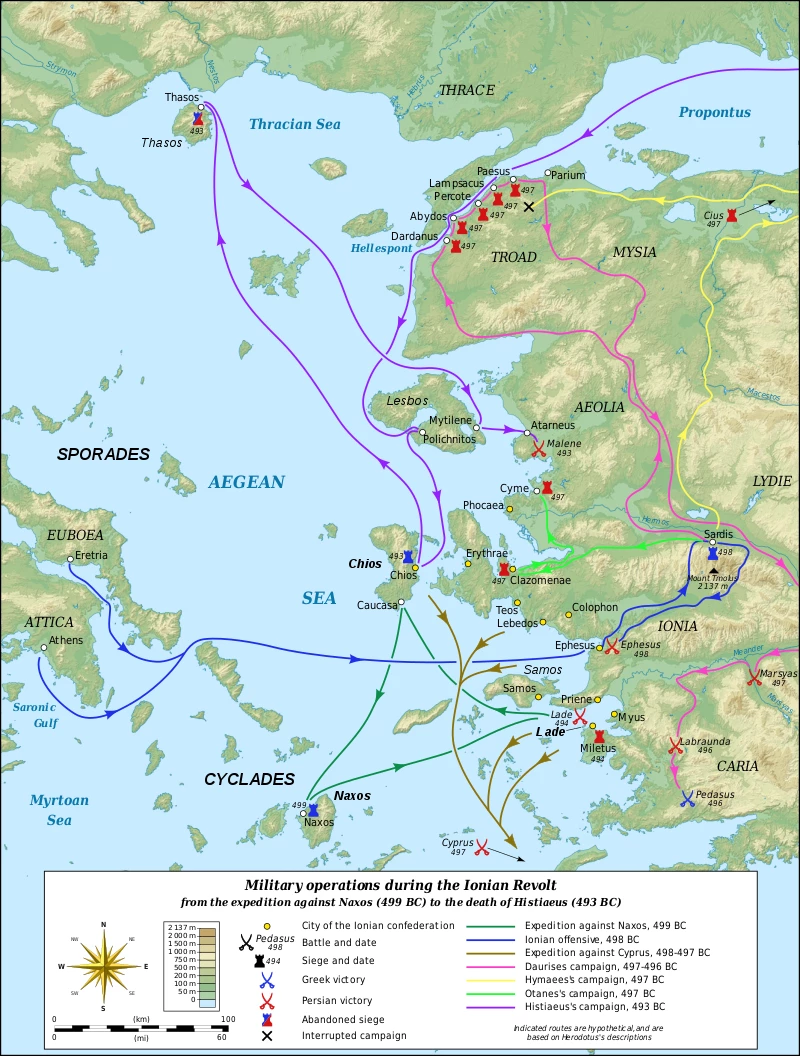 [ABOVE: Map of the Ionian Revolt, 499 - 493 BC] In 499 BC, the Greek cities of Ionia, on the Western coast of Asia Minor, staged a revolt against Persian rule. Greeks fighting against the Persians were initially successful, especially after gaining assistance from Athens soon after. Persia was initially slow to respond to the rioting, and the revolt eventually spread from Byzantium in the north to Cyprus in the south, engulfing much of the Greek world and the empire of Darius. When Persia began to gain the upper hand, Athens and her Eritrean allies backed off to mainland Greece, but Athens’s aid against Persia would not be forgotten by Darius. Using their excellent large-scale campaign management and siege warfare and by using the natural terrain to their advantage and to the Greek’s disadvantage, the revolt was suppressed and the rebels were put down harshly by 493 BC. Thrace and several Greek islands would be taken under Persian rule soon after, and revenge would be sought upon by Darius against Athens. HERODOTUS  [ABOVE: A 2nd century Roman-made copy of a Greek 4th century BC bust of Herodotus] The Ionian Revolt is described in detail in primary sources best by Herodotus (c.484-425 BC). A Greek himself living under the then-Persian-ruled Greek city of Halicarnassus a couple of decades after the revolt, he described the revolt as, largely, one that was doomed to always fail. This wasn’t born out of bias, but rather due to his position of only being able to write of events described to him through oral tradition. However, the revolt, while suppressed in the end, was very successful; most cities involved in it were raised to the ground, and aid from mainland Greece reflected the grand scale of the revolt. However, once the Persian army was mobilised, alongside their Phoenician-owned fleets, they were unstoppable. BEFORE THE REVOLT Go and check out my previous blog on the Achaemenid Persian Empire if you'd like a little background: https://steemit.com/hive-133974/@oo7harv/the-persian-empire-history-s-first-superpower Following their expeditions into Scythia, Thrace and Macedonia, Persian expansion relaxed during the last decade of the 6th century BC. This didn’t mean that Greek cities living under Persian rule were relieved of pressure, but it did mean many Persian military demands were cut short, allowing the resentment of perceived agents of Persian control - the tyrants - to increase. The revolt’s origins stem from politics; tyrants ruling over their individual city-states had to be seen to have the support of Persia in order to keep their prestigious titles, having to each bring themselves in person to the notice of Darius if they wanted greater rewards. This led to several times where these want-to-be tyrants would need to gamble, for if their one opportunity to show themselves off to the Persian king as irreplaceable failed then they would have to quit. This is likely the case with Aristagoras, tyrant of Miletus and the man who would start the revolt. ARISTAGORAS'S DESIGNS ON NAXOS, 499 BC MILETUS'S RECENT HISTORY 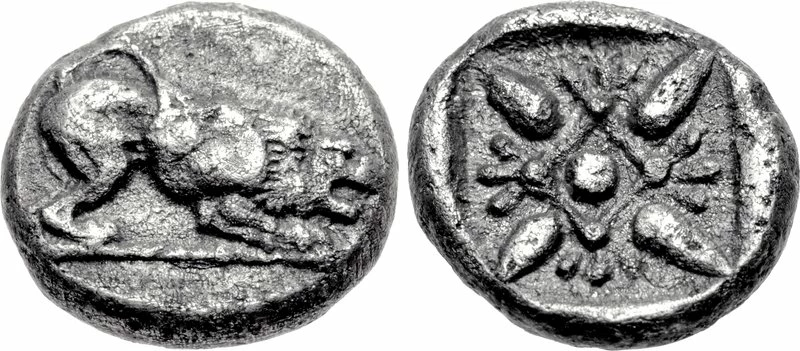 [ABOVE: A Miletan coin from Aristagoras's time, c.5th century BC] Of all Aegean island nations, Naxos was perhaps the most prosperous during the 6th to early 5th centuries BC, while Miletus was arguably the most prosperous Ionian city. Two generations prior, Miletus was engaged in civil war, which was quelled by the Greeks of Paros; The Parians sent their best men to Miletus, and settled the Miletan dispute by visiting their nation during their economic decline, and noting down the names of the few well-worked fields among the then-mostly devastated ones left on the island. With this list complete, they put the government in the hands of these people who owned the well-worked farms, thinking that they could run their nation as well as they ran their own lands. The populace was then ordered to do as their new rulers wished. NAXIAN'S PROPOSAL TO ARISTAGORAS 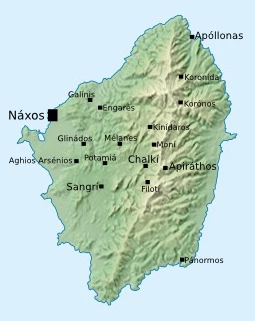 [ABOVE: Map of the isle of Naxos, showing its main settlements] While this happened, men were being banished from Naxos by the people, ending up in Miletus. Aristagoras was Miletus’s governor at the time, and he was the son of Molpagoras, who was in turn the son-in-law and cousin of Histiaeus, whose father in turn was being detained in Susa by Darius. Histiaeus, tyrant of Miletus, was in Susa when the Naxians arrived in Miletus. Once there, the Naxians asked Aristagoras for military aid to get them back to Naxos. Aristagoras took this to mean that he could in turn end up ruling Naxos as a thanks. He told them that while he did not have the manpower to retake Naxos by force, his friendship with the Lydian Satrap Artaphrenes, brother of Darius, could provide them with the troops needed. With this, the Naxians gave Aristagoras permission to do what he could, telling him to offer gifts and pay for his military’s expense along the way, which they said they’d pay themselves. They did this as they expected the current inhabitants of Naxos to submit to them once they saw them, thinking that this would also happen on all other Aegean Islands not yet under Persian control. ARISTAGORAS TALKS TO ARTAPHRENES  [ABOVE: A model head of a Persian noble, thought to be Artaphrenes, c.520-480 BC] Aristagoras travelled to Sardis. He told Artaphrenes that Naxos, while not a particularly big island, was lush, fertile and rich in property and slaves. Aristagoras told Artaphrenes to get an expedition together to take the island and bring back the banished exiles, telling him that he had enough money set aside as a reward to cover everything aside from military upkeep. Aristagoras also told Artaphrenes that owning Naxos would give Persia an Aegean island which had many other dependent islands (the Cyclades), enough islands to launch a successful attack on Euboea afterwards. Aristagoras recommended 100 warships would be enough for this expedition, but Artaphrenes disagreed, saying he would require 200, along with King Darius’s approval. Pleased with this reply, Aristagoras returned to Miletus, while Artaphrenes sent a message to Darius detailing Aristagoras’s proposition, which the king approved of too. With this, Artaphrenes received 200 warships and a large army of Persians and allies. Artaphrenes handed command of the army to Megabates, Artaphrenes and Darius’s cousin. The force under Megabates now was sent from Artpahrenes over to Miletus, where Aristagoras, the Ionian forces and the exiles from Naxos joined them. Upon reaching the isle of Chios, Megabates stopped to make round checks on his forces’ sentries, he found no guards were left on board one of the ships. The ships captain was punished by having his head placed through the ships oar-hole, where he was left tied down. Finding out, Aristagoras thought the captain had been severely mistreated, so went to untie him himself. Megabates was furious at this, but this didn’t phase Aristagoras, who reminded Megabates of his position under his command. Enraged further, Megabates secretly sent some men over to Naxos to warn them of the coming forces. THE SIEGE OF NAXOS The Naxians had no idea they were being targeted by such a large force, but upon hearing the news from Megabates’ messengers, everything from their fields was brought within the city walls, and the city’s people were stocked well with enough food and water to last out a siege, and the city’s walls themselves were reinforced. When the Persian force arrived, they were met with a now-well defended army and city, until 4 months had passed, and the money given to Aristagoras to fund this expedition had run out. With this in mind, a stronghold was ordered to be built on Naxos for the exiles while the main army returned to Persian territory. The Naxian expedition had failed. CONTEMPLATING REBELLION Aristagoras was thus able to keep his promise to Artaphrenes. He was also concerned that his failure, wasting of money and personal feud with Megabates could result in him loosing his rulership of Miletus. With this in mind, Aristagoras contemplated rebelling. By coincidence, at this time a message arrived from Histiaeus in Susa, telling Aristagoras he should rebel against Darius. With Persia’s road networks being heavily guarded, the message had to be tattooed to a man’s head after it had been shaved, whereafter his hair would grow and when the message needed to be read, the man's head was simply shaved again and the message could be read. Histiaeus took this extra precaution to deliver this message to Aristagoras because he disliked being kept in Susa, and expected to be allowed to the coast on the offset of a Miletan rebellion; he thought that unless such a rebellion took place, he’d likely never be allowed to leave. IONIA REVOLTS Aristagoras sought his supporters’ advice, telling them first of Histiaeus’s message. Their response is just what he was after; they urged him to revolt. One man however, the writer Hecataeus, said otherwise, stating that Darius’s vast empire and resources would lead to this rebellion being swiftly crushed. When this argument fell on deaf ears, Hecataeus instead switched tactics, saying that if Aristagoras were to indeed revolt, he should first take control of the sea, knowing Miletus was weak at the time. Hecataeus explained that taking over the sanctuary at Branchidae would be the best way to achieve this; this location is where Croesus of Lydia had once dedicated a vast amount of valuables, so seizing this wealth would help greatly fund their rebellion, or else they should be stolen by the empire. While Hecataeus’s proposal didn’t go down well, Aristagoras and his followers still chose to go through with the revolt. The followers also chose to sail to Myous, which is where the expeditionary force coming back from Naxos had temporarily stopped, in order to gain control of the commanders who were on board ships there. A force was dispatched and several captains were captured. With the Ionian Revolt officially started, the next thing Aristagoras did was give up his position as tyrant and convert the citizens of Miletus to a state of equality as per the law so as to make them more voluntary in joining the rebellion. He then went on to repeat this for the rest of the Ionian cities, expelling some local tyrants and installing his own captured captains as tyrants instead in order to get on good terms with the local peoples. Once enough tyrants were killed or deposed of, Aristagoras set sail for military allies, heading first to Sparta. ARISTAGORAS IN SPARTA Go and check out my previous blog on Lycurgus and the policy of the Spartans: https://steemit.com/history/@oo7harv/lycurgus-the-spartan-constitution HISTORY OF ANAXANDRIDAS II 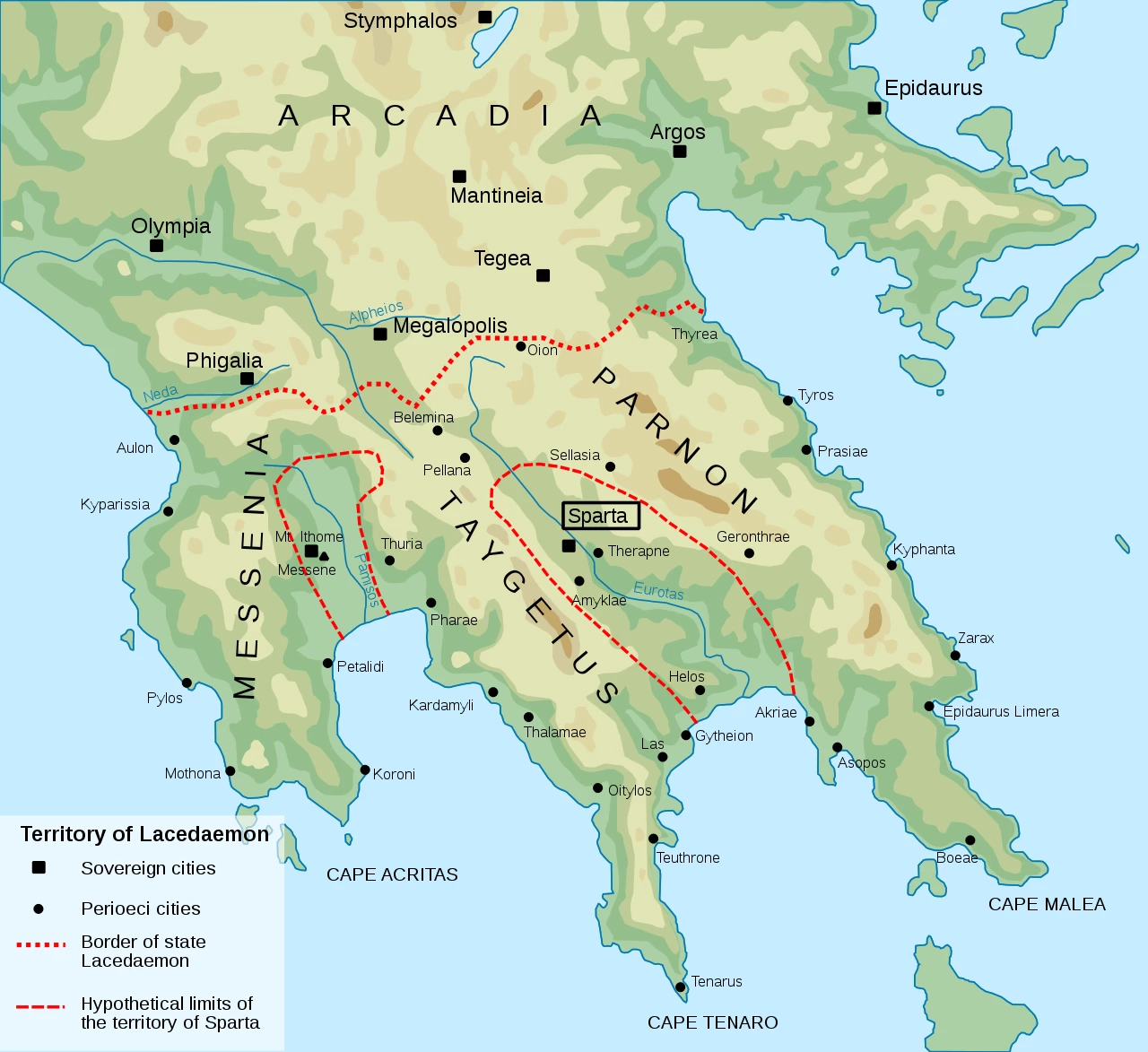 [ABOVE: Territorial holdings of Sparta] One of the current kings of Sparta was Cleomenes I, from the Eurypontid Lineage, who took over from his father Anaxandridas II in around 519 BC. Anaxandridas had previously married his niece, and while the marriage was stable, the Ephors of Sparta recommended he marry someone else instead to bare children, but he refused, despite this move making him unpopular with the people. Together, the Ephors and Gerousia insisted that he should thus instead keep his current wife but bring in a new one too. With this proposal, Anaxandridas agreed, and thus spent the rest of his life between two homes, contrary to normal Spartan custom. It was this second wife that birthed Cleomenes. DORIEUS Whereas Cleomenes is described as being on the verge of insanity during his life, his half-brother Dorieus (born to Anaxandridas’s first wife) is described to be an outstanding man, giving him confidence that his prestige as such would make him a better suited king than Cleomenes. However, when Anaxandridas died, as per the Spartan constitution, Cleomenes became king and not Dorieus, angering him greatly. He thus went so far as to get together a bunch of Spartan settlers and sail for Libya, hoping to found his own Spartan colony, without first checking with the Ephors for permission. Two years after the settlements founding on the banks of the River Cinyps, the Spartans were driven out by local Libyans and Carthaginians, forcing him back to the Peloponnese. Back home, he received advice to colonise Heraclea in Sicily, as the region it occupied was supposedly visited by Heracles. This advice, and a positive response from the Oracle at Delphi, convinced him to set sail for Sicily, taking his former Libyan followers with him. After aiding the people of the city of Croton, Dorieus captured the city of Sybaris. From here, they marched into Sicily, but were quickly defeated in battle by local Carthaginian forces. In this clash, Dorieus was killed. In hindsight, had Dorieus just stayed in Sparta, he would have become king soon after - Cleomenes’ reign, in which he would only bare a daughter named Gorgo, would be more brief than expected. CLEOMENES AND ARISTAGORAS'S MEETING It was in Cleomenes’ reign that Aristagoras arrived in Sparta. Aristagoras brought with him a bronze chart with the entire known world engraved into it. He told the king of the Ionian’s situation, and of how the Persians weren’t “formidable fighters” or well armoured in battle, making them easy to defeat. Aristagoras also tried to convince Cleomenes to join him by describing Ionia as wealthier “than the rest of the world put together” in terms of both its sheer wealth and luxury goods. After describing the lands of the Ionians, Lydians, Phrygians and all the tributes they paid to Darius, he described the Persian capital of Susa, telling Cleomenes that he should consider taking the city and all its wealth. Aristagoras then made a mistake in his pursuit to convince the Spartans to join: he told the truth as to how long it would take to get from Ionia to Susa: 3 months. This was a step too far for the Spartan king, who ordered Aristagoras to leave Sparta immediately. Aristagoras pursued Cleomenes further though, now trying to bribe the king to go to Asia, but Cleomenes’s 8/9 year old daughter, Gorgo, told her father that Aristagoras was attempting to corrupt him. This pleased the Spartan king, and with that, Aristagoras left Sparta. ATHENS SENDS MILITARY AID Go and check out my previous blog on how Athens became the world's first democracy, 508/7 BC: https://steemit.com/hive-133974/@oo7harv/kleisthenes-the-birth-of-democracy Once out of Sparta, Aristagoras went to Athens, who at that point had only recently rid themselves of their last tyrant, Hippias. He essentially gave them the same speech as he had in Sparta, stating how rich Asia was and how easy the Persians were to beat in combat. Aristagoras also expected that Miletus would receive their aid, since it was a colony of Athens. In desperation, and after promising them everything, Aristagoras had convinced Athens to help, and they in return voted to send twenty warships to aid the revolt, commanded by a distinguished Athenian: Melanthius. Aristagoras set sail for Asia at the head of the Athenians. 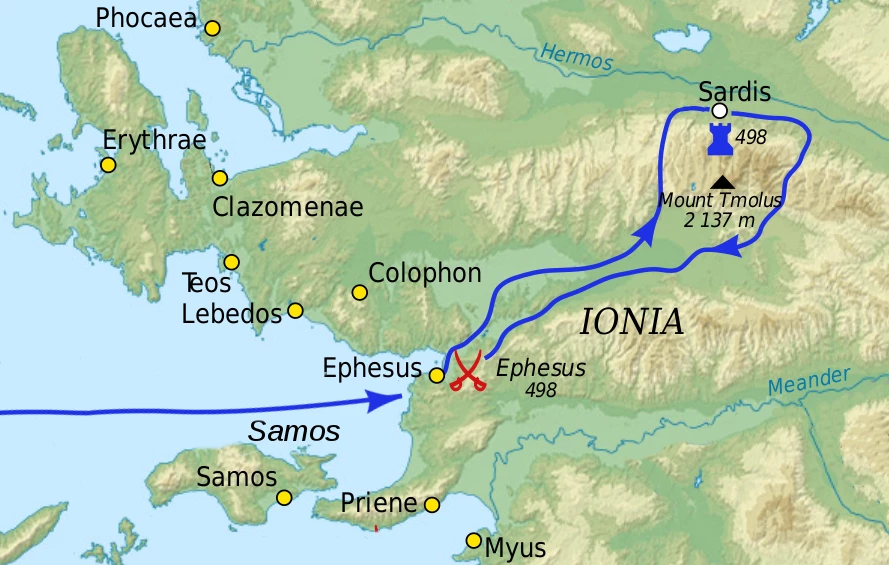 [ABOVE: The route of the Ionian forces aided by Athenian and Eritrean contingents] These twenty warships would be the beginning of misery to come for both sides. IONIAN OFFENSIVE, 498 BC When back at Miletus, Aristagoras hatched a plan, one simply to pest Darius; he sent a man to the Paeonians, now displaced in Phrygia from Thrace. His message was for the Paeonians to take the Ionian Revolt as the opportunity to also rise up against Persia and take their Thracian homeland back. The messenger promised the Paeonians protection once they made it to the Aegean coast. Happy with this idea, most of the Paeonians fled to the coast with their families, eventually returning to Paeonia. SIEGE OF SARDIS  [ABOVE: The acropolis of Sardis' remains] Meanwhile, Aristagoras and Melanthius’s twenty warships arrived at Miletus, joined by five ships from Eritrea who were there to repay a debt owed to Miletus. Once there, Aristagoras launched the attack on Sardis but stayed in Miletus, giving command to his brother, Charopinus, and a Milesian called Hermophantus. Leaving their fleet in Ephesian territory and using local Ephesians as guides, they eventually reached the city of Sardis, capturing the entire city aside from the well-fortified acropolis, which was being defended by Artaphrenes. The rest of the city could have been looted, but the houses were either entirely made out of reeds or only the roofs were; when a soldier burnt down one house, it didn’t take long for the entire city to be engulfed in flames. Artaphrenes only had a handful of troops with him in the acropolis, yet when attacked they put up a considerable fight, so much so that the attacking Ionians withdrew to the safety of the nearby Mount Tmolus, returning to their fleet in the night.  [ABOVE: The burning of Sardis by the Greeks in 498 BC, unknown author] During this siege, a sacred sanctuary to the goddess Cybebe was burnt down. Persia would use this sacrilege as the excuse to burn down several Greek sanctuaries in the wars to come. BATTLE OF EPHESUS The Ionian troops who left the siege of Sardis made it to Ephesus, but were caught up by Persian troops who had been called to help the Lydians. The Ionians formed up for battle, but were soundly defeated. Eualcides, the commander of the Eritrean forces, was killed in combat, while the remaining Ionian survivors split up in their route and returned to their homes. It was after the failed siege of Sardis and the defeat outside Ephesus that caused the Athenian troops to board their ships once more and return home, even when Aristagoras tried to persuade them to stay. Meanwhile, the Ionians had already come this far towards their pursuit of action against the Persian king that they regrouped and made ready to pursue Darius once more. Sending a fleet to the Hellespont, they captured the city of Byzantium and all its surrounding settlements, gaining most of Caria on their return back to Asia. CYPRUS, 497 BC 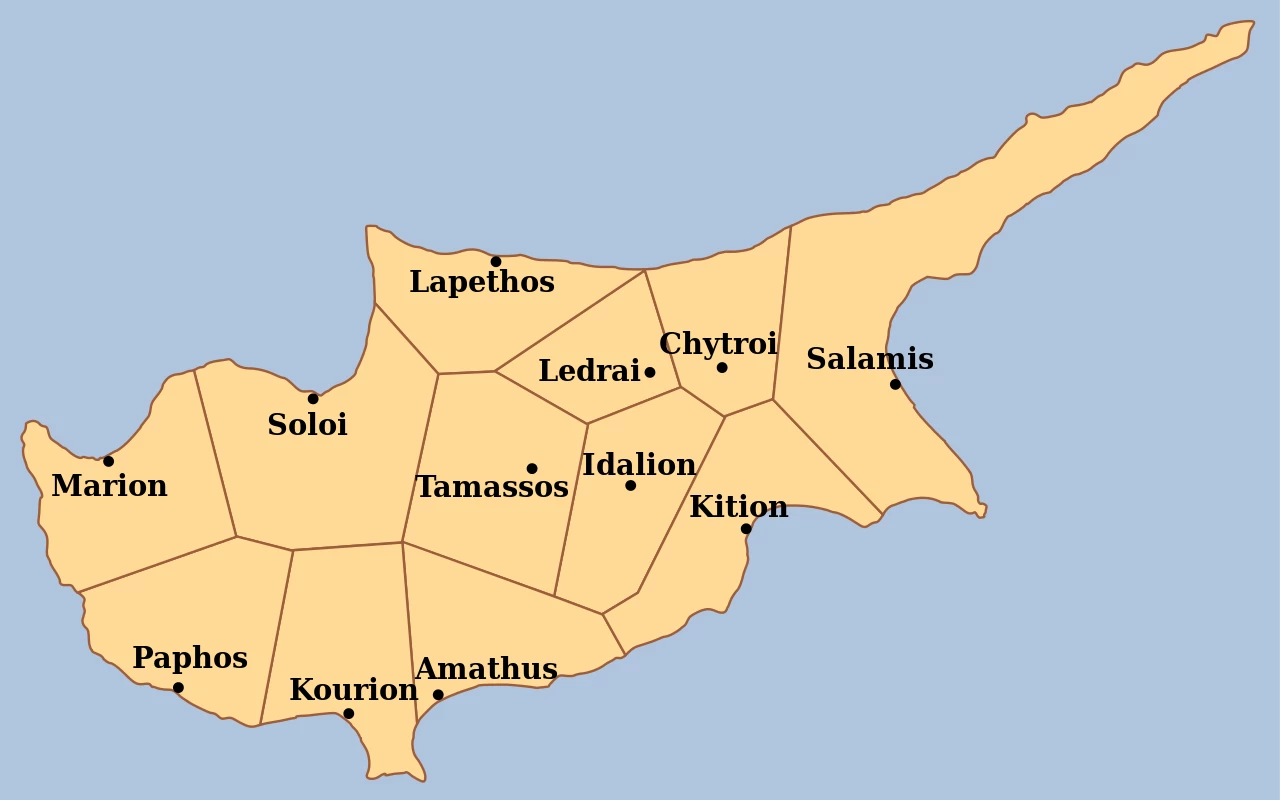 [ABOVE: Map of the ancient kingdoms and main cities within the isle of Cyprus] With the revolt having some good success at this point, Cyprus too revolted. The Cypriots had never been the most willing of Persian subjects, so when the king of Cyprus, Gorgus, was outside the main Cypriot city of Salamis one day, (this “Salamis” is not to be confused with the island near Athens of the same name where a famous battle would take place) Onesilus, Gorgus’s younger brother who had previously tried convincing Gorgus to join the Ionian Revolt, now joined with conspirators and closed the gates on his own brother. Gorgus thus took refuge with the Persians and Onesilus was made king of Salamis. Onesilus thus set out to convince all of Cyprus to join him in rebellion, and when only the city of Amathous refused, he quickly besieged the city. A Persian reinforcing army under a Persian named Artybius would eventually be sent to attack Onesilus, supported by Phoenician-manned warships, and Ionians would also arrive at Cyprus to protect Onesilus with their fleet. DARIUS AND HISTIAEUS 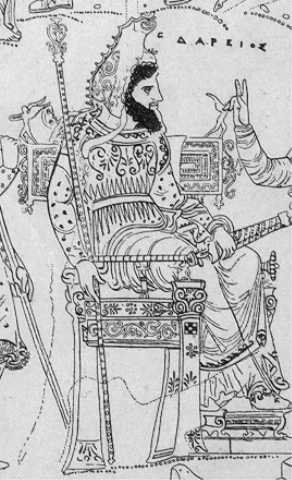 [ABOVE: Darius I in a painting imagined by a Greek painter, 4th century BC] Meanwhile, Darius got word of the Athenian and Ionian capture and destruction of Sardis by Aristagoras. Confident he could quickly subdue the Ionians again, Darius instead asked who the Athenians were. Once being told of them, the king took a bow and arrow and shot it into the sky, declaring for Zeus himself to make it possible for him to punish the Athenians one day. He also asked for a servant to remind him before every meal: “Master, remember the Athenians.” Darius then summoned for Histiaeus, still detained in Susa. The king prompted Histiaeus for answers as to why Aristagoras, who Histiaeus had himself left in charge of Miletus, was now leading a revolt against the empire, asking if he had anything to do with this too. Histiaeus denied involvement, despite being the one who first convinced Aristagoras to revolt. Histiaeus even convinced the king to allow him to go to Ionia himself to restore order. In agreement, Darius returned to Susa. BATTLE OF SALAMIS In Cyprus, the Persian and Cypriot armies lined up for battle outside the city of Salamis. The élite troops from the cities of Salamis and Soli were placed opposite the Persians, while the rest of the Cypriot forces faced off against the rest of the army. Onesilus placed himself directly opposite Artybius. The Ionian engaged the Phoenician fleet and proved worthy adversaries. On land, Artybius himself charged downhill on his horse, which is said to have been trained to stand up and kick with its front legs when confronted with heavy infantry, straight towards Onesilus. Onesilus’s esquire knew of Artybius’s horse’s trick, and when the Persian general attacked Onesilus, he cut off the horses feet as it landed them back on the ground. Artybius was then slain in combat. 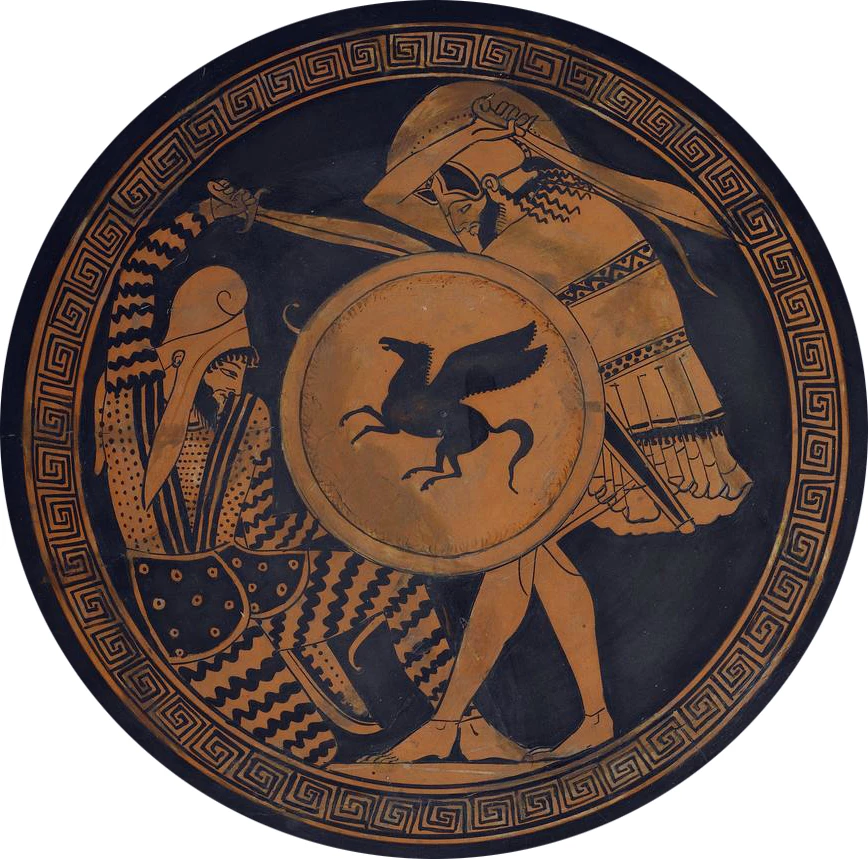 Persian V Greek [ABOVE: Depiction of a Greek hoplite (right) fighting a Persian soldier (left), 5th century BC] Elsewhere in the land battle, the tyrant of the Cypriot city of Curium, who was leading a big quantity of the Cypriot army, switched sides mid-battle, joining the Persians. This greatly turned the tide of battle, forcing the Cypriots to retreat. In the route, casualties were heavy. Among the dead was the king of Soli, and Onesilus himself. The people of the Cypriot city of Amathous, previously put under siege by Onesilus, gained revenge by cutting off Onesilus's head and burying it. With all other Cypriot cities soon besieged after by Persian forces, Gorgus was reinstated as king of Salamis. With the tide of war thus swinging back in Persia’s favour, the Ionian fleet set sail back to Ionia. Soli was the last Cypriot city to fall back into Persian hands after Achaemenid soldiers dug tunnels under ground and into the city. Cyprus was subdued, and the Ionian fleet that had fled were caught up to by Persian forces, who defeated the Greeks in battle and plundered their ships. The Hellespontine cities of Dardanus, Abydus, Percote, Lampsacus and Paesus were all quickly recaptured by Persian forces led by a commander named Daurises. PERSIAN COUNTER-OFFENSIVE, 497-495 BC CARIA, 496 BC 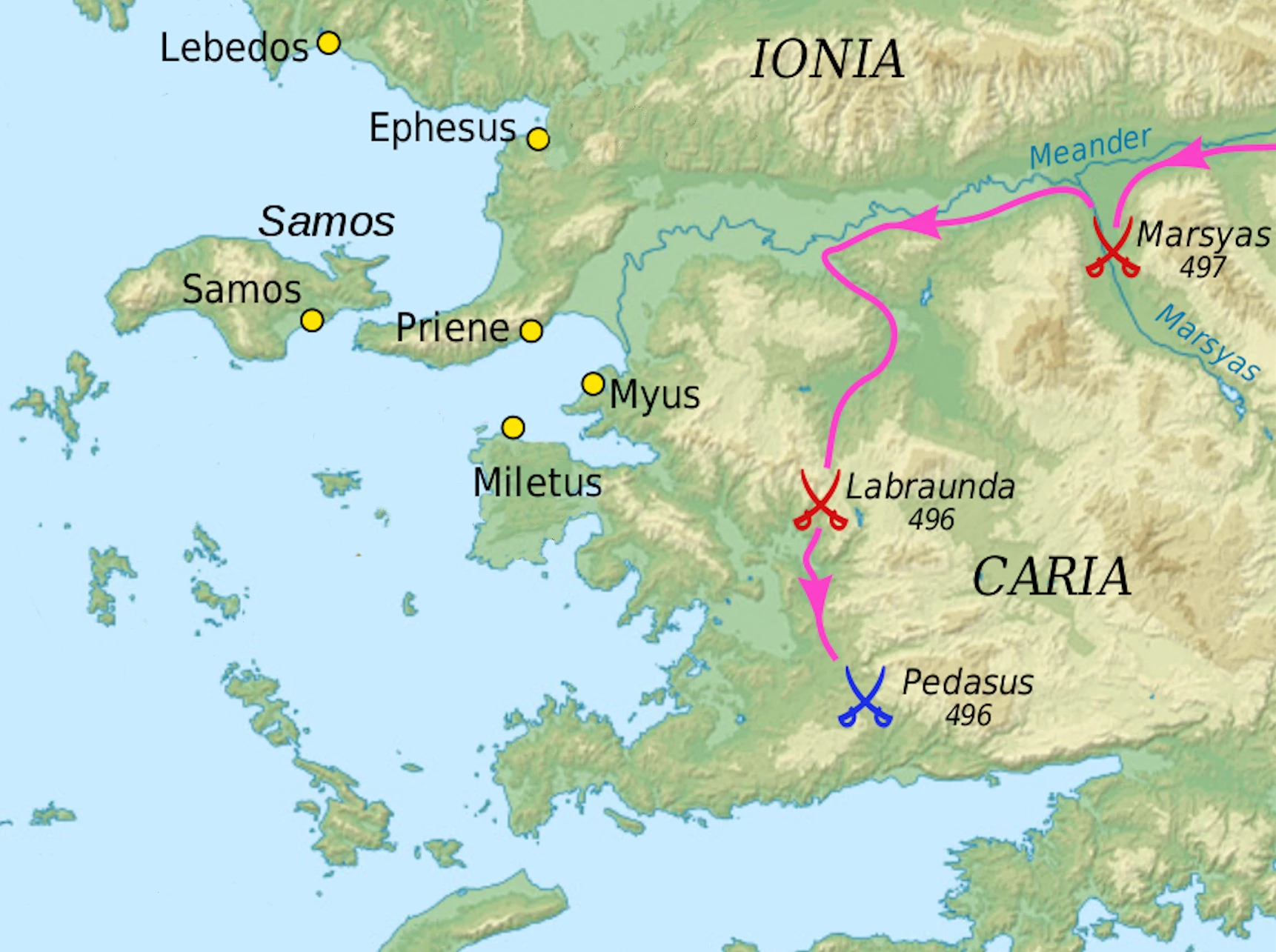 [ABOVE: The Carian campaign of 496 BC] Upon the recapture of Paesus, Daurises got word that the region of Caria had now joined in the revolt, so headed south from the Hellespont. The Carians, meanwhile, marched north quickly; their plan was to let the Persians cross the River Meander and then meet them for battle there, cutting off a quick line of retreat for the enemy. When the two armies engaged however, a quick Persian victory ensued, swarming the Carians with sheer numbers. Herodotus gives the figures of 2,000 dead Persian soldiers and around 10,000 Carians. Surviving Carian troops eventually regrouped with local Milesian allies at a sanctuary to Zeus. The Persians caught up to them, battle ensued once more and the rebels were crushed. However, some Carian survivors from this second engagement learned that the Persians were heading for their home cities. Knowing their own lands better than the Persians, the Carians set up a series of ambushes. On a road to the town of Pedasa, the Persians were ambushed. Three high-ranking Persian commanders, including Daurises and even Gyges' own son Myrsus, were killed. ARISTAGORAS DIES IN THRACE Meanwhile, after a Persian commander was sent to crush the Ionians that attacked Sardis caught an illness and died, Artaphrenes and Otanes, a commander who served with Daurises, were sent in his place, and both commanders captured cities on their march towards Ionia. With their successes, Aristagoras, who started this whole revolt, feared the armies heading his way, and thus fled for Thrace. Gaining control of the land he had set out for, his own army soon came under attack from local Thracian tribes, and in the fight, Aristagoras was killed. The revolt would continue, but without its first leader. HISTIAEUS JOINS THE REVOLT Histiaeus, formerly tyrant of Miletus and once detained in Susa by King Darius, had since been released by the king and met up with him in Sardis. When Histiaeus arrived, governor Artaphrenes asked him what he thought caused the revolt to begin with. Despite Histiaeus' attempt to feign ignorance, Artaphrenes saw through him, saying “it was you who stitched the shoe, while Aristagoras merely put it on.” In fear of what else Artaphrenes might know, Histiaeus quietly snuck out the city at night, heading for the coast. On his way west, he was captured in the city of Chios, whose citizens (who were fighting for the revolt) thought he was attempting to retake the city. When Histiaeus explained everything, they set him free. Later, Histiaeus sent a letter to Sardis; Persians who he had spoken to before about the rebellion were in the city, and he hoped to bolster the rebellion’s numbers with some of Darius’s own men. However, the messenger instead delivered the message to Artaphrenes, who told the messenger to hand it to the Persians at Sardis, but relay their reply back to him instead. With the plot discovered, Artaphernes had many Persians killed. CHIOS TO BYZANTIUM At Histiaeus’s own request, the men of Chios attempted to get him back to Miletus. The Milesians, though, having recently gained and enjoyed independence, did not wish to have another tyrant reinstated. Histiaeus would try to take the city for himself, but was wounded in the attempt. Effectively banished from his own city, Histiaeus set out for Mytilene, hoping the city would hand him some ships. They together manned eight ships, sailing for Byzantium. There, they set up camp and took control of all ships which were setting sail for the Black Sea, unless a ships crew would recognise Histiaeus as their leader. THE BATTLE OF LADE, 494 BC Histiaeus’s presence in Byzantium left Miletus vulnerable, and the city was soon under attack by Persian land and sea forces, which included the navy of the recently-subdued Cypriots. When word of the attacks on Miletus and Ionia reached the Ionian rebels, they decided not to engage the Persians head-on on land, choosing instead to pull back, let the Milesians delay the Persians, and assemble their fleets together, meeting the Persian ships at sea by a small island near Miletus called Lade. 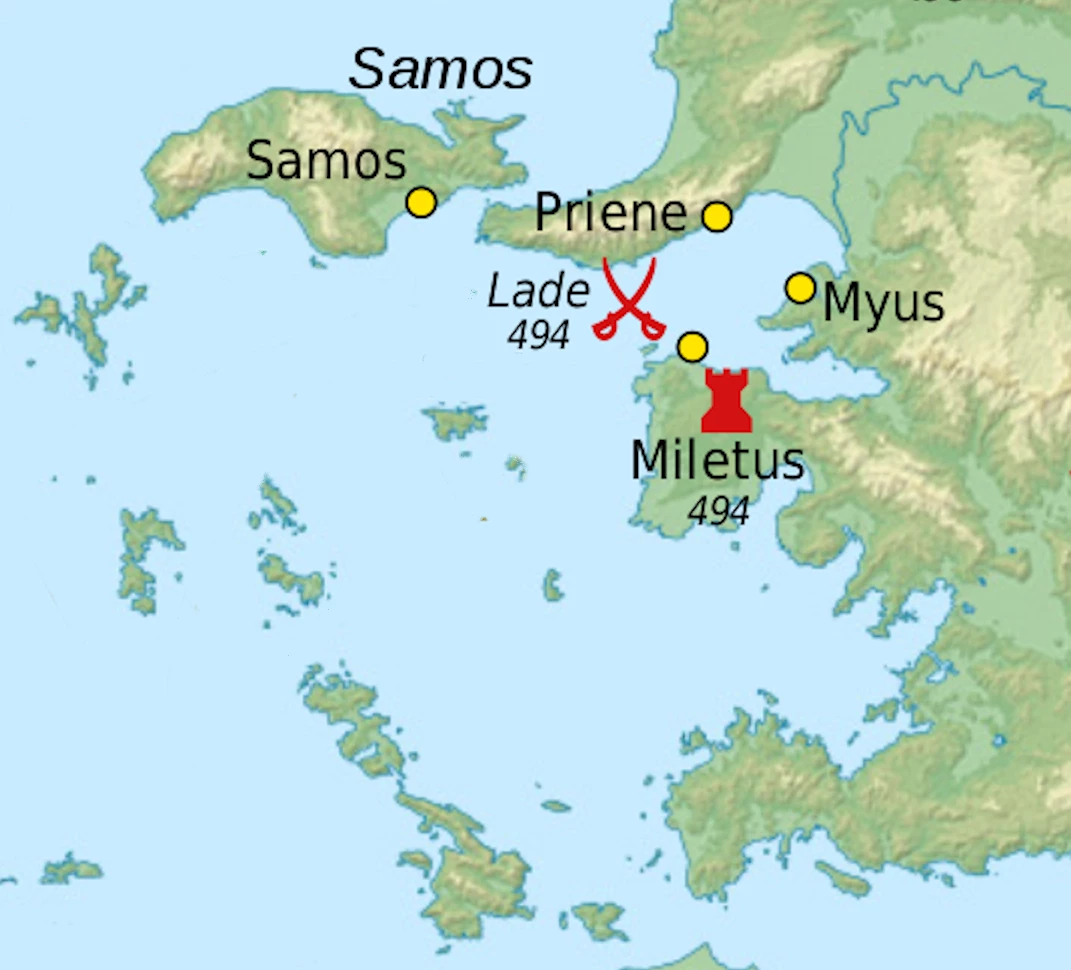 [ABOVE: Locations of the city of Miletus, and the location of the battle of Lade, 494 BC] GREEK FORCES Contingents of ships from Aeolis, Lesbos and Miletus itself would assist the Ionians as the Greek and Persian navies faced off against each other at Lade. From the left-wing of the combined navy to the right-wing were the following city-states and their ships: The Milesians with 80 ships, Prieneans with 12 ships, Myusians with 3 ships, Myesians with 17, Chians with 100, Erythraens and Phocaeans with 11 ships, Lesbians (from Lesbos) with 70 ships, and the right-wing was manned by the Samians with 60 ships. Together, 353 triremes, commanded by Dionysius of Phocaea, faced off against 600 Persian ships. Should the Greek fleet win the day at Lade, the Persians would likely loose control of the sea, and the fleet’s commanders would be punished severely by Darius. 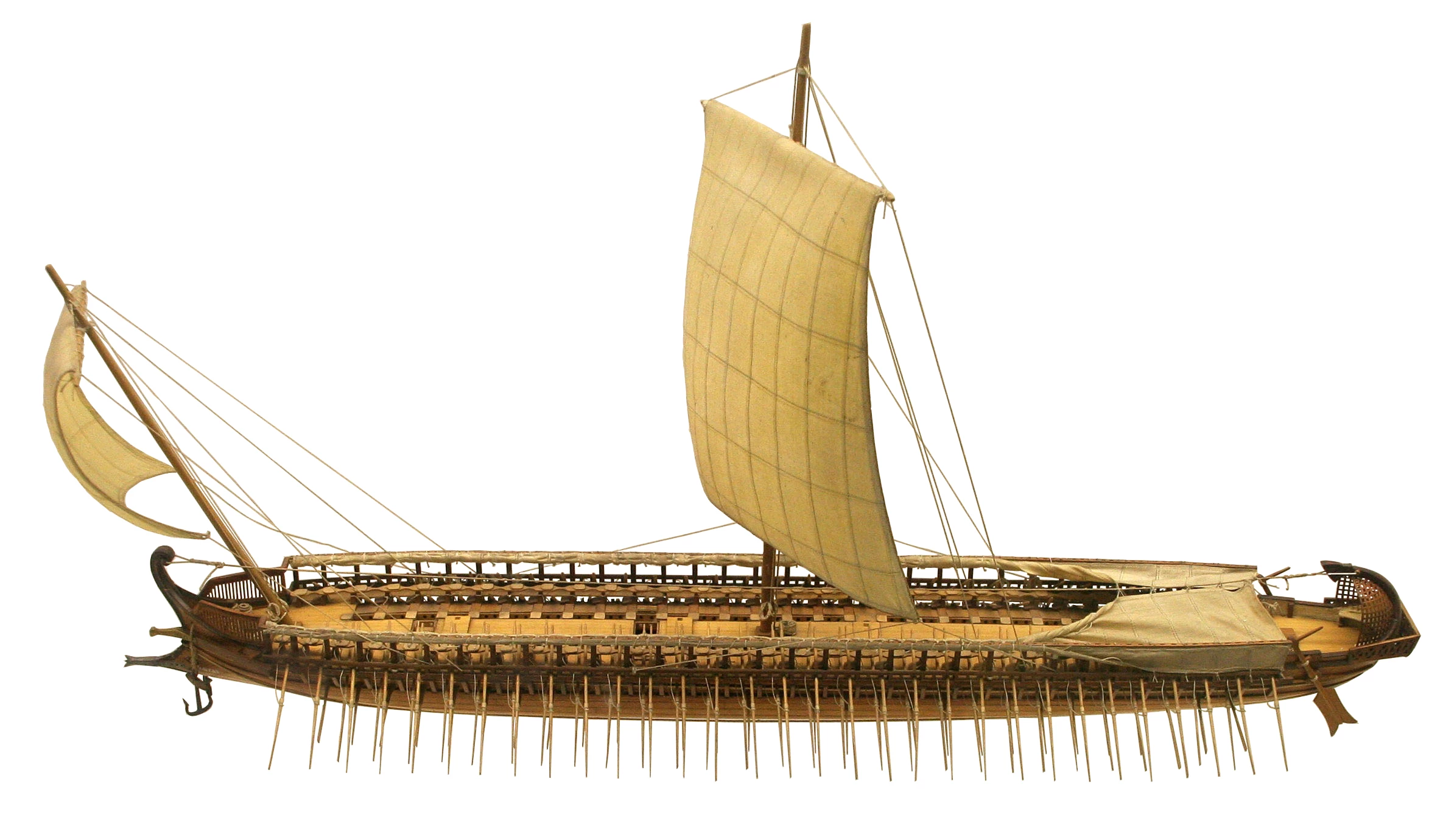 [ABOVE: Reconstructed model trireme, the Greek and Persian war ship] Worried in case they lost to a smaller navy, the Persian commanders convened together, inviting local Ionian tyrants who had gone to the Persian’s side after Aristagoras had deposed of them. They told the tyrants to detach their own citizens from the Ionian alliance, promising no punishment of any sort for them if they did. Come the cover of darkness, the tyrants went off to send messages to their own people to convince them to do so, but to no avail; the people were already set on their choice to stay in the rebellion. DIONYSIUS'S SPEECH Before the fleets engaged at Lade, Dionysius roused his troops up for battle: “Men of Ionia, our affairs are balanced on a razor’s edge. We can remain free or we can become slaves - and runaway slaves at that. If you are prepared to accept hardship, then in the short term there’ll be work for you to do, but you will defeat the enemy and be free; if, on the other hand, you choose softness and lack of discipline, I am quite sure that you’ll be punished for rebelling against the king. No, you must do as I suggest. Put yourselves in my hands, and I can assure you that, if the gods are impartial, the enemy will either not engage us or, if they do, they will suffer a severe defeat.” THE BATTLE This speech persuaded the Ionian alliance to train hard while awaiting the Persian fleet. In the meantime, Dionysius had the men practice fleet formations and drills all day. He in fact worked them so hard and during such hot temperatures that some men in the navy began to start viewing this hard work as a form of enslavement itself. Some of these men remained on the isle of Lade itself, making camp, keeping to the shade and refusing to board ships. Finding out about this, the Persian-led Phoenician ships set sail against the Ionian fleet. The battle of Lade had begun, but while the Ionians reacted by forming into a column, the Samians’ 49 out of 60 ships hoisted their sails and withdrew from the fight back to Samos. This flight of such a large contingent of ships caused all the Lesbian ships, and large amounts of other Ionian contingents, to break off and flee. The battle itself, though not documented in detail itself, saw the Chian fleet of 100 ships take the heaviest hit, as they showed the most upfront bravery in fighting the Persians after seeing some of their own allies flee without a fight. Several Persian ships were captured by Chian ships, but these Greeks were eventually heavily overrun and crushed. Any Chian survivors soon withdrew back to Chios. AFTERMATH OF LADE Surviving Chian ships beached at Mycale, with its soldiers and sailors setting out on foot to the mainland. They eventually arrived at night near Ephesus, to the Ephesians’s surprise. So surprised were they in fact that the local people’s mistook them for nighttime raiders, hoping to make off with their women, and so attacked and killed them. As Dionysius saw his Ionian fleet destroyed in battle or fleeing, he too fled far away. Following their victory at Lade, the Persians blockaded Miletus by sea and land. The city was eventually taken, and the inhabitants’ men were killed and the women and children were sold into slavery. Survivors were handed to King Darius at Susa, who relocated them to the Red Sea coast. Samos would be spared such harsh treatment by Persia, who instead reinstated their own local leader, Aeaces the son of Syloson, as governor. Caria was soon reoccupied by Persian forces shortly after Miletus’s fall, with its communities either bowing down willingly or being forcibly put down. 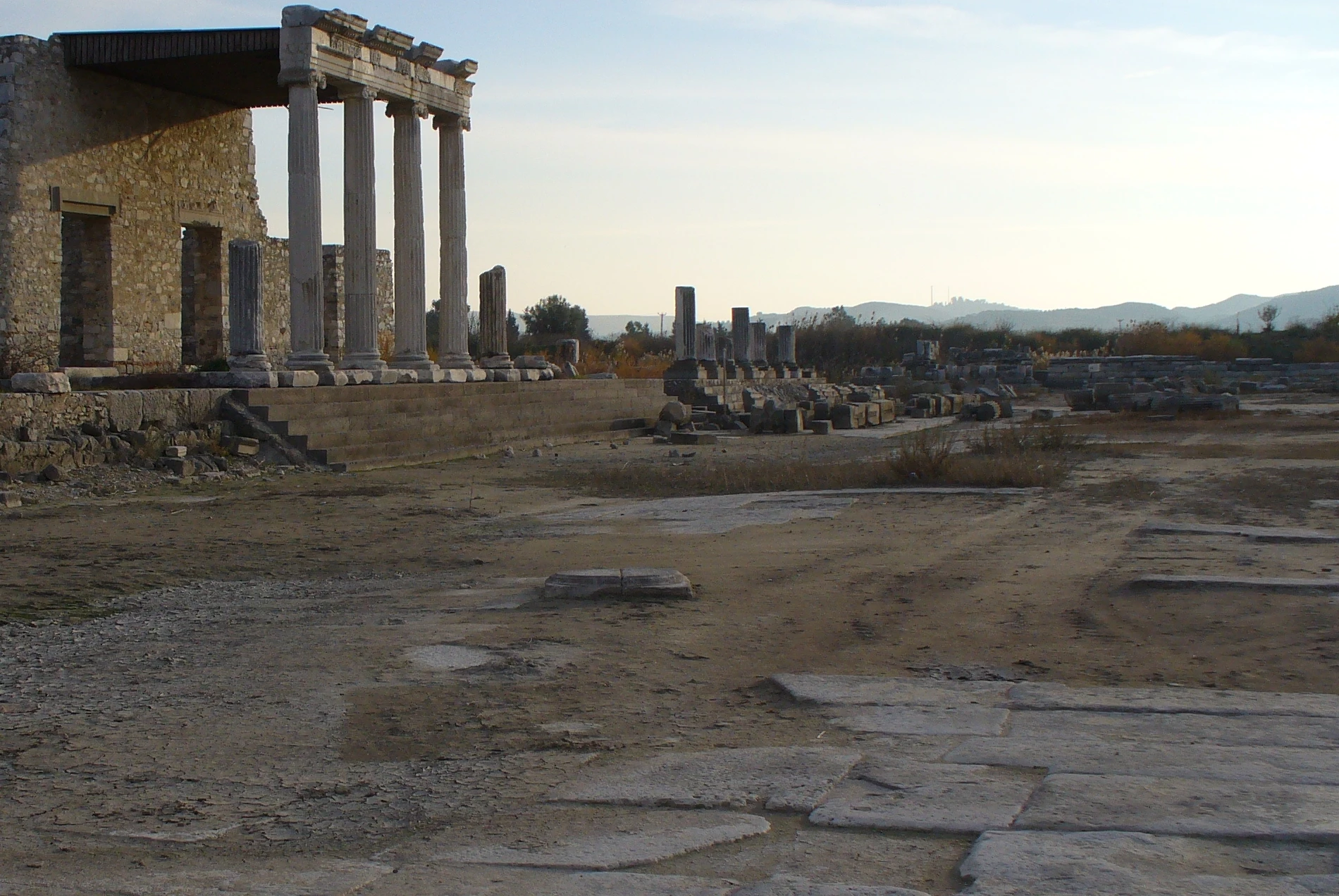 [ABOVE: The ruins of Miletus] HISTIAEUS DIES, 493 BC Meanwhile, Histiaeus, still gaining support in Byzantium, got word of the fall of Miletus. Leaving a general under him in charge of the Hellespont, he set sail for Chios with a force of Lesbians. Taking over the island after some resistance, he used the island as a base to begin further campaigns against the isle of Thasos, with a force of Aeolians and Ionians. While besieging Thasos, he got word that the Persian fleet who had blockaded Miletus had now set sail west to subdue the rest of the Aegean islands. Lifting the siege of Thasos, Histiaeus set sail for Lesbos to meet the fleet with his entire force. They soon, however, ran out of supplies while stationed at Lesbos, so set sail for the lush lands of Mysia. He was unaware, though, that the Persian general Harpagus was stationed nearby to there with a vast army of his own. Straight after disembarking, Histiaeus was met by Harpagus in combat, at what is known as the Battle of Malene. Histiaeus was captured and most of his army was wiped out after a reserved Persian cavalry detachment successfully charged into and routed most of the Greek forces. While retreating from the field himself, Histiaeus was caught by a pursuing Persian soldier, who spared his life after he was spoken to in Persian. Thinking his life may be spared, Histiaeus was instead brought to Darius and impaled on a stake in Susa, and his head was brought to Darius himself, who ordered the head buried to honour his enemy. PERSIAN SUBDUGATION AND PUNISHMENT 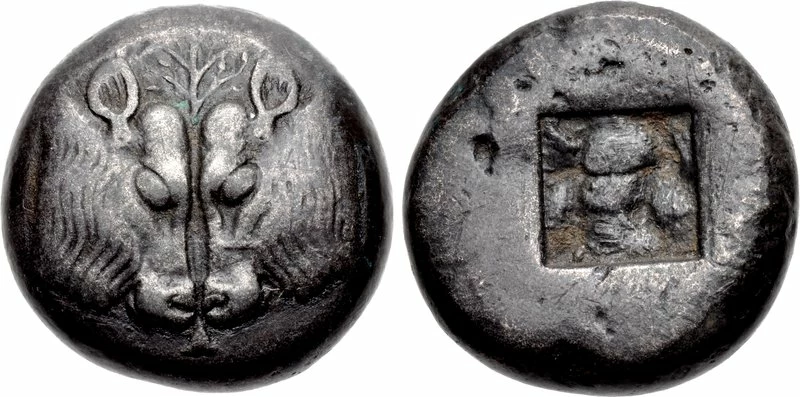 [ABOVE: Coin from Lesbos, c.510-480 BC] Stationed at Miletus for the winter, the Persian fleet put to sea in the following year of 493 BC, quickly capturing Chios, Lesbos and Tenedos. Captured boys were castrated and made into eunuchs, girls were sent to the king as slaves, settlements and sanctuaries were burnt, and the Ionians themselves were now under enslavement yet again. The Persian fleet then turned on the Hellespont, recapturing the Chersonese, Perinthus, Selymbria and Byzantium. The Byzantines, however, had already fled the city, setting course for the settlements around the Black Sea. More settlements north of the Hellespont were torched by the Persians soon after. 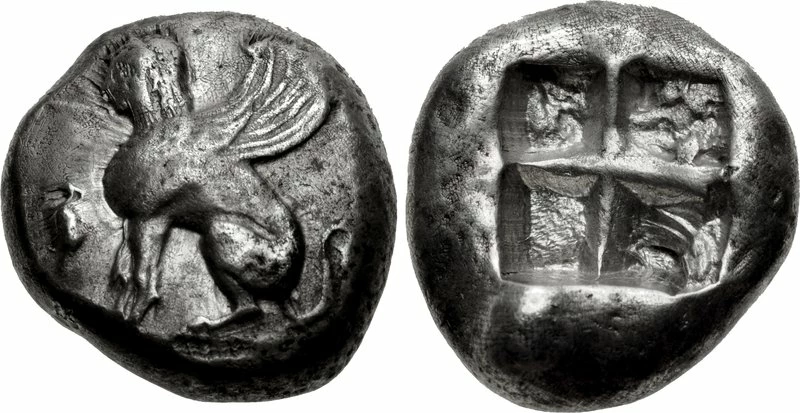 [ABOVE: Coin of Chios from AFTER the Ionian Revolt, c.490-435 BC] THE IONIAN PEACE After subduing the Hellespont, the Persians initiated no more hostile actions against the Ionians. In fact, following the revolt, developments were made to the benefit of the Ionians; Artaphrenes, governor of Sardis, forced the Ionians to negotiate terms with each other so that they would remain more loyal to advance Persian affairs than raiding each other’s own homelands. Tributes to be paid were established, being no more taxing on the citizens than any tax on the region had been beforehand. The Ionian Revolt did not allow the Greeks to completely escape Persian control, but it’s unknown if that was the overall goal. What the revolt did end was the Persians implementing their own tyrants in the Ionian cities for the time, and independence from Persia was only celebrated in a few Ionian cities for a brief time. Many Greeks would write that the revolt was the catalyst for Persia to begin setting its eyes on the Greek mainland, but their past subjugations of Thrace and Macedonia, and arguably even their Scythian campaign, show that their eyes were already somewhat set on the Greeks. Revolts under Persian rule had happened before, but for King Darius, this one was different; the Ionians had received help from overseas Athens, and for Darius this meant a revenge was necessary; such an up and coming powerful ally is surely part of what spurred the Ionians on during the revolt. A punishment was in order; military action would soon be taken against Greece. Stay tuned. SOURCES • Herodotus's "Histories" • Philip Parker, "World History" • Nic Fields, "Thermopylae 480 BC, Last Stand of the 300" • Oswyn Murray, "Early Greece" • Robin Osborne, "Greece in the Making 1200 - 479 BC" YOUTUBE LINKS (I do NOT own these videos) "The Ionian Revolt - Part 1+2+3 (Greco-Persian Wars) (499-493 B.C.E.)" by "Hoc Est Bellum" https://www.youtube.com/watch?v=XEnu4sRImH4 MY HISTORY COMMUNITY: https://steemit.com/created/hive-133974 NEXT BLOG: BATTLE OF MARATHON - THE FIRST GRECO-PERSIAN WAR, 492-490 BC Coming soon... All feedback - positive and/or critical - is appreciated! All images used are copyright-free Don't forget to rate this post if you enjoyed it Thanks for reading :) |
| json metadata | {"tags":["hive-133974","history","writing","photography","politics","greek","iranian","war"],"image":["https://cdn.steemitimages.com/DQmfLzbxy62ZFTzUgkia3YiaKv12yvHRYyTLEfTTioRUpoD/image.png","https://cdn.steemitimages.com/DQmb7M2Y2WteLADPw5iKyoz21WLvjiy9gkipzFQcTSatQkZ/image.png","https://cdn.steemitimages.com/DQmU5yeRu27WFWx4gn1f672pYxddRWLYcvWJMduUZaHDBS4/image.png","https://cdn.steemitimages.com/DQmck4Gvy8WByPez4WvsmEpHFG3LC6iTr61DbntnFDAknAB/image.png","https://cdn.steemitimages.com/DQmUrGUXhedgLQucdmkzzXNZXGEzSsYVymj3EbNmhSJzHL9/image.png","https://cdn.steemitimages.com/DQmWUo92URbQ4DN4tKqDtG5B5dfpVosTL1HA6k7f21ijKMT/image.png","https://cdn.steemitimages.com/DQmZLZuDw7XbahJ6vhiqn6DATJNQR6cm8tAZNgEFTqb9HCd/image.png","https://cdn.steemitimages.com/DQmapZ1gEgX7pb3spMAndnKUWsi8xwzF7cx9ntBfNehp5qM/image.png","https://cdn.steemitimages.com/DQmaWkRVEV1wzR9bFdU9k63bN7bS1wCbYHNnopWfEGLaERj/image.png","https://cdn.steemitimages.com/DQmaVyuL9bUNUaauFyZGoyp2gnpXeCkgkWfozTXzHypN3T6/image.png","https://cdn.steemitimages.com/DQmbWqz7AVTN3BYfQYAZwH6emLEKY8jvhZX2ZHgCMWgSzyn/image.png","https://cdn.steemitimages.com/DQmaTQ9ofkVo3zHJ4AH44Yh6yePTpiKHytGzuQvNYdYfrM2/image.png","https://cdn.steemitimages.com/DQmTeAjWJoqnjcnKEDUMTMt9haJpWmerisFg8m6Hev8PH3M/image.png","https://cdn.steemitimages.com/DQmcSB1sofwdHS368c9Ww9SiLBW8aCeChYAj1zWfqqat9M5/image.png","https://cdn.steemitimages.com/DQmRdTwNfyhFMVWm88fhYQRWvfE7aUevxVBnroLF5qANvs8/image.png","https://cdn.steemitimages.com/DQmP9zoNV8xzqk5avbU2YoAicm4dimiUhTVSDPuCqK264Aq/image.png","https://cdn.steemitimages.com/DQmWrF6Cy9CThnhHbBuxMf5H15UQrGY3qNLQTdK9uWyE6xT/image.png","https://cdn.steemitimages.com/DQmUsRcr7QokwszoXariE3ftbQShE9oA2C8vDgsXVNCezyM/image.png","https://img.youtube.com/vi/XEnu4sRImH4/0.jpg"],"links":["https://steemit.com/hive-133974/@oo7harv/the-persian-empire-history-s-first-superpower","https://steemit.com/history/@oo7harv/lycurgus-the-spartan-constitution","https://steemit.com/hive-133974/@oo7harv/kleisthenes-the-birth-of-democracy","https://www.youtube.com/watch?v=XEnu4sRImH4","https://steemit.com/created/hive-133974"],"app":"steemit/0.2","format":"markdown"} |
| parent author | |
| parent permlink | hive-133974 |
| permlink | the-ionian-revolt-499-493-bc-the-start-of-the-greco-persian-wars |
| title | THE IONIAN REVOLT, 499 - 493 BC: The Start of the Greco-Persian Wars |
| Transaction Info | Block #58901861/Trx 2a95a38f518858b58044b03ecf4477d8332d3898 |
View Raw JSON Data
{
"block": 58901861,
"op": [
"comment",
{
"author": "oo7harv",
"body": "At last: the Greco-Persian Wars - here we go…\n\nOVERVIEW\n\n[ABOVE: Map of the Ionian Revolt, 499 - 493 BC]\n\nIn 499 BC, the Greek cities of Ionia, on the Western coast of Asia Minor, staged a revolt against Persian rule. Greeks fighting against the Persians were initially successful, especially after gaining assistance from Athens soon after. Persia was initially slow to respond to the rioting, and the revolt eventually spread from Byzantium in the north to Cyprus in the south, engulfing much of the Greek world and the empire of Darius. When Persia began to gain the upper hand, Athens and her Eritrean allies backed off to mainland Greece, but Athens’s aid against Persia would not be forgotten by Darius. Using their excellent large-scale campaign management and siege warfare and by using the natural terrain to their advantage and to the Greek’s disadvantage, the revolt was suppressed and the rebels were put down harshly by 493 BC. Thrace and several Greek islands would be taken under Persian rule soon after, and revenge would be sought upon by Darius against Athens.\n\nHERODOTUS\n\n[ABOVE: A 2nd century Roman-made copy of a Greek 4th century BC bust of Herodotus]\n\nThe Ionian Revolt is described in detail in primary sources best by Herodotus (c.484-425 BC). A Greek himself living under the then-Persian-ruled Greek city of Halicarnassus a couple of decades after the revolt, he described the revolt as, largely, one that was doomed to always fail. This wasn’t born out of bias, but rather due to his position of only being able to write of events described to him through oral tradition. However, the revolt, while suppressed in the end, was very successful; most cities involved in it were raised to the ground, and aid from mainland Greece reflected the grand scale of the revolt. However, once the Persian army was mobilised, alongside their Phoenician-owned fleets, they were unstoppable.\n\nBEFORE THE REVOLT\nGo and check out my previous blog on the Achaemenid Persian Empire if you'd like a little background:\nhttps://steemit.com/hive-133974/@oo7harv/the-persian-empire-history-s-first-superpower\n\nFollowing their expeditions into Scythia, Thrace and Macedonia, Persian expansion relaxed during the last decade of the 6th century BC. This didn’t mean that Greek cities living under Persian rule were relieved of pressure, but it did mean many Persian military demands were cut short, allowing the resentment of perceived agents of Persian control - the tyrants - to increase. The revolt’s origins stem from politics; tyrants ruling over their individual city-states had to be seen to have the support of Persia in order to keep their prestigious titles, having to each bring themselves in person to the notice of Darius if they wanted greater rewards. This led to several times where these want-to-be tyrants would need to gamble, for if their one opportunity to show themselves off to the Persian king as irreplaceable failed then they would have to quit. This is likely the case with Aristagoras, tyrant of Miletus and the man who would start the revolt.\n\nARISTAGORAS'S DESIGNS ON NAXOS, 499 BC\nMILETUS'S RECENT HISTORY\n\n[ABOVE: A Miletan coin from Aristagoras's time, c.5th century BC]\n\nOf all Aegean island nations, Naxos was perhaps the most prosperous during the 6th to early 5th centuries BC, while Miletus was arguably the most prosperous Ionian city. Two generations prior, Miletus was engaged in civil war, which was quelled by the Greeks of Paros; The Parians sent their best men to Miletus, and settled the Miletan dispute by visiting their nation during their economic decline, and noting down the names of the few well-worked fields among the then-mostly devastated ones left on the island. With this list complete, they put the government in the hands of these people who owned the well-worked farms, thinking that they could run their nation as well as they ran their own lands. The populace was then ordered to do as their new rulers wished.\n\nNAXIAN'S PROPOSAL TO ARISTAGORAS\n\n[ABOVE: Map of the isle of Naxos, showing its main settlements]\n\nWhile this happened, men were being banished from Naxos by the people, ending up in Miletus. Aristagoras was Miletus’s governor at the time, and he was the son of Molpagoras, who was in turn the son-in-law and cousin of Histiaeus, whose father in turn was being detained in Susa by Darius. Histiaeus, tyrant of Miletus, was in Susa when the Naxians arrived in Miletus. Once there, the Naxians asked Aristagoras for military aid to get them back to Naxos. Aristagoras took this to mean that he could in turn end up ruling Naxos as a thanks. He told them that while he did not have the manpower to retake Naxos by force, his friendship with the Lydian Satrap Artaphrenes, brother of Darius, could provide them with the troops needed. With this, the Naxians gave Aristagoras permission to do what he could, telling him to offer gifts and pay for his military’s expense along the way, which they said they’d pay themselves. They did this as they expected the current inhabitants of Naxos to submit to them once they saw them, thinking that this would also happen on all other Aegean Islands not yet under Persian control.\n\nARISTAGORAS TALKS TO ARTAPHRENES\n\n[ABOVE: A model head of a Persian noble, thought to be Artaphrenes, c.520-480 BC]\n\nAristagoras travelled to Sardis. He told Artaphrenes that Naxos, while not a particularly big island, was lush, fertile and rich in property and slaves. Aristagoras told Artaphrenes to get an expedition together to take the island and bring back the banished exiles, telling him that he had enough money set aside as a reward to cover everything aside from military upkeep. Aristagoras also told Artaphrenes that owning Naxos would give Persia an Aegean island which had many other dependent islands (the Cyclades), enough islands to launch a successful attack on Euboea afterwards. Aristagoras recommended 100 warships would be enough for this expedition, but Artaphrenes disagreed, saying he would require 200, along with King Darius’s approval. Pleased with this reply, Aristagoras returned to Miletus, while Artaphrenes sent a message to Darius detailing Aristagoras’s proposition, which the king approved of too. With this, Artaphrenes received 200 warships and a large army of Persians and allies. Artaphrenes handed command of the army to Megabates, Artaphrenes and Darius’s cousin. The force under Megabates now was sent from Artpahrenes over to Miletus, where Aristagoras, the Ionian forces and the exiles from Naxos joined them. Upon reaching the isle of Chios, Megabates stopped to make round checks on his forces’ sentries, he found no guards were left on board one of the ships. The ships captain was punished by having his head placed through the ships oar-hole, where he was left tied down. Finding out, Aristagoras thought the captain had been severely mistreated, so went to untie him himself. Megabates was furious at this, but this didn’t phase Aristagoras, who reminded Megabates of his position under his command. Enraged further, Megabates secretly sent some men over to Naxos to warn them of the coming forces.\n\nTHE SIEGE OF NAXOS\nThe Naxians had no idea they were being targeted by such a large force, but upon hearing the news from Megabates’ messengers, everything from their fields was brought within the city walls, and the city’s people were stocked well with enough food and water to last out a siege, and the city’s walls themselves were reinforced. When the Persian force arrived, they were met with a now-well defended army and city, until 4 months had passed, and the money given to Aristagoras to fund this expedition had run out. With this in mind, a stronghold was ordered to be built on Naxos for the exiles while the main army returned to Persian territory. The Naxian expedition had failed.\n\nCONTEMPLATING REBELLION\nAristagoras was thus able to keep his promise to Artaphrenes. He was also concerned that his failure, wasting of money and personal feud with Megabates could result in him loosing his rulership of Miletus. With this in mind, Aristagoras contemplated rebelling. By coincidence, at this time a message arrived from Histiaeus in Susa, telling Aristagoras he should rebel against Darius. With Persia’s road networks being heavily guarded, the message had to be tattooed to a man’s head after it had been shaved, whereafter his hair would grow and when the message needed to be read, the man's head was simply shaved again and the message could be read. Histiaeus took this extra precaution to deliver this message to Aristagoras because he disliked being kept in Susa, and expected to be allowed to the coast on the offset of a Miletan rebellion; he thought that unless such a rebellion took place, he’d likely never be allowed to leave.\n\nIONIA REVOLTS\nAristagoras sought his supporters’ advice, telling them first of Histiaeus’s message. Their response is just what he was after; they urged him to revolt. One man however, the writer Hecataeus, said otherwise, stating that Darius’s vast empire and resources would lead to this rebellion being swiftly crushed. When this argument fell on deaf ears, Hecataeus instead switched tactics, saying that if Aristagoras were to indeed revolt, he should first take control of the sea, knowing Miletus was weak at the time. Hecataeus explained that taking over the sanctuary at Branchidae would be the best way to achieve this; this location is where Croesus of Lydia had once dedicated a vast amount of valuables, so seizing this wealth would help greatly fund their rebellion, or else they should be stolen by the empire. While Hecataeus’s proposal didn’t go down well, Aristagoras and his followers still chose to go through with the revolt. The followers also chose to sail to Myous, which is where the expeditionary force coming back from Naxos had temporarily stopped, in order to gain control of the commanders who were on board ships there.\n\nA force was dispatched and several captains were captured. With the Ionian Revolt officially started, the next thing Aristagoras did was give up his position as tyrant and convert the citizens of Miletus to a state of equality as per the law so as to make them more voluntary in joining the rebellion. He then went on to repeat this for the rest of the Ionian cities, expelling some local tyrants and installing his own captured captains as tyrants instead in order to get on good terms with the local peoples. Once enough tyrants were killed or deposed of, Aristagoras set sail for military allies, heading first to Sparta.\n\nARISTAGORAS IN SPARTA\nGo and check out my previous blog on Lycurgus and the policy of the Spartans:\nhttps://steemit.com/history/@oo7harv/lycurgus-the-spartan-constitution\n\nHISTORY OF ANAXANDRIDAS II\n\n[ABOVE: Territorial holdings of Sparta]\n\nOne of the current kings of Sparta was Cleomenes I, from the Eurypontid Lineage, who took over from his father Anaxandridas II in around 519 BC. Anaxandridas had previously married his niece, and while the marriage was stable, the Ephors of Sparta recommended he marry someone else instead to bare children, but he refused, despite this move making him unpopular with the people. Together, the Ephors and Gerousia insisted that he should thus instead keep his current wife but bring in a new one too. With this proposal, Anaxandridas agreed, and thus spent the rest of his life between two homes, contrary to normal Spartan custom. It was this second wife that birthed Cleomenes.\n\nDORIEUS\nWhereas Cleomenes is described as being on the verge of insanity during his life, his half-brother Dorieus (born to Anaxandridas’s first wife) is described to be an outstanding man, giving him confidence that his prestige as such would make him a better suited king than Cleomenes. However, when Anaxandridas died, as per the Spartan constitution, Cleomenes became king and not Dorieus, angering him greatly. He thus went so far as to get together a bunch of Spartan settlers and sail for Libya, hoping to found his own Spartan colony, without first checking with the Ephors for permission. Two years after the settlements founding on the banks of the River Cinyps, the Spartans were driven out by local Libyans and Carthaginians, forcing him back to the Peloponnese. Back home, he received advice to colonise Heraclea in Sicily, as the region it occupied was supposedly visited by Heracles. This advice, and a positive response from the Oracle at Delphi, convinced him to set sail for Sicily, taking his former Libyan followers with him. After aiding the people of the city of Croton, Dorieus captured the city of Sybaris. From here, they marched into Sicily, but were quickly defeated in battle by local Carthaginian forces. In this clash, Dorieus was killed. In hindsight, had Dorieus just stayed in Sparta, he would have become king soon after - Cleomenes’ reign, in which he would only bare a daughter named Gorgo, would be more brief than expected.\n\nCLEOMENES AND ARISTAGORAS'S MEETING\nIt was in Cleomenes’ reign that Aristagoras arrived in Sparta. Aristagoras brought with him a bronze chart with the entire known world engraved into it. He told the king of the Ionian’s situation, and of how the Persians weren’t “formidable fighters” or well armoured in battle, making them easy to defeat. Aristagoras also tried to convince Cleomenes to join him by describing Ionia as wealthier “than the rest of the world put together” in terms of both its sheer wealth and luxury goods. After describing the lands of the Ionians, Lydians, Phrygians and all the tributes they paid to Darius, he described the Persian capital of Susa, telling Cleomenes that he should consider taking the city and all its wealth. Aristagoras then made a mistake in his pursuit to convince the Spartans to join: he told the truth as to how long it would take to get from Ionia to Susa: 3 months. This was a step too far for the Spartan king, who ordered Aristagoras to leave Sparta immediately. Aristagoras pursued Cleomenes further though, now trying to bribe the king to go to Asia, but Cleomenes’s 8/9 year old daughter, Gorgo, told her father that Aristagoras was attempting to corrupt him. This pleased the Spartan king, and with that, Aristagoras left Sparta.\n\nATHENS SENDS MILITARY AID\nGo and check out my previous blog on how Athens became the world's first democracy, 508/7 BC:\nhttps://steemit.com/hive-133974/@oo7harv/kleisthenes-the-birth-of-democracy\n\nOnce out of Sparta, Aristagoras went to Athens, who at that point had only recently rid themselves of their last tyrant, Hippias. He essentially gave them the same speech as he had in Sparta, stating how rich Asia was and how easy the Persians were to beat in combat. Aristagoras also expected that Miletus would receive their aid, since it was a colony of Athens. In desperation, and after promising them everything, Aristagoras had convinced Athens to help, and they in return voted to send twenty warships to aid the revolt, commanded by a distinguished Athenian: Melanthius. Aristagoras set sail for Asia at the head of the Athenians.\n\n\n[ABOVE: The route of the Ionian forces aided by Athenian and Eritrean contingents]\n\nThese twenty warships would be the beginning of misery to come for both sides.\n\nIONIAN OFFENSIVE, 498 BC\nWhen back at Miletus, Aristagoras hatched a plan, one simply to pest Darius; he sent a man to the Paeonians, now displaced in Phrygia from Thrace. His message was for the Paeonians to take the Ionian Revolt as the opportunity to also rise up against Persia and take their Thracian homeland back. The messenger promised the Paeonians protection once they made it to the Aegean coast. Happy with this idea, most of the Paeonians fled to the coast with their families, eventually returning to Paeonia.\n\nSIEGE OF SARDIS\n\n[ABOVE: The acropolis of Sardis' remains]\n\nMeanwhile, Aristagoras and Melanthius’s twenty warships arrived at Miletus, joined by five ships from Eritrea who were there to repay a debt owed to Miletus. Once there, Aristagoras launched the attack on Sardis but stayed in Miletus, giving command to his brother, Charopinus, and a Milesian called Hermophantus. Leaving their fleet in Ephesian territory and using local Ephesians as guides, they eventually reached the city of Sardis, capturing the entire city aside from the well-fortified acropolis, which was being defended by Artaphrenes. The rest of the city could have been looted, but the houses were either entirely made out of reeds or only the roofs were; when a soldier burnt down one house, it didn’t take long for the entire city to be engulfed in flames. Artaphrenes only had a handful of troops with him in the acropolis, yet when attacked they put up a considerable fight, so much so that the attacking Ionians withdrew to the safety of the nearby Mount Tmolus, returning to their fleet in the night.\n\n\n\n[ABOVE: The burning of Sardis by the Greeks in 498 BC, unknown author]\n\nDuring this siege, a sacred sanctuary to the goddess Cybebe was burnt down. Persia would use this sacrilege as the excuse to burn down several Greek sanctuaries in the wars to come.\n\nBATTLE OF EPHESUS\nThe Ionian troops who left the siege of Sardis made it to Ephesus, but were caught up by Persian troops who had been called to help the Lydians. The Ionians formed up for battle, but were soundly defeated. Eualcides, the commander of the Eritrean forces, was killed in combat, while the remaining Ionian survivors split up in their route and returned to their homes. It was after the failed siege of Sardis and the defeat outside Ephesus that caused the Athenian troops to board their ships once more and return home, even when Aristagoras tried to persuade them to stay. Meanwhile, the Ionians had already come this far towards their pursuit of action against the Persian king that they regrouped and made ready to pursue Darius once more. Sending a fleet to the Hellespont, they captured the city of Byzantium and all its surrounding settlements, gaining most of Caria on their return back to Asia.\n\nCYPRUS, 497 BC\n\n[ABOVE: Map of the ancient kingdoms and main cities within the isle of Cyprus]\n\nWith the revolt having some good success at this point, Cyprus too revolted. The Cypriots had never been the most willing of Persian subjects, so when the king of Cyprus, Gorgus, was outside the main Cypriot city of Salamis one day, (this “Salamis” is not to be confused with the island near Athens of the same name where a famous battle would take place) Onesilus, Gorgus’s younger brother who had previously tried convincing Gorgus to join the Ionian Revolt, now joined with conspirators and closed the gates on his own brother. Gorgus thus took refuge with the Persians and Onesilus was made king of Salamis. Onesilus thus set out to convince all of Cyprus to join him in rebellion, and when only the city of Amathous refused, he quickly besieged the city. A Persian reinforcing army under a Persian named Artybius would eventually be sent to attack Onesilus, supported by Phoenician-manned warships, and Ionians would also arrive at Cyprus to protect Onesilus with their fleet.\n\nDARIUS AND HISTIAEUS\n\n[ABOVE: Darius I in a painting imagined by a Greek painter, 4th century BC]\n\nMeanwhile, Darius got word of the Athenian and Ionian capture and destruction of Sardis by Aristagoras. Confident he could quickly subdue the Ionians again, Darius instead asked who the Athenians were. Once being told of them, the king took a bow and arrow and shot it into the sky, declaring for Zeus himself to make it possible for him to punish the Athenians one day. He also asked for a servant to remind him before every meal:\n\n“Master, remember the Athenians.”\nDarius then summoned for Histiaeus, still detained in Susa. The king prompted Histiaeus for answers as to why Aristagoras, who Histiaeus had himself left in charge of Miletus, was now leading a revolt against the empire, asking if he had anything to do with this too. Histiaeus denied involvement, despite being the one who first convinced Aristagoras to revolt. Histiaeus even convinced the king to allow him to go to Ionia himself to restore order. In agreement, Darius returned to Susa.\n\nBATTLE OF SALAMIS\nIn Cyprus, the Persian and Cypriot armies lined up for battle outside the city of Salamis. The élite troops from the cities of Salamis and Soli were placed opposite the Persians, while the rest of the Cypriot forces faced off against the rest of the army. Onesilus placed himself directly opposite Artybius. The Ionian engaged the Phoenician fleet and proved worthy adversaries. On land, Artybius himself charged downhill on his horse, which is said to have been trained to stand up and kick with its front legs when confronted with heavy infantry, straight towards Onesilus. Onesilus’s esquire knew of Artybius’s horse’s trick, and when the Persian general attacked Onesilus, he cut off the horses feet as it landed them back on the ground. Artybius was then slain in combat.\n\n\nPersian V Greek\n[ABOVE: Depiction of a Greek hoplite (right) fighting a Persian soldier (left), 5th century BC]\n\nElsewhere in the land battle, the tyrant of the Cypriot city of Curium, who was leading a big quantity of the Cypriot army, switched sides mid-battle, joining the Persians. This greatly turned the tide of battle, forcing the Cypriots to retreat. In the route, casualties were heavy. Among the dead was the king of Soli, and Onesilus himself. The people of the Cypriot city of Amathous, previously put under siege by Onesilus, gained revenge by cutting off Onesilus's head and burying it. With all other Cypriot cities soon besieged after by Persian forces, Gorgus was reinstated as king of Salamis. With the tide of war thus swinging back in Persia’s favour, the Ionian fleet set sail back to Ionia. Soli was the last Cypriot city to fall back into Persian hands after Achaemenid soldiers dug tunnels under ground and into the city. Cyprus was subdued, and the Ionian fleet that had fled were caught up to by Persian forces, who defeated the Greeks in battle and plundered their ships. The Hellespontine cities of Dardanus, Abydus, Percote, Lampsacus and Paesus were all quickly recaptured by Persian forces led by a commander named Daurises.\n\nPERSIAN COUNTER-OFFENSIVE, 497-495 BC\nCARIA, 496 BC\n\n[ABOVE: The Carian campaign of 496 BC]\n\nUpon the recapture of Paesus, Daurises got word that the region of Caria had now joined in the revolt, so headed south from the Hellespont. The Carians, meanwhile, marched north quickly; their plan was to let the Persians cross the River Meander and then meet them for battle there, cutting off a quick line of retreat for the enemy. When the two armies engaged however, a quick Persian victory ensued, swarming the Carians with sheer numbers. Herodotus gives the figures of 2,000 dead Persian soldiers and around 10,000 Carians. Surviving Carian troops eventually regrouped with local Milesian allies at a sanctuary to Zeus. The Persians caught up to them, battle ensued once more and the rebels were crushed. However, some Carian survivors from this second engagement learned that the Persians were heading for their home cities. Knowing their own lands better than the Persians, the Carians set up a series of ambushes. On a road to the town of Pedasa, the Persians were ambushed. Three high-ranking Persian commanders, including Daurises and even Gyges' own son Myrsus, were killed.\n\nARISTAGORAS DIES IN THRACE\nMeanwhile, after a Persian commander was sent to crush the Ionians that attacked Sardis caught an illness and died, Artaphrenes and Otanes, a commander who served with Daurises, were sent in his place, and both commanders captured cities on their march towards Ionia. With their successes, Aristagoras, who started this whole revolt, feared the armies heading his way, and thus fled for Thrace. Gaining control of the land he had set out for, his own army soon came under attack from local Thracian tribes, and in the fight, Aristagoras was killed.\nThe revolt would continue, but without its first leader.\n\nHISTIAEUS JOINS THE REVOLT\nHistiaeus, formerly tyrant of Miletus and once detained in Susa by King Darius, had since been released by the king and met up with him in Sardis. When Histiaeus arrived, governor Artaphrenes asked him what he thought caused the revolt to begin with. Despite Histiaeus' attempt to feign ignorance, Artaphrenes saw through him, saying “it was you who stitched the shoe, while Aristagoras merely put it on.” In fear of what else Artaphrenes might know, Histiaeus quietly snuck out the city at night, heading for the coast. On his way west, he was captured in the city of Chios, whose citizens (who were fighting for the revolt) thought he was attempting to retake the city. When Histiaeus explained everything, they set him free.\n\nLater, Histiaeus sent a letter to Sardis; Persians who he had spoken to before about the rebellion were in the city, and he hoped to bolster the rebellion’s numbers with some of Darius’s own men. However, the messenger instead delivered the message to Artaphrenes, who told the messenger to hand it to the Persians at Sardis, but relay their reply back to him instead. With the plot discovered, Artaphernes had many Persians killed.\n\nCHIOS TO BYZANTIUM\nAt Histiaeus’s own request, the men of Chios attempted to get him back to Miletus. The Milesians, though, having recently gained and enjoyed independence, did not wish to have another tyrant reinstated. Histiaeus would try to take the city for himself, but was wounded in the attempt. Effectively banished from his own city, Histiaeus set out for Mytilene, hoping the city would hand him some ships. They together manned eight ships, sailing for Byzantium. There, they set up camp and took control of all ships which were setting sail for the Black Sea, unless a ships crew would recognise Histiaeus as their leader.\n\nTHE BATTLE OF LADE, 494 BC\nHistiaeus’s presence in Byzantium left Miletus vulnerable, and the city was soon under attack by Persian land and sea forces, which included the navy of the recently-subdued Cypriots. When word of the attacks on Miletus and Ionia reached the Ionian rebels, they decided not to engage the Persians head-on on land, choosing instead to pull back, let the Milesians delay the Persians, and assemble their fleets together, meeting the Persian ships at sea by a small island near Miletus called Lade.\n\n\n[ABOVE: Locations of the city of Miletus, and the location of the battle of Lade, 494 BC]\n\nGREEK FORCES\nContingents of ships from Aeolis, Lesbos and Miletus itself would assist the Ionians as the Greek and Persian navies faced off against each other at Lade. From the left-wing of the combined navy to the right-wing were the following city-states and their ships: The Milesians with 80 ships, Prieneans with 12 ships, Myusians with 3 ships, Myesians with 17, Chians with 100, Erythraens and Phocaeans with 11 ships, Lesbians (from Lesbos) with 70 ships, and the right-wing was manned by the Samians with 60 ships. Together, 353 triremes, commanded by Dionysius of Phocaea, faced off against 600 Persian ships. Should the Greek fleet win the day at Lade, the Persians would likely loose control of the sea, and the fleet’s commanders would be punished severely by Darius.\n\n\n[ABOVE: Reconstructed model trireme, the Greek and Persian war ship]\n\nWorried in case they lost to a smaller navy, the Persian commanders convened together, inviting local Ionian tyrants who had gone to the Persian’s side after Aristagoras had deposed of them. They told the tyrants to detach their own citizens from the Ionian alliance, promising no punishment of any sort for them if they did. Come the cover of darkness, the tyrants went off to send messages to their own people to convince them to do so, but to no avail; the people were already set on their choice to stay in the rebellion.\n\nDIONYSIUS'S SPEECH\nBefore the fleets engaged at Lade, Dionysius roused his troops up for battle:\n\n“Men of Ionia, our affairs are balanced on a razor’s edge. We can remain free or we can become slaves - and runaway slaves at that. If you are prepared to accept hardship, then in the short term there’ll be work for you to do, but you will defeat the enemy and be free; if, on the other hand, you choose softness and lack of discipline, I am quite sure that you’ll be punished for rebelling against the king. No, you must do as I suggest. Put yourselves in my hands, and I can assure you that, if the gods are impartial, the enemy will either not engage us or, if they do, they will suffer a severe defeat.”\n\nTHE BATTLE\nThis speech persuaded the Ionian alliance to train hard while awaiting the Persian fleet. In the meantime, Dionysius had the men practice fleet formations and drills all day. He in fact worked them so hard and during such hot temperatures that some men in the navy began to start viewing this hard work as a form of enslavement itself. Some of these men remained on the isle of Lade itself, making camp, keeping to the shade and refusing to board ships. Finding out about this, the Persian-led Phoenician ships set sail against the Ionian fleet. The battle of Lade had begun, but while the Ionians reacted by forming into a column, the Samians’ 49 out of 60 ships hoisted their sails and withdrew from the fight back to Samos. This flight of such a large contingent of ships caused all the Lesbian ships, and large amounts of other Ionian contingents, to break off and flee. The battle itself, though not documented in detail itself, saw the Chian fleet of 100 ships take the heaviest hit, as they showed the most upfront bravery in fighting the Persians after seeing some of their own allies flee without a fight. Several Persian ships were captured by Chian ships, but these Greeks were eventually heavily overrun and crushed. Any Chian survivors soon withdrew back to Chios.\n\nAFTERMATH OF LADE\nSurviving Chian ships beached at Mycale, with its soldiers and sailors setting out on foot to the mainland. They eventually arrived at night near Ephesus, to the Ephesians’s surprise. So surprised were they in fact that the local people’s mistook them for nighttime raiders, hoping to make off with their women, and so attacked and killed them. As Dionysius saw his Ionian fleet destroyed in battle or fleeing, he too fled far away.\n\nFollowing their victory at Lade, the Persians blockaded Miletus by sea and land. The city was eventually taken, and the inhabitants’ men were killed and the women and children were sold into slavery. Survivors were handed to King Darius at Susa, who relocated them to the Red Sea coast. Samos would be spared such harsh treatment by Persia, who instead reinstated their own local leader, Aeaces the son of Syloson, as governor. Caria was soon reoccupied by Persian forces shortly after Miletus’s fall, with its communities either bowing down willingly or being forcibly put down.\n\n\n[ABOVE: The ruins of Miletus]\n\nHISTIAEUS DIES, 493 BC\nMeanwhile, Histiaeus, still gaining support in Byzantium, got word of the fall of Miletus. Leaving a general under him in charge of the Hellespont, he set sail for Chios with a force of Lesbians. Taking over the island after some resistance, he used the island as a base to begin further campaigns against the isle of Thasos, with a force of Aeolians and Ionians. While besieging Thasos, he got word that the Persian fleet who had blockaded Miletus had now set sail west to subdue the rest of the Aegean islands. Lifting the siege of Thasos, Histiaeus set sail for Lesbos to meet the fleet with his entire force. They soon, however, ran out of supplies while stationed at Lesbos, so set sail for the lush lands of Mysia. He was unaware, though, that the Persian general Harpagus was stationed nearby to there with a vast army of his own. Straight after disembarking, Histiaeus was met by Harpagus in combat, at what is known as the Battle of Malene. Histiaeus was captured and most of his army was wiped out after a reserved Persian cavalry detachment successfully charged into and routed most of the Greek forces. While retreating from the field himself, Histiaeus was caught by a pursuing Persian soldier, who spared his life after he was spoken to in Persian. Thinking his life may be spared, Histiaeus was instead brought to Darius and impaled on a stake in Susa, and his head was brought to Darius himself, who ordered the head buried to honour his enemy.\n\nPERSIAN SUBDUGATION AND PUNISHMENT\n\n[ABOVE: Coin from Lesbos, c.510-480 BC]\n\nStationed at Miletus for the winter, the Persian fleet put to sea in the following year of 493 BC, quickly capturing Chios, Lesbos and Tenedos. Captured boys were castrated and made into eunuchs, girls were sent to the king as slaves, settlements and sanctuaries were burnt, and the Ionians themselves were now under enslavement yet again. The Persian fleet then turned on the Hellespont, recapturing the Chersonese, Perinthus, Selymbria and Byzantium. The Byzantines, however, had already fled the city, setting course for the settlements around the Black Sea. More settlements north of the Hellespont were torched by the Persians soon after.\n\n\n[ABOVE: Coin of Chios from AFTER the Ionian Revolt, c.490-435 BC]\n\nTHE IONIAN PEACE\nAfter subduing the Hellespont, the Persians initiated no more hostile actions against the Ionians. In fact, following the revolt, developments were made to the benefit of the Ionians; Artaphrenes, governor of Sardis, forced the Ionians to negotiate terms with each other so that they would remain more loyal to advance Persian affairs than raiding each other’s own homelands. Tributes to be paid were established, being no more taxing on the citizens than any tax on the region had been beforehand.\n\nThe Ionian Revolt did not allow the Greeks to completely escape Persian control, but it’s unknown if that was the overall goal. What the revolt did end was the Persians implementing their own tyrants in the Ionian cities for the time, and independence from Persia was only celebrated in a few Ionian cities for a brief time. Many Greeks would write that the revolt was the catalyst for Persia to begin setting its eyes on the Greek mainland, but their past subjugations of Thrace and Macedonia, and arguably even their Scythian campaign, show that their eyes were already somewhat set on the Greeks.\n\nRevolts under Persian rule had happened before, but for King Darius, this one was different; the Ionians had received help from overseas Athens, and for Darius this meant a revenge was necessary; such an up and coming powerful ally is surely part of what spurred the Ionians on during the revolt.\nA punishment was in order; military action would soon be taken against Greece.\n\nStay tuned.\n\nSOURCES\n• Herodotus's \"Histories\"\n• Philip Parker, \"World History\"\n• Nic Fields, \"Thermopylae 480 BC, Last Stand of the 300\"\n• Oswyn Murray, \"Early Greece\"\n• Robin Osborne, \"Greece in the Making 1200 - 479 BC\"\n\nYOUTUBE LINKS\n(I do NOT own these videos)\n\n\"The Ionian Revolt - Part 1+2+3 (Greco-Persian Wars) (499-493 B.C.E.)\" by \"Hoc Est Bellum\"\n\nhttps://www.youtube.com/watch?v=XEnu4sRImH4\n\nMY HISTORY COMMUNITY:\nhttps://steemit.com/created/hive-133974\n\nNEXT BLOG: BATTLE OF MARATHON - THE FIRST GRECO-PERSIAN WAR, 492-490 BC\nComing soon...\n\nAll feedback - positive and/or critical - is appreciated!\nAll images used are copyright-free\nDon't forget to rate this post if you enjoyed it\n\nThanks for reading :)",
"json_metadata": "{\"tags\":[\"hive-133974\",\"history\",\"writing\",\"photography\",\"politics\",\"greek\",\"iranian\",\"war\"],\"image\":[\"https://cdn.steemitimages.com/DQmfLzbxy62ZFTzUgkia3YiaKv12yvHRYyTLEfTTioRUpoD/image.png\",\"https://cdn.steemitimages.com/DQmb7M2Y2WteLADPw5iKyoz21WLvjiy9gkipzFQcTSatQkZ/image.png\",\"https://cdn.steemitimages.com/DQmU5yeRu27WFWx4gn1f672pYxddRWLYcvWJMduUZaHDBS4/image.png\",\"https://cdn.steemitimages.com/DQmck4Gvy8WByPez4WvsmEpHFG3LC6iTr61DbntnFDAknAB/image.png\",\"https://cdn.steemitimages.com/DQmUrGUXhedgLQucdmkzzXNZXGEzSsYVymj3EbNmhSJzHL9/image.png\",\"https://cdn.steemitimages.com/DQmWUo92URbQ4DN4tKqDtG5B5dfpVosTL1HA6k7f21ijKMT/image.png\",\"https://cdn.steemitimages.com/DQmZLZuDw7XbahJ6vhiqn6DATJNQR6cm8tAZNgEFTqb9HCd/image.png\",\"https://cdn.steemitimages.com/DQmapZ1gEgX7pb3spMAndnKUWsi8xwzF7cx9ntBfNehp5qM/image.png\",\"https://cdn.steemitimages.com/DQmaWkRVEV1wzR9bFdU9k63bN7bS1wCbYHNnopWfEGLaERj/image.png\",\"https://cdn.steemitimages.com/DQmaVyuL9bUNUaauFyZGoyp2gnpXeCkgkWfozTXzHypN3T6/image.png\",\"https://cdn.steemitimages.com/DQmbWqz7AVTN3BYfQYAZwH6emLEKY8jvhZX2ZHgCMWgSzyn/image.png\",\"https://cdn.steemitimages.com/DQmaTQ9ofkVo3zHJ4AH44Yh6yePTpiKHytGzuQvNYdYfrM2/image.png\",\"https://cdn.steemitimages.com/DQmTeAjWJoqnjcnKEDUMTMt9haJpWmerisFg8m6Hev8PH3M/image.png\",\"https://cdn.steemitimages.com/DQmcSB1sofwdHS368c9Ww9SiLBW8aCeChYAj1zWfqqat9M5/image.png\",\"https://cdn.steemitimages.com/DQmRdTwNfyhFMVWm88fhYQRWvfE7aUevxVBnroLF5qANvs8/image.png\",\"https://cdn.steemitimages.com/DQmP9zoNV8xzqk5avbU2YoAicm4dimiUhTVSDPuCqK264Aq/image.png\",\"https://cdn.steemitimages.com/DQmWrF6Cy9CThnhHbBuxMf5H15UQrGY3qNLQTdK9uWyE6xT/image.png\",\"https://cdn.steemitimages.com/DQmUsRcr7QokwszoXariE3ftbQShE9oA2C8vDgsXVNCezyM/image.png\",\"https://img.youtube.com/vi/XEnu4sRImH4/0.jpg\"],\"links\":[\"https://steemit.com/hive-133974/@oo7harv/the-persian-empire-history-s-first-superpower\",\"https://steemit.com/history/@oo7harv/lycurgus-the-spartan-constitution\",\"https://steemit.com/hive-133974/@oo7harv/kleisthenes-the-birth-of-democracy\",\"https://www.youtube.com/watch?v=XEnu4sRImH4\",\"https://steemit.com/created/hive-133974\"],\"app\":\"steemit/0.2\",\"format\":\"markdown\"}",
"parent_author": "",
"parent_permlink": "hive-133974",
"permlink": "the-ionian-revolt-499-493-bc-the-start-of-the-greco-persian-wars",
"title": "THE IONIAN REVOLT, 499 - 493 BC: The Start of the Greco-Persian Wars"
}
],
"op_in_trx": 0,
"timestamp": "2021-11-11T10:35:30",
"trx_id": "2a95a38f518858b58044b03ecf4477d8332d3898",
"trx_in_block": 1,
"virtual_op": 0
}oo7harvcustom json: notify2021/06/23 22:11:33
oo7harvcustom json: notify
2021/06/23 22:11:33
| id | notify |
| json | ["setLastRead",{"date":"2021-06-23T22:11:31"}] |
| required auths | [] |
| required posting auths | ["oo7harv"] |
| Transaction Info | Block #54890506/Trx 8dd8692a5c0ffad1a0838b9cef0b7c9044fed5a9 |
View Raw JSON Data
{
  "block": 54890506,
  "op": [
    "custom_json",
    {
      "id": "notify",
      "json": "[\"setLastRead\",{\"date\":\"2021-06-23T22:11:31\"}]",
      "required_auths": [],
      "required_posting_auths": [
        "oo7harv"
      ]
    }
  ],
  "op_in_trx": 0,
  "timestamp": "2021-06-23T22:11:33",
  "trx_id": "8dd8692a5c0ffad1a0838b9cef0b7c9044fed5a9",
  "trx_in_block": 2,
  "virtual_op": 0
}oo7harvremoved vote from (0.00%) @oo7harv / st-david-s-day-1st-march-celebrating-wales2021/06/23 22:11:24
oo7harvremoved vote from (0.00%) @oo7harv / st-david-s-day-1st-march-celebrating-wales
2021/06/23 22:11:24
| author | oo7harv |
| permlink | st-david-s-day-1st-march-celebrating-wales |
| voter | oo7harv |
| weight | 0 (0.00%) |
| Transaction Info | Block #54890503/Trx 05e7d41ede1b22dbfe095f3b4245c807886bf0cd |
View Raw JSON Data
{
  "block": 54890503,
  "op": [
    "vote",
    {
      "author": "oo7harv",
      "permlink": "st-david-s-day-1st-march-celebrating-wales",
      "voter": "oo7harv",
      "weight": 0
    }
  ],
  "op_in_trx": 0,
  "timestamp": "2021-06-23T22:11:24",
  "trx_id": "05e7d41ede1b22dbfe095f3b4245c807886bf0cd",
  "trx_in_block": 5,
  "virtual_op": 0
}oo7harvclaimed reward balance: 0.016 SBD, 0.121 SP2021/05/16 16:26:09
oo7harvclaimed reward balance: 0.016 SBD, 0.121 SP
2021/05/16 16:26:09
| account | oo7harv |
| reward sbd | 0.016 SBD |
| reward steem | 0.000 STEEM |
| reward vests | 196.310277 VESTS |
| Transaction Info | Block #53797432/Trx c23242dd0607cfbc6ce052c5ab3efc2430fe15b4 |
View Raw JSON Data
{
  "block": 53797432,
  "op": [
    "claim_reward_balance",
    {
      "account": "oo7harv",
      "reward_sbd": "0.016 SBD",
      "reward_steem": "0.000 STEEM",
      "reward_vests": "196.310277 VESTS"
    }
  ],
  "op_in_trx": 0,
  "timestamp": "2021-05-16T16:26:09",
  "trx_id": "c23242dd0607cfbc6ce052c5ab3efc2430fe15b4",
  "trx_in_block": 3,
  "virtual_op": 0
}oo7harvcustom json: notify2021/05/13 19:01:30
oo7harvcustom json: notify
2021/05/13 19:01:30
| id | notify |
| json | ["setLastRead",{"date":"2021-05-13T19:01:30"}] |
| required auths | [] |
| required posting auths | ["oo7harv"] |
| Transaction Info | Block #53714914/Trx acbacda689c9df902c3299b7668db556e2468ffe |
View Raw JSON Data
{
  "block": 53714914,
  "op": [
    "custom_json",
    {
      "id": "notify",
      "json": "[\"setLastRead\",{\"date\":\"2021-05-13T19:01:30\"}]",
      "required_auths": [],
      "required_posting_auths": [
        "oo7harv"
      ]
    }
  ],
  "op_in_trx": 0,
  "timestamp": "2021-05-13T19:01:30",
  "trx_id": "acbacda689c9df902c3299b7668db556e2468ffe",
  "trx_in_block": 4,
  "virtual_op": 0
}2021/05/13 19:01:24
2021/05/13 19:01:24
| id | follow |
| json | ["follow",{"follower":"oo7harv","following":"janakraj","what":["blog",""]}] |
| required auths | [] |
| required posting auths | ["oo7harv"] |
| Transaction Info | Block #53714912/Trx 9417ae94cf7ef8942d6cedb60fdea0e377dd7a3f |
View Raw JSON Data
{
  "block": 53714912,
  "op": [
    "custom_json",
    {
      "id": "follow",
      "json": "[\"follow\",{\"follower\":\"oo7harv\",\"following\":\"janakraj\",\"what\":[\"blog\",\"\"]}]",
      "required_auths": [],
      "required_posting_auths": [
        "oo7harv"
      ]
    }
  ],
  "op_in_trx": 0,
  "timestamp": "2021-05-13T19:01:24",
  "trx_id": "9417ae94cf7ef8942d6cedb60fdea0e377dd7a3f",
  "trx_in_block": 10,
  "virtual_op": 0
}oo7harvcustom json: notify2021/05/10 13:13:06
oo7harvcustom json: notify
2021/05/10 13:13:06
| id | notify |
| json | ["setLastRead",{"date":"2021-05-10T13:13:06"}] |
| required auths | [] |
| required posting auths | ["oo7harv"] |
| Transaction Info | Block #53622328/Trx 8b4a695a58a073f21307ad2744a9870800244486 |
View Raw JSON Data
{
  "block": 53622328,
  "op": [
    "custom_json",
    {
      "id": "notify",
      "json": "[\"setLastRead\",{\"date\":\"2021-05-10T13:13:06\"}]",
      "required_auths": [],
      "required_posting_auths": [
        "oo7harv"
      ]
    }
  ],
  "op_in_trx": 0,
  "timestamp": "2021-05-10T13:13:06",
  "trx_id": "8b4a695a58a073f21307ad2744a9870800244486",
  "trx_in_block": 13,
  "virtual_op": 0
}2021/05/10 12:59:00
2021/05/10 12:59:00
| id | follow |
| json | ["follow",{"follower":"oo7harv","following":"meherk","what":["blog",""]}] |
| required auths | [] |
| required posting auths | ["oo7harv"] |
| Transaction Info | Block #53622047/Trx 005d60572da662a9002ac79cc8c73bfdc1de9ba1 |
View Raw JSON Data
{
  "block": 53622047,
  "op": [
    "custom_json",
    {
      "id": "follow",
      "json": "[\"follow\",{\"follower\":\"oo7harv\",\"following\":\"meherk\",\"what\":[\"blog\",\"\"]}]",
      "required_auths": [],
      "required_posting_auths": [
        "oo7harv"
      ]
    }
  ],
  "op_in_trx": 0,
  "timestamp": "2021-05-10T12:59:00",
  "trx_id": "005d60572da662a9002ac79cc8c73bfdc1de9ba1",
  "trx_in_block": 2,
  "virtual_op": 0
}victorvarupvoted (100.00%) @oo7harv / cyrus-the-great-2-conquest-of-babylon-and-his-downfall2021/05/08 10:22:51
victorvarupvoted (100.00%) @oo7harv / cyrus-the-great-2-conquest-of-babylon-and-his-downfall
2021/05/08 10:22:51
| author | oo7harv |
| permlink | cyrus-the-great-2-conquest-of-babylon-and-his-downfall |
| voter | victorvar |
| weight | 10000 (100.00%) |
| Transaction Info | Block #53561803/Trx cc60cd778dbc8c0c25aee8b20146103d0a39297f |
View Raw JSON Data
{
  "block": 53561803,
  "op": [
    "vote",
    {
      "author": "oo7harv",
      "permlink": "cyrus-the-great-2-conquest-of-babylon-and-his-downfall",
      "voter": "victorvar",
      "weight": 10000
    }
  ],
  "op_in_trx": 0,
  "timestamp": "2021-05-08T10:22:51",
  "trx_id": "cc60cd778dbc8c0c25aee8b20146103d0a39297f",
  "trx_in_block": 5,
  "virtual_op": 0
}victorvarupvoted (100.00%) @oo7harv / cyrus-the-great-conquests-of-media-and-lydia2021/05/08 10:22:51
victorvarupvoted (100.00%) @oo7harv / cyrus-the-great-conquests-of-media-and-lydia
2021/05/08 10:22:51
| author | oo7harv |
| permlink | cyrus-the-great-conquests-of-media-and-lydia |
| voter | victorvar |
| weight | 10000 (100.00%) |
| Transaction Info | Block #53561803/Trx 04ae9a7ee83d19349815984ce5d6ccce75c57496 |
View Raw JSON Data
{
  "block": 53561803,
  "op": [
    "vote",
    {
      "author": "oo7harv",
      "permlink": "cyrus-the-great-conquests-of-media-and-lydia",
      "voter": "victorvar",
      "weight": 10000
    }
  ],
  "op_in_trx": 0,
  "timestamp": "2021-05-08T10:22:51",
  "trx_id": "04ae9a7ee83d19349815984ce5d6ccce75c57496",
  "trx_in_block": 1,
  "virtual_op": 0
}victorvarupvoted (100.00%) @oo7harv / battle-of-waterloo-sunday-18th-june-18152021/05/08 10:22:48
victorvarupvoted (100.00%) @oo7harv / battle-of-waterloo-sunday-18th-june-1815
2021/05/08 10:22:48
| author | oo7harv |
| permlink | battle-of-waterloo-sunday-18th-june-1815 |
| voter | victorvar |
| weight | 10000 (100.00%) |
| Transaction Info | Block #53561802/Trx 013f3029b67308575c09149de18fa2ea515e9dba |
View Raw JSON Data
{
  "block": 53561802,
  "op": [
    "vote",
    {
      "author": "oo7harv",
      "permlink": "battle-of-waterloo-sunday-18th-june-1815",
      "voter": "victorvar",
      "weight": 10000
    }
  ],
  "op_in_trx": 0,
  "timestamp": "2021-05-08T10:22:48",
  "trx_id": "013f3029b67308575c09149de18fa2ea515e9dba",
  "trx_in_block": 11,
  "virtual_op": 0
}victorvarupvoted (100.00%) @oo7harv / cambyses-ii-heir-to-cyrus-the-great-530-522-bc-part-12021/05/08 10:22:48
victorvarupvoted (100.00%) @oo7harv / cambyses-ii-heir-to-cyrus-the-great-530-522-bc-part-1
2021/05/08 10:22:48
| author | oo7harv |
| permlink | cambyses-ii-heir-to-cyrus-the-great-530-522-bc-part-1 |
| voter | victorvar |
| weight | 10000 (100.00%) |
| Transaction Info | Block #53561802/Trx a252feea1d288452a581793e97dfe1e9a32e4b77 |
View Raw JSON Data
{
  "block": 53561802,
  "op": [
    "vote",
    {
      "author": "oo7harv",
      "permlink": "cambyses-ii-heir-to-cyrus-the-great-530-522-bc-part-1",
      "voter": "victorvar",
      "weight": 10000
    }
  ],
  "op_in_trx": 0,
  "timestamp": "2021-05-08T10:22:48",
  "trx_id": "a252feea1d288452a581793e97dfe1e9a32e4b77",
  "trx_in_block": 3,
  "virtual_op": 0
}victorvarupvoted (100.00%) @oo7harv / the-conspiracy-of-the-seven-from-cambyses-to-darius2021/05/08 10:22:42
victorvarupvoted (100.00%) @oo7harv / the-conspiracy-of-the-seven-from-cambyses-to-darius
2021/05/08 10:22:42
| author | oo7harv |
| permlink | the-conspiracy-of-the-seven-from-cambyses-to-darius |
| voter | victorvar |
| weight | 10000 (100.00%) |
| Transaction Info | Block #53561800/Trx c07d7b9122a5e06497aa10298070f73eb1b04fe7 |
View Raw JSON Data
{
  "block": 53561800,
  "op": [
    "vote",
    {
      "author": "oo7harv",
      "permlink": "the-conspiracy-of-the-seven-from-cambyses-to-darius",
      "voter": "victorvar",
      "weight": 10000
    }
  ],
  "op_in_trx": 0,
  "timestamp": "2021-05-08T10:22:42",
  "trx_id": "c07d7b9122a5e06497aa10298070f73eb1b04fe7",
  "trx_in_block": 2,
  "virtual_op": 0
}victorvarupvoted (100.00%) @oo7harv / darius-the-great-part-i-administrating-an-empire2021/05/08 10:22:36
victorvarupvoted (100.00%) @oo7harv / darius-the-great-part-i-administrating-an-empire
2021/05/08 10:22:36
| author | oo7harv |
| permlink | darius-the-great-part-i-administrating-an-empire |
| voter | victorvar |
| weight | 10000 (100.00%) |
| Transaction Info | Block #53561798/Trx a29a2432aa3b188643c9f904acb893a841f448f8 |
View Raw JSON Data
{
  "block": 53561798,
  "op": [
    "vote",
    {
      "author": "oo7harv",
      "permlink": "darius-the-great-part-i-administrating-an-empire",
      "voter": "victorvar",
      "weight": 10000
    }
  ],
  "op_in_trx": 0,
  "timestamp": "2021-05-08T10:22:36",
  "trx_id": "a29a2432aa3b188643c9f904acb893a841f448f8",
  "trx_in_block": 7,
  "virtual_op": 0
}victorvarupvoted (100.00%) @oo7harv / darius-the-great-part-ii-expanding-an-empire2021/05/08 10:22:30
victorvarupvoted (100.00%) @oo7harv / darius-the-great-part-ii-expanding-an-empire
2021/05/08 10:22:30
| author | oo7harv |
| permlink | darius-the-great-part-ii-expanding-an-empire |
| voter | victorvar |
| weight | 10000 (100.00%) |
| Transaction Info | Block #53561796/Trx 58149c006df3a80751bb9000f9bf4a262911145a |
View Raw JSON Data
{
  "block": 53561796,
  "op": [
    "vote",
    {
      "author": "oo7harv",
      "permlink": "darius-the-great-part-ii-expanding-an-empire",
      "voter": "victorvar",
      "weight": 10000
    }
  ],
  "op_in_trx": 0,
  "timestamp": "2021-05-08T10:22:30",
  "trx_id": "58149c006df3a80751bb9000f9bf4a262911145a",
  "trx_in_block": 13,
  "virtual_op": 0
}oo7harvcustom json: notify2021/04/26 11:21:12
oo7harvcustom json: notify
2021/04/26 11:21:12
| id | notify |
| json | ["setLastRead",{"date":"2021-04-26T11:21:12"}] |
| required auths | [] |
| required posting auths | ["oo7harv"] |
| Transaction Info | Block #53220359/Trx 38e6adbfc3e6927a1e20883fa9edf0180af9454b |
View Raw JSON Data
{
  "block": 53220359,
  "op": [
    "custom_json",
    {
      "id": "notify",
      "json": "[\"setLastRead\",{\"date\":\"2021-04-26T11:21:12\"}]",
      "required_auths": [],
      "required_posting_auths": [
        "oo7harv"
      ]
    }
  ],
  "op_in_trx": 0,
  "timestamp": "2021-04-26T11:21:12",
  "trx_id": "38e6adbfc3e6927a1e20883fa9edf0180af9454b",
  "trx_in_block": 8,
  "virtual_op": 0
}oo7harvfollowed @imagediet2021/04/26 11:21:06
oo7harvfollowed @imagediet
2021/04/26 11:21:06
| id | follow |
| json | ["follow",{"follower":"oo7harv","following":"imagediet","what":["blog",""]}] |
| required auths | [] |
| required posting auths | ["oo7harv"] |
| Transaction Info | Block #53220357/Trx 7e712d32ea84533badc7c1091073e4e337aaef79 |
View Raw JSON Data
{
  "block": 53220357,
  "op": [
    "custom_json",
    {
      "id": "follow",
      "json": "[\"follow\",{\"follower\":\"oo7harv\",\"following\":\"imagediet\",\"what\":[\"blog\",\"\"]}]",
      "required_auths": [],
      "required_posting_auths": [
        "oo7harv"
      ]
    }
  ],
  "op_in_trx": 0,
  "timestamp": "2021-04-26T11:21:06",
  "trx_id": "7e712d32ea84533badc7c1091073e4e337aaef79",
  "trx_in_block": 8,
  "virtual_op": 0
}2021/04/26 11:20:54
2021/04/26 11:20:54
| id | follow |
| json | ["follow",{"follower":"oo7harv","following":"tunmiho","what":["blog",""]}] |
| required auths | [] |
| required posting auths | ["oo7harv"] |
| Transaction Info | Block #53220353/Trx c299a62e257567916dd83bec66ec1c9ba6d554d0 |
View Raw JSON Data
{
  "block": 53220353,
  "op": [
    "custom_json",
    {
      "id": "follow",
      "json": "[\"follow\",{\"follower\":\"oo7harv\",\"following\":\"tunmiho\",\"what\":[\"blog\",\"\"]}]",
      "required_auths": [],
      "required_posting_auths": [
        "oo7harv"
      ]
    }
  ],
  "op_in_trx": 0,
  "timestamp": "2021-04-26T11:20:54",
  "trx_id": "c299a62e257567916dd83bec66ec1c9ba6d554d0",
  "trx_in_block": 2,
  "virtual_op": 0
}oo7harvfollowed @rafaelcmontero2021/04/26 11:20:42
oo7harvfollowed @rafaelcmontero
2021/04/26 11:20:42
| id | follow |
| json | ["follow",{"follower":"oo7harv","following":"rafaelcmontero","what":["blog",""]}] |
| required auths | [] |
| required posting auths | ["oo7harv"] |
| Transaction Info | Block #53220349/Trx d8dc40fb5685c3895ffdf13105eb8b290bc63804 |
View Raw JSON Data
{
  "block": 53220349,
  "op": [
    "custom_json",
    {
      "id": "follow",
      "json": "[\"follow\",{\"follower\":\"oo7harv\",\"following\":\"rafaelcmontero\",\"what\":[\"blog\",\"\"]}]",
      "required_auths": [],
      "required_posting_auths": [
        "oo7harv"
      ]
    }
  ],
  "op_in_trx": 0,
  "timestamp": "2021-04-26T11:20:42",
  "trx_id": "d8dc40fb5685c3895ffdf13105eb8b290bc63804",
  "trx_in_block": 5,
  "virtual_op": 0
}oo7harvcustom json: notify2021/03/28 17:43:00
oo7harvcustom json: notify
2021/03/28 17:43:00
| id | notify |
| json | ["setLastRead",{"date":"2021-03-28T17:42:59"}] |
| required auths | [] |
| required posting auths | ["oo7harv"] |
| Transaction Info | Block #52401061/Trx b5f97d2e27bd1fffc181888a05c84a132354ea10 |
View Raw JSON Data
{
  "block": 52401061,
  "op": [
    "custom_json",
    {
      "id": "notify",
      "json": "[\"setLastRead\",{\"date\":\"2021-03-28T17:42:59\"}]",
      "required_auths": [],
      "required_posting_auths": [
        "oo7harv"
      ]
    }
  ],
  "op_in_trx": 0,
  "timestamp": "2021-03-28T17:43:00",
  "trx_id": "b5f97d2e27bd1fffc181888a05c84a132354ea10",
  "trx_in_block": 5,
  "virtual_op": 0
}oo7harvupvoted (100.00%) @swt3df1 / 6medbp-inspired-thought-of-the-day2021/03/28 17:42:51
oo7harvupvoted (100.00%) @swt3df1 / 6medbp-inspired-thought-of-the-day
2021/03/28 17:42:51
| author | swt3df1 |
| permlink | 6medbp-inspired-thought-of-the-day |
| voter | oo7harv |
| weight | 10000 (100.00%) |
| Transaction Info | Block #52401058/Trx 2b8b98d7a3a80af63adfb18f49d25f17e2e25693 |
View Raw JSON Data
{
  "block": 52401058,
  "op": [
    "vote",
    {
      "author": "swt3df1",
      "permlink": "6medbp-inspired-thought-of-the-day",
      "voter": "oo7harv",
      "weight": 10000
    }
  ],
  "op_in_trx": 0,
  "timestamp": "2021-03-28T17:42:51",
  "trx_id": "2b8b98d7a3a80af63adfb18f49d25f17e2e25693",
  "trx_in_block": 5,
  "virtual_op": 0
}2021/03/28 17:42:51
2021/03/28 17:42:51
| id | follow |
| json | ["follow",{"follower":"oo7harv","following":"swt3df1","what":["blog"]}] |
| required auths | [] |
| required posting auths | ["oo7harv"] |
| Transaction Info | Block #52401058/Trx 15ad15157015b4c7c28b7941409cf7dcd8e8f5fb |
View Raw JSON Data
{
  "block": 52401058,
  "op": [
    "custom_json",
    {
      "id": "follow",
      "json": "[\"follow\",{\"follower\":\"oo7harv\",\"following\":\"swt3df1\",\"what\":[\"blog\"]}]",
      "required_auths": [],
      "required_posting_auths": [
        "oo7harv"
      ]
    }
  ],
  "op_in_trx": 0,
  "timestamp": "2021-03-28T17:42:51",
  "trx_id": "15ad15157015b4c7c28b7941409cf7dcd8e8f5fb",
  "trx_in_block": 2,
  "virtual_op": 0
}oo7harvcustom json: notify2021/03/01 16:32:30
oo7harvcustom json: notify
2021/03/01 16:32:30
| id | notify |
| json | ["setLastRead",{"date":"2021-03-01T16:32:27"}] |
| required auths | [] |
| required posting auths | ["oo7harv"] |
| Transaction Info | Block #51636655/Trx e3d2f4eda3011abae35b43f227e62d61ae8b7e15 |
View Raw JSON Data
{
  "block": 51636655,
  "op": [
    "custom_json",
    {
      "id": "notify",
      "json": "[\"setLastRead\",{\"date\":\"2021-03-01T16:32:27\"}]",
      "required_auths": [],
      "required_posting_auths": [
        "oo7harv"
      ]
    }
  ],
  "op_in_trx": 0,
  "timestamp": "2021-03-01T16:32:30",
  "trx_id": "e3d2f4eda3011abae35b43f227e62d61ae8b7e15",
  "trx_in_block": 1,
  "virtual_op": 0
}oo7harvupvoted (100.00%) @oo7harv / st-david-s-day-1st-march-celebrating-wales2021/03/01 16:16:33
oo7harvupvoted (100.00%) @oo7harv / st-david-s-day-1st-march-celebrating-wales
2021/03/01 16:16:33
| author | oo7harv |
| permlink | st-david-s-day-1st-march-celebrating-wales |
| voter | oo7harv |
| weight | 10000 (100.00%) |
| Transaction Info | Block #51636338/Trx e844ea5a52fbb306057c054e42a79c8126fea5ef |
View Raw JSON Data
{
  "block": 51636338,
  "op": [
    "vote",
    {
      "author": "oo7harv",
      "permlink": "st-david-s-day-1st-march-celebrating-wales",
      "voter": "oo7harv",
      "weight": 10000
    }
  ],
  "op_in_trx": 0,
  "timestamp": "2021-03-01T16:16:33",
  "trx_id": "e844ea5a52fbb306057c054e42a79c8126fea5ef",
  "trx_in_block": 5,
  "virtual_op": 0
}oo7harvcustom json: follow2021/03/01 16:16:27
oo7harvcustom json: follow
2021/03/01 16:16:27
| id | follow |
| json | ["reblog",{"account":"oo7harv","author":"oo7harv","permlink":"st-david-s-day-1st-march-celebrating-wales"}] |
| required auths | [] |
| required posting auths | ["oo7harv"] |
| Transaction Info | Block #51636336/Trx 27e594ca5b83dfc13c1fbe6e55c42a098e535946 |
View Raw JSON Data
{
  "block": 51636336,
  "op": [
    "custom_json",
    {
      "id": "follow",
      "json": "[\"reblog\",{\"account\":\"oo7harv\",\"author\":\"oo7harv\",\"permlink\":\"st-david-s-day-1st-march-celebrating-wales\"}]",
      "required_auths": [],
      "required_posting_auths": [
        "oo7harv"
      ]
    }
  ],
  "op_in_trx": 0,
  "timestamp": "2021-03-01T16:16:27",
  "trx_id": "27e594ca5b83dfc13c1fbe6e55c42a098e535946",
  "trx_in_block": 3,
  "virtual_op": 0
}oo7harvpublished a new post: st-david-s-day-1st-march-celebrating-wales2021/03/01 16:14:24
oo7harvpublished a new post: st-david-s-day-1st-march-celebrating-wales
2021/03/01 16:14:24
| author | oo7harv |
| body |  *[Official flag of Wales (Cymru)]* While I'm working on my next Greek history blog (it is coming, don't worry), and since British history isn't my specialty (yet?), I thought I'd share a few videos about Wales and Saint David, since today is Saint David's Day! This is just a one-off blog mini-series on Britain's Patron Saints and I'll be back to my regular posts ASAP. In the meantime, hope you enjoy! CYMRU AM BYTH! - ("Wales Forever") (I do NOT own ANY of these videos) "National Anthem: Wales - Hen Wlad Fy Nhadau" (Old Land of my Fathers) - Composed by James James, 1856 Video uploaded by "Ian Berwick" https://www.youtube.com/watch?v=-CKJ4SMoPQM "History Summarised: Wales" - Video uploaded by "Overly Sarcastic Productions" https://www.youtube.com/watch?v=dpnYoWH4nBg "Do the Little Things: Saint David of Wales the Miracle Worker" - Video uploaded by "Trisagion Films" https://www.youtube.com/watch?v=zH8a6BcFATI&t=146s "The Welsh Flag: History and Meaning of The Red Dragon Flag" - Video uploaded by "History with Hilbert" https://www.youtube.com/watch?v=zVPXFZIOY2w "What Happened to the Old Welsh Flag?" - Video uploaded by "History with Hilbert" https://www.youtube.com/watch?v=YoYtBzR3LBQ "Ten Minute English and British History #12 - The Conquest of Wales and the Birth of Parliament" - Video uploaded by "Ten Minute History" https://www.youtube.com/watch?v=MyDELVes1-U My next post on Britain's Patron Saints will be on Saint Patrick of Ireland (17th March) My next post on Greco-Persian history will be on the Ionian Revolt (499 - 493 BC) Check out my previous post on Darius the Great of Persia: https://steemit.com/hive-133974/@oo7harv/darius-the-great-part-ii-expanding-an-empire Don't forget to leave a rate and a comment if you enjoyed! :) |
| json metadata | {"tags":["wales","welsh","britain","british","saint","david","history"],"image":["https://cdn.steemitimages.com/DQmTZFG2VUBhxKinTrTELeUZ63RDS6LjcimHFNsuwMLPdAh/Wales.jpg","https://img.youtube.com/vi/-CKJ4SMoPQM/0.jpg","https://img.youtube.com/vi/dpnYoWH4nBg/0.jpg","https://img.youtube.com/vi/zH8a6BcFATI/0.jpg","https://img.youtube.com/vi/zVPXFZIOY2w/0.jpg","https://img.youtube.com/vi/YoYtBzR3LBQ/0.jpg","https://img.youtube.com/vi/MyDELVes1-U/0.jpg"],"links":["https://www.youtube.com/watch?v=-CKJ4SMoPQM","https://www.youtube.com/watch?v=dpnYoWH4nBg","https://www.youtube.com/watch?v=zH8a6BcFATI&t=146s","https://www.youtube.com/watch?v=zVPXFZIOY2w","https://www.youtube.com/watch?v=YoYtBzR3LBQ","https://www.youtube.com/watch?v=MyDELVes1-U","https://steemit.com/hive-133974/@oo7harv/darius-the-great-part-ii-expanding-an-empire"],"app":"steemit/0.2","format":"markdown"} |
| parent author | |
| parent permlink | hive-133974 |
| permlink | st-david-s-day-1st-march-celebrating-wales |
| title | 🏴 ST. DAVID'S DAY, 1st MARCH - Celebrating Wales |
| Transaction Info | Block #51636296/Trx 42d7820e8891e08210c49f442f396518b6f7be4f |
View Raw JSON Data
{
"block": 51636296,
"op": [
"comment",
{
"author": "oo7harv",
"body": "\n*[Official flag of Wales (Cymru)]*\n\nWhile I'm working on my next Greek history blog (it is coming, don't worry), and since British history isn't my specialty (yet?), I thought I'd share a few videos about Wales and Saint David, since today is Saint David's Day!\n\nThis is just a one-off blog mini-series on Britain's Patron Saints and I'll be back to my regular posts ASAP.\n\nIn the meantime, hope you enjoy!\n\nCYMRU AM BYTH!\n-\n(\"Wales Forever\")\n\n(I do NOT own ANY of these videos)\n\n\"National Anthem: Wales - Hen Wlad Fy Nhadau\" (Old Land of my Fathers)\n-\nComposed by James James, 1856\nVideo uploaded by \"Ian Berwick\"\nhttps://www.youtube.com/watch?v=-CKJ4SMoPQM\n\n\"History Summarised: Wales\"\n-\nVideo uploaded by \"Overly Sarcastic Productions\"\nhttps://www.youtube.com/watch?v=dpnYoWH4nBg\n\n\"Do the Little Things: Saint David of Wales the Miracle Worker\"\n-\nVideo uploaded by \"Trisagion Films\"\nhttps://www.youtube.com/watch?v=zH8a6BcFATI&t=146s\n\n\"The Welsh Flag: History and Meaning of The Red Dragon Flag\"\n-\nVideo uploaded by \"History with Hilbert\"\nhttps://www.youtube.com/watch?v=zVPXFZIOY2w\n\n\"What Happened to the Old Welsh Flag?\"\n-\nVideo uploaded by \"History with Hilbert\"\nhttps://www.youtube.com/watch?v=YoYtBzR3LBQ\n\n\"Ten Minute English and British History #12 - The Conquest of Wales and the Birth of Parliament\"\n-\nVideo uploaded by \"Ten Minute History\"\nhttps://www.youtube.com/watch?v=MyDELVes1-U\n\n\nMy next post on Britain's Patron Saints will be on Saint Patrick of Ireland (17th March)\nMy next post on Greco-Persian history will be on the Ionian Revolt (499 - 493 BC)\n\nCheck out my previous post on Darius the Great of Persia:\nhttps://steemit.com/hive-133974/@oo7harv/darius-the-great-part-ii-expanding-an-empire\n\nDon't forget to leave a rate and a comment if you enjoyed!\n\n:)",
"json_metadata": "{\"tags\":[\"wales\",\"welsh\",\"britain\",\"british\",\"saint\",\"david\",\"history\"],\"image\":[\"https://cdn.steemitimages.com/DQmTZFG2VUBhxKinTrTELeUZ63RDS6LjcimHFNsuwMLPdAh/Wales.jpg\",\"https://img.youtube.com/vi/-CKJ4SMoPQM/0.jpg\",\"https://img.youtube.com/vi/dpnYoWH4nBg/0.jpg\",\"https://img.youtube.com/vi/zH8a6BcFATI/0.jpg\",\"https://img.youtube.com/vi/zVPXFZIOY2w/0.jpg\",\"https://img.youtube.com/vi/YoYtBzR3LBQ/0.jpg\",\"https://img.youtube.com/vi/MyDELVes1-U/0.jpg\"],\"links\":[\"https://www.youtube.com/watch?v=-CKJ4SMoPQM\",\"https://www.youtube.com/watch?v=dpnYoWH4nBg\",\"https://www.youtube.com/watch?v=zH8a6BcFATI&t=146s\",\"https://www.youtube.com/watch?v=zVPXFZIOY2w\",\"https://www.youtube.com/watch?v=YoYtBzR3LBQ\",\"https://www.youtube.com/watch?v=MyDELVes1-U\",\"https://steemit.com/hive-133974/@oo7harv/darius-the-great-part-ii-expanding-an-empire\"],\"app\":\"steemit/0.2\",\"format\":\"markdown\"}",
"parent_author": "",
"parent_permlink": "hive-133974",
"permlink": "st-david-s-day-1st-march-celebrating-wales",
"title": "🏴 ST. DAVID'S DAY, 1st MARCH - Celebrating Wales"
}
],
"op_in_trx": 0,
"timestamp": "2021-03-01T16:14:24",
"trx_id": "42d7820e8891e08210c49f442f396518b6f7be4f",
"trx_in_block": 4,
"virtual_op": 0
}oo7harvcustom json: notify2021/02/04 17:07:39
oo7harvcustom json: notify
2021/02/04 17:07:39
| id | notify |
| json | ["setLastRead",{"date":"2021-02-04T17:07:37"}] |
| required auths | [] |
| required posting auths | ["oo7harv"] |
| Transaction Info | Block #50926768/Trx f3fbc5c805d9fc9490766f78e9dd4eea361ad3f5 |
View Raw JSON Data
{
  "block": 50926768,
  "op": [
    "custom_json",
    {
      "id": "notify",
      "json": "[\"setLastRead\",{\"date\":\"2021-02-04T17:07:37\"}]",
      "required_auths": [],
      "required_posting_auths": [
        "oo7harv"
      ]
    }
  ],
  "op_in_trx": 0,
  "timestamp": "2021-02-04T17:07:39",
  "trx_id": "f3fbc5c805d9fc9490766f78e9dd4eea361ad3f5",
  "trx_in_block": 1,
  "virtual_op": 0
}oo7harvfollowed @hamsitava2021/02/04 17:07:12
oo7harvfollowed @hamsitava
2021/02/04 17:07:12
| id | follow |
| json | ["follow",{"follower":"oo7harv","following":"hamsitava","what":["blog"]}] |
| required auths | [] |
| required posting auths | ["oo7harv"] |
| Transaction Info | Block #50926759/Trx 74fef4c227b8c4fe930047e60cc8bd9d957698ad |
View Raw JSON Data
{
  "block": 50926759,
  "op": [
    "custom_json",
    {
      "id": "follow",
      "json": "[\"follow\",{\"follower\":\"oo7harv\",\"following\":\"hamsitava\",\"what\":[\"blog\"]}]",
      "required_auths": [],
      "required_posting_auths": [
        "oo7harv"
      ]
    }
  ],
  "op_in_trx": 0,
  "timestamp": "2021-02-04T17:07:12",
  "trx_id": "74fef4c227b8c4fe930047e60cc8bd9d957698ad",
  "trx_in_block": 1,
  "virtual_op": 0
}partitura.pointupvoted (100.00%) @oo7harv / darius-the-great-part-ii-expanding-an-empire2021/02/04 17:06:15
partitura.pointupvoted (100.00%) @oo7harv / darius-the-great-part-ii-expanding-an-empire
2021/02/04 17:06:15
| author | oo7harv |
| permlink | darius-the-great-part-ii-expanding-an-empire |
| voter | partitura.point |
| weight | 10000 (100.00%) |
| Transaction Info | Block #50926740/Trx 6b897f56a8b2e680e791698e3348b03ae386ea0d |
View Raw JSON Data
{
  "block": 50926740,
  "op": [
    "vote",
    {
      "author": "oo7harv",
      "permlink": "darius-the-great-part-ii-expanding-an-empire",
      "voter": "partitura.point",
      "weight": 10000
    }
  ],
  "op_in_trx": 0,
  "timestamp": "2021-02-04T17:06:15",
  "trx_id": "6b897f56a8b2e680e791698e3348b03ae386ea0d",
  "trx_in_block": 4,
  "virtual_op": 0
}oo7harvcustom json: follow2021/02/04 17:01:15
oo7harvcustom json: follow
2021/02/04 17:01:15
| id | follow |
| json | ["reblog",{"account":"oo7harv","author":"oo7harv","permlink":"darius-the-great-part-ii-expanding-an-empire"}] |
| required auths | [] |
| required posting auths | ["oo7harv"] |
| Transaction Info | Block #50926642/Trx 3d3469bf86ed8848eee4cfc30ea84dfbdf7fc8bc |
View Raw JSON Data
{
  "block": 50926642,
  "op": [
    "custom_json",
    {
      "id": "follow",
      "json": "[\"reblog\",{\"account\":\"oo7harv\",\"author\":\"oo7harv\",\"permlink\":\"darius-the-great-part-ii-expanding-an-empire\"}]",
      "required_auths": [],
      "required_posting_auths": [
        "oo7harv"
      ]
    }
  ],
  "op_in_trx": 0,
  "timestamp": "2021-02-04T17:01:15",
  "trx_id": "3d3469bf86ed8848eee4cfc30ea84dfbdf7fc8bc",
  "trx_in_block": 3,
  "virtual_op": 0
}oo7harvpublished a new post: darius-the-great-part-ii-expanding-an-empire2021/02/04 17:01:06
oo7harvpublished a new post: darius-the-great-part-ii-expanding-an-empire
2021/02/04 17:01:06
| author | oo7harv |
| body | 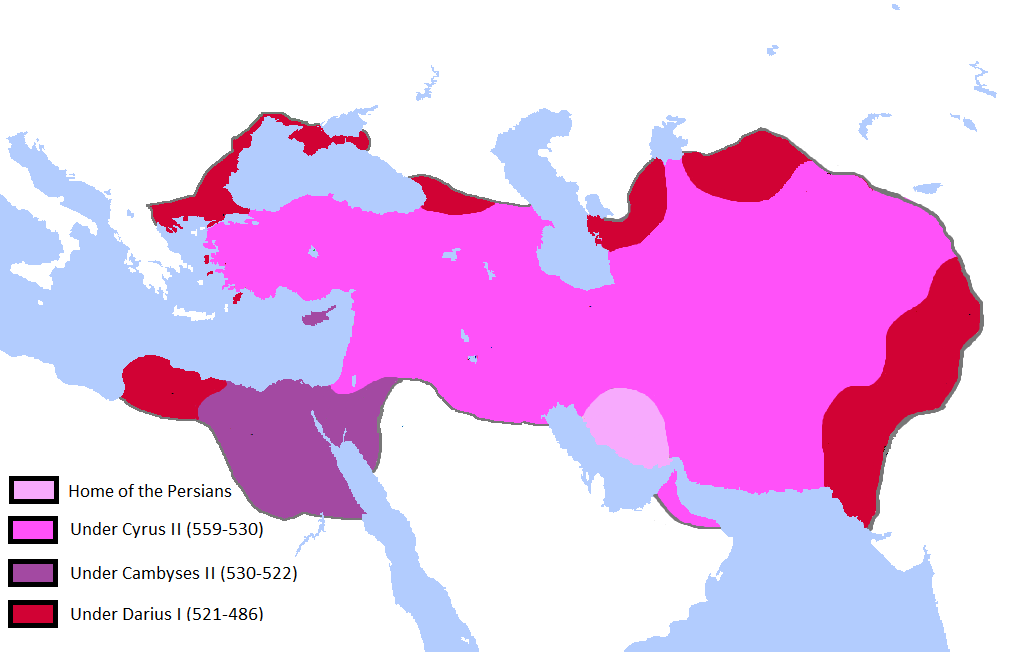 [ABOVE: The expansion of the Achaemenid Persian Empire under Darius I (red)] Go and check out my other blog on Darius the Great consolidating his empire: https://steemit.com/hive-133974/@oo7harv/darius-the-great-part-i-administrating-an-empire Like Cyrus, Darius was not just a brilliant ruler, but an equally brilliant conqueror. Under his reign, the Achaemenid Persian Empire would reach its territorial height, with borders stretching from Greece and Libya in the West to Central Asia and India in the East. Under his reign, the regions of the world including the Greek islands, Scythia, Libya and mainland Europe would come under his fold, and a large revolt would be suppressed, and I will discuss these conquests now. THE CAPTURE OF SAMOS -  [ABOVE: Darius the Great, depicted as Pharaoh of Egypt at the Temple of Hibis] With ease, Darius conquered India up to the Indus Valley, and quelled a revolt in Egypt again, stabilising Persian rule there for now. The first place West that Darius went to conquer was the island nation of Samos. 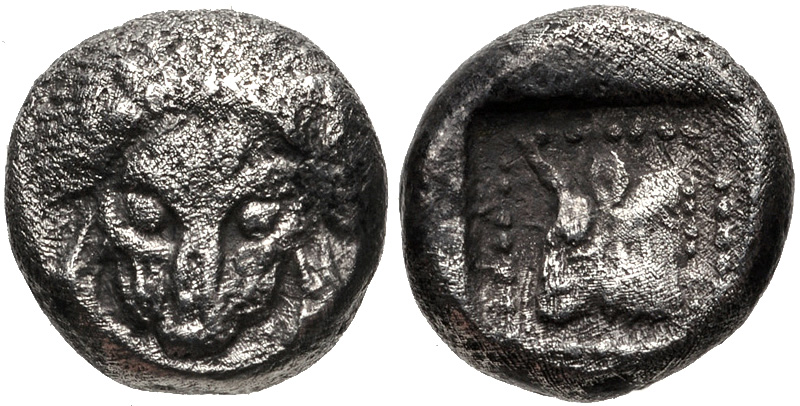 [ABOVE: Minted coins from Samos at the time of Syloson, c.500 - 494 BC] During King Cambyses’ reign in Egypt, large numbers of Greeks came to Egypt for varying reasons, one man of which was Syloson, Polycrates’ brother, who had been exiled from Samos. While walking the streets of Memphis, Darius (who at the time was an un-noteworthy figure in Cambyses’ personal guard) saw Syloson wearing a red cloak that he wanted. Darius approached Syloson offering to buy it, and seeing how anxious Darius was to get the cloak, Syloson said that he wouldn’t sell the cloak for any amount of money, but would give it away for free if it was wanted that badly, and thus gave Darius the red cloak. After the Conspiracy of the Seven and Darius’ accent to power, Syloson went to Susa to meet Darius. Syloson waited outside the palace gates and claimed to the guards to be a benefactor to Darius. Unaware of who was approaching him, Darius sent for the man to be brought to his presence. Darius was reminded of him getting the red cloak by Syloson, and the king showed his gratitude and offered to reward him for it at last. However, instead of wanting gold or silver, Syloson requested his homeland of Samos back; since Oroetes had Polycrates killed, the nation had been in the hands of the Greek's slaves. Syloson wanted his home back, but without a drop of blood being spilt. 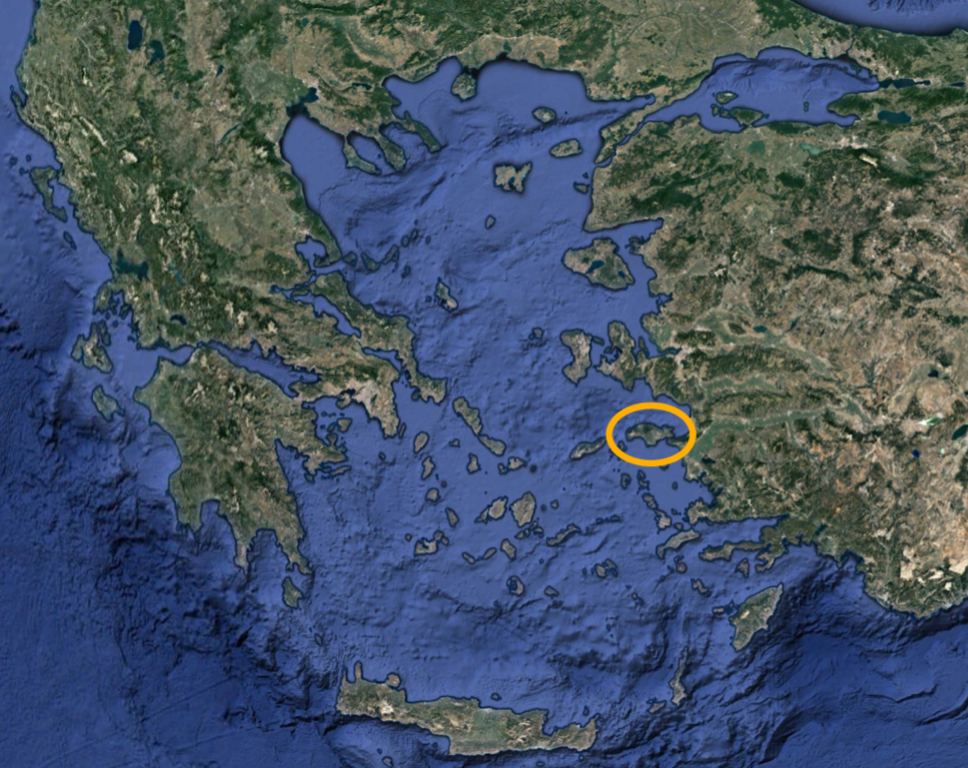 [ABOVE: A map of the Aegean Sea, highlighting the island of Samos] Darius organised an expedition to Samos under the command of Otanes, one of the Seven Conspirators. Darius told Otanes to do whatever Syloson asked of him. The man now in power of Samos was Maeandrius, the son of Maeandrius; Upon learning of Polycrates’ death, Maeandrius ordered an altar to Zeus be built with a boundary around it at the edge of town. He then addressed the citizen body, telling them that power had been entrusted to him to rule over them, stating that he wished to be a more fair and equal ruler, claiming only a sum of money from Polycrates to himself and priesthoods to Zeus for his own family. A man of some prestige from the crowd, Telesarchus, rose up however, stating that Maeandrius didn’t deserve to be in charge as he was low-born, and also wanted an account for the money Maeandrius was now handling. Maeandrius thought that if he gave up his power now, someone else would simply become tyrant. Withdrawing to the acropolis, he sent for the people to be brought to him one at a time as if he were going to financially reward them, but instead had them imprisoned. While the people were imprisoned, Maeandrius fell ill. Lycaretus, his brother who also wanted power for himself, had all the prisoners killed, as allegedly they did not want to be freed. This is all key to know because when the Persians under Otanes landed at Samos, the citizens left on the island did not object to the idea of someone else ruling over them. Maeandrius and a handful of his supporters readied to leave the island under a truce with Otanes. During the truce-making, Persian officials heard Charilaus, Maeandrius’s imprisoned and insane brother, call out to them, asking to see his brother. Once brought to Maeandrius, Charilaus argued that while he had been imprisoned by his own brother, Maeandrius was willing to exile himself in favour of his homeland succumbing to foreign rule, and Charilaus called him a coward for it. Charilaus asked Maeandrius to give him some mercenaries if he was just afraid of the Persians, stating he would make them regret ever coming to Samos and that he would be happy to help his brother get off the island all the same. Maeandrius agreed to the plan. It’s likely not because Maeandrius thought Charilaus could defeat the Persians, but rather because he resented the lack of effort in Syloson’s coming recovery of an intact town; should the Persians be poorly treated, Samos could come to meet a bad fate by their hands, and thus he likely wished to hand the island over to the Persians in a poor state. Maeandrius thus left Samos, and Chailaus’s mercenaries took the Persian nobles by complete surprise and killed them. This act brought the rest of the Persian expeditionary army down to the scene, where they later pinned the mercenaries on the acropolis. Otanes ignored Darius’s order to take the island without bloodshed; Otanes handed the island over to Syloson in good condition, and told his men to kill any adult and child they came across. Maeandrius meanwhile sailed to Sparta with his belongings and personal riches. While there, he would frequently set out silver and gold goblets on a table and have servants polish them while he spoke to the Spartan king, Cleomenes, attempting to bring him into his home. As Cleomenes would be in awe at the riches he saw in his home, Maeandrius would offer Cleomenes to take as many as he pleased, yet after hearing this offer three times over, Cleomenes rejected them, fearing the wealth could corrupt his Spartan people. Maeandrius was soon asked to leave the Peloponnese. THE RECONQUEST OF BABYLON -  [ABOVE: A lion statue, once positioned in the centre of the city of Babylon. The lion itself is an original, but the base is a cement reconstruction, built June/July 2013] During the Samos expedition, Babylon revolted. During the entire Magi Revolt and the Conspiracy of the Seven, they had readied themselves for a siege and had gone unnoticed in the process. Once the rebellion was in the open, the men of the city gathered most of the city’s women and publicly strangled them. Other women who were allowed to live, chosen either because they were mothers or just chosen by individual men to live, were kept alive as cooks. Once Darius got word of the rebellion, he gathered a large army to meet them, besieging the city as soon as his forces reached the walls, yet the citizens remained unthreatened, and its people would often taunt the Persian king during the siege, with one man shouting out, “What are you doing sitting there, men of Persia? Why don’t you just go away? Babylon will fall into your hands only when mules start bearing young!”, which they believed would never happen.  [ABOVE: A plan view of ancient Babylon along the ancient banks of the Euphrates River, with the city walls marked in orange and brown] Despite using every trick to try and reclaim the city, including the same method that Cyrus used to capture the city for Persia in the first place, the city remained untaken for a year and seven months. It was in the siege’s twentieth month that Zopyrus, the son of Megabyzus (one of the Seven Conspirators), was told of one of his pack-mules giving birth. He took this as a sign that Persia could indeed recapture the city, thinking that God must have guided the Babylonian man to shout what he shouted, and guided the mule to give birth. Once asking and finding out from Darius just how important the recapture of Babylon was to him, he set to work; he cut off his own nose and ears, flogged himself and gave himself a rough shave. His plan was to “defect” to the Babylonians and appear as if he had been poorly treated under Persian rule. Shocked at the sight of Zopyrus, Darius was convinced by him that once he was taken in to Babylon, the Babylonians would grant him military command; he planned first to approach the city as a deserter, claiming Darius mutilated him, and, as a man of his prestige, he would gain some military command within the city. Darius was then to post more expendable soldiers, armed only with daggers, at each of the city’s gates over the course of several days. Once these soldiers were inevitably beaten back, Zopyrus would be rewarded with the Babylonian’s confidence, and hopefully the keys to the city gates. Thankfully for Darius, the plan played out perfectly; the gates were swung open mid-siege and several thousand city defenders were slaughtered. With Babylon back under his hold, Darius ordered the city walls and gates to be torn down, an act which Cyrus himself was never able to do, and he ordered around 3,000 Babylonian men to be impaled on spikes. However, even after all of that, the city was returned to the Babylonians. With the remaining citizens there not having many women left since a majority of them were strangled, Darius ordered all nearby peoples to send some women to the city. In total, around 50,000 women arrived in Babylon. In Darius’s mind, no one had performed such a great act as Zopyrus, except Cyrus, saying he would rather see Zopyrus remain notmutilated than see him help capture twenty Babylons. Zopyrus was rewarded with gifts, his own domain and a tax-free life. THE SCYTHIAN CAMPAIGN - 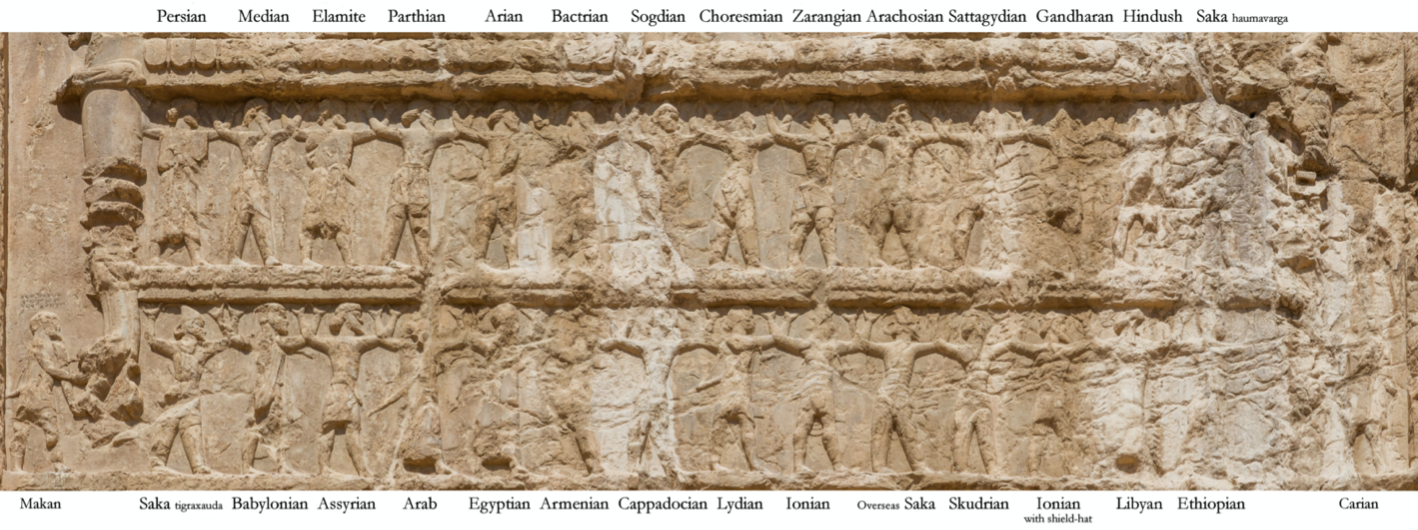 [ABOVE: The Tomb of Darius, depicting his army's several ethnicities] Following the fall of Babylon, Darius set his eyes on the steppes of Eurasia towards the nomadic Scythian tribes. Their nomadic lifestyle meant they had no settled towns or cities, but instead carried their livelihoods and livestock around with them on the move, constantly settling down temporary living areas. Since their specialisation in warfare lay with horse archery and since their primary means of acquiring food was cattle and not agriculture, this suited them perfectly. While not abundant in notable or large natural features, two things the steppes were known for were the number of rivers within its boundaries and the sheer size of the flat landmass. 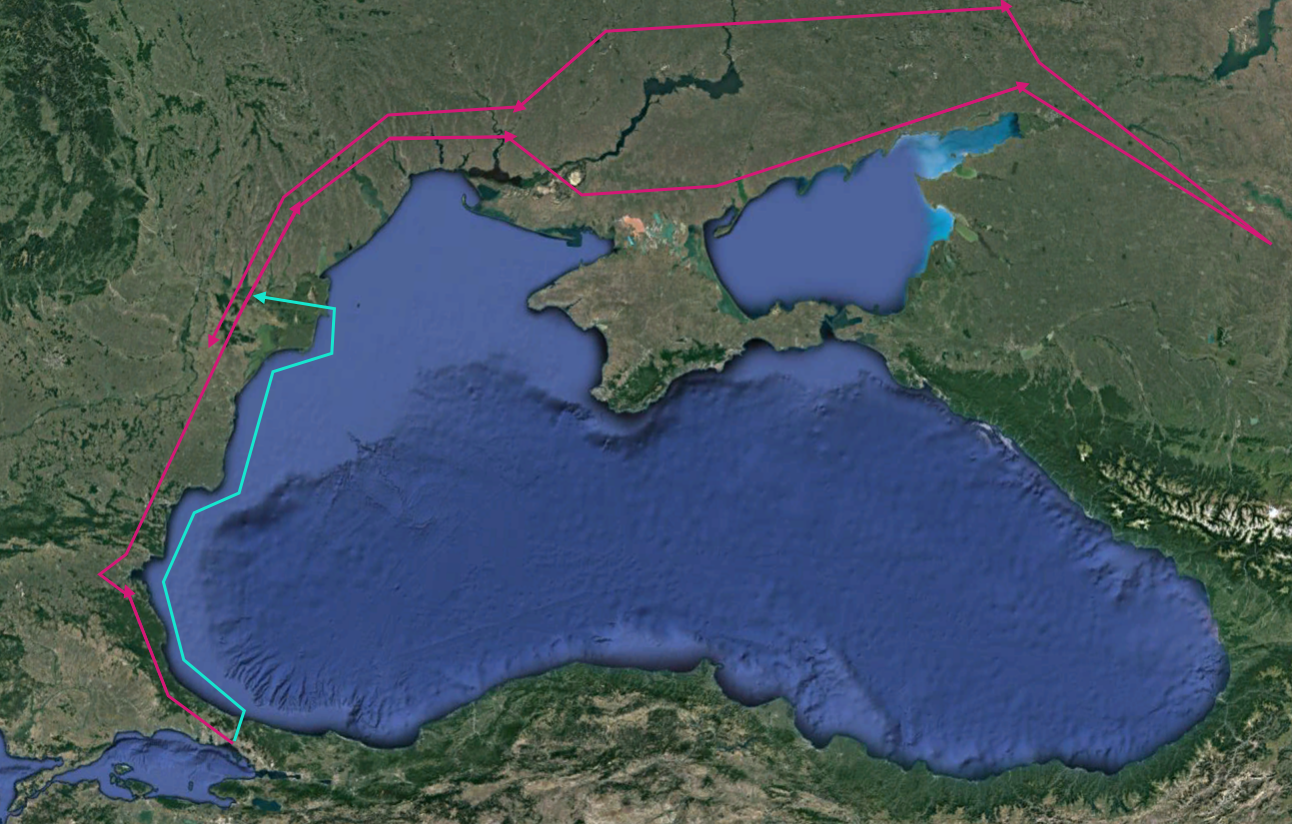 [ABOVE: A map of Darius's Scythian campaign. Darius's route is shown in purple, while his Ionian fleet's route is shown in cyan, with both meeting at the River Ister] *DARIUS'S MARCH FROM SUSA TO THE RIVER DANUBE* Darius sent messengers all across his empire to ready for the invasion, ordering for the gathering of ships and soldiers to cross the Bosporus into Thrace. His march to Scythia began in Susa, and upon reaching the coastal city of Chalcedon (now in the city of Istanbul), he and his army crossed a bridge which had previously been prepared for this expedition. After gazing at the beauty of the Black Sea from his ship, he sailed back to the bridge. After also inspecting the Bosporus too, he erected 2 pillars, having them list all the peoples he was bringing over into Europe. According to Herodotus, this number, which included cavalry, numbered 700,000, while the fleet numbered 600 ships, but these high numbers are disputed today. Darius would either way reward the bridge’s engineer, Mandrocles of Samos, with gifts for allowing such a potentially vast army to easily cross into Europe. Mandrocles would later thank Darius for such rewards by the creation of a painting depicting Darius and his forces crossing the Bosporus. The art was kept at the temple of Hera with the following inscription: *"This painting Mandrocles dedicated to Hera, to commemorate* *His bridging of the fish-rich Bosporus with a pontoon;* *His feat won the approval of King Darius,* *And earned a crown for himself and glory for the Samians.* Upon crossing the Bosporus, Darius ordered his Ionians to take the navy into the Black Sea and up the River Ister, bridge it and await their king for further instructions. Meanwhile, Darius advanced through Thrace, until reaching the River Tearus where he made camp for 3 days. Liking the river, and hearing that the locals alleged it had various healing abilities, Darius erected a pillar here too, ordering the following inscription be detailed on it: *"There is no better or finer water in the world than that of the springs of the River Tearus. And to them there came, leading an army against the Scythians, the best and finest man in the world, Darius the son of Hystaspes, king of Persia and the whole continent."* 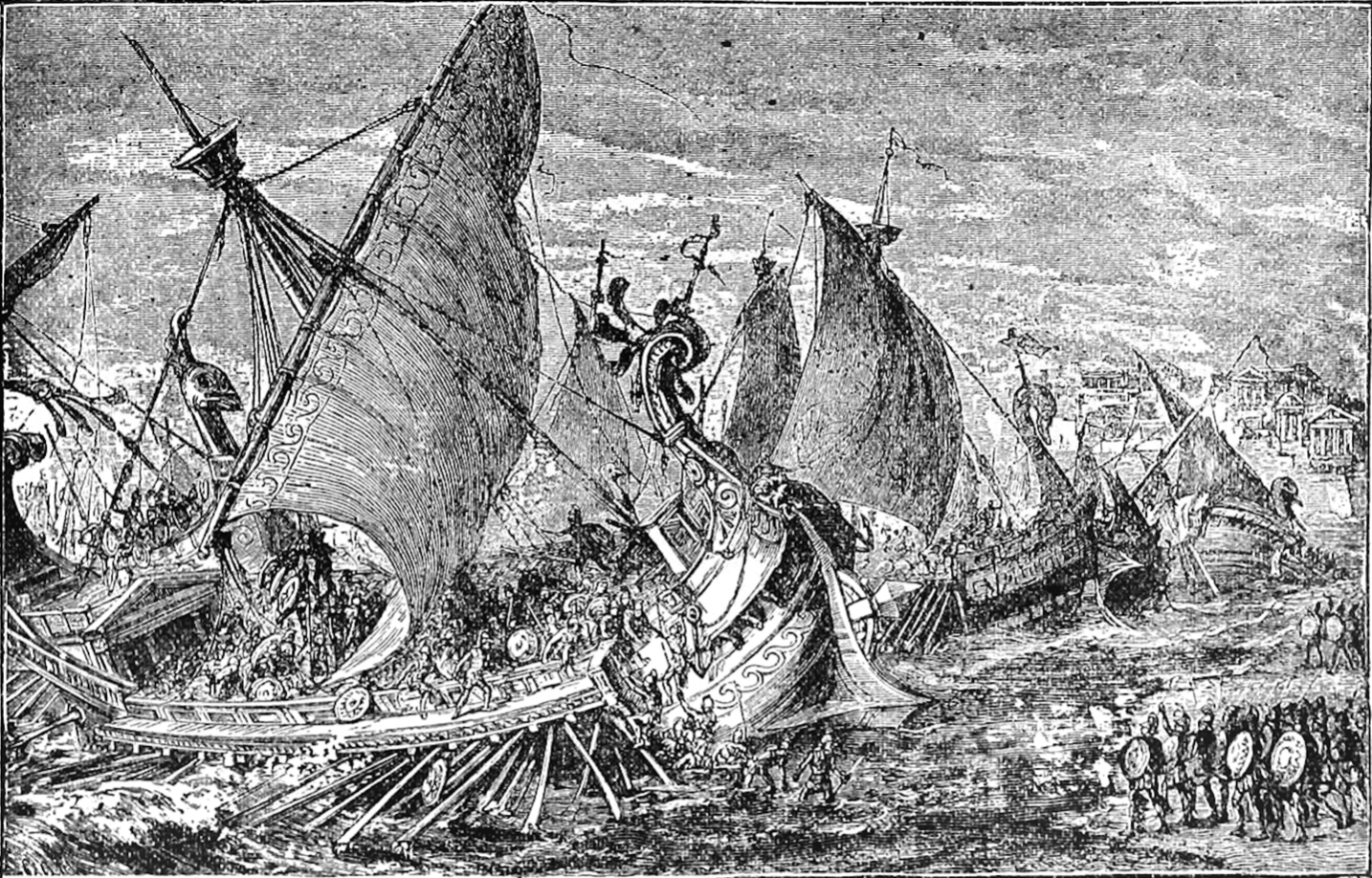 [ABOVE: Junction of the Ionian fleet and Darius's Persian army at the Bosporus, by Jacob Abbott, 19th century] Darius conquered all Thracian and Dacian peoples he encountered, including the Getae, before reaching the River Ister. Crossing it, he ordered his Ionians to dismantle the bridge and join up again with his forces, however an eminent man named Coës advised the king to leave the bridge up and keep it guarded, since Darius was about to invade lands where agriculture and thus permanent settlements were not known, and their random nomadic nature would make them hard to track down and thus conquer. Thankful for the advice, Darius instead ordered 60 knots to be tied to a leather strap, and told his Ionians to stay behind, guard the bridge and untie one knot every day that Darius’s main force was in Scythia. Should he not return on the 60th day, the Ionians were free to go back home. *SCYTHIAN DEFENCE PLAN* It didn’t take long for the peoples of Scythia to get word of such a large, foreign invasion. They agreed that a straight fight against the Persians would end terribly for them, so instead gathered several tribes to convene together as one. While convening, a messenger arrived, who told them of how Darius already had control of the Asian continent and had bridged all rivers up to Scythian lands, warning them not to stand by idly while such a vast force approached. Views were split as to what to do; some Scythian tribes had already attacked Persian forces and thus in their mind provoked the Persians to attack full-scale, but only those who had provoked him in the first place. Eventually, they agreed to not fight against the Persians in open conflict, but instead retreat. While they retreated though, they would fill in springs and wells, and destroy all vegetation they came across. The Scythian forces were also to be split into 2; one, led by Scopasis, was ordered to pull back to Lake Maeetis and to the River Tanaïs, but if Darius withdrew from them instead, they were to attack him. The other division, led by Idanthyrsus and Taxacis, were also ordered to withdraw and keep a day’s march between themselves and the Persians. They were ordered to withdraw further, if necessary, towards the lands of the Scythians who had refused to fight to hopefully goad them into combat with them. *THE CAMPAIGN* spaced forts. While these were under construction, the Scythians Darius was pursuing circled back into Scythia by a northern route, completely disappearing. Once his forces lost complete sight of the Scythians, Darius abandoned the fort’s completion and turned west, believing the Scythians had gone that way. After a forced-march, Darius arrived back in Scythia and came face to face with the combined forces of the other Scythian detachments, who kept their day’s march ahead of the invaders. As Darius did not break off from his pursuit of them, the Scythian detachment kept up their retreat into the lands of those other Scythians who had refused to help fight. This constant retreat into the lands of those who were not fighting stirred up a lot of confusion in their homelands, forcing many of them to flee their lands. One Scythian peoples though, the Agathyrsians, seeing how everyone else had fled due to confusion, sent a messenger to the withdrawing Scythian detachment. The messenger warned the army not to cross into their lands under threat of being attacked, and the Agathyrsians sent men to defend their borders. Seeing this well-prepared defence, the Scythian detachment led the Persians back into Scythia. This chase was testing Darius’s patience. He thus sent a messenger to Idasthyrsus asking why his men were constantly withdrawing if they fought themselves so capable of fighting back. He asked the Scythian king that if, on the contrary, he thought his own forces weaker than his Persian army, then peace terms should be discussed, and Darius should be recognised as their master with the typical offer of “Earth and water”. Idasthyrsus replied that he had never fled from an enemy out of fear; since he had no settled towns to protect. He could keep moving as he pleased, and told Darius’s messenger that he may only consider attacking should his ancestral burial grounds be attacked. Until then, the only masters he bowed down to were the deities Zeus and Hestia, Queen of Scythians. The mention of potential enslavement infuriated the Scythians. Scopasis, leading the first Scythian division, was sent to talk to the Ionians guarding the bridge, while the rest of the Scythian forces were to halt their constant retreats and attack the Persians while they stopped to look for food. The Scythians kept up a constant “attack and retreat” policy, pulling back from raiding the Persian army when the more tightly-packed infantry came to repel them. These assaults were kept up even at night, putting a constant strain on the Persian forces. However, one thing that slightly halted the Scythian attacks was the sound of mules; these animals were not native to Scythian lands due to the lower temperatures, and so the unfamiliar sound of donkeys threw the Scythian horses, comprising most of the Scythian army, into confusion and disarray. But either way, the attacks persisted and constantly weakened and worried the Persians. 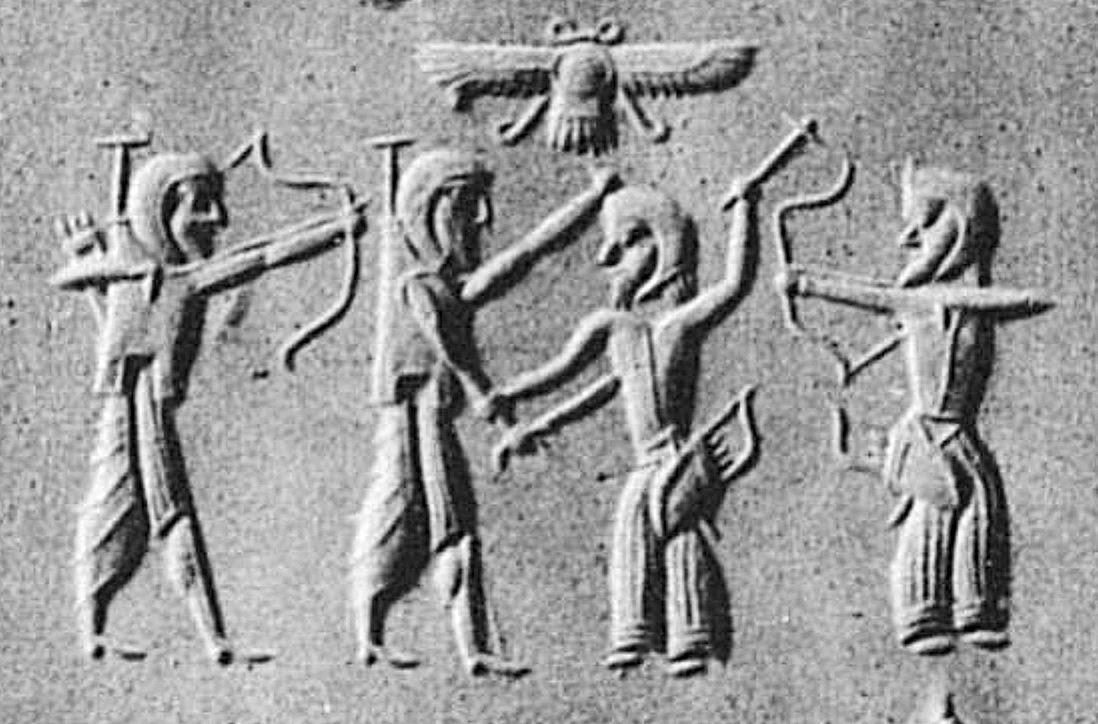 [ABOVE: Persian infantry fighting Scythians, depicted on a Persian cylinder seal] Knowing this, the Scythians wished to prolong the Persians’ stay in their lands, in the hope that it would shorten their supplies to make them wish they’d never stayed; the Scythians began to leave some of their livestock and supplies behind on their marches and allow the Persians to take them, boosting their morale. When this had happened enough times, events started to head south for Darius. He soon received a gift from a messenger without explanation: a bird, frog, mouse, and five arrows. All Darius was told was that if he were smart enough, he’d figure it out. Darius interpreted the gifts as the equivalent of an “Earth and Water” submission, whereas Gobryas interpreted the gifts as a sign that they should burrow, swim or fly away (like a mouse, frog and bird respectively) before being shot down by arrows. While the Persians decided what this meant, the first Scythian division, originally tasked with pulling back to Lake Meets, reached the bridge over the River Ister. They discussed with the Ionians that they knew of their task to guard the bridge for 60 days and leave if Darius didn’t return in the meantime, before heading back into Scythia. Once Darius took the gifts, the Scythians who remained in Scythia organised into battle formations and approached the Persians. While waiting in battle lines, a hare sprinted across the field between the two armies, and the Scythians weirdly gave chase to it one after another. Confused, Darius took this event as a sign that Gobryas was right, thinking the Scythians were holding the Persians in contempt, stating that the best plan now was to return to Persia. Gobryas too said that the best thing to do now was leave the mules and weakest troops behind and retreat back to the Ister. Come morning, Darius followed Gobryas’s plan. The Persian soldiers left behind were told by Darius that they were there to distract the Scythians while Darius found a path to flank them on. Eventually realising they had been betrayed by their king, this Persian detachment joined with the Scythians into one large army. 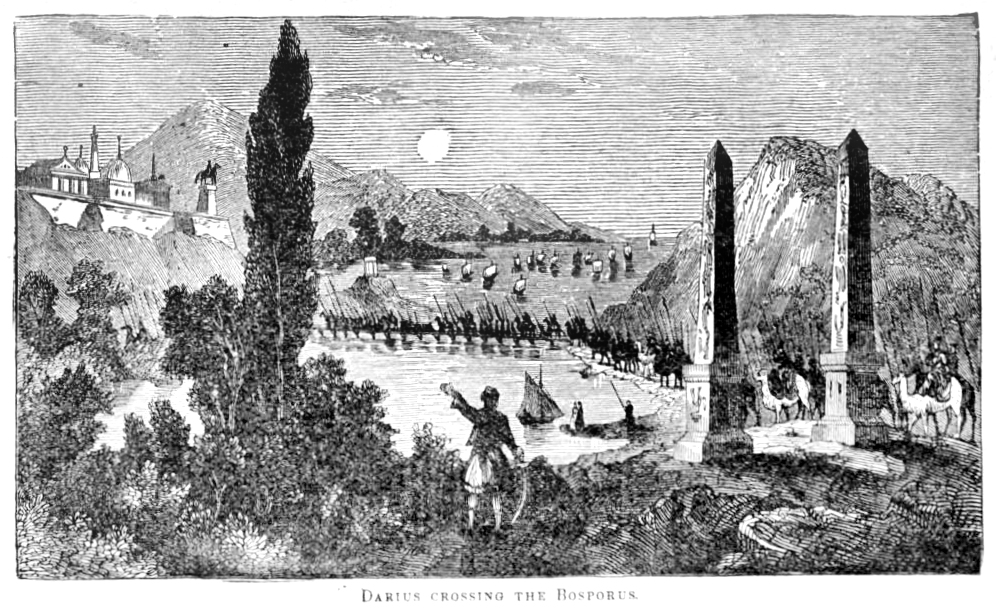 [ABOVE: Darius crossing the Bosporus again, by Jacob Abbott, 19th century] Now the Persians, not knowing the exact way back, were on foot fleeing from a native army of faster horse riders, and as a result the Scythians reached the Ister before the Persians. They spoke to the Ionians again and told them that their 60 days were up, encouraging them to dismantle the bridge and leave them to deal with Darius in Scythia. Among the Ionians was the tyrant of the Hellespontine Chersonese, Miltiades of Athens. He argued that the Scythian’s words were wisest and wanted to abandon the bridge, whereas another commander, Histiaeus of Miletus, argued that were it not for Darius, he would not be allowed his rule over Miletus and thus argued that they should stay. This swung the Ionian soldiers’ opinion to side with Histiaeus; many among them were also tyrants held in high regard by the Persian king. Wanting to make their actions match their words for Darius, they started to dismantle enough of the bridge to keep them safe from arrow fire and to make it seem like they were helping the Scythians, thus stalling the Scythians’ attempt to breach the bridge while they waited for Darius. Histiaeus, quickly elected as a representative to the Scythians, told the Scythians to find and ambush the Persians while they “dismantled” the bridge, however their previous plan of destroying their own lands to weaken the Persians before backfired and made it harder to track them. This slow and careful march allowed by the Scythians allowed the Persian army to make it back to the Ister. The bridge was then reconstructed and Persian soldiers were ferried back over the river. The rest of the Persian army returned home safely. 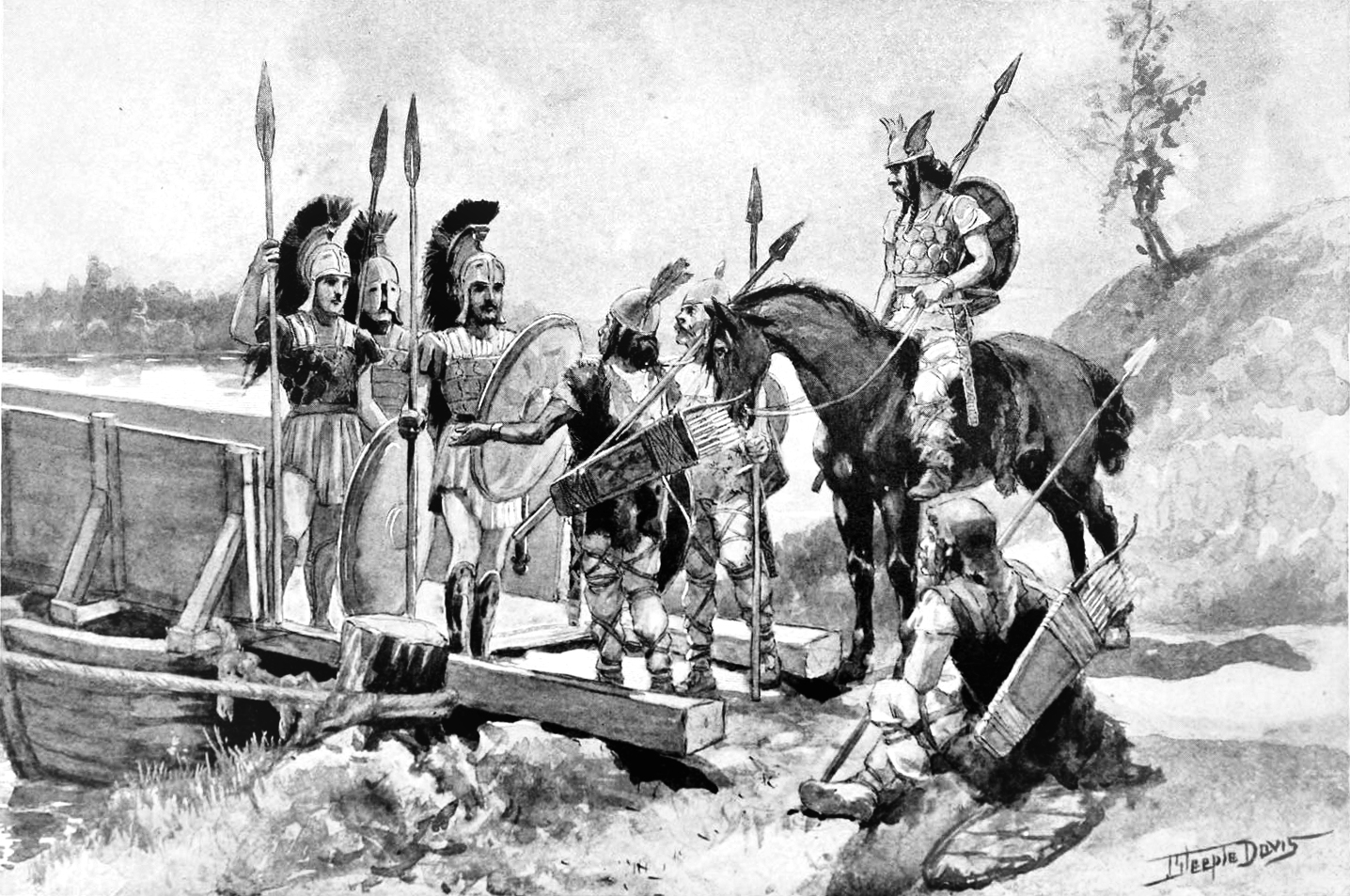 [ABOVE: Histiaeus and his Greeks holding the bridge for Darius, by John Steeple Davis, 19th century] The Scythians would after refer to Ionian Greeks as “the worst and most cowardly free people in the world”, yet stated that if they ever became slaves, they would be loyal. Megabazus was left in charge of the Hellespont forces in Europe, supposedly numbering 80,000 men. THE LIBYAN CAMPAIGN - This one's a short one, but worth a mention. 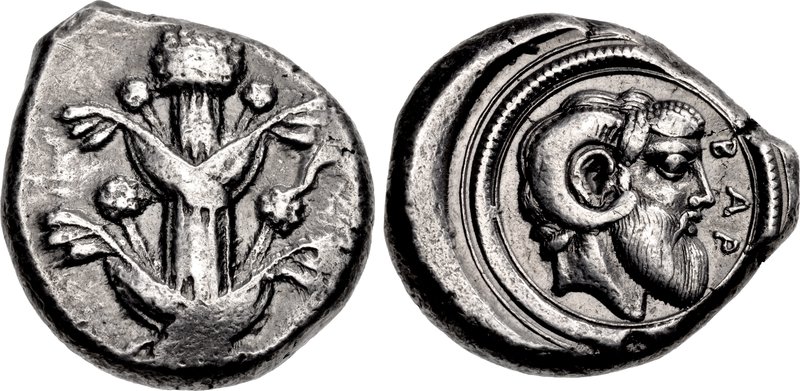 [ABOVE: Coin minted at Barca, under Persian rule, c.475 - 435 BC] Before the march into Europe and, ultimately, Greece, the last main campaign the Persians undertook was in Libya. The city of Barca was besieged for 9 months, and it was aggressive; tunnels were repeatedly dug underground as a means to pass the walls of the city under cover. As clever as this may have been, a metalworker in the city actually managed to detect the tunnels by holding a bronze shield against the grounds inside the city wall. He held the shield against the ground and gave it a bash; where there was a tunnel, the shield gave off a ringing sound, and where there was no tunnel, the shield gave off virtually no sound. Counter-tunnels were thus dug to meet the Persians, and the attacks were repelled. The direct assaults on the city walls were also unsuccessful, and the Barcaeans repelled the attacks for all this time. 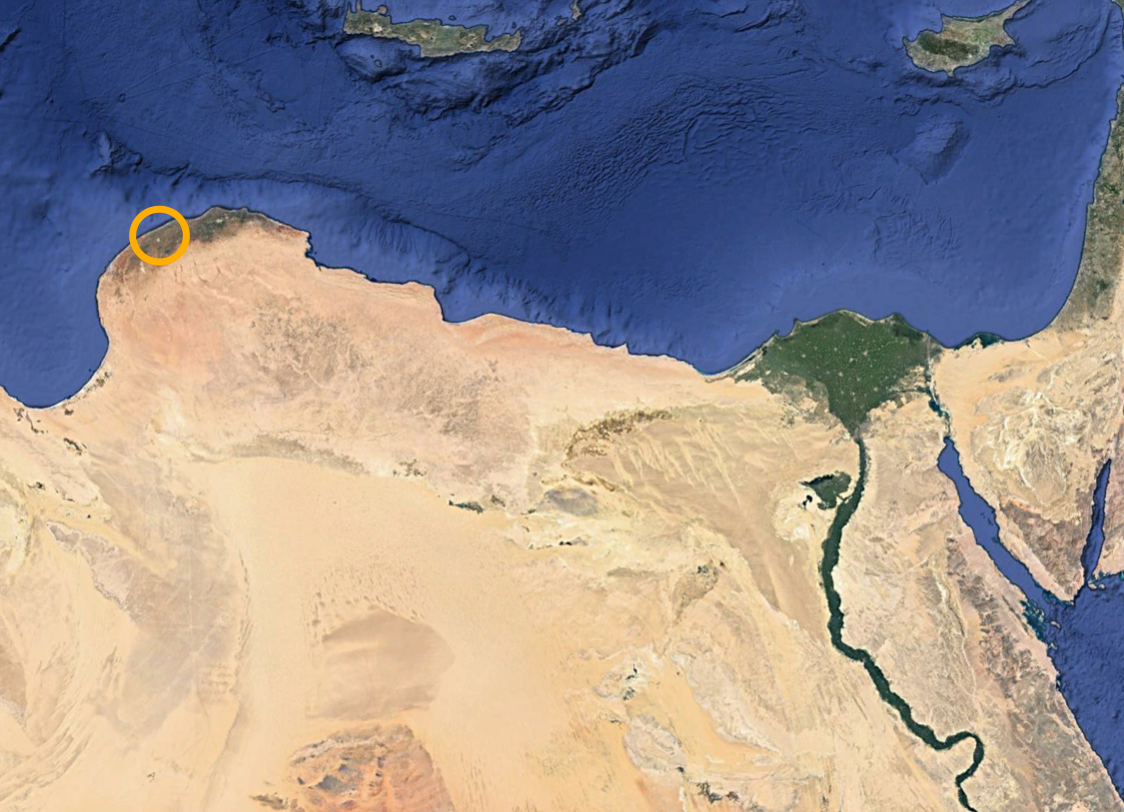 [ABOVE: The city of Barca in Libya, south-west of Cyrene] Commanding the Persian forces was Amasis - not the former Pharaoh. He realised the city would not fall to brute strength, so instead came up with a plan; at night, he ordered for his army to dig a wide trench and lay weak wooden planks on top of it, and then cover the wood with soil until level with the rest of the ground. By morning, the Barcaeans were invited to meet with the Persians, and they happily agreed. The meeting concluded with both sides agreeing to come to terms “as long as this earth lasts”, while the Barcaeans agreed to pay tribute to the Persians in the meantime. The city gates were then flung open to allow the Persians to come inside the city at will, and it was at this moment that the wooden planks were ordered to be broken. The Persians made their way into the city and, per the “lasting earth” agreement, the truce was broken. Large numbers of they city’s population was slaughtered and sold into slavery. The Persians, now heading back to Egypt, made their way to the Greek colonial city of Cyrene. The people there though had been directed by an Oracle to let the Persians pass through freely, although I wonder if their quick allowance of Persian passage had anything to do with how the people of Barca were recently treated. Badres, commander of the Persian fleet, insisted that this was the perfect opportunity to occupy the city, but Amasis insisted otherwise; this was not the city they had come to conquer. They would later attempt to retake the city, but to no success. The enslaved Barcaeans were sent to Darius, who allowed them to found their own settlement in Bactria, and they of course named this new city “Barca”. EUROPEAN CAMPAIGNS - *MEGABAZUS IN THRACE* 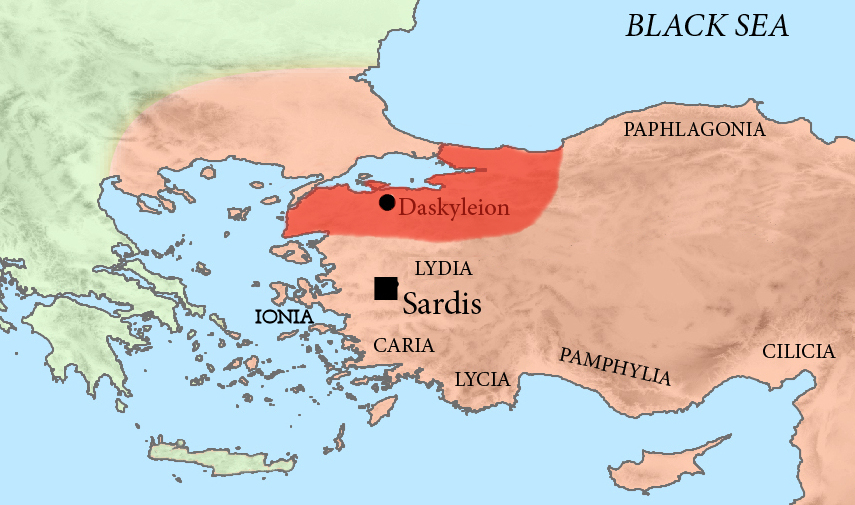 [ABOVE: Megabazus's Satrapy of Hellespontine Phrygia] Following the retreat from Scythia, Megabazus was left in charge of the Hellespont to subdue Thrace. Thrace was one of the most highly populated regions in the world at the time. According to Herodotus, only Indians outnumbered Thracians, and any man who could solely rule Thrace would be ruling over the most powerful nation on Earth, and they themselves would be invincible. The first city to fall to Megabazus was Perinthus, because the citizens refused to acknowledge Darius as their ruler. Perinthus had recently been ravaged by an assault by Paeonians from the north, and they had severely depopulated the city. The people of Perinthus thus saw it as their duty now to preserve their independence and freedom and defend their city at all costs, including from the Persians. Severely outnumbered now though, they fell to the empire with ease. Following Perinthus, all cities Megabazus reached fell to him with ease, as that was Darius’s command: Conquer Thrace. *DARIUS IN SARDIS* While Megabazus was in Thrace, Darius returned to Sardis. There, he allowed Histiaeus, who commanded the Ionians in Scythia, to return as tyrant of Miletus, as well as granting him the same position over Myrcinus in Edina. He also gave Coës, the commoner who had advised Darius’s Ionian forces in Scythia to wait 60 days by the Ister River, the position as tyrant of Mytilene. It was then that Darius noticed something that made him want to round up the Perennials in Europe and sent them to Asia: two Paeonian men, Mastyes and Pigres, wished to rule as tyrants in Paeonia. The two men went to Asia as Darius returned to Sardis, bringing their tall, beautiful sister with them. They dressed her up in the best dress they had and sent for her to fetch water, rein a horse and spin flax outside of Sardis before Darius reached there. Taken by the woman’s beauty and untypical actions for a local in Lydia, Darius ordered the woman be watched by his guards, who observed her watering the horse, filling the jar with water again, and retracing her steps back while leading the horse and rotating her spindle. She was ordered to be taken in by Darius. The two brothers arrived at this time, explaining that they were Paeonians who wished to submit to Persia. They convinced Darius that all Paeonians were as productive as the woman he saw, and this convinced him to order Megabazus in Thrace to round up the people of Paeonia and emigrate them to Asia. The people of Paeonia, now fearing a direct invasion from Persia, gathered a large army together to defend the Black Sea coast, assuming they would attack from there. The Persians, however, simply moved inland and captured the now-empty Paeonian cities. With this, the Paeonian army abandoned their generals and surrendered to the Persians, and the people were distributed across Asia and Paeonia was incorporated into the Persian Empire. *MACEDONIA, MADE A CLIENT-KINGDOM* 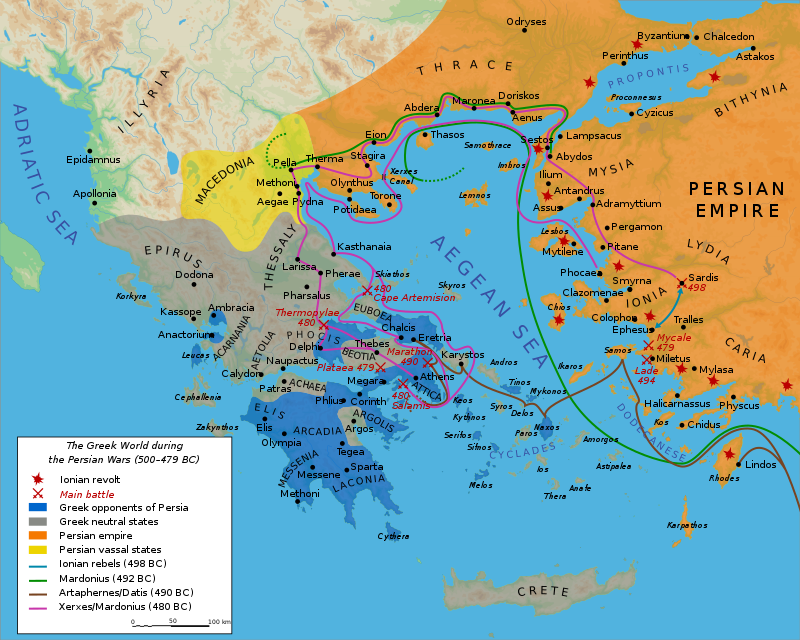 [ABOVE: The Kingdom of Macedonia (yellow) as a vassal kingdom under the Achaemenid Empire (orange), 512 - 499 BC, 492 - 479 BC] After winning over the Paeonians, Megabazus sent a delegation of the seven highest-ranking men under himself to Macedonia to ask their king, Amyntas, for the symbol of submission: “Earth and Water”. Amyntas granted these to Darius, and then invited the Persian emissaries to dine with him, preparing a huge feast for the delegation. While Macedonians typically separated their men from their women at such events, they were convinced to do otherwise by their new “masters”. The women were ordered to sit opposite the Persian men, who approached them and began to grope them. Amyntas held back in restraint, but his young son Alexander I - no not THAT Alexander of Macedon - let his innocence of youth get to him. He approached his father and asked him to leave and rest while he tended to the visitors. Amyntas, however, saw what Alexander was up to, telling him to stop out of fear of his nation being destroyed down the line by Persia. However, he still took his advice and went to bed. 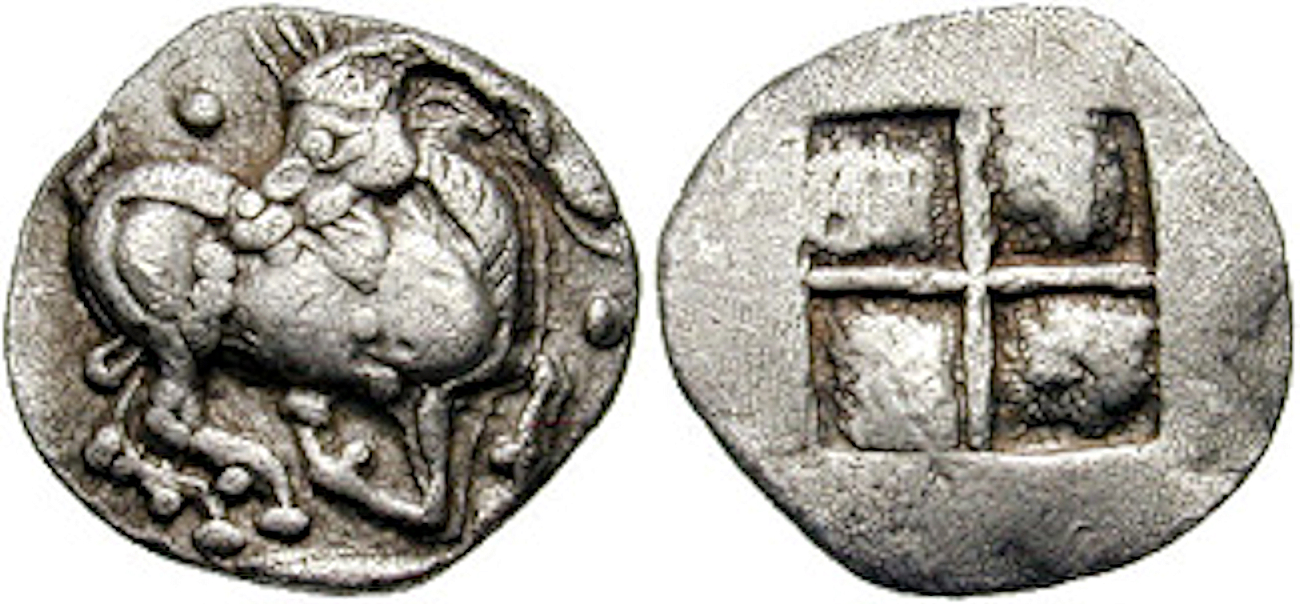 [ABOVE: Coin minted in Macedonia at the end of its independence before Persian rule, c.510 BC] In the meantime, Alexander told the Persians that the women were theirs to do with as they pleased, however for now they were to let them go and bathe and wait for them to return afterwards. The Persian men agreed. However, the women were ordered to their own quarters instead; Alexander chose the same number of (beardless) men as there were women and had them dress up like the women, arming each with a dagger. Addressing the Persian men kindly as a distraction, Alexander’s “women” were ordered to sit next to each Persian man, and when they attempted to grope them again, the daggers were drawn and the Persians, as well as their servants, were killed. Alexander covered his tracks once a search party was sent by Persia to look for the deceased emissaries, but Alexander sent bribes to Persia in the form of coinage and his own sister to distract them and help call off the search party. *DARIUS GOES TO SUSA* Megabazus took the Paeonian people across the Hellespont into Asia, and afterwards went to Sardis. By now, Histiaeus was fortifying his newly given city of Myrcinus. Megabazus expressed his disproval of allowing a cunning Greek to fortify in newly conquered lands close to his own homeland, in lands rich with resources. He requested that Darius order Histiaeus to his presence and restrain him, nulling any chance of him rallying up his local Greek population against Persia. Darius sent a message to Histiaeus: *"After thinking the matter over, I have come to the conclusion that there is no one who cares more for me and y affairs than you do; you have proved your loyalty to me by your actions, not my mere words. I have great plans for the future, and I want you here, no matter what, so that I can tell you about them."* When Histiaeus arrived in his presence, Darius told him to abandon his plans for Miletus and Myrcinus and remain by his side in Susa as an advisor and close companion. Afterwards, Darius appointed his half-brother Artaphrenes as governor of Sardis before heading back to Susa with Histiaeus. Meanwhile, Otanes, one of the original Seven Conspirators who went on to take Samos for Persia, had been made a prominent commander of the Asiatic coast, and with this command he went on to capture the cities of Byzantium (modern-day Istanbul), Chalcedon, Antandrus, Lamponium, Lemnos and Imbros, all Greek cities in and around Asia Minor. The former tyrant of Samos, Maeandrius, had his brother, Lycaretus, appointed as governor of Lemnos. An unpopular ruler there however, Lycaretus eventually died in Samos. THE IONIANS - The Ionians did not join in on the series of rebellions occurring during Darius’s reign, however come the year 499 BC, when an expedition to the island of Naxos was to take place, the Ionians deposed of their tyrants and begun a revolt. Cities from the Hellespont to the south of Asia Minor and even Cyprus would raise cities in rebellion too. 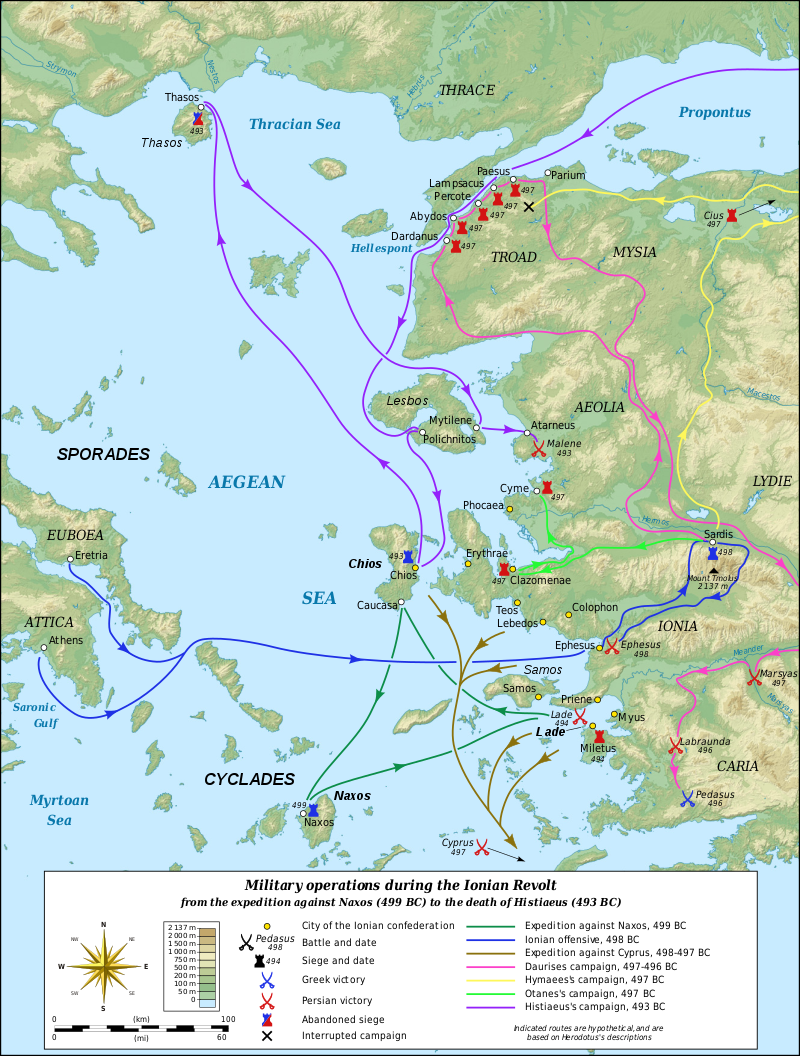 [ABOVE: Map of the Ionian Revolt, 499 - 493 BC] This rebellion, known as the Ionian Revolt, would spill into the Greek world; The Ionians would receive help from the newly-democratic nation of Athens and her allies, and the infamous wars to come would shape the world forever. Here starts the Greco-Persian Wars. Stay tuned. SOURCES - • Herodotus's "Histories" • National Geographic's "The Most Influential Figures of Ancient History" • Nic Fields' "Thermopylae 480 BC, Last Stand of the 300" • Oswyn Murray's "Early Greece" YOUTUBE LINK - (I do NOT own this video) "DARIUS THE GREAT - PERSIA RISES PART 3 - ACHAEMENID PERSIAN HISTORY", by "Yore History" https://www.youtube.com/watch?v=xtyYHIIkPVU This has been the eighth part in many blogs on the Achaemenid Empire. Go and check out the rest if you haven't already: THE PERSIAN EMPIRE - https://steemit.com/hive-133974/@oo7harv/the-persian-empire-history-s-first-superpower CYRUS THE GREAT 1 - https://steemit.com/hive-133974/@oo7harv/cyrus-the-great-conquests-of-media-and-lydia CYRUS THE GREAT 2 - https://steemit.com/hive-133974/@oo7harv/cyrus-the-great-2-conquest-of-babylon-and-his-downfall CAMBYSES II - https://steemit.com/hive-133974/@oo7harv/cambyses-ii-heir-to-cyrus-the-great-530-522-bc-part-1 CAMBYSES II 2 - https://steemit.com/hive-133974/@oo7harv/cambyses-ii-the-mad-persian-shah-530-522-bc-part-2 CONSPIRACY OF THE 7 - https://steemit.com/hive-133974/@oo7harv/the-conspiracy-of-the-seven-from-cambyses-to-darius DARIUS THE GREAT 1 - https://steemit.com/hive-133974/@oo7harv/darius-the-great-part-i-administrating-an-empire PERSIAN PROVERBS - https://steemit.com/quotes/@oo7harv/persian-proverbs THE HISTORY COMMUNITY - https://steemit.com/created/hive-133974 All feedback - positive and/or critical - is appreciated! Don't forget to rate this post and leave a tip if you enjoyed it Thanks for reading :) |
| json metadata | {"tags":["history","greek","greece","photography","writing","iran","politics"],"image":["https://cdn.steemitimages.com/DQmbjtS22yioUo15zjoBgpR93anqEcU7eD2jnAKG8Me8Prg/1.4%20Achaemenid%20Expansion%20map.png","https://cdn.steemitimages.com/DQmPi7NvUWvoeJxnErUzTnZU9MnckYQpCjx5GcqYpTBPjkv/8.1%20Pharaoh%20Darius.jpg","https://cdn.steemitimages.com/DQmYeb7woteyx8ULXGuBhfgexWvXgEWEwAgaCAiggkA6XsA/8.2%20Samos%20coin.jpg","https://cdn.steemitimages.com/DQmRVhnGZkg5qFgGSYtwB3p4WdDmmaNtz5dxERkojGKdJL7/8.3%20Samos.png","https://cdn.steemitimages.com/DQmenfpcjAWs6oKdvsHxMTvWdw7dGPUb3CofG8gBDX6ZDR6/8.4%20Babylon%20lion%20statue.jpg","https://cdn.steemitimages.com/DQmZSqty64aRUCnPVdtx82PUNpsEbHb2k7HGywXPUpomCru/8.5%20Babylon%20plan.png","https://cdn.steemitimages.com/DQmQGgQtyvt6NC44atA52SdhPgZqmqMQzSBAXDQfPAw8cEm/8.6%20Tomb%20of%20Darius.png","https://cdn.steemitimages.com/DQmSM3XZBBzNwDMmDxuJxbZ1J9mimLXiPa3EHbn1dBJcuCz/8.7%20Scythian%20campaign.png","https://cdn.steemitimages.com/DQmUea5E1xuoTSjXvSYfCqiHaRLnG4TbZQP6CFDEbUHaLSZ/8.8%20Ister%20Crossing.png","https://cdn.steemitimages.com/DQmYLzRevWv79kmDmH5LrR8SutAjibvoYG1i62PFwhtN2aj/8.10%20Persian%20and%20Scythian%20soldiers.jpg","https://cdn.steemitimages.com/DQmSLUWxDbxEmMVEsSs3K7URTpxnPYuwoUTxxY24fjZGZka/8.9%20Ister%20crossing%202.jpg","https://cdn.steemitimages.com/DQmfHQBkNY6GuPN6mnbGiuc1p1NyCgjF43ta623de8FvsPx/8.11%20Histiaeus%20and%20Ionians.jpg","https://cdn.steemitimages.com/DQmbbLLpAcq3bmWdxQXWQWfGTcn8NiwmPMXJvHZHKUKCBQA/8.12%20Barca%20coins.jpg","https://cdn.steemitimages.com/DQmUdXDxhtuGquJ6FuqXZw3rAjLSPQQnJ8MYu9duEwZoxpY/8.13%20Barca.png","https://cdn.steemitimages.com/DQmasNZSBZQZmmC6HWY9gqXwMZiiDTuSVEVCb9Uy9z5QFCq/8.14%20Megabazus's%20satrapy%20of%20Hellespontine%20Phrygia.jpg","https://cdn.steemitimages.com/DQmNpSjmC7wJncW5xVo7SXKnweE971pQzP6QX7e9JKKF4gR/8.15%20Persian%20Macedonia.png","https://cdn.steemitimages.com/DQmRp1vvWLueQj86UdpzuS7nDv1c891DJMwpubm9pgqNBgz/8.16%20Amyntas%20I%20coin.jpg","https://cdn.steemitimages.com/DQmQveWXzeyBvHR8WRboqtD5tchacSaZ5dpzyeMksJHzPrb/8.17%20Ionian%20Revolt.png","https://img.youtube.com/vi/xtyYHIIkPVU/0.jpg"],"links":["https://steemit.com/hive-133974/@oo7harv/darius-the-great-part-i-administrating-an-empire","https://www.youtube.com/watch?v=xtyYHIIkPVU","https://steemit.com/hive-133974/@oo7harv/the-persian-empire-history-s-first-superpower","https://steemit.com/hive-133974/@oo7harv/cyrus-the-great-conquests-of-media-and-lydia","https://steemit.com/hive-133974/@oo7harv/cyrus-the-great-2-conquest-of-babylon-and-his-downfall","https://steemit.com/hive-133974/@oo7harv/cambyses-ii-heir-to-cyrus-the-great-530-522-bc-part-1","https://steemit.com/hive-133974/@oo7harv/cambyses-ii-the-mad-persian-shah-530-522-bc-part-2","https://steemit.com/hive-133974/@oo7harv/the-conspiracy-of-the-seven-from-cambyses-to-darius","https://steemit.com/quotes/@oo7harv/persian-proverbs","https://steemit.com/created/hive-133974"],"app":"steemit/0.2","format":"markdown"} |
| parent author | |
| parent permlink | hive-133974 |
| permlink | darius-the-great-part-ii-expanding-an-empire |
| title | DARIUS THE GREAT, Part II - Expanding an Empire |
| Transaction Info | Block #50926639/Trx e60b05953419bb9f87e3e7319cdc16c59fdaec5f |
View Raw JSON Data
{
"block": 50926639,
"op": [
"comment",
{
"author": "oo7harv",
"body": "\n[ABOVE: The expansion of the Achaemenid Persian Empire under Darius I (red)]\n\nGo and check out my other blog on Darius the Great consolidating his empire:\n\nhttps://steemit.com/hive-133974/@oo7harv/darius-the-great-part-i-administrating-an-empire\n\nLike Cyrus, Darius was not just a brilliant ruler, but an equally brilliant conqueror. Under his reign, the Achaemenid Persian Empire would reach its territorial height, with borders stretching from Greece and Libya in the West to Central Asia and India in the East.\nUnder his reign, the regions of the world including the Greek islands, Scythia, Libya and mainland Europe would come under his fold, and a large revolt would be suppressed, and I will discuss these conquests now.\n\nTHE CAPTURE OF SAMOS\n-\n\n\n[ABOVE: Darius the Great, depicted as Pharaoh of Egypt at the Temple of Hibis]\n\nWith ease, Darius conquered India up to the Indus Valley, and quelled a revolt in Egypt again, stabilising Persian rule there for now. The first place West that Darius went to conquer was the island nation of Samos.\n\n\n[ABOVE: Minted coins from Samos at the time of Syloson, c.500 - 494 BC]\n\nDuring King Cambyses’ reign in Egypt, large numbers of Greeks came to Egypt for varying reasons, one man of which was Syloson, Polycrates’ brother, who had been exiled from Samos. While walking the streets of Memphis, Darius (who at the time was an un-noteworthy figure in Cambyses’ personal guard) saw Syloson wearing a red cloak that he wanted. Darius approached Syloson offering to buy it, and seeing how anxious Darius was to get the cloak, Syloson said that he wouldn’t sell the cloak for any amount of money, but would give it away for free if it was wanted that badly, and thus gave Darius the red cloak. After the Conspiracy of the Seven and Darius’ accent to power, Syloson went to Susa to meet Darius. Syloson waited outside the palace gates and claimed to the guards to be a benefactor to Darius. Unaware of who was approaching him, Darius sent for the man to be brought to his presence. Darius was reminded of him getting the red cloak by Syloson, and the king showed his gratitude and offered to reward him for it at last. However, instead of wanting gold or silver, Syloson requested his homeland of Samos back; since Oroetes had Polycrates killed, the nation had been in the hands of the Greek's slaves. Syloson wanted his home back, but without a drop of blood being spilt.\n\n\n[ABOVE: A map of the Aegean Sea, highlighting the island of Samos]\n\nDarius organised an expedition to Samos under the command of Otanes, one of the Seven Conspirators. Darius told Otanes to do whatever Syloson asked of him. The man now in power of Samos was Maeandrius, the son of Maeandrius; Upon learning of Polycrates’ death, Maeandrius ordered an altar to Zeus be built with a boundary around it at the edge of town. He then addressed the citizen body, telling them that power had been entrusted to him to rule over them, stating that he wished to be a more fair and equal ruler, claiming only a sum of money from Polycrates to himself and priesthoods to Zeus for his own family. A man of some prestige from the crowd, Telesarchus, rose up however, stating that Maeandrius didn’t deserve to be in charge as he was low-born, and also wanted an account for the money Maeandrius was now handling. Maeandrius thought that if he gave up his power now, someone else would simply become tyrant. Withdrawing to the acropolis, he sent for the people to be brought to him one at a time as if he were going to financially reward them, but instead had them imprisoned. While the people were imprisoned, Maeandrius fell ill. Lycaretus, his brother who also wanted power for himself, had all the prisoners killed, as allegedly they did not want to be freed.\n\nThis is all key to know because when the Persians under Otanes landed at Samos, the citizens left on the island did not object to the idea of someone else ruling over them. Maeandrius and a handful of his supporters readied to leave the island under a truce with Otanes. During the truce-making, Persian officials heard Charilaus, Maeandrius’s imprisoned and insane brother, call out to them, asking to see his brother. Once brought to Maeandrius, Charilaus argued that while he had been imprisoned by his own brother, Maeandrius was willing to exile himself in favour of his homeland succumbing to foreign rule, and Charilaus called him a coward for it. Charilaus asked Maeandrius to give him some mercenaries if he was just afraid of the Persians, stating he would make them regret ever coming to Samos and that he would be happy to help his brother get off the island all the same. Maeandrius agreed to the plan. It’s likely not because Maeandrius thought Charilaus could defeat the Persians, but rather because he resented the lack of effort in Syloson’s coming recovery of an intact town; should the Persians be poorly treated, Samos could come to meet a bad fate by their hands, and thus he likely wished to hand the island over to the Persians in a poor state.\n\nMaeandrius thus left Samos, and Chailaus’s mercenaries took the Persian nobles by complete surprise and killed them. This act brought the rest of the Persian expeditionary army down to the scene, where they later pinned the mercenaries on the acropolis. Otanes ignored Darius’s order to take the island without bloodshed; Otanes handed the island over to Syloson in good condition, and told his men to kill any adult and child they came across.\n\nMaeandrius meanwhile sailed to Sparta with his belongings and personal riches. While there, he would frequently set out silver and gold goblets on a table and have servants polish them while he spoke to the Spartan king, Cleomenes, attempting to bring him into his home. As Cleomenes would be in awe at the riches he saw in his home, Maeandrius would offer Cleomenes to take as many as he pleased, yet after hearing this offer three times over, Cleomenes rejected them, fearing the wealth could corrupt his Spartan people. Maeandrius was soon asked to leave the Peloponnese.\n\nTHE RECONQUEST OF BABYLON\n-\n\n[ABOVE: A lion statue, once positioned in the centre of the city of Babylon. The lion itself is an original, but the base is a cement reconstruction, built June/July 2013]\n\nDuring the Samos expedition, Babylon revolted. During the entire Magi Revolt and the Conspiracy of the Seven, they had readied themselves for a siege and had gone unnoticed in the process. Once the rebellion was in the open, the men of the city gathered most of the city’s women and publicly strangled them. Other women who were allowed to live, chosen either because they were mothers or just chosen by individual men to live, were kept alive as cooks. Once Darius got word of the rebellion, he gathered a large army to meet them, besieging the city as soon as his forces reached the walls, yet the citizens remained unthreatened, and its people would often taunt the Persian king during the siege, with one man shouting out, “What are you doing sitting there, men of Persia? Why don’t you just go away? Babylon will fall into your hands only when mules start bearing young!”, which they believed would never happen.\n\n\n[ABOVE: A plan view of ancient Babylon along the ancient banks of the Euphrates River, with the city walls marked in orange and brown]\n\nDespite using every trick to try and reclaim the city, including the same method that Cyrus used to capture the city for Persia in the first place, the city remained untaken for a year and seven months. It was in the siege’s twentieth month that Zopyrus, the son of Megabyzus (one of the Seven Conspirators), was told of one of his pack-mules giving birth. He took this as a sign that Persia could indeed recapture the city, thinking that God must have guided the Babylonian man to shout what he shouted, and guided the mule to give birth. Once asking and finding out from Darius just how important the recapture of Babylon was to him, he set to work; he cut off his own nose and ears, flogged himself and gave himself a rough shave. His plan was to “defect” to the Babylonians and appear as if he had been poorly treated under Persian rule. Shocked at the sight of Zopyrus, Darius was convinced by him that once he was taken in to Babylon, the Babylonians would grant him military command; he planned first to approach the city as a deserter, claiming Darius mutilated him, and, as a man of his prestige, he would gain some military command within the city. Darius was then to post more expendable soldiers, armed only with daggers, at each of the city’s gates over the course of several days. Once these soldiers were inevitably beaten back, Zopyrus would be rewarded with the Babylonian’s confidence, and hopefully the keys to the city gates. Thankfully for Darius, the plan played out perfectly; the gates were swung open mid-siege and several thousand city defenders were slaughtered.\n\nWith Babylon back under his hold, Darius ordered the city walls and gates to be torn down, an act which Cyrus himself was never able to do, and he ordered around 3,000 Babylonian men to be impaled on spikes. However, even after all of that, the city was returned to the Babylonians. With the remaining citizens there not having many women left since a majority of them were strangled, Darius ordered all nearby peoples to send some women to the city. In total, around 50,000 women arrived in Babylon. In Darius’s mind, no one had performed such a great act as Zopyrus, except Cyrus, saying he would rather see Zopyrus remain notmutilated than see him help capture twenty Babylons. Zopyrus was rewarded with gifts, his own domain and a tax-free life.\n\nTHE SCYTHIAN CAMPAIGN\n-\n\n[ABOVE: The Tomb of Darius, depicting his army's several ethnicities]\n\nFollowing the fall of Babylon, Darius set his eyes on the steppes of Eurasia towards the nomadic Scythian tribes. Their nomadic lifestyle meant they had no settled towns or cities, but instead carried their livelihoods and livestock around with them on the move, constantly settling down temporary living areas. Since their specialisation in warfare lay with horse archery and since their primary means of acquiring food was cattle and not agriculture, this suited them perfectly. While not abundant in notable or large natural features, two things the steppes were known for were the number of rivers within its boundaries and the sheer size of the flat landmass.\n\n\n[ABOVE: A map of Darius's Scythian campaign. Darius's route is shown in purple, while his Ionian fleet's route is shown in cyan, with both meeting at the River Ister]\n\n*DARIUS'S MARCH FROM SUSA TO THE RIVER DANUBE*\nDarius sent messengers all across his empire to ready for the invasion, ordering for the gathering of ships and soldiers to cross the Bosporus into Thrace. His march to Scythia began in Susa, and upon reaching the coastal city of Chalcedon (now in the city of Istanbul), he and his army crossed a bridge which had previously been prepared for this expedition. After gazing at the beauty of the Black Sea from his ship, he sailed back to the bridge. After also inspecting the Bosporus too, he erected 2 pillars, having them list all the peoples he was bringing over into Europe. According to Herodotus, this number, which included cavalry, numbered 700,000, while the fleet numbered 600 ships, but these high numbers are disputed today. Darius would either way reward the bridge’s engineer, Mandrocles of Samos, with gifts for allowing such a potentially vast army to easily cross into Europe. Mandrocles would later thank Darius for such rewards by the creation of a painting depicting Darius and his forces crossing the Bosporus. The art was kept at the temple of Hera with the following inscription:\n\n*\"This painting Mandrocles dedicated to Hera, to commemorate*\n*His bridging of the fish-rich Bosporus with a pontoon;*\n*His feat won the approval of King Darius,*\n*And earned a crown for himself and glory for the Samians.*\n\nUpon crossing the Bosporus, Darius ordered his Ionians to take the navy into the Black Sea and up the River Ister, bridge it and await their king for further instructions. Meanwhile, Darius advanced through Thrace, until reaching the River Tearus where he made camp for 3 days. Liking the river, and hearing that the locals alleged it had various healing abilities, Darius erected a pillar here too, ordering the following inscription be detailed on it:\n\n*\"There is no better or finer water in the world than that of the springs of the River Tearus. And to them there came, leading an army against the Scythians, the best and finest man in the world, Darius the son of Hystaspes, king of Persia and the whole continent.\"*\n\n\n[ABOVE: Junction of the Ionian fleet and Darius's Persian army at the Bosporus, by Jacob Abbott, 19th century]\n\nDarius conquered all Thracian and Dacian peoples he encountered, including the Getae, before reaching the River Ister. Crossing it, he ordered his Ionians to dismantle the bridge and join up again with his forces, however an eminent man named Coës advised the king to leave the bridge up and keep it guarded, since Darius was about to invade lands where agriculture and thus permanent settlements were not known, and their random nomadic nature would make them hard to track down and thus conquer. Thankful for the advice, Darius instead ordered 60 knots to be tied to a leather strap, and told his Ionians to stay behind, guard the bridge and untie one knot every day that Darius’s main force was in Scythia. Should he not return on the 60th day, the Ionians were free to go back home.\n\n*SCYTHIAN DEFENCE PLAN*\nIt didn’t take long for the peoples of Scythia to get word of such a large, foreign invasion. They agreed that a straight fight against the Persians would end terribly for them, so instead gathered several tribes to convene together as one. While convening, a messenger arrived, who told them of how Darius already had control of the Asian continent and had bridged all rivers up to Scythian lands, warning them not to stand by idly while such a vast force approached. Views were split as to what to do; some Scythian tribes had already attacked Persian forces and thus in their mind provoked the Persians to attack full-scale, but only those who had provoked him in the first place. Eventually, they agreed to not fight against the Persians in open conflict, but instead retreat. While they retreated though, they would fill in springs and wells, and destroy all vegetation they came across. The Scythian forces were also to be split into 2; one, led by Scopasis, was ordered to pull back to Lake Maeetis and to the River Tanaïs, but if Darius withdrew from them instead, they were to attack him. The other division, led by Idanthyrsus and Taxacis, were also ordered to withdraw and keep a day’s march between themselves and the Persians. They were ordered to withdraw further, if necessary, towards the lands of the Scythians who had refused to fight to hopefully goad them into combat with them.\n\n*THE CAMPAIGN*\nspaced forts. While these were under construction, the Scythians Darius was pursuing circled back into Scythia by a northern route, completely disappearing. Once his forces lost complete sight of the Scythians, Darius abandoned the fort’s completion and turned west, believing the Scythians had gone that way.\n\nAfter a forced-march, Darius arrived back in Scythia and came face to face with the combined forces of the other Scythian detachments, who kept their day’s march ahead of the invaders. As Darius did not break off from his pursuit of them, the Scythian detachment kept up their retreat into the lands of those other Scythians who had refused to help fight. This constant retreat into the lands of those who were not fighting stirred up a lot of confusion in their homelands, forcing many of them to flee their lands. One Scythian peoples though, the Agathyrsians, seeing how everyone else had fled due to confusion, sent a messenger to the withdrawing Scythian detachment. The messenger warned the army not to cross into their lands under threat of being attacked, and the Agathyrsians sent men to defend their borders. Seeing this well-prepared defence, the Scythian detachment led the Persians back into Scythia.\n\nThis chase was testing Darius’s patience. He thus sent a messenger to Idasthyrsus asking why his men were constantly withdrawing if they fought themselves so capable of fighting back. He asked the Scythian king that if, on the contrary, he thought his own forces weaker than his Persian army, then peace terms should be discussed, and Darius should be recognised as their master with the typical offer of “Earth and water”. Idasthyrsus replied that he had never fled from an enemy out of fear; since he had no settled towns to protect. He could keep moving as he pleased, and told Darius’s messenger that he may only consider attacking should his ancestral burial grounds be attacked. Until then, the only masters he bowed down to were the deities Zeus and Hestia, Queen of Scythians.\n\nThe mention of potential enslavement infuriated the Scythians. Scopasis, leading the first Scythian division, was sent to talk to the Ionians guarding the bridge, while the rest of the Scythian forces were to halt their constant retreats and attack the Persians while they stopped to look for food. The Scythians kept up a constant “attack and retreat” policy, pulling back from raiding the Persian army when the more tightly-packed infantry came to repel them. These assaults were kept up even at night, putting a constant strain on the Persian forces. However, one thing that slightly halted the Scythian attacks was the sound of mules; these animals were not native to Scythian lands due to the lower temperatures, and so the unfamiliar sound of donkeys threw the Scythian horses, comprising most of the Scythian army, into confusion and disarray. But either way, the attacks persisted and constantly weakened and worried the Persians.\n\n\n[ABOVE: Persian infantry fighting Scythians, depicted on a Persian cylinder seal]\n\nKnowing this, the Scythians wished to prolong the Persians’ stay in their lands, in the hope that it would shorten their supplies to make them wish they’d never stayed; the Scythians began to leave some of their livestock and supplies behind on their marches and allow the Persians to take them, boosting their morale. When this had happened enough times, events started to head south for Darius. He soon received a gift from a messenger without explanation: a bird, frog, mouse, and five arrows. All Darius was told was that if he were smart enough, he’d figure it out. Darius interpreted the gifts as the equivalent of an “Earth and Water” submission, whereas Gobryas interpreted the gifts as a sign that they should burrow, swim or fly away (like a mouse, frog and bird respectively) before being shot down by arrows. While the Persians decided what this meant, the first Scythian division, originally tasked with pulling back to Lake Meets, reached the bridge over the River Ister. They discussed with the Ionians that they knew of their task to guard the bridge for 60 days and leave if Darius didn’t return in the meantime, before heading back into Scythia.\n\nOnce Darius took the gifts, the Scythians who remained in Scythia organised into battle formations and approached the Persians. While waiting in battle lines, a hare sprinted across the field between the two armies, and the Scythians weirdly gave chase to it one after another. Confused, Darius took this event as a sign that Gobryas was right, thinking the Scythians were holding the Persians in contempt, stating that the best plan now was to return to Persia. Gobryas too said that the best thing to do now was leave the mules and weakest troops behind and retreat back to the Ister. Come morning, Darius followed Gobryas’s plan. The Persian soldiers left behind were told by Darius that they were there to distract the Scythians while Darius found a path to flank them on. Eventually realising they had been betrayed by their king, this Persian detachment joined with the Scythians into one large army.\n\n\n[ABOVE: Darius crossing the Bosporus again, by Jacob Abbott, 19th century]\n\nNow the Persians, not knowing the exact way back, were on foot fleeing from a native army of faster horse riders, and as a result the Scythians reached the Ister before the Persians. They spoke to the Ionians again and told them that their 60 days were up, encouraging them to dismantle the bridge and leave them to deal with Darius in Scythia. Among the Ionians was the tyrant of the Hellespontine Chersonese, Miltiades of Athens. He argued that the Scythian’s words were wisest and wanted to abandon the bridge, whereas another commander, Histiaeus of Miletus, argued that were it not for Darius, he would not be allowed his rule over Miletus and thus argued that they should stay. This swung the Ionian soldiers’ opinion to side with Histiaeus; many among them were also tyrants held in high regard by the Persian king. Wanting to make their actions match their words for Darius, they started to dismantle enough of the bridge to keep them safe from arrow fire and to make it seem like they were helping the Scythians, thus stalling the Scythians’ attempt to breach the bridge while they waited for Darius. Histiaeus, quickly elected as a representative to the Scythians, told the Scythians to find and ambush the Persians while they “dismantled” the bridge, however their previous plan of destroying their own lands to weaken the Persians before backfired and made it harder to track them. This slow and careful march allowed by the Scythians allowed the Persian army to make it back to the Ister. The bridge was then reconstructed and Persian soldiers were ferried back over the river. The rest of the Persian army returned home safely.\n\n\n[ABOVE: Histiaeus and his Greeks holding the bridge for Darius, by John Steeple Davis, 19th century]\n\nThe Scythians would after refer to Ionian Greeks as “the worst and most cowardly free people in the world”, yet stated that if they ever became slaves, they would be loyal. Megabazus was left in charge of the Hellespont forces in Europe, supposedly numbering 80,000 men.\n\nTHE LIBYAN CAMPAIGN\n-\nThis one's a short one, but worth a mention.\n\n\n[ABOVE: Coin minted at Barca, under Persian rule, c.475 - 435 BC]\n\nBefore the march into Europe and, ultimately, Greece, the last main campaign the Persians undertook was in Libya. The city of Barca was besieged for 9 months, and it was aggressive; tunnels were repeatedly dug underground as a means to pass the walls of the city under cover. As clever as this may have been, a metalworker in the city actually managed to detect the tunnels by holding a bronze shield against the grounds inside the city wall. He held the shield against the ground and gave it a bash; where there was a tunnel, the shield gave off a ringing sound, and where there was no tunnel, the shield gave off virtually no sound. Counter-tunnels were thus dug to meet the Persians, and the attacks were repelled. The direct assaults on the city walls were also unsuccessful, and the Barcaeans repelled the attacks for all this time.\n\n\n[ABOVE: The city of Barca in Libya, south-west of Cyrene]\n\nCommanding the Persian forces was Amasis - not the former Pharaoh. He realised the city would not fall to brute strength, so instead came up with a plan; at night, he ordered for his army to dig a wide trench and lay weak wooden planks on top of it, and then cover the wood with soil until level with the rest of the ground. By morning, the Barcaeans were invited to meet with the Persians, and they happily agreed. The meeting concluded with both sides agreeing to come to terms “as long as this earth lasts”, while the Barcaeans agreed to pay tribute to the Persians in the meantime. The city gates were then flung open to allow the Persians to come inside the city at will, and it was at this moment that the wooden planks were ordered to be broken. The Persians made their way into the city and, per the “lasting earth” agreement, the truce was broken. Large numbers of they city’s population was slaughtered and sold into slavery.\n\nThe Persians, now heading back to Egypt, made their way to the Greek colonial city of Cyrene. The people there though had been directed by an Oracle to let the Persians pass through freely, although I wonder if their quick allowance of Persian passage had anything to do with how the people of Barca were recently treated. Badres, commander of the Persian fleet, insisted that this was the perfect opportunity to occupy the city, but Amasis insisted otherwise; this was not the city they had come to conquer. They would later attempt to retake the city, but to no success. The enslaved Barcaeans were sent to Darius, who allowed them to found their own settlement in Bactria, and they of course named this new city “Barca”.\n\nEUROPEAN CAMPAIGNS\n-\n*MEGABAZUS IN THRACE*\n\n\n[ABOVE: Megabazus's Satrapy of Hellespontine Phrygia]\n\nFollowing the retreat from Scythia, Megabazus was left in charge of the Hellespont to subdue Thrace. Thrace was one of the most highly populated regions in the world at the time. According to Herodotus, only Indians outnumbered Thracians, and any man who could solely rule Thrace would be ruling over the most powerful nation on Earth, and they themselves would be invincible. The first city to fall to Megabazus was Perinthus, because the citizens refused to acknowledge Darius as their ruler. Perinthus had recently been ravaged by an assault by Paeonians from the north, and they had severely depopulated the city. The people of Perinthus thus saw it as their duty now to preserve their independence and freedom and defend their city at all costs, including from the Persians. Severely outnumbered now though, they fell to the empire with ease. Following Perinthus, all cities Megabazus reached fell to him with ease, as that was Darius’s command: Conquer Thrace.\n\n*DARIUS IN SARDIS*\nWhile Megabazus was in Thrace, Darius returned to Sardis. There, he allowed Histiaeus, who commanded the Ionians in Scythia, to return as tyrant of Miletus, as well as granting him the same position over Myrcinus in Edina. He also gave Coës, the commoner who had advised Darius’s Ionian forces in Scythia to wait 60 days by the Ister River, the position as tyrant of Mytilene. It was then that Darius noticed something that made him want to round up the Perennials in Europe and sent them to Asia: two Paeonian men, Mastyes and Pigres, wished to rule as tyrants in Paeonia. The two men went to Asia as Darius returned to Sardis, bringing their tall, beautiful sister with them. They dressed her up in the best dress they had and sent for her to fetch water, rein a horse and spin flax outside of Sardis before Darius reached there. Taken by the woman’s beauty and untypical actions for a local in Lydia, Darius ordered the woman be watched by his guards, who observed her watering the horse, filling the jar with water again, and retracing her steps back while leading the horse and rotating her spindle. She was ordered to be taken in by Darius. The two brothers arrived at this time, explaining that they were Paeonians who wished to submit to Persia. They convinced Darius that all Paeonians were as productive as the woman he saw, and this convinced him to order Megabazus in Thrace to round up the people of Paeonia and emigrate them to Asia. The people of Paeonia, now fearing a direct invasion from Persia, gathered a large army together to defend the Black Sea coast, assuming they would attack from there. The Persians, however, simply moved inland and captured the now-empty Paeonian cities. With this, the Paeonian army abandoned their generals and surrendered to the Persians, and the people were distributed across Asia and Paeonia was incorporated into the Persian Empire.\n\n*MACEDONIA, MADE A CLIENT-KINGDOM*\n\n\n[ABOVE: The Kingdom of Macedonia (yellow) as a vassal kingdom under the Achaemenid Empire (orange), 512 - 499 BC, 492 - 479 BC]\n\nAfter winning over the Paeonians, Megabazus sent a delegation of the seven highest-ranking men under himself to Macedonia to ask their king, Amyntas, for the symbol of submission: “Earth and Water”. Amyntas granted these to Darius, and then invited the Persian emissaries to dine with him, preparing a huge feast for the delegation. While Macedonians typically separated their men from their women at such events, they were convinced to do otherwise by their new “masters”. The women were ordered to sit opposite the Persian men, who approached them and began to grope them. Amyntas held back in restraint, but his young son Alexander I - no not THAT Alexander of Macedon - let his innocence of youth get to him. He approached his father and asked him to leave and rest while he tended to the visitors. Amyntas, however, saw what Alexander was up to, telling him to stop out of fear of his nation being destroyed down the line by Persia. However, he still took his advice and went to bed.\n\n\n[ABOVE: Coin minted in Macedonia at the end of its independence before Persian rule, c.510 BC]\n\nIn the meantime, Alexander told the Persians that the women were theirs to do with as they pleased, however for now they were to let them go and bathe and wait for them to return afterwards. The Persian men agreed. However, the women were ordered to their own quarters instead; Alexander chose the same number of (beardless) men as there were women and had them dress up like the women, arming each with a dagger. Addressing the Persian men kindly as a distraction, Alexander’s “women” were ordered to sit next to each Persian man, and when they attempted to grope them again, the daggers were drawn and the Persians, as well as their servants, were killed. Alexander covered his tracks once a search party was sent by Persia to look for the deceased emissaries, but Alexander sent bribes to Persia in the form of coinage and his own sister to distract them and help call off the search party.\n\n*DARIUS GOES TO SUSA*\nMegabazus took the Paeonian people across the Hellespont into Asia, and afterwards went to Sardis. By now, Histiaeus was fortifying his newly given city of Myrcinus. Megabazus expressed his disproval of allowing a cunning Greek to fortify in newly conquered lands close to his own homeland, in lands rich with resources. He requested that Darius order Histiaeus to his presence and restrain him, nulling any chance of him rallying up his local Greek population against Persia. Darius sent a message to Histiaeus:\n\n*\"After thinking the matter over, I have come to the conclusion that there is no one who cares more for me and y affairs than you do; you have proved your loyalty to me by your actions, not my mere words. I have great plans for the future, and I want you here, no matter what, so that I can tell you about them.\"*\n\nWhen Histiaeus arrived in his presence, Darius told him to abandon his plans for Miletus and Myrcinus and remain by his side in Susa as an advisor and close companion. Afterwards, Darius appointed his half-brother Artaphrenes as governor of Sardis before heading back to Susa with Histiaeus. Meanwhile, Otanes, one of the original Seven Conspirators who went on to take Samos for Persia, had been made a prominent commander of the Asiatic coast, and with this command he went on to capture the cities of Byzantium (modern-day Istanbul), Chalcedon, Antandrus, Lamponium, Lemnos and Imbros, all Greek cities in and around Asia Minor. The former tyrant of Samos, Maeandrius, had his brother, Lycaretus, appointed as governor of Lemnos. An unpopular ruler there however, Lycaretus eventually died in Samos.\n\nTHE IONIANS\n-\nThe Ionians did not join in on the series of rebellions occurring during Darius’s reign, however come the year 499 BC, when an expedition to the island of Naxos was to take place, the Ionians deposed of their tyrants and begun a revolt. Cities from the Hellespont to the south of Asia Minor and even Cyprus would raise cities in rebellion too.\n\n\n[ABOVE: Map of the Ionian Revolt, 499 - 493 BC]\n\nThis rebellion, known as the Ionian Revolt, would spill into the Greek world; The Ionians would receive help from the newly-democratic nation of Athens and her allies, and the infamous wars to come would shape the world forever. Here starts the Greco-Persian Wars.\n\nStay tuned.\n\nSOURCES\n-\n• Herodotus's \"Histories\"\n• National Geographic's \"The Most Influential Figures of Ancient History\"\n• Nic Fields' \"Thermopylae 480 BC, Last Stand of the 300\"\n• Oswyn Murray's \"Early Greece\"\n\nYOUTUBE LINK\n-\n(I do NOT own this video)\n\n\"DARIUS THE GREAT - PERSIA RISES PART 3 - ACHAEMENID PERSIAN HISTORY\", by \"Yore History\"\n\nhttps://www.youtube.com/watch?v=xtyYHIIkPVU\n\nThis has been the eighth part in many blogs on the Achaemenid Empire. Go and check out the rest if you haven't already:\n\nTHE PERSIAN EMPIRE\n-\nhttps://steemit.com/hive-133974/@oo7harv/the-persian-empire-history-s-first-superpower\n\nCYRUS THE GREAT 1\n-\nhttps://steemit.com/hive-133974/@oo7harv/cyrus-the-great-conquests-of-media-and-lydia\n\nCYRUS THE GREAT 2\n-\nhttps://steemit.com/hive-133974/@oo7harv/cyrus-the-great-2-conquest-of-babylon-and-his-downfall\n\nCAMBYSES II\n-\nhttps://steemit.com/hive-133974/@oo7harv/cambyses-ii-heir-to-cyrus-the-great-530-522-bc-part-1\n\nCAMBYSES II 2\n-\nhttps://steemit.com/hive-133974/@oo7harv/cambyses-ii-the-mad-persian-shah-530-522-bc-part-2\n\nCONSPIRACY OF THE 7\n-\nhttps://steemit.com/hive-133974/@oo7harv/the-conspiracy-of-the-seven-from-cambyses-to-darius\n\nDARIUS THE GREAT 1\n-\nhttps://steemit.com/hive-133974/@oo7harv/darius-the-great-part-i-administrating-an-empire\n\nPERSIAN PROVERBS\n-\nhttps://steemit.com/quotes/@oo7harv/persian-proverbs\n\nTHE HISTORY COMMUNITY\n-\nhttps://steemit.com/created/hive-133974\n\nAll feedback - positive and/or critical - is appreciated!\nDon't forget to rate this post and leave a tip if you enjoyed it\n\nThanks for reading :)",
"json_metadata": "{\"tags\":[\"history\",\"greek\",\"greece\",\"photography\",\"writing\",\"iran\",\"politics\"],\"image\":[\"https://cdn.steemitimages.com/DQmbjtS22yioUo15zjoBgpR93anqEcU7eD2jnAKG8Me8Prg/1.4%20Achaemenid%20Expansion%20map.png\",\"https://cdn.steemitimages.com/DQmPi7NvUWvoeJxnErUzTnZU9MnckYQpCjx5GcqYpTBPjkv/8.1%20Pharaoh%20Darius.jpg\",\"https://cdn.steemitimages.com/DQmYeb7woteyx8ULXGuBhfgexWvXgEWEwAgaCAiggkA6XsA/8.2%20Samos%20coin.jpg\",\"https://cdn.steemitimages.com/DQmRVhnGZkg5qFgGSYtwB3p4WdDmmaNtz5dxERkojGKdJL7/8.3%20Samos.png\",\"https://cdn.steemitimages.com/DQmenfpcjAWs6oKdvsHxMTvWdw7dGPUb3CofG8gBDX6ZDR6/8.4%20Babylon%20lion%20statue.jpg\",\"https://cdn.steemitimages.com/DQmZSqty64aRUCnPVdtx82PUNpsEbHb2k7HGywXPUpomCru/8.5%20Babylon%20plan.png\",\"https://cdn.steemitimages.com/DQmQGgQtyvt6NC44atA52SdhPgZqmqMQzSBAXDQfPAw8cEm/8.6%20Tomb%20of%20Darius.png\",\"https://cdn.steemitimages.com/DQmSM3XZBBzNwDMmDxuJxbZ1J9mimLXiPa3EHbn1dBJcuCz/8.7%20Scythian%20campaign.png\",\"https://cdn.steemitimages.com/DQmUea5E1xuoTSjXvSYfCqiHaRLnG4TbZQP6CFDEbUHaLSZ/8.8%20Ister%20Crossing.png\",\"https://cdn.steemitimages.com/DQmYLzRevWv79kmDmH5LrR8SutAjibvoYG1i62PFwhtN2aj/8.10%20Persian%20and%20Scythian%20soldiers.jpg\",\"https://cdn.steemitimages.com/DQmSLUWxDbxEmMVEsSs3K7URTpxnPYuwoUTxxY24fjZGZka/8.9%20Ister%20crossing%202.jpg\",\"https://cdn.steemitimages.com/DQmfHQBkNY6GuPN6mnbGiuc1p1NyCgjF43ta623de8FvsPx/8.11%20Histiaeus%20and%20Ionians.jpg\",\"https://cdn.steemitimages.com/DQmbbLLpAcq3bmWdxQXWQWfGTcn8NiwmPMXJvHZHKUKCBQA/8.12%20Barca%20coins.jpg\",\"https://cdn.steemitimages.com/DQmUdXDxhtuGquJ6FuqXZw3rAjLSPQQnJ8MYu9duEwZoxpY/8.13%20Barca.png\",\"https://cdn.steemitimages.com/DQmasNZSBZQZmmC6HWY9gqXwMZiiDTuSVEVCb9Uy9z5QFCq/8.14%20Megabazus's%20satrapy%20of%20Hellespontine%20Phrygia.jpg\",\"https://cdn.steemitimages.com/DQmNpSjmC7wJncW5xVo7SXKnweE971pQzP6QX7e9JKKF4gR/8.15%20Persian%20Macedonia.png\",\"https://cdn.steemitimages.com/DQmRp1vvWLueQj86UdpzuS7nDv1c891DJMwpubm9pgqNBgz/8.16%20Amyntas%20I%20coin.jpg\",\"https://cdn.steemitimages.com/DQmQveWXzeyBvHR8WRboqtD5tchacSaZ5dpzyeMksJHzPrb/8.17%20Ionian%20Revolt.png\",\"https://img.youtube.com/vi/xtyYHIIkPVU/0.jpg\"],\"links\":[\"https://steemit.com/hive-133974/@oo7harv/darius-the-great-part-i-administrating-an-empire\",\"https://www.youtube.com/watch?v=xtyYHIIkPVU\",\"https://steemit.com/hive-133974/@oo7harv/the-persian-empire-history-s-first-superpower\",\"https://steemit.com/hive-133974/@oo7harv/cyrus-the-great-conquests-of-media-and-lydia\",\"https://steemit.com/hive-133974/@oo7harv/cyrus-the-great-2-conquest-of-babylon-and-his-downfall\",\"https://steemit.com/hive-133974/@oo7harv/cambyses-ii-heir-to-cyrus-the-great-530-522-bc-part-1\",\"https://steemit.com/hive-133974/@oo7harv/cambyses-ii-the-mad-persian-shah-530-522-bc-part-2\",\"https://steemit.com/hive-133974/@oo7harv/the-conspiracy-of-the-seven-from-cambyses-to-darius\",\"https://steemit.com/quotes/@oo7harv/persian-proverbs\",\"https://steemit.com/created/hive-133974\"],\"app\":\"steemit/0.2\",\"format\":\"markdown\"}",
"parent_author": "",
"parent_permlink": "hive-133974",
"permlink": "darius-the-great-part-ii-expanding-an-empire",
"title": "DARIUS THE GREAT, Part II - Expanding an Empire"
}
],
"op_in_trx": 0,
"timestamp": "2021-02-04T17:01:06",
"trx_id": "e60b05953419bb9f87e3e7319cdc16c59fdaec5f",
"trx_in_block": 2,
"virtual_op": 0
}oo7harvcustom json: notify2021/01/28 16:25:03
oo7harvcustom json: notify
2021/01/28 16:25:03
| id | notify |
| json | ["setLastRead",{"date":"2021-01-28T16:25:04"}] |
| required auths | [] |
| required posting auths | ["oo7harv"] |
| Transaction Info | Block #50726680/Trx 6346268c73a38e809b1fc2e0a86122dc60bc88e2 |
View Raw JSON Data
{
  "block": 50726680,
  "op": [
    "custom_json",
    {
      "id": "notify",
      "json": "[\"setLastRead\",{\"date\":\"2021-01-28T16:25:04\"}]",
      "required_auths": [],
      "required_posting_auths": [
        "oo7harv"
      ]
    }
  ],
  "op_in_trx": 0,
  "timestamp": "2021-01-28T16:25:03",
  "trx_id": "6346268c73a38e809b1fc2e0a86122dc60bc88e2",
  "trx_in_block": 1,
  "virtual_op": 0
}oo7harvcustom json: notify2021/01/20 13:39:00
oo7harvcustom json: notify
2021/01/20 13:39:00
| id | notify |
| json | ["setLastRead",{"date":"2021-01-20T13:38:58"}] |
| required auths | [] |
| required posting auths | ["oo7harv"] |
| Transaction Info | Block #50495613/Trx a6513e471953335161869981e64283e6d7f09b3e |
View Raw JSON Data
{
  "block": 50495613,
  "op": [
    "custom_json",
    {
      "id": "notify",
      "json": "[\"setLastRead\",{\"date\":\"2021-01-20T13:38:58\"}]",
      "required_auths": [],
      "required_posting_auths": [
        "oo7harv"
      ]
    }
  ],
  "op_in_trx": 0,
  "timestamp": "2021-01-20T13:39:00",
  "trx_id": "a6513e471953335161869981e64283e6d7f09b3e",
  "trx_in_block": 4,
  "virtual_op": 0
}oo7harvupvoted (100.00%) @najie / matahari-terbenam2021/01/20 13:38:18
oo7harvupvoted (100.00%) @najie / matahari-terbenam
2021/01/20 13:38:18
| author | najie |
| permlink | matahari-terbenam |
| voter | oo7harv |
| weight | 10000 (100.00%) |
| Transaction Info | Block #50495599/Trx 04350907be32db42258cf94d281285a7b0788a31 |
View Raw JSON Data
{
  "block": 50495599,
  "op": [
    "vote",
    {
      "author": "najie",
      "permlink": "matahari-terbenam",
      "voter": "oo7harv",
      "weight": 10000
    }
  ],
  "op_in_trx": 0,
  "timestamp": "2021-01-20T13:38:18",
  "trx_id": "04350907be32db42258cf94d281285a7b0788a31",
  "trx_in_block": 15,
  "virtual_op": 0
}Manabar
Voting Power0.00%
Downvote Power0.00%
Resource Credits100.00%
Reputation Progress99.11%
{
  "voting_manabar": {
    "current_mana": "44870872600",
    "last_update_time": 1636722171
  },
  "downvote_manabar": {
    "current_mana": "10328713986",
    "last_update_time": 1636722171
  },
  "rc_account": {
    "account": "oo7harv",
    "max_rc": "5908745209",
    "max_rc_creation_adjustment": {
      "amount": "5908745209",
      "nai": "@@000000037",
      "precision": 6
    },
    "rc_manabar": {
      "current_mana": "5908745209",
      "last_update_time": 1649085087
    }
  }
}
Account Metadata
| POSTING JSON METADATA | |
| profile | {"name":"YouveBeenGreeked","about":"Classical History blogs, specialising in Greco-Roman military history. Check out the History community for more!","website":"https://d.tube/#!/c/youvebeengreekd98","location":"United Kingdom","cover_image":"https://cdn.steemitimages.com/DQmVWqM92fRUEsdqTdemjfBqtndTW9Nc5Fq2hR92PueyqrB/Carthago.jpg","profile_image":"http://images3.wikia.nocookie.net/cybernations/images/thumb/f/f0/Redsparta_flag_2.jpg/200px-Redsparta_flag_2.jpg","version":2} |
| JSON METADATA | |
| profile | {"name":"YouveBeenGreeked","about":"Classical History blogs, specialising in Greco-Roman military history","website":"https://www.youtube.com/user/YouveBeenGreeked","location":"United Kingdom","cover_image":"https://cdn.steemitimages.com/DQmVWqM92fRUEsdqTdemjfBqtndTW9Nc5Fq2hR92PueyqrB/Carthago.jpg","profile_image":"http://images3.wikia.nocookie.net/cybernations/images/thumb/f/f0/Redsparta_flag_2.jpg/200px-Redsparta_flag_2.jpg"} |
{
  "posting_json_metadata": {
    "profile": {
      "name": "YouveBeenGreeked",
      "about": "Classical History blogs, specialising in Greco-Roman military history. Check out the History community for more!",
      "website": "https://d.tube/#!/c/youvebeengreekd98",
      "location": "United Kingdom",
      "cover_image": "https://cdn.steemitimages.com/DQmVWqM92fRUEsdqTdemjfBqtndTW9Nc5Fq2hR92PueyqrB/Carthago.jpg",
      "profile_image": "http://images3.wikia.nocookie.net/cybernations/images/thumb/f/f0/Redsparta_flag_2.jpg/200px-Redsparta_flag_2.jpg",
      "version": 2
    }
  },
  "json_metadata": {
    "profile": {
      "name": "YouveBeenGreeked",
      "about": "Classical History blogs, specialising in Greco-Roman military history",
      "website": "https://www.youtube.com/user/YouveBeenGreeked",
      "location": "United Kingdom",
      "cover_image": "https://cdn.steemitimages.com/DQmVWqM92fRUEsdqTdemjfBqtndTW9Nc5Fq2hR92PueyqrB/Carthago.jpg",
      "profile_image": "http://images3.wikia.nocookie.net/cybernations/images/thumb/f/f0/Redsparta_flag_2.jpg/200px-Redsparta_flag_2.jpg"
    }
  }
}
Auth Keys
Owner
Single Signature
Public Keys
STM6xbdg7hCzBn3VMtd6WEug62BavVoRKm6H7BcGWsVKUZ6kj3zwx1/1
Active
Single Signature
Public Keys
STM6ShrkXGxA22r994Rro3sfiGMwRfneHz6iZFAhiXkZZMoh1GMk81/1
Posting
Single Signature
Public Keys
STM8BN9vnBYSkj8C3EkpUUA3yC7hogQkKKZpm6EseR59CQNGpduyc1/1
App Permissions
Memo
STM7YySAfch88f6629bbacDbGgYbbzPwtivAahZqeMfN9RtUQAzrX
{
  "owner": {
    "account_auths": [],
    "key_auths": [
      [
        "STM6xbdg7hCzBn3VMtd6WEug62BavVoRKm6H7BcGWsVKUZ6kj3zwx",
        1
      ]
    ],
    "weight_threshold": 1
  },
  "active": {
    "account_auths": [],
    "key_auths": [
      [
        "STM6ShrkXGxA22r994Rro3sfiGMwRfneHz6iZFAhiXkZZMoh1GMk8",
        1
      ]
    ],
    "weight_threshold": 1
  },
  "posting": {
    "account_auths": [
      [
        "steempeak.app",
        1
      ]
    ],
    "key_auths": [
      [
        "STM8BN9vnBYSkj8C3EkpUUA3yC7hogQkKKZpm6EseR59CQNGpduyc",
        1
      ]
    ],
    "weight_threshold": 1
  },
  "memo": "STM7YySAfch88f6629bbacDbGgYbbzPwtivAahZqeMfN9RtUQAzrX"
}
Witness Votes
0 / 30
No active witness votes.
[]