

VOTING POWER100.00%
DOWNVOTE POWER100.00%
RESOURCE CREDITS100.00%
REPUTATION PROGRESS0.00%
Net Worth
0.007USD
STEEM
0.000STEEM
SBD
0.000SBD
Effective Power
5.008SP
├── Own SP
0.125SP
└── Incoming DelegationsDeleg
+4.883SP
Detailed Balance
| STEEM | ||
| balance | 0.000STEEM | STEEM |
| market_balance | 0.000STEEM | STEEM |
| savings_balance | 0.000STEEM | STEEM |
| reward_steem_balance | 0.000STEEM | STEEM |
| STEEM POWER | ||
| Own SP | 0.125SP | SP |
| Delegated Out | 0.000SP | SP |
| Delegation In | 4.883SP | SP |
| Effective Power | 5.008SP | SP |
| Reward SP (pending) | 0.000SP | SP |
| SBD | ||
| sbd_balance | 0.000SBD | SBD |
| sbd_conversions | 0.000SBD | SBD |
| sbd_market_balance | 0.000SBD | SBD |
| savings_sbd_balance | 0.000SBD | SBD |
| reward_sbd_balance | 0.000SBD | SBD |
{
  "balance": "0.000 STEEM",
  "savings_balance": "0.000 STEEM",
  "reward_steem_balance": "0.000 STEEM",
  "vesting_shares": "202.523725 VESTS",
  "delegated_vesting_shares": "0.000000 VESTS",
  "received_vesting_shares": "7941.136081 VESTS",
  "sbd_balance": "0.000 SBD",
  "savings_sbd_balance": "0.000 SBD",
  "reward_sbd_balance": "0.000 SBD",
  "conversions": []
}
Account Info
| name | quantum-satoshi |
| id | 1107967 |
| rank | 1,447,140 |
| reputation | 12588665 |
| created | 2018-08-14T20:47:06 |
| recovery_account | steem |
| proxy | None |
| post_count | 1 |
| comment_count | 0 |
| lifetime_vote_count | 0 |
| witnesses_voted_for | 0 |
| last_post | 2018-09-22T10:40:45 |
| last_root_post | 2018-09-22T10:40:45 |
| last_vote_time | 1970-01-01T00:00:00 |
| proxied_vsf_votes | 0, 0, 0, 0 |
| can_vote | 1 |
| voting_power | 0 |
| delayed_votes | 0 |
| balance | 0.000 STEEM |
| savings_balance | 0.000 STEEM |
| sbd_balance | 0.000 SBD |
| savings_sbd_balance | 0.000 SBD |
| vesting_shares | 202.523725 VESTS |
| delegated_vesting_shares | 0.000000 VESTS |
| received_vesting_shares | 7941.136081 VESTS |
| reward_vesting_balance | 0.000000 VESTS |
| vesting_balance | 0.000 STEEM |
| vesting_withdraw_rate | 0.000000 VESTS |
| next_vesting_withdrawal | 1969-12-31T23:59:59 |
| withdrawn | 0 |
| to_withdraw | 0 |
| withdraw_routes | 0 |
| savings_withdraw_requests | 0 |
| last_account_recovery | 1970-01-01T00:00:00 |
| reset_account | null |
| last_owner_update | 1970-01-01T00:00:00 |
| last_account_update | 1970-01-01T00:00:00 |
| mined | No |
| sbd_seconds | 0 |
| sbd_last_interest_payment | 1970-01-01T00:00:00 |
| savings_sbd_last_interest_payment | 1970-01-01T00:00:00 |
{
  "active": {
    "account_auths": [],
    "key_auths": [
      [
        "STM7Fds1KQWpWTVMbKn5t19x6hyYYBJLFHj2ouPfZJFVnMu5M6gnt",
        1
      ]
    ],
    "weight_threshold": 1
  },
  "balance": "0.000 STEEM",
  "can_vote": true,
  "comment_count": 0,
  "created": "2018-08-14T20:47:06",
  "curation_rewards": 0,
  "delegated_vesting_shares": "0.000000 VESTS",
  "downvote_manabar": {
    "current_mana": 2035914951,
    "last_update_time": 1779081702
  },
  "guest_bloggers": [],
  "id": 1107967,
  "json_metadata": "{}",
  "last_account_recovery": "1970-01-01T00:00:00",
  "last_account_update": "1970-01-01T00:00:00",
  "last_owner_update": "1970-01-01T00:00:00",
  "last_post": "2018-09-22T10:40:45",
  "last_root_post": "2018-09-22T10:40:45",
  "last_vote_time": "1970-01-01T00:00:00",
  "lifetime_vote_count": 0,
  "market_history": [],
  "memo_key": "STM8gqA7qsbc6qyHVPWnTvbBomKhXytsbDPS9LDMkEyUdkG1XRSra",
  "mined": false,
  "name": "quantum-satoshi",
  "next_vesting_withdrawal": "1969-12-31T23:59:59",
  "other_history": [],
  "owner": {
    "account_auths": [],
    "key_auths": [
      [
        "STM8epqqYGkZtHptwHg9TszkaokKLj9ZTG9tbC8LN3q3Ud2sfQAmx",
        1
      ]
    ],
    "weight_threshold": 1
  },
  "pending_claimed_accounts": 0,
  "post_bandwidth": 0,
  "post_count": 1,
  "post_history": [],
  "posting": {
    "account_auths": [],
    "key_auths": [
      [
        "STM84C4Ci2w3qpkBSTTEpazyhBGLnGzFp9zJXdEX4tuJ38zU2paT5",
        1
      ]
    ],
    "weight_threshold": 1
  },
  "posting_json_metadata": "",
  "posting_rewards": 0,
  "proxied_vsf_votes": [
    0,
    0,
    0,
    0
  ],
  "proxy": "",
  "received_vesting_shares": "7941.136081 VESTS",
  "recovery_account": "steem",
  "reputation": 12588665,
  "reset_account": "null",
  "reward_sbd_balance": "0.000 SBD",
  "reward_steem_balance": "0.000 STEEM",
  "reward_vesting_balance": "0.000000 VESTS",
  "reward_vesting_steem": "0.000 STEEM",
  "savings_balance": "0.000 STEEM",
  "savings_sbd_balance": "0.000 SBD",
  "savings_sbd_last_interest_payment": "1970-01-01T00:00:00",
  "savings_sbd_seconds": "0",
  "savings_sbd_seconds_last_update": "1970-01-01T00:00:00",
  "savings_withdraw_requests": 0,
  "sbd_balance": "0.000 SBD",
  "sbd_last_interest_payment": "1970-01-01T00:00:00",
  "sbd_seconds": "0",
  "sbd_seconds_last_update": "1970-01-01T00:00:00",
  "tags_usage": [],
  "to_withdraw": 0,
  "transfer_history": [],
  "vesting_balance": "0.000 STEEM",
  "vesting_shares": "202.523725 VESTS",
  "vesting_withdraw_rate": "0.000000 VESTS",
  "vote_history": [],
  "voting_manabar": {
    "current_mana": "8143659806",
    "last_update_time": 1779081702
  },
  "voting_power": 0,
  "withdraw_routes": 0,
  "withdrawn": 0,
  "witness_votes": [],
  "witnesses_voted_for": 0,
  "rank": 1447140
}
Withdraw Routes
| Incoming | Outgoing |
|---|---|
Empty | Empty |
{
  "incoming": [],
  "outgoing": []
}From Date
To Date
steemdelegated 4.883 SP to @quantum-satoshi2026/05/18 05:21:42
steemdelegated 4.883 SP to @quantum-satoshi
2026/05/18 05:21:42
| delegatee | quantum-satoshi |
| delegator | steem |
| vesting shares | 7941.136081 VESTS |
| Transaction Info | Block #106149551/Trx 6768f45245ffd1813c127f67c29f63b4d542e6ae |
View Raw JSON Data
{
  "block": 106149551,
  "op": [
    "delegate_vesting_shares",
    {
      "delegatee": "quantum-satoshi",
      "delegator": "steem",
      "vesting_shares": "7941.136081 VESTS"
    }
  ],
  "op_in_trx": 0,
  "timestamp": "2026-05-18T05:21:42",
  "trx_id": "6768f45245ffd1813c127f67c29f63b4d542e6ae",
  "trx_in_block": 2,
  "virtual_op": 0
}steemdelegated 3.215 SP to @quantum-satoshi2026/05/13 00:35:18
steemdelegated 3.215 SP to @quantum-satoshi
2026/05/13 00:35:18
| delegatee | quantum-satoshi |
| delegator | steem |
| vesting shares | 5228.925676 VESTS |
| Transaction Info | Block #106000553/Trx dc0ba22a4681c2b4faaf791876b6c138d8b7c870 |
View Raw JSON Data
{
  "block": 106000553,
  "op": [
    "delegate_vesting_shares",
    {
      "delegatee": "quantum-satoshi",
      "delegator": "steem",
      "vesting_shares": "5228.925676 VESTS"
    }
  ],
  "op_in_trx": 0,
  "timestamp": "2026-05-13T00:35:18",
  "trx_id": "dc0ba22a4681c2b4faaf791876b6c138d8b7c870",
  "trx_in_block": 4,
  "virtual_op": 0
}steemdelegated 4.891 SP to @quantum-satoshi2026/04/26 04:34:54
steemdelegated 4.891 SP to @quantum-satoshi
2026/04/26 04:34:54
| delegatee | quantum-satoshi |
| delegator | steem |
| vesting shares | 7953.651837 VESTS |
| Transaction Info | Block #105517063/Trx 93c30eadf62acd0e973552443a16d027e50cec10 |
View Raw JSON Data
{
  "block": 105517063,
  "op": [
    "delegate_vesting_shares",
    {
      "delegatee": "quantum-satoshi",
      "delegator": "steem",
      "vesting_shares": "7953.651837 VESTS"
    }
  ],
  "op_in_trx": 0,
  "timestamp": "2026-04-26T04:34:54",
  "trx_id": "93c30eadf62acd0e973552443a16d027e50cec10",
  "trx_in_block": 0,
  "virtual_op": 0
}steemdelegated 3.241 SP to @quantum-satoshi2026/01/23 21:32:00
steemdelegated 3.241 SP to @quantum-satoshi
2026/01/23 21:32:00
| delegatee | quantum-satoshi |
| delegator | steem |
| vesting shares | 5270.472495 VESTS |
| Transaction Info | Block #102868262/Trx da0eb227c7b6f619c90e3147710f6ea47148cb5e |
View Raw JSON Data
{
  "block": 102868262,
  "op": [
    "delegate_vesting_shares",
    {
      "delegatee": "quantum-satoshi",
      "delegator": "steem",
      "vesting_shares": "5270.472495 VESTS"
    }
  ],
  "op_in_trx": 0,
  "timestamp": "2026-01-23T21:32:00",
  "trx_id": "da0eb227c7b6f619c90e3147710f6ea47148cb5e",
  "trx_in_block": 0,
  "virtual_op": 0
}steemdelegated 3.342 SP to @quantum-satoshi2024/12/17 16:42:48
steemdelegated 3.342 SP to @quantum-satoshi
2024/12/17 16:42:48
| delegatee | quantum-satoshi |
| delegator | steem |
| vesting shares | 5434.691692 VESTS |
| Transaction Info | Block #91314491/Trx a6658a9c46e614bc88d77d1309915773a9234a0c |
View Raw JSON Data
{
  "block": 91314491,
  "op": [
    "delegate_vesting_shares",
    {
      "delegatee": "quantum-satoshi",
      "delegator": "steem",
      "vesting_shares": "5434.691692 VESTS"
    }
  ],
  "op_in_trx": 0,
  "timestamp": "2024-12-17T16:42:48",
  "trx_id": "a6658a9c46e614bc88d77d1309915773a9234a0c",
  "trx_in_block": 2,
  "virtual_op": 0
}steemdelegated 3.446 SP to @quantum-satoshi2023/11/14 08:24:09
steemdelegated 3.446 SP to @quantum-satoshi
2023/11/14 08:24:09
| delegatee | quantum-satoshi |
| delegator | steem |
| vesting shares | 5603.825224 VESTS |
| Transaction Info | Block #79868647/Trx f918bc858d9716c2ade31a988112f0118d16fe23 |
View Raw JSON Data
{
  "block": 79868647,
  "op": [
    "delegate_vesting_shares",
    {
      "delegatee": "quantum-satoshi",
      "delegator": "steem",
      "vesting_shares": "5603.825224 VESTS"
    }
  ],
  "op_in_trx": 0,
  "timestamp": "2023-11-14T08:24:09",
  "trx_id": "f918bc858d9716c2ade31a988112f0118d16fe23",
  "trx_in_block": 2,
  "virtual_op": 0
}steemdelegated 5.252 SP to @quantum-satoshi2023/09/22 09:17:15
steemdelegated 5.252 SP to @quantum-satoshi
2023/09/22 09:17:15
| delegatee | quantum-satoshi |
| delegator | steem |
| vesting shares | 8540.734010 VESTS |
| Transaction Info | Block #78361544/Trx 67172cb4388977f1651ca9256d20739ef9be7975 |
View Raw JSON Data
{
  "block": 78361544,
  "op": [
    "delegate_vesting_shares",
    {
      "delegatee": "quantum-satoshi",
      "delegator": "steem",
      "vesting_shares": "8540.734010 VESTS"
    }
  ],
  "op_in_trx": 0,
  "timestamp": "2023-09-22T09:17:15",
  "trx_id": "67172cb4388977f1651ca9256d20739ef9be7975",
  "trx_in_block": 2,
  "virtual_op": 0
}steemdelegated 5.388 SP to @quantum-satoshi2022/11/03 16:53:42
steemdelegated 5.388 SP to @quantum-satoshi
2022/11/03 16:53:42
| delegatee | quantum-satoshi |
| delegator | steem |
| vesting shares | 8762.785448 VESTS |
| Transaction Info | Block #69119462/Trx 01f643047ff4410cd72b6e84f724d4c1e3c8506c |
View Raw JSON Data
{
  "block": 69119462,
  "op": [
    "delegate_vesting_shares",
    {
      "delegatee": "quantum-satoshi",
      "delegator": "steem",
      "vesting_shares": "8762.785448 VESTS"
    }
  ],
  "op_in_trx": 0,
  "timestamp": "2022-11-03T16:53:42",
  "trx_id": "01f643047ff4410cd72b6e84f724d4c1e3c8506c",
  "trx_in_block": 3,
  "virtual_op": 0
}steemdelegated 5.524 SP to @quantum-satoshi2022/01/17 22:11:27
steemdelegated 5.524 SP to @quantum-satoshi
2022/01/17 22:11:27
| delegatee | quantum-satoshi |
| delegator | steem |
| vesting shares | 8982.893049 VESTS |
| Transaction Info | Block #60822824/Trx b349184c5f88bbd418ee454ee04fbd3a02e4cb3b |
View Raw JSON Data
{
  "block": 60822824,
  "op": [
    "delegate_vesting_shares",
    {
      "delegatee": "quantum-satoshi",
      "delegator": "steem",
      "vesting_shares": "8982.893049 VESTS"
    }
  ],
  "op_in_trx": 0,
  "timestamp": "2022-01-17T22:11:27",
  "trx_id": "b349184c5f88bbd418ee454ee04fbd3a02e4cb3b",
  "trx_in_block": 1,
  "virtual_op": 0
}steemdelegated 5.637 SP to @quantum-satoshi2021/06/14 05:24:48
steemdelegated 5.637 SP to @quantum-satoshi
2021/06/14 05:24:48
| delegatee | quantum-satoshi |
| delegator | steem |
| vesting shares | 9167.087337 VESTS |
| Transaction Info | Block #54613204/Trx 2fb9feebdc8e6ee19b9d6af1e7a1e5f26fa8d274 |
View Raw JSON Data
{
  "block": 54613204,
  "op": [
    "delegate_vesting_shares",
    {
      "delegatee": "quantum-satoshi",
      "delegator": "steem",
      "vesting_shares": "9167.087337 VESTS"
    }
  ],
  "op_in_trx": 0,
  "timestamp": "2021-06-14T05:24:48",
  "trx_id": "2fb9feebdc8e6ee19b9d6af1e7a1e5f26fa8d274",
  "trx_in_block": 0,
  "virtual_op": 0
}steemdelegated 5.752 SP to @quantum-satoshi2020/12/11 15:37:45
steemdelegated 5.752 SP to @quantum-satoshi
2020/12/11 15:37:45
| delegatee | quantum-satoshi |
| delegator | steem |
| vesting shares | 9354.509311 VESTS |
| Transaction Info | Block #49360492/Trx ef02c1a3c648c5dc55e32f155a89f3bc7a9075ef |
View Raw JSON Data
{
  "block": 49360492,
  "op": [
    "delegate_vesting_shares",
    {
      "delegatee": "quantum-satoshi",
      "delegator": "steem",
      "vesting_shares": "9354.509311 VESTS"
    }
  ],
  "op_in_trx": 0,
  "timestamp": "2020-12-11T15:37:45",
  "trx_id": "ef02c1a3c648c5dc55e32f155a89f3bc7a9075ef",
  "trx_in_block": 2,
  "virtual_op": 0
}steemdelegated 1.176 SP to @quantum-satoshi2020/12/06 09:13:48
steemdelegated 1.176 SP to @quantum-satoshi
2020/12/06 09:13:48
| delegatee | quantum-satoshi |
| delegator | steem |
| vesting shares | 1912.543513 VESTS |
| Transaction Info | Block #49212019/Trx 2152bdd718cc269c779ae258319a5642c90b1408 |
View Raw JSON Data
{
  "block": 49212019,
  "op": [
    "delegate_vesting_shares",
    {
      "delegatee": "quantum-satoshi",
      "delegator": "steem",
      "vesting_shares": "1912.543513 VESTS"
    }
  ],
  "op_in_trx": 0,
  "timestamp": "2020-12-06T09:13:48",
  "trx_id": "2152bdd718cc269c779ae258319a5642c90b1408",
  "trx_in_block": 6,
  "virtual_op": 0
}steemdelegated 5.756 SP to @quantum-satoshi2020/12/05 19:15:42
steemdelegated 5.756 SP to @quantum-satoshi
2020/12/05 19:15:42
| delegatee | quantum-satoshi |
| delegator | steem |
| vesting shares | 9360.717165 VESTS |
| Transaction Info | Block #49195576/Trx b4e47dd3fbd1301ed6ce79e3be9ddfd11ba34246 |
View Raw JSON Data
{
  "block": 49195576,
  "op": [
    "delegate_vesting_shares",
    {
      "delegatee": "quantum-satoshi",
      "delegator": "steem",
      "vesting_shares": "9360.717165 VESTS"
    }
  ],
  "op_in_trx": 0,
  "timestamp": "2020-12-05T19:15:42",
  "trx_id": "b4e47dd3fbd1301ed6ce79e3be9ddfd11ba34246",
  "trx_in_block": 0,
  "virtual_op": 0
}steemdelegated 1.181 SP to @quantum-satoshi2020/11/03 00:58:00
steemdelegated 1.181 SP to @quantum-satoshi
2020/11/03 00:58:00
| delegatee | quantum-satoshi |
| delegator | steem |
| vesting shares | 1920.017158 VESTS |
| Transaction Info | Block #48268786/Trx 8fa77ffc4b6f9a2fc938a8ebd5aec16269db6f29 |
View Raw JSON Data
{
  "block": 48268786,
  "op": [
    "delegate_vesting_shares",
    {
      "delegatee": "quantum-satoshi",
      "delegator": "steem",
      "vesting_shares": "1920.017158 VESTS"
    }
  ],
  "op_in_trx": 0,
  "timestamp": "2020-11-03T00:58:00",
  "trx_id": "8fa77ffc4b6f9a2fc938a8ebd5aec16269db6f29",
  "trx_in_block": 4,
  "virtual_op": 0
}steemdelegated 5.881 SP to @quantum-satoshi2020/05/09 10:16:00
steemdelegated 5.881 SP to @quantum-satoshi
2020/05/09 10:16:00
| delegatee | quantum-satoshi |
| delegator | steem |
| vesting shares | 9563.522524 VESTS |
| Transaction Info | Block #43222338/Trx b237e7a5bf2c82d0e76b1d67d732ec75a5098bbb |
View Raw JSON Data
{
  "block": 43222338,
  "op": [
    "delegate_vesting_shares",
    {
      "delegatee": "quantum-satoshi",
      "delegator": "steem",
      "vesting_shares": "9563.522524 VESTS"
    }
  ],
  "op_in_trx": 0,
  "timestamp": "2020-05-09T10:16:00",
  "trx_id": "b237e7a5bf2c82d0e76b1d67d732ec75a5098bbb",
  "trx_in_block": 11,
  "virtual_op": 0
}steemdelegated 1.201 SP to @quantum-satoshi2020/05/08 14:32:51
steemdelegated 1.201 SP to @quantum-satoshi
2020/05/08 14:32:51
| delegatee | quantum-satoshi |
| delegator | steem |
| vesting shares | 1953.311140 VESTS |
| Transaction Info | Block #43199235/Trx d1efd63996fcd19c947bfd728424f166839fdf4b |
View Raw JSON Data
{
  "block": 43199235,
  "op": [
    "delegate_vesting_shares",
    {
      "delegatee": "quantum-satoshi",
      "delegator": "steem",
      "vesting_shares": "1953.311140 VESTS"
    }
  ],
  "op_in_trx": 0,
  "timestamp": "2020-05-08T14:32:51",
  "trx_id": "d1efd63996fcd19c947bfd728424f166839fdf4b",
  "trx_in_block": 23,
  "virtual_op": 0
}steemdelegated 5.937 SP to @quantum-satoshi2019/11/25 06:55:03
steemdelegated 5.937 SP to @quantum-satoshi
2019/11/25 06:55:03
| delegatee | quantum-satoshi |
| delegator | steem |
| vesting shares | 9655.765764 VESTS |
| Transaction Info | Block #38476956/Trx c7e58f73eeb5a4e09992c39c14e6bff1509ce484 |
View Raw JSON Data
{
  "block": 38476956,
  "op": [
    "delegate_vesting_shares",
    {
      "delegatee": "quantum-satoshi",
      "delegator": "steem",
      "vesting_shares": "9655.765764 VESTS"
    }
  ],
  "op_in_trx": 0,
  "timestamp": "2019-11-25T06:55:03",
  "trx_id": "c7e58f73eeb5a4e09992c39c14e6bff1509ce484",
  "trx_in_block": 11,
  "virtual_op": 0
}2019/08/14 22:07:12
2019/08/14 22:07:12
| author | steemitboard |
| body | Congratulations @quantum-satoshi! You received a personal award! <table><tr><td>https://steemitimages.com/70x70/http://steemitboard.com/@quantum-satoshi/birthday1.png</td><td>Happy Birthday! - You are on the Steem blockchain for 1 year!</td></tr></table> <sub>_You can view [your badges on your Steem Board](https://steemitboard.com/@quantum-satoshi) and compare to others on the [Steem Ranking](https://steemitboard.com/ranking/index.php?name=quantum-satoshi)_</sub> ###### [Vote for @Steemitboard as a witness](https://v2.steemconnect.com/sign/account-witness-vote?witness=steemitboard&approve=1) to get one more award and increased upvotes! |
| json metadata | {"image":["https://steemitboard.com/img/notify.png"]} |
| parent author | quantum-satoshi |
| parent permlink | how-to-improve-cybersecurity-through-quantum-technology |
| permlink | steemitboard-notify-quantum-satoshi-20190814t220711000z |
| title | |
| Transaction Info | Block #35556534/Trx a5ea1c91bf6f328d085ec0080a319050cc980ba3 |
View Raw JSON Data
{
  "block": 35556534,
  "op": [
    "comment",
    {
      "author": "steemitboard",
      "body": "Congratulations @quantum-satoshi! You received a personal award!\n\n<table><tr><td>https://steemitimages.com/70x70/http://steemitboard.com/@quantum-satoshi/birthday1.png</td><td>Happy Birthday! - You are on the Steem blockchain for 1 year!</td></tr></table>\n\n<sub>_You can view [your badges on your Steem Board](https://steemitboard.com/@quantum-satoshi) and compare to others on the [Steem Ranking](https://steemitboard.com/ranking/index.php?name=quantum-satoshi)_</sub>\n\n\n###### [Vote for @Steemitboard as a witness](https://v2.steemconnect.com/sign/account-witness-vote?witness=steemitboard&approve=1) to get one more award and increased upvotes!",
      "json_metadata": "{\"image\":[\"https://steemitboard.com/img/notify.png\"]}",
      "parent_author": "quantum-satoshi",
      "parent_permlink": "how-to-improve-cybersecurity-through-quantum-technology",
      "permlink": "steemitboard-notify-quantum-satoshi-20190814t220711000z",
      "title": ""
    }
  ],
  "op_in_trx": 0,
  "timestamp": "2019-08-14T22:07:12",
  "trx_id": "a5ea1c91bf6f328d085ec0080a319050cc980ba3",
  "trx_in_block": 8,
  "virtual_op": 0
}steemdelegated 6.059 SP to @quantum-satoshi2018/12/22 11:17:54
steemdelegated 6.059 SP to @quantum-satoshi
2018/12/22 11:17:54
| delegatee | quantum-satoshi |
| delegator | steem |
| vesting shares | 9852.956662 VESTS |
| Transaction Info | Block #28784880/Trx d436e370fc9b2bcd2aff3087c7587a44f2732f9d |
View Raw JSON Data
{
  "block": 28784880,
  "op": [
    "delegate_vesting_shares",
    {
      "delegatee": "quantum-satoshi",
      "delegator": "steem",
      "vesting_shares": "9852.956662 VESTS"
    }
  ],
  "op_in_trx": 0,
  "timestamp": "2018-12-22T11:17:54",
  "trx_id": "d436e370fc9b2bcd2aff3087c7587a44f2732f9d",
  "trx_in_block": 21,
  "virtual_op": 0
}steemdelegated 18.432 SP to @quantum-satoshi2018/12/16 01:46:21
steemdelegated 18.432 SP to @quantum-satoshi
2018/12/16 01:46:21
| delegatee | quantum-satoshi |
| delegator | steem |
| vesting shares | 29974.609748 VESTS |
| Transaction Info | Block #28600775/Trx e82d862483d8d54f75c7ed29c15c5f9f406440e2 |
View Raw JSON Data
{
  "block": 28600775,
  "op": [
    "delegate_vesting_shares",
    {
      "delegatee": "quantum-satoshi",
      "delegator": "steem",
      "vesting_shares": "29974.609748 VESTS"
    }
  ],
  "op_in_trx": 0,
  "timestamp": "2018-12-16T01:46:21",
  "trx_id": "e82d862483d8d54f75c7ed29c15c5f9f406440e2",
  "trx_in_block": 2,
  "virtual_op": 0
}sensationupvoted (100.00%) @quantum-satoshi / how-to-improve-cybersecurity-through-quantum-technology2018/09/22 11:55:21
sensationupvoted (100.00%) @quantum-satoshi / how-to-improve-cybersecurity-through-quantum-technology
2018/09/22 11:55:21
| author | quantum-satoshi |
| permlink | how-to-improve-cybersecurity-through-quantum-technology |
| voter | sensation |
| weight | 10000 (100.00%) |
| Transaction Info | Block #26166742/Trx ce5daedbcec9dc79a36bddb6e6b4a016467ea589 |
View Raw JSON Data
{
  "block": 26166742,
  "op": [
    "vote",
    {
      "author": "quantum-satoshi",
      "permlink": "how-to-improve-cybersecurity-through-quantum-technology",
      "voter": "sensation",
      "weight": 10000
    }
  ],
  "op_in_trx": 0,
  "timestamp": "2018-09-22T11:55:21",
  "trx_id": "ce5daedbcec9dc79a36bddb6e6b4a016467ea589",
  "trx_in_block": 5,
  "virtual_op": 0
}moby-dickupvoted (100.00%) @quantum-satoshi / how-to-improve-cybersecurity-through-quantum-technology2018/09/22 11:45:51
moby-dickupvoted (100.00%) @quantum-satoshi / how-to-improve-cybersecurity-through-quantum-technology
2018/09/22 11:45:51
| author | quantum-satoshi |
| permlink | how-to-improve-cybersecurity-through-quantum-technology |
| voter | moby-dick |
| weight | 10000 (100.00%) |
| Transaction Info | Block #26166552/Trx beb8bf7863f726245da52d905e3e8324ddd8ce4c |
View Raw JSON Data
{
  "block": 26166552,
  "op": [
    "vote",
    {
      "author": "quantum-satoshi",
      "permlink": "how-to-improve-cybersecurity-through-quantum-technology",
      "voter": "moby-dick",
      "weight": 10000
    }
  ],
  "op_in_trx": 0,
  "timestamp": "2018-09-22T11:45:51",
  "trx_id": "beb8bf7863f726245da52d905e3e8324ddd8ce4c",
  "trx_in_block": 13,
  "virtual_op": 0
}councilupvoted (10.00%) @quantum-satoshi / how-to-improve-cybersecurity-through-quantum-technology2018/09/22 11:12:12
councilupvoted (10.00%) @quantum-satoshi / how-to-improve-cybersecurity-through-quantum-technology
2018/09/22 11:12:12
| author | quantum-satoshi |
| permlink | how-to-improve-cybersecurity-through-quantum-technology |
| voter | council |
| weight | 1000 (10.00%) |
| Transaction Info | Block #26165879/Trx eb9909161b6b8ae093f5a7917367e2e081a2f341 |
View Raw JSON Data
{
  "block": 26165879,
  "op": [
    "vote",
    {
      "author": "quantum-satoshi",
      "permlink": "how-to-improve-cybersecurity-through-quantum-technology",
      "voter": "council",
      "weight": 1000
    }
  ],
  "op_in_trx": 0,
  "timestamp": "2018-09-22T11:12:12",
  "trx_id": "eb9909161b6b8ae093f5a7917367e2e081a2f341",
  "trx_in_block": 9,
  "virtual_op": 0
}ax3upvoted (1.00%) @quantum-satoshi / how-to-improve-cybersecurity-through-quantum-technology2018/09/22 10:40:54
ax3upvoted (1.00%) @quantum-satoshi / how-to-improve-cybersecurity-through-quantum-technology
2018/09/22 10:40:54
| author | quantum-satoshi |
| permlink | how-to-improve-cybersecurity-through-quantum-technology |
| voter | ax3 |
| weight | 100 (1.00%) |
| Transaction Info | Block #26165254/Trx 48696779483b8505dff9b879418867aa598c98b3 |
View Raw JSON Data
{
  "block": 26165254,
  "op": [
    "vote",
    {
      "author": "quantum-satoshi",
      "permlink": "how-to-improve-cybersecurity-through-quantum-technology",
      "voter": "ax3",
      "weight": 100
    }
  ],
  "op_in_trx": 0,
  "timestamp": "2018-09-22T10:40:54",
  "trx_id": "48696779483b8505dff9b879418867aa598c98b3",
  "trx_in_block": 26,
  "virtual_op": 0
}quantum-satoshipublished a new post: how-to-improve-cybersecurity-through-quantum-technology2018/09/22 10:40:45
quantum-satoshipublished a new post: how-to-improve-cybersecurity-through-quantum-technology
2018/09/22 10:40:45
| author | quantum-satoshi |
| body |  In 1977, an article in Scientific American stated that it would take 40 quadrillion years to crack a message encrypted with one of the most secure protocols called RSA-129. In fact, twenty years later and within six months the code was cracked using a distributed network of computers. In parallel to the progres of “Classical” encryption methods, physicists, mathematicians and engineers have worked on new concepts. Devices have emerged that use the principles of Quantum Physics, and powerful and sophisticated mathematics to communicate safely with respect to any kind of attack, classical or quantum. Why ? Because, until proven otherwise, Quantum Physics is a complete description of the world and, thanks to modern technology, we can at last make the best of its extraordinary features. More precisely, quantum technologies and mathematics are used to face the threat that emerging Quantum Computers pose for cybersecurity. Quantum Computers will be able to run ultra-complex models and solve extremely hard mathematical problems. And they will also be able to endanger most current and convenient encryption methods because of this previously unimaginable power. That will not happen tomorrow, because the machines needed to break encryption are insanely large from today’s perspective. But it is a serious enough threat that NIST, the US based certification body, has launched a call for propositions for so called “quantum safe” encryption algorithms to be implemented in the next decade. >This move has been triggered in part by a statement by the NSA in 2015 that surprised the whole community: *for those >partners and vendors that have not yet made the transition to Suite B elliptic curve algorithms, we recommend not >making a significant expenditure to do so at this point but instead to prepare for the upcoming quantum resistant >algorithm transition*. The thinking is: given the time it takes to implement a new standard, 5 to 10 years at least, better to be safe than sorry and do the right think from the start. After all, the day a powerful enough Quantum Computer is available, it might not be made public, and a malicious hacker will be able to read ALL the data that has been encrypted with “old” methods like an open book.  **Cryptocalypse ? Well, maybe not …** **There are already commercial technologies that can protect against the threat posed by very powerful machines such as Quantum Computers. They increase substantially the level of security but it’s not a panacea. In practice, real life introduces imperfections in hardware that reduce the level of safety. And algorithmic solutions are safe only until proven overwise by hackers…** Let’s dig into this. # First, what is cryptography? Cryptography is a method used to secure a set of data, to hinder any unwanted party to have access to them. For instance, all our online discussions, web-conferences, random web browsing sessions are safe thanks to cryptographic methods. **The way our data is protected is through a cryptographic algorithm which needs a key to be encrypted and a key to be decrypted. The use of the same private key (a specific string of bits) to encrypt and decrypt is called symmetrical cryptography, whereas the use of one key (“ public”) to encrypt and another one (“ private”) to decrypt is called asymmetrical (or public key) cryptography.** As an example, Alice is willing to talk to Bob but she doesn’t want anyone else to know, so she uses symmetrical cryptography as shown below. Alice’s key is shared with Bob sometime before the actual valuable information is shared. Then Bob can un-encrypt Alice’s message thanks to this key. 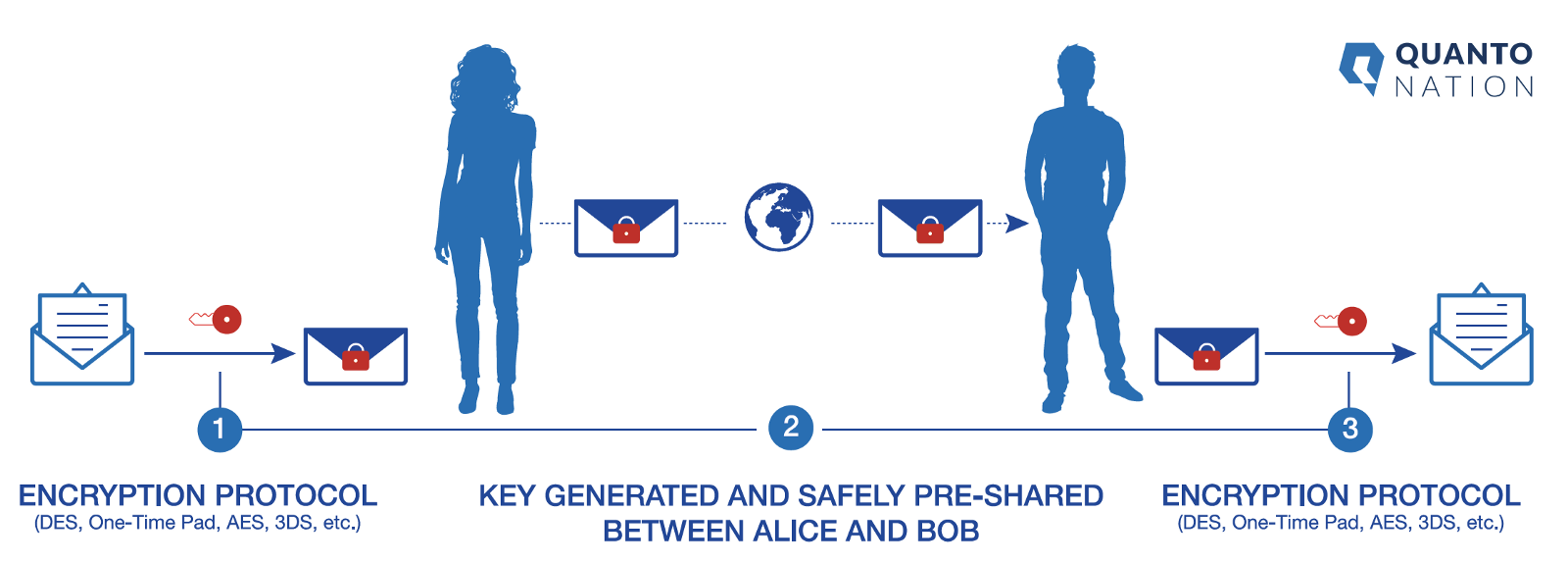 *Use of symmetrical cryptography for Alice and Bob’s secure communications.* This kind of scheme is used in most one-to-one messaging applications like Whatsapp, Messenger or Telegram and in file transfer protocols such as HTTPS and FTPS. It is very commonly used and currently offers good results in terms of security. Two algorithms names that are often mentioned: AES (Advanced Encryption Standard) and One-Time Pad, although this is rarely used because of implementation contraints. AES is currently using most commonly a key size of 128 bits. However, to avoid the fundamental difficulty of pre-sharing a key, another technology, asymmetrical cryptography, emerged in the 80s. It is in particular necessary when one needs to share information with many users without risking this information to be stolen. Two keys that are generated, one public, and one private. The public one is used by Alice to seal the message and send it to Bob who is uniquely identified by this key in a public register. It serves the purpose of authentication. The paired private one, known only to Bob, is necessary to un-encrypt and read the message. 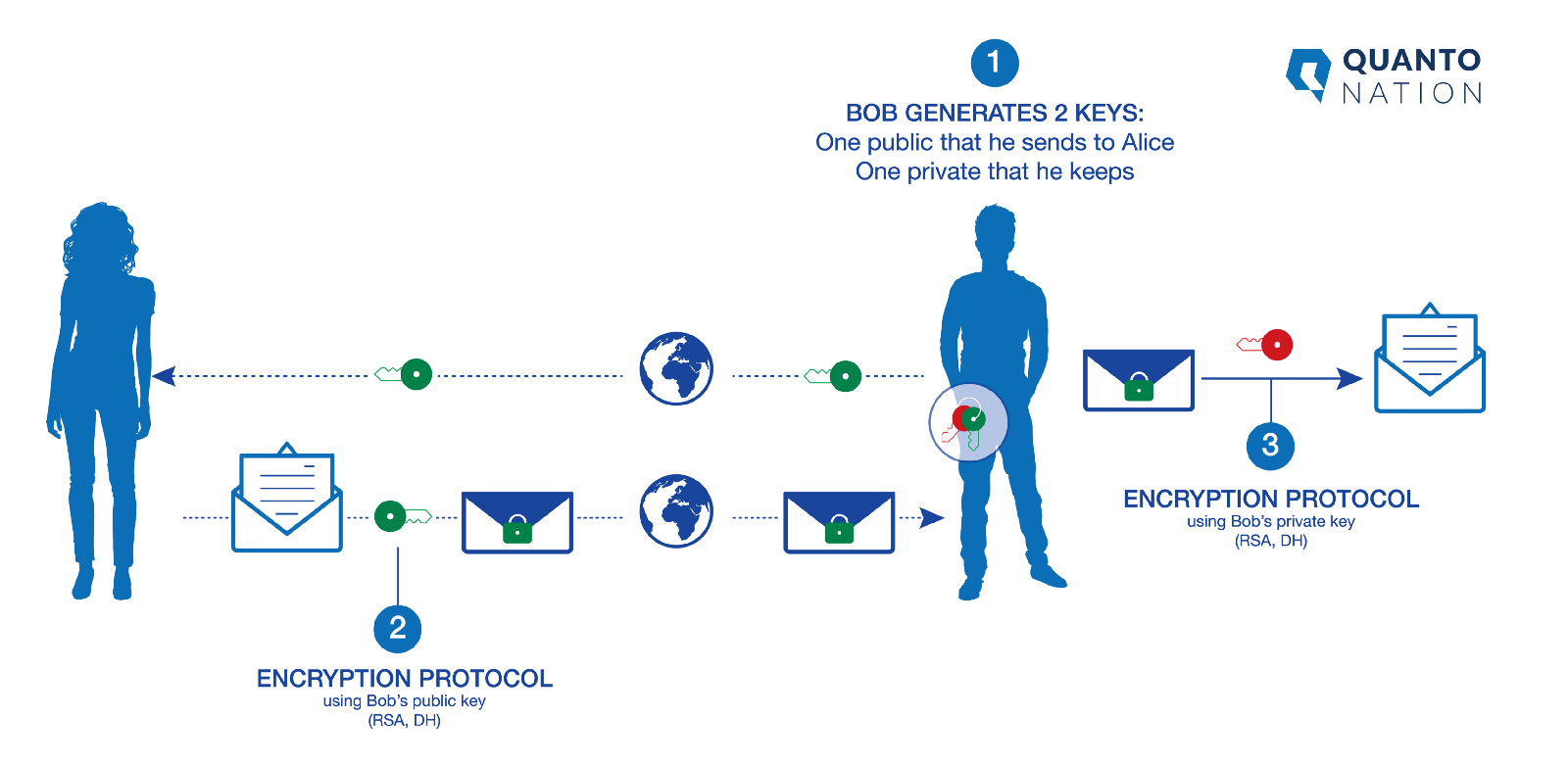 *Use of asymmetric cryptography, with a set of two keys generated by Bob.* Two widely used algorithms: RSA and DH, named according to their authors (Rivest, Shamir, & Adleman and Diffie & Hellman). RSA’s key size is rather large, 2048 bits for most applications. But this is not the whole story. In order to construct a full cryptographic protocol, e.g. TLS for communication security over a computer network, one first needs to choose which security features — primitives — he wants to ensure. TLS is built upon the following primitives : authentication — each participant proves that he is who he pretends to be, key agreement — they share the secret key material that is required to protect their future communications, encryption — they use their shared secret keys to make their communications unintelligible for anyone else , and message integrity — upon receiving a message, they check that it has not been damaged during the transportation. For each of these primitives, the participants can select which specific cryptographic algorithm they wish to employ, e.g. RSA for authentification and key agreement, AES for encryption, HMAC for message integrity. # Quantum Random Number Generators Public and Private Keys come from a sequence of random numbers generated by a machine, creatively called a Random Number Generator (RNG). Their lengths range from 128 to 3076 bits depending on the algorithms. The longer the keys, the harder they are to recover by a hacker. But the more difficult it is also to share and use them. However, current RNGs are not able to fully represent randomness which exposes them to the power of powerful computers potentially able to find a pattern in a “reasonable” time frame. This has been proven and the machines needed to find these patterns don’t need to be quantum computers, not even the largest supercomputers in the world such as Summit or Sunway TaihuLight. **The generation of genuine randomness is considered impossible with only classical means but Quantum Physics can be exploited to generate true random numbers. This is at the heart of Quantum Random Number Generators (QRNG).** There are several proven ways to implement these principles, such as the measurement of radioactive decay of a molecule or the use of the quantum states of light. Even if hardware still lacks flexibility and the key generation throughput is limited, progress has been huge over the last year, several startups have emerged to address a large and attractive market. After all, the security of the whole cyber world relies on random number generation. 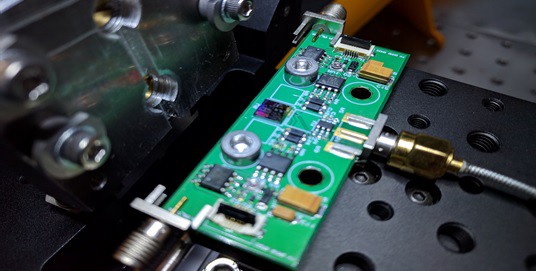 *A Quantum Random Number Generator that fits onto a standard electronic board. Source: KETS* # Quantum Key Distribution There are two ways for a large computer, whether classical or quantum, to steal secret information. The first way is to recover the key generated during the key agreement phase, the second way is by breaking the encryption algorithm. Thanks to works that span a couple of decades, the scientific community has designed solutions to generate unbreakable keys: Quantum Key Distribution, a quantum cryptographic primitive that ensures key agreement, including the well known BB84 (by Bennett & Brassard) and E91 (by Ekert) algorithms amongst many others. QKD makes use of, first, a QRNG to generate random keys and, second, a way to safely share them between Alice and Bob. Suffice it to say here that an extremely profound and elegant principle, the no-cloning theorem, makes sharing cryptographic keys through Quantum Key Distribution extremely safe. If an eavesdropper tries to copy i.e. “clone” a key that is shared between Alice and Bob, the laws of Quantum physics rule that both Alice and Bob will know it at the end of the protocol, so that they can decide not to use this compromised key. Othewise the eavesdropper would be able to read the message they share. Is this secret absolutely safe ? Yes … in principle. The devil is in the details and unavoidable compromises to implement such theory make real world QKD non unconditionnaly safe and vulnerable to so called “side-channel attacks”. **Bottom line: thanks to Quantum physics, secret keys are “much safer” with QKD than with classical communications schemes.** 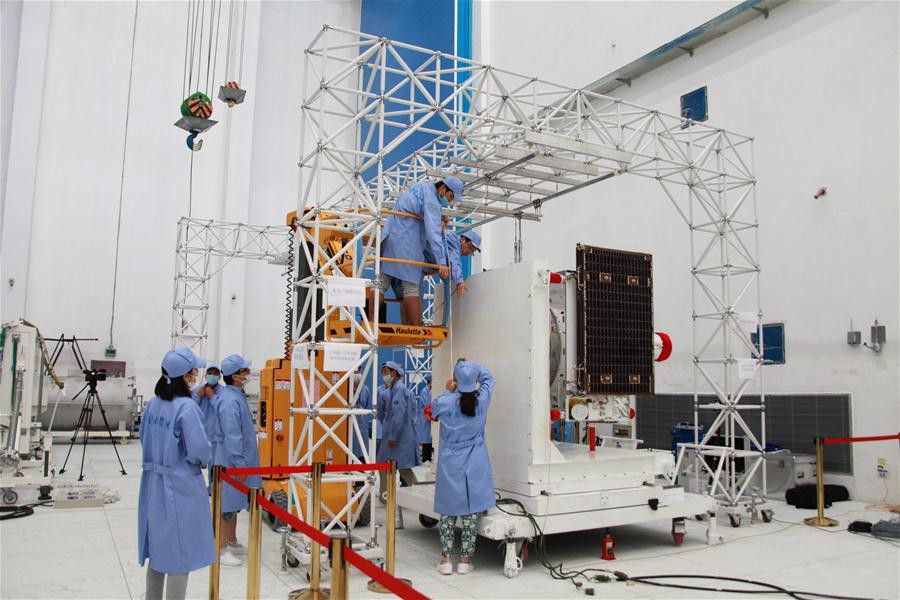 *The world’s first quantum communication satellite was launched by China in 2017 and proved the feasibility of performing quantum key distribution between space and two ground stations. Source: Xinhua.* This technology is still at its early stage. Indeed, most hardware is expensive, limited to relatively short distances (a few hundred kms), and cumbersome. But start-ups and academics are working tirelessly to improve performances. Most spectacularly, a Chinese team has demonstrated in 2017 that a satellite can successfully perform safe communication through QKD and symmetrical cryptography. They even used the technique to make a secure video call to colleagues in Austria who were 2,500 kilometers away. # Post Quantum Cryptography While QKD is becoming a key tool for the cryptographic toolbox, it is clear that it won’t be able to satisfy all protection needs. The way it needs to be implemented makes it impractical for many use cases. **The good news is that there are other ways to improve security with so called “quantum-safe” encryption algorithms. These methods don’t need quantum hardware and are actually not based on the laws of quantum physics but on solving mathematical problems that are currently thought to be computationally difficult for both classical and quantum computers.** That means that, while they can be broken by a powerful enough computer, there is no substantial benefit for a hacker to use a quantum computer. PQC can generate both symmetrical and asymmetrical algorithms and there is no need for a hardware based on quantum phenomena such as the ones we’ve mentionned above. 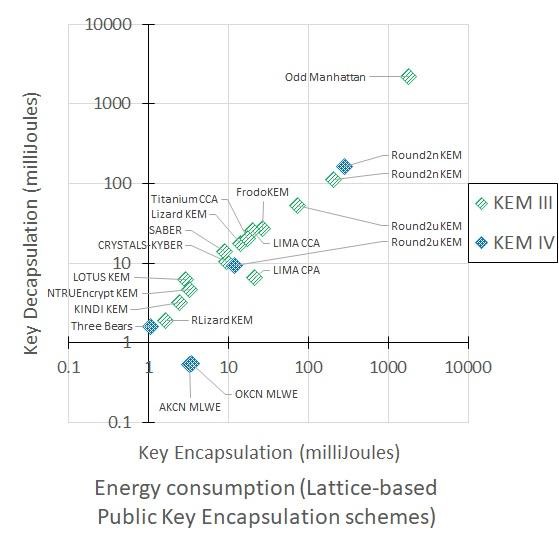 *An example of performance assesment of candidate Algorithms for NIST PQC standardsEnergy. The graph shows energy consumption for key encapsulation and decapsulation, with orders of magnitude differences. This has obviously an impact of the occurence of implementation of these algorithms. After Banerjee and Hasan, 2018* Great, so what’s the catch ? Well, many of the known PQC algorithms are actually not as safe as their inventors claimed them to be. In 2017, NIST (the National Institute of Standards and Technology) initiated a public call for teams worldwide to submit PQC algorithms that would be at the heart of new encryption standards post 2025. **A total of 71 algorithms has been submitted and their robustness against attacks is being tested by teams of researchers all around the world. 6 of them have already been shown unfit for purpose, and 32 are showing weaknesses that might compromise their security.** The updated situation is available in the Post-Quantum Crypto Lounge https://www.safecrypto.eu/pqclounge/. Something else to keep in mind is that some algorithms specify computing requirements that will be very hard to implement realistically any time soon. Energy consumption is one of these criteria (see picture above). # Quantum Attacks and how to protect against them While there are still very active debates about the precise numbers, we estimate that the successful implementation of a Quantum Computer with 100,000 qubits and high gate fidelities will be a strong signal of imminent danger for classical communications. This estimation only holds in the context of our current technological capabilities and will decrease accordingly as future progress in quantum hardware and algorithms design is made, e.g. better gate fidelities and more efficient Quantum Error Correction codes. **As of today, a computer with 100 qubits and good enough gate fidelity is within reach, so we’re some time away from doomsday. Nevertheless, the rapidly increasing chances that a large quantum computer could happen within 10 years is significant enough to put good protections in place now for communications and data which are at the heart of our society. RSA-129 was only a few decades ago …** 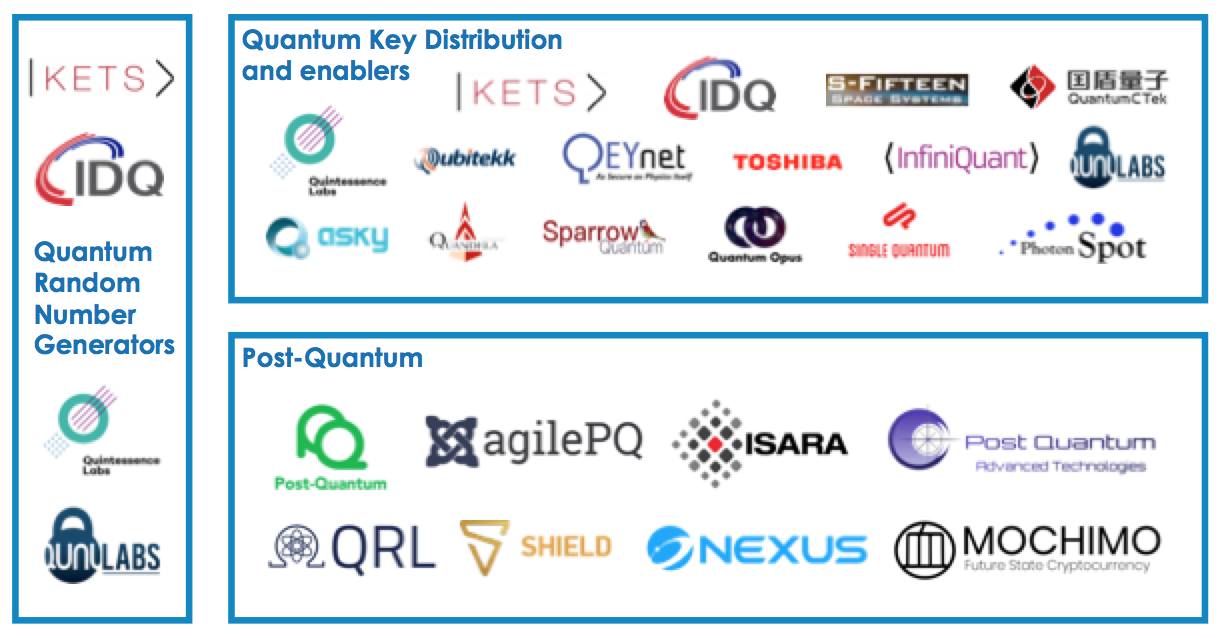 *The Quantum Cybersecurity and Communications industry.* QRNG, QKD, PQC … these are very active and exciting fields of research and the most mature technologies are coming to the market with a first generation of products being commercialized. Some of them are mentioned in the table above, but if we miss something please let us know ! A key application sector for these technologies is the field of crypto currencies, and other blockchain based applications. Some of these startups are precisely working on that. Hold on for a follow up post on Quantum +Blockchain… **If you have a project in these fields, have started a company or even only are thinking about it, reach out to me. I've founded https://www.quantonation.com, an early stage fund dedicated to Deep Physics, including Quantum Technologies as well as Post Quantum cryptography.** |
| json metadata | {"tags":["quantum","cybersecurity","crypto","computing"],"image":["https://cdn.steemitimages.com/DQmaN5zQQjCBtQni3XF8raWzKNgf1DoHUdMaFS9TeE3V9E3/MAtric%20GIF.gif","https://cdn.steemitimages.com/DQmXWzYGaBKPjovP6muHmP6bsNXEBuzd7TqYYenfywjaNSm/Unknown.jpg","https://cdn.steemitimages.com/DQmciSTkghdSyfRnoZarP3wic2fsCKTXeWgaCYw6P5qx2hr/Symm.png","https://cdn.steemitimages.com/DQmPTtv6VWfXq6skD6nm6JHsyz6iEwAcRmscMSxjeGUvzAg/Asymm.png","https://cdn.steemitimages.com/DQmNW2KnHm4ArdUTCqkVErosL6K8wZ2BcfNSDZCCYKKtuCt/QNRG%20Kets.jpg","https://cdn.steemitimages.com/DQmYyuaGxSfTQ2RoNPURGS9EoxPpmJr54JcjVzwhupxWzo7/Satellite%20QKD.jpg","https://cdn.steemitimages.com/DQma7fQxKShCof926yrtU2bh7dc9NzKtkn7Lx5Qpc7vTC5F/PQC%20Energy.jpg","https://cdn.steemitimages.com/DQmdHQZoT67vnvPFkfgJgeCp8f5QWSvASTzoqREnnyjNYpW/Quantum%20Comm%20landscape.png"],"links":["https://www.safecrypto.eu/pqclounge/","https://www.quantonation.com"],"app":"steemit/0.1","format":"markdown"} |
| parent author | |
| parent permlink | quantum |
| permlink | how-to-improve-cybersecurity-through-quantum-technology |
| title | How to improve cybersecurity through quantum technology ? |
| Transaction Info | Block #26165251/Trx a1e08e3d22fe67bb3ab866b5a490a989b2fb1c6b |
View Raw JSON Data
{
"block": 26165251,
"op": [
"comment",
{
"author": "quantum-satoshi",
"body": "\n\nIn 1977, an article in Scientific American stated that it would take 40 quadrillion years to crack a message encrypted with one of the most secure protocols called RSA-129. In fact, twenty years later and within six months the code was cracked using a distributed network of computers.\n\nIn parallel to the progres of “Classical” encryption methods, physicists, mathematicians and engineers have worked on new concepts. Devices have emerged that use the principles of Quantum Physics, and powerful and sophisticated mathematics to communicate safely with respect to any kind of attack, classical or quantum. Why ? Because, until proven otherwise, Quantum Physics is a complete description of the world and, thanks to modern technology, we can at last make the best of its extraordinary features.\n\nMore precisely, quantum technologies and mathematics are used to face the threat that emerging Quantum Computers pose for cybersecurity. Quantum Computers will be able to run ultra-complex models and solve extremely hard mathematical problems. And they will also be able to endanger most current and convenient encryption methods because of this previously unimaginable power. That will not happen tomorrow, because the machines needed to break encryption are insanely large from today’s perspective. But it is a serious enough threat that NIST, the US based certification body, has launched a call for propositions for so called “quantum safe” encryption algorithms to be implemented in the next decade.\n\n>This move has been triggered in part by a statement by the NSA in 2015 that surprised the whole community: *for those >partners and vendors that have not yet made the transition to Suite B elliptic curve algorithms, we recommend not >making a significant expenditure to do so at this point but instead to prepare for the upcoming quantum resistant >algorithm transition*.\n\nThe thinking is: given the time it takes to implement a new standard, 5 to 10 years at least, better to be safe than sorry and do the right think from the start. After all, the day a powerful enough Quantum Computer is available, it might not be made public, and a malicious hacker will be able to read ALL the data that has been encrypted with “old” methods like an open book.\n\n\n\n**Cryptocalypse ? Well, maybe not …**\n\n**There are already commercial technologies that can protect against the threat posed by very powerful machines such as Quantum Computers. They increase substantially the level of security but it’s not a panacea. In practice, real life introduces imperfections in hardware that reduce the level of safety. And algorithmic solutions are safe only until proven overwise by hackers…**\n\nLet’s dig into this.\n\n# First, what is cryptography?\n\nCryptography is a method used to secure a set of data, to hinder any unwanted party to have access to them. For instance, all our online discussions, web-conferences, random web browsing sessions are safe thanks to cryptographic methods.\n\n**The way our data is protected is through a cryptographic algorithm which needs a key to be encrypted and a key to be decrypted. The use of the same private key (a specific string of bits) to encrypt and decrypt is called symmetrical cryptography, whereas the use of one key (“ public”) to encrypt and another one (“ private”) to decrypt is called asymmetrical (or public key) cryptography.**\n\nAs an example, Alice is willing to talk to Bob but she doesn’t want anyone else to know, so she uses symmetrical cryptography as shown below. Alice’s key is shared with Bob sometime before the actual valuable information is shared. Then Bob can un-encrypt Alice’s message thanks to this key.\n\n\n*Use of symmetrical cryptography for Alice and Bob’s secure communications.*\n\nThis kind of scheme is used in most one-to-one messaging applications like Whatsapp, Messenger or Telegram and in file transfer protocols such as HTTPS and FTPS. It is very commonly used and currently offers good results in terms of security. Two algorithms names that are often mentioned: AES (Advanced Encryption Standard) and One-Time Pad, although this is rarely used because of implementation contraints. AES is currently using most commonly a key size of 128 bits.\nHowever, to avoid the fundamental difficulty of pre-sharing a key, another technology, asymmetrical cryptography, emerged in the 80s. It is in particular necessary when one needs to share information with many users without risking this information to be stolen. Two keys that are generated, one public, and one private. The public one is used by Alice to seal the message and send it to Bob who is uniquely identified by this key in a public register. It serves the purpose of authentication. The paired private one, known only to Bob, is necessary to un-encrypt and read the message.\n\n\n*Use of asymmetric cryptography, with a set of two keys generated by Bob.*\n\nTwo widely used algorithms: RSA and DH, named according to their authors (Rivest, Shamir, & Adleman and Diffie & Hellman). RSA’s key size is rather large, 2048 bits for most applications.\n\nBut this is not the whole story. In order to construct a full cryptographic protocol, e.g. TLS for communication security over a computer network, one first needs to choose which security features — primitives — he wants to ensure. TLS is built upon the following primitives : authentication — each participant proves that he is who he pretends to be, key agreement — they share the secret key material that is required to protect their future communications, encryption — they use their shared secret keys to make their communications unintelligible for anyone else , and message integrity — upon receiving a message, they check that it has not been damaged during the transportation. For each of these primitives, the participants can select which specific cryptographic algorithm they wish to employ, e.g. RSA for authentification and key agreement, AES for encryption, HMAC for message integrity.\n\n# Quantum Random Number Generators\n\nPublic and Private Keys come from a sequence of random numbers generated by a machine, creatively called a Random Number Generator (RNG). Their lengths range from 128 to 3076 bits depending on the algorithms. The longer the keys, the harder they are to recover by a hacker. But the more difficult it is also to share and use them.\nHowever, current RNGs are not able to fully represent randomness which exposes them to the power of powerful computers potentially able to find a pattern in a “reasonable” time frame. This has been proven and the machines needed to find these patterns don’t need to be quantum computers, not even the largest supercomputers in the world such as Summit or Sunway TaihuLight.\n\n**The generation of genuine randomness is considered impossible with only classical means but Quantum Physics can be exploited to generate true random numbers. This is at the heart of Quantum Random Number Generators (QRNG).**\n\nThere are several proven ways to implement these principles, such as the measurement of radioactive decay of a molecule or the use of the quantum states of light. Even if hardware still lacks flexibility and the key generation throughput is limited, progress has been huge over the last year, several startups have emerged to address a large and attractive market. After all, the security of the whole cyber world relies on random number generation.\n\n\n*A Quantum Random Number Generator that fits onto a standard electronic board. Source: KETS*\n\n# Quantum Key Distribution\n\nThere are two ways for a large computer, whether classical or quantum, to steal secret information. The first way is to recover the key generated during the key agreement phase, the second way is by breaking the encryption algorithm.\nThanks to works that span a couple of decades, the scientific community has designed solutions to generate unbreakable keys: Quantum Key Distribution, a quantum cryptographic primitive that ensures key agreement, including the well known BB84 (by Bennett & Brassard) and E91 (by Ekert) algorithms amongst many others. QKD makes use of, first, a QRNG to generate random keys and, second, a way to safely share them between Alice and Bob.\n\nSuffice it to say here that an extremely profound and elegant principle, the no-cloning theorem, makes sharing cryptographic keys through Quantum Key Distribution extremely safe. If an eavesdropper tries to copy i.e. “clone” a key that is shared between Alice and Bob, the laws of Quantum physics rule that both Alice and Bob will know it at the end of the protocol, so that they can decide not to use this compromised key. Othewise the eavesdropper would be able to read the message they share.\n\nIs this secret absolutely safe ? Yes … in principle. The devil is in the details and unavoidable compromises to implement such theory make real world QKD non unconditionnaly safe and vulnerable to so called “side-channel attacks”.\n\n**Bottom line: thanks to Quantum physics, secret keys are “much safer” with QKD than with classical communications schemes.**\n\n\n*The world’s first quantum communication satellite was launched by China in 2017 and proved the feasibility of performing quantum key distribution between space and two ground stations. Source: Xinhua.*\n\nThis technology is still at its early stage. Indeed, most hardware is expensive, limited to relatively short distances (a few hundred kms), and cumbersome. But start-ups and academics are working tirelessly to improve performances. Most spectacularly, a Chinese team has demonstrated in 2017 that a satellite can successfully perform safe communication through QKD and symmetrical cryptography. They even used the technique to make a secure video call to colleagues in Austria who were 2,500 kilometers away.\n\n# Post Quantum Cryptography\n\nWhile QKD is becoming a key tool for the cryptographic toolbox, it is clear that it won’t be able to satisfy all protection needs. The way it needs to be implemented makes it impractical for many use cases.\n\n**The good news is that there are other ways to improve security with so called “quantum-safe” encryption algorithms. These methods don’t need quantum hardware and are actually not based on the laws of quantum physics but on solving mathematical problems that are currently thought to be computationally difficult for both classical and quantum computers.**\n\nThat means that, while they can be broken by a powerful enough computer, there is no substantial benefit for a hacker to use a quantum computer. PQC can generate both symmetrical and asymmetrical algorithms and there is no need for a hardware based on quantum phenomena such as the ones we’ve mentionned above.\n\n\n*An example of performance assesment of candidate Algorithms for NIST PQC standardsEnergy. The graph shows energy consumption for key encapsulation and decapsulation, with orders of magnitude differences. This has obviously an impact of the occurence of implementation of these algorithms. After Banerjee and Hasan, 2018*\n\nGreat, so what’s the catch ? Well, many of the known PQC algorithms are actually not as safe as their inventors claimed them to be. In 2017, NIST (the National Institute of Standards and Technology) initiated a public call for teams worldwide to submit PQC algorithms that would be at the heart of new encryption standards post 2025.\n\n**A total of 71 algorithms has been submitted and their robustness against attacks is being tested by teams of researchers all around the world. 6 of them have already been shown unfit for purpose, and 32 are showing weaknesses that might compromise their security.**\n\nThe updated situation is available in the Post-Quantum Crypto Lounge https://www.safecrypto.eu/pqclounge/. Something else to keep in mind is that some algorithms specify computing requirements that will be very hard to implement realistically any time soon. Energy consumption is one of these criteria (see picture above).\n\n# Quantum Attacks and how to protect against them\n\nWhile there are still very active debates about the precise numbers, we estimate that the successful implementation of a Quantum Computer with 100,000 qubits and high gate fidelities will be a strong signal of imminent danger for classical communications. This estimation only holds in the context of our current technological capabilities and will decrease accordingly as future progress in quantum hardware and algorithms design is made, e.g. better gate fidelities and more efficient Quantum Error Correction codes.\n\n**As of today, a computer with 100 qubits and good enough gate fidelity is within reach, so we’re some time away from doomsday. Nevertheless, the rapidly increasing chances that a large quantum computer could happen within 10 years is significant enough to put good protections in place now for communications and data which are at the heart of our society. RSA-129 was only a few decades ago …**\n\n\n*The Quantum Cybersecurity and Communications industry.*\n\nQRNG, QKD, PQC … these are very active and exciting fields of research and the most mature technologies are coming to the market with a first generation of products being commercialized. Some of them are mentioned in the table above, but if we miss something please let us know ! A key application sector for these technologies is the field of crypto currencies, and other blockchain based applications. Some of these startups are precisely working on that. Hold on for a follow up post on Quantum +Blockchain…\n\n**If you have a project in these fields, have started a company or even only are thinking about it, reach out to me. I've founded https://www.quantonation.com, an early stage fund dedicated to Deep Physics, including Quantum Technologies as well as Post Quantum cryptography.**",
"json_metadata": "{\"tags\":[\"quantum\",\"cybersecurity\",\"crypto\",\"computing\"],\"image\":[\"https://cdn.steemitimages.com/DQmaN5zQQjCBtQni3XF8raWzKNgf1DoHUdMaFS9TeE3V9E3/MAtric%20GIF.gif\",\"https://cdn.steemitimages.com/DQmXWzYGaBKPjovP6muHmP6bsNXEBuzd7TqYYenfywjaNSm/Unknown.jpg\",\"https://cdn.steemitimages.com/DQmciSTkghdSyfRnoZarP3wic2fsCKTXeWgaCYw6P5qx2hr/Symm.png\",\"https://cdn.steemitimages.com/DQmPTtv6VWfXq6skD6nm6JHsyz6iEwAcRmscMSxjeGUvzAg/Asymm.png\",\"https://cdn.steemitimages.com/DQmNW2KnHm4ArdUTCqkVErosL6K8wZ2BcfNSDZCCYKKtuCt/QNRG%20Kets.jpg\",\"https://cdn.steemitimages.com/DQmYyuaGxSfTQ2RoNPURGS9EoxPpmJr54JcjVzwhupxWzo7/Satellite%20QKD.jpg\",\"https://cdn.steemitimages.com/DQma7fQxKShCof926yrtU2bh7dc9NzKtkn7Lx5Qpc7vTC5F/PQC%20Energy.jpg\",\"https://cdn.steemitimages.com/DQmdHQZoT67vnvPFkfgJgeCp8f5QWSvASTzoqREnnyjNYpW/Quantum%20Comm%20landscape.png\"],\"links\":[\"https://www.safecrypto.eu/pqclounge/\",\"https://www.quantonation.com\"],\"app\":\"steemit/0.1\",\"format\":\"markdown\"}",
"parent_author": "",
"parent_permlink": "quantum",
"permlink": "how-to-improve-cybersecurity-through-quantum-technology",
"title": "How to improve cybersecurity through quantum technology ?"
}
],
"op_in_trx": 0,
"timestamp": "2018-09-22T10:40:45",
"trx_id": "a1e08e3d22fe67bb3ab866b5a490a989b2fb1c6b",
"trx_in_block": 60,
"virtual_op": 0
}steemdelegated 18.556 SP to @quantum-satoshi2018/08/14 23:10:36
steemdelegated 18.556 SP to @quantum-satoshi
2018/08/14 23:10:36
| delegatee | quantum-satoshi |
| delegator | steem |
| vesting shares | 30175.903190 VESTS |
| Transaction Info | Block #25073127/Trx 1e1b2459f365584116adbd123ef343bfbe11f33e |
View Raw JSON Data
{
  "block": 25073127,
  "op": [
    "delegate_vesting_shares",
    {
      "delegatee": "quantum-satoshi",
      "delegator": "steem",
      "vesting_shares": "30175.903190 VESTS"
    }
  ],
  "op_in_trx": 0,
  "timestamp": "2018-08-14T23:10:36",
  "trx_id": "1e1b2459f365584116adbd123ef343bfbe11f33e",
  "trx_in_block": 52,
  "virtual_op": 0
}steemcreated a new account: @quantum-satoshi2018/08/14 20:47:06
steemcreated a new account: @quantum-satoshi
2018/08/14 20:47:06
| active | {"account_auths":[],"key_auths":[["STM7Fds1KQWpWTVMbKn5t19x6hyYYBJLFHj2ouPfZJFVnMu5M6gnt",1]],"weight_threshold":1} |
| creator | steem |
| delegation | 30690.000000 VESTS |
| extensions | [] |
| fee | 0.100 STEEM |
| json metadata | {} |
| memo key | STM8gqA7qsbc6qyHVPWnTvbBomKhXytsbDPS9LDMkEyUdkG1XRSra |
| new account name | quantum-satoshi |
| owner | {"account_auths":[],"key_auths":[["STM8epqqYGkZtHptwHg9TszkaokKLj9ZTG9tbC8LN3q3Ud2sfQAmx",1]],"weight_threshold":1} |
| posting | {"account_auths":[],"key_auths":[["STM84C4Ci2w3qpkBSTTEpazyhBGLnGzFp9zJXdEX4tuJ38zU2paT5",1]],"weight_threshold":1} |
| Transaction Info | Block #25070258/Trx 17c5d444793ddba8b7331eab2e02747bd9c37d2f |
View Raw JSON Data
{
  "block": 25070258,
  "op": [
    "account_create_with_delegation",
    {
      "active": {
        "account_auths": [],
        "key_auths": [
          [
            "STM7Fds1KQWpWTVMbKn5t19x6hyYYBJLFHj2ouPfZJFVnMu5M6gnt",
            1
          ]
        ],
        "weight_threshold": 1
      },
      "creator": "steem",
      "delegation": "30690.000000 VESTS",
      "extensions": [],
      "fee": "0.100 STEEM",
      "json_metadata": "{}",
      "memo_key": "STM8gqA7qsbc6qyHVPWnTvbBomKhXytsbDPS9LDMkEyUdkG1XRSra",
      "new_account_name": "quantum-satoshi",
      "owner": {
        "account_auths": [],
        "key_auths": [
          [
            "STM8epqqYGkZtHptwHg9TszkaokKLj9ZTG9tbC8LN3q3Ud2sfQAmx",
            1
          ]
        ],
        "weight_threshold": 1
      },
      "posting": {
        "account_auths": [],
        "key_auths": [
          [
            "STM84C4Ci2w3qpkBSTTEpazyhBGLnGzFp9zJXdEX4tuJ38zU2paT5",
            1
          ]
        ],
        "weight_threshold": 1
      }
    }
  ],
  "op_in_trx": 0,
  "timestamp": "2018-08-14T20:47:06",
  "trx_id": "17c5d444793ddba8b7331eab2e02747bd9c37d2f",
  "trx_in_block": 30,
  "virtual_op": 0
}Manabar
Voting Power100.00%
Downvote Power100.00%
Resource Credits100.00%
Reputation Progress0.00%
{
  "voting_manabar": {
    "current_mana": "8143659806",
    "last_update_time": 1779081702
  },
  "downvote_manabar": {
    "current_mana": 2035914951,
    "last_update_time": 1779081702
  },
  "rc_account": {
    "account": "quantum-satoshi",
    "max_rc": "10164408779",
    "max_rc_creation_adjustment": {
      "amount": "2020748973",
      "nai": "@@000000037",
      "precision": 6
    },
    "rc_manabar": {
      "current_mana": "10164408779",
      "last_update_time": 1779081702
    }
  }
}
Account Metadata
| POSTING JSON METADATA | |
| None | |
| JSON METADATA | |
| None |
{
  "posting_json_metadata": {},
  "json_metadata": {}
}
Auth Keys
Owner
Single Signature
Public Keys
STM8epqqYGkZtHptwHg9TszkaokKLj9ZTG9tbC8LN3q3Ud2sfQAmx1/1
Active
Single Signature
Public Keys
STM7Fds1KQWpWTVMbKn5t19x6hyYYBJLFHj2ouPfZJFVnMu5M6gnt1/1
Posting
Single Signature
Public Keys
STM84C4Ci2w3qpkBSTTEpazyhBGLnGzFp9zJXdEX4tuJ38zU2paT51/1
Memo
STM8gqA7qsbc6qyHVPWnTvbBomKhXytsbDPS9LDMkEyUdkG1XRSra
{
  "owner": {
    "account_auths": [],
    "key_auths": [
      [
        "STM8epqqYGkZtHptwHg9TszkaokKLj9ZTG9tbC8LN3q3Ud2sfQAmx",
        1
      ]
    ],
    "weight_threshold": 1
  },
  "active": {
    "account_auths": [],
    "key_auths": [
      [
        "STM7Fds1KQWpWTVMbKn5t19x6hyYYBJLFHj2ouPfZJFVnMu5M6gnt",
        1
      ]
    ],
    "weight_threshold": 1
  },
  "posting": {
    "account_auths": [],
    "key_auths": [
      [
        "STM84C4Ci2w3qpkBSTTEpazyhBGLnGzFp9zJXdEX4tuJ38zU2paT5",
        1
      ]
    ],
    "weight_threshold": 1
  },
  "memo": "STM8gqA7qsbc6qyHVPWnTvbBomKhXytsbDPS9LDMkEyUdkG1XRSra"
}
Witness Votes
0 / 30
No active witness votes.
[]