

@syntaxtechs
31Syntax Technologies is the world’s leading online training provider established in Virginia. It provides training and solutions for the IT industry.
steemit.com/@syntaxtechsVOTING POWER100.00%
DOWNVOTE POWER100.00%
RESOURCE CREDITS100.00%
REPUTATION PROGRESS30.70%
Net Worth
0.012USD
STEEM
0.214STEEM
SBD
0.000SBD
Effective Power
3.398SP
├── Own SP
0.000SP
└── Incoming DelegationsDeleg
+3.398SP
Detailed Balance
| STEEM | ||
| balance | 0.185STEEM | STEEM |
| market_balance | 0.000STEEM | STEEM |
| savings_balance | 0.000STEEM | STEEM |
| reward_steem_balance | 0.029STEEM | STEEM |
| STEEM POWER | ||
| Own SP | 0.000SP | SP |
| Delegated Out | 0.000SP | SP |
| Delegation In | 3.398SP | SP |
| Effective Power | 3.398SP | SP |
| Reward SP (pending) | 0.030SP | SP |
| SBD | ||
| sbd_balance | 0.000SBD | SBD |
| sbd_conversions | 0.000SBD | SBD |
| sbd_market_balance | 0.000SBD | SBD |
| savings_sbd_balance | 0.000SBD | SBD |
| reward_sbd_balance | 0.000SBD | SBD |
{
  "balance": "0.185 STEEM",
  "savings_balance": "0.000 STEEM",
  "reward_steem_balance": "0.029 STEEM",
  "vesting_shares": "0.000000 VESTS",
  "delegated_vesting_shares": "0.000000 VESTS",
  "received_vesting_shares": "5526.307897 VESTS",
  "sbd_balance": "0.000 SBD",
  "savings_sbd_balance": "0.000 SBD",
  "reward_sbd_balance": "0.000 SBD",
  "conversions": []
}
Account Info
| name | syntaxtechs |
| id | 1743347 |
| rank | 868,441 |
| reputation | 5020854913 |
| created | 2022-09-09T06:50:21 |
| recovery_account | steemcurator01 |
| proxy | None |
| post_count | 86 |
| comment_count | 0 |
| lifetime_vote_count | 0 |
| witnesses_voted_for | 0 |
| last_post | 2024-05-06T12:26:27 |
| last_root_post | 2024-05-06T12:26:27 |
| last_vote_time | 2022-09-09T07:15:12 |
| proxied_vsf_votes | 0, 0, 0, 0 |
| can_vote | 1 |
| voting_power | 0 |
| delayed_votes | 0 |
| balance | 0.185 STEEM |
| savings_balance | 0.000 STEEM |
| sbd_balance | 0.000 SBD |
| savings_sbd_balance | 0.000 SBD |
| vesting_shares | 0.000000 VESTS |
| delegated_vesting_shares | 0.000000 VESTS |
| received_vesting_shares | 5526.307897 VESTS |
| reward_vesting_balance | 54.011461 VESTS |
| vesting_balance | 0.000 STEEM |
| vesting_withdraw_rate | 0.000000 VESTS |
| next_vesting_withdrawal | 1969-12-31T23:59:59 |
| withdrawn | 0 |
| to_withdraw | 0 |
| withdraw_routes | 0 |
| savings_withdraw_requests | 0 |
| last_account_recovery | 1970-01-01T00:00:00 |
| reset_account | null |
| last_owner_update | 1970-01-01T00:00:00 |
| last_account_update | 2023-06-22T12:17:33 |
| mined | No |
| sbd_seconds | 0 |
| sbd_last_interest_payment | 1970-01-01T00:00:00 |
| savings_sbd_last_interest_payment | 1970-01-01T00:00:00 |
{
  "active": {
    "account_auths": [],
    "key_auths": [
      [
        "STM6WaiQqZ96VZLHV8MKt2APG637FBDLZYGQH3MfBgQRBLwL3dG5x",
        1
      ]
    ],
    "weight_threshold": 1
  },
  "balance": "0.185 STEEM",
  "can_vote": true,
  "comment_count": 0,
  "created": "2022-09-09T06:50:21",
  "curation_rewards": 0,
  "delegated_vesting_shares": "0.000000 VESTS",
  "downvote_manabar": {
    "current_mana": 1381576974,
    "last_update_time": 1757491521
  },
  "guest_bloggers": [],
  "id": 1743347,
  "json_metadata": "{}",
  "last_account_recovery": "1970-01-01T00:00:00",
  "last_account_update": "2023-06-22T12:17:33",
  "last_owner_update": "1970-01-01T00:00:00",
  "last_post": "2024-05-06T12:26:27",
  "last_root_post": "2024-05-06T12:26:27",
  "last_vote_time": "2022-09-09T07:15:12",
  "lifetime_vote_count": 0,
  "market_history": [],
  "memo_key": "STM8kD19r914wPpKCfKjRepsKRHx4vqvfJVPQCR5esgvAm76YkMi2",
  "mined": false,
  "name": "syntaxtechs",
  "next_vesting_withdrawal": "1969-12-31T23:59:59",
  "other_history": [],
  "owner": {
    "account_auths": [],
    "key_auths": [
      [
        "STM52FZU4n33W7UMSnXPbQzkumcryJu5i4pH4oacG7ZytLdVFyw7C",
        1
      ]
    ],
    "weight_threshold": 1
  },
  "pending_claimed_accounts": 0,
  "post_bandwidth": 0,
  "post_count": 86,
  "post_history": [],
  "posting": {
    "account_auths": [],
    "key_auths": [
      [
        "STM7VbFmdxzP9a9ZCsfDb5DE7Q2HSy9rZ2dVZnsg5WhHo8JV2jGUx",
        1
      ]
    ],
    "weight_threshold": 1
  },
  "posting_json_metadata": "{\"profile\":{\"name\":\"Syntax Technologies\",\"about\":\"Syntax Technologies is the world’s leading online training provider established in Virginia. It provides training and solutions for the IT industry.\",\"location\":\"14120 Newbrook Dr Suite #210 C\",\"website\":\"https://www.syntaxtechs.com/blog/sdet-vs-qa\",\"version\":2,\"profile_image\":\"https://cdn.steemitimages.com/DQmay5bBQXTjAJZEp1Bf9Ho5Xqir7vTCqxx3x6L9Nky9eWx/syntaxtechs_1050x1500.png\"}}",
  "posting_rewards": 59,
  "proxied_vsf_votes": [
    0,
    0,
    0,
    0
  ],
  "proxy": "",
  "received_vesting_shares": "5526.307897 VESTS",
  "recovery_account": "steemcurator01",
  "reputation": "5020854913",
  "reset_account": "null",
  "reward_sbd_balance": "0.000 SBD",
  "reward_steem_balance": "0.029 STEEM",
  "reward_vesting_balance": "54.011461 VESTS",
  "reward_vesting_steem": "0.030 STEEM",
  "savings_balance": "0.000 STEEM",
  "savings_sbd_balance": "0.000 SBD",
  "savings_sbd_last_interest_payment": "1970-01-01T00:00:00",
  "savings_sbd_seconds": "0",
  "savings_sbd_seconds_last_update": "1970-01-01T00:00:00",
  "savings_withdraw_requests": 0,
  "sbd_balance": "0.000 SBD",
  "sbd_last_interest_payment": "1970-01-01T00:00:00",
  "sbd_seconds": "0",
  "sbd_seconds_last_update": "1970-01-01T00:00:00",
  "tags_usage": [],
  "to_withdraw": 0,
  "transfer_history": [],
  "vesting_balance": "0.000 STEEM",
  "vesting_shares": "0.000000 VESTS",
  "vesting_withdraw_rate": "0.000000 VESTS",
  "vote_history": [],
  "voting_manabar": {
    "current_mana": "5526307897",
    "last_update_time": 1757491521
  },
  "voting_power": 0,
  "withdraw_routes": 0,
  "withdrawn": 0,
  "witness_votes": [],
  "witnesses_voted_for": 0,
  "rank": 868441
}
Withdraw Routes
| Incoming | Outgoing |
|---|---|
Empty | Empty |
{
  "incoming": [],
  "outgoing": []
}From Date
To Date
lewiswoodreplied to @syntaxtechs / t2zfye2025/09/22 09:06:15
lewiswoodreplied to @syntaxtechs / t2zfye
2025/09/22 09:06:15
| author | lewiswood |
| body | In 2024, business intelligence tools have evolved to become even more intuitive and powerful. They offer companies a comprehensive view of their performance, helping them make informed decisions based on real-time data. For businesses looking to improve their reporting, services from [here](https://www.reportsimple.com.au/about-us) offer advanced business intelligence solutions tailored to your needs. With their expertise in data analytics, businesses can streamline their reporting processes, uncover valuable insights, and gain a competitive edge in the marketplace. |
| json metadata | {"links":["https://www.reportsimple.com.au/about-us"],"app":"steemit/0.2"} |
| parent author | syntaxtechs |
| parent permlink | top-business-intelligence-reporting-tools-in-2024-a-comprehensive-guide |
| permlink | t2zfye |
| title | |
| Transaction Info | Block #99319898/Trx e6b983738395b177c2b4a2a0864624e22c5ebda8 |
View Raw JSON Data
{
  "block": 99319898,
  "op": [
    "comment",
    {
      "author": "lewiswood",
      "body": "In 2024, business intelligence tools have evolved to become even more intuitive and powerful. They offer companies a comprehensive view of their performance, helping them make informed decisions based on real-time data. For businesses looking to improve their reporting, services from [here](https://www.reportsimple.com.au/about-us) offer advanced business intelligence solutions tailored to your needs. With their expertise in data analytics, businesses can streamline their reporting processes, uncover valuable insights, and gain a competitive edge in the marketplace.",
      "json_metadata": "{\"links\":[\"https://www.reportsimple.com.au/about-us\"],\"app\":\"steemit/0.2\"}",
      "parent_author": "syntaxtechs",
      "parent_permlink": "top-business-intelligence-reporting-tools-in-2024-a-comprehensive-guide",
      "permlink": "t2zfye",
      "title": ""
    }
  ],
  "op_in_trx": 0,
  "timestamp": "2025-09-22T09:06:15",
  "trx_id": "e6b983738395b177c2b4a2a0864624e22c5ebda8",
  "trx_in_block": 2,
  "virtual_op": 0
}steemdelegated 3.398 SP to @syntaxtechs2025/09/10 08:05:21
steemdelegated 3.398 SP to @syntaxtechs
2025/09/10 08:05:21
| delegatee | syntaxtechs |
| delegator | steem |
| vesting shares | 5526.307897 VESTS |
| Transaction Info | Block #98973877/Trx b67760a913772b003ebe6d5c2affd3399da9d7d7 |
View Raw JSON Data
{
  "block": 98973877,
  "op": [
    "delegate_vesting_shares",
    {
      "delegatee": "syntaxtechs",
      "delegator": "steem",
      "vesting_shares": "5526.307897 VESTS"
    }
  ],
  "op_in_trx": 0,
  "timestamp": "2025-09-10T08:05:21",
  "trx_id": "b67760a913772b003ebe6d5c2affd3399da9d7d7",
  "trx_in_block": 2,
  "virtual_op": 0
}darkswerreplied to @syntaxtechs / sossej2024/12/20 15:01:45
darkswerreplied to @syntaxtechs / sossej
2024/12/20 15:01:45
| author | darkswer |
| body | If coding isn’t your thing but you still want to dive into the tech world, there are loads of jobs where you don’t need to write a single line of code. Roles like project manager, UX/UI designer, or tech sales are great options. Data analysts, too, often work with tools rather than actual coding. Another cool one is a tech recruiter—helping companies find the best talent. Then there's cybersecurity analysts, who focus on protecting systems, and even roles in tech support, which keep everything running smoothly.I think it's about finding a job that matches your interests and strengths. You can check out [advisedskills.com](https://www.advisedskills.com/corporate-training) for resources to build skills that fit these roles. |
| json metadata | {"links":["https://www.advisedskills.com/corporate-training"],"app":"steemit/0.2"} |
| parent author | syntaxtechs |
| parent permlink | top-tech-jobs-that-don-t-require-coding-skills |
| permlink | sossej |
| title | |
| Transaction Info | Block #91398674/Trx 3fa375682c0cd40be68bbf43c0c0f46734d551fe |
View Raw JSON Data
{
  "block": 91398674,
  "op": [
    "comment",
    {
      "author": "darkswer",
      "body": "If coding isn’t your thing but you still want to dive into the tech world, there are loads of jobs where you don’t need to write a single line of code. Roles like project manager, UX/UI designer, or tech sales are great options. Data analysts, too, often work with tools rather than actual coding. Another cool one is a tech recruiter—helping companies find the best talent. Then there's cybersecurity analysts, who focus on protecting systems, and even roles in tech support, which keep everything running smoothly.I think it's about finding a job that matches your interests and strengths. You can check out [advisedskills.com](https://www.advisedskills.com/corporate-training)  for resources to build skills that fit these roles.",
      "json_metadata": "{\"links\":[\"https://www.advisedskills.com/corporate-training\"],\"app\":\"steemit/0.2\"}",
      "parent_author": "syntaxtechs",
      "parent_permlink": "top-tech-jobs-that-don-t-require-coding-skills",
      "permlink": "sossej",
      "title": ""
    }
  ],
  "op_in_trx": 0,
  "timestamp": "2024-12-20T15:01:45",
  "trx_id": "3fa375682c0cd40be68bbf43c0c0f46734d551fe",
  "trx_in_block": 1,
  "virtual_op": 0
}henry23thomasreplied to @syntaxtechs / soss5m2024/12/20 14:56:24
henry23thomasreplied to @syntaxtechs / soss5m
2024/12/20 14:56:24
| author | henry23thomas |
| body | It's so refreshing to see attention given to non-coding roles in tech. Not everyone wants to dive into programming, and that's okay. Roles like UX/UI design, project management, data analysis, and tech sales are just as critical to driving innovation. |
| json metadata | {"app":"steemit/0.2"} |
| parent author | syntaxtechs |
| parent permlink | top-tech-jobs-that-don-t-require-coding-skills |
| permlink | soss5m |
| title | |
| Transaction Info | Block #91398567/Trx 60d8d6232b8bfe6a15710704175f8bb2ac197573 |
View Raw JSON Data
{
  "block": 91398567,
  "op": [
    "comment",
    {
      "author": "henry23thomas",
      "body": "It's so refreshing to see attention given to non-coding roles in tech. Not everyone wants to dive into programming, and that's okay. Roles like UX/UI design, project management, data analysis, and tech sales are just as critical to driving innovation.",
      "json_metadata": "{\"app\":\"steemit/0.2\"}",
      "parent_author": "syntaxtechs",
      "parent_permlink": "top-tech-jobs-that-don-t-require-coding-skills",
      "permlink": "soss5m",
      "title": ""
    }
  ],
  "op_in_trx": 0,
  "timestamp": "2024-12-20T14:56:24",
  "trx_id": "60d8d6232b8bfe6a15710704175f8bb2ac197573",
  "trx_in_block": 3,
  "virtual_op": 0
}ruvoterupvoted (17.00%) @syntaxtechs / unlocking-the-secrets-of-big-data-analyst-careers2024/11/01 00:19:18
ruvoterupvoted (17.00%) @syntaxtechs / unlocking-the-secrets-of-big-data-analyst-careers
2024/11/01 00:19:18
| author | syntaxtechs |
| permlink | unlocking-the-secrets-of-big-data-analyst-careers |
| voter | ruvoter |
| weight | 1700 (17.00%) |
| Transaction Info | Block #89973615/Trx f8b8e611c55600b3f1dc53c9ffdcebb5e61761bb |
View Raw JSON Data
{
  "block": 89973615,
  "op": [
    "vote",
    {
      "author": "syntaxtechs",
      "permlink": "unlocking-the-secrets-of-big-data-analyst-careers",
      "voter": "ruvoter",
      "weight": 1700
    }
  ],
  "op_in_trx": 0,
  "timestamp": "2024-11-01T00:19:18",
  "trx_id": "f8b8e611c55600b3f1dc53c9ffdcebb5e61761bb",
  "trx_in_block": 0,
  "virtual_op": 0
}steemdelegated 3.500 SP to @syntaxtechs2024/08/05 14:09:45
steemdelegated 3.500 SP to @syntaxtechs
2024/08/05 14:09:45
| delegatee | syntaxtechs |
| delegator | steem |
| vesting shares | 5692.119203 VESTS |
| Transaction Info | Block #87464880/Trx aa4fdb3d618303d27083fa43c101c0ff8578c1a3 |
View Raw JSON Data
{
  "block": 87464880,
  "op": [
    "delegate_vesting_shares",
    {
      "delegatee": "syntaxtechs",
      "delegator": "steem",
      "vesting_shares": "5692.119203 VESTS"
    }
  ],
  "op_in_trx": 0,
  "timestamp": "2024-08-05T14:09:45",
  "trx_id": "aa4fdb3d618303d27083fa43c101c0ff8578c1a3",
  "trx_in_block": 1,
  "virtual_op": 0
}bluesnipersent 0.010 STEEM to @syntaxtechs- "Hello. Good to see you on Steem. To maximize your rewards, publish your post also on Hive ( hive.blog ) and Blurt ( blurt.blog ) blockchains. Use upvu, jsup or ctime and get instant upvotes"2024/05/06 12:32:21
bluesnipersent 0.010 STEEM to @syntaxtechs- "Hello. Good to see you on Steem. To maximize your rewards, publish your post also on Hive ( hive.blog ) and Blurt ( blurt.blog ) blockchains. Use upvu, jsup or ctime and get instant upvotes"
2024/05/06 12:32:21
| amount | 0.010 STEEM |
| from | bluesniper |
| memo | Hello. Good to see you on Steem. To maximize your rewards, publish your post also on Hive ( hive.blog ) and Blurt ( blurt.blog ) blockchains. Use upvu, jsup or ctime and get instant upvotes |
| to | syntaxtechs |
| Transaction Info | Block #84854700/Trx 9114fd37d1c58dd2a384e333e285b3d7a7c2d04b |
View Raw JSON Data
{
  "block": 84854700,
  "op": [
    "transfer",
    {
      "amount": "0.010 STEEM",
      "from": "bluesniper",
      "memo": "Hello. Good to see you on Steem. To maximize your rewards, publish your post also on Hive ( hive.blog ) and Blurt ( blurt.blog ) blockchains. Use upvu, jsup or ctime and get instant upvotes",
      "to": "syntaxtechs"
    }
  ],
  "op_in_trx": 0,
  "timestamp": "2024-05-06T12:32:21",
  "trx_id": "9114fd37d1c58dd2a384e333e285b3d7a7c2d04b",
  "trx_in_block": 7,
  "virtual_op": 0
}bluesniperupvoted (100.00%) @syntaxtechs / basics-of-software-testing-a-comprehensive-guide2024/05/06 12:32:00
bluesniperupvoted (100.00%) @syntaxtechs / basics-of-software-testing-a-comprehensive-guide
2024/05/06 12:32:00
| author | syntaxtechs |
| permlink | basics-of-software-testing-a-comprehensive-guide |
| voter | bluesniper |
| weight | 10000 (100.00%) |
| Transaction Info | Block #84854693/Trx ede7ced3483b047ac753502db0cf09f40bb5e7c9 |
View Raw JSON Data
{
  "block": 84854693,
  "op": [
    "vote",
    {
      "author": "syntaxtechs",
      "permlink": "basics-of-software-testing-a-comprehensive-guide",
      "voter": "bluesniper",
      "weight": 10000
    }
  ],
  "op_in_trx": 0,
  "timestamp": "2024-05-06T12:32:00",
  "trx_id": "ede7ced3483b047ac753502db0cf09f40bb5e7c9",
  "trx_in_block": 3,
  "virtual_op": 0
}syntaxtechspublished a new post: basics-of-software-testing-a-comprehensive-guide2024/05/06 12:26:27
syntaxtechspublished a new post: basics-of-software-testing-a-comprehensive-guide
2024/05/06 12:26:27
| author | syntaxtechs |
| body | Testing software is pivotal in the software development journey. It guarantees that the software aligns with set requirements and operates as intended. This guide will thoroughly explore the <a href="https://www.syntaxtechs.com/blog/the-importance-of-automation-in-sdet-roles/">basics of software testing</a>, encompassing its various types, lifecycle, methodologies, levels, tools, optimal practices, hurdles, significance of documentation, and the prospective advancements in software testing.  <h2>Introduction to Software Testing</h2> <h3>Importance of Software Testing</h3> <a href="https://www.syntaxtechs.com/blog/introduction-to-software-testing-a-beginners-guide/">Software testing</a> plays a vital role in identifying defects early in the development process, which helps in reducing the cost of fixing them later. It ensures the reliability, functionality, and quality of the software, thus enhancing customer satisfaction and trust. <h3>Objectives of Software Testing</h3> The primary objectives of software testing include verifying and validating the software against the specified requirements, detecting defects, ensuring that it meets user expectations, and improving the overall quality of the software. <h2>Types of Software Testing</h2> <h3>Functional Testing</h3> Functional testing involves testing the individual functions or features of the software to ensure that they behave as expected according to the functional requirements. <h3>Non-functional Testing</h3> Non-functional testing focuses on aspects such as performance, usability, reliability, and security of the software rather than its specific functions. <h3>Manual Testing</h3> Manual testing involves executing test cases manually without using any automated tools. It is suitable for ad-hoc testing and exploratory testing. <h3>Automated Testing</h3> Automated testing involves using specialized tools to execute test cases automatically. It helps in saving time and effort, especially for repetitive test cases. <h2>Software Testing Life Cycle (STLC)</h2> <h3>Phases of STLC</h3> The Software Testing Life Cycle consists of phases such as requirement analysis, test planning, test case development, test execution, defect reporting, defect retesting, and closure. <h3>Importance of Each Phase</h3> Each phase of STLC contributes to the overall effectiveness of software testing by ensuring thorough planning, execution, and monitoring of the testing process. <h2>Testing Techniques</h2> <h3>Black Box Testing</h3> Black box testing focuses on testing the functionality of the software without knowing its internal code structure. Testers use input-output combinations to validate the software. <h3>White Box Testing</h3> White box testing involves testing the internal logic, structure, and code of the software. Testers have access to the source code and design to create test cases. <h3>Grey Box Testing</h3> Grey box testing combines elements of both black box and white box testing. Testers have limited knowledge of the internal workings of the software, allowing them to design comprehensive test cases. <h2>Testing Levels</h2> <h3>Unit Testing</h3> Unit testing involves testing individual units or components of the software in isolation to ensure that they work correctly. <h3>Integration Testing</h3> Integration testing verifies the interactions between different units or components of the software to ensure that they function together as intended. <h3>System Testing</h3> System testing involves testing the entire software system as a whole to evaluate its compliance with the specified requirements. <h3>Acceptance Testing</h3> Acceptance testing involves testing the software from the end user's perspective to ensure that it meets their acceptance criteria and business needs. <h2>Testing Artifacts</h2> <h3>Test Plan</h3> A test plan outlines the scope, objectives, approach, resources, and schedule of the testing activities. <h3>Test Cases</h3> Test cases are detailed instructions that specify the inputs, actions, and expected outcomes of individual test scenarios. <h3>Test Scripts</h3> Test scripts are automated test cases written in scripting languages to perform repetitive tests automatically. <h3>Test Reports</h3> Test reports provide detailed information about the test execution, including the test results, defects found, and their status. <h2>Common Testing Tools</h2> <h3>Selenium</h3> Selenium is a popular open-source tool for automating web browsers. It supports various programming languages and browsers. <h3>JUnit</h3> JUnit is a widely used Java framework for writing and running unit tests. It provides annotations and assertions for test case development. <h3>TestNG</h3> TestNG is a testing framework inspired by JUnit and NUnit. It offers additional features such as parameterization and grouping of test cases. <h3>QTP/UFT</h3> QTP (Quick Test Professional) or UFT (Unified Functional Testing) is a commercial tool for functional and regression testing of software applications. <h2>Best Practices in Software Testing</h2> <h3>Test Early and Often</h3> Testing should start as early as possible in the software development life cycle to identify and fix defects early, reducing the cost of rework. <h3>Use Real-World Scenarios</h3> Test scenarios should be based on real-world usage patterns and scenarios to ensure that the software meets user expectations. <h3>Continuous Integration and Testing</h3> Continuous integration and testing practices help in detecting defects early and ensuring the stability of the software through automated build and test processes. <h2>Challenges in Software Testing</h2> <h3>Time Constraints</h3> Limited time for testing often leads to inadequate test coverage and the risk of missing critical defects. <h3>Resource Limitations</h3> A shortage of skilled testers, tools, and infrastructure can hamper the effectiveness of software testing efforts. <h3>Changing Requirements</h3> Frequent changes in requirements during the software development process can make it challenging to maintain test cases and ensure their relevance. <h2>Importance of Documentation in Testing</h2> <h3>Traceability Matrix</h3> A traceability matrix helps in tracing the relationship between requirements, test cases, and defects, ensuring comprehensive test coverage. <h3>Bug Tracking System</h3> A bug tracking system enables testers to report, track, and prioritize defects efficiently, facilitating timely resolution. <h2>The Future of Software Testing</h2> <h3>AI and Machine Learning in Testing</h3> AI and machine learning technologies are increasingly being used in testing for tasks such as test case generation, anomaly detection, and predictive analysis. <h3>Shift-Left Testing Approach</h3> The shift-left testing approach involves shifting testing activities to earlier stages of the software development life cycle to detect and prevent defects sooner. <h2>Conclusion</h2> In conclusion, mastering the basics of software testing is essential for ensuring the quality, reliability, and performance of software applications. By understanding the various types, techniques, levels, and best practices of software testing, organizations can implement effective testing strategies to deliver high-quality software products that meet user expectations. With the advancements in technology and the adoption of innovative testing tools and methodologies, the future of software testing looks promising. AI and machine learning will continue to play a significant role in revolutionizing the testing landscape, enabling organizations to achieve greater efficiency, accuracy, and reliability in their testing efforts. By embracing these trends and best practices, organizations can stay ahead of the curve and ensure their success in today's competitive market landscape. If you're considering a career in software testing, diving into a <a href="https://www.syntaxtechs.com/courses/qa-automation/">QA Automation Engineer Course</a> is a smart move. This course opens up numerous career opportunities in the field of IT. |
| json metadata | {"tags":["softwaretesting","automationtesting","qatesting","softwareengineer","softwaredevelopment","careergoals"],"image":["https://cdn.steemitimages.com/DQmRcimk55vwVyfk2aZmio2hkDkVmF86hr1voqqbzsQYhHH/Basics%20of%20Software%20Testing.png"],"links":["https://www.syntaxtechs.com/blog/the-importance-of-automation-in-sdet-roles/","https://www.syntaxtechs.com/blog/introduction-to-software-testing-a-beginners-guide/","https://www.syntaxtechs.com/courses/qa-automation/"],"app":"steemit/0.2","format":"markdown"} |
| parent author | |
| parent permlink | softwaretesting |
| permlink | basics-of-software-testing-a-comprehensive-guide |
| title | Basics of Software Testing: A Comprehensive Guide |
| Transaction Info | Block #84854583/Trx 71b9d8474c353d7b542c0c8f02dec3e6a2becd4f |
View Raw JSON Data
{
"block": 84854583,
"op": [
"comment",
{
"author": "syntaxtechs",
"body": "Testing software is pivotal in the software development journey. It guarantees that the software aligns with set requirements and operates as intended. This guide will thoroughly explore the <a href=\"https://www.syntaxtechs.com/blog/the-importance-of-automation-in-sdet-roles/\">basics of software testing</a>, encompassing its various types, lifecycle, methodologies, levels, tools, optimal practices, hurdles, significance of documentation, and the prospective advancements in software testing.\n\n\n\n\n\n<h2>Introduction to Software Testing</h2>\n<h3>Importance of Software Testing</h3>\n<a href=\"https://www.syntaxtechs.com/blog/introduction-to-software-testing-a-beginners-guide/\">Software testing</a> plays a vital role in identifying defects early in the development process, which helps in reducing the cost of fixing them later. It ensures the reliability, functionality, and quality of the software, thus enhancing customer satisfaction and trust.\n<h3>Objectives of Software Testing</h3>\nThe primary objectives of software testing include verifying and validating the software against the specified requirements, detecting defects, ensuring that it meets user expectations, and improving the overall quality of the software.\n\n<h2>Types of Software Testing</h2>\n<h3>Functional Testing</h3>\nFunctional testing involves testing the individual functions or features of the software to ensure that they behave as expected according to the functional requirements.\n<h3>Non-functional Testing</h3>\nNon-functional testing focuses on aspects such as performance, usability, reliability, and security of the software rather than its specific functions.\n<h3>Manual Testing</h3>\nManual testing involves executing test cases manually without using any automated tools. It is suitable for ad-hoc testing and exploratory testing.\n<h3>Automated Testing</h3>\nAutomated testing involves using specialized tools to execute test cases automatically. It helps in saving time and effort, especially for repetitive test cases.\n\n<h2>Software Testing Life Cycle (STLC)</h2>\n<h3>Phases of STLC</h3>\nThe Software Testing Life Cycle consists of phases such as requirement analysis, test planning, test case development, test execution, defect reporting, defect retesting, and closure.\n<h3>Importance of Each Phase</h3>\nEach phase of STLC contributes to the overall effectiveness of software testing by ensuring thorough planning, execution, and monitoring of the testing process.\n\n<h2>Testing Techniques</h2>\n<h3>Black Box Testing</h3>\nBlack box testing focuses on testing the functionality of the software without knowing its internal code structure. Testers use input-output combinations to validate the software.\n<h3>White Box Testing</h3>\nWhite box testing involves testing the internal logic, structure, and code of the software. Testers have access to the source code and design to create test cases.\n<h3>Grey Box Testing</h3>\nGrey box testing combines elements of both black box and white box testing. Testers have limited knowledge of the internal workings of the software, allowing them to design comprehensive test cases.\n\n<h2>Testing Levels</h2>\n<h3>Unit Testing</h3>\nUnit testing involves testing individual units or components of the software in isolation to ensure that they work correctly.\n<h3>Integration Testing</h3>\nIntegration testing verifies the interactions between different units or components of the software to ensure that they function together as intended.\n<h3>System Testing</h3>\nSystem testing involves testing the entire software system as a whole to evaluate its compliance with the specified requirements.\n<h3>Acceptance Testing</h3>\nAcceptance testing involves testing the software from the end user's perspective to ensure that it meets their acceptance criteria and business needs.\n\n<h2>Testing Artifacts</h2>\n<h3>Test Plan</h3>\nA test plan outlines the scope, objectives, approach, resources, and schedule of the testing activities.\n<h3>Test Cases</h3>\nTest cases are detailed instructions that specify the inputs, actions, and expected outcomes of individual test scenarios.\n<h3>Test Scripts</h3>\nTest scripts are automated test cases written in scripting languages to perform repetitive tests automatically.\n<h3>Test Reports</h3>\nTest reports provide detailed information about the test execution, including the test results, defects found, and their status.\n\n<h2>Common Testing Tools</h2>\n<h3>Selenium</h3>\nSelenium is a popular open-source tool for automating web browsers. It supports various programming languages and browsers.\n<h3>JUnit</h3>\nJUnit is a widely used Java framework for writing and running unit tests. It provides annotations and assertions for test case development.\n<h3>TestNG</h3>\nTestNG is a testing framework inspired by JUnit and NUnit. It offers additional features such as parameterization and grouping of test cases.\n<h3>QTP/UFT</h3>\nQTP (Quick Test Professional) or UFT (Unified Functional Testing) is a commercial tool for functional and regression testing of software applications.\n\n<h2>Best Practices in Software Testing</h2>\n<h3>Test Early and Often</h3>\nTesting should start as early as possible in the software development life cycle to identify and fix defects early, reducing the cost of rework.\n<h3>Use Real-World Scenarios</h3>\nTest scenarios should be based on real-world usage patterns and scenarios to ensure that the software meets user expectations.\n<h3>Continuous Integration and Testing</h3>\nContinuous integration and testing practices help in detecting defects early and ensuring the stability of the software through automated build and test processes.\n\n<h2>Challenges in Software Testing</h2>\n<h3>Time Constraints</h3>\nLimited time for testing often leads to inadequate test coverage and the risk of missing critical defects.\n<h3>Resource Limitations</h3>\nA shortage of skilled testers, tools, and infrastructure can hamper the effectiveness of software testing efforts.\n<h3>Changing Requirements</h3>\nFrequent changes in requirements during the software development process can make it challenging to maintain test cases and ensure their relevance.\n\n<h2>Importance of Documentation in Testing</h2>\n<h3>Traceability Matrix</h3>\nA traceability matrix helps in tracing the relationship between requirements, test cases, and defects, ensuring comprehensive test coverage.\n<h3>Bug Tracking System</h3>\nA bug tracking system enables testers to report, track, and prioritize defects efficiently, facilitating timely resolution.\n\n<h2>The Future of Software Testing</h2>\n<h3>AI and Machine Learning in Testing</h3>\nAI and machine learning technologies are increasingly being used in testing for tasks such as test case generation, anomaly detection, and predictive analysis.\n<h3>Shift-Left Testing Approach</h3>\nThe shift-left testing approach involves shifting testing activities to earlier stages of the software development life cycle to detect and prevent defects sooner.\n\n<h2>Conclusion</h2>\nIn conclusion, mastering the basics of software testing is essential for ensuring the quality, reliability, and performance of software applications. By understanding the various types, techniques, levels, and best practices of software testing, organizations can implement effective testing strategies to deliver high-quality software products that meet user expectations.\nWith the advancements in technology and the adoption of innovative testing tools and methodologies, the future of software testing looks promising. AI and machine learning will continue to play a significant role in revolutionizing the testing landscape, enabling organizations to achieve greater efficiency, accuracy, and reliability in their testing efforts.\nBy embracing these trends and best practices, organizations can stay ahead of the curve and ensure their success in today's competitive market landscape.\n\nIf you're considering a career in software testing, diving into a <a href=\"https://www.syntaxtechs.com/courses/qa-automation/\">QA Automation Engineer Course</a> is a smart move. This course opens up numerous career opportunities in the field of IT.",
"json_metadata": "{\"tags\":[\"softwaretesting\",\"automationtesting\",\"qatesting\",\"softwareengineer\",\"softwaredevelopment\",\"careergoals\"],\"image\":[\"https://cdn.steemitimages.com/DQmRcimk55vwVyfk2aZmio2hkDkVmF86hr1voqqbzsQYhHH/Basics%20of%20Software%20Testing.png\"],\"links\":[\"https://www.syntaxtechs.com/blog/the-importance-of-automation-in-sdet-roles/\",\"https://www.syntaxtechs.com/blog/introduction-to-software-testing-a-beginners-guide/\",\"https://www.syntaxtechs.com/courses/qa-automation/\"],\"app\":\"steemit/0.2\",\"format\":\"markdown\"}",
"parent_author": "",
"parent_permlink": "softwaretesting",
"permlink": "basics-of-software-testing-a-comprehensive-guide",
"title": "Basics of Software Testing: A Comprehensive Guide"
}
],
"op_in_trx": 0,
"timestamp": "2024-05-06T12:26:27",
"trx_id": "71b9d8474c353d7b542c0c8f02dec3e6a2becd4f",
"trx_in_block": 1,
"virtual_op": 0
}bluesniperupvoted (100.00%) @syntaxtechs / secrets-revealed-how-to-choose-the-best-qa-automation-course2024/04/04 11:50:45
bluesniperupvoted (100.00%) @syntaxtechs / secrets-revealed-how-to-choose-the-best-qa-automation-course
2024/04/04 11:50:45
| author | syntaxtechs |
| permlink | secrets-revealed-how-to-choose-the-best-qa-automation-course |
| voter | bluesniper |
| weight | 10000 (100.00%) |
| Transaction Info | Block #83938527/Trx 310eebc32d8e0e94721c380af079ca3984d97469 |
View Raw JSON Data
{
  "block": 83938527,
  "op": [
    "vote",
    {
      "author": "syntaxtechs",
      "permlink": "secrets-revealed-how-to-choose-the-best-qa-automation-course",
      "voter": "bluesniper",
      "weight": 10000
    }
  ],
  "op_in_trx": 0,
  "timestamp": "2024-04-04T11:50:45",
  "trx_id": "310eebc32d8e0e94721c380af079ca3984d97469",
  "trx_in_block": 2,
  "virtual_op": 0
}syntaxtechspublished a new post: secrets-revealed-how-to-choose-the-best-qa-automation-course2024/04/04 11:44:48
syntaxtechspublished a new post: secrets-revealed-how-to-choose-the-best-qa-automation-course
2024/04/04 11:44:48
| author | syntaxtechs |
| body | In today's rapidly evolving tech landscape, the demand for Quality Assurance (QA) professionals with automation skills is on the rise. As companies strive to deliver flawless software products at an accelerated pace, the need for proficient QA automation engineers has never been greater. However, with numerous QA automation courses available in the market, choosing the right one can be a daunting task. Fear not, as we unveil the secrets to selecting the best QA automation course that aligns with your career goals and aspirations.  <h2>Introduction to QA Automation</h2> <a href="https://www.syntaxtechs.com/blog/what-is-qa-automation-and-who-is-a-qa-automation-engineer/">QA automation</a> involves using specialized tools and frameworks to automate the testing process, allowing for faster and more efficient identification of software defects. By automating repetitive test cases, QA teams can allocate more time and resources to exploratory testing and ensuring overall product quality. <h2>Importance of QA Automation Courses</h2> Investing in QA automation courses can provide you with the necessary skills and knowledge to excel in this field. With hands-on training and practical experience, you'll learn how to design, implement, and maintain automated test scripts, as well as analyze test results and identify areas for improvement. <h2>Key Components of QA Automation Courses</h2> <h3>Understanding Software Testing</h3> A solid understanding of software testing principles is essential for anyone aspiring to work in QA automation. QA automation courses typically cover topics such as test planning, test case development, and defect tracking. <h3>Learning Test Automation Tools</h3> There are various test automation tools available in the market, each with its own set of features and capabilities. Through QA automation courses, you'll learn how to use popular tools like Selenium, Appium, and TestComplete to automate different types of tests across web, mobile, and desktop applications. <h3>Scripting Languages for Automation</h3> Proficiency in scripting languages such as Python, Java, or JavaScript is crucial for creating robust and maintainable test scripts. QA automation courses often include modules dedicated to teaching these languages from scratch, ensuring that students are well-equipped to handle real-world automation challenges. <h2>Types of QA Automation Courses</h2> When it comes to QA automation training, there are several options to choose from, depending on your preferences and learning style. <h3>Online Courses</h3> Many online platforms offer a wide range of <a href="https://www.syntaxtechs.com/courses/qa-automation/">QA automation courses</a> that you can take at your own pace from the comfort of your home. <h3>Bootcamps</h3> Bootcamps are intensive, immersive programs that provide hands-on training in a condensed timeframe. They are ideal for individuals looking to gain practical experience quickly. <h3>Certification Programs</h3> Many organizations offer certification programs in QA automation, which can enhance your credentials and credibility in the job market. These programs typically include a combination of coursework and exams to test your knowledge and skills. <h2>Factors to Consider When Choosing QA Automation Courses</h2> With so many options available, it's important to carefully evaluate each course before making a decision. <h3>Understanding Your Goals</h3> Before embarking on your quest for the perfect QA automation course, it's crucial to introspect and identify your career objectives. Are you looking to enhance your existing skills or transition into a new role? Determine the specific skills and knowledge you wish to acquire through the course. <h3>Researching Course Options</h3> Once you've defined your goals, it's time to explore the plethora of QA automation courses available. Consider factors such as delivery mode (online vs. in-person), course duration, and reputation of the training provider. <h3>Course Curriculum</h3> Delve into the course curriculum to ensure it covers essential topics such as test automation frameworks, scripting languages, and continuous integration tools. Look for practical, hands-on learning experiences that simulate real-world scenarios. <h3>Instructor Expertise</h3> The quality of instruction can make or break your learning experience. Investigate the credentials and industry experience of the course instructors. Testimonials and reviews from past students can provide valuable insights into the effectiveness of the teaching faculty. <h3>Flexibility and Accessibility</h3> Evaluate the flexibility of the course schedule and the availability of resources such as recorded lectures and study materials. Opt for a course that fits seamlessly into your busy schedule without compromising on learning quality. <h3>Cost and Value</h3> While cost is an important consideration, prioritize value over price. Compare course fees against the skills and knowledge gained, as well as the potential return on investment in terms of career advancement opportunities. <h3>Networking Opportunities</h3> Look for courses that offer networking opportunities with industry professionals and fellow students. Alumni networks and collaborative projects can enhance your learning experience and open doors to future career prospects. <h3>Practical Experience</h3> Theory alone is insufficient in the world of QA automation. Seek courses that provide ample opportunities for hands-on practice through lab exercises and real-world projects. Internship or job placement assistance is an added bonus. <h3>Certifications</h3> Check if the course offers industry-recognized certifications that validate your skills and expertise. Accredited certifications enhance your credibility in the job market and increase your chances of landing lucrative job opportunities. <h3>Feedback and Reviews</h3> Don't just take the course provider's word for it. Read reviews and testimonials from past students on independent platforms to gain a balanced perspective on the course's strengths and weaknesses. <h3>Trial Period or Demo Classes</h3> Before committing to a course, inquire if they offer a trial period or demo classes. This allows you to experience the teaching style and course content firsthand before making a decision. <h3>Community Support</h3> Join online forums and communities dedicated to QA professionals to seek advice, share insights, and connect with like-minded individuals. Peer support can be invaluable on your learning journey. <h3>Continuing Education</h3> Choose a course that fosters a culture of continuous learning and growth. Look for opportunities to further specialize in niche areas of QA automation and stay updated with the latest industry trends. <h2>Conclusion</h2> Selecting the best QA automation course requires careful consideration of various factors, including course curriculum, instructor expertise, flexibility, and cost. By following the secrets revealed in this guide, you can embark on your journey to becoming a proficient QA automation engineer with confidence and clarity. |
| json metadata | {"tags":["qaautomation","automationcourses","qacourses","automationtesting","careergoals","careergrowth","certifications"],"image":["https://cdn.steemitimages.com/DQmPaetpM1k7e1WGNcAeNi9zpjuUZmeTy4PQXNH8uB5EBXa/How%20to%20Choose%20the%20Best%20QA%20Automation%20Course.png"],"links":["https://www.syntaxtechs.com/blog/what-is-qa-automation-and-who-is-a-qa-automation-engineer/","https://www.syntaxtechs.com/courses/qa-automation/"],"app":"steemit/0.2","format":"markdown"} |
| parent author | |
| parent permlink | qaautomation |
| permlink | secrets-revealed-how-to-choose-the-best-qa-automation-course |
| title | Secrets Revealed: How to Choose the Best QA Automation Course |
| Transaction Info | Block #83938408/Trx 8a36025055657681bb94723ca1221f418f9026cb |
View Raw JSON Data
{
"block": 83938408,
"op": [
"comment",
{
"author": "syntaxtechs",
"body": "In today's rapidly evolving tech landscape, the demand for Quality Assurance (QA) professionals with automation skills is on the rise. As companies strive to deliver flawless software products at an accelerated pace, the need for proficient QA automation engineers has never been greater. However, with numerous QA automation courses available in the market, choosing the right one can be a daunting task. Fear not, as we unveil the secrets to selecting the best QA automation course that aligns with your career goals and aspirations.\n\n\n\n\n\n<h2>Introduction to QA Automation</h2>\n<a href=\"https://www.syntaxtechs.com/blog/what-is-qa-automation-and-who-is-a-qa-automation-engineer/\">QA automation</a> involves using specialized tools and frameworks to automate the testing process, allowing for faster and more efficient identification of software defects. By automating repetitive test cases, QA teams can allocate more time and resources to exploratory testing and ensuring overall product quality.\n\n<h2>Importance of QA Automation Courses</h2>\nInvesting in QA automation courses can provide you with the necessary skills and knowledge to excel in this field. With hands-on training and practical experience, you'll learn how to design, implement, and maintain automated test scripts, as well as analyze test results and identify areas for improvement.\n\n<h2>Key Components of QA Automation Courses</h2>\n\n<h3>Understanding Software Testing</h3>\nA solid understanding of software testing principles is essential for anyone aspiring to work in QA automation. QA automation courses typically cover topics such as test planning, test case development, and defect tracking.\n\n<h3>Learning Test Automation Tools</h3>\nThere are various test automation tools available in the market, each with its own set of features and capabilities. Through QA automation courses, you'll learn how to use popular tools like Selenium, Appium, and TestComplete to automate different types of tests across web, mobile, and desktop applications.\n\n<h3>Scripting Languages for Automation</h3>\nProficiency in scripting languages such as Python, Java, or JavaScript is crucial for creating robust and maintainable test scripts. QA automation courses often include modules dedicated to teaching these languages from scratch, ensuring that students are well-equipped to handle real-world automation challenges.\n\n<h2>Types of QA Automation Courses</h2>\nWhen it comes to QA automation training, there are several options to choose from, depending on your preferences and learning style.\n\n<h3>Online Courses</h3>\nMany online platforms offer a wide range of <a href=\"https://www.syntaxtechs.com/courses/qa-automation/\">QA automation courses</a> that you can take at your own pace from the comfort of your home.\n\n<h3>Bootcamps</h3>\nBootcamps are intensive, immersive programs that provide hands-on training in a condensed timeframe. They are ideal for individuals looking to gain practical experience quickly.\n\n<h3>Certification Programs</h3>\nMany organizations offer certification programs in QA automation, which can enhance your credentials and credibility in the job market. These programs typically include a combination of coursework and exams to test your knowledge and skills.\n\n<h2>Factors to Consider When Choosing QA Automation Courses</h2>\nWith so many options available, it's important to carefully evaluate each course before making a decision.\n\n<h3>Understanding Your Goals</h3>\nBefore embarking on your quest for the perfect QA automation course, it's crucial to introspect and identify your career objectives. Are you looking to enhance your existing skills or transition into a new role? Determine the specific skills and knowledge you wish to acquire through the course.\n\n<h3>Researching Course Options</h3>\nOnce you've defined your goals, it's time to explore the plethora of QA automation courses available. Consider factors such as delivery mode (online vs. in-person), course duration, and reputation of the training provider.\n\n<h3>Course Curriculum</h3>\nDelve into the course curriculum to ensure it covers essential topics such as test automation frameworks, scripting languages, and continuous integration tools. Look for practical, hands-on learning experiences that simulate real-world scenarios.\n\n<h3>Instructor Expertise</h3>\nThe quality of instruction can make or break your learning experience. Investigate the credentials and industry experience of the course instructors. Testimonials and reviews from past students can provide valuable insights into the effectiveness of the teaching faculty.\n\n<h3>Flexibility and Accessibility</h3>\nEvaluate the flexibility of the course schedule and the availability of resources such as recorded lectures and study materials. Opt for a course that fits seamlessly into your busy schedule without compromising on learning quality.\n\n<h3>Cost and Value</h3>\nWhile cost is an important consideration, prioritize value over price. Compare course fees against the skills and knowledge gained, as well as the potential return on investment in terms of career advancement opportunities.\n\n<h3>Networking Opportunities</h3>\nLook for courses that offer networking opportunities with industry professionals and fellow students. Alumni networks and collaborative projects can enhance your learning experience and open doors to future career prospects.\n\n<h3>Practical Experience</h3>\nTheory alone is insufficient in the world of QA automation. Seek courses that provide ample opportunities for hands-on practice through lab exercises and real-world projects. Internship or job placement assistance is an added bonus.\n\n<h3>Certifications</h3>\nCheck if the course offers industry-recognized certifications that validate your skills and expertise. Accredited certifications enhance your credibility in the job market and increase your chances of landing lucrative job opportunities.\n\n<h3>Feedback and Reviews</h3>\nDon't just take the course provider's word for it. Read reviews and testimonials from past students on independent platforms to gain a balanced perspective on the course's strengths and weaknesses.\n\n<h3>Trial Period or Demo Classes</h3>\nBefore committing to a course, inquire if they offer a trial period or demo classes. This allows you to experience the teaching style and course content firsthand before making a decision.\n\n<h3>Community Support</h3>\nJoin online forums and communities dedicated to QA professionals to seek advice, share insights, and connect with like-minded individuals. Peer support can be invaluable on your learning journey.\n\n<h3>Continuing Education</h3>\nChoose a course that fosters a culture of continuous learning and growth. Look for opportunities to further specialize in niche areas of QA automation and stay updated with the latest industry trends.\n\n<h2>Conclusion</h2>\nSelecting the best QA automation course requires careful consideration of various factors, including course curriculum, instructor expertise, flexibility, and cost. By following the secrets revealed in this guide, you can embark on your journey to becoming a proficient QA automation engineer with confidence and clarity.",
"json_metadata": "{\"tags\":[\"qaautomation\",\"automationcourses\",\"qacourses\",\"automationtesting\",\"careergoals\",\"careergrowth\",\"certifications\"],\"image\":[\"https://cdn.steemitimages.com/DQmPaetpM1k7e1WGNcAeNi9zpjuUZmeTy4PQXNH8uB5EBXa/How%20to%20Choose%20the%20Best%20QA%20Automation%20Course.png\"],\"links\":[\"https://www.syntaxtechs.com/blog/what-is-qa-automation-and-who-is-a-qa-automation-engineer/\",\"https://www.syntaxtechs.com/courses/qa-automation/\"],\"app\":\"steemit/0.2\",\"format\":\"markdown\"}",
"parent_author": "",
"parent_permlink": "qaautomation",
"permlink": "secrets-revealed-how-to-choose-the-best-qa-automation-course",
"title": "Secrets Revealed: How to Choose the Best QA Automation Course"
}
],
"op_in_trx": 0,
"timestamp": "2024-04-04T11:44:48",
"trx_id": "8a36025055657681bb94723ca1221f418f9026cb",
"trx_in_block": 0,
"virtual_op": 0
}steemdelegated 10.605 SP to @syntaxtechs2024/03/25 01:52:09
steemdelegated 10.605 SP to @syntaxtechs
2024/03/25 01:52:09
| delegatee | syntaxtechs |
| delegator | steem |
| vesting shares | 17246.573097 VESTS |
| Transaction Info | Block #83640404/Trx f2a2a2d07413ddec4725f57ce0262c2d38919322 |
View Raw JSON Data
{
  "block": 83640404,
  "op": [
    "delegate_vesting_shares",
    {
      "delegatee": "syntaxtechs",
      "delegator": "steem",
      "vesting_shares": "17246.573097 VESTS"
    }
  ],
  "op_in_trx": 0,
  "timestamp": "2024-03-25T01:52:09",
  "trx_id": "f2a2a2d07413ddec4725f57ce0262c2d38919322",
  "trx_in_block": 3,
  "virtual_op": 0
}hunzlakhanupvoted (100.00%) @syntaxtechs / key-differences-between-data-warehouses-and-data-lakes2024/03/14 14:35:51
hunzlakhanupvoted (100.00%) @syntaxtechs / key-differences-between-data-warehouses-and-data-lakes
2024/03/14 14:35:51
| author | syntaxtechs |
| permlink | key-differences-between-data-warehouses-and-data-lakes |
| voter | hunzlakhan |
| weight | 10000 (100.00%) |
| Transaction Info | Block #83340823/Trx 282726ddd09655e9314802ccd936b0acc1871a86 |
View Raw JSON Data
{
  "block": 83340823,
  "op": [
    "vote",
    {
      "author": "syntaxtechs",
      "permlink": "key-differences-between-data-warehouses-and-data-lakes",
      "voter": "hunzlakhan",
      "weight": 10000
    }
  ],
  "op_in_trx": 0,
  "timestamp": "2024-03-14T14:35:51",
  "trx_id": "282726ddd09655e9314802ccd936b0acc1871a86",
  "trx_in_block": 10,
  "virtual_op": 0
}bluesnipersent 0.010 STEEM to @syntaxtechs- "Hello. Good to see you on Steem. To maximize your rewards, publish your post also on Hive ( hive.blog ) and Blurt ( blurt.blog ) blockchains. Use upvu, jsup or ctime and get instant upvotes"2024/03/14 11:58:51
bluesnipersent 0.010 STEEM to @syntaxtechs- "Hello. Good to see you on Steem. To maximize your rewards, publish your post also on Hive ( hive.blog ) and Blurt ( blurt.blog ) blockchains. Use upvu, jsup or ctime and get instant upvotes"
2024/03/14 11:58:51
| amount | 0.010 STEEM |
| from | bluesniper |
| memo | Hello. Good to see you on Steem. To maximize your rewards, publish your post also on Hive ( hive.blog ) and Blurt ( blurt.blog ) blockchains. Use upvu, jsup or ctime and get instant upvotes |
| to | syntaxtechs |
| Transaction Info | Block #83337694/Trx b9e721d09fdb2e66f488615a698054d6f8354827 |
View Raw JSON Data
{
  "block": 83337694,
  "op": [
    "transfer",
    {
      "amount": "0.010 STEEM",
      "from": "bluesniper",
      "memo": "Hello. Good to see you on Steem. To maximize your rewards, publish your post also on Hive ( hive.blog ) and Blurt ( blurt.blog ) blockchains. Use upvu, jsup or ctime and get instant upvotes",
      "to": "syntaxtechs"
    }
  ],
  "op_in_trx": 0,
  "timestamp": "2024-03-14T11:58:51",
  "trx_id": "b9e721d09fdb2e66f488615a698054d6f8354827",
  "trx_in_block": 4,
  "virtual_op": 0
}bluesniperupvoted (100.00%) @syntaxtechs / key-differences-between-data-warehouses-and-data-lakes2024/03/14 11:58:30
bluesniperupvoted (100.00%) @syntaxtechs / key-differences-between-data-warehouses-and-data-lakes
2024/03/14 11:58:30
| author | syntaxtechs |
| permlink | key-differences-between-data-warehouses-and-data-lakes |
| voter | bluesniper |
| weight | 10000 (100.00%) |
| Transaction Info | Block #83337687/Trx f74449bb6d7bfb01d750ffe391537165c4784017 |
View Raw JSON Data
{
  "block": 83337687,
  "op": [
    "vote",
    {
      "author": "syntaxtechs",
      "permlink": "key-differences-between-data-warehouses-and-data-lakes",
      "voter": "bluesniper",
      "weight": 10000
    }
  ],
  "op_in_trx": 0,
  "timestamp": "2024-03-14T11:58:30",
  "trx_id": "f74449bb6d7bfb01d750ffe391537165c4784017",
  "trx_in_block": 3,
  "virtual_op": 0
}syntaxtechspublished a new post: key-differences-between-data-warehouses-and-data-lakes2024/03/14 11:53:12
syntaxtechspublished a new post: key-differences-between-data-warehouses-and-data-lakes
2024/03/14 11:53:12
| author | syntaxtechs |
| body | In today's data-driven world, organizations rely on sophisticated systems to store, manage, and analyze vast amounts of data. Two prominent solutions in this domain are data warehouses and data lakes. While both serve as repositories for storing large datasets, they have distinct architectures, functionalities, and use cases. Understanding the <a href="https://www.syntaxtechs.com/blog/data-warehouse-vs-data-lake-understanding-the-two-concepts">Data Warehouse vs. Data Lake</a> is essential for organizations seeking to leverage data effectively for decision-making and insights.  <h2>Introduction to Data Warehouses and Data Lakes</h2> Data warehouses have been around for decades and are designed for structured data storage, catering primarily to business intelligence (BI) and reporting needs. They consolidate data from various sources into a centralized repository, making it easier to analyze and derive insights. On the other hand, data lakes are a relatively newer concept, capable of storing both structured and unstructured data in its raw format. Data lakes are often associated with big data and are prized for their flexibility and scalability in handling diverse data types and sources. <h2>Purpose and Functionality of Data Warehouses</h2> <h3>Definition of Data Warehouses</h3> A data warehouse is a relational database optimized for data analysis and reporting. It follows a schema-on-write approach, meaning data is structured and organized before being loaded into the warehouse. This structured approach facilitates faster query performance and ensures data consistency. <h3>Structured Data Storage</h3> Data warehouses excel at storing structured data, which is data organized into predefined categories and formats. This includes transactional data, customer information, and financial records. The structured nature of data warehouses simplifies data retrieval and analysis, making them ideal for generating standard reports and conducting ad-hoc queries. <h3>Query and Analysis Capabilities</h3> One of the primary functions of data warehouses is to support complex queries and analytical operations. They often incorporate online analytical processing (OLAP) tools, enabling users to slice and dice data, perform aggregations, and generate insights through multidimensional analysis. <h2>Purpose and Functionality of Data Lakes</h2> <h3>Definition of Data Lakes</h3> A data lake is a centralized repository that stores raw data in its native format until needed. Unlike data warehouses, data lakes employ a schema-on-read approach, allowing users to structure and interpret data dynamically during analysis. This flexibility makes data lakes well-suited for storing diverse data types, including structured, semi-structured, and unstructured data. <h3>Flexible Data Storage</h3> Data lakes accommodate a wide range of data formats and sources, making them ideal for storing raw, unprocessed data. This includes log files, sensor data, social media feeds, and multimedia content. By retaining data in its original format, data lakes preserve its integrity and enable downstream processing and analysis without prior transformation. <h3>Raw Data Storage</h3> Unlike data warehouses, which require data to be preprocessed and structured before ingestion, data lakes ingest data in its raw form. This raw data is then cataloged and indexed, making it accessible for analysis and exploration. This raw data storage enables organizations to retain large volumes of data cost-effectively while deferring schema design and data modeling decisions until necessary. <h2>Architectural Differences</h2> Data warehouses and data lakes differ significantly in their architectural principles and data storage structures. <h3>Schema-on-Write vs. Schema-on-Read</h3> The fundamental difference lies in how data is organized and interpreted. Data warehouses enforce a schema-on-write approach, where data is structured and transformed before being loaded into the warehouse. In contrast, data lakes embrace a schema-on-read approach, allowing users to apply schema and structure dynamically during data retrieval and analysis. <h3>Data Storage Structure</h3> Data warehouses typically use a star or snowflake schema to organize data into tables and dimensions, optimizing query performance for analytical workloads. Data lakes, on the other hand, store data in its native format, organized into directories and folders. This flat structure simplifies data ingestion and storage, eliminating the need for upfront schema design. <h2>Data Types and Formats</h2> <h3>Structured Data vs. Unstructured Data</h3> Data warehouses excel at storing structured data, which conforms to a predefined schema and format. This includes relational databases, spreadsheets, and CSV files. In contrast, data lakes accommodate both structured and unstructured data, including text documents, images, videos, and JSON files. <h3>File Formats</h3> Data warehouses typically support a limited set of file formats optimized for relational databases, such as CSV, Parquet, and Avro. Data lakes, on the other hand, support a broader range of file formats, including JSON, XML, ORC, and Apache Avro. This flexibility allows organizations to ingest and store data in its original format without prior transformation. <h2>Data Processing Methods</h2> Data warehouses and data lakes employ different data processing methods to analyze and derive insights from large datasets. <h3>Batch Processing</h3> Data warehouses are optimized for batch processing, where data is processed in predefined intervals or batches. This batch-oriented approach is well-suited for generating periodic reports, performing scheduled analytics, and processing large volumes of historical data. <h3>Real-time Processing</h3> Data lakes support real-time processing, enabling organizations to analyze streaming data and derive insights in near real-time. This real-time processing capability is essential for applications requiring low-latency data ingestion, such as fraud detection, recommendation engines, and IoT analytics. <h2>Use Cases</h2> Data warehouses and data lakes cater to diverse use cases across industries and business functions. <h3>Business Intelligence and Reporting</h3> Data warehouses are commonly used for business intelligence (BI) and reporting purposes, providing decision-makers with timely and accurate insights into key performance indicators (KPIs) and business metrics. They support ad-hoc querying, dashboarding, and visualization tools, empowering users to make data-driven decisions. <h3>Advanced Analytics</h3> Data lakes are well-suited for advanced analytics and data science applications, such as predictive modeling, machine learning, and natural language processing (NLP). They offer a flexible environment for data exploration and experimentation, allowing data scientists to access and analyze raw data without constraints. <h3>Machine Learning and AI</h3> Data lakes serve as fertile grounds for machine learning (ML) and artificial intelligence (AI) initiatives. By storing raw data in its original format, data lakes provide data scientists with the flexibility to explore and experiment with different ML algorithms and techniques. This raw data can include structured transactional data, unstructured text, sensor data, and more, enabling organizations to train robust ML models for various applications, such as predictive maintenance, customer segmentation, and sentiment analysis. <h2>Scalability and Cost Considerations</h2> <h3>Scalability of Data Warehouses</h3> Data warehouses are typically designed to scale vertically, meaning they can handle increased workloads by adding more resources, such as CPU, memory, or storage. However, this approach has limitations in terms of scalability and can lead to performance bottlenecks as data volumes grow. Scaling data warehouses horizontally, by distributing data across multiple nodes, can be complex and costly. <h3>Cost Implications</h3> Data warehouses often involve significant upfront costs for hardware, software licenses, and implementation. Additionally, they may incur ongoing costs for maintenance, upgrades, and support. The total cost of ownership (TCO) for data warehouses can vary depending on factors such as data volume, query complexity, and resource utilization. In contrast, data lakes offer a more cost-effective storage solution, as they leverage scalable cloud storage platforms and pay-as-you-go pricing models. <h2>Data Governance and Security</h2> <h3>Governance in Data Warehouses</h3> Data warehouses typically enforce strict governance policies to ensure data quality, integrity, and compliance with regulatory requirements. This includes measures such as data validation, access controls, audit trails, and data lineage tracking. Data governance frameworks help organizations maintain trust in their data assets and mitigate risks associated with data misuse or unauthorized access. <h3>Security in Data Lakes</h3> Security is a paramount concern in data lakes, given the diverse nature of data stored and the potential for unauthorized access or data breaches. Data lakes employ encryption, access controls, and identity management mechanisms to safeguard data confidentiality and integrity. Role-based access controls (RBAC) restrict access to sensitive data based on user roles and permissions, while encryption techniques protect data both at rest and in transit. <h2>Integration with Other Systems</h2> Both data warehouses and data lakes play crucial roles in an organization's data ecosystem and often complement each other in various ways. Integrating data warehouses with data lakes allows organizations to leverage the strengths of each platform while addressing specific business requirements. Data warehouses may serve as the primary source of structured data for reporting and analytics, with data lakes acting as a repository for raw, unstructured data. Integration between the two platforms enables seamless data movement, transformation, and synchronization, ensuring consistency and accuracy across the entire data pipeline. <h2>Conclusion</h2> Data warehouses and data lakes represent two distinct yet complementary approaches to data storage, management, and analysis. While data warehouses excel at structured data storage and analytics, data lakes offer flexibility, scalability, and cost-effectiveness in handling diverse data types and sources. Understanding the key differences between data warehouses and data lakes is essential for organizations seeking to harness the power of data to drive innovation, gain competitive advantage, and achieve business objectives. |
| json metadata | {"tags":["datawarehouse","datalake","techtrends","technology","datacapturing"],"image":["https://cdn.steemitimages.com/DQmXNuV9nNgihMmT46Nf6SDzMsM94V1ayC3PoPgw5QvdjJq/Key%20Differences%20Between%20Data%20Warehouses%20and%20Data%20Lakes.png"],"links":["https://www.syntaxtechs.com/blog/data-warehouse-vs-data-lake-understanding-the-two-concepts"],"app":"steemit/0.2","format":"markdown"} |
| parent author | |
| parent permlink | datawarehouse |
| permlink | key-differences-between-data-warehouses-and-data-lakes |
| title | Key Differences Between Data Warehouses and Data Lakes |
| Transaction Info | Block #83337581/Trx d0f9aa76f506b32a1c78f7b5175fee35d354c718 |
View Raw JSON Data
{
"block": 83337581,
"op": [
"comment",
{
"author": "syntaxtechs",
"body": "In today's data-driven world, organizations rely on sophisticated systems to store, manage, and analyze vast amounts of data. Two prominent solutions in this domain are data warehouses and data lakes. While both serve as repositories for storing large datasets, they have distinct architectures, functionalities, and use cases. Understanding the <a href=\"https://www.syntaxtechs.com/blog/data-warehouse-vs-data-lake-understanding-the-two-concepts\">Data Warehouse vs. Data Lake</a> is essential for organizations seeking to leverage data effectively for decision-making and insights.\n\n\n\n\n\n<h2>Introduction to Data Warehouses and Data Lakes</h2>\nData warehouses have been around for decades and are designed for structured data storage, catering primarily to business intelligence (BI) and reporting needs. They consolidate data from various sources into a centralized repository, making it easier to analyze and derive insights.\n\nOn the other hand, data lakes are a relatively newer concept, capable of storing both structured and unstructured data in its raw format. Data lakes are often associated with big data and are prized for their flexibility and scalability in handling diverse data types and sources.\n\n<h2>Purpose and Functionality of Data Warehouses</h2>\n\n<h3>Definition of Data Warehouses</h3>\nA data warehouse is a relational database optimized for data analysis and reporting. It follows a schema-on-write approach, meaning data is structured and organized before being loaded into the warehouse. This structured approach facilitates faster query performance and ensures data consistency.\n\n<h3>Structured Data Storage</h3>\nData warehouses excel at storing structured data, which is data organized into predefined categories and formats. This includes transactional data, customer information, and financial records. The structured nature of data warehouses simplifies data retrieval and analysis, making them ideal for generating standard reports and conducting ad-hoc queries.\n\n<h3>Query and Analysis Capabilities</h3>\nOne of the primary functions of data warehouses is to support complex queries and analytical operations. They often incorporate online analytical processing (OLAP) tools, enabling users to slice and dice data, perform aggregations, and generate insights through multidimensional analysis.\n\n<h2>Purpose and Functionality of Data Lakes</h2>\n\n<h3>Definition of Data Lakes</h3>\nA data lake is a centralized repository that stores raw data in its native format until needed. Unlike data warehouses, data lakes employ a schema-on-read approach, allowing users to structure and interpret data dynamically during analysis. This flexibility makes data lakes well-suited for storing diverse data types, including structured, semi-structured, and unstructured data.\n\n<h3>Flexible Data Storage</h3>\nData lakes accommodate a wide range of data formats and sources, making them ideal for storing raw, unprocessed data. This includes log files, sensor data, social media feeds, and multimedia content. By retaining data in its original format, data lakes preserve its integrity and enable downstream processing and analysis without prior transformation.\n\n<h3>Raw Data Storage</h3>\nUnlike data warehouses, which require data to be preprocessed and structured before ingestion, data lakes ingest data in its raw form. This raw data is then cataloged and indexed, making it accessible for analysis and exploration. This raw data storage enables organizations to retain large volumes of data cost-effectively while deferring schema design and data modeling decisions until necessary.\n\n<h2>Architectural Differences</h2>\nData warehouses and data lakes differ significantly in their architectural principles and data storage structures.\n\n<h3>Schema-on-Write vs. Schema-on-Read</h3>\nThe fundamental difference lies in how data is organized and interpreted. Data warehouses enforce a schema-on-write approach, where data is structured and transformed before being loaded into the warehouse. In contrast, data lakes embrace a schema-on-read approach, allowing users to apply schema and structure dynamically during data retrieval and analysis.\n\n<h3>Data Storage Structure</h3>\nData warehouses typically use a star or snowflake schema to organize data into tables and dimensions, optimizing query performance for analytical workloads. Data lakes, on the other hand, store data in its native format, organized into directories and folders. This flat structure simplifies data ingestion and storage, eliminating the need for upfront schema design.\n\n<h2>Data Types and Formats</h2>\n\n<h3>Structured Data vs. Unstructured Data</h3>\nData warehouses excel at storing structured data, which conforms to a predefined schema and format. This includes relational databases, spreadsheets, and CSV files. In contrast, data lakes accommodate both structured and unstructured data, including text documents, images, videos, and JSON files.\n\n<h3>File Formats</h3>\nData warehouses typically support a limited set of file formats optimized for relational databases, such as CSV, Parquet, and Avro. Data lakes, on the other hand, support a broader range of file formats, including JSON, XML, ORC, and Apache Avro. This flexibility allows organizations to ingest and store data in its original format without prior transformation.\n\n<h2>Data Processing Methods</h2>\nData warehouses and data lakes employ different data processing methods to analyze and derive insights from large datasets.\n\n<h3>Batch Processing</h3>\nData warehouses are optimized for batch processing, where data is processed in predefined intervals or batches. This batch-oriented approach is well-suited for generating periodic reports, performing scheduled analytics, and processing large volumes of historical data.\n\n<h3>Real-time Processing</h3>\nData lakes support real-time processing, enabling organizations to analyze streaming data and derive insights in near real-time. This real-time processing capability is essential for applications requiring low-latency data ingestion, such as fraud detection, recommendation engines, and IoT analytics.\n\n<h2>Use Cases</h2>\nData warehouses and data lakes cater to diverse use cases across industries and business functions.\n\n<h3>Business Intelligence and Reporting</h3>\nData warehouses are commonly used for business intelligence (BI) and reporting purposes, providing decision-makers with timely and accurate insights into key performance indicators (KPIs) and business metrics. They support ad-hoc querying, dashboarding, and visualization tools, empowering users to make data-driven decisions.\n\n<h3>Advanced Analytics</h3>\nData lakes are well-suited for advanced analytics and data science applications, such as predictive modeling, machine learning, and natural language processing (NLP). They offer a flexible environment for data exploration and experimentation, allowing data scientists to access and analyze raw data without constraints.\n\n<h3>Machine Learning and AI</h3>\nData lakes serve as fertile grounds for machine learning (ML) and artificial intelligence (AI) initiatives. By storing raw data in its original format, data lakes provide data scientists with the flexibility to explore and experiment with different ML algorithms and techniques. This raw data can include structured transactional data, unstructured text, sensor data, and more, enabling organizations to train robust ML models for various applications, such as predictive maintenance, customer segmentation, and sentiment analysis.\n\n<h2>Scalability and Cost Considerations</h2>\n\n<h3>Scalability of Data Warehouses</h3>\nData warehouses are typically designed to scale vertically, meaning they can handle increased workloads by adding more resources, such as CPU, memory, or storage. However, this approach has limitations in terms of scalability and can lead to performance bottlenecks as data volumes grow. Scaling data warehouses horizontally, by distributing data across multiple nodes, can be complex and costly.\n\n<h3>Cost Implications</h3>\nData warehouses often involve significant upfront costs for hardware, software licenses, and implementation. Additionally, they may incur ongoing costs for maintenance, upgrades, and support. The total cost of ownership (TCO) for data warehouses can vary depending on factors such as data volume, query complexity, and resource utilization. In contrast, data lakes offer a more cost-effective storage solution, as they leverage scalable cloud storage platforms and pay-as-you-go pricing models.\n\n<h2>Data Governance and Security</h2>\n\n<h3>Governance in Data Warehouses</h3>\nData warehouses typically enforce strict governance policies to ensure data quality, integrity, and compliance with regulatory requirements. This includes measures such as data validation, access controls, audit trails, and data lineage tracking. Data governance frameworks help organizations maintain trust in their data assets and mitigate risks associated with data misuse or unauthorized access.\n\n<h3>Security in Data Lakes</h3>\nSecurity is a paramount concern in data lakes, given the diverse nature of data stored and the potential for unauthorized access or data breaches. Data lakes employ encryption, access controls, and identity management mechanisms to safeguard data confidentiality and integrity. Role-based access controls (RBAC) restrict access to sensitive data based on user roles and permissions, while encryption techniques protect data both at rest and in transit.\n\n<h2>Integration with Other Systems</h2>\nBoth data warehouses and data lakes play crucial roles in an organization's data ecosystem and often complement each other in various ways. Integrating data warehouses with data lakes allows organizations to leverage the strengths of each platform while addressing specific business requirements.\n\nData warehouses may serve as the primary source of structured data for reporting and analytics, with data lakes acting as a repository for raw, unstructured data. Integration between the two platforms enables seamless data movement, transformation, and synchronization, ensuring consistency and accuracy across the entire data pipeline.\n\n<h2>Conclusion</h2>\nData warehouses and data lakes represent two distinct yet complementary approaches to data storage, management, and analysis. While data warehouses excel at structured data storage and analytics, data lakes offer flexibility, scalability, and cost-effectiveness in handling diverse data types and sources. Understanding the key differences between data warehouses and data lakes is essential for organizations seeking to harness the power of data to drive innovation, gain competitive advantage, and achieve business objectives.",
"json_metadata": "{\"tags\":[\"datawarehouse\",\"datalake\",\"techtrends\",\"technology\",\"datacapturing\"],\"image\":[\"https://cdn.steemitimages.com/DQmXNuV9nNgihMmT46Nf6SDzMsM94V1ayC3PoPgw5QvdjJq/Key%20Differences%20Between%20Data%20Warehouses%20and%20Data%20Lakes.png\"],\"links\":[\"https://www.syntaxtechs.com/blog/data-warehouse-vs-data-lake-understanding-the-two-concepts\"],\"app\":\"steemit/0.2\",\"format\":\"markdown\"}",
"parent_author": "",
"parent_permlink": "datawarehouse",
"permlink": "key-differences-between-data-warehouses-and-data-lakes",
"title": "Key Differences Between Data Warehouses and Data Lakes"
}
],
"op_in_trx": 0,
"timestamp": "2024-03-14T11:53:12",
"trx_id": "d0f9aa76f506b32a1c78f7b5175fee35d354c718",
"trx_in_block": 1,
"virtual_op": 0
}syntaxtechspublished a new post: unlocking-lucrative-tech-careers2024/03/07 12:13:33
syntaxtechspublished a new post: unlocking-lucrative-tech-careers
2024/03/07 12:13:33
| author | syntaxtechs |
| body | The world of technology is ever-evolving, offering a myriad of opportunities for individuals seeking lucrative and fulfilling careers. In this article, we will explore the diverse paths within the tech industry, the qualifications and skills required, and the numerous benefits and challenges associated with pursuing a tech career.  <h2>Diverse Tech Career Paths</h2> Tech careers span a wide range of fields, from software development and data science to cybersecurity and artificial intelligence. Whether you're inclined towards programming, design, or management, the tech industry has a place for you. The diversity within tech ensures that there's something for everyone, regardless of their background or interests. <h2>Qualifications and Skills</h2> To embark on a successful tech career, it's essential to acquire the right qualifications and skills. A strong educational foundation in computer science or a related field is often the starting point. However, the rapidly changing nature of technology demands continuous learning. In-demand skills include proficiency in programming languages, problem-solving abilities, and effective communication. <h2>Benefits of Pursuing a Tech Career</h2> One of the key attractions of a tech career is the potential for financial rewards. Tech professionals often enjoy competitive salaries, and the industry's constant demand for talent means there are ample job opportunities. Additionally, the flexibility to work remotely and the inherent culture of innovation contribute to a dynamic and satisfying work experience. <h2>Challenges in Tech Careers</h2> While tech careers offer numerous benefits, they also come with challenges. Long working hours, tight deadlines, and the pressure to stay updated with the latest technologies can be daunting. However, addressing these challenges head-on and developing effective coping strategies can lead to a successful and rewarding career in tech. <h2>Networking in the Tech Community</h2> Building a professional network is crucial in the tech industry. Networking provides opportunities for collaboration, knowledge sharing, and career advancement. Attend conferences, join online communities, and actively engage with peers to expand your network and stay informed about industry trends. <h2>Tech Career Trends</h2> Staying informed about current and future tech trends is essential for career success. The industry is constantly evolving, with trends such as artificial intelligence, blockchain, and quantum computing shaping the future. Tech professionals need to adapt and acquire new skills to remain relevant in this dynamic environment. <h2>Specializations in Tech</h2> Within the broad tech landscape, there are specialized areas that individuals can explore. Whether it's becoming an expert in cybersecurity, a data scientist, or a UX/UI designer, finding the right niche can enhance career prospects. Specializations allow professionals to focus on their passion and become sought-after experts in their field. <h2>Tech Career Success Stories</h2> Real-life success stories serve as inspiration for aspiring tech professionals. Stories of individuals who started from scratch and achieved remarkable success underscore the industry's potential. These stories demonstrate that dedication, continuous learning, and perseverance can lead to a fulfilling and prosperous tech career. <h2>Continuous Learning and Development</h2> In the tech industry, learning is a continuous process. Stay updated with the latest technologies, enroll in online courses, and pursue industry certifications. Continuous learning not only enhances your skills but also demonstrates to employers your commitment to staying at the forefront of technological advancements. <h2>Balancing Work and Life in Tech</h2> Maintaining a healthy work-life balance is crucial for long-term success in a tech career. The demanding nature of the industry can lead to burnout if not managed properly. Set boundaries, prioritize self-care, and take breaks to ensure a sustainable and fulfilling career. <h2>Industry Certifications</h2> Acquiring relevant industry certifications can significantly boost your tech career. <a href="https://www.syntaxtechs.com/">IT Certifications</a> validate your skills and expertise, making you stand out in a competitive job market. Identify certifications that align with your career goals and invest time and effort in obtaining them. <h2>Tech Job Search Strategies</h2> Effectively searching for tech jobs requires a strategic approach. Tailor your resume to highlight relevant skills, showcase a strong portfolio, and leverage online job platforms. Networking, both online and offline, plays a crucial role in discovering hidden job opportunities and connecting with potential employers. <h2>Mentorship in Tech Careers</h2> Seeking mentorship is invaluable for career growth in the tech industry. Experienced mentors provide guidance, share insights, and help navigate challenges. Establishing mentor-mentee relationships can open doors to new opportunities and accelerate your professional development. <h2>Highest Paying Tech Jobs</h2> Let’s explore the <a href="https://www.syntaxtechs.com/blog/top-10-highest-paying-it-jobs">highest paying tech jobs</a> that are in demand: <h3>Data Scientist Extravaganza: Mastering the Art of Data</h3> In an era dominated by big data, the role of a Data Scientist has never been more pivotal. Dive into the sea of information, analyze patterns, and derive meaningful insights. With the ever-growing importance of data-driven decision-making, companies are willing to pay top dollar for skilled individuals who can navigate the vast ocean of data. <h3>AI Architects: Building Tomorrow's Intelligence</h3> Artificial Intelligence (AI) is not just a buzzword; it's a game-changer. AI Architects are the maestros behind the scenes, orchestrating the symphony of machine learning algorithms and neural networks. As industries continue to embrace AI, the demand for talented architects is skyrocketing, and so are the salaries. <h3>Blockchain Developers: Securing the Future of Transactions</h3> In a world craving security and transparency, blockchain technology has emerged as a beacon of trust. Blockchain Developers are the architects of secure digital transactions, and their expertise is in high demand. As businesses increasingly adopt blockchain, developers are cashing in on their skills. <h3>Cybersecurity Sentinels: Guardians of Digital Fortresses</h3> In a world fraught with cyber threats, cybersecurity has become paramount. Cybersecurity Sentinels stand guard, protecting sensitive information from malicious attacks. As data breaches make headlines, organizations are willing to invest heavily in cybersecurity, making it one of the highest-paying tech domains. <h3>DevOps Champions: Bridging the Development-Operations Gap</h3> DevOps is the heartbeat of efficient software development and deployment. DevOps Champions streamline collaboration between development and operations, ensuring a smooth and agile workflow. As companies prioritize rapid, reliable software delivery, the demand for DevOps experts continues to surge. <h2>Conclusion</h2> Unlocking lucrative tech careers involves a combination of education, skill development, and a proactive approach to challenges. The tech industry offers diverse opportunities for those willing to invest in continuous learning and embrace innovation. Whether you're a seasoned professional or a newcomer, the potential for success in tech is vast and rewarding. |
| json metadata | {"tags":["techcareer","itcareer","careergoals","skills","techjobs","highpayingjobs","careerchange"],"image":["https://cdn.steemitimages.com/DQmfKNaQXhSAAPsJz3CzbdU14zKrh3SdR3JPyQBvkcNdxe4/Unlocking%20Lucrative%20Tech%20Careers.png"],"links":["https://www.syntaxtechs.com/","https://www.syntaxtechs.com/blog/top-10-highest-paying-it-jobs"],"app":"steemit/0.2","format":"markdown"} |
| parent author | |
| parent permlink | techcareer |
| permlink | unlocking-lucrative-tech-careers |
| title | Unlocking Lucrative Tech Careers |
| Transaction Info | Block #83137038/Trx 5c8e5218883740f868f195434cfb838a6a9c9824 |
View Raw JSON Data
{
"block": 83137038,
"op": [
"comment",
{
"author": "syntaxtechs",
"body": "The world of technology is ever-evolving, offering a myriad of opportunities for individuals seeking lucrative and fulfilling careers. In this article, we will explore the diverse paths within the tech industry, the qualifications and skills required, and the numerous benefits and challenges associated with pursuing a tech career.\n\n\n\n\n\n<h2>Diverse Tech Career Paths</h2>\nTech careers span a wide range of fields, from software development and data science to cybersecurity and artificial intelligence. Whether you're inclined towards programming, design, or management, the tech industry has a place for you. The diversity within tech ensures that there's something for everyone, regardless of their background or interests.\n\n<h2>Qualifications and Skills</h2>\nTo embark on a successful tech career, it's essential to acquire the right qualifications and skills. A strong educational foundation in computer science or a related field is often the starting point. However, the rapidly changing nature of technology demands continuous learning. In-demand skills include proficiency in programming languages, problem-solving abilities, and effective communication.\n\n<h2>Benefits of Pursuing a Tech Career</h2>\nOne of the key attractions of a tech career is the potential for financial rewards. Tech professionals often enjoy competitive salaries, and the industry's constant demand for talent means there are ample job opportunities. Additionally, the flexibility to work remotely and the inherent culture of innovation contribute to a dynamic and satisfying work experience.\n\n<h2>Challenges in Tech Careers</h2>\nWhile tech careers offer numerous benefits, they also come with challenges. Long working hours, tight deadlines, and the pressure to stay updated with the latest technologies can be daunting. However, addressing these challenges head-on and developing effective coping strategies can lead to a successful and rewarding career in tech.\n\n<h2>Networking in the Tech Community</h2>\nBuilding a professional network is crucial in the tech industry. Networking provides opportunities for collaboration, knowledge sharing, and career advancement. Attend conferences, join online communities, and actively engage with peers to expand your network and stay informed about industry trends.\n\n<h2>Tech Career Trends</h2>\nStaying informed about current and future tech trends is essential for career success. The industry is constantly evolving, with trends such as artificial intelligence, blockchain, and quantum computing shaping the future. Tech professionals need to adapt and acquire new skills to remain relevant in this dynamic environment.\n\n<h2>Specializations in Tech</h2>\nWithin the broad tech landscape, there are specialized areas that individuals can explore. Whether it's becoming an expert in cybersecurity, a data scientist, or a UX/UI designer, finding the right niche can enhance career prospects. Specializations allow professionals to focus on their passion and become sought-after experts in their field.\n\n<h2>Tech Career Success Stories</h2>\nReal-life success stories serve as inspiration for aspiring tech professionals. Stories of individuals who started from scratch and achieved remarkable success underscore the industry's potential. These stories demonstrate that dedication, continuous learning, and perseverance can lead to a fulfilling and prosperous tech career.\n\n<h2>Continuous Learning and Development</h2>\nIn the tech industry, learning is a continuous process. Stay updated with the latest technologies, enroll in online courses, and pursue industry certifications. Continuous learning not only enhances your skills but also demonstrates to employers your commitment to staying at the forefront of technological advancements.\n\n<h2>Balancing Work and Life in Tech</h2>\nMaintaining a healthy work-life balance is crucial for long-term success in a tech career. The demanding nature of the industry can lead to burnout if not managed properly. Set boundaries, prioritize self-care, and take breaks to ensure a sustainable and fulfilling career.\n\n<h2>Industry Certifications</h2>\nAcquiring relevant industry certifications can significantly boost your tech career. <a href=\"https://www.syntaxtechs.com/\">IT Certifications</a> validate your skills and expertise, making you stand out in a competitive job market. Identify certifications that align with your career goals and invest time and effort in obtaining them.\n\n<h2>Tech Job Search Strategies</h2>\nEffectively searching for tech jobs requires a strategic approach. Tailor your resume to highlight relevant skills, showcase a strong portfolio, and leverage online job platforms. Networking, both online and offline, plays a crucial role in discovering hidden job opportunities and connecting with potential employers.\n\n<h2>Mentorship in Tech Careers</h2>\nSeeking mentorship is invaluable for career growth in the tech industry. Experienced mentors provide guidance, share insights, and help navigate challenges. Establishing mentor-mentee relationships can open doors to new opportunities and accelerate your professional development.\n\n<h2>Highest Paying Tech Jobs</h2>\nLet’s explore the <a href=\"https://www.syntaxtechs.com/blog/top-10-highest-paying-it-jobs\">highest paying tech jobs</a> that are in demand:\n\n<h3>Data Scientist Extravaganza: Mastering the Art of Data</h3>\nIn an era dominated by big data, the role of a Data Scientist has never been more pivotal. Dive into the sea of information, analyze patterns, and derive meaningful insights. With the ever-growing importance of data-driven decision-making, companies are willing to pay top dollar for skilled individuals who can navigate the vast ocean of data.\n\n<h3>AI Architects: Building Tomorrow's Intelligence</h3>\nArtificial Intelligence (AI) is not just a buzzword; it's a game-changer. AI Architects are the maestros behind the scenes, orchestrating the symphony of machine learning algorithms and neural networks. As industries continue to embrace AI, the demand for talented architects is skyrocketing, and so are the salaries.\n\n<h3>Blockchain Developers: Securing the Future of Transactions</h3>\nIn a world craving security and transparency, blockchain technology has emerged as a beacon of trust. Blockchain Developers are the architects of secure digital transactions, and their expertise is in high demand. As businesses increasingly adopt blockchain, developers are cashing in on their skills.\n\n<h3>Cybersecurity Sentinels: Guardians of Digital Fortresses</h3>\nIn a world fraught with cyber threats, cybersecurity has become paramount. Cybersecurity Sentinels stand guard, protecting sensitive information from malicious attacks. As data breaches make headlines, organizations are willing to invest heavily in cybersecurity, making it one of the highest-paying tech domains.\n\n<h3>DevOps Champions: Bridging the Development-Operations Gap</h3>\nDevOps is the heartbeat of efficient software development and deployment. DevOps Champions streamline collaboration between development and operations, ensuring a smooth and agile workflow. As companies prioritize rapid, reliable software delivery, the demand for DevOps experts continues to surge.\n\n<h2>Conclusion</h2>\nUnlocking lucrative tech careers involves a combination of education, skill development, and a proactive approach to challenges. The tech industry offers diverse opportunities for those willing to invest in continuous learning and embrace innovation. Whether you're a seasoned professional or a newcomer, the potential for success in tech is vast and rewarding.",
"json_metadata": "{\"tags\":[\"techcareer\",\"itcareer\",\"careergoals\",\"skills\",\"techjobs\",\"highpayingjobs\",\"careerchange\"],\"image\":[\"https://cdn.steemitimages.com/DQmfKNaQXhSAAPsJz3CzbdU14zKrh3SdR3JPyQBvkcNdxe4/Unlocking%20Lucrative%20Tech%20Careers.png\"],\"links\":[\"https://www.syntaxtechs.com/\",\"https://www.syntaxtechs.com/blog/top-10-highest-paying-it-jobs\"],\"app\":\"steemit/0.2\",\"format\":\"markdown\"}",
"parent_author": "",
"parent_permlink": "techcareer",
"permlink": "unlocking-lucrative-tech-careers",
"title": "Unlocking Lucrative Tech Careers"
}
],
"op_in_trx": 0,
"timestamp": "2024-03-07T12:13:33",
"trx_id": "5c8e5218883740f868f195434cfb838a6a9c9824",
"trx_in_block": 8,
"virtual_op": 0
}syntaxtechspublished a new post: unlocking-the-power-of-data-visualization-for-business-success2024/03/01 11:54:03
syntaxtechspublished a new post: unlocking-the-power-of-data-visualization-for-business-success
2024/03/01 11:54:03
| author | syntaxtechs |
| body | In today's data-driven world, businesses are constantly seeking innovative ways to extract meaningful insights from the vast amounts of information at their disposal. One such powerful tool that has gained prominence is data visualization. This article explores the significance of data visualization in business and how it can be a game-changer for organizations aiming for success.  <h2>Introduction to Data Visualization</h2> Data visualization involves representing data in graphical or visual formats, making complex information more accessible and understandable. This visual representation allows stakeholders to grasp insights quickly, leading to more informed decisions. <h2>Importance of Data Visualization in Business</h2> <h3>Enhancing Understanding</h3> In the realm of business, where data can be overwhelming, visualization simplifies intricate datasets, enabling stakeholders at all levels to comprehend information effortlessly. <h3>Facilitating Decision-Making</h3> Data visualization empowers decision-makers by presenting insights in a format that is easy to interpret. This leads to quicker, more informed decisions, vital for staying competitive in today's fast-paced business environment. <h2>Types of Data Visualization</h2> <h3>Charts and Graphs</h3> Visual aids like line graphs, bar charts, and pie charts offer a clear representation of numerical data, aiding in trend analysis and comparison. <h3>Maps</h3> Geographical data is effectively communicated through maps, providing insights into regional variations and opportunities. <h3>Infographics</h3> Combining text and visuals, infographics are a powerful tool for conveying complex information in a concise and engaging manner. <h2>Tools for Effective Data Visualization</h2> <h3>Tableau</h3> Renowned for its user-friendly interface, Tableau allows businesses to create interactive and shareable dashboards, fostering collaboration and understanding. <h3>Power BI</h3> Microsoft's Power BI is lauded for its seamless integration with other Microsoft products, providing dynamic visualizations and real-time analytics. <h3>Google Data Studio</h3> For those preferring cloud-based solutions, Google Data Studio offers easy-to-create and customizable reports, perfect for collaboration and data sharing. <h2>Best Practices in Data Visualization</h2> <h3>Keep it Simple</h3> Simplicity is key in data visualization. Avoid clutter and unnecessary complexity to ensure that the message is easily digestible. <h3>Choose the Right Chart Type</h3> Selecting the appropriate chart type for the data being presented enhances clarity and understanding. Bar charts for comparisons, line graphs for trends – the right choice matters. <h3>Use Color Strategically</h3> Color can evoke emotions and highlight key points. However, it's crucial to use it strategically, ensuring that it aids comprehension rather than causing confusion. <h2>Examples of Data Visualization</h2> Data visualization presents complex information in graphical or visual format, enhancing understanding. <a href="https://www.syntaxtechs.com/blog/data-visualization-examples">Data visualization examples</a> include: • Bar charts display sales by region. • Line graphs depict temperature trends over time. • Pie charts illustrate market share among competitors. • Scatter plots show correlation between variables. • Heatmaps reveal website traffic patterns. • Treemaps visualize hierarchical data. • Radar charts compare performance across categories. <h3>Good Data Visualization:</h3> <h4>Bar Charts for Comparison:</h4> Bar charts effectively display and compare quantities. They're easy to understand and minimize misinterpretation. <h4>Line Charts for Trends:</h4> Line charts are great for illustrating trends over time. They help users see patterns and fluctuations in data. <h4>Color-Coding for Clarity:</h4> Effective use of color can enhance understanding. It aids in highlighting important data points or distinguishing between different categories. <h4>Interactive Dashboards:</h4> Interactive visualizations allow users to explore data themselves. Dashboards with filters and tooltips enhance user engagement and understanding. <h3>Bad Data Visualization:</h3> <h4>3D Pie Charts:</h4> 3D pie charts distort proportions, making it difficult to accurately compare slice sizes. A simple 2D pie chart or a bar chart is often more effective. <h4>Inconsistent Scaling:</h4> Axes with inconsistent scaling can mislead viewers. Ensure that axes are scaled appropriately to avoid exaggerating or downplaying differences. <h4>Overuse of 3D Effects:</h4> Excessive use of 3D effects, shadows, or embellishments can distract from the actual data and make interpretation confusing. <h4>Incomplete or Missing Labels:</h4> Lack of clear labels, axis titles, or legends can lead to confusion. Ensure that viewers can easily understand what the visualization represents. <h3>Misleading Data Visualization:</h3> <h4>Cherry-Picked Axes:</h4> Manipulating the scale of axes can exaggerate or diminish the impact of trends. Always check the scale for proper context. <h4>Truncated Y-Axis:</h4> Truncating the y-axis can exaggerate small differences. Always start the y-axis at zero for an accurate representation. <h4>Inconsistent Time Intervals:</h4> Irregular time intervals in line charts can create a false impression of trends. Maintain consistency in time intervals to avoid misinterpretation. <h4>Misleading Map Projections:</h4> Maps using distorted projections can misrepresent geographic data. Choose map projections carefully to avoid conveying inaccurate spatial relationships. <h2>Overcoming Challenges in Data Visualization</h2> <h3>Data Overload</h3> Dealing with large datasets can be challenging. Techniques and tools to handle data overload will be discussed, ensuring that visualizations remain clear and insightful. <h3>Ensuring Accuracy</h3> Maintaining the accuracy of data is paramount. This section will address common pitfalls and provide tips on ensuring the reliability of visualized information. <h2>Data Visualization for Different Business Functions</h2> <h3>Marketing</h3> Exploring how marketers can utilize data visualization for campaign analysis, customer segmentation, and performance tracking. <h3>Sales</h3> Demonstrating how sales teams can benefit from visualizing customer data, sales trends, and territory performance. <h3>Operations</h3> Highlighting the role of data visualization in optimizing operational processes, from supply chain management to resource allocation. <h2>Future Trends in Data Visualization</h2> <h3>Augmented Reality Integration</h3> The article will touch upon how augmented reality is poised to revolutionize data visualization, offering immersive and interactive experiences. <h3>Interactive Dashboards</h3> Discussing the growing trend of interactive dashboards that allow users to manipulate data in real-time, enhancing engagement and understanding. <h2>How Small Businesses Can Leverage Data Visualization</h2> Offering practical tips and affordable tools for small businesses to embrace data visualization, empowering them to make informed decisions on a budget. <h2>Conclusion</h2> The power of data visualization cannot be overstated in the business landscape. As organizations navigate the complexities of the modern world, unlocking insights from data through visualization becomes a crucial element for success. To enhance your career prospects in data visualization, consider enrolling in <a href="https://www.syntaxtechs.com/courses/data-analytics-and-business-intelligence-training-course-online">data analytics training courses</a>. |
| json metadata | {"tags":["datavisualization","gooddatavisualization","baddatavisualization"],"image":["https://cdn.steemitimages.com/DQmb5t9UKpiRUtbjMeWqPQQL1V5Wv4BsVFGamQCoyBJVd2v/Data%20Visualization%20for%20Business%20Success.png"],"links":["https://www.syntaxtechs.com/blog/data-visualization-examples","https://www.syntaxtechs.com/courses/data-analytics-and-business-intelligence-training-course-online"],"app":"steemit/0.2","format":"markdown"} |
| parent author | |
| parent permlink | datavisualization |
| permlink | unlocking-the-power-of-data-visualization-for-business-success |
| title | Unlocking the Power of Data Visualization for Business Success |
| Transaction Info | Block #82964416/Trx 6222e32ec56705bf2c2a42eb5ae8553105cd9808 |
View Raw JSON Data
{
"block": 82964416,
"op": [
"comment",
{
"author": "syntaxtechs",
"body": "In today's data-driven world, businesses are constantly seeking innovative ways to extract meaningful insights from the vast amounts of information at their disposal. One such powerful tool that has gained prominence is data visualization. This article explores the significance of data visualization in business and how it can be a game-changer for organizations aiming for success.\n\n\n\n\n\n<h2>Introduction to Data Visualization</h2>\nData visualization involves representing data in graphical or visual formats, making complex information more accessible and understandable. This visual representation allows stakeholders to grasp insights quickly, leading to more informed decisions.\n\n<h2>Importance of Data Visualization in Business</h2>\n\n<h3>Enhancing Understanding</h3>\nIn the realm of business, where data can be overwhelming, visualization simplifies intricate datasets, enabling stakeholders at all levels to comprehend information effortlessly.\n<h3>Facilitating Decision-Making</h3>\nData visualization empowers decision-makers by presenting insights in a format that is easy to interpret. This leads to quicker, more informed decisions, vital for staying competitive in today's fast-paced business environment.\n\n<h2>Types of Data Visualization</h2>\n\n<h3>Charts and Graphs</h3>\nVisual aids like line graphs, bar charts, and pie charts offer a clear representation of numerical data, aiding in trend analysis and comparison.\n<h3>Maps</h3>\nGeographical data is effectively communicated through maps, providing insights into regional variations and opportunities.\n<h3>Infographics</h3>\nCombining text and visuals, infographics are a powerful tool for conveying complex information in a concise and engaging manner.\n\n<h2>Tools for Effective Data Visualization</h2>\n\n<h3>Tableau</h3>\nRenowned for its user-friendly interface, Tableau allows businesses to create interactive and shareable dashboards, fostering collaboration and understanding.\n<h3>Power BI</h3>\nMicrosoft's Power BI is lauded for its seamless integration with other Microsoft products, providing dynamic visualizations and real-time analytics.\n<h3>Google Data Studio</h3>\nFor those preferring cloud-based solutions, Google Data Studio offers easy-to-create and customizable reports, perfect for collaboration and data sharing.\n\n<h2>Best Practices in Data Visualization</h2>\n\n<h3>Keep it Simple</h3>\nSimplicity is key in data visualization. Avoid clutter and unnecessary complexity to ensure that the message is easily digestible.\n<h3>Choose the Right Chart Type</h3>\nSelecting the appropriate chart type for the data being presented enhances clarity and understanding. Bar charts for comparisons, line graphs for trends – the right choice matters.\n<h3>Use Color Strategically</h3>\nColor can evoke emotions and highlight key points. However, it's crucial to use it strategically, ensuring that it aids comprehension rather than causing confusion.\n\n<h2>Examples of Data Visualization</h2>\nData visualization presents complex information in graphical or visual format, enhancing understanding. <a href=\"https://www.syntaxtechs.com/blog/data-visualization-examples\">Data visualization examples</a> include:\n•\tBar charts display sales by region.\n•\tLine graphs depict temperature trends over time.\n•\tPie charts illustrate market share among competitors.\n•\tScatter plots show correlation between variables.\n•\tHeatmaps reveal website traffic patterns.\n•\tTreemaps visualize hierarchical data.\n•\tRadar charts compare performance across categories.\n\n<h3>Good Data Visualization:</h3>\n\n<h4>Bar Charts for Comparison:</h4>\nBar charts effectively display and compare quantities. They're easy to understand and minimize misinterpretation.\n<h4>Line Charts for Trends:</h4>\nLine charts are great for illustrating trends over time. They help users see patterns and fluctuations in data.\n<h4>Color-Coding for Clarity:</h4>\nEffective use of color can enhance understanding. It aids in highlighting important data points or distinguishing between different categories.\n<h4>Interactive Dashboards:</h4>\n Interactive visualizations allow users to explore data themselves. Dashboards with filters and tooltips enhance user engagement and understanding.\n\n<h3>Bad Data Visualization:</h3>\n<h4>3D Pie Charts:</h4>\n3D pie charts distort proportions, making it difficult to accurately compare slice sizes. A simple 2D pie chart or a bar chart is often more effective.\n<h4>Inconsistent Scaling:</h4>\nAxes with inconsistent scaling can mislead viewers. Ensure that axes are scaled appropriately to avoid exaggerating or downplaying differences.\n<h4>Overuse of 3D Effects:</h4>\nExcessive use of 3D effects, shadows, or embellishments can distract from the actual data and make interpretation confusing.\n<h4>Incomplete or Missing Labels:</h4>\nLack of clear labels, axis titles, or legends can lead to confusion. Ensure that viewers can easily understand what the visualization represents.\n\n<h3>Misleading Data Visualization:</h3>\n<h4>Cherry-Picked Axes:</h4>\nManipulating the scale of axes can exaggerate or diminish the impact of trends. Always check the scale for proper context.\n<h4>Truncated Y-Axis:</h4>\nTruncating the y-axis can exaggerate small differences. Always start the y-axis at zero for an accurate representation.\n<h4>Inconsistent Time Intervals:</h4>\nIrregular time intervals in line charts can create a false impression of trends. Maintain consistency in time intervals to avoid misinterpretation.\n<h4>Misleading Map Projections:</h4>\nMaps using distorted projections can misrepresent geographic data. Choose map projections carefully to avoid conveying inaccurate spatial relationships.\n\n<h2>Overcoming Challenges in Data Visualization</h2>\n\n<h3>Data Overload</h3>\nDealing with large datasets can be challenging. Techniques and tools to handle data overload will be discussed, ensuring that visualizations remain clear and insightful.\n<h3>Ensuring Accuracy</h3>\nMaintaining the accuracy of data is paramount. This section will address common pitfalls and provide tips on ensuring the reliability of visualized information.\n\n<h2>Data Visualization for Different Business Functions</h2>\n\n<h3>Marketing</h3>\nExploring how marketers can utilize data visualization for campaign analysis, customer segmentation, and performance tracking.\n<h3>Sales</h3>\nDemonstrating how sales teams can benefit from visualizing customer data, sales trends, and territory performance.\n<h3>Operations</h3>\nHighlighting the role of data visualization in optimizing operational processes, from supply chain management to resource allocation.\n\n<h2>Future Trends in Data Visualization</h2>\n\n<h3>Augmented Reality Integration</h3>\nThe article will touch upon how augmented reality is poised to revolutionize data visualization, offering immersive and interactive experiences.\n<h3>Interactive Dashboards</h3>\nDiscussing the growing trend of interactive dashboards that allow users to manipulate data in real-time, enhancing engagement and understanding.\n\n<h2>How Small Businesses Can Leverage Data Visualization</h2>\nOffering practical tips and affordable tools for small businesses to embrace data visualization, empowering them to make informed decisions on a budget.\n\n<h2>Conclusion</h2>\nThe power of data visualization cannot be overstated in the business landscape. As organizations navigate the complexities of the modern world, unlocking insights from data through visualization becomes a crucial element for success. To enhance your career prospects in data visualization, consider enrolling in <a href=\"https://www.syntaxtechs.com/courses/data-analytics-and-business-intelligence-training-course-online\">data analytics training courses</a>.",
"json_metadata": "{\"tags\":[\"datavisualization\",\"gooddatavisualization\",\"baddatavisualization\"],\"image\":[\"https://cdn.steemitimages.com/DQmb5t9UKpiRUtbjMeWqPQQL1V5Wv4BsVFGamQCoyBJVd2v/Data%20Visualization%20for%20Business%20Success.png\"],\"links\":[\"https://www.syntaxtechs.com/blog/data-visualization-examples\",\"https://www.syntaxtechs.com/courses/data-analytics-and-business-intelligence-training-course-online\"],\"app\":\"steemit/0.2\",\"format\":\"markdown\"}",
"parent_author": "",
"parent_permlink": "datavisualization",
"permlink": "unlocking-the-power-of-data-visualization-for-business-success",
"title": "Unlocking the Power of Data Visualization for Business Success"
}
],
"op_in_trx": 0,
"timestamp": "2024-03-01T11:54:03",
"trx_id": "6222e32ec56705bf2c2a42eb5ae8553105cd9808",
"trx_in_block": 11,
"virtual_op": 0
}syntaxtechspublished a new post: exploring-ai-integration-in-business-intelligence2024/02/27 11:49:03
syntaxtechspublished a new post: exploring-ai-integration-in-business-intelligence
2024/02/27 11:49:03
| author | syntaxtechs |
| body | In today's fast-paced digital era, the integration of Artificial Intelligence in various business processes has become more than a trend; it's a necessity. As we navigate the complex landscape of technological advancements, one area that stands out is the intersection of AI and Business Intelligence (BI). Let's delve into the fascinating realm of "Exploring AI Integration in Business Intelligence" and understand how this synergy is reshaping the way businesses operate.  <h2>Understanding Business Intelligence: What is it?</h2> At its core, Business Intelligence involves collecting, analyzing, and interpreting data to facilitate informed decision-making. BI systems, utilizing a combination of tools, technologies, and processes, transform raw data into actionable insights. This analytical approach enables organizations to make strategic decisions that drive growth and efficiency. In essence, Business Intelligence answers the crucial question, “<a href="https://www.syntaxtechs.com/blog/what-is-business-intelligence">What is business intelligence?</a>” by providing a systematic framework for leveraging data to gain valuable insights for better decision-making. <h2>The Rise of Artificial Intelligence</h2> AI, on the other hand, has undergone a remarkable evolution over the years. From rule-based systems to machine learning algorithms, AI has found applications across diverse sectors, including healthcare, finance, and manufacturing. The ability of AI to process vast amounts of data and derive patterns has made it a valuable asset for businesses seeking a competitive edge. <h2>Benefits of AI Integration in Business Intelligence</h2> The integration of AI into BI brings forth a myriad of benefits. Firstly, it enhances data analysis capabilities, allowing organizations to glean deeper insights from their data. This, in turn, leads to more informed and strategic decision-making processes. Real-time insights further enable businesses to respond promptly to changing market dynamics, gaining a significant edge in today's fast-paced business environment. <h2>Challenges in AI Integration</h2> While the benefits are substantial, the journey towards AI integration in BI is not without challenges. Data privacy concerns loom large, requiring organizations to navigate the delicate balance between leveraging data for insights and respecting user privacy. Integration complexities and the associated costs are also hurdles that need careful consideration. <h2>Choosing the Right AI Tools for BI</h2> Selecting the right AI tools for BI is a critical decision. Organizations need to evaluate tools based on their specific needs, considering factors such as scalability, ease of integration, and the ability to handle diverse data types. Some popular AI tools in the BI domain include Tableau, Power BI, and IBM Cognos. <h2>Implementing AI in BI: A Step-by-Step Guide</h2> For businesses embarking on the AI integration journey, a step-by-step approach is crucial. <h3>Planning and Strategy: </h3> The first crucial step in integrating AI into Business Intelligence involves comprehensive planning and strategy development. This includes identifying business goals, assessing data needs, and outlining the specific AI applications that align with organizational objectives. During this phase, it is essential to engage key stakeholders and establish a roadmap for the successful integration of AI into the existing BI framework. <h3>Data Preparation and Cleansing: </h3> Following the planning stage, meticulous attention to data preparation and cleansing is necessary. This step involves aggregating relevant datasets, ensuring data quality, and addressing any inconsistencies. AI algorithms thrive on accurate and well-organized data, making this phase integral to the success of the implementation. Data preprocessing techniques, such as normalization and outlier detection, play a crucial role in preparing the data for effective AI analysis. <h3>Integration and Testing: </h3> The final step involves the integration of AI capabilities into the BI system and thorough testing to ensure seamless functionality. This includes deploying AI algorithms, connecting them with the existing BI tools, and validating their performance. Rigorous testing is essential to identify and rectify any issues, ensuring that the AI-enhanced BI system operates efficiently. Stakeholder feedback and iterative testing contribute to refining the integration, making certain that the implemented AI components align with the overarching BI goals. <h2>AI-Driven Predictive Analytics in BI</h2> Predictive analytics, empowered by AI, is a game-changer in BI. The ability to forecast future trends, identify potential risks, and optimize decision-making processes positions businesses for sustained success. This section explores how AI enhances predictive analytics, offering a glimpse into the future of data-driven insights. <h2>Future Trends in AI and BI</h2> As technology continues to advance, the future holds exciting prospects for AI and BI. Emerging technologies such as natural language processing and augmented analytics are set to redefine the landscape. Predictions indicate an increasingly symbiotic relationship between AI and BI, with AI becoming an integral part of everyday business operations. <h2>AI Ethics in Business Intelligence</h2> Addressing ethical considerations is paramount in the integration of AI in BI. Ensuring responsible AI practices involves transparency, fairness, and accountability. This section explores the ethical dimensions of AI applications in BI and emphasizes the need for a thoughtful and ethical approach to technology adoption. <h2>Measuring Success: Key Performance Indicators (KPIs)</h2> To gauge the effectiveness of AI integration in BI, organizations must define and monitor Key Performance Indicators (KPIs). Identifying the right KPIs ensures a comprehensive evaluation of the impact of AI on business processes, ranging from improved efficiency to increased profitability. <h2>Industry-Specific AI Integration</h2> Industries vary in their requirements, and AI solutions must be tailored accordingly. Success stories from different sectors highlight the adaptability and effectiveness of AI integration. Whether in healthcare, finance, or manufacturing, AI proves to be a versatile tool that can be customized to address industry-specific challenges. <h2>Training and Upskilling for AI Integration</h2> The human element remains critical in AI integration. Ensuring that employees are well-trained and equipped to harness the power of AI is essential. This section explores the importance of ongoing training and upskilling programs, empowering the workforce to leverage AI tools effectively. <h2>Conclusion</h2> The exploration of AI integration in Business Intelligence unveils a world of possibilities for businesses willing to embrace technological advancements. The synergistic relationship between AI and BI propels organizations towards data-driven decision-making, operational efficiency, and sustained success. As we navigate the future, the strategic integration of AI in BI processes will likely remain a cornerstone for businesses seeking a competitive advantage. |
| json metadata | {"tags":["aiintegration","artificialintelligence","businessintelligence","technology","emergingtrends","careersuccess"],"image":["https://cdn.steemitimages.com/DQmcs8UyHY4FAKoXQPAubK5HddKoyVWgJnutmymMsccxYpJ/AI%20Integration%20in%20Business%20Intelligence.png"],"links":["https://www.syntaxtechs.com/blog/what-is-business-intelligence"],"app":"steemit/0.2","format":"markdown"} |
| parent author | |
| parent permlink | aiintegration |
| permlink | exploring-ai-integration-in-business-intelligence |
| title | Exploring AI Integration in Business Intelligence |
| Transaction Info | Block #82878275/Trx f3c359e251c0d5e2c42fef86a9b331cb2abf2719 |
View Raw JSON Data
{
"block": 82878275,
"op": [
"comment",
{
"author": "syntaxtechs",
"body": "In today's fast-paced digital era, the integration of Artificial Intelligence in various business processes has become more than a trend; it's a necessity. As we navigate the complex landscape of technological advancements, one area that stands out is the intersection of AI and Business Intelligence (BI). Let's delve into the fascinating realm of \"Exploring AI Integration in Business Intelligence\" and understand how this synergy is reshaping the way businesses operate.\n\n\n\n\n\n<h2>Understanding Business Intelligence: What is it?</h2>\nAt its core, Business Intelligence involves collecting, analyzing, and interpreting data to facilitate informed decision-making. BI systems, utilizing a combination of tools, technologies, and processes, transform raw data into actionable insights. This analytical approach enables organizations to make strategic decisions that drive growth and efficiency. In essence, Business Intelligence answers the crucial question, “<a href=\"https://www.syntaxtechs.com/blog/what-is-business-intelligence\">What is business intelligence?</a>” by providing a systematic framework for leveraging data to gain valuable insights for better decision-making.\n\n<h2>The Rise of Artificial Intelligence</h2>\nAI, on the other hand, has undergone a remarkable evolution over the years. From rule-based systems to machine learning algorithms, AI has found applications across diverse sectors, including healthcare, finance, and manufacturing. The ability of AI to process vast amounts of data and derive patterns has made it a valuable asset for businesses seeking a competitive edge.\n\n<h2>Benefits of AI Integration in Business Intelligence</h2>\nThe integration of AI into BI brings forth a myriad of benefits. Firstly, it enhances data analysis capabilities, allowing organizations to glean deeper insights from their data. This, in turn, leads to more informed and strategic decision-making processes. Real-time insights further enable businesses to respond promptly to changing market dynamics, gaining a significant edge in today's fast-paced business environment.\n\n<h2>Challenges in AI Integration</h2>\nWhile the benefits are substantial, the journey towards AI integration in BI is not without challenges. Data privacy concerns loom large, requiring organizations to navigate the delicate balance between leveraging data for insights and respecting user privacy. Integration complexities and the associated costs are also hurdles that need careful consideration.\n\n<h2>Choosing the Right AI Tools for BI</h2>\nSelecting the right AI tools for BI is a critical decision. Organizations need to evaluate tools based on their specific needs, considering factors such as scalability, ease of integration, and the ability to handle diverse data types. Some popular AI tools in the BI domain include Tableau, Power BI, and IBM Cognos.\n\n<h2>Implementing AI in BI: A Step-by-Step Guide</h2>\nFor businesses embarking on the AI integration journey, a step-by-step approach is crucial.\n\n<h3>Planning and Strategy: </h3>\nThe first crucial step in integrating AI into Business Intelligence involves comprehensive planning and strategy development. This includes identifying business goals, assessing data needs, and outlining the specific AI applications that align with organizational objectives. During this phase, it is essential to engage key stakeholders and establish a roadmap for the successful integration of AI into the existing BI framework.\n\n<h3>Data Preparation and Cleansing: </h3>\nFollowing the planning stage, meticulous attention to data preparation and cleansing is necessary. This step involves aggregating relevant datasets, ensuring data quality, and addressing any inconsistencies. AI algorithms thrive on accurate and well-organized data, making this phase integral to the success of the implementation. Data preprocessing techniques, such as normalization and outlier detection, play a crucial role in preparing the data for effective AI analysis.\n\n<h3>Integration and Testing: </h3>\nThe final step involves the integration of AI capabilities into the BI system and thorough testing to ensure seamless functionality. This includes deploying AI algorithms, connecting them with the existing BI tools, and validating their performance. Rigorous testing is essential to identify and rectify any issues, ensuring that the AI-enhanced BI system operates efficiently. Stakeholder feedback and iterative testing contribute to refining the integration, making certain that the implemented AI components align with the overarching BI goals.\n\n<h2>AI-Driven Predictive Analytics in BI</h2>\nPredictive analytics, empowered by AI, is a game-changer in BI. The ability to forecast future trends, identify potential risks, and optimize decision-making processes positions businesses for sustained success. This section explores how AI enhances predictive analytics, offering a glimpse into the future of data-driven insights.\n\n<h2>Future Trends in AI and BI</h2>\nAs technology continues to advance, the future holds exciting prospects for AI and BI. Emerging technologies such as natural language processing and augmented analytics are set to redefine the landscape. Predictions indicate an increasingly symbiotic relationship between AI and BI, with AI becoming an integral part of everyday business operations.\n\n<h2>AI Ethics in Business Intelligence</h2>\nAddressing ethical considerations is paramount in the integration of AI in BI. Ensuring responsible AI practices involves transparency, fairness, and accountability. This section explores the ethical dimensions of AI applications in BI and emphasizes the need for a thoughtful and ethical approach to technology adoption.\n\n<h2>Measuring Success: Key Performance Indicators (KPIs)</h2>\nTo gauge the effectiveness of AI integration in BI, organizations must define and monitor Key Performance Indicators (KPIs). Identifying the right KPIs ensures a comprehensive evaluation of the impact of AI on business processes, ranging from improved efficiency to increased profitability.\n\n<h2>Industry-Specific AI Integration</h2>\nIndustries vary in their requirements, and AI solutions must be tailored accordingly. Success stories from different sectors highlight the adaptability and effectiveness of AI integration. Whether in healthcare, finance, or manufacturing, AI proves to be a versatile tool that can be customized to address industry-specific challenges.\n\n<h2>Training and Upskilling for AI Integration</h2>\nThe human element remains critical in AI integration. Ensuring that employees are well-trained and equipped to harness the power of AI is essential. This section explores the importance of ongoing training and upskilling programs, empowering the workforce to leverage AI tools effectively.\n\n<h2>Conclusion</h2>\nThe exploration of AI integration in Business Intelligence unveils a world of possibilities for businesses willing to embrace technological advancements. The synergistic relationship between AI and BI propels organizations towards data-driven decision-making, operational efficiency, and sustained success. As we navigate the future, the strategic integration of AI in BI processes will likely remain a cornerstone for businesses seeking a competitive advantage.",
"json_metadata": "{\"tags\":[\"aiintegration\",\"artificialintelligence\",\"businessintelligence\",\"technology\",\"emergingtrends\",\"careersuccess\"],\"image\":[\"https://cdn.steemitimages.com/DQmcs8UyHY4FAKoXQPAubK5HddKoyVWgJnutmymMsccxYpJ/AI%20Integration%20in%20Business%20Intelligence.png\"],\"links\":[\"https://www.syntaxtechs.com/blog/what-is-business-intelligence\"],\"app\":\"steemit/0.2\",\"format\":\"markdown\"}",
"parent_author": "",
"parent_permlink": "aiintegration",
"permlink": "exploring-ai-integration-in-business-intelligence",
"title": "Exploring AI Integration in Business Intelligence"
}
],
"op_in_trx": 0,
"timestamp": "2024-02-27T11:49:03",
"trx_id": "f3c359e251c0d5e2c42fef86a9b331cb2abf2719",
"trx_in_block": 4,
"virtual_op": 0
}bluesnipersent 0.010 STEEM to @syntaxtechs- "Hello. Good to see you on Steem. To maximize your rewards, publish your post also on Hive ( hive.blog ) and Blurt ( blurt.blog ) blockchains. Use upvu, jsup or ctime and get instant upvotes"2024/02/21 11:50:57
bluesnipersent 0.010 STEEM to @syntaxtechs- "Hello. Good to see you on Steem. To maximize your rewards, publish your post also on Hive ( hive.blog ) and Blurt ( blurt.blog ) blockchains. Use upvu, jsup or ctime and get instant upvotes"
2024/02/21 11:50:57
| amount | 0.010 STEEM |
| from | bluesniper |
| memo | Hello. Good to see you on Steem. To maximize your rewards, publish your post also on Hive ( hive.blog ) and Blurt ( blurt.blog ) blockchains. Use upvu, jsup or ctime and get instant upvotes |
| to | syntaxtechs |
| Transaction Info | Block #82706587/Trx cd2d80cf0e9df8ad60f7bf16af206d458ee20f44 |
View Raw JSON Data
{
  "block": 82706587,
  "op": [
    "transfer",
    {
      "amount": "0.010 STEEM",
      "from": "bluesniper",
      "memo": "Hello. Good to see you on Steem. To maximize your rewards, publish your post also on Hive ( hive.blog ) and Blurt ( blurt.blog ) blockchains. Use upvu, jsup or ctime and get instant upvotes",
      "to": "syntaxtechs"
    }
  ],
  "op_in_trx": 0,
  "timestamp": "2024-02-21T11:50:57",
  "trx_id": "cd2d80cf0e9df8ad60f7bf16af206d458ee20f44",
  "trx_in_block": 11,
  "virtual_op": 0
}bluesniperupvoted (100.00%) @syntaxtechs / mastering-data-analytics-for-marketing-success2024/02/21 11:50:36
bluesniperupvoted (100.00%) @syntaxtechs / mastering-data-analytics-for-marketing-success
2024/02/21 11:50:36
| author | syntaxtechs |
| permlink | mastering-data-analytics-for-marketing-success |
| voter | bluesniper |
| weight | 10000 (100.00%) |
| Transaction Info | Block #82706580/Trx 02b8a1a72e534eb296f14a02960d89fc81a3ac52 |
View Raw JSON Data
{
  "block": 82706580,
  "op": [
    "vote",
    {
      "author": "syntaxtechs",
      "permlink": "mastering-data-analytics-for-marketing-success",
      "voter": "bluesniper",
      "weight": 10000
    }
  ],
  "op_in_trx": 0,
  "timestamp": "2024-02-21T11:50:36",
  "trx_id": "02b8a1a72e534eb296f14a02960d89fc81a3ac52",
  "trx_in_block": 0,
  "virtual_op": 0
}syntaxtechspublished a new post: mastering-data-analytics-for-marketing-success2024/02/21 11:45:06
syntaxtechspublished a new post: mastering-data-analytics-for-marketing-success
2024/02/21 11:45:06
| author | syntaxtechs |
| body | In today's dynamic business landscape, where digital transformation is the norm, mastering data analytics is crucial for marketing success. As businesses continue to rely on digital channels to reach their audience, understanding and harnessing the power of data analytics can be a game-changer. In this article, we will explore the ins and outs of data analytics in marketing and provide insights into how you can master this essential skill for unparalleled success.  <h2>Understanding Marketing Data Analytics</h2> Data analytics, in the context of marketing, involves the systematic analysis of various data sets to extract meaningful insights. This process allows marketers to make informed decisions, optimize strategies, and enhance overall campaign performance. Types of data commonly used in <a href="https://www.syntaxtechs.com/blog/marketing-data-analytics-for-brand-growth">marketing data analytics</a> include customer demographics, online behaviour, and social media interactions. <h2>Key Components of Successful Data Analytics</h2> <h3>Importance of Quality Data</h3> The foundation of effective data analytics lies in the quality of the data being analyzed. Marketers need to ensure that the data collected is accurate, relevant, and up-to-date. Quality data forms the basis for reliable insights, enabling marketers to make data-driven decisions with confidence. <h3>Utilizing Advanced Analytics Tools</h3> To master data analytics, marketers should be familiar with a range of advanced analytics tools. These tools can handle large datasets, perform complex analyses, and generate actionable insights. Investing in the right analytics tools empowers marketers to uncover patterns, trends, and opportunities within their data. <h3>Incorporating Machine Learning for Predictive Analysis</h3> Machine learning (ML) plays a pivotal role in predictive analysis, allowing marketers to forecast future trends and consumer behaviors. By leveraging ML algorithms, marketers can make accurate predictions, optimize marketing strategies, and stay ahead of the competition. <h2>Data-Driven Decision Making</h2> <h3>How Data Influences Strategic Marketing Decisions</h3> Data-driven decision-making is at the core of successful marketing strategies. Marketers can use data insights to identify target audiences, personalize campaigns, and allocate resources effectively. Understanding the impact of data on decision-making is key to unlocking the full potential of marketing analytics. <h3>Real-World Examples of Successful Data-Driven Marketing Strategies</h3> Companies like Amazon and Netflix have revolutionized marketing by embracing data-driven strategies. These industry leaders analyze customer data to recommend products, personalize content, and optimize user experiences. Learning from these success stories can inspire marketers to implement similar data-driven approaches. <h2>Overcoming Challenges in Data Analytics</h2> <h3>Addressing Common Obstacles in Implementing Data Analytics</h3> While the benefits of data analytics are significant, many businesses face challenges in implementation. Common obstacles include a lack of skilled professionals, integration issues with existing systems, and resistance to change. Overcoming these challenges requires a strategic approach and a commitment to building a data-driven culture. <h3>Strategies for Handling Data Privacy and Security Concerns</h3> As data collection increases, ensuring privacy and security becomes paramount. Marketers must adopt robust data protection measures, comply with regulations, and prioritize ethical data practices. Addressing privacy concerns builds trust with customers and strengthens the credibility of data-driven marketing efforts. <h2>Measuring Marketing ROI with Analytics</h2> <h3>Establishing Key Performance Indicators (KPIs) for Marketing Campaigns</h3> Measuring the return on investment (ROI) is a critical aspect of marketing analytics. Marketers should establish clear Key Performance Indicators (KPIs) aligned with their business goals. Whether it's tracking website traffic, conversion rates, or customer acquisition costs, KPIs provide quantifiable metrics for assessing campaign effectiveness. <h3>Analyzing and Interpreting ROI Through Data Metrics</h3> Data metrics, such as customer lifetime value and conversion attribution, offer valuable insights into the performance of marketing campaigns. By analyzing these metrics, marketers can refine strategies, allocate resources efficiently, and maximize the impact of their marketing efforts. <h2>Emerging Trends in Marketing Data Analytics</h2> <h3>AI and Machine Learning Advancements in Data Analytics</h3> The integration of artificial intelligence (AI) and machine learning is transforming marketing analytics. AI-powered tools can automate processes, analyze vast datasets in real-time, and provide predictive analytics. This enables marketers to anticipate trends, personalize content at scale, and enhance overall campaign efficiency. Staying abreast of these technological advancements is crucial for mastering data analytics in the ever-evolving field of marketing. <h3>Predicting Future Trends to Stay Ahead in the Competitive Landscape</h3> As marketing analytics evolves, it's essential to look ahead and anticipate future trends. Predictive analytics, powered by machine learning algorithms, can help marketers identify emerging trends, consumer preferences, and market dynamics. Proactively adapting to these trends ensures a competitive edge in the fast-paced marketing landscape. <h3>Case Studies: Successful Data-Driven Marketing Campaigns</h3> Examining real-world examples provides valuable insights into effective data-driven marketing strategies. Companies like Google, leveraging user search data, and Spotify, curating personalized playlists based on user preferences, showcase the power of data analytics in tailoring offerings to individual needs. These case studies serve as inspiration for marketers seeking to replicate success. <h2>Ensuring Data Compliance in Marketing</h2> <h3>Navigating Through Data Protection Laws and Regulations</h3> With the increasing scrutiny on data privacy, marketers must navigate through various data protection laws and regulations. Understanding and adhering to frameworks like GDPR (General Data Protection Regulation) and CCPA (California Consumer Privacy Act) is imperative. Compliance not only mitigates legal risks but also builds trust among consumers. <h3>Implementing Ethical and Responsible Data Practices</h3> Ethical considerations are paramount in data analytics. Marketers should prioritize transparency, seek explicit consent for data collection, and ensure responsible data usage. Adopting ethical practices fosters a positive brand image and strengthens the relationship between consumers and businesses. <h2>Strategies for Small Businesses in Data Analytics</h2> <h3>Tailoring Data Analytics for Small Business Needs</h3> Small businesses may face resource constraints, but that doesn't mean they can't benefit from data analytics. Tailoring analytics strategies to meet the specific needs of small businesses, focusing on key metrics, and utilizing cost-effective tools enables them to make informed decisions and compete effectively in their niche. <h3>Cost-Effective Tools and Approaches for Small-Scale Marketers</h3> An array of affordable analytics tools cater to small-scale marketers. From Google Analytics to social media insights, these tools offer valuable data without breaking the bank. Small businesses can leverage these cost-effective solutions to gain insights, refine strategies, and drive marketing success. <h2>Conclusion</h2> Mastering data analytics is paramount for marketing success in the digital age. Enroll in an <a href="https://www.syntaxtechs.com/courses/data-analytics-and-business-intelligence-training-course-online">online data analytics course</a> to enhance your career prospects. From understanding the basics of data analytics to navigating challenges, incorporating ethical practices, and staying abreast of emerging trends, marketers can leverage data to drive informed decision-making and achieve unparalleled success in their campaigns. |
| json metadata | {"tags":["dataanalytics","marketinganalytics","marketingdataanalytics","marketingsuccess","technology","dataanalysis"],"image":["https://cdn.steemitimages.com/DQmYYN7Kb38aBdvvkthZRAQa2TGQiZPP4mPmASktjG8WPWt/Mastering%20Data%20Analytics%20for%20Marketing%20Success.png"],"links":["https://www.syntaxtechs.com/blog/marketing-data-analytics-for-brand-growth","https://www.syntaxtechs.com/courses/data-analytics-and-business-intelligence-training-course-online"],"app":"steemit/0.2","format":"markdown"} |
| parent author | |
| parent permlink | dataanalytics |
| permlink | mastering-data-analytics-for-marketing-success |
| title | Mastering Data Analytics for Marketing Success |
| Transaction Info | Block #82706472/Trx 59029bd8f89fa62f56cf2f782db169b876a9b465 |
View Raw JSON Data
{
"block": 82706472,
"op": [
"comment",
{
"author": "syntaxtechs",
"body": "In today's dynamic business landscape, where digital transformation is the norm, mastering data analytics is crucial for marketing success. As businesses continue to rely on digital channels to reach their audience, understanding and harnessing the power of data analytics can be a game-changer. In this article, we will explore the ins and outs of data analytics in marketing and provide insights into how you can master this essential skill for unparalleled success.\n\n\n\n\n\n<h2>Understanding Marketing Data Analytics</h2>\nData analytics, in the context of marketing, involves the systematic analysis of various data sets to extract meaningful insights. This process allows marketers to make informed decisions, optimize strategies, and enhance overall campaign performance. Types of data commonly used in <a href=\"https://www.syntaxtechs.com/blog/marketing-data-analytics-for-brand-growth\">marketing data analytics</a> include customer demographics, online behaviour, and social media interactions.\n\n<h2>Key Components of Successful Data Analytics</h2>\n\n<h3>Importance of Quality Data</h3>\nThe foundation of effective data analytics lies in the quality of the data being analyzed. Marketers need to ensure that the data collected is accurate, relevant, and up-to-date. Quality data forms the basis for reliable insights, enabling marketers to make data-driven decisions with confidence.\n\n<h3>Utilizing Advanced Analytics Tools</h3>\nTo master data analytics, marketers should be familiar with a range of advanced analytics tools. These tools can handle large datasets, perform complex analyses, and generate actionable insights. Investing in the right analytics tools empowers marketers to uncover patterns, trends, and opportunities within their data.\n\n<h3>Incorporating Machine Learning for Predictive Analysis</h3>\nMachine learning (ML) plays a pivotal role in predictive analysis, allowing marketers to forecast future trends and consumer behaviors. By leveraging ML algorithms, marketers can make accurate predictions, optimize marketing strategies, and stay ahead of the competition.\n\n<h2>Data-Driven Decision Making</h2>\n\n<h3>How Data Influences Strategic Marketing Decisions</h3>\nData-driven decision-making is at the core of successful marketing strategies. Marketers can use data insights to identify target audiences, personalize campaigns, and allocate resources effectively. Understanding the impact of data on decision-making is key to unlocking the full potential of marketing analytics.\n\n<h3>Real-World Examples of Successful Data-Driven Marketing Strategies</h3>\nCompanies like Amazon and Netflix have revolutionized marketing by embracing data-driven strategies. These industry leaders analyze customer data to recommend products, personalize content, and optimize user experiences. Learning from these success stories can inspire marketers to implement similar data-driven approaches.\n\n<h2>Overcoming Challenges in Data Analytics</h2>\n\n<h3>Addressing Common Obstacles in Implementing Data Analytics</h3>\nWhile the benefits of data analytics are significant, many businesses face challenges in implementation. Common obstacles include a lack of skilled professionals, integration issues with existing systems, and resistance to change. Overcoming these challenges requires a strategic approach and a commitment to building a data-driven culture.\n\n<h3>Strategies for Handling Data Privacy and Security Concerns</h3>\nAs data collection increases, ensuring privacy and security becomes paramount. Marketers must adopt robust data protection measures, comply with regulations, and prioritize ethical data practices. Addressing privacy concerns builds trust with customers and strengthens the credibility of data-driven marketing efforts.\n\n<h2>Measuring Marketing ROI with Analytics</h2>\n\n<h3>Establishing Key Performance Indicators (KPIs) for Marketing Campaigns</h3>\nMeasuring the return on investment (ROI) is a critical aspect of marketing analytics. Marketers should establish clear Key Performance Indicators (KPIs) aligned with their business goals. Whether it's tracking website traffic, conversion rates, or customer acquisition costs, KPIs provide quantifiable metrics for assessing campaign effectiveness.\n\n<h3>Analyzing and Interpreting ROI Through Data Metrics</h3>\nData metrics, such as customer lifetime value and conversion attribution, offer valuable insights into the performance of marketing campaigns. By analyzing these metrics, marketers can refine strategies, allocate resources efficiently, and maximize the impact of their marketing efforts.\n\n<h2>Emerging Trends in Marketing Data Analytics</h2>\n\n<h3>AI and Machine Learning Advancements in Data Analytics</h3>\nThe integration of artificial intelligence (AI) and machine learning is transforming marketing analytics. AI-powered tools can automate processes, analyze vast datasets in real-time, and provide predictive analytics. This enables marketers to anticipate trends, personalize content at scale, and enhance overall campaign efficiency. Staying abreast of these technological advancements is crucial for mastering data analytics in the ever-evolving field of marketing.\n\n<h3>Predicting Future Trends to Stay Ahead in the Competitive Landscape</h3>\nAs marketing analytics evolves, it's essential to look ahead and anticipate future trends. Predictive analytics, powered by machine learning algorithms, can help marketers identify emerging trends, consumer preferences, and market dynamics. Proactively adapting to these trends ensures a competitive edge in the fast-paced marketing landscape.\n\n<h3>Case Studies: Successful Data-Driven Marketing Campaigns</h3>\nExamining real-world examples provides valuable insights into effective data-driven marketing strategies. Companies like Google, leveraging user search data, and Spotify, curating personalized playlists based on user preferences, showcase the power of data analytics in tailoring offerings to individual needs. These case studies serve as inspiration for marketers seeking to replicate success.\n\n<h2>Ensuring Data Compliance in Marketing</h2>\n\n<h3>Navigating Through Data Protection Laws and Regulations</h3>\nWith the increasing scrutiny on data privacy, marketers must navigate through various data protection laws and regulations. Understanding and adhering to frameworks like GDPR (General Data Protection Regulation) and CCPA (California Consumer Privacy Act) is imperative. Compliance not only mitigates legal risks but also builds trust among consumers.\n\n<h3>Implementing Ethical and Responsible Data Practices</h3>\nEthical considerations are paramount in data analytics. Marketers should prioritize transparency, seek explicit consent for data collection, and ensure responsible data usage. Adopting ethical practices fosters a positive brand image and strengthens the relationship between consumers and businesses.\n\n<h2>Strategies for Small Businesses in Data Analytics</h2>\n\n<h3>Tailoring Data Analytics for Small Business Needs</h3>\nSmall businesses may face resource constraints, but that doesn't mean they can't benefit from data analytics. Tailoring analytics strategies to meet the specific needs of small businesses, focusing on key metrics, and utilizing cost-effective tools enables them to make informed decisions and compete effectively in their niche.\n\n<h3>Cost-Effective Tools and Approaches for Small-Scale Marketers</h3>\nAn array of affordable analytics tools cater to small-scale marketers. From Google Analytics to social media insights, these tools offer valuable data without breaking the bank. Small businesses can leverage these cost-effective solutions to gain insights, refine strategies, and drive marketing success.\n\n<h2>Conclusion</h2>\nMastering data analytics is paramount for marketing success in the digital age. Enroll in an <a href=\"https://www.syntaxtechs.com/courses/data-analytics-and-business-intelligence-training-course-online\">online data analytics course</a> to enhance your career prospects. From understanding the basics of data analytics to navigating challenges, incorporating ethical practices, and staying abreast of emerging trends, marketers can leverage data to drive informed decision-making and achieve unparalleled success in their campaigns.",
"json_metadata": "{\"tags\":[\"dataanalytics\",\"marketinganalytics\",\"marketingdataanalytics\",\"marketingsuccess\",\"technology\",\"dataanalysis\"],\"image\":[\"https://cdn.steemitimages.com/DQmYYN7Kb38aBdvvkthZRAQa2TGQiZPP4mPmASktjG8WPWt/Mastering%20Data%20Analytics%20for%20Marketing%20Success.png\"],\"links\":[\"https://www.syntaxtechs.com/blog/marketing-data-analytics-for-brand-growth\",\"https://www.syntaxtechs.com/courses/data-analytics-and-business-intelligence-training-course-online\"],\"app\":\"steemit/0.2\",\"format\":\"markdown\"}",
"parent_author": "",
"parent_permlink": "dataanalytics",
"permlink": "mastering-data-analytics-for-marketing-success",
"title": "Mastering Data Analytics for Marketing Success"
}
],
"op_in_trx": 0,
"timestamp": "2024-02-21T11:45:06",
"trx_id": "59029bd8f89fa62f56cf2f782db169b876a9b465",
"trx_in_block": 5,
"virtual_op": 0
}syntaxtechspublished a new post: top-business-intelligence-reporting-tools-in-2024-a-comprehensive-guide2024/02/14 11:35:00
syntaxtechspublished a new post: top-business-intelligence-reporting-tools-in-2024-a-comprehensive-guide
2024/02/14 11:35:00
| author | syntaxtechs |
| body |  Business Intelligence Reporting Tools have become the backbone of modern enterprises, providing actionable insights and data-driven decision-making capabilities. In this comprehensive guide, we'll explore the top tools shaping the BI landscape in 2024 and discuss key features and significance. <h2>Definition of Business Intelligence Reporting Tools</h2> Business Intelligence Reporting Tools, often referred to as BI tools, are software applications designed to collect, analyze, and present business data in a visually appealing and understandable format. These tools empower organizations to make informed decisions by transforming raw data into meaningful insights. <h3>Significance in 2024</h3> In the ever-evolving business landscape, the need for robust Business Intelligence reporting tools has never been more crucial. As we step into 2024, organizations are increasingly relying on these tools to navigate the complexities of big data, enhance operational efficiency, and gain a competitive edge. <h2>Key Features to Look For</h2> <h3>A. User-Friendly Interface</h3> One of the fundamental aspects of an effective BI reporting tool is a user-friendly interface. Intuitive navigation and accessibility ensure that users, regardless of their technical expertise, can harness the power of data analysis. <h3>B. Data Visualization Capabilities</h3> The ability to transform complex datasets into visually compelling charts and graphs is a hallmark of top-notch BI tools. Visualization enhances comprehension, enabling stakeholders to grasp insights quickly and make data-driven decisions. <h3>C. Integration with Multiple Data Sources</h3> In a data-rich environment, BI tools must seamlessly integrate with various data sources. Whether it's databases, spreadsheets, or cloud-based repositories, a versatile tool ensures comprehensive data coverage. <h2>Top BI Reporting Tools in 2024</h2> The top <a href="https://www.syntaxtechs.com/blog/business-intelligence-reporting">business intelligence reporting tools</a> that are shaping the landscape in 2024: <h3>Power BI</h3> Microsoft Power BI has consistently held its position as a leader in the business intelligence space. In 2024, Power BI continues to impress with its user-friendly interface, powerful data visualization capabilities, and seamless integration with other Microsoft products. The tool supports a wide range of data sources, making it a versatile choice for businesses with diverse data needs. With features like natural language processing and AI-powered insights, Power BI enables users to derive meaningful conclusions from their data effortlessly. <h3>Tableau</h3> Tableau, now part of Salesforce, remains a powerhouse in the business intelligence reporting domain. Recognized for its intuitive drag-and-drop interface and extensive visualization options, Tableau empowers users to create interactive and compelling dashboards. In 2024, Tableau has enhanced its capabilities with advanced analytics and AI-driven features, enabling users to uncover hidden patterns and trends within their data. Integration with Salesforce's ecosystem adds another layer of functionality, making Tableau a preferred choice for businesses invested in the Salesforce platform. <h3>Qlik Sense</h3> Qlik Sense continues to be a frontrunner in the business intelligence market, renowned for its associative data modeling and in-memory processing capabilities. In 2024, Qlik Sense has evolved to meet the demands of real-time analytics, allowing users to make data-driven decisions on the fly. The associative data model enables users to explore data relationships dynamically, providing a unique and powerful approach to data discovery. Qlik Sense's open API architecture facilitates seamless integration with third-party applications, making it a flexible choice for businesses with diverse technology stacks. <h3>Looker</h3> Acquired by Google Cloud, Looker has gained prominence as a modern business intelligence platform that emphasizes collaboration and data-driven decision-making. Looker's unique data modeling language, LookML, simplifies the process of defining and managing data models, promoting consistency across an organization. In 2024, Looker enhances its offering with advanced analytics features, including machine learning integrations, empowering users to uncover predictive insights. The platform's cloud-native architecture aligns with the growing trend of cloud adoption in the business intelligence space. <h3>Sisense</h3> Sisense stands out for its focus on simplifying complex data processes and enabling users to derive actionable insights effortlessly. In 2024, Sisense continues to impress with its Single-Stack™ architecture, providing a comprehensive business intelligence solution from data integration to visualization. Sisense's In-Chip™ technology accelerates data processing, ensuring high performance even with large datasets. The tool's AI-driven analytics capabilities enhance predictive modeling and anomaly detection, offering a holistic solution for businesses seeking a streamlined approach to business intelligence. <h3>Domo</h3> Domo distinguishes itself in the business intelligence landscape by offering a cloud-native platform that combines data integration, visualization, and collaboration features. In 2024, Domo focuses on enhancing its platform with features like Domo Everywhere, allowing users to embed analytics seamlessly into other applications. The platform's Appstore offers a marketplace for pre-built applications and integrations, fostering a collaborative ecosystem. With an emphasis on mobile accessibility, Domo caters to the evolving needs of businesses with a distributed workforce. <h3>Yellowfin BI</h3> Yellowfin BI stands out as a business intelligence tool that prioritizes collaboration and storytelling through data. In 2024, Yellowfin BI strengthens its position with enhanced collaboration features, enabling users to annotate and discuss insights directly within the platform. The tool's automated data discovery capabilities help users uncover trends and patterns without extensive manual exploration. Yellowfin's commitment to user-friendly interfaces and a focus on collaboration makes it an attractive choice for businesses aiming to foster a data-driven culture. <h3>IBM Cognos Analytics</h3> IBM Cognos Analytics continues to be a stalwart in the business intelligence arena, offering a comprehensive suite of tools for reporting, analysis, and dashboard creation. In 2024, IBM Cognos Analytics evolves to meet the demands of augmented analytics, leveraging AI and machine learning to automate data preparation and uncover insights. The platform's integration with IBM Watson further enhances its capabilities, allowing users to infuse AI-driven insights into their business intelligence processes. <h3>MicroStrategy</h3> MicroStrategy maintains its position as a leading business intelligence and analytics platform, known for its enterprise-grade capabilities. In 2024, MicroStrategy focuses on enhancing its HyperIntelligence™ feature, enabling users to embed intelligence directly into business applications. The platform's mobile analytics capabilities cater to the growing trend of mobile-centric business operations. With support for federated analytics and multi-cloud deployments, MicroStrategy offers a scalable solution for businesses with diverse infrastructure requirements. <h3>SAP BusinessObjects</h3> SAP BusinessObjects remains a robust choice for businesses seeking a comprehensive business intelligence solution with a focus on scalability and integration. In 2024, SAP BusinessObjects adapts to the evolving landscape with enhanced support for hybrid and multi-cloud deployments. The platform's integration with SAP's wider ecosystem ensures seamless connectivity with SAP applications and databases. With features like SAP Crystal Reports and Web Intelligence, SAP BusinessObjects caters to the diverse reporting needs of organizations across various industries. <h2>Conclusion</h2> As we navigate the intricate landscape of business intelligence reporting tools in 2024, the choices available cater to diverse business needs and preferences. From the user-friendly interfaces of Power BI and Tableau to the collaborative features of Looker and Domo, each tool brings a unique set of capabilities to the table. The emphasis on augmented analytics, AI-driven insights, and cloud-native architectures reflects the industry's commitment to innovation and adaptability. If you aspire to build a career in Business Intelligence or Data Analytics, consider exploring this <a href="https://www.syntaxtechs.com/courses/data-analytics-and-business-intelligence-training-course-online">Business Intelligence Analyst Course</a>. |
| json metadata | {"tags":["businessintelligence","bireportingtools","datavisualization","dataanalytics","technology","bicareer","onlinecourse"],"image":["https://cdn.steemitimages.com/DQmcTkDkuKdpmy8hFMhEzp1JcSugDdtp1wgt5cVYZFbtKdy/Business%20Intelligence%20Reporting%20Tools.png"],"links":["https://www.syntaxtechs.com/blog/business-intelligence-reporting","https://www.syntaxtechs.com/courses/data-analytics-and-business-intelligence-training-course-online"],"app":"steemit/0.2","format":"markdown"} |
| parent author | |
| parent permlink | businessintelligence |
| permlink | top-business-intelligence-reporting-tools-in-2024-a-comprehensive-guide |
| title | Top Business Intelligence Reporting Tools in 2024: A Comprehensive Guide |
| Transaction Info | Block #82505372/Trx 4f0cfb92ab5514f244bf4fbe95dea8db2671d9d4 |
View Raw JSON Data
{
"block": 82505372,
"op": [
"comment",
{
"author": "syntaxtechs",
"body": "\n\n\nBusiness Intelligence Reporting Tools have become the backbone of modern enterprises, providing actionable insights and data-driven decision-making capabilities. In this comprehensive guide, we'll explore the top tools shaping the BI landscape in 2024 and discuss key features and significance.\n\n<h2>Definition of Business Intelligence Reporting Tools</h2>\nBusiness Intelligence Reporting Tools, often referred to as BI tools, are software applications designed to collect, analyze, and present business data in a visually appealing and understandable format. These tools empower organizations to make informed decisions by transforming raw data into meaningful insights.\n\n<h3>Significance in 2024</h3>\nIn the ever-evolving business landscape, the need for robust Business Intelligence reporting tools has never been more crucial. As we step into 2024, organizations are increasingly relying on these tools to navigate the complexities of big data, enhance operational efficiency, and gain a competitive edge.\n\n<h2>Key Features to Look For</h2>\n\n<h3>A. User-Friendly Interface</h3>\nOne of the fundamental aspects of an effective BI reporting tool is a user-friendly interface. Intuitive navigation and accessibility ensure that users, regardless of their technical expertise, can harness the power of data analysis.\n\n<h3>B. Data Visualization Capabilities</h3>\nThe ability to transform complex datasets into visually compelling charts and graphs is a hallmark of top-notch BI tools. Visualization enhances comprehension, enabling stakeholders to grasp insights quickly and make data-driven decisions.\n\n<h3>C. Integration with Multiple Data Sources</h3>\nIn a data-rich environment, BI tools must seamlessly integrate with various data sources. Whether it's databases, spreadsheets, or cloud-based repositories, a versatile tool ensures comprehensive data coverage.\n\n<h2>Top BI Reporting Tools in 2024</h2>\nThe top <a href=\"https://www.syntaxtechs.com/blog/business-intelligence-reporting\">business intelligence reporting tools</a> that are shaping the landscape in 2024:\n\n<h3>Power BI</h3>\nMicrosoft Power BI has consistently held its position as a leader in the business intelligence space. In 2024, Power BI continues to impress with its user-friendly interface, powerful data visualization capabilities, and seamless integration with other Microsoft products. The tool supports a wide range of data sources, making it a versatile choice for businesses with diverse data needs. With features like natural language processing and AI-powered insights, Power BI enables users to derive meaningful conclusions from their data effortlessly.\n\n<h3>Tableau</h3>\nTableau, now part of Salesforce, remains a powerhouse in the business intelligence reporting domain. Recognized for its intuitive drag-and-drop interface and extensive visualization options, Tableau empowers users to create interactive and compelling dashboards. In 2024, Tableau has enhanced its capabilities with advanced analytics and AI-driven features, enabling users to uncover hidden patterns and trends within their data. Integration with Salesforce's ecosystem adds another layer of functionality, making Tableau a preferred choice for businesses invested in the Salesforce platform.\n\n<h3>Qlik Sense</h3>\nQlik Sense continues to be a frontrunner in the business intelligence market, renowned for its associative data modeling and in-memory processing capabilities. In 2024, Qlik Sense has evolved to meet the demands of real-time analytics, allowing users to make data-driven decisions on the fly. The associative data model enables users to explore data relationships dynamically, providing a unique and powerful approach to data discovery. Qlik Sense's open API architecture facilitates seamless integration with third-party applications, making it a flexible choice for businesses with diverse technology stacks.\n\n<h3>Looker</h3>\nAcquired by Google Cloud, Looker has gained prominence as a modern business intelligence platform that emphasizes collaboration and data-driven decision-making. Looker's unique data modeling language, LookML, simplifies the process of defining and managing data models, promoting consistency across an organization. In 2024, Looker enhances its offering with advanced analytics features, including machine learning integrations, empowering users to uncover predictive insights. The platform's cloud-native architecture aligns with the growing trend of cloud adoption in the business intelligence space.\n\n<h3>Sisense</h3>\nSisense stands out for its focus on simplifying complex data processes and enabling users to derive actionable insights effortlessly. In 2024, Sisense continues to impress with its Single-Stack™ architecture, providing a comprehensive business intelligence solution from data integration to visualization. Sisense's In-Chip™ technology accelerates data processing, ensuring high performance even with large datasets. The tool's AI-driven analytics capabilities enhance predictive modeling and anomaly detection, offering a holistic solution for businesses seeking a streamlined approach to business intelligence.\n\n<h3>Domo</h3>\nDomo distinguishes itself in the business intelligence landscape by offering a cloud-native platform that combines data integration, visualization, and collaboration features. In 2024, Domo focuses on enhancing its platform with features like Domo Everywhere, allowing users to embed analytics seamlessly into other applications. The platform's Appstore offers a marketplace for pre-built applications and integrations, fostering a collaborative ecosystem. With an emphasis on mobile accessibility, Domo caters to the evolving needs of businesses with a distributed workforce.\n\n<h3>Yellowfin BI</h3>\nYellowfin BI stands out as a business intelligence tool that prioritizes collaboration and storytelling through data. In 2024, Yellowfin BI strengthens its position with enhanced collaboration features, enabling users to annotate and discuss insights directly within the platform. The tool's automated data discovery capabilities help users uncover trends and patterns without extensive manual exploration. Yellowfin's commitment to user-friendly interfaces and a focus on collaboration makes it an attractive choice for businesses aiming to foster a data-driven culture.\n\n<h3>IBM Cognos Analytics</h3>\nIBM Cognos Analytics continues to be a stalwart in the business intelligence arena, offering a comprehensive suite of tools for reporting, analysis, and dashboard creation. In 2024, IBM Cognos Analytics evolves to meet the demands of augmented analytics, leveraging AI and machine learning to automate data preparation and uncover insights. The platform's integration with IBM Watson further enhances its capabilities, allowing users to infuse AI-driven insights into their business intelligence processes.\n\n<h3>MicroStrategy</h3>\nMicroStrategy maintains its position as a leading business intelligence and analytics platform, known for its enterprise-grade capabilities. In 2024, MicroStrategy focuses on enhancing its HyperIntelligence™ feature, enabling users to embed intelligence directly into business applications. The platform's mobile analytics capabilities cater to the growing trend of mobile-centric business operations. With support for federated analytics and multi-cloud deployments, MicroStrategy offers a scalable solution for businesses with diverse infrastructure requirements.\n\n<h3>SAP BusinessObjects</h3>\nSAP BusinessObjects remains a robust choice for businesses seeking a comprehensive business intelligence solution with a focus on scalability and integration. In 2024, SAP BusinessObjects adapts to the evolving landscape with enhanced support for hybrid and multi-cloud deployments. The platform's integration with SAP's wider ecosystem ensures seamless connectivity with SAP applications and databases. With features like SAP Crystal Reports and Web Intelligence, SAP BusinessObjects caters to the diverse reporting needs of organizations across various industries.\n\n<h2>Conclusion</h2>\nAs we navigate the intricate landscape of business intelligence reporting tools in 2024, the choices available cater to diverse business needs and preferences. From the user-friendly interfaces of Power BI and Tableau to the collaborative features of Looker and Domo, each tool brings a unique set of capabilities to the table. The emphasis on augmented analytics, AI-driven insights, and cloud-native architectures reflects the industry's commitment to innovation and adaptability.\nIf you aspire to build a career in Business Intelligence or Data Analytics, consider exploring this <a href=\"https://www.syntaxtechs.com/courses/data-analytics-and-business-intelligence-training-course-online\">Business Intelligence Analyst Course</a>.",
"json_metadata": "{\"tags\":[\"businessintelligence\",\"bireportingtools\",\"datavisualization\",\"dataanalytics\",\"technology\",\"bicareer\",\"onlinecourse\"],\"image\":[\"https://cdn.steemitimages.com/DQmcTkDkuKdpmy8hFMhEzp1JcSugDdtp1wgt5cVYZFbtKdy/Business%20Intelligence%20Reporting%20Tools.png\"],\"links\":[\"https://www.syntaxtechs.com/blog/business-intelligence-reporting\",\"https://www.syntaxtechs.com/courses/data-analytics-and-business-intelligence-training-course-online\"],\"app\":\"steemit/0.2\",\"format\":\"markdown\"}",
"parent_author": "",
"parent_permlink": "businessintelligence",
"permlink": "top-business-intelligence-reporting-tools-in-2024-a-comprehensive-guide",
"title": "Top Business Intelligence Reporting Tools in 2024: A Comprehensive Guide"
}
],
"op_in_trx": 0,
"timestamp": "2024-02-14T11:35:00",
"trx_id": "4f0cfb92ab5514f244bf4fbe95dea8db2671d9d4",
"trx_in_block": 0,
"virtual_op": 0
}syntaxtechspublished a new post: unleashing-the-power-top-10-software-testing-tools-of-20242024/02/06 12:43:48
syntaxtechspublished a new post: unleashing-the-power-top-10-software-testing-tools-of-2024
2024/02/06 12:43:48
| author | syntaxtechs |
| body | @@ -6061,16 +6061,19 @@ like:%0A%0A +%3Cb%3E %E2%80%A2%09TestRa @@ -6075,16 +6075,20 @@ estRail: +%3C/b%3E Streaml @@ -6160,16 +6160,23 @@ on.%0A +%3Cb%3E %E2%80%A2%09Mocha: +%3C/b%3E A p @@ -6260,16 +6260,19 @@ upport.%0A +%3Cb%3E %E2%80%A2%09Gatlin @@ -6273,16 +6273,20 @@ Gatling: +%3C/b%3E An open @@ -6365,16 +6365,19 @@ lities.%0A +%3Cb%3E %E2%80%A2%09Appium @@ -6387,16 +6387,20 @@ spector: +%3C/b%3E Enables |
| json metadata | {"tags":["softwaretestingtools","automationtools","sdet","technology","upskills","techtrends","careeropportunities"],"image":["https://cdn.steemitimages.com/DQmR9gnCxJL8Qt2fMT2Cbia2LowqQXqMRG2rSD8db74GTVW/Top%2010%20Software%20Testing%20Tools%20of%202024.png"],"links":["https://www.syntaxtechs.com/blog/essential-tools-and-technologies-for-an-sdet","https://www.syntaxtechs.com/courses/sdet-training-course-online"],"app":"steemit/0.2","format":"markdown"} |
| parent author | |
| parent permlink | softwaretesting |
| permlink | unleashing-the-power-top-10-software-testing-tools-of-2024 |
| title | Unleashing the Power: Top 10 Software Testing Tools of 2024 |
| Transaction Info | Block #82277139/Trx e21ba4dc087c5b125b0c995ebfb9785295e40f20 |
View Raw JSON Data
{
  "block": 82277139,
  "op": [
    "comment",
    {
      "author": "syntaxtechs",
      "body": "@@ -6061,16 +6061,19 @@\n  like:%0A%0A\n+%3Cb%3E\n %E2%80%A2%09TestRa\n@@ -6075,16 +6075,20 @@\n estRail:\n+%3C/b%3E\n  Streaml\n@@ -6160,16 +6160,23 @@\n on.%0A\n+%3Cb%3E\n %E2%80%A2%09Mocha:\n+%3C/b%3E\n  A p\n@@ -6260,16 +6260,19 @@\n upport.%0A\n+%3Cb%3E\n %E2%80%A2%09Gatlin\n@@ -6273,16 +6273,20 @@\n Gatling:\n+%3C/b%3E\n  An open\n@@ -6365,16 +6365,19 @@\n lities.%0A\n+%3Cb%3E\n %E2%80%A2%09Appium\n@@ -6387,16 +6387,20 @@\n spector:\n+%3C/b%3E\n  Enables\n",
      "json_metadata": "{\"tags\":[\"softwaretestingtools\",\"automationtools\",\"sdet\",\"technology\",\"upskills\",\"techtrends\",\"careeropportunities\"],\"image\":[\"https://cdn.steemitimages.com/DQmR9gnCxJL8Qt2fMT2Cbia2LowqQXqMRG2rSD8db74GTVW/Top%2010%20Software%20Testing%20Tools%20of%202024.png\"],\"links\":[\"https://www.syntaxtechs.com/blog/essential-tools-and-technologies-for-an-sdet\",\"https://www.syntaxtechs.com/courses/sdet-training-course-online\"],\"app\":\"steemit/0.2\",\"format\":\"markdown\"}",
      "parent_author": "",
      "parent_permlink": "softwaretesting",
      "permlink": "unleashing-the-power-top-10-software-testing-tools-of-2024",
      "title": "Unleashing the Power: Top 10 Software Testing Tools of 2024"
    }
  ],
  "op_in_trx": 0,
  "timestamp": "2024-02-06T12:43:48",
  "trx_id": "e21ba4dc087c5b125b0c995ebfb9785295e40f20",
  "trx_in_block": 2,
  "virtual_op": 0
}syntaxtechspublished a new post: unleashing-the-power-top-10-software-testing-tools-of-20242024/02/06 12:42:27
syntaxtechspublished a new post: unleashing-the-power-top-10-software-testing-tools-of-2024
2024/02/06 12:42:27
| author | syntaxtechs |
| body | In the ever-evolving landscape of software development, the role of testing remains paramount. As applications grow more complex and user expectations skyrocket, testers need sophisticated tools to ensure quality, functionality, and a seamless user experience. 2024 presents a treasure trove of innovative testing solutions, and choosing the right ones can empower your team to deliver exceptional software. This article delves into the top 10 <a href="https://www.syntaxtechs.com/blog/essential-tools-and-technologies-for-an-sdet">software testing tools</a> of 2024, highlighting their strengths, use cases, and how they can elevate your testing game. 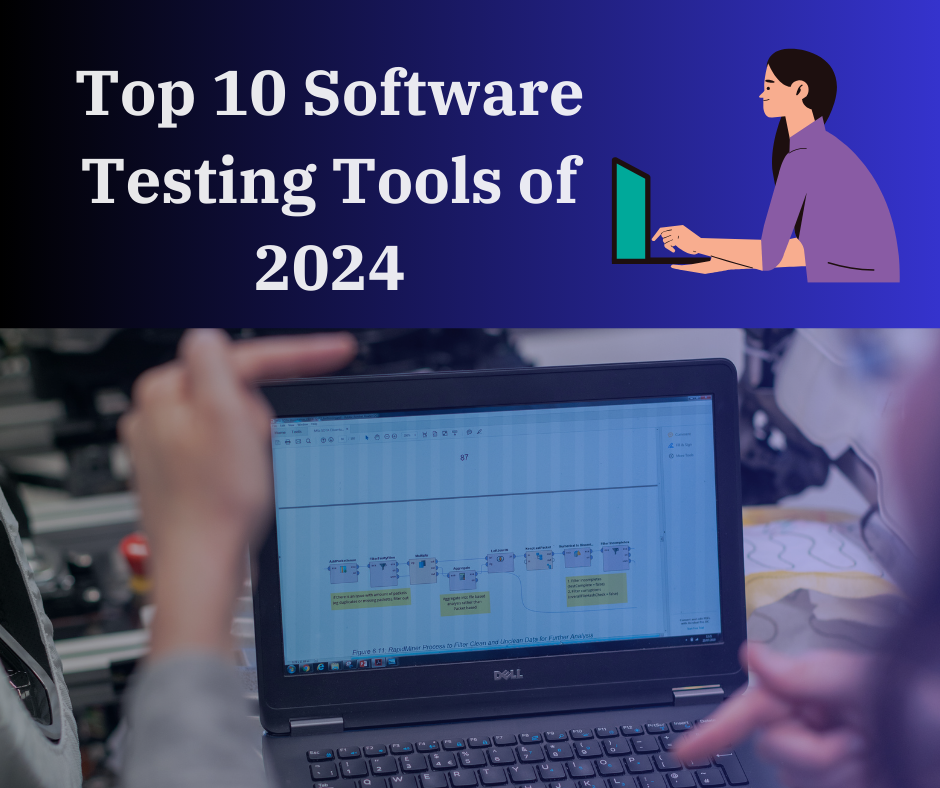 <h2>Best Software Testing Tools</h2> <h3>1. Selenium</h3> The undisputed veteran, Selenium holds its crown as the most versatile open-source automation framework. Supporting major browsers, languages, and operating systems, it empowers you to craft robust test scripts for web applications. Its freemium model and vast community support make it an ideal choice for beginners and seasoned testers alike. Explore Selenium WebDriver for browser automation, Appium for mobile testing, and Selenium IDE for rapid test script creation. <h3>2. Cypress</h3> This rising star shines bright for its unparalleled speed and intuitive interface. Unlike traditional frameworks, Cypress executes tests directly in the browser, providing real-time feedback and eliminating the need for browser extensions. Its focus on JavaScript makes it perfect for modern web applications and offers excellent visual debugging capabilities. <h3>3. Postman</h3> For API testing enthusiasts, Postman reigns supreme. This intuitive platform allows you to effortlessly build, send, and analyze API requests. Its rich ecosystem of plugins expands its functionality, covering security testing, performance analysis, and collaboration tools. With a free plan and premium options, Postman caters to individual testers and large teams alike. <h3>4. Katalon Studio</h3> This comprehensive suite caters to a broad spectrum of testing needs, offering tools for web, mobile, API, and desktop applications. Its user-friendly interface makes it accessible to testers of all experience levels, while its built-in record-and-playback feature empowers quick test script creation. Katalon Studio integrates seamlessly with various issue trackers and CI/CD pipelines, facilitating smooth collaboration and automation. <h3>5. Appium</h3> If your domain lies in mobile apps, Appium is your go-to tool. This open-source framework leverages Selenium's core functionalities for cross-platform mobile automation, supporting native, web, and hybrid apps. Its integration with frameworks like XCTest and Appium Inspector empowers in-depth testing and debugging on iOS and Android devices. <h3>6. SoapUI</h3> Dominating the world of SOAP and REST API testing, SoapUI stands tall. Its intuitive interface simplifies manual and automated API testing, while its powerful assertion capabilities ensure thorough validation of responses. Mock services and data-driven testing further enhance its utility, making it a favorite among API testing champions. <h3>7. Tricentis Tosca</h3> This AI-powered suite delivers intelligent automation, covering functional, regression, and performance testing across various technologies. Its Tosca Commander facilitates intuitive test script creation, while its machine learning algorithms optimize test execution and identify potential issues proactively. Tricentis Tosca caters to enterprises seeking advanced automation and AI-driven insights. <h3>8. Ranorex Studio</h3> Known for its cross-platform desktop application testing capabilities, Ranorex Studio offers visual test automation and record-and-playback features. Its keyword-driven approach simplifies test creation, while its integrated object repository ensures test reusability. Ranorex Studio also supports mobile and web testing, making it a versatile choice for diverse testing needs. <h3>9. LoadRunner</h3> A veteran in performance testing, LoadRunner continues to empower teams to assess application behavior under heavy load. Its ability to simulate large numbers of concurrent users and analyze performance metrics makes it ideal for identifying bottlenecks and ensuring scalability. LoadRunner integrates seamlessly with CI/CD pipelines, enabling performance testing as part of the development process. <h3>10. Kantu</h3> For those new to automation testing, Kantu offers a gentle introduction. This free, browser-based tool allows you to record user interactions and generate test scripts without coding knowledge. Its simple interface and visual representation make it ideal for beginners or quick manual test script creation. <h2>Choosing the Right Tools</h2> Selecting the best tools for your team depends on various factors, including project requirements, team expertise, budget, and desired level of automation. Consider the following before making your decision: <b>• Project needs:</b> Identify the types of applications you'll be testing (web, mobile, API, etc.) and the specific testing areas (functional, performance, security). <b>• Team expertise:</b> Choose tools that match your team's skillset and comfort level with automation. Opt for user-friendly options for beginners and more advanced tools for experienced testers. <b>• Budget:</b> Explore open-source and freemium options alongside paid tools with advanced features. Consider the long-term value proposition and return on investment. <b>• Desired automation level:</b> Assess your automation needs. Manual testing tools like Kantu suffice for basic needs, while frameworks like Selenium and Cypress excel in advanced automation scenarios. <h2>Beyond the Top 10</h2> Remember, the software testing landscape is dynamic, and this list merely scratches the surface. Explore other emerging tools like: • TestRail: Streamlines test case management and reporting for efficient collaboration. • Mocha: A popular JavaScript testing framework known for its flexibility and community support. • Gatling: An open-source performance testing tool offering powerful load injection capabilities. • Appium Inspector: Enables in-depth inspection and debugging of mobile apps within the Appium framework. <h2>The Power of Integration</h2> The true potential of these tools lies in their integration. Utilize platforms like CI/CD pipelines to automate testing throughout the development process. Integrate your testing tools with issue trackers for seamless defect reporting and management. Embrace collaborative tools to facilitate communication and knowledge sharing within your team. If someone is interested in acquiring knowledge about software testing, consider exploring this <a href="https://www.syntaxtechs.com/courses/sdet-training-course-online">software testing online course</a>. <h3>Conclusion</h3> By leveraging the right software testing tools, your team can unlock a new level of efficiency, improve software quality, and deliver exceptional user experiences. Remember, the most effective testing strategy combines the right tools with skilled professionals and a well-defined testing methodology. So, embark on your testing journey with these powerful tools at your side, and unleash the full potential of your software development process. |
| json metadata | {"tags":["softwaretesting","softwaretestingtools","automationtools","sdet","technology","upskills","techtrends","careeropportunities"],"image":["https://cdn.steemitimages.com/DQmR9gnCxJL8Qt2fMT2Cbia2LowqQXqMRG2rSD8db74GTVW/Top%2010%20Software%20Testing%20Tools%20of%202024.png"],"links":["https://www.syntaxtechs.com/blog/essential-tools-and-technologies-for-an-sdet","https://www.syntaxtechs.com/courses/sdet-training-course-online"],"app":"steemit/0.2","format":"markdown"} |
| parent author | |
| parent permlink | softwaretesting |
| permlink | unleashing-the-power-top-10-software-testing-tools-of-2024 |
| title | Unleashing the Power: Top 10 Software Testing Tools of 2024 |
| Transaction Info | Block #82277113/Trx 671a32b4134fbcc2f3bc1175d022b7a2b7e8b2f5 |
View Raw JSON Data
{
"block": 82277113,
"op": [
"comment",
{
"author": "syntaxtechs",
"body": "In the ever-evolving landscape of software development, the role of testing remains paramount. As applications grow more complex and user expectations skyrocket, testers need sophisticated tools to ensure quality, functionality, and a seamless user experience. 2024 presents a treasure trove of innovative testing solutions, and choosing the right ones can empower your team to deliver exceptional software.\n\nThis article delves into the top 10 <a href=\"https://www.syntaxtechs.com/blog/essential-tools-and-technologies-for-an-sdet\">software testing tools</a> of 2024, highlighting their strengths, use cases, and how they can elevate your testing game.\n\n\n\n\n\n\n<h2>Best Software Testing Tools</h2>\n\n<h3>1. Selenium</h3>\nThe undisputed veteran, Selenium holds its crown as the most versatile open-source automation framework. Supporting major browsers, languages, and operating systems, it empowers you to craft robust test scripts for web applications. Its freemium model and vast community support make it an ideal choice for beginners and seasoned testers alike. Explore Selenium WebDriver for browser automation, Appium for mobile testing, and Selenium IDE for rapid test script creation.\n\n<h3>2. Cypress</h3>\nThis rising star shines bright for its unparalleled speed and intuitive interface. Unlike traditional frameworks, Cypress executes tests directly in the browser, providing real-time feedback and eliminating the need for browser extensions. Its focus on JavaScript makes it perfect for modern web applications and offers excellent visual debugging capabilities.\n\n<h3>3. Postman</h3>\nFor API testing enthusiasts, Postman reigns supreme. This intuitive platform allows you to effortlessly build, send, and analyze API requests. Its rich ecosystem of plugins expands its functionality, covering security testing, performance analysis, and collaboration tools. With a free plan and premium options, Postman caters to individual testers and large teams alike.\n\n<h3>4. Katalon Studio</h3>\nThis comprehensive suite caters to a broad spectrum of testing needs, offering tools for web, mobile, API, and desktop applications. Its user-friendly interface makes it accessible to testers of all experience levels, while its built-in record-and-playback feature empowers quick test script creation. Katalon Studio integrates seamlessly with various issue trackers and CI/CD pipelines, facilitating smooth collaboration and automation.\n\n<h3>5. Appium</h3>\nIf your domain lies in mobile apps, Appium is your go-to tool. This open-source framework leverages Selenium's core functionalities for cross-platform mobile automation, supporting native, web, and hybrid apps. Its integration with frameworks like XCTest and Appium Inspector empowers in-depth testing and debugging on iOS and Android devices.\n\n<h3>6. SoapUI</h3>\nDominating the world of SOAP and REST API testing, SoapUI stands tall. Its intuitive interface simplifies manual and automated API testing, while its powerful assertion capabilities ensure thorough validation of responses. Mock services and data-driven testing further enhance its utility, making it a favorite among API testing champions.\n\n<h3>7. Tricentis Tosca</h3>\nThis AI-powered suite delivers intelligent automation, covering functional, regression, and performance testing across various technologies. Its Tosca Commander facilitates intuitive test script creation, while its machine learning algorithms optimize test execution and identify potential issues proactively. Tricentis Tosca caters to enterprises seeking advanced automation and AI-driven insights.\n\n<h3>8. Ranorex Studio</h3>\nKnown for its cross-platform desktop application testing capabilities, Ranorex Studio offers visual test automation and record-and-playback features. Its keyword-driven approach simplifies test creation, while its integrated object repository ensures test reusability. Ranorex Studio also supports mobile and web testing, making it a versatile choice for diverse testing needs.\n\n<h3>9. LoadRunner</h3>\nA veteran in performance testing, LoadRunner continues to empower teams to assess application behavior under heavy load. Its ability to simulate large numbers of concurrent users and analyze performance metrics makes it ideal for identifying bottlenecks and ensuring scalability. LoadRunner integrates seamlessly with CI/CD pipelines, enabling performance testing as part of the development process.\n\n<h3>10. Kantu</h3>\nFor those new to automation testing, Kantu offers a gentle introduction. This free, browser-based tool allows you to record user interactions and generate test scripts without coding knowledge. Its simple interface and visual representation make it ideal for beginners or quick manual test script creation.\n\n<h2>Choosing the Right Tools</h2>\nSelecting the best tools for your team depends on various factors, including project requirements, team expertise, budget, and desired level of automation. Consider the following before making your decision:\n\n<b>•\tProject needs:</b> Identify the types of applications you'll be testing (web, mobile, API, etc.) and the specific testing areas (functional, performance, security).\n<b>•\tTeam expertise:</b> Choose tools that match your team's skillset and comfort level with automation. Opt for user-friendly options for beginners and more advanced tools for experienced testers.\n<b>•\tBudget:</b> Explore open-source and freemium options alongside paid tools with advanced features. Consider the long-term value proposition and return on investment.\n<b>•\tDesired automation level:</b> Assess your automation needs. Manual testing tools like Kantu suffice for basic needs, while frameworks like Selenium and Cypress excel in advanced automation scenarios.\n\n<h2>Beyond the Top 10</h2>\nRemember, the software testing landscape is dynamic, and this list merely scratches the surface. Explore other emerging tools like:\n\n•\tTestRail: Streamlines test case management and reporting for efficient collaboration.\n•\tMocha: A popular JavaScript testing framework known for its flexibility and community support.\n•\tGatling: An open-source performance testing tool offering powerful load injection capabilities.\n•\tAppium Inspector: Enables in-depth inspection and debugging of mobile apps within the Appium framework.\n\n<h2>The Power of Integration</h2>\nThe true potential of these tools lies in their integration. Utilize platforms like CI/CD pipelines to automate testing throughout the development process. Integrate your testing tools with issue trackers for seamless defect reporting and management. Embrace collaborative tools to facilitate communication and knowledge sharing within your team.\n\nIf someone is interested in acquiring knowledge about software testing, consider exploring this <a href=\"https://www.syntaxtechs.com/courses/sdet-training-course-online\">software testing online course</a>.\n\n\n<h3>Conclusion</h3>\nBy leveraging the right software testing tools, your team can unlock a new level of efficiency, improve software quality, and deliver exceptional user experiences. Remember, the most effective testing strategy combines the right tools with skilled professionals and a well-defined testing methodology. So, embark on your testing journey with these powerful tools at your side, and unleash the full potential of your software development process.",
"json_metadata": "{\"tags\":[\"softwaretesting\",\"softwaretestingtools\",\"automationtools\",\"sdet\",\"technology\",\"upskills\",\"techtrends\",\"careeropportunities\"],\"image\":[\"https://cdn.steemitimages.com/DQmR9gnCxJL8Qt2fMT2Cbia2LowqQXqMRG2rSD8db74GTVW/Top%2010%20Software%20Testing%20Tools%20of%202024.png\"],\"links\":[\"https://www.syntaxtechs.com/blog/essential-tools-and-technologies-for-an-sdet\",\"https://www.syntaxtechs.com/courses/sdet-training-course-online\"],\"app\":\"steemit/0.2\",\"format\":\"markdown\"}",
"parent_author": "",
"parent_permlink": "softwaretesting",
"permlink": "unleashing-the-power-top-10-software-testing-tools-of-2024",
"title": "Unleashing the Power: Top 10 Software Testing Tools of 2024"
}
],
"op_in_trx": 0,
"timestamp": "2024-02-06T12:42:27",
"trx_id": "671a32b4134fbcc2f3bc1175d022b7a2b7e8b2f5",
"trx_in_block": 0,
"virtual_op": 0
}syntaxtechspublished a new post: mastering-predictive-analytics-challenges-and-future-trends2024/01/25 12:07:24
syntaxtechspublished a new post: mastering-predictive-analytics-challenges-and-future-trends
2024/01/25 12:07:24
| author | syntaxtechs |
| body | Predictive Analytics has become a cornerstone in today's data-driven world, offering businesses a powerful tool to make informed decisions. In this article, we'll delve into essential steps to master the predictive analytics, its challenges, benefits, and future trends.  <h2>Steps to Mastering Predictive Analytics</h2> <h3>Step 1: Understanding the Basics</h3> Before delving into challenges, it's essential to understand <a href="https://www.syntaxtechs.com/blog/predictive-analytics-in-your-business">what is predictive analytics</a> in actual. Predictive analytics involves using statistical algorithms and machine learning techniques to identify the likelihood of future outcomes based on historical data. To master it, start by grasping fundamental concepts such as regression, classification, and clustering. <h3>Step 2: Data Collection and Preparation</h3> The success of predictive analytics heavily relies on the quality of data. Collecting relevant and accurate data sets, followed by meticulous cleaning and preprocessing, ensures the reliability of your predictions. <h3>Step 3: Choosing the Right Model</h3> With various predictive models available, selecting the one that aligns with your objectives is crucial. Understand the differences between models like linear regression, decision trees, and neural networks, considering factors like data type and model complexity. <h3>Step 4: Training the Model</h3> Training your predictive model involves feeding it with historical data to enable it to learn patterns and make accurate predictions. Techniques like cross-validation and parameter tuning play a pivotal role in optimizing model performance. <h3>Step 5: Evaluation and Deployment</h3> Evaluate your model's performance using metrics like accuracy, precision, and recall. Once satisfied, deploy the model into your decision-making processes, ensuring seamless integration for practical applications. <h2>Challenges in Predictive Analytics</h2> While predictive analytics offers valuable insights, it also comes with several challenges. Here are some common challenges in predictive analytics: <h3>Data Quality and Quantity:</h3> • Predictive models require a sufficient amount of quality data for training. In some cases, there may not be enough relevant data to build an accurate model. • Poor data quality, including missing values, outliers, and inaccuracies, can adversely affect the performance of predictive models. <h3>Overfitting:</h3> Overfitting occurs when a model is too complex and captures noise in the training data rather than the underlying patterns. This leads to poor generalization to new, unseen data. <h3>Feature Selection:</h3> Choosing the right set of features or variables that contribute most to predictive accuracy is crucial. Including irrelevant or redundant features may degrade model performance. <h3>Model Interpretability:</h3> Many powerful predictive models, such as deep neural networks, are often challenging to interpret. Understanding how a model makes predictions is important for gaining trust and acceptance, especially in regulated industries. <h3>Changing Data Patterns:</h3> Predictive models may become less accurate over time if the underlying patterns in the data change. Continuous monitoring and retraining of models are necessary to adapt to evolving conditions. <h2>Future Trends in Predictive Analytics</h2> Let's delve into the future trends shaping the landscape of predictive analytics. <h3>The Rise of Machine Learning Algorithms</h3> Predictive analytics is undergoing a transformation with the integration of advanced machine learning algorithms. These algorithms analyze vast datasets, identifying patterns and making predictions with unprecedented accuracy. As businesses embrace machine learning, the capabilities of predictive analytics reach new heights, offering more nuanced insights and actionable recommendations. <h3>Real-Time Predictions for Instant Decision-Making</h3> The future of predictive analytics lies in its ability to provide real-time insights. Businesses are shifting towards systems that deliver instantaneous predictions, allowing them to make on-the-spot decisions. This shift towards immediacy is particularly crucial in industries where timing is everything, such as finance and e-commerce. <h3>Enhanced Personalization for Targeted Marketing</h3> As predictive analytics becomes more sophisticated, so does its application in marketing. Businesses are leveraging this technology to hyper-personalize their marketing strategies. By understanding customer behavior and preferences, companies can tailor their campaigns with laser-like precision, resulting in higher engagement and conversion rates. <h3>Predictive Analytics in Healthcare: A Game-Changer</h3> The healthcare industry is experiencing a revolutionary impact from predictive analytics. From predicting disease outbreaks to optimizing patient care, the applications are vast. Machine learning models analyze patient data, aiding in early diagnosis and personalized treatment plans. The result? Improved patient outcomes and more efficient healthcare systems. <h3>The Intersection of IoT and Predictive Analytics</h3> The Internet of Things (IoT) is seamlessly integrating with predictive analytics to create a powerhouse of insights. Connected devices generate a continuous stream of data, and predictive analytics interprets this information to anticipate issues and optimize performance. This synergy is transforming industries like manufacturing, where predictive maintenance is becoming a game-changer. <h2>Overcoming Challenges: The Future of Predictive Analytics</h2> While the future looks promising, there are challenges to overcome. Ensuring data privacy and security remains a priority. Striking the right balance between data collection and ethical considerations is crucial for the continued success of predictive analytics. <h2>Embracing the Future Today</h2> The future of predictive analytics is an exciting landscape of possibilities. From machine learning advancements to real-time predictions and personalized marketing strategies, businesses have much to gain by staying at the forefront of these trends. As we navigate this evolving terrain, one thing is clear – predictive analytics is not just a tool; it's a strategic imperative for those who seek to thrive in the data-driven era. <h2>Benefits of Mastering Predictive Analytics</h2> Mastering predictive analytics unlocks the power to glean actionable insights from vast datasets, driving informed decision-making. By leveraging statistical algorithms and machine learning techniques, professionals can foresee trends, identify patterns, and anticipate future outcomes. This proficiency empowers businesses to optimize resource allocation, enhance customer experiences, and mitigate risks. The ability to predict future events and trends equips individuals with a strategic edge, fostering innovation and efficiency in diverse fields such as finance, healthcare, and marketing. Ultimately, mastering predictive analytics facilitates a proactive approach, transforming data into a strategic asset for organizational success. For those new to predictive analytics, leverage online resources, participate in <a href="https://www.syntaxtechs.com/">certification courses</a>, and join communities. Be aware of common pitfalls, and continuously seek to expand your knowledge and skills. <h2>Conclusion</h2> Mastering predictive analytics is a journey that involves understanding the basics, collecting quality data, overcoming the challenges, choosing the right model, training it effectively, and deploying it wisely. The benefits are vast, providing a competitive advantage and enhancing decision-making capabilities. |
| json metadata | {"tags":["predictiveanalytics","tools","challenges","futuretrend","innovations","machinelearning","dataanalytics"],"image":["https://cdn.steemitimages.com/DQmUMWXDPYuUYwNW6eRMzp4sn3tiQPLpCEyNusWxPY3wtfZ/Mastering%20Predictive%20Analytics.jpg"],"links":["https://www.syntaxtechs.com/blog/predictive-analytics-in-your-business","https://www.syntaxtechs.com/"],"app":"steemit/0.2","format":"markdown"} |
| parent author | |
| parent permlink | predictiveanalytics |
| permlink | mastering-predictive-analytics-challenges-and-future-trends |
| title | Mastering Predictive Analytics: Challenges & Future Trends |
| Transaction Info | Block #81931964/Trx 8b25b70fd8b41f311b3f2371385811a2c7dd454b |
View Raw JSON Data
{
"block": 81931964,
"op": [
"comment",
{
"author": "syntaxtechs",
"body": "Predictive Analytics has become a cornerstone in today's data-driven world, offering businesses a powerful tool to make informed decisions. In this article, we'll delve into essential steps to master the predictive analytics, its challenges, benefits, and future trends.\n\n\n\n\n\n<h2>Steps to Mastering Predictive Analytics</h2>\n\n<h3>Step 1: Understanding the Basics</h3>\nBefore delving into challenges, it's essential to understand <a href=\"https://www.syntaxtechs.com/blog/predictive-analytics-in-your-business\">what is predictive analytics</a> in actual. Predictive analytics involves using statistical algorithms and machine learning techniques to identify the likelihood of future outcomes based on historical data. To master it, start by grasping fundamental concepts such as regression, classification, and clustering.\n\n<h3>Step 2: Data Collection and Preparation</h3>\nThe success of predictive analytics heavily relies on the quality of data. Collecting relevant and accurate data sets, followed by meticulous cleaning and preprocessing, ensures the reliability of your predictions.\n\n<h3>Step 3: Choosing the Right Model</h3>\nWith various predictive models available, selecting the one that aligns with your objectives is crucial. Understand the differences between models like linear regression, decision trees, and neural networks, considering factors like data type and model complexity.\n\n<h3>Step 4: Training the Model</h3>\nTraining your predictive model involves feeding it with historical data to enable it to learn patterns and make accurate predictions. Techniques like cross-validation and parameter tuning play a pivotal role in optimizing model performance.\n\n<h3>Step 5: Evaluation and Deployment</h3>\nEvaluate your model's performance using metrics like accuracy, precision, and recall. Once satisfied, deploy the model into your decision-making processes, ensuring seamless integration for practical applications.\n\n<h2>Challenges in Predictive Analytics</h2>\nWhile predictive analytics offers valuable insights, it also comes with several challenges. Here are some common challenges in predictive analytics:\n\n<h3>Data Quality and Quantity:</h3>\n•\tPredictive models require a sufficient amount of quality data for training. In some cases, there may not be enough relevant data to build an accurate model.\n•\tPoor data quality, including missing values, outliers, and inaccuracies, can adversely affect the performance of predictive models.\n\n<h3>Overfitting:</h3>\nOverfitting occurs when a model is too complex and captures noise in the training data rather than the underlying patterns. This leads to poor generalization to new, unseen data.\n\n<h3>Feature Selection:</h3>\nChoosing the right set of features or variables that contribute most to predictive accuracy is crucial. Including irrelevant or redundant features may degrade model performance.\n\n<h3>Model Interpretability:</h3>\nMany powerful predictive models, such as deep neural networks, are often challenging to interpret. Understanding how a model makes predictions is important for gaining trust and acceptance, especially in regulated industries.\n\n<h3>Changing Data Patterns:</h3>\nPredictive models may become less accurate over time if the underlying patterns in the data change. Continuous monitoring and retraining of models are necessary to adapt to evolving conditions.\n\n<h2>Future Trends in Predictive Analytics</h2>\nLet's delve into the future trends shaping the landscape of predictive analytics.\n\n<h3>The Rise of Machine Learning Algorithms</h3>\nPredictive analytics is undergoing a transformation with the integration of advanced machine learning algorithms. These algorithms analyze vast datasets, identifying patterns and making predictions with unprecedented accuracy. As businesses embrace machine learning, the capabilities of predictive analytics reach new heights, offering more nuanced insights and actionable recommendations.\n\n<h3>Real-Time Predictions for Instant Decision-Making</h3>\nThe future of predictive analytics lies in its ability to provide real-time insights. Businesses are shifting towards systems that deliver instantaneous predictions, allowing them to make on-the-spot decisions. This shift towards immediacy is particularly crucial in industries where timing is everything, such as finance and e-commerce.\n\n<h3>Enhanced Personalization for Targeted Marketing</h3>\nAs predictive analytics becomes more sophisticated, so does its application in marketing. Businesses are leveraging this technology to hyper-personalize their marketing strategies. By understanding customer behavior and preferences, companies can tailor their campaigns with laser-like precision, resulting in higher engagement and conversion rates.\n\n<h3>Predictive Analytics in Healthcare: A Game-Changer</h3>\nThe healthcare industry is experiencing a revolutionary impact from predictive analytics. From predicting disease outbreaks to optimizing patient care, the applications are vast. Machine learning models analyze patient data, aiding in early diagnosis and personalized treatment plans. The result? Improved patient outcomes and more efficient healthcare systems.\n\n<h3>The Intersection of IoT and Predictive Analytics</h3>\nThe Internet of Things (IoT) is seamlessly integrating with predictive analytics to create a powerhouse of insights. Connected devices generate a continuous stream of data, and predictive analytics interprets this information to anticipate issues and optimize performance. This synergy is transforming industries like manufacturing, where predictive maintenance is becoming a game-changer.\n\n<h2>Overcoming Challenges: The Future of Predictive Analytics</h2>\nWhile the future looks promising, there are challenges to overcome. Ensuring data privacy and security remains a priority. Striking the right balance between data collection and ethical considerations is crucial for the continued success of predictive analytics.\n\n<h2>Embracing the Future Today</h2>\nThe future of predictive analytics is an exciting landscape of possibilities. From machine learning advancements to real-time predictions and personalized marketing strategies, businesses have much to gain by staying at the forefront of these trends. As we navigate this evolving terrain, one thing is clear – predictive analytics is not just a tool; it's a strategic imperative for those who seek to thrive in the data-driven era.\n\n<h2>Benefits of Mastering Predictive Analytics</h2>\nMastering predictive analytics unlocks the power to glean actionable insights from vast datasets, driving informed decision-making. By leveraging statistical algorithms and machine learning techniques, professionals can foresee trends, identify patterns, and anticipate future outcomes. This proficiency empowers businesses to optimize resource allocation, enhance customer experiences, and mitigate risks. The ability to predict future events and trends equips individuals with a strategic edge, fostering innovation and efficiency in diverse fields such as finance, healthcare, and marketing. Ultimately, mastering predictive analytics facilitates a proactive approach, transforming data into a strategic asset for organizational success.\n\nFor those new to predictive analytics, leverage online resources, participate in <a href=\"https://www.syntaxtechs.com/\">certification courses</a>, and join communities. Be aware of common pitfalls, and continuously seek to expand your knowledge and skills.\n\n<h2>Conclusion</h2>\nMastering predictive analytics is a journey that involves understanding the basics, collecting quality data, overcoming the challenges, choosing the right model, training it effectively, and deploying it wisely. The benefits are vast, providing a competitive advantage and enhancing decision-making capabilities.",
"json_metadata": "{\"tags\":[\"predictiveanalytics\",\"tools\",\"challenges\",\"futuretrend\",\"innovations\",\"machinelearning\",\"dataanalytics\"],\"image\":[\"https://cdn.steemitimages.com/DQmUMWXDPYuUYwNW6eRMzp4sn3tiQPLpCEyNusWxPY3wtfZ/Mastering%20Predictive%20Analytics.jpg\"],\"links\":[\"https://www.syntaxtechs.com/blog/predictive-analytics-in-your-business\",\"https://www.syntaxtechs.com/\"],\"app\":\"steemit/0.2\",\"format\":\"markdown\"}",
"parent_author": "",
"parent_permlink": "predictiveanalytics",
"permlink": "mastering-predictive-analytics-challenges-and-future-trends",
"title": "Mastering Predictive Analytics: Challenges & Future Trends"
}
],
"op_in_trx": 0,
"timestamp": "2024-01-25T12:07:24",
"trx_id": "8b25b70fd8b41f311b3f2371385811a2c7dd454b",
"trx_in_block": 11,
"virtual_op": 0
}bluesnipersent 0.010 STEEM to @syntaxtechs- "Hello. Good to see you on Steem. To maximize your rewards, publish your post also on Hive ( hive.blog ) and Blurt ( blurt.blog ) blockchains. Use upvu, jsup or ctime and get instant upvotes"2024/01/18 12:54:45
bluesnipersent 0.010 STEEM to @syntaxtechs- "Hello. Good to see you on Steem. To maximize your rewards, publish your post also on Hive ( hive.blog ) and Blurt ( blurt.blog ) blockchains. Use upvu, jsup or ctime and get instant upvotes"
2024/01/18 12:54:45
| amount | 0.010 STEEM |
| from | bluesniper |
| memo | Hello. Good to see you on Steem. To maximize your rewards, publish your post also on Hive ( hive.blog ) and Blurt ( blurt.blog ) blockchains. Use upvu, jsup or ctime and get instant upvotes |
| to | syntaxtechs |
| Transaction Info | Block #81731995/Trx 28bc98b37423b8fc77180832ad02551b4989d634 |
View Raw JSON Data
{
  "block": 81731995,
  "op": [
    "transfer",
    {
      "amount": "0.010 STEEM",
      "from": "bluesniper",
      "memo": "Hello. Good to see you on Steem. To maximize your rewards, publish your post also on Hive ( hive.blog ) and Blurt ( blurt.blog ) blockchains. Use upvu, jsup or ctime and get instant upvotes",
      "to": "syntaxtechs"
    }
  ],
  "op_in_trx": 0,
  "timestamp": "2024-01-18T12:54:45",
  "trx_id": "28bc98b37423b8fc77180832ad02551b4989d634",
  "trx_in_block": 2,
  "virtual_op": 0
}bluesniperupvoted (100.00%) @syntaxtechs / power-bi-vs-google-data-studio-making-informed-decisions2024/01/18 12:54:24
bluesniperupvoted (100.00%) @syntaxtechs / power-bi-vs-google-data-studio-making-informed-decisions
2024/01/18 12:54:24
| author | syntaxtechs |
| permlink | power-bi-vs-google-data-studio-making-informed-decisions |
| voter | bluesniper |
| weight | 10000 (100.00%) |
| Transaction Info | Block #81731988/Trx 8753d6c06a1292a90f348e9387d3c51064483d96 |
View Raw JSON Data
{
  "block": 81731988,
  "op": [
    "vote",
    {
      "author": "syntaxtechs",
      "permlink": "power-bi-vs-google-data-studio-making-informed-decisions",
      "voter": "bluesniper",
      "weight": 10000
    }
  ],
  "op_in_trx": 0,
  "timestamp": "2024-01-18T12:54:24",
  "trx_id": "8753d6c06a1292a90f348e9387d3c51064483d96",
  "trx_in_block": 0,
  "virtual_op": 0
}syntaxtechspublished a new post: power-bi-vs-google-data-studio-making-informed-decisions2024/01/18 12:41:39
syntaxtechspublished a new post: power-bi-vs-google-data-studio-making-informed-decisions
2024/01/18 12:41:39
| author | syntaxtechs |
| body | In today's data-driven world, businesses rely heavily on robust data visualization tools to transform raw data into actionable insights. Two prominent players in this arena are Microsoft's Power BI and Google's Data Studio. Let's dive into the features, strengths, weaknesses, and real-world applications of these tools to help you make an informed decision for your data needs.  <h2>Power BI: Unveiling the Powerhouse</h2> Power BI stands out with its diverse data connectivity options, allowing users to seamlessly integrate data from various sources. The interactive dashboards empower users to explore data dynamically, while AI-powered analytics enhance predictive analysis. The user-friendly interface ensures that even non-technical users can harness the power of data analytics. <h2>Google Data Studio: The Google Approach</h2> Google Data Studio takes a different approach, deeply integrating with the Google ecosystem. Its collaborative reporting features make it an ideal choice for teams working in a Google-centric environment. Customization options allow users to create visually appealing reports tailored to their brand. <h2>Pricing Comparison</h2> Digging into the financial aspect, Power BI's pricing model is structured based on user types and capacities, providing flexibility but requiring careful consideration. Google Data Studio, on the other hand, follows a more straightforward free-to-use model, with additional features available through Google's paid subscription, making it more accessible for small businesses. <h2>User Interface and Ease of Use</h2> When talking about how easy it is to use, Power BI has a simple and easy-to-understand design. It's made for people who are used to using Microsoft applications. On the other hand, Google Data Studio keeps things really simple, and many people like it because it's straightforward. Both tools are easy to use, but your choice might depend on which design you feel more comfortable with. <h2>Data Connectivity</h2> Being able to easily connect to different sources of data is really important when picking a data visualization tool. Power BI can connect with many types of data platforms because it's good at integrating with them. Google Data Studio also does well in connecting to data, especially because it's part of Google's big set of tools. Choosing between them might depend on the specific types of data sources you use a lot. <h2>Data Visualization Options</h2> The main thing a data visualization tool does is show information in a way that makes sense. Power BI gives you lots of options for how to show your data, like customizable charts, graphs, and dashboards. Google Data Studio doesn't have as many features, but it still gives you a clean and good-looking space to create reports and dashboards. The choice here depends on how much you want to customize things and how complicated your data is. <h2>Collaboration and Sharing</h2> When working together in a business, being able to share and work on reports with others is really important. Power BI lets teams collaborate easily with shared workspaces and real-time collaboration features. Google Data Studio, using Google Drive, also lets people work together effectively. To decide between them, think about what your team needs and likes when it comes to working together. <h2>Security Measures</h2> Keeping data safe is a big concern for businesses, and both Power BI and Google Data Studio have strong security measures. Power BI, being part of Microsoft, follows their strict security rules. Google Data Studio, with support from Google, also creates a safe environment for visualizing data. Check which security features match what your organization needs before deciding. <h2>Performance and Speed</h2> How fast and well a computer program works can affect how quickly people can make decisions. Power BI is really good at working fast, even when dealing with a lot of information. Google Data Studio is also good, but it might not work as well with really huge amounts of data. When you're deciding which one to use, think about how much data you have. <h2>Learning Curve</h2> Learning how to use a new tool can be easy or hard. Power BI has a lot of features, so it might be a bit hard for new users. On the other hand, Google Data Studio is made to be simple, so it's easier for beginners to learn. Think about how much your team knows about these tools and how much time you can spend training them. You can also take <a href="https://www.syntaxtechs.com/courses/data-analytics-and-business-intelligence-training-course-online">online data analytics courses</a> to get better at both Power BI and Google Data Studio. <h2>Use Cases and Industries</h2> Understanding the industries that benefit most from each tool is crucial. Power BI finds its strength in industries requiring extensive data analysis, such as finance and healthcare. Google Data Studio, with its simplicity and integration capabilities, fits well in marketing and communication sectors. <h2>Integration Capabilities</h2> Power BI seamlessly integrates with Microsoft's suite of products, enhancing collaboration and data sharing within the Microsoft ecosystem. Google Data Studio, while not confined to a single ecosystem, offers flexibility in integration across various platforms. <h2>Strengths and Weaknesses</h2> Power BI's strength lies in its comprehensive analytics capabilities, but its potential drawbacks include a steeper learning curve for complex features. On the other hand, Google Data Studio excels in simplicity but may lack some advanced analytics features. <h2>Choosing the Right Tool for You</h2> Consider factors like your existing tech stack, team collaboration needs, and budget constraints when choosing between Power BI and Google Data Studio. Real-world scenarios and decision-making criteria can guide you towards the tool that aligns best with your requirements. <h2>User Reviews and Testimonials</h2> User reviews highlight Power BI's robustness and depth in analytics. Businesses appreciate the tool's ability to handle large datasets effectively. Google Data Studio users commend its ease of use, particularly for collaborative projects, and its seamless integration with other Google applications. <h2>Future Developments</h2> Power BI constantly evolves with new features and updates. Keep an eye on upcoming enhancements, such as improved AI capabilities and expanded data connectivity options. Google Data Studio, too, has an active roadmap, focusing on providing more customization options and refining collaboration features. <h2>Tips and Tricks for Effective Data Visualization</h2> Whether using Power BI or Google Data Studio, effective data visualization is crucial. Embrace best practices like decluttering dashboards, using appropriate visual elements, and utilizing advanced features to enhance the overall impact of your reports. <h3>Conclusion</h3> In the <a href="https://www.syntaxtechs.com/blog/google-data-studio-vs-power-bi">Google Data Studio vs Power BI</a> debate, both tools offer unique strengths. Power BI caters to in-depth data analysis needs, while Google Data Studio thrives in collaborative environments. Assess your business requirements, user preferences, and integration needs to make the right choice. |
| json metadata | {"tags":["googledatastudio","powerbi","tools","technology","techtrends","careeropportunities","dataanalytics"],"image":["https://cdn.steemitimages.com/DQmRUDpWf61onU1cVZvtjwPSg98hM8CB5NH4ByFgcLsa8bh/PowerBI%20vs%20Google%20Data%20Studio.png"],"links":["https://www.syntaxtechs.com/courses/data-analytics-and-business-intelligence-training-course-online","https://www.syntaxtechs.com/blog/google-data-studio-vs-power-bi"],"app":"steemit/0.2","format":"markdown"} |
| parent author | |
| parent permlink | googledatastudio |
| permlink | power-bi-vs-google-data-studio-making-informed-decisions |
| title | Power BI vs Google Data Studio: Making Informed Decisions |
| Transaction Info | Block #81731733/Trx 347ee82b2efc82f73ae870208c72243d900e1b05 |
View Raw JSON Data
{
"block": 81731733,
"op": [
"comment",
{
"author": "syntaxtechs",
"body": "In today's data-driven world, businesses rely heavily on robust data visualization tools to transform raw data into actionable insights. Two prominent players in this arena are Microsoft's Power BI and Google's Data Studio. Let's dive into the features, strengths, weaknesses, and real-world applications of these tools to help you make an informed decision for your data needs.\n\n\n\n\n\n<h2>Power BI: Unveiling the Powerhouse</h2>\nPower BI stands out with its diverse data connectivity options, allowing users to seamlessly integrate data from various sources. The interactive dashboards empower users to explore data dynamically, while AI-powered analytics enhance predictive analysis. The user-friendly interface ensures that even non-technical users can harness the power of data analytics.\n\n<h2>Google Data Studio: The Google Approach</h2>\nGoogle Data Studio takes a different approach, deeply integrating with the Google ecosystem. Its collaborative reporting features make it an ideal choice for teams working in a Google-centric environment. Customization options allow users to create visually appealing reports tailored to their brand.\n\n<h2>Pricing Comparison</h2>\nDigging into the financial aspect, Power BI's pricing model is structured based on user types and capacities, providing flexibility but requiring careful consideration. Google Data Studio, on the other hand, follows a more straightforward free-to-use model, with additional features available through Google's paid subscription, making it more accessible for small businesses.\n\n<h2>User Interface and Ease of Use</h2>\nWhen talking about how easy it is to use, Power BI has a simple and easy-to-understand design. It's made for people who are used to using Microsoft applications. On the other hand, Google Data Studio keeps things really simple, and many people like it because it's straightforward. Both tools are easy to use, but your choice might depend on which design you feel more comfortable with.\n\n<h2>Data Connectivity</h2>\nBeing able to easily connect to different sources of data is really important when picking a data visualization tool. Power BI can connect with many types of data platforms because it's good at integrating with them. Google Data Studio also does well in connecting to data, especially because it's part of Google's big set of tools. Choosing between them might depend on the specific types of data sources you use a lot.\n\n<h2>Data Visualization Options</h2>\nThe main thing a data visualization tool does is show information in a way that makes sense. Power BI gives you lots of options for how to show your data, like customizable charts, graphs, and dashboards. Google Data Studio doesn't have as many features, but it still gives you a clean and good-looking space to create reports and dashboards. The choice here depends on how much you want to customize things and how complicated your data is.\n\n<h2>Collaboration and Sharing</h2>\nWhen working together in a business, being able to share and work on reports with others is really important. Power BI lets teams collaborate easily with shared workspaces and real-time collaboration features. Google Data Studio, using Google Drive, also lets people work together effectively. To decide between them, think about what your team needs and likes when it comes to working together.\n\n<h2>Security Measures</h2>\nKeeping data safe is a big concern for businesses, and both Power BI and Google Data Studio have strong security measures. Power BI, being part of Microsoft, follows their strict security rules. Google Data Studio, with support from Google, also creates a safe environment for visualizing data. Check which security features match what your organization needs before deciding.\n\n<h2>Performance and Speed</h2>\nHow fast and well a computer program works can affect how quickly people can make decisions. Power BI is really good at working fast, even when dealing with a lot of information. Google Data Studio is also good, but it might not work as well with really huge amounts of data. When you're deciding which one to use, think about how much data you have.\n\n<h2>Learning Curve</h2>\nLearning how to use a new tool can be easy or hard. Power BI has a lot of features, so it might be a bit hard for new users. On the other hand, Google Data Studio is made to be simple, so it's easier for beginners to learn. Think about how much your team knows about these tools and how much time you can spend training them. You can also take <a href=\"https://www.syntaxtechs.com/courses/data-analytics-and-business-intelligence-training-course-online\">online data analytics courses</a> to get better at both Power BI and Google Data Studio.\n\n<h2>Use Cases and Industries</h2>\nUnderstanding the industries that benefit most from each tool is crucial. Power BI finds its strength in industries requiring extensive data analysis, such as finance and healthcare. Google Data Studio, with its simplicity and integration capabilities, fits well in marketing and communication sectors.\n\n<h2>Integration Capabilities</h2>\nPower BI seamlessly integrates with Microsoft's suite of products, enhancing collaboration and data sharing within the Microsoft ecosystem. Google Data Studio, while not confined to a single ecosystem, offers flexibility in integration across various platforms.\n\n<h2>Strengths and Weaknesses</h2>\nPower BI's strength lies in its comprehensive analytics capabilities, but its potential drawbacks include a steeper learning curve for complex features. On the other hand, Google Data Studio excels in simplicity but may lack some advanced analytics features.\n\n<h2>Choosing the Right Tool for You</h2>\nConsider factors like your existing tech stack, team collaboration needs, and budget constraints when choosing between Power BI and Google Data Studio. Real-world scenarios and decision-making criteria can guide you towards the tool that aligns best with your requirements.\n\n<h2>User Reviews and Testimonials</h2>\nUser reviews highlight Power BI's robustness and depth in analytics. Businesses appreciate the tool's ability to handle large datasets effectively. Google Data Studio users commend its ease of use, particularly for collaborative projects, and its seamless integration with other Google applications.\n\n<h2>Future Developments</h2>\nPower BI constantly evolves with new features and updates. Keep an eye on upcoming enhancements, such as improved AI capabilities and expanded data connectivity options. Google Data Studio, too, has an active roadmap, focusing on providing more customization options and refining collaboration features.\n\n<h2>Tips and Tricks for Effective Data Visualization</h2>\nWhether using Power BI or Google Data Studio, effective data visualization is crucial. Embrace best practices like decluttering dashboards, using appropriate visual elements, and utilizing advanced features to enhance the overall impact of your reports.\n\n<h3>Conclusion</h3>\nIn the <a href=\"https://www.syntaxtechs.com/blog/google-data-studio-vs-power-bi\">Google Data Studio vs Power BI</a> debate, both tools offer unique strengths. Power BI caters to in-depth data analysis needs, while Google Data Studio thrives in collaborative environments. Assess your business requirements, user preferences, and integration needs to make the right choice.",
"json_metadata": "{\"tags\":[\"googledatastudio\",\"powerbi\",\"tools\",\"technology\",\"techtrends\",\"careeropportunities\",\"dataanalytics\"],\"image\":[\"https://cdn.steemitimages.com/DQmRUDpWf61onU1cVZvtjwPSg98hM8CB5NH4ByFgcLsa8bh/PowerBI%20vs%20Google%20Data%20Studio.png\"],\"links\":[\"https://www.syntaxtechs.com/courses/data-analytics-and-business-intelligence-training-course-online\",\"https://www.syntaxtechs.com/blog/google-data-studio-vs-power-bi\"],\"app\":\"steemit/0.2\",\"format\":\"markdown\"}",
"parent_author": "",
"parent_permlink": "googledatastudio",
"permlink": "power-bi-vs-google-data-studio-making-informed-decisions",
"title": "Power BI vs Google Data Studio: Making Informed Decisions"
}
],
"op_in_trx": 0,
"timestamp": "2024-01-18T12:41:39",
"trx_id": "347ee82b2efc82f73ae870208c72243d900e1b05",
"trx_in_block": 1,
"virtual_op": 0
}bluesnipersent 0.010 STEEM to @syntaxtechs- "Hello. Good to see you on Steem. To maximize your rewards, publish your post also on Hive ( hive.blog ) and Blurt ( blurt.blog ) blockchains. Use upvu, jsup or ctime and get instant upvotes"2024/01/11 12:51:21
bluesnipersent 0.010 STEEM to @syntaxtechs- "Hello. Good to see you on Steem. To maximize your rewards, publish your post also on Hive ( hive.blog ) and Blurt ( blurt.blog ) blockchains. Use upvu, jsup or ctime and get instant upvotes"
2024/01/11 12:51:21
| amount | 0.010 STEEM |
| from | bluesniper |
| memo | Hello. Good to see you on Steem. To maximize your rewards, publish your post also on Hive ( hive.blog ) and Blurt ( blurt.blog ) blockchains. Use upvu, jsup or ctime and get instant upvotes |
| to | syntaxtechs |
| Transaction Info | Block #81531076/Trx 2562f67491a6c9cd8f2276f01b89cb5a12f2a1e4 |
View Raw JSON Data
{
  "block": 81531076,
  "op": [
    "transfer",
    {
      "amount": "0.010 STEEM",
      "from": "bluesniper",
      "memo": "Hello. Good to see you on Steem. To maximize your rewards, publish your post also on Hive ( hive.blog ) and Blurt ( blurt.blog ) blockchains. Use upvu, jsup or ctime and get instant upvotes",
      "to": "syntaxtechs"
    }
  ],
  "op_in_trx": 0,
  "timestamp": "2024-01-11T12:51:21",
  "trx_id": "2562f67491a6c9cd8f2276f01b89cb5a12f2a1e4",
  "trx_in_block": 0,
  "virtual_op": 0
}bluesniperupvoted (100.00%) @syntaxtechs / best-business-intelligence-books-you-should-read2024/01/11 12:50:57
bluesniperupvoted (100.00%) @syntaxtechs / best-business-intelligence-books-you-should-read
2024/01/11 12:50:57
| author | syntaxtechs |
| permlink | best-business-intelligence-books-you-should-read |
| voter | bluesniper |
| weight | 10000 (100.00%) |
| Transaction Info | Block #81531068/Trx 2a1f0978436db7d70baed1dcdfe0876c0d737edf |
View Raw JSON Data
{
  "block": 81531068,
  "op": [
    "vote",
    {
      "author": "syntaxtechs",
      "permlink": "best-business-intelligence-books-you-should-read",
      "voter": "bluesniper",
      "weight": 10000
    }
  ],
  "op_in_trx": 0,
  "timestamp": "2024-01-11T12:50:57",
  "trx_id": "2a1f0978436db7d70baed1dcdfe0876c0d737edf",
  "trx_in_block": 2,
  "virtual_op": 0
}syntaxtechspublished a new post: best-business-intelligence-books-you-should-read2024/01/11 12:45:18
syntaxtechspublished a new post: best-business-intelligence-books-you-should-read
2024/01/11 12:45:18
| author | syntaxtechs |
| body | Business Intelligence is really important for making smart decisions in today's fast business world. Businesses use data a lot to plan what they do, so it's crucial to understand BI well. One great way to learn more about Business Intelligence is by reading books that explain different parts of it. Let's explore some of the best <a href="https://www.syntaxtechs.com/blog/10-business-intelligence-books-you-must-know">Business Intelligence books</a> that work for all levels of expertise and cover many important aspects of this business area.  <h2>Top 10 Business Intelligence Books</h2> <strong>"Competing on Analytics" by Thomas H. Davenport and Jeanne G. Harris (2007):</strong> Davenport and Harris, who know a lot about analytics, explain how using data as a strategic asset can make companies better. The book shares real examples of companies that have used analytics well. <strong>"Data Science for Business" by Foster Provost and Tom Fawcett (2013):</strong> This book is important as BI connects with data science. It helps BI professionals understand both the technical and business sides of things, giving insights into creating value from data. <strong>"The Art of Business Intelligence" by Rahul Anand (2019):</strong> Anand's book looks at BI from both technical and strategic angles. It talks about the creativity in turning data into useful insights and the need to match BI efforts with what the organization wants to achieve. <strong>"Information Dashboard Design" by Stephen Few (2006):</strong> Effective data visualization is key in BI. Few's classic guide teaches how to design dashboards that clearly show insights. With examples and best practices, it helps readers make visuals that guide good decision-making. <strong>"Business Intelligence Guidebook" by Rick Sherman (2014):</strong> Sherman's book covers the whole life cycle of BI, from planning to maintenance. It's a useful guide for BI professionals and decision-makers handling the complexities of BI projects. <strong>"The Big Data-Driven Business" by Russell Glass and Sean Callahan (2014):</strong> As big data becomes more important in BI, this book explains how to use massive datasets for smart decision-making. Real-world examples show how organizations gain an edge using big data. <strong>"Business Intelligence Guide to Digital Transformation" by Boris Evelson and Jim Lundy (2017):</strong> This book talks about the crucial role BI plays in digital transformation. It shows how organizations can use BI to adapt to the digital age and integrate it into broader business plans. <strong>"The Data Warehouse Toolkit" by Ralph Kimball and Margy Ross (2013):</strong> Kimball and Ross, experts in data warehousing, provide practical advice on designing effective data warehouses. It's a timeless guide for BI architects and designers. <strong>"Analytics at Work" by Thomas H. Davenport, Jeanne G. Harris, and Robert Morison (2010):</strong> Davenport and Harris explore how organizations can use analytics every day. The book highlights how to make analytics a regular part of business processes for ongoing improvement and innovation. <strong>"Building the Agile Business through Digital Transformation" by Neil Perkin, Peter Abraham, and Andrew Grant (2017):</strong> In the age of agile methodologies, this book gives insights into how businesses can adapt and thrive through digital changes. Though not only about BI, it offers useful perspectives for BI professionals in dynamic business environments. <h2>Why Read Business Intelligence Books?</h2> Reading business intelligence books can provide numerous benefits for individuals interested in understanding and leveraging the power of business intelligence. Here are several reasons why reading Business Intelligence books can be valuable: <strong>Understanding Concepts:</strong> Business intelligence involves complex concepts, methodologies, and technologies. Books provide in-depth explanations and insights into BI fundamentals, helping readers build a solid understanding of the subject. <strong>Learning Best Practices:</strong> BI books often share industry best practices, case studies, and success stories. Learning from real-world examples can help readers apply effective strategies and tactics to their own business scenarios. <strong>Technology Exploration:</strong> BI tools and technologies are continually evolving. Books can guide readers through the latest advancements, tools, and techniques, helping them stay updated on the rapidly changing landscape of BI. <strong>Skill Development: </strong>Reading BI books can contribute to the development of specific skills, such as data analysis, data visualization, and interpretation of business data. These skills are essential for professionals working in BI-related roles. <strong>Decision-Making Improvement:</strong> BI is closely tied to data-driven decision-making. Books can provide insights into how businesses can use data to make informed decisions, enhance strategic planning, and optimize overall performance. <strong>Career Advancement: </strong>For professionals in roles related to data analysis, business analytics, or BI, reading relevant books can contribute to their professional development. It may also enhance their knowledge and make them more competitive in the job market. <strong>Implementation Guidance:</strong> BI books often provide practical guidance on implementing BI solutions within organizations. This can be valuable for business leaders, managers, and IT professionals involved in BI projects. <strong>Understanding Trends:</strong> BI is influenced by emerging trends, such as artificial intelligence, machine learning, and big data. Books can help readers grasp the impact of these trends on BI and how to leverage them effectively. <strong>Problem Solving: </strong>BI books may address common challenges and issues faced by organizations in implementing BI solutions. Learning how others have overcome similar challenges can provide valuable insights for problem-solving. <strong>Networking Opportunities: </strong>Many BI authors are experts in the field and may share additional resources, communities, or events where readers can further their knowledge and connect with like-minded professionals. <h2>How Books Help You Understand Better</h2> Books let you go deep into BI at your own speed. They guide you through learning step by step, helping you build a strong foundation before moving on to harder topics. Reading a book helps you understand things better compared to fast online guides. <h3>Conclusion:</h3> In the ever-changing world of Business Intelligence, keeping up with the latest ideas, strategies, and tools is key to success. The top BI books mentioned here offer a diverse and complete guide for BI professionals, decision-makers, and anyone interested in enrolling <a href="https://www.syntaxtechs.com/courses/data-analytics-and-business-intelligence-training-course-online">business intelligence analyst BootCamp</a>. Whether you're a pro or new to BI, these books give useful perspectives and practical tips to boost your analytical skills and help your organization succeed. |
| json metadata | {"tags":["businessintelligence","bestbooks","bibooks","successstory","upskills","technology","learning"],"image":["https://cdn.steemitimages.com/DQmR7KqmF6u5pxE6FZntgniq9VGMk2P6haK6YK5WUn18Jd8/Best%20Business%20Intelligence%20Books%20You%20Should%20Read.png"],"links":["https://www.syntaxtechs.com/blog/10-business-intelligence-books-you-must-know","https://www.syntaxtechs.com/courses/data-analytics-and-business-intelligence-training-course-online"],"app":"steemit/0.2","format":"markdown"} |
| parent author | |
| parent permlink | businessintelligence |
| permlink | best-business-intelligence-books-you-should-read |
| title | Best Business Intelligence Books You Should Read |
| Transaction Info | Block #81530955/Trx 9997b78d7ffee4cd5d98ece2d2fb597f7b950af0 |
View Raw JSON Data
{
"block": 81530955,
"op": [
"comment",
{
"author": "syntaxtechs",
"body": "Business Intelligence is really important for making smart decisions in today's fast business world. Businesses use data a lot to plan what they do, so it's crucial to understand BI well. One great way to learn more about Business Intelligence is by reading books that explain different parts of it. Let's explore some of the best <a href=\"https://www.syntaxtechs.com/blog/10-business-intelligence-books-you-must-know\">Business Intelligence books</a> that work for all levels of expertise and cover many important aspects of this business area.\n\n\n\n\n\n<h2>Top 10 Business Intelligence Books</h2>\n\n<strong>\"Competing on Analytics\" by Thomas H. Davenport and Jeanne G. Harris (2007):</strong>\nDavenport and Harris, who know a lot about analytics, explain how using data as a strategic asset can make companies better. The book shares real examples of companies that have used analytics well.\n\n<strong>\"Data Science for Business\" by Foster Provost and Tom Fawcett (2013):</strong>\nThis book is important as BI connects with data science. It helps BI professionals understand both the technical and business sides of things, giving insights into creating value from data.\n\n<strong>\"The Art of Business Intelligence\" by Rahul Anand (2019):</strong>\nAnand's book looks at BI from both technical and strategic angles. It talks about the creativity in turning data into useful insights and the need to match BI efforts with what the organization wants to achieve.\n\n<strong>\"Information Dashboard Design\" by Stephen Few (2006):</strong>\nEffective data visualization is key in BI. Few's classic guide teaches how to design dashboards that clearly show insights. With examples and best practices, it helps readers make visuals that guide good decision-making.\n\n<strong>\"Business Intelligence Guidebook\" by Rick Sherman (2014):</strong>\nSherman's book covers the whole life cycle of BI, from planning to maintenance. It's a useful guide for BI professionals and decision-makers handling the complexities of BI projects.\n\n<strong>\"The Big Data-Driven Business\" by Russell Glass and Sean Callahan (2014):</strong>\nAs big data becomes more important in BI, this book explains how to use massive datasets for smart decision-making. Real-world examples show how organizations gain an edge using big data.\n\n<strong>\"Business Intelligence Guide to Digital Transformation\" by Boris Evelson and Jim Lundy (2017):</strong>\nThis book talks about the crucial role BI plays in digital transformation. It shows how organizations can use BI to adapt to the digital age and integrate it into broader business plans.\n\n<strong>\"The Data Warehouse Toolkit\" by Ralph Kimball and Margy Ross (2013):</strong>\nKimball and Ross, experts in data warehousing, provide practical advice on designing effective data warehouses. It's a timeless guide for BI architects and designers.\n\n<strong>\"Analytics at Work\" by Thomas H. Davenport, Jeanne G. Harris, and Robert Morison (2010):</strong>\nDavenport and Harris explore how organizations can use analytics every day. The book highlights how to make analytics a regular part of business processes for ongoing improvement and innovation.\n\n<strong>\"Building the Agile Business through Digital Transformation\" by Neil Perkin, Peter Abraham, and Andrew Grant (2017):</strong>\nIn the age of agile methodologies, this book gives insights into how businesses can adapt and thrive through digital changes. Though not only about BI, it offers useful perspectives for BI professionals in dynamic business environments.\n\n<h2>Why Read Business Intelligence Books?</h2>\nReading business intelligence books can provide numerous benefits for individuals interested in understanding and leveraging the power of business intelligence. Here are several reasons why reading Business Intelligence books can be valuable:\n\n<strong>Understanding Concepts:</strong> Business intelligence involves complex concepts, methodologies, and technologies. Books provide in-depth explanations and insights into BI fundamentals, helping readers build a solid understanding of the subject.\n\n<strong>Learning Best Practices:</strong> BI books often share industry best practices, case studies, and success stories. Learning from real-world examples can help readers apply effective strategies and tactics to their own business scenarios.\n\n<strong>Technology Exploration:</strong> BI tools and technologies are continually evolving. Books can guide readers through the latest advancements, tools, and techniques, helping them stay updated on the rapidly changing landscape of BI.\n\n<strong>Skill Development: </strong>Reading BI books can contribute to the development of specific skills, such as data analysis, data visualization, and interpretation of business data. These skills are essential for professionals working in BI-related roles.\n\n<strong>Decision-Making Improvement:</strong> BI is closely tied to data-driven decision-making. Books can provide insights into how businesses can use data to make informed decisions, enhance strategic planning, and optimize overall performance.\n\n<strong>Career Advancement: </strong>For professionals in roles related to data analysis, business analytics, or BI, reading relevant books can contribute to their professional development. It may also enhance their knowledge and make them more competitive in the job market.\n\n<strong>Implementation Guidance:</strong> BI books often provide practical guidance on implementing BI solutions within organizations. This can be valuable for business leaders, managers, and IT professionals involved in BI projects.\n\n<strong>Understanding Trends:</strong> BI is influenced by emerging trends, such as artificial intelligence, machine learning, and big data. Books can help readers grasp the impact of these trends on BI and how to leverage them effectively.\n\n<strong>Problem Solving: </strong>BI books may address common challenges and issues faced by organizations in implementing BI solutions. Learning how others have overcome similar challenges can provide valuable insights for problem-solving.\n\n<strong>Networking Opportunities: </strong>Many BI authors are experts in the field and may share additional resources, communities, or events where readers can further their knowledge and connect with like-minded professionals.\n\n<h2>How Books Help You Understand Better</h2>\nBooks let you go deep into BI at your own speed. They guide you through learning step by step, helping you build a strong foundation before moving on to harder topics. Reading a book helps you understand things better compared to fast online guides.\n\n<h3>Conclusion:</h3>\nIn the ever-changing world of Business Intelligence, keeping up with the latest ideas, strategies, and tools is key to success. The top BI books mentioned here offer a diverse and complete guide for BI professionals, decision-makers, and anyone interested in enrolling <a href=\"https://www.syntaxtechs.com/courses/data-analytics-and-business-intelligence-training-course-online\">business intelligence analyst BootCamp</a>. Whether you're a pro or new to BI, these books give useful perspectives and practical tips to boost your analytical skills and help your organization succeed.",
"json_metadata": "{\"tags\":[\"businessintelligence\",\"bestbooks\",\"bibooks\",\"successstory\",\"upskills\",\"technology\",\"learning\"],\"image\":[\"https://cdn.steemitimages.com/DQmR7KqmF6u5pxE6FZntgniq9VGMk2P6haK6YK5WUn18Jd8/Best%20Business%20Intelligence%20Books%20You%20Should%20Read.png\"],\"links\":[\"https://www.syntaxtechs.com/blog/10-business-intelligence-books-you-must-know\",\"https://www.syntaxtechs.com/courses/data-analytics-and-business-intelligence-training-course-online\"],\"app\":\"steemit/0.2\",\"format\":\"markdown\"}",
"parent_author": "",
"parent_permlink": "businessintelligence",
"permlink": "best-business-intelligence-books-you-should-read",
"title": "Best Business Intelligence Books You Should Read"
}
],
"op_in_trx": 0,
"timestamp": "2024-01-11T12:45:18",
"trx_id": "9997b78d7ffee4cd5d98ece2d2fb597f7b950af0",
"trx_in_block": 2,
"virtual_op": 0
}syntaxtechspublished a new post: the-ultimate-guide-to-understand-sanity-testing2024/01/05 12:15:42
syntaxtechspublished a new post: the-ultimate-guide-to-understand-sanity-testing
2024/01/05 12:15:42
| author | syntaxtechs |
| body | In the ever-evolving landscape of software development, ensuring the reliability and stability of applications is paramount. One crucial aspect of this process is sanity testing. In the dynamic realm of software development, the term "Sanity Testing" holds a crucial place. It serves as a checkpoint to ensure that the basic functionalities of a software application work as intended. In order to understand <a href="https://www.syntaxtechs.com/blog/what-is-sanity-testing">what is Sanity Testing</a> in Software Testing one should look at it as a subset of regression testing, plays a pivotal role in maintaining the overall quality of the software.  <h2>Sanity Testing: The Ultimate Guide</h2> This article delves into the intricacies of sanity testing, shedding light on its purpose, characteristics, and the pivotal role it plays in the software development life cycle. <h3>Purpose of Sanity Testing</h3> The primary purpose of sanity testing is to quickly identify any major issues that might arise due to recent changes in the codebase. Unlike comprehensive testing methodologies, sanity testing focuses on specific areas of the application, making it an efficient process for developers to execute regularly. <h3>Evolution of Sanity Testing</h3> Sanity testing has evolved as a crucial component of the software testing lifecycle. Initially employed as a quick check for major issues after code changes, it has evolved to address the growing complexity of software development. With agile methodologies gaining prominence, sanity testing has become more iterative and automated, allowing for faster and more frequent assessments of specific functionalities. Its role has expanded beyond post-change verification to include continuous integration pipelines, ensuring ongoing stability. This evolution reflects the need for efficient, targeted testing in dynamic development environments, contributing to improved software quality and faster release cycles. <h3>Key Characteristics of Sanity Testing</h3> One of the key characteristics of sanity testing is its selective approach. Instead of testing the entire application, it concentrates on specific functionalities or features. This focused testing allows for a quick evaluation of critical aspects without investing excessive time and resources. <h3>When to Perform Sanity Testing</h3> Sanity testing is typically conducted after major changes are implemented in the codebase. It acts as a rapid verification process to ensure that the recent modifications haven't adversely affected the existing functionalities. Additionally, sanity testing is often performed before more extensive regression testing, providing an initial filter for identifying major issues. <h3>Smoke Testing vs Sanity Testing</h3> <a href="https://www.syntaxtechs.com/blog/smoke-testing-vs-sanity-testing">Smoke testing vs sanity testing</a> are two distinct levels of software testing. Smoke testing, also known as build verification testing, is a preliminary check to ensure that the essential functionalities of a software build are working correctly. It aims to identify major issues early in the development process and verifies if the build is stable enough for more in-depth testing. On the other hand, sanity testing is a focused and narrow verification process that aims to check specific functionalities or features after changes are made. It ensures that the recent modifications haven't adversely affected the existing functionalities and helps maintain the overall integrity of the software. Both testing types play crucial roles in ensuring the quality and reliability of software applications. <h3>Steps to Conduct Sanity Testing</h3> The execution of sanity testing involves careful selection of test cases that cover the critical functionalities impacted by recent changes. Once the test cases are chosen, the testing team performs the tests and verifies the results. This streamlined process allows for quick identification of major issues, if any. <h3>Benefits of Sanity Testing</h3> Sanity testing offers several advantages in the software development lifecycle. One of the primary benefits is its time and cost efficiency. By concentrating on specific areas, sanity testing provides a quick overview without the need for exhaustive testing. Additionally, it aids in early defect detection, preventing major issues from progressing to later stages of development. <h3>Challenges in Sanity Testing</h3> Despite its efficiency, sanity testing has its limitations. The testing coverage is limited, and there's a risk of obtaining a false sense of security, assuming that the application is entirely defect-free. It's essential for testing teams to be aware of these challenges and supplement sanity testing with more comprehensive testing methodologies. <h3>Common Misconceptions about Sanity Testing</h3> • One common misconception is viewing sanity testing as a replacement for comprehensive testing. In reality, it complements comprehensive testing by focusing on specific areas. • Sanity testing is not about ignoring complex scenarios but prioritizing critical functionalities. It does not substitute the need for comprehensive testing that covers a wide range of scenarios. <h3>Best Practices for Conducting Sanity Testing</h3> • To adapt to evolving software, regularly update sanity test cases to reflect changes in functionalities and priorities. • Effective communication and collaboration between developers and testers are crucial for successful sanity testing. Developers should provide insights into recent changes to aid in test case selection. <h3>Tools for Automating Sanity Testing</h3> Sanity testing, a subset of software testing, can be efficiently automated using various tools to streamline the validation of critical functionalities after each code change. Popular tools like Selenium, Appium, and Cypress offer robust automation capabilities for web and mobile applications, ensuring rapid execution of sanity test suites across multiple browsers and platforms. Test frameworks such as JUnit and TestNG facilitate structured test case organization and reporting. Continuous Integration (CI) tools like Jenkins or Travis CI can be integrated to automate the execution of sanity tests in a continuous delivery pipeline, enhancing the speed and reliability of software releases. <h3>Future Trends in Sanity Testing</h3> • The evolution of sanity testing is intertwined with the rising trend of automation and the incorporation of artificial intelligence. Automation simplifies the testing procedures, while AI elevates the capability to identify nuanced issues that might escape detection through manual testing. • As software development methodologies progress, sanity testing is anticipated to assume a progressively vital role within DevOps practices. The smooth integration of testing into the development and operations workflow ensures that software quality becomes more than just a checkpoint but an integral aspect of the entire lifecycle. <h3>Conclusion</h3> Sanity Testing holds a pivotal role in the software development life cycle by offering a focused method to validate alterations, guarantee stability, and improve overall software quality. Encouraging development teams to acknowledge the significance of Sanity Testing and seamlessly integrate it into their workflows fosters a culture of proactive issue detection and resolution. |
| json metadata | {"tags":["sanitytesting","softwaretesting","softwaredevelopment","automationtesting","smoketesting","technology"],"image":["https://cdn.steemitimages.com/DQmRCpHEYv5uz6TVUWpwzqimrpke75AbJUsdhLK2ZxT1dj7/Understand%20Sanity%20Testing.png"],"links":["https://www.syntaxtechs.com/blog/what-is-sanity-testing","https://www.syntaxtechs.com/blog/smoke-testing-vs-sanity-testing"],"app":"steemit/0.2","format":"markdown"} |
| parent author | |
| parent permlink | sanitytesting |
| permlink | the-ultimate-guide-to-understand-sanity-testing |
| title | The Ultimate Guide to Understand Sanity Testing |
| Transaction Info | Block #81358151/Trx a1e0f73e29c0bec00c04dadc3c19e832e4ae5027 |
View Raw JSON Data
{
"block": 81358151,
"op": [
"comment",
{
"author": "syntaxtechs",
"body": "In the ever-evolving landscape of software development, ensuring the reliability and stability of applications is paramount. One crucial aspect of this process is sanity testing. In the dynamic realm of software development, the term \"Sanity Testing\" holds a crucial place. It serves as a checkpoint to ensure that the basic functionalities of a software application work as intended. In order to understand <a href=\"https://www.syntaxtechs.com/blog/what-is-sanity-testing\">what is Sanity Testing</a> in Software Testing one should look at it as a subset of regression testing, plays a pivotal role in maintaining the overall quality of the software. \n\n\n\n\n\n<h2>Sanity Testing: The Ultimate Guide</h2>\nThis article delves into the intricacies of sanity testing, shedding light on its purpose, characteristics, and the pivotal role it plays in the software development life cycle.\n\n<h3>Purpose of Sanity Testing</h3>\nThe primary purpose of sanity testing is to quickly identify any major issues that might arise due to recent changes in the codebase. Unlike comprehensive testing methodologies, sanity testing focuses on specific areas of the application, making it an efficient process for developers to execute regularly. \n\n<h3>Evolution of Sanity Testing</h3>\nSanity testing has evolved as a crucial component of the software testing lifecycle. Initially employed as a quick check for major issues after code changes, it has evolved to address the growing complexity of software development. With agile methodologies gaining prominence, sanity testing has become more iterative and automated, allowing for faster and more frequent assessments of specific functionalities. Its role has expanded beyond post-change verification to include continuous integration pipelines, ensuring ongoing stability. This evolution reflects the need for efficient, targeted testing in dynamic development environments, contributing to improved software quality and faster release cycles.\n\n<h3>Key Characteristics of Sanity Testing</h3>\nOne of the key characteristics of sanity testing is its selective approach. Instead of testing the entire application, it concentrates on specific functionalities or features. This focused testing allows for a quick evaluation of critical aspects without investing excessive time and resources.\n\n<h3>When to Perform Sanity Testing</h3>\nSanity testing is typically conducted after major changes are implemented in the codebase. It acts as a rapid verification process to ensure that the recent modifications haven't adversely affected the existing functionalities. Additionally, sanity testing is often performed before more extensive regression testing, providing an initial filter for identifying major issues.\n\n<h3>Smoke Testing vs Sanity Testing</h3>\n<a href=\"https://www.syntaxtechs.com/blog/smoke-testing-vs-sanity-testing\">Smoke testing vs sanity testing</a> are two distinct levels of software testing. Smoke testing, also known as build verification testing, is a preliminary check to ensure that the essential functionalities of a software build are working correctly. It aims to identify major issues early in the development process and verifies if the build is stable enough for more in-depth testing.\nOn the other hand, sanity testing is a focused and narrow verification process that aims to check specific functionalities or features after changes are made. It ensures that the recent modifications haven't adversely affected the existing functionalities and helps maintain the overall integrity of the software. Both testing types play crucial roles in ensuring the quality and reliability of software applications.\n\n<h3>Steps to Conduct Sanity Testing</h3>\nThe execution of sanity testing involves careful selection of test cases that cover the critical functionalities impacted by recent changes. Once the test cases are chosen, the testing team performs the tests and verifies the results. This streamlined process allows for quick identification of major issues, if any.\n\n<h3>Benefits of Sanity Testing</h3>\nSanity testing offers several advantages in the software development lifecycle. One of the primary benefits is its time and cost efficiency. By concentrating on specific areas, sanity testing provides a quick overview without the need for exhaustive testing. Additionally, it aids in early defect detection, preventing major issues from progressing to later stages of development.\n\n<h3>Challenges in Sanity Testing</h3>\nDespite its efficiency, sanity testing has its limitations. The testing coverage is limited, and there's a risk of obtaining a false sense of security, assuming that the application is entirely defect-free. It's essential for testing teams to be aware of these challenges and supplement sanity testing with more comprehensive testing methodologies.\n\n<h3>Common Misconceptions about Sanity Testing</h3>\n•\tOne common misconception is viewing sanity testing as a replacement for comprehensive testing. In reality, it complements comprehensive testing by focusing on specific areas.\n\n•\tSanity testing is not about ignoring complex scenarios but prioritizing critical functionalities. It does not substitute the need for comprehensive testing that covers a wide range of scenarios.\n\n<h3>Best Practices for Conducting Sanity Testing</h3>\n•\tTo adapt to evolving software, regularly update sanity test cases to reflect changes in functionalities and priorities.\n\n•\tEffective communication and collaboration between developers and testers are crucial for successful sanity testing. Developers should provide insights into recent changes to aid in test case selection.\n\n<h3>Tools for Automating Sanity Testing</h3>\nSanity testing, a subset of software testing, can be efficiently automated using various tools to streamline the validation of critical functionalities after each code change. Popular tools like Selenium, Appium, and Cypress offer robust automation capabilities for web and mobile applications, ensuring rapid execution of sanity test suites across multiple browsers and platforms. Test frameworks such as JUnit and TestNG facilitate structured test case organization and reporting. Continuous Integration (CI) tools like Jenkins or Travis CI can be integrated to automate the execution of sanity tests in a continuous delivery pipeline, enhancing the speed and reliability of software releases.\n\n<h3>Future Trends in Sanity Testing</h3>\n•\tThe evolution of sanity testing is intertwined with the rising trend of automation and the incorporation of artificial intelligence. Automation simplifies the testing procedures, while AI elevates the capability to identify nuanced issues that might escape detection through manual testing.\n\n•\tAs software development methodologies progress, sanity testing is anticipated to assume a progressively vital role within DevOps practices. The smooth integration of testing into the development and operations workflow ensures that software quality becomes more than just a checkpoint but an integral aspect of the entire lifecycle.\n\n<h3>Conclusion</h3>\nSanity Testing holds a pivotal role in the software development life cycle by offering a focused method to validate alterations, guarantee stability, and improve overall software quality. Encouraging development teams to acknowledge the significance of Sanity Testing and seamlessly integrate it into their workflows fosters a culture of proactive issue detection and resolution.",
"json_metadata": "{\"tags\":[\"sanitytesting\",\"softwaretesting\",\"softwaredevelopment\",\"automationtesting\",\"smoketesting\",\"technology\"],\"image\":[\"https://cdn.steemitimages.com/DQmRCpHEYv5uz6TVUWpwzqimrpke75AbJUsdhLK2ZxT1dj7/Understand%20Sanity%20Testing.png\"],\"links\":[\"https://www.syntaxtechs.com/blog/what-is-sanity-testing\",\"https://www.syntaxtechs.com/blog/smoke-testing-vs-sanity-testing\"],\"app\":\"steemit/0.2\",\"format\":\"markdown\"}",
"parent_author": "",
"parent_permlink": "sanitytesting",
"permlink": "the-ultimate-guide-to-understand-sanity-testing",
"title": "The Ultimate Guide to Understand Sanity Testing"
}
],
"op_in_trx": 0,
"timestamp": "2024-01-05T12:15:42",
"trx_id": "a1e0f73e29c0bec00c04dadc3c19e832e4ae5027",
"trx_in_block": 0,
"virtual_op": 0
}bluesnipersent 0.010 STEEM to @syntaxtechs- "Hello. Good to see you on Steem. To maximize your rewards, publish your post also on Hive ( hive.blog ) and Blurt ( blurt.blog ) blockchains. Use upvu, jsup or ctime and get instant upvotes"2023/12/28 11:33:24
bluesnipersent 0.010 STEEM to @syntaxtechs- "Hello. Good to see you on Steem. To maximize your rewards, publish your post also on Hive ( hive.blog ) and Blurt ( blurt.blog ) blockchains. Use upvu, jsup or ctime and get instant upvotes"
2023/12/28 11:33:24
| amount | 0.010 STEEM |
| from | bluesniper |
| memo | Hello. Good to see you on Steem. To maximize your rewards, publish your post also on Hive ( hive.blog ) and Blurt ( blurt.blog ) blockchains. Use upvu, jsup or ctime and get instant upvotes |
| to | syntaxtechs |
| Transaction Info | Block #81127762/Trx 17dfd9770b073f739d7b56ec4835cec1d20a9d78 |
View Raw JSON Data
{
  "block": 81127762,
  "op": [
    "transfer",
    {
      "amount": "0.010 STEEM",
      "from": "bluesniper",
      "memo": "Hello. Good to see you on Steem. To maximize your rewards, publish your post also on Hive ( hive.blog ) and Blurt ( blurt.blog ) blockchains. Use upvu, jsup or ctime and get instant upvotes",
      "to": "syntaxtechs"
    }
  ],
  "op_in_trx": 0,
  "timestamp": "2023-12-28T11:33:24",
  "trx_id": "17dfd9770b073f739d7b56ec4835cec1d20a9d78",
  "trx_in_block": 0,
  "virtual_op": 0
}bluesniperupvoted (100.00%) @syntaxtechs / unlocking-the-secrets-of-big-data-analyst-careers2023/12/28 11:33:00
bluesniperupvoted (100.00%) @syntaxtechs / unlocking-the-secrets-of-big-data-analyst-careers
2023/12/28 11:33:00
| author | syntaxtechs |
| permlink | unlocking-the-secrets-of-big-data-analyst-careers |
| voter | bluesniper |
| weight | 10000 (100.00%) |
| Transaction Info | Block #81127754/Trx bf7b69c414c903c466bcad5a2b0a1a9c8d5f68e2 |
View Raw JSON Data
{
  "block": 81127754,
  "op": [
    "vote",
    {
      "author": "syntaxtechs",
      "permlink": "unlocking-the-secrets-of-big-data-analyst-careers",
      "voter": "bluesniper",
      "weight": 10000
    }
  ],
  "op_in_trx": 0,
  "timestamp": "2023-12-28T11:33:00",
  "trx_id": "bf7b69c414c903c466bcad5a2b0a1a9c8d5f68e2",
  "trx_in_block": 5,
  "virtual_op": 0
}syntaxtechspublished a new post: unlocking-the-secrets-of-big-data-analyst-careers2023/12/28 11:27:33
syntaxtechspublished a new post: unlocking-the-secrets-of-big-data-analyst-careers
2023/12/28 11:27:33
| author | syntaxtechs |
| body | In today's rapidly evolving digital landscape, data has become the lifeblood of organizations across industries. As the volume and complexity of data continue to grow, so does the demand for skilled professionals who can make sense of this information and extract valuable insights. Big data analysts play a pivotal role in this data-driven era, helping businesses make informed decisions, optimize processes, and gain a competitive edge. In this blog post, we will delve into the world of big data analyst careers, how to become a big data analyst, exploring the key skills, challenges, and opportunities that define this dynamic field.  <h2>The Rise of Big Data</h2> To understand the significance of big data analyst careers, it's essential to recognize the exponential growth of data in recent years. The digitalization of processes, the proliferation of internet-connected devices, and the widespread adoption of technologies like the Internet of Things (IoT) have led to an unprecedented generation of data. This massive influx of information, commonly referred to as big data, presents both challenges and opportunities for businesses. Big data encompasses large and complex datasets that traditional data processing tools struggle to handle. It comes in various forms, including structured data from databases, unstructured data from social media and text documents, and semi-structured data from sources like XML files. To extract meaningful insights from this vast sea of information, organizations turn to big data analysts. <h2>How to become a Big Data Analyst?</h2> Here's a step-by-step guide on <a href="https://www.syntaxtechs.com/blog/how-to-become-a-big-data-analyst">how to become a Big Data Analyst</a>: <h3>Crafting Your Foundation: Education and Skills</h3> To start your career as a Big Data Analyst, a solid educational background is crucial. Pursue relevant degrees in computer science, statistics, or data analytics. Equip yourself with skills in programming languages like Python and R, and familiarize yourself with tools such as Hadoop and Spark. <h3>Gaining Practical Experience: Internships and Projects</h3> Theory alone won't suffice in the dynamic world of big data. Secure internships or engage in real-world projects to apply your knowledge. Practical experience not only enhances your skills but also makes your resume stand out in a competitive job market. <h3>Building a Robust Network: Connect and Collaborate</h3> Networking plays a pivotal role in any profession. Attend industry events, webinars, and conferences. Leverage platforms like LinkedIn to connect with professionals in the field. Collaborate on projects, share insights, and stay updated on the latest trends to position yourself as a valuable asset. <h3>Showcasing Your Skills: Creating a Stellar Portfolio</h3> In the digital age, a well-crafted portfolio is your online resume. Showcase your projects, highlight your achievements, and demonstrate your analytical prowess. A compelling portfolio not only speaks volumes about your capabilities but also serves as a tangible testament to your expertise. <h3>Stay Inquisitive: Continuous Learning and Certification</h3> The field of big data is ever-changing. Stay ahead by embracing a mindset of continuous learning. Pursue relevant certifications that validate your skills and demonstrate your commitment to staying updated with industry standards. Choose your <a href="https://www.syntaxtechs.com/courses/data-analytics-and-business-intelligence-training-course-online">best data analyst course</a> or big data course wisely. <h3>Nailing the Interview: Preparation and Confidence</h3> As you secure interviews, preparation is key. Anticipate common questions, rehearse your responses, and showcase your problem-solving abilities. Confidence coupled with a deep understanding of the industry landscape will set you apart in the competitive job market. <h2>Key Skills for Big Data Analysts</h2> <b>Data Analysis and Interpretation: </b>Big data analysts must possess a strong foundation in data analysis, including the ability to clean, organize, and interpret large datasets. Proficiency in statistical analysis and data visualization tools is crucial for transforming raw data into actionable insights. <b>Programming Languages:</b> Familiarity with programming languages such as Python, R, and SQL is essential for big data analysts. These languages enable analysts to manipulate data, write algorithms, and create scripts for automating tasks. <b>Database Management:</b> Big data analysts often work with databases to retrieve, store, and manage data. Knowledge of database management systems (DBMS) like MySQL, Oracle, or MongoDB is beneficial for effective data handling. <b>Machine Learning and AI:</b> Understanding machine learning algorithms and artificial intelligence (AI) is increasingly valuable in the realm of big data analytics. These technologies can enhance the predictive capabilities of analysts and contribute to more advanced data-driven decision-making. <b>Data Warehousing:</b> Knowledge of data warehousing concepts and tools, such as Amazon Redshift or Google BigQuery, is crucial for storing and retrieving large volumes of data efficiently. <b>Communication Skills:</b> Big data analysts must effectively communicate their findings to non-technical stakeholders. Strong written and verbal communication skills are essential for conveying complex data insights in a clear and understandable manner. <h2>Challenges in Big Data Analysis</h2> <b>Data Security and Privacy:</b> As big data analysts handle sensitive information, ensuring data security and privacy is a top priority. Analysts need to be well-versed in data protection regulations and implement robust security measures to safeguard valuable assets. <b>Data Quality and Cleaning:</b> Raw data is often messy and incomplete. Big data analysts spend a significant amount of time cleaning and preprocessing data to ensure accuracy and reliability in their analyses. <b>Scalability:</b> The sheer volume of big data requires scalable solutions. Analysts must work with tools and technologies that can handle large datasets and scale to meet the growing demands of the organization. <b>Continuous Learning:</b> The field of big data is dynamic, with new tools and technologies emerging regularly. Big data analysts need to stay updated with the latest trends and continuously enhance their skills to remain effective in their roles. <h2>Opportunities in Big Data Analyst Careers</h2> <b>Increased Demand:</b> The demand for skilled big data analysts continues to rise across industries. Organizations recognize the value of data-driven decision-making and are actively seeking professionals who can unlock the insights hidden in their data. <b>Diverse Industry Applications:</b> Big data analytics is not confined to a specific industry. From healthcare and finance to marketing and e-commerce, big data analysts find opportunities in diverse sectors, contributing to innovation and efficiency improvements. <b>Career Progression:</b> Big data analysts often have clear paths for career progression. As they gain experience, they may advance to roles such as data scientist, machine learning engineer, or data architect, opening up new opportunities and challenges. <b>Impactful Decision-Making:</b> Big data analysts play a crucial role in influencing organizational strategies and decision-making processes. By providing data-driven insights, they empower leaders to make informed choices that can drive business success. <b>Global Opportunities:</b> The skills acquired in big data analysis are in demand worldwide. This presents opportunities for professionals to work in different geographical locations and experience diverse business environments. <h3>Conclusion</h3> Big data analyst careers are at the forefront of the data revolution, where professionals unlock the secrets hidden within vast and complex datasets. The rise of big data has transformed the way organizations operate, making data analytics a critical function for informed decision-making. By acquiring the necessary skills, addressing challenges, and embracing opportunities, individuals can embark on a rewarding journey in the dynamic and ever-evolving field of big data analysis. As organizations continue to recognize the value of data, the role of big data analysts will remain integral to shaping the future of industries across the globe. |
| json metadata | {"tags":["bigdataanalyst","bigdata","dataanalyst","dataanalytics","emergingtrend","technology","techcareer"],"image":["https://cdn.steemitimages.com/DQmQodv2h1SmiLaNnSqnYxanChTpoeqQvcWgWnjs4zE64Mr/Big%20Data%20Analyst%20Career.png"],"links":["https://www.syntaxtechs.com/blog/how-to-become-a-big-data-analyst","https://www.syntaxtechs.com/courses/data-analytics-and-business-intelligence-training-course-online"],"app":"steemit/0.2","format":"markdown"} |
| parent author | |
| parent permlink | bigdataanalyst |
| permlink | unlocking-the-secrets-of-big-data-analyst-careers |
| title | Unlocking the Secrets of Big Data Analyst Careers |
| Transaction Info | Block #81127647/Trx 86a66fbf1e2e67537113a776077cabbfa5674988 |
View Raw JSON Data
{
"block": 81127647,
"op": [
"comment",
{
"author": "syntaxtechs",
"body": "In today's rapidly evolving digital landscape, data has become the lifeblood of organizations across industries. As the volume and complexity of data continue to grow, so does the demand for skilled professionals who can make sense of this information and extract valuable insights. Big data analysts play a pivotal role in this data-driven era, helping businesses make informed decisions, optimize processes, and gain a competitive edge. In this blog post, we will delve into the world of big data analyst careers, how to become a big data analyst, exploring the key skills, challenges, and opportunities that define this dynamic field.\n\n\n\n\n\n\n\n<h2>The Rise of Big Data</h2>\nTo understand the significance of big data analyst careers, it's essential to recognize the exponential growth of data in recent years. The digitalization of processes, the proliferation of internet-connected devices, and the widespread adoption of technologies like the Internet of Things (IoT) have led to an unprecedented generation of data. This massive influx of information, commonly referred to as big data, presents both challenges and opportunities for businesses.\n\nBig data encompasses large and complex datasets that traditional data processing tools struggle to handle. It comes in various forms, including structured data from databases, unstructured data from social media and text documents, and semi-structured data from sources like XML files. To extract meaningful insights from this vast sea of information, organizations turn to big data analysts.\n\n<h2>How to become a Big Data Analyst?</h2>\nHere's a step-by-step guide on <a href=\"https://www.syntaxtechs.com/blog/how-to-become-a-big-data-analyst\">how to become a Big Data Analyst</a>:\n\n<h3>Crafting Your Foundation: Education and Skills</h3>\nTo start your career as a Big Data Analyst, a solid educational background is crucial. Pursue relevant degrees in computer science, statistics, or data analytics. Equip yourself with skills in programming languages like Python and R, and familiarize yourself with tools such as Hadoop and Spark.\n\n<h3>Gaining Practical Experience: Internships and Projects</h3>\nTheory alone won't suffice in the dynamic world of big data. Secure internships or engage in real-world projects to apply your knowledge. Practical experience not only enhances your skills but also makes your resume stand out in a competitive job market.\n\n<h3>Building a Robust Network: Connect and Collaborate</h3>\nNetworking plays a pivotal role in any profession. Attend industry events, webinars, and conferences. Leverage platforms like LinkedIn to connect with professionals in the field. Collaborate on projects, share insights, and stay updated on the latest trends to position yourself as a valuable asset.\n\n<h3>Showcasing Your Skills: Creating a Stellar Portfolio</h3>\nIn the digital age, a well-crafted portfolio is your online resume. Showcase your projects, highlight your achievements, and demonstrate your analytical prowess. A compelling portfolio not only speaks volumes about your capabilities but also serves as a tangible testament to your expertise.\n\n<h3>Stay Inquisitive: Continuous Learning and Certification</h3>\nThe field of big data is ever-changing. Stay ahead by embracing a mindset of continuous learning. Pursue relevant certifications that validate your skills and demonstrate your commitment to staying updated with industry standards. Choose your <a href=\"https://www.syntaxtechs.com/courses/data-analytics-and-business-intelligence-training-course-online\">best data analyst course</a> or big data course wisely.\n\n<h3>Nailing the Interview: Preparation and Confidence</h3>\nAs you secure interviews, preparation is key. Anticipate common questions, rehearse your responses, and showcase your problem-solving abilities. Confidence coupled with a deep understanding of the industry landscape will set you apart in the competitive job market.\n\n<h2>Key Skills for Big Data Analysts</h2>\n\n<b>Data Analysis and Interpretation: </b>Big data analysts must possess a strong foundation in data analysis, including the ability to clean, organize, and interpret large datasets. Proficiency in statistical analysis and data visualization tools is crucial for transforming raw data into actionable insights.\n\n<b>Programming Languages:</b> Familiarity with programming languages such as Python, R, and SQL is essential for big data analysts. These languages enable analysts to manipulate data, write algorithms, and create scripts for automating tasks.\n\n<b>Database Management:</b> Big data analysts often work with databases to retrieve, store, and manage data. Knowledge of database management systems (DBMS) like MySQL, Oracle, or MongoDB is beneficial for effective data handling.\n\n<b>Machine Learning and AI:</b> Understanding machine learning algorithms and artificial intelligence (AI) is increasingly valuable in the realm of big data analytics. These technologies can enhance the predictive capabilities of analysts and contribute to more advanced data-driven decision-making.\n\n<b>Data Warehousing:</b> Knowledge of data warehousing concepts and tools, such as Amazon Redshift or Google BigQuery, is crucial for storing and retrieving large volumes of data efficiently.\n\n<b>Communication Skills:</b> Big data analysts must effectively communicate their findings to non-technical stakeholders. Strong written and verbal communication skills are essential for conveying complex data insights in a clear and understandable manner.\n\n<h2>Challenges in Big Data Analysis</h2>\n\n<b>Data Security and Privacy:</b> As big data analysts handle sensitive information, ensuring data security and privacy is a top priority. Analysts need to be well-versed in data protection regulations and implement robust security measures to safeguard valuable assets.\n\n<b>Data Quality and Cleaning:</b> Raw data is often messy and incomplete. Big data analysts spend a significant amount of time cleaning and preprocessing data to ensure accuracy and reliability in their analyses.\n\n<b>Scalability:</b> The sheer volume of big data requires scalable solutions. Analysts must work with tools and technologies that can handle large datasets and scale to meet the growing demands of the organization.\n\n<b>Continuous Learning:</b> The field of big data is dynamic, with new tools and technologies emerging regularly. Big data analysts need to stay updated with the latest trends and continuously enhance their skills to remain effective in their roles.\n\n<h2>Opportunities in Big Data Analyst Careers</h2>\n\n<b>Increased Demand:</b> The demand for skilled big data analysts continues to rise across industries. Organizations recognize the value of data-driven decision-making and are actively seeking professionals who can unlock the insights hidden in their data.\n\n<b>Diverse Industry Applications:</b> Big data analytics is not confined to a specific industry. From healthcare and finance to marketing and e-commerce, big data analysts find opportunities in diverse sectors, contributing to innovation and efficiency improvements.\n\n<b>Career Progression:</b> Big data analysts often have clear paths for career progression. As they gain experience, they may advance to roles such as data scientist, machine learning engineer, or data architect, opening up new opportunities and challenges.\n\n<b>Impactful Decision-Making:</b> Big data analysts play a crucial role in influencing organizational strategies and decision-making processes. By providing data-driven insights, they empower leaders to make informed choices that can drive business success.\n\n<b>Global Opportunities:</b> The skills acquired in big data analysis are in demand worldwide. This presents opportunities for professionals to work in different geographical locations and experience diverse business environments.\n\n<h3>Conclusion</h3>\nBig data analyst careers are at the forefront of the data revolution, where professionals unlock the secrets hidden within vast and complex datasets. The rise of big data has transformed the way organizations operate, making data analytics a critical function for informed decision-making. By acquiring the necessary skills, addressing challenges, and embracing opportunities, individuals can embark on a rewarding journey in the dynamic and ever-evolving field of big data analysis. As organizations continue to recognize the value of data, the role of big data analysts will remain integral to shaping the future of industries across the globe.",
"json_metadata": "{\"tags\":[\"bigdataanalyst\",\"bigdata\",\"dataanalyst\",\"dataanalytics\",\"emergingtrend\",\"technology\",\"techcareer\"],\"image\":[\"https://cdn.steemitimages.com/DQmQodv2h1SmiLaNnSqnYxanChTpoeqQvcWgWnjs4zE64Mr/Big%20Data%20Analyst%20Career.png\"],\"links\":[\"https://www.syntaxtechs.com/blog/how-to-become-a-big-data-analyst\",\"https://www.syntaxtechs.com/courses/data-analytics-and-business-intelligence-training-course-online\"],\"app\":\"steemit/0.2\",\"format\":\"markdown\"}",
"parent_author": "",
"parent_permlink": "bigdataanalyst",
"permlink": "unlocking-the-secrets-of-big-data-analyst-careers",
"title": "Unlocking the Secrets of Big Data Analyst Careers"
}
],
"op_in_trx": 0,
"timestamp": "2023-12-28T11:27:33",
"trx_id": "86a66fbf1e2e67537113a776077cabbfa5674988",
"trx_in_block": 8,
"virtual_op": 0
}bluesnipersent 0.010 STEEM to @syntaxtechs- "Hello. Good to see you on Steem. To maximize your rewards, publish your post also on Hive ( hive.blog ) and Blurt ( blurt.blog ) blockchains. Use upvu, jsup or ctime and get instant upvotes"2023/12/21 12:02:57
bluesnipersent 0.010 STEEM to @syntaxtechs- "Hello. Good to see you on Steem. To maximize your rewards, publish your post also on Hive ( hive.blog ) and Blurt ( blurt.blog ) blockchains. Use upvu, jsup or ctime and get instant upvotes"
2023/12/21 12:02:57
| amount | 0.010 STEEM |
| from | bluesniper |
| memo | Hello. Good to see you on Steem. To maximize your rewards, publish your post also on Hive ( hive.blog ) and Blurt ( blurt.blog ) blockchains. Use upvu, jsup or ctime and get instant upvotes |
| to | syntaxtechs |
| Transaction Info | Block #80928347/Trx 5a1a129d7122b788bdae6dd3c3ee4b896e668c07 |
View Raw JSON Data
{
  "block": 80928347,
  "op": [
    "transfer",
    {
      "amount": "0.010 STEEM",
      "from": "bluesniper",
      "memo": "Hello. Good to see you on Steem. To maximize your rewards, publish your post also on Hive ( hive.blog ) and Blurt ( blurt.blog ) blockchains. Use upvu, jsup or ctime and get instant upvotes",
      "to": "syntaxtechs"
    }
  ],
  "op_in_trx": 0,
  "timestamp": "2023-12-21T12:02:57",
  "trx_id": "5a1a129d7122b788bdae6dd3c3ee4b896e668c07",
  "trx_in_block": 0,
  "virtual_op": 0
}bluesniperupvoted (100.00%) @syntaxtechs / mastering-xpath-in-selenium-a-complete-guide2023/12/21 12:02:33
bluesniperupvoted (100.00%) @syntaxtechs / mastering-xpath-in-selenium-a-complete-guide
2023/12/21 12:02:33
| author | syntaxtechs |
| permlink | mastering-xpath-in-selenium-a-complete-guide |
| voter | bluesniper |
| weight | 10000 (100.00%) |
| Transaction Info | Block #80928339/Trx e27e1513a7d11db2e39b694ce639c3bc81c90ecc |
View Raw JSON Data
{
  "block": 80928339,
  "op": [
    "vote",
    {
      "author": "syntaxtechs",
      "permlink": "mastering-xpath-in-selenium-a-complete-guide",
      "voter": "bluesniper",
      "weight": 10000
    }
  ],
  "op_in_trx": 0,
  "timestamp": "2023-12-21T12:02:33",
  "trx_id": "e27e1513a7d11db2e39b694ce639c3bc81c90ecc",
  "trx_in_block": 1,
  "virtual_op": 0
}syntaxtechspublished a new post: mastering-xpath-in-selenium-a-complete-guide2023/12/21 11:57:09
syntaxtechspublished a new post: mastering-xpath-in-selenium-a-complete-guide
2023/12/21 11:57:09
| author | syntaxtechs |
| body | In the ever-evolving landscape of web development and software testing, Selenium has emerged as a cornerstone for automating browser interactions. At the heart of Selenium's power lies XPath, a versatile language designed for navigating and selecting elements within HTML documents. This blog serves as your definitive guide to mastering XPath in Selenium, offering insights, tips, and practical examples that will empower you to harness the full potential of web automation.  <h2>What is XPath in Selenium</h2> <a href="https://www.syntaxtechs.com/blog/xpath-in-selenium-a-complete-tutorial">XPath in Selenium</a> is a powerful and flexible language used to navigate and locate elements on a web page. It is commonly employed in web scraping and automation testing using the Selenium WebDriver. XPath expressions can locate elements based on their attributes, structure, or position in the HTML document. <strong>XPath can be classified into two types:</strong> <h3>Absolute XPath:</h3> • Uses the complete path from the root element to the desired element. • Starts with a single forward slash /. • Example: /html/body/div[1]/form/input[2] <h3>Relative XPath:</h3> • Uses a partial path from the current element to the desired element. • Starts with a double forward slash //. • Example: //input[@name='username'] <h2>How to Write XPath in Selenium</h2> Here are a few examples of how you can write XPath expressions in Selenium: <strong>Absolute XPath:</strong> WebElement element = driver.findElement(By.xpath("/html/body/div[1]/div/div[2]/form/input[1]")); <strong>Relative XPath: </strong>WebElement element = driver.findElement(By.xpath("//input[@id='username']")); <strong> XPath with Multiple Attributes: </strong>WebElement element = driver.findElement(By.xpath("//input[@id='username' and @type='text']")); <strong>XPath with Text: </strong>WebElement element = driver.findElement(By.xpath("//div[text()='Welcome']")); <strong>XPath with Contains: </strong>WebElement element = driver.findElement(By.xpath("//input[contains(@class,'search')]")); <strong>XPath with Starts-With: </strong>WebElement element = driver.findElement(By.xpath("//input[starts-with(@id,'user')]")); <strong>XPath with Parent and Child Relationship: </strong>WebElement element = driver.findElement(By.xpath("//div[@class='parent']/span[@class='child']")); <strong>XPath using Axes (following-sibling):</strong> WebElement element = driver.findElement(By.xpath("//a[text()='Link']/following-sibling::span")); <strong>XPath with Dynamic Values: </strong>String dynamicValue = "example"; WebElement element = driver.findElement(By.xpath("//input[contains(@id, '" + dynamicValue + "')]")); <strong>Using OR in XPath:</strong> WebElement element = driver.findElement(By.xpath("//input[@id='username' or @name='user']")); These are just a few examples of how you can write XPath expressions in Selenium. When writing XPath, it's essential to understand the structure of the HTML document and use expressions that are both accurate and resilient to changes in the web page structure. It's generally a good practice to prefer relative XPath over absolute XPath to make your locators more robust. <h2>How to use XPath in Selenium</h2> Here's a basic guide on how to use XPath in Selenium with Python: <h3>Import the necessary modules:</h3> Make sure you have Selenium installed (pip install selenium) and import the required modules in your script. From selenium import webdriver. <h3>Create a WebDriver instance:</h3> Set up a WebDriver instance to open a web browser. In this example, we'll use Chrome: driver = webdriver.Chrome() <h3>Navigate to a web page:</h3> Open a web page using the get method: driver.get("https://example.com") <h3>Using XPath to locate elements:</h3> You can use various XPath expressions to locate elements on the page. Here are some examples: <h3>Using absolute XPath:</h3> element = driver.find_element_by_xpath("/html/body/div[1]/div[2]/ul/li[1]") <h3>Using relative XPath:</h3> element = driver.find_element_by_xpath("//ul/li[1]") <h3>Using attributes:</h3> element = driver.find_element_by_xpath("//input[@id='username']") element = driver.find_element_by_xpath("//button[@class='submit-button']") <h3>Using text content:</h3> element = driver.find_element_by_xpath("//*[text()='Submit']") <h3>Perform actions on located elements:</h3> Once you have located an element, you can perform various actions, such as clicking, sending keys, etc. element.click() element.send_keys("Hello, World!") <h3>Close the browser:</h3> Don't forget to close the browser window when you're done. driver.quit() <h3>Putting it all together:</h3> From selenium import webdriver # Create a WebDriver instance driver = webdriver.Chrome() # Navigate to a web page driver.get("https://example.com") # Use XPath to locate an element element = driver.find_element_by_xpath("//input[@id='username']") # Perform actions on the located element element.send_keys("your_username") # Close the browser driver.quit() This is a basic example, and you can customize it based on your specific needs. XPath provides a flexible way to locate elements, and you can experiment with different expressions depending on the structure of the HTML on the web page you are working with. <h2>How to Find XPath in Selenium</h2> Here's how you can find XPath in Selenium: <h3>Using Browser Developer Tools:</h3> • Open your web page in a browser (Chrome, Firefox, etc.). • Right-click on the element you want to locate and select "Inspect" or "Inspect Element" from the context menu. • In the Developer Tools window, right-click on the highlighted HTML code of the element in the "Elements" tab. • Choose "Copy" and then select "Copy XPath" or "Copy Full XPath." <h3>Manually Constructing XPath:</h3> XPath can be constructed manually based on the structure of the HTML document. For example: • //tagname[@attribute='value'] selects elements with a specific attribute value. • //tagname[contains(@attribute, 'partialValue')] selects elements with an attribute containing a partial value. <h3>Using Browser Plugins:</h3> Browser plugins like ChroPath for Chrome or Firebug for Firefox can generate XPath expressions for selected elements. <h3>Using Browser Console:</h3> In the browser console, you can use $x("yourXPath") to test and evaluate XPath expressions. For example: $x("//input[@id='username']") <h3>In Selenium WebDriver Code:</h3> Use the findElement method with By.xpath to locate elements in your Selenium WebDriver script. For example: WebElement element = driver.findElement(By.xpath("//input[@id='username']")); Remember that XPath can be sensitive to changes in the structure of the HTML, so it's a good practice to create robust and flexible XPath expressions. Avoid using overly specific paths unless necessary, and prefer relative paths over absolute paths when possible. <h2>Tips for Writing Effective XPath in Selenium:</h2> • Prefer using relative XPath over absolute XPath for better maintainability. • Keep XPath short and specific. • Use attributes that are less likely to change. • Test XPath expressions in browser developer tools before using them in your code. <h3>Conclusion</h3> XPath is a powerful tool in Selenium for locating elements on a webpage, and understanding its syntax and usage is essential for effective web automation testing. Whether you are a seasoned QA engineer, a budding automation tester, or a developer venturing into the realm of Selenium, understanding XPath is crucial for robust and effective test automation. |
| json metadata | {"tags":["xpath","selenium","automationtesting","softwaretesting","futuretrend","softwaredevelopment","softwareengineer"],"users":["name","type","class","attribute"],"image":["https://cdn.steemitimages.com/DQmSjPU2k2CGDmTH6raB6eo8Jya6Lw7jQ7uzmccWV4EMXwv/Mastering%20XPath%20in%20Selenium.png"],"links":["https://www.syntaxtechs.com/blog/xpath-in-selenium-a-complete-tutorial","https://example.com"],"app":"steemit/0.2","format":"markdown"} |
| parent author | |
| parent permlink | xpath |
| permlink | mastering-xpath-in-selenium-a-complete-guide |
| title | Mastering XPath in Selenium: A Complete Guide |
| Transaction Info | Block #80928231/Trx 8bec3ff91df6ff302bf90eb563baa08af5c006c1 |
View Raw JSON Data
{
"block": 80928231,
"op": [
"comment",
{
"author": "syntaxtechs",
"body": "In the ever-evolving landscape of web development and software testing, Selenium has emerged as a cornerstone for automating browser interactions. At the heart of Selenium's power lies XPath, a versatile language designed for navigating and selecting elements within HTML documents. This blog serves as your definitive guide to mastering XPath in Selenium, offering insights, tips, and practical examples that will empower you to harness the full potential of web automation.\n\n\n\n\n\n<h2>What is XPath in Selenium</h2>\n<a href=\"https://www.syntaxtechs.com/blog/xpath-in-selenium-a-complete-tutorial\">XPath in Selenium</a> is a powerful and flexible language used to navigate and locate elements on a web page. It is commonly employed in web scraping and automation testing using the Selenium WebDriver. XPath expressions can locate elements based on their attributes, structure, or position in the HTML document.\n\n<strong>XPath can be classified into two types:</strong>\n\n<h3>Absolute XPath:</h3>\n\n•\tUses the complete path from the root element to the desired element.\n•\tStarts with a single forward slash /.\n•\tExample: /html/body/div[1]/form/input[2]\n\n<h3>Relative XPath:</h3>\n\n•\tUses a partial path from the current element to the desired element.\n•\tStarts with a double forward slash //.\n•\tExample: //input[@name='username']\n\n<h2>How to Write XPath in Selenium</h2>\nHere are a few examples of how you can write XPath expressions in Selenium:\n\n<strong>Absolute XPath:</strong> WebElement element = driver.findElement(By.xpath(\"/html/body/div[1]/div/div[2]/form/input[1]\"));\n\n<strong>Relative XPath: </strong>WebElement element = driver.findElement(By.xpath(\"//input[@id='username']\"));\n\n<strong> XPath with Multiple Attributes: </strong>WebElement element = driver.findElement(By.xpath(\"//input[@id='username' and @type='text']\"));\n\n<strong>XPath with Text: </strong>WebElement element = driver.findElement(By.xpath(\"//div[text()='Welcome']\"));\n\n<strong>XPath with Contains: </strong>WebElement element = driver.findElement(By.xpath(\"//input[contains(@class,'search')]\"));\n\n<strong>XPath with Starts-With: </strong>WebElement element = driver.findElement(By.xpath(\"//input[starts-with(@id,'user')]\"));\n\n<strong>XPath with Parent and Child Relationship: </strong>WebElement element = driver.findElement(By.xpath(\"//div[@class='parent']/span[@class='child']\"));\n\n<strong>XPath using Axes (following-sibling):</strong> WebElement element = driver.findElement(By.xpath(\"//a[text()='Link']/following-sibling::span\"));\n\n<strong>XPath with Dynamic Values: </strong>String dynamicValue = \"example\";\nWebElement element = driver.findElement(By.xpath(\"//input[contains(@id, '\" + dynamicValue + \"')]\"));\n\n<strong>Using OR in XPath:</strong> WebElement element = driver.findElement(By.xpath(\"//input[@id='username' or @name='user']\"));\n\nThese are just a few examples of how you can write XPath expressions in Selenium. When writing XPath, it's essential to understand the structure of the HTML document and use expressions that are both accurate and resilient to changes in the web page structure. It's generally a good practice to prefer relative XPath over absolute XPath to make your locators more robust.\n\n<h2>How to use XPath in Selenium</h2>\nHere's a basic guide on how to use XPath in Selenium with Python:\n\n<h3>Import the necessary modules:</h3>\nMake sure you have Selenium installed (pip install selenium) and import the required modules in your script. From selenium import webdriver.\n\n<h3>Create a WebDriver instance:</h3>\nSet up a WebDriver instance to open a web browser. In this example, we'll use Chrome:\ndriver = webdriver.Chrome()\n\n<h3>Navigate to a web page:</h3>\nOpen a web page using the get method:\ndriver.get(\"https://example.com\")\n\n<h3>Using XPath to locate elements:</h3>\nYou can use various XPath expressions to locate elements on the page. Here are some examples:\n\n<h3>Using absolute XPath:</h3>\nelement = driver.find_element_by_xpath(\"/html/body/div[1]/div[2]/ul/li[1]\")\n\n<h3>Using relative XPath:</h3>\nelement = driver.find_element_by_xpath(\"//ul/li[1]\")\n\n<h3>Using attributes:</h3>\nelement = driver.find_element_by_xpath(\"//input[@id='username']\")\nelement = driver.find_element_by_xpath(\"//button[@class='submit-button']\")\n\n<h3>Using text content:</h3>\nelement = driver.find_element_by_xpath(\"//*[text()='Submit']\")\n\n<h3>Perform actions on located elements:</h3>\nOnce you have located an element, you can perform various actions, such as clicking, sending keys, etc.\nelement.click()\nelement.send_keys(\"Hello, World!\")\n\n<h3>Close the browser:</h3>\nDon't forget to close the browser window when you're done.\ndriver.quit()\n\n<h3>Putting it all together:</h3>\nFrom selenium import webdriver\n\n# Create a WebDriver instance\ndriver = webdriver.Chrome()\n\n# Navigate to a web page\ndriver.get(\"https://example.com\")\n\n# Use XPath to locate an element\nelement = driver.find_element_by_xpath(\"//input[@id='username']\")\n\n# Perform actions on the located element\nelement.send_keys(\"your_username\")\n\n# Close the browser\ndriver.quit()\n\nThis is a basic example, and you can customize it based on your specific needs. XPath provides a flexible way to locate elements, and you can experiment with different expressions depending on the structure of the HTML on the web page you are working with.\n\n<h2>How to Find XPath in Selenium</h2>\nHere's how you can find XPath in Selenium:\n\n<h3>Using Browser Developer Tools:</h3>\n\n•\tOpen your web page in a browser (Chrome, Firefox, etc.).\n•\tRight-click on the element you want to locate and select \"Inspect\" or \"Inspect Element\" from the context menu.\n•\tIn the Developer Tools window, right-click on the highlighted HTML code of the element in the \"Elements\" tab.\n•\tChoose \"Copy\" and then select \"Copy XPath\" or \"Copy Full XPath.\"\n\n<h3>Manually Constructing XPath:</h3>\nXPath can be constructed manually based on the structure of the HTML document. For example:\n•\t//tagname[@attribute='value'] selects elements with a specific attribute value.\n•\t//tagname[contains(@attribute, 'partialValue')] selects elements with an attribute containing a partial value.\n\n<h3>Using Browser Plugins:</h3>\nBrowser plugins like ChroPath for Chrome or Firebug for Firefox can generate XPath expressions for selected elements.\n\n<h3>Using Browser Console:</h3>\nIn the browser console, you can use $x(\"yourXPath\") to test and evaluate XPath expressions. \nFor example: $x(\"//input[@id='username']\")\n\n<h3>In Selenium WebDriver Code:</h3>\nUse the findElement method with By.xpath to locate elements in your Selenium WebDriver script. \nFor example: WebElement element = driver.findElement(By.xpath(\"//input[@id='username']\"));\n\nRemember that XPath can be sensitive to changes in the structure of the HTML, so it's a good practice to create robust and flexible XPath expressions. Avoid using overly specific paths unless necessary, and prefer relative paths over absolute paths when possible.\n\n<h2>Tips for Writing Effective XPath in Selenium:</h2>\n\n•\tPrefer using relative XPath over absolute XPath for better maintainability.\n•\tKeep XPath short and specific.\n•\tUse attributes that are less likely to change.\n•\tTest XPath expressions in browser developer tools before using them in your code.\n\n<h3>Conclusion</h3>\nXPath is a powerful tool in Selenium for locating elements on a webpage, and understanding its syntax and usage is essential for effective web automation testing. Whether you are a seasoned QA engineer, a budding automation tester, or a developer venturing into the realm of Selenium, understanding XPath is crucial for robust and effective test automation.",
"json_metadata": "{\"tags\":[\"xpath\",\"selenium\",\"automationtesting\",\"softwaretesting\",\"futuretrend\",\"softwaredevelopment\",\"softwareengineer\"],\"users\":[\"name\",\"type\",\"class\",\"attribute\"],\"image\":[\"https://cdn.steemitimages.com/DQmSjPU2k2CGDmTH6raB6eo8Jya6Lw7jQ7uzmccWV4EMXwv/Mastering%20XPath%20in%20Selenium.png\"],\"links\":[\"https://www.syntaxtechs.com/blog/xpath-in-selenium-a-complete-tutorial\",\"https://example.com\"],\"app\":\"steemit/0.2\",\"format\":\"markdown\"}",
"parent_author": "",
"parent_permlink": "xpath",
"permlink": "mastering-xpath-in-selenium-a-complete-guide",
"title": "Mastering XPath in Selenium: A Complete Guide"
}
],
"op_in_trx": 0,
"timestamp": "2023-12-21T11:57:09",
"trx_id": "8bec3ff91df6ff302bf90eb563baa08af5c006c1",
"trx_in_block": 9,
"virtual_op": 0
}bluesnipersent 0.010 STEEM to @syntaxtechs- "Hello. Good to see you on Steem. To maximize your rewards, publish your post also on Hive ( hive.blog ) and Blurt ( blurt.blog ) blockchains. Use upvu, jsup or ctime and get instant upvotes"2023/12/18 11:58:45
bluesnipersent 0.010 STEEM to @syntaxtechs- "Hello. Good to see you on Steem. To maximize your rewards, publish your post also on Hive ( hive.blog ) and Blurt ( blurt.blog ) blockchains. Use upvu, jsup or ctime and get instant upvotes"
2023/12/18 11:58:45
| amount | 0.010 STEEM |
| from | bluesniper |
| memo | Hello. Good to see you on Steem. To maximize your rewards, publish your post also on Hive ( hive.blog ) and Blurt ( blurt.blog ) blockchains. Use upvu, jsup or ctime and get instant upvotes |
| to | syntaxtechs |
| Transaction Info | Block #80842162/Trx b46035ec264b7ecbab7cfeb7996da01dcaec7db7 |
View Raw JSON Data
{
  "block": 80842162,
  "op": [
    "transfer",
    {
      "amount": "0.010 STEEM",
      "from": "bluesniper",
      "memo": "Hello. Good to see you on Steem. To maximize your rewards, publish your post also on Hive ( hive.blog ) and Blurt ( blurt.blog ) blockchains. Use upvu, jsup or ctime and get instant upvotes",
      "to": "syntaxtechs"
    }
  ],
  "op_in_trx": 0,
  "timestamp": "2023-12-18T11:58:45",
  "trx_id": "b46035ec264b7ecbab7cfeb7996da01dcaec7db7",
  "trx_in_block": 0,
  "virtual_op": 0
}2023/12/18 11:58:21
2023/12/18 11:58:21
| author | syntaxtechs |
| permlink | why-data-analyst-training-programs-are-the-key-to-career-success |
| voter | bluesniper |
| weight | 10000 (100.00%) |
| Transaction Info | Block #80842154/Trx 26ce7ae3b0bd3e97332a2cd0aa95056b0364a8a5 |
View Raw JSON Data
{
  "block": 80842154,
  "op": [
    "vote",
    {
      "author": "syntaxtechs",
      "permlink": "why-data-analyst-training-programs-are-the-key-to-career-success",
      "voter": "bluesniper",
      "weight": 10000
    }
  ],
  "op_in_trx": 0,
  "timestamp": "2023-12-18T11:58:21",
  "trx_id": "26ce7ae3b0bd3e97332a2cd0aa95056b0364a8a5",
  "trx_in_block": 1,
  "virtual_op": 0
}syntaxtechspublished a new post: why-data-analyst-training-programs-are-the-key-to-career-success2023/12/18 11:53:12
syntaxtechspublished a new post: why-data-analyst-training-programs-are-the-key-to-career-success
2023/12/18 11:53:12
| author | syntaxtechs |
| body | In today's digital age, where data drives decision-making across industries, the role of a data analyst has become increasingly crucial. The demand for skilled professionals who can interpret and derive insights from vast datasets is on the rise. This article explores why data analyst training programs are the key to unlocking a successful career in this dynamic field.  <h2>Why Data Analyst Training Programs are Important for Career Success</h2> <h3>The Evolving Role of Data Analysts</h3> Traditionally, data analysts were tasked with interpreting historical data to guide business decisions. However, the role has evolved significantly. Modern data analysts are expected to handle complex datasets, provide predictive analytics, and contribute to strategic decision-making processes. <h3>Benefits of Data Analyst Training Programs</h3> Enrolling in a <a href="https://www.syntaxtechs.com/courses/data-analytics-and-business-intelligence-training-course-online">data analyst training program</a> comes with a myriad of benefits. These programs not only enhance technical skills but also provide a comprehensive understanding of the industry. Participants gain hands-on experience, ensuring they are well-prepared for the challenges of real-world data analysis. <h3>Choosing the Right Data Analyst Training Program</h3> With the increasing demand for data analysts, numerous training programs have emerged. Choosing the right one is crucial for career success. Prospective participants should conduct thorough research, considering factors such as program content, accreditation, and alignment with their career goals. <h3>Key Components of an Effective Training Program</h3> An effective data analyst training program covers various essential components. From mastering data visualization techniques to utilizing statistical analysis tools, participants should gain a well-rounded skill set. Real-world case studies further enhance the practical application of acquired knowledge. <h3>Navigating the Bursting Job Market</h3> The job market for data analysts is booming. Organizations across industries recognize the value of data-driven decision-making, leading to a surge in demand for skilled professionals. This section explores the lucrative career opportunities available and provides insights into job market trends and projections. <h3>Overcoming Challenges in Data Analysis</h3> Data analysis is not without its challenges. Dealing with the complexity of large datasets, addressing ethical considerations, and staying updated with evolving technologies are hurdles that data analysts must overcome. This section provides practical tips for navigating these challenges. <h3>Success Stories: Impact of Data Analyst Training</h3> Real-life success stories serve as inspiring examples for aspiring data analysts. This section highlights individuals who have benefited from data analyst training programs, showcasing their career advancements and achievements. <h3>Testimonials from Industry Experts</h3> Insights from industry experts provide valuable perspectives on the significance of data analyst training. Recommendations and advice from professionals who have carved successful careers in data analysis offer guidance to those entering the field. <h3>Perplexity in Data Analysis</h3> Understanding and embracing the complexity of data analysis is essential. This section delves into the concept of perplexity, emphasizing the importance of balancing depth and simplicity in analysis for meaningful insights. <h3>Burstiness: Adapting to Dynamic Data Challenges</h3> In the ever-evolving landscape of data, analysts must be prepared to handle bursts in data. This section explores strategies for adapting to sudden data influx, ensuring analysts can maintain accuracy and efficiency in their work. <h3>Maintaining Specificity in Data Analysis</h3> Precision is paramount in data analysis. This section emphasizes the importance of maintaining specificity in interpreting and presenting findings, avoiding generalizations and assumptions that can compromise the integrity of the analysis. <h3>The Role of Context in Effective Data Analysis</h3> Understanding the context of data is crucial for effective analysis. This section explores how considering the broader context enhances the relevance and applicability of data insights. <h2>High Paying Data Analytics Jobs</h2> The field of data analytics is experiencing significant growth, offering lucrative opportunities for professionals possessing the requisite skills and expertise. Here are some <a href="https://www.syntaxtechs.com/blog/top-10-high-paying-data-analytics-jobs-in-2023">high paying data analytics jobs</a>: <h3>Data Scientist:</h3> Data scientists are responsible for collecting, analyzing, and interpreting large amounts of data to help companies make informed business decisions. They often use machine learning and statistical modeling techniques. <b>Average Salary: </b>The salary can range from $90,000 to well over $150,000, depending on experience and location. <h3>Data Engineer:</h3> Data engineers design, construct, test, and maintain data architectures (e.g., databases, large-scale processing systems). They work on the infrastructure that allows data to be processed and analyzed. <b>Average Salary: </b>Salaries for data engineers can range from $95,000 to $150,000 or more. <h3>Business Intelligence Analyst:</h3> BI analysts focus on using data to help companies make strategic business decisions. They create visualizations and reports to present data trends and insights. <b>Average Salary:</b> BI analysts can earn salaries ranging from $80,000 to $120,000. <h3>Data Architect:</h3> Data architects design and create data systems, ensuring they align with organizational goals and requirements. They work on the structure and organization of data for optimal use and performance. <b>Average Salary:</b> Salaries for data architects typically range from $100,000 to $150,000. <h3>Machine Learning Engineer:</h3> Machine learning engineers develop algorithms and models that enable machines to learn from and make predictions or decisions based on data. They often work on implementing machine learning solutions. <b>Average Salary:</b> Salaries can range from $100,000 to $150,000 or more. <h3>Quantitative Analyst:</h3> Quantitative analysts, or quants, apply mathematical and statistical techniques to financial and risk management problems. They are often employed in finance, but their skills are increasingly sought in other industries. <b>Average Salary:</b> Salaries for quantitative analysts can vary widely but often exceed $100,000. <h3>Big Data Engineer:</h3> Big data engineers work with large and complex datasets, designing and implementing systems for processing and analyzing massive amounts of information. <b>Average Salary:</b> Salaries for big data engineers typically range from $100,000 to $150,000 or more. <h3>Data Science Manager/Director:</h3> As professionals progress in their careers, they may move into managerial or directorial roles overseeing data science teams. <b>Average Salary:</b> Managerial positions can command salaries ranging from $120,000 to $200,000 or more. <h3>Conclusion</h3> In conclusion, Data Analyst Training Programs serve as the gateway to a prosperous and satisfying career in the field of data analysis. These programs empower aspiring professionals to fill skill gaps, acquire practical experience, and stay abreast of industry trends. Given the unabated demand for skilled data analysts, seizing the current moment presents an excellent opportunity to embark on a transformative journey through a high-quality training program. |
| json metadata | {"tags":["dataanalytics","dataanalyticstraining","trainingprogram","careersuccess","careergoals","careeropportunities","techtrends"],"image":["https://cdn.steemitimages.com/DQmY3jqVQkBmQYNDLnoTJr22mqxPBctNWUrfQu7nGhdpVfv/Data%20Analyst%20Training%20Programs.png"],"links":["https://www.syntaxtechs.com/courses/data-analytics-and-business-intelligence-training-course-online","https://www.syntaxtechs.com/blog/top-10-high-paying-data-analytics-jobs-in-2023"],"app":"steemit/0.2","format":"markdown"} |
| parent author | |
| parent permlink | dataanalytics |
| permlink | why-data-analyst-training-programs-are-the-key-to-career-success |
| title | Why Data Analyst Training Programs Are the Key to Career Success |
| Transaction Info | Block #80842052/Trx 2e3b495e5b3818ac96c24a2475cb0e7b1503b563 |
View Raw JSON Data
{
"block": 80842052,
"op": [
"comment",
{
"author": "syntaxtechs",
"body": "In today's digital age, where data drives decision-making across industries, the role of a data analyst has become increasingly crucial. The demand for skilled professionals who can interpret and derive insights from vast datasets is on the rise. This article explores why data analyst training programs are the key to unlocking a successful career in this dynamic field.\n\n\n\n\n\n<h2>Why Data Analyst Training Programs are Important for Career Success</h2>\n\n<h3>The Evolving Role of Data Analysts</h3>\nTraditionally, data analysts were tasked with interpreting historical data to guide business decisions. However, the role has evolved significantly. Modern data analysts are expected to handle complex datasets, provide predictive analytics, and contribute to strategic decision-making processes.\n\n<h3>Benefits of Data Analyst Training Programs</h3>\nEnrolling in a <a href=\"https://www.syntaxtechs.com/courses/data-analytics-and-business-intelligence-training-course-online\">data analyst training program</a> comes with a myriad of benefits. These programs not only enhance technical skills but also provide a comprehensive understanding of the industry. Participants gain hands-on experience, ensuring they are well-prepared for the challenges of real-world data analysis.\n\n<h3>Choosing the Right Data Analyst Training Program</h3>\nWith the increasing demand for data analysts, numerous training programs have emerged. Choosing the right one is crucial for career success. Prospective participants should conduct thorough research, considering factors such as program content, accreditation, and alignment with their career goals.\n\n<h3>Key Components of an Effective Training Program</h3>\nAn effective data analyst training program covers various essential components. From mastering data visualization techniques to utilizing statistical analysis tools, participants should gain a well-rounded skill set. Real-world case studies further enhance the practical application of acquired knowledge.\n\n<h3>Navigating the Bursting Job Market</h3>\nThe job market for data analysts is booming. Organizations across industries recognize the value of data-driven decision-making, leading to a surge in demand for skilled professionals. This section explores the lucrative career opportunities available and provides insights into job market trends and projections.\n\n<h3>Overcoming Challenges in Data Analysis</h3>\nData analysis is not without its challenges. Dealing with the complexity of large datasets, addressing ethical considerations, and staying updated with evolving technologies are hurdles that data analysts must overcome. This section provides practical tips for navigating these challenges.\n\n<h3>Success Stories: Impact of Data Analyst Training</h3>\nReal-life success stories serve as inspiring examples for aspiring data analysts. This section highlights individuals who have benefited from data analyst training programs, showcasing their career advancements and achievements.\n\n<h3>Testimonials from Industry Experts</h3>\nInsights from industry experts provide valuable perspectives on the significance of data analyst training. Recommendations and advice from professionals who have carved successful careers in data analysis offer guidance to those entering the field.\n\n<h3>Perplexity in Data Analysis</h3>\nUnderstanding and embracing the complexity of data analysis is essential. This section delves into the concept of perplexity, emphasizing the importance of balancing depth and simplicity in analysis for meaningful insights.\n\n<h3>Burstiness: Adapting to Dynamic Data Challenges</h3>\nIn the ever-evolving landscape of data, analysts must be prepared to handle bursts in data. This section explores strategies for adapting to sudden data influx, ensuring analysts can maintain accuracy and efficiency in their work.\n\n<h3>Maintaining Specificity in Data Analysis</h3>\nPrecision is paramount in data analysis. This section emphasizes the importance of maintaining specificity in interpreting and presenting findings, avoiding generalizations and assumptions that can compromise the integrity of the analysis.\n\n<h3>The Role of Context in Effective Data Analysis</h3>\nUnderstanding the context of data is crucial for effective analysis. This section explores how considering the broader context enhances the relevance and applicability of data insights.\n\n<h2>High Paying Data Analytics Jobs</h2>\nThe field of data analytics is experiencing significant growth, offering lucrative opportunities for professionals possessing the requisite skills and expertise. Here are some <a href=\"https://www.syntaxtechs.com/blog/top-10-high-paying-data-analytics-jobs-in-2023\">high paying data analytics jobs</a>:\n\n<h3>Data Scientist:</h3>\nData scientists are responsible for collecting, analyzing, and interpreting large amounts of data to help companies make informed business decisions. They often use machine learning and statistical modeling techniques.\n<b>Average Salary: </b>The salary can range from $90,000 to well over $150,000, depending on experience and location.\n\n<h3>Data Engineer:</h3>\nData engineers design, construct, test, and maintain data architectures (e.g., databases, large-scale processing systems). They work on the infrastructure that allows data to be processed and analyzed.\n<b>Average Salary: </b>Salaries for data engineers can range from $95,000 to $150,000 or more.\n\n<h3>Business Intelligence Analyst:</h3>\nBI analysts focus on using data to help companies make strategic business decisions. They create visualizations and reports to present data trends and insights.\n<b>Average Salary:</b> BI analysts can earn salaries ranging from $80,000 to $120,000.\n\n<h3>Data Architect:</h3>\nData architects design and create data systems, ensuring they align with organizational goals and requirements. They work on the structure and organization of data for optimal use and performance.\n<b>Average Salary:</b> Salaries for data architects typically range from $100,000 to $150,000.\n\n<h3>Machine Learning Engineer:</h3>\nMachine learning engineers develop algorithms and models that enable machines to learn from and make predictions or decisions based on data. They often work on implementing machine learning solutions.\n<b>Average Salary:</b> Salaries can range from $100,000 to $150,000 or more.\n\n<h3>Quantitative Analyst:</h3>\nQuantitative analysts, or quants, apply mathematical and statistical techniques to financial and risk management problems. They are often employed in finance, but their skills are increasingly sought in other industries.\n<b>Average Salary:</b> Salaries for quantitative analysts can vary widely but often exceed $100,000.\n\n<h3>Big Data Engineer:</h3>\nBig data engineers work with large and complex datasets, designing and implementing systems for processing and analyzing massive amounts of information.\n<b>Average Salary:</b> Salaries for big data engineers typically range from $100,000 to $150,000 or more.\n\n<h3>Data Science Manager/Director:</h3>\nAs professionals progress in their careers, they may move into managerial or directorial roles overseeing data science teams.\n<b>Average Salary:</b> Managerial positions can command salaries ranging from $120,000 to $200,000 or more.\n\n<h3>Conclusion</h3>\nIn conclusion, Data Analyst Training Programs serve as the gateway to a prosperous and satisfying career in the field of data analysis. These programs empower aspiring professionals to fill skill gaps, acquire practical experience, and stay abreast of industry trends. Given the unabated demand for skilled data analysts, seizing the current moment presents an excellent opportunity to embark on a transformative journey through a high-quality training program.",
"json_metadata": "{\"tags\":[\"dataanalytics\",\"dataanalyticstraining\",\"trainingprogram\",\"careersuccess\",\"careergoals\",\"careeropportunities\",\"techtrends\"],\"image\":[\"https://cdn.steemitimages.com/DQmY3jqVQkBmQYNDLnoTJr22mqxPBctNWUrfQu7nGhdpVfv/Data%20Analyst%20Training%20Programs.png\"],\"links\":[\"https://www.syntaxtechs.com/courses/data-analytics-and-business-intelligence-training-course-online\",\"https://www.syntaxtechs.com/blog/top-10-high-paying-data-analytics-jobs-in-2023\"],\"app\":\"steemit/0.2\",\"format\":\"markdown\"}",
"parent_author": "",
"parent_permlink": "dataanalytics",
"permlink": "why-data-analyst-training-programs-are-the-key-to-career-success",
"title": "Why Data Analyst Training Programs Are the Key to Career Success"
}
],
"op_in_trx": 0,
"timestamp": "2023-12-18T11:53:12",
"trx_id": "2e3b495e5b3818ac96c24a2475cb0e7b1503b563",
"trx_in_block": 1,
"virtual_op": 0
}bluesnipersent 0.010 STEEM to @syntaxtechs- "Hello. Good to see you on Steem. To maximize your rewards, publish your post also on Hive ( hive.blog ) and Blurt ( blurt.blog ) blockchains. Use upvu, jsup or ctime and get instant upvotes"2023/12/13 11:07:27
bluesnipersent 0.010 STEEM to @syntaxtechs- "Hello. Good to see you on Steem. To maximize your rewards, publish your post also on Hive ( hive.blog ) and Blurt ( blurt.blog ) blockchains. Use upvu, jsup or ctime and get instant upvotes"
2023/12/13 11:07:27
| amount | 0.010 STEEM |
| from | bluesniper |
| memo | Hello. Good to see you on Steem. To maximize your rewards, publish your post also on Hive ( hive.blog ) and Blurt ( blurt.blog ) blockchains. Use upvu, jsup or ctime and get instant upvotes |
| to | syntaxtechs |
| Transaction Info | Block #80697729/Trx c4eb67a070bf8f6169062b9259cd0b133b5a39dc |
View Raw JSON Data
{
  "block": 80697729,
  "op": [
    "transfer",
    {
      "amount": "0.010 STEEM",
      "from": "bluesniper",
      "memo": "Hello. Good to see you on Steem. To maximize your rewards, publish your post also on Hive ( hive.blog ) and Blurt ( blurt.blog ) blockchains. Use upvu, jsup or ctime and get instant upvotes",
      "to": "syntaxtechs"
    }
  ],
  "op_in_trx": 0,
  "timestamp": "2023-12-13T11:07:27",
  "trx_id": "c4eb67a070bf8f6169062b9259cd0b133b5a39dc",
  "trx_in_block": 0,
  "virtual_op": 0
}bluesniperupvoted (100.00%) @syntaxtechs / unlocking-the-power-why-automation-testing-is-a-game-changer2023/12/13 11:07:03
bluesniperupvoted (100.00%) @syntaxtechs / unlocking-the-power-why-automation-testing-is-a-game-changer
2023/12/13 11:07:03
| author | syntaxtechs |
| permlink | unlocking-the-power-why-automation-testing-is-a-game-changer |
| voter | bluesniper |
| weight | 10000 (100.00%) |
| Transaction Info | Block #80697721/Trx 1555404645001a2bdfcd552dcf9126234abdb6cd |
View Raw JSON Data
{
  "block": 80697721,
  "op": [
    "vote",
    {
      "author": "syntaxtechs",
      "permlink": "unlocking-the-power-why-automation-testing-is-a-game-changer",
      "voter": "bluesniper",
      "weight": 10000
    }
  ],
  "op_in_trx": 0,
  "timestamp": "2023-12-13T11:07:03",
  "trx_id": "1555404645001a2bdfcd552dcf9126234abdb6cd",
  "trx_in_block": 6,
  "virtual_op": 0
}syntaxtechspublished a new post: unlocking-the-power-why-automation-testing-is-a-game-changer2023/12/13 11:01:42
syntaxtechspublished a new post: unlocking-the-power-why-automation-testing-is-a-game-changer
2023/12/13 11:01:42
| author | syntaxtechs |
| body | Automation testing has emerged as a pivotal force in the realm of software development, revolutionizing how companies ensure the quality of their products. As technology continues to evolve, the importance of automation testing becomes increasingly evident. In this article, we will delve into the intricacies of automation testing, exploring its advantages, key components, popular tools, and its impact on the development life cycle.  <h2>Definition of Automation Testing</h2> Automation testing involves using specialized tools to execute pre-scripted tests on software applications. Unlike manual testing, which is time-consuming and prone to human error, automation testing enhances efficiency and accuracy in the testing process. <h2>Significance in Software Development</h2> In the fast-paced world of software development, meeting tight deadlines without compromising quality is paramount. Automation testing plays a crucial role in achieving this balance by expediting the testing phase and ensuring robust applications. <h3>Benefits of Automation Testing</h3> <strong>A. Faster Execution</strong> One of the primary <a href="https://www.syntaxtechs.com/blog/benefits-of-automation-testing-10-reasons-why-you-should-automate">benefits of automation testing</a> is the speed at which test cases can be executed. Automated tests run significantly faster than their manual counterparts, allowing for quick feedback during the development process. <strong>B. Increased Test Coverage</strong> Automation testing enables comprehensive testing of software across various scenarios, ensuring that all functionalities are thoroughly examined. This extensive test coverage minimizes the likelihood of undetected bugs in the final product. <strong>C. Consistency in Test Cases</strong> Human testers may inadvertently overlook certain test cases or execute them inconsistently. Automation testing guarantees consistent test case execution, eliminating the variability introduced by human testers. <strong>D. Early Detection of Bugs</strong> By automating repetitive and mundane test cases, developers can focus on more complex scenarios, leading to the early detection and resolution of bugs. This proactive approach enhances the overall quality of the software. <h3>Key Components of Automation Testing</h3> <strong>A. Test Scripts</strong> Test scripts form the foundation of automation testing. These scripts outline the steps to be taken during testing, allowing for the systematic and repeatable execution of test cases. <strong>B. Test Data</strong> Automation testing requires a set of predefined test data to simulate various scenarios. This ensures that the software behaves as expected under different conditions. <strong>C. Test Environment Setup</strong> Creating a stable and consistent test environment is essential for reliable automation testing. Proper configuration of the testing environment minimizes the risk of false positives or negatives in test results. <h3>Popular Automation Testing Tools</h3> <strong>A. Selenium</strong> Selenium is a widely-used open-source tool for automating web browsers. Its versatility and compatibility with multiple programming languages make it a favorite among developers. <strong>B. JUnit</strong> JUnit is a popular testing framework for Java applications. It provides annotations and assertions to streamline the testing process and enhance code quality. <strong>C. TestNG</strong> TestNG is a testing framework inspired by JUnit but designed to overcome some of its limitations. It supports parallel test execution and provides more flexible configuration options. <strong>D. Appium</strong> Appium is a cross-platform mobile application automation tool. It allows for the automation of native, hybrid, and mobile web applications, making it a valuable asset in the mobile development landscape. <h3>Best Practices for Implementing Automation Testing</h3> <strong>A. Test Case Selection</strong> Not all test cases are suitable for automation. Careful consideration should be given to selecting test cases that offer the most value when automated, such as repetitive and time-consuming scenarios. <strong>B. Regular Maintenance of Test Scripts</strong> Automation testing is an ongoing process that requires regular maintenance of test scripts. As the software evolves, so should the test scripts to ensure they remain relevant and effective. <strong>C. Collaboration between Developers and Testers</strong> Effective communication and collaboration between developers and testers are crucial for successful automation testing implementation. Both teams must work in tandem to create efficient test scripts and address any issues that arise. <h3>Challenges in Automation Testing</h3> <strong>A. Initial Setup Costs</strong> While automation testing brings long-term benefits, the initial setup costs can be a barrier for some organizations. However, the return on investment (ROI) in terms of time saved and improved software quality often justifies these upfront expenses. <strong>B. Difficulty in Testing Dynamic User Interfaces</strong> Dynamic user interfaces, common in modern web applications, can pose a challenge for automation testing. Ensuring that automation scripts adapt to changes in the user interface is essential for accurate testing. <strong>C. Maintenance Challenges</strong> As software evolves, the maintenance of automation scripts becomes crucial. Changes in application features or functionality may require updates to existing test scripts, requiring ongoing effort and resources. <h3>Real-world Examples of Successful Automation Testing Implementations</h3> <strong>A. Google's Testing Automation Strategy</strong> Google, a pioneer in technology, relies heavily on automation testing to maintain the quality and reliability of its products. Google's testing framework allows for swift testing across various platforms, contributing to the company's reputation for robust software. <strong>B. Facebook's Test Automation Framework</strong> Facebook employs a comprehensive test automation framework that covers both web and mobile applications. This approach ensures a high level of confidence in the functionality and performance of Facebook's diverse range of features. <h3>How Automation Testing Impacts the Development Life Cycle</h3> <strong>A. Shortened Development Cycles</strong> Automation testing accelerates the testing phase, allowing developers to receive prompt feedback on their code. This results in shortened development cycles, facilitating the timely delivery of software products. <strong>B. Increased Confidence in Releases</strong> The implementation of automation testing instills confidence in the release process. Developers and stakeholders alike can rely on the thorough and consistent testing procedures, reducing the risk of critical issues slipping through to the final release. <h3>Future Trends in Automation Testing</h3> <strong>A. Integration with Artificial Intelligence</strong> The future of automation testing is intertwined with artificial intelligence (AI). Integrating AI into testing processes enhances test case generation, detects complex patterns, and optimizes testing strategies, leading to more efficient and effective testing. <strong>B. Continuous Testing in DevOps</strong> As DevOps practices gain momentum, continuous testing becomes integral to the development pipeline. Automation testing seamlessly integrates into the DevOps workflow, ensuring that testing is an ongoing and integral part of the software delivery process. <h3>Conclusion</h3> In conclusion, automation testing is a game-changer in the software development landscape. Its advantages, including faster execution, increased test coverage, and early bug detection, contribute to the overall efficiency and reliability of the development process. As technology advances, the future of automation testing holds exciting prospects. With the integration of AI and the adoption of continuous testing in DevOps, automation testing is poised to play an even more pivotal role in ensuring the quality of software products. If you aspire to pursue a career in automation, consider enrolling in an <a href="https://www.syntaxtechs.com/courses/sdet-training-course-online">automation testing course</a> to delve deeper into the subject. |
| json metadata | {"tags":["automationtesting","gamechanger","benefits","technology","softwaretesting","softwaredevelopment"],"image":["https://cdn.steemitimages.com/DQmQYGFX6Lq2guAWx23k2vWons4mKCGg7YQoN56DwjVYrLF/Why%20Automation%20Testing%20is%20a%20Game%20Changer.png"],"links":["https://www.syntaxtechs.com/blog/benefits-of-automation-testing-10-reasons-why-you-should-automate","https://www.syntaxtechs.com/courses/sdet-training-course-online"],"app":"steemit/0.2","format":"markdown"} |
| parent author | |
| parent permlink | automationtesting |
| permlink | unlocking-the-power-why-automation-testing-is-a-game-changer |
| title | Unlocking the Power: Why Automation Testing is a Game-Changer |
| Transaction Info | Block #80697614/Trx cd357b6654f0b07c8c1bd976597eb5b889dd3bac |
View Raw JSON Data
{
"block": 80697614,
"op": [
"comment",
{
"author": "syntaxtechs",
"body": "Automation testing has emerged as a pivotal force in the realm of software development, revolutionizing how companies ensure the quality of their products. As technology continues to evolve, the importance of automation testing becomes increasingly evident. In this article, we will delve into the intricacies of automation testing, exploring its advantages, key components, popular tools, and its impact on the development life cycle.\n\n\n\n\n\n<h2>Definition of Automation Testing</h2>\nAutomation testing involves using specialized tools to execute pre-scripted tests on software applications. Unlike manual testing, which is time-consuming and prone to human error, automation testing enhances efficiency and accuracy in the testing process.\n\n<h2>Significance in Software Development</h2>\nIn the fast-paced world of software development, meeting tight deadlines without compromising quality is paramount. Automation testing plays a crucial role in achieving this balance by expediting the testing phase and ensuring robust applications.\n\n<h3>Benefits of Automation Testing</h3>\n\n<strong>A. Faster Execution</strong>\nOne of the primary <a href=\"https://www.syntaxtechs.com/blog/benefits-of-automation-testing-10-reasons-why-you-should-automate\">benefits of automation testing</a> is the speed at which test cases can be executed. Automated tests run significantly faster than their manual counterparts, allowing for quick feedback during the development process.\n\n<strong>B. Increased Test Coverage</strong>\nAutomation testing enables comprehensive testing of software across various scenarios, ensuring that all functionalities are thoroughly examined. This extensive test coverage minimizes the likelihood of undetected bugs in the final product.\n\n<strong>C. Consistency in Test Cases</strong>\nHuman testers may inadvertently overlook certain test cases or execute them inconsistently. Automation testing guarantees consistent test case execution, eliminating the variability introduced by human testers.\n\n<strong>D. Early Detection of Bugs</strong>\nBy automating repetitive and mundane test cases, developers can focus on more complex scenarios, leading to the early detection and resolution of bugs. This proactive approach enhances the overall quality of the software.\n\n<h3>Key Components of Automation Testing</h3>\n\n<strong>A. Test Scripts</strong>\nTest scripts form the foundation of automation testing. These scripts outline the steps to be taken during testing, allowing for the systematic and repeatable execution of test cases.\n\n<strong>B. Test Data</strong>\nAutomation testing requires a set of predefined test data to simulate various scenarios. This ensures that the software behaves as expected under different conditions.\n\n<strong>C. Test Environment Setup</strong>\nCreating a stable and consistent test environment is essential for reliable automation testing. Proper configuration of the testing environment minimizes the risk of false positives or negatives in test results.\n\n<h3>Popular Automation Testing Tools</h3>\n\n<strong>A. Selenium</strong>\nSelenium is a widely-used open-source tool for automating web browsers. Its versatility and compatibility with multiple programming languages make it a favorite among developers.\n\n<strong>B. JUnit</strong>\nJUnit is a popular testing framework for Java applications. It provides annotations and assertions to streamline the testing process and enhance code quality.\n\n<strong>C. TestNG</strong>\nTestNG is a testing framework inspired by JUnit but designed to overcome some of its limitations. It supports parallel test execution and provides more flexible configuration options.\n\n<strong>D. Appium</strong>\nAppium is a cross-platform mobile application automation tool. It allows for the automation of native, hybrid, and mobile web applications, making it a valuable asset in the mobile development landscape.\n\n<h3>Best Practices for Implementing Automation Testing</h3>\n\n<strong>A. Test Case Selection</strong>\nNot all test cases are suitable for automation. Careful consideration should be given to selecting test cases that offer the most value when automated, such as repetitive and time-consuming scenarios.\n\n<strong>B. Regular Maintenance of Test Scripts</strong>\nAutomation testing is an ongoing process that requires regular maintenance of test scripts. As the software evolves, so should the test scripts to ensure they remain relevant and effective.\n\n<strong>C. Collaboration between Developers and Testers</strong>\nEffective communication and collaboration between developers and testers are crucial for successful automation testing implementation. Both teams must work in tandem to create efficient test scripts and address any issues that arise.\n\n<h3>Challenges in Automation Testing</h3>\n\n<strong>A. Initial Setup Costs</strong>\nWhile automation testing brings long-term benefits, the initial setup costs can be a barrier for some organizations. However, the return on investment (ROI) in terms of time saved and improved software quality often justifies these upfront expenses.\n\n<strong>B. Difficulty in Testing Dynamic User Interfaces</strong>\nDynamic user interfaces, common in modern web applications, can pose a challenge for automation testing. Ensuring that automation scripts adapt to changes in the user interface is essential for accurate testing.\n\n<strong>C. Maintenance Challenges</strong>\nAs software evolves, the maintenance of automation scripts becomes crucial. Changes in application features or functionality may require updates to existing test scripts, requiring ongoing effort and resources.\n\n<h3>Real-world Examples of Successful Automation Testing Implementations</h3>\n\n<strong>A. Google's Testing Automation Strategy</strong>\nGoogle, a pioneer in technology, relies heavily on automation testing to maintain the quality and reliability of its products. Google's testing framework allows for swift testing across various platforms, contributing to the company's reputation for robust software.\n\n<strong>B. Facebook's Test Automation Framework</strong>\nFacebook employs a comprehensive test automation framework that covers both web and mobile applications. This approach ensures a high level of confidence in the functionality and performance of Facebook's diverse range of features.\n\n<h3>How Automation Testing Impacts the Development Life Cycle</h3>\n\n<strong>A. Shortened Development Cycles</strong>\nAutomation testing accelerates the testing phase, allowing developers to receive prompt feedback on their code. This results in shortened development cycles, facilitating the timely delivery of software products.\n\n<strong>B. Increased Confidence in Releases</strong>\nThe implementation of automation testing instills confidence in the release process. Developers and stakeholders alike can rely on the thorough and consistent testing procedures, reducing the risk of critical issues slipping through to the final release.\n\n<h3>Future Trends in Automation Testing</h3>\n\n<strong>A. Integration with Artificial Intelligence</strong>\nThe future of automation testing is intertwined with artificial intelligence (AI). Integrating AI into testing processes enhances test case generation, detects complex patterns, and optimizes testing strategies, leading to more efficient and effective testing.\n\n<strong>B. Continuous Testing in DevOps</strong>\nAs DevOps practices gain momentum, continuous testing becomes integral to the development pipeline. Automation testing seamlessly integrates into the DevOps workflow, ensuring that testing is an ongoing and integral part of the software delivery process.\n\n<h3>Conclusion</h3>\nIn conclusion, automation testing is a game-changer in the software development landscape. Its advantages, including faster execution, increased test coverage, and early bug detection, contribute to the overall efficiency and reliability of the development process.\nAs technology advances, the future of automation testing holds exciting prospects. With the integration of AI and the adoption of continuous testing in DevOps, automation testing is poised to play an even more pivotal role in ensuring the quality of software products.\nIf you aspire to pursue a career in automation, consider enrolling in an <a href=\"https://www.syntaxtechs.com/courses/sdet-training-course-online\">automation testing course</a> to delve deeper into the subject.",
"json_metadata": "{\"tags\":[\"automationtesting\",\"gamechanger\",\"benefits\",\"technology\",\"softwaretesting\",\"softwaredevelopment\"],\"image\":[\"https://cdn.steemitimages.com/DQmQYGFX6Lq2guAWx23k2vWons4mKCGg7YQoN56DwjVYrLF/Why%20Automation%20Testing%20is%20a%20Game%20Changer.png\"],\"links\":[\"https://www.syntaxtechs.com/blog/benefits-of-automation-testing-10-reasons-why-you-should-automate\",\"https://www.syntaxtechs.com/courses/sdet-training-course-online\"],\"app\":\"steemit/0.2\",\"format\":\"markdown\"}",
"parent_author": "",
"parent_permlink": "automationtesting",
"permlink": "unlocking-the-power-why-automation-testing-is-a-game-changer",
"title": "Unlocking the Power: Why Automation Testing is a Game-Changer"
}
],
"op_in_trx": 0,
"timestamp": "2023-12-13T11:01:42",
"trx_id": "cd357b6654f0b07c8c1bd976597eb5b889dd3bac",
"trx_in_block": 0,
"virtual_op": 0
}bluesnipersent 0.010 STEEM to @syntaxtechs- "Hello. Good to see you on Steem. To maximize your rewards, publish your post also on Hive ( hive.blog ) and Blurt ( blurt.blog ) blockchains. Use upvu, jsup or ctime and get instant upvotes"2023/12/07 11:44:00
bluesnipersent 0.010 STEEM to @syntaxtechs- "Hello. Good to see you on Steem. To maximize your rewards, publish your post also on Hive ( hive.blog ) and Blurt ( blurt.blog ) blockchains. Use upvu, jsup or ctime and get instant upvotes"
2023/12/07 11:44:00
| amount | 0.010 STEEM |
| from | bluesniper |
| memo | Hello. Good to see you on Steem. To maximize your rewards, publish your post also on Hive ( hive.blog ) and Blurt ( blurt.blog ) blockchains. Use upvu, jsup or ctime and get instant upvotes |
| to | syntaxtechs |
| Transaction Info | Block #80526326/Trx 31cf50cc5036edb7ee04f5c1092f003afcc23e52 |
View Raw JSON Data
{
  "block": 80526326,
  "op": [
    "transfer",
    {
      "amount": "0.010 STEEM",
      "from": "bluesniper",
      "memo": "Hello. Good to see you on Steem. To maximize your rewards, publish your post also on Hive ( hive.blog ) and Blurt ( blurt.blog ) blockchains. Use upvu, jsup or ctime and get instant upvotes",
      "to": "syntaxtechs"
    }
  ],
  "op_in_trx": 0,
  "timestamp": "2023-12-07T11:44:00",
  "trx_id": "31cf50cc5036edb7ee04f5c1092f003afcc23e52",
  "trx_in_block": 5,
  "virtual_op": 0
}bluesniperupvoted (100.00%) @syntaxtechs / the-10-best-data-analytics-tools-for-data-analysts2023/12/07 11:43:39
bluesniperupvoted (100.00%) @syntaxtechs / the-10-best-data-analytics-tools-for-data-analysts
2023/12/07 11:43:39
| author | syntaxtechs |
| permlink | the-10-best-data-analytics-tools-for-data-analysts |
| voter | bluesniper |
| weight | 10000 (100.00%) |
| Transaction Info | Block #80526319/Trx e177d574919520341493540bc4a2c53ff98b9f8e |
View Raw JSON Data
{
  "block": 80526319,
  "op": [
    "vote",
    {
      "author": "syntaxtechs",
      "permlink": "the-10-best-data-analytics-tools-for-data-analysts",
      "voter": "bluesniper",
      "weight": 10000
    }
  ],
  "op_in_trx": 0,
  "timestamp": "2023-12-07T11:43:39",
  "trx_id": "e177d574919520341493540bc4a2c53ff98b9f8e",
  "trx_in_block": 5,
  "virtual_op": 0
}syntaxtechspublished a new post: the-10-best-data-analytics-tools-for-data-analysts2023/12/07 11:38:18
syntaxtechspublished a new post: the-10-best-data-analytics-tools-for-data-analysts
2023/12/07 11:38:18
| author | syntaxtechs |
| body | Data analytics has become an indispensable part of decision-making processes across industries, and the right tools can make all the difference for data analysts. In this article, we will explore the top 10 data analytics tools that empower analysts to extract meaningful insights from vast datasets. <h2>What are Data Analytics Tools?</h2> Before diving into the specifics, let's understand what <a href="https://www.syntaxtechs.com/blog/data-analytics-tools">Data Analytics Tools</a> are. These tools are software applications designed to process and analyze data, helping individuals and organizations make informed decisions based on statistical patterns and trends. In today's data-driven era, businesses leverage analytics to gain a competitive edge. From identifying market trends to optimizing operations, data analytics plays a pivotal role. The choice of analytics tools significantly influences the effectiveness of these processes. 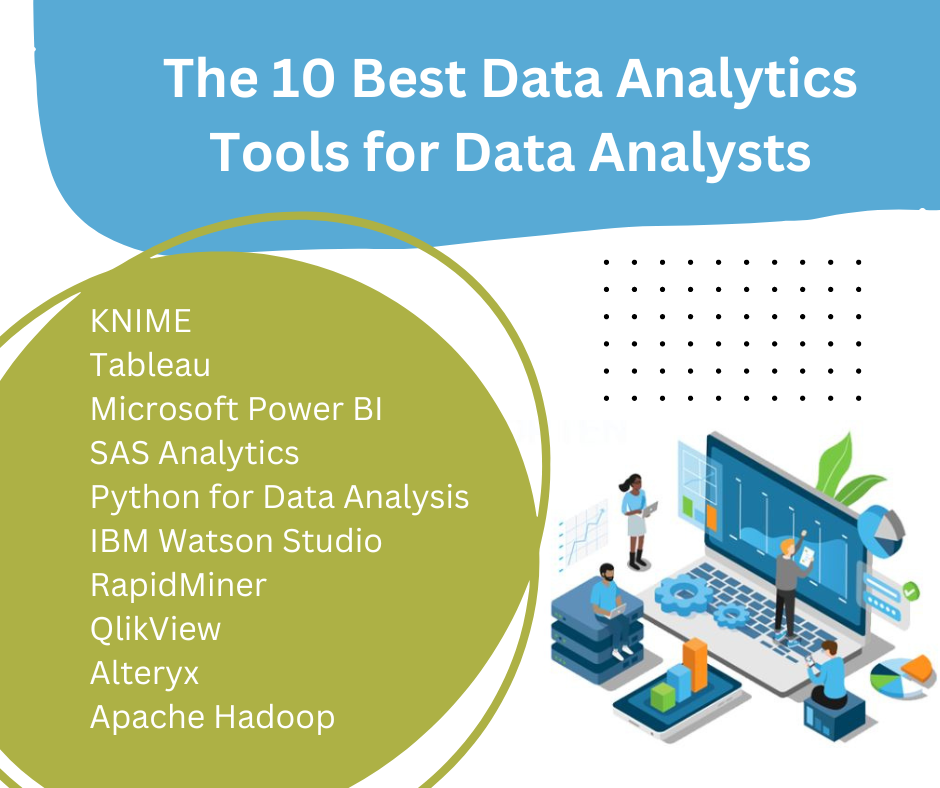 <h2>Top 10 Data Analytics Tools</h2> <h3>1. KNIME</h3> KNIME (Konstanz Information Miner) is an open-source data analytics and integration platform. It allows users to visually design, execute, and analyze data workflows, facilitating the processing and manipulation of diverse data sources. KNIME supports a wide range of data science tasks, including data preprocessing, machine learning, and reporting. <h3>2. Tableau: Transforming Data into Visual Masterpieces</h3> Tableau is a leading data visualization and business intelligence platform. It empowers users to create interactive and shareable dashboards, uncovering insights from complex datasets. Known for its intuitive drag-and-drop interface, Tableau enables users to transform raw data into visually appealing charts, graphs, and maps without requiring extensive programming skills. <h3>3. Microsoft Power BI: Empowering Businesses with Intelligence</h3> Microsoft Power BI is a powerful business analytics tool that facilitates data visualization and sharing insights across an organization. With a user-friendly interface, it enables users to connect to various data sources, transform raw data into meaningful reports and dashboards, and share them for collaborative decision-making. Power BI supports real-time analytics, offering a comprehensive suite of interactive visualizations and customizable reports. <h3>4. SAS Analytics: A Pioneer in Advanced Analytics</h3> SAS Analytics is a comprehensive suite of software solutions for advanced analytics, business intelligence, and data management. Renowned for its robust statistical analysis capabilities, SAS empowers organizations to derive valuable insights from complex datasets. The platform encompasses a wide range of tools for data exploration, predictive modeling, machine learning, and statistical analysis. SAS Analytics is widely used in industries like finance, healthcare, and academia, offering a scalable and customizable environment. <h3>5. Python for Data Analysis: Coding Excellence in Analytics</h3> Python for Data Analysis is a powerful and versatile programming language widely used in the field of data science. Leveraging libraries like NumPy, Pandas, and Matplotlib, Python facilitates efficient data manipulation, analysis, and visualization. Pandas provides data structures for easy handling of structured data, while NumPy offers support for numerical operations. Python's simplicity, readability, and extensive community support make it an ideal choice for tasks ranging from exploratory data analysis to machine learning. <h3>6. IBM Watson Studio: AI-Driven Analytics at Your Fingertips</h3> IBM Watson Studio is an advanced cloud-based platform designed for data scientists and AI developers. Offering a collaborative environment, it streamlines the end-to-end process of data analysis, machine learning, and model deployment. Watson Studio integrates various tools, including Jupyter Notebooks and Apache Spark, providing flexibility and scalability for diverse data science tasks. <h3>7. RapidMiner: Accelerating Data Science Workflows</h3> RapidMiner is a user-friendly, open-source data science platform for building advanced analytics workflows. Known for its drag-and-drop interface, it facilitates data preparation, machine learning, and predictive modeling. RapidMiner integrates seamlessly with various data sources and offers a wide range of pre-built machine learning algorithms. Its visual workflow design simplifies complex analytics tasks, making it accessible to both data scientists and business analysts. <h3>8. QlikView: Associative Data Modeling for Deeper Insights</h3> QlikView is a business intelligence (BI) platform renowned for its associative data modeling and visualization capabilities. It allows users to explore and analyze data dynamically, making connections across diverse datasets for comprehensive insights. QlikView's in-memory processing enables rapid data retrieval and visualization, enhancing real-time analytics. Its interactive dashboards and user-friendly interface empower users to create intuitive reports and make data-driven decisions. <h3>9. Alteryx: Revolutionizing Data Blending and Preparation</h3> Alteryx is a leading data analytics platform that streamlines the end-to-end process of data preparation and advanced analytics. Known for its user-friendly interface, Alteryx enables data blending, cleansing, and transformation without requiring extensive coding. It empowers data analysts and business users to create sophisticated workflows, integrating disparate data sources for comprehensive insights. Alteryx supports predictive and spatial analytics, making it a versatile tool for uncovering patterns and trends. <h3>10. Apache Hadoop: Tackling Big Data Challenges Head-On</h3> Apache Hadoop is an open-source framework designed for distributed storage and processing of large-scale data sets. It utilizes a distributed file system (HDFS) to store data across multiple nodes, and the MapReduce programming model for parallel processing. Hadoop's scalable architecture enables efficient processing of massive datasets, making it valuable for big data analytics. It has become a cornerstone in managing and analyzing structured and unstructured data, providing fault tolerance and scalability. <h2>Criteria for Selecting Data Analytics Tools</h2> <strong>A. Ease of Use</strong> An ideal analytics tool should be user-friendly, allowing analysts to navigate through complex datasets effortlessly. Intuitive interfaces and drag-and-drop functionalities enhance the overall user experience. <strong>B. Integration Capabilities</strong> Integration with other tools and platforms is crucial for a seamless workflow. Tools that can effortlessly integrate with existing systems offer enhanced efficiency and convenience. <strong>C. Customization Options</strong> Every organization has unique analytical needs. A good analytics tool should provide customization options, allowing users to tailor the tool to their specific requirements. <h3>Conclusion</h3> In conclusion, the field of data analytics tools is expansive and varied, providing solutions tailored to businesses of any size or industry. Each tool possesses distinct strengths, and the selection hinges on the organization's specific needs and objectives. Whether you prefer the user-friendly features of Tableau, the analytical capabilities of SAS, or the programming flexibility offered by R and Python, there's a tool suited for every analytical requirement. If you are considering a career in data analytics, it is advisable to explore <a href="https://www.syntaxtechs.com/courses/data-analytics-and-business-intelligence-training-course-online">online data analytics courses</a> to enhance your skills and knowledge. |
| json metadata | {"tags":["dataanalytics","tools","dataanalysis","python","tableau","excel","careergrowth","techtrends"],"image":["https://cdn.steemitimages.com/DQmd4CuSEPQkh9niU8j4UvmSZTiPWjb18G532kyXMREDgkh/Best%20Data%20Analytics%20Tools%20for%20Data%20Analysts.png"],"links":["https://www.syntaxtechs.com/blog/data-analytics-tools","https://www.syntaxtechs.com/courses/data-analytics-and-business-intelligence-training-course-online"],"app":"steemit/0.2","format":"markdown"} |
| parent author | |
| parent permlink | dataanalytics |
| permlink | the-10-best-data-analytics-tools-for-data-analysts |
| title | The 10 Best Data Analytics Tools for Data Analysts |
| Transaction Info | Block #80526212/Trx 47e36235992062ac8e4e7d7c9c9d0e04920c01ef |
View Raw JSON Data
{
"block": 80526212,
"op": [
"comment",
{
"author": "syntaxtechs",
"body": "Data analytics has become an indispensable part of decision-making processes across industries, and the right tools can make all the difference for data analysts. In this article, we will explore the top 10 data analytics tools that empower analysts to extract meaningful insights from vast datasets.\n\n<h2>What are Data Analytics Tools?</h2>\nBefore diving into the specifics, let's understand what <a href=\"https://www.syntaxtechs.com/blog/data-analytics-tools\">Data Analytics Tools</a> are. These tools are software applications designed to process and analyze data, helping individuals and organizations make informed decisions based on statistical patterns and trends.\nIn today's data-driven era, businesses leverage analytics to gain a competitive edge. From identifying market trends to optimizing operations, data analytics plays a pivotal role. The choice of analytics tools significantly influences the effectiveness of these processes.\n\n\n\n\n\n\n<h2>Top 10 Data Analytics Tools</h2>\n\n<h3>1. KNIME</h3>\nKNIME (Konstanz Information Miner) is an open-source data analytics and integration platform. It allows users to visually design, execute, and analyze data workflows, facilitating the processing and manipulation of diverse data sources. KNIME supports a wide range of data science tasks, including data preprocessing, machine learning, and reporting.\n\n<h3>2. Tableau: Transforming Data into Visual Masterpieces</h3>\nTableau is a leading data visualization and business intelligence platform. It empowers users to create interactive and shareable dashboards, uncovering insights from complex datasets. Known for its intuitive drag-and-drop interface, Tableau enables users to transform raw data into visually appealing charts, graphs, and maps without requiring extensive programming skills.\n\n<h3>3. Microsoft Power BI: Empowering Businesses with Intelligence</h3>\nMicrosoft Power BI is a powerful business analytics tool that facilitates data visualization and sharing insights across an organization. With a user-friendly interface, it enables users to connect to various data sources, transform raw data into meaningful reports and dashboards, and share them for collaborative decision-making. Power BI supports real-time analytics, offering a comprehensive suite of interactive visualizations and customizable reports.\n\n<h3>4. SAS Analytics: A Pioneer in Advanced Analytics</h3>\nSAS Analytics is a comprehensive suite of software solutions for advanced analytics, business intelligence, and data management. Renowned for its robust statistical analysis capabilities, SAS empowers organizations to derive valuable insights from complex datasets. The platform encompasses a wide range of tools for data exploration, predictive modeling, machine learning, and statistical analysis. SAS Analytics is widely used in industries like finance, healthcare, and academia, offering a scalable and customizable environment.\n\n<h3>5. Python for Data Analysis: Coding Excellence in Analytics</h3>\nPython for Data Analysis is a powerful and versatile programming language widely used in the field of data science. Leveraging libraries like NumPy, Pandas, and Matplotlib, Python facilitates efficient data manipulation, analysis, and visualization. Pandas provides data structures for easy handling of structured data, while NumPy offers support for numerical operations. Python's simplicity, readability, and extensive community support make it an ideal choice for tasks ranging from exploratory data analysis to machine learning.\n\n<h3>6. IBM Watson Studio: AI-Driven Analytics at Your Fingertips</h3>\nIBM Watson Studio is an advanced cloud-based platform designed for data scientists and AI developers. Offering a collaborative environment, it streamlines the end-to-end process of data analysis, machine learning, and model deployment. Watson Studio integrates various tools, including Jupyter Notebooks and Apache Spark, providing flexibility and scalability for diverse data science tasks.\n\n<h3>7. RapidMiner: Accelerating Data Science Workflows</h3>\nRapidMiner is a user-friendly, open-source data science platform for building advanced analytics workflows. Known for its drag-and-drop interface, it facilitates data preparation, machine learning, and predictive modeling. RapidMiner integrates seamlessly with various data sources and offers a wide range of pre-built machine learning algorithms. Its visual workflow design simplifies complex analytics tasks, making it accessible to both data scientists and business analysts. \n\n<h3>8. QlikView: Associative Data Modeling for Deeper Insights</h3>\nQlikView is a business intelligence (BI) platform renowned for its associative data modeling and visualization capabilities. It allows users to explore and analyze data dynamically, making connections across diverse datasets for comprehensive insights. QlikView's in-memory processing enables rapid data retrieval and visualization, enhancing real-time analytics. Its interactive dashboards and user-friendly interface empower users to create intuitive reports and make data-driven decisions.\n\n<h3>9. Alteryx: Revolutionizing Data Blending and Preparation</h3>\nAlteryx is a leading data analytics platform that streamlines the end-to-end process of data preparation and advanced analytics. Known for its user-friendly interface, Alteryx enables data blending, cleansing, and transformation without requiring extensive coding. It empowers data analysts and business users to create sophisticated workflows, integrating disparate data sources for comprehensive insights. Alteryx supports predictive and spatial analytics, making it a versatile tool for uncovering patterns and trends.\n\n<h3>10. Apache Hadoop: Tackling Big Data Challenges Head-On</h3>\nApache Hadoop is an open-source framework designed for distributed storage and processing of large-scale data sets. It utilizes a distributed file system (HDFS) to store data across multiple nodes, and the MapReduce programming model for parallel processing. Hadoop's scalable architecture enables efficient processing of massive datasets, making it valuable for big data analytics. It has become a cornerstone in managing and analyzing structured and unstructured data, providing fault tolerance and scalability.\n\n<h2>Criteria for Selecting Data Analytics Tools</h2>\n\n<strong>A. Ease of Use</strong>\nAn ideal analytics tool should be user-friendly, allowing analysts to navigate through complex datasets effortlessly. Intuitive interfaces and drag-and-drop functionalities enhance the overall user experience.\n\n<strong>B. Integration Capabilities</strong>\nIntegration with other tools and platforms is crucial for a seamless workflow. Tools that can effortlessly integrate with existing systems offer enhanced efficiency and convenience.\n\n<strong>C. Customization Options</strong>\nEvery organization has unique analytical needs. A good analytics tool should provide customization options, allowing users to tailor the tool to their specific requirements.\n\n<h3>Conclusion</h3>\nIn conclusion, the field of data analytics tools is expansive and varied, providing solutions tailored to businesses of any size or industry. Each tool possesses distinct strengths, and the selection hinges on the organization's specific needs and objectives. Whether you prefer the user-friendly features of Tableau, the analytical capabilities of SAS, or the programming flexibility offered by R and Python, there's a tool suited for every analytical requirement.\n\nIf you are considering a career in data analytics, it is advisable to explore <a href=\"https://www.syntaxtechs.com/courses/data-analytics-and-business-intelligence-training-course-online\">online data analytics courses</a> to enhance your skills and knowledge.",
"json_metadata": "{\"tags\":[\"dataanalytics\",\"tools\",\"dataanalysis\",\"python\",\"tableau\",\"excel\",\"careergrowth\",\"techtrends\"],\"image\":[\"https://cdn.steemitimages.com/DQmd4CuSEPQkh9niU8j4UvmSZTiPWjb18G532kyXMREDgkh/Best%20Data%20Analytics%20Tools%20for%20Data%20Analysts.png\"],\"links\":[\"https://www.syntaxtechs.com/blog/data-analytics-tools\",\"https://www.syntaxtechs.com/courses/data-analytics-and-business-intelligence-training-course-online\"],\"app\":\"steemit/0.2\",\"format\":\"markdown\"}",
"parent_author": "",
"parent_permlink": "dataanalytics",
"permlink": "the-10-best-data-analytics-tools-for-data-analysts",
"title": "The 10 Best Data Analytics Tools for Data Analysts"
}
],
"op_in_trx": 0,
"timestamp": "2023-12-07T11:38:18",
"trx_id": "47e36235992062ac8e4e7d7c9c9d0e04920c01ef",
"trx_in_block": 4,
"virtual_op": 0
}bluesnipersent 0.010 STEEM to @syntaxtechs- "Hello. Good to see you on Steem. To maximize your rewards, publish your post also on Hive ( hive.blog ) and Blurt ( blurt.blog ) blockchains. Use upvu, jsup or ctime and get instant upvotes"2023/11/30 13:30:03
bluesnipersent 0.010 STEEM to @syntaxtechs- "Hello. Good to see you on Steem. To maximize your rewards, publish your post also on Hive ( hive.blog ) and Blurt ( blurt.blog ) blockchains. Use upvu, jsup or ctime and get instant upvotes"
2023/11/30 13:30:03
| amount | 0.010 STEEM |
| from | bluesniper |
| memo | Hello. Good to see you on Steem. To maximize your rewards, publish your post also on Hive ( hive.blog ) and Blurt ( blurt.blog ) blockchains. Use upvu, jsup or ctime and get instant upvotes |
| to | syntaxtechs |
| Transaction Info | Block #80327724/Trx 9f0fb988cb1e8e95097b4de9b88bc0d29d3b0cd2 |
View Raw JSON Data
{
  "block": 80327724,
  "op": [
    "transfer",
    {
      "amount": "0.010 STEEM",
      "from": "bluesniper",
      "memo": "Hello. Good to see you on Steem. To maximize your rewards, publish your post also on Hive ( hive.blog ) and Blurt ( blurt.blog ) blockchains. Use upvu, jsup or ctime and get instant upvotes",
      "to": "syntaxtechs"
    }
  ],
  "op_in_trx": 0,
  "timestamp": "2023-11-30T13:30:03",
  "trx_id": "9f0fb988cb1e8e95097b4de9b88bc0d29d3b0cd2",
  "trx_in_block": 4,
  "virtual_op": 0
}bluesniperupvoted (100.00%) @syntaxtechs / the-power-of-business-intelligence-tools2023/11/30 13:29:42
bluesniperupvoted (100.00%) @syntaxtechs / the-power-of-business-intelligence-tools
2023/11/30 13:29:42
| author | syntaxtechs |
| permlink | the-power-of-business-intelligence-tools |
| voter | bluesniper |
| weight | 10000 (100.00%) |
| Transaction Info | Block #80327717/Trx 4c04acc937a2ff1aea99ac6e6be6bda2258d4e63 |
View Raw JSON Data
{
  "block": 80327717,
  "op": [
    "vote",
    {
      "author": "syntaxtechs",
      "permlink": "the-power-of-business-intelligence-tools",
      "voter": "bluesniper",
      "weight": 10000
    }
  ],
  "op_in_trx": 0,
  "timestamp": "2023-11-30T13:29:42",
  "trx_id": "4c04acc937a2ff1aea99ac6e6be6bda2258d4e63",
  "trx_in_block": 1,
  "virtual_op": 0
}syntaxtechspublished a new post: the-power-of-business-intelligence-tools2023/11/30 13:24:03
syntaxtechspublished a new post: the-power-of-business-intelligence-tools
2023/11/30 13:24:03
| author | syntaxtechs |
| body | Business Intelligence has become a cornerstone in the success of modern enterprises, propelling them toward data-driven decision-making. From historical data analysis to real-time insights, Business Intelligence tools have evolved significantly, revolutionizing how businesses operate. In the dynamic landscape of the business world, where data is abundant and vital, Business Intelligence Tools stand as the key to unlocking actionable insights. At its core, BI involves the use of technology to transform raw data into meaningful information, aiding in strategic decision-making. In a world driven by information, the power of BI tools cannot be overstated.  <h2>Evolution of Business Intelligence Tools</h2> The journey of <a href="https://www.syntaxtechs.com/blog/top-10-business-intelligence-tools">Business Intelligence Tools</a> traces back to the early days of computing when businesses relied on basic analytics. Over the years, technological advancements, especially in data storage and processing capabilities, have propelled BI tools to unprecedented heights. The integration of artificial intelligence and machine learning has elevated Business Intelligence tools, allowing for predictive analytics and a deeper understanding of data patterns. This evolution has not only enhanced the speed of analysis but also expanded the scope of insights businesses can gain. <h3>Key Features of Modern Business Intelligence Tools</h3> In the present era, BI tools come equipped with a myriad of features designed to simplify complex data. <h4>Data Visualization</h4> One of the hallmarks of modern BI tools is their ability to transform complex data sets into visually appealing and easily understandable charts, graphs, and dashboards. <h4>Predictive Analytics</h4> Predictive analytics, powered by machine learning algorithms, enables businesses to anticipate future trends and make proactive decisions. <h4>Real-time Reporting</h4> Unlike traditional reporting, modern BI tools provide real-time updates, allowing businesses to respond swiftly to changing market conditions. <h3>Benefits of Implementing Business Intelligence Tools</h3> The implementation of BI tools brings forth a plethora of advantages for businesses of all sizes. <h4>Improved Decision-Making</h4> Business Intelligence tools provide decision-makers with timely and accurate information, enabling them to make informed choices that align with organizational goals. <h4>Increased Operational Efficiency</h4> Streamlining processes and workflows, BI tools contribute to enhanced operational efficiency, saving time and resources. <h4>Enhanced Competitive Advantage</h4> Businesses leveraging BI tools gain a competitive edge by staying ahead of market trends and consumer preferences. <h3>Popular Business Intelligence Tools in the Market</h3> Several BI tools have emerged as frontrunners in the market, catering to diverse business needs. <h4>Tableau</h4> Known for its robust data visualization capabilities, Tableau empowers users to create interactive and shareable dashboards. <h4>Power BI</h4> Microsoft's Power BI offers seamless integration with other Microsoft products and provides comprehensive data analytics solutions. <h4>QlikView</h4> QlikView stands out for its associative data modeling, allowing users to explore data relationships effortlessly. <h3>Choosing the Right Business Intelligence Tool for Your Business</h3> The effectiveness of BI tools hinges on selecting the right one that aligns with your business objectives. <h4>Assessing Business Needs</h4> Understanding your specific requirements is crucial in choosing a BI tool that addresses your unique challenges and goals. <h4>Scalability and Integration</h4> Opt for BI tools that can scale with your business growth and seamlessly integrate with your existing systems. <h3>Challenges in Implementing Business Intelligence Tools</h3> While the benefits of BI tools are substantial, businesses often face challenges during the implementation phase. <h4>Data Security Concerns</h4> As BI tools deal with sensitive business data, ensuring robust security measures is paramount to prevent unauthorized access. <h4>Resistance to Change</h4> Employees may resist the adoption of BI tools due to a fear of change or lack of understanding. Addressing this resistance is vital for successful implementation. <h3>Future Trends in Business Intelligence</h3> The landscape of BI is continually evolving, with several trends shaping the future of these tools. <h4>Artificial Intelligence Integration</h4> The integration of artificial intelligence into BI tools is set to revolutionize data analysis, providing more accurate predictions and deeper insights. <h4>Augmented Analytics</h4> Augmented analytics, combining machine learning and natural language processing, will make BI tools more user-friendly and accessible to non-technical users. <h3>How Business Intelligence Tools Empower Small Businesses</h3> BI tools are not exclusive to large enterprises; they also play a pivotal role in empowering small businesses. <h4>Cost-Effective Solutions</h4> Affordable BI solutions tailored for small businesses level the playing field, allowing them to compete with larger counterparts. <h4>Levelling the Playing Field</h4> BI tools provide small businesses with the ability to analyze and leverage data, enabling them to make strategic decisions on par with larger competitors. <h3>Business Intelligence Tools and Data Governance</h3> Ensuring the accuracy and reliability of data is paramount in the world of BI. <h4>Ensuring Data Accuracy and Reliability</h4> Discuss the measures and best practices for maintaining data accuracy, from regular audits to implementing data quality management systems. <h4>Regulatory Compliance</h4> Address the significance of adhering to data protection regulations and industry standards, underscoring the importance of ethical and legal considerations in BI implementation. <h3>Conclusion</h3> In conclusion, the power of Business Intelligence Tools transcends mere data analysis; it reshapes how businesses strategize, operate, and thrive in the competitive landscape. From improving decision-making processes to providing real-time insights, BI tools are indispensable in the modern business ecosystem. As we navigate the future, the symbiotic relationship between technology and human insights will continue to drive innovation and success. In order to learn effective strategies for BI tool adoption, anyone can enroll in an <a href="https://www.syntaxtechs.com/courses/data-analytics-and-business-intelligence-training-course-online">online business intelligence course</a>. |
| json metadata | {"tags":["businessintelligence","bitools","tableau","powerbi","looker","techtrends","emergingtrends"],"image":["https://cdn.steemitimages.com/DQmczkhTAFHFNoXQMrUTMWr5AZSwkk8jGWtzkLziNfMqbZR/Power_of_Business_Intelligence_Tools_1600x840.png"],"links":["https://www.syntaxtechs.com/blog/top-10-business-intelligence-tools","https://www.syntaxtechs.com/courses/data-analytics-and-business-intelligence-training-course-online"],"app":"steemit/0.2","format":"markdown"} |
| parent author | |
| parent permlink | businessintelligence |
| permlink | the-power-of-business-intelligence-tools |
| title | The Power of Business Intelligence Tools |
| Transaction Info | Block #80327604/Trx d31affd978c965664f110111700111a5d0e92608 |
View Raw JSON Data
{
"block": 80327604,
"op": [
"comment",
{
"author": "syntaxtechs",
"body": "Business Intelligence has become a cornerstone in the success of modern enterprises, propelling them toward data-driven decision-making. From historical data analysis to real-time insights, Business Intelligence tools have evolved significantly, revolutionizing how businesses operate.\n\nIn the dynamic landscape of the business world, where data is abundant and vital, Business Intelligence Tools stand as the key to unlocking actionable insights. At its core, BI involves the use of technology to transform raw data into meaningful information, aiding in strategic decision-making. In a world driven by information, the power of BI tools cannot be overstated.\n\n\n\n\n\n<h2>Evolution of Business Intelligence Tools</h2>\nThe journey of <a href=\"https://www.syntaxtechs.com/blog/top-10-business-intelligence-tools\">Business Intelligence Tools</a> traces back to the early days of computing when businesses relied on basic analytics. Over the years, technological advancements, especially in data storage and processing capabilities, have propelled BI tools to unprecedented heights.\nThe integration of artificial intelligence and machine learning has elevated Business Intelligence tools, allowing for predictive analytics and a deeper understanding of data patterns. This evolution has not only enhanced the speed of analysis but also expanded the scope of insights businesses can gain.\n\n<h3>Key Features of Modern Business Intelligence Tools</h3>\nIn the present era, BI tools come equipped with a myriad of features designed to simplify complex data.\n\n<h4>Data Visualization</h4>\nOne of the hallmarks of modern BI tools is their ability to transform complex data sets into visually appealing and easily understandable charts, graphs, and dashboards.\n\n<h4>Predictive Analytics</h4>\nPredictive analytics, powered by machine learning algorithms, enables businesses to anticipate future trends and make proactive decisions.\n\n<h4>Real-time Reporting</h4>\nUnlike traditional reporting, modern BI tools provide real-time updates, allowing businesses to respond swiftly to changing market conditions.\n\n<h3>Benefits of Implementing Business Intelligence Tools</h3>\nThe implementation of BI tools brings forth a plethora of advantages for businesses of all sizes.\n\n<h4>Improved Decision-Making</h4>\nBusiness Intelligence tools provide decision-makers with timely and accurate information, enabling them to make informed choices that align with organizational goals.\n\n<h4>Increased Operational Efficiency</h4>\nStreamlining processes and workflows, BI tools contribute to enhanced operational efficiency, saving time and resources.\n\n<h4>Enhanced Competitive Advantage</h4>\nBusinesses leveraging BI tools gain a competitive edge by staying ahead of market trends and consumer preferences.\n\n<h3>Popular Business Intelligence Tools in the Market</h3>\nSeveral BI tools have emerged as frontrunners in the market, catering to diverse business needs.\n\n<h4>Tableau</h4>\nKnown for its robust data visualization capabilities, Tableau empowers users to create interactive and shareable dashboards.\n\n<h4>Power BI</h4>\nMicrosoft's Power BI offers seamless integration with other Microsoft products and provides comprehensive data analytics solutions.\n\n<h4>QlikView</h4>\nQlikView stands out for its associative data modeling, allowing users to explore data relationships effortlessly.\n\n<h3>Choosing the Right Business Intelligence Tool for Your Business</h3>\nThe effectiveness of BI tools hinges on selecting the right one that aligns with your business objectives.\n\n<h4>Assessing Business Needs</h4>\nUnderstanding your specific requirements is crucial in choosing a BI tool that addresses your unique challenges and goals.\n\n<h4>Scalability and Integration</h4>\nOpt for BI tools that can scale with your business growth and seamlessly integrate with your existing systems.\n\n<h3>Challenges in Implementing Business Intelligence Tools</h3>\nWhile the benefits of BI tools are substantial, businesses often face challenges during the implementation phase.\n\n<h4>Data Security Concerns</h4>\nAs BI tools deal with sensitive business data, ensuring robust security measures is paramount to prevent unauthorized access.\n\n<h4>Resistance to Change</h4>\nEmployees may resist the adoption of BI tools due to a fear of change or lack of understanding. Addressing this resistance is vital for successful implementation.\n\n<h3>Future Trends in Business Intelligence</h3>\nThe landscape of BI is continually evolving, with several trends shaping the future of these tools.\n\n<h4>Artificial Intelligence Integration</h4>\nThe integration of artificial intelligence into BI tools is set to revolutionize data analysis, providing more accurate predictions and deeper insights.\n\n<h4>Augmented Analytics</h4>\nAugmented analytics, combining machine learning and natural language processing, will make BI tools more user-friendly and accessible to non-technical users.\n\n<h3>How Business Intelligence Tools Empower Small Businesses</h3>\nBI tools are not exclusive to large enterprises; they also play a pivotal role in empowering small businesses.\n\n<h4>Cost-Effective Solutions</h4>\nAffordable BI solutions tailored for small businesses level the playing field, allowing them to compete with larger counterparts.\n\n<h4>Levelling the Playing Field</h4>\nBI tools provide small businesses with the ability to analyze and leverage data, enabling them to make strategic decisions on par with larger competitors.\n\n<h3>Business Intelligence Tools and Data Governance</h3>\nEnsuring the accuracy and reliability of data is paramount in the world of BI.\n\n<h4>Ensuring Data Accuracy and Reliability</h4>\nDiscuss the measures and best practices for maintaining data accuracy, from regular audits to implementing data quality management systems.\n\n<h4>Regulatory Compliance</h4>\nAddress the significance of adhering to data protection regulations and industry standards, underscoring the importance of ethical and legal considerations in BI implementation.\n\n<h3>Conclusion</h3>\nIn conclusion, the power of Business Intelligence Tools transcends mere data analysis; it reshapes how businesses strategize, operate, and thrive in the competitive landscape. From improving decision-making processes to providing real-time insights, BI tools are indispensable in the modern business ecosystem. As we navigate the future, the symbiotic relationship between technology and human insights will continue to drive innovation and success. In order to learn effective strategies for BI tool adoption, anyone can enroll in an <a href=\"https://www.syntaxtechs.com/courses/data-analytics-and-business-intelligence-training-course-online\">online business intelligence course</a>.",
"json_metadata": "{\"tags\":[\"businessintelligence\",\"bitools\",\"tableau\",\"powerbi\",\"looker\",\"techtrends\",\"emergingtrends\"],\"image\":[\"https://cdn.steemitimages.com/DQmczkhTAFHFNoXQMrUTMWr5AZSwkk8jGWtzkLziNfMqbZR/Power_of_Business_Intelligence_Tools_1600x840.png\"],\"links\":[\"https://www.syntaxtechs.com/blog/top-10-business-intelligence-tools\",\"https://www.syntaxtechs.com/courses/data-analytics-and-business-intelligence-training-course-online\"],\"app\":\"steemit/0.2\",\"format\":\"markdown\"}",
"parent_author": "",
"parent_permlink": "businessintelligence",
"permlink": "the-power-of-business-intelligence-tools",
"title": "The Power of Business Intelligence Tools"
}
],
"op_in_trx": 0,
"timestamp": "2023-11-30T13:24:03",
"trx_id": "d31affd978c965664f110111700111a5d0e92608",
"trx_in_block": 10,
"virtual_op": 0
}bluesniperupvoted (100.00%) @syntaxtechs / the-evolution-of-qa-testing-a-comprehensive-guide2023/11/24 12:01:15
bluesniperupvoted (100.00%) @syntaxtechs / the-evolution-of-qa-testing-a-comprehensive-guide
2023/11/24 12:01:15
| author | syntaxtechs |
| permlink | the-evolution-of-qa-testing-a-comprehensive-guide |
| voter | bluesniper |
| weight | 10000 (100.00%) |
| Transaction Info | Block #80158816/Trx 50e3a5219bba3d4f5ca2caab1e4c07cae7b22d81 |
View Raw JSON Data
{
  "block": 80158816,
  "op": [
    "vote",
    {
      "author": "syntaxtechs",
      "permlink": "the-evolution-of-qa-testing-a-comprehensive-guide",
      "voter": "bluesniper",
      "weight": 10000
    }
  ],
  "op_in_trx": 0,
  "timestamp": "2023-11-24T12:01:15",
  "trx_id": "50e3a5219bba3d4f5ca2caab1e4c07cae7b22d81",
  "trx_in_block": 0,
  "virtual_op": 0
}syntaxtechspublished a new post: the-evolution-of-qa-testing-a-comprehensive-guide2023/11/24 11:55:21
syntaxtechspublished a new post: the-evolution-of-qa-testing-a-comprehensive-guide
2023/11/24 11:55:21
| author | syntaxtechs |
| body | Over the years, Quality Assurance testing has experienced a substantial evolution, progressing from manual testing procedures to sophisticated automated methodologies. This article will examine the evolution of QA testing, covering its inception, the influence of the digital revolution, the significance of Agile methodology, the ascent of AI and machine learning, and the obstacles and forthcoming trends in the domain of software quality assurance.  <h2>Definition of QA Testing</h2> QA testing, or Quality Assurance testing, is a systematic process that ensures software products meet defined standards and specifications. It involves evaluating various aspects of a system to identify defects and improve overall performance. QA testing encompasses test planning, execution, and result analysis to enhance software quality and user satisfaction. By validating functionality, security, and performance, QA testing helps identify and rectify issues before software release. This meticulous process ensures a reliable and seamless user experience, promoting trust in the software's capabilities. In essence, QA testing is the vital practice of systematically verifying and validating software to guarantee its adherence to predefined quality standards. <a href="https://www.syntaxtechs.com/blog/what-is-qa-testing">What is QA testing</a> is an inquiry into the methods and processes employed to guarantee the quality and reliability of software products. <h2>Journey of QA Testing: The Evolution</h2> <h3>Automation Takes the Stage</h3> The evolution of QA witnessed a significant milestone with the introduction of automated testing. Automated testing not only accelerated the testing process but also enhanced test coverage and efficiency. However, it brought its own set of challenges, such as selecting the right test cases for automation. <h3>Challenges in QA Evolution</h3> As QA evolved, it faced challenges such as keeping pace with rapid development cycles and ensuring compatibility with diverse technologies. Strategies to overcome these challenges involve a combination of robust planning, continuous learning, and adapting to industry best practices. <h3>DevOps and QA Collaboration</h3> DevOps, a cultural and technological movement, emphasizes collaboration between development and operations. QA seamlessly fits into the DevOps pipeline, ensuring that testing becomes an integral part of the continuous integration and continuous delivery (CI/CD) process. <h3>AI and Machine Learning in QA</h3> The incorporation of Artificial Intelligence (AI) and Machine Learning (ML) has brought a new dimension to QA. AI-driven testing can predict potential areas of failure, automate test case generation, and analyze complex data sets, significantly enhancing the effectiveness of QA processes. <h3>Continuous Testing: Ensuring Quality in Real Time</h3> Continuous testing is a crucial practice in today's fast-paced development environment. It involves automated testing throughout the software development life cycle, providing real-time feedback on the quality of the code. Implementing continuous testing requires a well-defined strategy and the right set of tools. <h3>Security Testing: A Critical Component</h3> In an era of increasing cybersecurity threats, security testing has become a non-negotiable aspect of QA. Embedding security testing into the development process helps identify vulnerabilities early on, preventing potential breaches and safeguarding sensitive data. <h3>The Human Element in QA</h3> Despite the rise of automation, the human element remains indispensable in QA. Human testers bring critical thinking, creativity, and domain expertise to the testing process. Striking the right balance between automation and manual testing is essential for comprehensive QA. <h3>Evolving Metrics in QA Assessment</h3> Traditional QA metrics have evolved to align with the dynamic nature of modern development practices. Metrics now focus on speed, efficiency, and customer satisfaction. Understanding and applying the right metrics is crucial for assessing the effectiveness of QA processes. <h3>Globalization and QA Challenges</h3> Globalized development teams present unique challenges to QA. Differences in time zones, cultural nuances, and varied development practices can impact the efficiency of testing processes. Implementing collaborative tools and communication strategies is vital for overcoming these challenges. <h3>Future Trends in QA</h3> Looking ahead, the future of QA testing holds exciting possibilities. From increased reliance on AI and ML to the integration of cutting-edge technologies like blockchain, QA is poised for continuous evolution. Staying informed about emerging trends is crucial for QA professionals to adapt and thrive in the ever-changing landscape. <h2>How to become QA Tester?</h2> To become a QA Tester, enroll in a comprehensive <a href="https://www.syntaxtechs.com/courses/sdet-training-course-online">QA testing course online</a> to acquire a strong understanding of software development processes and testing methodologies. Familiarize yourself with testing tools and automation frameworks. Learn programming languages like Java or Python, and gain expertise in bug tracking systems. Pursue relevant certifications such as ISTQB to enhance your credibility. Develop effective communication skills to collaborate with developers and stakeholders. Gain hands-on experience through internships or freelance projects, showcasing your ability to identify and report bugs. Stay updated on industry trends and continuously expand your knowledge of different testing types. A combination of technical proficiency, attention to detail, and communication skills will position you for a successful career as a QA Tester. <h4>Conclusion</h4> The journey of QA testing has been a fascinating exploration of adaptability and innovation. From its humble beginnings to the current landscape of AI-driven testing and continuous integration, QA has played a pivotal role in ensuring the delivery of high-quality software. As the industry continues to evolve, staying informed and embracing change will be key to navigating the future of QA testing. |
| json metadata | {"tags":["qatesting","qualityassurance","softwaretesting","softwaredevelopment","sdet","careergoals","techtrends"],"image":["https://cdn.steemitimages.com/DQmedey4b4hwHZeQd6aGdDa2n1pxxw1KJBt4PWSpGd1CaDt/Evolution%20of%20QA%20Testing.png"],"links":["https://www.syntaxtechs.com/blog/what-is-qa-testing","https://www.syntaxtechs.com/courses/sdet-training-course-online"],"app":"steemit/0.2","format":"markdown"} |
| parent author | |
| parent permlink | qatesting |
| permlink | the-evolution-of-qa-testing-a-comprehensive-guide |
| title | The Evolution of QA Testing: A Comprehensive Guide |
| Transaction Info | Block #80158703/Trx 8a3247fd887b76b6563fc96a043a303e186c452a |
View Raw JSON Data
{
"block": 80158703,
"op": [
"comment",
{
"author": "syntaxtechs",
"body": "Over the years, Quality Assurance testing has experienced a substantial evolution, progressing from manual testing procedures to sophisticated automated methodologies. This article will examine the evolution of QA testing, covering its inception, the influence of the digital revolution, the significance of Agile methodology, the ascent of AI and machine learning, and the obstacles and forthcoming trends in the domain of software quality assurance.\n\n\n\n\n\n<h2>Definition of QA Testing</h2>\nQA testing, or Quality Assurance testing, is a systematic process that ensures software products meet defined standards and specifications. It involves evaluating various aspects of a system to identify defects and improve overall performance. QA testing encompasses test planning, execution, and result analysis to enhance software quality and user satisfaction. By validating functionality, security, and performance, QA testing helps identify and rectify issues before software release. This meticulous process ensures a reliable and seamless user experience, promoting trust in the software's capabilities. In essence, QA testing is the vital practice of systematically verifying and validating software to guarantee its adherence to predefined quality standards. <a href=\"https://www.syntaxtechs.com/blog/what-is-qa-testing\">What is QA testing</a> is an inquiry into the methods and processes employed to guarantee the quality and reliability of software products.\n\n<h2>Journey of QA Testing: The Evolution</h2>\n\n<h3>Automation Takes the Stage</h3>\nThe evolution of QA witnessed a significant milestone with the introduction of automated testing. Automated testing not only accelerated the testing process but also enhanced test coverage and efficiency. However, it brought its own set of challenges, such as selecting the right test cases for automation.\n\n<h3>Challenges in QA Evolution</h3>\nAs QA evolved, it faced challenges such as keeping pace with rapid development cycles and ensuring compatibility with diverse technologies. Strategies to overcome these challenges involve a combination of robust planning, continuous learning, and adapting to industry best practices.\n\n<h3>DevOps and QA Collaboration</h3>\nDevOps, a cultural and technological movement, emphasizes collaboration between development and operations. QA seamlessly fits into the DevOps pipeline, ensuring that testing becomes an integral part of the continuous integration and continuous delivery (CI/CD) process.\n\n<h3>AI and Machine Learning in QA</h3>\nThe incorporation of Artificial Intelligence (AI) and Machine Learning (ML) has brought a new dimension to QA. AI-driven testing can predict potential areas of failure, automate test case generation, and analyze complex data sets, significantly enhancing the effectiveness of QA processes.\n\n<h3>Continuous Testing: Ensuring Quality in Real Time</h3>\nContinuous testing is a crucial practice in today's fast-paced development environment. It involves automated testing throughout the software development life cycle, providing real-time feedback on the quality of the code. Implementing continuous testing requires a well-defined strategy and the right set of tools.\n\n<h3>Security Testing: A Critical Component</h3>\nIn an era of increasing cybersecurity threats, security testing has become a non-negotiable aspect of QA. Embedding security testing into the development process helps identify vulnerabilities early on, preventing potential breaches and safeguarding sensitive data.\n\n<h3>The Human Element in QA</h3>\nDespite the rise of automation, the human element remains indispensable in QA. Human testers bring critical thinking, creativity, and domain expertise to the testing process. Striking the right balance between automation and manual testing is essential for comprehensive QA.\n\n<h3>Evolving Metrics in QA Assessment</h3>\nTraditional QA metrics have evolved to align with the dynamic nature of modern development practices. Metrics now focus on speed, efficiency, and customer satisfaction. Understanding and applying the right metrics is crucial for assessing the effectiveness of QA processes.\n\n<h3>Globalization and QA Challenges</h3>\nGlobalized development teams present unique challenges to QA. Differences in time zones, cultural nuances, and varied development practices can impact the efficiency of testing processes. Implementing collaborative tools and communication strategies is vital for overcoming these challenges.\n\n<h3>Future Trends in QA</h3>\nLooking ahead, the future of QA testing holds exciting possibilities. From increased reliance on AI and ML to the integration of cutting-edge technologies like blockchain, QA is poised for continuous evolution. Staying informed about emerging trends is crucial for QA professionals to adapt and thrive in the ever-changing landscape.\n\n<h2>How to become QA Tester?</h2>\nTo become a QA Tester, enroll in a comprehensive <a href=\"https://www.syntaxtechs.com/courses/sdet-training-course-online\">QA testing course online</a> to acquire a strong understanding of software development processes and testing methodologies. Familiarize yourself with testing tools and automation frameworks. Learn programming languages like Java or Python, and gain expertise in bug tracking systems. Pursue relevant certifications such as ISTQB to enhance your credibility. Develop effective communication skills to collaborate with developers and stakeholders. Gain hands-on experience through internships or freelance projects, showcasing your ability to identify and report bugs. Stay updated on industry trends and continuously expand your knowledge of different testing types. A combination of technical proficiency, attention to detail, and communication skills will position you for a successful career as a QA Tester.\n\n<h4>Conclusion</h4>\nThe journey of QA testing has been a fascinating exploration of adaptability and innovation. From its humble beginnings to the current landscape of AI-driven testing and continuous integration, QA has played a pivotal role in ensuring the delivery of high-quality software. As the industry continues to evolve, staying informed and embracing change will be key to navigating the future of QA testing.",
"json_metadata": "{\"tags\":[\"qatesting\",\"qualityassurance\",\"softwaretesting\",\"softwaredevelopment\",\"sdet\",\"careergoals\",\"techtrends\"],\"image\":[\"https://cdn.steemitimages.com/DQmedey4b4hwHZeQd6aGdDa2n1pxxw1KJBt4PWSpGd1CaDt/Evolution%20of%20QA%20Testing.png\"],\"links\":[\"https://www.syntaxtechs.com/blog/what-is-qa-testing\",\"https://www.syntaxtechs.com/courses/sdet-training-course-online\"],\"app\":\"steemit/0.2\",\"format\":\"markdown\"}",
"parent_author": "",
"parent_permlink": "qatesting",
"permlink": "the-evolution-of-qa-testing-a-comprehensive-guide",
"title": "The Evolution of QA Testing: A Comprehensive Guide"
}
],
"op_in_trx": 0,
"timestamp": "2023-11-24T11:55:21",
"trx_id": "8a3247fd887b76b6563fc96a043a303e186c452a",
"trx_in_block": 3,
"virtual_op": 0
}bluesnipersent 0.010 STEEM to @syntaxtechs- "Hello. Good to see you on Steem. To maximize your rewards, publish your post also on Hive ( hive.blog ) and Blurt ( blurt.blog ) blockchains. Use upvu, jsup or ctime and get instant upvotes"2023/11/20 10:59:27
bluesnipersent 0.010 STEEM to @syntaxtechs- "Hello. Good to see you on Steem. To maximize your rewards, publish your post also on Hive ( hive.blog ) and Blurt ( blurt.blog ) blockchains. Use upvu, jsup or ctime and get instant upvotes"
2023/11/20 10:59:27
| amount | 0.010 STEEM |
| from | bluesniper |
| memo | Hello. Good to see you on Steem. To maximize your rewards, publish your post also on Hive ( hive.blog ) and Blurt ( blurt.blog ) blockchains. Use upvu, jsup or ctime and get instant upvotes |
| to | syntaxtechs |
| Transaction Info | Block #80043894/Trx 8abb68480c6ce18a16561b8a8cd1fcac6e5c27ee |
View Raw JSON Data
{
  "block": 80043894,
  "op": [
    "transfer",
    {
      "amount": "0.010 STEEM",
      "from": "bluesniper",
      "memo": "Hello. Good to see you on Steem. To maximize your rewards, publish your post also on Hive ( hive.blog ) and Blurt ( blurt.blog ) blockchains. Use upvu, jsup or ctime and get instant upvotes",
      "to": "syntaxtechs"
    }
  ],
  "op_in_trx": 0,
  "timestamp": "2023-11-20T10:59:27",
  "trx_id": "8abb68480c6ce18a16561b8a8cd1fcac6e5c27ee",
  "trx_in_block": 5,
  "virtual_op": 0
}2023/11/20 10:59:06
2023/11/20 10:59:06
| author | syntaxtechs |
| permlink | top-5-factors-influencing-business-intelligence-analyst-salaries |
| voter | bluesniper |
| weight | 10000 (100.00%) |
| Transaction Info | Block #80043888/Trx 35af433e5099c52df161138c8b9a84d405550dac |
View Raw JSON Data
{
  "block": 80043888,
  "op": [
    "vote",
    {
      "author": "syntaxtechs",
      "permlink": "top-5-factors-influencing-business-intelligence-analyst-salaries",
      "voter": "bluesniper",
      "weight": 10000
    }
  ],
  "op_in_trx": 0,
  "timestamp": "2023-11-20T10:59:06",
  "trx_id": "35af433e5099c52df161138c8b9a84d405550dac",
  "trx_in_block": 12,
  "virtual_op": 0
}syntaxtechspublished a new post: top-5-factors-influencing-business-intelligence-analyst-salaries2023/11/20 10:53:48
syntaxtechspublished a new post: top-5-factors-influencing-business-intelligence-analyst-salaries
2023/11/20 10:53:48
| author | syntaxtechs |
| body | Within the ever-changing realm of business intelligence, the importance of Business Intelligence Analysts has grown significantly. These professionals play a crucial role in helping organizations extract valuable insights from data, thereby influencing strategic decision-making. With businesses acknowledging the importance of data-driven methodologies, the need for proficient BI Analysts is on the rise. Nevertheless, multiple factors contribute to the fluctuating salaries in this field. This article delves into the top five influences on Business Intelligence Analyst salaries, offering insights on how to navigate the intricate landscape of compensation in this profession. 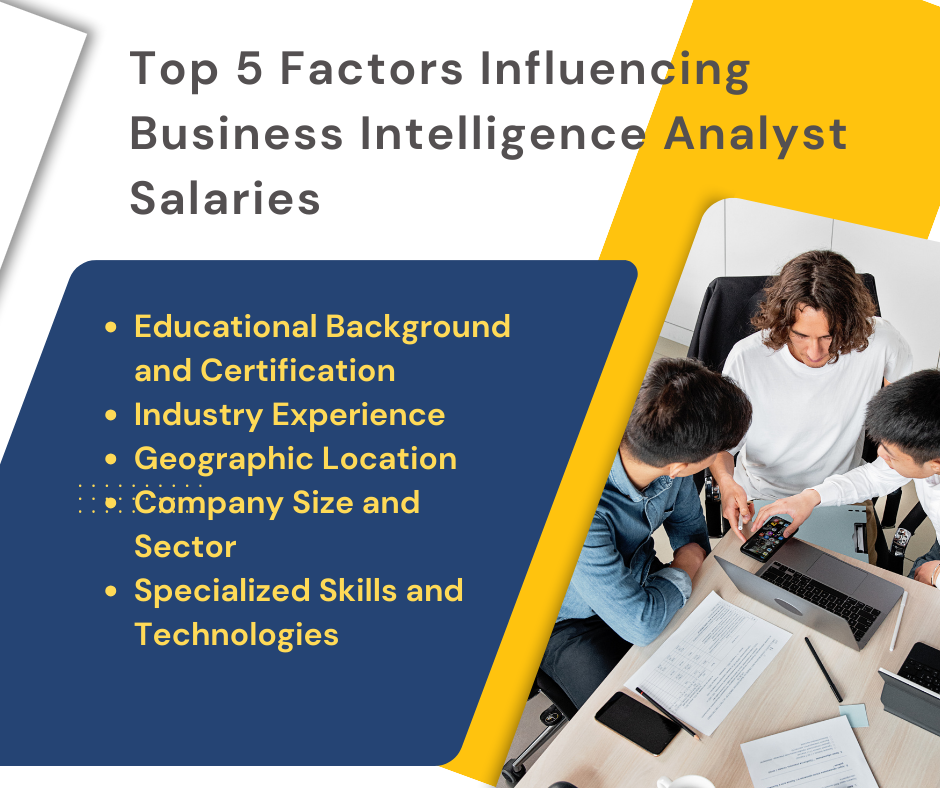 <h2>Top 5 Factors that influence Business Intelligence Analyst Salaries</h2> <h3>1- Educational Background and Certification</h3> One of the key factors influencing the Business Intelligence Analyst salary is their educational credentials. Those holding advanced degrees in areas like data science, statistics, or business analytics typically earn higher salaries. Furthermore, acquiring pertinent certifications from top BI software providers, participating in <a href="https://www.syntaxtechs.com/courses/data-analytics-and-business-intelligence-training-course-online">online business intelligence BootCamp</a>, or obtaining certifications from industry-recognized organizations can notably affect salary outcomes. Employers highly appreciate a commitment to ongoing learning and expertise showcased through certifications, making it a pivotal aspect in salary discussions. <h3>2- Industry Experience</h3> The saying "experience is the best teacher" remains applicable in the realm of Business Intelligence. The amount of time a BI Analyst has dedicated to refining their skills directly links to their earning capacity. Veteran professionals frequently demand higher salaries owing to their profound understanding of industry trends, nuances in data, and proficiency in navigating intricate datasets. Employers acknowledge the significance of experience, rendering it a pivotal element in salary negotiations. <h3>3- Geographic Location</h3> The geographic location of a BI Analyst's workplace plays a significant role in determining their salary. Where a BI Analyst works really matters for how much they get paid. The salary can change a lot depending on how expensive it is to live there, how much companies need BI skills, and how the economy is doing. For example, BI Analysts in tech places like Silicon Valley might earn more money than those in areas where not many companies need data experts. It's important for both people looking for jobs and companies to know about the job market in that area when talking about how much to get paid. <h3>4- Company Size and Sector</h3> BI Analyst salaries are influenced by the size and industry of the employing organization. Larger enterprises dealing with vast datasets and intricate analytics needs typically provide more competitive salaries to draw in top-tier talent. Likewise, BI Analysts in industries where data plays a pivotal role, like finance or healthcare, may receive elevated compensation due to the specialized nature of their work. Smaller companies, while offering competitive salaries, may focus on alternative perks such as a flexible work environment to attract proficient BI professionals. <h3>5- Specialized Skills and Technologies</h3> In the dynamic realm of business intelligence, keeping up with the latest technologies and developing specialized skills can notably influence salary levels. BI Analysts with expertise in emerging technologies such as machine learning, artificial intelligence, or advanced data visualization tools are highly sought after. Employers are prepared to offer higher salaries to professionals with cutting-edge skills, acknowledging the strategic advantage of staying ahead in the competitive BI landscape. <h2>Business Intelligence Analyst Salary in USA</h2> The <a href="https://www.syntaxtechs.com/blog/business-intelligence-analyst-salary-in-usa">Business Intelligence Analyst Salary</a> in the USA varies based on factors such as experience, education, location, and industry. Typically, entry-level BI analysts can earn between $60,000 and $85,000 per year, while mid-level professionals with several years of experience may receive salaries ranging from $85,000 to $100,000. Senior BI analysts, especially those with specialized skills or in managerial roles, can earn well over $100,000, with some reaching six-figure salaries. Regional differences also play a role, with metropolitan areas generally offering higher compensation. Moreover, industries like finance and technology often provide higher salaries for BI analysts due to the complexity and critical nature of their work. <h2>Future Trends in BI Salaries</h2> In the ever-changing landscape of Business Intelligence, anticipating future salary trends is essential. Those who can adjust to emerging industry standards and technologies are poised to receive higher salaries. Professionals in this field should remain vigilant about these forthcoming trends to strategically position themselves for optimal compensation. <h4>Conclusion</h4> Effectively navigating the intricate realm of Business Intelligence Analyst salaries demands a nuanced comprehension of multiple influencing factors. From educational qualifications to geographical location and specialized skills, each component plays a role in shaping the overall compensation package. As professionals in this field, it is crucial to consistently evaluate and improve our skills, stay abreast of industry trends, and employ negotiation strategies to secure competitive salaries. Similarly, employers should acknowledge the value of skilled BI Analysts and align their compensation structures with the dynamic nature of the BI landscape. |
| json metadata | {"tags":["businessintelligence","bianalystsalary","highpayingjobs","techjobs","techcareer","careergoals"],"image":["https://cdn.steemitimages.com/DQmPomqSeNm1WuEYrRGpvTWXUD2DxkYszfbdnR291AJF71H/Business%20Intelligence%20Analyst%20Salaries.png"],"links":["https://www.syntaxtechs.com/courses/data-analytics-and-business-intelligence-training-course-online","https://www.syntaxtechs.com/blog/business-intelligence-analyst-salary-in-usa"],"app":"steemit/0.2","format":"markdown"} |
| parent author | |
| parent permlink | businessintelligence |
| permlink | top-5-factors-influencing-business-intelligence-analyst-salaries |
| title | Top 5 Factors Influencing Business Intelligence Analyst Salaries |
| Transaction Info | Block #80043783/Trx 1f69c4ef85cbeda19a78851070d4ace79784ac09 |
View Raw JSON Data
{
"block": 80043783,
"op": [
"comment",
{
"author": "syntaxtechs",
"body": "Within the ever-changing realm of business intelligence, the importance of Business Intelligence Analysts has grown significantly. These professionals play a crucial role in helping organizations extract valuable insights from data, thereby influencing strategic decision-making. With businesses acknowledging the importance of data-driven methodologies, the need for proficient BI Analysts is on the rise. Nevertheless, multiple factors contribute to the fluctuating salaries in this field. This article delves into the top five influences on Business Intelligence Analyst salaries, offering insights on how to navigate the intricate landscape of compensation in this profession.\n\n\n\n\n\n<h2>Top 5 Factors that influence Business Intelligence Analyst Salaries</h2>\n\n<h3>1- Educational Background and Certification</h3>\nOne of the key factors influencing the Business Intelligence Analyst salary is their educational credentials. Those holding advanced degrees in areas like data science, statistics, or business analytics typically earn higher salaries. Furthermore, acquiring pertinent certifications from top BI software providers, participating in <a href=\"https://www.syntaxtechs.com/courses/data-analytics-and-business-intelligence-training-course-online\">online business intelligence BootCamp</a>, or obtaining certifications from industry-recognized organizations can notably affect salary outcomes. Employers highly appreciate a commitment to ongoing learning and expertise showcased through certifications, making it a pivotal aspect in salary discussions.\n\n<h3>2- Industry Experience</h3>\nThe saying \"experience is the best teacher\" remains applicable in the realm of Business Intelligence. The amount of time a BI Analyst has dedicated to refining their skills directly links to their earning capacity. Veteran professionals frequently demand higher salaries owing to their profound understanding of industry trends, nuances in data, and proficiency in navigating intricate datasets. Employers acknowledge the significance of experience, rendering it a pivotal element in salary negotiations.\n\n<h3>3- Geographic Location</h3>\nThe geographic location of a BI Analyst's workplace plays a significant role in determining their salary. Where a BI Analyst works really matters for how much they get paid. The salary can change a lot depending on how expensive it is to live there, how much companies need BI skills, and how the economy is doing. For example, BI Analysts in tech places like Silicon Valley might earn more money than those in areas where not many companies need data experts. It's important for both people looking for jobs and companies to know about the job market in that area when talking about how much to get paid.\n\n<h3>4- Company Size and Sector</h3>\nBI Analyst salaries are influenced by the size and industry of the employing organization. Larger enterprises dealing with vast datasets and intricate analytics needs typically provide more competitive salaries to draw in top-tier talent. Likewise, BI Analysts in industries where data plays a pivotal role, like finance or healthcare, may receive elevated compensation due to the specialized nature of their work. Smaller companies, while offering competitive salaries, may focus on alternative perks such as a flexible work environment to attract proficient BI professionals.\n\n<h3>5- Specialized Skills and Technologies</h3>\nIn the dynamic realm of business intelligence, keeping up with the latest technologies and developing specialized skills can notably influence salary levels. BI Analysts with expertise in emerging technologies such as machine learning, artificial intelligence, or advanced data visualization tools are highly sought after. Employers are prepared to offer higher salaries to professionals with cutting-edge skills, acknowledging the strategic advantage of staying ahead in the competitive BI landscape.\n\n<h2>Business Intelligence Analyst Salary in USA</h2>\nThe <a href=\"https://www.syntaxtechs.com/blog/business-intelligence-analyst-salary-in-usa\">Business Intelligence Analyst Salary</a> in the USA varies based on factors such as experience, education, location, and industry. Typically, entry-level BI analysts can earn between $60,000 and $85,000 per year, while mid-level professionals with several years of experience may receive salaries ranging from $85,000 to $100,000. Senior BI analysts, especially those with specialized skills or in managerial roles, can earn well over $100,000, with some reaching six-figure salaries. Regional differences also play a role, with metropolitan areas generally offering higher compensation. Moreover, industries like finance and technology often provide higher salaries for BI analysts due to the complexity and critical nature of their work.\n\n<h2>Future Trends in BI Salaries</h2>\nIn the ever-changing landscape of Business Intelligence, anticipating future salary trends is essential. Those who can adjust to emerging industry standards and technologies are poised to receive higher salaries. Professionals in this field should remain vigilant about these forthcoming trends to strategically position themselves for optimal compensation.\n\n<h4>Conclusion</h4>\nEffectively navigating the intricate realm of Business Intelligence Analyst salaries demands a nuanced comprehension of multiple influencing factors. From educational qualifications to geographical location and specialized skills, each component plays a role in shaping the overall compensation package. As professionals in this field, it is crucial to consistently evaluate and improve our skills, stay abreast of industry trends, and employ negotiation strategies to secure competitive salaries. Similarly, employers should acknowledge the value of skilled BI Analysts and align their compensation structures with the dynamic nature of the BI landscape.",
"json_metadata": "{\"tags\":[\"businessintelligence\",\"bianalystsalary\",\"highpayingjobs\",\"techjobs\",\"techcareer\",\"careergoals\"],\"image\":[\"https://cdn.steemitimages.com/DQmPomqSeNm1WuEYrRGpvTWXUD2DxkYszfbdnR291AJF71H/Business%20Intelligence%20Analyst%20Salaries.png\"],\"links\":[\"https://www.syntaxtechs.com/courses/data-analytics-and-business-intelligence-training-course-online\",\"https://www.syntaxtechs.com/blog/business-intelligence-analyst-salary-in-usa\"],\"app\":\"steemit/0.2\",\"format\":\"markdown\"}",
"parent_author": "",
"parent_permlink": "businessintelligence",
"permlink": "top-5-factors-influencing-business-intelligence-analyst-salaries",
"title": "Top 5 Factors Influencing Business Intelligence Analyst Salaries"
}
],
"op_in_trx": 0,
"timestamp": "2023-11-20T10:53:48",
"trx_id": "1f69c4ef85cbeda19a78851070d4ace79784ac09",
"trx_in_block": 6,
"virtual_op": 0
}bluesnipersent 0.010 STEEM to @syntaxtechs- "Hello. Good to see you on Steem. To maximize your rewards, publish your post also on Hive ( hive.blog ) and Blurt ( blurt.blog ) blockchains. Use upvu, jsup or ctime and get instant upvotes"2023/11/16 08:32:42
bluesnipersent 0.010 STEEM to @syntaxtechs- "Hello. Good to see you on Steem. To maximize your rewards, publish your post also on Hive ( hive.blog ) and Blurt ( blurt.blog ) blockchains. Use upvu, jsup or ctime and get instant upvotes"
2023/11/16 08:32:42
| amount | 0.010 STEEM |
| from | bluesniper |
| memo | Hello. Good to see you on Steem. To maximize your rewards, publish your post also on Hive ( hive.blog ) and Blurt ( blurt.blog ) blockchains. Use upvu, jsup or ctime and get instant upvotes |
| to | syntaxtechs |
| Transaction Info | Block #79926205/Trx 613cd928c5f686502c8bdb0338222af0e9544d91 |
View Raw JSON Data
{
  "block": 79926205,
  "op": [
    "transfer",
    {
      "amount": "0.010 STEEM",
      "from": "bluesniper",
      "memo": "Hello. Good to see you on Steem. To maximize your rewards, publish your post also on Hive ( hive.blog ) and Blurt ( blurt.blog ) blockchains. Use upvu, jsup or ctime and get instant upvotes",
      "to": "syntaxtechs"
    }
  ],
  "op_in_trx": 0,
  "timestamp": "2023-11-16T08:32:42",
  "trx_id": "613cd928c5f686502c8bdb0338222af0e9544d91",
  "trx_in_block": 0,
  "virtual_op": 0
}bluesniperupvoted (100.00%) @syntaxtechs / is-data-analytics-hard-to-learn-let-s-explore2023/11/16 08:32:21
bluesniperupvoted (100.00%) @syntaxtechs / is-data-analytics-hard-to-learn-let-s-explore
2023/11/16 08:32:21
| author | syntaxtechs |
| permlink | is-data-analytics-hard-to-learn-let-s-explore |
| voter | bluesniper |
| weight | 10000 (100.00%) |
| Transaction Info | Block #79926198/Trx d62f62443a072870c0bb4d25b0ec7a54f3cc5c36 |
View Raw JSON Data
{
  "block": 79926198,
  "op": [
    "vote",
    {
      "author": "syntaxtechs",
      "permlink": "is-data-analytics-hard-to-learn-let-s-explore",
      "voter": "bluesniper",
      "weight": 10000
    }
  ],
  "op_in_trx": 0,
  "timestamp": "2023-11-16T08:32:21",
  "trx_id": "d62f62443a072870c0bb4d25b0ec7a54f3cc5c36",
  "trx_in_block": 1,
  "virtual_op": 0
}syntaxtechspublished a new post: is-data-analytics-hard-to-learn-let-s-explore2023/11/16 08:26:42
syntaxtechspublished a new post: is-data-analytics-hard-to-learn-let-s-explore
2023/11/16 08:26:42
| author | syntaxtechs |
| body | Data analytics, the process of examining, cleaning, transforming, and modeling data to extract useful information, has become an integral part of decision-making in various industries. The increasing reliance on data-driven insights raises a common question: <a href="https://www.syntaxtechs.com/blog/is-data-analytics-hard">is data analytics hard</a> to learn? Let's embark on a journey to explore the nuances of learning data analytics and uncover the myths surrounding this field.  <h2>Definition of Data Analytics</h2> In the era of information overload, data analytics plays a pivotal role in extracting meaningful insights from vast datasets. But what exactly is data analytics? At its core, data analytics involves the interpretation of data to make informed business decisions. <h2>Importance of Data Analytics in Today's World</h2> In a digitally-driven world, data is the new currency. Businesses leverage data analytics to gain a competitive edge, enhance decision-making processes, and optimize operations. The significance of data analytics extends across various industries, from healthcare to finance. <h2>The Growing Demand for Data Analytics Skills</h2> As the reliance on data-driven decision-making grows, so does the demand for professionals with data analytics skills. The job market is witnessing a surge in opportunities for individuals proficient in analyzing and interpreting data. <h2>Is Data Analytics Hard to Learn?</h2> <h3>A. Common Misconceptions</h3> Many aspiring data analysts are deterred by common misconceptions about the difficulty of learning data analytics. It's time to debunk these myths and uncover the reality of acquiring this valuable skill set. <h3>B. The Reality of Learning Data Analytics</h3> Contrary to popular belief, learning data analytics is an achievable goal. The key lies in understanding the learning process, breaking it down into manageable steps, and staying committed to continuous improvement. <h3>C. Factors Influencing the Learning Process</h3> Several factors, including personal dedication, the quality of learning resources, and the chosen learning path, influence how challenging or straightforward the journey to mastering data analytics becomes. <h2>Getting Started with Data Analytics</h2> <h3>A. Essential Skills for Data Analytics</h3> To excel in data analytics, certain skills are essential. These include proficiency in programming languages, statistical knowledge, data visualization skills, and the ability to think critically. <h3>B. Recommended Learning Resources</h3> Embarking on the data analytics journey requires reliable learning resources. Online platforms, books, and interactive courses provide a solid foundation for beginners and advanced learners alike. <h3>C. Online Courses and Certifications</h3> Enrolling in <a href="https://www.syntaxtechs.com/courses/data-analytics-and-business-intelligence-training-course-online">data analytics online courses</a> and obtaining certifications not only enhances knowledge but also adds credibility to one's skill set. Various platforms offer specialized courses tailored to different aspects of data analytics. <h2>Overcoming Challenges in Learning Data Analytics</h2> <h3>A. Strategies for Effective Learning</h3> Overcoming challenges in learning data analytics involves adopting effective strategies. These include setting realistic goals, breaking down complex concepts, and engaging in hands-on projects. <h3>B. Real-Life Applications and Projects</h3> Practical experience is invaluable in the world of data analytics. Undertaking real-life projects allows learners to apply theoretical knowledge, build a portfolio, and gain confidence in their skills. <h3>C. Building a Strong Foundation</h3> Establishing a strong foundation is crucial. Understanding the basics of data analytics, such as data cleaning, exploratory data analysis, and statistical modeling, sets the stage for more advanced learning. <h2>Career Opportunities in Data Analytics</h2> <h3>A. Job Market Overview</h3> The demand for data analysts continues to grow across various industries. Understanding the job market's dynamics provides insights into potential career paths and opportunities. <h3>B. Industries Embracing Data Analytics</h3> Data analytics is not confined to a specific industry. From healthcare and finance to marketing and e-commerce, numerous sectors leverage data analytics for informed decision-making. <h3>C. Salary and Growth Potential</h3> The remuneration for data analysts is competitive, reflecting the value organizations place on individuals who can turn raw data into actionable insights. Moreover, the potential for career growth is significant. <h2>Advancements in Data Analytics</h2> <h3>A. Emerging Technologies</h3> The landscape of data analytics is continually evolving. Staying abreast of emerging technologies, such as machine learning and artificial intelligence, is crucial for remaining competitive in the field. <h3>B. The Future of Data Analytics</h3> As technology advances, so does the scope of data analytics. The future promises more sophisticated tools and techniques, opening new possibilities for professionals in the field. <h3>C. Continuous Learning and Adaptation</h3> Adaptability is key in the dynamic field of data analytics. Professionals must embrace continuous learning to stay relevant and proficient in the ever-changing landscape. <h2>Success Stories in Data Analytics</h2> <h3>A. Profiles of Successful Data Analysts</h3> Examining the journeys of successful data analysts provides inspiration and insights. Learning from their experiences can guide aspiring analysts in their own careers. <h3>B. Learning from Industry Leaders</h3> Industry leaders often share valuable insights into the evolving nature of data analytics. Following their thought leadership can broaden one's perspective on the field. <h3>C. Inspiring Journeys in the Field</h3> The stories of individuals who started from scratch and reached great heights in the field of data analytics serve as motivation for those at the beginning of their journey. <h2>Community and Networking in Data Analytics</h2> <h3>A. Joining Data Analytics Communities</h3> Being part of a community offers a support system and opportunities for collaboration. Online forums, social media groups, and local meetups facilitate networking and knowledge sharing. <h3>B. Networking Opportunities</h3> Building a professional network is crucial in the world of data analytics. Networking opens doors to collaborations, job opportunities, and the exchange of valuable insights. <h3>C. Collaboration and Knowledge Sharing</h3> Collaboration within the data analytics community fosters knowledge sharing and accelerates personal and professional growth. Engaging in collaborative projects, participating in hackathons, and attending industry events are effective ways to build meaningful connections. <h4>Conclusion</h4> In conclusion, learning data analytics is a rewarding journey that offers immense opportunities for personal and professional development. By debunking common myths, acquiring essential skills, and staying connected with the community, aspiring data analysts can overcome challenges and thrive in this dynamic field. |
| json metadata | {"tags":["dataanalytics","learning","challenges","skills","careergoals","opportunities","bootcamps","onlinecourses"],"image":["https://cdn.steemitimages.com/DQmZSxjYAufiGPsaxh9hZeWacaABdtAurio4hKJ9CUj2v4d/Is%20Data%20Analytics%20Hard%20to%20Learn.png"],"links":["https://www.syntaxtechs.com/blog/is-data-analytics-hard","https://www.syntaxtechs.com/courses/data-analytics-and-business-intelligence-training-course-online"],"app":"steemit/0.2","format":"markdown"} |
| parent author | |
| parent permlink | dataanalytics |
| permlink | is-data-analytics-hard-to-learn-let-s-explore |
| title | Is Data Analytics Hard to Learn? Let's explore! |
| Transaction Info | Block #79926086/Trx 994207f3805033392c8bb76c12f17b502515b40d |
View Raw JSON Data
{
"block": 79926086,
"op": [
"comment",
{
"author": "syntaxtechs",
"body": "Data analytics, the process of examining, cleaning, transforming, and modeling data to extract useful information, has become an integral part of decision-making in various industries. The increasing reliance on data-driven insights raises a common question: <a href=\"https://www.syntaxtechs.com/blog/is-data-analytics-hard\">is data analytics hard</a> to learn? Let's embark on a journey to explore the nuances of learning data analytics and uncover the myths surrounding this field.\n\n\n\n\n\n<h2>Definition of Data Analytics</h2>\nIn the era of information overload, data analytics plays a pivotal role in extracting meaningful insights from vast datasets. But what exactly is data analytics? At its core, data analytics involves the interpretation of data to make informed business decisions.\n\n<h2>Importance of Data Analytics in Today's World</h2>\nIn a digitally-driven world, data is the new currency. Businesses leverage data analytics to gain a competitive edge, enhance decision-making processes, and optimize operations. The significance of data analytics extends across various industries, from healthcare to finance.\n\n<h2>The Growing Demand for Data Analytics Skills</h2>\nAs the reliance on data-driven decision-making grows, so does the demand for professionals with data analytics skills. The job market is witnessing a surge in opportunities for individuals proficient in analyzing and interpreting data.\n\n<h2>Is Data Analytics Hard to Learn?</h2>\n\n<h3>A. Common Misconceptions</h3>\nMany aspiring data analysts are deterred by common misconceptions about the difficulty of learning data analytics. It's time to debunk these myths and uncover the reality of acquiring this valuable skill set.\n\n<h3>B. The Reality of Learning Data Analytics</h3>\nContrary to popular belief, learning data analytics is an achievable goal. The key lies in understanding the learning process, breaking it down into manageable steps, and staying committed to continuous improvement.\n\n<h3>C. Factors Influencing the Learning Process</h3>\nSeveral factors, including personal dedication, the quality of learning resources, and the chosen learning path, influence how challenging or straightforward the journey to mastering data analytics becomes.\n\n<h2>Getting Started with Data Analytics</h2>\n\n<h3>A. Essential Skills for Data Analytics</h3>\nTo excel in data analytics, certain skills are essential. These include proficiency in programming languages, statistical knowledge, data visualization skills, and the ability to think critically.\n\n<h3>B. Recommended Learning Resources</h3>\nEmbarking on the data analytics journey requires reliable learning resources. Online platforms, books, and interactive courses provide a solid foundation for beginners and advanced learners alike.\n\n<h3>C. Online Courses and Certifications</h3>\nEnrolling in <a href=\"https://www.syntaxtechs.com/courses/data-analytics-and-business-intelligence-training-course-online\">data analytics online courses</a> and obtaining certifications not only enhances knowledge but also adds credibility to one's skill set. Various platforms offer specialized courses tailored to different aspects of data analytics.\n\n<h2>Overcoming Challenges in Learning Data Analytics</h2>\n\n<h3>A. Strategies for Effective Learning</h3>\nOvercoming challenges in learning data analytics involves adopting effective strategies. These include setting realistic goals, breaking down complex concepts, and engaging in hands-on projects.\n\n<h3>B. Real-Life Applications and Projects</h3>\nPractical experience is invaluable in the world of data analytics. Undertaking real-life projects allows learners to apply theoretical knowledge, build a portfolio, and gain confidence in their skills.\n\n<h3>C. Building a Strong Foundation</h3>\nEstablishing a strong foundation is crucial. Understanding the basics of data analytics, such as data cleaning, exploratory data analysis, and statistical modeling, sets the stage for more advanced learning.\n\n<h2>Career Opportunities in Data Analytics</h2>\n\n<h3>A. Job Market Overview</h3>\nThe demand for data analysts continues to grow across various industries. Understanding the job market's dynamics provides insights into potential career paths and opportunities.\n\n<h3>B. Industries Embracing Data Analytics</h3>\nData analytics is not confined to a specific industry. From healthcare and finance to marketing and e-commerce, numerous sectors leverage data analytics for informed decision-making.\n\n<h3>C. Salary and Growth Potential</h3>\nThe remuneration for data analysts is competitive, reflecting the value organizations place on individuals who can turn raw data into actionable insights. Moreover, the potential for career growth is significant.\n\n<h2>Advancements in Data Analytics</h2>\n\n<h3>A. Emerging Technologies</h3>\nThe landscape of data analytics is continually evolving. Staying abreast of emerging technologies, such as machine learning and artificial intelligence, is crucial for remaining competitive in the field.\n\n<h3>B. The Future of Data Analytics</h3>\nAs technology advances, so does the scope of data analytics. The future promises more sophisticated tools and techniques, opening new possibilities for professionals in the field.\n\n<h3>C. Continuous Learning and Adaptation</h3>\nAdaptability is key in the dynamic field of data analytics. Professionals must embrace continuous learning to stay relevant and proficient in the ever-changing landscape.\n\n<h2>Success Stories in Data Analytics</h2>\n\n<h3>A. Profiles of Successful Data Analysts</h3>\nExamining the journeys of successful data analysts provides inspiration and insights. Learning from their experiences can guide aspiring analysts in their own careers.\n\n<h3>B. Learning from Industry Leaders</h3>\nIndustry leaders often share valuable insights into the evolving nature of data analytics. Following their thought leadership can broaden one's perspective on the field.\n\n<h3>C. Inspiring Journeys in the Field</h3>\nThe stories of individuals who started from scratch and reached great heights in the field of data analytics serve as motivation for those at the beginning of their journey.\n\n<h2>Community and Networking in Data Analytics</h2>\n\n<h3>A. Joining Data Analytics Communities</h3>\nBeing part of a community offers a support system and opportunities for collaboration. Online forums, social media groups, and local meetups facilitate networking and knowledge sharing.\n\n<h3>B. Networking Opportunities</h3>\nBuilding a professional network is crucial in the world of data analytics. Networking opens doors to collaborations, job opportunities, and the exchange of valuable insights.\n\n<h3>C. Collaboration and Knowledge Sharing</h3>\nCollaboration within the data analytics community fosters knowledge sharing and accelerates personal and professional growth. Engaging in collaborative projects, participating in hackathons, and attending industry events are effective ways to build meaningful connections.\n\n<h4>Conclusion</h4>\nIn conclusion, learning data analytics is a rewarding journey that offers immense opportunities for personal and professional development. By debunking common myths, acquiring essential skills, and staying connected with the community, aspiring data analysts can overcome challenges and thrive in this dynamic field.",
"json_metadata": "{\"tags\":[\"dataanalytics\",\"learning\",\"challenges\",\"skills\",\"careergoals\",\"opportunities\",\"bootcamps\",\"onlinecourses\"],\"image\":[\"https://cdn.steemitimages.com/DQmZSxjYAufiGPsaxh9hZeWacaABdtAurio4hKJ9CUj2v4d/Is%20Data%20Analytics%20Hard%20to%20Learn.png\"],\"links\":[\"https://www.syntaxtechs.com/blog/is-data-analytics-hard\",\"https://www.syntaxtechs.com/courses/data-analytics-and-business-intelligence-training-course-online\"],\"app\":\"steemit/0.2\",\"format\":\"markdown\"}",
"parent_author": "",
"parent_permlink": "dataanalytics",
"permlink": "is-data-analytics-hard-to-learn-let-s-explore",
"title": "Is Data Analytics Hard to Learn? Let's explore!"
}
],
"op_in_trx": 0,
"timestamp": "2023-11-16T08:26:42",
"trx_id": "994207f3805033392c8bb76c12f17b502515b40d",
"trx_in_block": 3,
"virtual_op": 0
}steemdelegated 10.711 SP to @syntaxtechs2023/11/14 13:07:42
steemdelegated 10.711 SP to @syntaxtechs
2023/11/14 13:07:42
| delegatee | syntaxtechs |
| delegator | steem |
| vesting shares | 17419.046848 VESTS |
| Transaction Info | Block #79874297/Trx cb9aab1267bfa5ffb7dca1b628fcf1eed2c73dad |
View Raw JSON Data
{
  "block": 79874297,
  "op": [
    "delegate_vesting_shares",
    {
      "delegatee": "syntaxtechs",
      "delegator": "steem",
      "vesting_shares": "17419.046848 VESTS"
    }
  ],
  "op_in_trx": 0,
  "timestamp": "2023-11-14T13:07:42",
  "trx_id": "cb9aab1267bfa5ffb7dca1b628fcf1eed2c73dad",
  "trx_in_block": 3,
  "virtual_op": 0
}bluesnipersent 0.010 STEEM to @syntaxtechs- "Hello. Good to see you on Steem. To maximize your rewards, publish your post also on Hive ( hive.blog ) and Blurt ( blurt.blog ) blockchains. Use upvu, jsup or ctime and get instant upvotes"2023/11/13 10:58:30
bluesnipersent 0.010 STEEM to @syntaxtechs- "Hello. Good to see you on Steem. To maximize your rewards, publish your post also on Hive ( hive.blog ) and Blurt ( blurt.blog ) blockchains. Use upvu, jsup or ctime and get instant upvotes"
2023/11/13 10:58:30
| amount | 0.010 STEEM |
| from | bluesniper |
| memo | Hello. Good to see you on Steem. To maximize your rewards, publish your post also on Hive ( hive.blog ) and Blurt ( blurt.blog ) blockchains. Use upvu, jsup or ctime and get instant upvotes |
| to | syntaxtechs |
| Transaction Info | Block #79843024/Trx 182c701c512a713107c2266d17690c2a352bde5c |
View Raw JSON Data
{
  "block": 79843024,
  "op": [
    "transfer",
    {
      "amount": "0.010 STEEM",
      "from": "bluesniper",
      "memo": "Hello. Good to see you on Steem. To maximize your rewards, publish your post also on Hive ( hive.blog ) and Blurt ( blurt.blog ) blockchains. Use upvu, jsup or ctime and get instant upvotes",
      "to": "syntaxtechs"
    }
  ],
  "op_in_trx": 0,
  "timestamp": "2023-11-13T10:58:30",
  "trx_id": "182c701c512a713107c2266d17690c2a352bde5c",
  "trx_in_block": 4,
  "virtual_op": 0
}bluesniperupvoted (100.00%) @syntaxtechs / benefits-of-enrolling-in-a-software-testing-online-course2023/11/13 10:58:09
bluesniperupvoted (100.00%) @syntaxtechs / benefits-of-enrolling-in-a-software-testing-online-course
2023/11/13 10:58:09
| author | syntaxtechs |
| permlink | benefits-of-enrolling-in-a-software-testing-online-course |
| voter | bluesniper |
| weight | 10000 (100.00%) |
| Transaction Info | Block #79843017/Trx 762ee6b5754e9183fafec974401199fbadaa5091 |
View Raw JSON Data
{
  "block": 79843017,
  "op": [
    "vote",
    {
      "author": "syntaxtechs",
      "permlink": "benefits-of-enrolling-in-a-software-testing-online-course",
      "voter": "bluesniper",
      "weight": 10000
    }
  ],
  "op_in_trx": 0,
  "timestamp": "2023-11-13T10:58:09",
  "trx_id": "762ee6b5754e9183fafec974401199fbadaa5091",
  "trx_in_block": 1,
  "virtual_op": 0
}syntaxtechspublished a new post: benefits-of-enrolling-in-a-software-testing-online-course2023/11/13 10:52:39
syntaxtechspublished a new post: benefits-of-enrolling-in-a-software-testing-online-course
2023/11/13 10:52:39
| author | syntaxtechs |
| body | In today's heavily technology-oriented world, the importance of software testing during the development process is crucial. It guarantees the effectiveness, performance, and trustworthiness of software applications. Taking a <a href="https://www.syntaxtechs.com/courses/sdet-training-course-online">software testing online course</a> can bring numerous benefits, allowing people to understand the complexities of this area and start a fulfilling career journey.  <h2>Importance of Software Testing Online Courses</h2> Software testing online courses are crucial in molding skilled professionals in the tech field. They provide a systematic grasp of testing techniques, tools, and procedures, empowering learners to pinpoint and fix software flaws. In a swiftly changing digital environment, these courses don't just guarantee top-notch, bug-free software but also furnish individuals with the know-how to adjust to various technologies, encouraging innovation and trust in the development cycle. This education not only enhances career opportunities but also enhances the overall performance and reliability of software applications in the market. <h2>IBenefits of Software Testing Online Courses</h2> Software testing online courses offer several benefits for individuals looking to enter or advance in the field: <h3>1. Flexibility and Accessibility </h3> Flexibility and accessibility stand as key advantages of taking a software testing online course. This aspect allows learners to tailor their learning schedule to suit their needs. You're not confined to fixed schedules or specific locations. Study the course material at your own pace, whether it's during breaks, late nights, or while on the move. This adaptability empowers individuals to integrate learning into their daily routines. Plus, being online means you can access the content from anywhere with an internet connection. Whether you're at home, in a cafe, or traveling, the course materials are always available. <h3>2. Comprehensive Curriculum </h3> When we discuss a complete curriculum in a software testing online course, it's about covering everything you need to know. These courses extensively explore various testing methods, tools, and the intricate details of software testing, ranging from basics to advanced techniques. The aim is to provide a thorough understanding of different testing types—such as functional, performance, and security testing—building a well-rounded knowledge base. Yet, it's not solely theoretical; these courses often incorporate real-world case studies and hands-on exercises. This practical application bridges the theory-to-practice gap, ensuring you grasp not only concepts but also how they apply in real software development scenarios. <h3> 3. Expert Guidance and Support </h3> In software testing online courses, having expert guidance and support is pivotal. These courses often feature seasoned professionals as instructors, individuals with substantial industry experience who can demystify complex concepts and offer mentorship. Their insight helps learners comprehend the material and its practical applications. Additionally, these courses typically cultivate a community of learners. They establish forums and group discussions where students can engage, exchange experiences, and learn from one another. This peer-to-peer interaction not only deepens understanding but also facilitates networking and collaboration within the field. <h3>4. Career Advancement Opportunities </h3> The potential for advancing your career through a software testing online course is substantial. These courses act as a starting point for individuals seeking to enhance or shift their careers toward software testing. Gaining expertise in this field equips you with sought-after skills applicable across diverse industries, creating numerous job prospects. Furthermore, certifications obtained from these <a href="https://www.syntaxtechs.com/">certification courses</a> are highly esteemed by many employers. These certifications validate your skills, providing a competitive advantage in the job market. It's a concrete method to showcase your proficiency and dedication to mastering software testing, ultimately boosting your employability and opportunities for career advancement. <h3>5. Cost-effectiveness</h3> The cost-effectiveness of joining a software testing online course is a major advantage. These courses typically come at a significantly lower price compared to traditional in-person training. This affordability is due to the absence of costs related to commuting, accommodation, or physical classroom facilities. Moreover, the benefits gained from these courses often exceed their cost. The knowledge, skills, and certifications acquired through these programs are a valuable investment in your career. It's not solely about saving money; it's the value and return on investment in terms of career growth and expertise that make these courses a cost-effective option. <h4>Conclusion</h4> Enrolling in a software testing online course offers a range of advantages. From flexibility and thorough learning to expert guidance and cost efficiency, these courses provide a path for individuals to master software testing skills and progress in this ever-evolving field. When considering software testing online courses, it's essential to research and choose a reputable course that aligns with your goals and provides the knowledge and skills you seek. |
| json metadata | {"tags":["softwaretesting","onlinecourses","bootcamp","certification","skillslearning","softwaredevelopment","sdet","careeropportunities"],"image":["https://cdn.steemitimages.com/DQmcSWQJjdcmhzji7VU7VqBGuspsDzjgNqaupmaUm9rea9d/Software%20Testing%20Online%20Course.png"],"links":["https://www.syntaxtechs.com/courses/sdet-training-course-online","https://www.syntaxtechs.com/"],"app":"steemit/0.2","format":"markdown"} |
| parent author | |
| parent permlink | softwaretesting |
| permlink | benefits-of-enrolling-in-a-software-testing-online-course |
| title | Benefits of Enrolling in a Software Testing Online Course |
| Transaction Info | Block #79842908/Trx 9d635a85540f81e46f3aaa9d843171fe2b1a7f53 |
View Raw JSON Data
{
"block": 79842908,
"op": [
"comment",
{
"author": "syntaxtechs",
"body": "In today's heavily technology-oriented world, the importance of software testing during the development process is crucial. It guarantees the effectiveness, performance, and trustworthiness of software applications. Taking a <a href=\"https://www.syntaxtechs.com/courses/sdet-training-course-online\">software testing online course</a> can bring numerous benefits, allowing people to understand the complexities of this area and start a fulfilling career journey.\n\n\n\n\n\n<h2>Importance of Software Testing Online Courses</h2>\nSoftware testing online courses are crucial in molding skilled professionals in the tech field. They provide a systematic grasp of testing techniques, tools, and procedures, empowering learners to pinpoint and fix software flaws. In a swiftly changing digital environment, these courses don't just guarantee top-notch, bug-free software but also furnish individuals with the know-how to adjust to various technologies, encouraging innovation and trust in the development cycle. This education not only enhances career opportunities but also enhances the overall performance and reliability of software applications in the market.\n\n<h2>IBenefits of Software Testing Online Courses</h2>\nSoftware testing online courses offer several benefits for individuals looking to enter or advance in the field:\n\n<h3>1. Flexibility and Accessibility </h3>\nFlexibility and accessibility stand as key advantages of taking a software testing online course. This aspect allows learners to tailor their learning schedule to suit their needs. You're not confined to fixed schedules or specific locations. Study the course material at your own pace, whether it's during breaks, late nights, or while on the move. This adaptability empowers individuals to integrate learning into their daily routines. Plus, being online means you can access the content from anywhere with an internet connection. Whether you're at home, in a cafe, or traveling, the course materials are always available.\n\n<h3>2. Comprehensive Curriculum </h3>\nWhen we discuss a complete curriculum in a software testing online course, it's about covering everything you need to know. These courses extensively explore various testing methods, tools, and the intricate details of software testing, ranging from basics to advanced techniques. The aim is to provide a thorough understanding of different testing types—such as functional, performance, and security testing—building a well-rounded knowledge base. Yet, it's not solely theoretical; these courses often incorporate real-world case studies and hands-on exercises. This practical application bridges the theory-to-practice gap, ensuring you grasp not only concepts but also how they apply in real software development scenarios.\n\n<h3> 3. Expert Guidance and Support </h3>\nIn software testing online courses, having expert guidance and support is pivotal. These courses often feature seasoned professionals as instructors, individuals with substantial industry experience who can demystify complex concepts and offer mentorship. Their insight helps learners comprehend the material and its practical applications.\n\nAdditionally, these courses typically cultivate a community of learners. They establish forums and group discussions where students can engage, exchange experiences, and learn from one another. This peer-to-peer interaction not only deepens understanding but also facilitates networking and collaboration within the field.\n\n<h3>4. Career Advancement Opportunities </h3>\nThe potential for advancing your career through a software testing online course is substantial. These courses act as a starting point for individuals seeking to enhance or shift their careers toward software testing. Gaining expertise in this field equips you with sought-after skills applicable across diverse industries, creating numerous job prospects.\n\nFurthermore, certifications obtained from these <a href=\"https://www.syntaxtechs.com/\">certification courses</a> are highly esteemed by many employers. These certifications validate your skills, providing a competitive advantage in the job market. It's a concrete method to showcase your proficiency and dedication to mastering software testing, ultimately boosting your employability and opportunities for career advancement.\n\n<h3>5. Cost-effectiveness</h3>\nThe cost-effectiveness of joining a software testing online course is a major advantage. These courses typically come at a significantly lower price compared to traditional in-person training. This affordability is due to the absence of costs related to commuting, accommodation, or physical classroom facilities.\n\nMoreover, the benefits gained from these courses often exceed their cost. The knowledge, skills, and certifications acquired through these programs are a valuable investment in your career. It's not solely about saving money; it's the value and return on investment in terms of career growth and expertise that make these courses a cost-effective option.\n\n<h4>Conclusion</h4>\nEnrolling in a software testing online course offers a range of advantages. From flexibility and thorough learning to expert guidance and cost efficiency, these courses provide a path for individuals to master software testing skills and progress in this ever-evolving field. When considering software testing online courses, it's essential to research and choose a reputable course that aligns with your goals and provides the knowledge and skills you seek.",
"json_metadata": "{\"tags\":[\"softwaretesting\",\"onlinecourses\",\"bootcamp\",\"certification\",\"skillslearning\",\"softwaredevelopment\",\"sdet\",\"careeropportunities\"],\"image\":[\"https://cdn.steemitimages.com/DQmcSWQJjdcmhzji7VU7VqBGuspsDzjgNqaupmaUm9rea9d/Software%20Testing%20Online%20Course.png\"],\"links\":[\"https://www.syntaxtechs.com/courses/sdet-training-course-online\",\"https://www.syntaxtechs.com/\"],\"app\":\"steemit/0.2\",\"format\":\"markdown\"}",
"parent_author": "",
"parent_permlink": "softwaretesting",
"permlink": "benefits-of-enrolling-in-a-software-testing-online-course",
"title": "Benefits of Enrolling in a Software Testing Online Course"
}
],
"op_in_trx": 0,
"timestamp": "2023-11-13T10:52:39",
"trx_id": "9d635a85540f81e46f3aaa9d843171fe2b1a7f53",
"trx_in_block": 4,
"virtual_op": 0
}bluesnipersent 0.010 STEEM to @syntaxtechs- "Hello. Good to see you on Steem. To maximize your rewards, publish your post also on Hive ( hive.blog ) and Blurt ( blurt.blog ) blockchains. Use upvu, jsup or ctime and get instant upvotes"2023/11/09 11:51:18
bluesnipersent 0.010 STEEM to @syntaxtechs- "Hello. Good to see you on Steem. To maximize your rewards, publish your post also on Hive ( hive.blog ) and Blurt ( blurt.blog ) blockchains. Use upvu, jsup or ctime and get instant upvotes"
2023/11/09 11:51:18
| amount | 0.010 STEEM |
| from | bluesniper |
| memo | Hello. Good to see you on Steem. To maximize your rewards, publish your post also on Hive ( hive.blog ) and Blurt ( blurt.blog ) blockchains. Use upvu, jsup or ctime and get instant upvotes |
| to | syntaxtechs |
| Transaction Info | Block #79729356/Trx 84eca57ee150b0d6b400ecbb53c2ad06609dd218 |
View Raw JSON Data
{
  "block": 79729356,
  "op": [
    "transfer",
    {
      "amount": "0.010 STEEM",
      "from": "bluesniper",
      "memo": "Hello. Good to see you on Steem. To maximize your rewards, publish your post also on Hive ( hive.blog ) and Blurt ( blurt.blog ) blockchains. Use upvu, jsup or ctime and get instant upvotes",
      "to": "syntaxtechs"
    }
  ],
  "op_in_trx": 0,
  "timestamp": "2023-11-09T11:51:18",
  "trx_id": "84eca57ee150b0d6b400ecbb53c2ad06609dd218",
  "trx_in_block": 2,
  "virtual_op": 0
}bluesniperupvoted (100.00%) @syntaxtechs / the-evolution-of-qa-tester-training-a-comprehensive-guide2023/11/09 11:50:54
bluesniperupvoted (100.00%) @syntaxtechs / the-evolution-of-qa-tester-training-a-comprehensive-guide
2023/11/09 11:50:54
| author | syntaxtechs |
| permlink | the-evolution-of-qa-tester-training-a-comprehensive-guide |
| voter | bluesniper |
| weight | 10000 (100.00%) |
| Transaction Info | Block #79729348/Trx 897c5eb298603b771e7229f120256966205f3c07 |
View Raw JSON Data
{
  "block": 79729348,
  "op": [
    "vote",
    {
      "author": "syntaxtechs",
      "permlink": "the-evolution-of-qa-tester-training-a-comprehensive-guide",
      "voter": "bluesniper",
      "weight": 10000
    }
  ],
  "op_in_trx": 0,
  "timestamp": "2023-11-09T11:50:54",
  "trx_id": "897c5eb298603b771e7229f120256966205f3c07",
  "trx_in_block": 3,
  "virtual_op": 0
}syntaxtechspublished a new post: the-evolution-of-qa-tester-training-a-comprehensive-guide2023/11/09 11:45:27
syntaxtechspublished a new post: the-evolution-of-qa-tester-training-a-comprehensive-guide
2023/11/09 11:45:27
| author | syntaxtechs |
| body | In today's quick and techy world, making sure software is good is super important. The people who test software (we call them QA testers) are seeing some big changes in how they do their job. As technology continues to evolve, the role of QA testers is also undergoing a transformation. The field of Quality Assurance (QA) testing is experiencing a significant transformation, and with it, the approach to training future QA testers is evolving. In this article, we'll explore the changing landscape of <a href="https://www.syntaxtechs.com/courses/sdet-training-course-online">QA tester training</a>, considering both traditional and emerging methods, and how professionals can adapt to stay relevant in the industry.  <h2>Evolution of QA Tester Training </h2> <h3>The Traditional Approach to QA Tester Training</h3> In the past, people learning to be QA testers usually went to classes and followed a set plan. They took courses, read books, and got certified. This way of learning gave them good basics, but it didn't always give them the hands-on practice they needed for real testing situations. <h3>The Challenges in the Traditional QA Training</h3> The old way of training QA testers had some problems like using old information, not getting enough practical practice, and being slow to catch up with new technologies. Nowadays, QA testers have to know about agile methods, DevOps practices, and how to use automated testing tools to keep up with the modern industry. <h3>The Role of Automation in QA Testing</h3> Using tools to test things has made a big difference in QA testing. Now, QA testers need to know how to make, take care of, and run these automated test scripts because they've become really important. This means that training methods should now focus on teaching about automation as a key part. <h3>Adapting to the Digital Age: Agile and DevOps</h3> In today's digital age, we need software to be made and released quickly. Agile and DevOps are ways of doing this that have become really important, and QA testers need to know about them. So, when training QA testers, the programs should teach about these methods to get them ready for what the industry needs. <h3>The Importance of Soft Skills for QA Testers</h3> Beyond technical skills, soft skills such as effective communication, problem-solving, and teamwork are essential for QA testers. Training programs should emphasize the development of these skills to create well-rounded professionals. <h3>The Role of AI in QA Testing</h3> Artificial Intelligence (AI) is playing an increasing role in QA testing. QA testers should be trained to work alongside AI-powered tools and systems. Understanding AI and its applications in testing is crucial for staying competitive. <h3>Continuous Learning and Skill Development</h3> In the fast-evolving tech industry, continuous learning is essential. QA testers should be encouraged to seek ongoing professional development and stay updated on the latest testing trends and tools. <h3>Preparing for the Future: Emerging Technologies</h3> The future of QA testing will likely involve emerging technologies such as blockchain, IoT, and virtual reality. QA training should adapt to incorporate these technologies to ensure that testers are prepared for new challenges. <h3>The Shifting Landscape of Remote QA Testing</h3> Remote work has become more common, and this trend is likely to continue. QA tester training should consider the skills and tools needed for effective remote testing. <h3>The Growing Demand for Certified QA Testers</h3> Certifications provide a way for QA testers to demonstrate their expertise. As the demand for qualified QA testers grows, industry-recognized certifications become increasingly important. <h3>The Benefits of Specialization in QA Testing</h3> Some QA testers choose to specialize in areas like security testing, mobile app testing, or usability testing. Specialization can offer unique career opportunities and should be part of QA training discussions. <h3>Diversity and Inclusion in QA Tester Training</h3> Promoting diversity and inclusion in QA training programs can lead to a broader range of perspectives and ideas. Inclusive training can help create a more dynamic and innovative QA community. <h3>The Role of Professional Associations and Communities</h3> Joining QA-focused professional associations and online communities can help QA testers network, share knowledge, and stay updated on industry trends. <h3>Mastering Agile Methodologies</h3> Agile methodologies have become really important in making software. QA testers need to follow these methodologies to stay important in their work. Learn how QA training is helping testers get good at Agile ways, encouraging teamwork and being able to adjust to changes. <h4>Conclusion: </h4> The future looks good for QA tester training, with lots of chances and things to learn. To have a successful career in QA testing, it's important to accept the changes and keep learning about the newest trends and tools. As QA testing keeps changing, the training programs and <a href="https://www.syntaxtechs.com/">certification courses</a> should teach practical skills, people skills, and how to use new technologies and methods. |
| json metadata | {"tags":["qatester","training","qualityassurance","certification","bootcamp","softwaredevelopment","softwareengineer","careergoals"],"image":["https://cdn.steemitimages.com/DQmQ9Cmphpszt48y48FtsyqoSxs7SbiPqW76YX67LpyrzRv/The%20Evolution%20of%20QA%20Tester%20Training.png"],"links":["https://www.syntaxtechs.com/courses/sdet-training-course-online","https://www.syntaxtechs.com/"],"app":"steemit/0.2","format":"markdown"} |
| parent author | |
| parent permlink | qatester |
| permlink | the-evolution-of-qa-tester-training-a-comprehensive-guide |
| title | The Evolution of QA Tester Training: A Comprehensive Guide |
| Transaction Info | Block #79729239/Trx 180e8c29668cebaf75c420b98e1f3b44a51080f3 |
View Raw JSON Data
{
"block": 79729239,
"op": [
"comment",
{
"author": "syntaxtechs",
"body": "In today's quick and techy world, making sure software is good is super important. The people who test software (we call them QA testers) are seeing some big changes in how they do their job. As technology continues to evolve, the role of QA testers is also undergoing a transformation. The field of Quality Assurance (QA) testing is experiencing a significant transformation, and with it, the approach to training future QA testers is evolving. In this article, we'll explore the changing landscape of <a href=\"https://www.syntaxtechs.com/courses/sdet-training-course-online\">QA tester training</a>, considering both traditional and emerging methods, and how professionals can adapt to stay relevant in the industry.\n\n\n\n\n\n\n<h2>Evolution of QA Tester Training </h2>\n\n<h3>The Traditional Approach to QA Tester Training</h3>\nIn the past, people learning to be QA testers usually went to classes and followed a set plan. They took courses, read books, and got certified. This way of learning gave them good basics, but it didn't always give them the hands-on practice they needed for real testing situations.\n\n<h3>The Challenges in the Traditional QA Training</h3>\nThe old way of training QA testers had some problems like using old information, not getting enough practical practice, and being slow to catch up with new technologies. Nowadays, QA testers have to know about agile methods, DevOps practices, and how to use automated testing tools to keep up with the modern industry.\n\n<h3>The Role of Automation in QA Testing</h3>\nUsing tools to test things has made a big difference in QA testing. Now, QA testers need to know how to make, take care of, and run these automated test scripts because they've become really important. This means that training methods should now focus on teaching about automation as a key part.\n\n<h3>Adapting to the Digital Age: Agile and DevOps</h3>\nIn today's digital age, we need software to be made and released quickly. Agile and DevOps are ways of doing this that have become really important, and QA testers need to know about them. So, when training QA testers, the programs should teach about these methods to get them ready for what the industry needs.\n\n<h3>The Importance of Soft Skills for QA Testers</h3>\nBeyond technical skills, soft skills such as effective communication, problem-solving, and teamwork are essential for QA testers. Training programs should emphasize the development of these skills to create well-rounded professionals.\n\n<h3>The Role of AI in QA Testing</h3>\nArtificial Intelligence (AI) is playing an increasing role in QA testing. QA testers should be trained to work alongside AI-powered tools and systems. Understanding AI and its applications in testing is crucial for staying competitive.\n\n<h3>Continuous Learning and Skill Development</h3>\nIn the fast-evolving tech industry, continuous learning is essential. QA testers should be encouraged to seek ongoing professional development and stay updated on the latest testing trends and tools.\n\n<h3>Preparing for the Future: Emerging Technologies</h3>\nThe future of QA testing will likely involve emerging technologies such as blockchain, IoT, and virtual reality. QA training should adapt to incorporate these technologies to ensure that testers are prepared for new challenges.\n\n<h3>The Shifting Landscape of Remote QA Testing</h3>\nRemote work has become more common, and this trend is likely to continue. QA tester training should consider the skills and tools needed for effective remote testing.\n\n<h3>The Growing Demand for Certified QA Testers</h3>\nCertifications provide a way for QA testers to demonstrate their expertise. As the demand for qualified QA testers grows, industry-recognized certifications become increasingly important.\n\n<h3>The Benefits of Specialization in QA Testing</h3>\nSome QA testers choose to specialize in areas like security testing, mobile app testing, or usability testing. Specialization can offer unique career opportunities and should be part of QA training discussions.\n\n<h3>Diversity and Inclusion in QA Tester Training</h3>\nPromoting diversity and inclusion in QA training programs can lead to a broader range of perspectives and ideas. Inclusive training can help create a more dynamic and innovative QA community.\n\n<h3>The Role of Professional Associations and Communities</h3>\nJoining QA-focused professional associations and online communities can help QA testers network, share knowledge, and stay updated on industry trends.\n\n<h3>Mastering Agile Methodologies</h3>\nAgile methodologies have become really important in making software. QA testers need to follow these methodologies to stay important in their work. Learn how QA training is helping testers get good at Agile ways, encouraging teamwork and being able to adjust to changes.\n\n<h4>Conclusion: </h4>\nThe future looks good for QA tester training, with lots of chances and things to learn. To have a successful career in QA testing, it's important to accept the changes and keep learning about the newest trends and tools. As QA testing keeps changing, the training programs and <a href=\"https://www.syntaxtechs.com/\">certification courses</a> should teach practical skills, people skills, and how to use new technologies and methods.",
"json_metadata": "{\"tags\":[\"qatester\",\"training\",\"qualityassurance\",\"certification\",\"bootcamp\",\"softwaredevelopment\",\"softwareengineer\",\"careergoals\"],\"image\":[\"https://cdn.steemitimages.com/DQmQ9Cmphpszt48y48FtsyqoSxs7SbiPqW76YX67LpyrzRv/The%20Evolution%20of%20QA%20Tester%20Training.png\"],\"links\":[\"https://www.syntaxtechs.com/courses/sdet-training-course-online\",\"https://www.syntaxtechs.com/\"],\"app\":\"steemit/0.2\",\"format\":\"markdown\"}",
"parent_author": "",
"parent_permlink": "qatester",
"permlink": "the-evolution-of-qa-tester-training-a-comprehensive-guide",
"title": "The Evolution of QA Tester Training: A Comprehensive Guide"
}
],
"op_in_trx": 0,
"timestamp": "2023-11-09T11:45:27",
"trx_id": "180e8c29668cebaf75c420b98e1f3b44a51080f3",
"trx_in_block": 1,
"virtual_op": 0
}bluesnipersent 0.010 STEEM to @syntaxtechs- "Hello. Good to see you on Steem. To maximize your rewards, publish your post also on Hive ( hive.blog ) and Blurt ( blurt.blog ) blockchains. Use upvu, jsup or ctime and get instant upvotes"2023/11/06 10:38:36
bluesnipersent 0.010 STEEM to @syntaxtechs- "Hello. Good to see you on Steem. To maximize your rewards, publish your post also on Hive ( hive.blog ) and Blurt ( blurt.blog ) blockchains. Use upvu, jsup or ctime and get instant upvotes"
2023/11/06 10:38:36
| amount | 0.010 STEEM |
| from | bluesniper |
| memo | Hello. Good to see you on Steem. To maximize your rewards, publish your post also on Hive ( hive.blog ) and Blurt ( blurt.blog ) blockchains. Use upvu, jsup or ctime and get instant upvotes |
| to | syntaxtechs |
| Transaction Info | Block #79643076/Trx 450af7e9cb54184327d5b2be4bc87736eef59348 |
View Raw JSON Data
{
  "block": 79643076,
  "op": [
    "transfer",
    {
      "amount": "0.010 STEEM",
      "from": "bluesniper",
      "memo": "Hello. Good to see you on Steem. To maximize your rewards, publish your post also on Hive ( hive.blog ) and Blurt ( blurt.blog ) blockchains. Use upvu, jsup or ctime and get instant upvotes",
      "to": "syntaxtechs"
    }
  ],
  "op_in_trx": 0,
  "timestamp": "2023-11-06T10:38:36",
  "trx_id": "450af7e9cb54184327d5b2be4bc87736eef59348",
  "trx_in_block": 0,
  "virtual_op": 0
}bluesniperupvoted (100.00%) @syntaxtechs / 10-reasons-you-need-an-online-business-intelligence-bootcamp2023/11/06 10:38:12
bluesniperupvoted (100.00%) @syntaxtechs / 10-reasons-you-need-an-online-business-intelligence-bootcamp
2023/11/06 10:38:12
| author | syntaxtechs |
| permlink | 10-reasons-you-need-an-online-business-intelligence-bootcamp |
| voter | bluesniper |
| weight | 10000 (100.00%) |
| Transaction Info | Block #79643068/Trx bcb89ad6a78cdeb1193447f109b0dbae077f5660 |
View Raw JSON Data
{
  "block": 79643068,
  "op": [
    "vote",
    {
      "author": "syntaxtechs",
      "permlink": "10-reasons-you-need-an-online-business-intelligence-bootcamp",
      "voter": "bluesniper",
      "weight": 10000
    }
  ],
  "op_in_trx": 0,
  "timestamp": "2023-11-06T10:38:12",
  "trx_id": "bcb89ad6a78cdeb1193447f109b0dbae077f5660",
  "trx_in_block": 4,
  "virtual_op": 0
}syntaxtechspublished a new post: 10-reasons-you-need-an-online-business-intelligence-bootcamp2023/11/06 10:32:45
syntaxtechspublished a new post: 10-reasons-you-need-an-online-business-intelligence-bootcamp
2023/11/06 10:32:45
| author | syntaxtechs |
| body | In the fast-paced world of modern business, remaining competitive is no longer a choice; it's an imperative. Business Intelligence (BI) emerges as a crucial tool for achieving this goal. To harness the potential of data, both organizations and individuals are increasingly embracing Online Business Intelligence Bootcamps. These rigorous training programs aim to provide you with the expertise and insights essential for effectively utilizing BI in the digital era. Within this article, we will delve into the top ten reasons why you should consider enrolling in an Online Business Intelligence Bootcamp to advance your career and propel your business to greater heights. 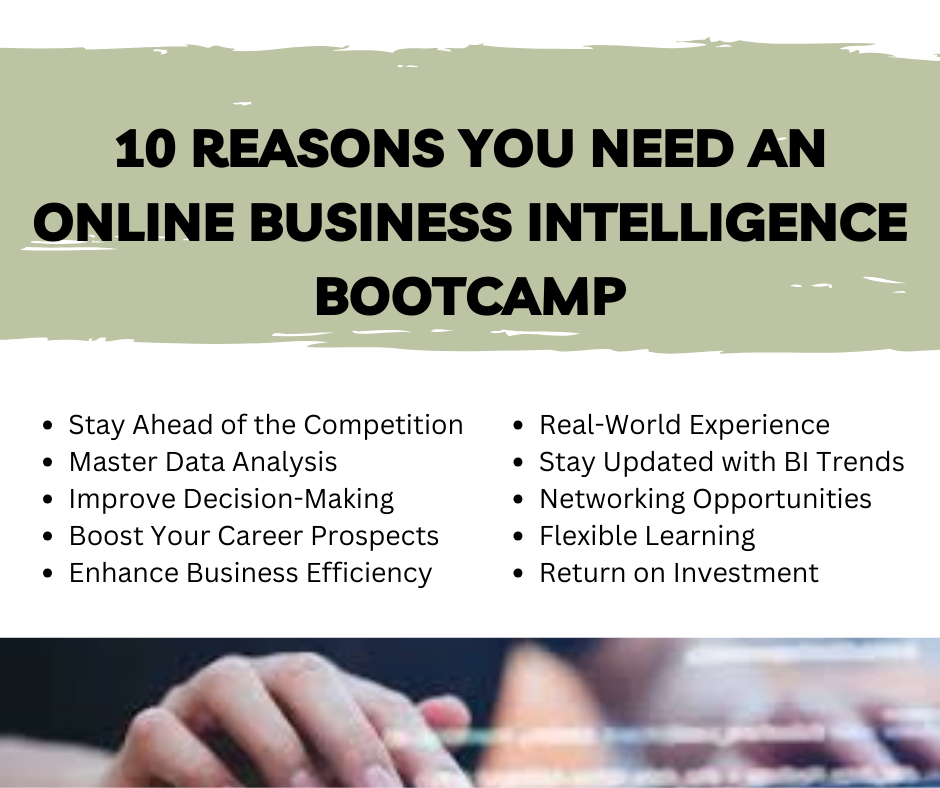 <h2>What is Business Intelligence?</h2> Business intelligence encompasses the gathering, examination, and delivery of data and information to facilitate informed decision-making within an organization. BI experts employ a range of tools, technologies, and approaches to extract valuable insights from data, aiding businesses in making well-considered strategic decisions. Business Intelligence finds application in diverse industries and functions, including finance, marketing, sales, operations, and human resources. BI tools and methodologies have evolved into indispensable resources for organizations of all scales, empowering them to harness data for making informed and strategic decisions that propel their success and foster growth. <h2>What is Online Business Intelligence Bootcamp?</h2> An <a href="https://www.syntaxtechs.com/courses/data-analytics-and-business-intelligence-training-course-online">Online Business Intelligence Bootcamp</a> is a dedicated, comprehensive training program available on the internet. Its primary focus is to impart the skills and knowledge required to excel in the realm of business intelligence (BI). These online bootcamps attract individuals seeking to enter BI roles, enhance their current job prospects, or embark on a career change. They provide a well-organized and efficient means of acquiring the essential knowledge and competencies for success in the field of business intelligence, all in a convenient online format. <h2>Why do you need an Online Business Intelligence Bootcamp? </h2> <h3>1. Stay Ahead of the Competition</h3> In the era of digital dominance, competition is intense, and maintaining a competitive edge is crucial. Online Business Intelligence Bootcamps equip you with state-of-the-art BI tools and methods, guaranteeing that you consistently stay a stride ahead of your rivals. <h3>2. Master Data Analysis</h3> Data serves as the cornerstone of business intelligence, and the ability to analyze and comprehend data is paramount. Enrolling in a BI bootcamp will instruct you in the skill of data analysis, enabling you to make well-informed decisions rooted in insights derived from data. <h3>3. Improve Decision-Making</h3> BI Bootcamps equip you with the abilities to make superior decisions supported by data. This will not only elevate your career but also boost your business's financial performance. <h3>4. Boost Your Career Prospects</h3> In the current job market, employers actively seek candidates with BI expertise. Successfully finishing an Online Business Intelligence Bootcamp can substantially bolster your CV, rendering you a more appealing applicant for a diverse array of employment prospects. <h3>5. Enhance Business Efficiency</h3> Efficiency is the cornerstone of triumph in every business. A BI Bootcamp provides you with the tools and techniques to optimize operations, reduce expenses, and optimize earnings. <h3>6. Real-World Experience</h3> Online Business Intelligence Bootcamps frequently integrate real-world projects and case studies, affording you the opportunity to put your skills into action in practical situations. This hands-on experience holds immense value for your career growth. <h3>7. Stay Updated with BI Trends</h3> The field of BI is in a perpetual state of evolution. Enrolling in a bootcamp keeps you up to date with the most recent trends and technologies, guaranteeing the ongoing relevance of your skills in a swiftly changing industry. <h3>8. Networking Opportunities</h3> In the realm of business, your network can be equally precious as your expertise. A BI Bootcamp offers you the opportunity to forge connections with fellow professionals, potential employers, and mentors who share your interests and aspirations. <h3>9. Flexible Learning</h3> Online BI Bootcamps offer flexibility, enabling you to acquire knowledge at your preferred speed and convenience. This accessibility caters to the needs of both working professionals and students. <h3>10. Return on Investment</h3> Enrolling in an Online Business Intelligence Bootcamp represents an investment in your future. The competencies and insights acquired will yield a significant return on investment, whether in the form of career progression or the expansion of your business. <h4>Conclusion</h4> If you're dedicated to advancing your career or business, an Online Business Intelligence Bootcamp is a transformative experience. It equips you with the essential skills and knowledge to thrive in a data-driven landscape, providing a multitude of advantages, such as enhancing your decision-making capabilities and optimizing your business's efficiency. Seize the chance to outpace your competition, elevate your career prospects, and realize a significant return on investment. Enroll in an <a href="https://www.syntaxtechs.com/">online learning</a> bootcamp today and embark on the initial stride towards a brighter, data-driven future. |
| json metadata | {"tags":["businessintelligence","bootcamp","onlinecourses","onlinelearning","training","skillsdevelopment","careermotivation","careergoals"],"image":["https://cdn.steemitimages.com/DQmTLpNbWUtJn4A3FaYWYma6fJDtNnViTwW8Z8BvUAPpbH5/Online%20Business%20Intelligence%20Bootcamp.png"],"links":["https://www.syntaxtechs.com/courses/data-analytics-and-business-intelligence-training-course-online","https://www.syntaxtechs.com/"],"app":"steemit/0.2","format":"markdown"} |
| parent author | |
| parent permlink | businessintelligence |
| permlink | 10-reasons-you-need-an-online-business-intelligence-bootcamp |
| title | 10 Reasons You Need an Online Business Intelligence Bootcamp |
| Transaction Info | Block #79642959/Trx 82b548d1022103e385fba78cc40f73f2b4916317 |
View Raw JSON Data
{
"block": 79642959,
"op": [
"comment",
{
"author": "syntaxtechs",
"body": "In the fast-paced world of modern business, remaining competitive is no longer a choice; it's an imperative. Business Intelligence (BI) emerges as a crucial tool for achieving this goal. To harness the potential of data, both organizations and individuals are increasingly embracing Online Business Intelligence Bootcamps. These rigorous training programs aim to provide you with the expertise and insights essential for effectively utilizing BI in the digital era. Within this article, we will delve into the top ten reasons why you should consider enrolling in an Online Business Intelligence Bootcamp to advance your career and propel your business to greater heights.\n\n\n\n\n\n<h2>What is Business Intelligence?</h2>\nBusiness intelligence encompasses the gathering, examination, and delivery of data and information to facilitate informed decision-making within an organization. BI experts employ a range of tools, technologies, and approaches to extract valuable insights from data, aiding businesses in making well-considered strategic decisions.\nBusiness Intelligence finds application in diverse industries and functions, including finance, marketing, sales, operations, and human resources. BI tools and methodologies have evolved into indispensable resources for organizations of all scales, empowering them to harness data for making informed and strategic decisions that propel their success and foster growth.\n\n<h2>What is Online Business Intelligence Bootcamp?</h2>\nAn <a href=\"https://www.syntaxtechs.com/courses/data-analytics-and-business-intelligence-training-course-online\">Online Business Intelligence Bootcamp</a> is a dedicated, comprehensive training program available on the internet. Its primary focus is to impart the skills and knowledge required to excel in the realm of business intelligence (BI). These online bootcamps attract individuals seeking to enter BI roles, enhance their current job prospects, or embark on a career change. They provide a well-organized and efficient means of acquiring the essential knowledge and competencies for success in the field of business intelligence, all in a convenient online format.\n\n<h2>Why do you need an Online Business Intelligence Bootcamp? </h2>\n\n<h3>1. Stay Ahead of the Competition</h3>\nIn the era of digital dominance, competition is intense, and maintaining a competitive edge is crucial. Online Business Intelligence Bootcamps equip you with state-of-the-art BI tools and methods, guaranteeing that you consistently stay a stride ahead of your rivals.\n\n<h3>2. Master Data Analysis</h3>\nData serves as the cornerstone of business intelligence, and the ability to analyze and comprehend data is paramount. Enrolling in a BI bootcamp will instruct you in the skill of data analysis, enabling you to make well-informed decisions rooted in insights derived from data.\n\n<h3>3. Improve Decision-Making</h3>\nBI Bootcamps equip you with the abilities to make superior decisions supported by data. This will not only elevate your career but also boost your business's financial performance.\n\n<h3>4. Boost Your Career Prospects</h3>\nIn the current job market, employers actively seek candidates with BI expertise. Successfully finishing an Online Business Intelligence Bootcamp can substantially bolster your CV, rendering you a more appealing applicant for a diverse array of employment prospects.\n\n<h3>5. Enhance Business Efficiency</h3>\nEfficiency is the cornerstone of triumph in every business. A BI Bootcamp provides you with the tools and techniques to optimize operations, reduce expenses, and optimize earnings.\n\n<h3>6. Real-World Experience</h3>\nOnline Business Intelligence Bootcamps frequently integrate real-world projects and case studies, affording you the opportunity to put your skills into action in practical situations. This hands-on experience holds immense value for your career growth.\n\n<h3>7. Stay Updated with BI Trends</h3>\nThe field of BI is in a perpetual state of evolution. Enrolling in a bootcamp keeps you up to date with the most recent trends and technologies, guaranteeing the ongoing relevance of your skills in a swiftly changing industry.\n\n<h3>8. Networking Opportunities</h3>\nIn the realm of business, your network can be equally precious as your expertise. A BI Bootcamp offers you the opportunity to forge connections with fellow professionals, potential employers, and mentors who share your interests and aspirations.\n\n<h3>9. Flexible Learning</h3>\nOnline BI Bootcamps offer flexibility, enabling you to acquire knowledge at your preferred speed and convenience. This accessibility caters to the needs of both working professionals and students.\n\n<h3>10. Return on Investment</h3>\nEnrolling in an Online Business Intelligence Bootcamp represents an investment in your future. The competencies and insights acquired will yield a significant return on investment, whether in the form of career progression or the expansion of your business.\n\n<h4>Conclusion</h4>\nIf you're dedicated to advancing your career or business, an Online Business Intelligence Bootcamp is a transformative experience. It equips you with the essential skills and knowledge to thrive in a data-driven landscape, providing a multitude of advantages, such as enhancing your decision-making capabilities and optimizing your business's efficiency. Seize the chance to outpace your competition, elevate your career prospects, and realize a significant return on investment. Enroll in an <a href=\"https://www.syntaxtechs.com/\">online learning</a> bootcamp today and embark on the initial stride towards a brighter, data-driven future.",
"json_metadata": "{\"tags\":[\"businessintelligence\",\"bootcamp\",\"onlinecourses\",\"onlinelearning\",\"training\",\"skillsdevelopment\",\"careermotivation\",\"careergoals\"],\"image\":[\"https://cdn.steemitimages.com/DQmTLpNbWUtJn4A3FaYWYma6fJDtNnViTwW8Z8BvUAPpbH5/Online%20Business%20Intelligence%20Bootcamp.png\"],\"links\":[\"https://www.syntaxtechs.com/courses/data-analytics-and-business-intelligence-training-course-online\",\"https://www.syntaxtechs.com/\"],\"app\":\"steemit/0.2\",\"format\":\"markdown\"}",
"parent_author": "",
"parent_permlink": "businessintelligence",
"permlink": "10-reasons-you-need-an-online-business-intelligence-bootcamp",
"title": "10 Reasons You Need an Online Business Intelligence Bootcamp"
}
],
"op_in_trx": 0,
"timestamp": "2023-11-06T10:32:45",
"trx_id": "82b548d1022103e385fba78cc40f73f2b4916317",
"trx_in_block": 5,
"virtual_op": 0
}bluesnipersent 0.010 STEEM to @syntaxtechs- "Hello. Good to see you on Steem. To maximize your rewards, publish your post also on Hive ( https://hive.blog ) and Blurt ( https://blurt.blog ) blockchains"2023/11/02 10:49:18
bluesnipersent 0.010 STEEM to @syntaxtechs- "Hello. Good to see you on Steem. To maximize your rewards, publish your post also on Hive ( https://hive.blog ) and Blurt ( https://blurt.blog ) blockchains"
2023/11/02 10:49:18
| amount | 0.010 STEEM |
| from | bluesniper |
| memo | Hello. Good to see you on Steem. To maximize your rewards, publish your post also on Hive ( https://hive.blog ) and Blurt ( https://blurt.blog ) blockchains |
| to | syntaxtechs |
| Transaction Info | Block #79528590/Trx a99c9a9765ace4705bb9e01ae36569a1928a97c9 |
View Raw JSON Data
{
  "block": 79528590,
  "op": [
    "transfer",
    {
      "amount": "0.010 STEEM",
      "from": "bluesniper",
      "memo": "Hello. Good to see you on Steem. To maximize your rewards, publish your post also on Hive ( https://hive.blog ) and Blurt ( https://blurt.blog ) blockchains",
      "to": "syntaxtechs"
    }
  ],
  "op_in_trx": 0,
  "timestamp": "2023-11-02T10:49:18",
  "trx_id": "a99c9a9765ace4705bb9e01ae36569a1928a97c9",
  "trx_in_block": 8,
  "virtual_op": 0
}bluesniperupvoted (100.00%) @syntaxtechs / how-to-choose-the-right-software-testing-certification-program2023/11/02 10:48:57
bluesniperupvoted (100.00%) @syntaxtechs / how-to-choose-the-right-software-testing-certification-program
2023/11/02 10:48:57
| author | syntaxtechs |
| permlink | how-to-choose-the-right-software-testing-certification-program |
| voter | bluesniper |
| weight | 10000 (100.00%) |
| Transaction Info | Block #79528583/Trx 2dcedfa80a49b49a26487435f20f158e52bba5b6 |
View Raw JSON Data
{
  "block": 79528583,
  "op": [
    "vote",
    {
      "author": "syntaxtechs",
      "permlink": "how-to-choose-the-right-software-testing-certification-program",
      "voter": "bluesniper",
      "weight": 10000
    }
  ],
  "op_in_trx": 0,
  "timestamp": "2023-11-02T10:48:57",
  "trx_id": "2dcedfa80a49b49a26487435f20f158e52bba5b6",
  "trx_in_block": 1,
  "virtual_op": 0
}syntaxtechspublished a new post: how-to-choose-the-right-software-testing-certification-program2023/11/02 10:43:30
syntaxtechspublished a new post: how-to-choose-the-right-software-testing-certification-program
2023/11/02 10:43:30
| author | syntaxtechs |
| body | In the world of software testing, staying relevant and competitive is crucial. One way to achieve this is by obtaining a software testing certification. However, with numerous certification programs available, choosing the right one can be a daunting task. This article will guide you through the process of selecting the perfect <a href="https://www.syntaxtechs.com/courses/sdet-training-course-online">software testing certification</a> program that aligns with your career goals and aspirations. Software testing is an essential part of the software development lifecycle. It ensures that the software functions as intended and meets quality standards. To excel in this field, many professionals opt for software testing certifications, which not only validate their skills but also provide a competitive edge in the job market.  <h2>Why Choose a Software Testing Certification?</h2> Software testing certifications offer several advantages: <strong>1. Career Advancement:</strong> Obtaining a software testing certification can significantly enhance your career prospects. It demonstrates your commitment to the field and validates your expertise, making you a more attractive candidate for job opportunities and promotions. <strong>2. Skill Validation:</strong> Certifications ensure that you possess the necessary skills and knowledge to excel in software testing. They cover essential concepts, methodologies, and tools, giving you a solid foundation to excel in your role. <strong>3. Industry Recognition:</strong> Certified software testers are recognized and respected by employers and peers. Industry-recognized certifications, such as ISTQB or CSTE, provide a common standard and language for professionals, enhancing credibility. <strong>4. Quality Assurance:</strong> Certified testers contribute to higher software quality by following best practices and standardized testing processes. This ultimately results in improved product quality and customer satisfaction. <strong>5. Competitive Edge:</strong> In a competitive job market, a certification sets you apart from non-certified candidates and can be the deciding factor in securing a job or project. <strong>6. Continuous Learning:</strong> Certifications require ongoing professional development, ensuring that you stay updated with the latest trends and technologies in software testing. <h2>Types of Software Testing Certifications</h2> • CAST (Certified Associate in Software Testing) • CSQA (Certified Software Quality Analyst Certification) • International Software Testing Qualifications Board (ISTQB) Certification • Certified Quality Engineer (CQE) • Certified Manager of Software Testing (CMST) • Certified Software Tester (CSTE) • ISTQB Foundation Level (CTFL) <h2>Choosing the Right Software Testing Certification Program</h2> <h3>Understanding Your Career Goals</h3> Before selecting a certification program, it's essential to understand your career goals. Consider where you want to be in your software testing career and choose a certification that aligns with your aspirations. <h3>Research the Certification Providers</h3> Not all certification providers are created equal. Some well-known organizations, such as the International Software Testing Qualifications Board (ISTQB) and the American Software Testing Qualifications Board (ASTQB), are recognized globally. Research and choose a reputable provider. <h3>Curriculum and Syllabus</h3> Examine the curriculum and syllabus of the certification program. Ensure it covers topics relevant to your career goals and interests. Look for programs that include both theory and practical applications. <h3>Prerequisites and Eligibility</h3> Every certification has specific prerequisites and eligibility criteria. Make sure you meet these requirements before enrolling in a program. Some certifications may require a certain level of experience or prior certifications. <h3>Delivery Method: Online vs In-Person</h3> Consider the delivery method that suits your schedule and learning style. Many certification programs offer both online and in-person options. Choose the one that aligns with your preferences. <h3>Cost Considerations</h3> Certification programs come with a cost. Evaluate your budget and determine if the program's fees fit within it. Additionally, consider the potential return on investment in terms of career growth and higher earning potential. <h3>Certification Duration</h3> The duration of certification programs can vary. Some can be completed in a few weeks, while others may take several months. Assess your availability and time commitment before making a decision. <h3>Study Materials and Resources</h3> Check if the certification program provides study materials or resources. Having access to study guides, practice exams, and reference materials can be incredibly beneficial in your preparation. <h3>Feedback and Reviews</h3> Research the experiences of past candidates. Look for reviews, testimonials, and feedback on the certification program. This can provide valuable insights into the program's quality and effectiveness. <h3>Networking Opportunities</h3> Certification programs often offer networking opportunities. These can include forums, webinars, and events where you can connect with other professionals in the field. <h3>Exam Format and Pass Rates</h3> Understand the format of the certification exam, including the number of questions, time limits, and passing scores. Additionally, research the program's pass rates to gauge the difficulty level. After considering all the factors mentioned above, it's time to make an informed decision. Choose the software testing certification that aligns with your career goals, budget, and preferred learning style. Remember that the right certification can significantly boost your software testing career. <h4>Conclusion</h4> Selecting the right software testing certification program is a crucial step in your career development. It can lead to better job opportunities and <a href="https://www.syntaxtechs.com/">advanced placement</a>, increased credibility, and professional growth. By thoroughly researching and considering the factors discussed in this article, you can make an informed decision and embark on your journey to becoming a certified software testing professional. |
| json metadata | {"tags":["softwaretesting","certifications","softwareengineer","sdet","bootcamp","onlinecourses","careergoals","techcareer"],"image":["https://cdn.steemitimages.com/DQmb197sL2usEg18fnufjkNQN8qDF2tKwHZ1xggf6Rs626p/Software%20Testing%20Certification%20Program.png"],"links":["https://www.syntaxtechs.com/courses/sdet-training-course-online","https://www.syntaxtechs.com/"],"app":"steemit/0.2","format":"markdown"} |
| parent author | |
| parent permlink | softwaretesting |
| permlink | how-to-choose-the-right-software-testing-certification-program |
| title | How to Choose the Right Software Testing Certification Program |
| Transaction Info | Block #79528474/Trx 50526bd1697b6a0cc8a1457194f35a964a281452 |
View Raw JSON Data
{
"block": 79528474,
"op": [
"comment",
{
"author": "syntaxtechs",
"body": "In the world of software testing, staying relevant and competitive is crucial. One way to achieve this is by obtaining a software testing certification. However, with numerous certification programs available, choosing the right one can be a daunting task. This article will guide you through the process of selecting the perfect <a href=\"https://www.syntaxtechs.com/courses/sdet-training-course-online\">software testing certification</a> program that aligns with your career goals and aspirations.\n\nSoftware testing is an essential part of the software development lifecycle. It ensures that the software functions as intended and meets quality standards. To excel in this field, many professionals opt for software testing certifications, which not only validate their skills but also provide a competitive edge in the job market.\n\n\n\n\n\n<h2>Why Choose a Software Testing Certification?</h2>\nSoftware testing certifications offer several advantages:\n\n<strong>1. Career Advancement:</strong>\nObtaining a software testing certification can significantly enhance your career prospects. It demonstrates your commitment to the field and validates your expertise, making you a more attractive candidate for job opportunities and promotions.\n\n<strong>2. Skill Validation:</strong>\nCertifications ensure that you possess the necessary skills and knowledge to excel in software testing. They cover essential concepts, methodologies, and tools, giving you a solid foundation to excel in your role.\n\n<strong>3. Industry Recognition:</strong>\nCertified software testers are recognized and respected by employers and peers. Industry-recognized certifications, such as ISTQB or CSTE, provide a common standard and language for professionals, enhancing credibility.\n\n<strong>4. Quality Assurance:</strong>\nCertified testers contribute to higher software quality by following best practices and standardized testing processes. This ultimately results in improved product quality and customer satisfaction.\n\n<strong>5. Competitive Edge:</strong>\nIn a competitive job market, a certification sets you apart from non-certified candidates and can be the deciding factor in securing a job or project.\n\n<strong>6. Continuous Learning:</strong>\nCertifications require ongoing professional development, ensuring that you stay updated with the latest trends and technologies in software testing.\n\n<h2>Types of Software Testing Certifications</h2>\n\n•\tCAST (Certified Associate in Software Testing)\n•\tCSQA (Certified Software Quality Analyst Certification)\n•\tInternational Software Testing Qualifications Board (ISTQB) Certification\n•\tCertified Quality Engineer (CQE)\n•\tCertified Manager of Software Testing (CMST)\n•\tCertified Software Tester (CSTE)\n•\tISTQB Foundation Level (CTFL)\n\n<h2>Choosing the Right Software Testing Certification Program</h2>\n\n<h3>Understanding Your Career Goals</h3>\nBefore selecting a certification program, it's essential to understand your career goals. Consider where you want to be in your software testing career and choose a certification that aligns with your aspirations.\n\n<h3>Research the Certification Providers</h3>\nNot all certification providers are created equal. Some well-known organizations, such as the International Software Testing Qualifications Board (ISTQB) and the American Software Testing Qualifications Board (ASTQB), are recognized globally. Research and choose a reputable provider.\n\n<h3>Curriculum and Syllabus</h3>\nExamine the curriculum and syllabus of the certification program. Ensure it covers topics relevant to your career goals and interests. Look for programs that include both theory and practical applications.\n\n<h3>Prerequisites and Eligibility</h3>\nEvery certification has specific prerequisites and eligibility criteria. Make sure you meet these requirements before enrolling in a program. Some certifications may require a certain level of experience or prior certifications.\n\n<h3>Delivery Method: Online vs In-Person</h3>\nConsider the delivery method that suits your schedule and learning style. Many certification programs offer both online and in-person options. Choose the one that aligns with your preferences.\n\n<h3>Cost Considerations</h3>\nCertification programs come with a cost. Evaluate your budget and determine if the program's fees fit within it. Additionally, consider the potential return on investment in terms of career growth and higher earning potential.\n\n<h3>Certification Duration</h3>\nThe duration of certification programs can vary. Some can be completed in a few weeks, while others may take several months. Assess your availability and time commitment before making a decision.\n\n<h3>Study Materials and Resources</h3>\nCheck if the certification program provides study materials or resources. Having access to study guides, practice exams, and reference materials can be incredibly beneficial in your preparation.\n\n<h3>Feedback and Reviews</h3>\nResearch the experiences of past candidates. Look for reviews, testimonials, and feedback on the certification program. This can provide valuable insights into the program's quality and effectiveness.\n\n<h3>Networking Opportunities</h3>\nCertification programs often offer networking opportunities. These can include forums, webinars, and events where you can connect with other professionals in the field.\n\n<h3>Exam Format and Pass Rates</h3>\nUnderstand the format of the certification exam, including the number of questions, time limits, and passing scores. Additionally, research the program's pass rates to gauge the difficulty level.\n\nAfter considering all the factors mentioned above, it's time to make an informed decision. Choose the software testing certification that aligns with your career goals, budget, and preferred learning style. Remember that the right certification can significantly boost your software testing career.\n\n<h4>Conclusion</h4>\nSelecting the right software testing certification program is a crucial step in your career development. It can lead to better job opportunities and <a href=\"https://www.syntaxtechs.com/\">advanced placement</a>, increased credibility, and professional growth. By thoroughly researching and considering the factors discussed in this article, you can make an informed decision and embark on your journey to becoming a certified software testing professional.",
"json_metadata": "{\"tags\":[\"softwaretesting\",\"certifications\",\"softwareengineer\",\"sdet\",\"bootcamp\",\"onlinecourses\",\"careergoals\",\"techcareer\"],\"image\":[\"https://cdn.steemitimages.com/DQmb197sL2usEg18fnufjkNQN8qDF2tKwHZ1xggf6Rs626p/Software%20Testing%20Certification%20Program.png\"],\"links\":[\"https://www.syntaxtechs.com/courses/sdet-training-course-online\",\"https://www.syntaxtechs.com/\"],\"app\":\"steemit/0.2\",\"format\":\"markdown\"}",
"parent_author": "",
"parent_permlink": "softwaretesting",
"permlink": "how-to-choose-the-right-software-testing-certification-program",
"title": "How to Choose the Right Software Testing Certification Program"
}
],
"op_in_trx": 0,
"timestamp": "2023-11-02T10:43:30",
"trx_id": "50526bd1697b6a0cc8a1457194f35a964a281452",
"trx_in_block": 3,
"virtual_op": 0
}bluesnipersent 0.010 STEEM to @syntaxtechs- "Hello. Good to see you on Steem. To maximize your rewards, publish your post also on Hive ( https://hive.blog ) and Blurt ( https://blurt.blog ) blockchains"2023/10/30 10:53:09
bluesnipersent 0.010 STEEM to @syntaxtechs- "Hello. Good to see you on Steem. To maximize your rewards, publish your post also on Hive ( https://hive.blog ) and Blurt ( https://blurt.blog ) blockchains"
2023/10/30 10:53:09
| amount | 0.010 STEEM |
| from | bluesniper |
| memo | Hello. Good to see you on Steem. To maximize your rewards, publish your post also on Hive ( https://hive.blog ) and Blurt ( https://blurt.blog ) blockchains |
| to | syntaxtechs |
| Transaction Info | Block #79442619/Trx b06dc59adf529da542a31643a4c9f01f2247fdfb |
View Raw JSON Data
{
  "block": 79442619,
  "op": [
    "transfer",
    {
      "amount": "0.010 STEEM",
      "from": "bluesniper",
      "memo": "Hello. Good to see you on Steem. To maximize your rewards, publish your post also on Hive ( https://hive.blog ) and Blurt ( https://blurt.blog ) blockchains",
      "to": "syntaxtechs"
    }
  ],
  "op_in_trx": 0,
  "timestamp": "2023-10-30T10:53:09",
  "trx_id": "b06dc59adf529da542a31643a4c9f01f2247fdfb",
  "trx_in_block": 0,
  "virtual_op": 0
}bluesniperupvoted (100.00%) @syntaxtechs / why-business-intelligence-training-is-a-game-changer2023/10/30 10:52:45
bluesniperupvoted (100.00%) @syntaxtechs / why-business-intelligence-training-is-a-game-changer
2023/10/30 10:52:45
| author | syntaxtechs |
| permlink | why-business-intelligence-training-is-a-game-changer |
| voter | bluesniper |
| weight | 10000 (100.00%) |
| Transaction Info | Block #79442611/Trx aec8f4603b999daff573508dea96f72fb0b64738 |
View Raw JSON Data
{
  "block": 79442611,
  "op": [
    "vote",
    {
      "author": "syntaxtechs",
      "permlink": "why-business-intelligence-training-is-a-game-changer",
      "voter": "bluesniper",
      "weight": 10000
    }
  ],
  "op_in_trx": 0,
  "timestamp": "2023-10-30T10:52:45",
  "trx_id": "aec8f4603b999daff573508dea96f72fb0b64738",
  "trx_in_block": 4,
  "virtual_op": 0
}syntaxtechspublished a new post: why-business-intelligence-training-is-a-game-changer2023/10/30 10:47:36
syntaxtechspublished a new post: why-business-intelligence-training-is-a-game-changer
2023/10/30 10:47:36
| author | syntaxtechs |
| body | In today's dynamic, data-centric business landscape, maintaining competitiveness and ensuring well-informed decision-making are paramount. Business Intelligence has risen as a potent asset, enabling enterprises to unlock the complete potential of their data. In this article, we'll explore the transformative role of <a href="https://www.syntaxtechs.com/courses/data-analytics-and-business-intelligence-training-course-online">Business Intelligence Training</a> and how it has become a game-changer in the corporate landscape.  <h2>What is Business Intelligence (BI)?</h2> Business Intelligence, or BI, encompasses the collection, analysis, and presentation of business information. It involves understanding <a href="https://www.syntaxtechs.com/blog/what-is-business-intelligence">what is business intelligence</a> and how it helps in making data-driven decisions, optimizing business operations, and identifying new opportunities and trends. Essentially, BI converts raw data into valuable insights, aiding companies in strategic planning and improved performance. <h2>Business Intelligence Training: A Necessity</h2> Business Intelligence (BI) training is often considered a necessity for organizations looking to harness data to make informed decisions and gain a competitive edge. Here are some key reasons why BI training is essential: <b>Data-Driven Decision Making:</b> In today's data-driven world, organizations need to make decisions based on accurate, timely, and relevant data. BI training equips employees with the skills to gather, analyze, and interpret data to make informed choices that drive business success. <b>Improved Efficiency: </b>BI tools and techniques can streamline data analysis processes, saving time and resources. Proper BI training can help employees use these tools effectively, leading to improved efficiency in data handling and reporting. <b>Competitive Advantage:</b> Organizations that can effectively leverage data have a competitive advantage. BI training enables employees to gain insights from data, identify trends, and respond quickly to market changes or customer demands. <b>Optimized Operations:</b> BI training can help organizations optimize their operations by identifying areas where improvements are needed. This can result in cost savings and increased productivity. <b>Enhanced Reporting:</b> BI training helps employees create clear, visual reports and dashboards that convey complex data in a simple and understandable manner. This improves communication and decision-making at all levels of the organization. <b>Customer Insights:</b> BI tools can provide valuable insights into customer behavior, preferences, and feedback. BI training enables organizations to use this information to tailor products, services, and marketing strategies to meet customer needs. <b>Risk Management:</b> BI can help identify potential risks and issues in real-time, allowing organizations to take proactive measures to mitigate them. BI training ensures that employees can effectively use these tools to manage risks. <b>Data Security:</b> Data privacy and security are critical concerns. BI training includes best practices for handling sensitive data, ensuring that employees understand the importance of data security. <b>Cost Reduction:</b> Effective BI can help organizations identify cost-cutting opportunities, eliminate waste, and allocate resources more efficiently. This can result in significant cost reductions. <b>Alignment with Strategic Goals: </b>BI training can help employees align their work with the organization's strategic goals and objectives by ensuring that data analysis and decision-making processes support the broader mission. <b>Better Collaboration:</b> BI training encourages cross-functional collaboration as employees from various departments learn to work together on data analysis and reporting projects. <b>Talent Development:</b> Providing BI training opportunities can attract and retain top talent. Skilled data professionals are in high demand, and organizations that invest in their employees' development can maintain a competitive edge. <h2>Business Intelligence Training: A Game Changer</h2> <h3>Unlocking Data's Potential</h3> Data is often considered the lifeblood of modern businesses. However, without the right tools and skills, it remains untapped potential. Business Intelligence Training equips professionals with the ability to collect, analyze, and transform data into actionable insights. This empowers businesses to make informed decisions, spot trends, and identify opportunities and threats. <h3>Enhanced Decision-Making</h3> Informed decision-making is at the heart of every successful business. Business Intelligence Training enables individuals to create data-driven reports and dashboards, which help executives and managers make decisions based on real-time information. This ability to react quickly to changing market conditions is a significant advantage in today's dynamic business landscape. <h3>Improved Operational Efficiency</h3> BI tools and techniques help streamline processes, reduce waste, and optimize resources. With the skills gained through training, professionals can identify inefficiencies, bottlenecks, and areas for improvement. This, in turn, enhances operational efficiency and leads to cost savings. <h3>Competitive Advantage</h3> In a crowded marketplace, a competitive edge can be the difference between success and failure. Business Intelligence Training allows businesses to gain insights into market trends, customer behavior, and competitor performance. Armed with this knowledge, companies can tailor their strategies and stay ahead of the competition. <h3>Real-time Analytics</h3> The ability to access real-time data is a crucial aspect of Business Intelligence Training. This means that businesses can monitor their performance and respond to changes as they happen. Real-time analytics not only helps in crisis management but also in seizing opportunities promptly. <h3>Enhanced Customer Understanding</h3> Understanding customer behaviour is key to delivering a superior customer experience. Business Intelligence Training enables professionals to analyze customer data and gain insights into preferences, buying habits, and satisfaction levels. This knowledge can guide marketing efforts and product development to meet customer expectations. <h3>Adaptation to Technological Advances</h3> Technology is constantly evolving, and BI professionals must keep pace. Business Intelligence Training ensures that individuals are well-versed in the latest tools and techniques. This adaptability is vital for staying relevant in the ever-changing business landscape. <h3>Data Security and Compliance</h3> Data security and compliance are paramount concerns for any organization. Business Intelligence Training covers best practices for data protection and ensures that professionals understand the legal and ethical aspects of handling sensitive information. <h3>Cost-Effective Scalability</h3> BI tools can be scaled to fit the needs of an organization, making them cost-effective. With proper training, companies can effectively use BI solutions and scale them as their data and analytics requirements grow. <h4>Conclusion</h4> In conclusion, Business Intelligence Training is a game-changer in today's business world. It equips both individuals and organizations with the means to harness the full potential of data, empowering them to make well-informed, strategic choices. Given the swift progression of Business Intelligence and the growing need for skilled practitioners, BI training is a crucial component for maintaining a competitive edge in the corporate world. |
| json metadata | {"tags":["businessintelligence","training","gamechanger","tools","challenges","onlinecourses"],"image":["https://cdn.steemitimages.com/DQmVcaDiteDQjZEbQmCrrAY4BVcWjJ8SvQ8TUFmTvJu9fWt/Why%20Business%20Intelligence%20Training%20-%20A%20Game%20Changer.png"],"links":["https://www.syntaxtechs.com/courses/data-analytics-and-business-intelligence-training-course-online","https://www.syntaxtechs.com/blog/what-is-business-intelligence"],"app":"steemit/0.2","format":"markdown"} |
| parent author | |
| parent permlink | businessintelligence |
| permlink | why-business-intelligence-training-is-a-game-changer |
| title | Why Business Intelligence Training is a Game Changer |
| Transaction Info | Block #79442509/Trx d5db2623a4b66f0a33f035bf0181bb3ec36f71cc |
View Raw JSON Data
{
"block": 79442509,
"op": [
"comment",
{
"author": "syntaxtechs",
"body": "In today's dynamic, data-centric business landscape, maintaining competitiveness and ensuring well-informed decision-making are paramount. Business Intelligence has risen as a potent asset, enabling enterprises to unlock the complete potential of their data. In this article, we'll explore the transformative role of <a href=\"https://www.syntaxtechs.com/courses/data-analytics-and-business-intelligence-training-course-online\">Business Intelligence Training</a> and how it has become a game-changer in the corporate landscape.\n\n\n\n\n\n<h2>What is Business Intelligence (BI)?</h2>\nBusiness Intelligence, or BI, encompasses the collection, analysis, and presentation of business information. It involves understanding <a href=\"https://www.syntaxtechs.com/blog/what-is-business-intelligence\">what is business intelligence</a> and how it helps in making data-driven decisions, optimizing business operations, and identifying new opportunities and trends. Essentially, BI converts raw data into valuable insights, aiding companies in strategic planning and improved performance.\n\n<h2>Business Intelligence Training: A Necessity</h2>\nBusiness Intelligence (BI) training is often considered a necessity for organizations looking to harness data to make informed decisions and gain a competitive edge. Here are some key reasons why BI training is essential:\n\n<b>Data-Driven Decision Making:</b> In today's data-driven world, organizations need to make decisions based on accurate, timely, and relevant data. BI training equips employees with the skills to gather, analyze, and interpret data to make informed choices that drive business success.\n\n<b>Improved Efficiency: </b>BI tools and techniques can streamline data analysis processes, saving time and resources. Proper BI training can help employees use these tools effectively, leading to improved efficiency in data handling and reporting.\n\n<b>Competitive Advantage:</b> Organizations that can effectively leverage data have a competitive advantage. BI training enables employees to gain insights from data, identify trends, and respond quickly to market changes or customer demands.\n\n<b>Optimized Operations:</b> BI training can help organizations optimize their operations by identifying areas where improvements are needed. This can result in cost savings and increased productivity.\n\n<b>Enhanced Reporting:</b> BI training helps employees create clear, visual reports and dashboards that convey complex data in a simple and understandable manner. This improves communication and decision-making at all levels of the organization.\n\n<b>Customer Insights:</b> BI tools can provide valuable insights into customer behavior, preferences, and feedback. BI training enables organizations to use this information to tailor products, services, and marketing strategies to meet customer needs.\n\n<b>Risk Management:</b> BI can help identify potential risks and issues in real-time, allowing organizations to take proactive measures to mitigate them. BI training ensures that employees can effectively use these tools to manage risks.\n\n<b>Data Security:</b> Data privacy and security are critical concerns. BI training includes best practices for handling sensitive data, ensuring that employees understand the importance of data security.\n\n<b>Cost Reduction:</b> Effective BI can help organizations identify cost-cutting opportunities, eliminate waste, and allocate resources more efficiently. This can result in significant cost reductions.\n\n<b>Alignment with Strategic Goals: </b>BI training can help employees align their work with the organization's strategic goals and objectives by ensuring that data analysis and decision-making processes support the broader mission.\n\n<b>Better Collaboration:</b> BI training encourages cross-functional collaboration as employees from various departments learn to work together on data analysis and reporting projects.\n\n<b>Talent Development:</b> Providing BI training opportunities can attract and retain top talent. Skilled data professionals are in high demand, and organizations that invest in their employees' development can maintain a competitive edge.\n\n<h2>Business Intelligence Training: A Game Changer</h2>\n\n<h3>Unlocking Data's Potential</h3>\nData is often considered the lifeblood of modern businesses. However, without the right tools and skills, it remains untapped potential. Business Intelligence Training equips professionals with the ability to collect, analyze, and transform data into actionable insights. This empowers businesses to make informed decisions, spot trends, and identify opportunities and threats.\n\n<h3>Enhanced Decision-Making</h3>\nInformed decision-making is at the heart of every successful business. Business Intelligence Training enables individuals to create data-driven reports and dashboards, which help executives and managers make decisions based on real-time information. This ability to react quickly to changing market conditions is a significant advantage in today's dynamic business landscape.\n\n<h3>Improved Operational Efficiency</h3>\nBI tools and techniques help streamline processes, reduce waste, and optimize resources. With the skills gained through training, professionals can identify inefficiencies, bottlenecks, and areas for improvement. This, in turn, enhances operational efficiency and leads to cost savings.\n\n<h3>Competitive Advantage</h3>\nIn a crowded marketplace, a competitive edge can be the difference between success and failure. Business Intelligence Training allows businesses to gain insights into market trends, customer behavior, and competitor performance. Armed with this knowledge, companies can tailor their strategies and stay ahead of the competition.\n\n<h3>Real-time Analytics</h3>\nThe ability to access real-time data is a crucial aspect of Business Intelligence Training. This means that businesses can monitor their performance and respond to changes as they happen. Real-time analytics not only helps in crisis management but also in seizing opportunities promptly.\n\n<h3>Enhanced Customer Understanding</h3>\nUnderstanding customer behaviour is key to delivering a superior customer experience. Business Intelligence Training enables professionals to analyze customer data and gain insights into preferences, buying habits, and satisfaction levels. This knowledge can guide marketing efforts and product development to meet customer expectations.\n\n<h3>Adaptation to Technological Advances</h3>\nTechnology is constantly evolving, and BI professionals must keep pace. Business Intelligence Training ensures that individuals are well-versed in the latest tools and techniques. This adaptability is vital for staying relevant in the ever-changing business landscape.\n\n<h3>Data Security and Compliance</h3>\nData security and compliance are paramount concerns for any organization. Business Intelligence Training covers best practices for data protection and ensures that professionals understand the legal and ethical aspects of handling sensitive information.\n\n<h3>Cost-Effective Scalability</h3>\nBI tools can be scaled to fit the needs of an organization, making them cost-effective. With proper training, companies can effectively use BI solutions and scale them as their data and analytics requirements grow.\n\n<h4>Conclusion</h4>\nIn conclusion, Business Intelligence Training is a game-changer in today's business world. It equips both individuals and organizations with the means to harness the full potential of data, empowering them to make well-informed, strategic choices. Given the swift progression of Business Intelligence and the growing need for skilled practitioners, BI training is a crucial component for maintaining a competitive edge in the corporate world.",
"json_metadata": "{\"tags\":[\"businessintelligence\",\"training\",\"gamechanger\",\"tools\",\"challenges\",\"onlinecourses\"],\"image\":[\"https://cdn.steemitimages.com/DQmVcaDiteDQjZEbQmCrrAY4BVcWjJ8SvQ8TUFmTvJu9fWt/Why%20Business%20Intelligence%20Training%20-%20A%20Game%20Changer.png\"],\"links\":[\"https://www.syntaxtechs.com/courses/data-analytics-and-business-intelligence-training-course-online\",\"https://www.syntaxtechs.com/blog/what-is-business-intelligence\"],\"app\":\"steemit/0.2\",\"format\":\"markdown\"}",
"parent_author": "",
"parent_permlink": "businessintelligence",
"permlink": "why-business-intelligence-training-is-a-game-changer",
"title": "Why Business Intelligence Training is a Game Changer"
}
],
"op_in_trx": 0,
"timestamp": "2023-10-30T10:47:36",
"trx_id": "d5db2623a4b66f0a33f035bf0181bb3ec36f71cc",
"trx_in_block": 12,
"virtual_op": 0
}Manabar
Voting Power100.00%
Downvote Power100.00%
Resource Credits100.00%
Reputation Progress30.70%
{
  "voting_manabar": {
    "current_mana": "5526307897",
    "last_update_time": 1757491521
  },
  "downvote_manabar": {
    "current_mana": 1381576974,
    "last_update_time": 1757491521
  },
  "rc_account": {
    "account": "syntaxtechs",
    "max_rc": "10929586076",
    "max_rc_creation_adjustment": {
      "amount": "5403278179",
      "nai": "@@000000037",
      "precision": 6
    },
    "rc_manabar": {
      "current_mana": "11095397382",
      "last_update_time": 1757491521
    }
  }
}
Account Metadata
| POSTING JSON METADATA | |
| profile | {"name":"Syntax Technologies","about":"Syntax Technologies is the world’s leading online training provider established in Virginia. It provides training and solutions for the IT industry.","location":"14120 Newbrook Dr Suite #210 C","website":"https://www.syntaxtechs.com/blog/sdet-vs-qa","version":2,"profile_image":"https://cdn.steemitimages.com/DQmay5bBQXTjAJZEp1Bf9Ho5Xqir7vTCqxx3x6L9Nky9eWx/syntaxtechs_1050x1500.png"} |
| JSON METADATA | |
| None | |
{
  "posting_json_metadata": {
    "profile": {
      "name": "Syntax Technologies",
      "about": "Syntax Technologies is the world’s leading online training provider established in Virginia. It provides training and solutions for the IT industry.",
      "location": "14120 Newbrook Dr Suite #210 C",
      "website": "https://www.syntaxtechs.com/blog/sdet-vs-qa",
      "version": 2,
      "profile_image": "https://cdn.steemitimages.com/DQmay5bBQXTjAJZEp1Bf9Ho5Xqir7vTCqxx3x6L9Nky9eWx/syntaxtechs_1050x1500.png"
    }
  },
  "json_metadata": {}
}
Auth Keys
Owner
Single Signature
Public Keys
STM52FZU4n33W7UMSnXPbQzkumcryJu5i4pH4oacG7ZytLdVFyw7C1/1
Active
Single Signature
Public Keys
STM6WaiQqZ96VZLHV8MKt2APG637FBDLZYGQH3MfBgQRBLwL3dG5x1/1
Posting
Single Signature
Public Keys
STM7VbFmdxzP9a9ZCsfDb5DE7Q2HSy9rZ2dVZnsg5WhHo8JV2jGUx1/1
Memo
STM8kD19r914wPpKCfKjRepsKRHx4vqvfJVPQCR5esgvAm76YkMi2
{
  "owner": {
    "account_auths": [],
    "key_auths": [
      [
        "STM52FZU4n33W7UMSnXPbQzkumcryJu5i4pH4oacG7ZytLdVFyw7C",
        1
      ]
    ],
    "weight_threshold": 1
  },
  "active": {
    "account_auths": [],
    "key_auths": [
      [
        "STM6WaiQqZ96VZLHV8MKt2APG637FBDLZYGQH3MfBgQRBLwL3dG5x",
        1
      ]
    ],
    "weight_threshold": 1
  },
  "posting": {
    "account_auths": [],
    "key_auths": [
      [
        "STM7VbFmdxzP9a9ZCsfDb5DE7Q2HSy9rZ2dVZnsg5WhHo8JV2jGUx",
        1
      ]
    ],
    "weight_threshold": 1
  },
  "memo": "STM8kD19r914wPpKCfKjRepsKRHx4vqvfJVPQCR5esgvAm76YkMi2"
}
Witness Votes
0 / 30
No active witness votes.
[]