

@zeevedeeptech
37Zeeve is an enterprise-grade, low-code Blockchain Infrastructure-as-a-Service platform adhering to ISO, SOC2 Type II, and GDPR standards.
steemit.com/@zeevedeeptechVOTING POWER100.00%
DOWNVOTE POWER100.00%
RESOURCE CREDITS100.00%
REPUTATION PROGRESS62.36%
Net Worth
0.013USD
STEEM
0.119STEEM
SBD
0.007SBD
Effective Power
3.357SP
├── Own SP
0.044SP
└── Incoming DelegationsDeleg
+3.312SP
Detailed Balance
| STEEM | ||
| balance | 0.065STEEM | STEEM |
| market_balance | 0.000STEEM | STEEM |
| savings_balance | 0.000STEEM | STEEM |
| reward_steem_balance | 0.054STEEM | STEEM |
| STEEM POWER | ||
| Own SP | 0.044SP | SP |
| Delegated Out | 0.000SP | SP |
| Delegation In | 3.312SP | SP |
| Effective Power | 3.357SP | SP |
| Reward SP (pending) | 0.082SP | SP |
| SBD | ||
| sbd_balance | 0.000SBD | SBD |
| sbd_conversions | 0.000SBD | SBD |
| sbd_market_balance | 0.000SBD | SBD |
| savings_sbd_balance | 0.000SBD | SBD |
| reward_sbd_balance | 0.007SBD | SBD |
{
  "balance": "0.065 STEEM",
  "savings_balance": "0.000 STEEM",
  "reward_steem_balance": "0.054 STEEM",
  "vesting_shares": "71.869032 VESTS",
  "delegated_vesting_shares": "0.000000 VESTS",
  "received_vesting_shares": "5387.362641 VESTS",
  "sbd_balance": "0.000 SBD",
  "savings_sbd_balance": "0.000 SBD",
  "reward_sbd_balance": "0.007 SBD",
  "conversions": []
}
Account Info
| name | zeevedeeptech |
| id | 1702502 |
| rank | 0 |
| reputation | 19566555324 |
| created | 2022-03-28T09:52:00 |
| recovery_account | steemcurator01 |
| proxy | None |
| post_count | 224 |
| comment_count | 0 |
| lifetime_vote_count | 0 |
| witnesses_voted_for | 0 |
| last_post | 2024-10-21T05:30:03 |
| last_root_post | 2024-10-21T05:30:03 |
| last_vote_time | 2024-01-18T06:53:36 |
| proxied_vsf_votes | 0, 0, 0, 0 |
| can_vote | 1 |
| voting_power | 0 |
| delayed_votes | 0 |
| balance | 0.065 STEEM |
| savings_balance | 0.000 STEEM |
| sbd_balance | 0.000 SBD |
| savings_sbd_balance | 0.000 SBD |
| vesting_shares | 71.869032 VESTS |
| delegated_vesting_shares | 0.000000 VESTS |
| received_vesting_shares | 5387.362641 VESTS |
| reward_vesting_balance | 140.668387 VESTS |
| vesting_balance | 0.000 STEEM |
| vesting_withdraw_rate | 0.000000 VESTS |
| next_vesting_withdrawal | 1969-12-31T23:59:59 |
| withdrawn | 0 |
| to_withdraw | 0 |
| withdraw_routes | 0 |
| savings_withdraw_requests | 0 |
| last_account_recovery | 1970-01-01T00:00:00 |
| reset_account | null |
| last_owner_update | 1970-01-01T00:00:00 |
| last_account_update | 2023-11-29T12:12:21 |
| mined | No |
| sbd_seconds | 0 |
| sbd_last_interest_payment | 1970-01-01T00:00:00 |
| savings_sbd_last_interest_payment | 1970-01-01T00:00:00 |
{
  "id": 1702502,
  "name": "zeevedeeptech",
  "owner": {
    "weight_threshold": 1,
    "account_auths": [],
    "key_auths": [
      [
        "STM7CwJD1uyDkwEiY2YRwtMv9yJDNW3BHhN82Bx8sg5yUAt9KrVjJ",
        1
      ]
    ]
  },
  "active": {
    "weight_threshold": 1,
    "account_auths": [],
    "key_auths": [
      [
        "STM6uF3tpC4PNyMNoiRV84H3rbGa9ANA1EFq6A816zu8B9Efrbhce",
        1
      ]
    ]
  },
  "posting": {
    "weight_threshold": 1,
    "account_auths": [],
    "key_auths": [
      [
        "STM6B1wTrjot6hJXicmheuHDFFoUN9MXxViz5oavUnhJSnJ8vZ7q2",
        1
      ]
    ]
  },
  "memo_key": "STM8GAzNMDm2QD3ck1nQN21XVVA5NBWjT5Uk41sLfNpKaV42cWH3S",
  "json_metadata": "{}",
  "posting_json_metadata": "{\"profile\":{\"profile_image\":\"https://cdn.steemitimages.com/DQmeMXPmQhRFNDpaZP1HniCdDt2CRNVKXUi6QBwQyuV9mV2/zeeve%20new%20logo.png\",\"about\":\"Zeeve is an enterprise-grade, low-code Blockchain Infrastructure-as-a-Service platform adhering to ISO, SOC2 Type II, and GDPR standards. \",\"location\":\"United States\",\"website\":\"https://www.zeeve.io/\",\"version\":2}}",
  "proxy": "",
  "last_owner_update": "1970-01-01T00:00:00",
  "last_account_update": "2023-11-29T12:12:21",
  "created": "2022-03-28T09:52:00",
  "mined": false,
  "recovery_account": "steemcurator01",
  "last_account_recovery": "1970-01-01T00:00:00",
  "reset_account": "null",
  "comment_count": 0,
  "lifetime_vote_count": 0,
  "post_count": 224,
  "can_vote": true,
  "voting_manabar": {
    "current_mana": "5459231673",
    "last_update_time": 1772211930
  },
  "downvote_manabar": {
    "current_mana": 1364807918,
    "last_update_time": 1772211930
  },
  "voting_power": 0,
  "balance": "0.065 STEEM",
  "savings_balance": "0.000 STEEM",
  "sbd_balance": "0.000 SBD",
  "sbd_seconds": "0",
  "sbd_seconds_last_update": "2024-05-23T07:26:09",
  "sbd_last_interest_payment": "1970-01-01T00:00:00",
  "savings_sbd_balance": "0.000 SBD",
  "savings_sbd_seconds": "0",
  "savings_sbd_seconds_last_update": "1970-01-01T00:00:00",
  "savings_sbd_last_interest_payment": "1970-01-01T00:00:00",
  "savings_withdraw_requests": 0,
  "reward_sbd_balance": "0.007 SBD",
  "reward_steem_balance": "0.054 STEEM",
  "reward_vesting_balance": "140.668387 VESTS",
  "reward_vesting_steem": "0.082 STEEM",
  "vesting_shares": "71.869032 VESTS",
  "delegated_vesting_shares": "0.000000 VESTS",
  "received_vesting_shares": "5387.362641 VESTS",
  "vesting_withdraw_rate": "0.000000 VESTS",
  "next_vesting_withdrawal": "1969-12-31T23:59:59",
  "withdrawn": 0,
  "to_withdraw": 0,
  "withdraw_routes": 0,
  "curation_rewards": 0,
  "posting_rewards": 243,
  "proxied_vsf_votes": [
    0,
    0,
    0,
    0
  ],
  "witnesses_voted_for": 0,
  "last_post": "2024-10-21T05:30:03",
  "last_root_post": "2024-10-21T05:30:03",
  "last_vote_time": "2024-01-18T06:53:36",
  "post_bandwidth": 0,
  "pending_claimed_accounts": 0,
  "vesting_balance": "0.000 STEEM",
  "reputation": "19566555324",
  "transfer_history": [],
  "market_history": [],
  "post_history": [],
  "vote_history": [],
  "other_history": [],
  "witness_votes": [],
  "tags_usage": [],
  "guest_bloggers": []
}
Withdraw Routes
| Incoming | Outgoing |
|---|---|
Empty | Empty |
{
  "incoming": [],
  "outgoing": []
}From Date
To Date
steemdelegated 3.312 SP to @zeevedeeptech2026/02/27 17:05:30
steemdelegated 3.312 SP to @zeevedeeptech
2026/02/27 17:05:30
| delegatee | zeevedeeptech |
| delegator | steem |
| vesting shares | 5387.362641 VESTS |
| Transaction Info | Block #103868538/Trx 006ad23627bc07938970d8963962025ea66e8a5f |
View Raw JSON Data
{
  "block": 103868538,
  "op": [
    "delegate_vesting_shares",
    {
      "delegatee": "zeevedeeptech",
      "delegator": "steem",
      "vesting_shares": "5387.362641 VESTS"
    }
  ],
  "op_in_trx": 0,
  "timestamp": "2026-02-27T17:05:30",
  "trx_id": "006ad23627bc07938970d8963962025ea66e8a5f",
  "trx_in_block": 1,
  "virtual_op": 0
}steemdelegated 3.413 SP to @zeevedeeptech2025/01/20 07:47:09
steemdelegated 3.413 SP to @zeevedeeptech
2025/01/20 07:47:09
| delegatee | zeevedeeptech |
| delegator | steem |
| vesting shares | 5551.163399 VESTS |
| Transaction Info | Block #92280677/Trx 26a93d70f5633fc3d5f326172b892596691dd4e7 |
View Raw JSON Data
{
  "block": 92280677,
  "op": [
    "delegate_vesting_shares",
    {
      "delegatee": "zeevedeeptech",
      "delegator": "steem",
      "vesting_shares": "5551.163399 VESTS"
    }
  ],
  "op_in_trx": 0,
  "timestamp": "2025-01-20T07:47:09",
  "trx_id": "26a93d70f5633fc3d5f326172b892596691dd4e7",
  "trx_in_block": 9,
  "virtual_op": 0
}zeevedeeptechpublished a new post: the-evolution-and-readiness-of-web3-infra-where-are-we-now2024/10/21 05:30:03
zeevedeeptechpublished a new post: the-evolution-and-readiness-of-web3-infra-where-are-we-now
2024/10/21 05:30:03
| author | zeevedeeptech |
| body |  <p>Innovations either prevail or perish! The statement is bold and insensitive but a reality, nonetheless. How? We have seen the likes of Nokia and BlackBerry perish to change because they were non-adaptive. However, Web3, despite being readily new, has acknowledged challenges and responded positively with time. As a result, from 2014 onwards, we have seen major industries inclining towards blockchains as their go-to strategy for improving their market share. In China and the United States, more than 300 companies featured on the Fortune 500 list have adopted blockchain. </p> <p>So, if you think that the Bitcoin ETF's approval is out of the blue, that is not the case. It has happened due to structural evolution via infrastructural improvements Web 3 has embraced in this brief span of time since its inception. In this piece, we shall see some of the groundbreaking <a href="https://www.zeeve.io/web3-infrastructure-for-gaming/">Web 3 Infrastructure</a> readiness and evolution that is making blockchains native to adoption across a vast range of industries. </p> <h2 class="wp-block-heading" id="h-the-evolution-period-outsmarting-the-learning-curve-nbsp">The Evolution Period: Outsmarting the Learning Curve </h2> <p>Why are more industries ready to adopt the Web 3 way now than previously? The answer: Evolution. In the last 7 years starting 2018 onwards, we have seen some of the major upgrades coming to Web 3 in the form of; </p> <p><strong>Infrastructure Improvements </strong></p> <p>In the erstwhile set-up, we have already seen that there was a cookie-cutter approach to deploying blockchains. For example, enterprises had minimal options when it came to improvising on the communication with other blockchains or abstracting features by improving the tech infra that ideally impacts the gas costs, scalability, and UX . To put that into perspective, there was no scope to decouple the execution, consensus and settlement layers and make adjustments so that each can function independently to suit the specific application purpose. </p> <p>However, as time passed, we witnessed improvements at the infrastructural fronts by the introduction of oracles that helped in fetching data from different blockchains. Along with this, to some extent, the intercommunication with other blockchains have improved massively by the introduction of bridges connecting different blockchains to some extent. Also, there was wallet integration to help improve the experience through account abstraction features that readily improved other aspects of the technology to optimize blockchain for peak level performance. </p> <p><strong>Language</strong> </p> <p>In the initial stage of the blockchains and smart-contracts, the coding part was the most crucial thing to crack. Why? Because, if you wanted to deploy smart-contracts, everything happened around Solidity. As a result, when you were deploying your application on top of the blockchain in the past, it had to be done from the scratch because RPC endpoint set-ups and others couldn’t be migrated from one language to another. However, the new era of Web 3 is increasingly different. Now you have Web 3 stacks that are using APIs to connect the Web 2 to Web 3. <a href="https://www.crossriver.com">Cross River Bank </a>is already doing the same by allowing banking institutions to use their existing technology stack to connect with the crypto sectors. </p> <p><strong>Management </strong></p> <p>Management of blockchains have also seen a massive transformation in the last couple of years. For example, blockchains consist of nodes, blocks, Consensus algorithms and miners responsible for taking the management in hand run operations. However, this process is readily complex and cost intensive. For setting up validators and others, an enterprise has to spend a lot of money initially. But citing the demand and dependency on blockchains increasing with time, now you have managed services that can allow you to set up your blockchains in just a click of a button on a rent based model. All of these evolutions have happened because increasing adoption has helped the technology to mature. Let’s see how the infrastructure readiness has occurred overtime. </p> <h2 class="wp-block-heading" id="h-infrastructure-readiness-of-web-3-the-journey-of-innovation-over-time">Infrastructure Readiness of Web 3: The Journey of Innovation Over Time</h2> <h3 class="wp-block-heading" id="h-ready-to-deploy-stack-for-operations-nbsp">Ready To Deploy Stack for Operations </h3> <p>How did rubber tires replace the stone wheels so fast? They were standardized and ready for deployment without any omissions and commissions required at larger proportions. Likewise, the same is true for present-day Web 3. If you have to do everything from scratch, it would take centuries to truly hit mass adoption. However, those drawbacks fade when you have technologies which have matured overtime. Technologies that provide you with an already ready to deploy validators, governance, token and liquidity at your own will without having to change a single line of code. So, in the past, if your existing system was built on C++, Go, Java, or Python, it was impossible to set-up RPCs and query transcations. </p> <p>However, appchains and rollups SDKs with the likes of Polygon CDK completely revolutionized this possibility. Now, you need not have to experience walled gardens when using blockchains like in the past. On the contrary, using SDKs like Polygon, you can bypass the struggle of adhering to a standardized proving system to setup your blockchain. Rather, the Polygon SDK stack allows enterprises to set up a value chain with Polygon as an existing chain or a new chain based on their will and that too without having to spend months on the development, instead the libraries are robust enough to allow drag and deploy deployment, which is comprehensive but quite different from what we have seen on Ethereum. </p> <p>For example, there's the possibility of using a different chain as a settlement layer other than Ethereum. With that, Dapps have full control on governance, validators, tokens and liquidity using the robustness and readiness of ready to deploy stacks like Polygon CDK, ZySync, Cosmos SDK, or Arbitrum Orbit chains. </p> <h3 class="wp-block-heading" id="h-highly-scalable-chains-nbsp">Highly Scalable Chains </h3> <p>You can measure the readiness of a technology when it can accommodate the changing needs of the sector. In this regard, some of the rollup environments provided an added advantage over Ethereum, but they couldn’t match peak hyper scalability. For example, during a very high network clogging event, one some of the layer 2’s, we have seen fees touching $5 to $8 for every transaction. The erstwhile <a href="https://www.zeeve.io/blog/web3-explained-the-ultimate-beginners-guide/">Web 3</a> environment had very little room for improving the block space because in doing so, there’s a greater chance for diluting the decentralization. </p> <p>But in the present context, we have seen stark improvements through parallel processing on StarkNet that introduces multi-tasking for rollups. So, in this model, transactions can be easily categorized in a specific order and opted for execution. </p>  <p>As you can see in the above image, someone seeking a Fanta to quench the thirst has to go with the pepsi guys in a queue, which is not needed in the first place for them. But when parallel processing comes, it breaks the process through a state-access parallelization model where the network would group the transaction and the RPC will feed the consensus system with a specific group of transcations representing different categorization; allowing faster finality. This could ideally improvise on chains like Polkadot, which are introducing . Hence, it simply stimulates the processing / TPS and significantly impacts the gas cost and too an extent, the scalability has put the present day Web 3 in line with Visa/mastercard to support a near equivalent financial ecosystem like CeDeFi, where Dapps can work with the traditional financial system like Visa/Mastercard to bring fiat onramps/offramps to Web3, which were impossible when we look into the past because blockchains could meet the speed as given in the image below. </p>  <h3 class="wp-block-heading" id="h-maturity-of-technology-in-zkp-op-and-fhe">Maturity of Technology In ZKP, OP, and FHE</h3> <p>There cannot be an independent ecosystem as a standalone solution and we can expect to have 10% GDP moving to blockchains. For industries and enterprises to readily accept Web 3, it should be safe, private, secure and easily interoperable. In the past period of generation 1 blockchains, it was very difficult to secure interoperability, privacy, scalability and decentralization, because the technology stack was not ready for this leap. Fast forward to 2022 and beyond, we have seen massive level upgrades to roll-up stacks like Optimism, where through the use of the ZK-Technology, it has been possible to safeguard one’s data. On top of this, rollups like Optimism have provided a standardized way of modules or libraries of code to build a single environment for all the rollups to operate and excel. </p> <p>In this way, in the past ideally blockchains were like massive walled gardens/islands of their own. However, through upgrades in the tech, now a superchain thesis of independent yet easily communicable blockchains is possible. FHE and ZK readiness have further upped the ante because privacy was a grave concern for roll ups that were using the Zk-Tech. But introduction of FHE concepts in roll ups brought forward through <a href="https://blockworks.co/news/fhenix-whitepaper-fhe-rollups">Fhenix</a>, a layer2 network, has made privacy, security, scalability and decentralization to all occur at once when optimistic rollups, ZKPs and FHE Rollups collectively work to not only improve scalability but without compromising the privacy. </p> <h3 class="wp-block-heading" id="h-eliminating-the-gas-for-good-nbsp">Eliminating the Gas for Good </h3> <p>Initially, when we speak of Bitcoin and the Ethereum Network, the nightmarish experience to behold was paying very high gas fees. In some situations, it could even surpass $10 to $100 or so. Why? Because, all the transaction data was stored as a call-data forever on the blockchains. However, ideally the need to keep the transaction is as good as may be till the time the fraud proofs are not challenged. </p> <p>But in the absence of technology maturity, these transactions simply lived on the blockchains forever. However, the present maturity through EIP- 4844 introduces the concept of Blob-Data instead of call-data. So, multiple transactions can be kept as blobs for a specific time period and rolled as one single transaction after the challenger period ends and the blob space deletes that data to make space for new data to be injected as blobs. </p> <p>Now, when this technology fuses with relayer function where a blockchain can reprogram the smart-contract through Account Abstraction (AA) to either eliminate the gas or pay gas share on a shared basis, it significantly makes chains either very low on gas or even gas free. </p> <h3 class="wp-block-heading" id="h-simplifying-usage-through-superior-ux">Simplifying Usage Through Superior UX</h3> <p>Using blockchains in 2016 Vs. 2024? What’s the difference, if you may ask? In 2016, the EOAs were not abstract. Now, EOAs can be abstracted as per the need. So, when you are speaking of improving the user-experience in 2016 to 2020, it was not possible because smart-contracts didn’t evolve to that level. But at present, you can abstract almost everything by eliminating the need to login every single time through wallets or setting up session keys for interaction with the blockchains. </p> <p>In addition to this, you can also get away with the task of remembering those complex phrases and include programmability to abstract everything that is necessary. So, you can now define smart-contract programmability wallets that allow quick access through even social accounts or they can also aid in account recovery through the use of social media profiles and include any native token for use in gas payments. </p> <h3 class="wp-block-heading" id="h-standardized-deployments-of-customized-chains-nbsp">Standardized Deployments of Customized Chains </h3> <p>While developing an application on top of the blockchain, the approach that enterprises seek is short and time-boxed. Still, the experience that enterprises get is lengthy, breaking the bank in the process. However, that narrative is changing when R-a-a-S solutions come into play. Now, one can launch their own rollups or an app chain with just a click of a button. <a href="https://www.zeeve.io/rollups/">R-a-a-S service providers</a> have ended up as game changers where they have expedited the development time and pruned the development cost. How? Through providing a growing rollup infrastructure to launch applications, be it Web 3 games, deFi protocols, or others, with just a simple integration experience. </p> <p>Now, enterprising entrepreneurs aspiring to launch on top of the blockchain need not have to think of everything from scratch, such as the consensus, execution, and settlement layer. Rather, they have the discretion to launch on DevNet to try different configurations; if things are good, they can move to testnet and, finally, the full-fledged mainnet. They can choose on/off-chain data availability, centralized/decentralized sequencers, and other crucial integrations, with 24/7 monitoring through a single dashboard, analytics, and alerts. R-a-a-S service providers like Zeeve have provided that advantage where enterprises can launch on their preferred tech stack like Optimism's OP Stack, Arbitrum Orbit, Polygon CDK, or zkSync ZK Stack with just a click of a button and see their blockchain going live very fast. </p> <h3 class="wp-block-heading" id="h-more-powerful-amp-augmented-platforms">More Powerful & Augmented Platforms</h3> <p>Some 7 to 8 years from now, Ethereum will be the single source of truth. You have to rely on it for execution, consensus, and settlement. Hence, if a single transaction finality was costing $100, it was no surprise at all. However, in the past seven years, adoption has skyrocketed, exposing numerous points of failure that need undivided attention. Data storage was the most important proposition to acknowledge. In this regard, powerful and augmented platforms like ALT DAs have become an amenable refuge. Why? Imagine competing for a block space to store your heavy transaction data amounting to 50 to 100 KB versus a proof size of compressed recursive data of thousands of transactions stored off-chain in a 10 KB or lesser proof size. If you ask if this was possible three years ago, it was not. Is it possible now? Of Course, allegiance to the ALT DA layers like Near, Celestia, Avail, and Eigen DA makes this possible. Now, you can save a lot of costs, as evidenced by the image below; </p>  <p>So, if you are witnessing a massive level where <a href="https://www.wipro.com/business-process/blockchain-adoption-for-enterprises-leapfrogging-towards-reality/#:~:text=Blockchain%20is%20clearly%20gaining%20incremental,phase%20of%20their%20blockchain%20journey.">28% </a>of the enterprises are leapfrogging into blockchain adoption and another 42% of them have been making up their minds, it is not because they are fomo-ing but because they have ideally identified and acknowledged the benefits that it can bring. That’s where the journey has come from being a technology meant for the nerds to a technology that is revolutionizing the future and changing the business landscape for better outcomes. That has been the evolution and the readiness of Web 3 to change the business dynamics of the future. </p> <h2 class="wp-block-heading" id="h-build-your-web-3-infra-with-zeeve-nbsp">Build Your Web 3 Infra with Zeeve </h2> <p>Zeeve is your go-to for all things blockchain infrastructure. We’re here to simplify your life with our Rollups and Appchains-as-a-Service, plus a robust lineup of dedicated node infrastructure and more. Our user-friendly, no-code tools let anyone whip up custom OP (using OP Stack and Arbitrum Orbit) and ZK rollup chains (like zkSync ZK Stack, Polygon CDK), as well as tailored chains based on Cosmos & Substrate, Avalanche Subnets, and Hyperledger Besu—all decked out with handy third-party integrations and middleware.</p> <p>Ready to experiment? Our Sandbox tool lets you launch instant DevNet environments for all the leading rollup stacks, allowing you to test drive various configurations before moving to a public testnet or mainnet. For parachain enthusiasts, our Perfuse tool automates the launch of parachain DevNets, streamlining your development process.</p> <p>Plus, we have dozens of integrations available for every rollup and appchain, including, alternative Data Availability layers like Celestia and Avail, account abstraction SDKs from Biconomy and Halliday, and reliable decentralized oracles such as RedStone and Pyth.Check out our <a href="https://www.zeeve.io/integrations/">integration partner</a> page to see the full menu.</p> <p>Got questions? <a href="https://www.zeeve.io/talk-to-an-expert/">Just hit us up</a>. Our experts are here to help you figure out the best setup for your needs</p> |
| json metadata | {"tags":["web3"],"image":["https://cdn.steemitimages.com/DQmXqmjbqZNN5asW5jSEfomskcx5KLuzW4jv3eaR7HDgwPa/image.png","https://dev-to-uploads.s3.amazonaws.com/uploads/articles/ny3p9maboeybiefftss5.png","https://dev-to-uploads.s3.amazonaws.com/uploads/articles/hi94u4z5dj01gp82teai.png","https://dev-to-uploads.s3.amazonaws.com/uploads/articles/1qriznym4knmhed4u0to.png"],"links":["https://www.zeeve.io/web3-infrastructure-for-gaming/","https://www.crossriver.com","https://www.zeeve.io/blog/web3-explained-the-ultimate-beginners-guide/","https://blockworks.co/news/fhenix-whitepaper-fhe-rollups","https://www.zeeve.io/rollups/","https://www.wipro.com/business-process/blockchain-adoption-for-enterprises-leapfrogging-towards-reality/#:~:text=Blockchain%20is%20clearly%20gaining%20incremental,phase%20of%20their%20blockchain%20journey.","https://www.zeeve.io/integrations/","https://www.zeeve.io/talk-to-an-expert/"],"app":"steemit/0.2","format":"markdown"} |
| parent author | |
| parent permlink | web3 |
| permlink | the-evolution-and-readiness-of-web3-infra-where-are-we-now |
| title | The Evolution and Readiness of Web3 Infra: Where Are We Now? |
| Transaction Info | Block #89664304/Trx 02d8a91417361b6a2a01ae52543d0deacef11a00 |
View Raw JSON Data
{
"block": 89664304,
"op": [
"comment",
{
"author": "zeevedeeptech",
"body": "\n<p>Innovations either prevail or perish! The statement is bold and insensitive but a reality, nonetheless. How? We have seen the likes of Nokia and BlackBerry perish to change because they were non-adaptive. However, Web3, despite being readily new, has acknowledged challenges and responded positively with time. As a result, from 2014 onwards, we have seen major industries inclining towards blockchains as their go-to strategy for improving their market share. In China and the United States, more than 300 companies featured on the Fortune 500 list have adopted blockchain. </p>\n<p>So, if you think that the Bitcoin ETF's approval is out of the blue, that is not the case. It has happened due to structural evolution via infrastructural improvements Web 3 has embraced in this brief span of time since its inception. In this piece, we shall see some of the groundbreaking <a href=\"https://www.zeeve.io/web3-infrastructure-for-gaming/\">Web 3 Infrastructure</a> readiness and evolution that is making blockchains native to adoption across a vast range of industries. </p>\n<h2 class=\"wp-block-heading\" id=\"h-the-evolution-period-outsmarting-the-learning-curve-nbsp\">The Evolution Period: Outsmarting the Learning Curve </h2>\n<p>Why are more industries ready to adopt the Web 3 way now than previously? The answer: Evolution. In the last 7 years starting 2018 onwards, we have seen some of the major upgrades coming to Web 3 in the form of; </p>\n<p><strong>Infrastructure Improvements </strong></p>\n<p>In the erstwhile set-up, we have already seen that there was a cookie-cutter approach to deploying blockchains. For example, enterprises had minimal options when it came to improvising on the communication with other blockchains or abstracting features by improving the tech infra that ideally impacts the gas costs, scalability, and UX . To put that into perspective, there was no scope to decouple the execution, consensus and settlement layers and make adjustments so that each can function independently to suit the specific application purpose. </p>\n<p>However, as time passed, we witnessed improvements at the infrastructural fronts by the introduction of oracles that helped in fetching data from different blockchains. Along with this, to some extent, the intercommunication with other blockchains have improved massively by the introduction of bridges connecting different blockchains to some extent. Also, there was wallet integration to help improve the experience through account abstraction features that readily improved other aspects of the technology to optimize blockchain for peak level performance. </p>\n<p><strong>Language</strong> </p>\n<p>In the initial stage of the blockchains and smart-contracts, the coding part was the most crucial thing to crack. Why? Because, if you wanted to deploy smart-contracts, everything happened around Solidity. As a result, when you were deploying your application on top of the blockchain in the past, it had to be done from the scratch because RPC endpoint set-ups and others couldn’t be migrated from one language to another. However, the new era of Web 3 is increasingly different. Now you have Web 3 stacks that are using APIs to connect the Web 2 to Web 3. <a href=\"https://www.crossriver.com\">Cross River Bank </a>is already doing the same by allowing banking institutions to use their existing technology stack to connect with the crypto sectors. </p>\n<p><strong>Management </strong></p>\n<p>Management of blockchains have also seen a massive transformation in the last couple of years. For example, blockchains consist of nodes, blocks, Consensus algorithms and miners responsible for taking the management in hand run operations. However, this process is readily complex and cost intensive. For setting up validators and others, an enterprise has to spend a lot of money initially. But citing the demand and dependency on blockchains increasing with time, now you have managed services that can allow you to set up your blockchains in just a click of a button on a rent based model. All of these evolutions have happened because increasing adoption has helped the technology to mature. Let’s see how the infrastructure readiness has occurred overtime. </p>\n<h2 class=\"wp-block-heading\" id=\"h-infrastructure-readiness-of-web-3-the-journey-of-innovation-over-time\">Infrastructure Readiness of Web 3: The Journey of Innovation Over Time</h2>\n<h3 class=\"wp-block-heading\" id=\"h-ready-to-deploy-stack-for-operations-nbsp\">Ready To Deploy Stack for Operations </h3>\n<p>How did rubber tires replace the stone wheels so fast? They were standardized and ready for deployment without any omissions and commissions required at larger proportions. Likewise, the same is true for present-day Web 3. If you have to do everything from scratch, it would take centuries to truly hit mass adoption. However, those drawbacks fade when you have technologies which have matured overtime. Technologies that provide you with an already ready to deploy validators, governance, token and liquidity at your own will without having to change a single line of code. So, in the past, if your existing system was built on C++, Go, Java, or Python, it was impossible to set-up RPCs and query transcations. </p>\n<p>However, appchains and rollups SDKs with the likes of Polygon CDK completely revolutionized this possibility. Now, you need not have to experience walled gardens when using blockchains like in the past. On the contrary, using SDKs like Polygon, you can bypass the struggle of adhering to a standardized proving system to setup your blockchain. Rather, the Polygon SDK stack allows enterprises to set up a value chain with Polygon as an existing chain or a new chain based on their will and that too without having to spend months on the development, instead the libraries are robust enough to allow drag and deploy deployment, which is comprehensive but quite different from what we have seen on Ethereum. </p>\n<p>For example, there's the possibility of using a different chain as a settlement layer other than Ethereum. With that, Dapps have full control on governance, validators, tokens and liquidity using the robustness and readiness of ready to deploy stacks like Polygon CDK, ZySync, Cosmos SDK, or Arbitrum Orbit chains. </p>\n<h3 class=\"wp-block-heading\" id=\"h-highly-scalable-chains-nbsp\">Highly Scalable Chains </h3>\n<p>You can measure the readiness of a technology when it can accommodate the changing needs of the sector. In this regard, some of the rollup environments provided an added advantage over Ethereum, but they couldn’t match peak hyper scalability. For example, during a very high network clogging event, one some of the layer 2’s, we have seen fees touching $5 to $8 for every transaction. The erstwhile <a href=\"https://www.zeeve.io/blog/web3-explained-the-ultimate-beginners-guide/\">Web 3</a> environment had very little room for improving the block space because in doing so, there’s a greater chance for diluting the decentralization. </p>\n<p>But in the present context, we have seen stark improvements through parallel processing on StarkNet that introduces multi-tasking for rollups. So, in this model, transactions can be easily categorized in a specific order and opted for execution. </p>\n\n\n<p>As you can see in the above image, someone seeking a Fanta to quench the thirst has to go with the pepsi guys in a queue, which is not needed in the first place for them. But when parallel processing comes, it breaks the process through a state-access parallelization model where the network would group the transaction and the RPC will feed the consensus system with a specific group of transcations representing different categorization; allowing faster finality. This could ideally improvise on chains like Polkadot, which are introducing . Hence, it simply stimulates the processing / TPS and significantly impacts the gas cost and too an extent, the scalability has put the present day Web 3 in line with Visa/mastercard to support a near equivalent financial ecosystem like CeDeFi, where Dapps can work with the traditional financial system like Visa/Mastercard to bring fiat onramps/offramps to Web3, which were impossible when we look into the past because blockchains could meet the speed as given in the image below. </p>\n\n\n<h3 class=\"wp-block-heading\" id=\"h-maturity-of-technology-in-zkp-op-and-fhe\">Maturity of Technology In ZKP, OP, and FHE</h3>\n<p>There cannot be an independent ecosystem as a standalone solution and we can expect to have 10% GDP moving to blockchains. For industries and enterprises to readily accept Web 3, it should be safe, private, secure and easily interoperable. In the past period of generation 1 blockchains, it was very difficult to secure interoperability, privacy, scalability and decentralization, because the technology stack was not ready for this leap. Fast forward to 2022 and beyond, we have seen massive level upgrades to roll-up stacks like Optimism, where through the use of the ZK-Technology, it has been possible to safeguard one’s data. On top of this, rollups like Optimism have provided a standardized way of modules or libraries of code to build a single environment for all the rollups to operate and excel. </p>\n<p>In this way, in the past ideally blockchains were like massive walled gardens/islands of their own. However, through upgrades in the tech, now a superchain thesis of independent yet easily communicable blockchains is possible. FHE and ZK readiness have further upped the ante because privacy was a grave concern for roll ups that were using the Zk-Tech. But introduction of FHE concepts in roll ups brought forward through <a href=\"https://blockworks.co/news/fhenix-whitepaper-fhe-rollups\">Fhenix</a>, a layer2 network, has made privacy, security, scalability and decentralization to all occur at once when optimistic rollups, ZKPs and FHE Rollups collectively work to not only improve scalability but without compromising the privacy. </p>\n<h3 class=\"wp-block-heading\" id=\"h-eliminating-the-gas-for-good-nbsp\">Eliminating the Gas for Good </h3>\n<p>Initially, when we speak of Bitcoin and the Ethereum Network, the nightmarish experience to behold was paying very high gas fees. In some situations, it could even surpass $10 to $100 or so. Why? Because, all the transaction data was stored as a call-data forever on the blockchains. However, ideally the need to keep the transaction is as good as may be till the time the fraud proofs are not challenged. </p>\n<p>But in the absence of technology maturity, these transactions simply lived on the blockchains forever. However, the present maturity through EIP- 4844 introduces the concept of Blob-Data instead of call-data. So, multiple transactions can be kept as blobs for a specific time period and rolled as one single transaction after the challenger period ends and the blob space deletes that data to make space for new data to be injected as blobs. </p>\n<p>Now, when this technology fuses with relayer function where a blockchain can reprogram the smart-contract through Account Abstraction (AA) to either eliminate the gas or pay gas share on a shared basis, it significantly makes chains either very low on gas or even gas free. </p>\n<h3 class=\"wp-block-heading\" id=\"h-simplifying-usage-through-superior-ux\">Simplifying Usage Through Superior UX</h3>\n<p>Using blockchains in 2016 Vs. 2024? What’s the difference, if you may ask? In 2016, the EOAs were not abstract. Now, EOAs can be abstracted as per the need. So, when you are speaking of improving the user-experience in 2016 to 2020, it was not possible because smart-contracts didn’t evolve to that level. But at present, you can abstract almost everything by eliminating the need to login every single time through wallets or setting up session keys for interaction with the blockchains. </p>\n<p>In addition to this, you can also get away with the task of remembering those complex phrases and include programmability to abstract everything that is necessary. So, you can now define smart-contract programmability wallets that allow quick access through even social accounts or they can also aid in account recovery through the use of social media profiles and include any native token for use in gas payments. </p>\n<h3 class=\"wp-block-heading\" id=\"h-standardized-deployments-of-customized-chains-nbsp\">Standardized Deployments of Customized Chains </h3>\n<p>While developing an application on top of the blockchain, the approach that enterprises seek is short and time-boxed. Still, the experience that enterprises get is lengthy, breaking the bank in the process. However, that narrative is changing when R-a-a-S solutions come into play. Now, one can launch their own rollups or an app chain with just a click of a button. <a href=\"https://www.zeeve.io/rollups/\">R-a-a-S service providers</a> have ended up as game changers where they have expedited the development time and pruned the development cost. How? Through providing a growing rollup infrastructure to launch applications, be it Web 3 games, deFi protocols, or others, with just a simple integration experience. </p>\n<p>Now, enterprising entrepreneurs aspiring to launch on top of the blockchain need not have to think of everything from scratch, such as the consensus, execution, and settlement layer. Rather, they have the discretion to launch on DevNet to try different configurations; if things are good, they can move to testnet and, finally, the full-fledged mainnet. They can choose on/off-chain data availability, centralized/decentralized sequencers, and other crucial integrations, with 24/7 monitoring through a single dashboard, analytics, and alerts. R-a-a-S service providers like Zeeve have provided that advantage where enterprises can launch on their preferred tech stack like Optimism's OP Stack, Arbitrum Orbit, Polygon CDK, or zkSync ZK Stack with just a click of a button and see their blockchain going live very fast. </p>\n<h3 class=\"wp-block-heading\" id=\"h-more-powerful-amp-augmented-platforms\">More Powerful & Augmented Platforms</h3>\n<p>Some 7 to 8 years from now, Ethereum will be the single source of truth. You have to rely on it for execution, consensus, and settlement. Hence, if a single transaction finality was costing $100, it was no surprise at all. However, in the past seven years, adoption has skyrocketed, exposing numerous points of failure that need undivided attention. Data storage was the most important proposition to acknowledge. In this regard, powerful and augmented platforms like ALT DAs have become an amenable refuge. Why? Imagine competing for a block space to store your heavy transaction data amounting to 50 to 100 KB versus a proof size of compressed recursive data of thousands of transactions stored off-chain in a 10 KB or lesser proof size. If you ask if this was possible three years ago, it was not. Is it possible now? Of Course, allegiance to the ALT DA layers like Near, Celestia, Avail, and Eigen DA makes this possible. Now, you can save a lot of costs, as evidenced by the image below; </p>\n\n\n<p>So, if you are witnessing a massive level where <a href=\"https://www.wipro.com/business-process/blockchain-adoption-for-enterprises-leapfrogging-towards-reality/#:~:text=Blockchain%20is%20clearly%20gaining%20incremental,phase%20of%20their%20blockchain%20journey.\">28% </a>of the enterprises are leapfrogging into blockchain adoption and another 42% of them have been making up their minds, it is not because they are fomo-ing but because they have ideally identified and acknowledged the benefits that it can bring. That’s where the journey has come from being a technology meant for the nerds to a technology that is revolutionizing the future and changing the business landscape for better outcomes. That has been the evolution and the readiness of Web 3 to change the business dynamics of the future. </p>\n<h2 class=\"wp-block-heading\" id=\"h-build-your-web-3-infra-with-zeeve-nbsp\">Build Your Web 3 Infra with Zeeve </h2>\n<p>Zeeve is your go-to for all things blockchain infrastructure. We’re here to simplify your life with our Rollups and Appchains-as-a-Service, plus a robust lineup of dedicated node infrastructure and more. Our user-friendly, no-code tools let anyone whip up custom OP (using OP Stack and Arbitrum Orbit) and ZK rollup chains (like zkSync ZK Stack, Polygon CDK), as well as tailored chains based on Cosmos & Substrate, Avalanche Subnets, and Hyperledger Besu—all decked out with handy third-party integrations and middleware.</p>\n<p>Ready to experiment? Our Sandbox tool lets you launch instant DevNet environments for all the leading rollup stacks, allowing you to test drive various configurations before moving to a public testnet or mainnet. For parachain enthusiasts, our Perfuse tool automates the launch of parachain DevNets, streamlining your development process.</p>\n<p>Plus, we have dozens of integrations available for every rollup and appchain, including, alternative Data Availability layers like Celestia and Avail, account abstraction SDKs from Biconomy and Halliday, and reliable decentralized oracles such as RedStone and Pyth.Check out our <a href=\"https://www.zeeve.io/integrations/\">integration partner</a> page to see the full menu.</p>\n<p>Got questions? <a href=\"https://www.zeeve.io/talk-to-an-expert/\">Just hit us up</a>. Our experts are here to help you figure out the best setup for your needs</p>",
"json_metadata": "{\"tags\":[\"web3\"],\"image\":[\"https://cdn.steemitimages.com/DQmXqmjbqZNN5asW5jSEfomskcx5KLuzW4jv3eaR7HDgwPa/image.png\",\"https://dev-to-uploads.s3.amazonaws.com/uploads/articles/ny3p9maboeybiefftss5.png\",\"https://dev-to-uploads.s3.amazonaws.com/uploads/articles/hi94u4z5dj01gp82teai.png\",\"https://dev-to-uploads.s3.amazonaws.com/uploads/articles/1qriznym4knmhed4u0to.png\"],\"links\":[\"https://www.zeeve.io/web3-infrastructure-for-gaming/\",\"https://www.crossriver.com\",\"https://www.zeeve.io/blog/web3-explained-the-ultimate-beginners-guide/\",\"https://blockworks.co/news/fhenix-whitepaper-fhe-rollups\",\"https://www.zeeve.io/rollups/\",\"https://www.wipro.com/business-process/blockchain-adoption-for-enterprises-leapfrogging-towards-reality/#:~:text=Blockchain%20is%20clearly%20gaining%20incremental,phase%20of%20their%20blockchain%20journey.\",\"https://www.zeeve.io/integrations/\",\"https://www.zeeve.io/talk-to-an-expert/\"],\"app\":\"steemit/0.2\",\"format\":\"markdown\"}",
"parent_author": "",
"parent_permlink": "web3",
"permlink": "the-evolution-and-readiness-of-web3-infra-where-are-we-now",
"title": "The Evolution and Readiness of Web3 Infra: Where Are We Now?"
}
],
"op_in_trx": 0,
"timestamp": "2024-10-21T05:30:03",
"trx_id": "02d8a91417361b6a2a01ae52543d0deacef11a00",
"trx_in_block": 3,
"virtual_op": 0
}zeevedeeptechpublished a new post: how-op-superchain-makes-l2s-highly-interoperable-present-and-the-future2024/10/21 05:23:57
zeevedeeptechpublished a new post: how-op-superchain-makes-l2s-highly-interoperable-present-and-the-future
2024/10/21 05:23:57
| author | zeevedeeptech |
| body |  <p>OP Superchain ecosystem is<a href="https://www.superchain.eco/chains"> growing tremendously</a>. The reason for this can be battle-tested security, super scaling, and modularity. But, cross-L2s interoperability is said to be the most significant factor that has encouraged big names like Base, Zora, Mantle Network, and Ancient8 to build their standalone OP rollup chains.</p> <p>Considering this, our article digs into the core concept of OP Superchain Interoperability, highlighting its current solutions and the vision superchain has created for the future. Basically, it aims to give you an idea about how OP chains operate right now in terms of interoperability and what solutions they can adopt for a sustainable future.</p> <a href="https://www.zeeve.io/appchains/optimistic-rollups/"><img src="https://www.zeeve.io/wp-content/uploads/2024/06/Launch-your-modular-OP-Stack-with-40-Integrations-1024x213.jpg" alt="OP Superchain Interoperability" class="wp-image-71227"/></a> <h2 class="wp-block-heading" id="h-the-critical-need-of-interoperability-across-op-stack-superchains">The critical need of interoperability across OP Stack Superchains</h2> <p>As we know, each <a href="https://www.zeeve.io/appchains/optimistic-rollups/">OP chain</a> has the end goal to satisfy the specific requirements of both dApp builders and the end users. For example, a dApp user may look for seamless onboarding, high transaction speed, low fees, zero transaction failures, and a simple yet powerful wallet infrastructure. Talking about developers, they seek easy access to liquidity, governance, and cross-chain transfers. The requirements for all these stakeholders can be catered through enabling unparalleled OP Superchain interoperability. Here’s why end-to-end interoperability is critical for OP superchain:</p> <ol> <li><strong>Seamless token bridging: </strong>The capability of OP chains being able to bridge assets cross-chain enables web3 builders to create sustainable DeFi solution on top of OP stack. Plus, ease of bridging avoids the hassle of incorporating burn & mint standards. </li> <li><strong>Inter-chain state verification</strong>: L2 builders seek the ability to read and verify chain’s state easily on different chains without going through the prolonged process of initiating messages and its verification.</li> <li><strong>Atomic transactions: </strong>Atomic transaction is a critical component for dApps, especially the DeFi apps; which consist of atomic inclusion and atomic execution. With inclusion, dApps can get the ability to burn/mint-like features. Meanwhile, atomic execution enables the seamless moving of assets like flash loans across various chains, allowing users to hop on L2s that offer lower interest. </li> </ol> <h2 class="wp-block-heading" id="h-superchain-s-current-and-future-interoperability-state-nbsp">Superchain’s current and future interoperability state: </h2> <p>Optimism is working on achieving native interoperability between OP Superchains. However, OP Chains still supports end-to-end interoperability for best user experience, ease of use, and unified liquidity across sovereign chains. </p> <p>As discussed, we’ll first discuss what strategies OP Superchain implements at the moment and what different ideas superchain envision to adopt in future. Also, we will quickly discuss the tradeoff of all these interoperability solutions. Let’s start!</p> <h3 class="wp-block-heading" id="h-current-solutions">Current solutions</h3> <p><strong>#1:</strong> <strong>Cross-chain bridges: Optimism and 3rd party bridges</strong></p> <p>The idea of superchain is to introduce a network of chains that can share a common communication layer, decentralized governance, upgrades, and asset bridging–everything built on top of OP Stack. Knowing that all these are achievable through interoperability, Optimism offers an advanced cross-chain bridge that acts as a foundation to move tokens from/to any OP stack chain using the standard canonical bridge. Also, OP superchain support a range of 3rd party bridges to enable bridging between superchains and non-OP stack/Ethereum chains. </p> <p><strong>#2:</strong> <strong>Pluggable Interoperability Protocols: Axelar, LayerZero, Wormhole, and more</strong></p> <p>Popular interoperability protocols/layers such as Axelar, LayerZero, Wormhole, Hyperlane, and Socket are supported on OP superchains. These are essentially interoperability stacks that allow dApps to engage in cross-chain activities beyond bridging capabilities, such as sending arbitrary messages or utilizing contract logic. Projects building L2s with OP Stack can choose an interoperability layer matching their requirements and simply plug it with minimal effort or upfront cost. The selection can be mainly made based on critical parameters like permissionless deployment, the ability to detect malicious transactions or communication speed.</p> <p><strong>#3:</strong> <strong>Liquidity Layers: Catalyst, Orderly Network</strong></p> <p>Superchain allows OP chains to utilize Catalyst or Orderly Network as their modular liquidity layer. Both of these liquidity layers enable sovereign OP chains to seamlessly transfer value/assets cross-chain and tap into liquidity of Layer2s builders to allow seamless liquidity sharing across standalone chains. Further, these solutions claim to eradicate bridging challenges like fragmented liquidity, complex UX, or security breaches. Note that Catalyst and Orderly Network are already an integral part of the superchain ecosystem as Catalyst is deployed on Base and Orderly is built using OP Stack itself. Now, these are enabling interoperability across all the modular OP chains.</p> <p><strong>#4:</strong> <strong>Bridge aggregators: Jumper, Bungee, etc.</strong></p> <p>Bridge aggregators like Jumper and Bungee are innovative multi-chain bridging and swap solutions that assist OP superchains to achieve greater interoperability with any OP Stack L2s and various EVM-compatible chains. These are like one-stop solutions to buy, exchange, or swap tokens across superchains and also pay gas fees without hassle. </p> <p>As you might already know, there are certain challenges associated with the superchain’s existing interoperability solutions. For example, bridges can cause delays in asset/message transfer due to ‘a challenge period, liquidity fragmentation, complex UX, and security vulnerabilities like false deposits or private key compromises. Similarly, pluggable interoperability layers can cause centralization issues as they are operated through some trusted entities. Also, cost here can be high due to inclusion of Merkle proofs. As for liquidity engines, there can be issues like liquidity imbalance and price slippages. </p> <p>Therefore, Superchains has visioned for novel interoperability solutions that aims to unlock native interoperability for OP chains and Optimism dApps. Let’s dive into those ideas and also highlight their possible tradeoffs.</p> <h3 class="wp-block-heading" id="h-solutions-for-future">Solutions for future:</h3> <p>There are different approaches in Superchain’s <a href="https://gov.optimism.io/t/superchain-and-the-monolithic-experience-a-cross-chain-guide-for-superchain/8151">interoperability roadmap</a> through which OP Superchain aims to battle against lack of interoperability and thus facilitate seamless communication between OP chains. Let’s discuss them:</p> <p><strong>#1: No changes to Base layer</strong></p> <p>The approach of allowing no changes to the base layer is somewhat similar to the current space of Ethereum/EVM interoperability state. This will require OP chains to add an abstraction layer on top of the dApps’ monolithic experience, enabling them to use multi-message aggregation (MMA) tools that supports trust-minimized asset bridging across siloed chains. Initially, this solution may offer an average cross-chain experience for users, but the user experience, security, and cost will improve due to constant innovation and increasing competition. However, this solution comes with certain tradeoffs, such as expensive cross-chain interaction, lack of trust, cross-chain MEV, and MEV censorship. These tradeoffs might not be a trouble on developers’ end, but end dApp users will be highly impacted as they seek interoperability and security the most.</p> <p><strong>#2: Asynchronous composability</strong></p> <p>Asynchronous composability refers to the approach of OP Superchains leveraging IBC protocol to offer endless interoperability across OP chains. This solution is an improvised alternative to the previous solution because it offers secure cross-chain bridging without involving MMA solutions or 3rd party bridges. Hence, it allows for a cheaper and more standardized way of bridging for users. Superchain builders can retain sovereignty in this interoperability design and they can even have a near-monolithic experience if asynchronous composability is combined with proper intents. Simply put, Asynchronous composability makes verification of cross-messaging easier for OP superchains, allowing them to confirm and mark blocks as fast on any corresponding chain. The possible tradeoff here can be due to the interdependency of rollups. If one rollup is compromised, it will impact all the adjacent rollups. Also, cross-chain MEV will be a trouble in Asynchronous composability similar to the first option. </p> <p><strong>#3: Shared validity sequencing </strong></p> <p>Shared validity sequencing is an interoperability solution proposed by <a href="https://www.umbraresearch.xyz/writings/shared-validity-sequencing">Umbra Research</a> for superchain. This refers to a shared sequencer architecture supporting cross-chain interaction between OP chains. Following are the three main components upholding this sequencing design, including:</p> <ul> <li>A mechanism for shared sequencer to support cross-chain interactions.</li> <li>A block building algorithm in shared sequencer to manage cross-chain transactions while also respecting atomic transactions and conditional execution terms. </li> <li>Shared fraud proofs for all the involved superchains to ensure guarantee for cross-chain transactions.</li> </ul> <p>Using above components, shared validity sequencing outlines two different systems; the atomic <strong><em>burn </em></strong>and <strong><em>mint </em></strong>method and generalization of this same method to offer cross-chain experience beyond burn & mint. The first structure is based on system contracts, block building, and shared fraud proofs where <strong>burn </strong>on rollup A will only happen if <strong><em>mint on rollup B</em></strong><strong> </strong>succeeds<strong>.</strong></p> <p>Now, for generalization, this method can be easily modified to allow for passing of arbitrary messages and conditional transaction execution across OP rollups. Here, a cross-rollup action is invoked when all the triggered calls or none of them succeed.</p> <p>The challenge with this approach is the requirement for a shared sequencer to run full nodes for all the rollup it has done sequencing. Similarly, rollups also need to run nodes for cross-verification purposes. Doing this can be complex as well as expensive. Additionally, if an invalid state happens on a rollup, it will impact all its associated rollups. </p> <p><strong>#4: Zk Aggregation layer</strong></p> <p>The Zk Aggregation layer represents an interoperability concept similar to Polygon’s zk aggregation layer which requires the Superchain stack to transition over Zk-powered rollups. The Optimism ecosystem already has recognized the pace of zero-knowledge advancement and its rapid adoption, therefore now superchain is seeking to add zk-rollups in its stack soon. This will tackle the challenges of synchronous composability because verification and inclusion can be done seamlessly using zk-proofs. Also, ZK technology tackles the centralization issue of shared validity sequencing along with enabling fast finality. </p> <p>However, the cost will slightly increase for both dApp developers and users as there will be an aggregation layer sitting between the superchain-based rollup and the settlement layer. There is another concern for existing OP rollups who may struggle to meet the expectations of being permissionless which is a must to leverage the aggregation layer. </p> <p><strong>#5: Shared decentralized sequencer</strong></p> <p>Shared sequencer is one of the highly feasible solutions that match most of the interoperability requirements on OP superchain with almost zero trade offs. Having such sequencers means that superchains can offer a fully secure atomic inclusion & exclusion through crypto-economic guarantees and meanwhile keeping the decentralization intact. Shared sequencers also contribute to better liveliness, security, and extremely fast finality in rollups via pre-confirmations. However, note that pre-confirmation requires re-staking which comes with its own set of challenges and cost add on because users need to pay for atomic execution guarantees. </p> <p><strong>#6: Based sequencing</strong></p> <p>Based sequencing or Layer-1 sequencing has emerged as a great solution to align OP rollups more towards Layer1 Ethereum, unlock higher decentralization while also seamlessly interoperability across them. One additional benefit of based sequencing is the liveliness and censorship inheritance from Layer1; the Layer1 proposers can also serve as proposers on the based sequencing network. </p> <p>Again, the cost here can be high due to superchain’s need to operate with all the other superchains, independent L2s outside the superchain ecosystem, as well as Ethereum itself. However, the final cost depends upon which all layers a user actually interacts with. Plus, this end-to-end interaction approach also leads to fast finality and finality guarantees to improve user experience on superchains. Learn more about based sequencing <a href="https://www.zeeve.io/blog/the-bold-promise-of-based-rollups-sequencing-pre-confirmations-mev-explained/">here</a>.</p> 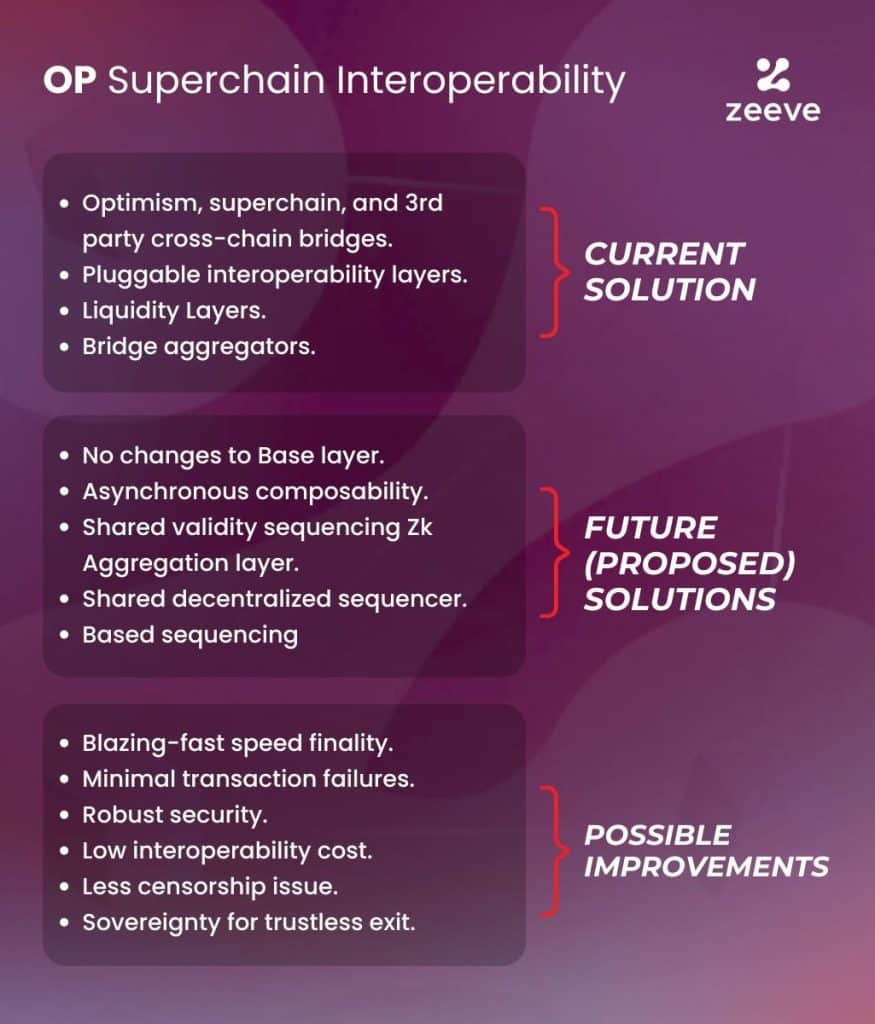 <h2 class="wp-block-heading" id="h-launch-your-modular-op-stack-powered-chain-with-zeeve-raas">Launch your modular OP Stack Powered Chain with Zeeve RaaS</h2> <p>From our whole discussion around <a href="https://www.zeeve.io/appchains/optimistic-rollups/">OP Superchain</a> interoperability, it is evident that superchain will soon offer native interoperability through a best-suited approach. However, we strongly believe that OP stack rollups will still have the choice to leverage native interoperability or existing solutions. Knowing this, Zeeve <a href="https://www.zeeve.io/rollups/">Rollups-as-a-service platform</a> is offering a comprehensive OP Stack-specific stack for enterprises and web3 projects to launch modular OP rollup chains offering end-to-end interoperability, unified liquidity, and robust security. From one-click sandbox tool to decentralized shared sequencers, Alt DA layers, and MPC wallets– <a href="https://www.zeeve.io/rollups/">Zeeve RaaS</a> has <a href="https://www.zeeve.io/integrations/">40+ integration</a> add ons and the list is expanding constantly. So, if you are planning to launch an OP stack superchain, Zeeve Raas will help you to save significant cost and accelerate time-to-market. <a href="https://www.zeeve.io/talk-to-an-expert/">Connect with our web3 expert</a> to discuss your project requirements or get a quote instantly. </p> |
| json metadata | {"tags":["opstack","rollups"],"image":["https://cdn.steemitimages.com/DQmcdELGdfsyNY2AAfYTaYGvfqZgtwjtZ9C9Q6ULnkGGGB1/image.png","https://www.zeeve.io/wp-content/uploads/2024/06/Launch-your-modular-OP-Stack-with-40-Integrations-1024x213.jpg","https://dev-to-uploads.s3.amazonaws.com/uploads/articles/51bvgwjsgw2hc6p93lwy.png"],"links":["https://www.superchain.eco/chains","https://www.zeeve.io/appchains/optimistic-rollups/","https://gov.optimism.io/t/superchain-and-the-monolithic-experience-a-cross-chain-guide-for-superchain/8151","https://www.umbraresearch.xyz/writings/shared-validity-sequencing","https://www.zeeve.io/blog/the-bold-promise-of-based-rollups-sequencing-pre-confirmations-mev-explained/","https://www.zeeve.io/rollups/","https://www.zeeve.io/integrations/","https://www.zeeve.io/talk-to-an-expert/"],"app":"steemit/0.2","format":"markdown"} |
| parent author | |
| parent permlink | opstack |
| permlink | how-op-superchain-makes-l2s-highly-interoperable-present-and-the-future |
| title | How OP Superchain Makes L2s highly interoperable: Present & the Future |
| Transaction Info | Block #89664182/Trx f6dbda7f627eb0d03cdfc3a19097ff60bc0841c4 |
View Raw JSON Data
{
"block": 89664182,
"op": [
"comment",
{
"author": "zeevedeeptech",
"body": "\n<p>OP Superchain ecosystem is<a href=\"https://www.superchain.eco/chains\"> growing tremendously</a>. The reason for this can be battle-tested security, super scaling, and modularity. But, cross-L2s interoperability is said to be the most significant factor that has encouraged big names like Base, Zora, Mantle Network, and Ancient8 to build their standalone OP rollup chains.</p>\n<p>Considering this, our article digs into the core concept of OP Superchain Interoperability, highlighting its current solutions and the vision superchain has created for the future. Basically, it aims to give you an idea about how OP chains operate right now in terms of interoperability and what solutions they can adopt for a sustainable future.</p>\n<a href=\"https://www.zeeve.io/appchains/optimistic-rollups/\"><img src=\"https://www.zeeve.io/wp-content/uploads/2024/06/Launch-your-modular-OP-Stack-with-40-Integrations-1024x213.jpg\" alt=\"OP Superchain Interoperability\" class=\"wp-image-71227\"/></a>\n<h2 class=\"wp-block-heading\" id=\"h-the-critical-need-of-interoperability-across-op-stack-superchains\">The critical need of interoperability across OP Stack Superchains</h2>\n<p>As we know, each <a href=\"https://www.zeeve.io/appchains/optimistic-rollups/\">OP chain</a> has the end goal to satisfy the specific requirements of both dApp builders and the end users. For example, a dApp user may look for seamless onboarding, high transaction speed, low fees, zero transaction failures, and a simple yet powerful wallet infrastructure. Talking about developers, they seek easy access to liquidity, governance, and cross-chain transfers. The requirements for all these stakeholders can be catered through enabling unparalleled OP Superchain interoperability. Here’s why end-to-end interoperability is critical for OP superchain:</p>\n<ol>\n<li><strong>Seamless token bridging: </strong>The capability of OP chains being able to bridge assets cross-chain enables web3 builders to create sustainable DeFi solution on top of OP stack. Plus, ease of bridging avoids the hassle of incorporating burn & mint standards. </li>\n<li><strong>Inter-chain state verification</strong>: L2 builders seek the ability to read and verify chain’s state easily on different chains without going through the prolonged process of initiating messages and its verification.</li>\n<li><strong>Atomic transactions: </strong>Atomic transaction is a critical component for dApps, especially the DeFi apps; which consist of atomic inclusion and atomic execution. With inclusion, dApps can get the ability to burn/mint-like features. Meanwhile, atomic execution enables the seamless moving of assets like flash loans across various chains, allowing users to hop on L2s that offer lower interest. </li>\n</ol>\n<h2 class=\"wp-block-heading\" id=\"h-superchain-s-current-and-future-interoperability-state-nbsp\">Superchain’s current and future interoperability state: </h2>\n<p>Optimism is working on achieving native interoperability between OP Superchains. However, OP Chains still supports end-to-end interoperability for best user experience, ease of use, and unified liquidity across sovereign chains. </p>\n<p>As discussed, we’ll first discuss what strategies OP Superchain implements at the moment and what different ideas superchain envision to adopt in future. Also, we will quickly discuss the tradeoff of all these interoperability solutions. Let’s start!</p>\n<h3 class=\"wp-block-heading\" id=\"h-current-solutions\">Current solutions</h3>\n<p><strong>#1:</strong> <strong>Cross-chain bridges: Optimism and 3rd party bridges</strong></p>\n<p>The idea of superchain is to introduce a network of chains that can share a common communication layer, decentralized governance, upgrades, and asset bridging–everything built on top of OP Stack. Knowing that all these are achievable through interoperability, Optimism offers an advanced cross-chain bridge that acts as a foundation to move tokens from/to any OP stack chain using the standard canonical bridge. Also, OP superchain support a range of 3rd party bridges to enable bridging between superchains and non-OP stack/Ethereum chains. </p>\n<p><strong>#2:</strong> <strong>Pluggable Interoperability Protocols: Axelar, LayerZero, Wormhole, and more</strong></p>\n<p>Popular interoperability protocols/layers such as Axelar, LayerZero, Wormhole, Hyperlane, and Socket are supported on OP superchains. These are essentially interoperability stacks that allow dApps to engage in cross-chain activities beyond bridging capabilities, such as sending arbitrary messages or utilizing contract logic. Projects building L2s with OP Stack can choose an interoperability layer matching their requirements and simply plug it with minimal effort or upfront cost. The selection can be mainly made based on critical parameters like permissionless deployment, the ability to detect malicious transactions or communication speed.</p>\n<p><strong>#3:</strong> <strong>Liquidity Layers: Catalyst, Orderly Network</strong></p>\n<p>Superchain allows OP chains to utilize Catalyst or Orderly Network as their modular liquidity layer. Both of these liquidity layers enable sovereign OP chains to seamlessly transfer value/assets cross-chain and tap into liquidity of Layer2s builders to allow seamless liquidity sharing across standalone chains. Further, these solutions claim to eradicate bridging challenges like fragmented liquidity, complex UX, or security breaches. Note that Catalyst and Orderly Network are already an integral part of the superchain ecosystem as Catalyst is deployed on Base and Orderly is built using OP Stack itself. Now, these are enabling interoperability across all the modular OP chains.</p>\n<p><strong>#4:</strong> <strong>Bridge aggregators: Jumper, Bungee, etc.</strong></p>\n<p>Bridge aggregators like Jumper and Bungee are innovative multi-chain bridging and swap solutions that assist OP superchains to achieve greater interoperability with any OP Stack L2s and various EVM-compatible chains. These are like one-stop solutions to buy, exchange, or swap tokens across superchains and also pay gas fees without hassle. </p>\n<p>As you might already know, there are certain challenges associated with the superchain’s existing interoperability solutions. For example, bridges can cause delays in asset/message transfer due to ‘a challenge period, liquidity fragmentation, complex UX, and security vulnerabilities like false deposits or private key compromises. Similarly, pluggable interoperability layers can cause centralization issues as they are operated through some trusted entities. Also, cost here can be high due to inclusion of Merkle proofs. As for liquidity engines, there can be issues like liquidity imbalance and price slippages. </p>\n<p>Therefore, Superchains has visioned for novel interoperability solutions that aims to unlock native interoperability for OP chains and Optimism dApps. Let’s dive into those ideas and also highlight their possible tradeoffs.</p>\n<h3 class=\"wp-block-heading\" id=\"h-solutions-for-future\">Solutions for future:</h3>\n<p>There are different approaches in Superchain’s <a href=\"https://gov.optimism.io/t/superchain-and-the-monolithic-experience-a-cross-chain-guide-for-superchain/8151\">interoperability roadmap</a> through which OP Superchain aims to battle against lack of interoperability and thus facilitate seamless communication between OP chains. Let’s discuss them:</p>\n<p><strong>#1: No changes to Base layer</strong></p>\n<p>The approach of allowing no changes to the base layer is somewhat similar to the current space of Ethereum/EVM interoperability state. This will require OP chains to add an abstraction layer on top of the dApps’ monolithic experience, enabling them to use multi-message aggregation (MMA) tools that supports trust-minimized asset bridging across siloed chains. Initially, this solution may offer an average cross-chain experience for users, but the user experience, security, and cost will improve due to constant innovation and increasing competition. However, this solution comes with certain tradeoffs, such as expensive cross-chain interaction, lack of trust, cross-chain MEV, and MEV censorship. These tradeoffs might not be a trouble on developers’ end, but end dApp users will be highly impacted as they seek interoperability and security the most.</p>\n<p><strong>#2: Asynchronous composability</strong></p>\n<p>Asynchronous composability refers to the approach of OP Superchains leveraging IBC protocol to offer endless interoperability across OP chains. This solution is an improvised alternative to the previous solution because it offers secure cross-chain bridging without involving MMA solutions or 3rd party bridges. Hence, it allows for a cheaper and more standardized way of bridging for users. Superchain builders can retain sovereignty in this interoperability design and they can even have a near-monolithic experience if asynchronous composability is combined with proper intents. Simply put, Asynchronous composability makes verification of cross-messaging easier for OP superchains, allowing them to confirm and mark blocks as fast on any corresponding chain. The possible tradeoff here can be due to the interdependency of rollups. If one rollup is compromised, it will impact all the adjacent rollups. Also, cross-chain MEV will be a trouble in Asynchronous composability similar to the first option. </p>\n<p><strong>#3: Shared validity sequencing </strong></p>\n<p>Shared validity sequencing is an interoperability solution proposed by <a href=\"https://www.umbraresearch.xyz/writings/shared-validity-sequencing\">Umbra Research</a> for superchain. This refers to a shared sequencer architecture supporting cross-chain interaction between OP chains. Following are the three main components upholding this sequencing design, including:</p>\n<ul>\n<li>A mechanism for shared sequencer to support cross-chain interactions.</li>\n<li>A block building algorithm in shared sequencer to manage cross-chain transactions while also respecting atomic transactions and conditional execution terms. </li>\n<li>Shared fraud proofs for all the involved superchains to ensure guarantee for cross-chain transactions.</li>\n</ul>\n<p>Using above components, shared validity sequencing outlines two different systems; the atomic <strong><em>burn </em></strong>and <strong><em>mint </em></strong>method and generalization of this same method to offer cross-chain experience beyond burn & mint. The first structure is based on system contracts, block building, and shared fraud proofs where <strong>burn </strong>on rollup A will only happen if <strong><em>mint on rollup B</em></strong><strong> </strong>succeeds<strong>.</strong></p>\n<p>Now, for generalization, this method can be easily modified to allow for passing of arbitrary messages and conditional transaction execution across OP rollups. Here, a cross-rollup action is invoked when all the triggered calls or none of them succeed.</p>\n<p>The challenge with this approach is the requirement for a shared sequencer to run full nodes for all the rollup it has done sequencing. Similarly, rollups also need to run nodes for cross-verification purposes. Doing this can be complex as well as expensive. Additionally, if an invalid state happens on a rollup, it will impact all its associated rollups. </p>\n<p><strong>#4: Zk Aggregation layer</strong></p>\n<p>The Zk Aggregation layer represents an interoperability concept similar to Polygon’s zk aggregation layer which requires the Superchain stack to transition over Zk-powered rollups. The Optimism ecosystem already has recognized the pace of zero-knowledge advancement and its rapid adoption, therefore now superchain is seeking to add zk-rollups in its stack soon. This will tackle the challenges of synchronous composability because verification and inclusion can be done seamlessly using zk-proofs. Also, ZK technology tackles the centralization issue of shared validity sequencing along with enabling fast finality. </p>\n<p>However, the cost will slightly increase for both dApp developers and users as there will be an aggregation layer sitting between the superchain-based rollup and the settlement layer. There is another concern for existing OP rollups who may struggle to meet the expectations of being permissionless which is a must to leverage the aggregation layer. </p>\n<p><strong>#5: Shared decentralized sequencer</strong></p>\n<p>Shared sequencer is one of the highly feasible solutions that match most of the interoperability requirements on OP superchain with almost zero trade offs. Having such sequencers means that superchains can offer a fully secure atomic inclusion & exclusion through crypto-economic guarantees and meanwhile keeping the decentralization intact. Shared sequencers also contribute to better liveliness, security, and extremely fast finality in rollups via pre-confirmations. However, note that pre-confirmation requires re-staking which comes with its own set of challenges and cost add on because users need to pay for atomic execution guarantees. </p>\n<p><strong>#6: Based sequencing</strong></p>\n<p>Based sequencing or Layer-1 sequencing has emerged as a great solution to align OP rollups more towards Layer1 Ethereum, unlock higher decentralization while also seamlessly interoperability across them. One additional benefit of based sequencing is the liveliness and censorship inheritance from Layer1; the Layer1 proposers can also serve as proposers on the based sequencing network. </p>\n<p>Again, the cost here can be high due to superchain’s need to operate with all the other superchains, independent L2s outside the superchain ecosystem, as well as Ethereum itself. However, the final cost depends upon which all layers a user actually interacts with. Plus, this end-to-end interaction approach also leads to fast finality and finality guarantees to improve user experience on superchains. Learn more about based sequencing <a href=\"https://www.zeeve.io/blog/the-bold-promise-of-based-rollups-sequencing-pre-confirmations-mev-explained/\">here</a>.</p>\n\n\n<h2 class=\"wp-block-heading\" id=\"h-launch-your-modular-op-stack-powered-chain-with-zeeve-raas\">Launch your modular OP Stack Powered Chain with Zeeve RaaS</h2>\n<p>From our whole discussion around <a href=\"https://www.zeeve.io/appchains/optimistic-rollups/\">OP Superchain</a> interoperability, it is evident that superchain will soon offer native interoperability through a best-suited approach. However, we strongly believe that OP stack rollups will still have the choice to leverage native interoperability or existing solutions. Knowing this, Zeeve <a href=\"https://www.zeeve.io/rollups/\">Rollups-as-a-service platform</a> is offering a comprehensive OP Stack-specific stack for enterprises and web3 projects to launch modular OP rollup chains offering end-to-end interoperability, unified liquidity, and robust security. From one-click sandbox tool to decentralized shared sequencers, Alt DA layers, and MPC wallets– <a href=\"https://www.zeeve.io/rollups/\">Zeeve RaaS</a> has <a href=\"https://www.zeeve.io/integrations/\">40+ integration</a> add ons and the list is expanding constantly. So, if you are planning to launch an OP stack superchain, Zeeve Raas will help you to save significant cost and accelerate time-to-market. <a href=\"https://www.zeeve.io/talk-to-an-expert/\">Connect with our web3 expert</a> to discuss your project requirements or get a quote instantly. </p>",
"json_metadata": "{\"tags\":[\"opstack\",\"rollups\"],\"image\":[\"https://cdn.steemitimages.com/DQmcdELGdfsyNY2AAfYTaYGvfqZgtwjtZ9C9Q6ULnkGGGB1/image.png\",\"https://www.zeeve.io/wp-content/uploads/2024/06/Launch-your-modular-OP-Stack-with-40-Integrations-1024x213.jpg\",\"https://dev-to-uploads.s3.amazonaws.com/uploads/articles/51bvgwjsgw2hc6p93lwy.png\"],\"links\":[\"https://www.superchain.eco/chains\",\"https://www.zeeve.io/appchains/optimistic-rollups/\",\"https://gov.optimism.io/t/superchain-and-the-monolithic-experience-a-cross-chain-guide-for-superchain/8151\",\"https://www.umbraresearch.xyz/writings/shared-validity-sequencing\",\"https://www.zeeve.io/blog/the-bold-promise-of-based-rollups-sequencing-pre-confirmations-mev-explained/\",\"https://www.zeeve.io/rollups/\",\"https://www.zeeve.io/integrations/\",\"https://www.zeeve.io/talk-to-an-expert/\"],\"app\":\"steemit/0.2\",\"format\":\"markdown\"}",
"parent_author": "",
"parent_permlink": "opstack",
"permlink": "how-op-superchain-makes-l2s-highly-interoperable-present-and-the-future",
"title": "How OP Superchain Makes L2s highly interoperable: Present & the Future"
}
],
"op_in_trx": 0,
"timestamp": "2024-10-21T05:23:57",
"trx_id": "f6dbda7f627eb0d03cdfc3a19097ff60bc0841c4",
"trx_in_block": 3,
"virtual_op": 0
}2024/10/15 11:44:39
2024/10/15 11:44:39
| author | zeevedeeptech |
| body |  <p><a href="https://www.zeeve.io/">Zeeve</a> is excited to announce that we have surpassed the mark of 250+ testnets on the 1-click <a href="https://www.zeeve.io/rollups/">Zeeve RaaS platform</a> across optimistic and ZK Rollup stacks. This is a proud moment for the entire Zeeve RaaS family. This milestone highlights our platform's robust capabilities and the growing trust web3 builders place in Zeeve for their blockchain infrastructure.</p> <p>These testnets are spread across OP Stack, Arbitrum Orbit, zkSync Hyperchain, and Polygon CDK, allowing developers to modify chain specifications, gas settings, and settlement layers; test bridges and smart contracts; configure RPC and other nodes (local Geth and L2/L3 nodes); manage cloud infrastructure and wallets; and access in-depth analytics, monitoring capabilities, activity logs, and alerts.</p> <p><em>“Zeeve was one of the first to offer automated testnets for both OP and zkRollups, and we’re delighted that builders are finding them useful</em>. <em>Our Sandbox environment simplifies decision-making and delivers actionable outcomes. By standardizing the deployment process across leading rollup frameworks, we’ve reduced testnet setup time to just a few minutes with zero coding required. This makes it much easier for businesses to transition to public testnets and mainnets, with complete confidence that their smart contracts and dApps are reliable and ready for production.”</em></p> <p>Dr. Ravi Chamria</p> <p>co-founder and CEO of Zeeve</p>  <p>These figures represent only the 1-click testnet users and do not include production Testnet or mainnet clients using Zeeve RaaS.</p> <p>Zeeve has also built a robust Apps Marketplace of web3 protocols and tools. Builders can choose from over 40 pluggable third-party integrations, including custom DA layers, decentralized oracles, Account Abstraction, Interoperability protocols, on/off-ramp solutions, developer tools, and more.</p> <p>Do you want to build and launch your own Layer2/ Layer3 rollup network using the OP Stack, Arbitrum Orbit, zkSync Hyperchain, or Polygon CDK? Try our 1-click RaaS platform for free.</p> <p>For more information on Testnet/mainnet rollups and supported <a href="https://www.zeeve.io/integrations/">integrations</a>, <a href="https://www.zeeve.io/rollups/">visit our RaaS page</a>. Have further queries? <a href="https://www.zeeve.io/talk-to-an-expert/">Schedule a call with our experts</a>.</p> |
| json metadata | {"tags":["announcement","zeeveraas"],"image":["https://cdn.steemitimages.com/DQmPphpmKXuR3DW4Lmzx6945dEr6ha2cPWaP7GSdsLdAxbH/image.png","https://dev-to-uploads.s3.amazonaws.com/uploads/articles/i4t8ui05wzfvskslu8re.png"],"links":["https://www.zeeve.io/","https://www.zeeve.io/rollups/","https://www.zeeve.io/integrations/","https://www.zeeve.io/talk-to-an-expert/"],"app":"steemit/0.2","format":"markdown"} |
| parent author | |
| parent permlink | announcement |
| permlink | zeeve-raas-achieves-milestone-with-250-rollup-testnets-across-leading-rollup-frameworks |
| title | Zeeve RaaS Achieves Milestone with 250+ Rollup Testnets across Leading Rollup Frameworks |
| Transaction Info | Block #89499375/Trx fd07c400016b12aa125118c22aa356194374f370 |
View Raw JSON Data
{
"block": 89499375,
"op": [
"comment",
{
"author": "zeevedeeptech",
"body": "\n<p><a href=\"https://www.zeeve.io/\">Zeeve</a> is excited to announce that we have surpassed the mark of 250+ testnets on the 1-click <a href=\"https://www.zeeve.io/rollups/\">Zeeve RaaS platform</a> across optimistic and ZK Rollup stacks. This is a proud moment for the entire Zeeve RaaS family. This milestone highlights our platform's robust capabilities and the growing trust web3 builders place in Zeeve for their blockchain infrastructure.</p>\n<p>These testnets are spread across OP Stack, Arbitrum Orbit, zkSync Hyperchain, and Polygon CDK, allowing developers to modify chain specifications, gas settings, and settlement layers; test bridges and smart contracts; configure RPC and other nodes (local Geth and L2/L3 nodes); manage cloud infrastructure and wallets; and access in-depth analytics, monitoring capabilities, activity logs, and alerts.</p>\n<p><em>“Zeeve was one of the first to offer automated testnets for both OP and zkRollups, and we’re delighted that builders are finding them useful</em>. <em>Our Sandbox environment simplifies decision-making and delivers actionable outcomes. By standardizing the deployment process across leading rollup frameworks, we’ve reduced testnet setup time to just a few minutes with zero coding required. This makes it much easier for businesses to transition to public testnets and mainnets, with complete confidence that their smart contracts and dApps are reliable and ready for production.”</em></p>\n<p>Dr. Ravi Chamria</p>\n<p>co-founder and CEO of Zeeve</p>\n\n\n<p>These figures represent only the 1-click testnet users and do not include production Testnet or mainnet clients using Zeeve RaaS.</p>\n<p>Zeeve has also built a robust Apps Marketplace of web3 protocols and tools. Builders can choose from over 40 pluggable third-party integrations, including custom DA layers, decentralized oracles, Account Abstraction, Interoperability protocols, on/off-ramp solutions, developer tools, and more.</p>\n<p>Do you want to build and launch your own Layer2/ Layer3 rollup network using the OP Stack, Arbitrum Orbit, zkSync Hyperchain, or Polygon CDK? Try our 1-click RaaS platform for free.</p>\n<p>For more information on Testnet/mainnet rollups and supported <a href=\"https://www.zeeve.io/integrations/\">integrations</a>, <a href=\"https://www.zeeve.io/rollups/\">visit our RaaS page</a>. Have further queries? <a href=\"https://www.zeeve.io/talk-to-an-expert/\">Schedule a call with our experts</a>.</p>",
"json_metadata": "{\"tags\":[\"announcement\",\"zeeveraas\"],\"image\":[\"https://cdn.steemitimages.com/DQmPphpmKXuR3DW4Lmzx6945dEr6ha2cPWaP7GSdsLdAxbH/image.png\",\"https://dev-to-uploads.s3.amazonaws.com/uploads/articles/i4t8ui05wzfvskslu8re.png\"],\"links\":[\"https://www.zeeve.io/\",\"https://www.zeeve.io/rollups/\",\"https://www.zeeve.io/integrations/\",\"https://www.zeeve.io/talk-to-an-expert/\"],\"app\":\"steemit/0.2\",\"format\":\"markdown\"}",
"parent_author": "",
"parent_permlink": "announcement",
"permlink": "zeeve-raas-achieves-milestone-with-250-rollup-testnets-across-leading-rollup-frameworks",
"title": "Zeeve RaaS Achieves Milestone with 250+ Rollup Testnets across Leading Rollup Frameworks"
}
],
"op_in_trx": 0,
"timestamp": "2024-10-15T11:44:39",
"trx_id": "fd07c400016b12aa125118c22aa356194374f370",
"trx_in_block": 1,
"virtual_op": 0
}zeevedeeptechpublished a new post: how-zkrollups-and-fhe-rollups-tackle-privacy-challenges-differently2024/10/15 11:27:09
zeevedeeptechpublished a new post: how-zkrollups-and-fhe-rollups-tackle-privacy-challenges-differently
2024/10/15 11:27:09
| author | zeevedeeptech |
| body |  <p>One of the most serious challenges Ethereum faces today is privacy. Privacy problems have grown in priority as the number of users and apps on the network has increased. To solve these challenges, <a href="https://www.zeeve.io/appchains/polygon-zkrollups/">zk-rollups</a> and FHE rollups have emerged as some of the most viable options. The article will compare zk-rollups vs. FHE rollups, examining their advantages and applications for improving privacy.</p> <h2 class="wp-block-heading" id="h-what-are-zk-rollups-btw">What are ZK Rollups, btw?</h2> <p>To fully comprehend <a href="https://www.zeeve.io/appchains/polygon-zkrollups/">zk-Rollups</a>, one has to have a thorough understanding of zero-knowledge proofs.</p> <p>A zero-knowledge (ZK) proof is a cryptographic method that enables one person (the prover) to convince another (the verifier) that a particular claim is true without revealing any details about the claim itself. </p> <p>This is especially helpful in situations where it's important to verify authenticity or condition compliance without disclosing sensitive information. The name "zero-knowledge" refers to this technique, which allows transaction records to be validated without revealing any further information. Applications for it include private transactions, improving blockchain scalability, and identity verification, as shown by digital wallets and verifiable credentials.</p> <p>A particular type of layer-two (L2) scaling technique called Zero-Knowledge Rollups (ZK Rollups) emerged to overcome the scalability issues with blockchains like Ethereum. To free up space on the main blockchain, they function by carrying out the majority of transaction processing and computation off-chain. </p> <p>Subsequently, ZK Rollups adds zero-knowledge proof, a cryptographic validation of these transactions, along with a summary of them for the main chain. This verification confirms the transactions' legitimacy without necessitating the storage of every detail on the chain. ZK Rollups greatly increase the efficiency of transaction processing overall, which lowers wait times and transaction fees.</p> 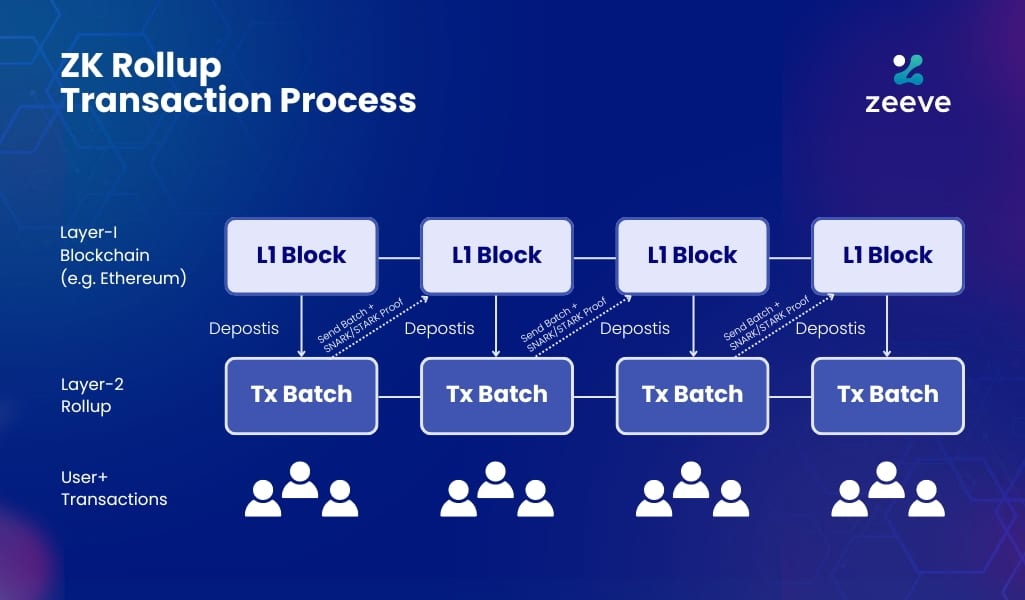 <p><a href="https://www.zeeve.io/appchains/polygon-zkrollups/">zk-Rollups</a> are made up of two essential parts that are necessary for them to function:</p> <li>On-chain contracts: On-chain contracts are essential to the zk-rollup protocol by establishing the operating guidelines. The primary contract and the verifier contract are the two main contracts in this segment. The primary contract serves as a rollup block repository, manages deposit monitoring, and enables essential changes. On the other hand, the verification contract has the responsibility of verifying the created Zero-Knowledge Proofs (ZKPs).</li> <li>Off-chain virtual machines: These machines, which execute transactions on Layer 2 (L2) outside of the main Ethereum blockchain, are another essential component of the zk-rollup ecosystem. They run independently of the Ethereum network.</li> <h2 class="wp-block-heading" id="h-what-are-fhe-rollups">What are FHE Rollups?</h2> <p>A key aspect of the design of FHE Rollups is Fully Homomorphic Encryption (FHE), which allows calculations on encrypted data to produce outcomes identical to those on plaintext. Since its inception, Gentry's concept of FHE has taken several forms. This innovative method permits a wide range of activities, from basic arithmetic to intricate computations, while guaranteeing a high degree of data protection.</p> <p>A straightforward illustration of FHE would be this: A data owner wants to protect their privacy while still transferring data to a cloud provider for processing. In this case, the data owner transfers the data to the server after encrypting it so that it is no longer readable. Without first decrypting the data to restore its legibility, the server can execute computations on it and return the encrypted results. </p> 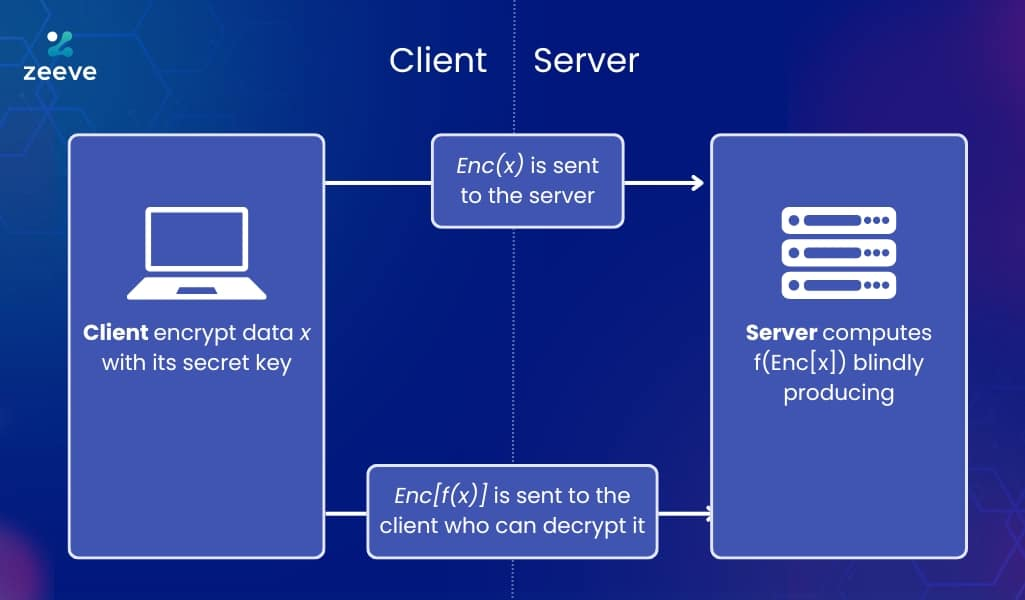 <p>Because they have the secret key, only the data owner may decode the results, guaranteeing data security and process confidence.</p> <p>Fully Homomorphic Encryption Rollups guarantee the confidentiality of all data during transmission, computation, and storage, preventing the ever-present possibility of sensitive data exposure. Because of the incredibly high level of privacy and security offered by continuous encryption, FHE Rollups are especially well-suited for sensitive data-handling applications like financial transactions and medical information.</p> <p>FHE Rollups provide a scalable method for blockchain integration. They process massive amounts of encrypted data off-chain and guarantee that the outcomes can be safely validated before being reintegrated into the blockchain. </p> <p>Once the necessary operations have been completed on the encrypted data, the encrypted results must be sent back to the data owner or another designated party for decryption. This technique improves overall efficiency and scalability by lowering the computing load on the blockchain itself while also guaranteeing privacy and security.</p> <p>Let's examine how the discussion of zk Rollups vs FHE Rollups is contributing to advancements in privacy solutions.</p> <h2 class="wp-block-heading" id="h-the-architecture-of-fhe-rollups">The Architecture of FHE Rollups</h2> <p>The choice of whether to employ a Zero-Knowledge (ZK) Rollup or an Optimistic Rollup method forms the architectural cornerstone of FHE Rollups. This choice necessitates a careful balancing act between verification efficiency and proof speed.</p> <p>Preferred for its speed, optimistic rollups presume transactions are valid by default and only do on-chain verification in response to disagreements. Although transaction processing is sped up with this method, any differences must be resolved by a robust fraud-proof mechanism. On the other hand, ZK Rollups provide more privacy by using Zero-Knowledge Proofs to protect transaction data, but at the expense of slower proving times.</p> <p>An optimistic-based method within the encrypted domain is recommended, taking into account the difficulties of incorporating Fully Homomorphic Encryption (FHE) into the verification process. This approach acknowledges the existing barriers to generating effective ZK-based FHE Rollups while also being in line with FHE's fundamental properties.</p> <h2 class="wp-block-heading" id="h-comparing-privacy-solutions-zk-rollups-vs-fhe-rollups">Comparing Privacy Solutions: zk-Rollups vs. FHE Rollups</h2> <p>The origins of Zero Knowledge Proofs (ZKPs) and Fully Homomorphic Encryption (FHE) date back several decades. Although FHE was first proposed in 1978, it wasn't until 2009 that it became a reality. Conversely, ZK first appeared in the 1980s and served as the basis for a large number of cryptographic systems. Both FHE and ZK have had major improvements over time and are still essential to protecting data privacy.</p> <h3 class="wp-block-heading" id="h-data-visibility-and-protection">Data visibility and protection</h3> <p>The transaction data in zk-Rollups is protected from validators by zero-knowledge proofs, although the data isn't necessarily encrypted. This implies that even though validators cannot view transaction details, there is still a chance for the data to be compromised in the event that the proof system is hacked. </p> <p>On the other hand, FHE Rollups keep data encrypted throughout. Continuous encryption guarantees that, even in the event of a compromised computing environment, the attacker can only access encrypted data that is useless without the decryption key. As a result, FHE Rollups are better able to safeguard data against leaks and illegal access.</p> <h3 class="wp-block-heading" id="h-security-nbsp">Security </h3> <p>By using cryptographic proofs, zk-Rollups minimize the danger of fraud and data exposure while providing excellent security. By guaranteeing the legitimacy of transactions without disclosing the specifics, a safe transaction environment is created. </p> <p>But by guaranteeing that data is encrypted during every process, FHE Rollups go above and beyond for security. Ensuring that sensitive data is always safe, this end-to-end encryption guards against data breaches and unwanted access. Because of its strong encryption, in the comparison of zk Rollups vs FHE Rollups, FHE Rollups are especially well-suited for situations where the highest level of data confidentiality is required.</p> <h3 class="wp-block-heading" id="h-privacy-guarantees-and-performance">Privacy guarantees and performance</h3> <p>With zk Rollups, high privacy guarantees can be achieved by using ZKPs, which can be computationally demanding to prove but are very efficient in terms of verification. This implies that although the process of verifying transactions is quick and effective, the generation of the proofs themselves may take longer.</p> <p>FHE Rollups, on the other hand, have a large computational expense but provide strong privacy by encrypting all computations. When compared to plaintext data, operations on encrypted data require more resources to complete. As a result, if we consider zk rollups vs FHE rollups, the latter offers superior privacy despite the fact that they can be slower and need more processing power.</p> <h2 class="wp-block-heading" id="h-difference-between-zk-rollups-vs-fhe-rollups-nbsp">Difference between zk Rollups vs. FHE Rollups </h2> 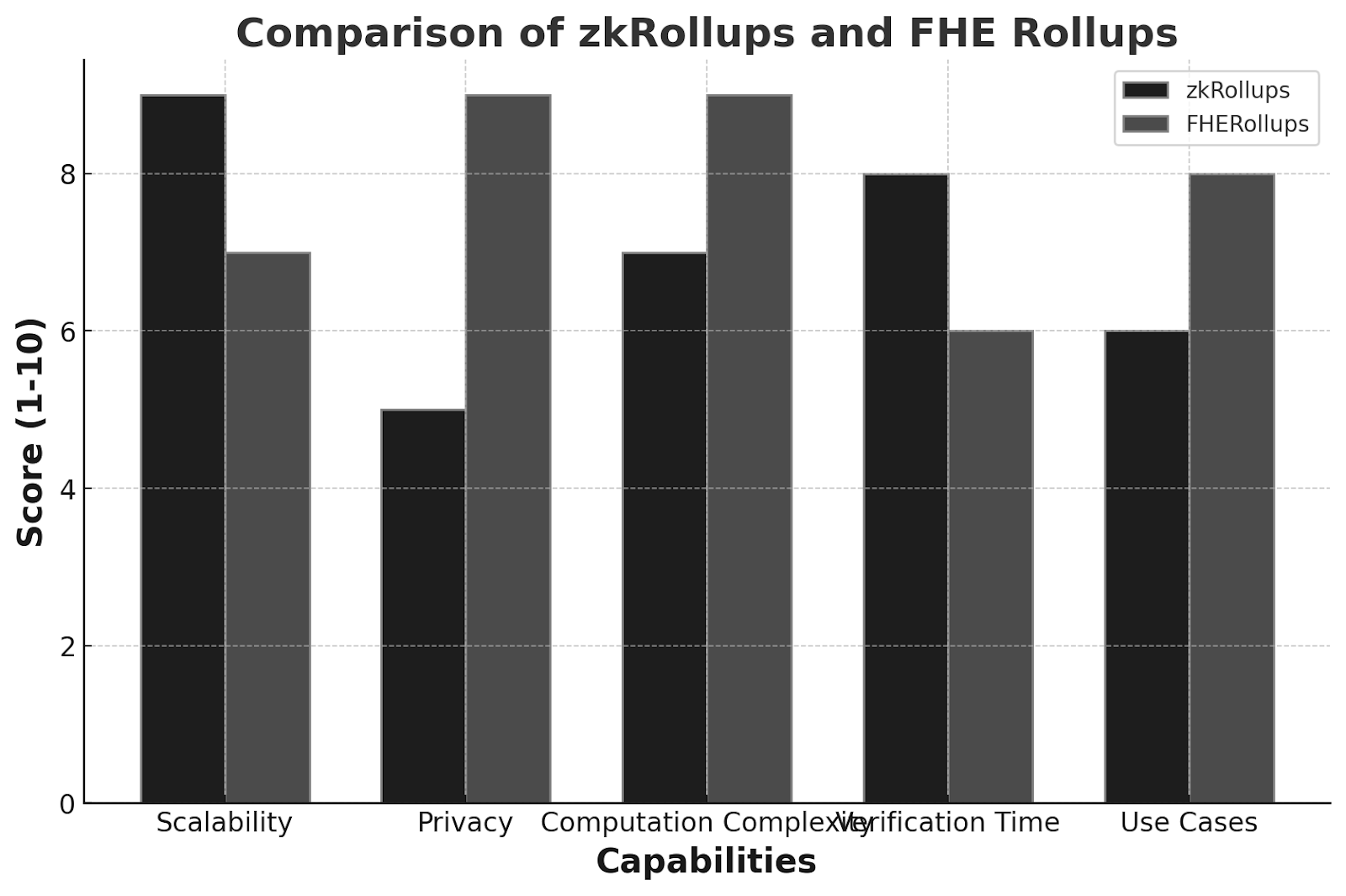 <p>When evaluating zk Rollups vs FHE Rollups, there are a few important things to take into account. zk Rollups are known for their excellent efficiency when it comes to scalability. To do this, they group transactions off-chain and carry out as little on-chain verification as possible, enabling a high transaction throughput. However, because FHE requires more resource-intensive computations, FHE Rollups only provide limited scalability. <p>Another area where these technologies diverge greatly is in privacy. FHE Rollups offer a moderate level of privacy, making them appropriate for situations where lone users rely on zero-knowledge proofs to keep information private. FHE Rollups, on the other hand, provide a far greater level of privacy. They are perfect for applications that demand strict security measures because they allow complex multi-party calculations on encrypted data.</p> <p>There are differences in computation difficulty between the two as well. Since zero-knowledge proofs must be generated, zk Rollups are quite challenging but nonetheless rather effective. On the other hand, FHE Rollups have extremely high computational complexity. This is due to the fact that FHE necessitates greater processing power and time due to its extensive computation on encrypted data.</p> <p>Another factor to consider is the verification time. Quick verification is advantageous for zk Rollups because zero-knowledge proofs are concise. FHE Rollups, on the other hand, have a moderate verification time because it is more difficult to verify the encrypted computations.</p> <h2 class="wp-block-heading" id="h-projects-using-fhe-nbsp">Projects using FHE </h2> <p>With the 2020 launch of TFHE and fhEVM, open-source cryptography company Zama elevated FHE ahead in the crypto space. Few projects currently take advantage of the Fully Homomorphic Encryption (FHE) rollups to increase privacy and security within blockchain applications. </p> <p>Here are some notable ones:</p> <h3 class="wp-block-heading" id="h-zama">Zama</h3> <p>In early 2020, Hindi and Pascal Paillier, a well-known cryptographer and co-inventor of Fully Homomorphic Encryption (FHE), founded the open-source cryptography startup Zama. The company focuses on creating FHE solutions for applications utilizing blockchain technology and artificial intelligence (AI). Among Zama's products are the “TFHE-re library,” FHE compiler “Concrete,” “Concrete ML,” and “fhEVM.”</p> <p>Zama has a three-phase plan for its development approach. The first phase (2022–2024) is dedicated to putting FHE for machine learning into practice, namely to create effective encrypted inference for neural networks. Phase 2 (2025–2027) intends to extend the use of FHE by incorporating analytics, encrypted search, and more extensive privacy-preserving computations. In the end, Phase 3 (2028–2030) aims to attain full FHE capabilities, allowing for practical performance in arbitrary calculations on encrypted data.</p> <h3 class="wp-block-heading" id="h-fhenix">Fhenix</h3> <p>Fhenix is driven by fhEVM, a private programming environment, and runs on a layer-2 network that is compatible with EVM. With this configuration, programmers can design apps on the Fhenix platform without needing to have a deep understanding of Fully Homomorphic Encryption. The method provides more comprehensive data protection, especially in cases where data comes from many sources, setting it apart from previous privacy solutions like ZK-SNARKs.</p> <p>Zama's fhEVM technology lies at the core of Fhenix's capabilities. This makes it possible for developers to include FHE in blockchain applications with ease. As a result, blockchain technology has advanced and it is now possible to write encrypted smart contracts in Solidity without having a deep understanding of cryptography. </p> <p>Fhenix's first development, the FHE Rollup, enables it to process private and sensitive data on Ethereum in a safe manner, increasing the blockchain's usefulness for a range of applications.</p> <p>Their fheOS library contains the essential FHE logic. This is an encrypted computing library that includes pre-compiles for frequently used encrypted opcodes, like addition and multiplication, and comparison of two numbers. It allows network-running Smart Contracts to use FHE primitives inside the contract. This implies that encrypted data can be incorporated into the smart contract logic of dApps that are utilizing or running on Fhenix. </p> <h3 class="wp-block-heading" id="h-inco">Inco</h3> <p>Inco is a universal confidentiality layer and modular Layer-1 blockchain for Ethereum and other networks that use Ethereum security and fully homomorphic encryption (FHE). </p> <p>Their fhEVM (FHE + EVM) removes the complexities of FHE and allows Solidity developers to create private dApps in 20 minutes or less by utilizing Solidity, the most popular smart contract language, together with Ethereum ecosystem tools like Metamask, Remix, and Hardhat. </p> <p>The network provides a programmable and dynamic layer of decentralized identity (DID) that uses FHE to securely store private data on-chain and lets dApps query certain insights.</p> <h2 class="wp-block-heading" id="h-final-thoughts">Final Thoughts</h2> <p>Both zk Rollups and FHE Rollups endorse data privacy, although they function according to different ideas. Since FHE Rollups enable direct computations on encrypted data, data processing can benefit from them. In contrast, Zk Rollups prioritizes demonstrating knowledge of information without divulging it, which makes it perfect for safe transactions and identity authentication.</p> <p>It is worth considering and conducting more studies to see if it is possible to combine homomorphic encryption with Zk in a single application to provide data security and identity protection and improve the ZKP and FHE algorithms. In the upcoming years, several advances are anticipated that could make data processing and storage even more private and safe.</p> <p>If you are building a rollup that leverages ZKPs or FHEs or both maybe, and looking for an infra partner, check out <a href="https://www.zeeve.io/rollups/">Zeeve’s Rollups-as-a-Service (RaaS)</a>. If you have any further queries or need consultation, <a href="https://www.zeeve.io/">schedule a call with our experts</a> today!</p> |
| json metadata | {"tags":["rollups","zkrollups"],"image":["https://cdn.steemitimages.com/DQmb3JCxgR8c9VHpMHs2LmJ5govcFDNnu46QQuhbybzhdsV/image.png","https://dev-to-uploads.s3.amazonaws.com/uploads/articles/bekllljphj3x0mrygh8r.png","https://dev-to-uploads.s3.amazonaws.com/uploads/articles/7zpgs9axpw5mddht14ey.png","https://dev-to-uploads.s3.amazonaws.com/uploads/articles/yeu5dv8qs9pgdiay8cvs.png"],"links":["https://www.zeeve.io/appchains/polygon-zkrollups/","https://www.zeeve.io/rollups/","https://www.zeeve.io/"],"app":"steemit/0.2","format":"markdown"} |
| parent author | |
| parent permlink | rollups |
| permlink | how-zkrollups-and-fhe-rollups-tackle-privacy-challenges-differently |
| title | How zkRollups and FHE Rollups Tackle Privacy Challenges Differently |
| Transaction Info | Block #89499035/Trx 17269181b1c679baed14207b4e02d948772cf698 |
View Raw JSON Data
{
"block": 89499035,
"op": [
"comment",
{
"author": "zeevedeeptech",
"body": "\n<p>One of the most serious challenges Ethereum faces today is privacy. Privacy problems have grown in priority as the number of users and apps on the network has increased. To solve these challenges, <a href=\"https://www.zeeve.io/appchains/polygon-zkrollups/\">zk-rollups</a> and FHE rollups have emerged as some of the most viable options. The article will compare zk-rollups vs. FHE rollups, examining their advantages and applications for improving privacy.</p>\n<h2 class=\"wp-block-heading\" id=\"h-what-are-zk-rollups-btw\">What are ZK Rollups, btw?</h2>\n<p>To fully comprehend <a href=\"https://www.zeeve.io/appchains/polygon-zkrollups/\">zk-Rollups</a>, one has to have a thorough understanding of zero-knowledge proofs.</p>\n<p>A zero-knowledge (ZK) proof is a cryptographic method that enables one person (the prover) to convince another (the verifier) that a particular claim is true without revealing any details about the claim itself. </p>\n<p>This is especially helpful in situations where it's important to verify authenticity or condition compliance without disclosing sensitive information. The name \"zero-knowledge\" refers to this technique, which allows transaction records to be validated without revealing any further information. Applications for it include private transactions, improving blockchain scalability, and identity verification, as shown by digital wallets and verifiable credentials.</p>\n<p>A particular type of layer-two (L2) scaling technique called Zero-Knowledge Rollups (ZK Rollups) emerged to overcome the scalability issues with blockchains like Ethereum. To free up space on the main blockchain, they function by carrying out the majority of transaction processing and computation off-chain. </p>\n<p>Subsequently, ZK Rollups adds zero-knowledge proof, a cryptographic validation of these transactions, along with a summary of them for the main chain. This verification confirms the transactions' legitimacy without necessitating the storage of every detail on the chain. ZK Rollups greatly increase the efficiency of transaction processing overall, which lowers wait times and transaction fees.</p>\n\n\n<p><a href=\"https://www.zeeve.io/appchains/polygon-zkrollups/\">zk-Rollups</a> are made up of two essential parts that are necessary for them to function:</p>\n<li>On-chain contracts: On-chain contracts are essential to the zk-rollup protocol by establishing the operating guidelines. The primary contract and the verifier contract are the two main contracts in this segment. The primary contract serves as a rollup block repository, manages deposit monitoring, and enables essential changes. On the other hand, the verification contract has the responsibility of verifying the created Zero-Knowledge Proofs (ZKPs).</li>\n<li>Off-chain virtual machines: These machines, which execute transactions on Layer 2 (L2) outside of the main Ethereum blockchain, are another essential component of the zk-rollup ecosystem. They run independently of the Ethereum network.</li>\n<h2 class=\"wp-block-heading\" id=\"h-what-are-fhe-rollups\">What are FHE Rollups?</h2>\n<p>A key aspect of the design of FHE Rollups is Fully Homomorphic Encryption (FHE), which allows calculations on encrypted data to produce outcomes identical to those on plaintext. Since its inception, Gentry's concept of FHE has taken several forms. This innovative method permits a wide range of activities, from basic arithmetic to intricate computations, while guaranteeing a high degree of data protection.</p>\n<p>A straightforward illustration of FHE would be this: A data owner wants to protect their privacy while still transferring data to a cloud provider for processing. In this case, the data owner transfers the data to the server after encrypting it so that it is no longer readable. Without first decrypting the data to restore its legibility, the server can execute computations on it and return the encrypted results. </p>\n\n\n<p>Because they have the secret key, only the data owner may decode the results, guaranteeing data security and process confidence.</p>\n<p>Fully Homomorphic Encryption Rollups guarantee the confidentiality of all data during transmission, computation, and storage, preventing the ever-present possibility of sensitive data exposure. Because of the incredibly high level of privacy and security offered by continuous encryption, FHE Rollups are especially well-suited for sensitive data-handling applications like financial transactions and medical information.</p>\n<p>FHE Rollups provide a scalable method for blockchain integration. They process massive amounts of encrypted data off-chain and guarantee that the outcomes can be safely validated before being reintegrated into the blockchain. </p>\n<p>Once the necessary operations have been completed on the encrypted data, the encrypted results must be sent back to the data owner or another designated party for decryption. This technique improves overall efficiency and scalability by lowering the computing load on the blockchain itself while also guaranteeing privacy and security.</p>\n<p>Let's examine how the discussion of zk Rollups vs FHE Rollups is contributing to advancements in privacy solutions.</p>\n<h2 class=\"wp-block-heading\" id=\"h-the-architecture-of-fhe-rollups\">The Architecture of FHE Rollups</h2>\n<p>The choice of whether to employ a Zero-Knowledge (ZK) Rollup or an Optimistic Rollup method forms the architectural cornerstone of FHE Rollups. This choice necessitates a careful balancing act between verification efficiency and proof speed.</p>\n<p>Preferred for its speed, optimistic rollups presume transactions are valid by default and only do on-chain verification in response to disagreements. Although transaction processing is sped up with this method, any differences must be resolved by a robust fraud-proof mechanism. On the other hand, ZK Rollups provide more privacy by using Zero-Knowledge Proofs to protect transaction data, but at the expense of slower proving times.</p>\n<p>An optimistic-based method within the encrypted domain is recommended, taking into account the difficulties of incorporating Fully Homomorphic Encryption (FHE) into the verification process. This approach acknowledges the existing barriers to generating effective ZK-based FHE Rollups while also being in line with FHE's fundamental properties.</p>\n<h2 class=\"wp-block-heading\" id=\"h-comparing-privacy-solutions-zk-rollups-vs-fhe-rollups\">Comparing Privacy Solutions: zk-Rollups vs. FHE Rollups</h2>\n<p>The origins of Zero Knowledge Proofs (ZKPs) and Fully Homomorphic Encryption (FHE) date back several decades. Although FHE was first proposed in 1978, it wasn't until 2009 that it became a reality. Conversely, ZK first appeared in the 1980s and served as the basis for a large number of cryptographic systems. Both FHE and ZK have had major improvements over time and are still essential to protecting data privacy.</p>\n<h3 class=\"wp-block-heading\" id=\"h-data-visibility-and-protection\">Data visibility and protection</h3>\n<p>The transaction data in zk-Rollups is protected from validators by zero-knowledge proofs, although the data isn't necessarily encrypted. This implies that even though validators cannot view transaction details, there is still a chance for the data to be compromised in the event that the proof system is hacked. </p>\n<p>On the other hand, FHE Rollups keep data encrypted throughout. Continuous encryption guarantees that, even in the event of a compromised computing environment, the attacker can only access encrypted data that is useless without the decryption key. As a result, FHE Rollups are better able to safeguard data against leaks and illegal access.</p>\n<h3 class=\"wp-block-heading\" id=\"h-security-nbsp\">Security </h3>\n<p>By using cryptographic proofs, zk-Rollups minimize the danger of fraud and data exposure while providing excellent security. By guaranteeing the legitimacy of transactions without disclosing the specifics, a safe transaction environment is created. </p>\n<p>But by guaranteeing that data is encrypted during every process, FHE Rollups go above and beyond for security. Ensuring that sensitive data is always safe, this end-to-end encryption guards against data breaches and unwanted access. Because of its strong encryption, in the comparison of zk Rollups vs FHE Rollups, FHE Rollups are especially well-suited for situations where the highest level of data confidentiality is required.</p>\n<h3 class=\"wp-block-heading\" id=\"h-privacy-guarantees-and-performance\">Privacy guarantees and performance</h3>\n<p>With zk Rollups, high privacy guarantees can be achieved by using ZKPs, which can be computationally demanding to prove but are very efficient in terms of verification. This implies that although the process of verifying transactions is quick and effective, the generation of the proofs themselves may take longer.</p>\n<p>FHE Rollups, on the other hand, have a large computational expense but provide strong privacy by encrypting all computations. When compared to plaintext data, operations on encrypted data require more resources to complete. As a result, if we consider zk rollups vs FHE rollups, the latter offers superior privacy despite the fact that they can be slower and need more processing power.</p>\n<h2 class=\"wp-block-heading\" id=\"h-difference-between-zk-rollups-vs-fhe-rollups-nbsp\">Difference between zk Rollups vs. FHE Rollups </h2>\n\n\n<p>When evaluating zk Rollups vs FHE Rollups, there are a few important things to take into account. zk Rollups are known for their excellent efficiency when it comes to scalability. To do this, they group transactions off-chain and carry out as little on-chain verification as possible, enabling a high transaction throughput. However, because FHE requires more resource-intensive computations, FHE Rollups only provide limited scalability.\n<p>Another area where these technologies diverge greatly is in privacy. FHE Rollups offer a moderate level of privacy, making them appropriate for situations where lone users rely on zero-knowledge proofs to keep information private. FHE Rollups, on the other hand, provide a far greater level of privacy. They are perfect for applications that demand strict security measures because they allow complex multi-party calculations on encrypted data.</p>\n<p>There are differences in computation difficulty between the two as well. Since zero-knowledge proofs must be generated, zk Rollups are quite challenging but nonetheless rather effective. On the other hand, FHE Rollups have extremely high computational complexity. This is due to the fact that FHE necessitates greater processing power and time due to its extensive computation on encrypted data.</p>\n<p>Another factor to consider is the verification time. Quick verification is advantageous for zk Rollups because zero-knowledge proofs are concise. FHE Rollups, on the other hand, have a moderate verification time because it is more difficult to verify the encrypted computations.</p>\n<h2 class=\"wp-block-heading\" id=\"h-projects-using-fhe-nbsp\">Projects using FHE </h2>\n<p>With the 2020 launch of TFHE and fhEVM, open-source cryptography company Zama elevated FHE ahead in the crypto space. Few projects currently take advantage of the Fully Homomorphic Encryption (FHE) rollups to increase privacy and security within blockchain applications. </p>\n<p>Here are some notable ones:</p>\n<h3 class=\"wp-block-heading\" id=\"h-zama\">Zama</h3>\n<p>In early 2020, Hindi and Pascal Paillier, a well-known cryptographer and co-inventor of Fully Homomorphic Encryption (FHE), founded the open-source cryptography startup Zama. The company focuses on creating FHE solutions for applications utilizing blockchain technology and artificial intelligence (AI). Among Zama's products are the “TFHE-re library,” FHE compiler “Concrete,” “Concrete ML,” and “fhEVM.”</p>\n<p>Zama has a three-phase plan for its development approach. The first phase (2022–2024) is dedicated to putting FHE for machine learning into practice, namely to create effective encrypted inference for neural networks. Phase 2 (2025–2027) intends to extend the use of FHE by incorporating analytics, encrypted search, and more extensive privacy-preserving computations. In the end, Phase 3 (2028–2030) aims to attain full FHE capabilities, allowing for practical performance in arbitrary calculations on encrypted data.</p>\n<h3 class=\"wp-block-heading\" id=\"h-fhenix\">Fhenix</h3>\n<p>Fhenix is driven by fhEVM, a private programming environment, and runs on a layer-2 network that is compatible with EVM. With this configuration, programmers can design apps on the Fhenix platform without needing to have a deep understanding of Fully Homomorphic Encryption. The method provides more comprehensive data protection, especially in cases where data comes from many sources, setting it apart from previous privacy solutions like ZK-SNARKs.</p>\n<p>Zama's fhEVM technology lies at the core of Fhenix's capabilities. This makes it possible for developers to include FHE in blockchain applications with ease. As a result, blockchain technology has advanced and it is now possible to write encrypted smart contracts in Solidity without having a deep understanding of cryptography. </p>\n<p>Fhenix's first development, the FHE Rollup, enables it to process private and sensitive data on Ethereum in a safe manner, increasing the blockchain's usefulness for a range of applications.</p>\n<p>Their fheOS library contains the essential FHE logic. This is an encrypted computing library that includes pre-compiles for frequently used encrypted opcodes, like addition and multiplication, and comparison of two numbers. It allows network-running Smart Contracts to use FHE primitives inside the contract. This implies that encrypted data can be incorporated into the smart contract logic of dApps that are utilizing or running on Fhenix. </p>\n<h3 class=\"wp-block-heading\" id=\"h-inco\">Inco</h3>\n<p>Inco is a universal confidentiality layer and modular Layer-1 blockchain for Ethereum and other networks that use Ethereum security and fully homomorphic encryption (FHE). </p>\n<p>Their fhEVM (FHE + EVM) removes the complexities of FHE and allows Solidity developers to create private dApps in 20 minutes or less by utilizing Solidity, the most popular smart contract language, together with Ethereum ecosystem tools like Metamask, Remix, and Hardhat. </p>\n<p>The network provides a programmable and dynamic layer of decentralized identity (DID) that uses FHE to securely store private data on-chain and lets dApps query certain insights.</p>\n<h2 class=\"wp-block-heading\" id=\"h-final-thoughts\">Final Thoughts</h2>\n<p>Both zk Rollups and FHE Rollups endorse data privacy, although they function according to different ideas. Since FHE Rollups enable direct computations on encrypted data, data processing can benefit from them. In contrast, Zk Rollups prioritizes demonstrating knowledge of information without divulging it, which makes it perfect for safe transactions and identity authentication.</p>\n<p>It is worth considering and conducting more studies to see if it is possible to combine homomorphic encryption with Zk in a single application to provide data security and identity protection and improve the ZKP and FHE algorithms. In the upcoming years, several advances are anticipated that could make data processing and storage even more private and safe.</p>\n<p>If you are building a rollup that leverages ZKPs or FHEs or both maybe, and looking for an infra partner, check out <a href=\"https://www.zeeve.io/rollups/\">Zeeve’s Rollups-as-a-Service (RaaS)</a>. If you have any further queries or need consultation, <a href=\"https://www.zeeve.io/\">schedule a call with our experts</a> today!</p>",
"json_metadata": "{\"tags\":[\"rollups\",\"zkrollups\"],\"image\":[\"https://cdn.steemitimages.com/DQmb3JCxgR8c9VHpMHs2LmJ5govcFDNnu46QQuhbybzhdsV/image.png\",\"https://dev-to-uploads.s3.amazonaws.com/uploads/articles/bekllljphj3x0mrygh8r.png\",\"https://dev-to-uploads.s3.amazonaws.com/uploads/articles/7zpgs9axpw5mddht14ey.png\",\"https://dev-to-uploads.s3.amazonaws.com/uploads/articles/yeu5dv8qs9pgdiay8cvs.png\"],\"links\":[\"https://www.zeeve.io/appchains/polygon-zkrollups/\",\"https://www.zeeve.io/rollups/\",\"https://www.zeeve.io/\"],\"app\":\"steemit/0.2\",\"format\":\"markdown\"}",
"parent_author": "",
"parent_permlink": "rollups",
"permlink": "how-zkrollups-and-fhe-rollups-tackle-privacy-challenges-differently",
"title": "How zkRollups and FHE Rollups Tackle Privacy Challenges Differently"
}
],
"op_in_trx": 0,
"timestamp": "2024-10-15T11:27:09",
"trx_id": "17269181b1c679baed14207b4e02d948772cf698",
"trx_in_block": 6,
"virtual_op": 0
}2024/10/08 06:04:45
2024/10/08 06:04:45
| author | zeevedeeptech |
| permlink | zeeve-raas-partners-with-pandasea-for-the-launch-of-their-op-stack-powered-layer2-chain |
| voter | tujinshan |
| weight | 10000 (100.00%) |
| Transaction Info | Block #89292198/Trx 3e1d9adeef8f685918f3d9aa795e9e7c2090aa89 |
View Raw JSON Data
{
  "block": 89292198,
  "op": [
    "vote",
    {
      "author": "zeevedeeptech",
      "permlink": "zeeve-raas-partners-with-pandasea-for-the-launch-of-their-op-stack-powered-layer2-chain",
      "voter": "tujinshan",
      "weight": 10000
    }
  ],
  "op_in_trx": 0,
  "timestamp": "2024-10-08T06:04:45",
  "trx_id": "3e1d9adeef8f685918f3d9aa795e9e7c2090aa89",
  "trx_in_block": 0,
  "virtual_op": 0
}2024/10/08 06:03:21
2024/10/08 06:03:21
| author | zeevedeeptech |
| body |  <p>We are delighted to announce our partnership with <a href="https://pandasea.io/">PandaSea</a> as their chosen <a href="https://www.zeeve.io/rollups/">Rollups-as-a-Service provider</a> for the new L2 OP chain built with the <a href="https://www.zeeve.io/appchains/optimistic-rollups/">OP Stack</a>. We warmly welcome the PandaSea community to the Zeeve RaaS ecosystem and look forward to advancing SocialFi and creator economy together.</p> <p>PandaSea.io is a layer 2 Web3 platform focused on integrating social finance and sports engagement. Utilizing its own chain on the OP Stack, PandaSea provides a robust, scalable solution for decentralized applications, with PandaSea Coin (PANDA) serving as its native gas token. PandaSea aims to redefine the interaction between fans and their favorite sports through innovative products like PandaFantasy.net.</p> <p>Panda chain testnet on OP Stack is already live and their mainnet will be coming soon. </p> <p>As an infrastructure partner, <a href="https://www.zeeve.io/">Zeeve</a> is committed to equipping PandaSea with a robust suite of tools and integrations for streamlined deployment, effortless management, and frictionless user onboarding for their OP Stack Chain. </p> <p><em>“As an infrastructure partner, Zeeve is committed to equipping PandaSea with a robust suite of tools and integrations for streamlined deployment, effortless management, and frictionless user onboarding for their OP stack powered L2 Chain. We’ll ensure, with efficient management, that the ecosystem also remains compliant and meets the objective of PandaSea as well as the broader goals of OP Labs.”</em></p> <p>Dr Ravi Chamria</p> <p>Co-founder and CEO of Zeeve</p> <p><em>“We are pleased to have Zeeve as a partner, and we are excited for the world to discover the power of our platform, and to experience social and sports in a new way with our new PandaFantasy.net stock market for sports.”</em></p> <p>Steve van Zutphen</p> <p>PandaSea founder</p> <h2 class="wp-block-heading" id="h-key-features-and-deliverables">Key Features and Deliverables</h2> <h3 class="wp-block-heading" id="h-quick-and-automated-setup">Quick and Automated Setup</h3> <li><strong>Automated Deployment:</strong> Utilize automation scripts and infrastructure-as-code tools (like Terraform or Ansible) to quickly deploy the OP Stack-based L2 Rollup infrastructure.</li> <li><strong>Compliance and Security:</strong> Ensure the deployment process adheres to industry-standard security practices and compliance requirements. This includes secure key management, encrypted communication channels, and regular security audits.</li> <h3 class="wp-block-heading" id="h-management-dashboards">Management Dashboards</h3> <li><strong>Operational Activities Monitoring: </strong>Provide dashboards for real-time monitoring of the rollup network and its operations. </li> <li><strong>Customizable Dashboards:</strong> Allow users to customize their dashboards to monitor specific metrics relevant to their operations.</li> <li><strong>Alerting Systems:</strong> Implement an alerting system to notify the team of any critical issues or performance degradation. This could include email alerts, SMS, or integrations with tools like Slack.</li> <li><strong>Comprehensive Logging:</strong> Ensure all activities are logged comprehensively, with logs stored securely and accessible for auditing and troubleshooting.</li> <h3 class="wp-block-heading" id="h-necessary-tools-and-third-party-integrations">Necessary Tools and Third-Party Integrations</h3> <li><strong>Rebranded Explorer:</strong> Offer a customizable blockchain explorer that can be branded to PandaSea requirements.</li> <li><strong>Bridge UI:</strong> Develop a user-friendly interface for bridging assets between L1 and L2.</li> <li><strong>Faucets for Testnet: </strong>Provide faucets to distribute testnet tokens, aiding developers and testers.</li> <li><strong>Third-Party Integrations:</strong> Integrate additional tools and services as required by PandaSea, ensuring seamless operation and compatibility with their existing systems.</li> <h3 class="wp-block-heading" id="h-regular-maintenance-and-upgrades">Regular Maintenance and Upgrades</h3> <li><strong>Scheduled Maintenance: </strong>Regularly schedule maintenance windows to apply updates and patches, ensuring minimal disruption to the service.</li> <li><strong>Automatic Upgrades:</strong> Implement a process for automatic or semi-automatic upgrades to keep the stack up-to-date with the latest features and security improvements.</li> <h3 class="wp-block-heading" id="h-24-7-support-with-enterprise-grade-slas">24/7 Support with Enterprise Grade SLAs</h3> <li><strong>Round-the-Clock Support: </strong>Provide 24/7 technical support to handle any issues or incidents, ensuring high availability and reliability.</li> <li><strong>Enterprise SLAs: </strong>Offer Service Level Agreements that guarantee response times, uptime, and performance standards suitable for enterprise needs.</li> <h3 class="wp-block-heading" id="h-integration-of-tracehawk">Integration of TraceHawk</h3> <li><strong>Enhanced Monitoring and Analytics:</strong> Utilize TraceHawk to enhance monitoring and analytics capabilities, providing deeper insights into rollup performance and security.</li> <li><strong>Seamless Integration: </strong>Ensure TraceHawk is seamlessly integrated into the overall infrastructure, enhancing operational visibility and control.</li><p>With the custom features from Zeeve and the OP Stack, PandaSea will utilize $PANDA as its native gas token, adding substantial utility to the token and promoting a vibrant native economy. Transactions made with PANDA will incur lower fees compared to other payment methods and users frequently transacting with PANDA can receive loyalty rewards and bonuses, incentivizing continued engagement on the platform.</p> <p>Zeeve makes it easy to go from concept to live deployment with our intuitive Rollup Launchpad. Our network of over <a href="https://www.zeeve.io/integrations/">40 industry partners </a>allows for quick integration with decentralized and developer services. Trusted by more than 30,000 users and 40 institutional partners, Zeeve's strong security and support systems make it the go-to choice for global infrastructure.</p> <p>For further details on <a href="https://www.zeeve.io/appchains/optimistic-rollups/">Zeeve's managed OP Stack chains</a>, visit our webpage.</p> |
| json metadata | {"tags":["pandasea","opstack","announcement","zeeve"],"image":["https://cdn.steemitimages.com/DQmRJzDjLGtD39Dt6BssbmK97Fy4BbkYQxpUoyw1CtBZtvN/image.png"],"links":["https://pandasea.io/","https://www.zeeve.io/rollups/","https://www.zeeve.io/appchains/optimistic-rollups/","https://www.zeeve.io/","https://www.zeeve.io/integrations/"],"app":"steemit/0.2","format":"markdown"} |
| parent author | |
| parent permlink | pandasea |
| permlink | zeeve-raas-partners-with-pandasea-for-the-launch-of-their-op-stack-powered-layer2-chain |
| title | Zeeve RaaS Partners with PandaSea for the Launch of their OP Stack Powered Layer2 chain |
| Transaction Info | Block #89292171/Trx ddf323db63febdaabd7198a37b1920bb939e63e6 |
View Raw JSON Data
{
"block": 89292171,
"op": [
"comment",
{
"author": "zeevedeeptech",
"body": "\n<p>We are delighted to announce our partnership with <a href=\"https://pandasea.io/\">PandaSea</a> as their chosen <a href=\"https://www.zeeve.io/rollups/\">Rollups-as-a-Service provider</a> for the new L2 OP chain built with the <a href=\"https://www.zeeve.io/appchains/optimistic-rollups/\">OP Stack</a>. We warmly welcome the PandaSea community to the Zeeve RaaS ecosystem and look forward to advancing SocialFi and creator economy together.</p>\n<p>PandaSea.io is a layer 2 Web3 platform focused on integrating social finance and sports engagement. Utilizing its own chain on the OP Stack, PandaSea provides a robust, scalable solution for decentralized applications, with PandaSea Coin (PANDA) serving as its native gas token. PandaSea aims to redefine the interaction between fans and their favorite sports through innovative products like PandaFantasy.net.</p>\n<p>Panda chain testnet on OP Stack is already live and their mainnet will be coming soon. </p>\n<p>As an infrastructure partner, <a href=\"https://www.zeeve.io/\">Zeeve</a> is committed to equipping PandaSea with a robust suite of tools and integrations for streamlined deployment, effortless management, and frictionless user onboarding for their OP Stack Chain. </p>\n<p><em>“As an infrastructure partner, Zeeve is committed to equipping PandaSea with a robust suite of tools and integrations for streamlined deployment, effortless management, and frictionless user onboarding for their OP stack powered L2 Chain. We’ll ensure, with efficient management, that the ecosystem also remains compliant and meets the objective of PandaSea as well as the broader goals of OP Labs.”</em></p>\n<p>Dr Ravi Chamria</p>\n<p>Co-founder and CEO of Zeeve</p>\n<p><em>“We are pleased to have Zeeve as a partner, and we are excited for the world to discover the power of our platform, and to experience social and sports in a new way with our new PandaFantasy.net stock market for sports.”</em></p>\n<p>Steve van Zutphen</p>\n<p>PandaSea founder</p>\n<h2 class=\"wp-block-heading\" id=\"h-key-features-and-deliverables\">Key Features and Deliverables</h2>\n<h3 class=\"wp-block-heading\" id=\"h-quick-and-automated-setup\">Quick and Automated Setup</h3>\n<li><strong>Automated Deployment:</strong> Utilize automation scripts and infrastructure-as-code tools (like Terraform or Ansible) to quickly deploy the OP Stack-based L2 Rollup infrastructure.</li>\n<li><strong>Compliance and Security:</strong> Ensure the deployment process adheres to industry-standard security practices and compliance requirements. This includes secure key management, encrypted communication channels, and regular security audits.</li>\n<h3 class=\"wp-block-heading\" id=\"h-management-dashboards\">Management Dashboards</h3>\n<li><strong>Operational Activities Monitoring: </strong>Provide dashboards for real-time monitoring of the rollup network and its operations. </li>\n<li><strong>Customizable Dashboards:</strong> Allow users to customize their dashboards to monitor specific metrics relevant to their operations.</li>\n<li><strong>Alerting Systems:</strong> Implement an alerting system to notify the team of any critical issues or performance degradation. This could include email alerts, SMS, or integrations with tools like Slack.</li>\n<li><strong>Comprehensive Logging:</strong> Ensure all activities are logged comprehensively, with logs stored securely and accessible for auditing and troubleshooting.</li>\n<h3 class=\"wp-block-heading\" id=\"h-necessary-tools-and-third-party-integrations\">Necessary Tools and Third-Party Integrations</h3>\n<li><strong>Rebranded Explorer:</strong> Offer a customizable blockchain explorer that can be branded to PandaSea requirements.</li>\n<li><strong>Bridge UI:</strong> Develop a user-friendly interface for bridging assets between L1 and L2.</li>\n<li><strong>Faucets for Testnet: </strong>Provide faucets to distribute testnet tokens, aiding developers and testers.</li>\n<li><strong>Third-Party Integrations:</strong> Integrate additional tools and services as required by PandaSea, ensuring seamless operation and compatibility with their existing systems.</li>\n<h3 class=\"wp-block-heading\" id=\"h-regular-maintenance-and-upgrades\">Regular Maintenance and Upgrades</h3>\n<li><strong>Scheduled Maintenance: </strong>Regularly schedule maintenance windows to apply updates and patches, ensuring minimal disruption to the service.</li>\n<li><strong>Automatic Upgrades:</strong> Implement a process for automatic or semi-automatic upgrades to keep the stack up-to-date with the latest features and security improvements.</li>\n<h3 class=\"wp-block-heading\" id=\"h-24-7-support-with-enterprise-grade-slas\">24/7 Support with Enterprise Grade SLAs</h3>\n<li><strong>Round-the-Clock Support: </strong>Provide 24/7 technical support to handle any issues or incidents, ensuring high availability and reliability.</li>\n<li><strong>Enterprise SLAs: </strong>Offer Service Level Agreements that guarantee response times, uptime, and performance standards suitable for enterprise needs.</li>\n<h3 class=\"wp-block-heading\" id=\"h-integration-of-tracehawk\">Integration of TraceHawk</h3>\n<li><strong>Enhanced Monitoring and Analytics:</strong> Utilize TraceHawk to enhance monitoring and analytics capabilities, providing deeper insights into rollup performance and security.</li>\n<li><strong>Seamless Integration: </strong>Ensure TraceHawk is seamlessly integrated into the overall infrastructure, enhancing operational visibility and control.</li><p>With the custom features from Zeeve and the OP Stack, PandaSea will utilize $PANDA as its native gas token, adding substantial utility to the token and promoting a vibrant native economy. Transactions made with PANDA will incur lower fees compared to other payment methods and users frequently transacting with PANDA can receive loyalty rewards and bonuses, incentivizing continued engagement on the platform.</p>\n<p>Zeeve makes it easy to go from concept to live deployment with our intuitive Rollup Launchpad. Our network of over <a href=\"https://www.zeeve.io/integrations/\">40 industry partners </a>allows for quick integration with decentralized and developer services. Trusted by more than 30,000 users and 40 institutional partners, Zeeve's strong security and support systems make it the go-to choice for global infrastructure.</p>\n<p>For further details on <a href=\"https://www.zeeve.io/appchains/optimistic-rollups/\">Zeeve's managed OP Stack chains</a>, visit our webpage.</p>",
"json_metadata": "{\"tags\":[\"pandasea\",\"opstack\",\"announcement\",\"zeeve\"],\"image\":[\"https://cdn.steemitimages.com/DQmRJzDjLGtD39Dt6BssbmK97Fy4BbkYQxpUoyw1CtBZtvN/image.png\"],\"links\":[\"https://pandasea.io/\",\"https://www.zeeve.io/rollups/\",\"https://www.zeeve.io/appchains/optimistic-rollups/\",\"https://www.zeeve.io/\",\"https://www.zeeve.io/integrations/\"],\"app\":\"steemit/0.2\",\"format\":\"markdown\"}",
"parent_author": "",
"parent_permlink": "pandasea",
"permlink": "zeeve-raas-partners-with-pandasea-for-the-launch-of-their-op-stack-powered-layer2-chain",
"title": "Zeeve RaaS Partners with PandaSea for the Launch of their OP Stack Powered Layer2 chain"
}
],
"op_in_trx": 0,
"timestamp": "2024-10-08T06:03:21",
"trx_id": "ddf323db63febdaabd7198a37b1920bb939e63e6",
"trx_in_block": 4,
"virtual_op": 0
}2024/10/07 07:15:57
2024/10/07 07:15:57
| author | zeevedeeptech |
| body |  <p><a href="https://www.zeeve.io/">Zeeve</a> is excited to welcome <a href="https://mudrex.com/">Mudrex</a> as our newest integration partner in our Rollups as a Service (RaaS) ecosystem. This collaboration enhances our RaaS platform with Mudrex's leading ramp services, providing a seamless bridge between traditional payment systems and the new world of digital currencies. </p> <p>Mudrex’s Saber.money, a B2B on/off-ramping service targeted for Indian clients, offers the best conversation rates and easy integration for applications to accept fiat <>crypto deposits and withdrawals seamlessly. Its fully customizable integrations, like Web SDK and APIs, ensure smooth onboarding, optimised flow and the minimum possible time to go live. The platform supports all popular payment banking methods like IMPS, NEFT, UPI and RTGS, multiple networks ( BNB, ETH, Matic, ARB, TRX) and currencies (INR and Euro, GBP on-demand) for on/off ramp operations. Beyond this core solution, Saber offers features that will add further value to applications. These include secure KYC and AML solutions to adhere to tax compliance and payment regulations in India, a real-time partner dashboard, a pooled wallet for custom fees, tri-party KYC sharing to avoid repeat KYC, robust risk monitoring, and more. </p> <p>This integration will simplify integrating Mudrex’s payment gateways with a single integration through Zeeve RaaS, offering our users a secure and reliable way to on/off-ramp, all in their dApp. Our RaaS is already compatible with various Ethereum rollup and appchain frameworks such as Polygon CDK, zkStack, Arbitrum Orbit, OP Stack, Cosmos SDK, Avalanche Subnet, and Substrate, all of which integrate smoothly with Saber while launching their rollup or appchain. </p> <p><em>“Mudrex’s on/off-ramp solution is designed for ease, efficiency, and a smoother payment experience, with top-notch compliance in mind. Now, this integration on Zeeve RaaS means users will get Saber as a pluggable integration when deploying their custom appchains or rollups, improving your users' payment experience, enhancing customer retention, and accelerating the buying/selling processes, all while reducing infrastructure management overhead.”</em></p> <p>Dr Ravi Chamria</p> <p>Co-founder and CEO of Zeeve</p> <p><em>“Excited to partner with Zeeve, which has been pioneering end-to-end blockchain infrastructure development, we are happy that going forward, all Zeeve integrations will be powered by “saber.money” on-ramp / off-ramp payments infrastructure.” </em></p> <p>Edul Patel</p> <p>CEO, Mudrex</p> <p>As we broaden our integration partner ecosystem, we are excited to offer more robust and scalable options for deploying rollups and appchains. This expansion will serve our growing network of over 30,000 Web3 startups and 40+ institutional partners, as well as Mudrex’s users who require dependable infrastructure for their custom L1, L2, and L3 solutions.</p> <p>Zeeve's RaaS platform also offers various pluggable integrations on-demand, such as alt data availability layers, sequencer networks, interoperability protocols, decentralized oracles, account abstraction SDKs, data indexers, and other developer tools and protocols. These integrations enhance the functionality and efficiency of the ecosystems Zeeve supports.</p> <p>For additional information or to discuss launching a rollup chain, please visit our <a href="https://www.zeeve.io/rollups/">Rollups-as-a-Service page</a> or <a href="https://www.zeeve.io/talk-to-an-expert/">contact our expert team</a> to find the ideal infrastructure for your needs. </p> |
| json metadata | {"tags":["mudrex","announcement","zeeve"],"image":["https://cdn.steemitimages.com/DQmWycNeX24Pu9cdcC7nKa8Mnau7wmFUZH6WBxk6nM4b7Dv/image.png"],"links":["https://www.zeeve.io/","https://mudrex.com/","https://www.zeeve.io/rollups/","https://www.zeeve.io/talk-to-an-expert/"],"app":"steemit/0.2","format":"markdown"} |
| parent author | |
| parent permlink | mudrex |
| permlink | mudrex-is-the-latest-partner-to-join-zeeve-raas-integration-network-for-seamless-on-off-ramping |
| title | Mudrex is the latest partner to join Zeeve RaaS integration network for seamless on/off-ramping |
| Transaction Info | Block #89265050/Trx 2eb5d8a4b441f8dccecf585a46cd80fa4e34a97d |
View Raw JSON Data
{
"block": 89265050,
"op": [
"comment",
{
"author": "zeevedeeptech",
"body": "\n<p><a href=\"https://www.zeeve.io/\">Zeeve</a> is excited to welcome <a href=\"https://mudrex.com/\">Mudrex</a> as our newest integration partner in our Rollups as a Service (RaaS) ecosystem. This collaboration enhances our RaaS platform with Mudrex's leading ramp services, providing a seamless bridge between traditional payment systems and the new world of digital currencies. </p>\n<p>Mudrex’s Saber.money, a B2B on/off-ramping service targeted for Indian clients, offers the best conversation rates and easy integration for applications to accept fiat <>crypto deposits and withdrawals seamlessly. Its fully customizable integrations, like Web SDK and APIs, ensure smooth onboarding, optimised flow and the minimum possible time to go live. The platform supports all popular payment banking methods like IMPS, NEFT, UPI and RTGS, multiple networks ( BNB, ETH, Matic, ARB, TRX) and currencies (INR and Euro, GBP on-demand) for on/off ramp operations. Beyond this core solution, Saber offers features that will add further value to applications. These include secure KYC and AML solutions to adhere to tax compliance and payment regulations in India, a real-time partner dashboard, a pooled wallet for custom fees, tri-party KYC sharing to avoid repeat KYC, robust risk monitoring, and more. </p>\n<p>This integration will simplify integrating Mudrex’s payment gateways with a single integration through Zeeve RaaS, offering our users a secure and reliable way to on/off-ramp, all in their dApp. Our RaaS is already compatible with various Ethereum rollup and appchain frameworks such as Polygon CDK, zkStack, Arbitrum Orbit, OP Stack, Cosmos SDK, Avalanche Subnet, and Substrate, all of which integrate smoothly with Saber while launching their rollup or appchain. </p>\n<p><em>“Mudrex’s on/off-ramp solution is designed for ease, efficiency, and a smoother payment experience, with top-notch compliance in mind. Now, this integration on Zeeve RaaS means users will get Saber as a pluggable integration when deploying their custom appchains or rollups, improving your users' payment experience, enhancing customer retention, and accelerating the buying/selling processes, all while reducing infrastructure management overhead.”</em></p>\n<p>Dr Ravi Chamria</p>\n<p>Co-founder and CEO of Zeeve</p>\n<p><em>“Excited to partner with Zeeve, which has been pioneering end-to-end blockchain infrastructure development, we are happy that going forward, all Zeeve integrations will be powered by “saber.money” on-ramp / off-ramp payments infrastructure.” </em></p>\n<p>Edul Patel</p>\n<p>CEO, Mudrex</p>\n<p>As we broaden our integration partner ecosystem, we are excited to offer more robust and scalable options for deploying rollups and appchains. This expansion will serve our growing network of over 30,000 Web3 startups and 40+ institutional partners, as well as Mudrex’s users who require dependable infrastructure for their custom L1, L2, and L3 solutions.</p>\n<p>Zeeve's RaaS platform also offers various pluggable integrations on-demand, such as alt data availability layers, sequencer networks, interoperability protocols, decentralized oracles, account abstraction SDKs, data indexers, and other developer tools and protocols. These integrations enhance the functionality and efficiency of the ecosystems Zeeve supports.</p>\n<p>For additional information or to discuss launching a rollup chain, please visit our <a href=\"https://www.zeeve.io/rollups/\">Rollups-as-a-Service page</a> or <a href=\"https://www.zeeve.io/talk-to-an-expert/\">contact our expert team</a> to find the ideal infrastructure for your needs. </p>",
"json_metadata": "{\"tags\":[\"mudrex\",\"announcement\",\"zeeve\"],\"image\":[\"https://cdn.steemitimages.com/DQmWycNeX24Pu9cdcC7nKa8Mnau7wmFUZH6WBxk6nM4b7Dv/image.png\"],\"links\":[\"https://www.zeeve.io/\",\"https://mudrex.com/\",\"https://www.zeeve.io/rollups/\",\"https://www.zeeve.io/talk-to-an-expert/\"],\"app\":\"steemit/0.2\",\"format\":\"markdown\"}",
"parent_author": "",
"parent_permlink": "mudrex",
"permlink": "mudrex-is-the-latest-partner-to-join-zeeve-raas-integration-network-for-seamless-on-off-ramping",
"title": "Mudrex is the latest partner to join Zeeve RaaS integration network for seamless on/off-ramping"
}
],
"op_in_trx": 0,
"timestamp": "2024-10-07T07:15:57",
"trx_id": "2eb5d8a4b441f8dccecf585a46cd80fa4e34a97d",
"trx_in_block": 7,
"virtual_op": 0
}2024/10/07 06:15:00
2024/10/07 06:15:00
| author | zeevedeeptech |
| body |  <p>We are happy to announce that a range of partner integrations are now available to our Rollups-as-a-service users deploying their Polygon CDK Testnet and Mainnet with Zeeve. </p> <p>When launching a dApp on a public chain, businesses have access to all the necessary tools like Oracles, Wallets, and other dev tools. However, for custom L2/L3 rollups, these integrations aren't readily available. That's where <a href="https://www.zeeve.io/rollups/">Zeeve RaaS</a> comes in, offering all native integrations in one place. This enables businesses to plug in critical functionalities into their rollups and appchains from day one, ensuring seamless deployment with out-of-the-box integrations.</p> <p>Dr. Ravi Chamria, co-founder and CEO of Zeeve, said, “We understand the importance of Integrations and are always looking for ways to make it easy for our Rollup users. Now, with these Integrations, businesses can choose which ones are required for their CDK chains and configure their Rollup parameters. Zeeve will ensure that your integrated Rollup chain is LIVE in the minimum possible time and free from any multi-layer management hassle.”</p> <p>Any other Integrations that are not yet available on the list but supported on <a href="https://www.zeeve.io/">Zeeve</a> can be used on demand any time after your chain is in testnet/mainnet. </p> <h2 class="wp-block-heading" id="h-what-integrations-are-available-for-polygon-cdk-nbsp">What Integrations Are Available for Polygon CDK? </h2>  <p>Users will get <a href="https://www.zeeve.io/appchains/polygon-zkrollups/">Polygon CDK</a> Partner Integration for Data Availability, Sequencer, Oracles, Account Abstraction, On/off-ramping, storage protocols, developer tools, etc.</p> <h3 class="wp-block-heading" id="h-external-data-availability-da-nbsp">External Data Availability (DA): </h3> <p>Users who don't want to go with on-chain Data Availability can choose off-chain DA layers. They ensure the availability of the minimum transaction data outside of the blockchain network. Off-Chain DA partners include,</p> <ul> <li>Celestia</li> <li>Near DA</li> <li>Avail</li> <li>Eigen DA</li> </ul> <h3 class="wp-block-heading" id="h-decentralized-oracles-nbsp">Decentralized Oracles: </h3> <p>Decentralized oracles bridge external data to smart contracts, facilitating interaction with real-world events</p> <ul> <li><a href="https://chain.link/">Chainlink</a></li> <li>Pyth</li> <li><a href="https://redstone.finance/">Redstone</a></li> </ul> <h3 class="wp-block-heading" id="h-decentralized-storage-nbsp">Decentralized Storage: </h3> <p>Decentralized storage stores and replicates data across a network of computers instead of a single centralized server.</p> <ul> <li><a href="https://arweave.org/">Arweave</a></li> <li><a href="https://filecoin.io/">Filecoin</a></li> <li><a href="https://ipfs.tech/">IPFS</a></li> </ul> <h3 class="wp-block-heading" id="h-developer-tools">Developer Tools:</h3> <p>Onboard users with wallets, build & deploy smart contracts, accept fiat with payments, and scale apps with infrastructure on any EVM chain, and more.</p> <ul> <li>ThirdWeb</li> <li><a href="https://tenderly.co/">Tenderly</a></li> </ul> <h2 class="wp-block-heading" id="h-request-the-integrations-for-your-cdk-testnet-amp-mainnet">Request the Integrations for Your CDK Testnet & Mainnet</h2>  <p>From the same DevNet deployment panel, users can choose between CDK Testnet and Mainnet launches, along with a dozen integrations.</p> <p>Just like you deploy the DevNet, provide your Network Details, Select off-chain DA (if that is a requirement), select the mentioned partner for the same, and do the customization for middlewares & Third Party Integrations, click next and provide RPC details (if selected) and select region by clicking on next button and submit the request.</p> <p>You are done! Soon, your CDK network will be available for use with your pre-defined configurations and integrations. </p> <p>Visit our web page for more details on <a href="https://www.zeeve.io/rollups/">Zeeve RaaS</a> and <a href="https://www.zeeve.io/integrations/">the integrations supported</a> on Zeeve. If you have further queries, <a href="https://www.zeeve.io/talk-to-an-expert/">schedule a call</a> with our experts today! </p> |
| json metadata | {"tags":["polygoncdk","announcement","zeeve"],"image":["https://cdn.steemitimages.com/DQmX6Gckv2wSjTDAAtmthSisNajUYBFEtPe2CZA8p66d4b6/image.png","https://dev-to-uploads.s3.amazonaws.com/uploads/articles/dnk8xum24zpbg5nyjpxd.png","https://dev-to-uploads.s3.amazonaws.com/uploads/articles/nk5lnihqlpb0qgq7yfy8.png"],"links":["https://www.zeeve.io/rollups/","https://www.zeeve.io/","https://www.zeeve.io/appchains/polygon-zkrollups/","https://chain.link/","https://redstone.finance/","https://arweave.org/","https://filecoin.io/","https://ipfs.tech/","https://tenderly.co/","https://www.zeeve.io/integrations/","https://www.zeeve.io/talk-to-an-expert/"],"app":"steemit/0.2","format":"markdown"} |
| parent author | |
| parent permlink | polygoncdk |
| permlink | dozens-of-partner-integrations-for-polygon-cdk-testnet-mainnet-are-now-a-request-away |
| title | Dozens of Partner Integrations for Polygon CDK Testnet/Mainnet are Now a Request Away! |
| Transaction Info | Block #89263893/Trx e62557deff968d1f8ce4d36a9cbea558aa0a2dfb |
View Raw JSON Data
{
"block": 89263893,
"op": [
"comment",
{
"author": "zeevedeeptech",
"body": "\n<p>We are happy to announce that a range of partner integrations are now available to our Rollups-as-a-service users deploying their Polygon CDK Testnet and Mainnet with Zeeve. </p>\n<p>When launching a dApp on a public chain, businesses have access to all the necessary tools like Oracles, Wallets, and other dev tools. However, for custom L2/L3 rollups, these integrations aren't readily available. That's where <a href=\"https://www.zeeve.io/rollups/\">Zeeve RaaS</a> comes in, offering all native integrations in one place. This enables businesses to plug in critical functionalities into their rollups and appchains from day one, ensuring seamless deployment with out-of-the-box integrations.</p>\n<p>Dr. Ravi Chamria, co-founder and CEO of Zeeve, said, “We understand the importance of Integrations and are always looking for ways to make it easy for our Rollup users. Now, with these Integrations, businesses can choose which ones are required for their CDK chains and configure their Rollup parameters. Zeeve will ensure that your integrated Rollup chain is LIVE in the minimum possible time and free from any multi-layer management hassle.”</p>\n<p>Any other Integrations that are not yet available on the list but supported on <a href=\"https://www.zeeve.io/\">Zeeve</a> can be used on demand any time after your chain is in testnet/mainnet. </p>\n<h2 class=\"wp-block-heading\" id=\"h-what-integrations-are-available-for-polygon-cdk-nbsp\">What Integrations Are Available for Polygon CDK? </h2>\n\n\n<p>Users will get <a href=\"https://www.zeeve.io/appchains/polygon-zkrollups/\">Polygon CDK</a> Partner Integration for Data Availability, Sequencer, Oracles, Account Abstraction, On/off-ramping, storage protocols, developer tools, etc.</p>\n<h3 class=\"wp-block-heading\" id=\"h-external-data-availability-da-nbsp\">External Data Availability (DA): </h3>\n<p>Users who don't want to go with on-chain Data Availability can choose off-chain DA layers. They ensure the availability of the minimum transaction data outside of the blockchain network. Off-Chain DA partners include,</p>\n<ul>\n<li>Celestia</li>\n<li>Near DA</li>\n\n<li>Avail</li>\n\n<li>Eigen DA</li>\n</ul>\n<h3 class=\"wp-block-heading\" id=\"h-decentralized-oracles-nbsp\">Decentralized Oracles: </h3>\n<p>Decentralized oracles bridge external data to smart contracts, facilitating interaction with real-world events</p>\n<ul>\n<li><a href=\"https://chain.link/\">Chainlink</a></li>\n<li>Pyth</li>\n\n<li><a href=\"https://redstone.finance/\">Redstone</a></li>\n</ul>\n<h3 class=\"wp-block-heading\" id=\"h-decentralized-storage-nbsp\">Decentralized Storage: </h3>\n<p>Decentralized storage stores and replicates data across a network of computers instead of a single centralized server.</p>\n<ul>\n<li><a href=\"https://arweave.org/\">Arweave</a></li>\n\n<li><a href=\"https://filecoin.io/\">Filecoin</a></li>\n\n<li><a href=\"https://ipfs.tech/\">IPFS</a></li>\n</ul>\n<h3 class=\"wp-block-heading\" id=\"h-developer-tools\">Developer Tools:</h3>\n<p>Onboard users with wallets, build & deploy smart contracts, accept fiat with payments, and scale apps with infrastructure on any EVM chain, and more.</p>\n<ul>\n<li>ThirdWeb</li>\n\n<li><a href=\"https://tenderly.co/\">Tenderly</a></li>\n</ul>\n<h2 class=\"wp-block-heading\" id=\"h-request-the-integrations-for-your-cdk-testnet-amp-mainnet\">Request the Integrations for Your CDK Testnet & Mainnet</h2>\n\n\n<p>From the same DevNet deployment panel, users can choose between CDK Testnet and Mainnet launches, along with a dozen integrations.</p>\n<p>Just like you deploy the DevNet, provide your Network Details, Select off-chain DA (if that is a requirement), select the mentioned partner for the same, and do the customization for middlewares & Third Party Integrations, click next and provide RPC details (if selected) and select region by clicking on next button and submit the request.</p>\n<p>You are done! Soon, your CDK network will be available for use with your pre-defined configurations and integrations. </p>\n<p>Visit our web page for more details on <a href=\"https://www.zeeve.io/rollups/\">Zeeve RaaS</a> and <a href=\"https://www.zeeve.io/integrations/\">the integrations supported</a> on Zeeve. If you have further queries, <a href=\"https://www.zeeve.io/talk-to-an-expert/\">schedule a call</a> with our experts today! </p>",
"json_metadata": "{\"tags\":[\"polygoncdk\",\"announcement\",\"zeeve\"],\"image\":[\"https://cdn.steemitimages.com/DQmX6Gckv2wSjTDAAtmthSisNajUYBFEtPe2CZA8p66d4b6/image.png\",\"https://dev-to-uploads.s3.amazonaws.com/uploads/articles/dnk8xum24zpbg5nyjpxd.png\",\"https://dev-to-uploads.s3.amazonaws.com/uploads/articles/nk5lnihqlpb0qgq7yfy8.png\"],\"links\":[\"https://www.zeeve.io/rollups/\",\"https://www.zeeve.io/\",\"https://www.zeeve.io/appchains/polygon-zkrollups/\",\"https://chain.link/\",\"https://redstone.finance/\",\"https://arweave.org/\",\"https://filecoin.io/\",\"https://ipfs.tech/\",\"https://tenderly.co/\",\"https://www.zeeve.io/integrations/\",\"https://www.zeeve.io/talk-to-an-expert/\"],\"app\":\"steemit/0.2\",\"format\":\"markdown\"}",
"parent_author": "",
"parent_permlink": "polygoncdk",
"permlink": "dozens-of-partner-integrations-for-polygon-cdk-testnet-mainnet-are-now-a-request-away",
"title": "Dozens of Partner Integrations for Polygon CDK Testnet/Mainnet are Now a Request Away!"
}
],
"op_in_trx": 0,
"timestamp": "2024-10-07T06:15:00",
"trx_id": "e62557deff968d1f8ce4d36a9cbea558aa0a2dfb",
"trx_in_block": 0,
"virtual_op": 0
}zeevedeeptechdeleted a comment or post2024/10/07 06:03:06
zeevedeeptechdeleted a comment or post
2024/10/07 06:03:06
| author | zeevedeeptech |
| permlink | 6hevvv-zeeve-raas-partners-with-ternoa-for-the-launch-of-their-zkevm-l2-cdk-chain |
| Transaction Info | Block #89263670/Trx 0f122587bb0bed64804aff9c02f73cee3d6954e1 |
View Raw JSON Data
{
  "block": 89263670,
  "op": [
    "delete_comment",
    {
      "author": "zeevedeeptech",
      "permlink": "6hevvv-zeeve-raas-partners-with-ternoa-for-the-launch-of-their-zkevm-l2-cdk-chain"
    }
  ],
  "op_in_trx": 0,
  "timestamp": "2024-10-07T06:03:06",
  "trx_id": "0f122587bb0bed64804aff9c02f73cee3d6954e1",
  "trx_in_block": 3,
  "virtual_op": 0
}2024/10/07 06:02:42
2024/10/07 06:02:42
| author | zeevedeeptech |
| body |  <p id="9a90"><a href="https://www.zeeve.io/" rel="noreferrer noopener" target="_blank">Zeeve</a>, the leading <a href="https://www.zeeve.io/rollups/" rel="noreferrer noopener" target="_blank">Rollups-as-a-Service (RaaS)</a> platform has partnered with Ternoa for the support of their new zkEVM+ L2 chain. Developed with Polygon CDK, this new chain is set to bring a whole new level of security and privacy to builders and users, in a context where Ethereum hyper scaling and numerous L2 launches happen with huge tradeoffs in these areas.</p> <p id="05d4"><a href="https://www.ternoa.network/" rel="noreferrer noopener" target="_blank">Ternoa</a> already runs a Substrate WASM L1 Mainnet since 2022, and “the Fortress”, a decentralized TEE coprocessor dedicated to data encryption. With this, new zkEVM+ L2 CDK Chain, they are launching an EVM equivalent infrastructure to build security and privacy-first web3 use cases in Ethereum ecosystem. The chain brings <a href="https://ethresear.ch/t/integrity-proofs-to-improve-rollup-security/19437" rel="noreferrer noopener" target="_blank">integrity proofs, censorship resistance</a> and decentralized privacy, to Ethereum ecosystem builders and users. Built using the CDK tech stack, it integrates state-of-the-art hybrid coprocessor technologies with Avail Data Availability, in a best-of-breed architecture co-implemented with Zeeve RaaS.</p> <p id="6ad7">Zeeve provides a full-spectrum ZK L2 rollup solution for Ternoa to enhance operational efficiency and security. This partnership delivers:</p> <li><strong>Setup and Compliance</strong>: Efficient, automated systems that comply with the highest security standards.</li> <li><strong>Operational Dashboards</strong>: Tools for managing activities and monitoring rollups.</li> <li><strong>Developer Tools</strong>: Includes a rebranded testnet faucet, bridge, and Tracehawk explorer.</li> <li><strong>Security Enhancements</strong>: Features active alert systems, logging, DDoS protection, intrusion detection, malware protection, server hardening, and firewall implementation.</li> <li><strong>Maintenance</strong>: Ongoing updates and maintenance of the deployed infrastructure.</li> <li><strong>Support</strong>: Round-the-clock assistance with enterprise-grade SLAs.</li> <p id="9f37"><a href="mailto:[email protected]" rel="noreferrer noopener" target="_blank">Dr Ravi Chamria</a>, co-founder and CEO of Zeeve said, “As an infrastructure partner, Zeeve is committed to equipping Ternoa with a robust suite of tools and integrations for streamlined deployment, effortless management, and frictionless user onboarding for their CDK L2 Chain. We’ll ensure, with efficient management, that the ecosystem also remains compliant and meets the objective of Ternoa as well as the broader goals of Polygon CDK.”</p> <p id="259f">Mickael Canu, co-founder and CEO of Ternoa said, “This is a new chapter in Ternoa’s journey. We are grateful for the opportunity to collaborate with Zeeve teams on this high stakes journey. In particular, Zeeve experience interacting with Trusted Execution Environments, and expert teams will help us streamline this critical launch.”</p> <p id="0720">To welcome EVM builders looking to launch apps on a high-security infrastructure, Ternoa is also opening a $500k / 33 million CAPS grant program to onboard new developers and projects during the Testnet phase, and a $250k / 17 million CAPS incentive program with KEEPER DEFI app</p> <p id="d8f5">Zeeve as a RaaS makes it easy to go from concept to live deployment with its intuitive Rollup Launchpad. Their network of over <a href="https://www.zeeve.io/integrations/" rel="noreferrer noopener" target="_blank">40 industry partners </a>allows for quick integration with decentralised and developer services. Trusted by more than 30,000 users and 40 institutional partners, Zeeve’s strong security and support systems make us the go-to choice for global infrastructure.</p> <p id="99f1">For further details on <a href="https://www.zeeve.io/appchains/polygon-zkrollups/" rel="noreferrer noopener" target="_blank">Zeeve’s managed Polygon CDK Chains</a>, visit their webpage.</p> |
| json metadata | {"tags":["ternoa","zkevm","announcement","zeeve"],"image":["https://cdn.steemitimages.com/DQmXDz2L7G8vn7AvdDXFEQZVpju9nhqG5qjwrmuKSnfeKbw/image.png"],"links":["https://www.zeeve.io/","https://www.zeeve.io/rollups/","https://www.ternoa.network/","https://ethresear.ch/t/integrity-proofs-to-improve-rollup-security/19437","mailto:[email protected]","https://www.zeeve.io/integrations/","https://www.zeeve.io/appchains/polygon-zkrollups/"],"app":"steemit/0.2","format":"markdown"} |
| parent author | |
| parent permlink | ternoa |
| permlink | 6hevvv-zeeve-raas-partners-with-ternoa-for-the-launch-of-their-zkevm-l2-cdk-chain |
| title | Zeeve Raas Partners With Ternoa for the Launch of Their Zkevm+ L2 Cdk Chain |
| Transaction Info | Block #89263662/Trx 07220e9fae025075c1df56d373a414b478c95917 |
View Raw JSON Data
{
"block": 89263662,
"op": [
"comment",
{
"author": "zeevedeeptech",
"body": "\n<p id=\"9a90\"><a href=\"https://www.zeeve.io/\" rel=\"noreferrer noopener\" target=\"_blank\">Zeeve</a>, the leading <a href=\"https://www.zeeve.io/rollups/\" rel=\"noreferrer noopener\" target=\"_blank\">Rollups-as-a-Service (RaaS)</a> platform has partnered with Ternoa for the support of their new zkEVM+ L2 chain. Developed with Polygon CDK, this new chain is set to bring a whole new level of security and privacy to builders and users, in a context where Ethereum hyper scaling and numerous L2 launches happen with huge tradeoffs in these areas.</p>\n<p id=\"05d4\"><a href=\"https://www.ternoa.network/\" rel=\"noreferrer noopener\" target=\"_blank\">Ternoa</a> already runs a Substrate WASM L1 Mainnet since 2022, and “the Fortress”, a decentralized TEE coprocessor dedicated to data encryption. With this, new zkEVM+ L2 CDK Chain, they are launching an EVM equivalent infrastructure to build security and privacy-first web3 use cases in Ethereum ecosystem. The chain brings <a href=\"https://ethresear.ch/t/integrity-proofs-to-improve-rollup-security/19437\" rel=\"noreferrer noopener\" target=\"_blank\">integrity proofs, censorship resistance</a> and decentralized privacy, to Ethereum ecosystem builders and users. Built using the CDK tech stack, it integrates state-of-the-art hybrid coprocessor technologies with Avail Data Availability, in a best-of-breed architecture co-implemented with Zeeve RaaS.</p>\n<p id=\"6ad7\">Zeeve provides a full-spectrum ZK L2 rollup solution for Ternoa to enhance operational efficiency and security. This partnership delivers:</p>\n<li><strong>Setup and Compliance</strong>: Efficient, automated systems that comply with the highest security standards.</li>\n<li><strong>Operational Dashboards</strong>: Tools for managing activities and monitoring rollups.</li>\n<li><strong>Developer Tools</strong>: Includes a rebranded testnet faucet, bridge, and Tracehawk explorer.</li>\n<li><strong>Security Enhancements</strong>: Features active alert systems, logging, DDoS protection, intrusion detection, malware protection, server hardening, and firewall implementation.</li>\n<li><strong>Maintenance</strong>: Ongoing updates and maintenance of the deployed infrastructure.</li>\n<li><strong>Support</strong>: Round-the-clock assistance with enterprise-grade SLAs.</li>\n<p id=\"9f37\"><a href=\"mailto:[email protected]\" rel=\"noreferrer noopener\" target=\"_blank\">Dr Ravi Chamria</a>, co-founder and CEO of Zeeve said, “As an infrastructure partner, Zeeve is committed to equipping Ternoa with a robust suite of tools and integrations for streamlined deployment, effortless management, and frictionless user onboarding for their CDK L2 Chain. We’ll ensure, with efficient management, that the ecosystem also remains compliant and meets the objective of Ternoa as well as the broader goals of Polygon CDK.”</p>\n<p id=\"259f\">Mickael Canu, co-founder and CEO of Ternoa said, “This is a new chapter in Ternoa’s journey. We are grateful for the opportunity to collaborate with Zeeve teams on this high stakes journey. In particular, Zeeve experience interacting with Trusted Execution Environments, and expert teams will help us streamline this critical launch.”</p>\n<p id=\"0720\">To welcome EVM builders looking to launch apps on a high-security infrastructure, Ternoa is also opening a $500k / 33 million CAPS grant program to onboard new developers and projects during the Testnet phase, and a $250k / 17 million CAPS incentive program with KEEPER DEFI app</p>\n<p id=\"d8f5\">Zeeve as a RaaS makes it easy to go from concept to live deployment with its intuitive Rollup Launchpad. Their network of over <a href=\"https://www.zeeve.io/integrations/\" rel=\"noreferrer noopener\" target=\"_blank\">40 industry partners </a>allows for quick integration with decentralised and developer services. Trusted by more than 30,000 users and 40 institutional partners, Zeeve’s strong security and support systems make us the go-to choice for global infrastructure.</p>\n<p id=\"99f1\">For further details on <a href=\"https://www.zeeve.io/appchains/polygon-zkrollups/\" rel=\"noreferrer noopener\" target=\"_blank\">Zeeve’s managed Polygon CDK Chains</a>, visit their webpage.</p>",
"json_metadata": "{\"tags\":[\"ternoa\",\"zkevm\",\"announcement\",\"zeeve\"],\"image\":[\"https://cdn.steemitimages.com/DQmXDz2L7G8vn7AvdDXFEQZVpju9nhqG5qjwrmuKSnfeKbw/image.png\"],\"links\":[\"https://www.zeeve.io/\",\"https://www.zeeve.io/rollups/\",\"https://www.ternoa.network/\",\"https://ethresear.ch/t/integrity-proofs-to-improve-rollup-security/19437\",\"mailto:[email protected]\",\"https://www.zeeve.io/integrations/\",\"https://www.zeeve.io/appchains/polygon-zkrollups/\"],\"app\":\"steemit/0.2\",\"format\":\"markdown\"}",
"parent_author": "",
"parent_permlink": "ternoa",
"permlink": "6hevvv-zeeve-raas-partners-with-ternoa-for-the-launch-of-their-zkevm-l2-cdk-chain",
"title": "Zeeve Raas Partners With Ternoa for the Launch of Their Zkevm+ L2 Cdk Chain"
}
],
"op_in_trx": 0,
"timestamp": "2024-10-07T06:02:42",
"trx_id": "07220e9fae025075c1df56d373a414b478c95917",
"trx_in_block": 3,
"virtual_op": 0
}zeevedeeptechpublished a new post: l2-l3-agg-l2-rollups-who-has-better-edge-in-scalability-and-power2024/10/04 06:03:03
zeevedeeptechpublished a new post: l2-l3-agg-l2-rollups-who-has-better-edge-in-scalability-and-power
2024/10/04 06:03:03
| author | zeevedeeptech |
| body |  <p>The race to achieve scalable, efficient, and cost-effective blockchain solutions is heating up, with Layer 2 (L2) rollups leading the charge for a while. Now, with the growing popularity of Layer3 rollups, many new narratives can be seen across the web3 community. Blockchain has influenced various industries by providing a decentralized and transparent way to store and execute transactions and smart contracts. However, this revolutionary technology still faces significant challenges, including limited storage, high fees, and low throughput.</p> <p>According to Statista, blockchain technology is projected to reach nearly 1,000 trillion U.S. dollars by 2032, showcasing its growing significance. Despite its rising popularity, blockchain still faces a significant challenge: scalability. To address these challenges and trick the blockchain trilemma, we are always coming up with concepts and new solutions. Agg Layer 2 by Polygon is one such solution. </p> <p>Through this comprehensive article, we are creating an analogy between Layer2, Layer3s, and Polygon’s Agg L2s.</p> <p>But, let’s start from the beginning. </p> <h2 class="wp-block-heading" id="h-understanding-blockchain-layers">Understanding Blockchain Layers</h2> <h3 class="wp-block-heading" id="h-layer-1-the-foundation">Layer 1: The Foundation</h3> <p>Layer 1 represents the base layer of a blockchain, which includes the main blockchain network itself. Bitcoin and Ethereum are the popular examples of Layer1 blockchain. These blockchains handle core functions such as consensus mechanisms, block production, and security. However, due to their design, which prioritizes security and decentralization over speed and capacity, Layer 1 blockchains often struggle with scalability issues.</p> <h3 class="wp-block-heading" id="h-layer-2-enhancing-scalability">Layer 2: Enhancing Scalability</h3> <p>Layer 2 solutions exist on top of Layer1 ecosystems, aiming to reduce congestion and improve scalability and efficiency significantly. These solutions work through offloading of transactions from the base chain, which leads to improving transaction speed and lowering down the cost. <a href="https://www.zeeve.io/rollups/">Layer 2 rollups</a>, such as Optimistic Rollups and Zero-Knowledge (ZK) Rollups, bundle multiple transactions into a single batch and then submit this batch to the Layer 1 chain for finalization.</p> <h3 class="wp-block-heading" id="h-layer-3-specialized-applications">Layer 3: Specialized Applications</h3> <p>Layer 3 protocols are the solutions running on top of Layer 2 ecosystems. These include decentralized applications (DApps) that leverage the enhanced capabilities provided by Layer 2. Layer 3 rollups are less clearly defined but generally refer to solutions that provide additional functionalities or optimizations on top of existing Layer 2 protocols.</p> <h2 class="wp-block-heading" id="h-the-rise-of-layer-2-solutions">The Rise of Layer 2 Solutions</h2> <p>Layer 2 rollups are secondary frameworks built atop primary blockchains (Layer 1), such as Ethereum. Rollups computes all the transactions off-chain on an additional layer which, as we discussed, makes transactions cheaper and improves the throughput speed dramatically. </p> <h3 class="wp-block-heading" id="h-advantages-of-layer-2-rollups">Advantages of Layer 2 Rollups</h3> <li><strong>Scalability Boost:</strong></li> <p>By offloading the transaction processing from the main chain, L2 rollups dramatically increase the network's throughput. Processed transactions are bundled into batches and submitted on Layer1, taking off notable load from L1. </p> <li><strong>Cost Efficiency</strong></li> <p>Users benefit from reduced transaction fees because L2 rollups minimize the need for frequent interactions with the main chain. This batching process lowers the overall gas fees required for processing transactions.</p> <li><strong>Security Assurance</strong></li> <p>Since L2 rollups ultimately settle on the main chain, they inherit the robust security measures of Layer 1 blockchains. This ensures that despite operating off-chain, the transactions remain secure and tamper-proof.</p> <h2 class="wp-block-heading" id="h-the-advent-of-layer-3-rollup-chains">The Advent of Layer 3 Rollup Chains</h2> <p>Layer 3 rollup chains build on the foundation laid by L2 solutions, offering even more specialization and scalability. These chains provide a further layer of abstraction, allowing for application-specific optimizations without overloading the L2 or L1 layers.</p> <p>L3 rollups use L2 solutions as their base layer. They offer a customized environment for specific tasks, enhancing scalability and efficiency while still leveraging the security and interoperability of the L2 layer.</p> <h3 class="wp-block-heading" id="h-key-benefits-of-layer-3-rollups">Key Benefits of Layer 3 Rollups</h3> <li><strong>Superior Customization</strong>: </li> <p>L3 rollups provide developers with the flexibility to tailor solutions specifically for their applications. This includes customizing smart contract functionalities and optimizing performance to meet specific use cases.</p> <li><strong>Efficient Cost Management</strong>: </li> <p>L3 rollups can further reduce transaction costs by handling more transactions off-chain before submitting them to L2, which then posts them to L1. This multi-layered approach spreads the cost burden, resulting in lower fees for users.</p> <li><strong>Enhanced Interoperability</strong>: </li> <p>L3 rollups improve interoperability by facilitating smoother interchain communication and data transfer. This is crucial for the seamless functioning of dApps across different blockchain networks.</p> <h3 class="wp-block-heading" id="h-the-downsides-of-layer-3-rollups">The Downsides of Layer 3 Rollups</h3> <p>While L3 rollups present an innovative approach to scaling, they are not without significant drawbacks.</p> <li><strong>Fragmentation and Liquidity Issues</strong>: L3 rollups may lead to fragmented liquidity and user bases, creating isolated ecosystems that can hinder the broader integration of the blockchain network.</li> <li><strong>Fee Extraction and Governance Challenges</strong>: Many L3 models involve fee extraction mechanisms imposed by the underlying L2 solutions. This can undermine the sovereignty of L3 chains and create governance challenges that complicate the ecosystem.</li> <li><strong>Security Dependencies</strong>: L3 rollups rely on L2 for security guarantees. However, L2 solutions themselves may not have the economic or decentralized security strength required to serve as a reliable settlement layer. This multi-layered dependency increases the risk of security breaches.</li> <h2 class="wp-block-heading" id="h-aggregated-l2s-a-promising-alternative">Aggregated L2s: A Promising Alternative</h2> <p>Polygon Labs and other industry leaders argue that aggregated L2 solutions offer all the benefits of L3 rollups without their inherent drawbacks.</p> <h3 class="wp-block-heading" id="h-advantages-of-aggregated-l2-solutions">Advantages of Aggregated L2 Solutions</h3> <li><strong>True Sovereignty</strong>: </li> <p>Aggregated L2s enable extensive customization and maintain sovereignty without the constraints of L2-to-L3 dependencies. Developers can build highly tailored solutions while retaining full control over their chains.</p> <li><strong>Reduced Costs and Enhanced Security</strong>: </li> <p>Through techniques like proof aggregation and recursion, aggregated L2s reduce the costs of posting transactions to the main chain. This approach also leverages the security of zero-knowledge proofs, providing robust economic security without intermediary dependencies.</p> <li><strong>Unified Liquidity and State</strong>: </li> <p>Aggregated L2 networks create a unified liquidity pool and shared state across multiple chains, promoting horizontal scalability and reducing fragmentation. This integrated approach supports a more cohesive and efficient blockchain ecosystem.</p> <h2 class="wp-block-heading" id="h-comparison-layer-2-vs-layer-3-vs-agg-l2-rollups">Comparison: Layer 2 Vs. Layer 3 Vs. Agg L2 Rollups</h2> <p>Now, let's expand on some vital parameters to provide a detailed analysis of L2s, L3s, and Agg L2s. This section will help you understand the nuanced differences and use cases for each layer.</p> <h3 class="wp-block-heading" id="h-customizability">Customizability</h3> <p><strong>Layer 2:</strong></p> <li>L2 solutions provide a high degree of customization, allowing developers to build unique protocols and services without being constrained by the main Ethereum layer’s limitations. The ability to create custom rules and features means L2s can be tailored to specific needs, ranging from gaming applications to complex financial products.</li> <p><strong>Layer 3:</strong></p> <li>L3s are often designed for niche applications that require a specific framework or set of rules that are not efficiently handled at the L2 or L1 level. While this allows for targeted solutions, it also means that L3s often depend on the underlying L2s for fundamental operations, potentially limiting their sovereignty and the breadth of customization.</li> <p><strong>Agg L2s</strong></p> <li>Agg L2s offer the highest level of customization among the three, by enabling a network of L2s to interoperate seamlessly. This creates a rich ecosystem where different L2 solutions can specialize and yet benefit from one another’s capabilities. The aggregation ensures that enhancements and custom features of one L2 can be leveraged across others, enhancing the overall network's adaptability and functionality.</li> <h3 class="wp-block-heading" id="h-cost">Cost</h3> <p><strong>Layer 2:</strong></p> <li>L2s generally offer cost benefits by processing transactions off the main Ethereum chain, reducing the burden on Ethereum and thus lowering transaction costs. Technologies like ZK-rollups and optimistic rollups aggregate multiple transactions into a single one, significantly reducing costs.</li> <p><strong>Layer 3:</strong></p> <li>The cost-effectiveness of L3s can vary significantly based on their design and the L2 networks they rely on. While L3s can optimize transaction costs within their specific ecosystem, they may incur additional costs related to cross-layer operations and potential fee extractions by the L2 layer.</li> <p><strong>L2:</strong></p> <li>By aggregating multiple L2 solutions, Agg L2s can distribute operational costs more efficiently across the network, often resulting in lower costs for end-users. This structure also allows for more efficient resource use, further driving down fees.</li> <h3 class="wp-block-heading" id="h-interoperability">Interoperability</h3> <p><strong>Layer 2:</strong></p> <li>L2s can be highly interoperable within their own ecosystem but may face challenges interacting with other L2s or L3s without specific bridging solutions. L2s are free to create their own specific standards and protocols, and this can create further silos. </li> <p><strong>Layer 3:</strong></p> <li>L3s provide interoperability within a constrained ecosystem, typically focusing on vertical integration within a specific L2 environment. This can limit broader interoperability with other blockchain networks, potentially isolating the L3 from wider blockchain benefits.</li> <p><strong>Agg L2:</strong></p> <li>Agg L2s are designed to maximize interoperability among different L2 networks. This design philosophy not only enhances liquidity and state sharing but also simplifies the user experience across different blockchain applications. The aggregated nature of these platforms facilitates a more unified blockchain ecosystem.</li> <h3 class="wp-block-heading" id="h-user-experience">User Experience</h3> <p><strong>Layer 2:</strong></p> <p>L2s with high-speed transactions and lower cost definitely improves user experience when compared to L1s. However, the basis of user experience is always the way L2s is managed and its various implementation aspects. </p> <p><strong>Layer 3:</strong></p> <li>L3s can optimize the user experience for specific applications by providing specialized services or features that are not feasible at the L2 or L1 levels. However, this specialization might also introduce complexities in user interaction, especially when moving assets or operations across layers.</li> <p><strong>Agg L2s:</strong></p> <li>Agg L2s potentially offer the best user experience by combining the advantages of multiple L2 solutions into a cohesive platform. Users benefit from enhanced features, lower costs, and greater speed without having to navigate the complexities of multiple independent L2 environments.</li> <h3 class="wp-block-heading" id="h-security">Security</h3> <p><strong>Layer 2:</strong></p> <li>Security in L2 solutions depends heavily on their specific architecture and the security mechanisms they inherit from Ethereum. While they add their own security measures, the integrity of these additions is crucial for protecting against vulnerabilities.</li> <p><strong>Layer 3:</strong></p> <li>L3s rely on L2s for their security model, which means their security is only as robust as the underlying L2. This dependency can introduce additional security risks if the L2 layer is compromised.</li> <p><strong>Agg L2s:</strong></p> <li>Agg L2s enhance security by leveraging the collective security protocols of all connected L2s. This not only helps in creating a more resilient framework but also mitigates risks associated with individual L2 vulnerabilities.</li> 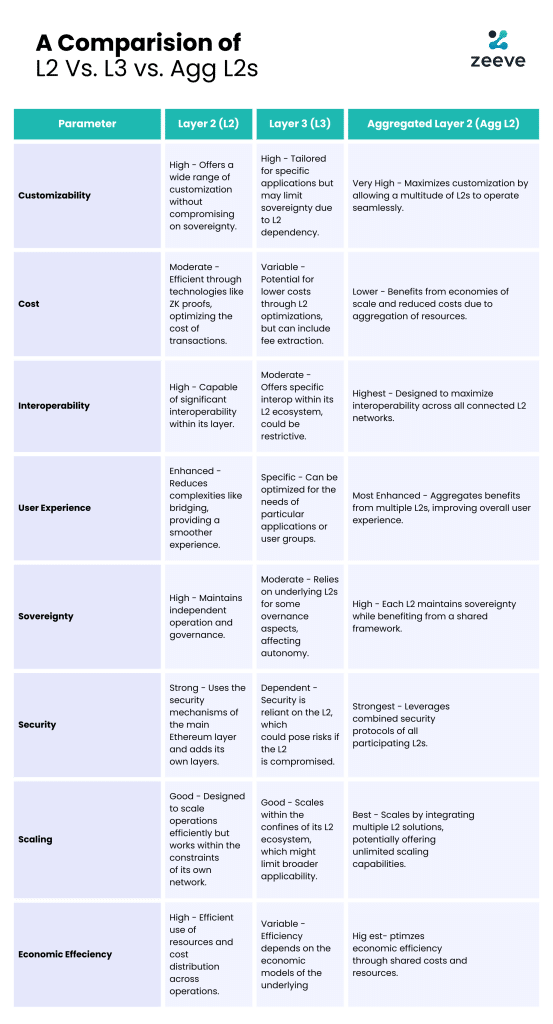 <h2 class="wp-block-heading" id="h-let-s-wrap">Let’s Wrap:</h2> <p>The debate between Layer 2 and Layer 3 rollups highlights the evolving landscape of blockchain scaling strategies. While L3 rollups offer significant advancements in scalability and customization, they also introduce potential pitfalls related to interoperability, fee extraction, and sovereignty. On the other hand, aggregated L2 solutions promise to deliver these benefits while avoiding many associated drawbacks, fostering a more integrated and scalable blockchain environment.</p> <p>Businesses, developers, and stakeholders must carefully consider the trade-offs between these approaches, aiming to build scalable, secure, and efficient solutions that drive the next wave of blockchain innovation.</p> <p>If you are building a custom rollup solution, check out Zeeve RaaS. We support all the leading rollup frameworks required to launch your L2, L3, or even Agg L2 chain. <a href="https://www.zeeve.io/rollups/">Visit our RaaS page</a> for more information. If you have any further queries, <a href="https://www.zeeve.io/talk-to-an-expert/">schedule a call with our experts</a> to help you develop your custom rollup solutions. </p> |
| json metadata | {"tags":["rollups","layer2"],"image":["https://cdn.steemitimages.com/DQmUxg2wUyJnai71iyw1YGsWwCTNrALWCmVtqEstwSkFw7e/image.png","https://dev-to-uploads.s3.amazonaws.com/uploads/articles/6s19uxh9e2yppmjqxywv.png"],"links":["https://www.zeeve.io/rollups/","https://www.zeeve.io/talk-to-an-expert/"],"app":"steemit/0.2","format":"markdown"} |
| parent author | |
| parent permlink | rollups |
| permlink | l2-l3-agg-l2-rollups-who-has-better-edge-in-scalability-and-power |
| title | L2, L3, Agg L2 Rollups: Who Has Better Edge in Scalability and Power? |
| Transaction Info | Block #89177806/Trx 1227f634437c3dc670e28ae7895fb02e059bf73e |
View Raw JSON Data
{
"block": 89177806,
"op": [
"comment",
{
"author": "zeevedeeptech",
"body": "\n<p>The race to achieve scalable, efficient, and cost-effective blockchain solutions is heating up, with Layer 2 (L2) rollups leading the charge for a while. Now, with the growing popularity of Layer3 rollups, many new narratives can be seen across the web3 community. Blockchain has influenced various industries by providing a decentralized and transparent way to store and execute transactions and smart contracts. However, this revolutionary technology still faces significant challenges, including limited storage, high fees, and low throughput.</p>\n<p>According to Statista, blockchain technology is projected to reach nearly 1,000 trillion U.S. dollars by 2032, showcasing its growing significance. Despite its rising popularity, blockchain still faces a significant challenge: scalability. To address these challenges and trick the blockchain trilemma, we are always coming up with concepts and new solutions. Agg Layer 2 by Polygon is one such solution. </p>\n<p>Through this comprehensive article, we are creating an analogy between Layer2, Layer3s, and Polygon’s Agg L2s.</p>\n<p>But, let’s start from the beginning. </p>\n<h2 class=\"wp-block-heading\" id=\"h-understanding-blockchain-layers\">Understanding Blockchain Layers</h2>\n<h3 class=\"wp-block-heading\" id=\"h-layer-1-the-foundation\">Layer 1: The Foundation</h3>\n<p>Layer 1 represents the base layer of a blockchain, which includes the main blockchain network itself. Bitcoin and Ethereum are the popular examples of Layer1 blockchain. These blockchains handle core functions such as consensus mechanisms, block production, and security. However, due to their design, which prioritizes security and decentralization over speed and capacity, Layer 1 blockchains often struggle with scalability issues.</p>\n<h3 class=\"wp-block-heading\" id=\"h-layer-2-enhancing-scalability\">Layer 2: Enhancing Scalability</h3>\n<p>Layer 2 solutions exist on top of Layer1 ecosystems, aiming to reduce congestion and improve scalability and efficiency significantly. These solutions work through offloading of transactions from the base chain, which leads to improving transaction speed and lowering down the cost. <a href=\"https://www.zeeve.io/rollups/\">Layer 2 rollups</a>, such as Optimistic Rollups and Zero-Knowledge (ZK) Rollups, bundle multiple transactions into a single batch and then submit this batch to the Layer 1 chain for finalization.</p>\n<h3 class=\"wp-block-heading\" id=\"h-layer-3-specialized-applications\">Layer 3: Specialized Applications</h3>\n<p>Layer 3 protocols are the solutions running on top of Layer 2 ecosystems. These include decentralized applications (DApps) that leverage the enhanced capabilities provided by Layer 2. Layer 3 rollups are less clearly defined but generally refer to solutions that provide additional functionalities or optimizations on top of existing Layer 2 protocols.</p>\n<h2 class=\"wp-block-heading\" id=\"h-the-rise-of-layer-2-solutions\">The Rise of Layer 2 Solutions</h2>\n<p>Layer 2 rollups are secondary frameworks built atop primary blockchains (Layer 1), such as Ethereum. Rollups computes all the transactions off-chain on an additional layer which, as we discussed, makes transactions cheaper and improves the throughput speed dramatically. </p>\n<h3 class=\"wp-block-heading\" id=\"h-advantages-of-layer-2-rollups\">Advantages of Layer 2 Rollups</h3>\n<li><strong>Scalability Boost:</strong></li>\n<p>By offloading the transaction processing from the main chain, L2 rollups dramatically increase the network's throughput. Processed transactions are bundled into batches and submitted on Layer1, taking off notable load from L1. </p>\n<li><strong>Cost Efficiency</strong></li>\n<p>Users benefit from reduced transaction fees because L2 rollups minimize the need for frequent interactions with the main chain. This batching process lowers the overall gas fees required for processing transactions.</p>\n<li><strong>Security Assurance</strong></li>\n<p>Since L2 rollups ultimately settle on the main chain, they inherit the robust security measures of Layer 1 blockchains. This ensures that despite operating off-chain, the transactions remain secure and tamper-proof.</p>\n<h2 class=\"wp-block-heading\" id=\"h-the-advent-of-layer-3-rollup-chains\">The Advent of Layer 3 Rollup Chains</h2>\n<p>Layer 3 rollup chains build on the foundation laid by L2 solutions, offering even more specialization and scalability. These chains provide a further layer of abstraction, allowing for application-specific optimizations without overloading the L2 or L1 layers.</p>\n<p>L3 rollups use L2 solutions as their base layer. They offer a customized environment for specific tasks, enhancing scalability and efficiency while still leveraging the security and interoperability of the L2 layer.</p>\n<h3 class=\"wp-block-heading\" id=\"h-key-benefits-of-layer-3-rollups\">Key Benefits of Layer 3 Rollups</h3>\n<li><strong>Superior Customization</strong>: </li>\n<p>L3 rollups provide developers with the flexibility to tailor solutions specifically for their applications. This includes customizing smart contract functionalities and optimizing performance to meet specific use cases.</p>\n<li><strong>Efficient Cost Management</strong>: </li>\n<p>L3 rollups can further reduce transaction costs by handling more transactions off-chain before submitting them to L2, which then posts them to L1. This multi-layered approach spreads the cost burden, resulting in lower fees for users.</p>\n<li><strong>Enhanced Interoperability</strong>: </li>\n<p>L3 rollups improve interoperability by facilitating smoother interchain communication and data transfer. This is crucial for the seamless functioning of dApps across different blockchain networks.</p>\n<h3 class=\"wp-block-heading\" id=\"h-the-downsides-of-layer-3-rollups\">The Downsides of Layer 3 Rollups</h3>\n<p>While L3 rollups present an innovative approach to scaling, they are not without significant drawbacks.</p>\n<li><strong>Fragmentation and Liquidity Issues</strong>: L3 rollups may lead to fragmented liquidity and user bases, creating isolated ecosystems that can hinder the broader integration of the blockchain network.</li>\n<li><strong>Fee Extraction and Governance Challenges</strong>: Many L3 models involve fee extraction mechanisms imposed by the underlying L2 solutions. This can undermine the sovereignty of L3 chains and create governance challenges that complicate the ecosystem.</li>\n<li><strong>Security Dependencies</strong>: L3 rollups rely on L2 for security guarantees. However, L2 solutions themselves may not have the economic or decentralized security strength required to serve as a reliable settlement layer. This multi-layered dependency increases the risk of security breaches.</li>\n<h2 class=\"wp-block-heading\" id=\"h-aggregated-l2s-a-promising-alternative\">Aggregated L2s: A Promising Alternative</h2>\n<p>Polygon Labs and other industry leaders argue that aggregated L2 solutions offer all the benefits of L3 rollups without their inherent drawbacks.</p>\n<h3 class=\"wp-block-heading\" id=\"h-advantages-of-aggregated-l2-solutions\">Advantages of Aggregated L2 Solutions</h3>\n<li><strong>True Sovereignty</strong>: </li>\n<p>Aggregated L2s enable extensive customization and maintain sovereignty without the constraints of L2-to-L3 dependencies. Developers can build highly tailored solutions while retaining full control over their chains.</p>\n<li><strong>Reduced Costs and Enhanced Security</strong>: </li>\n<p>Through techniques like proof aggregation and recursion, aggregated L2s reduce the costs of posting transactions to the main chain. This approach also leverages the security of zero-knowledge proofs, providing robust economic security without intermediary dependencies.</p>\n<li><strong>Unified Liquidity and State</strong>: </li>\n<p>Aggregated L2 networks create a unified liquidity pool and shared state across multiple chains, promoting horizontal scalability and reducing fragmentation. This integrated approach supports a more cohesive and efficient blockchain ecosystem.</p>\n<h2 class=\"wp-block-heading\" id=\"h-comparison-layer-2-vs-layer-3-vs-agg-l2-rollups\">Comparison: Layer 2 Vs. Layer 3 Vs. Agg L2 Rollups</h2>\n<p>Now, let's expand on some vital parameters to provide a detailed analysis of L2s, L3s, and Agg L2s. This section will help you understand the nuanced differences and use cases for each layer.</p>\n<h3 class=\"wp-block-heading\" id=\"h-customizability\">Customizability</h3>\n<p><strong>Layer 2:</strong></p>\n<li>L2 solutions provide a high degree of customization, allowing developers to build unique protocols and services without being constrained by the main Ethereum layer’s limitations. The ability to create custom rules and features means L2s can be tailored to specific needs, ranging from gaming applications to complex financial products.</li>\n<p><strong>Layer 3:</strong></p>\n<li>L3s are often designed for niche applications that require a specific framework or set of rules that are not efficiently handled at the L2 or L1 level. While this allows for targeted solutions, it also means that L3s often depend on the underlying L2s for fundamental operations, potentially limiting their sovereignty and the breadth of customization.</li>\n<p><strong>Agg L2s</strong></p>\n<li>Agg L2s offer the highest level of customization among the three, by enabling a network of L2s to interoperate seamlessly. This creates a rich ecosystem where different L2 solutions can specialize and yet benefit from one another’s capabilities. The aggregation ensures that enhancements and custom features of one L2 can be leveraged across others, enhancing the overall network's adaptability and functionality.</li>\n<h3 class=\"wp-block-heading\" id=\"h-cost\">Cost</h3>\n<p><strong>Layer 2:</strong></p>\n<li>L2s generally offer cost benefits by processing transactions off the main Ethereum chain, reducing the burden on Ethereum and thus lowering transaction costs. Technologies like ZK-rollups and optimistic rollups aggregate multiple transactions into a single one, significantly reducing costs.</li>\n<p><strong>Layer 3:</strong></p>\n<li>The cost-effectiveness of L3s can vary significantly based on their design and the L2 networks they rely on. While L3s can optimize transaction costs within their specific ecosystem, they may incur additional costs related to cross-layer operations and potential fee extractions by the L2 layer.</li>\n<p><strong>L2:</strong></p>\n<li>By aggregating multiple L2 solutions, Agg L2s can distribute operational costs more efficiently across the network, often resulting in lower costs for end-users. This structure also allows for more efficient resource use, further driving down fees.</li>\n<h3 class=\"wp-block-heading\" id=\"h-interoperability\">Interoperability</h3>\n<p><strong>Layer 2:</strong></p>\n<li>L2s can be highly interoperable within their own ecosystem but may face challenges interacting with other L2s or L3s without specific bridging solutions. L2s are free to create their own specific standards and protocols, and this can create further silos. </li>\n<p><strong>Layer 3:</strong></p>\n<li>L3s provide interoperability within a constrained ecosystem, typically focusing on vertical integration within a specific L2 environment. This can limit broader interoperability with other blockchain networks, potentially isolating the L3 from wider blockchain benefits.</li>\n<p><strong>Agg L2:</strong></p>\n<li>Agg L2s are designed to maximize interoperability among different L2 networks. This design philosophy not only enhances liquidity and state sharing but also simplifies the user experience across different blockchain applications. The aggregated nature of these platforms facilitates a more unified blockchain ecosystem.</li>\n<h3 class=\"wp-block-heading\" id=\"h-user-experience\">User Experience</h3>\n<p><strong>Layer 2:</strong></p>\n<p>L2s with high-speed transactions and lower cost definitely improves user experience when compared to L1s. However, the basis of user experience is always the way L2s is managed and its various implementation aspects. </p>\n<p><strong>Layer 3:</strong></p>\n<li>L3s can optimize the user experience for specific applications by providing specialized services or features that are not feasible at the L2 or L1 levels. However, this specialization might also introduce complexities in user interaction, especially when moving assets or operations across layers.</li>\n<p><strong>Agg L2s:</strong></p>\n<li>Agg L2s potentially offer the best user experience by combining the advantages of multiple L2 solutions into a cohesive platform. Users benefit from enhanced features, lower costs, and greater speed without having to navigate the complexities of multiple independent L2 environments.</li>\n<h3 class=\"wp-block-heading\" id=\"h-security\">Security</h3>\n<p><strong>Layer 2:</strong></p>\n<li>Security in L2 solutions depends heavily on their specific architecture and the security mechanisms they inherit from Ethereum. While they add their own security measures, the integrity of these additions is crucial for protecting against vulnerabilities.</li>\n<p><strong>Layer 3:</strong></p>\n<li>L3s rely on L2s for their security model, which means their security is only as robust as the underlying L2. This dependency can introduce additional security risks if the L2 layer is compromised.</li>\n<p><strong>Agg L2s:</strong></p>\n<li>Agg L2s enhance security by leveraging the collective security protocols of all connected L2s. This not only helps in creating a more resilient framework but also mitigates risks associated with individual L2 vulnerabilities.</li>\n\n\n<h2 class=\"wp-block-heading\" id=\"h-let-s-wrap\">Let’s Wrap:</h2>\n<p>The debate between Layer 2 and Layer 3 rollups highlights the evolving landscape of blockchain scaling strategies. While L3 rollups offer significant advancements in scalability and customization, they also introduce potential pitfalls related to interoperability, fee extraction, and sovereignty. On the other hand, aggregated L2 solutions promise to deliver these benefits while avoiding many associated drawbacks, fostering a more integrated and scalable blockchain environment.</p>\n<p>Businesses, developers, and stakeholders must carefully consider the trade-offs between these approaches, aiming to build scalable, secure, and efficient solutions that drive the next wave of blockchain innovation.</p>\n<p>If you are building a custom rollup solution, check out Zeeve RaaS. We support all the leading rollup frameworks required to launch your L2, L3, or even Agg L2 chain. <a href=\"https://www.zeeve.io/rollups/\">Visit our RaaS page</a> for more information. If you have any further queries, <a href=\"https://www.zeeve.io/talk-to-an-expert/\">schedule a call with our experts</a> to help you develop your custom rollup solutions. </p>",
"json_metadata": "{\"tags\":[\"rollups\",\"layer2\"],\"image\":[\"https://cdn.steemitimages.com/DQmUxg2wUyJnai71iyw1YGsWwCTNrALWCmVtqEstwSkFw7e/image.png\",\"https://dev-to-uploads.s3.amazonaws.com/uploads/articles/6s19uxh9e2yppmjqxywv.png\"],\"links\":[\"https://www.zeeve.io/rollups/\",\"https://www.zeeve.io/talk-to-an-expert/\"],\"app\":\"steemit/0.2\",\"format\":\"markdown\"}",
"parent_author": "",
"parent_permlink": "rollups",
"permlink": "l2-l3-agg-l2-rollups-who-has-better-edge-in-scalability-and-power",
"title": "L2, L3, Agg L2 Rollups: Who Has Better Edge in Scalability and Power?"
}
],
"op_in_trx": 0,
"timestamp": "2024-10-04T06:03:03",
"trx_id": "1227f634437c3dc670e28ae7895fb02e059bf73e",
"trx_in_block": 0,
"virtual_op": 0
}ashish0101upvoted (100.00%) @zeevedeeptech / zeeve-expands-raas-platform-to-support-tezos-smart-rollups2024/10/03 17:56:15
ashish0101upvoted (100.00%) @zeevedeeptech / zeeve-expands-raas-platform-to-support-tezos-smart-rollups
2024/10/03 17:56:15
| author | zeevedeeptech |
| permlink | zeeve-expands-raas-platform-to-support-tezos-smart-rollups |
| voter | ashish0101 |
| weight | 10000 (100.00%) |
| Transaction Info | Block #89163314/Trx bc4ad2a374117d849d7dab2ed41e1568533bc8e3 |
View Raw JSON Data
{
  "block": 89163314,
  "op": [
    "vote",
    {
      "author": "zeevedeeptech",
      "permlink": "zeeve-expands-raas-platform-to-support-tezos-smart-rollups",
      "voter": "ashish0101",
      "weight": 10000
    }
  ],
  "op_in_trx": 0,
  "timestamp": "2024-10-03T17:56:15",
  "trx_id": "bc4ad2a374117d849d7dab2ed41e1568533bc8e3",
  "trx_in_block": 0,
  "virtual_op": 0
}zeevedeeptechpublished a new post: scanning-the-revenue-models-of-2024-s-top-funded-web3-games2024/10/03 05:49:00
zeevedeeptechpublished a new post: scanning-the-revenue-models-of-2024-s-top-funded-web3-games
2024/10/03 05:49:00
| author | zeevedeeptech |
| body |  <p>2024 has been an iconic year for the growth of web3 games. Total funding as of April 2024 recorded a whopping <a href="https://dappradar.com/blog/impressive-988m-in-investments-fuels-blockchain-gaming-growth">$988M</a> across a diverse niche of games ranging from role play (RPG), battle, fantasy, card, and fun games. </p> <p>Investors putting so much money into new <a href="https://www.zeeve.io/web3-infrastructure-for-gaming/">Web3 games</a> mean that they expect the projects to have huge revenue potential, which comes from the fusion of efficient monetization and reward models. </p> <p>Having understood that, we did a thorough analysis of web3 gaming revenue models for 2024’s top-funded games and drafted this article highlighting their novel revenue models. After reading this, you will get an idea about how these games are setting new trends in terms of growth and sustainability while also offering money-making opportunities for players.</p> <a href="https://www.zeeve.io/web3-infrastructure-for-gaming/"><img src="https://www.zeeve.io/wp-content/uploads/2024/06/Utilize-Zeeves-Infrastructure-as-a-service-for-your-next-gen-games-1024x213.jpg" alt="Web3 Gaming Revenue Models" class="wp-image-69741"/></a> <h2 class="wp-block-heading" id="h-what-all-revenue-models-are-relevant-for-today-s-web3-games">What all revenue models are relevant for today’s web3 games?</h2> <p>Web3 games’ approach to making revenue has always been very different. However, revenue streams for these games were Initially limited to Initial Game Offering (IGO), Yield Farming & Staking, and digital asset trading. But now, web3 games are further opening up to novel monetization models like in-game ads, subscriptions, sales of NFT-backed assets, secondary market revenue, and more. In this regard, let’s examine some new-age Web3 games revenue models explained below:</p>  <h2 class="wp-block-heading" id="h-deep-dive-into-revenue-models-of-2024-s-top-funded-web3-games">Deep dive into revenue models of 2024’s top-funded web3 games</h2> <p>Based on our analysis of 15 top-funded web3 games in 2024, we have filtered the below main revenue models that these games have adopted so far. Let’s discuss them.</p> <h3 class="wp-block-heading" id="h-free-to-play-in-game-advertisements-nbsp">Free-to-play In-game advertisements: </h3> <p>Gaming projects are the ones with a huge player base and massive traction. Hence, in-game ads are becoming a preferred way to generate revenue in top-funded web3 games focusing on the free-to-play aspect. Based on a joint study of in-game advertising platform Anzu and global attention technology company Lumen Research– in-game ads have 98% viewability on average, which is surprising compared to Lumen’s digital ad norm offering 78%. Also, the duration for in-game was typically longer– around 3.1 seconds, an improvement of 0.2 seconds compared to digital ads and even social media. </p> <p>2024’s high-funded web3 games, like <strong>Wildcard ($46M)</strong> and<strong> Immortal Rising 2 ($15M)</strong>, have already adopted in-game ads. Immortal Rising 2 shows in-game ads as part of live daily quests, whereas Wildcard also includes sponsors besides placing ads in its games. </p> <p>It’s up to the web3 games how they want in-game ads and sponsored messages to appear, like placing branded banners, showing promotional content as NFTs on the marketplace, providing access to special content in exchange for watching ads, and a lot more. </p> <h3 class="wp-block-heading" id="h-subscription-based-models">Subscription-based models:</h3> <p>Subscription or freemium web3 games are free to download and play. However, players who wish to upgrade their assets, mint NFTs, or unlock access to special features/characters through paid subscription.</p> <p>An example of this is <strong>Off The Grid</strong>, which has raised $46M in funding. The web3 game clearly offers free-to-play games with interesting characters, weapons, and features. There’s a provision for optional NFTs where players can subscribe to access special characters or enhance their experience with powerful characters. Those who own NFTs can engage in NFT trading and thereby earn profit. </p> <p>Also, there is <strong>Outer Ring MMO</strong>, the game with $14M funding. Outer Ring MMO allows players to obtain, acquire, and even trade various assets, materials or resources without purchasing NFTs. But, they can anytime buy special materials & ability to boost their gameplay, mint NFTs, or trade their processed materials as NFTs on the auction marketplace. This is a win-win situation for both, as players will earn money from NFT selling, and Outer Ring MMO will receive a marketplace fee, a small percentage of total sales. </p> <p><strong>Treeverse</strong> also allows players to experience their game for free. Later, if they want to change the paradigm of zones, participate in political games, engage in combat arenas, improve their property level, or access premium items– all these require them to buy a subscription using the platform's native token.</p> <h3 class="wp-block-heading" id="h-end-game-deepness">End game deepness:</h3> <p>End-game in web3 games refers to extended game play through which players can continue playing and complete their core objectives, for example- winning a battle. This revenue model is designed especially for players who want to make real money from games instead of just playing for fun. </p> <p>All the leading web3 games, mainly battlefield games, offer Endgame benefits to players. The name includes <strong>Illuvium games</strong>,<strong> </strong><strong>Legacy</strong>, <strong>Champions Ascension</strong>,<strong> Project Legends (ex-Legions & Legends), Space Nation, and </strong>more.</p> <h3 class="wp-block-heading" id="h-tournaments-amp-events-entry-cards">Tournaments & events entry cards:</h3> <p>Web3 games like role-play games, shooter games, and other adventurous games often organize live tournaments and events, allowing players to participate, compete, and win exciting rewards. In return, the platform charges a certain amount to provide entry cards Almost all the top-funded games, including <strong>Illuvium: Overworld ($77M)</strong>,<strong> Legacy ($54M)</strong>, Legendary: <strong>Heroes Unchained ($46)</strong>, <strong>Sidus Heroes ($21M)</strong>, <strong>Space Nation (25M)</strong>, <strong>MetalCore ($15M)</strong>, and <strong>Treeweverse ($13M)</strong> leverage tournaments & event passes as a solid revenue stream. </p> <p>Like <strong>Legendary: Heroes Unchained</strong> organized a drop event where NFT in Bronze Packs sold for just $10, a discount of $12 on the original price. These NFTs were later minted on the platform. Space Nation allows players to participate in guild wars and tournaments with minimal charges for entry cards but exciting rewards. <strong>Treeverse</strong> offers a political card game that players need to buy using GQ to confirm their participation. </p> <h3 class="wp-block-heading" id="h-sale-commission-and-nft-royalties">Sale commission and NFT royalties:</h3> <p>NFT royalties are similar to how equities serve in the secondary market, which offers a rigid, continuous revenue for web3 games creators. Whenever the sale happens, the platform takes a specific percentage of royalty as trading fee on the total sale of NFTs in secondary markets. This opportunity is also game-changer for content creators and artists who engage in games, mint NFTs, and sell them in the secondary market for profit.</p> <p>Legendary: Heroes Unchained, Project Legends ($24M funding), Space Nation, Sidus Heroes, Metal Core, Illuvium games, and every other top-funded web3 games collects NFT royalties on secondary market sale, where percentage of commission can range from 5% to 2.5% based on the game ecosystem. </p> <h3 class="wp-block-heading" id="h-pixel-profit-with-in-game-items">Pixel profit with in-game items:</h3> <p>Sale of in-game assets have already proven to be an effective revenue stream for web2 games. However, it works differently in today’s web3 games. Instead of simply paying to unlock a new character or buying gadgets, games now allow players to own their NFT-powered assets and trade them to earn money. For sale, they can either utilize an in-game marketplace, or it can take place outside of the game. </p> <p>Web3 games are free to implement their novel in-game purchase system according to the niche. For example,<strong> Illuvium: Overworld</strong>– the web3 game with the highest funding of $77M, offers players to buy Illuvials like agile monkey rogue and Polar Bear to assemble a powerful team for winning battles. Likewise, Legacy, with $54M funding, allows for the acquisition of land, buildings, Gems, etc, so that players can establish their business empire. This same in-game purchases approach is used in Illuvium’s other projects– Illuvium: Arena, Illuvium: Zero, and Illuvium: Beyond.</p> <p>Further, <strong>MetalCore</strong> ($15M funding) adopts a distinct in-game purchase approach by allowing players to purchase blueprints for fabricating new vehicles and other assets, along with the option to buy perks such as fast travel, quicker repairs, and resources. </p> <h3 class="wp-block-heading" id="h-nft-minting-and-marketplace-charges">NFT Minting and marketplace charges:</h3> <p>NFT minting fees drive an excellent amount of revenue in Web3 games. This fee usually appears in the form of a network/gas fee or NFT marketplace fee where players mint their NFTs. Initially, NFT minting charges were imposed directly, but today’s Web3 games prefer to put a certain percentage of commission on the NFTs’ selling price.</p> <p>Also, Web3 games now feature in-game trading marketplaces, enabling players to buy, sell, and trade NFT-powered digital assets like characters, cosmetics, equipment, and resources and earn profit. As part of the revenue model, the game will charge a minimal fee as a Marketplace fee/trading fee/Transaction fee.</p> <p>Looking at the top-funded games of 2024, Heroes Unchained allows NFT minting on its marketplace. When NFTs are sold, the platform takes 5% of the final price, and the NFT owner receives the rest, 95%. </p> <p>Whereas Champions Ascension ($32M funding) requires players to pay a small amount of NFTs fee through n-game “Gold”, which players can either earn through tournaments or buy using crypto or credit cards. Similarly, Outer Ring MMO, Space Nation and MetalCore implement NFT minting fees to drive revenue. </p> <p>Here, we have only focused on the novel revenue model according to their adoption in 2024’s top funded web3 games. However, some general-use revenue streams like Early access, play-to-airdrop, initial game offerings (IGO), and purchase of internal services are still relevant for all the web3 games, be it new, old, top-funded or mid-funded. Now, let's look at reward models of 2024’s top-funded games. </p> <h2 class="wp-block-heading" id="h-build-your-next-gaming-project-with-zeeve-raas-nbsp">Build your next gaming project with Zeeve RaaS </h2> <p>As discussed, the gaming industry is already booming and it will show tremendous growth in future. Amidst this, we can see many next-gen gaming projects are considering to shift to their standalone chain to leverage benefits like massive scalability, modularity, and use case-specific functionalities. If you are planning to do so, explore Zeeve RaaS once.</p> <p>Zeeve RaaS simplifies launching of blockchain-based custom gaming chains while also lowering down the cost significantly. With Zeeve, enterprises get access to a comprehensive gaming-focused stack to build tailor-made gaming Layer2 and Layer3 to support their specific use cases. </p> <p>Whether you are launching a new gaming project or want to optimize the existing one, Zeeve allows you to quickly spin up a rollup chain Zeeve allows rollup L2& L3s to leverage 30+ third-party integrations such as decentralized sequencer, MPC wallets, off-chain DA players, storage solutions, and more. Also, you can set up a fully-fledged DevNet for your chain using our 1-click deployment sandbox available for OP Stack, Polygon CDK, Arbitrum Orbit, and ZkSync Hyperchain.</p> <p>For more details about Zeeve RaaS or our blockchain services, contact us. Send us your queries via mail or set up a <a href="https://www.zeeve.io/talk-to-an-expert/">one-to-one call</a> for in-depth discussion.</p> |
| json metadata | {"tags":["web3games","web3"],"image":["https://cdn.steemitimages.com/DQmeuFpV32b57CZ61ChWFtE63hoSht9Gh3AaH1J62Kyg55Z/image.png","https://www.zeeve.io/wp-content/uploads/2024/06/Utilize-Zeeves-Infrastructure-as-a-service-for-your-next-gen-games-1024x213.jpg","https://dev-to-uploads.s3.amazonaws.com/uploads/articles/aqd1wc4rpcr1pkxhsr9y.png"],"links":["https://dappradar.com/blog/impressive-988m-in-investments-fuels-blockchain-gaming-growth","https://www.zeeve.io/web3-infrastructure-for-gaming/","https://www.zeeve.io/talk-to-an-expert/"],"app":"steemit/0.2","format":"markdown"} |
| parent author | |
| parent permlink | web3games |
| permlink | scanning-the-revenue-models-of-2024-s-top-funded-web3-games |
| title | Scanning the Revenue Models of 2024’s Top-funded Web3 games |
| Transaction Info | Block #89148817/Trx 9f36939076081fcb8380c63fa56e26a84eb1b487 |
View Raw JSON Data
{
"block": 89148817,
"op": [
"comment",
{
"author": "zeevedeeptech",
"body": "\n<p>2024 has been an iconic year for the growth of web3 games. Total funding as of April 2024 recorded a whopping <a href=\"https://dappradar.com/blog/impressive-988m-in-investments-fuels-blockchain-gaming-growth\">$988M</a> across a diverse niche of games ranging from role play (RPG), battle, fantasy, card, and fun games. </p>\n<p>Investors putting so much money into new <a href=\"https://www.zeeve.io/web3-infrastructure-for-gaming/\">Web3 games</a> mean that they expect the projects to have huge revenue potential, which comes from the fusion of efficient monetization and reward models. </p>\n<p>Having understood that, we did a thorough analysis of web3 gaming revenue models for 2024’s top-funded games and drafted this article highlighting their novel revenue models. After reading this, you will get an idea about how these games are setting new trends in terms of growth and sustainability while also offering money-making opportunities for players.</p>\n<a href=\"https://www.zeeve.io/web3-infrastructure-for-gaming/\"><img src=\"https://www.zeeve.io/wp-content/uploads/2024/06/Utilize-Zeeves-Infrastructure-as-a-service-for-your-next-gen-games-1024x213.jpg\" alt=\"Web3 Gaming Revenue Models\" class=\"wp-image-69741\"/></a>\n<h2 class=\"wp-block-heading\" id=\"h-what-all-revenue-models-are-relevant-for-today-s-web3-games\">What all revenue models are relevant for today’s web3 games?</h2>\n<p>Web3 games’ approach to making revenue has always been very different. However, revenue streams for these games were Initially limited to Initial Game Offering (IGO), Yield Farming & Staking, and digital asset trading. But now, web3 games are further opening up to novel monetization models like in-game ads, subscriptions, sales of NFT-backed assets, secondary market revenue, and more. In this regard, let’s examine some new-age Web3 games revenue models explained below:</p>\n\n\n<h2 class=\"wp-block-heading\" id=\"h-deep-dive-into-revenue-models-of-2024-s-top-funded-web3-games\">Deep dive into revenue models of 2024’s top-funded web3 games</h2>\n<p>Based on our analysis of 15 top-funded web3 games in 2024, we have filtered the below main revenue models that these games have adopted so far. Let’s discuss them.</p>\n<h3 class=\"wp-block-heading\" id=\"h-free-to-play-in-game-advertisements-nbsp\">Free-to-play In-game advertisements: </h3>\n<p>Gaming projects are the ones with a huge player base and massive traction. Hence, in-game ads are becoming a preferred way to generate revenue in top-funded web3 games focusing on the free-to-play aspect. Based on a joint study of in-game advertising platform Anzu and global attention technology company Lumen Research– in-game ads have 98% viewability on average, which is surprising compared to Lumen’s digital ad norm offering 78%. Also, the duration for in-game was typically longer– around 3.1 seconds, an improvement of 0.2 seconds compared to digital ads and even social media. </p>\n<p>2024’s high-funded web3 games, like <strong>Wildcard ($46M)</strong> and<strong> Immortal Rising 2 ($15M)</strong>, have already adopted in-game ads. Immortal Rising 2 shows in-game ads as part of live daily quests, whereas Wildcard also includes sponsors besides placing ads in its games. </p>\n<p>It’s up to the web3 games how they want in-game ads and sponsored messages to appear, like placing branded banners, showing promotional content as NFTs on the marketplace, providing access to special content in exchange for watching ads, and a lot more. </p>\n<h3 class=\"wp-block-heading\" id=\"h-subscription-based-models\">Subscription-based models:</h3>\n<p>Subscription or freemium web3 games are free to download and play. However, players who wish to upgrade their assets, mint NFTs, or unlock access to special features/characters through paid subscription.</p>\n<p>An example of this is <strong>Off The Grid</strong>, which has raised $46M in funding. The web3 game clearly offers free-to-play games with interesting characters, weapons, and features. There’s a provision for optional NFTs where players can subscribe to access special characters or enhance their experience with powerful characters. Those who own NFTs can engage in NFT trading and thereby earn profit. </p>\n<p>Also, there is <strong>Outer Ring MMO</strong>, the game with $14M funding. Outer Ring MMO allows players to obtain, acquire, and even trade various assets, materials or resources without purchasing NFTs. But, they can anytime buy special materials & ability to boost their gameplay, mint NFTs, or trade their processed materials as NFTs on the auction marketplace. This is a win-win situation for both, as players will earn money from NFT selling, and Outer Ring MMO will receive a marketplace fee, a small percentage of total sales. </p>\n<p><strong>Treeverse</strong> also allows players to experience their game for free. Later, if they want to change the paradigm of zones, participate in political games, engage in combat arenas, improve their property level, or access premium items– all these require them to buy a subscription using the platform's native token.</p>\n<h3 class=\"wp-block-heading\" id=\"h-end-game-deepness\">End game deepness:</h3>\n<p>End-game in web3 games refers to extended game play through which players can continue playing and complete their core objectives, for example- winning a battle. This revenue model is designed especially for players who want to make real money from games instead of just playing for fun. </p>\n<p>All the leading web3 games, mainly battlefield games, offer Endgame benefits to players. The name includes <strong>Illuvium games</strong>,<strong> </strong><strong>Legacy</strong>, <strong>Champions Ascension</strong>,<strong> Project Legends (ex-Legions & Legends), Space Nation, and </strong>more.</p>\n<h3 class=\"wp-block-heading\" id=\"h-tournaments-amp-events-entry-cards\">Tournaments & events entry cards:</h3>\n<p>Web3 games like role-play games, shooter games, and other adventurous games often organize live tournaments and events, allowing players to participate, compete, and win exciting rewards. In return, the platform charges a certain amount to provide entry cards Almost all the top-funded games, including <strong>Illuvium: Overworld ($77M)</strong>,<strong> Legacy ($54M)</strong>, Legendary: <strong>Heroes Unchained ($46)</strong>, <strong>Sidus Heroes ($21M)</strong>, <strong>Space Nation (25M)</strong>, <strong>MetalCore ($15M)</strong>, and <strong>Treeweverse ($13M)</strong> leverage tournaments & event passes as a solid revenue stream. </p>\n<p>Like <strong>Legendary: Heroes Unchained</strong> organized a drop event where NFT in Bronze Packs sold for just $10, a discount of $12 on the original price. These NFTs were later minted on the platform. Space Nation allows players to participate in guild wars and tournaments with minimal charges for entry cards but exciting rewards. <strong>Treeverse</strong> offers a political card game that players need to buy using GQ to confirm their participation. </p>\n<h3 class=\"wp-block-heading\" id=\"h-sale-commission-and-nft-royalties\">Sale commission and NFT royalties:</h3>\n<p>NFT royalties are similar to how equities serve in the secondary market, which offers a rigid, continuous revenue for web3 games creators. Whenever the sale happens, the platform takes a specific percentage of royalty as trading fee on the total sale of NFTs in secondary markets. This opportunity is also game-changer for content creators and artists who engage in games, mint NFTs, and sell them in the secondary market for profit.</p>\n<p>Legendary: Heroes Unchained, Project Legends ($24M funding), Space Nation, Sidus Heroes, Metal Core, Illuvium games, and every other top-funded web3 games collects NFT royalties on secondary market sale, where percentage of commission can range from 5% to 2.5% based on the game ecosystem. </p>\n<h3 class=\"wp-block-heading\" id=\"h-pixel-profit-with-in-game-items\">Pixel profit with in-game items:</h3>\n<p>Sale of in-game assets have already proven to be an effective revenue stream for web2 games. However, it works differently in today’s web3 games. Instead of simply paying to unlock a new character or buying gadgets, games now allow players to own their NFT-powered assets and trade them to earn money. For sale, they can either utilize an in-game marketplace, or it can take place outside of the game. </p>\n<p>Web3 games are free to implement their novel in-game purchase system according to the niche. For example,<strong> Illuvium: Overworld</strong>– the web3 game with the highest funding of $77M, offers players to buy Illuvials like agile monkey rogue and Polar Bear to assemble a powerful team for winning battles. Likewise, Legacy, with $54M funding, allows for the acquisition of land, buildings, Gems, etc, so that players can establish their business empire. This same in-game purchases approach is used in Illuvium’s other projects– Illuvium: Arena, Illuvium: Zero, and Illuvium: Beyond.</p>\n<p>Further, <strong>MetalCore</strong> ($15M funding) adopts a distinct in-game purchase approach by allowing players to purchase blueprints for fabricating new vehicles and other assets, along with the option to buy perks such as fast travel, quicker repairs, and resources. </p>\n<h3 class=\"wp-block-heading\" id=\"h-nft-minting-and-marketplace-charges\">NFT Minting and marketplace charges:</h3>\n<p>NFT minting fees drive an excellent amount of revenue in Web3 games. This fee usually appears in the form of a network/gas fee or NFT marketplace fee where players mint their NFTs. Initially, NFT minting charges were imposed directly, but today’s Web3 games prefer to put a certain percentage of commission on the NFTs’ selling price.</p>\n<p>Also, Web3 games now feature in-game trading marketplaces, enabling players to buy, sell, and trade NFT-powered digital assets like characters, cosmetics, equipment, and resources and earn profit. As part of the revenue model, the game will charge a minimal fee as a Marketplace fee/trading fee/Transaction fee.</p>\n<p>Looking at the top-funded games of 2024, Heroes Unchained allows NFT minting on its marketplace. When NFTs are sold, the platform takes 5% of the final price, and the NFT owner receives the rest, 95%. </p>\n<p>Whereas Champions Ascension ($32M funding) requires players to pay a small amount of NFTs fee through n-game “Gold”, which players can either earn through tournaments or buy using crypto or credit cards. Similarly, Outer Ring MMO, Space Nation and MetalCore implement NFT minting fees to drive revenue. </p>\n<p>Here, we have only focused on the novel revenue model according to their adoption in 2024’s top funded web3 games. However, some general-use revenue streams like Early access, play-to-airdrop, initial game offerings (IGO), and purchase of internal services are still relevant for all the web3 games, be it new, old, top-funded or mid-funded. Now, let's look at reward models of 2024’s top-funded games. </p>\n<h2 class=\"wp-block-heading\" id=\"h-build-your-next-gaming-project-with-zeeve-raas-nbsp\">Build your next gaming project with Zeeve RaaS </h2>\n<p>As discussed, the gaming industry is already booming and it will show tremendous growth in future. Amidst this, we can see many next-gen gaming projects are considering to shift to their standalone chain to leverage benefits like massive scalability, modularity, and use case-specific functionalities. If you are planning to do so, explore Zeeve RaaS once.</p>\n<p>Zeeve RaaS simplifies launching of blockchain-based custom gaming chains while also lowering down the cost significantly. With Zeeve, enterprises get access to a comprehensive gaming-focused stack to build tailor-made gaming Layer2 and Layer3 to support their specific use cases. </p>\n<p>Whether you are launching a new gaming project or want to optimize the existing one, Zeeve allows you to quickly spin up a rollup chain Zeeve allows rollup L2& L3s to leverage 30+ third-party integrations such as decentralized sequencer, MPC wallets, off-chain DA players, storage solutions, and more. Also, you can set up a fully-fledged DevNet for your chain using our 1-click deployment sandbox available for OP Stack, Polygon CDK, Arbitrum Orbit, and ZkSync Hyperchain.</p>\n<p>For more details about Zeeve RaaS or our blockchain services, contact us. Send us your queries via mail or set up a <a href=\"https://www.zeeve.io/talk-to-an-expert/\">one-to-one call</a> for in-depth discussion.</p>",
"json_metadata": "{\"tags\":[\"web3games\",\"web3\"],\"image\":[\"https://cdn.steemitimages.com/DQmeuFpV32b57CZ61ChWFtE63hoSht9Gh3AaH1J62Kyg55Z/image.png\",\"https://www.zeeve.io/wp-content/uploads/2024/06/Utilize-Zeeves-Infrastructure-as-a-service-for-your-next-gen-games-1024x213.jpg\",\"https://dev-to-uploads.s3.amazonaws.com/uploads/articles/aqd1wc4rpcr1pkxhsr9y.png\"],\"links\":[\"https://dappradar.com/blog/impressive-988m-in-investments-fuels-blockchain-gaming-growth\",\"https://www.zeeve.io/web3-infrastructure-for-gaming/\",\"https://www.zeeve.io/talk-to-an-expert/\"],\"app\":\"steemit/0.2\",\"format\":\"markdown\"}",
"parent_author": "",
"parent_permlink": "web3games",
"permlink": "scanning-the-revenue-models-of-2024-s-top-funded-web3-games",
"title": "Scanning the Revenue Models of 2024’s Top-funded Web3 games"
}
],
"op_in_trx": 0,
"timestamp": "2024-10-03T05:49:00",
"trx_id": "9f36939076081fcb8380c63fa56e26a84eb1b487",
"trx_in_block": 2,
"virtual_op": 0
}zeevedeeptechpublished a new post: zeeve-expands-raas-platform-to-support-tezos-smart-rollups2024/10/01 07:46:06
zeevedeeptechpublished a new post: zeeve-expands-raas-platform-to-support-tezos-smart-rollups
2024/10/01 07:46:06
| author | zeevedeeptech |
| body |  <p><a href="https://www.zeeve.io/">Zeeve</a>, the leading provider of Rollups-as-a-Service (RaaS), is thrilled to announce the expansion of its RaaS stack to support <a href="https://tezos.com/developers/smart-rollups/">Tezos Smart Rollups</a>. This strategic enhancement will empower businesses to swiftly launch and manage enterprise-grade Layer 2 Rollups on Tezos, tailored to their application-specific needs, with just a few clicks.</p> <p>Tezos Smart Rollups empower dApps with high scalability, robust security, and flexibility– all while offering unparalleled decentralization. Through Zeeve’s RaaS platform, enterprises and web3 developers can now build seamless and powerful solutions using <a href="https://www.zeeve.io/appchains/tezos-rollups/">Tezos Smart Rollups</a>. The low-code Zeeve’s RaaS platform simplifies the process of building high-performance Layer 2 rollups secured by Tezos' stability and longevity. Businesses can customize and configure their high-performance Tezos rollups to meet specific needs, while benefiting from gasless transactions, WASM support, and limitless customization options. </p> <p><em>“Our partnership with Zeeve elevates Tezos’s Smart Rollup infrastructure, and is a crucial step towards realizing Tezos’ vision of driving innovation and growth in the web3 space."</em></p> <p>Siddharth Singhal</p> <p>Head of BD at Trilitech, the adoption hub for the Tezos blockchain.</p> <p>With Zeeve RaaS, businesses can launch, monitor, and scale their Layer 2 Smart Rollup using a low-code rollup deployment platform, comprehensive management dashboard, 24x7 monitoring, reliable node infrastructure, and an ecosystem of 30+ <a href="https://www.zeeve.io/integrations/">integration partners</a>. The Zeeve platform combines top-notch security and decentralization with robust compliance standards, including ISO 27001, SOC 2 Type 2, and GDPR, ensuring rollups always perform at their best.</p> <p><em>“The meteoric rise of L2/L3 rollups is set to foster adoption of Tezos smart rollups, but we can’t oversee the struggle that comes along with launching and managing full-fledged rollups. A significant portion of developers’ time and resources can go into this. As a RaaS infrastructure partner and node provider for Tezos Smart Rollups, Zeeve now handles all these critical infrastructure tasks through low-code deployment tools, rigorous monitoring and enterprise SLAs. Not just that, onboarding is a seamless process with Zeeve platform, which unbolts high standards of participation and accelerated success rates for everyone building on Tezos.”</em></p> <p>Dr. Ravi Chamria</p> <p>Co-founder and CEO at Zeeve</p> <p>With Zeeve’s RaaS-Tezos integration, enterprises can effortlessly deploy & manage their Tezos smart rollups on the infrastructure optimized for high availability, security, and reliability. Through a one-click deployment platform, Zeeve provides an abstraction layer over the complex process of rollup creation and configuration, enabling users to launch rollup solutions in minutes. </p> <p>Zeeve handles everything– from infra hosting to management and scaling, offering the entire Tezos community a zero-friction experience. Additionally, Zeeve provides access to both public and private RPC endpoints for users.</p> <h2 class="wp-block-heading" id="h-zeeve-and-etherlink-a-strategic-partnership-for-superior-node-management">Zeeve and Etherlink: A Strategic Partnership for Superior Node Management</h2> <p>In addition to expanding RaaS support for Tezos Smart Rollups, Zeeve is excited to announce a strategic partnership with Etherlink, an EVM-compatible, non-custodial Layer 2 blockchain powered by Tezos Smart Rollups technology. Zeeve is now the official node-as-a-service provider for Etherlink. With that, Zeeve is delivering a superior node deployment, management, and scaling experience for the vast web3 community.</p> <p><em>“With most leading L2’s still relying on centralized technical operations, i.e. training wheels, many have actually used their might to halt block productions post mainnet. Etherlink, being a non-custodial L2 though still in beta, might be quite ahead of the crowded curve already.” </em></p> <p>Siddharth Singhal</p> <p>Head of BD at Trilitech, the adoption hub for the Tezos blockchain</p> <p>Etherlink’s main features include decentralized governance, MEV protection, and a remarkably low transaction cost of $0.001, all while enabling Tezos’ robust security. The integration of Etherlink as an enshrined rollup into Tezos Layer 1 distinguishes it from other blockchains. </p> <h3 class="wp-block-heading" id="h-about-tezos">About Tezos</h3> <p>Tezos is an open source project and a scalable, energy efficient, public blockchain for assets and applications. It empowers builders, developers and businesses to deploy applications at low cost. One of the original Proof of Stake blockchains, the Tezos protocol is supported by a global peer-to-peer network and is valued for its long-term upgradability, open participation, and smart contract safety. As a result, Tezos is home to a thriving community of artists, scientists, developers and others who wish to create and transfer value frictionlessly in a digital-centric world.</p> <h3 class="wp-block-heading" id="h-about-etherlink">About Etherlink</h3> <p>Etherlink is an EVM-compatible, non-custodial Layer 2 blockchain powered by Tezos Smart Rollups technology. It’s permissionless, inherits Tezos Layer 1 security, and features a decentralized governance model, fraud proofs, and censorship resistance. It’s fast, fair and (nearly) free with extremely low transaction costs, and features MEV protection by design.</p> <h3 class="wp-block-heading" id="h-about-zeeve">About Zeeve</h3> <p>Zeeve is an enterprise-grade RaaS provider for rapid deployment, management, and scaling of all kinds of optimistic and Zk Rollups. With Zeeve, you get access to a comprehensive RaaS stack, in addition to 30+ third-party rollups service integrations, plus rollup components like cross-chain bridges, MPC wallets, testnet faucets, and blazing fast data indexers for custom experience.</p> <p>Press Contact for questions relating to the Tezos Foundation, Tezos blockchain and Etherlink: <a href="[email protected]">Sara Moric</a>.</p> |
| json metadata | {"tags":["tezossmartrollups","rollups","announcement","zeeve"],"image":["https://cdn.steemitimages.com/DQmUsqouqpvSMwfP9YECKrbxuJxuSbuuJWrKKxV9xNnciqq/image.png"],"links":["https://www.zeeve.io/","https://tezos.com/developers/smart-rollups/","https://www.zeeve.io/appchains/tezos-rollups/","https://www.zeeve.io/integrations/","[email protected]"],"app":"steemit/0.2","format":"markdown"} |
| parent author | |
| parent permlink | tezossmartrollups |
| permlink | zeeve-expands-raas-platform-to-support-tezos-smart-rollups |
| title | Zeeve Expands RaaS Platform to Support Tezos Smart Rollups |
| Transaction Info | Block #89093746/Trx 052c936b5cb367d2900d7a6a0a5f8e7f978621df |
View Raw JSON Data
{
"block": 89093746,
"op": [
"comment",
{
"author": "zeevedeeptech",
"body": "\n<p><a href=\"https://www.zeeve.io/\">Zeeve</a>, the leading provider of Rollups-as-a-Service (RaaS), is thrilled to announce the expansion of its RaaS stack to support <a href=\"https://tezos.com/developers/smart-rollups/\">Tezos Smart Rollups</a>. This strategic enhancement will empower businesses to swiftly launch and manage enterprise-grade Layer 2 Rollups on Tezos, tailored to their application-specific needs, with just a few clicks.</p>\n<p>Tezos Smart Rollups empower dApps with high scalability, robust security, and flexibility– all while offering unparalleled decentralization. Through Zeeve’s RaaS platform, enterprises and web3 developers can now build seamless and powerful solutions using <a href=\"https://www.zeeve.io/appchains/tezos-rollups/\">Tezos Smart Rollups</a>. The low-code Zeeve’s RaaS platform simplifies the process of building high-performance Layer 2 rollups secured by Tezos' stability and longevity. Businesses can customize and configure their high-performance Tezos rollups to meet specific needs, while benefiting from gasless transactions, WASM support, and limitless customization options. </p>\n<p><em>“Our partnership with Zeeve elevates Tezos’s Smart Rollup infrastructure, and is a crucial step towards realizing Tezos’ vision of driving innovation and growth in the web3 space.\"</em></p>\n<p>Siddharth Singhal</p>\n<p>Head of BD at Trilitech, the adoption hub for the Tezos blockchain.</p>\n<p>With Zeeve RaaS, businesses can launch, monitor, and scale their Layer 2 Smart Rollup using a low-code rollup deployment platform, comprehensive management dashboard, 24x7 monitoring, reliable node infrastructure, and an ecosystem of 30+ <a href=\"https://www.zeeve.io/integrations/\">integration partners</a>. The Zeeve platform combines top-notch security and decentralization with robust compliance standards, including ISO 27001, SOC 2 Type 2, and GDPR, ensuring rollups always perform at their best.</p>\n<p><em>“The meteoric rise of L2/L3 rollups is set to foster adoption of Tezos smart rollups, but we can’t oversee the struggle that comes along with launching and managing full-fledged rollups. A significant portion of developers’ time and resources can go into this. As a RaaS infrastructure partner and node provider for Tezos Smart Rollups, Zeeve now handles all these critical infrastructure tasks through low-code deployment tools, rigorous monitoring and enterprise SLAs. Not just that, onboarding is a seamless process with Zeeve platform, which unbolts high standards of participation and accelerated success rates for everyone building on Tezos.”</em></p>\n<p>Dr. Ravi Chamria</p>\n<p>Co-founder and CEO at Zeeve</p>\n<p>With Zeeve’s RaaS-Tezos integration, enterprises can effortlessly deploy & manage their Tezos smart rollups on the infrastructure optimized for high availability, security, and reliability. Through a one-click deployment platform, Zeeve provides an abstraction layer over the complex process of rollup creation and configuration, enabling users to launch rollup solutions in minutes. </p>\n<p>Zeeve handles everything– from infra hosting to management and scaling, offering the entire Tezos community a zero-friction experience. Additionally, Zeeve provides access to both public and private RPC endpoints for users.</p>\n<h2 class=\"wp-block-heading\" id=\"h-zeeve-and-etherlink-a-strategic-partnership-for-superior-node-management\">Zeeve and Etherlink: A Strategic Partnership for Superior Node Management</h2>\n<p>In addition to expanding RaaS support for Tezos Smart Rollups, Zeeve is excited to announce a strategic partnership with Etherlink, an EVM-compatible, non-custodial Layer 2 blockchain powered by Tezos Smart Rollups technology. Zeeve is now the official node-as-a-service provider for Etherlink. With that, Zeeve is delivering a superior node deployment, management, and scaling experience for the vast web3 community.</p>\n<p><em>“With most leading L2’s still relying on centralized technical operations, i.e. training wheels, many have actually used their might to halt block productions post mainnet. Etherlink, being a non-custodial L2 though still in beta, might be quite ahead of the crowded curve already.” </em></p>\n<p>Siddharth Singhal</p>\n<p>Head of BD at Trilitech, the adoption hub for the Tezos blockchain</p>\n<p>Etherlink’s main features include decentralized governance, MEV protection, and a remarkably low transaction cost of $0.001, all while enabling Tezos’ robust security. The integration of Etherlink as an enshrined rollup into Tezos Layer 1 distinguishes it from other blockchains. </p>\n<h3 class=\"wp-block-heading\" id=\"h-about-tezos\">About Tezos</h3>\n<p>Tezos is an open source project and a scalable, energy efficient, public blockchain for assets and applications. It empowers builders, developers and businesses to deploy applications at low cost. One of the original Proof of Stake blockchains, the Tezos protocol is supported by a global peer-to-peer network and is valued for its long-term upgradability, open participation, and smart contract safety. As a result, Tezos is home to a thriving community of artists, scientists, developers and others who wish to create and transfer value frictionlessly in a digital-centric world.</p>\n<h3 class=\"wp-block-heading\" id=\"h-about-etherlink\">About Etherlink</h3>\n<p>Etherlink is an EVM-compatible, non-custodial Layer 2 blockchain powered by Tezos Smart Rollups technology. It’s permissionless, inherits Tezos Layer 1 security, and features a decentralized governance model, fraud proofs, and censorship resistance. It’s fast, fair and (nearly) free with extremely low transaction costs, and features MEV protection by design.</p>\n<h3 class=\"wp-block-heading\" id=\"h-about-zeeve\">About Zeeve</h3>\n<p>Zeeve is an enterprise-grade RaaS provider for rapid deployment, management, and scaling of all kinds of optimistic and Zk Rollups. With Zeeve, you get access to a comprehensive RaaS stack, in addition to 30+ third-party rollups service integrations, plus rollup components like cross-chain bridges, MPC wallets, testnet faucets, and blazing fast data indexers for custom experience.</p>\n<p>Press Contact for questions relating to the Tezos Foundation, Tezos blockchain and Etherlink: <a href=\"[email protected]\">Sara Moric</a>.</p>",
"json_metadata": "{\"tags\":[\"tezossmartrollups\",\"rollups\",\"announcement\",\"zeeve\"],\"image\":[\"https://cdn.steemitimages.com/DQmUsqouqpvSMwfP9YECKrbxuJxuSbuuJWrKKxV9xNnciqq/image.png\"],\"links\":[\"https://www.zeeve.io/\",\"https://tezos.com/developers/smart-rollups/\",\"https://www.zeeve.io/appchains/tezos-rollups/\",\"https://www.zeeve.io/integrations/\",\"[email protected]\"],\"app\":\"steemit/0.2\",\"format\":\"markdown\"}",
"parent_author": "",
"parent_permlink": "tezossmartrollups",
"permlink": "zeeve-expands-raas-platform-to-support-tezos-smart-rollups",
"title": "Zeeve Expands RaaS Platform to Support Tezos Smart Rollups"
}
],
"op_in_trx": 0,
"timestamp": "2024-10-01T07:46:06",
"trx_id": "052c936b5cb367d2900d7a6a0a5f8e7f978621df",
"trx_in_block": 2,
"virtual_op": 0
}zeevedeeptechpublished a new post: zeeve-raas-partners-with-shlenpower-for-the-launch-of-a-l2-hyperchain2024/10/01 07:15:57
zeevedeeptechpublished a new post: zeeve-raas-partners-with-shlenpower-for-the-launch-of-a-l2-hyperchain
2024/10/01 07:15:57
| author | zeevedeeptech |
| body |  <p>We are elated to announce our partnership with <a href="https://www.shlenpower.com/">ShlenPower</a> as their chosen Rollups-as-a-Service (RaaS) provider to launch a zkSync L2 Hyperchain. Shlenpower is building an empowerment hub on top of the DLIecosystem, and <a href="https://www.zeeve.io/">Zeeve</a> will power its L2 Rollup infrastructure. </p> <p>Dlicom Platform is the creative fusion of decentralized financial opportunities with social media features, presenting safe communication combined with economic activity and deep community involvement. Their self-custody wallet, decentralized browser, and secure, end-to-end encrypted messaging make the app a go-to choice for users looking for privacy and security in their transactions and interactions. On the social side, Dlicom allows users to post multimedia content, engage in community discussions, and earn tokens through community tipping. It also has a monetization model with customizable feed ads, allowing content creators to earn based on the engagement their content generates. Premium subscribers have access to advanced features like a portfolio tracker, crypto screener, and more. From a financial perspective, Dlicom offers a decentralized wallet for managing cryptos and NFTs, and a browser that supports seamless interactions with dApps. Users can swap tokens with minimum slippage, stake directly within the app, and receive rewards in USDT, making it a comprehensive tool for financial incentivizing within a decentralized social framework.</p> <p><em>“To realize the full functionality of the Dlicom Platform in its best safety and norms of performance, we have collaborated with Zeeve to build and launch the L2 Rollup. Through this collaboration with Zeeve, the Dlicom platform will become one of the most secure and scaled systems, bringing together the best of decentralized finance and social media into one integrated singular ecosystem.”</em></p> <p>Mohammad Qadriah</p> <p>Chairman & Co-Founder of ShlenPower</p> <p>The following are some benefits Zeeve RaaS will bring to the Dlicom platform with this revamping: </p> <p><strong>Scalability:</strong></p> <li>ZKsync hyperchains offer layer-2 scaling solutions with low-latency, high-throughput transactions. This ensures that the Dlicom Platform performs at its peak, running at its peak with a large volume of transactions and delivering a flawless user experience.</li> <p><strong>Saving on Costs:</strong></p> <li>We will drastically reduce the transaction costs using Hyperchain, an amount that can be passed on to the users by offering all operations on the Dlicom platform.</li> <p><strong>Security:</strong></p> <li>ZKsync hyperchains operate under the principle of using zero-knowledge proofs for privacy and security. Users can confirm transactions without exposing critical information, ensuring that all transactions within the application are safe and secure.</li> <p><strong>Better User Experience:</strong></p> <li>ZKSync hyperchain will significantly improve the user experience of the Dlicom Platform in terms of quick transaction time, minimal fees, and better security.</li> <p><em>“When it comes to SocialFi, the ecosystem developed should be such that it can cater to rising scalability needs without putting additional pressure on the infrastructure. By incorporating ZK technology and recursive proofs, Dlicom is significantly enhancing both the capacity and efficiency of their ecosystem. Zeeve will optimize its operational performance through an intuitive RaaS dashboard, enhanced security measures, necessary middleware, a rebranded TraceHawk block explorer, and robust support systems, including 24/7 enterprise-grade SLAs. Zeeve will also ensure, with efficient management, that the ecosystem also remains compliant and meets the objective of the project as well as the broader goals of Matter Labs.”</em></p> <p>Dr Ravi Chamaria</p> <p>Co-founder and CEO of Zeeve</p> <p><a href="https://www.zeeve.io/">Zeeve</a> makes it easy to go from concept to live deployment with our intuitive <a href="https://www.zeeve.io/rollups/">Rollup Launchpad</a>. Our network of over <a href="https://www.zeeve.io/integrations/">40 industry partners </a>allows for quick integration with decentralised and developer services. Trusted by more than 30,000 users and 40+ institutional partners, Zeeve's strong security and support systems make it the go-to choice for global web3 infrastructure.</p> <p>For further details on <a href="https://www.zeeve.io/appchains/zksync-hyperchains-zkrollups/">Zeeve's managed zkSync Hyperchains</a>, visit our webpage. </p> |
| json metadata | {"tags":["shlempower","zeeve","announcement"],"image":["https://cdn.steemitimages.com/DQmVXD6PZLTnceVdJXoeCAv16Tn5bfveeHvxbkWMeHgr24h/image.png"],"links":["https://www.shlenpower.com/","https://www.zeeve.io/","https://www.zeeve.io/rollups/","https://www.zeeve.io/integrations/","https://www.zeeve.io/appchains/zksync-hyperchains-zkrollups/"],"app":"steemit/0.2","format":"markdown"} |
| parent author | |
| parent permlink | shlempower |
| permlink | zeeve-raas-partners-with-shlenpower-for-the-launch-of-a-l2-hyperchain |
| title | Zeeve RaaS Partners with ShlenPower for the Launch of a L2 HyperChain |
| Transaction Info | Block #89093143/Trx 433c1c919d327d284d669c3885497c12209a98ca |
View Raw JSON Data
{
"block": 89093143,
"op": [
"comment",
{
"author": "zeevedeeptech",
"body": "\n<p>We are elated to announce our partnership with <a href=\"https://www.shlenpower.com/\">ShlenPower</a> as their chosen Rollups-as-a-Service (RaaS) provider to launch a zkSync L2 Hyperchain. Shlenpower is building an empowerment hub on top of the DLIecosystem, and <a href=\"https://www.zeeve.io/\">Zeeve</a> will power its L2 Rollup infrastructure. </p>\n<p>Dlicom Platform is the creative fusion of decentralized financial opportunities with social media features, presenting safe communication combined with economic activity and deep community involvement. Their self-custody wallet, decentralized browser, and secure, end-to-end encrypted messaging make the app a go-to choice for users looking for privacy and security in their transactions and interactions. On the social side, Dlicom allows users to post multimedia content, engage in community discussions, and earn tokens through community tipping. It also has a monetization model with customizable feed ads, allowing content creators to earn based on the engagement their content generates. Premium subscribers have access to advanced features like a portfolio tracker, crypto screener, and more. From a financial perspective, Dlicom offers a decentralized wallet for managing cryptos and NFTs, and a browser that supports seamless interactions with dApps. Users can swap tokens with minimum slippage, stake directly within the app, and receive rewards in USDT, making it a comprehensive tool for financial incentivizing within a decentralized social framework.</p>\n<p><em>“To realize the full functionality of the Dlicom Platform in its best safety and norms of performance, we have collaborated with Zeeve to build and launch the L2 Rollup. Through this collaboration with Zeeve, the Dlicom platform will become one of the most secure and scaled systems, bringing together the best of decentralized finance and social media into one integrated singular ecosystem.”</em></p>\n<p>Mohammad Qadriah</p>\n<p>Chairman & Co-Founder of ShlenPower</p>\n<p>The following are some benefits Zeeve RaaS will bring to the Dlicom platform with this revamping: </p>\n<p><strong>Scalability:</strong></p>\n<li>ZKsync hyperchains offer layer-2 scaling solutions with low-latency, high-throughput transactions. This ensures that the Dlicom Platform performs at its peak, running at its peak with a large volume of transactions and delivering a flawless user experience.</li>\n<p><strong>Saving on Costs:</strong></p>\n<li>We will drastically reduce the transaction costs using Hyperchain, an amount that can be passed on to the users by offering all operations on the Dlicom platform.</li>\n<p><strong>Security:</strong></p>\n<li>ZKsync hyperchains operate under the principle of using zero-knowledge proofs for privacy and security. Users can confirm transactions without exposing critical information, ensuring that all transactions within the application are safe and secure.</li>\n<p><strong>Better User Experience:</strong></p>\n<li>ZKSync hyperchain will significantly improve the user experience of the Dlicom Platform in terms of quick transaction time, minimal fees, and better security.</li>\n<p><em>“When it comes to SocialFi, the ecosystem developed should be such that it can cater to rising scalability needs without putting additional pressure on the infrastructure. By incorporating ZK technology and recursive proofs, Dlicom is significantly enhancing both the capacity and efficiency of their ecosystem. Zeeve will optimize its operational performance through an intuitive RaaS dashboard, enhanced security measures, necessary middleware, a rebranded TraceHawk block explorer, and robust support systems, including 24/7 enterprise-grade SLAs. Zeeve will also ensure, with efficient management, that the ecosystem also remains compliant and meets the objective of the project as well as the broader goals of Matter Labs.”</em></p>\n<p>Dr Ravi Chamaria</p>\n<p>Co-founder and CEO of Zeeve</p>\n<p><a href=\"https://www.zeeve.io/\">Zeeve</a> makes it easy to go from concept to live deployment with our intuitive <a href=\"https://www.zeeve.io/rollups/\">Rollup Launchpad</a>. Our network of over <a href=\"https://www.zeeve.io/integrations/\">40 industry partners </a>allows for quick integration with decentralised and developer services. Trusted by more than 30,000 users and 40+ institutional partners, Zeeve's strong security and support systems make it the go-to choice for global web3 infrastructure.</p>\n<p>For further details on <a href=\"https://www.zeeve.io/appchains/zksync-hyperchains-zkrollups/\">Zeeve's managed zkSync Hyperchains</a>, visit our webpage. </p>",
"json_metadata": "{\"tags\":[\"shlempower\",\"zeeve\",\"announcement\"],\"image\":[\"https://cdn.steemitimages.com/DQmVXD6PZLTnceVdJXoeCAv16Tn5bfveeHvxbkWMeHgr24h/image.png\"],\"links\":[\"https://www.shlenpower.com/\",\"https://www.zeeve.io/\",\"https://www.zeeve.io/rollups/\",\"https://www.zeeve.io/integrations/\",\"https://www.zeeve.io/appchains/zksync-hyperchains-zkrollups/\"],\"app\":\"steemit/0.2\",\"format\":\"markdown\"}",
"parent_author": "",
"parent_permlink": "shlempower",
"permlink": "zeeve-raas-partners-with-shlenpower-for-the-launch-of-a-l2-hyperchain",
"title": "Zeeve RaaS Partners with ShlenPower for the Launch of a L2 HyperChain"
}
],
"op_in_trx": 0,
"timestamp": "2024-10-01T07:15:57",
"trx_id": "433c1c919d327d284d669c3885497c12209a98ca",
"trx_in_block": 0,
"virtual_op": 0
}2024/09/30 05:55:00
2024/09/30 05:55:00
| author | zeevedeeptech |
| permlink | how-decentralized-science-desci-cures-the-common-ails-of-academic-research |
| voter | starrchris |
| weight | 900 (9.00%) |
| Transaction Info | Block #89062787/Trx 2928613946acaef16528df82ebbeb067f862bbdf |
View Raw JSON Data
{
  "block": 89062787,
  "op": [
    "vote",
    {
      "author": "zeevedeeptech",
      "permlink": "how-decentralized-science-desci-cures-the-common-ails-of-academic-research",
      "voter": "starrchris",
      "weight": 900
    }
  ],
  "op_in_trx": 0,
  "timestamp": "2024-09-30T05:55:00",
  "trx_id": "2928613946acaef16528df82ebbeb067f862bbdf",
  "trx_in_block": 0,
  "virtual_op": 0
}zeevedeeptechpublished a new post: how-decentralized-science-desci-cures-the-common-ails-of-academic-research2024/09/30 05:50:30
zeevedeeptechpublished a new post: how-decentralized-science-desci-cures-the-common-ails-of-academic-research
2024/09/30 05:50:30
| author | zeevedeeptech |
| body |  <p>The current state of academic research is riddled with numerous challenges, including funding constraints, publication biases, data accessibility issues, and barriers to collaboration. According to a <a href="https://www.pewresearch.org/politics/2009/07/09/section-3-funding-scientific-research/">PEW Research report</a>, more than 46% of scientists find procuring funds for basic research two to three times harder than for applied research.</p> <p>Decentralized Science (DeSci) offers a revolutionary approach to tackling these problems by leveraging emerging technologies such as blockchain. This article explores how DeSci can address and solve these issues, transforming the landscape of scientific research.</p> <p>These challenges stem from a lack of interest by governments and agencies like the NIH in funding research that is purely educational or informational, as it involves engaging a review system that could otherwise be utilized for more financially rewarding purposes. For instance, a <a href="https://www.thelancet.com/journals/lancet/article/PIIS0140-6736(14)60556-0/fulltext">report</a> by Lancet claims that 85% of biomedical research gets wasted every year, highlighting inefficiencies and biases in the current system.</p> <h2 class="wp-block-heading" id="h-the-problems-with-traditional-academic-research">The Problems with Traditional Academic Research</h2>  <h3 class="wp-block-heading" id="h-funding-and-financial-barriers">Funding and Financial Barriers</h3> <p>Academic research funding is notoriously limited and highly competitive. A 2020 data suggests only 20% of NIH grant applications got <a href="https://nexus.od.nih.gov/all/2021/04/21/fy-2020-by-the-numbers-extramural-investments-in-research/">funded</a>, leaving a vast majority of research projects unfunded. This scarcity of funds leads to a hyper-competitive environment where securing funding often depends more on networking and reputation than the merit of the research itself. Early-career researchers, in particular, face significant hurdles, with the average age of first-time NIH grant recipients now over 42 years.</p> <p>Another critical issue is the influence of funding sources on research direction and outcomes. Private and governmental funding bodies often prioritize research that aligns with their interests, potentially stifling innovative or controversial research. This can lead to a misallocation of resources and a focus on short-term, incremental advances rather than groundbreaking discoveries.</p> <h3 class="wp-block-heading" id="h-publication-and-peer-review-challenges">Publication and Peer Review Challenges</h3> <p>The traditional publication model is dominated by a few large publishers, who charge exorbitant fees for both publishing and accessing research. For instance, publishing in Nature can cost over <a href="https://news.ycombinator.com/item?id=30081034">$11,000 per paper</a>, and subscription fees for academic journals often exceed the budgets of many institutions. This kind of pay-to-publish model can limit researchers and also spreading of scientific knowledge like intended.</p> <p>The peer review process is fraught with biases and inefficiencies. Reviewers are often unpaid, leading to delays and variable quality in reviews. A 2019 study found that peer review times can vary widely, with some papers taking over a year to be reviewed. Moreover, biases in the selection of reviewers can result in the suppression of innovative or dissenting ideas, as established researchers are more likely to favour work that aligns with their own perspectives.</p> <h3 class="wp-block-heading" id="h-data-accessibility-and-transparency-issues">Data Accessibility and Transparency Issues</h3> <p>Access to data and research findings is often restricted by paywalls and proprietary databases. According to a 2018 survey, 85% of research data remains inaccessible to the public. This lack of transparency hampers the reproducibility of research, a cornerstone of scientific integrity. A 2016 study in the journal Nature reported that over 70% of researchers had tried and failed to reproduce another scientist’s experiments, highlighting a reproducibility crisis in science.</p> <h3 class="wp-block-heading" id="h-intellectual-property-and-collaboration-barriers">Intellectual Property and Collaboration Barriers</h3> <p>Intellectual property (IP) rights and patenting in academia are complex and often hinder the dissemination of knowledge. University TTOs(University Transfer Offices) are typically underfunded and lack the resources to manage IP effectively. As a result, many innovations languish in patent offices or are never commercialized.</p> <p>Collaborating across different areas of study and countries is hard because of complex rules and bureaucracy. A 2017 report found that over 60% of researchers face significant obstacles in establishing international collaborations, ranging from funding issues to administrative hurdles</p> <h2 class="wp-block-heading" id="h-what-is-decentralized-science-desci">What is Decentralized Science (DeSci)?</h2> <p>Decentralized Science (DeSci) refers to the application of decentralized technologies, particularly blockchain, to scientific research processes. Core principles of DeSci include openness, transparency, collaboration, and decentralization. DeSci aims to democratize access to research funding, ensure transparency in data and methodologies, and facilitate global collaboration without the constraints imposed by traditional academic institutions.</p> <p>DeSci is a movement in which the scientific community is exploiting the capabilities of emerging technologies like blockchain to create an ecosystem where funding, creating, reviewing, crediting, storing, and disseminating scientific knowledge wouldn’t be as challenging as it is now. As a result, scientists who have been neglected in the past would have equal participation and acknowledgement in the research. They will be gratified by the community either through a DAO or a <a href="https://cointelegraph.com/explained/quadratic-funding-the-future-of-crowdfunding-explained">quadratic funding</a> model.</p> <h3 class="wp-block-heading" id="h-technologies-enabling-desci">Technologies Enabling DeSci</h3> <p>Blockchain technology underpins DeSci by providing an immutable, transparent ledger for recording research data, funding transactions, and peer reviews. Smart contracts automate agreements and transactions, ensuring fairness and efficiency. Decentralized autonomous organizations (DAOs) enable community-driven governance and decision-making, allowing researchers to manage resources and projects without centralized oversight collectively.</p> <h2 class="wp-block-heading" id="h-how-desci-addresses-the-issues-in-academic-research">How DeSci Addresses the Issues in Academic Research</h2> <h3 class="wp-block-heading" id="h-democratizing-funding">Democratizing Funding</h3> <p>DeSci democratizes funding through crowdfunding and decentralized grant systems. Platforms like Gitcoin use quadratic funding to distribute resources in a way that reflects community priorities. <a href="https://vitalik.eth.limo/general/2019/12/07/quadratic.html">Quadratic funding</a>, as Vitalik Buterin proposed, mathematically optimizes funding distribution by considering the number of contributors and the amount contributed, ensuring that widely supported projects receive more funding.</p> <p>Additionally, DAOs like VitaDAO pool resources from a global community to fund longevity research, bypassing traditional funding bodies and their biases. This reduces the influence of centralized entities and opens up funding opportunities to a broader range of researchers and projects.</p> <h3 class="wp-block-heading" id="h-revolutionizing-publication-and-peer-review">Revolutionizing Publication and Peer Review</h3> <p>Decentralized publishing platforms such as SCINET and Ants Review offer open access to research papers, eliminating paywalls and publication fees. These platforms utilize blockchain to ensure transparency and accountability by recording peer reviews and transactions. Reviewers are incentivized with tokens, which can be traded or used within the platform, ensuring timely and high-quality reviews.</p> <p>A study by SCINET found that their blockchain-based peer review process reduced review times by 40% and improved the quality of feedback by providing clear, verifiable records of reviewer contributions. This incentivized model ensures that reviewers are fairly compensated for their work, addressing a major flaw in the traditional system.</p> <h3 class="wp-block-heading" id="h-enhancing-data-accessibility-and-transparency">Enhancing Data Accessibility and Transparency</h3> <p>DeSci enhances data accessibility through open data repositories like Ocean Protocol, which allow researchers to share and monetize their data securely. Blockchain’s transparency ensures that data is tamper-proof and publicly accessible, fostering trust and enabling reproducibility.</p> <p>By recording methodologies and results on the blockchain, DeSci platforms like Ocean Protocol ensure that research processes are transparent and reproducible, addressing the reproducibility crisis.</p> <h3 class="wp-block-heading" id="h-facilitating-intellectual-property-and-collaboration">Facilitating Intellectual Property and Collaboration</h3> <p>Blockchain technology simplifies IP management by providing clear, secure records of ownership and transactions. IP agreements are automated through smart contracts, alleviating administrative burdens and guaranteeing fair compensation for creators. For example, Molecule’s IP-NFT model allows researchers to tokenize their projects, raising funds from investors before filing patents.</p> <p>This approach fosters democratization of intellectual property ownership, granting stakeholders the opportunity to invest in and derive benefits from scientific innovation. Additionally, decentralized platforms like ResearchHub facilitate global collaboration by providing tools for communication, data sharing, and joint project management, breaking down traditional barriers to cooperation.</p> <h2 class="wp-block-heading" id="h-case-studies-and-real-world-applications">Case Studies and Real-world Applications</h2> <h3 class="wp-block-heading" id="h-success-stories-of-desci-ini-tiatives">Success Stories of DeSci Ini<strong>tiatives</strong></h3> <p>Several DeSci initiatives have demonstrated the transformative potential of decentralized science. Molecule, for instance, has raised over $10 million for decentralized biotech research, connecting scientists with a global community of investors. This funding model has enabled projects that would otherwise struggle to secure traditional funding, such as research into rare diseases and unconventional therapies.</p> <p>Similarly, VitaDAO has successfully funded multiple longevity research projects through community-driven mechanisms, showcasing the potential of decentralized funding to drive innovation in emerging fields.</p> <h3 class="wp-block-heading" id="h-platforms-and-organizations-leading-the-desci-movement">Platforms and Organizations Leading the DeSci Movement</h3> <p>Prominent platforms and organizations are at the forefront of the DeSci movement. Gitcoin, for example, uses quadratic funding to support open-source projects, including scientific research. By distributing funds based on community preferences, Gitcoin ensures that diverse and impactful projects receive support.</p> <p>Another notable platform is LabDAO, which facilitates decentralized collaboration among researchers by providing tools for data sharing, communication, and project management. These platforms serve as examples of how DeSci can foster an inclusive and dynamic research environment.</p> <h2 class="wp-block-heading" id="h-challenges-and-considerations-in-implementing-desci">Challenges and Considerations in Implementing DeSci</h2>  <h3 class="wp-block-heading" id="h-technological-and-infrastructural-challenges">Technological and Infrastructural Challenges</h3> <p>Despite its promise, DeSci faces significant technological and infrastructural challenges. Although potent, blockchain technology continues to evolve, necessitating solutions for challenges like scalability and energy consumption. Current blockchain networks like <a href="https://www.zeeve.io/blockchain-protocols/deploy-ethereum-blockchain/">Ethereum</a> can handle only a limited number of transactions per second, which can be a bottleneck for large-scale research applications.</p> <p>Developing robust and user-friendly platforms that can be easily adopted by researchers is crucial. Ensuring interoperability between different DeSci platforms and integrating them with existing research infrastructure will be essential for widespread adoption.</p> <h3 class="wp-block-heading" id="h-regulatory-and-ethical-considerations">Regulatory and Ethical Considerations</h3> <p>Navigating the regulatory landscape is another significant challenge for DeSci. It is crucial to ensure compliance with data protection laws, intellectual property regulations, and other legal requirements. The decentralized nature of DeSci platforms, as they operate across multiple jurisdictions, can complicate compliance.</p> <p>Ethical considerations must also be addressed, such as ensuring data privacy and preventing the misuse of decentralized platforms for unethical research practices. Developing clear ethical guidelines and regulatory frameworks will be crucial for the responsible implementation of DeSci.</p> <h3 class="wp-block-heading" id="h-cultural-and-institutional-resistance">Cultural and Institutional Resistance</h3> <p>Implementing DeSci also requires overcoming cultural and institutional resistance. Traditional academic institutions may be hesitant to adopt new technologies and decentralized models. Building awareness and demonstrating the benefits of DeSci through pilot projects and success stories can help foster acceptance and integration within the scientific community.</p> <p>Engaging stakeholders, including researchers, funding bodies, and policymakers, in the development and implementation of DeSci initiatives will be essential for building a supportive ecosystem.</p> <h2 class="wp-block-heading" id="h-let-s-wrap">Let’s Wrap:</h2> <p>In conclusion, Decentralized Science (DeSci) offers transformative solutions to the common ails of academic research by democratizing funding, revolutionizing publication and peer review, enhancing data accessibility and transparency, and facilitating IP management and collaboration, </p> <p>DeSci proposes a new paradigm where emerging technologies like blockchain democratize access, enhance transparency, and foster collaboration. Despite facing challenges in terms of technology, regulation, and cultural acceptance, the potential of DeSci to revolutionize scientific research is undeniable.</p> <p>The future of academic research depends on our ability to adapt and integrate these transformative technologies, creating a more equitable, efficient, and impactful scientific community.</p> |
| json metadata | {"tags":["decenralizedscience","blockchaintechnology"],"image":["https://cdn.steemitimages.com/DQmbtrPuZvBctDz5bodMcjVDhPaHzWuXHeRBxv21Ugutp13/image.png","https://dev-to-uploads.s3.amazonaws.com/uploads/articles/maigeyqkjynhphqal5fo.png","https://dev-to-uploads.s3.amazonaws.com/uploads/articles/7iklssu3yc9bs4egrf6s.png"],"links":["https://www.pewresearch.org/politics/2009/07/09/section-3-funding-scientific-research/","https://www.thelancet.com/journals/lancet/article/PIIS0140-6736(14)60556-0/fulltext","https://nexus.od.nih.gov/all/2021/04/21/fy-2020-by-the-numbers-extramural-investments-in-research/","https://news.ycombinator.com/item?id=30081034","https://cointelegraph.com/explained/quadratic-funding-the-future-of-crowdfunding-explained","https://vitalik.eth.limo/general/2019/12/07/quadratic.html","https://www.zeeve.io/blockchain-protocols/deploy-ethereum-blockchain/"],"app":"steemit/0.2","format":"markdown"} |
| parent author | |
| parent permlink | decenralizedscience |
| permlink | how-decentralized-science-desci-cures-the-common-ails-of-academic-research |
| title | How Decentralized Science(DeSci) Cures the Common Ails of Academic Research |
| Transaction Info | Block #89062697/Trx 83047d6d91b2215ba2489cdcadd8352b78b4ffa5 |
View Raw JSON Data
{
"block": 89062697,
"op": [
"comment",
{
"author": "zeevedeeptech",
"body": "\n<p>The current state of academic research is riddled with numerous challenges, including funding constraints, publication biases, data accessibility issues, and barriers to collaboration. According to a <a href=\"https://www.pewresearch.org/politics/2009/07/09/section-3-funding-scientific-research/\">PEW Research report</a>, more than 46% of scientists find procuring funds for basic research two to three times harder than for applied research.</p>\n<p>Decentralized Science (DeSci) offers a revolutionary approach to tackling these problems by leveraging emerging technologies such as blockchain. This article explores how DeSci can address and solve these issues, transforming the landscape of scientific research.</p>\n<p>These challenges stem from a lack of interest by governments and agencies like the NIH in funding research that is purely educational or informational, as it involves engaging a review system that could otherwise be utilized for more financially rewarding purposes. For instance, a <a href=\"https://www.thelancet.com/journals/lancet/article/PIIS0140-6736(14)60556-0/fulltext\">report</a> by Lancet claims that 85% of biomedical research gets wasted every year, highlighting inefficiencies and biases in the current system.</p>\n<h2 class=\"wp-block-heading\" id=\"h-the-problems-with-traditional-academic-research\">The Problems with Traditional Academic Research</h2>\n\n\n<h3 class=\"wp-block-heading\" id=\"h-funding-and-financial-barriers\">Funding and Financial Barriers</h3>\n<p>Academic research funding is notoriously limited and highly competitive. A 2020 data suggests only 20% of NIH grant applications got <a href=\"https://nexus.od.nih.gov/all/2021/04/21/fy-2020-by-the-numbers-extramural-investments-in-research/\">funded</a>, leaving a vast majority of research projects unfunded. This scarcity of funds leads to a hyper-competitive environment where securing funding often depends more on networking and reputation than the merit of the research itself. Early-career researchers, in particular, face significant hurdles, with the average age of first-time NIH grant recipients now over 42 years.</p>\n<p>Another critical issue is the influence of funding sources on research direction and outcomes. Private and governmental funding bodies often prioritize research that aligns with their interests, potentially stifling innovative or controversial research. This can lead to a misallocation of resources and a focus on short-term, incremental advances rather than groundbreaking discoveries.</p>\n<h3 class=\"wp-block-heading\" id=\"h-publication-and-peer-review-challenges\">Publication and Peer Review Challenges</h3>\n<p>The traditional publication model is dominated by a few large publishers, who charge exorbitant fees for both publishing and accessing research. For instance, publishing in Nature can cost over <a href=\"https://news.ycombinator.com/item?id=30081034\">$11,000 per paper</a>, and subscription fees for academic journals often exceed the budgets of many institutions. This kind of pay-to-publish model can limit researchers and also spreading of scientific knowledge like intended.</p>\n<p>The peer review process is fraught with biases and inefficiencies. Reviewers are often unpaid, leading to delays and variable quality in reviews. A 2019 study found that peer review times can vary widely, with some papers taking over a year to be reviewed. Moreover, biases in the selection of reviewers can result in the suppression of innovative or dissenting ideas, as established researchers are more likely to favour work that aligns with their own perspectives.</p>\n<h3 class=\"wp-block-heading\" id=\"h-data-accessibility-and-transparency-issues\">Data Accessibility and Transparency Issues</h3>\n<p>Access to data and research findings is often restricted by paywalls and proprietary databases. According to a 2018 survey, 85% of research data remains inaccessible to the public. This lack of transparency hampers the reproducibility of research, a cornerstone of scientific integrity. A 2016 study in the journal Nature reported that over 70% of researchers had tried and failed to reproduce another scientist’s experiments, highlighting a reproducibility crisis in science.</p>\n<h3 class=\"wp-block-heading\" id=\"h-intellectual-property-and-collaboration-barriers\">Intellectual Property and Collaboration Barriers</h3>\n<p>Intellectual property (IP) rights and patenting in academia are complex and often hinder the dissemination of knowledge. University TTOs(University Transfer Offices) are typically underfunded and lack the resources to manage IP effectively. As a result, many innovations languish in patent offices or are never commercialized.</p>\n<p>Collaborating across different areas of study and countries is hard because of complex rules and bureaucracy. A 2017 report found that over 60% of researchers face significant obstacles in establishing international collaborations, ranging from funding issues to administrative hurdles</p>\n<h2 class=\"wp-block-heading\" id=\"h-what-is-decentralized-science-desci\">What is Decentralized Science (DeSci)?</h2>\n<p>Decentralized Science (DeSci) refers to the application of decentralized technologies, particularly blockchain, to scientific research processes. Core principles of DeSci include openness, transparency, collaboration, and decentralization. DeSci aims to democratize access to research funding, ensure transparency in data and methodologies, and facilitate global collaboration without the constraints imposed by traditional academic institutions.</p>\n<p>DeSci is a movement in which the scientific community is exploiting the capabilities of emerging technologies like blockchain to create an ecosystem where funding, creating, reviewing, crediting, storing, and disseminating scientific knowledge wouldn’t be as challenging as it is now. As a result, scientists who have been neglected in the past would have equal participation and acknowledgement in the research. They will be gratified by the community either through a DAO or a <a href=\"https://cointelegraph.com/explained/quadratic-funding-the-future-of-crowdfunding-explained\">quadratic funding</a> model.</p>\n<h3 class=\"wp-block-heading\" id=\"h-technologies-enabling-desci\">Technologies Enabling DeSci</h3>\n<p>Blockchain technology underpins DeSci by providing an immutable, transparent ledger for recording research data, funding transactions, and peer reviews. Smart contracts automate agreements and transactions, ensuring fairness and efficiency. Decentralized autonomous organizations (DAOs) enable community-driven governance and decision-making, allowing researchers to manage resources and projects without centralized oversight collectively.</p>\n<h2 class=\"wp-block-heading\" id=\"h-how-desci-addresses-the-issues-in-academic-research\">How DeSci Addresses the Issues in Academic Research</h2>\n<h3 class=\"wp-block-heading\" id=\"h-democratizing-funding\">Democratizing Funding</h3>\n<p>DeSci democratizes funding through crowdfunding and decentralized grant systems. Platforms like Gitcoin use quadratic funding to distribute resources in a way that reflects community priorities. <a href=\"https://vitalik.eth.limo/general/2019/12/07/quadratic.html\">Quadratic funding</a>, as Vitalik Buterin proposed, mathematically optimizes funding distribution by considering the number of contributors and the amount contributed, ensuring that widely supported projects receive more funding.</p>\n<p>Additionally, DAOs like VitaDAO pool resources from a global community to fund longevity research, bypassing traditional funding bodies and their biases. This reduces the influence of centralized entities and opens up funding opportunities to a broader range of researchers and projects.</p>\n<h3 class=\"wp-block-heading\" id=\"h-revolutionizing-publication-and-peer-review\">Revolutionizing Publication and Peer Review</h3>\n<p>Decentralized publishing platforms such as SCINET and Ants Review offer open access to research papers, eliminating paywalls and publication fees. These platforms utilize blockchain to ensure transparency and accountability by recording peer reviews and transactions. Reviewers are incentivized with tokens, which can be traded or used within the platform, ensuring timely and high-quality reviews.</p>\n<p>A study by SCINET found that their blockchain-based peer review process reduced review times by 40% and improved the quality of feedback by providing clear, verifiable records of reviewer contributions. This incentivized model ensures that reviewers are fairly compensated for their work, addressing a major flaw in the traditional system.</p>\n<h3 class=\"wp-block-heading\" id=\"h-enhancing-data-accessibility-and-transparency\">Enhancing Data Accessibility and Transparency</h3>\n<p>DeSci enhances data accessibility through open data repositories like Ocean Protocol, which allow researchers to share and monetize their data securely. Blockchain’s transparency ensures that data is tamper-proof and publicly accessible, fostering trust and enabling reproducibility.</p>\n<p>By recording methodologies and results on the blockchain, DeSci platforms like Ocean Protocol ensure that research processes are transparent and reproducible, addressing the reproducibility crisis.</p>\n<h3 class=\"wp-block-heading\" id=\"h-facilitating-intellectual-property-and-collaboration\">Facilitating Intellectual Property and Collaboration</h3>\n<p>Blockchain technology simplifies IP management by providing clear, secure records of ownership and transactions. IP agreements are automated through smart contracts, alleviating administrative burdens and guaranteeing fair compensation for creators. For example, Molecule’s IP-NFT model allows researchers to tokenize their projects, raising funds from investors before filing patents.</p>\n<p>This approach fosters democratization of intellectual property ownership, granting stakeholders the opportunity to invest in and derive benefits from scientific innovation. Additionally, decentralized platforms like ResearchHub facilitate global collaboration by providing tools for communication, data sharing, and joint project management, breaking down traditional barriers to cooperation.</p>\n<h2 class=\"wp-block-heading\" id=\"h-case-studies-and-real-world-applications\">Case Studies and Real-world Applications</h2>\n<h3 class=\"wp-block-heading\" id=\"h-success-stories-of-desci-ini-tiatives\">Success Stories of DeSci Ini<strong>tiatives</strong></h3>\n<p>Several DeSci initiatives have demonstrated the transformative potential of decentralized science. Molecule, for instance, has raised over $10 million for decentralized biotech research, connecting scientists with a global community of investors. This funding model has enabled projects that would otherwise struggle to secure traditional funding, such as research into rare diseases and unconventional therapies.</p>\n<p>Similarly, VitaDAO has successfully funded multiple longevity research projects through community-driven mechanisms, showcasing the potential of decentralized funding to drive innovation in emerging fields.</p>\n<h3 class=\"wp-block-heading\" id=\"h-platforms-and-organizations-leading-the-desci-movement\">Platforms and Organizations Leading the DeSci Movement</h3>\n<p>Prominent platforms and organizations are at the forefront of the DeSci movement. Gitcoin, for example, uses quadratic funding to support open-source projects, including scientific research. By distributing funds based on community preferences, Gitcoin ensures that diverse and impactful projects receive support.</p>\n<p>Another notable platform is LabDAO, which facilitates decentralized collaboration among researchers by providing tools for data sharing, communication, and project management. These platforms serve as examples of how DeSci can foster an inclusive and dynamic research environment.</p>\n<h2 class=\"wp-block-heading\" id=\"h-challenges-and-considerations-in-implementing-desci\">Challenges and Considerations in Implementing DeSci</h2>\n\n\n<h3 class=\"wp-block-heading\" id=\"h-technological-and-infrastructural-challenges\">Technological and Infrastructural Challenges</h3>\n<p>Despite its promise, DeSci faces significant technological and infrastructural challenges. Although potent, blockchain technology continues to evolve, necessitating solutions for challenges like scalability and energy consumption. Current blockchain networks like <a href=\"https://www.zeeve.io/blockchain-protocols/deploy-ethereum-blockchain/\">Ethereum</a> can handle only a limited number of transactions per second, which can be a bottleneck for large-scale research applications.</p>\n<p>Developing robust and user-friendly platforms that can be easily adopted by researchers is crucial. Ensuring interoperability between different DeSci platforms and integrating them with existing research infrastructure will be essential for widespread adoption.</p>\n<h3 class=\"wp-block-heading\" id=\"h-regulatory-and-ethical-considerations\">Regulatory and Ethical Considerations</h3>\n<p>Navigating the regulatory landscape is another significant challenge for DeSci. It is crucial to ensure compliance with data protection laws, intellectual property regulations, and other legal requirements. The decentralized nature of DeSci platforms, as they operate across multiple jurisdictions, can complicate compliance.</p>\n<p>Ethical considerations must also be addressed, such as ensuring data privacy and preventing the misuse of decentralized platforms for unethical research practices. Developing clear ethical guidelines and regulatory frameworks will be crucial for the responsible implementation of DeSci.</p>\n<h3 class=\"wp-block-heading\" id=\"h-cultural-and-institutional-resistance\">Cultural and Institutional Resistance</h3>\n<p>Implementing DeSci also requires overcoming cultural and institutional resistance. Traditional academic institutions may be hesitant to adopt new technologies and decentralized models. Building awareness and demonstrating the benefits of DeSci through pilot projects and success stories can help foster acceptance and integration within the scientific community.</p>\n<p>Engaging stakeholders, including researchers, funding bodies, and policymakers, in the development and implementation of DeSci initiatives will be essential for building a supportive ecosystem.</p>\n<h2 class=\"wp-block-heading\" id=\"h-let-s-wrap\">Let’s Wrap:</h2>\n<p>In conclusion, Decentralized Science (DeSci) offers transformative solutions to the common ails of academic research by democratizing funding, revolutionizing publication and peer review, enhancing data accessibility and transparency, and facilitating IP management and collaboration, </p>\n<p>DeSci proposes a new paradigm where emerging technologies like blockchain democratize access, enhance transparency, and foster collaboration. Despite facing challenges in terms of technology, regulation, and cultural acceptance, the potential of DeSci to revolutionize scientific research is undeniable.</p>\n<p>The future of academic research depends on our ability to adapt and integrate these transformative technologies, creating a more equitable, efficient, and impactful scientific community.</p>",
"json_metadata": "{\"tags\":[\"decenralizedscience\",\"blockchaintechnology\"],\"image\":[\"https://cdn.steemitimages.com/DQmbtrPuZvBctDz5bodMcjVDhPaHzWuXHeRBxv21Ugutp13/image.png\",\"https://dev-to-uploads.s3.amazonaws.com/uploads/articles/maigeyqkjynhphqal5fo.png\",\"https://dev-to-uploads.s3.amazonaws.com/uploads/articles/7iklssu3yc9bs4egrf6s.png\"],\"links\":[\"https://www.pewresearch.org/politics/2009/07/09/section-3-funding-scientific-research/\",\"https://www.thelancet.com/journals/lancet/article/PIIS0140-6736(14)60556-0/fulltext\",\"https://nexus.od.nih.gov/all/2021/04/21/fy-2020-by-the-numbers-extramural-investments-in-research/\",\"https://news.ycombinator.com/item?id=30081034\",\"https://cointelegraph.com/explained/quadratic-funding-the-future-of-crowdfunding-explained\",\"https://vitalik.eth.limo/general/2019/12/07/quadratic.html\",\"https://www.zeeve.io/blockchain-protocols/deploy-ethereum-blockchain/\"],\"app\":\"steemit/0.2\",\"format\":\"markdown\"}",
"parent_author": "",
"parent_permlink": "decenralizedscience",
"permlink": "how-decentralized-science-desci-cures-the-common-ails-of-academic-research",
"title": "How Decentralized Science(DeSci) Cures the Common Ails of Academic Research"
}
],
"op_in_trx": 0,
"timestamp": "2024-09-30T05:50:30",
"trx_id": "83047d6d91b2215ba2489cdcadd8352b78b4ffa5",
"trx_in_block": 1,
"virtual_op": 0
}2024/09/30 05:33:15
2024/09/30 05:33:15
| author | zeevedeeptech |
| body |  <p><a href="https://www.zeeve.io/">Zeeve</a>, the leading provider of Rollups-as-a-service, is teaming up with the <a href="https://www.trailofbits.com/">Trail of Bits</a> to provide industry-standard security audits for its ecosystem of rollups and appchains. This will help projects identify and rectify security vulnerabilities through manual and automated reviews. </p> <p>Governance attacks and source code exploitation are some of the most prevalent </p> <p>security compromises we have seen in the past. This has siphoned off millions of dollars in assets from on-chain platforms. Trail of Bits aims to help projects mitigate that with white box security reviews, design reviews, threat modeling, appsec or cryptography review, invariant development, and automated tooling. They combine high-end security research with a real-world attacker mentality to reduce risk and fortify code.</p> <p>Now, with this integration, businesses and developers launching their Optimistic or ZK rollup chains with Zeeve RaaS can include critical security considerations early in the design phase. They can improve their network's security posture for intended use cases while leveraging Zeeve’s low-code platform with robust security, enterprise SLA, and a full suite of middleware and tools, including block explorers, faucets, data indexers, cross-chain bridges, etc. </p> <p><em>“Many of the leading protocols and widely used blockchain-based platforms trust Trial of Bits for their security assessment, and Zeeve is happy to add them to its ecosystem of integration partners for appchains and rollups. Undiscovered bugs and security loopholes are always present when you're building something, but they shouldn’t be the reason you end up in the REKT database. Partners like Trail of Bits are essential for ensuring the overall security and integrity of your rollup chains. When combined with Zeeve, you have a super easy system for L2/L3 deployments, management, and continuous monitoring, complete with all necessary integrations and tools, minus the security threats.”</em></p> <p>Dr Ravi Chamria</p> <p>Co-founder and CEO of Zeeve</p> <p><em>“Trail of Bits is a pioneer among security-oriented organizations in transitioning from the Web 2.0 space to explore blockchain technologies. The team has performed over 300 blockchain security reviews worth 30 engineer years of effort, including several rollup systems (such as Arbitrum, Optimism and Scroll). Teaming up with Zeeve, a RaaS provider, Trail of Bits enhances early-stage security audits, providing an added layer of assurance for blockchain projects. This integration ensures early security considerations for Optimistic or ZK rollup chains, fortifying networks against vulnerabilities while leveraging Zeeve’s platform for seamless deployment and robust security."</em></p> <p>Josselin Feist</p> <p>Blockchain Engineering Director</p> <p>Zeeve provides a comprehensive partner ecosystem where projects can enjoy a wide variety of features that integration partners provide, like permissionless interoperability protocols, decentralized oracles, sequencing services, data indexers, account abstraction SDKs, and more. These additions are designed to expand and enrich the functionality of smart contracts and sovereign rollups on the Zeeve platform and give users more options to choose from. All these ready-made tools can seamlessly integrate with the top rollup frameworks supported by Zeeve, including Polygon CDK, zkSync hyperchains, Arbitrum Orbit, and OP Stack. </p> <p>For more information, visit our <a href="https://www.zeeve.io/integrations/">Integration Partners page</a>. If you are planning to launch an OP or ZK rollup chain, <a href="https://www.zeeve.io/talk-to-an-expert/">contact us</a>. Our expert team can help you determine which infrastructure best suits your needs. </p> |
| json metadata | {"tags":["announcement","trailofbits","zeeve"],"image":["https://cdn.steemitimages.com/DQmRsoJnXhHJMvZtmtPTe8vj3wTWwHfo5zhX7ar6WFBVcUd/image.png"],"links":["https://www.zeeve.io/","https://www.trailofbits.com/","https://www.zeeve.io/integrations/","https://www.zeeve.io/talk-to-an-expert/"],"app":"steemit/0.2","format":"markdown"} |
| parent author | |
| parent permlink | announcement |
| permlink | zeeve-raas-partners-with-trail-of-bits-for-easy-and-industry-standard-security-audits-for-its-ecosystem-of-rollups |
| title | Zeeve RaaS partners with ‘Trail of Bits’ for easy and industry-standard security audits for its ecosystem of rollups |
| Transaction Info | Block #89062353/Trx 243915b74691bacb438462cdccfd76f44a4acc1b |
View Raw JSON Data
{
"block": 89062353,
"op": [
"comment",
{
"author": "zeevedeeptech",
"body": "\n<p><a href=\"https://www.zeeve.io/\">Zeeve</a>, the leading provider of Rollups-as-a-service, is teaming up with the <a href=\"https://www.trailofbits.com/\">Trail of Bits</a> to provide industry-standard security audits for its ecosystem of rollups and appchains. This will help projects identify and rectify security vulnerabilities through manual and automated reviews. </p>\n<p>Governance attacks and source code exploitation are some of the most prevalent </p>\n<p>security compromises we have seen in the past. This has siphoned off millions of dollars in assets from on-chain platforms. Trail of Bits aims to help projects mitigate that with white box security reviews, design reviews, threat modeling, appsec or cryptography review, invariant development, and automated tooling. They combine high-end security research with a real-world attacker mentality to reduce risk and fortify code.</p>\n<p>Now, with this integration, businesses and developers launching their Optimistic or ZK rollup chains with Zeeve RaaS can include critical security considerations early in the design phase. They can improve their network's security posture for intended use cases while leveraging Zeeve’s low-code platform with robust security, enterprise SLA, and a full suite of middleware and tools, including block explorers, faucets, data indexers, cross-chain bridges, etc. </p>\n<p><em>“Many of the leading protocols and widely used blockchain-based platforms trust Trial of Bits for their security assessment, and Zeeve is happy to add them to its ecosystem of integration partners for appchains and rollups. Undiscovered bugs and security loopholes are always present when you're building something, but they shouldn’t be the reason you end up in the REKT database. Partners like Trail of Bits are essential for ensuring the overall security and integrity of your rollup chains. When combined with Zeeve, you have a super easy system for L2/L3 deployments, management, and continuous monitoring, complete with all necessary integrations and tools, minus the security threats.”</em></p>\n<p>Dr Ravi Chamria</p>\n<p>Co-founder and CEO of Zeeve</p>\n<p><em>“Trail of Bits is a pioneer among security-oriented organizations in transitioning from the Web 2.0 space to explore blockchain technologies. The team has performed over 300 blockchain security reviews worth 30 engineer years of effort, including several rollup systems (such as Arbitrum, Optimism and Scroll). Teaming up with Zeeve, a RaaS provider, Trail of Bits enhances early-stage security audits, providing an added layer of assurance for blockchain projects. This integration ensures early security considerations for Optimistic or ZK rollup chains, fortifying networks against vulnerabilities while leveraging Zeeve’s platform for seamless deployment and robust security.\"</em></p>\n<p>Josselin Feist</p>\n<p>Blockchain Engineering Director</p>\n<p>Zeeve provides a comprehensive partner ecosystem where projects can enjoy a wide variety of features that integration partners provide, like permissionless interoperability protocols, decentralized oracles, sequencing services, data indexers, account abstraction SDKs, and more. These additions are designed to expand and enrich the functionality of smart contracts and sovereign rollups on the Zeeve platform and give users more options to choose from. All these ready-made tools can seamlessly integrate with the top rollup frameworks supported by Zeeve, including Polygon CDK, zkSync hyperchains, Arbitrum Orbit, and OP Stack. </p>\n<p>For more information, visit our <a href=\"https://www.zeeve.io/integrations/\">Integration Partners page</a>. If you are planning to launch an OP or ZK rollup chain, <a href=\"https://www.zeeve.io/talk-to-an-expert/\">contact us</a>. Our expert team can help you determine which infrastructure best suits your needs. </p>",
"json_metadata": "{\"tags\":[\"announcement\",\"trailofbits\",\"zeeve\"],\"image\":[\"https://cdn.steemitimages.com/DQmRsoJnXhHJMvZtmtPTe8vj3wTWwHfo5zhX7ar6WFBVcUd/image.png\"],\"links\":[\"https://www.zeeve.io/\",\"https://www.trailofbits.com/\",\"https://www.zeeve.io/integrations/\",\"https://www.zeeve.io/talk-to-an-expert/\"],\"app\":\"steemit/0.2\",\"format\":\"markdown\"}",
"parent_author": "",
"parent_permlink": "announcement",
"permlink": "zeeve-raas-partners-with-trail-of-bits-for-easy-and-industry-standard-security-audits-for-its-ecosystem-of-rollups",
"title": "Zeeve RaaS partners with ‘Trail of Bits’ for easy and industry-standard security audits for its ecosystem of rollups"
}
],
"op_in_trx": 0,
"timestamp": "2024-09-30T05:33:15",
"trx_id": "243915b74691bacb438462cdccfd76f44a4acc1b",
"trx_in_block": 6,
"virtual_op": 0
}2024/09/26 12:09:45
2024/09/26 12:09:45
| author | zeevedeeptech |
| body |  <p>Pentagon Games, an innovative video game publishing & distribution platform powered with XR Metaverse, AI, and Web3 for empowering GameFi adoption, is set to launch a custom, gaming-focused Pentagon chain (CDK ZKEVM) leveraging Zeeve’s comprehensive CDK-specific RaaS stack offering. </p> <p><a href="https://pentagon.games/">Pentagon Games</a> originally chose to utilize a public chain, as its focus centered around unlocking new ways of game development through futuristic technologies like AI, Web3, and AR/VR, further pushing the boundaries of advancement in gameFi. Now that the platform is growing tremendously with 7+ years of web3 gaming experience, 10+ game titles, and more than 1.2 million global users– Pentagon Games is transitioning to an application-specific, standalone chain to achieve higher scalability, enhanced modularity, atomic inter-chain transactions, and robust security arrangements. </p> <p>The decision to launch the Pentagon chain comes from Pentagon games’ vision to tap into CDK’s modularity, EVM compatibility and novel features like independent data availability, near-instant block finality, plus cutting-edge security. A standalone chain will allow Pentagon games to meet the diverse needs of their platform and meanwhile govern the ecosystem for a more adaptable player's perception and interactions. As a part of their action plan, Pentagon Games will release their own native token; $PEN, UE5 cross reality metaverse, as well as a mature game launchpad to empower a futuristic gaming infrastructure to scale mass adoption amid rising competition. Players, developers, and game studios will leverage the upcoming Pentagon chain to capture higher value by deploying unique web3 games, and most importantly be able to interact across an aggregated ecosystem of many such games running on the chain.</p> <p>To ensure a streamlined and complexity-free launch of the Pentagon chain, their team will utilize Zeeve’s comprehensive rollups-as–a-service (RaaS) stack offering. As an official implementation partner for CDK, Zeeve has expertise in working closely with the CDK team to provide quality rollup services to all its clients. Speaking about Pentagon Games, they will benefit from core CDK infrastructure offerings such as a quick, automated infrastructure setup, end-to-end infra management for reliable performance, 24/7 enterprise SLA, 99.9% uptime guarantee, and full compliance for ISO, SOC 2 Type II, and GDPR standards. Further, <a href="https://www.zeeve.io/">Zeeve</a> will enable modularity into the Pentagon chain with 30+ third-party integration services spanning off-chain DA layers, provers, account abstraction, wallets, and more. Zeeve is also assisting Pentagon Games to use a hybrid decentralized sequencer; Cero, alongside essential blockchain components like native bridge, testnet faucet, etc. </p> <p><em>“It’s exciting to be teaming up with Pentagon Games. As their official RaaS provider, Zeeve allows Pentagon Games to be entirely focused on catering a solid ecosystem for top-level immersive games while we ensure a seamless launch, management, and timely scaling of the Pentagon chain’s infrastructure. With us, Pentagon Games envisions to utilize CDK’s zero-knowledge proof-based security, massive scalability, and easy modularity as their bedrock to accomplish their mission of revamping the video game industry entirely.” </em></p> <p>Ravi Chamria</p> <p>Co-founder and CEO at Zeeve</p> <p><em>"The team at Pentagon Games is thrilled to have reached this stage in our development, collaborating with Zeeve to build critical infrastructure that will power the next generation of experiences in Web3 gaming." </em></p> <p>Idon Liu</p> <p>Co-founder of Pentagon Games</p> <p>The Pentagon chain’ testnet is expected to go live in June 2024, and mainnet in Sept 2024. The Pentagon games team is currently dedicated to the successful execution of this project. From launch to infrastructure management and further upgradation, <a href="https://www.zeeve.io/">Zeeve</a> will be a reliable RaaS provider for the Pentagon to perform all the operations without hassle. Zeeve’s highly-optimized RaaS infrastructure, blockchain experts, and proven track of deploying/managing L2 rollups for a range of enterprises, including 30,000+ users and 40+ industry partners, makes Zeeve RaaS a trusted <a href="https://www.zeeve.io/rollups/">rollup infrastructure provider</a> and a valuable contributor in the rapidly evolving web3 ecosystem.</p> |
| json metadata | {"tags":["pentagongames","announcement","zeeve"],"image":["https://cdn.steemitimages.com/DQmWpQNbLfu1nSVe3x8JXbySijXCHuw3KABsLevm1R9FmKj/image.png"],"links":["https://pentagon.games/","https://www.zeeve.io/","https://www.zeeve.io/rollups/"],"app":"steemit/0.2","format":"markdown"} |
| parent author | |
| parent permlink | pentagongames |
| permlink | pentagon-games-is-launching-a-dedicated-pentagon-chain-leveraging-zeeve-s-comprehensive-raas-offering |
| title | Pentagon Games is Launching a Dedicated Pentagon Chain leveraging Zeeve’s Comprehensive RaaS Offering |
| Transaction Info | Block #88955328/Trx e25958b1210ea2210f02960da9009ffcf51b77b3 |
View Raw JSON Data
{
"block": 88955328,
"op": [
"comment",
{
"author": "zeevedeeptech",
"body": "\n<p>Pentagon Games, an innovative video game publishing & distribution platform powered with XR Metaverse, AI, and Web3 for empowering GameFi adoption, is set to launch a custom, gaming-focused Pentagon chain (CDK ZKEVM) leveraging Zeeve’s comprehensive CDK-specific RaaS stack offering. </p>\n<p><a href=\"https://pentagon.games/\">Pentagon Games</a> originally chose to utilize a public chain, as its focus centered around unlocking new ways of game development through futuristic technologies like AI, Web3, and AR/VR, further pushing the boundaries of advancement in gameFi. Now that the platform is growing tremendously with 7+ years of web3 gaming experience, 10+ game titles, and more than 1.2 million global users– Pentagon Games is transitioning to an application-specific, standalone chain to achieve higher scalability, enhanced modularity, atomic inter-chain transactions, and robust security arrangements. </p>\n<p>The decision to launch the Pentagon chain comes from Pentagon games’ vision to tap into CDK’s modularity, EVM compatibility and novel features like independent data availability, near-instant block finality, plus cutting-edge security. A standalone chain will allow Pentagon games to meet the diverse needs of their platform and meanwhile govern the ecosystem for a more adaptable player's perception and interactions. As a part of their action plan, Pentagon Games will release their own native token; $PEN, UE5 cross reality metaverse, as well as a mature game launchpad to empower a futuristic gaming infrastructure to scale mass adoption amid rising competition. Players, developers, and game studios will leverage the upcoming Pentagon chain to capture higher value by deploying unique web3 games, and most importantly be able to interact across an aggregated ecosystem of many such games running on the chain.</p>\n<p>To ensure a streamlined and complexity-free launch of the Pentagon chain, their team will utilize Zeeve’s comprehensive rollups-as–a-service (RaaS) stack offering. As an official implementation partner for CDK, Zeeve has expertise in working closely with the CDK team to provide quality rollup services to all its clients. Speaking about Pentagon Games, they will benefit from core CDK infrastructure offerings such as a quick, automated infrastructure setup, end-to-end infra management for reliable performance, 24/7 enterprise SLA, 99.9% uptime guarantee, and full compliance for ISO, SOC 2 Type II, and GDPR standards. Further, <a href=\"https://www.zeeve.io/\">Zeeve</a> will enable modularity into the Pentagon chain with 30+ third-party integration services spanning off-chain DA layers, provers, account abstraction, wallets, and more. Zeeve is also assisting Pentagon Games to use a hybrid decentralized sequencer; Cero, alongside essential blockchain components like native bridge, testnet faucet, etc. </p>\n<p><em>“It’s exciting to be teaming up with Pentagon Games. As their official RaaS provider, Zeeve allows Pentagon Games to be entirely focused on catering a solid ecosystem for top-level immersive games while we ensure a seamless launch, management, and timely scaling of the Pentagon chain’s infrastructure. With us, Pentagon Games envisions to utilize CDK’s zero-knowledge proof-based security, massive scalability, and easy modularity as their bedrock to accomplish their mission of revamping the video game industry entirely.” </em></p>\n<p>Ravi Chamria</p>\n<p>Co-founder and CEO at Zeeve</p>\n<p><em>\"The team at Pentagon Games is thrilled to have reached this stage in our development, collaborating with Zeeve to build critical infrastructure that will power the next generation of experiences in Web3 gaming.\" </em></p>\n<p>Idon Liu</p>\n<p>Co-founder of Pentagon Games</p>\n<p>The Pentagon chain’ testnet is expected to go live in June 2024, and mainnet in Sept 2024. The Pentagon games team is currently dedicated to the successful execution of this project. From launch to infrastructure management and further upgradation, <a href=\"https://www.zeeve.io/\">Zeeve</a> will be a reliable RaaS provider for the Pentagon to perform all the operations without hassle. Zeeve’s highly-optimized RaaS infrastructure, blockchain experts, and proven track of deploying/managing L2 rollups for a range of enterprises, including 30,000+ users and 40+ industry partners, makes Zeeve RaaS a trusted <a href=\"https://www.zeeve.io/rollups/\">rollup infrastructure provider</a> and a valuable contributor in the rapidly evolving web3 ecosystem.</p>",
"json_metadata": "{\"tags\":[\"pentagongames\",\"announcement\",\"zeeve\"],\"image\":[\"https://cdn.steemitimages.com/DQmWpQNbLfu1nSVe3x8JXbySijXCHuw3KABsLevm1R9FmKj/image.png\"],\"links\":[\"https://pentagon.games/\",\"https://www.zeeve.io/\",\"https://www.zeeve.io/rollups/\"],\"app\":\"steemit/0.2\",\"format\":\"markdown\"}",
"parent_author": "",
"parent_permlink": "pentagongames",
"permlink": "pentagon-games-is-launching-a-dedicated-pentagon-chain-leveraging-zeeve-s-comprehensive-raas-offering",
"title": "Pentagon Games is Launching a Dedicated Pentagon Chain leveraging Zeeve’s Comprehensive RaaS Offering"
}
],
"op_in_trx": 0,
"timestamp": "2024-09-26T12:09:45",
"trx_id": "e25958b1210ea2210f02960da9009ffcf51b77b3",
"trx_in_block": 1,
"virtual_op": 0
}zeevedeeptechpublished a new post: unlock-mobile-monitoring-zksync-hyperchain-devnets-now-on-zeeve-app2024/09/25 06:48:24
zeevedeeptechpublished a new post: unlock-mobile-monitoring-zksync-hyperchain-devnets-now-on-zeeve-app
2024/09/25 06:48:24
| author | zeevedeeptech |
| body | 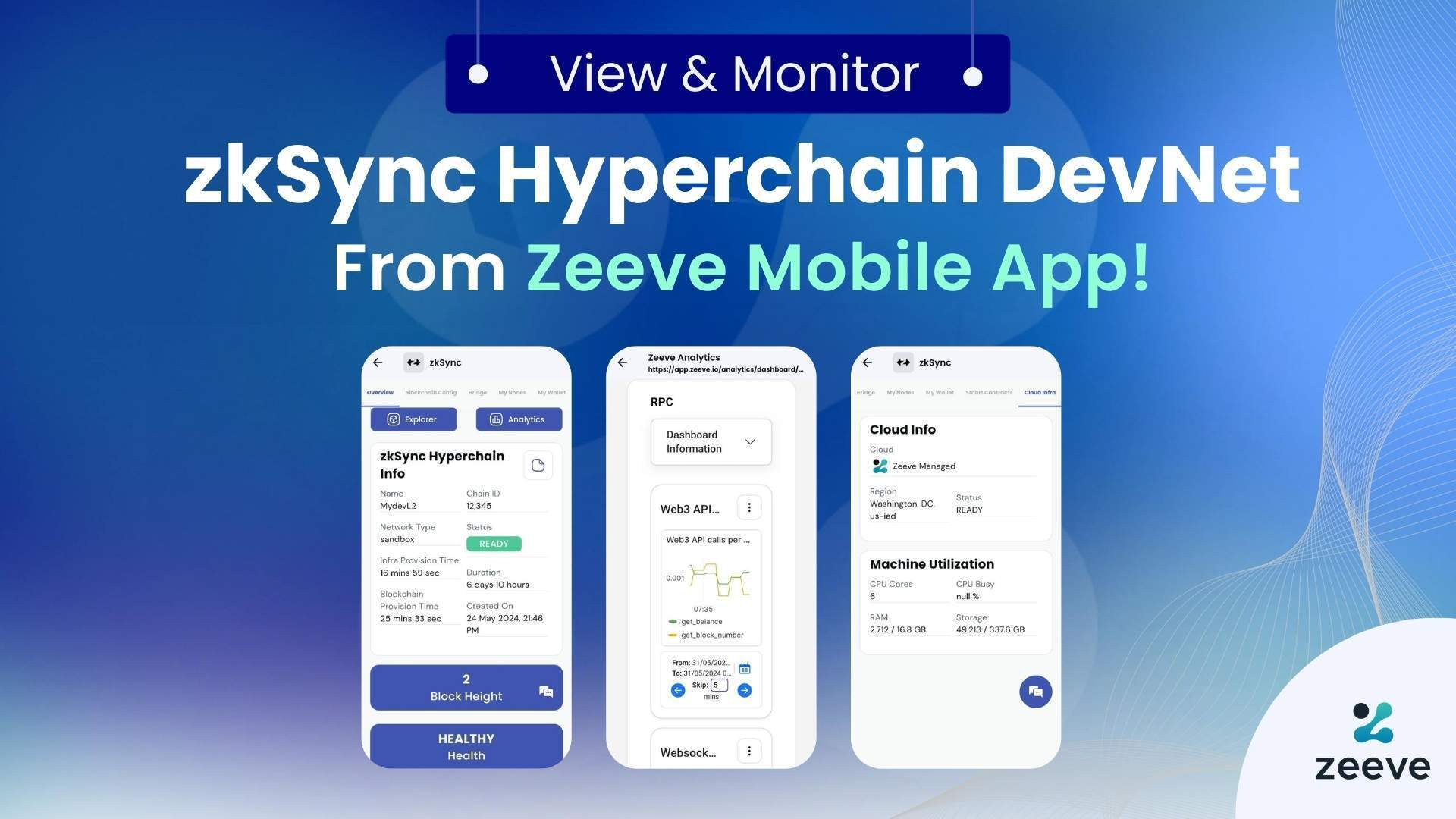 <p>We are happy to announce that we have extended the support of the Zeeve mobile app, and now clients running their <a href="https://www.zeeve.io/appchains/zksync-hyperchains-zkrollups/">zkSync Hyperchain</a> DevNets on Zeeve RaaS can also view and monitor their networks directly from their Android or iOS app. This enhanced mobile version, while read-only, provides a comprehensive view of analytics, chain configurations, node details, deployed smart contracts, cloud infrastructure, and more. For creating and managing new services, users will continue to use our web-based platforms.</p> <p><em>"Launching a DevNet and having immediate access to crucial metrics without being tethered to a desktop significantly enhances flexibility for business owners, system administrators, and other key stakeholders</em>. <em>This integration does more than just display data; it powers our clients to oversee their zkSync Hyperchain environments with unmatched ease and agility anytime and anywhere. We are confident this will foster more efficient and scalable blockchain development, enhancing mobile monitoring capabilities that keep you informed and decision-ready, no matter where you are."</em></p> <p>Dr. Ravi Chamria</p> <p>Co- founder and CEO of Zeeve</p> <h2 class="wp-block-heading" id="h-what-s-possible-for-zksync-hyperchains-on-mobile">What’s Possible for zkSync Hyperchains on Mobile?</h2>  <li><strong>zkSync Hyperchain Overview Page: </strong>Click on the <strong>Explorers </strong>button to open L2 Explorer, along with basic zkSync Hyperchain Info, Block height, Health Status (Healthy or Unhealthy), L1 Info, Node Count, Cloud Infra details, alerts and access to docs.</li> <li><strong>Blockchain Configurations:</strong> To view blockchain configuration, click the Blockchain Config tab on the overview page. On the blockchain configuration<strong> </strong>page, you can view the blockchain configurations<strong>.</strong> Users can also have information<strong> </strong>related to the General Config, Block Config, Transaction Config, and zkSync Hyperchain Env.</li> <li><strong>Bridge: </strong>To view the bridge, click on the Bridge tab on the overview page. Open the bridge by clicking on the icon next to the bridge URL. This will open the zkSync Hyperchain Bridge page, where you can perform bridge operations.</li> <li><strong>My Nodes: </strong>To view nodes, click on the <strong>My Nodes</strong> Tab. Users can see the machine status of the nodes (zkSync Hyperchain Nodes, RPC Nodes and Prover Nodes (not available in devnet).</li> <li><strong>My Wallets: </strong>To view wallet information, click on the <strong>My Wallets</strong> tab on the overview page. You can view the wallets on Explorers by clicking on the links provided against each wallet.</li> <li><strong>Smart Contracts: </strong>To view smart contracts for both L1 and L2, click on the <strong>Smart Contracts </strong>tab on the overview page. Click on the icon under the <strong>Actions</strong> column to view smart contracts on the Explorer.</li> <li><strong>Cloud Infra:</strong> Details of Clod, Region, Machine Status, Machine Configurations and Storage.</li> <li><strong>Analytics:</strong> Advanced tools for tracking the performance and health of blockchain nodes, Servers, logs and alerts.</li> <h2 class="wp-block-heading" id="h-get-access">Get access</h2> <p>Download the Zeeve app from the <a href="https://apps.apple.com/us/app/zeeve/id6449033150">Apple App Store</a> or <a href="https://play.google.com/store/apps/details?id=io.zeeve.app">Google Play Store</a>. Log in to your Zeeve account with Google, Apple, GitHub, and your Registered email ID, or sign up in just a few taps. Go to the <a href="https://www.zeeve.io/appchains/zksync-hyperchains-zkrollups/">zkSync Hyperchain</a> section, and your deployed DevNet should be visible there (along with a public Demo network). That's it! </p> <p>Thank you for choosing <a href="https://www.zeeve.io/">Zeeve</a> as your trusted partner in blockchain infrastructure. We can't wait to see what you'll build next!</p> |
| json metadata | {"tags":["announcement","zksynchyperchain"],"image":["https://cdn.steemitimages.com/DQmWkiQkUfBLj1DLL2UjPeNhQPtnuKmk8WoSrRbctNQQrt5/image.png","https://dev-to-uploads.s3.amazonaws.com/uploads/articles/t6ih5arnu0aio04rp1r8.png"],"links":["https://www.zeeve.io/appchains/zksync-hyperchains-zkrollups/","https://apps.apple.com/us/app/zeeve/id6449033150","https://play.google.com/store/apps/details?id=io.zeeve.app","https://www.zeeve.io/"],"app":"steemit/0.2","format":"markdown"} |
| parent author | |
| parent permlink | announcement |
| permlink | unlock-mobile-monitoring-zksync-hyperchain-devnets-now-on-zeeve-app |
| title | Unlock Mobile Monitoring: zkSync Hyperchain DevNets Now on Zeeve App |
| Transaction Info | Block #88920176/Trx bb88849af92e16bb9d54869ca6898920aa75af35 |
View Raw JSON Data
{
"block": 88920176,
"op": [
"comment",
{
"author": "zeevedeeptech",
"body": "\n<p>We are happy to announce that we have extended the support of the Zeeve mobile app, and now clients running their <a href=\"https://www.zeeve.io/appchains/zksync-hyperchains-zkrollups/\">zkSync Hyperchain</a> DevNets on Zeeve RaaS can also view and monitor their networks directly from their Android or iOS app. This enhanced mobile version, while read-only, provides a comprehensive view of analytics, chain configurations, node details, deployed smart contracts, cloud infrastructure, and more. For creating and managing new services, users will continue to use our web-based platforms.</p>\n<p><em>\"Launching a DevNet and having immediate access to crucial metrics without being tethered to a desktop significantly enhances flexibility for business owners, system administrators, and other key stakeholders</em>. <em>This integration does more than just display data; it powers our clients to oversee their zkSync Hyperchain environments with unmatched ease and agility anytime and anywhere. We are confident this will foster more efficient and scalable blockchain development, enhancing mobile monitoring capabilities that keep you informed and decision-ready, no matter where you are.\"</em></p>\n<p>Dr. Ravi Chamria</p>\n<p>Co- founder and CEO of Zeeve</p>\n<h2 class=\"wp-block-heading\" id=\"h-what-s-possible-for-zksync-hyperchains-on-mobile\">What’s Possible for zkSync Hyperchains on Mobile?</h2>\n\n\n<li><strong>zkSync Hyperchain Overview Page: </strong>Click on the <strong>Explorers </strong>button to open L2 Explorer, along with basic zkSync Hyperchain Info, Block height, Health Status (Healthy or Unhealthy), L1 Info, Node Count, Cloud Infra details, alerts and access to docs.</li>\n<li><strong>Blockchain Configurations:</strong> To view blockchain configuration, click the Blockchain Config tab on the overview page. On the blockchain configuration<strong> </strong>page, you can view the blockchain configurations<strong>.</strong> Users can also have information<strong> </strong>related to the General Config, Block Config, Transaction Config, and zkSync Hyperchain Env.</li>\n<li><strong>Bridge: </strong>To view the bridge, click on the Bridge tab on the overview page. Open the bridge by clicking on the icon next to the bridge URL. This will open the zkSync Hyperchain Bridge page, where you can perform bridge operations.</li>\n<li><strong>My Nodes: </strong>To view nodes, click on the <strong>My Nodes</strong> Tab. Users can see the machine status of the nodes (zkSync Hyperchain Nodes, RPC Nodes and Prover Nodes (not available in devnet).</li>\n<li><strong>My Wallets: </strong>To view wallet information, click on the <strong>My Wallets</strong> tab on the overview page. You can view the wallets on Explorers by clicking on the links provided against each wallet.</li>\n<li><strong>Smart Contracts: </strong>To view smart contracts for both L1 and L2, click on the <strong>Smart Contracts </strong>tab on the overview page. Click on the icon under the <strong>Actions</strong> column to view smart contracts on the Explorer.</li>\n<li><strong>Cloud Infra:</strong> Details of Clod, Region, Machine Status, Machine Configurations and Storage.</li>\n<li><strong>Analytics:</strong> Advanced tools for tracking the performance and health of blockchain nodes, Servers, logs and alerts.</li>\n<h2 class=\"wp-block-heading\" id=\"h-get-access\">Get access</h2>\n<p>Download the Zeeve app from the <a href=\"https://apps.apple.com/us/app/zeeve/id6449033150\">Apple App Store</a> or <a href=\"https://play.google.com/store/apps/details?id=io.zeeve.app\">Google Play Store</a>. Log in to your Zeeve account with Google, Apple, GitHub, and your Registered email ID, or sign up in just a few taps. Go to the <a href=\"https://www.zeeve.io/appchains/zksync-hyperchains-zkrollups/\">zkSync Hyperchain</a> section, and your deployed DevNet should be visible there (along with a public Demo network). That's it! </p>\n<p>Thank you for choosing <a href=\"https://www.zeeve.io/\">Zeeve</a> as your trusted partner in blockchain infrastructure. We can't wait to see what you'll build next!</p>",
"json_metadata": "{\"tags\":[\"announcement\",\"zksynchyperchain\"],\"image\":[\"https://cdn.steemitimages.com/DQmWkiQkUfBLj1DLL2UjPeNhQPtnuKmk8WoSrRbctNQQrt5/image.png\",\"https://dev-to-uploads.s3.amazonaws.com/uploads/articles/t6ih5arnu0aio04rp1r8.png\"],\"links\":[\"https://www.zeeve.io/appchains/zksync-hyperchains-zkrollups/\",\"https://apps.apple.com/us/app/zeeve/id6449033150\",\"https://play.google.com/store/apps/details?id=io.zeeve.app\",\"https://www.zeeve.io/\"],\"app\":\"steemit/0.2\",\"format\":\"markdown\"}",
"parent_author": "",
"parent_permlink": "announcement",
"permlink": "unlock-mobile-monitoring-zksync-hyperchain-devnets-now-on-zeeve-app",
"title": "Unlock Mobile Monitoring: zkSync Hyperchain DevNets Now on Zeeve App"
}
],
"op_in_trx": 0,
"timestamp": "2024-09-25T06:48:24",
"trx_id": "bb88849af92e16bb9d54869ca6898920aa75af35",
"trx_in_block": 1,
"virtual_op": 0
}2024/09/24 05:43:33
2024/09/24 05:43:33
| author | zeevedeeptech |
| permlink | zeeve-adds-1-click-validator-node-support-for-shido-blockchain |
| voter | yarsb21 |
| weight | 5000 (50.00%) |
| Transaction Info | Block #88890144/Trx 3b01067ff29aebe6d33129a7215770b8a7a5b272 |
View Raw JSON Data
{
  "block": 88890144,
  "op": [
    "vote",
    {
      "author": "zeevedeeptech",
      "permlink": "zeeve-adds-1-click-validator-node-support-for-shido-blockchain",
      "voter": "yarsb21",
      "weight": 5000
    }
  ],
  "op_in_trx": 0,
  "timestamp": "2024-09-24T05:43:33",
  "trx_id": "3b01067ff29aebe6d33129a7215770b8a7a5b272",
  "trx_in_block": 5,
  "virtual_op": 0
}2024/09/24 05:43:06
2024/09/24 05:43:06
| author | zeevedeeptech |
| permlink | zeeve-adds-1-click-validator-node-support-for-shido-blockchain |
| voter | isnochys |
| weight | 5000 (50.00%) |
| Transaction Info | Block #88890135/Trx 7d46bf81f2b13b9e3bc155c70eab3878e4d83226 |
View Raw JSON Data
{
  "block": 88890135,
  "op": [
    "vote",
    {
      "author": "zeevedeeptech",
      "permlink": "zeeve-adds-1-click-validator-node-support-for-shido-blockchain",
      "voter": "isnochys",
      "weight": 5000
    }
  ],
  "op_in_trx": 0,
  "timestamp": "2024-09-24T05:43:06",
  "trx_id": "7d46bf81f2b13b9e3bc155c70eab3878e4d83226",
  "trx_in_block": 0,
  "virtual_op": 0
}2024/09/24 05:43:00
2024/09/24 05:43:00
| author | zeevedeeptech |
| permlink | zeeve-adds-1-click-validator-node-support-for-shido-blockchain |
| voter | witnessbot |
| weight | 5000 (50.00%) |
| Transaction Info | Block #88890133/Trx 3cf539268b76ceb58dff897e24ae3fdc91b9043e |
View Raw JSON Data
{
  "block": 88890133,
  "op": [
    "vote",
    {
      "author": "zeevedeeptech",
      "permlink": "zeeve-adds-1-click-validator-node-support-for-shido-blockchain",
      "voter": "witnessbot",
      "weight": 5000
    }
  ],
  "op_in_trx": 0,
  "timestamp": "2024-09-24T05:43:00",
  "trx_id": "3cf539268b76ceb58dff897e24ae3fdc91b9043e",
  "trx_in_block": 5,
  "virtual_op": 0
}2024/09/24 05:42:57
2024/09/24 05:42:57
| author | zeevedeeptech |
| permlink | zeeve-adds-1-click-validator-node-support-for-shido-blockchain |
| voter | rdstm1985 |
| weight | 5000 (50.00%) |
| Transaction Info | Block #88890132/Trx b624b27b058e346d1417473e3c18cfa9c56cbdfe |
View Raw JSON Data
{
  "block": 88890132,
  "op": [
    "vote",
    {
      "author": "zeevedeeptech",
      "permlink": "zeeve-adds-1-click-validator-node-support-for-shido-blockchain",
      "voter": "rdstm1985",
      "weight": 5000
    }
  ],
  "op_in_trx": 0,
  "timestamp": "2024-09-24T05:42:57",
  "trx_id": "b624b27b058e346d1417473e3c18cfa9c56cbdfe",
  "trx_in_block": 0,
  "virtual_op": 0
}2024/09/24 05:42:51
2024/09/24 05:42:51
| author | zeevedeeptech |
| permlink | zeeve-adds-1-click-validator-node-support-for-shido-blockchain |
| voter | cheapestwhale |
| weight | 5000 (50.00%) |
| Transaction Info | Block #88890130/Trx 8d47a9de24374f9fe9a07ee6064a6d00540d977a |
View Raw JSON Data
{
  "block": 88890130,
  "op": [
    "vote",
    {
      "author": "zeevedeeptech",
      "permlink": "zeeve-adds-1-click-validator-node-support-for-shido-blockchain",
      "voter": "cheapestwhale",
      "weight": 5000
    }
  ],
  "op_in_trx": 0,
  "timestamp": "2024-09-24T05:42:51",
  "trx_id": "8d47a9de24374f9fe9a07ee6064a6d00540d977a",
  "trx_in_block": 2,
  "virtual_op": 0
}2024/09/24 05:42:48
2024/09/24 05:42:48
| author | zeevedeeptech |
| permlink | zeeve-adds-1-click-validator-node-support-for-shido-blockchain |
| voter | o2rs2015 |
| weight | 5000 (50.00%) |
| Transaction Info | Block #88890129/Trx 773bbecd3b3e035cba06c8da0cbf8853a24c6e84 |
View Raw JSON Data
{
  "block": 88890129,
  "op": [
    "vote",
    {
      "author": "zeevedeeptech",
      "permlink": "zeeve-adds-1-click-validator-node-support-for-shido-blockchain",
      "voter": "o2rs2015",
      "weight": 5000
    }
  ],
  "op_in_trx": 0,
  "timestamp": "2024-09-24T05:42:48",
  "trx_id": "773bbecd3b3e035cba06c8da0cbf8853a24c6e84",
  "trx_in_block": 2,
  "virtual_op": 0
}2024/09/24 05:42:42
2024/09/24 05:42:42
| author | zeevedeeptech |
| permlink | zeeve-adds-1-click-validator-node-support-for-shido-blockchain |
| voter | phoxinus |
| weight | 5000 (50.00%) |
| Transaction Info | Block #88890127/Trx cef9e077abb69dc9f25c4c0b002d3f2e984857aa |
View Raw JSON Data
{
  "block": 88890127,
  "op": [
    "vote",
    {
      "author": "zeevedeeptech",
      "permlink": "zeeve-adds-1-click-validator-node-support-for-shido-blockchain",
      "voter": "phoxinus",
      "weight": 5000
    }
  ],
  "op_in_trx": 0,
  "timestamp": "2024-09-24T05:42:42",
  "trx_id": "cef9e077abb69dc9f25c4c0b002d3f2e984857aa",
  "trx_in_block": 3,
  "virtual_op": 0
}2024/09/24 05:42:39
2024/09/24 05:42:39
| author | zeevedeeptech |
| permlink | zeeve-adds-1-click-validator-node-support-for-shido-blockchain |
| voter | cheapwhale |
| weight | 5000 (50.00%) |
| Transaction Info | Block #88890126/Trx 1d628541bdafe4140da2e53e68e6d2df1108c589 |
View Raw JSON Data
{
  "block": 88890126,
  "op": [
    "vote",
    {
      "author": "zeevedeeptech",
      "permlink": "zeeve-adds-1-click-validator-node-support-for-shido-blockchain",
      "voter": "cheapwhale",
      "weight": 5000
    }
  ],
  "op_in_trx": 0,
  "timestamp": "2024-09-24T05:42:39",
  "trx_id": "1d628541bdafe4140da2e53e68e6d2df1108c589",
  "trx_in_block": 2,
  "virtual_op": 0
}2024/09/24 05:42:33
2024/09/24 05:42:33
| author | zeevedeeptech |
| permlink | zeeve-adds-1-click-validator-node-support-for-shido-blockchain |
| voter | dirtywhale |
| weight | 5000 (50.00%) |
| Transaction Info | Block #88890124/Trx 5a6d394d9b90fd7f9fc6f5d5600b93aaff8db029 |
View Raw JSON Data
{
  "block": 88890124,
  "op": [
    "vote",
    {
      "author": "zeevedeeptech",
      "permlink": "zeeve-adds-1-click-validator-node-support-for-shido-blockchain",
      "voter": "dirtywhale",
      "weight": 5000
    }
  ],
  "op_in_trx": 0,
  "timestamp": "2024-09-24T05:42:33",
  "trx_id": "5a6d394d9b90fd7f9fc6f5d5600b93aaff8db029",
  "trx_in_block": 1,
  "virtual_op": 0
}2024/09/24 05:42:30
2024/09/24 05:42:30
| author | zeevedeeptech |
| permlink | zeeve-adds-1-click-validator-node-support-for-shido-blockchain |
| voter | pornwhale |
| weight | 5000 (50.00%) |
| Transaction Info | Block #88890123/Trx 4c9fbcdff16c0d196b5e9ff16f724e344ccb91f6 |
View Raw JSON Data
{
  "block": 88890123,
  "op": [
    "vote",
    {
      "author": "zeevedeeptech",
      "permlink": "zeeve-adds-1-click-validator-node-support-for-shido-blockchain",
      "voter": "pornwhale",
      "weight": 5000
    }
  ],
  "op_in_trx": 0,
  "timestamp": "2024-09-24T05:42:30",
  "trx_id": "4c9fbcdff16c0d196b5e9ff16f724e344ccb91f6",
  "trx_in_block": 1,
  "virtual_op": 0
}2024/09/24 05:42:24
2024/09/24 05:42:24
| author | zeevedeeptech |
| permlink | zeeve-adds-1-click-validator-node-support-for-shido-blockchain |
| voter | nanobot |
| weight | 5000 (50.00%) |
| Transaction Info | Block #88890121/Trx b423080affba605610ed65115d91df3170a436ed |
View Raw JSON Data
{
  "block": 88890121,
  "op": [
    "vote",
    {
      "author": "zeevedeeptech",
      "permlink": "zeeve-adds-1-click-validator-node-support-for-shido-blockchain",
      "voter": "nanobot",
      "weight": 5000
    }
  ],
  "op_in_trx": 0,
  "timestamp": "2024-09-24T05:42:24",
  "trx_id": "b423080affba605610ed65115d91df3170a436ed",
  "trx_in_block": 0,
  "virtual_op": 0
}2024/09/24 05:42:09
2024/09/24 05:42:09
| author | zeevedeeptech |
| permlink | zeeve-adds-1-click-validator-node-support-for-shido-blockchain |
| voter | cheaperwhale |
| weight | 5000 (50.00%) |
| Transaction Info | Block #88890116/Trx f9b247e36ef4a4d9ef1ed2bbc22b26c6755e2840 |
View Raw JSON Data
{
  "block": 88890116,
  "op": [
    "vote",
    {
      "author": "zeevedeeptech",
      "permlink": "zeeve-adds-1-click-validator-node-support-for-shido-blockchain",
      "voter": "cheaperwhale",
      "weight": 5000
    }
  ],
  "op_in_trx": 0,
  "timestamp": "2024-09-24T05:42:09",
  "trx_id": "f9b247e36ef4a4d9ef1ed2bbc22b26c6755e2840",
  "trx_in_block": 1,
  "virtual_op": 0
}2024/09/24 05:42:03
2024/09/24 05:42:03
| author | zeevedeeptech |
| permlink | zeeve-adds-1-click-validator-node-support-for-shido-blockchain |
| voter | rgau1985 |
| weight | 5000 (50.00%) |
| Transaction Info | Block #88890114/Trx 56e5325d4a0a35a81812382e5327a3618a94005c |
View Raw JSON Data
{
  "block": 88890114,
  "op": [
    "vote",
    {
      "author": "zeevedeeptech",
      "permlink": "zeeve-adds-1-click-validator-node-support-for-shido-blockchain",
      "voter": "rgau1985",
      "weight": 5000
    }
  ],
  "op_in_trx": 0,
  "timestamp": "2024-09-24T05:42:03",
  "trx_id": "56e5325d4a0a35a81812382e5327a3618a94005c",
  "trx_in_block": 0,
  "virtual_op": 0
}mutuupvoted (50.00%) @zeevedeeptech / zeeve-adds-1-click-validator-node-support-for-shido-blockchain2024/09/24 05:41:57
mutuupvoted (50.00%) @zeevedeeptech / zeeve-adds-1-click-validator-node-support-for-shido-blockchain
2024/09/24 05:41:57
| author | zeevedeeptech |
| permlink | zeeve-adds-1-click-validator-node-support-for-shido-blockchain |
| voter | mutu |
| weight | 5000 (50.00%) |
| Transaction Info | Block #88890112/Trx 4c23379dc8859be5b590fde009a9ef0a4f077c3f |
View Raw JSON Data
{
  "block": 88890112,
  "op": [
    "vote",
    {
      "author": "zeevedeeptech",
      "permlink": "zeeve-adds-1-click-validator-node-support-for-shido-blockchain",
      "voter": "mutu",
      "weight": 5000
    }
  ],
  "op_in_trx": 0,
  "timestamp": "2024-09-24T05:41:57",
  "trx_id": "4c23379dc8859be5b590fde009a9ef0a4f077c3f",
  "trx_in_block": 3,
  "virtual_op": 0
}2024/09/24 05:41:54
2024/09/24 05:41:54
| author | zeevedeeptech |
| permlink | zeeve-adds-1-click-validator-node-support-for-shido-blockchain |
| voter | grand.strategy |
| weight | 5000 (50.00%) |
| Transaction Info | Block #88890111/Trx 3286202b1b476e2beec535ca13d35926f8a3b1b6 |
View Raw JSON Data
{
  "block": 88890111,
  "op": [
    "vote",
    {
      "author": "zeevedeeptech",
      "permlink": "zeeve-adds-1-click-validator-node-support-for-shido-blockchain",
      "voter": "grand.strategy",
      "weight": 5000
    }
  ],
  "op_in_trx": 0,
  "timestamp": "2024-09-24T05:41:54",
  "trx_id": "3286202b1b476e2beec535ca13d35926f8a3b1b6",
  "trx_in_block": 0,
  "virtual_op": 0
}2024/09/24 05:41:48
2024/09/24 05:41:48
| author | zeevedeeptech |
| permlink | zeeve-adds-1-click-validator-node-support-for-shido-blockchain |
| voter | kehrwoche |
| weight | 5000 (50.00%) |
| Transaction Info | Block #88890109/Trx dcb2b6efbb69e051641e9e60e2e48c12a98cdfab |
View Raw JSON Data
{
  "block": 88890109,
  "op": [
    "vote",
    {
      "author": "zeevedeeptech",
      "permlink": "zeeve-adds-1-click-validator-node-support-for-shido-blockchain",
      "voter": "kehrwoche",
      "weight": 5000
    }
  ],
  "op_in_trx": 0,
  "timestamp": "2024-09-24T05:41:48",
  "trx_id": "dcb2b6efbb69e051641e9e60e2e48c12a98cdfab",
  "trx_in_block": 1,
  "virtual_op": 0
}2024/09/24 05:41:45
2024/09/24 05:41:45
| author | zeevedeeptech |
| permlink | zeeve-adds-1-click-validator-node-support-for-shido-blockchain |
| voter | filthywhale |
| weight | 5000 (50.00%) |
| Transaction Info | Block #88890108/Trx 8cdb4e5b8fbd643bcb3028d359aa5e86d2676b49 |
View Raw JSON Data
{
  "block": 88890108,
  "op": [
    "vote",
    {
      "author": "zeevedeeptech",
      "permlink": "zeeve-adds-1-click-validator-node-support-for-shido-blockchain",
      "voter": "filthywhale",
      "weight": 5000
    }
  ],
  "op_in_trx": 0,
  "timestamp": "2024-09-24T05:41:45",
  "trx_id": "8cdb4e5b8fbd643bcb3028d359aa5e86d2676b49",
  "trx_in_block": 0,
  "virtual_op": 0
}2024/09/24 05:41:39
2024/09/24 05:41:39
| author | zeevedeeptech |
| permlink | zeeve-adds-1-click-validator-node-support-for-shido-blockchain |
| voter | minibot |
| weight | 5000 (50.00%) |
| Transaction Info | Block #88890106/Trx da17cf5a5ed3266bc2432550c43bdc5810733033 |
View Raw JSON Data
{
  "block": 88890106,
  "op": [
    "vote",
    {
      "author": "zeevedeeptech",
      "permlink": "zeeve-adds-1-click-validator-node-support-for-shido-blockchain",
      "voter": "minibot",
      "weight": 5000
    }
  ],
  "op_in_trx": 0,
  "timestamp": "2024-09-24T05:41:39",
  "trx_id": "da17cf5a5ed3266bc2432550c43bdc5810733033",
  "trx_in_block": 0,
  "virtual_op": 0
}2024/09/24 05:41:30
2024/09/24 05:41:30
| author | zeevedeeptech |
| permlink | zeeve-adds-1-click-validator-node-support-for-shido-blockchain |
| voter | microbot |
| weight | 5000 (50.00%) |
| Transaction Info | Block #88890103/Trx 8d983080a5e333753e459040049987e55082e5fa |
View Raw JSON Data
{
  "block": 88890103,
  "op": [
    "vote",
    {
      "author": "zeevedeeptech",
      "permlink": "zeeve-adds-1-click-validator-node-support-for-shido-blockchain",
      "voter": "microbot",
      "weight": 5000
    }
  ],
  "op_in_trx": 0,
  "timestamp": "2024-09-24T05:41:30",
  "trx_id": "8d983080a5e333753e459040049987e55082e5fa",
  "trx_in_block": 0,
  "virtual_op": 0
}2024/09/24 05:41:09
2024/09/24 05:41:09
| author | zeevedeeptech |
| permlink | zeeve-adds-1-click-validator-node-support-for-shido-blockchain |
| voter | elritze |
| weight | 5000 (50.00%) |
| Transaction Info | Block #88890096/Trx 9f28198b131eec98a64577bfaa5516a9778399f1 |
View Raw JSON Data
{
  "block": 88890096,
  "op": [
    "vote",
    {
      "author": "zeevedeeptech",
      "permlink": "zeeve-adds-1-click-validator-node-support-for-shido-blockchain",
      "voter": "elritze",
      "weight": 5000
    }
  ],
  "op_in_trx": 0,
  "timestamp": "2024-09-24T05:41:09",
  "trx_id": "9f28198b131eec98a64577bfaa5516a9778399f1",
  "trx_in_block": 3,
  "virtual_op": 0
}2024/09/24 05:41:00
2024/09/24 05:41:00
| author | zeevedeeptech |
| permlink | zeeve-adds-1-click-validator-node-support-for-shido-blockchain |
| voter | drowningwhale |
| weight | 5000 (50.00%) |
| Transaction Info | Block #88890093/Trx de3a45bd8eb3bac5ebd2450af8e4577578ffa175 |
View Raw JSON Data
{
  "block": 88890093,
  "op": [
    "vote",
    {
      "author": "zeevedeeptech",
      "permlink": "zeeve-adds-1-click-validator-node-support-for-shido-blockchain",
      "voter": "drowningwhale",
      "weight": 5000
    }
  ],
  "op_in_trx": 0,
  "timestamp": "2024-09-24T05:41:00",
  "trx_id": "de3a45bd8eb3bac5ebd2450af8e4577578ffa175",
  "trx_in_block": 1,
  "virtual_op": 0
}2024/09/24 05:40:57
2024/09/24 05:40:57
| author | zeevedeeptech |
| permlink | zeeve-adds-1-click-validator-node-support-for-shido-blockchain |
| voter | fumegi |
| weight | 5000 (50.00%) |
| Transaction Info | Block #88890092/Trx 4435a6d312e256fa4b6c9e9ac2015b1bb66a1bd1 |
View Raw JSON Data
{
  "block": 88890092,
  "op": [
    "vote",
    {
      "author": "zeevedeeptech",
      "permlink": "zeeve-adds-1-click-validator-node-support-for-shido-blockchain",
      "voter": "fumegi",
      "weight": 5000
    }
  ],
  "op_in_trx": 0,
  "timestamp": "2024-09-24T05:40:57",
  "trx_id": "4435a6d312e256fa4b6c9e9ac2015b1bb66a1bd1",
  "trx_in_block": 0,
  "virtual_op": 0
}2024/09/24 05:40:51
2024/09/24 05:40:51
| author | zeevedeeptech |
| permlink | zeeve-adds-1-click-validator-node-support-for-shido-blockchain |
| voter | vairon |
| weight | 5000 (50.00%) |
| Transaction Info | Block #88890090/Trx e0ca24c5baf16652fb80a13e6056d4c42610a30e |
View Raw JSON Data
{
  "block": 88890090,
  "op": [
    "vote",
    {
      "author": "zeevedeeptech",
      "permlink": "zeeve-adds-1-click-validator-node-support-for-shido-blockchain",
      "voter": "vairon",
      "weight": 5000
    }
  ],
  "op_in_trx": 0,
  "timestamp": "2024-09-24T05:40:51",
  "trx_id": "e0ca24c5baf16652fb80a13e6056d4c42610a30e",
  "trx_in_block": 1,
  "virtual_op": 0
}2024/09/24 05:40:45
2024/09/24 05:40:45
| author | zeevedeeptech |
| permlink | zeeve-adds-1-click-validator-node-support-for-shido-blockchain |
| voter | wetten |
| weight | 5000 (50.00%) |
| Transaction Info | Block #88890088/Trx 63f75147758b2512c4f78964f29d49bcc06e9501 |
View Raw JSON Data
{
  "block": 88890088,
  "op": [
    "vote",
    {
      "author": "zeevedeeptech",
      "permlink": "zeeve-adds-1-click-validator-node-support-for-shido-blockchain",
      "voter": "wetten",
      "weight": 5000
    }
  ],
  "op_in_trx": 0,
  "timestamp": "2024-09-24T05:40:45",
  "trx_id": "63f75147758b2512c4f78964f29d49bcc06e9501",
  "trx_in_block": 1,
  "virtual_op": 0
}2024/09/24 05:40:42
2024/09/24 05:40:42
| author | zeevedeeptech |
| permlink | zeeve-adds-1-click-validator-node-support-for-shido-blockchain |
| voter | millibot |
| weight | 5000 (50.00%) |
| Transaction Info | Block #88890087/Trx e3a428f9e09fd18814fa338afb81f7e4c9dc7ba6 |
View Raw JSON Data
{
  "block": 88890087,
  "op": [
    "vote",
    {
      "author": "zeevedeeptech",
      "permlink": "zeeve-adds-1-click-validator-node-support-for-shido-blockchain",
      "voter": "millibot",
      "weight": 5000
    }
  ],
  "op_in_trx": 0,
  "timestamp": "2024-09-24T05:40:42",
  "trx_id": "e3a428f9e09fd18814fa338afb81f7e4c9dc7ba6",
  "trx_in_block": 0,
  "virtual_op": 0
}zeevedeeptechpublished a new post: zeeve-adds-1-click-validator-node-support-for-shido-blockchain2024/09/24 05:39:00
zeevedeeptechpublished a new post: zeeve-adds-1-click-validator-node-support-for-shido-blockchain
2024/09/24 05:39:00
| author | zeevedeeptech |
| body |  <p><em>Easily deploy Shido validator nodes with Zeeve's robust institutional staking infrastructure for maximized yields, enhanced security, and reduced performance-related risks.</em></p> <p><a href="https://www.zeeve.io/">Zeeve</a> is excited to announce support for white-labelled Shido validator nodes on our platform. This will enable users to deploy validator nodes on <a href="https://shido.io/">Shido</a> with just a few clicks.</p> <p>Shido is a leading Layer 1 Proof-of-Stake Network with superior TTF and infinite scalability. Built on the lightning-fast Tendermint, it enables developers to choose an environment. It is permission-less and seamlessly interoperable between IBC, WASM, and EVM environments.</p> <p>With Zeeve's integration of Shido validator nodes, institutions and individual investors have the opportunity to seamlessly participate as validators in the network, optimizing their yields while concurrently bolstering the security and decentralization of the blockchain.</p> <h2 class="wp-block-heading" id="h-shido-a-high-performance-low-cost-and-evm-amp-wasm-compatible-blockchain">Shido: A High-Performance, Low-Cost, and EVM & WASM Compatible Blockchain</h2> <p>Shido Network is designed for expansive scalability within the Cosmos ecosystem, efficiently growing both horizontally and vertically. It's anchored by the reliable Tendermint Proof-of-Stake consensus mechanism, which ensures transactions are finalized quickly, typically in less than 0.90 seconds per block.</p> <p>Shido uniquely supports both Ethereum Virtual Machine (EVM) and WebAssembly (WASM), making it highly accessible for developers from other platforms. This compatibility allows the use of popular EVM tools like Remix and MetaMask and supports various programming languages such as RUST, C++, and Python. This flexibility is ideal for developing smart contracts and decentralized applications (dApps).</p> <p>The network is built on open-source, customizable modules, enhancing its capability-based system. It includes the Inter-Blockchain Communication (IBC) Protocol, enabling dApps to interact across different blockchains within the Cosmos network, which aids in shared liquidity and value transfers.</p> <p>Additionally, the Shido Network is designed to be energy-efficient and cost-effective, with a robust decentralized governance system. It supports fast block generation and low transaction fees, with a built-in feature to waive gas fees for consensus participants, making it economical for all users.</p> <p>With its impressive features and capabilities, Shido is an ideal choice for businesses & developers looking to deploy and manage validator node infrastructure, which is where Zeeve's platform comes into play.</p> <h2 class="wp-block-heading" id="h-zeeve-the-ideal-platform-for-your-shido-validator-nodes">Zeeve: The Ideal Platform for Your Shido Validator Nodes</h2> <p>Leverage Zeeve's enterprise-grade staking infrastructure to simplify your validator node deployment on Shido. Discover the benefits Zeeve offers for Shido Staking Nodes:</p> <h3 class="wp-block-heading" id="h-automated-deployments-nbsp">Automated Deployments: </h3> <p>Zeeve offers fully automated deployment of Shido validator nodes over the Zeeve-managed cloud. This removes all the technical barriers to running validator nodes and helps you bypass the complex setups and waiting period to go live. Within a couple of minutes, your node will be up and running. </p> <h3 class="wp-block-heading" id="h-secure-validator-nodes-nbsp">Secure Validator Nodes: </h3> <p>Zeeve allows users to run their own white-labelled validator nodes with continuous security monitoring. We take care of all your requirements, ensuring your nodes remain online, synchronized, and up-to-date. Investors and institutions can stake confidently with Zeeve-managed validator nodes developed and maintained by top blockchain infrastructure experts.</p> <h3 class="wp-block-heading" id="h-non-custodial-staking-nbsp">Non-custodial Staking: </h3> <p>Zeeve is a non-custodial staking infrastructure platform. Validators maintain complete control and ownership of their funds at all times, as Zeeve will not access users' private keys or hold any user funds. You control your dedicated staking node while we manage the underlying infrastructure.</p> <h3 class="wp-block-heading" id="h-institutional-grade-node-infrastructure-nbsp">Institutional-Grade Node Infrastructure: </h3> <p>Zeeve's infrastructure is designed for maximum resilience, uptime, and validator-grade integrity. We ensure that your validator nodes are always active, mitigating any slashing or performance-related risks. Our proprietary deployment architecture ensures cost-efficient performance.</p> <h3 class="wp-block-heading" id="h-vital-analytics-amp-24-7-monitoring-nbsp">Vital Analytics & 24*7 Monitoring: </h3> <p>Zeeve offers 24/7 monitoring for your staking nodes, cloud resources, and logs. Our visual dashboard, complete with proactive alerts and notifications, allows you to access essential staking parameters and node performance.</p> <p>Our blend of effortless no-code deployment, unparalleled uptime, exceptional performance, detailed analytics, and a unified monitoring dashboard establishes Zeeve as the optimal choice for institutions aiming to deploy and manage validator nodes on the Shido network.</p> |
| json metadata | {"tags":["announcement","shido","zeeve"],"image":["https://cdn.steemitimages.com/DQmYc6DJRXfmcM2tZSkwuauFcoycKcjXgp74vSW9ibd6X9B/image.png"],"links":["https://www.zeeve.io/","https://shido.io/"],"app":"steemit/0.2","format":"markdown"} |
| parent author | |
| parent permlink | announcement |
| permlink | zeeve-adds-1-click-validator-node-support-for-shido-blockchain |
| title | Zeeve adds 1-click Validator Node support for Shido Blockchain |
| Transaction Info | Block #88890053/Trx 52b6d294f26e195022923c48b38a0c2ecc8891e2 |
View Raw JSON Data
{
"block": 88890053,
"op": [
"comment",
{
"author": "zeevedeeptech",
"body": "\n<p><em>Easily deploy Shido validator nodes with Zeeve's robust institutional staking infrastructure for maximized yields, enhanced security, and reduced performance-related risks.</em></p>\n<p><a href=\"https://www.zeeve.io/\">Zeeve</a> is excited to announce support for white-labelled Shido validator nodes on our platform. This will enable users to deploy validator nodes on <a href=\"https://shido.io/\">Shido</a> with just a few clicks.</p>\n<p>Shido is a leading Layer 1 Proof-of-Stake Network with superior TTF and infinite scalability. Built on the lightning-fast Tendermint, it enables developers to choose an environment. It is permission-less and seamlessly interoperable between IBC, WASM, and EVM environments.</p>\n<p>With Zeeve's integration of Shido validator nodes, institutions and individual investors have the opportunity to seamlessly participate as validators in the network, optimizing their yields while concurrently bolstering the security and decentralization of the blockchain.</p>\n<h2 class=\"wp-block-heading\" id=\"h-shido-a-high-performance-low-cost-and-evm-amp-wasm-compatible-blockchain\">Shido: A High-Performance, Low-Cost, and EVM & WASM Compatible Blockchain</h2>\n<p>Shido Network is designed for expansive scalability within the Cosmos ecosystem, efficiently growing both horizontally and vertically. It's anchored by the reliable Tendermint Proof-of-Stake consensus mechanism, which ensures transactions are finalized quickly, typically in less than 0.90 seconds per block.</p>\n<p>Shido uniquely supports both Ethereum Virtual Machine (EVM) and WebAssembly (WASM), making it highly accessible for developers from other platforms. This compatibility allows the use of popular EVM tools like Remix and MetaMask and supports various programming languages such as RUST, C++, and Python. This flexibility is ideal for developing smart contracts and decentralized applications (dApps).</p>\n<p>The network is built on open-source, customizable modules, enhancing its capability-based system. It includes the Inter-Blockchain Communication (IBC) Protocol, enabling dApps to interact across different blockchains within the Cosmos network, which aids in shared liquidity and value transfers.</p>\n<p>Additionally, the Shido Network is designed to be energy-efficient and cost-effective, with a robust decentralized governance system. It supports fast block generation and low transaction fees, with a built-in feature to waive gas fees for consensus participants, making it economical for all users.</p>\n<p>With its impressive features and capabilities, Shido is an ideal choice for businesses & developers looking to deploy and manage validator node infrastructure, which is where Zeeve's platform comes into play.</p>\n<h2 class=\"wp-block-heading\" id=\"h-zeeve-the-ideal-platform-for-your-shido-validator-nodes\">Zeeve: The Ideal Platform for Your Shido Validator Nodes</h2>\n<p>Leverage Zeeve's enterprise-grade staking infrastructure to simplify your validator node deployment on Shido. Discover the benefits Zeeve offers for Shido Staking Nodes:</p>\n<h3 class=\"wp-block-heading\" id=\"h-automated-deployments-nbsp\">Automated Deployments: </h3>\n<p>Zeeve offers fully automated deployment of Shido validator nodes over the Zeeve-managed cloud. This removes all the technical barriers to running validator nodes and helps you bypass the complex setups and waiting period to go live. Within a couple of minutes, your node will be up and running. </p>\n<h3 class=\"wp-block-heading\" id=\"h-secure-validator-nodes-nbsp\">Secure Validator Nodes: </h3>\n<p>Zeeve allows users to run their own white-labelled validator nodes with continuous security monitoring. We take care of all your requirements, ensuring your nodes remain online, synchronized, and up-to-date. Investors and institutions can stake confidently with Zeeve-managed validator nodes developed and maintained by top blockchain infrastructure experts.</p>\n<h3 class=\"wp-block-heading\" id=\"h-non-custodial-staking-nbsp\">Non-custodial Staking: </h3>\n<p>Zeeve is a non-custodial staking infrastructure platform. Validators maintain complete control and ownership of their funds at all times, as Zeeve will not access users' private keys or hold any user funds. You control your dedicated staking node while we manage the underlying infrastructure.</p>\n<h3 class=\"wp-block-heading\" id=\"h-institutional-grade-node-infrastructure-nbsp\">Institutional-Grade Node Infrastructure: </h3>\n<p>Zeeve's infrastructure is designed for maximum resilience, uptime, and validator-grade integrity. We ensure that your validator nodes are always active, mitigating any slashing or performance-related risks. Our proprietary deployment architecture ensures cost-efficient performance.</p>\n<h3 class=\"wp-block-heading\" id=\"h-vital-analytics-amp-24-7-monitoring-nbsp\">Vital Analytics & 24*7 Monitoring: </h3>\n<p>Zeeve offers 24/7 monitoring for your staking nodes, cloud resources, and logs. Our visual dashboard, complete with proactive alerts and notifications, allows you to access essential staking parameters and node performance.</p>\n<p>Our blend of effortless no-code deployment, unparalleled uptime, exceptional performance, detailed analytics, and a unified monitoring dashboard establishes Zeeve as the optimal choice for institutions aiming to deploy and manage validator nodes on the Shido network.</p>",
"json_metadata": "{\"tags\":[\"announcement\",\"shido\",\"zeeve\"],\"image\":[\"https://cdn.steemitimages.com/DQmYc6DJRXfmcM2tZSkwuauFcoycKcjXgp74vSW9ibd6X9B/image.png\"],\"links\":[\"https://www.zeeve.io/\",\"https://shido.io/\"],\"app\":\"steemit/0.2\",\"format\":\"markdown\"}",
"parent_author": "",
"parent_permlink": "announcement",
"permlink": "zeeve-adds-1-click-validator-node-support-for-shido-blockchain",
"title": "Zeeve adds 1-click Validator Node support for Shido Blockchain"
}
],
"op_in_trx": 0,
"timestamp": "2024-09-24T05:39:00",
"trx_id": "52b6d294f26e195022923c48b38a0c2ecc8891e2",
"trx_in_block": 1,
"virtual_op": 0
}zeevedeeptechpublished a new post: what-web3-games-did-right-that-turn-2024-narrative-in-their-favor2024/09/23 05:53:54
zeevedeeptechpublished a new post: what-web3-games-did-right-that-turn-2024-narrative-in-their-favor
2024/09/23 05:53:54
| author | zeevedeeptech |
| body |  <p>The web3 gaming industry is constantly climbing to new heights. As of March 2024, daily active addresses for on-chain games spotted at 6M+ and daily transactions volume around $100 million. It is not just the playerbase; web3 games also lead in terms of investment. April 2024 saw the highest investment in blockchain-based games at<a href="https://bigblockchaingamelist.com/2024/04/15/big-blockchain-game-report-q1-2024/"> $988</a> million, which is almost double of January 2021’s data that stood at $288M. And it is expected to grow further to $65.7B<a href="https://www.marketsandmarkets.com/Market-Reports/blockchain-gaming-market-167926225.html"> by 2027</a>. </p> <p>Such magic numbers in <a href="https://www.zeeve.io/web3-infrastructure-for-gaming/">web3 gaming</a> again make people curious, raising the question– what web3 games did right that's turning the spotlight towards them. These articles provide you answer to this question while explaining the Web3 Gaming Narrative in 2024 in a simplified way.</p> <h2 class="wp-block-heading" id="h-quick-dive-into-web3-games-progress-so-far-nbsp">Quick dive into Web3 games’ progress so far </h2> <p>The web3 gaming industry is forging ahead with creative developments and innovations, propelling it to the next phase of maturity and thus building a solid playerbase for future. Started the journey with a simple multiplayers game-Huntercoin to now powering the future-proof web3 game like Pixels- the web3 gaming ecosystem has significantly evolved. </p> <p>Today, web3 games are built for almost every genre– be it shooter games, role play, esports, or casual games. Big entrepreneurs to individual developers, everyone is tapping into web3 to build games that can amaze players and stay relevant in the long-run. With fair gaming, player-focused economies, asset ownership, and real-money rewards– web3 games are still stealing the spotlight in 2024. </p> <p>Additionally, all the previous pain points related to low scalability, lack of customization, higher transaction cost, etc are now tackled well with the surge of standalone L2/L3 chains built with top such as Polygon, Arbitrum, Optimism, and ZkSync's modular rollup stacks. </p> <a href="https://www.zeeve.io/talk-to-an-expert/"><img src="https://www.zeeve.io/wp-content/uploads/2024/05/Launch-your-gaming-focused-L2L3s-at-lower-cost-1024x213.jpg" alt="" class="wp-image-68787"/></a> <h2 class="wp-block-heading" id="h-what-all-changes-web3-games-have-adopted-to-turn-the-2024-narrative-in-their-favor">What all changes web3 games have adopted to turn the 2024 narrative in their favor?</h2> <p>Below are top moves that web3 games made to turn 2024 Web3 Gaming Narrative in their favor:</p> <li><strong>Play-to-airdrop and node sale events:</strong></li> <p>Web3 is bringing more native ways to engage players and shift the focus solely from playing to earn money.</p> <p>Play-to-airdrop and verifier node sales are some of the newly introduced methods that add some additional utility to gaming tokens. </p> <p>For example, in Play-to-airdrop tokens are distributed according to the players’ in-game activities and dedication in leveling up their characters. Play-to-airdrop is mainly focused on kickstarting a game’s economy through. Popular web3 games like Pixels, Kuroro Beats, Nifty Island, Farcana, and MixMob have already launched their Play-to-airdrop events and achieved significant success. </p> <p>Regarding node sales, XAI’s Arbitrum-powered Layer3 and gaming-adjacent cloud-compute project- Aethir have raised <a href="https://public.bnbstatic.com/static/files/research/data-insights-exploring-crypto-fundraises-3q2023.pdf">$15M and $65M+</a> respectively from sale of their verifier node; a new type of node for additional monitoring of rollup networks. If you want to learn more about the verifier node sale and its core concept, read the article we have linked below: Zeeve Launchpad for Node Sale Infrastructure: Boost Security & Token Utility in Rollups</p> <li><strong>Adoption of custom L2/L3 chains:</strong></li> <p>Web3 games have faced a lot of challenges due to high traffic congestion, which leads to slow TPS, high gas cost, and impacts the network performance. As a solution, a lot of web3 games are shifting to their own standalone chain for cheaper transactions, higher TPS, and customizable features. Some of the highly-played crypto-native games like Gods Unchained and Illuvium have already built their custom chain with Immutable X– the NFT-friendly ‘validium’ powered offering with StarkWare technology offering zero gas fees, instant trades and massive scalability. Similarly, gaming L2/L3s are frequently developed with leading frameworks like Polygon CDK, Arbitrum Orbit, and OP Stack. </p> <li><strong>The multichain approach:</strong></li> <p>Multichain gaming is a rising concept in the web3 gaming realm that allows a gaming project to leverage a multiple ecosystem altogether, for example- Immutable, Arbitrum, Robin, and Polkadot for an additional ecosystem boost. Players of multichain games can access the games across all the supported blockchains while seamlessly switching between them. It’s just like web2 game players can enjoy their favorite game on multiple PlayStation generations. Although this multichchain strategy has some technical limitations, and increased cost & risks, it’s worth noting that 27% of total web3 games has chosen multichain approach to amaze their plates and embrace a better growth. Here’s the data:</p>  <p class="has-text-align-center">Source: Big Blockchain game report.</p> <li><strong>A move towards more indie web3 games:</strong></li> <p>Indie games have brought a metaphoric shift in web3 games, allowing the industry to grow tremendously and match the popularity of AAA games. That’s because today’s players are more interested in gameplay loop and mechanics rather than caring much about high density graphics or characters. At present, a lion's share of web3 games are mainly indie-level games, taking away over 94% of the total market. Casual games, RPG, and strategy games are the top genre of indie games which attracts players the most. Popular indie web3 games are Rocket League, Cult of the Lamb, Golf Story, and Moonlighter. </p> <p>Learn in-depth about indie web3 games <a href="https://www.zeeve.io/blog/why-indie-web3-games-will-steal-the-spotlight-from-aaa-titles-in-2024/">here</a>. </p> <li><strong>Account Abstraction:</strong></li> <p>Account abstraction (AA) is one of the new and interesting features that make we3 games more user friendly. AA brings the concept of social recovery and multi-signature wallets into games. The former offers seamless recovery of private keys in case lost because a ‘trusted group’ that you choose will still keep your keys safe. The latter enhances security of wallets by including several parties to sign transactions and approve it. A practical application of account abstraction is XRaise wallet integrated with AA functionalities to solve the problem of poor wallet UX and security challenges of web3 wallets.</p> <li><strong>Sponsored/gasless gas transactions: </strong></li> <p>The concept of gasless or sponsored gas transactions is introduced to get higher player retention and conversion by eliminating the challenges they face due to gas payments. Immutable, the leading gaming-based projects has already been offering sponsored gas transactions to all the gaming chains or applications building using it. Thereby, web3 games can enable their players to interact with any game’s marketplace or ecosystem through a unique digital passport without any friction. </p> <li><strong>Web2-matching UX for web3:</strong></li> <p>Web3 games are now offering Web2-like user experience so that players web2 players do not need to learn web3 game mechanics for just playing the game. No one cares about what's running in the backend or what technologies their game uses. All they want is a smooth UX which should resemble the games they are already familiar with. Projects like Titanium games are making this possible by allowing players to fully engage in new-gen activities such as trading assets or using the blockchain tech without any discomfort of using wallets or dealing with cryptos. Just login and start playing– that’s it! </p> <li><strong>Use of Generative AI and Virtual reality: </strong></li> <p>Combination of Generative AI and virtual reality (VR) creates more personalized and highly immersive experiences for players. It’s exciting for web3 gamers because they can create AI Avatars that have more creative expression, or engage with LLM and deep learning-based non-player characters, as well as create highly unique and personalized content for P2E games. All these features are mainly accommodated through metaverse games that have more than <a href="https://embryo.com/blog/metaverse-stats-2024/">600 Million</a> active users as of 2024. Use of AI and VR/AR will further grow in 2024 and beyond, which will bring even more realistic games for web3.</p> <h2 class="wp-block-heading" id="h-launch-your-next-gen-custom-gaming-l2-l3-chain-with-zeeve-raas">Launch your next-gen, custom gaming L2/L3 chain with Zeeve RaaS</h2> <p>Zeeve RaaS offers a comprehensive gaming-focused stack that allows Web3 developers and enterprises to build tailor-made gaming Layer2 and Layer3 to support their specific use cases. Whether you want to migrate from a public chain to standalone L2 or you need a chain built from scratch, Zeeve’s services are optimized to handle each type of project. </p> <p>WIth a strong focus on modularity, Zeeve allows gaming chains to build custom chains leveraging 30+ third-party integrations such as decentralized sequencer, MPC wallets, off-chain DA players, storage solutions, and <a href="https://www.zeeve.io/integrations/">more</a>. Also, you can setup a fully-fledged DevNet for your gaming chain using our 1-click deployment sandbox available for OP Stack, Polygon CDK, Arbitrum Orbit, and ZkSync Hyperchain.</p> <p>For more details about Zeeve RaaS or our blockchain services, contact us. Send us your queries via mail or <a href="https://www.zeeve.io/talk-to-an-expert/">set up a one-to-one call</a> for in-depth discussion.</p> |
| json metadata | {"tags":["web3","web3gaming"],"image":["https://cdn.steemitimages.com/DQme9ivanWEiaWm9zqHfqSHeWrHnj1exxzTyGmPXbfDgYKi/image.png","https://www.zeeve.io/wp-content/uploads/2024/05/Launch-your-gaming-focused-L2L3s-at-lower-cost-1024x213.jpg","https://dev-to-uploads.s3.amazonaws.com/uploads/articles/hp6i7suzx2htlufgys8n.png"],"links":["https://bigblockchaingamelist.com/2024/04/15/big-blockchain-game-report-q1-2024/","https://www.marketsandmarkets.com/Market-Reports/blockchain-gaming-market-167926225.html","https://www.zeeve.io/web3-infrastructure-for-gaming/","https://www.zeeve.io/talk-to-an-expert/","https://public.bnbstatic.com/static/files/research/data-insights-exploring-crypto-fundraises-3q2023.pdf","https://www.zeeve.io/blog/why-indie-web3-games-will-steal-the-spotlight-from-aaa-titles-in-2024/","https://embryo.com/blog/metaverse-stats-2024/","https://www.zeeve.io/integrations/"],"app":"steemit/0.2","format":"markdown"} |
| parent author | |
| parent permlink | web3 |
| permlink | what-web3-games-did-right-that-turn-2024-narrative-in-their-favor |
| title | What Web3 games did right that turn 2024 narrative in their favor? |
| Transaction Info | Block #88861628/Trx 2deb16d6f42c3b0489368289f28a1cd1ea044886 |
View Raw JSON Data
{
"block": 88861628,
"op": [
"comment",
{
"author": "zeevedeeptech",
"body": "\n<p>The web3 gaming industry is constantly climbing to new heights. As of March 2024, daily active addresses for on-chain games spotted at 6M+ and daily transactions volume around $100 million. It is not just the playerbase; web3 games also lead in terms of investment. April 2024 saw the highest investment in blockchain-based games at<a href=\"https://bigblockchaingamelist.com/2024/04/15/big-blockchain-game-report-q1-2024/\"> $988</a> million, which is almost double of January 2021’s data that stood at $288M. And it is expected to grow further to $65.7B<a href=\"https://www.marketsandmarkets.com/Market-Reports/blockchain-gaming-market-167926225.html\"> by 2027</a>. </p>\n<p>Such magic numbers in <a href=\"https://www.zeeve.io/web3-infrastructure-for-gaming/\">web3 gaming</a> again make people curious, raising the question– what web3 games did right that's turning the spotlight towards them. These articles provide you answer to this question while explaining the Web3 Gaming Narrative in 2024 in a simplified way.</p>\n<h2 class=\"wp-block-heading\" id=\"h-quick-dive-into-web3-games-progress-so-far-nbsp\">Quick dive into Web3 games’ progress so far </h2>\n<p>The web3 gaming industry is forging ahead with creative developments and innovations, propelling it to the next phase of maturity and thus building a solid playerbase for future. Started the journey with a simple multiplayers game-Huntercoin to now powering the future-proof web3 game like Pixels- the web3 gaming ecosystem has significantly evolved. </p>\n<p>Today, web3 games are built for almost every genre– be it shooter games, role play, esports, or casual games. Big entrepreneurs to individual developers, everyone is tapping into web3 to build games that can amaze players and stay relevant in the long-run. With fair gaming, player-focused economies, asset ownership, and real-money rewards– web3 games are still stealing the spotlight in 2024. </p>\n<p>Additionally, all the previous pain points related to low scalability, lack of customization, higher transaction cost, etc are now tackled well with the surge of standalone L2/L3 chains built with top such as Polygon, Arbitrum, Optimism, and ZkSync's modular rollup stacks. </p>\n<a href=\"https://www.zeeve.io/talk-to-an-expert/\"><img src=\"https://www.zeeve.io/wp-content/uploads/2024/05/Launch-your-gaming-focused-L2L3s-at-lower-cost-1024x213.jpg\" alt=\"\" class=\"wp-image-68787\"/></a>\n<h2 class=\"wp-block-heading\" id=\"h-what-all-changes-web3-games-have-adopted-to-turn-the-2024-narrative-in-their-favor\">What all changes web3 games have adopted to turn the 2024 narrative in their favor?</h2>\n<p>Below are top moves that web3 games made to turn 2024 Web3 Gaming Narrative in their favor:</p>\n<li><strong>Play-to-airdrop and node sale events:</strong></li>\n<p>Web3 is bringing more native ways to engage players and shift the focus solely from playing to earn money.</p>\n<p>Play-to-airdrop and verifier node sales are some of the newly introduced methods that add some additional utility to gaming tokens. </p>\n<p>For example, in Play-to-airdrop tokens are distributed according to the players’ in-game activities and dedication in leveling up their characters. Play-to-airdrop is mainly focused on kickstarting a game’s economy through. Popular web3 games like Pixels, Kuroro Beats, Nifty Island, Farcana, and MixMob have already launched their Play-to-airdrop events and achieved significant success. </p>\n<p>Regarding node sales, XAI’s Arbitrum-powered Layer3 and gaming-adjacent cloud-compute project- Aethir have raised <a href=\"https://public.bnbstatic.com/static/files/research/data-insights-exploring-crypto-fundraises-3q2023.pdf\">$15M and $65M+</a> respectively from sale of their verifier node; a new type of node for additional monitoring of rollup networks. If you want to learn more about the verifier node sale and its core concept, read the article we have linked below: Zeeve Launchpad for Node Sale Infrastructure: Boost Security & Token Utility in Rollups</p>\n<li><strong>Adoption of custom L2/L3 chains:</strong></li>\n<p>Web3 games have faced a lot of challenges due to high traffic congestion, which leads to slow TPS, high gas cost, and impacts the network performance. As a solution, a lot of web3 games are shifting to their own standalone chain for cheaper transactions, higher TPS, and customizable features. Some of the highly-played crypto-native games like Gods Unchained and Illuvium have already built their custom chain with Immutable X– the NFT-friendly ‘validium’ powered offering with StarkWare technology offering zero gas fees, instant trades and massive scalability. Similarly, gaming L2/L3s are frequently developed with leading frameworks like Polygon CDK, Arbitrum Orbit, and OP Stack. </p>\n<li><strong>The multichain approach:</strong></li>\n<p>Multichain gaming is a rising concept in the web3 gaming realm that allows a gaming project to leverage a multiple ecosystem altogether, for example- Immutable, Arbitrum, Robin, and Polkadot for an additional ecosystem boost. Players of multichain games can access the games across all the supported blockchains while seamlessly switching between them. It’s just like web2 game players can enjoy their favorite game on multiple PlayStation generations. Although this multichchain strategy has some technical limitations, and increased cost & risks, it’s worth noting that 27% of total web3 games has chosen multichain approach to amaze their plates and embrace a better growth. Here’s the data:</p>\n\n\n<p class=\"has-text-align-center\">Source: Big Blockchain game report.</p>\n<li><strong>A move towards more indie web3 games:</strong></li>\n<p>Indie games have brought a metaphoric shift in web3 games, allowing the industry to grow tremendously and match the popularity of AAA games. That’s because today’s players are more interested in gameplay loop and mechanics rather than caring much about high density graphics or characters. At present, a lion's share of web3 games are mainly indie-level games, taking away over 94% of the total market. Casual games, RPG, and strategy games are the top genre of indie games which attracts players the most. Popular indie web3 games are Rocket League, Cult of the Lamb, Golf Story, and Moonlighter. </p>\n<p>Learn in-depth about indie web3 games <a href=\"https://www.zeeve.io/blog/why-indie-web3-games-will-steal-the-spotlight-from-aaa-titles-in-2024/\">here</a>. </p>\n<li><strong>Account Abstraction:</strong></li>\n<p>Account abstraction (AA) is one of the new and interesting features that make we3 games more user friendly. AA brings the concept of social recovery and multi-signature wallets into games. The former offers seamless recovery of private keys in case lost because a ‘trusted group’ that you choose will still keep your keys safe. The latter enhances security of wallets by including several parties to sign transactions and approve it. A practical application of account abstraction is XRaise wallet integrated with AA functionalities to solve the problem of poor wallet UX and security challenges of web3 wallets.</p>\n<li><strong>Sponsored/gasless gas transactions: </strong></li>\n<p>The concept of gasless or sponsored gas transactions is introduced to get higher player retention and conversion by eliminating the challenges they face due to gas payments. Immutable, the leading gaming-based projects has already been offering sponsored gas transactions to all the gaming chains or applications building using it. Thereby, web3 games can enable their players to interact with any game’s marketplace or ecosystem through a unique digital passport without any friction. </p>\n<li><strong>Web2-matching UX for web3:</strong></li>\n<p>Web3 games are now offering Web2-like user experience so that players web2 players do not need to learn web3 game mechanics for just playing the game. No one cares about what's running in the backend or what technologies their game uses. All they want is a smooth UX which should resemble the games they are already familiar with. Projects like Titanium games are making this possible by allowing players to fully engage in new-gen activities such as trading assets or using the blockchain tech without any discomfort of using wallets or dealing with cryptos. Just login and start playing– that’s it! </p>\n<li><strong>Use of Generative AI and Virtual reality: </strong></li>\n<p>Combination of Generative AI and virtual reality (VR) creates more personalized and highly immersive experiences for players. It’s exciting for web3 gamers because they can create AI Avatars that have more creative expression, or engage with LLM and deep learning-based non-player characters, as well as create highly unique and personalized content for P2E games. All these features are mainly accommodated through metaverse games that have more than <a href=\"https://embryo.com/blog/metaverse-stats-2024/\">600 Million</a> active users as of 2024. Use of AI and VR/AR will further grow in 2024 and beyond, which will bring even more realistic games for web3.</p>\n<h2 class=\"wp-block-heading\" id=\"h-launch-your-next-gen-custom-gaming-l2-l3-chain-with-zeeve-raas\">Launch your next-gen, custom gaming L2/L3 chain with Zeeve RaaS</h2>\n<p>Zeeve RaaS offers a comprehensive gaming-focused stack that allows Web3 developers and enterprises to build tailor-made gaming Layer2 and Layer3 to support their specific use cases. Whether you want to migrate from a public chain to standalone L2 or you need a chain built from scratch, Zeeve’s services are optimized to handle each type of project. </p>\n<p>WIth a strong focus on modularity, Zeeve allows gaming chains to build custom chains leveraging 30+ third-party integrations such as decentralized sequencer, MPC wallets, off-chain DA players, storage solutions, and <a href=\"https://www.zeeve.io/integrations/\">more</a>. Also, you can setup a fully-fledged DevNet for your gaming chain using our 1-click deployment sandbox available for OP Stack, Polygon CDK, Arbitrum Orbit, and ZkSync Hyperchain.</p>\n<p>For more details about Zeeve RaaS or our blockchain services, contact us. Send us your queries via mail or <a href=\"https://www.zeeve.io/talk-to-an-expert/\">set up a one-to-one call</a> for in-depth discussion.</p>",
"json_metadata": "{\"tags\":[\"web3\",\"web3gaming\"],\"image\":[\"https://cdn.steemitimages.com/DQme9ivanWEiaWm9zqHfqSHeWrHnj1exxzTyGmPXbfDgYKi/image.png\",\"https://www.zeeve.io/wp-content/uploads/2024/05/Launch-your-gaming-focused-L2L3s-at-lower-cost-1024x213.jpg\",\"https://dev-to-uploads.s3.amazonaws.com/uploads/articles/hp6i7suzx2htlufgys8n.png\"],\"links\":[\"https://bigblockchaingamelist.com/2024/04/15/big-blockchain-game-report-q1-2024/\",\"https://www.marketsandmarkets.com/Market-Reports/blockchain-gaming-market-167926225.html\",\"https://www.zeeve.io/web3-infrastructure-for-gaming/\",\"https://www.zeeve.io/talk-to-an-expert/\",\"https://public.bnbstatic.com/static/files/research/data-insights-exploring-crypto-fundraises-3q2023.pdf\",\"https://www.zeeve.io/blog/why-indie-web3-games-will-steal-the-spotlight-from-aaa-titles-in-2024/\",\"https://embryo.com/blog/metaverse-stats-2024/\",\"https://www.zeeve.io/integrations/\"],\"app\":\"steemit/0.2\",\"format\":\"markdown\"}",
"parent_author": "",
"parent_permlink": "web3",
"permlink": "what-web3-games-did-right-that-turn-2024-narrative-in-their-favor",
"title": "What Web3 games did right that turn 2024 narrative in their favor?"
}
],
"op_in_trx": 0,
"timestamp": "2024-09-23T05:53:54",
"trx_id": "2deb16d6f42c3b0489368289f28a1cd1ea044886",
"trx_in_block": 4,
"virtual_op": 0
}2024/09/23 05:27:30
2024/09/23 05:27:30
| author | zeevedeeptech |
| body |  <p>Zeeve is expanding its <a href="https://www.zeeve.io/rollups/">rollups-as-a-service (RaaS)</a> offering with an advanced node sale launchpad for the node sale infrastructure. All kinds of optimistic rollup projects seeking to add an additional security and monitoring layer can leverage the Launchpad service to implement a robust verifier node system in their ecosystem. And, with that, web3 projects can create new paths for enhanced security, additional token utility and funding options. Let’s dive deeper to understand more about Zeeve’s Verifier node sale launchpad also while briefing verifier nodes, the node sale process, and the projects that have announced verifier node sale. </p> <h2 class="wp-block-heading" id="h-what-exactly-are-verifier-nodes">What exactly are verifier nodes?</h2> <p>Verifier nodes, also sometimes called checker or sentry nodes, refer to an additional standalone component responsible for maintaining security and robustness for <a href="https://www.zeeve.io/appchains/optimistic-rollups/">Layer2 optimistic rollups</a>. Instead of assuming the transactions to be valid after the challenge period, you can actually appoint honest third-party screeners who will proactively monitor the entire on-chain operations and ensure there are no errors or malicious activities that potentially hamper security and decentralization. </p> <a href="https://www.zeeve.io/appchains/optimistic-rollups/"><img src="https://www.zeeve.io/wp-content/uploads/2024/05/Launch-DevNet-for-your-preferred-Optimistic-Rollup-in-a-snap-1024x213.jpg" alt="Verifier Node Sale Launchpad" class="wp-image-68638"/></a> <p>Projects are free to set criteria for operators interested in running verifier nodes. For example, the staking requirement can differ, hardware requirements can be distinct, etc. With everything in place, you can simply sell node licenses to the node operators so that they can set up and run nodes on their system. However, rollups first need to add a verifier node layer into their protocol, which can be complex. And that’s where Zeeve’s verifier node sale infrastructure helps. We will learn more about this later in the article.</p> <h2 class="wp-block-heading" id="h-why-are-more-l2-l3-rollups-opting-for-node-sales-nbsp">Why are more L2/L3 rollups opting for node sales? </h2> <p>Following are some of the top benefits that Layer2/ Layer3 Optimistic rollups can leverage through verifier nodes:</p> <li><strong>Enhanced network security & decentralization: </strong></li> <p>The most important role of verifier nodes is to act as a powerful, unbiased screener for the rollup transactions, ensuring security compliance and standards at each network layer. Note that verifier nodes do more than just detect fraudulent activities. They are optimized to achieve significant enforcement against misbehaving nodes and protect users’ sensitive data. Due to their decentralized structure, verifier nodes eliminate challenges like single points of failure to achieve greater reliability.</p> <li><strong>Additional token utility:</strong></li> <p>Adding more utility to native tokens can be a challenge for independent Rollups. That’s because tokenomics in L2/L3s are not as mature as established layer1 blockchains. Through verifier nodes, networks allow node operators to lock/stake their tokens, pay a transaction fee in the native token, and receive an incentive in the same native token for their contribution to ensuring security and decentralization. This way, rollups add significant utility to their token and generate its higher demand.</p> <li><strong>A solid source of funding: </strong></li> <p>Getting enough funds is definitely a big challenge for Web3 projects. Now, they have another funding option through verifier nodes. By selling the node license for a continued duration, projects can unlock a solid revenue stream to support the development of their protocol in the long run. A good example of this is HYCHAIN, which raised 8M+ funding through the sale of 16000+ node license keys in just 2 days. </p> <li><strong>Community engagement: </strong></li> <p>Rollup protocols that want to build their<strong> </strong>brand and reputation often seek better community engagement. Through verifier nodes, optimistic rollups entail the seamless participation of additional, community-run nodes that promote community engagement without much heavy lifting. </p> <h2 class="wp-block-heading" id="h-how-does-the-entire-node-sale-process-work-nbsp">How does the entire node sale process work? </h2> <p>Although new, verifier nodes have started getting traction across rollups due to the tremendous benefits we discussed above. However, we must understand that the implementation of an additional validation system like verifier nodes is not supported natively on optimistic rollups as of now. </p> <p>Therefore, Layer2 rollup projects need the service offered by RaaS providers. These providers allow rollups to seamlessly add verifier node systems to their ecosystem and sell node licenses to eligible operators. The software for implementing verifier nodes and the node license — both components are essential for node sale, which projects require from their RaaS partner.</p> <h2 class="wp-block-heading" id="h-protocols-that-have-announced-verifier-node-sales-so-far">Protocols that have announced verifier node sales so far:</h2> <li><strong>Athier- </strong>Aethir, the reliable provider of decentralized GPU cloud infrastructure, announced its AI node sale a few months ago. The network has decided to make 10,000 nodes available for sale via a tiered pricing approach, which will be sold publicly. The initial price for checker nodes is decided to start from $500, and the node license will be sold as NFTs. Further, checker nodes on Athier are transferable 1-year after their sale, and there will be no cap on the number of nodes one can purchase.</li> <li><strong>KIP protocol-</strong> KIP protocol, one of the pioneers in merging blockchain technology with AI, has recently announced the upcoming sale of KIP checker nodes. It is confirmed that node licenses will be distributed as NFTs to operators. Checker nodes have an important role in the KIP protocol’s overall operation and governance. Hence, these nodes monitor KIP’s distributed verification system and consensus-based checking to ensure the network’s integrity and decentralization remain intact. KIP rewards its node operators with $KIP tokens while claiming to have allotted 20% of the total $KIP token supply as rewards.</li> <li><strong>XAI Protocol-</strong> XAI, the Ethereum Layer2 scaling solution, has announced the sale of its sentry nodes, which are in charge of monitoring the XAI rollup ecosystem. Node runners on XAI are required to stake esXAI and abide by a probabilistic algorithm to determine their rewards. Starting in 2023, XAI sentry node sales started at $300 for Tier-1 nodes, and the price went up with every tier. Also, XAI claimed that the protocol will only offer 50,000 Sentry nodes. To operate a sentry node, operators must purchase at least 1 Sentry license key, and they successfully pass the KYC screening to be eligible for rewards.</li> <li><strong>CARV Protocol: </strong>CARV protocol, the modular data layer for enabling seamless exchange of data and value distribution, has announced its verifier node sale. Verifier nodes on CARV validate the on-chain TEE attestations, confirming if the outcome is reliable and their process aligns with the data privacy standards. CARV mainly has two offerings: buy a license key (non-transferrable NFTs) and run a node or delegate your license key to NaaS (node-as–a-service) providers. For both scenarios, CARV claims to distribute 25% of the $CARV token supply to verifiers. </li> <h2 class="wp-block-heading" id="h-try-zeeve-s-verifier-node-sale-launchpad-super-easy-way-to-sell-node-licenses">Try Zeeve’s verifier node sale launchpad: Super easy way to sell node licenses</h2> <p>Zeeve’s verifier node sale launchpad is designed to serve all kinds of Optimistic rollup chains. For example, L2s built with Arbitrum Orbit or OP Stack can leverage the launchpad service to add a verifier node layer into their protocol and thereby open up the node license for sale. </p> <p>Essentially, <a href="https://www.zeeve.io/">Zeeve</a> provides the set of software needed for the implementation of the verifier node infrastructure into rollups, as well as the node license that node operators will buy to run their verifier nodes. </p> <p>By doing this, Zeeve streamlines verifier node sales for Optimistic L2/L3s, allowing them to leverage benefits like unparalleled security, easy funding, and additional token utility. Here’s an image showing how you can launch & manage verifier node sales with Zeeve in some simple steps:</p> 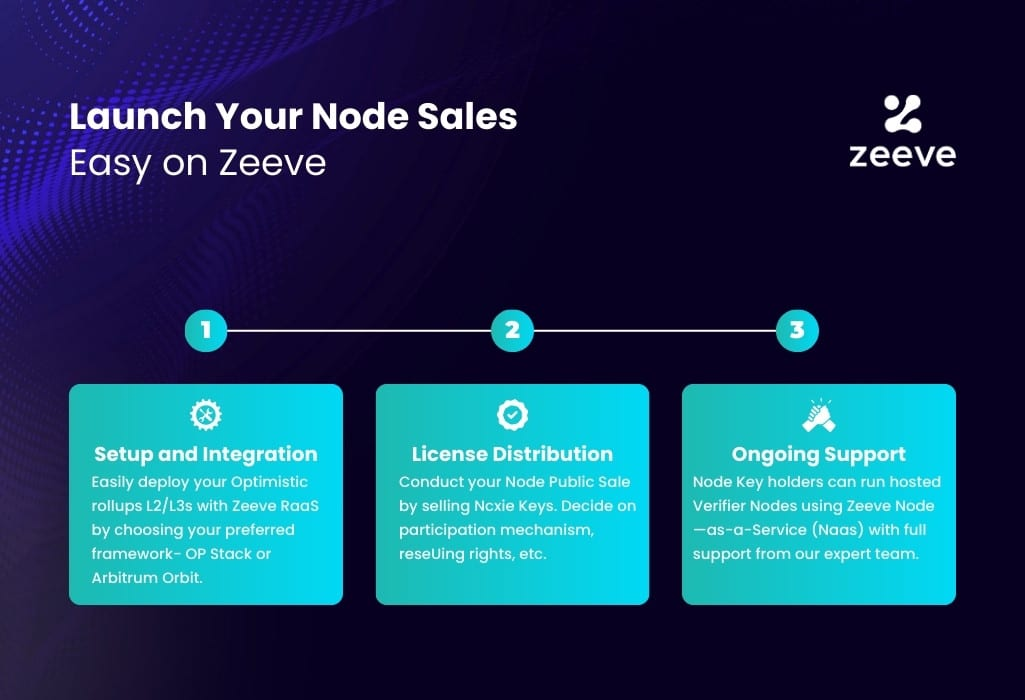 <p>As discussed, verifier nodes introduce an innovative concept for enhancing security and decentralization on rollup protocols. Looking forward, we expect a lot of <a href="https://www.zeeve.io/appchains/optimistic-rollups/">optimistic rollup</a> L2/L3s, especially for the new players, to leverage verifier nodes into their networks. However, for a simple selling approach, they can always use Zeeve’s verifier node sale launchpad. Also, Zeeve offers node-as—a-service (NaaS) for people interested in running, managing, and scaling verifier nodes with the benefits of a fully hosted service. For other RaaS services or blockchain-related offerings at Zeeve, <a href="https://www.zeeve.io/talk-to-an-expert/">connect with our experts</a>. Mail us your queries or discuss your project requirements in detail on a one-to-one call. </p> |
| json metadata | {"tags":["nodesalelaunchpad"],"image":["https://cdn.steemitimages.com/DQmQkM2rS5QpkvnxHEgK3VQ4pkJCxvwjzJxgEuRbHZQack2/image.png","https://www.zeeve.io/wp-content/uploads/2024/05/Launch-DevNet-for-your-preferred-Optimistic-Rollup-in-a-snap-1024x213.jpg","https://dev-to-uploads.s3.amazonaws.com/uploads/articles/wn6d43hqcbxbqycfvzd9.png"],"links":["https://www.zeeve.io/rollups/","https://www.zeeve.io/appchains/optimistic-rollups/","https://www.zeeve.io/","https://www.zeeve.io/talk-to-an-expert/"],"app":"steemit/0.2","format":"markdown"} |
| parent author | |
| parent permlink | nodesalelaunchpad |
| permlink | zeeve-launchpad-for-node-sale-infrastructure-boost-security-and-token-utility-in-rollups |
| title | Zeeve Launchpad for Node Sale Infrastructure: Boost Security & Token Utility in Rollups |
| Transaction Info | Block #88861101/Trx e1675aa88bf8ca99c2639de9620b04d47ff97cc4 |
View Raw JSON Data
{
"block": 88861101,
"op": [
"comment",
{
"author": "zeevedeeptech",
"body": "\n<p>Zeeve is expanding its <a href=\"https://www.zeeve.io/rollups/\">rollups-as-a-service (RaaS)</a> offering with an advanced node sale launchpad for the node sale infrastructure. All kinds of optimistic rollup projects seeking to add an additional security and monitoring layer can leverage the Launchpad service to implement a robust verifier node system in their ecosystem. And, with that, web3 projects can create new paths for enhanced security, additional token utility and funding options. Let’s dive deeper to understand more about Zeeve’s Verifier node sale launchpad also while briefing verifier nodes, the node sale process, and the projects that have announced verifier node sale. </p>\n<h2 class=\"wp-block-heading\" id=\"h-what-exactly-are-verifier-nodes\">What exactly are verifier nodes?</h2>\n<p>Verifier nodes, also sometimes called checker or sentry nodes, refer to an additional standalone component responsible for maintaining security and robustness for <a href=\"https://www.zeeve.io/appchains/optimistic-rollups/\">Layer2 optimistic rollups</a>. Instead of assuming the transactions to be valid after the challenge period, you can actually appoint honest third-party screeners who will proactively monitor the entire on-chain operations and ensure there are no errors or malicious activities that potentially hamper security and decentralization. </p>\n<a href=\"https://www.zeeve.io/appchains/optimistic-rollups/\"><img src=\"https://www.zeeve.io/wp-content/uploads/2024/05/Launch-DevNet-for-your-preferred-Optimistic-Rollup-in-a-snap-1024x213.jpg\" alt=\"Verifier Node Sale Launchpad\" class=\"wp-image-68638\"/></a>\n<p>Projects are free to set criteria for operators interested in running verifier nodes. For example, the staking requirement can differ, hardware requirements can be distinct, etc. With everything in place, you can simply sell node licenses to the node operators so that they can set up and run nodes on their system. However, rollups first need to add a verifier node layer into their protocol, which can be complex. And that’s where Zeeve’s verifier node sale infrastructure helps. We will learn more about this later in the article.</p>\n<h2 class=\"wp-block-heading\" id=\"h-why-are-more-l2-l3-rollups-opting-for-node-sales-nbsp\">Why are more L2/L3 rollups opting for node sales? </h2>\n<p>Following are some of the top benefits that Layer2/ Layer3 Optimistic rollups can leverage through verifier nodes:</p>\n<li><strong>Enhanced network security & decentralization: </strong></li>\n<p>The most important role of verifier nodes is to act as a powerful, unbiased screener for the rollup transactions, ensuring security compliance and standards at each network layer. Note that verifier nodes do more than just detect fraudulent activities. They are optimized to achieve significant enforcement against misbehaving nodes and protect users’ sensitive data. Due to their decentralized structure, verifier nodes eliminate challenges like single points of failure to achieve greater reliability.</p>\n<li><strong>Additional token utility:</strong></li>\n<p>Adding more utility to native tokens can be a challenge for independent Rollups. That’s because tokenomics in L2/L3s are not as mature as established layer1 blockchains. Through verifier nodes, networks allow node operators to lock/stake their tokens, pay a transaction fee in the native token, and receive an incentive in the same native token for their contribution to ensuring security and decentralization. This way, rollups add significant utility to their token and generate its higher demand.</p>\n<li><strong>A solid source of funding: </strong></li>\n<p>Getting enough funds is definitely a big challenge for Web3 projects. Now, they have another funding option through verifier nodes. By selling the node license for a continued duration, projects can unlock a solid revenue stream to support the development of their protocol in the long run. A good example of this is HYCHAIN, which raised 8M+ funding through the sale of 16000+ node license keys in just 2 days. </p>\n<li><strong>Community engagement: </strong></li>\n<p>Rollup protocols that want to build their<strong> </strong>brand and reputation often seek better community engagement. Through verifier nodes, optimistic rollups entail the seamless participation of additional, community-run nodes that promote community engagement without much heavy lifting. </p>\n<h2 class=\"wp-block-heading\" id=\"h-how-does-the-entire-node-sale-process-work-nbsp\">How does the entire node sale process work? </h2>\n<p>Although new, verifier nodes have started getting traction across rollups due to the tremendous benefits we discussed above. However, we must understand that the implementation of an additional validation system like verifier nodes is not supported natively on optimistic rollups as of now. </p>\n<p>Therefore, Layer2 rollup projects need the service offered by RaaS providers. These providers allow rollups to seamlessly add verifier node systems to their ecosystem and sell node licenses to eligible operators. The software for implementing verifier nodes and the node license — both components are essential for node sale, which projects require from their RaaS partner.</p>\n<h2 class=\"wp-block-heading\" id=\"h-protocols-that-have-announced-verifier-node-sales-so-far\">Protocols that have announced verifier node sales so far:</h2>\n<li><strong>Athier- </strong>Aethir, the reliable provider of decentralized GPU cloud infrastructure, announced its AI node sale a few months ago. The network has decided to make 10,000 nodes available for sale via a tiered pricing approach, which will be sold publicly. The initial price for checker nodes is decided to start from $500, and the node license will be sold as NFTs. Further, checker nodes on Athier are transferable 1-year after their sale, and there will be no cap on the number of nodes one can purchase.</li>\n\n<li><strong>KIP protocol-</strong> KIP protocol, one of the pioneers in merging blockchain technology with AI, has recently announced the upcoming sale of KIP checker nodes. It is confirmed that node licenses will be distributed as NFTs to operators. Checker nodes have an important role in the KIP protocol’s overall operation and governance. Hence, these nodes monitor KIP’s distributed verification system and consensus-based checking to ensure the network’s integrity and decentralization remain intact. KIP rewards its node operators with $KIP tokens while claiming to have allotted 20% of the total $KIP token supply as rewards.</li>\n\n<li><strong>XAI Protocol-</strong> XAI, the Ethereum Layer2 scaling solution, has announced the sale of its sentry nodes, which are in charge of monitoring the XAI rollup ecosystem. Node runners on XAI are required to stake esXAI and abide by a probabilistic algorithm to determine their rewards. Starting in 2023, XAI sentry node sales started at $300 for Tier-1 nodes, and the price went up with every tier. Also, XAI claimed that the protocol will only offer 50,000 Sentry nodes. To operate a sentry node, operators must purchase at least 1 Sentry license key, and they successfully pass the KYC screening to be eligible for rewards.</li>\n\n<li><strong>CARV Protocol: </strong>CARV protocol, the modular data layer for enabling seamless exchange of data and value distribution, has announced its verifier node sale. Verifier nodes on CARV validate the on-chain TEE attestations, confirming if the outcome is reliable and their process aligns with the data privacy standards. CARV mainly has two offerings: buy a license key (non-transferrable NFTs) and run a node or delegate your license key to NaaS (node-as–a-service) providers. For both scenarios, CARV claims to distribute 25% of the $CARV token supply to verifiers. </li>\n\n<h2 class=\"wp-block-heading\" id=\"h-try-zeeve-s-verifier-node-sale-launchpad-super-easy-way-to-sell-node-licenses\">Try Zeeve’s verifier node sale launchpad: Super easy way to sell node licenses</h2>\n<p>Zeeve’s verifier node sale launchpad is designed to serve all kinds of Optimistic rollup chains. For example, L2s built with Arbitrum Orbit or OP Stack can leverage the launchpad service to add a verifier node layer into their protocol and thereby open up the node license for sale. </p>\n<p>Essentially, <a href=\"https://www.zeeve.io/\">Zeeve</a> provides the set of software needed for the implementation of the verifier node infrastructure into rollups, as well as the node license that node operators will buy to run their verifier nodes. </p>\n<p>By doing this, Zeeve streamlines verifier node sales for Optimistic L2/L3s, allowing them to leverage benefits like unparalleled security, easy funding, and additional token utility. Here’s an image showing how you can launch & manage verifier node sales with Zeeve in some simple steps:</p>\n\n\n<p>As discussed, verifier nodes introduce an innovative concept for enhancing security and decentralization on rollup protocols. Looking forward, we expect a lot of <a href=\"https://www.zeeve.io/appchains/optimistic-rollups/\">optimistic rollup</a> L2/L3s, especially for the new players, to leverage verifier nodes into their networks. However, for a simple selling approach, they can always use Zeeve’s verifier node sale launchpad. Also, Zeeve offers node-as—a-service (NaaS) for people interested in running, managing, and scaling verifier nodes with the benefits of a fully hosted service. For other RaaS services or blockchain-related offerings at Zeeve, <a href=\"https://www.zeeve.io/talk-to-an-expert/\">connect with our experts</a>. Mail us your queries or discuss your project requirements in detail on a one-to-one call. </p>",
"json_metadata": "{\"tags\":[\"nodesalelaunchpad\"],\"image\":[\"https://cdn.steemitimages.com/DQmQkM2rS5QpkvnxHEgK3VQ4pkJCxvwjzJxgEuRbHZQack2/image.png\",\"https://www.zeeve.io/wp-content/uploads/2024/05/Launch-DevNet-for-your-preferred-Optimistic-Rollup-in-a-snap-1024x213.jpg\",\"https://dev-to-uploads.s3.amazonaws.com/uploads/articles/wn6d43hqcbxbqycfvzd9.png\"],\"links\":[\"https://www.zeeve.io/rollups/\",\"https://www.zeeve.io/appchains/optimistic-rollups/\",\"https://www.zeeve.io/\",\"https://www.zeeve.io/talk-to-an-expert/\"],\"app\":\"steemit/0.2\",\"format\":\"markdown\"}",
"parent_author": "",
"parent_permlink": "nodesalelaunchpad",
"permlink": "zeeve-launchpad-for-node-sale-infrastructure-boost-security-and-token-utility-in-rollups",
"title": "Zeeve Launchpad for Node Sale Infrastructure: Boost Security & Token Utility in Rollups"
}
],
"op_in_trx": 0,
"timestamp": "2024-09-23T05:27:30",
"trx_id": "e1675aa88bf8ca99c2639de9620b04d47ff97cc4",
"trx_in_block": 1,
"virtual_op": 0
}zeevedeeptechpublished a new post: step-by-step-guide-to-build-an-op-stack-rollup-devnet-with-zeeve-raas2024/09/17 06:12:18
zeevedeeptechpublished a new post: step-by-step-guide-to-build-an-op-stack-rollup-devnet-with-zeeve-raas
2024/09/17 06:12:18
| author | zeevedeeptech |
| body |  <p>OP Stack is one of the oldest and matured rollup frameworks, which is developed by OP Labs to focus on offering a high-quality, shared, and completely open-source system. If you are launching an OP Stack chain or superchain, you will need to set up a DevNet environment for troubleshooting purposes, such as testing the configurations, nodes, functionalities, and network connectivity to ensure the chain functions as expected. </p> <p>Through this step-by-step guide, we will continue our DIY rollup deployment series by making today’s article focused on the step-by-step process to deploy your OP Stack devNet launch within minutes via a simple, low-code approach facilitated by Zeeve RaaS. </p> <p>Similar guides we’ve done for <a href="https://www.zeeve.io/blog/a-comprehensive-guide-on-polygon-cdk-and-its-deployment/">Polygon CDK</a>, <a href="https://www.zeeve.io/blog/launch-your-first-zksync-hyperchain-test-rigorously-deploy-to-publicnet/">Zk Stack Hyperchain</a>, and <a href="https://www.zeeve.io/blog/deploy-an-arbitrum-orbit-devnet-with-zeeve-raas-your-diy-guide/">Arbitrum Orbit</a>. </p> <h2 class="wp-block-heading" id="h-why-op-stack-is-a-preferred-option-for-top-web3-projects">Why OP Stack is a preferred option for top web3 projects?</h2> <p>Since launch, <a href="https://www.zeeve.io/appchains/optimistic-rollups/">OP Stack</a> has been recognized as a high quality, comprehensive framework for building production-quality Optimistic rollup L2 and L3 chains. Now after the Bedrock upgrade, OP Stack supports creation of even powerful OP Stack chains that will leverage the following features:</p> <ul> <li>Bedrock implements a unique data compression technique to reduce the network fees significantly– by 10% and meanwhile removing the execution gas from Layer1.</li> <li>After Bedrock, the deposit time has been reduced from 10 minutes to merely 3 minutes, contributing to better user experience and performance.</li> <li>OP Stack now enables rollup chains to maintain as high Ethereum equivalency as possible. Also, Bedrock supports EIP-1559, chain-reorgs along with all the important Ethereum features available for Layer1.</li> <li>With Bedrock, rollups have the ease to either use fraud or validity proof for correct execution of rollup inputs. This approach enables implementation of innovative systems like cannon for fault proving.</li> <li>Node performance is improved significantly after Bedrock as technical debt such as the need for an independent ‘data transport layer’ has been eliminated.</li> <!-- /wp:list-item --></ul> <p>There are a lot more on Bedrock that are worth mentioning for OP Stack rollups, such as enhanced modularity of chains, code reuse, quick withdrawals, revamped batch processing, block derivation, etc that you can read in-depth from more things <a href="https://community.optimism.io/docs/developers/bedrock/">here</a>.</p> <a href="https://www.zeeve.io/rollups/"><img src="https://www.zeeve.io/wp-content/uploads/2024/05/Get-faster-time-to-market-for-your-production-grade-L2L3s-1-1024x213.jpg" alt="Guide to deploy OP Stack DevNet" class="wp-image-68128"/></a> <p>With such next-gen features, OP Stack keeps adding a range of innovative, top-grade L2/L3 projects to its ecosystem, such as Base, Blast L2, Mantle Network, Metic L2, Zircuit L2, Mode Network, Aevo, BNB Chain, etc. For a comprehensive view into industry-wise leading OP Stack projects, check out the detailed guide linked below: <a href="https://www.zeeve.io/blog/inside-op-stack-universe-latest-greatest-projects-to-watch-in-2024/">Inside OP Stack Universe: Latest & Greatest Projects to Watch in 2024</a></p> <h2 class="wp-block-heading" id="h-quick-walkthrough-of-zeeve-s-op-stack-raas-stack">Quick walkthrough of Zeeve’s OP Stack RaaS Stack</h2> <p>Zeeve offers a comprehensive RaaS stack for all the leading rollup frameworks, including OP stack. </p> <ol> <li><strong>Production-grade infrastructure: </strong>Deploy your OP Stack rollups on Zeeve’s production-grade, highly optimized infrastructure to deploy, manage, and scale OP Stack rollups. Your rollups will benefit from powerful APIs, load-balancers, and security best practices with Enterprise SLAs.</li> <li><strong>One-click deployment sandbox: </strong>Use low-code OP Stack sandbox tool to setup your own DevNet before launching a fully-functional public testnet or mainnet. Access to sandbox is free for limited launches and it’s optimized for low-code deployment. We will learn more about the sandbox later in this guide.</li> <li><strong>40+ third-party rollup service integrations: </strong>If you want modularity in your OP Stack rollups, Zeeve RaaS allows you do so with its wide range of <a href="https://www.zeeve.io/integrations/">3rd party rollup integration list</a> comprising of decentralized sequencers, Alt DA layer, account abstraction, prover, custom block explorers, and a lot more. </li> <li><strong>24/7 monitoring with Enterprise SLA: </strong>All your OP stack rollups deployed through Zeeve RaaS will be monitored on critical parameters, such as node performance, resource consumption, block height, etc to ensure 99.9% uptime with Enterprise SLAs. </li> <li><strong>Ready-to-use, pluggable components: </strong>Free up significant development time by leveraging the ready-to-use rollup chain components offered at Zeeve RaaS. From custom data indexers to cross-chain bridges, MPC/AA-backed wallet, and testnet faucets– you will get everything in the form of pluggable components.</li> </ol> <h2 class="wp-block-heading" id="h-deploy-your-own-op-stack-rollup-devnet-with-zeeve-raas-step-by-step-guide-nbsp">Deploy your own OP Stack Rollup DevNet with Zeeve RaaS: Step-by-step guide </h2> <p>Now that we understand the basics of OP Stack and Zeeve’s OP Stack RaaS, let’s time to move to DevNet setup with Zeeve RaaS platform. Below is a step-by-step process for the same:</p> <p><strong>Step:1</strong> Login or signup to the Zeeve RaaS platform. From the dashboard, navigate to the ‘Appchains & Rollups’ section and click on ‘OP Stack’. </p>  <p><strong>Step:2</strong> A new dashboard will appear with the option to deploy OP Stack DevNet as well as a pre-deployed demo account. The purpose of this demo is to provide you hands-on access to a full-powered DevNet where you can interact with the setup, perform a range of activities such as sending/receiving tokens via bridges, using RPCs to fetch data, check transactions on explorer, and much more. Basically, the demo account gives you the confidence you need to set up your own DevNet. Check out this <a href="https://www.zeeve.io/blog/test-drive-zksync-hyperchain-on-zeeves-fully-powered-demo-network/">guide</a> for an in depth overview of the Zeeve demo account offerings on Zeeve RaaS. </p>  <p><strong>Step:3</strong> From the above dashboard, click on the ‘Deploy DevNet’ button and continue deploying your first OP Stack DevNet. However, Zeeve also gives you the flexibility to setup public testnet and mainnet through the same portal in a few clicks. As you can see, the OP Stack DevNet comes with 1-1 nodes for OP, Ethereum RPC, OP-Geth, OP-batcher, and OP-proposer. Also, you will get default smart contracts deployed on L1& L2, asset bridge, L1 & L2 supported explorer, 24/7 monitoring & analytics dashboard. All these offerings you can access for free in the Zeeve’s 30-days trial period.</p> <p><strong>Step:4 </strong>Now to set up your OP Stack DevNet, provide the basic network details required on the dashboard, such as The name for your OP Stack DevNet, workspace, account address in where you would like to permit some tokens, and also the Ether account balance for this address so that you can get started with the transactions and thereby engage/interact with the network.</p> <p>As you can see, we have picked ‘MyOPRollup’ name for our OP DevNet, workspace is set to default, and we’ve pulled the preminted account address and its account balance. The option for settlement layer is Ethereum as of now. </p>  <p><strong>Step:5</strong> Also, there’s the settlement layer which is provided as ‘Ethereum’ on Zeeve RaaS as of now. That means, you can deploy Layer2 OP stack rollup with Zeeve using Ethereum as your main chain for transaction settlement.</p> <p><strong>Step:6</strong> For DA layer and sequencer, Zeeve Raas supports modularity, allowing you to choose Layer1 like Ethereum for on-chain data availability or move to off-chain data availability with alternative DA providers such as Celestia, NEAR DA, Avail, and Eigen DA. Depending on the level of modularity you expect from your OP Chain, you can configure the setup.</p> <p><strong>Step:7</strong> The another important aspect of your OP Stack DevNet is ‘Integrations’. Zeeve’s RaaS stack is optimized to Zeeve-Managed cross-chain bridges, RPCs, and customizable block explorers. Also, it supports a bunch of 3rd party rollup service integrations, including decentralized oracles, block explorers, decentralized storage, MPC wallets, and a range of powerful developer tools to simplify development on various EVM chains. </p>  <p><strong>Step:8. </strong>Cross-verify all the configurations you’ve done so far and click on ‘Deploy’ to launch your OP Stack DevNet. Go back to the dashboard and it will show your DevNet with its environment (DevNet) and status (ready or syncing). The status will change to ‘Ready’ once the network is fully synched.</p>  <h2 class="wp-block-heading" id="h-24-7-monitoring-amp-analytics-for-your-op-stack-devnet">24/7 Monitoring & Analytics for your OP Stack DevNet</h2> <p>Once your DevNet is ready, you can start monitoring its network to get vital 24/7 analytics and real-time alerts. For that, click ‘view’ as shown in the above image. A new page will appear showing the comprehensive details of your OP Stack DevNet.</p> <li>Here’s what analytics you will get from the <strong>overview </strong>option.</li>  <li><strong>My nodes</strong>–Get details about nodes that underpins your DevNet network, such as Node ID, Name, Status, and creation info.</li>  <li><strong>Smart contracts</strong>– Check out the contract deployed on the Layer1 and Layer2 ecosystem. Dive deeper into the transactions by analyzing them on explorer. Click on the explorer icon under ‘Actions’ and explore further details.</li>  <li><strong>Bridge</strong>– Analytics for bridge operations will appear once you integrate a native bridge on your OP Stack chain. Contact Zeeve team for an effortless bridge integration. However, for TestNet and mainnet, you will automatically get a native bridge integrated already in your chain. </li>  <p>Further, the ‘Explorer’ and ‘Analytics’ options on the Zeeve RaaS platform will allow you to get transactional activities for Layer1/Layer2 through their explorers and analytics will appear for node, OP Node, Log, and real-time alerts (if any). Note that alerts are produced and get solved immediately to ensure a seamless performance of your network. </p>  <h2 class="wp-block-heading" id="h-ready-to-launch-testnet-or-mainnet">Ready to launch Testnet or Mainnet?</h2><p>That’s how easily you can set up your own OP Stack DevNet and test drive all the broad configurations and OP Stack-specific functionalities. Similar instructions can follow for launching your testnet or mainnet on Zeeve RaaS; only the options for integrations will expand to enable the highest degree of modularity. While Zeeve’s RaaS platform is standardized, we understand that your project’s requirements may differ. Hence, you can <a href="https://www.zeeve.io/talk-to-an-expert/">set up a call with our web3 experts</a> or send all your queries via email to us. We will handle all your queries diligently and provide you a solution as quickly as possible.</p> |
| json metadata | {"tags":["opstack","rollups"],"image":["https://cdn.steemitimages.com/DQmezgmq1GhnArXCZHeEMrXRVmxRhHWH3ZDoacipQRE8sa1/image.png","https://www.zeeve.io/wp-content/uploads/2024/05/Get-faster-time-to-market-for-your-production-grade-L2L3s-1-1024x213.jpg","https://dev-to-uploads.s3.amazonaws.com/uploads/articles/wnncc7j3d3i29nosco8j.png","https://dev-to-uploads.s3.amazonaws.com/uploads/articles/9ngu0u2gp98d39f9vmbl.png","https://dev-to-uploads.s3.amazonaws.com/uploads/articles/8gx3j7pscn9keq7e623v.png","https://dev-to-uploads.s3.amazonaws.com/uploads/articles/r3cflw0a6ki6mhz08a6o.png","https://dev-to-uploads.s3.amazonaws.com/uploads/articles/8zspng8tisrdaknusp4m.png","https://dev-to-uploads.s3.amazonaws.com/uploads/articles/4031eorxnnua7mf49iu6.png","https://dev-to-uploads.s3.amazonaws.com/uploads/articles/k547842um1klsd0aecn5.png","https://dev-to-uploads.s3.amazonaws.com/uploads/articles/kqiume9m0em8ybneyvul.png","https://dev-to-uploads.s3.amazonaws.com/uploads/articles/n1ht2xv120s6sv41kl06.png","https://dev-to-uploads.s3.amazonaws.com/uploads/articles/da72v7t5n4p53i1vfvic.png"],"links":["https://www.zeeve.io/blog/a-comprehensive-guide-on-polygon-cdk-and-its-deployment/","https://www.zeeve.io/blog/launch-your-first-zksync-hyperchain-test-rigorously-deploy-to-publicnet/","https://www.zeeve.io/blog/deploy-an-arbitrum-orbit-devnet-with-zeeve-raas-your-diy-guide/","https://www.zeeve.io/appchains/optimistic-rollups/","https://community.optimism.io/docs/developers/bedrock/","https://www.zeeve.io/rollups/","https://www.zeeve.io/blog/inside-op-stack-universe-latest-greatest-projects-to-watch-in-2024/","https://www.zeeve.io/integrations/","https://www.zeeve.io/blog/test-drive-zksync-hyperchain-on-zeeves-fully-powered-demo-network/","https://www.zeeve.io/talk-to-an-expert/"],"app":"steemit/0.2","format":"markdown"} |
| parent author | |
| parent permlink | opstack |
| permlink | step-by-step-guide-to-build-an-op-stack-rollup-devnet-with-zeeve-raas |
| title | Step-by-step guide to Build an OP Stack Rollup DevNet with Zeeve RaaS |
| Transaction Info | Block #88689566/Trx 82a4cdd51ac5c03a638b250a3137dcfcc3c0e83d |
View Raw JSON Data
{
"block": 88689566,
"op": [
"comment",
{
"author": "zeevedeeptech",
"body": "\n<p>OP Stack is one of the oldest and matured rollup frameworks, which is developed by OP Labs to focus on offering a high-quality, shared, and completely open-source system. If you are launching an OP Stack chain or superchain, you will need to set up a DevNet environment for troubleshooting purposes, such as testing the configurations, nodes, functionalities, and network connectivity to ensure the chain functions as expected. </p>\n<p>Through this step-by-step guide, we will continue our DIY rollup deployment series by making today’s article focused on the step-by-step process to deploy your OP Stack devNet launch within minutes via a simple, low-code approach facilitated by Zeeve RaaS. </p>\n<p>Similar guides we’ve done for <a href=\"https://www.zeeve.io/blog/a-comprehensive-guide-on-polygon-cdk-and-its-deployment/\">Polygon CDK</a>, <a href=\"https://www.zeeve.io/blog/launch-your-first-zksync-hyperchain-test-rigorously-deploy-to-publicnet/\">Zk Stack Hyperchain</a>, and <a href=\"https://www.zeeve.io/blog/deploy-an-arbitrum-orbit-devnet-with-zeeve-raas-your-diy-guide/\">Arbitrum Orbit</a>. </p>\n<h2 class=\"wp-block-heading\" id=\"h-why-op-stack-is-a-preferred-option-for-top-web3-projects\">Why OP Stack is a preferred option for top web3 projects?</h2>\n<p>Since launch, <a href=\"https://www.zeeve.io/appchains/optimistic-rollups/\">OP Stack</a> has been recognized as a high quality, comprehensive framework for building production-quality Optimistic rollup L2 and L3 chains. Now after the Bedrock upgrade, OP Stack supports creation of even powerful OP Stack chains that will leverage the following features:</p>\n<ul>\n<li>Bedrock implements a unique data compression technique to reduce the network fees significantly– by 10% and meanwhile removing the execution gas from Layer1.</li>\n<li>After Bedrock, the deposit time has been reduced from 10 minutes to merely 3 minutes, contributing to better user experience and performance.</li>\n<li>OP Stack now enables rollup chains to maintain as high Ethereum equivalency as possible. Also, Bedrock supports EIP-1559, chain-reorgs along with all the important Ethereum features available for Layer1.</li>\n<li>With Bedrock, rollups have the ease to either use fraud or validity proof for correct execution of rollup inputs. This approach enables implementation of innovative systems like cannon for fault proving.</li>\n<li>Node performance is improved significantly after Bedrock as technical debt such as the need for an independent ‘data transport layer’ has been eliminated.</li>\n<!-- /wp:list-item --></ul>\n<p>There are a lot more on Bedrock that are worth mentioning for OP Stack rollups, such as enhanced modularity of chains, code reuse, quick withdrawals, revamped batch processing, block derivation, etc that you can read in-depth from more things <a href=\"https://community.optimism.io/docs/developers/bedrock/\">here</a>.</p>\n<a href=\"https://www.zeeve.io/rollups/\"><img src=\"https://www.zeeve.io/wp-content/uploads/2024/05/Get-faster-time-to-market-for-your-production-grade-L2L3s-1-1024x213.jpg\" alt=\"Guide to deploy OP Stack DevNet\" class=\"wp-image-68128\"/></a>\n<p>With such next-gen features, OP Stack keeps adding a range of innovative, top-grade L2/L3 projects to its ecosystem, such as Base, Blast L2, Mantle Network, Metic L2, Zircuit L2, Mode Network, Aevo, BNB Chain, etc. For a comprehensive view into industry-wise leading OP Stack projects, check out the detailed guide linked below: <a href=\"https://www.zeeve.io/blog/inside-op-stack-universe-latest-greatest-projects-to-watch-in-2024/\">Inside OP Stack Universe: Latest & Greatest Projects to Watch in 2024</a></p>\n<h2 class=\"wp-block-heading\" id=\"h-quick-walkthrough-of-zeeve-s-op-stack-raas-stack\">Quick walkthrough of Zeeve’s OP Stack RaaS Stack</h2>\n<p>Zeeve offers a comprehensive RaaS stack for all the leading rollup frameworks, including OP stack. </p>\n<ol>\n<li><strong>Production-grade infrastructure: </strong>Deploy your OP Stack rollups on Zeeve’s production-grade, highly optimized infrastructure to deploy, manage, and scale OP Stack rollups. Your rollups will benefit from powerful APIs, load-balancers, and security best practices with Enterprise SLAs.</li>\n<li><strong>One-click deployment sandbox: </strong>Use low-code OP Stack sandbox tool to setup your own DevNet before launching a fully-functional public testnet or mainnet. Access to sandbox is free for limited launches and it’s optimized for low-code deployment. We will learn more about the sandbox later in this guide.</li>\n<li><strong>40+ third-party rollup service integrations: </strong>If you want modularity in your OP Stack rollups, Zeeve RaaS allows you do so with its wide range of <a href=\"https://www.zeeve.io/integrations/\">3rd party rollup integration list</a> comprising of decentralized sequencers, Alt DA layer, account abstraction, prover, custom block explorers, and a lot more. </li>\n<li><strong>24/7 monitoring with Enterprise SLA: </strong>All your OP stack rollups deployed through Zeeve RaaS will be monitored on critical parameters, such as node performance, resource consumption, block height, etc to ensure 99.9% uptime with Enterprise SLAs. </li>\n<li><strong>Ready-to-use, pluggable components: </strong>Free up significant development time by leveraging the ready-to-use rollup chain components offered at Zeeve RaaS. From custom data indexers to cross-chain bridges, MPC/AA-backed wallet, and testnet faucets– you will get everything in the form of pluggable components.</li>\n</ol>\n<h2 class=\"wp-block-heading\" id=\"h-deploy-your-own-op-stack-rollup-devnet-with-zeeve-raas-step-by-step-guide-nbsp\">Deploy your own OP Stack Rollup DevNet with Zeeve RaaS: Step-by-step guide </h2>\n<p>Now that we understand the basics of OP Stack and Zeeve’s OP Stack RaaS, let’s time to move to DevNet setup with Zeeve RaaS platform. Below is a step-by-step process for the same:</p>\n<p><strong>Step:1</strong> Login or signup to the Zeeve RaaS platform. From the dashboard, navigate to the ‘Appchains & Rollups’ section and click on ‘OP Stack’. </p>\n\n\n<p><strong>Step:2</strong> A new dashboard will appear with the option to deploy OP Stack DevNet as well as a pre-deployed demo account. The purpose of this demo is to provide you hands-on access to a full-powered DevNet where you can interact with the setup, perform a range of activities such as sending/receiving tokens via bridges, using RPCs to fetch data, check transactions on explorer, and much more. Basically, the demo account gives you the confidence you need to set up your own DevNet. Check out this <a href=\"https://www.zeeve.io/blog/test-drive-zksync-hyperchain-on-zeeves-fully-powered-demo-network/\">guide</a> for an in depth overview of the Zeeve demo account offerings on Zeeve RaaS. </p>\n\n\n<p><strong>Step:3</strong> From the above dashboard, click on the ‘Deploy DevNet’ button and continue deploying your first OP Stack DevNet. However, Zeeve also gives you the flexibility to setup public testnet and mainnet through the same portal in a few clicks. As you can see, the OP Stack DevNet comes with 1-1 nodes for OP, Ethereum RPC, OP-Geth, OP-batcher, and OP-proposer. Also, you will get default smart contracts deployed on L1& L2, asset bridge, L1 & L2 supported explorer, 24/7 monitoring & analytics dashboard. All these offerings you can access for free in the Zeeve’s 30-days trial period.</p>\n<p><strong>Step:4 </strong>Now to set up your OP Stack DevNet, provide the basic network details required on the dashboard, such as The name for your OP Stack DevNet, workspace, account address in where you would like to permit some tokens, and also the Ether account balance for this address so that you can get started with the transactions and thereby engage/interact with the network.</p>\n<p>As you can see, we have picked ‘MyOPRollup’ name for our OP DevNet, workspace is set to default, and we’ve pulled the preminted account address and its account balance. The option for settlement layer is Ethereum as of now. </p>\n\n\n<p><strong>Step:5</strong> Also, there’s the settlement layer which is provided as ‘Ethereum’ on Zeeve RaaS as of now. That means, you can deploy Layer2 OP stack rollup with Zeeve using Ethereum as your main chain for transaction settlement.</p>\n<p><strong>Step:6</strong> For DA layer and sequencer, Zeeve Raas supports modularity, allowing you to choose Layer1 like Ethereum for on-chain data availability or move to off-chain data availability with alternative DA providers such as Celestia, NEAR DA, Avail, and Eigen DA. Depending on the level of modularity you expect from your OP Chain, you can configure the setup.</p>\n<p><strong>Step:7</strong> The another important aspect of your OP Stack DevNet is ‘Integrations’. Zeeve’s RaaS stack is optimized to Zeeve-Managed cross-chain bridges, RPCs, and customizable block explorers. Also, it supports a bunch of 3rd party rollup service integrations, including decentralized oracles, block explorers, decentralized storage, MPC wallets, and a range of powerful developer tools to simplify development on various EVM chains. </p>\n\n\n<p><strong>Step:8. </strong>Cross-verify all the configurations you’ve done so far and click on ‘Deploy’ to launch your OP Stack DevNet. Go back to the dashboard and it will show your DevNet with its environment (DevNet) and status (ready or syncing). The status will change to ‘Ready’ once the network is fully synched.</p>\n\n\n<h2 class=\"wp-block-heading\" id=\"h-24-7-monitoring-amp-analytics-for-your-op-stack-devnet\">24/7 Monitoring & Analytics for your OP Stack DevNet</h2>\n<p>Once your DevNet is ready, you can start monitoring its network to get vital 24/7 analytics and real-time alerts. For that, click ‘view’ as shown in the above image. A new page will appear showing the comprehensive details of your OP Stack DevNet.</p>\n<li>Here’s what analytics you will get from the <strong>overview </strong>option.</li>\n\n\n<li><strong>My nodes</strong>–Get details about nodes that underpins your DevNet network, such as Node ID, Name, Status, and creation info.</li>\n\n\n<li><strong>Smart contracts</strong>– Check out the contract deployed on the Layer1 and Layer2 ecosystem. Dive deeper into the transactions by analyzing them on explorer. Click on the explorer icon under ‘Actions’ and explore further details.</li>\n\n\n<li><strong>Bridge</strong>– Analytics for bridge operations will appear once you integrate a native bridge on your OP Stack chain. Contact Zeeve team for an effortless bridge integration. However, for TestNet and mainnet, you will automatically get a native bridge integrated already in your chain. </li>\n\n\n<p>Further, the ‘Explorer’ and ‘Analytics’ options on the Zeeve RaaS platform will allow you to get transactional activities for Layer1/Layer2 through their explorers and analytics will appear for node, OP Node, Log, and real-time alerts (if any). Note that alerts are produced and get solved immediately to ensure a seamless performance of your network. </p>\n\n\n<h2 class=\"wp-block-heading\" id=\"h-ready-to-launch-testnet-or-mainnet\">Ready to launch Testnet or Mainnet?</h2><p>That’s how easily you can set up your own OP Stack DevNet and test drive all the broad configurations and OP Stack-specific functionalities. Similar instructions can follow for launching your testnet or mainnet on Zeeve RaaS; only the options for integrations will expand to enable the highest degree of modularity. While Zeeve’s RaaS platform is standardized, we understand that your project’s requirements may differ. Hence, you can <a href=\"https://www.zeeve.io/talk-to-an-expert/\">set up a call with our web3 experts</a> or send all your queries via email to us. We will handle all your queries diligently and provide you a solution as quickly as possible.</p>",
"json_metadata": "{\"tags\":[\"opstack\",\"rollups\"],\"image\":[\"https://cdn.steemitimages.com/DQmezgmq1GhnArXCZHeEMrXRVmxRhHWH3ZDoacipQRE8sa1/image.png\",\"https://www.zeeve.io/wp-content/uploads/2024/05/Get-faster-time-to-market-for-your-production-grade-L2L3s-1-1024x213.jpg\",\"https://dev-to-uploads.s3.amazonaws.com/uploads/articles/wnncc7j3d3i29nosco8j.png\",\"https://dev-to-uploads.s3.amazonaws.com/uploads/articles/9ngu0u2gp98d39f9vmbl.png\",\"https://dev-to-uploads.s3.amazonaws.com/uploads/articles/8gx3j7pscn9keq7e623v.png\",\"https://dev-to-uploads.s3.amazonaws.com/uploads/articles/r3cflw0a6ki6mhz08a6o.png\",\"https://dev-to-uploads.s3.amazonaws.com/uploads/articles/8zspng8tisrdaknusp4m.png\",\"https://dev-to-uploads.s3.amazonaws.com/uploads/articles/4031eorxnnua7mf49iu6.png\",\"https://dev-to-uploads.s3.amazonaws.com/uploads/articles/k547842um1klsd0aecn5.png\",\"https://dev-to-uploads.s3.amazonaws.com/uploads/articles/kqiume9m0em8ybneyvul.png\",\"https://dev-to-uploads.s3.amazonaws.com/uploads/articles/n1ht2xv120s6sv41kl06.png\",\"https://dev-to-uploads.s3.amazonaws.com/uploads/articles/da72v7t5n4p53i1vfvic.png\"],\"links\":[\"https://www.zeeve.io/blog/a-comprehensive-guide-on-polygon-cdk-and-its-deployment/\",\"https://www.zeeve.io/blog/launch-your-first-zksync-hyperchain-test-rigorously-deploy-to-publicnet/\",\"https://www.zeeve.io/blog/deploy-an-arbitrum-orbit-devnet-with-zeeve-raas-your-diy-guide/\",\"https://www.zeeve.io/appchains/optimistic-rollups/\",\"https://community.optimism.io/docs/developers/bedrock/\",\"https://www.zeeve.io/rollups/\",\"https://www.zeeve.io/blog/inside-op-stack-universe-latest-greatest-projects-to-watch-in-2024/\",\"https://www.zeeve.io/integrations/\",\"https://www.zeeve.io/blog/test-drive-zksync-hyperchain-on-zeeves-fully-powered-demo-network/\",\"https://www.zeeve.io/talk-to-an-expert/\"],\"app\":\"steemit/0.2\",\"format\":\"markdown\"}",
"parent_author": "",
"parent_permlink": "opstack",
"permlink": "step-by-step-guide-to-build-an-op-stack-rollup-devnet-with-zeeve-raas",
"title": "Step-by-step guide to Build an OP Stack Rollup DevNet with Zeeve RaaS"
}
],
"op_in_trx": 0,
"timestamp": "2024-09-17T06:12:18",
"trx_id": "82a4cdd51ac5c03a638b250a3137dcfcc3c0e83d",
"trx_in_block": 6,
"virtual_op": 0
}zeevedeeptechpublished a new post: socialfi-deep-dive-how-it-is-constructing-social-network-for-future2024/09/16 05:42:39
zeevedeeptechpublished a new post: socialfi-deep-dive-how-it-is-constructing-social-network-for-future
2024/09/16 05:42:39
| author | zeevedeeptech |
| body |  <p>As per <a href="https://statusbrew.com/insights/social-media-statistics/#:~:text=62.6%25%20of%20the%20world's%20population,per%20day%20using%20social%20media.">statistics</a>, out of 7 B people in the world, a staggering 5.07 B people actively spend close to 140 minutes daily on social media. During this time span, they actively engage with numerous products, advertisements and many other things on social media. At one end of the spectrum, the platforms and creators benefit from such an activity but on the other side of the spectrum, the users, which are the major chunks contributing to the growth of the social platforms and their content creators couldn’t freely exercise control over their data, speech and their ability to monetize their participation. However, that narrative is changing when social media is fusing with decentralized finance to launch a new concept known as SocialFi. </p> <h2 class="wp-block-heading" id="h-what-is-socialfi">What is SocialFi?</h2> <p>SocialFi is a portmanteau of social media that blends two concepts together: <a href="https://www.zeeve.io/blog/decentralized-social-media/">Social Media and Decentralized Finance</a>. To put that into perspective, if you have used Patreaon, you will understand that Patreon acts as a platform gratifying the Patreon ecosystem and the content creators. For example, the content creator sets aside a value-generating segment of the content as paid and demands users to pay for the access.</p> <a href="https://www.zeeve.io/rollups/"><img src="https://www.zeeve.io/wp-content/uploads/2024/05/Launch-your-application-specific-rollup-chain-in-minutes-1024x213.jpg" alt="What is SocialFi" class="wp-image-68036"/></a> <p>Such a practice might sound a bit off, right? But, why do content creators do that? </p> <p>The content creators are forced to practice this because the platform introduces unpredictable algorithmic updates and uncontested revenue sharing models making them as marketing engines, which dilutes creators’ interest. As a result, the creators are forced to deploy such revenue models where they can remain sustainable for long through a forced subscription model, even at the cost of diluting the user's interest. But SocialFi changes that equation by allowing the creators to directly connect with the users, bypassing restrictive hurdles imposed by centralized platforms and keeping users in the revenue equation as equal partners. </p> <h2 class="wp-block-heading" id="h-how-socialfi-works-to-achieve-that">How SocialFi Works To Achieve That?</h2> <p>SocialFi uses the DAO model and tokens for achieving this. DAOs or decentralized Autonomous Organizations take charge of the platform governance and prevent developers from altering any line of code that could deincentivize creators. </p> <p><strong>How? </strong></p> <p>For example, a developer might program an algorithm in such a way that it can throw away creators from the search and visibility section on a Web 2 social platform. But in SocialFi, the DAO is in full control. So, even if a developer wants to do that, he/she will have to get that approved by the DAO, in which the members are creators and users along with developers. </p> <p>Hence, allowing creators to exercise equal control over their content and directly communicate with the users. As a result, they can incentivize/reward the users/subscribers directly from their revenue stream since they are not dependent on the platform to bring them to their content; which results in revenue. </p> <p>Moreover, the use of cryptocurrencies and smart-contracts ensure the creators directly pay to their community and fandom for their support encouraging their participation. </p> <h2 class="wp-block-heading" id="h-why-is-socialfi-needed-nbsp">Why is SocialFi Needed? </h2> <h3 class="wp-block-heading" id="h-decentralization-nbsp">Decentralization </h3> <p>Most of the traditional Web 2 platforms have a murkier track record. For example, platforms like Facebook have abused subscribers' data as per the <a href="https://www.nytimes.com/2018/04/04/us/politics/cambridge-analytica-scandal-fallout.html">Cambridge Analytica Scandal</a>. SocialFi decouples the practice of storing the data on a single server. On the contrary, the users have complete control over their data and they can choose how they wish to monetize their data. Likewise, the creators can also directly interact with the users and post contents irrespective of a forced filter imposed on them while using traditional Web 2 social platforms. </p> <h3 class="wp-block-heading" id="h-censorship-nbsp">Censorship </h3> <p>Censorship is a necessary evil. However, it should not have a one-size-fits- all approach. For example, most of the OTT platforms and social media contents are getting censored. China is an imminent example to quote here. In China, there’s very little freedom of speech exercised. SocialFi can help balance the same by decentralizing the on-chain data. To put that simply, some of the contents on the given OTT platforms ought to be censored as shown in the image below. </p> <p>These are perfect. But censoring against the general view of the state and its political atmosphere suppresses the right to speak against injustice. For example, in China, the Chinese Communist Party censors anything that doesn’t go in accordance with their narratives and propaganda. Having SocialFi abstracts this dependency since on-chain data can be decentralized and made readily available across a wider network of nodes. The DAOs can actively participate and decide which content to show and which ones to hide. Since, the decisions will be collectively taken by consensus through DAOs, creators/users will be given more freedom than they get in a traditional Web 2 platform. </p> <h3 class="wp-block-heading" id="h-monetization-nbsp">Monetization </h3> <p>In the traditional Web 2 social platform, there's a limited revenue stream for creators as well as viewers. However, SocialFi introduces new models where creators can resort to social tokens to avoid spamming of the contents through bots and other means. At the same time, the viewers/users can also extract value from their undivided support to creators by tapping into their revenue streams through tokens and rewards. </p> <h2 class="wp-block-heading" id="h-how-socialfi-can-tackle-increasing-scalability-needs">How SocialFi Can Tackle Increasing Scalability Needs?</h2> <p>When you look into Facebook, it more or less generates 4 petabytes of data per day comprising 510,000 comments, 293,000 status updates, 4 million post likes and over 136,000 photos uploaded. With that being said, if blockchains have to accommodate the same degree of scalability, they need indexing, block size management, warp sync and sharding to address scalability. Such efficacies are hard to meet on a traditional Layer 1 or Layer 2 blockchains. Platforms like EOS.IO, and Theta Network, Base, and Lens Protocol have been specifically designed to meet with such demands. </p> <h2 class="wp-block-heading" id="h-growth-potential-of-socialfi-in-web-3">Growth Potential of SocialFi in Web 3</h2> <p>Traditional Web 2 social media has shown a significant jump from $219.06 B in 2023 to $251.45 billion in 2024, growing at a CAGR of 14.8%. In case you are wondering how SocialFi has performed, they have already clocked $5.5 B and the momentum is showing no signs of stopping ever since 2022 onwards. </p>  <p>In 2024, due to very high censorship and control during the coverage of the FTX scandal, the shift to DeSoc was already evident; flawed revenue models of Web2 social platforms have given more mileage to SocialFi with DeSoc, bundling as one unique concept as shown below in the <a href="https://x.com/JeanineHoman0/status/1791823908217164268">charts</a>. Hence, it wouldn’t be an understatement to say that SocialFi will soon see the light of the day as more users explore the efficacy and trade-offs it can generate in the long run. </p>  <h2 class="wp-block-heading" id="h-key-socialfi-projects-to-watch-out-for-monetization-nbsp-in-2024">Key SocialFi Projects To Watch Out For Monetization in 2024</h2> <h3 class="wp-block-heading" id="h-farcaster">Farcaster</h3> <p>Farcaster has integrated the whole of the social platform as one on Ethereum and Optimism chain. For example, there’s no interoperability among traditional social media platforms like Instagram, Twitter, Facebook and LinkedIn. Farcaster has not only eliminated censorship, and control over one’s data; along with this, it has also made a revolutionary addition of eliminating bot spamming of social platforms and interoperability with other Socialfi apps developed on the same blockchain. For example, someone might use one’s influence to make an account or post trends on social media by introducing bot activities. Through Farcaster’s 5$ sign up fees that limits a single account interaction throughout the year to 5,000 casts, 2,500 reactions, and 2,500 links or photo posts, it can seemingly look after the spamming scams wreaking havoc on social platforms. </p> <h3 class="wp-block-heading" id="h-friendzone">FriendZone</h3> <p>FriendZone is another SocialFi app launching on the Polygon PoS blockchain. Their vision is to restrict a single entity controlling the entire social platform. For that reason, they have introduced specific models like private alpha groups, bounties, experiences, pay-per-view, giveaways, raffles, and personalized interactions. These specific revenue models allow users to interact with the creators and brands and receive their share of revenue in their growth. In this way, as the network of the brands grows, their earning grows along with the creators and the users seeing their creations and engaging with them. </p> <h3 class="wp-block-heading" id="h-open-campus">Open Campus</h3> <p>Open Campus is another key socialFi project to watch out for in 2024 . The reason to launch Open Campus was people posting valuable content and information on social media. However, though the platform benefits from such valuable information through network activity and brands willing to advertise on them, the creators are rarely compensated for bringing the activity on the platform. Through Open Campus, which is hosted on the Polygon and Ethereum chain for now, creators who are posting valuable content will be compensated for all the views, likes and shares. </p> <p>Subsequently, the community will also be rewarded for making such posts viral and they can tap into their own personal activity to make such valuable content posts and shares reach out to a larger audience. Some of the projects which have launched on Open Campus like TinyTap have doubled its sales in the last two years and it has emerged as the top application for childers. TinyTaps 12 NFTs from its 2 NFT auctions representing their specific courses customized for children have raised 240 ETH selling them as course materials for childrens. Anticipating such huge network activity, in the near future, Open Campus will soon migrate to their own app specific chain known as EDU chain, but the dates have not been revealed yet. </p> <h3 class="wp-block-heading" id="h-lens-protocol">Lens Protocol</h3> <p>Lens Protocol, launched on the Polygon PoS chain, helps overcome the problem that Facebook has exposed in its operations: abusing user’s data. On the Lens Protocol, the creators are in full control of making connections with the community and using them for traction. However, there’s no one way traffic for data as far as the creator's tapping into the fanbase is concerned. </p> <p>On the other hand, the Lens Protocol will allow the users to have full control over their data. As a result, if the creator wants to flood their walls with ads of brands or use their data for random push notification, in the first place, these creators will need permission from the users. The users can subsequently charge the creators directly for using their data to show ads or help them communicate with the products or brands directly. </p> <h3 class="wp-block-heading" id="h-theta">Theta</h3> <p>Theta Network, which is launched on the Theta Chain unveils the concept of decentralized video delivery network. On this social platform, anyone can pledge their resources in the form of storage for video streaming and sharing and get tokens in return for the same. Those who are pledging their storage bandwidth get ThetaFuels or TFuels. Through Theta, now it is possible to enjoy cheaper video streaming and watching favorite shows at a fraction of a cost, which key platforms like NetFlix and Amazon Prime are charging excessively for.</p> <h2 class="wp-block-heading" id="h-conclusion-nbsp">Conclusion </h2> <p>We have barely scratched the surface when it comes to evolving the next gen solutions through the use of decentralized technologies. Sectors ripe for adoption like social media have already embraced the changes. In the near future, we will also see how blockchains will be upgrading other segments like GameFI through DeFi, which is another segment undergoing rigorous exploitation at the hands of developers and gaming corporations. </p> <p>If you are building a SocialFI platform, and looking to use any of the leading rollup frameworks, like, OP Stack, Arbitrum Orbit, Polygon CDK, and zkSync ZK Stack, use our RaaS to launch your DevNet in minutes and move to testnet/mainnet smoothly after rigorous testing. <br><a href="https://www.zeeve.io/talk-to-an-expert/">Schedule a call with us</a> to learn more and see how Zeeve RaaS can help you simplify your SocialFi experience.</p> |
| json metadata | {"tags":["blockchaintechology"],"image":["https://cdn.steemitimages.com/DQmWRVwYXyewJQS9QbAmiZygoC7JzzSpT3dKaS5dHn5ecTZ/image.png","https://www.zeeve.io/wp-content/uploads/2024/05/Launch-your-application-specific-rollup-chain-in-minutes-1024x213.jpg","https://dev-to-uploads.s3.amazonaws.com/uploads/articles/tcy4j8usp8v60r9kz4e1.png","https://dev-to-uploads.s3.amazonaws.com/uploads/articles/x49v8dhxhvtscqmf4ets.png"],"links":["https://statusbrew.com/insights/social-media-statistics/#:~:text=62.6%25%20of%20the%20world's%20population,per%20day%20using%20social%20media.","https://www.zeeve.io/blog/decentralized-social-media/","https://www.zeeve.io/rollups/","https://www.nytimes.com/2018/04/04/us/politics/cambridge-analytica-scandal-fallout.html","https://x.com/JeanineHoman0/status/1791823908217164268","https://www.zeeve.io/talk-to-an-expert/"],"app":"steemit/0.2","format":"markdown"} |
| parent author | |
| parent permlink | blockchaintechology |
| permlink | socialfi-deep-dive-how-it-is-constructing-social-network-for-future |
| title | SocialFi Deep Dive: How it is constructing social network for future? |
| Transaction Info | Block #88660239/Trx 1672943f627c8a89861a25894cf9a555b8c6d3a6 |
View Raw JSON Data
{
"block": 88660239,
"op": [
"comment",
{
"author": "zeevedeeptech",
"body": "\n<p>As per <a href=\"https://statusbrew.com/insights/social-media-statistics/#:~:text=62.6%25%20of%20the%20world's%20population,per%20day%20using%20social%20media.\">statistics</a>, out of 7 B people in the world, a staggering 5.07 B people actively spend close to 140 minutes daily on social media. During this time span, they actively engage with numerous products, advertisements and many other things on social media. At one end of the spectrum, the platforms and creators benefit from such an activity but on the other side of the spectrum, the users, which are the major chunks contributing to the growth of the social platforms and their content creators couldn’t freely exercise control over their data, speech and their ability to monetize their participation. However, that narrative is changing when social media is fusing with decentralized finance to launch a new concept known as SocialFi. </p>\n<h2 class=\"wp-block-heading\" id=\"h-what-is-socialfi\">What is SocialFi?</h2>\n<p>SocialFi is a portmanteau of social media that blends two concepts together: <a href=\"https://www.zeeve.io/blog/decentralized-social-media/\">Social Media and Decentralized Finance</a>. To put that into perspective, if you have used Patreaon, you will understand that Patreon acts as a platform gratifying the Patreon ecosystem and the content creators. For example, the content creator sets aside a value-generating segment of the content as paid and demands users to pay for the access.</p>\n<a href=\"https://www.zeeve.io/rollups/\"><img src=\"https://www.zeeve.io/wp-content/uploads/2024/05/Launch-your-application-specific-rollup-chain-in-minutes-1024x213.jpg\" alt=\"What is SocialFi\" class=\"wp-image-68036\"/></a>\n<p>Such a practice might sound a bit off, right? But, why do content creators do that? </p>\n<p>The content creators are forced to practice this because the platform introduces unpredictable algorithmic updates and uncontested revenue sharing models making them as marketing engines, which dilutes creators’ interest. As a result, the creators are forced to deploy such revenue models where they can remain sustainable for long through a forced subscription model, even at the cost of diluting the user's interest. But SocialFi changes that equation by allowing the creators to directly connect with the users, bypassing restrictive hurdles imposed by centralized platforms and keeping users in the revenue equation as equal partners. </p>\n<h2 class=\"wp-block-heading\" id=\"h-how-socialfi-works-to-achieve-that\">How SocialFi Works To Achieve That?</h2>\n<p>SocialFi uses the DAO model and tokens for achieving this. DAOs or decentralized Autonomous Organizations take charge of the platform governance and prevent developers from altering any line of code that could deincentivize creators. </p>\n<p><strong>How? </strong></p>\n<p>For example, a developer might program an algorithm in such a way that it can throw away creators from the search and visibility section on a Web 2 social platform. But in SocialFi, the DAO is in full control. So, even if a developer wants to do that, he/she will have to get that approved by the DAO, in which the members are creators and users along with developers. </p>\n<p>Hence, allowing creators to exercise equal control over their content and directly communicate with the users. As a result, they can incentivize/reward the users/subscribers directly from their revenue stream since they are not dependent on the platform to bring them to their content; which results in revenue. </p>\n<p>Moreover, the use of cryptocurrencies and smart-contracts ensure the creators directly pay to their community and fandom for their support encouraging their participation. </p>\n<h2 class=\"wp-block-heading\" id=\"h-why-is-socialfi-needed-nbsp\">Why is SocialFi Needed? </h2>\n<h3 class=\"wp-block-heading\" id=\"h-decentralization-nbsp\">Decentralization </h3>\n<p>Most of the traditional Web 2 platforms have a murkier track record. For example, platforms like Facebook have abused subscribers' data as per the <a href=\"https://www.nytimes.com/2018/04/04/us/politics/cambridge-analytica-scandal-fallout.html\">Cambridge Analytica Scandal</a>. SocialFi decouples the practice of storing the data on a single server. On the contrary, the users have complete control over their data and they can choose how they wish to monetize their data. Likewise, the creators can also directly interact with the users and post contents irrespective of a forced filter imposed on them while using traditional Web 2 social platforms. </p>\n<h3 class=\"wp-block-heading\" id=\"h-censorship-nbsp\">Censorship </h3>\n<p>Censorship is a necessary evil. However, it should not have a one-size-fits- all approach. For example, most of the OTT platforms and social media contents are getting censored. China is an imminent example to quote here. In China, there’s very little freedom of speech exercised. SocialFi can help balance the same by decentralizing the on-chain data. To put that simply, some of the contents on the given OTT platforms ought to be censored as shown in the image below. </p>\n<p>These are perfect. But censoring against the general view of the state and its political atmosphere suppresses the right to speak against injustice. For example, in China, the Chinese Communist Party censors anything that doesn’t go in accordance with their narratives and propaganda. Having SocialFi abstracts this dependency since on-chain data can be decentralized and made readily available across a wider network of nodes. The DAOs can actively participate and decide which content to show and which ones to hide. Since, the decisions will be collectively taken by consensus through DAOs, creators/users will be given more freedom than they get in a traditional Web 2 platform. </p>\n<h3 class=\"wp-block-heading\" id=\"h-monetization-nbsp\">Monetization </h3>\n<p>In the traditional Web 2 social platform, there's a limited revenue stream for creators as well as viewers. However, SocialFi introduces new models where creators can resort to social tokens to avoid spamming of the contents through bots and other means. At the same time, the viewers/users can also extract value from their undivided support to creators by tapping into their revenue streams through tokens and rewards. </p>\n<h2 class=\"wp-block-heading\" id=\"h-how-socialfi-can-tackle-increasing-scalability-needs\">How SocialFi Can Tackle Increasing Scalability Needs?</h2>\n<p>When you look into Facebook, it more or less generates 4 petabytes of data per day comprising 510,000 comments, 293,000 status updates, 4 million post likes and over 136,000 photos uploaded. With that being said, if blockchains have to accommodate the same degree of scalability, they need indexing, block size management, warp sync and sharding to address scalability. Such efficacies are hard to meet on a traditional Layer 1 or Layer 2 blockchains. Platforms like EOS.IO, and Theta Network, Base, and Lens Protocol have been specifically designed to meet with such demands. </p>\n<h2 class=\"wp-block-heading\" id=\"h-growth-potential-of-socialfi-in-web-3\">Growth Potential of SocialFi in Web 3</h2>\n<p>Traditional Web 2 social media has shown a significant jump from $219.06 B in 2023 to $251.45 billion in 2024, growing at a CAGR of 14.8%. In case you are wondering how SocialFi has performed, they have already clocked $5.5 B and the momentum is showing no signs of stopping ever since 2022 onwards. </p>\n\n\n<p>In 2024, due to very high censorship and control during the coverage of the FTX scandal, the shift to DeSoc was already evident; flawed revenue models of Web2 social platforms have given more mileage to SocialFi with DeSoc, bundling as one unique concept as shown below in the <a href=\"https://x.com/JeanineHoman0/status/1791823908217164268\">charts</a>. Hence, it wouldn’t be an understatement to say that SocialFi will soon see the light of the day as more users explore the efficacy and trade-offs it can generate in the long run. </p>\n\n\n<h2 class=\"wp-block-heading\" id=\"h-key-socialfi-projects-to-watch-out-for-monetization-nbsp-in-2024\">Key SocialFi Projects To Watch Out For Monetization in 2024</h2>\n<h3 class=\"wp-block-heading\" id=\"h-farcaster\">Farcaster</h3>\n<p>Farcaster has integrated the whole of the social platform as one on Ethereum and Optimism chain. For example, there’s no interoperability among traditional social media platforms like Instagram, Twitter, Facebook and LinkedIn. Farcaster has not only eliminated censorship, and control over one’s data; along with this, it has also made a revolutionary addition of eliminating bot spamming of social platforms and interoperability with other Socialfi apps developed on the same blockchain. For example, someone might use one’s influence to make an account or post trends on social media by introducing bot activities. Through Farcaster’s 5$ sign up fees that limits a single account interaction throughout the year to 5,000 casts, 2,500 reactions, and 2,500 links or photo posts, it can seemingly look after the spamming scams wreaking havoc on social platforms. </p>\n<h3 class=\"wp-block-heading\" id=\"h-friendzone\">FriendZone</h3>\n<p>FriendZone is another SocialFi app launching on the Polygon PoS blockchain. Their vision is to restrict a single entity controlling the entire social platform. For that reason, they have introduced specific models like private alpha groups, bounties, experiences, pay-per-view, giveaways, raffles, and personalized interactions. These specific revenue models allow users to interact with the creators and brands and receive their share of revenue in their growth. In this way, as the network of the brands grows, their earning grows along with the creators and the users seeing their creations and engaging with them. </p>\n<h3 class=\"wp-block-heading\" id=\"h-open-campus\">Open Campus</h3>\n<p>Open Campus is another key socialFi project to watch out for in 2024 . The reason to launch Open Campus was people posting valuable content and information on social media. However, though the platform benefits from such valuable information through network activity and brands willing to advertise on them, the creators are rarely compensated for bringing the activity on the platform. Through Open Campus, which is hosted on the Polygon and Ethereum chain for now, creators who are posting valuable content will be compensated for all the views, likes and shares. </p>\n<p>Subsequently, the community will also be rewarded for making such posts viral and they can tap into their own personal activity to make such valuable content posts and shares reach out to a larger audience. Some of the projects which have launched on Open Campus like TinyTap have doubled its sales in the last two years and it has emerged as the top application for childers. TinyTaps 12 NFTs from its 2 NFT auctions representing their specific courses customized for children have raised 240 ETH selling them as course materials for childrens. Anticipating such huge network activity, in the near future, Open Campus will soon migrate to their own app specific chain known as EDU chain, but the dates have not been revealed yet. </p>\n<h3 class=\"wp-block-heading\" id=\"h-lens-protocol\">Lens Protocol</h3>\n<p>Lens Protocol, launched on the Polygon PoS chain, helps overcome the problem that Facebook has exposed in its operations: abusing user’s data. On the Lens Protocol, the creators are in full control of making connections with the community and using them for traction. However, there’s no one way traffic for data as far as the creator's tapping into the fanbase is concerned. </p>\n<p>On the other hand, the Lens Protocol will allow the users to have full control over their data. As a result, if the creator wants to flood their walls with ads of brands or use their data for random push notification, in the first place, these creators will need permission from the users. The users can subsequently charge the creators directly for using their data to show ads or help them communicate with the products or brands directly. </p>\n<h3 class=\"wp-block-heading\" id=\"h-theta\">Theta</h3>\n<p>Theta Network, which is launched on the Theta Chain unveils the concept of decentralized video delivery network. On this social platform, anyone can pledge their resources in the form of storage for video streaming and sharing and get tokens in return for the same. Those who are pledging their storage bandwidth get ThetaFuels or TFuels. Through Theta, now it is possible to enjoy cheaper video streaming and watching favorite shows at a fraction of a cost, which key platforms like NetFlix and Amazon Prime are charging excessively for.</p>\n<h2 class=\"wp-block-heading\" id=\"h-conclusion-nbsp\">Conclusion </h2>\n<p>We have barely scratched the surface when it comes to evolving the next gen solutions through the use of decentralized technologies. Sectors ripe for adoption like social media have already embraced the changes. In the near future, we will also see how blockchains will be upgrading other segments like GameFI through DeFi, which is another segment undergoing rigorous exploitation at the hands of developers and gaming corporations. </p>\n<p>If you are building a SocialFI platform, and looking to use any of the leading rollup frameworks, like, OP Stack, Arbitrum Orbit, Polygon CDK, and zkSync ZK Stack, use our RaaS to launch your DevNet in minutes and move to testnet/mainnet smoothly after rigorous testing. <br><a href=\"https://www.zeeve.io/talk-to-an-expert/\">Schedule a call with us</a> to learn more and see how Zeeve RaaS can help you simplify your SocialFi experience.</p>",
"json_metadata": "{\"tags\":[\"blockchaintechology\"],\"image\":[\"https://cdn.steemitimages.com/DQmWRVwYXyewJQS9QbAmiZygoC7JzzSpT3dKaS5dHn5ecTZ/image.png\",\"https://www.zeeve.io/wp-content/uploads/2024/05/Launch-your-application-specific-rollup-chain-in-minutes-1024x213.jpg\",\"https://dev-to-uploads.s3.amazonaws.com/uploads/articles/tcy4j8usp8v60r9kz4e1.png\",\"https://dev-to-uploads.s3.amazonaws.com/uploads/articles/x49v8dhxhvtscqmf4ets.png\"],\"links\":[\"https://statusbrew.com/insights/social-media-statistics/#:~:text=62.6%25%20of%20the%20world's%20population,per%20day%20using%20social%20media.\",\"https://www.zeeve.io/blog/decentralized-social-media/\",\"https://www.zeeve.io/rollups/\",\"https://www.nytimes.com/2018/04/04/us/politics/cambridge-analytica-scandal-fallout.html\",\"https://x.com/JeanineHoman0/status/1791823908217164268\",\"https://www.zeeve.io/talk-to-an-expert/\"],\"app\":\"steemit/0.2\",\"format\":\"markdown\"}",
"parent_author": "",
"parent_permlink": "blockchaintechology",
"permlink": "socialfi-deep-dive-how-it-is-constructing-social-network-for-future",
"title": "SocialFi Deep Dive: How it is constructing social network for future?"
}
],
"op_in_trx": 0,
"timestamp": "2024-09-16T05:42:39",
"trx_id": "1672943f627c8a89861a25894cf9a555b8c6d3a6",
"trx_in_block": 1,
"virtual_op": 0
}zeevedeeptechpublished a new post: why-indie-web3-games-will-steal-the-spotlight-from-aaa-titles-in-20242024/09/16 05:29:36
zeevedeeptechpublished a new post: why-indie-web3-games-will-steal-the-spotlight-from-aaa-titles-in-2024
2024/09/16 05:29:36
| author | zeevedeeptech |
| body |  <p>The video gaming industry has seen a seismic shift in the past few years. Games initially seemed more interested in AAA games due to its highly immersive graphics and cutting-edge features. Now, the trend is heading more towards indie web3 games. As we know, web3 games already stand out with real money-earning and asset tokenization opportunities. Now that smaller studios are experimenting with multiplatform and multiplayer niches, indie game adoption is increasing rapidly and it is set to steal the spotlight from AAA titles in 2024. With that, several indie games, including Enshrouded, Palworld, and Manor Lords have sold more compared to AAA, with over 100M budgets. </p> <p>Considering this, our article dives into the future of <a href="https://www.zeeve.io/web3-infrastructure-for-gaming/">web3 gaming</a> to understand what drives the adoption of indie web3 games and how AAA gamers are shifting to indies. Also, we will explore some of the top web3 indies games for 2024.</p> <a href="https://www.zeeve.io/talk-to-an-expert/"><img src="https://www.zeeve.io/wp-content/uploads/2024/05/Launch-your-custom-gaming-L2L3s-quickly-with-Zeeve-1024x213.jpg" alt="" class="wp-image-67742"/></a> <h2 class="wp-block-heading" id="h-from-aaa-games-to-web3-indie-games-understanding-the-power-shift">From AAA games to Web3 Indie Games- understanding the power shift</h2> <p>AAA games have long had a monopoly over the Web2 gaming industry, and they are still popular due to their extensive budgets for incorporating powerful 3D graphics, high-performance infrastructure, advanced machine learning technology, and rigid connectivity on portable devices. These games are the products of world-famed studios like Activision Blizzard, Square Enix, Ubisoft, and Warner Bros.</p> <p>Despite the unmatched features and benefits of AAA title games, the players’ interests are now shifting considerably to indie web3 games in 2024. Indie games are the product of smaller studios that implement interesting gameplay loops and focus much on the trend; for example- most indie web3 games these days are based on RPG and shooter games as they are popular across gamers a lot. These games don't care much about the branding or incorporating very high-intensity graphics. Their end goal remains to keep players engaged, that’s it. Often starting with a single developer, indie web3 games are now set to contribute to massive successful games such as Minecraft, Terraria, or Stardew Valley.</p> <p>As you can see in the below image, Indie games make up 42% of the total gaming market, which clearly shows their significant role in shaping the future of web3 gaming. </p> 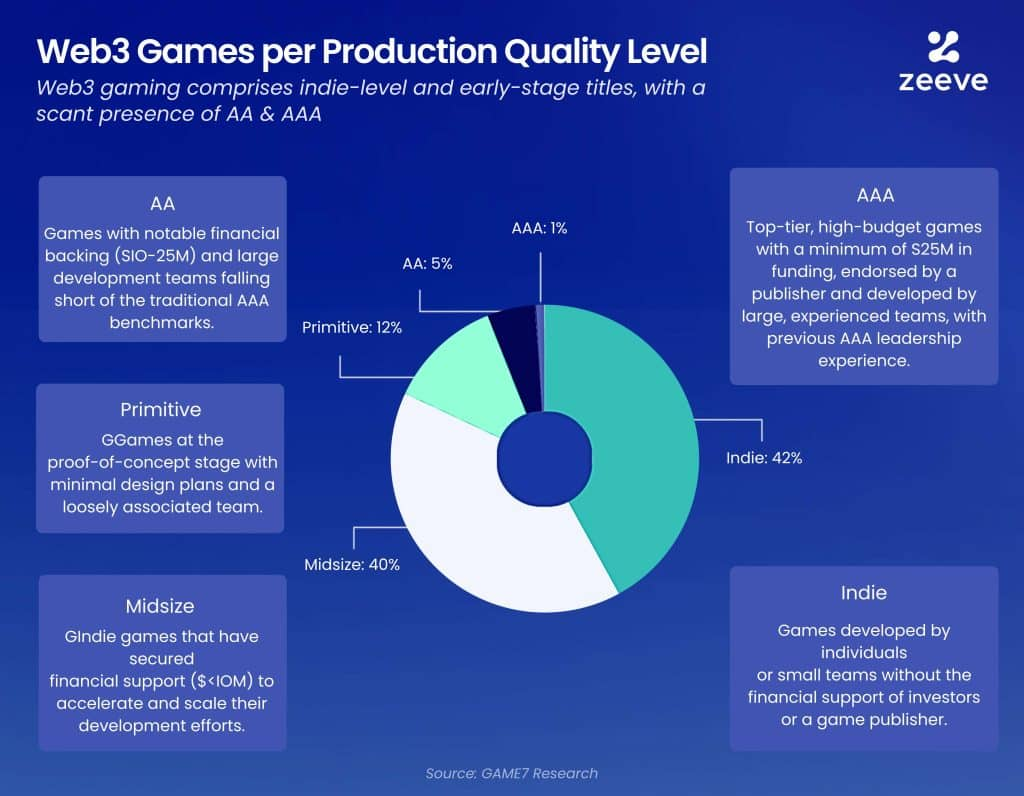 <p>If we look at the reasons why web3 indie games struggled to get enough popularity, then there will be a lack of funding support, demand outpacing, and less familiarity of players with the web3 space. Now that new funding methods are revolving around, such as in-app purchases, in-app advertising, as well as the innovative user-initiated marketplace;offerwall, indie games are able to make a hit. Additionally, gamers continue to show their interest in trying web3 games due to sure-shot earning opportunities, new game mechanics, and ownership aspects. </p> <h2 class="wp-block-heading" id="h-key-factors-driving-the-popularity-of-indie-web3-games-over-aaa-in-2024">Key factors driving the popularity of Indie web3 games over AAA in 2024</h2> <p>Following are the main factors that are contributing to the rapid adoption of web3 indie games in 2024. All these explanation justifies the future of web3 gaming, allowing you to better understand the whole picture:</p> <li><strong>Web3 indie games can easily experiment and take risks:</strong></li> <p>Indie web3 games are the product of smaller studios or sometimes even individual game developers who can easily afford to experiment with new genre blends and concepts that have the potential to peak gamers' interest. Constant testing and inclusion of new features result in higher success rates, allowing studios to come out with unique products every time. </p> <p>But, AAA studios are large, with a minimum budget allocated over 60M. At such huge spending, they cannot take the risk of innovating something different, which may or may not be sustained in the long run. Therefore, in most cases, AAA games are based on a similar concept that has gained popularity. There can be changes in graphics, characters, or some basic things. </p> <li><strong>Less cost required to develop and scale: </strong></li> <p>From upfront development costs to marketing, user acquisition, and ecosystem management– costs for all these aspects are lower in case of indie web3 games. All that is needed for a successful indie web3 game is: </p> <ul><!-- wp:list-item --> <li>Strong planning & strategy</li> <!-- /wp:list-item --> <!-- wp:list-item --> <li>Short game loop</li> <!-- /wp:list-item --> <!-- wp:list-item --> <li>No IAP (in-app purchases) or DLCs (downloadable content).</li> <!-- /wp:list-item --> <!-- wp:list-item --> <li>Minimal marketing </li> <!-- /wp:list-item --> <!-- wp:list-item --> <li>Usually, a small team and a low burn rate. </li> <!-- /wp:list-item --></ul> <p>Here, we can take the example of 'Only Up'- a small indie web3 game with over 50K downloads and a good number of daily active players. The reason for its success highly depends on the lead character's 'Goblin' Jacket. As we discussed, the game doesn't have huge funding or very intensive marketing but an interesting game loop that delivers players a few hours of exciting gameplay for just $10. </p> <li><strong>Higher rate of retention with low UA cost:</strong></li> <p>As evident, the success of a large base like AAA title games requires a huge player base to be profitable. But, since indie web3 games are small projects, they can achieve success easily by convincing a targeted portion of players. The success of indie games also depends highly on the web3 technology because players stay assured about their data privacy and asset ownership. The global ad for gaming apps is about to reach <a href="https://www.statista.com/statistics/280640/mobile-advertising-spending-worldwide/#:~:text=Global%20mobile%20ad%20spend%20stood,reach%20495%20billion%20U.S.%20dollars.">US$495 billion</a>- 431% higher in 2019, whereas player spending is recorded at only 1% higher in 2020. Looking at indie web3 games, user acquisition is more and they have 4.5x higher retention than AAA (as per GDC report and highlights).</p> <li><strong>Play-and-earn leads over Free-to-play model: </strong></li> <p>Most of the AAA games in Web2 are based on the traditional free-to-play model. While this can be a good option from the entertainment point of view, a significant portion of gamers show higher interest in play-and earn games. These gamers are professional players and passive income seekers who want to adopt gaming as their part-time/full-time career. In web3 indie games, GameFi presents a great opportunity for players to win digital assets, NFTs, rare in-game items, and tokens– all holding real-world value. Play-and-earn is already a multi-billion-dollar industry, and it is forecast to cross <a href="https://www.businessresearchinsights.com/market-reports/gamefi-market-102420">$38B by 2028</a>. </p> <li><strong>Asset ownership is becoming a great deal: </strong></li> <p>Indie web3 games are already getting the highlights with their interesting gameplay loops and AAA-like features. Additional factor that pushes its popularity beyond AAA games is the asset ownership thing. Asset ownership in web3 indie games is enabled through NFTs or non-fungible tokens. NFT-backed assets establish true ownership, allowing players to engage in the buying, selling, and trading of in-game assets beyond any boundaries or the fear of double-spending. This creates a 'true ownership' sense and thus opens up endless possibilities to diversify revenue streams along with increasing the user retention. </p> <li><strong>Higher average revenue: </strong></li> <p>GDC’s report further suggests that indie web3 games have around 7.2x higher average revenue per user and acquire an additional incremental revenue of over 20% annually. Here also, indie games are giving tough competition to AAA title games because their 70% of games are not giving expected profits, while their development cost has increased by 20% as of 2020. According to Gods Unchained’s data, web3 players contribute $130+ monthly revenue while recording more players than 25% of top mobile games. </p> 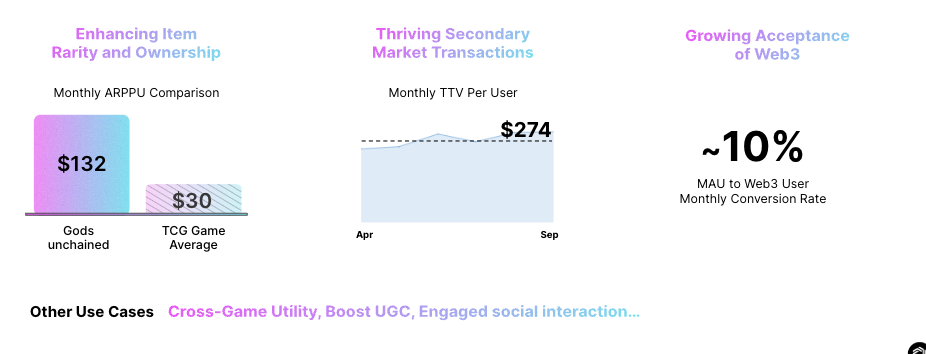 <p class="has-text-align-center">Image source: Immutable </p> <h2 class="wp-block-heading" id="h-a-look-at-top-indie-web3-games-in-2024">A look at Top Indie Web3 games in 2024</h2> <p>You may already be familiar with great indie web3 games such as Rocket League, Roguelite and Sim Management, Golf Story, and Moonlighter. However, let's have a look at the 05 best indie web3 games that are <a href="https://www.metaedge.gg/indie">leading most recently in 2024</a>. All of these games are powered with features like NFTs, GameFi, Metaverse, and play-to-earn. Let's dive in:</p> <li><strong>Overworld:</strong><strong> </strong>A free-to-play + play-to-earn game running on the Ethereum blockchain to drive transformation across social gaming. With a +2943% rise in its monthly trend, Overworld is doing well in keeping the players' challenges and engaging through meaningful gameplays.<br></li> <li><strong>MetalCore:</strong><strong> </strong>An immutable-based multiplayer PVE (Player versus environment game) that combines the high engagement of the traditional web2 games with the digital assets and in-game trading features of web3 gaming for an exciting experience. Every asset in MetalCore, from land, excluding gear, war machines, etc are NFTs and can be traded for real money. With a +1136% rise in trend, MetalCore appears as one of the best indie web3 games.<br></li> <li><strong>Evermoon: </strong>Evermoon is the next-gen 5v5 MOBA powered by Immutable blockchain. Players on Evermoon experience thrilling battles and dynamic gameplay and earn rewards in the DeFi ESports arena. Evermoon has opened its Beta testnet, NFT drops, and IGO and is preparing to roll out the mainnet soon. With a +405% rise in monthly trend, Evermoon secures a good position in the top web3 indie game list.<br></li> <li><strong>Legends of Venari</strong><strong>:</strong> Legends of Venari is an indie web3 game based on an innovative role-play concept built on Ethereum. The platform allows players to attract, tame, and collect all the Venari's creatures to compete for rare resources in a player-driven sandbox environment. Legends of Venari has a +194% rise in monthly trend as per <a href="https://www.metaedge.gg/indie">MetaEdge's stats</a>.<br></li> <li><strong>Stella Fantasy</strong><strong>:</strong> With a +69% rise in monthly trend, Stella Fantasy is the final name to appear in the top Web3 indie games. Stella Fantasy is an NFT-based role-playing battle game built on the Binance Smart chain (BSC). The game creates a unique experience for players through powerful characters, interesting material, and in-game items. </li> <h2 class="wp-block-heading" id="h-developments-down-the-road">Developments down the road</h2> <p>Our whole discussion around the future of web3 gaming concludes that Web3 has the power to lay the ground for notable development in indie web3 games and, meanwhile, solve the existing challenges, including funding issues and technological pain points like lack of interoperability. Considering this, we expect a lot of innovative indie games down the road in 2024 that will steal the spotlight from AAA titles. If you are interested in building indie web3 games or even AAA web3 games, connect with us. Our web3 developers have extensive experience in working with all blockchain-based games. Hence, you can choose what suits your project the best. </p> <p>Also, Zeeve’s Rollups-as–a-service (RaaS) stack assists you in launching your own L2/L3 chain using any leading framework, be it OP Stack, Zk Stack, Polygon CDK, or Arbitrum Orbit. You can also try our one-click deployment sandbox for all of these frameworks with free access for 30 days. </p> <p>For more information on our comprehensive blockchain services, send us an email or <a href="https://www.zeeve.io/talk-to-an-expert/">connect with our experts</a> on a one-to-one call. </p> |
| json metadata | {"tags":["web3gaming","web3"],"image":["https://cdn.steemitimages.com/DQmXx4hT7hBoeM617pe1nM32K8L9JdqcQVPqsS2A4iGrNby/image.png","https://www.zeeve.io/wp-content/uploads/2024/05/Launch-your-custom-gaming-L2L3s-quickly-with-Zeeve-1024x213.jpg","https://dev-to-uploads.s3.amazonaws.com/uploads/articles/w2sgbyde63e1870wcysw.png","https://dev-to-uploads.s3.amazonaws.com/uploads/articles/vytl1xaw2ur0xdfldcit.png"],"links":["https://www.zeeve.io/web3-infrastructure-for-gaming/","https://www.zeeve.io/talk-to-an-expert/","https://www.statista.com/statistics/280640/mobile-advertising-spending-worldwide/#:~:text=Global%20mobile%20ad%20spend%20stood,reach%20495%20billion%20U.S.%20dollars.","https://www.businessresearchinsights.com/market-reports/gamefi-market-102420","https://www.metaedge.gg/indie"],"app":"steemit/0.2","format":"markdown"} |
| parent author | |
| parent permlink | web3gaming |
| permlink | why-indie-web3-games-will-steal-the-spotlight-from-aaa-titles-in-2024 |
| title | Why Indie Web3 Games will Steal the Spotlight from AAA Titles in 2024? |
| Transaction Info | Block #88659980/Trx cd1e4c0082ac82553a171268a1a53e81d70de0bf |
View Raw JSON Data
{
"block": 88659980,
"op": [
"comment",
{
"author": "zeevedeeptech",
"body": "\n<p>The video gaming industry has seen a seismic shift in the past few years. Games initially seemed more interested in AAA games due to its highly immersive graphics and cutting-edge features. Now, the trend is heading more towards indie web3 games. As we know, web3 games already stand out with real money-earning and asset tokenization opportunities. Now that smaller studios are experimenting with multiplatform and multiplayer niches, indie game adoption is increasing rapidly and it is set to steal the spotlight from AAA titles in 2024. With that, several indie games, including Enshrouded, Palworld, and Manor Lords have sold more compared to AAA, with over 100M budgets. </p>\n<p>Considering this, our article dives into the future of <a href=\"https://www.zeeve.io/web3-infrastructure-for-gaming/\">web3 gaming</a> to understand what drives the adoption of indie web3 games and how AAA gamers are shifting to indies. Also, we will explore some of the top web3 indies games for 2024.</p>\n<a href=\"https://www.zeeve.io/talk-to-an-expert/\"><img src=\"https://www.zeeve.io/wp-content/uploads/2024/05/Launch-your-custom-gaming-L2L3s-quickly-with-Zeeve-1024x213.jpg\" alt=\"\" class=\"wp-image-67742\"/></a>\n<h2 class=\"wp-block-heading\" id=\"h-from-aaa-games-to-web3-indie-games-understanding-the-power-shift\">From AAA games to Web3 Indie Games- understanding the power shift</h2>\n<p>AAA games have long had a monopoly over the Web2 gaming industry, and they are still popular due to their extensive budgets for incorporating powerful 3D graphics, high-performance infrastructure, advanced machine learning technology, and rigid connectivity on portable devices. These games are the products of world-famed studios like Activision Blizzard, Square Enix, Ubisoft, and Warner Bros.</p>\n<p>Despite the unmatched features and benefits of AAA title games, the players’ interests are now shifting considerably to indie web3 games in 2024. Indie games are the product of smaller studios that implement interesting gameplay loops and focus much on the trend; for example- most indie web3 games these days are based on RPG and shooter games as they are popular across gamers a lot. These games don't care much about the branding or incorporating very high-intensity graphics. Their end goal remains to keep players engaged, that’s it. Often starting with a single developer, indie web3 games are now set to contribute to massive successful games such as Minecraft, Terraria, or Stardew Valley.</p>\n<p>As you can see in the below image, Indie games make up 42% of the total gaming market, which clearly shows their significant role in shaping the future of web3 gaming. </p>\n\n\n<p>If we look at the reasons why web3 indie games struggled to get enough popularity, then there will be a lack of funding support, demand outpacing, and less familiarity of players with the web3 space. Now that new funding methods are revolving around, such as in-app purchases, in-app advertising, as well as the innovative user-initiated marketplace;offerwall, indie games are able to make a hit. Additionally, gamers continue to show their interest in trying web3 games due to sure-shot earning opportunities, new game mechanics, and ownership aspects. </p>\n<h2 class=\"wp-block-heading\" id=\"h-key-factors-driving-the-popularity-of-indie-web3-games-over-aaa-in-2024\">Key factors driving the popularity of Indie web3 games over AAA in 2024</h2>\n<p>Following are the main factors that are contributing to the rapid adoption of web3 indie games in 2024. All these explanation justifies the future of web3 gaming, allowing you to better understand the whole picture:</p>\n<li><strong>Web3 indie games can easily experiment and take risks:</strong></li>\n<p>Indie web3 games are the product of smaller studios or sometimes even individual game developers who can easily afford to experiment with new genre blends and concepts that have the potential to peak gamers' interest. Constant testing and inclusion of new features result in higher success rates, allowing studios to come out with unique products every time. </p>\n<p>But, AAA studios are large, with a minimum budget allocated over 60M. At such huge spending, they cannot take the risk of innovating something different, which may or may not be sustained in the long run. Therefore, in most cases, AAA games are based on a similar concept that has gained popularity. There can be changes in graphics, characters, or some basic things. </p>\n<li><strong>Less cost required to develop and scale: </strong></li>\n<p>From upfront development costs to marketing, user acquisition, and ecosystem management– costs for all these aspects are lower in case of indie web3 games. All that is needed for a successful indie web3 game is: </p>\n<ul><!-- wp:list-item -->\n<li>Strong planning & strategy</li>\n<!-- /wp:list-item -->\n\n<!-- wp:list-item -->\n<li>Short game loop</li>\n<!-- /wp:list-item -->\n\n<!-- wp:list-item -->\n<li>No IAP (in-app purchases) or DLCs (downloadable content).</li>\n<!-- /wp:list-item -->\n\n<!-- wp:list-item -->\n<li>Minimal marketing </li>\n<!-- /wp:list-item -->\n\n<!-- wp:list-item -->\n<li>Usually, a small team and a low burn rate. </li>\n<!-- /wp:list-item --></ul>\n<p>Here, we can take the example of 'Only Up'- a small indie web3 game with over 50K downloads and a good number of daily active players. The reason for its success highly depends on the lead character's 'Goblin' Jacket. As we discussed, the game doesn't have huge funding or very intensive marketing but an interesting game loop that delivers players a few hours of exciting gameplay for just $10. </p>\n<li><strong>Higher rate of retention with low UA cost:</strong></li>\n<p>As evident, the success of a large base like AAA title games requires a huge player base to be profitable. But, since indie web3 games are small projects, they can achieve success easily by convincing a targeted portion of players. The success of indie games also depends highly on the web3 technology because players stay assured about their data privacy and asset ownership. The global ad for gaming apps is about to reach <a href=\"https://www.statista.com/statistics/280640/mobile-advertising-spending-worldwide/#:~:text=Global%20mobile%20ad%20spend%20stood,reach%20495%20billion%20U.S.%20dollars.\">US$495 billion</a>- 431% higher in 2019, whereas player spending is recorded at only 1% higher in 2020. Looking at indie web3 games, user acquisition is more and they have 4.5x higher retention than AAA (as per GDC report and highlights).</p>\n<li><strong>Play-and-earn leads over Free-to-play model: </strong></li>\n<p>Most of the AAA games in Web2 are based on the traditional free-to-play model. While this can be a good option from the entertainment point of view, a significant portion of gamers show higher interest in play-and earn games. These gamers are professional players and passive income seekers who want to adopt gaming as their part-time/full-time career. In web3 indie games, GameFi presents a great opportunity for players to win digital assets, NFTs, rare in-game items, and tokens– all holding real-world value. Play-and-earn is already a multi-billion-dollar industry, and it is forecast to cross <a href=\"https://www.businessresearchinsights.com/market-reports/gamefi-market-102420\">$38B by 2028</a>. </p>\n<li><strong>Asset ownership is becoming a great deal: </strong></li>\n<p>Indie web3 games are already getting the highlights with their interesting gameplay loops and AAA-like features. Additional factor that pushes its popularity beyond AAA games is the asset ownership thing. Asset ownership in web3 indie games is enabled through NFTs or non-fungible tokens. NFT-backed assets establish true ownership, allowing players to engage in the buying, selling, and trading of in-game assets beyond any boundaries or the fear of double-spending. This creates a 'true ownership' sense and thus opens up endless possibilities to diversify revenue streams along with increasing the user retention. </p>\n<li><strong>Higher average revenue: </strong></li>\n<p>GDC’s report further suggests that indie web3 games have around 7.2x higher average revenue per user and acquire an additional incremental revenue of over 20% annually. Here also, indie games are giving tough competition to AAA title games because their 70% of games are not giving expected profits, while their development cost has increased by 20% as of 2020. According to Gods Unchained’s data, web3 players contribute $130+ monthly revenue while recording more players than 25% of top mobile games. </p>\n\n\n<p class=\"has-text-align-center\">Image source: Immutable </p>\n<h2 class=\"wp-block-heading\" id=\"h-a-look-at-top-indie-web3-games-in-2024\">A look at Top Indie Web3 games in 2024</h2>\n<p>You may already be familiar with great indie web3 games such as Rocket League, Roguelite and Sim Management, Golf Story, and Moonlighter. However, let's have a look at the 05 best indie web3 games that are <a href=\"https://www.metaedge.gg/indie\">leading most recently in 2024</a>. All of these games are powered with features like NFTs, GameFi, Metaverse, and play-to-earn. Let's dive in:</p>\n<li><strong>Overworld:</strong><strong> </strong>A free-to-play + play-to-earn game running on the Ethereum blockchain to drive transformation across social gaming. With a +2943% rise in its monthly trend, Overworld is doing well in keeping the players' challenges and engaging through meaningful gameplays.<br></li>\n<li><strong>MetalCore:</strong><strong> </strong>An immutable-based multiplayer PVE (Player versus environment game) that combines the high engagement of the traditional web2 games with the digital assets and in-game trading features of web3 gaming for an exciting experience. Every asset in MetalCore, from land, excluding gear, war machines, etc are NFTs and can be traded for real money. With a +1136% rise in trend, MetalCore appears as one of the best indie web3 games.<br></li>\n<li><strong>Evermoon: </strong>Evermoon is the next-gen 5v5 MOBA powered by Immutable blockchain. Players on Evermoon experience thrilling battles and dynamic gameplay and earn rewards in the DeFi ESports arena. Evermoon has opened its Beta testnet, NFT drops, and IGO and is preparing to roll out the mainnet soon. With a +405% rise in monthly trend, Evermoon secures a good position in the top web3 indie game list.<br></li>\n<li><strong>Legends of Venari</strong><strong>:</strong> Legends of Venari is an indie web3 game based on an innovative role-play concept built on Ethereum. The platform allows players to attract, tame, and collect all the Venari's creatures to compete for rare resources in a player-driven sandbox environment. Legends of Venari has a +194% rise in monthly trend as per <a href=\"https://www.metaedge.gg/indie\">MetaEdge's stats</a>.<br></li>\n<li><strong>Stella Fantasy</strong><strong>:</strong> With a +69% rise in monthly trend, Stella Fantasy is the final name to appear in the top Web3 indie games. Stella Fantasy is an NFT-based role-playing battle game built on the Binance Smart chain (BSC). The game creates a unique experience for players through powerful characters, interesting material, and in-game items. </li>\n<h2 class=\"wp-block-heading\" id=\"h-developments-down-the-road\">Developments down the road</h2>\n<p>Our whole discussion around the future of web3 gaming concludes that Web3 has the power to lay the ground for notable development in indie web3 games and, meanwhile, solve the existing challenges, including funding issues and technological pain points like lack of interoperability. Considering this, we expect a lot of innovative indie games down the road in 2024 that will steal the spotlight from AAA titles. If you are interested in building indie web3 games or even AAA web3 games, connect with us. Our web3 developers have extensive experience in working with all blockchain-based games. Hence, you can choose what suits your project the best. </p>\n<p>Also, Zeeve’s Rollups-as–a-service (RaaS) stack assists you in launching your own L2/L3 chain using any leading framework, be it OP Stack, Zk Stack, Polygon CDK, or Arbitrum Orbit. You can also try our one-click deployment sandbox for all of these frameworks with free access for 30 days. </p>\n<p>For more information on our comprehensive blockchain services, send us an email or <a href=\"https://www.zeeve.io/talk-to-an-expert/\">connect with our experts</a> on a one-to-one call. </p>",
"json_metadata": "{\"tags\":[\"web3gaming\",\"web3\"],\"image\":[\"https://cdn.steemitimages.com/DQmXx4hT7hBoeM617pe1nM32K8L9JdqcQVPqsS2A4iGrNby/image.png\",\"https://www.zeeve.io/wp-content/uploads/2024/05/Launch-your-custom-gaming-L2L3s-quickly-with-Zeeve-1024x213.jpg\",\"https://dev-to-uploads.s3.amazonaws.com/uploads/articles/w2sgbyde63e1870wcysw.png\",\"https://dev-to-uploads.s3.amazonaws.com/uploads/articles/vytl1xaw2ur0xdfldcit.png\"],\"links\":[\"https://www.zeeve.io/web3-infrastructure-for-gaming/\",\"https://www.zeeve.io/talk-to-an-expert/\",\"https://www.statista.com/statistics/280640/mobile-advertising-spending-worldwide/#:~:text=Global%20mobile%20ad%20spend%20stood,reach%20495%20billion%20U.S.%20dollars.\",\"https://www.businessresearchinsights.com/market-reports/gamefi-market-102420\",\"https://www.metaedge.gg/indie\"],\"app\":\"steemit/0.2\",\"format\":\"markdown\"}",
"parent_author": "",
"parent_permlink": "web3gaming",
"permlink": "why-indie-web3-games-will-steal-the-spotlight-from-aaa-titles-in-2024",
"title": "Why Indie Web3 Games will Steal the Spotlight from AAA Titles in 2024?"
}
],
"op_in_trx": 0,
"timestamp": "2024-09-16T05:29:36",
"trx_id": "cd1e4c0082ac82553a171268a1a53e81d70de0bf",
"trx_in_block": 9,
"virtual_op": 0
}zeevedeeptechpublished a new post: inside-polkadot-parachains-design-benefits-and-data-to-blow-your-mind2024/09/11 06:54:18
zeevedeeptechpublished a new post: inside-polkadot-parachains-design-benefits-and-data-to-blow-your-mind
2024/09/11 06:54:18
| author | zeevedeeptech |
| body |  <p>In the third quarter of 2023, the Polkadot ecosystem witnessed a dynamic rise, with five new parachains launched and DOT supply reaching 663 M and counting. Judging by the percentage of the rise in staking, which touched <a href="https://staking.polkadot.network/#/overview">55.67%</a> at the time of writing, it is not an understatement to quote that parachains are turning red hot. In this article, we shall cover everything that you need to know about parachains and how Polkadot parachains will benefit the crypto space under its Polkadot 2.0 roadmap head. But before we do that, let’s dive deep into understanding parachains and their necessary subsets. </p> <a href="https://www.zeeve.io/appchains/"><img src="https://www.zeeve.io/wp-content/uploads/2024/05/Launch-Your-managed-AppChain-with-all-infra-tools-1-1024x213.jpg" alt="Polkadot parachains benefits" class="wp-image-67676"/></a> <h2 class="wp-block-heading" id="h-what-are-parachains-nbsp-amp-why-were-they-nbsp-launched">What are Parachains & Why Were They Launched?</h2> <p><a href="https://www.zeeve.io/appchains/polkadot-parachains/">Parachains</a> are independent blockchains running parallel to the Polkadot blockchain to inherit its security while remaining interoperable and highly scalable. But in order to do that, the parachains need a connecting layer that helps them get access to the greater Polkadot ecosystem and use its security standards. To fulfill this objective, the parachains are linked to the Relay chain, which is the central chain housing all the validators to validate the transactions of the parachains, as demonstrated in the image below. </p>  <p>As you can see, para-chains are connected to the relay chains that help them access the greater <a href="https://www.zeeve.io/blockchain-protocols/deploy-polkadot-node/">Polkadot ecosystem</a>, which allows them to access other blockchains via bridges. At the same time, you can also see the parathreads, which act similarly to parachains, but they share a common validator node to validate the transactions, which makes them a little slow in comparison to parachains. </p> <h2 class="wp-block-heading" id="h-why-were-nbsp-parachain-created">Why Were Parachain Created?</h2> <p>Before 2020, there were only a handful of blockchains serving different purposes. However, as a growing technology, blockchains were expected to scale; but remain independent islands of their own nonetheless, non-accessible, and with limited liquidity, severely hampering massive adoption. </p> <p><strong>Why? </strong></p> <p>It is certain that once technology matures, blockchains will see the same fate as the Internet, requiring massive multi-level interoperability. However, if there is no infrastructure available capable of connecting different blockchains together for the exchange of liquidity and features, mainstream adoption becomes a farce. </p> <p>However, while maintaining interoperability and inter-chain communication, no applications wanted to pay the price of sovereignty, such as the inability to have their own tokens, consensus mechanism, network speed, and governance simultaneously. </p>\ <p>Polkadot’s parachains solved this problem. These parachains provided flexibility to Dapps to run as an independent ecosystem, but while doing so, they can still remain interoperable and tap into other dapps hosted on other chains to access their liquidity and use cases. However, as adoption triggered, it exposed multiple points of failures nonetheless, requiring an upgrade at an architecture level. </p> <h2 class="wp-block-heading" id="h-new-design-upgrades-nbsp-in-the-parachain-architecture-nbsp">New Design Upgrades In The Parachain Architecture </h2> <p>As we have already explained in the section above parachains were created to not only allow specific customized environments to develop custom applications but remain interoperable alongside. However, the old structure of the parachains demanding slot auctions to run chains independently made it into a chain-focused ecosystem. However, when you are building an ecosystem, it should be customized to meet everyone’s needs. For example, there could be small startups with no investor backing and big ones with resources to spare. But both should be given equal opportunity to build their respective solutions and host on top of blockchains. </p> <p>For that matter, the Polkadot parachain auction has included a series of upgrades under its Polkadot 2.0 roadmap. The first is the upgrade in the parachain auction mechanism using the candle mechanism and VRF. In this, the auction bid is not shown to the participants so that they remain increasingly competitive. </p> <p><strong>How does it benefit, if you may ask?</strong></p> <p>Suppose there are two parachain slots, Alice and Bob. Both want to win, but if Bob has more revenue to spare, he can outsmart Alice. To make the parachain auctions transparent and non-biased, Polkadot 2.0 is adding the Vickrey Auction Mechanism, which will hide the bid to the last to ensure ethical bidding and entertaining every bidder without the obligations of locking in their tokens for months; on the contrary, use the pay-as-you-go method. </p> <p>However, that raises some questions, like how the ecosystem will address the high demand for parachain thread auctions when the design specifics of the ecosystem force most of the resources to remain idle.</p> <p><strong>The answer: CoreTime Upgrade and Asynchronous Backing </strong></p> <p>CoreTime upgrade will make the Polkadot ecosystem from a chain specific ecosystem to application-specific by abstracting processing functions in the given ways. </p> <p>As you can see in the image above, CoreTime will interchangeably answer to all the pay-as-you-go demand instead of sitting idle in the Polkadot ecosystem because, in the former setup, the protocol was designed so that irrespective of the network demand, a block was produced, which might contain fewer or even no transactions. </p> <p>In the new model, these cores can be dedicated to other pay-as-you-go clients on the bidding status instead of compelling them to lock tokens. However, this massively strains the Relay chain to validate and back every translation for block insertion. </p> <p>In this regard, the <a href="https://wiki.polkadot.network/docs/learn-async-backing">Asynchronous backing</a> provides an added edge, abstracting the dependency on the Relay chains for validation using <a href="https://wiki.polkadot.network/docs/learn-parachains-protocol#erasure-codes">erasure coded chunks</a> in a different way from other <a href="https://wiki.polkadot.network/docs/learn-async-backing#unincluded-segments">unincluded elements</a> or chains or candidate parablocks. </p> <p>This practice significantly abstracts dependency on the relay chain for block building by collators and allows more than 1 parachain block to be bolted on the Relay chain with even a higher throughput and finality rate. </p> <p>As you can see in the image below, more than two to three parablocks can be bolted on the Relaychain all at once.</p>  <p>This practice can significantly cut the processing and finality time from 12 seconds to 5 seconds and include 4X more data on the parachain blocks for meeting with elastic scaling. </p> <p>However, when you look at this, they sound more or less similar to what ALT L1s and Rollups are doing for their respective blockchains. So, why do we even need Polkadot parachains in the first place? </p> <h2 class="wp-block-heading" id="h-why-are-polkadot-parachains-still-relevant-despite-ethereum-shards-rollups-and-alt-l1s">Why are Polkadot Parachains Still Relevant Despite Ethereum Shards, rollups, and alt L1s?</h2> <p>One might very well say that shards, rollups and even ALT L1 provide the same degree of scalability as a Polkadot Parachain, but why are they still relevant in this age? Well, the reason for the same is that parachains allow developers to customize their blockchains in their own way and remain highly interoperable because of its STF or State Transition Function and runs standardized communication across all the WASM-compliant Polkadot ecosystem and beyond via bridges. Put simple, think of it as someone as an interconnecting layer undertaking 10 different languages and compiling them all as one for understability. </p> <p>However, if you are doing that with an ALT L1, you have to build everything from scratch like consensus and bridges to connect with different chains. Moreover, if you are thinking of an L2 way or Ethereum on these chains, you cannot go for heterogeneous shared chain execution, which can significantly impact the network performance and speed. </p> <p><strong>Why? </strong></p> <p>Because on ETH L2s, the data is stored on Ethereum as L2 Call data on L1 blocks. So, when ETH holds all the data as a DA layer, it significantly increases the cost of operations when a different blockchain ecosystem wants to communicate with the base layer. </p> <p>Most of the Dapps launched on L2s are paying a lot of fees to ETH to be used as a <a href="https://www.coindesk.com/tech/2024/03/06/ethereum-fees-set-to-drop-for-arbitrum-polygon-starknet-base-but-how-much/">DA layer.</a> However, on the Polkadot Parachain ecosystem, there’s an in-house DA mechanism, and the ecosystem uses erasure coding to keep the data of the parachains without depending on Relay chain validators and protocol level sharding, improves throughput and even facilitates better interchain communication. As a result, it significantly reduces the fees and passes the benefit to the users, which are hosted on top of the <a href="https://forum.polkadot.network/t/rollup-vs-parachain/585/2">parachains</a>on Polkadot. </p> <p>Moreover, another interesting thing to note about the parachains is the inexpensive operations that ZK-rollups and ALT L1s have failed to accomplish. For example, a 16z core running a ZK-Rollup provider would cost 1 million times more than a Polkadot parachain prover. </p> <p>However, if you wish to bypass the same and look forward to an optimistic rollup, for that reason, though they might be running very few provers than Polkadot’s parachains, they are more susceptible to hacks due to their verifier’s identity becoming public.</p> <p>That doesn’t mean Polkadot’s parachains are superior to them all. Rather, every application has its own demand and resources to spare, and they choose the blockchains that can best fit into their narrative. For example, though a blockchain might be superior if it does not attract enough buildings on top of it and has been readily battle-tested, developers might refrain from using it. </p> <h2 class="wp-block-heading" id="h-projects-building-on-the-polkadot-parachain-ecosystem">Projects Building on the Polkadot Parachain Ecosystem</h2> <h3 class="wp-block-heading" id="h-sora-network-nbsp">Sora Network </h3> <p>Sora Network is building a new economic system on the Polkadot ecosystem that will be working towards decentralizing the concepts of central banking. It will be providing all the tools that will be required for launching different DeFi concepts spanning across RWAs, or DePIN on the Polkadot ecosystem, like allowing atomic token swaps, bridge tokens to other blockchains, and creation of programmatic rules that will involve dealing in digital assets. </p> <h3 class="wp-block-heading" id="h-origin-trail-nbsp">Origin Trail </h3> <p>Origin Trail is a decentralized knowledge graph built on top of the Polkadot ecosystem. It combines the knowledge graph and blockchain technology to build AI-ready knowledge assets. Through Origin Trail, one can process and refine any data from the metaverse to supplychain and acquire actionable intelligence to build next-gen ecosystems. </p> <h3 class="wp-block-heading" id="h-phala-network-nbsp">Phala Network </h3> <p>Phala Network is building an AI execution layer on the Polkadot ecosystem to help developers build encrypted AI computation on blockchains. Through the Phala Network, guarantees of data protection will be provided while interacting with Dapps built around a larger blockchain ecosystem. </p> <h3 class="wp-block-heading" id="h-supra-network-nbsp">Supra Network </h3> <p>Supra Network is building an ecosystem where blockchains can enjoy low-latency interoperability while securing on-chain and off-chain data. The ecosystem has been designed to solve the oracle dilemma plaguing blockchains and even optimize the network performance for better outcomes. </p> <h3 class="wp-block-heading" id="h-bittensor-nbsp">Bittensor </h3> <p>Bittensor is launching on the Polkadot ecosystem to create a market for machine intelligence. In this ecosystem, all the machines/AI models can jointly collaborate and share their learnings and improvisation in a truly decentralized and peer-to-peer manner. For that reason, the project will utilize blockchain technology for scalability and interoperability, and the contributors will be rewarded for sharing their AI models and contributing to the growth of the AI ecosystem. </p> <h3 class="wp-block-heading" id="h-astar-nbsp">Astar </h3> <p>The network is building a smart-contract hub on the Polkadot ecosystem where developers can undertake the task of building dapps that are EVM and WASM compatible. The trade-off of building dapps on Astar will be improved interoperability and cross-consensus messaging to tap into a wider ecosystem of Polkadot and beyond. On the Astar ecosystem, the developers are getting paid for the code that they write through a DApp staking mechanism. </p> <h2 class="wp-block-heading" id="h-new-parachains-launching-on-polkadot-nbsp">New Parachains Launching on Polkadot </h2>  <h2 class="wp-block-heading" id="h-some-growing-concerns-of-the-polkadot-parachain-ecosystem-nbsp">Some Growing Concerns of the Polkadot Parachain Ecosystem </h2> <p>Many concerns have emerged nonetheless despite the Polkadot ecosystem remaining in the news for the last 7 years ever since its inception. </p> <li>The economic model has been criticized by the community and developers because the inflation rate is very high in the Polkadot ecosystem. And since the token has limited use-cases as of data, it is becoming very hard to bind users to it. </li> <li>Another key offsetter for using the Polkadot ecosystem is the expensive development cost. Building on the Polkadot ecosystem would involve investing a lot of money in acquiring different infrastructure and tooling, such as blockchain explorers, indexers, hardware wallets, and RPC providers. These challenges create fundamental barriers; in addition, there is a lack of standardized tools and documentation, which can further hinder expedited development in the ecosystem. </li> <li>Treasury on the Polkadot ecosystem has reached a new low, and a continuous decline of as high as 23% in 2024 has raised serious concerns because despite spending a lot of money on development, substantial outputs are not being generated to keep the ecosystem bonded together. </li> <h2 class="wp-block-heading" id="h-what-s-coming-in-the-roadmap-for-polkadot-parachain-to-catapult-its-growth">What’s Coming In The Roadmap for Polkadot Parachain To Catapult Its Growth?</h2> <p>We have already spoken about the Agile CoreTime upgrade for elastic scaling and asynchronous backing. At the Polkadot Decoded 2023 event in Copenhagen, its CEO and founder, Dr Gavin Wood, said that he wants to make the Polkadot ecosystem from a network of interconnected blockchains to a global supercomputer.</p> <p>In the near future, we shall also see XCM unlocks or Polkadot’s Cross Consensus Communication Standards, which allow all the blockchains developed across different stacks to speak a common language. This objective will be massive when you are building something like a supercomputer for all the blockchains. </p> <p>Hoon Kim CTO @ Astarsays, This is huge - the possibilities are endless! When we have XCM, we have a stable and reliable interchain messaging channel that is far superior to the fragmented bridges. I can imagine a future where more and more projects use XCM to create something that was impossible just a couple of years ago.</p> <h2 class="wp-block-heading" id="h-manage-your-polkadot-parachain-with-zeeve-s-appchain-as-a-service">Manage Your Polkadot Parachain With Zeeve’s AppChain-as-a-Service</h2> <p>Zeeve has two open-source Parachain builder tools: Larch (For Zombienet Automation & Monitoring) and <a href="https://www.zeeve.io/blog/zeeve-launched-wrench-a-tool-for-launching-polkadot-and-kusama-parachain-devnet-in-just-a-few-clicks/">Wrench</a> (for launching a Polkadot Parachain DevNet). If you are looking for fully managed parachain services with all necessary infrastructure and tools, leverage our Appchain-as-a-Service to launch your parachains in the minimum possible time. </p> <p>Visit our <a href="https://www.zeeve.io/appchains/polkadot-parachains/">webpage</a> for more information about Zeeve Parachain-related services. If you have any further queries, <a href="https://www.zeeve.io/talk-to-an-expert/">contact our support team</a>, and they will help you deploy your parachain on the Polkadot network. </p> |
| json metadata | {"tags":["polkadotparachains","appchains"],"image":["https://cdn.steemitimages.com/DQmQpdnoNKFUdcHdj8Y9EMV1epsrVaELrkLw297YJw3shwA/image.png","https://www.zeeve.io/wp-content/uploads/2024/05/Launch-Your-managed-AppChain-with-all-infra-tools-1-1024x213.jpg","https://dev-to-uploads.s3.amazonaws.com/uploads/articles/8p25mcofr8ugij1vnw1b.png","https://dev-to-uploads.s3.amazonaws.com/uploads/articles/4jop5tcoyfu3lpoywycp.png","https://dev-to-uploads.s3.amazonaws.com/uploads/articles/w6nyptgfpwxdwd1n1xhz.png"],"links":["https://staking.polkadot.network/#/overview","https://www.zeeve.io/appchains/","https://www.zeeve.io/appchains/polkadot-parachains/","https://www.zeeve.io/blockchain-protocols/deploy-polkadot-node/","https://wiki.polkadot.network/docs/learn-async-backing","https://wiki.polkadot.network/docs/learn-parachains-protocol#erasure-codes","https://wiki.polkadot.network/docs/learn-async-backing#unincluded-segments","https://www.coindesk.com/tech/2024/03/06/ethereum-fees-set-to-drop-for-arbitrum-polygon-starknet-base-but-how-much/","https://forum.polkadot.network/t/rollup-vs-parachain/585/2","https://www.zeeve.io/blog/zeeve-launched-wrench-a-tool-for-launching-polkadot-and-kusama-parachain-devnet-in-just-a-few-clicks/","https://www.zeeve.io/talk-to-an-expert/"],"app":"steemit/0.2","format":"markdown"} |
| parent author | |
| parent permlink | polkadotparachains |
| permlink | inside-polkadot-parachains-design-benefits-and-data-to-blow-your-mind |
| title | Inside Polkadot Parachains: Design, Benefits, & Data to Blow Your Mind |
| Transaction Info | Block #88517987/Trx d129c75cbd489caae1d07fb3467297845bc1a00b |
View Raw JSON Data
{
"block": 88517987,
"op": [
"comment",
{
"author": "zeevedeeptech",
"body": "\n<p>In the third quarter of 2023, the Polkadot ecosystem witnessed a dynamic rise, with five new parachains launched and DOT supply reaching 663 M and counting. Judging by the percentage of the rise in staking, which touched <a href=\"https://staking.polkadot.network/#/overview\">55.67%</a> at the time of writing, it is not an understatement to quote that parachains are turning red hot. In this article, we shall cover everything that you need to know about parachains and how Polkadot parachains will benefit the crypto space under its Polkadot 2.0 roadmap head. But before we do that, let’s dive deep into understanding parachains and their necessary subsets. </p>\n<a href=\"https://www.zeeve.io/appchains/\"><img src=\"https://www.zeeve.io/wp-content/uploads/2024/05/Launch-Your-managed-AppChain-with-all-infra-tools-1-1024x213.jpg\" alt=\"Polkadot parachains benefits\" class=\"wp-image-67676\"/></a>\n<h2 class=\"wp-block-heading\" id=\"h-what-are-parachains-nbsp-amp-why-were-they-nbsp-launched\">What are Parachains & Why Were They Launched?</h2>\n<p><a href=\"https://www.zeeve.io/appchains/polkadot-parachains/\">Parachains</a> are independent blockchains running parallel to the Polkadot blockchain to inherit its security while remaining interoperable and highly scalable. But in order to do that, the parachains need a connecting layer that helps them get access to the greater Polkadot ecosystem and use its security standards. To fulfill this objective, the parachains are linked to the Relay chain, which is the central chain housing all the validators to validate the transactions of the parachains, as demonstrated in the image below. </p>\n\n\n<p>As you can see, para-chains are connected to the relay chains that help them access the greater <a href=\"https://www.zeeve.io/blockchain-protocols/deploy-polkadot-node/\">Polkadot ecosystem</a>, which allows them to access other blockchains via bridges. At the same time, you can also see the parathreads, which act similarly to parachains, but they share a common validator node to validate the transactions, which makes them a little slow in comparison to parachains. </p>\n<h2 class=\"wp-block-heading\" id=\"h-why-were-nbsp-parachain-created\">Why Were Parachain Created?</h2>\n<p>Before 2020, there were only a handful of blockchains serving different purposes. However, as a growing technology, blockchains were expected to scale; but remain independent islands of their own nonetheless, non-accessible, and with limited liquidity, severely hampering massive adoption. </p>\n<p><strong>Why? </strong></p>\n<p>It is certain that once technology matures, blockchains will see the same fate as the Internet, requiring massive multi-level interoperability. However, if there is no infrastructure available capable of connecting different blockchains together for the exchange of liquidity and features, mainstream adoption becomes a farce. </p>\n<p>However, while maintaining interoperability and inter-chain communication, no applications wanted to pay the price of sovereignty, such as the inability to have their own tokens, consensus mechanism, network speed, and governance simultaneously. </p>\\\n<p>Polkadot’s parachains solved this problem. These parachains provided flexibility to Dapps to run as an independent ecosystem, but while doing so, they can still remain interoperable and tap into other dapps hosted on other chains to access their liquidity and use cases. However, as adoption triggered, it exposed multiple points of failures nonetheless, requiring an upgrade at an architecture level. </p>\n<h2 class=\"wp-block-heading\" id=\"h-new-design-upgrades-nbsp-in-the-parachain-architecture-nbsp\">New Design Upgrades In The Parachain Architecture </h2>\n<p>As we have already explained in the section above parachains were created to not only allow specific customized environments to develop custom applications but remain interoperable alongside. However, the old structure of the parachains demanding slot auctions to run chains independently made it into a chain-focused ecosystem. However, when you are building an ecosystem, it should be customized to meet everyone’s needs. For example, there could be small startups with no investor backing and big ones with resources to spare. But both should be given equal opportunity to build their respective solutions and host on top of blockchains. </p>\n<p>For that matter, the Polkadot parachain auction has included a series of upgrades under its Polkadot 2.0 roadmap. The first is the upgrade in the parachain auction mechanism using the candle mechanism and VRF. In this, the auction bid is not shown to the participants so that they remain increasingly competitive. </p>\n<p><strong>How does it benefit, if you may ask?</strong></p>\n<p>Suppose there are two parachain slots, Alice and Bob. Both want to win, but if Bob has more revenue to spare, he can outsmart Alice. To make the parachain auctions transparent and non-biased, Polkadot 2.0 is adding the Vickrey Auction Mechanism, which will hide the bid to the last to ensure ethical bidding and entertaining every bidder without the obligations of locking in their tokens for months; on the contrary, use the pay-as-you-go method. </p>\n<p>However, that raises some questions, like how the ecosystem will address the high demand for parachain thread auctions when the design specifics of the ecosystem force most of the resources to remain idle.</p>\n<p><strong>The answer: CoreTime Upgrade and Asynchronous Backing </strong></p>\n<p>CoreTime upgrade will make the Polkadot ecosystem from a chain specific ecosystem to application-specific by abstracting processing functions in the given ways. </p>\n<p>As you can see in the image above, CoreTime will interchangeably answer to all the pay-as-you-go demand instead of sitting idle in the Polkadot ecosystem because, in the former setup, the protocol was designed so that irrespective of the network demand, a block was produced, which might contain fewer or even no transactions. </p>\n<p>In the new model, these cores can be dedicated to other pay-as-you-go clients on the bidding status instead of compelling them to lock tokens. However, this massively strains the Relay chain to validate and back every translation for block insertion. </p>\n<p>In this regard, the <a href=\"https://wiki.polkadot.network/docs/learn-async-backing\">Asynchronous backing</a> provides an added edge, abstracting the dependency on the Relay chains for validation using <a href=\"https://wiki.polkadot.network/docs/learn-parachains-protocol#erasure-codes\">erasure coded chunks</a> in a different way from other <a href=\"https://wiki.polkadot.network/docs/learn-async-backing#unincluded-segments\">unincluded elements</a> or chains or candidate parablocks. </p>\n<p>This practice significantly abstracts dependency on the relay chain for block building by collators and allows more than 1 parachain block to be bolted on the Relay chain with even a higher throughput and finality rate. </p>\n<p>As you can see in the image below, more than two to three parablocks can be bolted on the Relaychain all at once.</p>\n\n\n<p>This practice can significantly cut the processing and finality time from 12 seconds to 5 seconds and include 4X more data on the parachain blocks for meeting with elastic scaling. </p>\n<p>However, when you look at this, they sound more or less similar to what ALT L1s and Rollups are doing for their respective blockchains. So, why do we even need Polkadot parachains in the first place? </p>\n<h2 class=\"wp-block-heading\" id=\"h-why-are-polkadot-parachains-still-relevant-despite-ethereum-shards-rollups-and-alt-l1s\">Why are Polkadot Parachains Still Relevant Despite Ethereum Shards, rollups, and alt L1s?</h2>\n<p>One might very well say that shards, rollups and even ALT L1 provide the same degree of scalability as a Polkadot Parachain, but why are they still relevant in this age? Well, the reason for the same is that parachains allow developers to customize their blockchains in their own way and remain highly interoperable because of its STF or State Transition Function and runs standardized communication across all the WASM-compliant Polkadot ecosystem and beyond via bridges. Put simple, think of it as someone as an interconnecting layer undertaking 10 different languages and compiling them all as one for understability. </p>\n<p>However, if you are doing that with an ALT L1, you have to build everything from scratch like consensus and bridges to connect with different chains. Moreover, if you are thinking of an L2 way or Ethereum on these chains, you cannot go for heterogeneous shared chain execution, which can significantly impact the network performance and speed. </p>\n<p><strong>Why? </strong></p>\n<p>Because on ETH L2s, the data is stored on Ethereum as L2 Call data on L1 blocks. So, when ETH holds all the data as a DA layer, it significantly increases the cost of operations when a different blockchain ecosystem wants to communicate with the base layer. </p>\n<p>Most of the Dapps launched on L2s are paying a lot of fees to ETH to be used as a <a href=\"https://www.coindesk.com/tech/2024/03/06/ethereum-fees-set-to-drop-for-arbitrum-polygon-starknet-base-but-how-much/\">DA layer.</a> However, on the Polkadot Parachain ecosystem, there’s an in-house DA mechanism, and the ecosystem uses erasure coding to keep the data of the parachains without depending on Relay chain validators and protocol level sharding, improves throughput and even facilitates better interchain communication. As a result, it significantly reduces the fees and passes the benefit to the users, which are hosted on top of the <a href=\"https://forum.polkadot.network/t/rollup-vs-parachain/585/2\">parachains</a>on Polkadot. </p>\n<p>Moreover, another interesting thing to note about the parachains is the inexpensive operations that ZK-rollups and ALT L1s have failed to accomplish. For example, a 16z core running a ZK-Rollup provider would cost 1 million times more than a Polkadot parachain prover. </p>\n<p>However, if you wish to bypass the same and look forward to an optimistic rollup, for that reason, though they might be running very few provers than Polkadot’s parachains, they are more susceptible to hacks due to their verifier’s identity becoming public.</p>\n<p>That doesn’t mean Polkadot’s parachains are superior to them all. Rather, every application has its own demand and resources to spare, and they choose the blockchains that can best fit into their narrative. For example, though a blockchain might be superior if it does not attract enough buildings on top of it and has been readily battle-tested, developers might refrain from using it. </p>\n<h2 class=\"wp-block-heading\" id=\"h-projects-building-on-the-polkadot-parachain-ecosystem\">Projects Building on the Polkadot Parachain Ecosystem</h2>\n<h3 class=\"wp-block-heading\" id=\"h-sora-network-nbsp\">Sora Network </h3>\n<p>Sora Network is building a new economic system on the Polkadot ecosystem that will be working towards decentralizing the concepts of central banking. It will be providing all the tools that will be required for launching different DeFi concepts spanning across RWAs, or DePIN on the Polkadot ecosystem, like allowing atomic token swaps, bridge tokens to other blockchains, and creation of programmatic rules that will involve dealing in digital assets. </p>\n<h3 class=\"wp-block-heading\" id=\"h-origin-trail-nbsp\">Origin Trail </h3>\n<p>Origin Trail is a decentralized knowledge graph built on top of the Polkadot ecosystem. It combines the knowledge graph and blockchain technology to build AI-ready knowledge assets. Through Origin Trail, one can process and refine any data from the metaverse to supplychain and acquire actionable intelligence to build next-gen ecosystems. </p>\n<h3 class=\"wp-block-heading\" id=\"h-phala-network-nbsp\">Phala Network </h3>\n<p>Phala Network is building an AI execution layer on the Polkadot ecosystem to help developers build encrypted AI computation on blockchains. Through the Phala Network, guarantees of data protection will be provided while interacting with Dapps built around a larger blockchain ecosystem. </p>\n<h3 class=\"wp-block-heading\" id=\"h-supra-network-nbsp\">Supra Network </h3>\n<p>Supra Network is building an ecosystem where blockchains can enjoy low-latency interoperability while securing on-chain and off-chain data. The ecosystem has been designed to solve the oracle dilemma plaguing blockchains and even optimize the network performance for better outcomes. </p>\n<h3 class=\"wp-block-heading\" id=\"h-bittensor-nbsp\">Bittensor </h3>\n<p>Bittensor is launching on the Polkadot ecosystem to create a market for machine intelligence. In this ecosystem, all the machines/AI models can jointly collaborate and share their learnings and improvisation in a truly decentralized and peer-to-peer manner. For that reason, the project will utilize blockchain technology for scalability and interoperability, and the contributors will be rewarded for sharing their AI models and contributing to the growth of the AI ecosystem. </p>\n<h3 class=\"wp-block-heading\" id=\"h-astar-nbsp\">Astar </h3>\n<p>The network is building a smart-contract hub on the Polkadot ecosystem where developers can undertake the task of building dapps that are EVM and WASM compatible. The trade-off of building dapps on Astar will be improved interoperability and cross-consensus messaging to tap into a wider ecosystem of Polkadot and beyond. On the Astar ecosystem, the developers are getting paid for the code that they write through a DApp staking mechanism. </p>\n<h2 class=\"wp-block-heading\" id=\"h-new-parachains-launching-on-polkadot-nbsp\">New Parachains Launching on Polkadot </h2>\n\n\n<h2 class=\"wp-block-heading\" id=\"h-some-growing-concerns-of-the-polkadot-parachain-ecosystem-nbsp\">Some Growing Concerns of the Polkadot Parachain Ecosystem </h2>\n<p>Many concerns have emerged nonetheless despite the Polkadot ecosystem remaining in the news for the last 7 years ever since its inception. </p>\n<li>The economic model has been criticized by the community and developers because the inflation rate is very high in the Polkadot ecosystem. And since the token has limited use-cases as of data, it is becoming very hard to bind users to it. </li>\n<li>Another key offsetter for using the Polkadot ecosystem is the expensive development cost. Building on the Polkadot ecosystem would involve investing a lot of money in acquiring different infrastructure and tooling, such as blockchain explorers, indexers, hardware wallets, and RPC providers. These challenges create fundamental barriers; in addition, there is a lack of standardized tools and documentation, which can further hinder expedited development in the ecosystem. </li>\n<li>Treasury on the Polkadot ecosystem has reached a new low, and a continuous decline of as high as 23% in 2024 has raised serious concerns because despite spending a lot of money on development, substantial outputs are not being generated to keep the ecosystem bonded together. </li>\n<h2 class=\"wp-block-heading\" id=\"h-what-s-coming-in-the-roadmap-for-polkadot-parachain-to-catapult-its-growth\">What’s Coming In The Roadmap for Polkadot Parachain To Catapult Its Growth?</h2>\n<p>We have already spoken about the Agile CoreTime upgrade for elastic scaling and asynchronous backing. At the Polkadot Decoded 2023 event in Copenhagen, its CEO and founder, Dr Gavin Wood, said that he wants to make the Polkadot ecosystem from a network of interconnected blockchains to a global supercomputer.</p>\n<p>In the near future, we shall also see XCM unlocks or Polkadot’s Cross Consensus Communication Standards, which allow all the blockchains developed across different stacks to speak a common language. This objective will be massive when you are building something like a supercomputer for all the blockchains. </p>\n<p>Hoon Kim CTO @ Astarsays, This is huge - the possibilities are endless! When we have XCM, we have a stable and reliable interchain messaging channel that is far superior to the fragmented bridges. I can imagine a future where more and more projects use XCM to create something that was impossible just a couple of years ago.</p>\n<h2 class=\"wp-block-heading\" id=\"h-manage-your-polkadot-parachain-with-zeeve-s-appchain-as-a-service\">Manage Your Polkadot Parachain With Zeeve’s AppChain-as-a-Service</h2>\n<p>Zeeve has two open-source Parachain builder tools: Larch (For Zombienet Automation & Monitoring) and <a href=\"https://www.zeeve.io/blog/zeeve-launched-wrench-a-tool-for-launching-polkadot-and-kusama-parachain-devnet-in-just-a-few-clicks/\">Wrench</a> (for launching a Polkadot Parachain DevNet). If you are looking for fully managed parachain services with all necessary infrastructure and tools, leverage our Appchain-as-a-Service to launch your parachains in the minimum possible time. </p>\n<p>Visit our <a href=\"https://www.zeeve.io/appchains/polkadot-parachains/\">webpage</a> for more information about Zeeve Parachain-related services. If you have any further queries, <a href=\"https://www.zeeve.io/talk-to-an-expert/\">contact our support team</a>, and they will help you deploy your parachain on the Polkadot network. </p>",
"json_metadata": "{\"tags\":[\"polkadotparachains\",\"appchains\"],\"image\":[\"https://cdn.steemitimages.com/DQmQpdnoNKFUdcHdj8Y9EMV1epsrVaELrkLw297YJw3shwA/image.png\",\"https://www.zeeve.io/wp-content/uploads/2024/05/Launch-Your-managed-AppChain-with-all-infra-tools-1-1024x213.jpg\",\"https://dev-to-uploads.s3.amazonaws.com/uploads/articles/8p25mcofr8ugij1vnw1b.png\",\"https://dev-to-uploads.s3.amazonaws.com/uploads/articles/4jop5tcoyfu3lpoywycp.png\",\"https://dev-to-uploads.s3.amazonaws.com/uploads/articles/w6nyptgfpwxdwd1n1xhz.png\"],\"links\":[\"https://staking.polkadot.network/#/overview\",\"https://www.zeeve.io/appchains/\",\"https://www.zeeve.io/appchains/polkadot-parachains/\",\"https://www.zeeve.io/blockchain-protocols/deploy-polkadot-node/\",\"https://wiki.polkadot.network/docs/learn-async-backing\",\"https://wiki.polkadot.network/docs/learn-parachains-protocol#erasure-codes\",\"https://wiki.polkadot.network/docs/learn-async-backing#unincluded-segments\",\"https://www.coindesk.com/tech/2024/03/06/ethereum-fees-set-to-drop-for-arbitrum-polygon-starknet-base-but-how-much/\",\"https://forum.polkadot.network/t/rollup-vs-parachain/585/2\",\"https://www.zeeve.io/blog/zeeve-launched-wrench-a-tool-for-launching-polkadot-and-kusama-parachain-devnet-in-just-a-few-clicks/\",\"https://www.zeeve.io/talk-to-an-expert/\"],\"app\":\"steemit/0.2\",\"format\":\"markdown\"}",
"parent_author": "",
"parent_permlink": "polkadotparachains",
"permlink": "inside-polkadot-parachains-design-benefits-and-data-to-blow-your-mind",
"title": "Inside Polkadot Parachains: Design, Benefits, & Data to Blow Your Mind"
}
],
"op_in_trx": 0,
"timestamp": "2024-09-11T06:54:18",
"trx_id": "d129c75cbd489caae1d07fb3467297845bc1a00b",
"trx_in_block": 2,
"virtual_op": 0
}zeevedeeptechpublished a new post: the-ultimate-arbitrum-orbit-advantage-for-all-things-layer32024/09/09 06:52:36
zeevedeeptechpublished a new post: the-ultimate-arbitrum-orbit-advantage-for-all-things-layer3
2024/09/09 06:52:36
| author | zeevedeeptech |
| body |  <p>As custom Layer2 and Layer3 blockchains grow in popularity and adoption, the demand for powerful rollup frameworks sees impressive responses, including Arbitrum Orbit. Orbit stands out with features such as simplified Layer3 adoption, expansion to MultiVM, and chain clusters fostering true interoperability. Moreover, it has the backing of the broad Arbitrum network, recording a whopping <a href="https://defillama.com/chain/Arbitrum">$2.585B </a>TVL. And, now that many promising Layer3s are built using Arbitrum Orbit, let’s highlight all the advantages of Arbitrum Orbit for application-specific rollup chains in all the niches– be it Web3 gaming, DeFi, RWA tokenisation, or general-purpose applications. </p> <h2 class="wp-block-heading" id="h-arbitrum-orbit-explained-nbsp">Arbitrum Orbit Explained </h2> <p><a href="https://www.zeeve.io/appchains/arbitrum-orbit-rollups/">Arbitrum Orbit</a> is an Optimistic rollup-based framework designed to empower web3 businesses by allowing them to build custom, use case-specific Layer2 or Layer3 chains in a purely permissionless way. Orbit leverages the Arbitrum Nitro Tech stack that powers all the Arbitrum Orbit chains with unparalleled scalability, advanced compression, full EVM compatibility, and cross-chain interoperability (rolling out soon). For a clear understanding, we can think of Arbitrum Orbit as Nitro stack’s deployable and configurable instances that together form an ecosystem of independent chains. </p> <a href="https://www.zeeve.io/appchains/arbitrum-orbit-rollups/"><img src="https://www.zeeve.io/wp-content/uploads/2024/05/Leverage-30-Rollups-service-integrations-for-your-Orbit-chains-1024x213.jpg" alt="Arbitrum Orbit benefits " class="wp-image-67618"/></a> <p>With Arbitrum Orbit, developers or enterprises have the choice to build a Layer2 or Layer3. Meaning, they get the flexibility to choose Ethereum as their settlement layer or any of Arbitrum’s L2 chains, for example- Arbitrum One. Plus, the ease of customizability allows for personalisation of the chain as per project-specific requirements. All the essential components of a rollup chain, including precompiles, transaction throughput, governance, privacy, sequencer, and data availability (DA) layers, can be configured effortlessly, plus the customisation possibilities are endless. </p> <p>Also, Arbitrum Orbit is often confused with application-specific blockchains or “appchains”. Here, the idea should be clear that an Orbit chain can work as an appchain, but they do more than just powering a single application, such as supporting smart contracts on one or more apps, an ecosystem of apps or absolutely no apps. Additionally, your dApps can utilise multiple L2/L3 Orbit chains to enable high availability and advanced features in its ecosystem. </p> <h2 class="wp-block-heading" id="h-key-advantages-arbitrum-orbit-offers-for-layer3s">Key advantages Arbitrum Orbit offers for Layer3s</h2> <h3 class="wp-block-heading" id="h-customizable-dedicated-throughout">Customizable, dedicated throughout:</h3> <p>High-traction dApps, such as gaming and crypto trading platforms, demand massive scalability and they often need to adjust their ecosystem’s throughput capacity as per the traffic volume. With Orbit chains, your dApp is managed on its own independent chain so that you don't need to compete with other dApps for storage or computation resources. This helps chains overcome scalability limitations and get a separate opt-in environment to ensure the high availability of all types of resources. </p> <h3 class="wp-block-heading" id="h-evm-compatibility-of-stylus-nbsp">EVM+ Compatibility of Stylus: </h3> <p>L2/L3 Orbit chains benefit from the multiVM support features that <a href="https://arbitrum.io/stylus">Stylus </a>introduces. This means developers can write smart contracts in their preferred languages, be it Rust, C++, C, or Solidity, while still maintaining full compatibility. Basically, any language that compiles to Arbitrum's WASM VM is supported for smart contract programming. After the giga-update, Stylus has been optimised to offer 2-4x cheaper fees, compression of contract sizes, broader tooling support, reliable safety, and new host I/Os. </p> <h3 class="wp-block-heading" id="h-unparalleled-customisation-in-all-aspects">Unparalleled customisation in all aspects:</h3> <p>Layer3s building with Arbitrum Orbit can customise various aspects of their network. For example, they can introduce a custom ERC-20 token as their chain’s native token, define their own governance protocol, or modify the chain logic (like execution, settlement, DA, etc) to meet specific needs. All these are possible while retaining the high level of security from Ethereum through DAO-governed L2s of Arbitrum. </p> <h3 class="wp-block-heading" id="h-predictable-gas-cost">Predictable gas cost:</h3> <p>Predictability of transactions/gas cost is important for a lot of dApps that want to forecast their business cost and thereby implement cost-prohibitive strategies such as subsidisation of transaction fees. Doing this is easier for Orbit chains as they do not share a common ecosystem and remain isolated from underlying Layer1 like Ethereum or Arbitrum L2s. Managing an ecosystem of your own means your dApp won’t get affected by other dApp’s on-chain activity, which makes way for more reliable gas fees for dApp users. </p> <h3 class="wp-block-heading" id="h-broad-data-availability-da-options">Broad Data availability (DA) options:</h3> <p>Arbitrum Orbit supports broad data availability choices, enabling L3s to build their chain as an Arbitrum rollup or Arbitrum AnyTrust chain. Rollups allow for the use of Ethereum Layer 1 as the DA layer, while AnyTrust leverages a data availability committee (DAC) for off-chain storage of raw transaction data, offering users extremely cheaper gas costs. On top of that, Orbit chains can use third-party DA layers such as Celestia for off-chain data availability. The ultimate decision depends upon your project’s requirements. </p> <p>Btw, you can launch your fully functioning Arbitrum Orbit L3 devNet on Zeeve RaaS in just a few clicks. Here, you have the options for DAC in the Arbitrum AnyTrust chain and off-chain DA of Celestia, NEAR, Avail, and Eigen. </p> 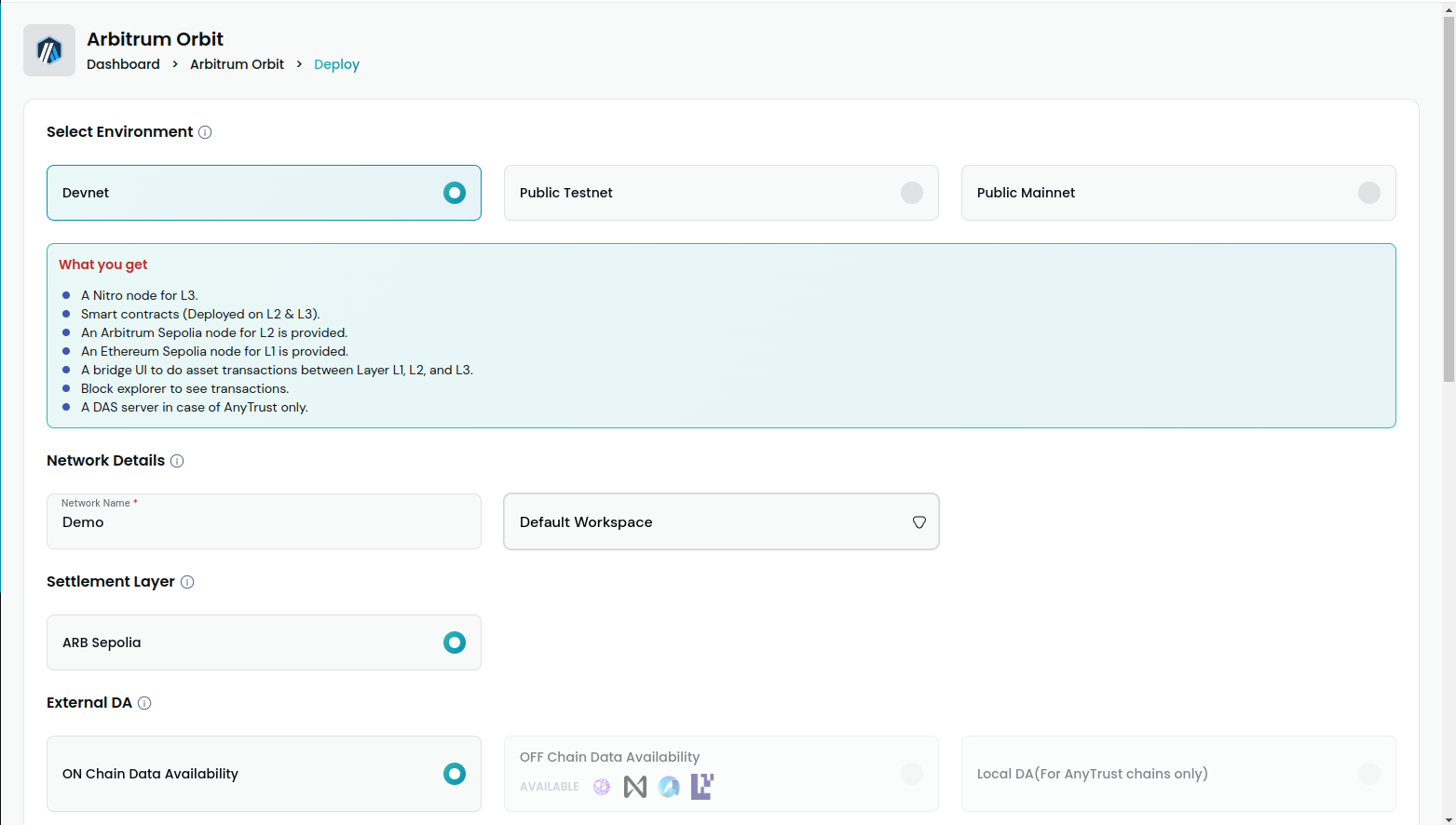 <p>Let’s get back to the discussion. We were on the advantages of Orbit chains, and here’s the next one. </p> <h3 class="wp-block-heading" id="h-quick-launch-for-faster-time-to-market-nbsp">Quick launch for faster time-to-market: </h3> <p>Having witnessed the rising popularity of the low-code approach to launching rollups, Arbitrum Orbit allows developers to use the Orbit chain deployment portal or choose from a range of Rollups–as-a-Service (RaaS) providers that guarantee the quick launch of your Orbit chain through their low-code deployment platforms, pluggable integrations, and innovative developer tools. Hence, the time to market becomes quite fast, which also lowers the overall cost. </p> <h3 class="wp-block-heading" id="h-robust-security-guarantee">Robust security guarantee:</h3> <p>With Ethereum’s inherited security and Arbitrum Nitro, Arbitrum continues to keep its commitment to powering the most Layer2s across diverse industries. L3s can use this same powerful and mature technology stack to maintain robust security on their chain. </p> <h3 class="wp-block-heading" id="h-flexible-technology-stack-nbsp">Flexible technology stack: </h3> <p>Flexibility in Arbitrum Orbit stack refers to the Layer3’s ability to choosing to build between L2 rollup, AnyTrust chain, or a Layer3 chain. However, there are crucial parameters for making the right decision. For example, Layer2 rollups are ideal for use cases that prioritize security and reasonable scalability the most. Rollups allow them to inherit security from Layer1 and meanwhile ensure massive scalability through off-chain computation where cost is much lesser than Layer1. Speaking about Layer3s, this is good for enabling scalability and low computation cost, however security here cannot be unmatched as Layer1. Likewise, AnyTrust is preferred when your chain wants to maintain data privacy through storage of data off-chain and its on-demand release. Security in DAC is based on assumption, which again introduces slight security trade-offs.</p> <h3 class="wp-block-heading" id="h-permissioning-feature">Permissioning feature:</h3> <p>Orbit chains have the flexibility to either add permissioned access to their ecosystem or keep it open to everyone, just like Ethereum. Meaning that, you can restrict smart contract deployment for your chain so that only your dApps can utilize the chain or make it permissionless, depending on the level of privacy you seek. </p> <h3 class="wp-block-heading" id="h-support-for-rollups-modularity">Support for rollups modularity:</h3> <p>Arbitrum Orbit significantly focuses on modularity; hence, the protocol allows for seamless integration of alternative rollup components into Orbit and Arbitrum Layer2 chains. For example, you can integrate an off-chain DA layer, use a decentralized sequencer, a wallet, and an explorer with distinct features—everything is on you.</p> <h3 class="wp-block-heading" id="h-freedom-to-use-execution-environments">Freedom to use execution environments:</h3> <p>Different Arbitrum chains can experiment with full or partial restriction in their execution environment. For example, Orbit chains optimize their project by restricting some of the smart contract functionalities despite the EVM-compatibility of Arbitrum chains. </p> <h3 class="wp-block-heading" id="h-independent-product-roadmap-nbsp">Independent product roadmap: </h3> <p>Orbit makes it possible to separate your L3 chain’s roadmap from that of Layer1 Ethereum or Arbitrum L2s. This means if you want to introduce cutting-edge features such as Account Abstraction (AA) on your network, you can accomplish this even when the feature is not yet enabled on the base chain Arbitrum public chains. </p> <h3 class="wp-block-heading" id="h-interoperability-with-chain-clusters-nbsp">Interoperability with Chain clusters: </h3> <p>Although Orbit chains exist within an ecosystem of interconnected L2 or L3s, natively, interoperability between them still seems a heavy lifting. To solve this, Arbitrum has introduced chain clusters, which are essentially a communication layer to enable fast cross-chain communication token/resources transfers across standalone layer 2 and layer 3s. The idea of this chain cluster is new; thus, it might see a lot of changes, but it has been seen as a component that can enable true interoperability for Arbitrum. </p> 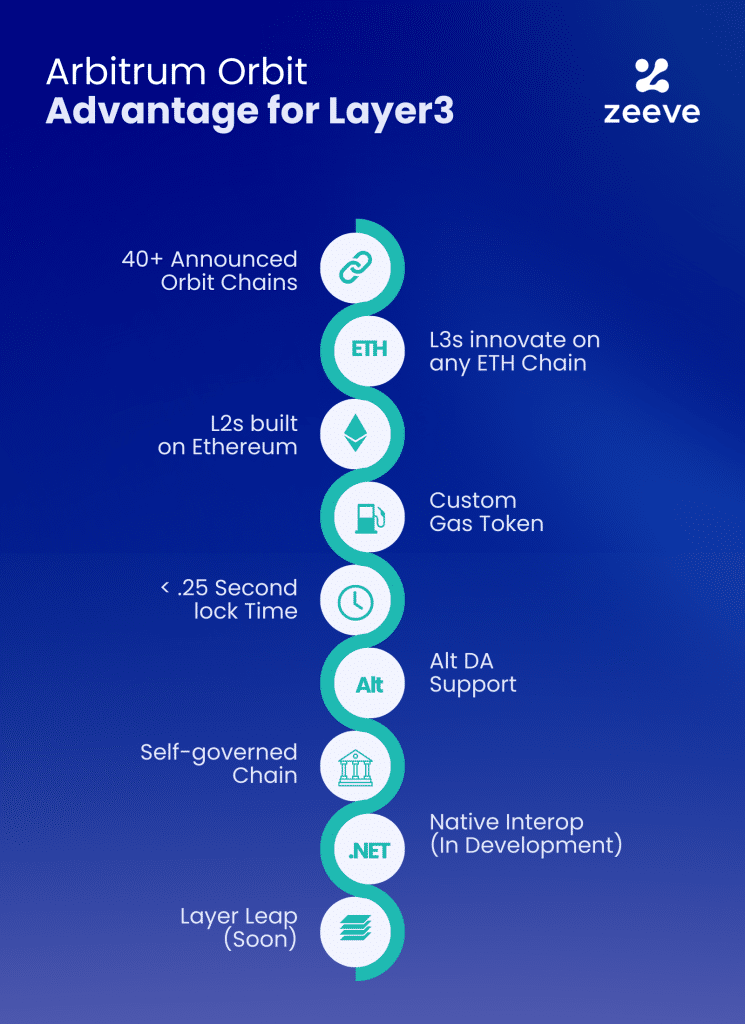 <h2 class="wp-block-heading" id="h-a-look-at-some-of-the-recent-layer3s-built-with-arbitrum-orbit-nbsp">A look at some of the recent Layer3s built with Arbitrum Orbit </h2> <p>Below are the Layer3s that have recently developed using the Orbit technology stack, leveraging the Arbitrum Orbit advantages:</p> <li><strong>Millicent One:</strong></li> <p>Millicent Labs is launching Millicent One, an Ethereum-based public rollup Layer3 powered with Arbitrum Orbit’s highly scalable and unparalleled customization benefits enabled through the best-in-class Arbitrum Nitro stack. Millicent One will work as a dedicated chain for real-world asset tokenization (RWAs) and digital currencies, including stablecoins, tokenized banks or even central bank assets. Further, Orbit allows Millicent One L3 to maintain granular control for its essential parameters, such as privacy, permissioned access, transaction fees, and gas tokens. </p> <li><strong>DODOChain</strong></li> <p>DODO, the popular decentralized exchange protocol and liquidity provider, has announced the first phase of the DODOChain launch. DODOChain will serve as an Omni-trading layer3 for enhancing trade efficiency and ensuring swift transactions for the DODO ecosystem. Built with Arbitrum Orbit technology, DODOChain will offer faster confirmation of rollup transactions, the implementation of crypto-economic security for eliminating malicious participants, and purely decentralized validation of its rollup state. More updates will be released with the rolling out of the second launch phase.</p> <li><strong>Anomaly: </strong></li> <p>Anomaly, the leading AI-powered gaming appchain, has recently announced a testnet launch for its zero-gas gaming Layer3 built with Arbitrum Orbit. The platform is designed to empower game developers to build immersive web3 gaming experiences through Anomaly’s AI-enabled Game Engine and complexity-free blockchain implementation. Leveraging AnyTrust DAC technology, Anomaly L3 boasts a 250ms blocktime, near-instant finality, $nom native token, and thousands of transactions processing per second. Also, Anomaly stands out as one of the fastest EVM rollup Layer3 across the gaming market, offering a play-to-airdrop model to achieve 900 million DAU (daily active users).</p> <li><strong>Degen</strong></li> <p>Degen, the memecoin surging in popularity, has now launched its standalone Layer3 network built using the Arbitrum Orbit technology stack. With the Degen chain, Degen aims to host DEGEN tokens more efficiently and take the community forward for its surpassing growth. Leveraging Arbitrum Orbit, the Degen chain settles its transactions on Layer2 Base Network, taps into AnyTrust for DAC services, and gets additional utility for the DEGEN token (ex, using it as a network gas token). All these have allowed Degen to grow tremendously, leading to a more than 2000% price increase of DEGEN's value in the past 30-day period.</p> <li><strong>ALIENX Chain</strong></li> <p>ALIENX has launched the ALIENX chain, the next-gen staking blockchain built with Arbitrum Orbit technology and thus optimized for high-performance, EVM compatibility, and battle-tested security. The ALIENX chain allows users to automatically earn rewards in BTC, ARB, SOL, and NFTs. This L3 is driven through AI nodes running in the Arbitrum ecosystem, which plays a crucial role in maintaining network security and driving mass adoption of gaming and NFTs on the platform. </p> <p>Continue reading: <a href="https://www.zeeve.io/blog/whats-brewing-on-arbitrum-orbit-navigating-the-hottest-projects/">What’s brewing on Arbitrum Orbit? Navigating the Hottest Projects</a></p> <h2 class="wp-block-heading" id="h-launch-your-arbitrum-orbit-chain-at-a-lower-cost-with-zeeve-raas">Launch your Arbitrum Orbit chain at a lower cost with Zeeve RaaS</h2> <p>Zeeve offers a comprehensive, modular rollups-as-a-service (RaaS) stack for rapid launch and low-cost management and scaling of Arbitrum Orbit Layer2s and Layer3s. With low-code deployment tools, pluggable rollup components, and 30+ third-party rollup service integrations– Zeeve RaaS guarantees 2X faster deployment of your L2/L3 chain and up to 40-50% reduction in total cost. Also, Zeeve offers a sandbox tool for Arbitrum Orbit, allowing you to deploy a DevNet for your Arbitrum Orbit chain with 40+ third-party integrations. The same kind of sandbox is available at Zeeve for Polygon CDK, zkSync ZK Stack, and OP Stack, along with a 30-day free trial. </p> <p>For more information on Zeeve’s RaaS offerings and blockchain services, contact us. Also, you can <a href="https://www.zeeve.io/talk-to-an-expert/">schedule a call</a> with our blockchain experts for an in-depth discussion about your projects.</p> |
| json metadata | {"tags":["arbitrumorbit","rollups"],"image":["https://cdn.steemitimages.com/DQmWKusuvGyC6QTgHvMiExS17urKKGPoJdyCeutc63LBYoY/image.png","https://www.zeeve.io/wp-content/uploads/2024/05/Leverage-30-Rollups-service-integrations-for-your-Orbit-chains-1024x213.jpg","https://dev-to-uploads.s3.amazonaws.com/uploads/articles/oobuaucxcj2tqlz1d93v.png","https://dev-to-uploads.s3.amazonaws.com/uploads/articles/j26fpoh03rdji5qkp8oy.png"],"links":["https://defillama.com/chain/Arbitrum","https://www.zeeve.io/appchains/arbitrum-orbit-rollups/","https://arbitrum.io/stylus","https://www.zeeve.io/blog/whats-brewing-on-arbitrum-orbit-navigating-the-hottest-projects/","https://www.zeeve.io/talk-to-an-expert/"],"app":"steemit/0.2","format":"markdown"} |
| parent author | |
| parent permlink | arbitrumorbit |
| permlink | the-ultimate-arbitrum-orbit-advantage-for-all-things-layer3 |
| title | The Ultimate Arbitrum Orbit Advantage for All Things Layer3 |
| Transaction Info | Block #88460483/Trx c237d1b51d11fdf81b933c67310ddf6bd89f23fe |
View Raw JSON Data
{
"block": 88460483,
"op": [
"comment",
{
"author": "zeevedeeptech",
"body": "\n<p>As custom Layer2 and Layer3 blockchains grow in popularity and adoption, the demand for powerful rollup frameworks sees impressive responses, including Arbitrum Orbit. Orbit stands out with features such as simplified Layer3 adoption, expansion to MultiVM, and chain clusters fostering true interoperability. Moreover, it has the backing of the broad Arbitrum network, recording a whopping <a href=\"https://defillama.com/chain/Arbitrum\">$2.585B </a>TVL. And, now that many promising Layer3s are built using Arbitrum Orbit, let’s highlight all the advantages of Arbitrum Orbit for application-specific rollup chains in all the niches– be it Web3 gaming, DeFi, RWA tokenisation, or general-purpose applications. </p>\n<h2 class=\"wp-block-heading\" id=\"h-arbitrum-orbit-explained-nbsp\">Arbitrum Orbit Explained </h2>\n<p><a href=\"https://www.zeeve.io/appchains/arbitrum-orbit-rollups/\">Arbitrum Orbit</a> is an Optimistic rollup-based framework designed to empower web3 businesses by allowing them to build custom, use case-specific Layer2 or Layer3 chains in a purely permissionless way. Orbit leverages the Arbitrum Nitro Tech stack that powers all the Arbitrum Orbit chains with unparalleled scalability, advanced compression, full EVM compatibility, and cross-chain interoperability (rolling out soon). For a clear understanding, we can think of Arbitrum Orbit as Nitro stack’s deployable and configurable instances that together form an ecosystem of independent chains. </p>\n<a href=\"https://www.zeeve.io/appchains/arbitrum-orbit-rollups/\"><img src=\"https://www.zeeve.io/wp-content/uploads/2024/05/Leverage-30-Rollups-service-integrations-for-your-Orbit-chains-1024x213.jpg\" alt=\"Arbitrum Orbit benefits \" class=\"wp-image-67618\"/></a>\n<p>With Arbitrum Orbit, developers or enterprises have the choice to build a Layer2 or Layer3. Meaning, they get the flexibility to choose Ethereum as their settlement layer or any of Arbitrum’s L2 chains, for example- Arbitrum One. Plus, the ease of customizability allows for personalisation of the chain as per project-specific requirements. All the essential components of a rollup chain, including precompiles, transaction throughput, governance, privacy, sequencer, and data availability (DA) layers, can be configured effortlessly, plus the customisation possibilities are endless. </p>\n<p>Also, Arbitrum Orbit is often confused with application-specific blockchains or “appchains”. Here, the idea should be clear that an Orbit chain can work as an appchain, but they do more than just powering a single application, such as supporting smart contracts on one or more apps, an ecosystem of apps or absolutely no apps. Additionally, your dApps can utilise multiple L2/L3 Orbit chains to enable high availability and advanced features in its ecosystem. </p>\n<h2 class=\"wp-block-heading\" id=\"h-key-advantages-arbitrum-orbit-offers-for-layer3s\">Key advantages Arbitrum Orbit offers for Layer3s</h2>\n<h3 class=\"wp-block-heading\" id=\"h-customizable-dedicated-throughout\">Customizable, dedicated throughout:</h3>\n<p>High-traction dApps, such as gaming and crypto trading platforms, demand massive scalability and they often need to adjust their ecosystem’s throughput capacity as per the traffic volume. With Orbit chains, your dApp is managed on its own independent chain so that you don't need to compete with other dApps for storage or computation resources. This helps chains overcome scalability limitations and get a separate opt-in environment to ensure the high availability of all types of resources. </p>\n<h3 class=\"wp-block-heading\" id=\"h-evm-compatibility-of-stylus-nbsp\">EVM+ Compatibility of Stylus: </h3>\n<p>L2/L3 Orbit chains benefit from the multiVM support features that <a href=\"https://arbitrum.io/stylus\">Stylus </a>introduces. This means developers can write smart contracts in their preferred languages, be it Rust, C++, C, or Solidity, while still maintaining full compatibility. Basically, any language that compiles to Arbitrum's WASM VM is supported for smart contract programming. After the giga-update, Stylus has been optimised to offer 2-4x cheaper fees, compression of contract sizes, broader tooling support, reliable safety, and new host I/Os. </p>\n<h3 class=\"wp-block-heading\" id=\"h-unparalleled-customisation-in-all-aspects\">Unparalleled customisation in all aspects:</h3>\n<p>Layer3s building with Arbitrum Orbit can customise various aspects of their network. For example, they can introduce a custom ERC-20 token as their chain’s native token, define their own governance protocol, or modify the chain logic (like execution, settlement, DA, etc) to meet specific needs. All these are possible while retaining the high level of security from Ethereum through DAO-governed L2s of Arbitrum. </p>\n<h3 class=\"wp-block-heading\" id=\"h-predictable-gas-cost\">Predictable gas cost:</h3>\n<p>Predictability of transactions/gas cost is important for a lot of dApps that want to forecast their business cost and thereby implement cost-prohibitive strategies such as subsidisation of transaction fees. Doing this is easier for Orbit chains as they do not share a common ecosystem and remain isolated from underlying Layer1 like Ethereum or Arbitrum L2s. Managing an ecosystem of your own means your dApp won’t get affected by other dApp’s on-chain activity, which makes way for more reliable gas fees for dApp users. </p>\n<h3 class=\"wp-block-heading\" id=\"h-broad-data-availability-da-options\">Broad Data availability (DA) options:</h3>\n<p>Arbitrum Orbit supports broad data availability choices, enabling L3s to build their chain as an Arbitrum rollup or Arbitrum AnyTrust chain. Rollups allow for the use of Ethereum Layer 1 as the DA layer, while AnyTrust leverages a data availability committee (DAC) for off-chain storage of raw transaction data, offering users extremely cheaper gas costs. On top of that, Orbit chains can use third-party DA layers such as Celestia for off-chain data availability. The ultimate decision depends upon your project’s requirements. </p>\n<p>Btw, you can launch your fully functioning Arbitrum Orbit L3 devNet on Zeeve RaaS in just a few clicks. Here, you have the options for DAC in the Arbitrum AnyTrust chain and off-chain DA of Celestia, NEAR, Avail, and Eigen. </p>\n\n\n<p>Let’s get back to the discussion. We were on the advantages of Orbit chains, and here’s the next one. </p>\n<h3 class=\"wp-block-heading\" id=\"h-quick-launch-for-faster-time-to-market-nbsp\">Quick launch for faster time-to-market: </h3>\n<p>Having witnessed the rising popularity of the low-code approach to launching rollups, Arbitrum Orbit allows developers to use the Orbit chain deployment portal or choose from a range of Rollups–as-a-Service (RaaS) providers that guarantee the quick launch of your Orbit chain through their low-code deployment platforms, pluggable integrations, and innovative developer tools. Hence, the time to market becomes quite fast, which also lowers the overall cost. </p>\n<h3 class=\"wp-block-heading\" id=\"h-robust-security-guarantee\">Robust security guarantee:</h3>\n<p>With Ethereum’s inherited security and Arbitrum Nitro, Arbitrum continues to keep its commitment to powering the most Layer2s across diverse industries. L3s can use this same powerful and mature technology stack to maintain robust security on their chain. </p>\n<h3 class=\"wp-block-heading\" id=\"h-flexible-technology-stack-nbsp\">Flexible technology stack: </h3>\n<p>Flexibility in Arbitrum Orbit stack refers to the Layer3’s ability to choosing to build between L2 rollup, AnyTrust chain, or a Layer3 chain. However, there are crucial parameters for making the right decision. For example, Layer2 rollups are ideal for use cases that prioritize security and reasonable scalability the most. Rollups allow them to inherit security from Layer1 and meanwhile ensure massive scalability through off-chain computation where cost is much lesser than Layer1. Speaking about Layer3s, this is good for enabling scalability and low computation cost, however security here cannot be unmatched as Layer1. Likewise, AnyTrust is preferred when your chain wants to maintain data privacy through storage of data off-chain and its on-demand release. Security in DAC is based on assumption, which again introduces slight security trade-offs.</p>\n<h3 class=\"wp-block-heading\" id=\"h-permissioning-feature\">Permissioning feature:</h3>\n<p>Orbit chains have the flexibility to either add permissioned access to their ecosystem or keep it open to everyone, just like Ethereum. Meaning that, you can restrict smart contract deployment for your chain so that only your dApps can utilize the chain or make it permissionless, depending on the level of privacy you seek. </p>\n<h3 class=\"wp-block-heading\" id=\"h-support-for-rollups-modularity\">Support for rollups modularity:</h3>\n<p>Arbitrum Orbit significantly focuses on modularity; hence, the protocol allows for seamless integration of alternative rollup components into Orbit and Arbitrum Layer2 chains. For example, you can integrate an off-chain DA layer, use a decentralized sequencer, a wallet, and an explorer with distinct features—everything is on you.</p>\n<h3 class=\"wp-block-heading\" id=\"h-freedom-to-use-execution-environments\">Freedom to use execution environments:</h3>\n<p>Different Arbitrum chains can experiment with full or partial restriction in their execution environment. For example, Orbit chains optimize their project by restricting some of the smart contract functionalities despite the EVM-compatibility of Arbitrum chains. </p>\n<h3 class=\"wp-block-heading\" id=\"h-independent-product-roadmap-nbsp\">Independent product roadmap: </h3>\n<p>Orbit makes it possible to separate your L3 chain’s roadmap from that of Layer1 Ethereum or Arbitrum L2s. This means if you want to introduce cutting-edge features such as Account Abstraction (AA) on your network, you can accomplish this even when the feature is not yet enabled on the base chain Arbitrum public chains. </p>\n<h3 class=\"wp-block-heading\" id=\"h-interoperability-with-chain-clusters-nbsp\">Interoperability with Chain clusters: </h3>\n<p>Although Orbit chains exist within an ecosystem of interconnected L2 or L3s, natively, interoperability between them still seems a heavy lifting. To solve this, Arbitrum has introduced chain clusters, which are essentially a communication layer to enable fast cross-chain communication token/resources transfers across standalone layer 2 and layer 3s. The idea of this chain cluster is new; thus, it might see a lot of changes, but it has been seen as a component that can enable true interoperability for Arbitrum. </p>\n\n\n<h2 class=\"wp-block-heading\" id=\"h-a-look-at-some-of-the-recent-layer3s-built-with-arbitrum-orbit-nbsp\">A look at some of the recent Layer3s built with Arbitrum Orbit </h2>\n<p>Below are the Layer3s that have recently developed using the Orbit technology stack, leveraging the Arbitrum Orbit advantages:</p>\n<li><strong>Millicent One:</strong></li>\n<p>Millicent Labs is launching Millicent One, an Ethereum-based public rollup Layer3 powered with Arbitrum Orbit’s highly scalable and unparalleled customization benefits enabled through the best-in-class Arbitrum Nitro stack. Millicent One will work as a dedicated chain for real-world asset tokenization (RWAs) and digital currencies, including stablecoins, tokenized banks or even central bank assets. Further, Orbit allows Millicent One L3 to maintain granular control for its essential parameters, such as privacy, permissioned access, transaction fees, and gas tokens. </p>\n<li><strong>DODOChain</strong></li>\n<p>DODO, the popular decentralized exchange protocol and liquidity provider, has announced the first phase of the DODOChain launch. DODOChain will serve as an Omni-trading layer3 for enhancing trade efficiency and ensuring swift transactions for the DODO ecosystem. Built with Arbitrum Orbit technology, DODOChain will offer faster confirmation of rollup transactions, the implementation of crypto-economic security for eliminating malicious participants, and purely decentralized validation of its rollup state. More updates will be released with the rolling out of the second launch phase.</p>\n<li><strong>Anomaly: </strong></li>\n<p>Anomaly, the leading AI-powered gaming appchain, has recently announced a testnet launch for its zero-gas gaming Layer3 built with Arbitrum Orbit. The platform is designed to empower game developers to build immersive web3 gaming experiences through Anomaly’s AI-enabled Game Engine and complexity-free blockchain implementation. Leveraging AnyTrust DAC technology, Anomaly L3 boasts a 250ms blocktime, near-instant finality, $nom native token, and thousands of transactions processing per second. Also, Anomaly stands out as one of the fastest EVM rollup Layer3 across the gaming market, offering a play-to-airdrop model to achieve 900 million DAU (daily active users).</p>\n<li><strong>Degen</strong></li>\n<p>Degen, the memecoin surging in popularity, has now launched its standalone Layer3 network built using the Arbitrum Orbit technology stack. With the Degen chain, Degen aims to host DEGEN tokens more efficiently and take the community forward for its surpassing growth. Leveraging Arbitrum Orbit, the Degen chain settles its transactions on Layer2 Base Network, taps into AnyTrust for DAC services, and gets additional utility for the DEGEN token (ex, using it as a network gas token). All these have allowed Degen to grow tremendously, leading to a more than 2000% price increase of DEGEN's value in the past 30-day period.</p>\n<li><strong>ALIENX Chain</strong></li>\n<p>ALIENX has launched the ALIENX chain, the next-gen staking blockchain built with Arbitrum Orbit technology and thus optimized for high-performance, EVM compatibility, and battle-tested security. The ALIENX chain allows users to automatically earn rewards in BTC, ARB, SOL, and NFTs. This L3 is driven through AI nodes running in the Arbitrum ecosystem, which plays a crucial role in maintaining network security and driving mass adoption of gaming and NFTs on the platform. </p>\n<p>Continue reading: <a href=\"https://www.zeeve.io/blog/whats-brewing-on-arbitrum-orbit-navigating-the-hottest-projects/\">What’s brewing on Arbitrum Orbit? Navigating the Hottest Projects</a></p>\n<h2 class=\"wp-block-heading\" id=\"h-launch-your-arbitrum-orbit-chain-at-a-lower-cost-with-zeeve-raas\">Launch your Arbitrum Orbit chain at a lower cost with Zeeve RaaS</h2>\n<p>Zeeve offers a comprehensive, modular rollups-as-a-service (RaaS) stack for rapid launch and low-cost management and scaling of Arbitrum Orbit Layer2s and Layer3s. With low-code deployment tools, pluggable rollup components, and 30+ third-party rollup service integrations– Zeeve RaaS guarantees 2X faster deployment of your L2/L3 chain and up to 40-50% reduction in total cost. Also, Zeeve offers a sandbox tool for Arbitrum Orbit, allowing you to deploy a DevNet for your Arbitrum Orbit chain with 40+ third-party integrations. The same kind of sandbox is available at Zeeve for Polygon CDK, zkSync ZK Stack, and OP Stack, along with a 30-day free trial. </p>\n<p>For more information on Zeeve’s RaaS offerings and blockchain services, contact us. Also, you can <a href=\"https://www.zeeve.io/talk-to-an-expert/\">schedule a call</a> with our blockchain experts for an in-depth discussion about your projects.</p>",
"json_metadata": "{\"tags\":[\"arbitrumorbit\",\"rollups\"],\"image\":[\"https://cdn.steemitimages.com/DQmWKusuvGyC6QTgHvMiExS17urKKGPoJdyCeutc63LBYoY/image.png\",\"https://www.zeeve.io/wp-content/uploads/2024/05/Leverage-30-Rollups-service-integrations-for-your-Orbit-chains-1024x213.jpg\",\"https://dev-to-uploads.s3.amazonaws.com/uploads/articles/oobuaucxcj2tqlz1d93v.png\",\"https://dev-to-uploads.s3.amazonaws.com/uploads/articles/j26fpoh03rdji5qkp8oy.png\"],\"links\":[\"https://defillama.com/chain/Arbitrum\",\"https://www.zeeve.io/appchains/arbitrum-orbit-rollups/\",\"https://arbitrum.io/stylus\",\"https://www.zeeve.io/blog/whats-brewing-on-arbitrum-orbit-navigating-the-hottest-projects/\",\"https://www.zeeve.io/talk-to-an-expert/\"],\"app\":\"steemit/0.2\",\"format\":\"markdown\"}",
"parent_author": "",
"parent_permlink": "arbitrumorbit",
"permlink": "the-ultimate-arbitrum-orbit-advantage-for-all-things-layer3",
"title": "The Ultimate Arbitrum Orbit Advantage for All Things Layer3"
}
],
"op_in_trx": 0,
"timestamp": "2024-09-09T06:52:36",
"trx_id": "c237d1b51d11fdf81b933c67310ddf6bd89f23fe",
"trx_in_block": 14,
"virtual_op": 0
}2024/09/06 05:51:00
2024/09/06 05:51:00
| author | zeevedeeptech |
| body |  <h2 class="wp-block-heading" id="h-key-takeaways">Key Takeaways</h2> <ul> <li>Zeeve has partnered with Memento for the launch of their <a href="https://www.zeeve.io/appchains/zksync-hyperchains-zkrollups/">zkSync Layer2 Hyperchain</a>.</li> <li>Memento’s Hyperchain introduces a secure, customized, and controlled blockchain environment tailored for institutional finance, addressing scalability concerns and enabling low-cost transactions on Ethereum.</li> <li>Leveraging Zeeve’s RaaS ecosystem, the partnership streamlines the deployment and management of Memento’s Hyperchain on the Ethereum mainnet, equipped with automated setup, management dashboards, and robust security features.</li> <li>With custom features and EVM compatibility, the Memento Hyperchain fosters compliance-driven institutional DeFi operations, offering a gateway for creating digital-native assets and unlocking new opportunities in the financial landscape.</li> </ul> <p><a href="https://www.zeeve.io/" target="_blank" rel="noreferrer noopener">Zeeve</a>, a leading <a href="https://www.zeeve.io/rollups/">Rollups-as-a-Service provider</a>, today announced its partnership with Memento to launch a new Layer 2 solution, the Hyperchain, powered by zkSync’s ZK Stack technology.</p> <p>The newly introduced Hyperchain is designed to address the primary concerns that have deterred traditional financial sectors from embracing public blockchains, namely issues of security and customization. By employing zkSync’s zero-knowledge (ZK) proofs—a cutting-edge cryptographic method—Hyperchain aims to provide a scalable, secure environment for institutional finance to operate on blockchain, facilitating low-cost, scalable transactions that ultimately settle on the Ethereum network.</p> <p>“By welcoming the Memento community into our ecosystem, we look forward to advance institutional finance together,” Zeeve said in a statement.</p> <p>This initiative is not just a technological upgrade but a strategic alignment to bridge the gap between traditional finance (TradFi) and DeFi, offering the best of both worlds.</p> <p>The partnership highlights the functionality of the Hyperchain, including automated setup for compliance and security, management dashboards, essential development tools, and enhanced security features like DDoS protection and malware defense. These features are geared towards ensuring that the platform remains robust and adaptable to the needs of institutional players.</p> <p>Furthermore, the Hyperchain will benefit from Zeeve’s infrastructure expertise, making it possible to transition from proof-of-concept on a testnet to full operational capability on the mainnet.</p> <p><em>“Memento’s launch of layer 2 Hyperchain is a thoughtful decision for its institutional DeFi operations, where compliance and controlled experimentation meets innovation and the power of decentralised finance”.</em></p> <p>Dr. Ravi Chamria</p> <p>Co-founder and CEO of Zeeve</p> <p><em>"The Hyperchain will open up new avenues for merging traditional and decentralized finance.”</em></p> <p>Fabrizio Audisio</p> <p>Memento’s CTO</p> <p>With its launch, the Hyperchain introduces a compliance-driven environment, supported by dual-layered KYC processes to eliminate bad actors, and EVM compatibility to ensure seamless integration with existing Ethereum applications. This platform also supports the creation of digital-native assets through applications like the Domani Protocol, significantly enhancing the institutional DeFi landscape.</p> <p>Zeeve’s commitment to security, evidenced by its strong network of over 40 industry partners and a user base exceeding 30,000, underscores its position as a trusted global infrastructure provider. This partnership not only signifies a pivotal moment for Zeeve and Memento but also sets the stage for future innovations where traditional financial institutions can securely and effectively engage with the burgeoning world of DeFi.</p> |
| json metadata | {"tags":["announcement","memento","zeeve"],"image":["https://cdn.steemitimages.com/DQmZJL4dk6okuFmDF3MivFNcidZCzn9aius7PPgCodMLcfw/image.png"],"links":["https://www.zeeve.io/appchains/zksync-hyperchains-zkrollups/","https://www.zeeve.io/","https://www.zeeve.io/rollups/"],"app":"steemit/0.2","format":"markdown"} |
| parent author | |
| parent permlink | announcement |
| permlink | memento-to-advance-institutional-finance-integration-on-blockchain-with-zeeve |
| title | Memento to Advance Institutional Finance Integration on Blockchain with Zeeve |
| Transaction Info | Block #88373146/Trx 81f3574cfddd33dc8b3cbc75fdea0bbc974f13d3 |
View Raw JSON Data
{
"block": 88373146,
"op": [
"comment",
{
"author": "zeevedeeptech",
"body": "\n<h2 class=\"wp-block-heading\" id=\"h-key-takeaways\">Key Takeaways</h2>\n<ul>\n<li>Zeeve has partnered with Memento for the launch of their <a href=\"https://www.zeeve.io/appchains/zksync-hyperchains-zkrollups/\">zkSync Layer2 Hyperchain</a>.</li>\n<li>Memento’s Hyperchain introduces a secure, customized, and controlled blockchain environment tailored for institutional finance, addressing scalability concerns and enabling low-cost transactions on Ethereum.</li>\n<li>Leveraging Zeeve’s RaaS ecosystem, the partnership streamlines the deployment and management of Memento’s Hyperchain on the Ethereum mainnet, equipped with automated setup, management dashboards, and robust security features.</li>\n<li>With custom features and EVM compatibility, the Memento Hyperchain fosters compliance-driven institutional DeFi operations, offering a gateway for creating digital-native assets and unlocking new opportunities in the financial landscape.</li>\n</ul>\n<p><a href=\"https://www.zeeve.io/\" target=\"_blank\" rel=\"noreferrer noopener\">Zeeve</a>, a leading <a href=\"https://www.zeeve.io/rollups/\">Rollups-as-a-Service provider</a>, today announced its partnership with Memento to launch a new Layer 2 solution, the Hyperchain, powered by zkSync’s ZK Stack technology.</p>\n<p>The newly introduced Hyperchain is designed to address the primary concerns that have deterred traditional financial sectors from embracing public blockchains, namely issues of security and customization. By employing zkSync’s zero-knowledge (ZK) proofs—a cutting-edge cryptographic method—Hyperchain aims to provide a scalable, secure environment for institutional finance to operate on blockchain, facilitating low-cost, scalable transactions that ultimately settle on the Ethereum network.</p>\n<p>“By welcoming the Memento community into our ecosystem, we look forward to advance institutional finance together,” Zeeve said in a statement.</p>\n<p>This initiative is not just a technological upgrade but a strategic alignment to bridge the gap between traditional finance (TradFi) and DeFi, offering the best of both worlds.</p>\n<p>The partnership highlights the functionality of the Hyperchain, including automated setup for compliance and security, management dashboards, essential development tools, and enhanced security features like DDoS protection and malware defense. These features are geared towards ensuring that the platform remains robust and adaptable to the needs of institutional players.</p>\n<p>Furthermore, the Hyperchain will benefit from Zeeve’s infrastructure expertise, making it possible to transition from proof-of-concept on a testnet to full operational capability on the mainnet.</p>\n<p><em>“Memento’s launch of layer 2 Hyperchain is a thoughtful decision for its institutional DeFi operations, where compliance and controlled experimentation meets innovation and the power of decentralised finance”.</em></p>\n<p>Dr. Ravi Chamria</p>\n<p>Co-founder and CEO of Zeeve</p>\n<p><em>\"The Hyperchain will open up new avenues for merging traditional and decentralized finance.”</em></p>\n<p>Fabrizio Audisio</p>\n<p>Memento’s CTO</p>\n<p>With its launch, the Hyperchain introduces a compliance-driven environment, supported by dual-layered KYC processes to eliminate bad actors, and EVM compatibility to ensure seamless integration with existing Ethereum applications. This platform also supports the creation of digital-native assets through applications like the Domani Protocol, significantly enhancing the institutional DeFi landscape.</p>\n<p>Zeeve’s commitment to security, evidenced by its strong network of over 40 industry partners and a user base exceeding 30,000, underscores its position as a trusted global infrastructure provider. This partnership not only signifies a pivotal moment for Zeeve and Memento but also sets the stage for future innovations where traditional financial institutions can securely and effectively engage with the burgeoning world of DeFi.</p>",
"json_metadata": "{\"tags\":[\"announcement\",\"memento\",\"zeeve\"],\"image\":[\"https://cdn.steemitimages.com/DQmZJL4dk6okuFmDF3MivFNcidZCzn9aius7PPgCodMLcfw/image.png\"],\"links\":[\"https://www.zeeve.io/appchains/zksync-hyperchains-zkrollups/\",\"https://www.zeeve.io/\",\"https://www.zeeve.io/rollups/\"],\"app\":\"steemit/0.2\",\"format\":\"markdown\"}",
"parent_author": "",
"parent_permlink": "announcement",
"permlink": "memento-to-advance-institutional-finance-integration-on-blockchain-with-zeeve",
"title": "Memento to Advance Institutional Finance Integration on Blockchain with Zeeve"
}
],
"op_in_trx": 0,
"timestamp": "2024-09-06T05:51:00",
"trx_id": "81f3574cfddd33dc8b3cbc75fdea0bbc974f13d3",
"trx_in_block": 2,
"virtual_op": 0
}zeevedeeptechpublished a new post: web3-gaming-s-best-blockchain-where-all-developers-are-turning-to2024/09/06 05:44:15
zeevedeeptechpublished a new post: web3-gaming-s-best-blockchain-where-all-developers-are-turning-to
2024/09/06 05:44:15
| author | zeevedeeptech |
| body |  <p>After undergoing rigorous improvements at the technology level on L1s, a common narrative flies thick that <a href="https://www.zeeve.io/web3-infrastructure-for-gaming/">Web 3 gaming</a> is majorly concentrated on Layer 1 blockchains like Ethereum, Solana and Avalanche. However, after looking at the speed of development of new L3 chains and the leverages they grant, at the time of writing, more than 81 new blockchains have inundated the gaming horizon around L3; filling up specific gaps left by traditional L1s and general-purpose scaling L2s. </p> <p>In this article, we shall see the top blockchains that saw the majority of the fresh gaming launches and also 3 hot favorite blockchain ecosystems when it comes to migration of any games. </p> <a href="https://www.zeeve.io/web3-infrastructure-for-gaming/"><img src="https://www.zeeve.io/wp-content/uploads/2024/05/Power-Your-Gaming-Chain-with-Critical-Integrations-1024x213.jpg" alt="" class="wp-image-67504"/></a> <h2 class="wp-block-heading" id="h-these-3-took-away-60-of-fresh-games-launched-nbsp">These 3 took away 60% of fresh games launched: </h2> <h3 class="wp-block-heading" id="h-arbitrum-nbsp">Arbitrum </h3> <p>Arbitrum stack in the short span of time attracted 75 games in 2023 and the momentum has not stopped with the addition of another 14 games in 2024 on its ecosystem due to the following reasons; </p> <li><strong>The Gaming Catalyst Program (CGP)</strong></li> <p>The <a href="https://coinmarketcap.com/community/articles/65f1c78f7ee8977ea2bf341f/">Gaming Catalyst Program</a>, or CGP, is one of the latest trade-offs of the Arbitrum Orbit chain, which is amplifying game development and improving game mechanics. In the CGP program, the Arbitrum ecosystem is earmarking 200 Million ARB tokens that will help developers build complete custom gaming chains without the challenge of building everything from scratch. So, it is saving considerable time to market without compromising the game mechanism. </p> <p>XAI has pivoted to Arbitrum due to this trade-off because they wanted to improve wallet management for parallel processing, which demands higher throughput and better gas optimisation than the Arbitrum stack has provided. </p> <p>Moreover, the CCP program also delves into improving the game model through the introduction of Sticky games, attracting developers of key games like Playnance, SmolBound, Rimverse, Zeeverse, PlayBitmate and KuroroBeast to use the Arbitrum Stack,</p>  <li><strong>Diversifying Network</strong></li> <p>Arbitrum is introducing many connected L2 ecosystems like the Arbitrum One ecosystem with a $1.6 B TVL, giving games access to the DeFi ecosystem. At the moment, we have already seen that games want to tap into a multi-chain ecosystem to counter liquidity challenges. Arbitrum Orbit’s Stylus upgrades allow developers to write programs in Rust, C++, and more to allow them to interact with other gaming ecosystems. Pirate Nation, which is a Multi-chain gaming ecosystem, wanted to have simplicity in trading NFTs, staking and experiencing a better in-game environment. Arbitrum AnyTrust chains provided them with an edge to indulge in cross-chain NFT transfer in the most cost-effective manner. </p> <p>XAI, a gaming blockchain, is also launching on the Arbitrum chain because of this trade-off since they want to bring the combination of Web 2.5 and Web 3 games launching on Arbitrum Nova, allowing game developers to have cheaper access to the blockspace using DAC and faster finality/withdrawal for NFTs when compared to other general-purpose L2 scaling solutions. Other games like Rhascau and Battle For Blockchain have the purpose of reducing fees which have attracted them to develop on top of the Arbitrum Stack. </p> <h3 class="wp-block-heading" id="h-optimism">Optimism</h3> <p>Even OP Stack is not far behind, on the contrary, it is leading the charge by hosting more than 96 games on top of it when compared to Arbitrum and the reasons which are listed below are to blame for that; </p> <li><strong>One Ecosystem for All </strong></li> <p>Gaming has been the sector moving the needle of blockchains; despite that fact, the challenge lies in uniting all the games and different ecosystems launched on top of it. Why? Because, earlier we had just 3 to 4 blockchains in 2018, now we have more than 80+ blockchains live and running. If you are developing on a single ecosystem, it is like building on an Island with no means to connect. That’s where Op Stack is making a difference. </p> <p>Due to its superchain thesis, Op Stack has combined all the gaming ecosystem as one restoring interconnectedness and operability with the larger ecosystem like Base, Zora Network, Worldcoin, opBNB, and Ancient8. Hence, if you are building a new game and you get access to a wider network, there’s a greater chance of success since Op Stack allows low-cost block space amalgamation and the ability to launch applications on your own terms and connect with other ecosystems minus messaging layers or bridges, which have a past record of vulnerabilities in the form of <a href="https://www.bankinfosecurity.com/crypto-hackers-exploit-ronin-network-for-615-million-a-18810">bridge attacks</a>.</p> <p>These trade-offs have been utilized by games like Sky Strife, Promodium, Cellula and Kamigotchi, which use the MUD framework of Op Stack, allowing them to optimize the development process from scratch by integrating store contacts that facilitate superior data management through a world contract connecting blockchain seamless, which not only holds data logic of the Dapps but also relays them across for better operability with an alien ecosystem. Due to this, it becomes seemingly easier to connect with different gaming Dapps hosted in different gaming ecosystems of Optimism, unifying a one-chain ecosystem for all the games and eliminating any instances of liquidity fragmentation in their gaming ecosystem. </p> <li><strong>Most Stable & Battle Tested Track Record </strong></li> <p>Optimism has been introducing a series of upgrades improving their network to launch games in a flash. Their latest improvement was the Bedrock upgrade, which has significantly reduced the coding overheads that game developers have to go through while developing the games. As a result of this upgrade, the erstwhile challenges where developers had to deploy codes for new feature integration have been done away with. </p> <p>The outcome is lower fees, reduced deposit time, enhanced modularity, optimized node performance, and very closely connected Ethereum equivalence which developers have lauded on <a href="https://x.com/HaMidOwAiSi3/status/1711532881854767163">Crypto Twitte</a>r. So, if Op stack is emerging as the game changer for game development, as evidenced by the Game7 Research Outlook hosting as many as 96 games at the time of writing, it shouldn’t come as a surprise because the tech stack is matured and ready for innovation. </p> <li><strong>Superchain Developer Console </strong></li> <p>Like its counterpart Arbitrum Orbit, which has launched the CGP or Gaming Catalyst Program, Optimism is launching a Superchain Developer Console to beat the noise of simplifying game development in the L2 realm. In this Superchain Developer Console, game developers will have access to testnet faucets, custom apps and UX feedback, significantly improving the time-to-market lag of new gaming dapps. </p> <p>Furthermore, developers will be getting access to test-eth-tokens, allowing them greater opportunities to build their gaming dapps on top of the Op Stack. The Op Stack ecosystem under its <a href="https://console.optimism.io/">Superchain Developer Console</a> upgrade will contribute to gas sponsoring on the gaming environment and will also be triggering a suite of other features further to improve the game development experience of the developers. </p> <li><strong>Low Latency </strong></li> <p>OP Stack allows low latency and higher scalability on its ecosystem, which is another reason that is driving developers to choose the OP Stack for game development because when playing fast-paced play-to-earn games, the players are looking for better in-game experience without stickiness in the game in the form of UI freezing or high fees. Through the use of OP Stack, such an advantage has been created, attracting games like <a href="https://www.globenewswire.com/news-release/2023/02/28/2617551/0/en/Cocos-BCX-s-L2-on-BNB-Chain-built-on-OP-Stack-The-Key-to-Unlocking-Web3-Gaming-Potential.html">Cocos-BCX</a> to use OP Stack as their go-to choice because they want to use the MUD Stack that will help them in amplifying the game development.</p> <h3 class="wp-block-heading" id="h-starkware-nbsp">Starkware </h3> <p>If you have been thinking that Arbitrum and Optimism have something unparalleled to offer bringing developers towards their stack, maybe we should reconsider this narrative because Starkware is reigning supreme with more than 114 games launched due to the following reasons; </p> <li><strong>Scalability in Gaming </strong></li> <p>Starkware is introducing Madara, which is a special kind of sequencer that can be customized to build efficient AppChains. Right now, game developers have to struggle when looking for a faster transaction system. They have to either choose between scalability or security. Starkware is designed in a manner to cater to this dilemma, allowing more games to develop on top of it. Cairo's capabilities are uncontested and it is providing near finality and scalability to the gaming dapps.</p> <li><strong>Launch of the Gaming Committee</strong></li> <p>Starkware is launching a gaming committee comprising six members with the likes of Henri Lieutaud, Starknet’s developer relations head; Chris Lexmond, the founder of Unstoppable Games; and Gabin Marignier, a co-founder of Web3-based productivity app Focus Tree, Oli Feuler, Starknet ecosystem developer from Starknet development firm StarkWare; Tarrence van As, co-founder of Starknet-based “gaming console” Cartridge; and the pseudonymous creator of Starknet-based game Realms World known as “LordOfAFew” or “LOAF.” </p> <p>These are the folks who are planning to provide the required assistance to game developers to help launch their games within an autonomous world where the games can enjoy constant accessibility, multiplayer interactivity, immunity to shutdown and unrestricted user engagement. </p> <p>Due to these trade-offs, the Starkware ecosystem is ending up as the first-of-its-kind high TPS games on-chain. DOJO Engine, Katana, Sozo, and Tori are using the Starkware ecosystem because they wanted features where the user’s action should not be made public before the game changes. In such a situation, the need was to keep the user information off-chain and could easily be called upon the need of the client. Hence, Starkware is allowing the concept of proof of publication where even multiplayer games can store the user’s data on-chain for validation. In this way, allowing gamers to participate in the ecosystem and democratize the gaming ecosystem. </p> <h2 class="wp-block-heading" id="h-what-about-game-migration-who-is-taking-the-bigger-pie">What About Game Migration? Who is taking the Bigger Pie?</h2>  <p>When you look at the chart above, we can clearly see that Polygon has an edge over its peers like ImmutableX and Arbitrum. Let’s see why games are moving to these chains one by one. </p> <h3 class="wp-block-heading" id="h-polygon-nbsp">Polygon </h3> <p>Polygon has been leading from the front when it comes to favorite blockchain to either launch afresh or move to it as evident from the chart. </p>  <p>So far more than 20 games have been freshly launched and additionally 14 others have migrated to the Polygon chain. When a closer look was taken, it has been unveiled that games are migrating more towards Polygon because Polygon is abstracting development from game play. For example, game developers have to focus more on improving the game-play rather than cracking the complex technicalities of the blockchain like integrating NFTs and streamlining sustainable technology models to bind users/gamers. </p> <p>Polygon solving specific problems like transaction fees, throughput, developer support and user base, has attracted projects like Trikon to develop games on top of it. Trikon’s first preference was solving the low entry barriers, resolving the bot problems, ensuring customizable game environments and helping them tap into a wider audience. In all these aspects, the Polygon chain has been exemplary not only for Trikon but also other games like Knight and Peasants, who wanted to migrate to a chain that is less expensive and exhibits a better chance of growth. Polygon has promised that to the gaming community, <a href="https://medium.com/oneplanetnft/the-great-migration-97cfba0b5264">attracting </a>many games towards it. </p> <h3 class="wp-block-heading" id="h-arbitrum-nbsp-0">Arbitrum </h3> <p>Arbitrum is another noteworthy chain to look forward to attracting more than 15+ games towards it. At the time of writing, games like Aurory, WSG or Wall Street Games, Game of Silk, Pirate Nation, Plannace and others have moved to Arbitrum for a variety of reasons that we have captured in our previous blog that you refer to for more<a href="https://www.zeeve.io/blog/arbitrum-orbit-for-gaming-why-are-so-many-game-rollups-getting-built-on-it/"> updates. </a>In the coming days, we might see more activities returning or Arbitrum post its CGP launch that will dramatically improve the Web 3 gaming. </p> <h3 class="wp-block-heading" id="h-immutable-x">Immutable X</h3> <p>The flood of Web 3 gaming has grown strong requiring superior infrastructure that not only aids in improving the scalability but also makes migration seamless. Since immutable X mirrors an EVM equivalence environment with the trade-off of superior scalability, games are turning towards ImmutableX for upgrades. Using the ZkEVM API of ImmutableX and SDK, it becomes very easy to migrate to a new environment like <a href="https://medium.com/@TinyColonyGame/immutablex-migration-steps-423f24abded1">Tiny Colony</a>, which is not only looking for faster speed but also wants high level security to make Web 3 gaming less risky. In this regard, the Immutable X ecosystem has provided all the advantages to games like Tiny Colony and others can experience when moving to a new chain. </p> <h2 class="wp-block-heading" id="h-launch-your-game-tailored-chain-with-zeeve-raas">Launch Your Game-tailored Chain With Zeeve RaaS</h2> <p>Zeeve is a growing <a href="https://www.zeeve.io/web3-infrastructure-for-gaming/">gaming rollup infrastructure provider</a> to launch your Web 3 games with a simple click of a button. Users can launch on DevNet to try different configurations, if things are good, they can move to testnet and then finally the full-fledged mainnet. They can choose on/off-chain data availability, centralized/decentralized sequencers, and other crucial integrations, with 24/7 monitoring, analytics, and alerts, Zeeve has everything that you need to launch your Web 3 game on your preferred tech stack like Optimism's OP Stack, Arbitrum Orbit, Polygon CDK or zkSync ZK Stack. </p> <p>For more details, <a href="https://www.zeeve.io/web3-infrastructure-for-gaming/">visit our webpage</a> or <a href="https://www.zeeve.io/talk-to-an-expert/">schedule a call</a> with our service team to help you in launching your Web 3 game smoothly. </p> |
| json metadata | {"tags":["web3gaming"],"image":["https://cdn.steemitimages.com/DQmQAnnhn4knJZLS6ucixxebfwJb2dvmJ7ggoYePwLZB1Vq/image.png","https://www.zeeve.io/wp-content/uploads/2024/05/Power-Your-Gaming-Chain-with-Critical-Integrations-1024x213.jpg","https://dev-to-uploads.s3.amazonaws.com/uploads/articles/mxww8f6qgllew2huiedo.png","https://dev-to-uploads.s3.amazonaws.com/uploads/articles/c5lvnn8luq1plu5im9mw.png","https://dev-to-uploads.s3.amazonaws.com/uploads/articles/4ln59hougwu4nwzigxs7.png"],"links":["https://www.zeeve.io/web3-infrastructure-for-gaming/","https://coinmarketcap.com/community/articles/65f1c78f7ee8977ea2bf341f/","https://www.bankinfosecurity.com/crypto-hackers-exploit-ronin-network-for-615-million-a-18810","https://x.com/HaMidOwAiSi3/status/1711532881854767163","https://console.optimism.io/","https://www.globenewswire.com/news-release/2023/02/28/2617551/0/en/Cocos-BCX-s-L2-on-BNB-Chain-built-on-OP-Stack-The-Key-to-Unlocking-Web3-Gaming-Potential.html","https://medium.com/oneplanetnft/the-great-migration-97cfba0b5264","https://www.zeeve.io/blog/arbitrum-orbit-for-gaming-why-are-so-many-game-rollups-getting-built-on-it/","https://medium.com/@TinyColonyGame/immutablex-migration-steps-423f24abded1","https://www.zeeve.io/talk-to-an-expert/"],"app":"steemit/0.2","format":"markdown"} |
| parent author | |
| parent permlink | web3gaming |
| permlink | web3-gaming-s-best-blockchain-where-all-developers-are-turning-to |
| title | Web3 Gaming’s Best Blockchain: Where All Developers Are Turning To! |
| Transaction Info | Block #88373012/Trx 8c05fc57caf55aa5af9e0ec4143d50a1037911ad |
View Raw JSON Data
{
"block": 88373012,
"op": [
"comment",
{
"author": "zeevedeeptech",
"body": "\n<p>After undergoing rigorous improvements at the technology level on L1s, a common narrative flies thick that <a href=\"https://www.zeeve.io/web3-infrastructure-for-gaming/\">Web 3 gaming</a> is majorly concentrated on Layer 1 blockchains like Ethereum, Solana and Avalanche. However, after looking at the speed of development of new L3 chains and the leverages they grant, at the time of writing, more than 81 new blockchains have inundated the gaming horizon around L3; filling up specific gaps left by traditional L1s and general-purpose scaling L2s. </p>\n<p>In this article, we shall see the top blockchains that saw the majority of the fresh gaming launches and also 3 hot favorite blockchain ecosystems when it comes to migration of any games. </p>\n<a href=\"https://www.zeeve.io/web3-infrastructure-for-gaming/\"><img src=\"https://www.zeeve.io/wp-content/uploads/2024/05/Power-Your-Gaming-Chain-with-Critical-Integrations-1024x213.jpg\" alt=\"\" class=\"wp-image-67504\"/></a>\n<h2 class=\"wp-block-heading\" id=\"h-these-3-took-away-60-of-fresh-games-launched-nbsp\">These 3 took away 60% of fresh games launched: </h2>\n<h3 class=\"wp-block-heading\" id=\"h-arbitrum-nbsp\">Arbitrum </h3>\n<p>Arbitrum stack in the short span of time attracted 75 games in 2023 and the momentum has not stopped with the addition of another 14 games in 2024 on its ecosystem due to the following reasons; </p>\n<li><strong>The Gaming Catalyst Program (CGP)</strong></li>\n<p>The <a href=\"https://coinmarketcap.com/community/articles/65f1c78f7ee8977ea2bf341f/\">Gaming Catalyst Program</a>, or CGP, is one of the latest trade-offs of the Arbitrum Orbit chain, which is amplifying game development and improving game mechanics. In the CGP program, the Arbitrum ecosystem is earmarking 200 Million ARB tokens that will help developers build complete custom gaming chains without the challenge of building everything from scratch. So, it is saving considerable time to market without compromising the game mechanism. </p>\n<p>XAI has pivoted to Arbitrum due to this trade-off because they wanted to improve wallet management for parallel processing, which demands higher throughput and better gas optimisation than the Arbitrum stack has provided. </p>\n<p>Moreover, the CCP program also delves into improving the game model through the introduction of Sticky games, attracting developers of key games like Playnance, SmolBound, Rimverse, Zeeverse, PlayBitmate and KuroroBeast to use the Arbitrum Stack,</p>\n\n\n<li><strong>Diversifying Network</strong></li>\n<p>Arbitrum is introducing many connected L2 ecosystems like the Arbitrum One ecosystem with a $1.6 B TVL, giving games access to the DeFi ecosystem. At the moment, we have already seen that games want to tap into a multi-chain ecosystem to counter liquidity challenges. Arbitrum Orbit’s Stylus upgrades allow developers to write programs in Rust, C++, and more to allow them to interact with other gaming ecosystems. Pirate Nation, which is a Multi-chain gaming ecosystem, wanted to have simplicity in trading NFTs, staking and experiencing a better in-game environment. Arbitrum AnyTrust chains provided them with an edge to indulge in cross-chain NFT transfer in the most cost-effective manner. </p>\n<p>XAI, a gaming blockchain, is also launching on the Arbitrum chain because of this trade-off since they want to bring the combination of Web 2.5 and Web 3 games launching on Arbitrum Nova, allowing game developers to have cheaper access to the blockspace using DAC and faster finality/withdrawal for NFTs when compared to other general-purpose L2 scaling solutions. Other games like Rhascau and Battle For Blockchain have the purpose of reducing fees which have attracted them to develop on top of the Arbitrum Stack. </p>\n<h3 class=\"wp-block-heading\" id=\"h-optimism\">Optimism</h3>\n<p>Even OP Stack is not far behind, on the contrary, it is leading the charge by hosting more than 96 games on top of it when compared to Arbitrum and the reasons which are listed below are to blame for that; </p>\n<li><strong>One Ecosystem for All </strong></li>\n<p>Gaming has been the sector moving the needle of blockchains; despite that fact, the challenge lies in uniting all the games and different ecosystems launched on top of it. Why? Because, earlier we had just 3 to 4 blockchains in 2018, now we have more than 80+ blockchains live and running. If you are developing on a single ecosystem, it is like building on an Island with no means to connect. That’s where Op Stack is making a difference. </p>\n<p>Due to its superchain thesis, Op Stack has combined all the gaming ecosystem as one restoring interconnectedness and operability with the larger ecosystem like Base, Zora Network, Worldcoin, opBNB, and Ancient8. Hence, if you are building a new game and you get access to a wider network, there’s a greater chance of success since Op Stack allows low-cost block space amalgamation and the ability to launch applications on your own terms and connect with other ecosystems minus messaging layers or bridges, which have a past record of vulnerabilities in the form of <a href=\"https://www.bankinfosecurity.com/crypto-hackers-exploit-ronin-network-for-615-million-a-18810\">bridge attacks</a>.</p>\n<p>These trade-offs have been utilized by games like Sky Strife, Promodium, Cellula and Kamigotchi, which use the MUD framework of Op Stack, allowing them to optimize the development process from scratch by integrating store contacts that facilitate superior data management through a world contract connecting blockchain seamless, which not only holds data logic of the Dapps but also relays them across for better operability with an alien ecosystem. Due to this, it becomes seemingly easier to connect with different gaming Dapps hosted in different gaming ecosystems of Optimism, unifying a one-chain ecosystem for all the games and eliminating any instances of liquidity fragmentation in their gaming ecosystem. </p>\n<li><strong>Most Stable & Battle Tested Track Record </strong></li>\n<p>Optimism has been introducing a series of upgrades improving their network to launch games in a flash. Their latest improvement was the Bedrock upgrade, which has significantly reduced the coding overheads that game developers have to go through while developing the games. As a result of this upgrade, the erstwhile challenges where developers had to deploy codes for new feature integration have been done away with. </p>\n<p>The outcome is lower fees, reduced deposit time, enhanced modularity, optimized node performance, and very closely connected Ethereum equivalence which developers have lauded on <a href=\"https://x.com/HaMidOwAiSi3/status/1711532881854767163\">Crypto Twitte</a>r. So, if Op stack is emerging as the game changer for game development, as evidenced by the Game7 Research Outlook hosting as many as 96 games at the time of writing, it shouldn’t come as a surprise because the tech stack is matured and ready for innovation. </p>\n<li><strong>Superchain Developer Console </strong></li>\n<p>Like its counterpart Arbitrum Orbit, which has launched the CGP or Gaming Catalyst Program, Optimism is launching a Superchain Developer Console to beat the noise of simplifying game development in the L2 realm. In this Superchain Developer Console, game developers will have access to testnet faucets, custom apps and UX feedback, significantly improving the time-to-market lag of new gaming dapps. </p>\n<p>Furthermore, developers will be getting access to test-eth-tokens, allowing them greater opportunities to build their gaming dapps on top of the Op Stack. The Op Stack ecosystem under its <a href=\"https://console.optimism.io/\">Superchain Developer Console</a> upgrade will contribute to gas sponsoring on the gaming environment and will also be triggering a suite of other features further to improve the game development experience of the developers. </p>\n<li><strong>Low Latency </strong></li>\n<p>OP Stack allows low latency and higher scalability on its ecosystem, which is another reason that is driving developers to choose the OP Stack for game development because when playing fast-paced play-to-earn games, the players are looking for better in-game experience without stickiness in the game in the form of UI freezing or high fees. Through the use of OP Stack, such an advantage has been created, attracting games like <a href=\"https://www.globenewswire.com/news-release/2023/02/28/2617551/0/en/Cocos-BCX-s-L2-on-BNB-Chain-built-on-OP-Stack-The-Key-to-Unlocking-Web3-Gaming-Potential.html\">Cocos-BCX</a> to use OP Stack as their go-to choice because they want to use the MUD Stack that will help them in amplifying the game development.</p>\n<h3 class=\"wp-block-heading\" id=\"h-starkware-nbsp\">Starkware </h3>\n<p>If you have been thinking that Arbitrum and Optimism have something unparalleled to offer bringing developers towards their stack, maybe we should reconsider this narrative because Starkware is reigning supreme with more than 114 games launched due to the following reasons; </p>\n<li><strong>Scalability in Gaming </strong></li>\n<p>Starkware is introducing Madara, which is a special kind of sequencer that can be customized to build efficient AppChains. Right now, game developers have to struggle when looking for a faster transaction system. They have to either choose between scalability or security. Starkware is designed in a manner to cater to this dilemma, allowing more games to develop on top of it. Cairo's capabilities are uncontested and it is providing near finality and scalability to the gaming dapps.</p>\n<li><strong>Launch of the Gaming Committee</strong></li>\n<p>Starkware is launching a gaming committee comprising six members with the likes of Henri Lieutaud, Starknet’s developer relations head; Chris Lexmond, the founder of Unstoppable Games; and Gabin Marignier, a co-founder of Web3-based productivity app Focus Tree, Oli Feuler, Starknet ecosystem developer from Starknet development firm StarkWare; Tarrence van As, co-founder of Starknet-based “gaming console” Cartridge; and the pseudonymous creator of Starknet-based game Realms World known as “LordOfAFew” or “LOAF.” </p>\n<p>These are the folks who are planning to provide the required assistance to game developers to help launch their games within an autonomous world where the games can enjoy constant accessibility, multiplayer interactivity, immunity to shutdown and unrestricted user engagement. </p>\n<p>Due to these trade-offs, the Starkware ecosystem is ending up as the first-of-its-kind high TPS games on-chain. DOJO Engine, Katana, Sozo, and Tori are using the Starkware ecosystem because they wanted features where the user’s action should not be made public before the game changes. In such a situation, the need was to keep the user information off-chain and could easily be called upon the need of the client. Hence, Starkware is allowing the concept of proof of publication where even multiplayer games can store the user’s data on-chain for validation. In this way, allowing gamers to participate in the ecosystem and democratize the gaming ecosystem. </p>\n<h2 class=\"wp-block-heading\" id=\"h-what-about-game-migration-who-is-taking-the-bigger-pie\">What About Game Migration? Who is taking the Bigger Pie?</h2>\n\n\n<p>When you look at the chart above, we can clearly see that Polygon has an edge over its peers like ImmutableX and Arbitrum. Let’s see why games are moving to these chains one by one. </p>\n<h3 class=\"wp-block-heading\" id=\"h-polygon-nbsp\">Polygon </h3>\n<p>Polygon has been leading from the front when it comes to favorite blockchain to either launch afresh or move to it as evident from the chart. </p>\n\n\n<p>So far more than 20 games have been freshly launched and additionally 14 others have migrated to the Polygon chain. When a closer look was taken, it has been unveiled that games are migrating more towards Polygon because Polygon is abstracting development from game play. For example, game developers have to focus more on improving the game-play rather than cracking the complex technicalities of the blockchain like integrating NFTs and streamlining sustainable technology models to bind users/gamers. </p>\n<p>Polygon solving specific problems like transaction fees, throughput, developer support and user base, has attracted projects like Trikon to develop games on top of it. Trikon’s first preference was solving the low entry barriers, resolving the bot problems, ensuring customizable game environments and helping them tap into a wider audience. In all these aspects, the Polygon chain has been exemplary not only for Trikon but also other games like Knight and Peasants, who wanted to migrate to a chain that is less expensive and exhibits a better chance of growth. Polygon has promised that to the gaming community, <a href=\"https://medium.com/oneplanetnft/the-great-migration-97cfba0b5264\">attracting </a>many games towards it. </p>\n<h3 class=\"wp-block-heading\" id=\"h-arbitrum-nbsp-0\">Arbitrum </h3>\n<p>Arbitrum is another noteworthy chain to look forward to attracting more than 15+ games towards it. At the time of writing, games like Aurory, WSG or Wall Street Games, Game of Silk, Pirate Nation, Plannace and others have moved to Arbitrum for a variety of reasons that we have captured in our previous blog that you refer to for more<a href=\"https://www.zeeve.io/blog/arbitrum-orbit-for-gaming-why-are-so-many-game-rollups-getting-built-on-it/\"> updates. </a>In the coming days, we might see more activities returning or Arbitrum post its CGP launch that will dramatically improve the Web 3 gaming. </p>\n<h3 class=\"wp-block-heading\" id=\"h-immutable-x\">Immutable X</h3>\n<p>The flood of Web 3 gaming has grown strong requiring superior infrastructure that not only aids in improving the scalability but also makes migration seamless. Since immutable X mirrors an EVM equivalence environment with the trade-off of superior scalability, games are turning towards ImmutableX for upgrades. Using the ZkEVM API of ImmutableX and SDK, it becomes very easy to migrate to a new environment like <a href=\"https://medium.com/@TinyColonyGame/immutablex-migration-steps-423f24abded1\">Tiny Colony</a>, which is not only looking for faster speed but also wants high level security to make Web 3 gaming less risky. In this regard, the Immutable X ecosystem has provided all the advantages to games like Tiny Colony and others can experience when moving to a new chain. </p>\n<h2 class=\"wp-block-heading\" id=\"h-launch-your-game-tailored-chain-with-zeeve-raas\">Launch Your Game-tailored Chain With Zeeve RaaS</h2>\n<p>Zeeve is a growing <a href=\"https://www.zeeve.io/web3-infrastructure-for-gaming/\">gaming rollup infrastructure provider</a> to launch your Web 3 games with a simple click of a button. Users can launch on DevNet to try different configurations, if things are good, they can move to testnet and then finally the full-fledged mainnet. They can choose on/off-chain data availability, centralized/decentralized sequencers, and other crucial integrations, with 24/7 monitoring, analytics, and alerts, Zeeve has everything that you need to launch your Web 3 game on your preferred tech stack like Optimism's OP Stack, Arbitrum Orbit, Polygon CDK or zkSync ZK Stack. </p>\n<p>For more details, <a href=\"https://www.zeeve.io/web3-infrastructure-for-gaming/\">visit our webpage</a> or <a href=\"https://www.zeeve.io/talk-to-an-expert/\">schedule a call</a> with our service team to help you in launching your Web 3 game smoothly. </p>",
"json_metadata": "{\"tags\":[\"web3gaming\"],\"image\":[\"https://cdn.steemitimages.com/DQmQAnnhn4knJZLS6ucixxebfwJb2dvmJ7ggoYePwLZB1Vq/image.png\",\"https://www.zeeve.io/wp-content/uploads/2024/05/Power-Your-Gaming-Chain-with-Critical-Integrations-1024x213.jpg\",\"https://dev-to-uploads.s3.amazonaws.com/uploads/articles/mxww8f6qgllew2huiedo.png\",\"https://dev-to-uploads.s3.amazonaws.com/uploads/articles/c5lvnn8luq1plu5im9mw.png\",\"https://dev-to-uploads.s3.amazonaws.com/uploads/articles/4ln59hougwu4nwzigxs7.png\"],\"links\":[\"https://www.zeeve.io/web3-infrastructure-for-gaming/\",\"https://coinmarketcap.com/community/articles/65f1c78f7ee8977ea2bf341f/\",\"https://www.bankinfosecurity.com/crypto-hackers-exploit-ronin-network-for-615-million-a-18810\",\"https://x.com/HaMidOwAiSi3/status/1711532881854767163\",\"https://console.optimism.io/\",\"https://www.globenewswire.com/news-release/2023/02/28/2617551/0/en/Cocos-BCX-s-L2-on-BNB-Chain-built-on-OP-Stack-The-Key-to-Unlocking-Web3-Gaming-Potential.html\",\"https://medium.com/oneplanetnft/the-great-migration-97cfba0b5264\",\"https://www.zeeve.io/blog/arbitrum-orbit-for-gaming-why-are-so-many-game-rollups-getting-built-on-it/\",\"https://medium.com/@TinyColonyGame/immutablex-migration-steps-423f24abded1\",\"https://www.zeeve.io/talk-to-an-expert/\"],\"app\":\"steemit/0.2\",\"format\":\"markdown\"}",
"parent_author": "",
"parent_permlink": "web3gaming",
"permlink": "web3-gaming-s-best-blockchain-where-all-developers-are-turning-to",
"title": "Web3 Gaming’s Best Blockchain: Where All Developers Are Turning To!"
}
],
"op_in_trx": 0,
"timestamp": "2024-09-06T05:44:15",
"trx_id": "8c05fc57caf55aa5af9e0ec4143d50a1037911ad",
"trx_in_block": 10,
"virtual_op": 0
}2024/09/05 19:50:00
2024/09/05 19:50:00
| author | xpilar.witness |
| body | 🚀 "Wow, what an exciting time for rollups! 🤩 It's amazing to see the innovations happening in 2024, like modular rollups, cost optimization after Dencun upgrade, and the rise of Rollups-as-a-service (RaaS) Solutions providers. 💡 These advancements will surely drive better performance and sustainability for the future. Let's continue this conversation and explore more about these topics! 🤝 What are your thoughts on modularity and its potential impact? 🤔 Do you have any favorite RaaS solutions or rollups that you'd like to share? 🤓 Also, don't forget to vote for our witness, 'xpilar.witness' by going to https://steemitwallet.com/~witnesses. Your support will help us continue contributing to the growth and success of the Steem community. 👍 Let's make 2024 an amazing year for rollups! 🎉" |
| json metadata | {"tags":["upvote","community"],"app":"upex-app"} |
| parent author | zeevedeeptech |
| parent permlink | state-of-blockchain-rollups-in-2024 |
| permlink | re-zeevedeeptech-1725565801034 |
| title | |
| Transaction Info | Block #88361164/Trx a8ba4998a31469e5ea5513b5c16aed3f494f1f0e |
View Raw JSON Data
{
  "block": 88361164,
  "op": [
    "comment",
    {
      "author": "xpilar.witness",
      "body": "🚀 \"Wow, what an exciting time for rollups! 🤩 It's amazing to see the innovations happening in 2024, like modular rollups, cost optimization after Dencun upgrade, and the rise of Rollups-as-a-service (RaaS) Solutions providers. 💡 These advancements will surely drive better performance and sustainability for the future.\n\nLet's continue this conversation and explore more about these topics! 🤝 What are your thoughts on modularity and its potential impact? 🤔 Do you have any favorite RaaS solutions or rollups that you'd like to share? 🤓\n\nAlso, don't forget to vote for our witness, 'xpilar.witness' by going to https://steemitwallet.com/~witnesses. Your support will help us continue contributing to the growth and success of the Steem community. 👍 Let's make 2024 an amazing year for rollups! 🎉\"",
      "json_metadata": "{\"tags\":[\"upvote\",\"community\"],\"app\":\"upex-app\"}",
      "parent_author": "zeevedeeptech",
      "parent_permlink": "state-of-blockchain-rollups-in-2024",
      "permlink": "re-zeevedeeptech-1725565801034",
      "title": ""
    }
  ],
  "op_in_trx": 0,
  "timestamp": "2024-09-05T19:50:00",
  "trx_id": "a8ba4998a31469e5ea5513b5c16aed3f494f1f0e",
  "trx_in_block": 7,
  "virtual_op": 0
}2024/09/05 10:37:57
2024/09/05 10:37:57
| author | xpilar.witness |
| body | 🎉 "Hey @zeeve, just finished the test drive of zkSync hyperchain using the pre-configured public network 🚀! I'm loving the features like making RPC calls, deploying smart contracts, checking transaction details on explorer, and accessing 24/7 monitoring & alerts dashboard 💡. It's amazing to see how easy it is to get started with a Hyperchain 🤩! Would love to hear more about setting up my own DevNet using Zeeve's RaaS platform 🤔. Also, please keep sharing those awesome community engagement tips 😊! By the way, don't forget to vote for our witness @xpilar.witness by going to https://steemitwallet.com/~witnesses 👍. Let's continue growing and succeeding together as a community 💕! 👏" |
| json metadata | {"tags":["upvote","community"],"app":"upex-app"} |
| parent author | zeevedeeptech |
| parent permlink | test-drive-zksync-hyperchain-on-zeeve-s-fully-powered-demo-network |
| permlink | re-zeevedeeptech-1725532678785 |
| title | |
| Transaction Info | Block #88350160/Trx 2dc8441d1b24f7c00f67b6cd28c59ebfcb3ce6f0 |
View Raw JSON Data
{
  "block": 88350160,
  "op": [
    "comment",
    {
      "author": "xpilar.witness",
      "body": "🎉 \"Hey @zeeve, just finished the test drive of zkSync hyperchain using the pre-configured public network 🚀! I'm loving the features like making RPC calls, deploying smart contracts, checking transaction details on explorer, and accessing 24/7 monitoring & alerts dashboard 💡. It's amazing to see how easy it is to get started with a Hyperchain 🤩! Would love to hear more about setting up my own DevNet using Zeeve's RaaS platform 🤔. Also, please keep sharing those awesome community engagement tips 😊! By the way, don't forget to vote for our witness @xpilar.witness by going to https://steemitwallet.com/~witnesses 👍. Let's continue growing and succeeding together as a community 💕! 👏\"",
      "json_metadata": "{\"tags\":[\"upvote\",\"community\"],\"app\":\"upex-app\"}",
      "parent_author": "zeevedeeptech",
      "parent_permlink": "test-drive-zksync-hyperchain-on-zeeve-s-fully-powered-demo-network",
      "permlink": "re-zeevedeeptech-1725532678785",
      "title": ""
    }
  ],
  "op_in_trx": 0,
  "timestamp": "2024-09-05T10:37:57",
  "trx_id": "2dc8441d1b24f7c00f67b6cd28c59ebfcb3ce6f0",
  "trx_in_block": 6,
  "virtual_op": 0
}2024/09/05 10:35:57
2024/09/05 10:35:57
| author | xpilar.witness |
| body | "Wow, what an exciting partnership between Zeeve and Etherspot! 🚀 It's amazing to see these two innovative companies working together to bring seamless account abstraction functionality to L2/L3 rollups and appchains. 👏 The possibilities for web3 builders and enterprises are endless with this integration! 💡 I'm loving the emphasis on frictionless UX for end-users, making it easier for everyone to access and interact with decentralized applications. 🤩 Have you had a chance to check out Etherspot's comprehensive suite of Account Abstraction tools? What do you think about the potential impact of this collaboration on web3 mass adoption? Share your thoughts! 💬 And don't forget to cast your vote for our witness, xpilar.witness, by heading over to https://steemitwallet.com/~witnesses - every vote counts towards growing and strengthening the Steem community! 🙏" |
| json metadata | {"tags":["upvote","community"],"app":"upex-app"} |
| parent author | zeevedeeptech |
| parent permlink | zeeve-raas-partners-with-etherspot-to-bring-account-abstraction-benefits-into-rollups-and-appchains |
| permlink | re-zeevedeeptech-1725532557997 |
| title | |
| Transaction Info | Block #88350120/Trx ef58a32bd2fbf1abd35cd1a38808a2848eec9948 |
View Raw JSON Data
{
  "block": 88350120,
  "op": [
    "comment",
    {
      "author": "xpilar.witness",
      "body": "\"Wow, what an exciting partnership between Zeeve and Etherspot! 🚀 It's amazing to see these two innovative companies working together to bring seamless account abstraction functionality to L2/L3 rollups and appchains. 👏 The possibilities for web3 builders and enterprises are endless with this integration! 💡 I'm loving the emphasis on frictionless UX for end-users, making it easier for everyone to access and interact with decentralized applications. 🤩 Have you had a chance to check out Etherspot's comprehensive suite of Account Abstraction tools? What do you think about the potential impact of this collaboration on web3 mass adoption? Share your thoughts! 💬 And don't forget to cast your vote for our witness, xpilar.witness, by heading over to https://steemitwallet.com/~witnesses - every vote counts towards growing and strengthening the Steem community! 🙏\"",
      "json_metadata": "{\"tags\":[\"upvote\",\"community\"],\"app\":\"upex-app\"}",
      "parent_author": "zeevedeeptech",
      "parent_permlink": "zeeve-raas-partners-with-etherspot-to-bring-account-abstraction-benefits-into-rollups-and-appchains",
      "permlink": "re-zeevedeeptech-1725532557997",
      "title": ""
    }
  ],
  "op_in_trx": 0,
  "timestamp": "2024-09-05T10:35:57",
  "trx_id": "ef58a32bd2fbf1abd35cd1a38808a2848eec9948",
  "trx_in_block": 0,
  "virtual_op": 0
}2024/09/05 10:30:18
2024/09/05 10:30:18
| author | xpilar.witness |
| body | 🚀💥 2023 & Beyond: Embracing Innovations 🚀💥 In the year 2023, games had by now improved the P2E model and game-play to bind gamers and eventually new concepts like creator economy and e-sports started picking up pace. However, the intriguing part to acknowledge in this period was the sudden transformation of Web3 games from a mere revenue-generating and game play platform for gamers/ecosystems to a comprehensive game experience hub spot. Games like My Pet Hooligan, illuvium, Star Atlas and Cross the Ages not only improved the gameplay mirroring the experience of top-notch games like Hearthstone, Legends of Runeterra, and Upland; but they also started exploring the elephant in the room, interoperability. Aurory, a free-to-play blockchain-based tactical Japanese game, has been the front runner in this category by not only improving the game play but also introducing cross-chain interoperability in gaming. Due to this trade-off, the Web3 games, which have been criticized all these while for being an ecosystem embracing forced technical integration, started progressing towards solving the problems of Web 2 games, which have plagued their growth for years. As a result, the swift growth and dynamic transformation that Web3 gaming withstood following multiple trials and errors have made them a force to be reckoned with while writing the script of a Web 2 to Web 3 transition and future of the game verse. Final World In the last three years, we have seen that Web 3 games deployed multiple models, some worked like improving game play mechanism, transparency , interoperability; while their other counterparts, like player reward models and DAOs, eventually failed. But that is not the end of the story for Web 3 gaming because we have barely scratched the surface of innovation for now. Some of the milestones like interoperability have been scaled and game play improved, the other things which soon emerge on the platter as Web 3 matures with time. However, one thing to acknowledge nonetheless is the dynamic approach of Web 3 games in blending with the changing trends attracting some of the big names from the world of Web 2 games like Ubisoft, Square Enix, CCP, Nexon, Bandai Namco, Com2US, Sega, Konami, Atari, and NetMarble to move towards Web3 gaming to tackle their dropping revenue base and game participation. As a result, it is not an understatement to say that acknowledging the dramatic experimentation and adaptations, the future of Web 3 games is promising when games like Monsterarra, Game of Silk and Pirate Nation demonstrate innovation attracting more of Web 2 games to think for a Web 3 gaming transition. Hence, in the near future, we might very well see Web 2 games adapting Web 3 models where they will not just get access to new revenue models, gameplay but also a one-chain ecosystem for all games. Such a trade-off could very well trigger new revenue models to emerge like special status for XP and powers in the game redeemable for utility tokens in a different game environment, speculative, not conclusive though. Planning to build a game-specific rollup chain? Visit our gaming webpage to see what all benefits rollups can add to your application and how Zeeve can be helpful. Still have queries? Schedule a call with our Zeeve experts. We can help you figure out what infrastructure might suit your needs better. 🤔 Let's build something amazing together! 💫 What are your thoughts on this topic? Share them in the comments below! 📢 |
| json metadata | {"tags":["upvote","community"],"app":"upex-app"} |
| parent author | zeevedeeptech |
| parent permlink | the-continuous-rise-of-web3-gaming-in-a-web2-dominated-world |
| permlink | re-zeevedeeptech-1725532217652 |
| title | |
| Transaction Info | Block #88350007/Trx 034072c24980f5bb937fc16719d9ab5d1fb74404 |
View Raw JSON Data
{
  "block": 88350007,
  "op": [
    "comment",
    {
      "author": "xpilar.witness",
      "body": "🚀💥 2023 & Beyond: Embracing Innovations 🚀💥\n\nIn the year 2023, games had by now improved the P2E model and game-play to bind gamers and eventually new concepts like creator economy and e-sports started picking up pace. However, the intriguing part to acknowledge in this period was the sudden transformation of Web3 games from a mere revenue-generating and game play platform for gamers/ecosystems to a comprehensive game experience hub spot.\n\nGames like My Pet Hooligan, illuvium, Star Atlas and Cross the Ages not only improved the gameplay mirroring the experience of top-notch games like Hearthstone, Legends of Runeterra, and Upland; but they also started exploring the elephant in the room, interoperability. Aurory, a free-to-play blockchain-based tactical Japanese game, has been the front runner in this category by not only improving the game play but also introducing cross-chain interoperability in gaming.\n\nDue to this trade-off, the Web3 games, which have been criticized all these while for being an ecosystem embracing forced technical integration, started progressing towards solving the problems of Web 2 games, which have plagued their growth for years.\n\nAs a result, the swift growth and dynamic transformation that Web3 gaming withstood following multiple trials and errors have made them a force to be reckoned with while writing the script of a Web 2 to Web 3 transition and future of the game verse.\n\nFinal World\n\nIn the last three years, we have seen that Web 3 games deployed multiple models, some worked like improving game play mechanism, transparency , interoperability; while their other counterparts, like player reward models and DAOs, eventually failed. But that is not the end of the story for Web 3 gaming because we have barely scratched the surface of innovation for now.\n\nSome of the milestones like interoperability have been scaled and game play improved, the other things which soon emerge on the platter as Web 3 matures with time. However, one thing to acknowledge nonetheless is the dynamic approach of Web 3 games in blending with the changing trends attracting some of the big names from the world of Web 2 games like Ubisoft, Square Enix, CCP, Nexon, Bandai Namco, Com2US, Sega, Konami, Atari, and NetMarble to move towards Web3 gaming to tackle their dropping revenue base and game participation.\n\nAs a result, it is not an understatement to say that acknowledging the dramatic experimentation and adaptations, the future of Web 3 games is promising when games like Monsterarra, Game of Silk and Pirate Nation demonstrate innovation attracting more of Web 2 games to think for a Web 3 gaming transition.\n\nHence, in the near future, we might very well see Web 2 games adapting Web 3 models where they will not just get access to new revenue models, gameplay but also a one-chain ecosystem for all games. Such a trade-off could very well trigger new revenue models to emerge like special status for XP and powers in the game redeemable for utility tokens in a different game environment, speculative, not conclusive though.\n\nPlanning to build a game-specific rollup chain? Visit our gaming webpage to see what all benefits rollups can add to your application and how Zeeve can be helpful. Still have queries? Schedule a call with our Zeeve experts. We can help you figure out what infrastructure might suit your needs better. 🤔\n\nLet's build something amazing together! 💫 What are your thoughts on this topic? Share them in the comments below! 📢",
      "json_metadata": "{\"tags\":[\"upvote\",\"community\"],\"app\":\"upex-app\"}",
      "parent_author": "zeevedeeptech",
      "parent_permlink": "the-continuous-rise-of-web3-gaming-in-a-web2-dominated-world",
      "permlink": "re-zeevedeeptech-1725532217652",
      "title": ""
    }
  ],
  "op_in_trx": 0,
  "timestamp": "2024-09-05T10:30:18",
  "trx_id": "034072c24980f5bb937fc16719d9ab5d1fb74404",
  "trx_in_block": 0,
  "virtual_op": 0
}zeevedeeptechpublished a new post: state-of-blockchain-rollups-in-20242024/09/04 06:50:03
zeevedeeptechpublished a new post: state-of-blockchain-rollups-in-2024
2024/09/04 06:50:03
| author | zeevedeeptech |
| body |  <p>Blockchain rollups; whether Optimistic or zero-knowledge, both are designed to address the problem of Ethereum scalability through the approach of taking transaction computation off-chain. Over the years, the rollup ecosystem has undergone several changes, and thus, it has become highly mature. Now that we are in 2024, it’s important to understand how rollups operate in current times and what all is happening today. This helps existing projects to dive deeper into the comprehensive rollup concept while those who are getting started will have a clear idea of what stack will be ideal for them. Through this detailed report, we will understand the state of rollups in 2024. Also, we will have a quick recap of the evolution of rollups over the years. </p> <p><strong>Key takeaways:</strong></p> <ul> <li>Modular blockchains are becoming the spotlight in 2024.</li> <li>Arbitrum is keeping the momentum with more than 32% of total rollup’s TVL.</li> <li>Optimism is retaining its leading position with its innovative infrastructure offerings.</li> <li>Base has crossed 2M in daily transactions with over $1B TVL.</li> <li>Ethereum’s pro-dank sharding update has raised the popularity of Optimistic rollups.</li> <li>Optimism’s Bedrock upgrade continues to accommodate lower gas cost and faster block confirmation.</li> <li><a href="https://www.zeeve.io/rollups/">Rollup-as-a-service (RaaS)</a> is becoming a preferred option for seamless launch and management of rollups.</li> <!-- /wp:list-item --></ul> <h2 class="wp-block-heading" id="h-rollups-launch-and-evolution-in-its-landscape-to-date">Rollups Launch and evolution in its landscape to date</h2> <p>The concept of rollups as a powerful scaling solution was first driven around 2021 by Ethereum’s co-founder, Vitalik Buterin. <a href="https://vitalik.eth.limo/general/2021/01/05/rollup.html">In this research</a>, he talked about Layer2 rollups as a means to improve Ethereum’s efficiency by taking the computation off-chain on a separate layer where congestion is extremely low. At that time, token transfer on Ethereum's base layer cost ~45000 gas, whereas the same took up ~300 gas in rollups. Hence, rollups got its firm grip in the web3 space, contributing to the development of advanced rollup chains like Arbitrum, Optimism, ZkSync Era, and Polygon zkEVM. </p> <a href="https://www.zeeve.io/rollups/"><img src="https://www.zeeve.io/wp-content/uploads/2024/05/Save-up-to-60-cost-for-your-next-rollup-project-1024x213.jpg" alt="" class="wp-image-67489"/></a> <p>Arbitrum is the first to launch Layer2 rollups as it released classic optimistic rollups in 2012. Besides offering a public rollup aggregating a total of <a href="https://twitter.com/Uniswap/status/1787479308740571373">$150 billion transactions</a>, Arbitrum offers its advanced rollup stack– Arbitrum Orbit, to accommodate development of standalone L2/L3 rollup chains. Optimism was introduced a few months after Arbitrum, in Dec 2021. This rollup gathered popularity because of its approach of using multi-round proofs, thus lowering the gas consumption significantly. Also, Optimism is known for its Superchains built through OP Stack, which has been even more feasible after the Bedrock update. Total transactions on Optimism is currently recorded at 263.66M. Polygon zkEVM and ZkSync Era launched their mainnet later and rolled out their distinct stacks– Polygon CDK and ZkSync hyperchains that are witnessing fast adoption. Total transaction on Polygon zkEVM is 11.16M and 37.721334B on zkSync Era as of now. </p> <h2 class="wp-block-heading" id="h-inspecting-the-state-of-layer2-rollups-in-2024">Inspecting the state of Layer2 Rollups in 2024</h2> <p>Let’s dive into the state of rollups in 2024, exploring everything that is happening currently on the rollups’ landscape. From the growth in rollup chains to the market expansion and innovation, we will have a broader view of it. </p> <h3 class="wp-block-heading" id="h-dominance-of-new-layer2-rollups-nbsp">Dominance of new Layer2 rollups </h3> <p>There has been rapid growth in the rollup space, which has led to the development of several new rollup chains. Speaking about 2023, new Layer2 rollups like Base and zkSync Era were launched and as of December, these two chains recorded the third highest TVL (total value locked). Also, Base at times surpassed the amount of Arbitrum and Optimism’s TVL. However, these are the widely used rollups with hundreds of projects already running on their ecosystem. Here’s a snapshot of the 2023’s TVL for popular rollups. </p> <img src="https://lh7-us.googleusercontent.com/VqyIkFqXYlOKjWmCcpaMmm-GFUDiUnY6qp6K1m3ptyUHWez579DH81G-gOF0W9xWCt62_5bHamUffFzJiQXLOuHgK4i_JRhxo7Nj5vH6ok-ZeKcsWGvuqrbtHC_PG8IG1HR69W7jEOUKRRkNcUKt2t8" alt=""/> <p>Even in 2024, Base is recording 2.52M transactions, higher than leading Optimistic rollups; Optimism and Base are seeing 1.58M and 586.66k, respectively.</p> <p>Regarding zkRollups, ZkSync Era (906.65k) and Manta Pacific (71.53k) are recording higher daily transactions compared to Polygon zkEVM (20k).</p> <p>The reason behind new rollups’ surge in adoption can be varied. For example, Base initially acquired 11M+ verified users because it has the backing of the most trusted and respected name– Coinbase. Plus, users will be able to tap into the broad liquidity of Coinbase. </p> <p>Similarly, for ZkSync Era, their idea of offering unprecedented scalability and modularity through ‘Hyperchains’ can be one of the biggest reason for its rapid adoption, aggregating more than a million transactions within the initial 3-4 days of launch as mentioned in their <a href="https://twitter.com/zksync/status/1640340768434065411">official twitter post</a>. </p> 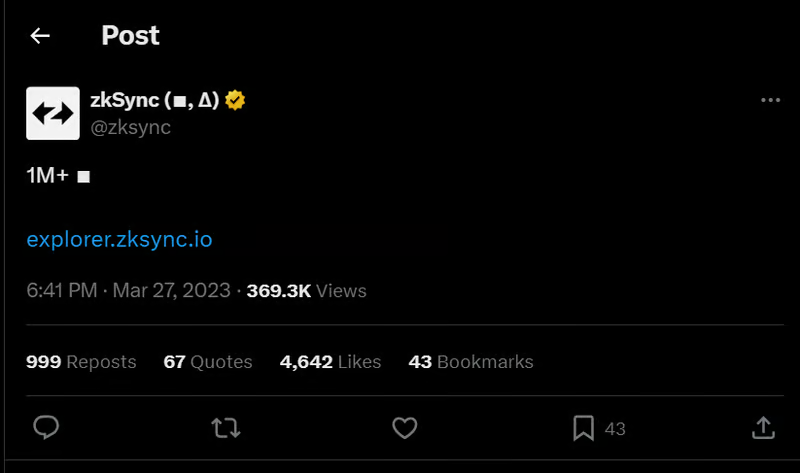 <h3 class="wp-block-heading" id="h-notable-fluctuations-in-rollups-tvl-nbsp">Notable fluctuations in rollups TVL: </h3> <img src="https://lh7-us.googleusercontent.com/c29VjyTAK1-2huPS7egoWoa9qaTginftvZH-st78lL09jSHc5eqZQfSuuT8zanFCrcCVKX4yeSpidyEI2tEkG0ZMCGfJ4enlC2-hOHZaj1hO0b59Sio3QWQRRUapdeA3WuE46K4QbI9t4lKx3-pnMIM" alt=""/> <p class="has-text-align-center"> <a href="https://defillama.com/chains/Rollup">Source: DeFiLlama</a></p> <p>Adoption of new rollups definitely has a significant impact on the TVL across major chains. Like, if we look at the stats of the first the above image, Base Arbitrum currently accounts for the highest TVL across all the rollups with 32.26% market share, then there is Base with 19.25% and Blast with 18.54% while Optimism and zkSync Era has 10.5% and 1.78% respectively. That’s about present, but if we look back a year ago, Arbitrum accounted for 65.04% of total TVL, Base and Blase simply 0%, while Optimism had 32.29% TVL. </p> <p>Here, we can see that Arbitrum and Optimism have seen notable decline in their TVL (based on 1-year data), despite the growing innovation in their ecosystem and a good number of projects built on them; Arbitrum- 613 and Optimism- 233. On top of that, zkSync Era being a new rollup has 107 projects. As we already discussed, the reason for growth of new rollups are their unique features, high TPS guarantee, and most importantly the provision of low gas cost. </p> <p>For example, zkSync Era promises to handle up to 10,000 TPS using the zkPorter technology in Hyperchains. Likewise, Blast is getting fast adoption as a specialized Layer2 having native yield for ETH and Stablecoins. Its yield comes directly from ETH staking and real-world asset (RWA) protocols. Plus, the default interest rate on Blast is 4% for ETH & 5% for stablecoins. Base’s factor for adoption we have discussed already.</p> <p>Coming to the decline in Arbitrum is said to be the protocol’s liquidity shrink. This implies that network’s participants have a lack of trust in getting enough yield as return. However, Arbitrum is now again getting the hold with a jump of 330.1k to 472k daily active addresses in the past 30 days. </p> 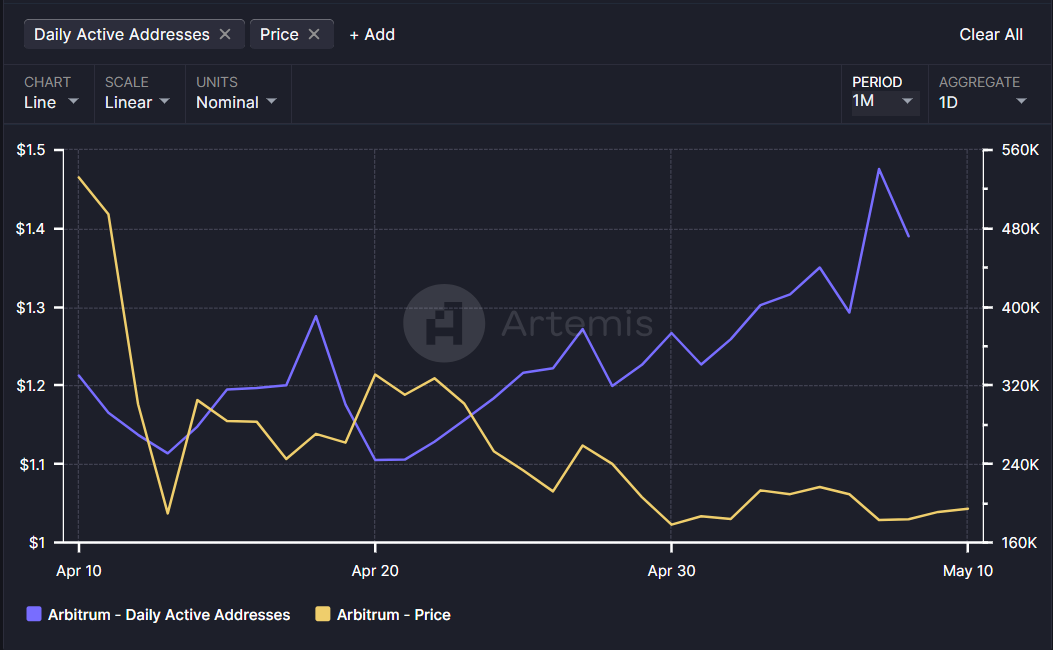 <p class="has-text-align-center"> Source: Artemis</p> <p>Optimism’s decline in TVL can be due to many reasons, such as late adoption of Superchains, customization challenges after Bedrock upgrade, as well as other pain points like delayed withdrawals, complicated framework, asynchronous cross-chain transactions, and more. However with <a href="https://www.superchain.eco/analytics">40+ superchain projects</a>, including big names like opBNB, Mantle Network, and Worldcoin, Optimism seeks to raise its TVL soon. </p> <h3 class="wp-block-heading" id="h-expansion-of-modular-rollups-nbsp">Expansion of Modular Rollups: </h3> <p>2024 is the year of modular rollups, due to the inception of highly innovative modular networks like Celestia for off-chain data availability, Espresso for decentralized sequencing, Risk Zero as proving network, and more as seen in the below image. These 100+ teams are capable of making a difference with their specific modular rollup offerings.</p> 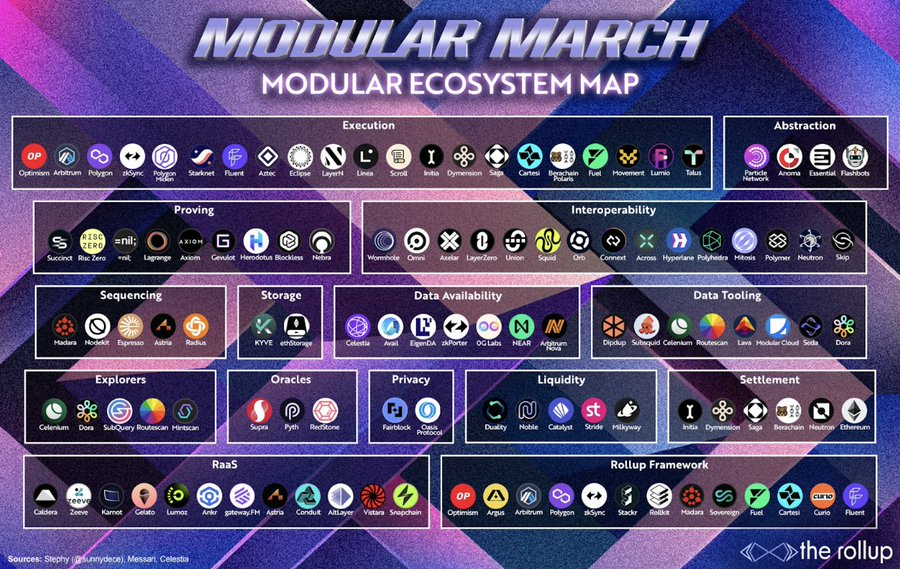 <p>With that, top modular rollup frameworks such as Polygon CDK, ZK Stack, Arbitrum Orbit, and OP Stack are getting boost, offering unique features like EVM-compatibility, EIP-4488 support, off-chain DA options, unified liquidity, easy modularity, very high TPS, and a lot more. </p> 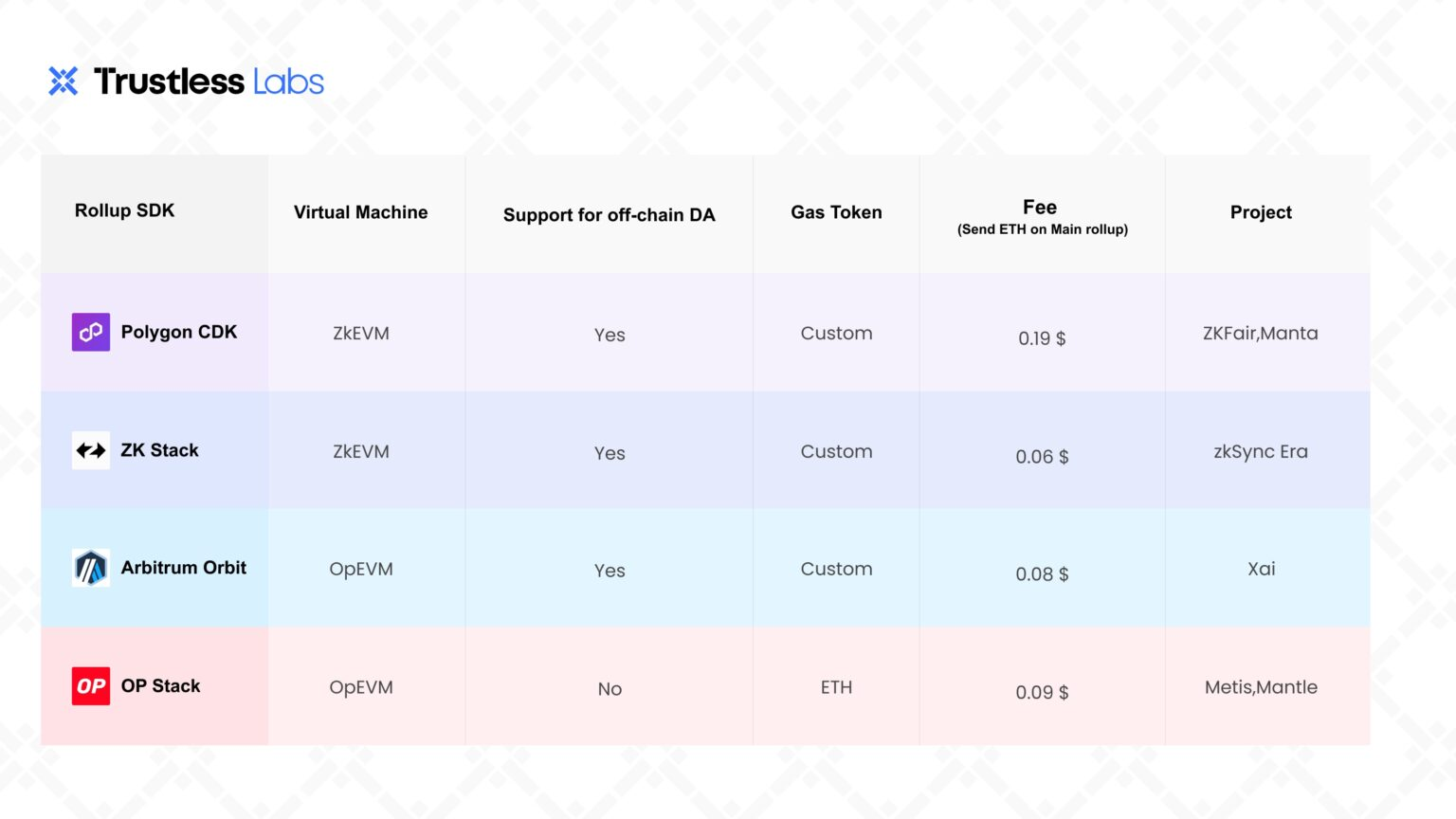 <p class="has-text-align-center"> Source: Trustless Labs</p> <h3 class="wp-block-heading" id="h-cost-optimization-after-dencun-upgrade">Cost optimization after Dencun upgrade:</h3> <p>Ethereum’s Dencun upgrade rolled out in 2024, introducing “blobs' ' through EIP-4788 to make transactions extremely cheaper for Layer2s. Arbitrum, Polygon, Optimism, Zora, Mode, Starknet, and Metis are the forerunners in adding support for the Dencun upgrade to offer low-cost transactions. The below stats shows the amount of fees that these Layer2s spend in USD as network fee, following the Dencun upgrade:</p> <h3 class="wp-block-heading" id="h-rise-of-rollups-as-a-service-nbsp-raas-solutions-nbsp">Rise of Rollups-as-a-service (RaaS) Solutions </h3> <p>Rollups-as-a-service (RaaS) Solutions providers are becoming indispensable in 2024, offering essential services for seamless launch, scaling, and maintenance of various rollup solutions. Here’s a list of top RaaS providers that will be rollups’ preferred partners to simplify L2/L3 deployment and management. With specialized services like low-code deployment, Enterprise SLA, and 24/7 network monitoring, RaaS providers are gaining momentum over time.</p> <h2 class="wp-block-heading" id="h-looking-forward">Looking Forward</h2> <p>From this extensive research, it's clear that 2024 is a promising year for rollups as its ecosystem is brimming with so many innovations such as modularity, higher scalability, cross-chain interoperability, and unique concepts like <a href="https://hackernoon.com/what-the-future-of-hybrid-rollups-could-look-like">Hybrid rollup</a>s. Additionally, as the rollup ecosystem matures, it will continue to drive better innovations to improve performance and sustainability for 2024 and beyond. </p> |
| json metadata | {"tags":["rollups"],"image":["https://cdn.steemitimages.com/DQmRSQt7gqPjUrjn6JY3eMfp8Rx6hfnQtXuVoiy1WHuxNTv/image.png","https://www.zeeve.io/wp-content/uploads/2024/05/Save-up-to-60-cost-for-your-next-rollup-project-1024x213.jpg","https://lh7-us.googleusercontent.com/VqyIkFqXYlOKjWmCcpaMmm-GFUDiUnY6qp6K1m3ptyUHWez579DH81G-gOF0W9xWCt62_5bHamUffFzJiQXLOuHgK4i_JRhxo7Nj5vH6ok-ZeKcsWGvuqrbtHC_PG8IG1HR69W7jEOUKRRkNcUKt2t8","https://cdn.steemitimages.com/DQmbEQXredASDmacPejY7Xu5aeqGVkf6YhnzdKiUaxFtZB5/image.png","https://lh7-us.googleusercontent.com/c29VjyTAK1-2huPS7egoWoa9qaTginftvZH-st78lL09jSHc5eqZQfSuuT8zanFCrcCVKX4yeSpidyEI2tEkG0ZMCGfJ4enlC2-hOHZaj1hO0b59Sio3QWQRRUapdeA3WuE46K4QbI9t4lKx3-pnMIM","https://dev-to-uploads.s3.amazonaws.com/uploads/articles/7re5riohczuxwi7j79jn.png","https://dev-to-uploads.s3.amazonaws.com/uploads/articles/1qx0xcnazrrkdc595xmr.png","https://dev-to-uploads.s3.amazonaws.com/uploads/articles/fvq1v9grblugey2wtzo1.png"],"links":["https://www.zeeve.io/rollups/","https://vitalik.eth.limo/general/2021/01/05/rollup.html","https://twitter.com/Uniswap/status/1787479308740571373","https://twitter.com/zksync/status/1640340768434065411","https://defillama.com/chains/Rollup","https://www.superchain.eco/analytics","https://hackernoon.com/what-the-future-of-hybrid-rollups-could-look-like"],"app":"steemit/0.2","format":"markdown"} |
| parent author | |
| parent permlink | rollups |
| permlink | state-of-blockchain-rollups-in-2024 |
| title | State of Blockchain Rollups in 2024 |
| Transaction Info | Block #88316909/Trx f9fe9f129f7cf6e415f3f8cde80457ec5b49a553 |
View Raw JSON Data
{
"block": 88316909,
"op": [
"comment",
{
"author": "zeevedeeptech",
"body": "\n<p>Blockchain rollups; whether Optimistic or zero-knowledge, both are designed to address the problem of Ethereum scalability through the approach of taking transaction computation off-chain. Over the years, the rollup ecosystem has undergone several changes, and thus, it has become highly mature. Now that we are in 2024, it’s important to understand how rollups operate in current times and what all is happening today. This helps existing projects to dive deeper into the comprehensive rollup concept while those who are getting started will have a clear idea of what stack will be ideal for them. Through this detailed report, we will understand the state of rollups in 2024. Also, we will have a quick recap of the evolution of rollups over the years. </p>\n<p><strong>Key takeaways:</strong></p>\n<ul>\n<li>Modular blockchains are becoming the spotlight in 2024.</li>\n<li>Arbitrum is keeping the momentum with more than 32% of total rollup’s TVL.</li>\n<li>Optimism is retaining its leading position with its innovative infrastructure offerings.</li>\n<li>Base has crossed 2M in daily transactions with over $1B TVL.</li>\n<li>Ethereum’s pro-dank sharding update has raised the popularity of Optimistic rollups.</li>\n<li>Optimism’s Bedrock upgrade continues to accommodate lower gas cost and faster block confirmation.</li>\n<li><a href=\"https://www.zeeve.io/rollups/\">Rollup-as-a-service (RaaS)</a> is becoming a preferred option for seamless launch and management of rollups.</li>\n<!-- /wp:list-item --></ul>\n<h2 class=\"wp-block-heading\" id=\"h-rollups-launch-and-evolution-in-its-landscape-to-date\">Rollups Launch and evolution in its landscape to date</h2>\n<p>The concept of rollups as a powerful scaling solution was first driven around 2021 by Ethereum’s co-founder, Vitalik Buterin. <a href=\"https://vitalik.eth.limo/general/2021/01/05/rollup.html\">In this research</a>, he talked about Layer2 rollups as a means to improve Ethereum’s efficiency by taking the computation off-chain on a separate layer where congestion is extremely low. At that time, token transfer on Ethereum's base layer cost ~45000 gas, whereas the same took up ~300 gas in rollups. Hence, rollups got its firm grip in the web3 space, contributing to the development of advanced rollup chains like Arbitrum, Optimism, ZkSync Era, and Polygon zkEVM. </p>\n<a href=\"https://www.zeeve.io/rollups/\"><img src=\"https://www.zeeve.io/wp-content/uploads/2024/05/Save-up-to-60-cost-for-your-next-rollup-project-1024x213.jpg\" alt=\"\" class=\"wp-image-67489\"/></a>\n<p>Arbitrum is the first to launch Layer2 rollups as it released classic optimistic rollups in 2012. Besides offering a public rollup aggregating a total of <a href=\"https://twitter.com/Uniswap/status/1787479308740571373\">$150 billion transactions</a>, Arbitrum offers its advanced rollup stack– Arbitrum Orbit, to accommodate development of standalone L2/L3 rollup chains. Optimism was introduced a few months after Arbitrum, in Dec 2021. This rollup gathered popularity because of its approach of using multi-round proofs, thus lowering the gas consumption significantly. Also, Optimism is known for its Superchains built through OP Stack, which has been even more feasible after the Bedrock update. Total transactions on Optimism is currently recorded at 263.66M. Polygon zkEVM and ZkSync Era launched their mainnet later and rolled out their distinct stacks– Polygon CDK and ZkSync hyperchains that are witnessing fast adoption. Total transaction on Polygon zkEVM is 11.16M and 37.721334B on zkSync Era as of now. </p>\n<h2 class=\"wp-block-heading\" id=\"h-inspecting-the-state-of-layer2-rollups-in-2024\">Inspecting the state of Layer2 Rollups in 2024</h2>\n<p>Let’s dive into the state of rollups in 2024, exploring everything that is happening currently on the rollups’ landscape. From the growth in rollup chains to the market expansion and innovation, we will have a broader view of it. </p>\n<h3 class=\"wp-block-heading\" id=\"h-dominance-of-new-layer2-rollups-nbsp\">Dominance of new Layer2 rollups </h3>\n<p>There has been rapid growth in the rollup space, which has led to the development of several new rollup chains. Speaking about 2023, new Layer2 rollups like Base and zkSync Era were launched and as of December, these two chains recorded the third highest TVL (total value locked). Also, Base at times surpassed the amount of Arbitrum and Optimism’s TVL. However, these are the widely used rollups with hundreds of projects already running on their ecosystem. Here’s a snapshot of the 2023’s TVL for popular rollups. </p>\n<img src=\"https://lh7-us.googleusercontent.com/VqyIkFqXYlOKjWmCcpaMmm-GFUDiUnY6qp6K1m3ptyUHWez579DH81G-gOF0W9xWCt62_5bHamUffFzJiQXLOuHgK4i_JRhxo7Nj5vH6ok-ZeKcsWGvuqrbtHC_PG8IG1HR69W7jEOUKRRkNcUKt2t8\" alt=\"\"/>\n<p>Even in 2024, Base is recording 2.52M transactions, higher than leading Optimistic rollups; Optimism and Base are seeing 1.58M and 586.66k, respectively.</p>\n<p>Regarding zkRollups, ZkSync Era (906.65k) and Manta Pacific (71.53k) are recording higher daily transactions compared to Polygon zkEVM (20k).</p>\n<p>The reason behind new rollups’ surge in adoption can be varied. For example, Base initially acquired 11M+ verified users because it has the backing of the most trusted and respected name– Coinbase. Plus, users will be able to tap into the broad liquidity of Coinbase. </p>\n<p>Similarly, for ZkSync Era, their idea of offering unprecedented scalability and modularity through ‘Hyperchains’ can be one of the biggest reason for its rapid adoption, aggregating more than a million transactions within the initial 3-4 days of launch as mentioned in their <a href=\"https://twitter.com/zksync/status/1640340768434065411\">official twitter post</a>. </p>\n\n\n\n<h3 class=\"wp-block-heading\" id=\"h-notable-fluctuations-in-rollups-tvl-nbsp\">Notable fluctuations in rollups TVL: </h3>\n<img src=\"https://lh7-us.googleusercontent.com/c29VjyTAK1-2huPS7egoWoa9qaTginftvZH-st78lL09jSHc5eqZQfSuuT8zanFCrcCVKX4yeSpidyEI2tEkG0ZMCGfJ4enlC2-hOHZaj1hO0b59Sio3QWQRRUapdeA3WuE46K4QbI9t4lKx3-pnMIM\" alt=\"\"/>\n<p class=\"has-text-align-center\"> <a href=\"https://defillama.com/chains/Rollup\">Source: DeFiLlama</a></p>\n<p>Adoption of new rollups definitely has a significant impact on the TVL across major chains. Like, if we look at the stats of the first the above image, Base Arbitrum currently accounts for the highest TVL across all the rollups with 32.26% market share, then there is Base with 19.25% and Blast with 18.54% while Optimism and zkSync Era has 10.5% and 1.78% respectively. That’s about present, but if we look back a year ago, Arbitrum accounted for 65.04% of total TVL, Base and Blase simply 0%, while Optimism had 32.29% TVL. </p>\n<p>Here, we can see that Arbitrum and Optimism have seen notable decline in their TVL (based on 1-year data), despite the growing innovation in their ecosystem and a good number of projects built on them; Arbitrum- 613 and Optimism- 233. On top of that, zkSync Era being a new rollup has 107 projects. As we already discussed, the reason for growth of new rollups are their unique features, high TPS guarantee, and most importantly the provision of low gas cost. </p>\n<p>For example, zkSync Era promises to handle up to 10,000 TPS using the zkPorter technology in Hyperchains. Likewise, Blast is getting fast adoption as a specialized Layer2 having native yield for ETH and Stablecoins. Its yield comes directly from ETH staking and real-world asset (RWA) protocols. Plus, the default interest rate on Blast is 4% for ETH & 5% for stablecoins. Base’s factor for adoption we have discussed already.</p>\n<p>Coming to the decline in Arbitrum is said to be the protocol’s liquidity shrink. This implies that network’s participants have a lack of trust in getting enough yield as return. However, Arbitrum is now again getting the hold with a jump of 330.1k to 472k daily active addresses in the past 30 days. </p>\n\n\n<p class=\"has-text-align-center\"> Source: Artemis</p>\n<p>Optimism’s decline in TVL can be due to many reasons, such as late adoption of Superchains, customization challenges after Bedrock upgrade, as well as other pain points like delayed withdrawals, complicated framework, asynchronous cross-chain transactions, and more. However with <a href=\"https://www.superchain.eco/analytics\">40+ superchain projects</a>, including big names like opBNB, Mantle Network, and Worldcoin, Optimism seeks to raise its TVL soon. </p>\n<h3 class=\"wp-block-heading\" id=\"h-expansion-of-modular-rollups-nbsp\">Expansion of Modular Rollups: </h3>\n<p>2024 is the year of modular rollups, due to the inception of highly innovative modular networks like Celestia for off-chain data availability, Espresso for decentralized sequencing, Risk Zero as proving network, and more as seen in the below image. These 100+ teams are capable of making a difference with their specific modular rollup offerings.</p>\n\n\n<p>With that, top modular rollup frameworks such as Polygon CDK, ZK Stack, Arbitrum Orbit, and OP Stack are getting boost, offering unique features like EVM-compatibility, EIP-4488 support, off-chain DA options, unified liquidity, easy modularity, very high TPS, and a lot more. </p>\n\n\n<p class=\"has-text-align-center\"> Source: Trustless Labs</p>\n<h3 class=\"wp-block-heading\" id=\"h-cost-optimization-after-dencun-upgrade\">Cost optimization after Dencun upgrade:</h3>\n<p>Ethereum’s Dencun upgrade rolled out in 2024, introducing “blobs' ' through EIP-4788 to make transactions extremely cheaper for Layer2s. Arbitrum, Polygon, Optimism, Zora, Mode, Starknet, and Metis are the forerunners in adding support for the Dencun upgrade to offer low-cost transactions. The below stats shows the amount of fees that these Layer2s spend in USD as network fee, following the Dencun upgrade:</p>\n<h3 class=\"wp-block-heading\" id=\"h-rise-of-rollups-as-a-service-nbsp-raas-solutions-nbsp\">Rise of Rollups-as-a-service (RaaS) Solutions </h3>\n<p>Rollups-as-a-service (RaaS) Solutions providers are becoming indispensable in 2024, offering essential services for seamless launch, scaling, and maintenance of various rollup solutions. Here’s a list of top RaaS providers that will be rollups’ preferred partners to simplify L2/L3 deployment and management. With specialized services like low-code deployment, Enterprise SLA, and 24/7 network monitoring, RaaS providers are gaining momentum over time.</p>\n<h2 class=\"wp-block-heading\" id=\"h-looking-forward\">Looking Forward</h2>\n<p>From this extensive research, it's clear that 2024 is a promising year for rollups as its ecosystem is brimming with so many innovations such as modularity, higher scalability, cross-chain interoperability, and unique concepts like <a href=\"https://hackernoon.com/what-the-future-of-hybrid-rollups-could-look-like\">Hybrid rollup</a>s. Additionally, as the rollup ecosystem matures, it will continue to drive better innovations to improve performance and sustainability for 2024 and beyond. </p>",
"json_metadata": "{\"tags\":[\"rollups\"],\"image\":[\"https://cdn.steemitimages.com/DQmRSQt7gqPjUrjn6JY3eMfp8Rx6hfnQtXuVoiy1WHuxNTv/image.png\",\"https://www.zeeve.io/wp-content/uploads/2024/05/Save-up-to-60-cost-for-your-next-rollup-project-1024x213.jpg\",\"https://lh7-us.googleusercontent.com/VqyIkFqXYlOKjWmCcpaMmm-GFUDiUnY6qp6K1m3ptyUHWez579DH81G-gOF0W9xWCt62_5bHamUffFzJiQXLOuHgK4i_JRhxo7Nj5vH6ok-ZeKcsWGvuqrbtHC_PG8IG1HR69W7jEOUKRRkNcUKt2t8\",\"https://cdn.steemitimages.com/DQmbEQXredASDmacPejY7Xu5aeqGVkf6YhnzdKiUaxFtZB5/image.png\",\"https://lh7-us.googleusercontent.com/c29VjyTAK1-2huPS7egoWoa9qaTginftvZH-st78lL09jSHc5eqZQfSuuT8zanFCrcCVKX4yeSpidyEI2tEkG0ZMCGfJ4enlC2-hOHZaj1hO0b59Sio3QWQRRUapdeA3WuE46K4QbI9t4lKx3-pnMIM\",\"https://dev-to-uploads.s3.amazonaws.com/uploads/articles/7re5riohczuxwi7j79jn.png\",\"https://dev-to-uploads.s3.amazonaws.com/uploads/articles/1qx0xcnazrrkdc595xmr.png\",\"https://dev-to-uploads.s3.amazonaws.com/uploads/articles/fvq1v9grblugey2wtzo1.png\"],\"links\":[\"https://www.zeeve.io/rollups/\",\"https://vitalik.eth.limo/general/2021/01/05/rollup.html\",\"https://twitter.com/Uniswap/status/1787479308740571373\",\"https://twitter.com/zksync/status/1640340768434065411\",\"https://defillama.com/chains/Rollup\",\"https://www.superchain.eco/analytics\",\"https://hackernoon.com/what-the-future-of-hybrid-rollups-could-look-like\"],\"app\":\"steemit/0.2\",\"format\":\"markdown\"}",
"parent_author": "",
"parent_permlink": "rollups",
"permlink": "state-of-blockchain-rollups-in-2024",
"title": "State of Blockchain Rollups in 2024"
}
],
"op_in_trx": 0,
"timestamp": "2024-09-04T06:50:03",
"trx_id": "f9fe9f129f7cf6e415f3f8cde80457ec5b49a553",
"trx_in_block": 3,
"virtual_op": 0
}zeevedeeptechpublished a new post: test-drive-zksync-hyperchain-on-zeeve-s-fully-powered-demo-network2024/09/02 06:38:30
zeevedeeptechpublished a new post: test-drive-zksync-hyperchain-on-zeeve-s-fully-powered-demo-network
2024/09/02 06:38:30
| author | zeevedeeptech |
| body |  <p>ZkSync Hyperchains is one of the powerful rollup frameworks that claims to represent the end game for Ethereum scaling. For those who are building their own hyperchain, testing becomes an important aspect of ensuring a flawless operation. What if you could access a network that is a simulation of the real ZkSync Hyperchain setup, just for the purpose of understanding the hyperchain’s configurations, integrations, and also testing can be done. That’s where Zeeve’s zkSync Hyperchain Demo Network comes into the picture. This demo sandbox is designed to allow developers and users to interact with a fully functioning zkSync hyperchain setup, test its functionalities, and thereby understand how a real network exactly looks like. </p> <p>Through this article, we dive into the <a href="https://app.zeeve.io/auth/signup?serviceURL=https://app.zeeve.io/zksync-hyperchains-zkrollups">zkSync Hyperchain Demo Network on Zeeve</a> to learn how you can get hands-on expertise on a hyperchain’s various aspects without creating a network of your own. </p> <h2 class="wp-block-heading" id="h-a-walkthrough-of-zksync-demo-network-offered-by-zeeve-raas-nbsp">A walkthrough of zkSync Demo Network offered by Zeeve RaaS </h2> <p>The zkSync hyperchain’s demo network is one of the core offerings of Zeeve Rollups-as-a-service (RaaS) offerings, which is a sandbox environment designed to offer a pre-configured DevNet. It allows developers and web3 projects to explore a fully-functioning zkSync network and meanwhile see how their chain will look like. Further, they can set up their own DevNet after learning all the essentials. Note that this demo zkSync hyperchain is shared and accessible to every user. If you want custom configurations specific to your chain, you can quickly <a href="https://www.zeeve.io/appchains/zksync-hyperchains-zkrollups/">deploy a zkSync hyperchain</a> from the same dashboard. </p> <a href="https://www.zeeve.io/talk-to-an-expert/"><img src="https://www.zeeve.io/wp-content/uploads/2024/05/Build-your-custom-zkSync-Hyperchain-at-lower-cost-with-us-1024x213.jpg" alt="zkSync Hyperchain Demo Network on Zeeve " class="wp-image-67354"/></a> <p>Zeeve’s zkSync hyperchain demo network is not merely a simulation of a static network. Rather, it provides you hands-on access to a fully powered DevNet where you can interact with components such as RPC nodes & its endpoints to interact with the network, perform bridge operations, view smart contract and wallet transactions on the explorer, download necessary files to use in further development, and much more. </p> <h2 class="wp-block-heading" id="h-what-all-things-you-can-do-with-the-zksync-hyperchain-s-demo-network">What all things you can do with the zkSync Hyperchain’s demo network?</h2> <p>Let’s discuss all the things Zeeve’s zkSync Hyperchain Demo Network has to offer. Also, we will explore the interactions enabled in this setup- for example– viewing transactions on explorer, making RPC calls, or interacting with the bridges. </p> <li><strong>Get complete overview of the zkSync Hyperchain:</strong></li> <p>Upon login, you will see a zkSync Hyperchain’s overview page has all this pre-configured demo network, such as Network’s name, Chain ID, Network Type, Status; deployed or synching, infrastructure provision time, etc. </p> 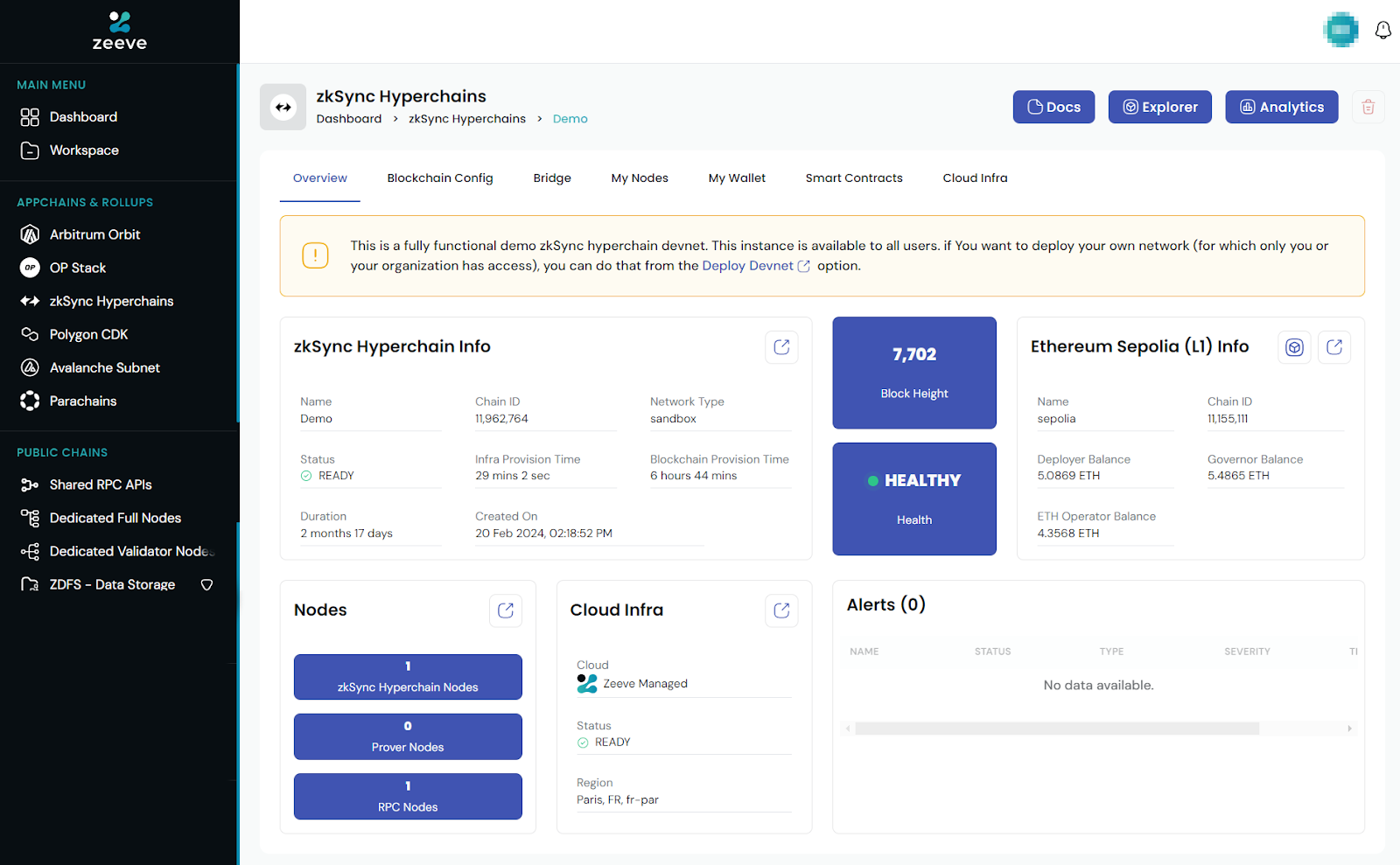 <p>Also, you will see similar details about Layer1- Ethereum Sepolia’s, such as Network name, Chain ID, Deployer Balanche, Governor Balance, and ETH Operator Balance. </p> <p>Other details are also there, like node count, cloud infrastructure info, and alerts. Note that, alerts on this demo setup are produced in real-time and it also gets solved automatically. Hence, you won’t see any alerts listed here.</p> <li><strong>Inspect all the configurations at one-place: </strong></li> <p>For a successful deployment, you must understand all configurations running in the backend of a hyperchain. Hence, the demo network shows a dashboard with general configuration, block-level configuration, and transaction configuration. This default configuration will help you to understand what type of configuration you may need to set up your own chain. Also, you can download the zkSync Hyperchain Env file from here.</p> 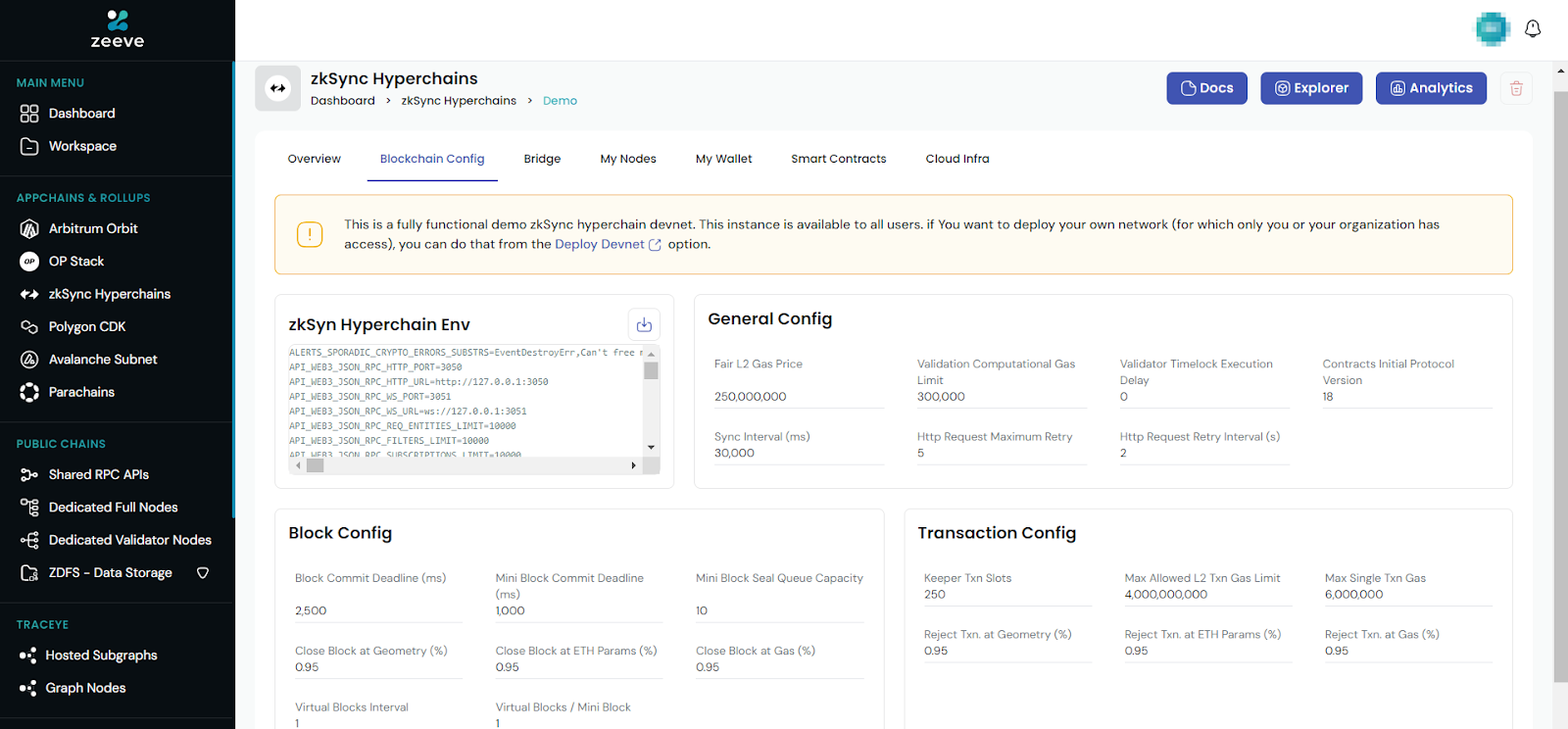 <li><strong>Interact through the Bridge:</strong></li> <p>The demo network of zkSync Hyperchain comes with a native bridge that you can use to perform bridge operations, such as sending or receiving funds/tokens between Layer1 and Layer2 chains. </p> 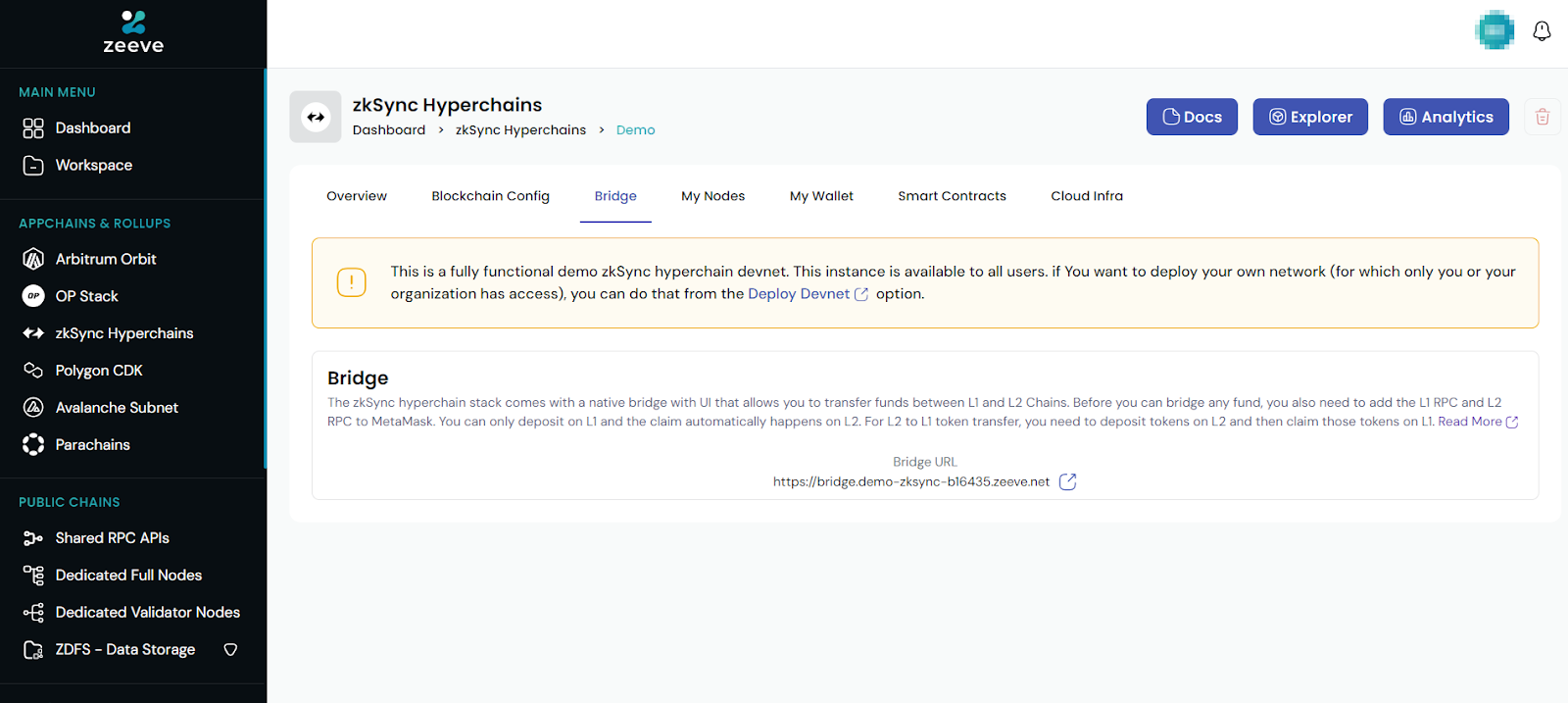 <p>To do this, navigate to the Bridge and click on the Bridge URL (as you can see in the above image) and connect any of your Ethereum wallets. For example, we are using Metamask’s browser wallet. </p>  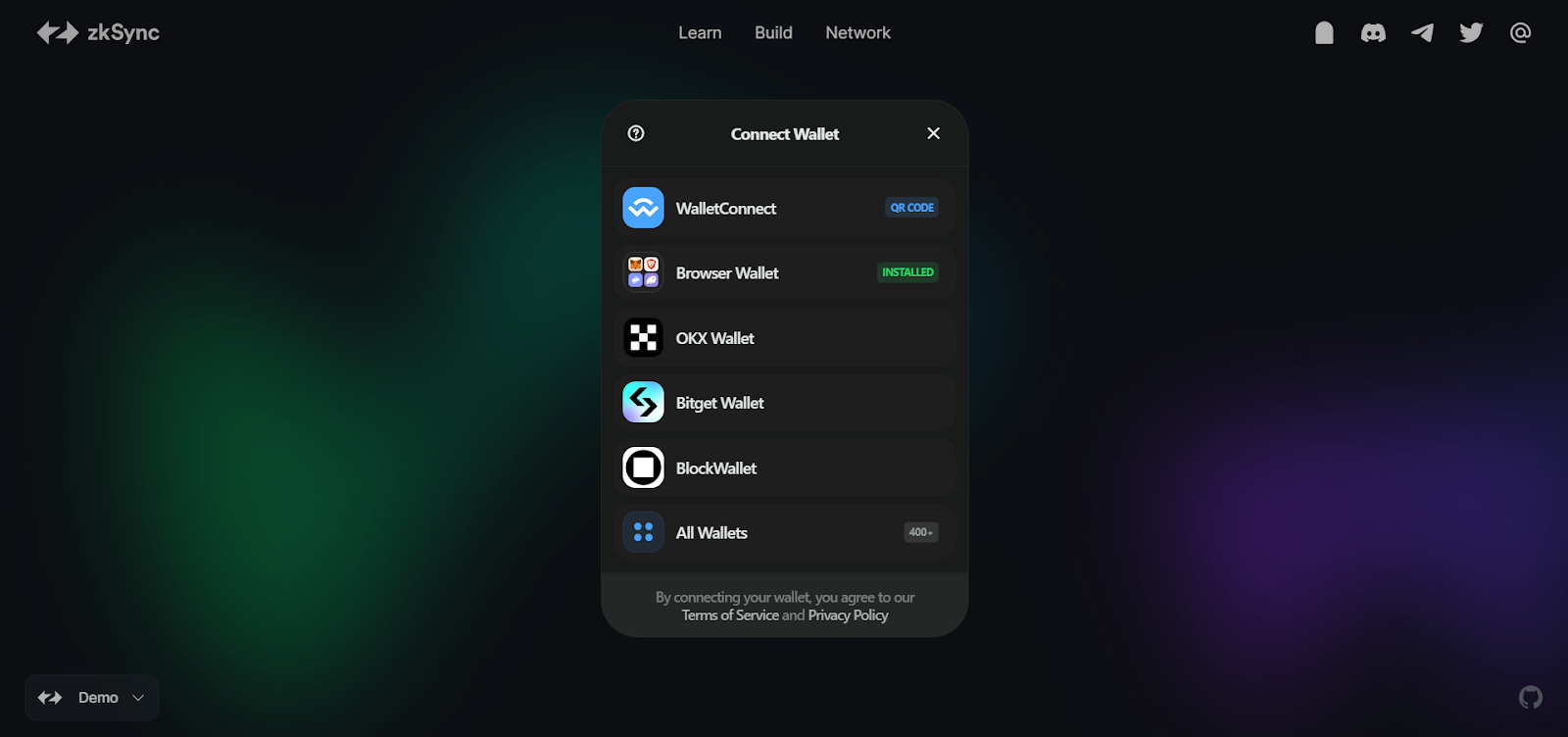 <p>For interaction, let’s receive some tokens in the demo account from the Ethereum Sepolia network. </p> <p>Click on ‘Assets’ and proceed to add funds. Click on Receive—>select official bridge—>choose your account address. In our case, the balance on the Sepolia network is 0.05 and we are sending 0.01 to the Demo network. </p> 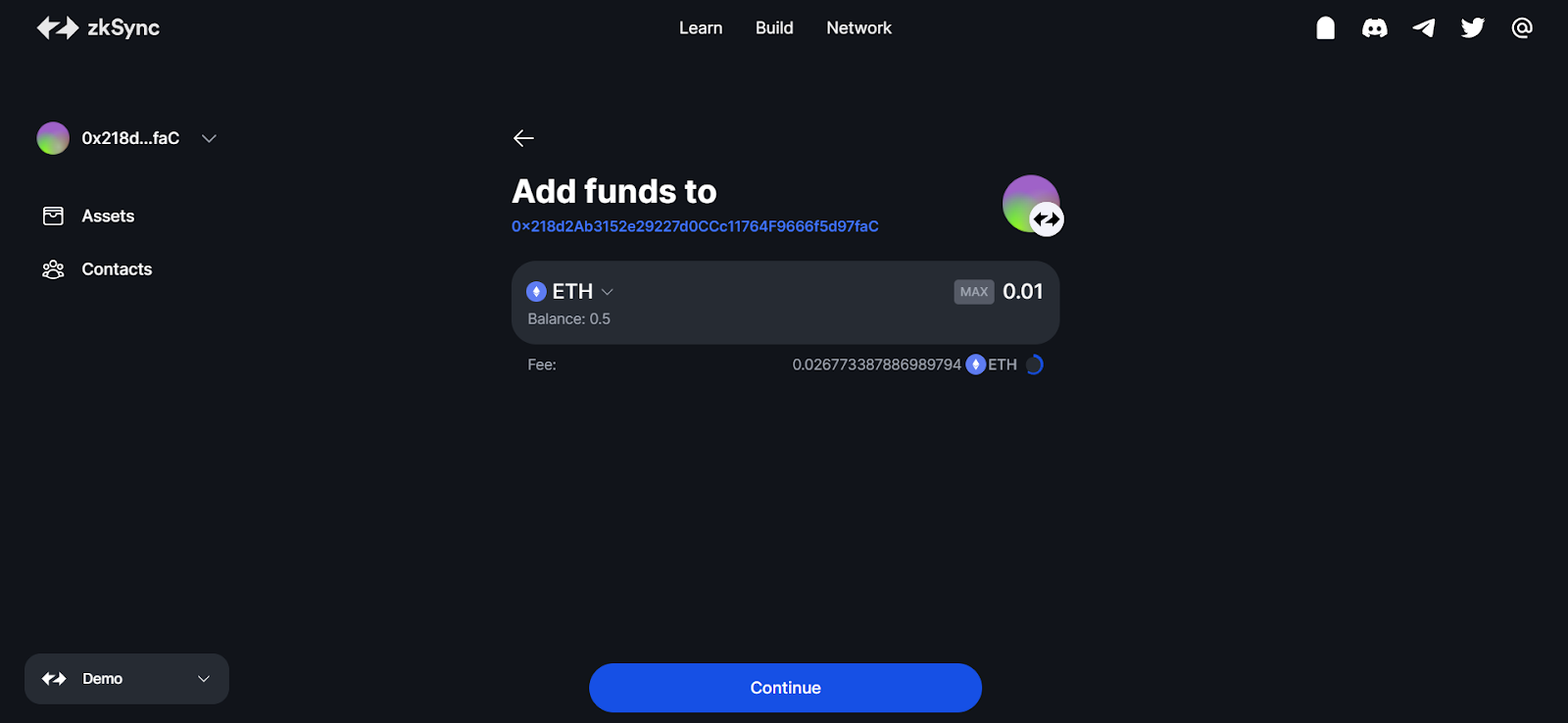 <p>Click continue and confirm transactions from your Metamask wallet. Once confirmed, the balance will reflect in your demo account under ‘Assets’.</p> 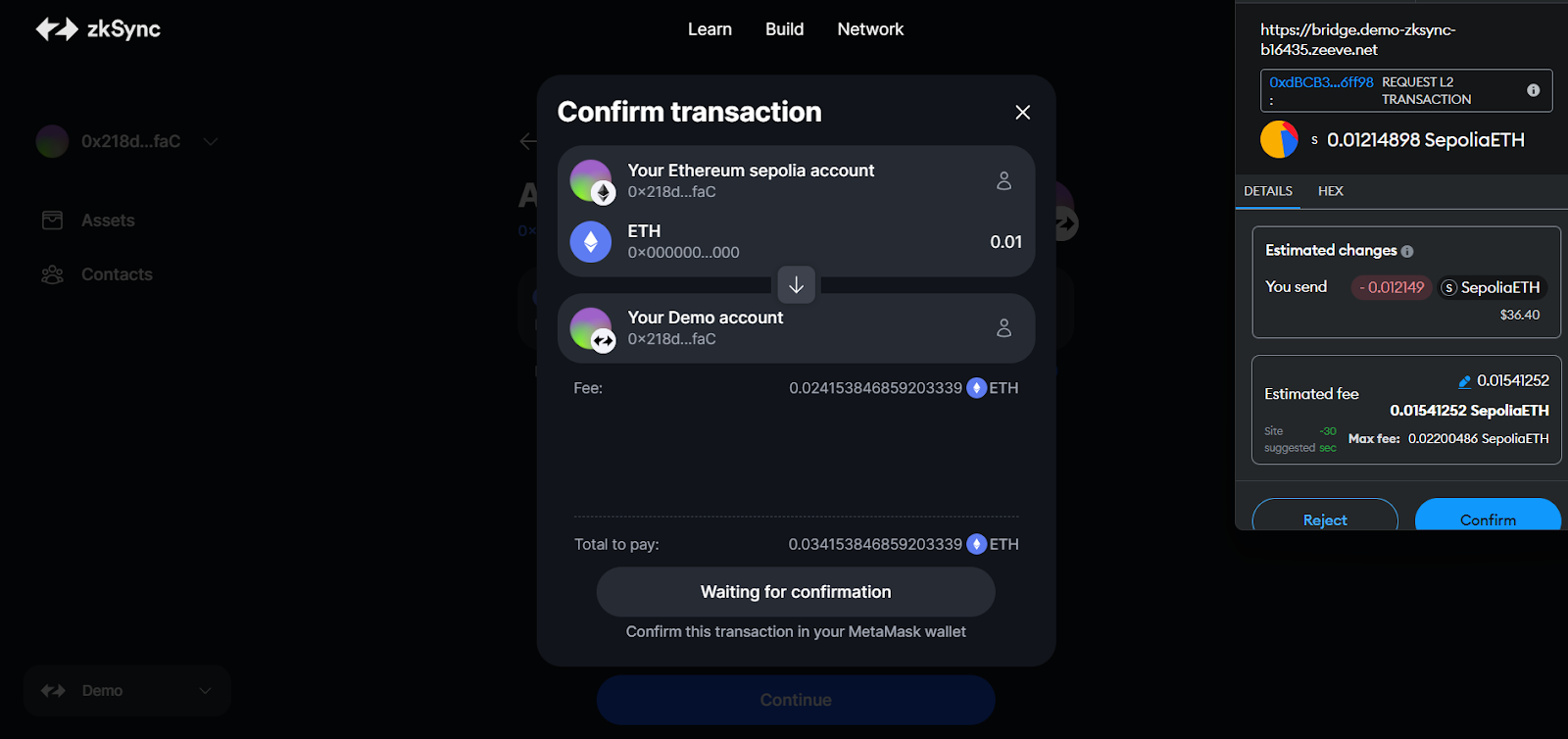 <li><strong>Make seamless RPC Calls: </strong></li> <p>Under the nodes section, you will see the hyperchain node/nodes running for the demo network. As you can see, there are RPC Nodes and Prover Nodes. However, the prover node is for testnet/mainnet. Hence, let’s explore the RPC.</p> 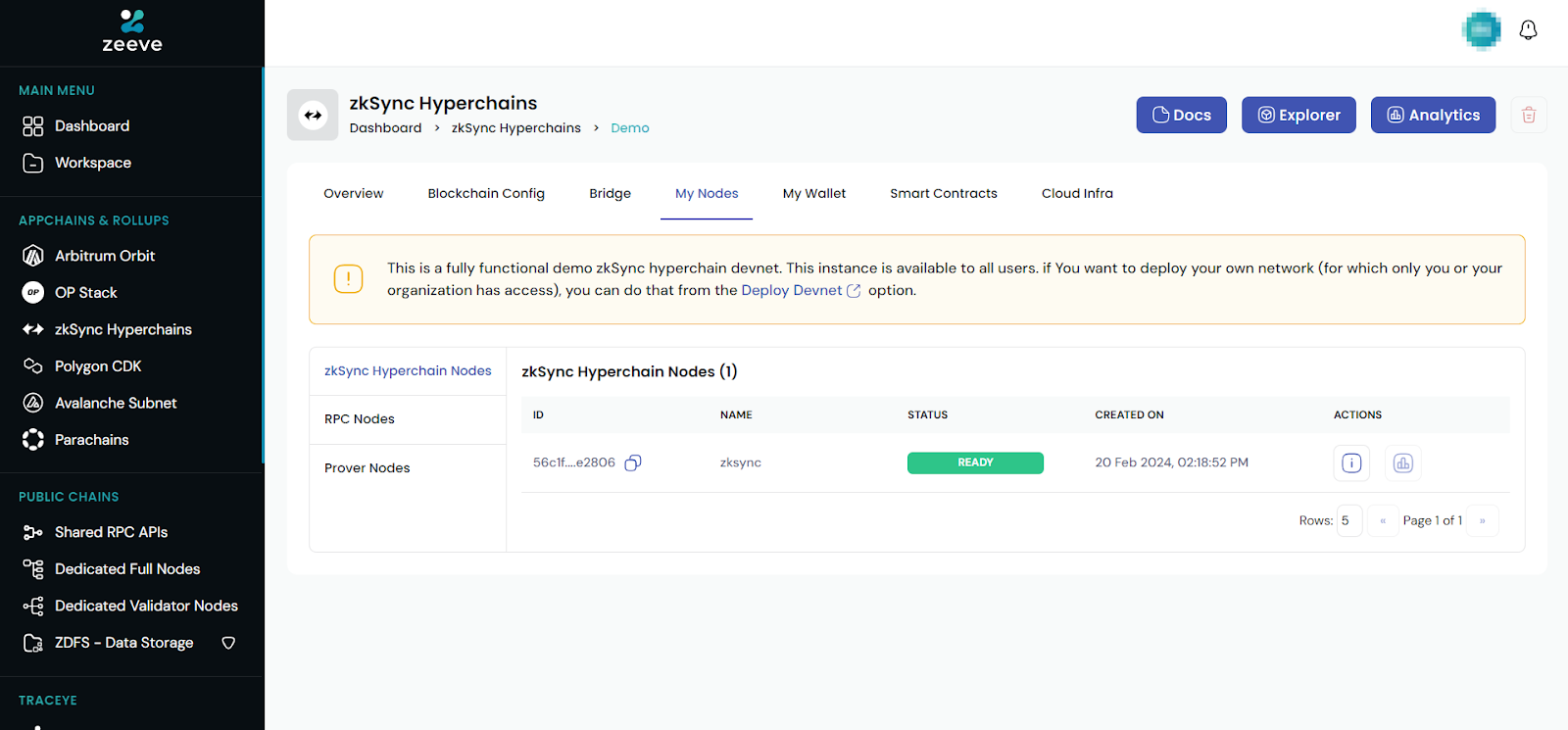 <p>Navigate to the ‘Actions’ and click the info button’s icon. This will open a detailed page showing RPC node configurations, such as General node info, Cloud infra details, RPC Endpoints, and RPC configurations. </p> 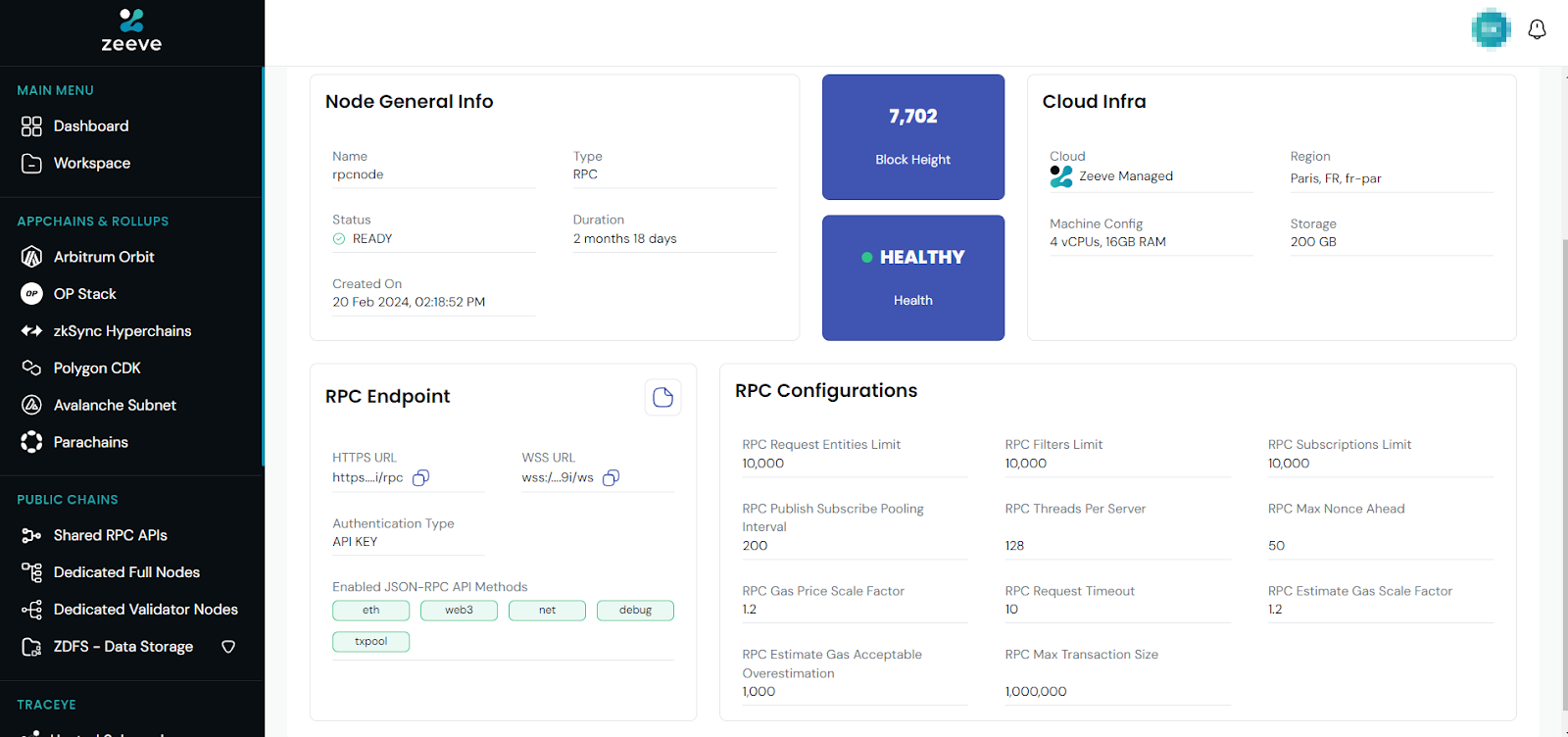 <p>Using these live RPC endpoints, you can RPC calls and interact with the network. For that, you first need to install an API request builder tool, like we are using PostWoman. Also, we are initiating an RPC call for <strong>‘eth_blockNumber’, </strong>hence it will show block number as outcome.<strong> </strong></p> <p>Go to Postwoman—> change call method to ‘Post’ —>paste HTTP URL (as given in the above image) in the URL section—> paste the given command in the ‘Parameter’ section. </p> <p>{"jsonrpc":"2.0","method":"eth_blockNumber","params":[],"id":83}.</p> 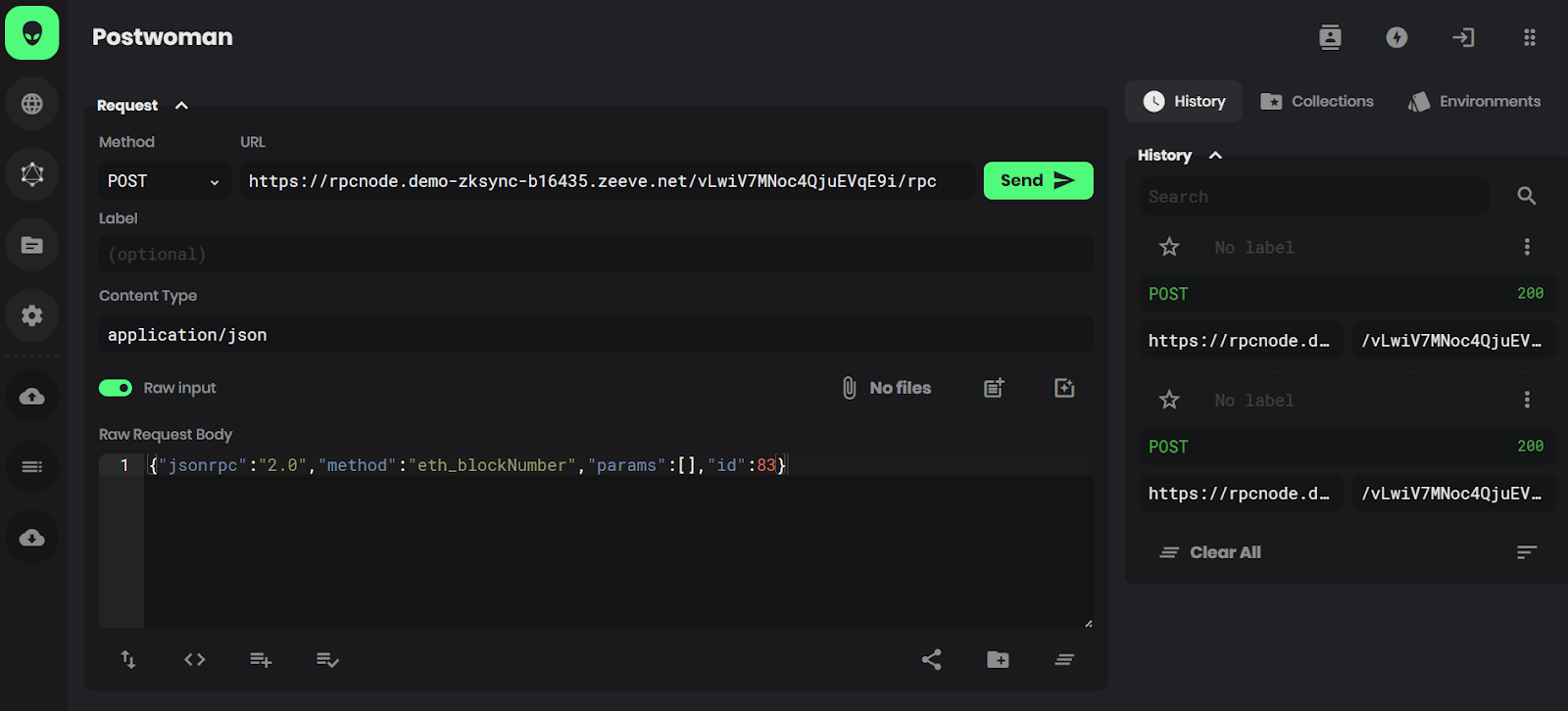 <p>Now, click send. </p> 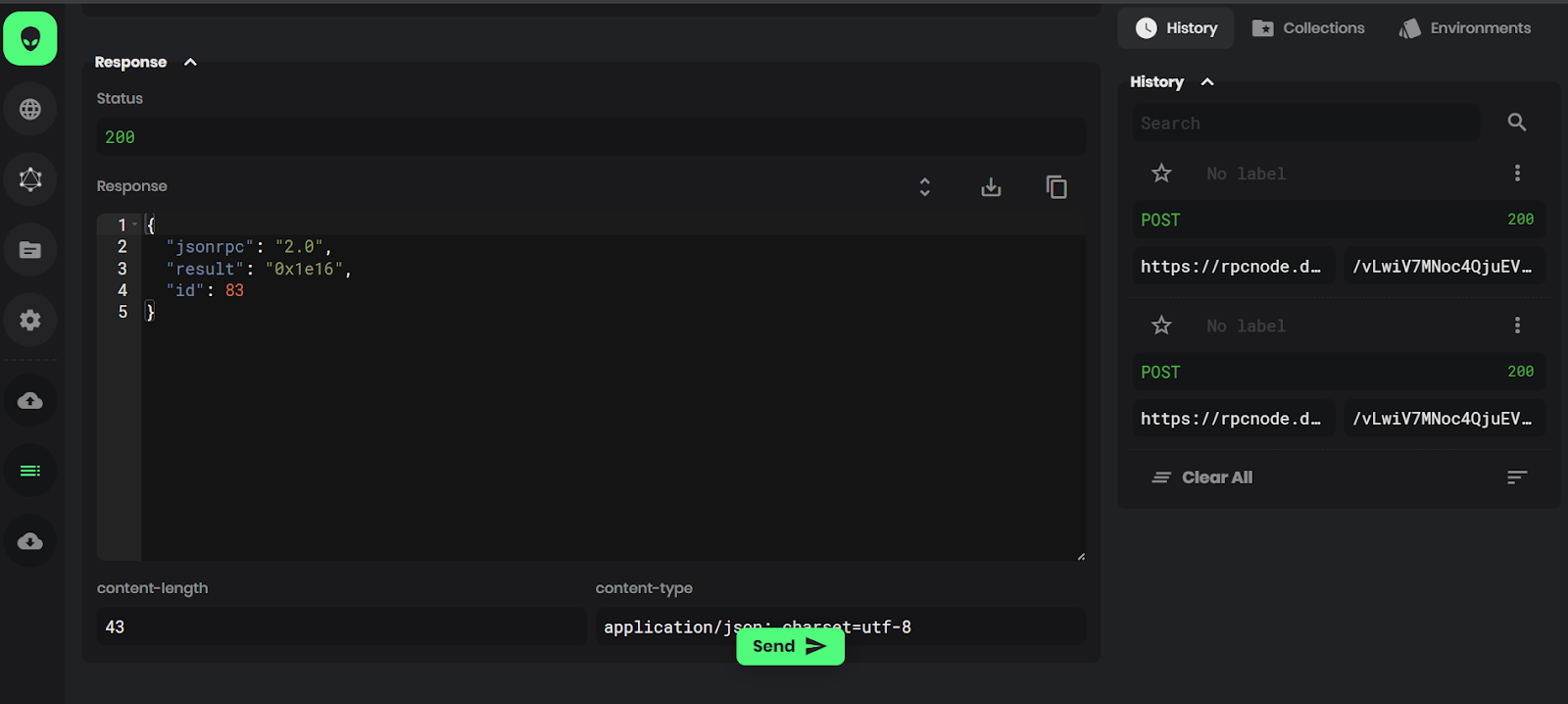 <p>In response, you will get the result as a block number. When you convert the <strong>0x1e16 </strong>(hexadecimal) to decimal, it will give you the exact block number, which is 7702 in the case of this demo network. Similarly, you can make RPC calls to get balance, gas price, peer count, etc. Commands for all of these you can get from Etherem’s official <a href="https://ethereum.org/en/developers/docs/apis/json-rpc/">JSON API docs</a>. </p> <li><strong>Deploy smart contracts:</strong></li> <p>Using the RPC endpoints from the demo network, you can do smart contract transactions and thereby deploy any type of application contract. For this, you first need to create a zkSync project using zksync-cli and perform all the configurations before deploying the contract on the network. Your contracts will operate alongside the core rollup contract to serve the specific purpose of your dApp. For this, this demo network provides <a href="https://docs.zeeve.io/rollups/zksync-hyperchain/demo-network/deploying-contract">detailed docs</a> that you can get by clicking on the ‘Docs’ icon. </p> 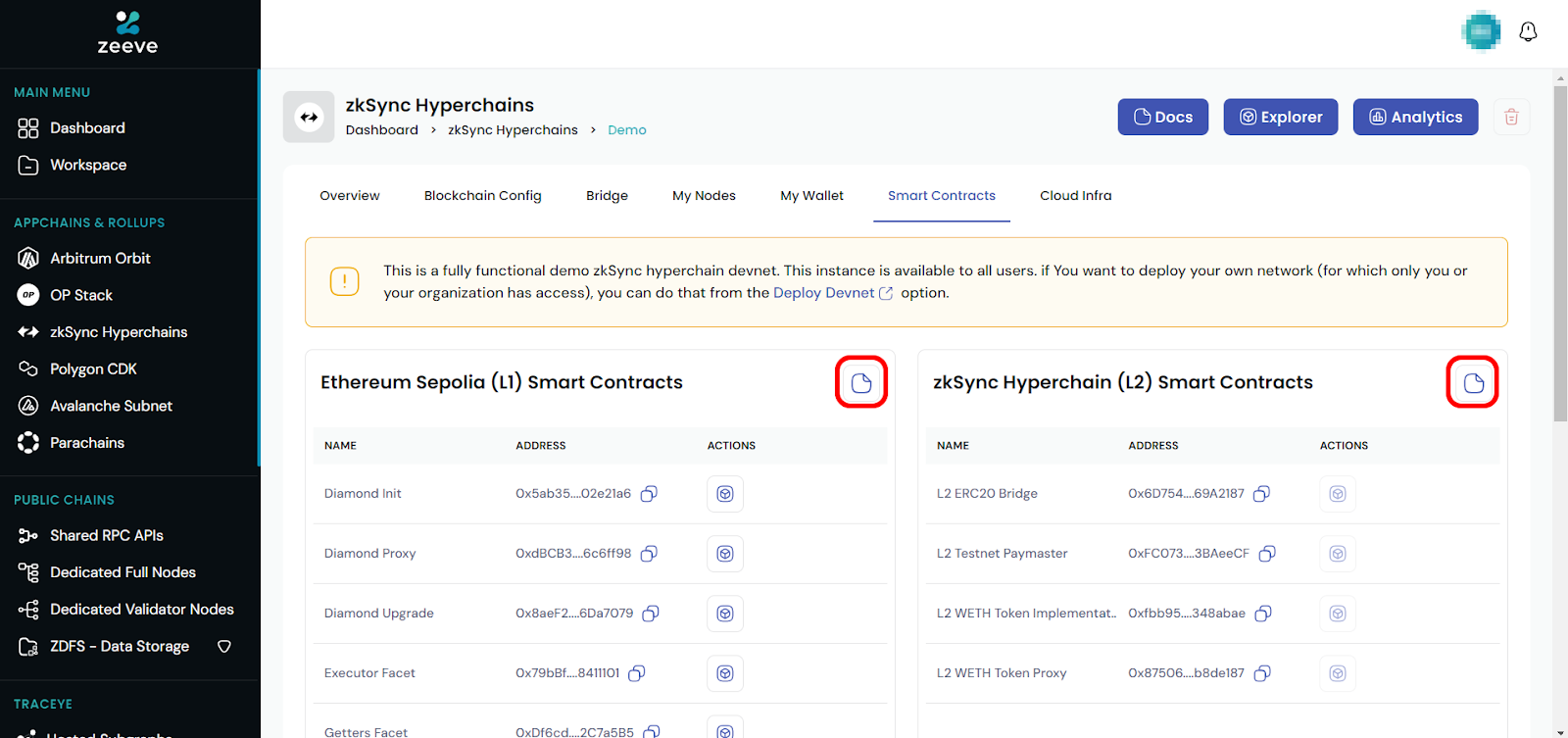 <li><strong>Check transaction details on explorer:</strong></li> <p>Be it for wallets, nodes, or smart contracts, the explorer in the demo network allows you to see comprehensive transaction details seamlessly. For example, if you want to check the transaction details for any wallet, click the explorer icon given for L1 & L2. </p> 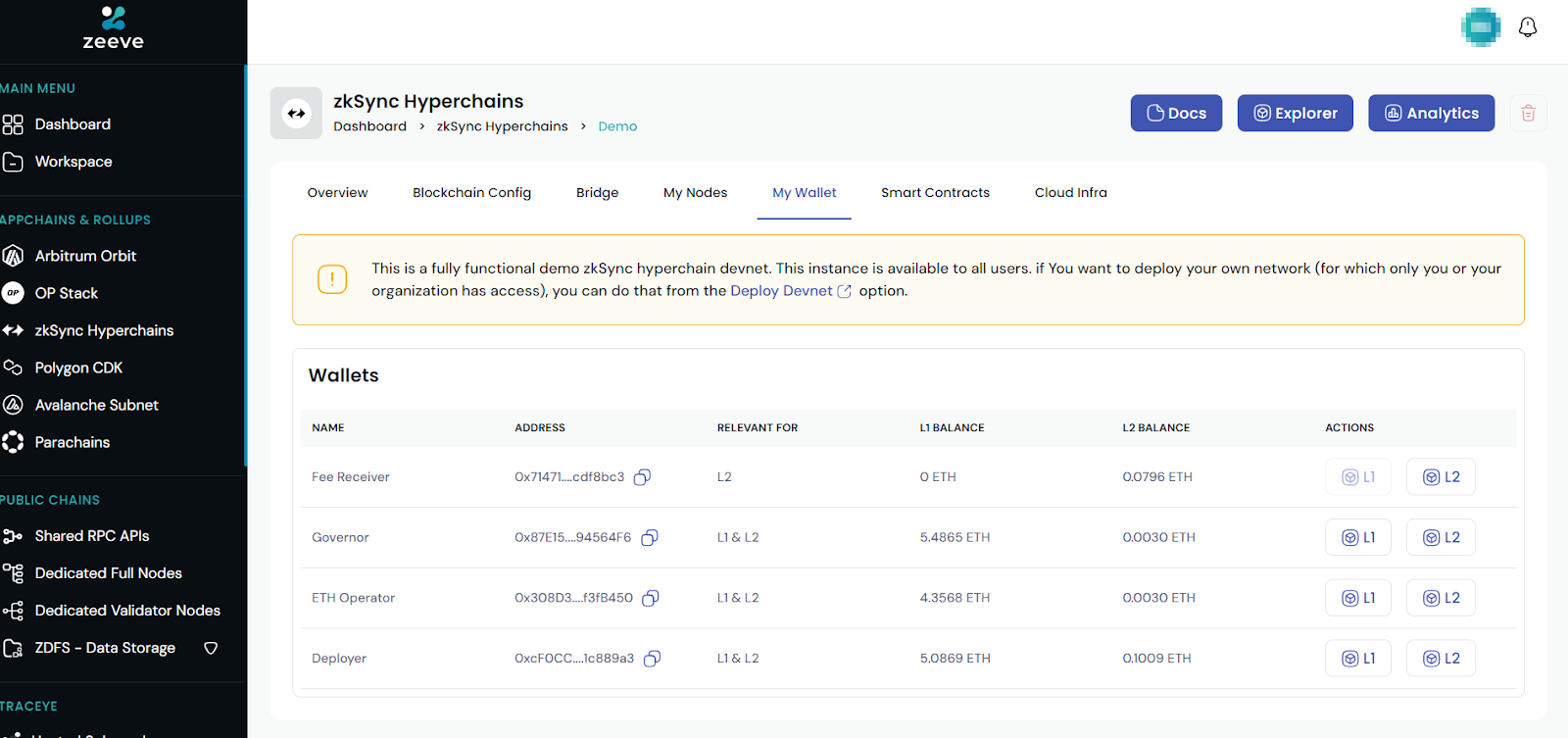 <p>It will redirect you to the Etherscan explorer and provide all the transaction details. Similarly, you can explore details for smart contract addresses.</p> 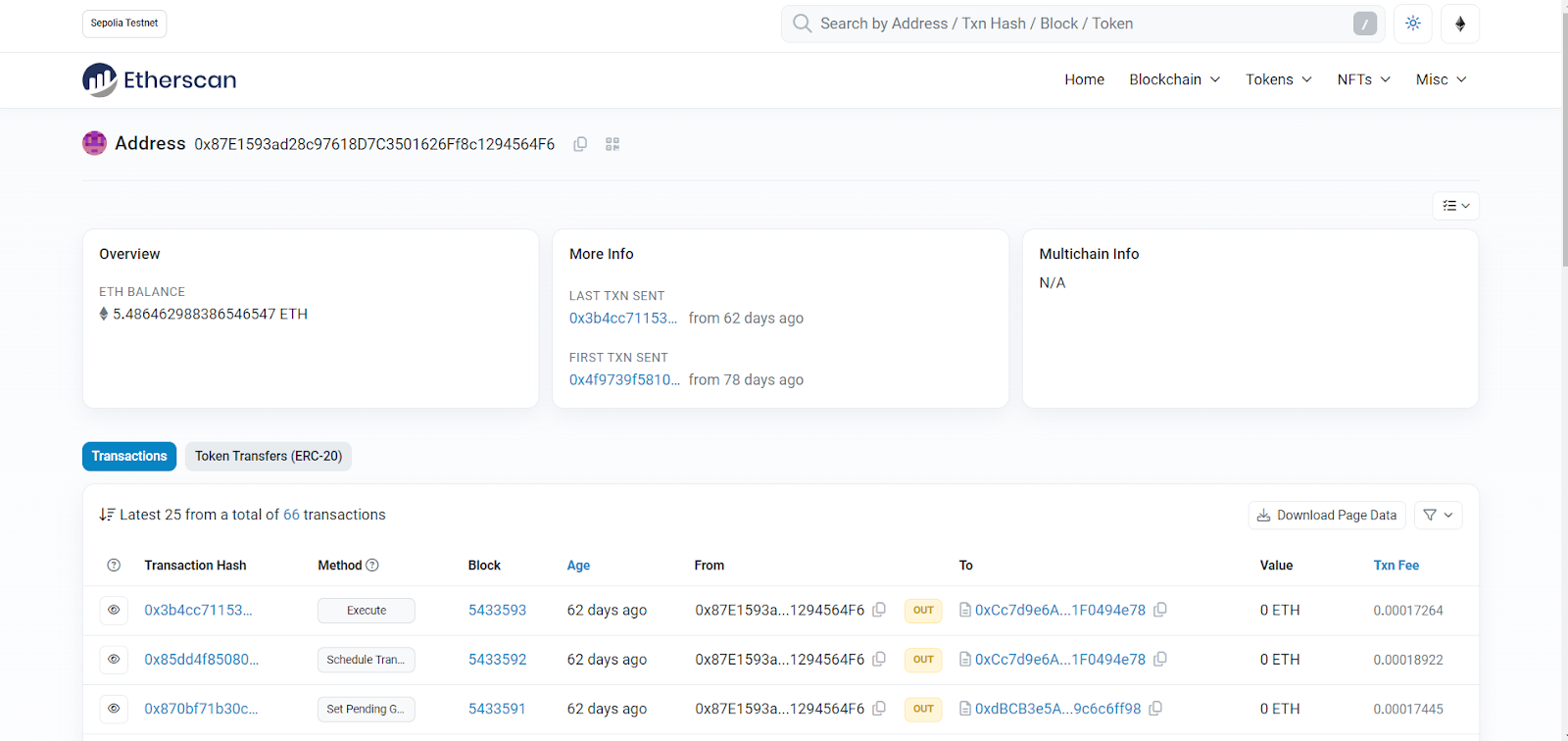 <li><strong>Access 24/7 monitoring & alerts dashboard:</strong></li> <p>The Demo network comes with a 24/7 monitoring & alerts dashboard, designed to show you all the real-time analytics for nodes, explorer, RPC, server, log, and alerts in a single place. It shows all sorts of data like total CPU usage, RAM used, System load, memory stack, network traffic, block height and more. Also, if something is wrong– like memory or CPU is running out, it will produce real-time alerts. This exact dashboard you will get for your zkSync Hyperchain on Zeeve. </p> 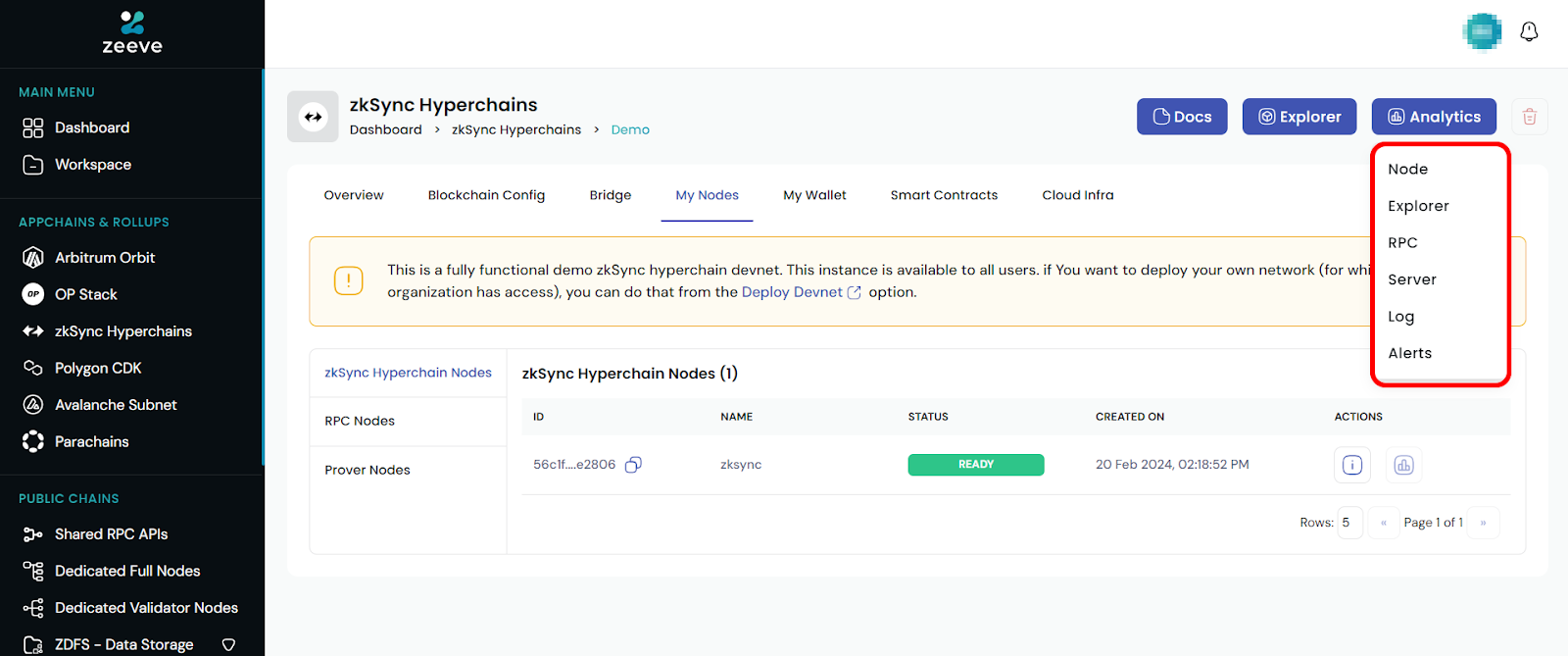 <h2 class="wp-block-heading" id="h-wrap-up">Wrap up!</h2> <p>That’s all about the test drive of a zkSync hyperchain using a pre-configured public network. The next step is setting up your own DevNet on Zeeve’s RaaS platform. Here, you get freedom to deploy & destroy sandboxes until you have the confidence to move to TestNet or Mainnet. Best part is that you can leverage this demo network without paying for any subscription. Additionally, if you are planning to launch a custom zkSync Hyperchain, or any other L1/L2 rollup chain, contact us. We will suggest the best possible solution to launch your chain at low cost, with faster time-to-market. Send us your queries via mail or <a href="https://www.zeeve.io/talk-to-an-expert/">schedule a call with us</a> for one-to-one, detailed discussion. </p> |
| json metadata | {"tags":["zksynchyperchain","rollups"],"image":["https://cdn.steemitimages.com/DQmRUsrH9yRdr8RdyeBdWqC5a2jKM1aRCfmPAcfzGMq4s7M/image.png","https://www.zeeve.io/wp-content/uploads/2024/05/Build-your-custom-zkSync-Hyperchain-at-lower-cost-with-us-1024x213.jpg","https://dev-to-uploads.s3.amazonaws.com/uploads/articles/6vq2l15x32wh2jfowwmb.png","https://dev-to-uploads.s3.amazonaws.com/uploads/articles/55jyugx92uzhj24n5cfm.png","https://dev-to-uploads.s3.amazonaws.com/uploads/articles/jyt6r43niy1o12uzrdz5.png","https://dev-to-uploads.s3.amazonaws.com/uploads/articles/fttmlg38e7pf2fwsuoei.png","https://dev-to-uploads.s3.amazonaws.com/uploads/articles/d0uvqqkhneyxfrxx92xi.png","https://dev-to-uploads.s3.amazonaws.com/uploads/articles/0zqk5stt7o278xxlo1at.png","https://dev-to-uploads.s3.amazonaws.com/uploads/articles/esxx67iz94c4t457nzfn.png","https://dev-to-uploads.s3.amazonaws.com/uploads/articles/l6qj58e1iahr2tvsazk0.png","https://dev-to-uploads.s3.amazonaws.com/uploads/articles/lo7t4lo7gopnkc0t03nt.png","https://dev-to-uploads.s3.amazonaws.com/uploads/articles/ai4ouu2pkzkho3akm40v.png","https://dev-to-uploads.s3.amazonaws.com/uploads/articles/kgoho0qgekgygyzmbzgc.png","https://dev-to-uploads.s3.amazonaws.com/uploads/articles/6qnzmid22jyq1iovnegf.png","https://dev-to-uploads.s3.amazonaws.com/uploads/articles/znpv4ucmxkth4voloh0w.png","https://dev-to-uploads.s3.amazonaws.com/uploads/articles/vdq787n7vws9sunhexuj.png","https://dev-to-uploads.s3.amazonaws.com/uploads/articles/ydsughijo37nszwj7nl4.png"],"links":["https://app.zeeve.io/auth/signup?serviceURL=https://app.zeeve.io/zksync-hyperchains-zkrollups","https://www.zeeve.io/appchains/zksync-hyperchains-zkrollups/","https://www.zeeve.io/talk-to-an-expert/","https://ethereum.org/en/developers/docs/apis/json-rpc/","https://docs.zeeve.io/rollups/zksync-hyperchain/demo-network/deploying-contract"],"app":"steemit/0.2","format":"markdown"} |
| parent author | |
| parent permlink | zksynchyperchain |
| permlink | test-drive-zksync-hyperchain-on-zeeve-s-fully-powered-demo-network |
| title | Test Drive zkSync Hyperchain on Zeeve’s Fully Powered Demo Network |
| Transaction Info | Block #88259980/Trx c410e32105cdb2336f270c554c3d079ec94b9a2e |
View Raw JSON Data
{
"block": 88259980,
"op": [
"comment",
{
"author": "zeevedeeptech",
"body": "\n<p>ZkSync Hyperchains is one of the powerful rollup frameworks that claims to represent the end game for Ethereum scaling. For those who are building their own hyperchain, testing becomes an important aspect of ensuring a flawless operation. What if you could access a network that is a simulation of the real ZkSync Hyperchain setup, just for the purpose of understanding the hyperchain’s configurations, integrations, and also testing can be done. That’s where Zeeve’s zkSync Hyperchain Demo Network comes into the picture. This demo sandbox is designed to allow developers and users to interact with a fully functioning zkSync hyperchain setup, test its functionalities, and thereby understand how a real network exactly looks like. </p>\n<p>Through this article, we dive into the <a href=\"https://app.zeeve.io/auth/signup?serviceURL=https://app.zeeve.io/zksync-hyperchains-zkrollups\">zkSync Hyperchain Demo Network on Zeeve</a> to learn how you can get hands-on expertise on a hyperchain’s various aspects without creating a network of your own. </p>\n<h2 class=\"wp-block-heading\" id=\"h-a-walkthrough-of-zksync-demo-network-offered-by-zeeve-raas-nbsp\">A walkthrough of zkSync Demo Network offered by Zeeve RaaS </h2>\n<p>The zkSync hyperchain’s demo network is one of the core offerings of Zeeve Rollups-as-a-service (RaaS) offerings, which is a sandbox environment designed to offer a pre-configured DevNet. It allows developers and web3 projects to explore a fully-functioning zkSync network and meanwhile see how their chain will look like. Further, they can set up their own DevNet after learning all the essentials. Note that this demo zkSync hyperchain is shared and accessible to every user. If you want custom configurations specific to your chain, you can quickly <a href=\"https://www.zeeve.io/appchains/zksync-hyperchains-zkrollups/\">deploy a zkSync hyperchain</a> from the same dashboard. </p>\n<a href=\"https://www.zeeve.io/talk-to-an-expert/\"><img src=\"https://www.zeeve.io/wp-content/uploads/2024/05/Build-your-custom-zkSync-Hyperchain-at-lower-cost-with-us-1024x213.jpg\" alt=\"zkSync Hyperchain Demo Network on Zeeve \" class=\"wp-image-67354\"/></a>\n<p>Zeeve’s zkSync hyperchain demo network is not merely a simulation of a static network. Rather, it provides you hands-on access to a fully powered DevNet where you can interact with components such as RPC nodes & its endpoints to interact with the network, perform bridge operations, view smart contract and wallet transactions on the explorer, download necessary files to use in further development, and much more. </p>\n<h2 class=\"wp-block-heading\" id=\"h-what-all-things-you-can-do-with-the-zksync-hyperchain-s-demo-network\">What all things you can do with the zkSync Hyperchain’s demo network?</h2>\n<p>Let’s discuss all the things Zeeve’s zkSync Hyperchain Demo Network has to offer. Also, we will explore the interactions enabled in this setup- for example– viewing transactions on explorer, making RPC calls, or interacting with the bridges. </p>\n<li><strong>Get complete overview of the zkSync Hyperchain:</strong></li>\n<p>Upon login, you will see a zkSync Hyperchain’s overview page has all this pre-configured demo network, such as Network’s name, Chain ID, Network Type, Status; deployed or synching, infrastructure provision time, etc. </p>\n\n\n<p>Also, you will see similar details about Layer1- Ethereum Sepolia’s, such as Network name, Chain ID, Deployer Balanche, Governor Balance, and ETH Operator Balance. </p>\n<p>Other details are also there, like node count, cloud infrastructure info, and alerts. Note that, alerts on this demo setup are produced in real-time and it also gets solved automatically. Hence, you won’t see any alerts listed here.</p>\n<li><strong>Inspect all the configurations at one-place: </strong></li>\n<p>For a successful deployment, you must understand all configurations running in the backend of a hyperchain. Hence, the demo network shows a dashboard with general configuration, block-level configuration, and transaction configuration. This default configuration will help you to understand what type of configuration you may need to set up your own chain. Also, you can download the zkSync Hyperchain Env file from here.</p>\n\n\n<li><strong>Interact through the Bridge:</strong></li>\n<p>The demo network of zkSync Hyperchain comes with a native bridge that you can use to perform bridge operations, such as sending or receiving funds/tokens between Layer1 and Layer2 chains. </p>\n\n\n<p>To do this, navigate to the Bridge and click on the Bridge URL (as you can see in the above image) and connect any of your Ethereum wallets. For example, we are using Metamask’s browser wallet. </p>\n\n\n\n\n<p>For interaction, let’s receive some tokens in the demo account from the Ethereum Sepolia network. </p>\n<p>Click on ‘Assets’ and proceed to add funds. Click on Receive—>select official bridge—>choose your account address. In our case, the balance on the Sepolia network is 0.05 and we are sending 0.01 to the Demo network. </p>\n\n\n<p>Click continue and confirm transactions from your Metamask wallet. Once confirmed, the balance will reflect in your demo account under ‘Assets’.</p>\n\n\n<li><strong>Make seamless RPC Calls: </strong></li>\n<p>Under the nodes section, you will see the hyperchain node/nodes running for the demo network. As you can see, there are RPC Nodes and Prover Nodes. However, the prover node is for testnet/mainnet. Hence, let’s explore the RPC.</p>\n\n\n<p>Navigate to the ‘Actions’ and click the info button’s icon. This will open a detailed page showing RPC node configurations, such as General node info, Cloud infra details, RPC Endpoints, and RPC configurations. </p>\n\n\n<p>Using these live RPC endpoints, you can RPC calls and interact with the network. For that, you first need to install an API request builder tool, like we are using PostWoman. Also, we are initiating an RPC call for <strong>‘eth_blockNumber’, </strong>hence it will show block number as outcome.<strong> </strong></p>\n<p>Go to Postwoman—> change call method to ‘Post’ —>paste HTTP URL (as given in the above image) in the URL section—> paste the given command in the ‘Parameter’ section. </p>\n<p>{\"jsonrpc\":\"2.0\",\"method\":\"eth_blockNumber\",\"params\":[],\"id\":83}.</p>\n\n\n<p>Now, click send. </p>\n\n\n<p>In response, you will get the result as a block number. When you convert the <strong>0x1e16 </strong>(hexadecimal) to decimal, it will give you the exact block number, which is 7702 in the case of this demo network. Similarly, you can make RPC calls to get balance, gas price, peer count, etc. Commands for all of these you can get from Etherem’s official <a href=\"https://ethereum.org/en/developers/docs/apis/json-rpc/\">JSON API docs</a>. </p>\n<li><strong>Deploy smart contracts:</strong></li>\n<p>Using the RPC endpoints from the demo network, you can do smart contract transactions and thereby deploy any type of application contract. For this, you first need to create a zkSync project using zksync-cli and perform all the configurations before deploying the contract on the network. Your contracts will operate alongside the core rollup contract to serve the specific purpose of your dApp. For this, this demo network provides <a href=\"https://docs.zeeve.io/rollups/zksync-hyperchain/demo-network/deploying-contract\">detailed docs</a> that you can get by clicking on the ‘Docs’ icon. </p>\n\n\n<li><strong>Check transaction details on explorer:</strong></li>\n<p>Be it for wallets, nodes, or smart contracts, the explorer in the demo network allows you to see comprehensive transaction details seamlessly. For example, if you want to check the transaction details for any wallet, click the explorer icon given for L1 & L2. </p>\n\n\n<p>It will redirect you to the Etherscan explorer and provide all the transaction details. Similarly, you can explore details for smart contract addresses.</p>\n\n\n<li><strong>Access 24/7 monitoring & alerts dashboard:</strong></li>\n<p>The Demo network comes with a 24/7 monitoring & alerts dashboard, designed to show you all the real-time analytics for nodes, explorer, RPC, server, log, and alerts in a single place. It shows all sorts of data like total CPU usage, RAM used, System load, memory stack, network traffic, block height and more. Also, if something is wrong– like memory or CPU is running out, it will produce real-time alerts. This exact dashboard you will get for your zkSync Hyperchain on Zeeve. </p>\n\n\n<h2 class=\"wp-block-heading\" id=\"h-wrap-up\">Wrap up!</h2>\n<p>That’s all about the test drive of a zkSync hyperchain using a pre-configured public network. The next step is setting up your own DevNet on Zeeve’s RaaS platform. Here, you get freedom to deploy & destroy sandboxes until you have the confidence to move to TestNet or Mainnet. Best part is that you can leverage this demo network without paying for any subscription. Additionally, if you are planning to launch a custom zkSync Hyperchain, or any other L1/L2 rollup chain, contact us. We will suggest the best possible solution to launch your chain at low cost, with faster time-to-market. Send us your queries via mail or <a href=\"https://www.zeeve.io/talk-to-an-expert/\">schedule a call with us</a> for one-to-one, detailed discussion. </p>",
"json_metadata": "{\"tags\":[\"zksynchyperchain\",\"rollups\"],\"image\":[\"https://cdn.steemitimages.com/DQmRUsrH9yRdr8RdyeBdWqC5a2jKM1aRCfmPAcfzGMq4s7M/image.png\",\"https://www.zeeve.io/wp-content/uploads/2024/05/Build-your-custom-zkSync-Hyperchain-at-lower-cost-with-us-1024x213.jpg\",\"https://dev-to-uploads.s3.amazonaws.com/uploads/articles/6vq2l15x32wh2jfowwmb.png\",\"https://dev-to-uploads.s3.amazonaws.com/uploads/articles/55jyugx92uzhj24n5cfm.png\",\"https://dev-to-uploads.s3.amazonaws.com/uploads/articles/jyt6r43niy1o12uzrdz5.png\",\"https://dev-to-uploads.s3.amazonaws.com/uploads/articles/fttmlg38e7pf2fwsuoei.png\",\"https://dev-to-uploads.s3.amazonaws.com/uploads/articles/d0uvqqkhneyxfrxx92xi.png\",\"https://dev-to-uploads.s3.amazonaws.com/uploads/articles/0zqk5stt7o278xxlo1at.png\",\"https://dev-to-uploads.s3.amazonaws.com/uploads/articles/esxx67iz94c4t457nzfn.png\",\"https://dev-to-uploads.s3.amazonaws.com/uploads/articles/l6qj58e1iahr2tvsazk0.png\",\"https://dev-to-uploads.s3.amazonaws.com/uploads/articles/lo7t4lo7gopnkc0t03nt.png\",\"https://dev-to-uploads.s3.amazonaws.com/uploads/articles/ai4ouu2pkzkho3akm40v.png\",\"https://dev-to-uploads.s3.amazonaws.com/uploads/articles/kgoho0qgekgygyzmbzgc.png\",\"https://dev-to-uploads.s3.amazonaws.com/uploads/articles/6qnzmid22jyq1iovnegf.png\",\"https://dev-to-uploads.s3.amazonaws.com/uploads/articles/znpv4ucmxkth4voloh0w.png\",\"https://dev-to-uploads.s3.amazonaws.com/uploads/articles/vdq787n7vws9sunhexuj.png\",\"https://dev-to-uploads.s3.amazonaws.com/uploads/articles/ydsughijo37nszwj7nl4.png\"],\"links\":[\"https://app.zeeve.io/auth/signup?serviceURL=https://app.zeeve.io/zksync-hyperchains-zkrollups\",\"https://www.zeeve.io/appchains/zksync-hyperchains-zkrollups/\",\"https://www.zeeve.io/talk-to-an-expert/\",\"https://ethereum.org/en/developers/docs/apis/json-rpc/\",\"https://docs.zeeve.io/rollups/zksync-hyperchain/demo-network/deploying-contract\"],\"app\":\"steemit/0.2\",\"format\":\"markdown\"}",
"parent_author": "",
"parent_permlink": "zksynchyperchain",
"permlink": "test-drive-zksync-hyperchain-on-zeeve-s-fully-powered-demo-network",
"title": "Test Drive zkSync Hyperchain on Zeeve’s Fully Powered Demo Network"
}
],
"op_in_trx": 0,
"timestamp": "2024-09-02T06:38:30",
"trx_id": "c410e32105cdb2336f270c554c3d079ec94b9a2e",
"trx_in_block": 6,
"virtual_op": 0
}2024/09/02 06:24:42
2024/09/02 06:24:42
| author | zeevedeeptech |
| body |  <p><a href="https://www.zeeve.io/">Zeeve</a>, the leading Rollups-as-a-service (RaaS) platform, has partnered with <a href="https://etherspot.io/?utm_source=zeeve_blog&utm_medium=article&utm_campaign=zeeve_ann">Etherspot</a> to enable developers and businesses to embed account abstraction functionality easily into their L2/L3 rollups and appchains. </p> <p>ERC-4337/Account Abstraction simplifies wallet setup, removes the need for seed phrase retention, and enables multi-factor authentication and account recovery. Users can access customized services, including auto-pay, pre-approved, bundled transactions, etc. Although we have yet to achieve complete account abstraction, we have arrived at a point where we can deliver frictionless web3 UX for the end-users. </p> <p>Etherspot is one such player that aims to redefine how we build decentralized applications with their comprehensive suite of Account Abstraction tools, including the Prime AA SDK, ERC-4337 Skandha Bundler, Arka Paymaster, and data APIs. These tools empower developers to ensure their dApps are ERC-4337 compliant while implementing numerous features such as Web2-like onboarding, seamless multichain experiences, fiat on-ramps, gasless transactions, recovery guardians, and much more. </p> <p>Now, with this integration with Zeeve, web3 builders and enterprises will be able to leverage the power of Etherspot’s account abstraction infrastructure and Zeeve’s low-code Rollup launchpad to create seamless blockchain experiences. Zeeve will make it easier to launch performant, modular EVM-compatible rollups and L1/L2 chains using leading frameworks like OP Stack, Arbitrum Orbit, Polygon CDK, ZK Stack, Cosmos SDK, and Substrate with superior UX, all the managed infra, middleware, and 3rd party integrations. </p> <p><em>“Etherspot’s multi-chain platform is not just leveraging ERC-4337 but also showing how the standard can significantly streamline user-blockchain interactions, thereby lowering entry barriers for both developers and end-users. Combined with Zeeve’s Rollups and appchains-as-a-Service, users now can get their Prime SDK and associated 4337 infrastructure as an on-demand pluggable integration at the time of deploying their infrastructure on Zeeve, ensuring quick integration and effortless implementation, without the hassle of infra management.”</em></p> <p><em>Dr Ravi Chamria</em></p> <p>Co-founder and CEO of Zeeve</p> <p><em>“At Etherspot, we're thrilled to partner with Zeeve to extend Account Abstraction capabilities to L2/L3 rollups and appchains. This collaboration moves us even closer to Web3 mass adoption."</em></p> <p><em>Michael Messele</em></p> <p>CEO of Etherspot</p> <p>Additionally, Zeeve extends your rollup capabilities with 40+ integration partners. These include alternative DA layers, sequencing services, data indexers, decentralized oracles, interoperability protocols, account abstraction SDKs, and various other developers' tools and protocols to augment the capabilities of custom appchains and rollups on the Zeeve platform. </p> <p>Our platform also provides a 1-click Sandbox tool for developers to experiment with various rollup configurations before they go for testnet/mainnet deployments. </p> |
| json metadata | {"tags":["announcement","etherspot","zeeve"],"image":["https://cdn.steemitimages.com/DQmZcXDrp2rwke3RtivveMPi7NhTUgL7vsTuL8qXuy3WwGp/image.png"],"links":["https://www.zeeve.io/","https://etherspot.io/?utm_source=zeeve_blog&utm_medium=article&utm_campaign=zeeve_ann"],"app":"steemit/0.2","format":"markdown"} |
| parent author | |
| parent permlink | announcement |
| permlink | zeeve-raas-partners-with-etherspot-to-bring-account-abstraction-benefits-into-rollups-and-appchains |
| title | Zeeve RaaS partners with Etherspot to bring Account Abstraction benefits into Rollups & AppChains |
| Transaction Info | Block #88259707/Trx d550f9de8a6d9887356775c8e694039a5a78bd6c |
View Raw JSON Data
{
"block": 88259707,
"op": [
"comment",
{
"author": "zeevedeeptech",
"body": "\n<p><a href=\"https://www.zeeve.io/\">Zeeve</a>, the leading Rollups-as-a-service (RaaS) platform, has partnered with <a href=\"https://etherspot.io/?utm_source=zeeve_blog&utm_medium=article&utm_campaign=zeeve_ann\">Etherspot</a> to enable developers and businesses to embed account abstraction functionality easily into their L2/L3 rollups and appchains. </p>\n<p>ERC-4337/Account Abstraction simplifies wallet setup, removes the need for seed phrase retention, and enables multi-factor authentication and account recovery. Users can access customized services, including auto-pay, pre-approved, bundled transactions, etc. Although we have yet to achieve complete account abstraction, we have arrived at a point where we can deliver frictionless web3 UX for the end-users. </p>\n<p>Etherspot is one such player that aims to redefine how we build decentralized applications with their comprehensive suite of Account Abstraction tools, including the Prime AA SDK, ERC-4337 Skandha Bundler, Arka Paymaster, and data APIs. These tools empower developers to ensure their dApps are ERC-4337 compliant while implementing numerous features such as Web2-like onboarding, seamless multichain experiences, fiat on-ramps, gasless transactions, recovery guardians, and much more. </p>\n<p>Now, with this integration with Zeeve, web3 builders and enterprises will be able to leverage the power of Etherspot’s account abstraction infrastructure and Zeeve’s low-code Rollup launchpad to create seamless blockchain experiences. Zeeve will make it easier to launch performant, modular EVM-compatible rollups and L1/L2 chains using leading frameworks like OP Stack, Arbitrum Orbit, Polygon CDK, ZK Stack, Cosmos SDK, and Substrate with superior UX, all the managed infra, middleware, and 3rd party integrations. </p>\n<p><em>“Etherspot’s multi-chain platform is not just leveraging ERC-4337 but also showing how the standard can significantly streamline user-blockchain interactions, thereby lowering entry barriers for both developers and end-users. Combined with Zeeve’s Rollups and appchains-as-a-Service, users now can get their Prime SDK and associated 4337 infrastructure as an on-demand pluggable integration at the time of deploying their infrastructure on Zeeve, ensuring quick integration and effortless implementation, without the hassle of infra management.”</em></p>\n<p><em>Dr Ravi Chamria</em></p>\n<p>Co-founder and CEO of Zeeve</p>\n<p><em>“At Etherspot, we're thrilled to partner with Zeeve to extend Account Abstraction capabilities to L2/L3 rollups and appchains. This collaboration moves us even closer to Web3 mass adoption.\"</em></p>\n<p><em>Michael Messele</em></p>\n<p>CEO of Etherspot</p>\n<p>Additionally, Zeeve extends your rollup capabilities with 40+ integration partners. These include alternative DA layers, sequencing services, data indexers, decentralized oracles, interoperability protocols, account abstraction SDKs, and various other developers' tools and protocols to augment the capabilities of custom appchains and rollups on the Zeeve platform. </p>\n<p>Our platform also provides a 1-click Sandbox tool for developers to experiment with various rollup configurations before they go for testnet/mainnet deployments. </p>",
"json_metadata": "{\"tags\":[\"announcement\",\"etherspot\",\"zeeve\"],\"image\":[\"https://cdn.steemitimages.com/DQmZcXDrp2rwke3RtivveMPi7NhTUgL7vsTuL8qXuy3WwGp/image.png\"],\"links\":[\"https://www.zeeve.io/\",\"https://etherspot.io/?utm_source=zeeve_blog&utm_medium=article&utm_campaign=zeeve_ann\"],\"app\":\"steemit/0.2\",\"format\":\"markdown\"}",
"parent_author": "",
"parent_permlink": "announcement",
"permlink": "zeeve-raas-partners-with-etherspot-to-bring-account-abstraction-benefits-into-rollups-and-appchains",
"title": "Zeeve RaaS partners with Etherspot to bring Account Abstraction benefits into Rollups & AppChains"
}
],
"op_in_trx": 0,
"timestamp": "2024-09-02T06:24:42",
"trx_id": "d550f9de8a6d9887356775c8e694039a5a78bd6c",
"trx_in_block": 1,
"virtual_op": 0
}zeevedeeptechpublished a new post: the-continuous-rise-of-web3-gaming-in-a-web2-dominated-world2024/09/02 06:00:33
zeevedeeptechpublished a new post: the-continuous-rise-of-web3-gaming-in-a-web2-dominated-world
2024/09/02 06:00:33
| author | zeevedeeptech |
| body |  <p>BGA, or Blockchain Gaming Alliance, published a report for 2023 that discussed some key metrics that have changed over the years in blockchain-powered Web 3 games. In this article, we shall be closely analyzing how games have adapted to the changing trends allowing not only Web 3 games to evolve but also Web 2 games transition to Web 3 for competence and sustainability captivated by their dynamic evolution and innovations. </p> <h2 class="wp-block-heading" id="h-the-2021-period-the-rise-and-fall-of-new-web-3-gaming-concepts-nbsp">The 2021 Period: The Rise and Fall of New Web 3 Gaming Concepts </h2> <p>The 2021 period witnessed the explosion of Web3 games, with over 1.4 M UAWs or Unique Active Wallets created, triggered primarily by the Pandemic and new revenue models like Play-to-Earn (P2E). People were home-bound due to the CoronaVirus, and <a href="https://www.zeeve.io/web3-infrastructure-for-gaming/">Web3 gaming</a> ended up as a newfound treasure, riding on concepts like P2E models, where players were rewarded for performing activities in the game. </p> <p>However, the momentum of P2E started to wither off when the bear market started, and tokens started losing their value. As per BGA or Blockchain Game Alliance report, while at the initial stages, some of the concepts of Web 3 games that revolved around asset ownership, revenue models, player reward model, and decentralized project ownership, transparency, new collaborations, creativity & gameplay created a FOMO. However, things started to go berserk when gamers eventually realized that a transition in Web 3 gaming experience shouldn’t be solely incentive driven; rather, experience is equally important. To prove this point, head of marketing at the Unix Games, Timothy Biggar says, </p> <p><em>“The problem is, most gamers don’t care about earning potential. They just want to play the game. It’s our job to help developers build and market their games, so of course we’re paying attention to what’s working, for our partners and the industry, but we won’t know what works and what doesn’t until they’ve been on the market for some time. Ultimately, it needs to come down to your objectives as a blockchain developer.” </em></p> <a href="https://app.zeeve.io/account/register"><img src="https://www.zeeve.io/wp-content/uploads/2024/05/Launch-Your-1st-Rollup-DevNet-in-a-Matter-of-Minutes-1024x213.jpg" alt="" class="wp-image-67001"/></a> <p>And whatever Timothy had said earlier started reflecting in games like Axie infinity, which started witnessing a dwindling interest of the gamers in its player reward model when Axie prices fell. And the domino effect was not restricted to only Axie infinity but it's close counterparts, like Entropia, the game that introduced the concept of real gaming in the Metaverse with a lackluster attitude because decentralized ownership in the game went missing and the gaming ecosystem encountered instances of theft with a 265,000 PED or Project Entropia Dollars, which is equal to US$26,500 at the hands of either the publishers or hackers, also witnessed the same fate. </p> <p>The remaining credibility of the P2E or earning models were compromised when games like HunterCoin and MotoCoin excessively started tapping only one segment, which is using incentivize as a bait to lure players. </p> <p>However, over the period, that concept went <a href="https://youtu.be/WFoWwb3ZMXw">non-sustainable</a> and debatable for the growth of the gaming segment after the mention of Bots taking over and compromising the game mechanism, economies and leaving no room for gamers to stick with the P2E models, leading to a collapse of more than 1,000+ games from the market. </p> <h2 class="wp-block-heading" id="h-2022-period-the-learning-curve-nbsp">2022 Period: The Learning Curve </h2> <p>When the P2E model backfired with the likes of games like War Space featuring in the top 20 collections on Atomic Hub with a $6.2M sales volume, biting the dust. It was necessary to investigate the sharp drop of player’s interest. One might say that these games had community, new reward models and player’s interest intact; however, despite these trade-offs, why did they fail? </p> <p>The game-play substance, missing in all these games. The learning was quickly deployed in games like Gods Unchained, which focussed at P2E initially, but later on pivoted to improving the game play through the launch of new attractive models like interoperable in-game asset ownership. It was soon followed by other games like Phantasma, which started improving specific features that allow in-game assets like pocket monsters in the Phantasma environment to be upgraded and made interoperable with other ecosystems to improve gameplay. </p> <p>In addition to this, Phantasma went further ahead and introduced a dual token economy model as well in its gaming to further stimulate community participation of gamers looking for both gameplay and incentives. For that purpose, they introduced the SOUL and KCAL tokens, anchoring the narrative that only the revenue model will not be sufficient but an immersive game play is equally important. </p> <p>Through the use of the SOUL Token, Phantasma not only bolstered the erstwhile revenue model but the ability to upgrade its game asset features further improved the game play mechanics to bind players to <a href="https://www.zeeve.io/web3-infrastructure-for-gaming/">Web 3 gaming</a> who were looking forward to transitioning from Web 2 games to Web 3 games. </p> <h2 class="wp-block-heading" id="h-2023-amp-beyond-embracing-innovations-nbsp">2023 & Beyond: Embracing Innovations </h2> <p>In the year 2023, games had by now improved the P2E model and game-play to bind gamers and eventually new concepts like creator economy and e-sports started picking up pace. </p> <p>However, the intriguing part to acknowledge in this period was the sudden transformation of Web3 games from a mere revenue-generating and game play platform for gamers/ecosystems to a comprehensive game experience hub spot. </p> <p><strong>How?</strong></p> <p>Games like My Pet Hooligan, illuvium, Star Atlas and Cross the Ages not only improved the gameplay mirroring the experience of top-notch games like Hearthstone, Legends of Runeterra, and Upland; but they also started exploring the elephant in the room, interoperability. Aurory, a free-to-play blockchain-based tactical Japanese game, has been the front runner in this category by not only improving the game play but also introducing cross-chain interoperability in gaming. </p> <p>Due to this trade-off, the Web3 games, which have been criticized all these while for being an ecosystem embracing forced technical integration, started progressing towards solving the problems of Web 2 games, which have plagued their growth for years. </p> <p>As a result, the swift growth and dynamic transformation that Web3 gaming withstood following multiple trials and errors have made them a force to be reckoned with while writing the script of a Web 2 to Web 3 transition and future of the game verse. </p> 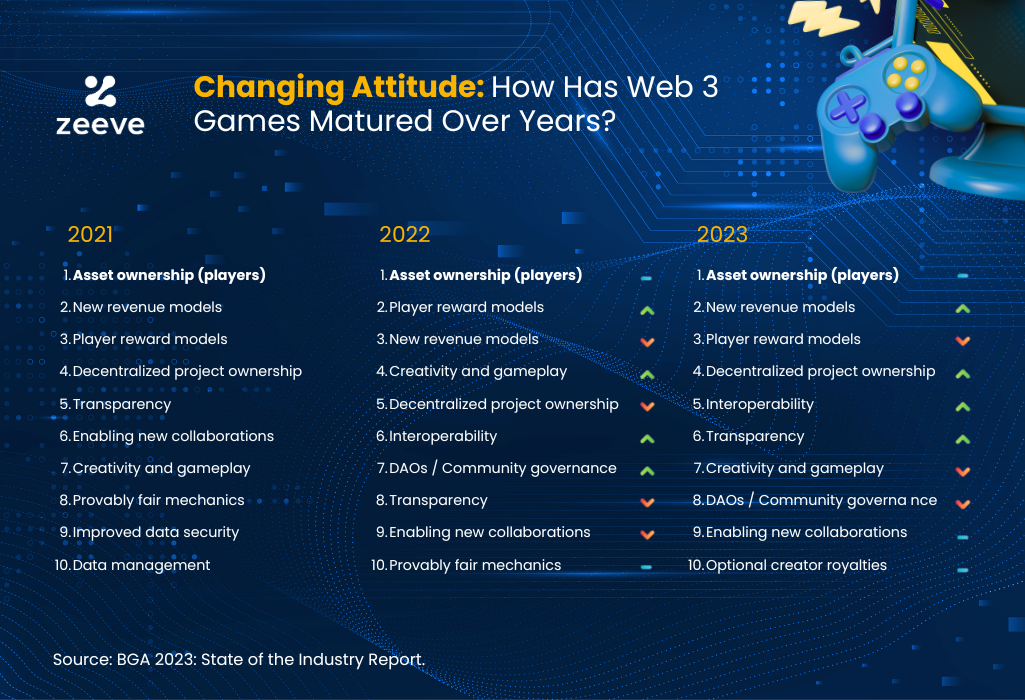 <h2 class="wp-block-heading" id="h-final-world">Final World</h2> <p>In the last three years, we have seen that Web 3 games deployed multiple models, some worked like improving game play mechanism, transparency , interoperability; while their other counterparts, like player reward models and DAOs, eventually failed</p> <p>But that is not the end of the story for Web 3 gaming because we have barely scratched the surface of innovation for now. Some of the milestones like interoperability have been scaled and game play improved, the other things which soon emerge on the platter as Web 3 matures with time. </p> <p>However, one thing to acknowledge nonetheless is the dynamic approach of Web 3 games in blending with the changing trends attracting some of the big names from the world of Web 2 games like Ubisoft, Square Enix, CCP, Nexon, Bandai Namco, Com2US, Sega, Konami, Atari, and NetMarble to move towards Web3 gaming to tackle their dropping revenue base and game participation. As a result, it is not an understatement to say that acknowledging the dramatic experimentation and adaptations, the future of Web 3 games is promising when games like Monsterarra, Game of Silk and Pirate Nation demonstrate innovation attracting more of Web 2 games to think for a Web 3 gaming transition. </p> <p>Hence, in the near future, we might very well see Web 2 games adapting Web 3 models where they will not just get access to new revenue models, gameplay but also a one-chain ecosystem for all games. Such a trade-off could very well trigger new revenue models to emerge like special status for XP and powers in the game redeemable for utility tokens in a different game environment, speculative, not conclusive though. <br>Planning to build a game-specific rollup chain? Visit our gaming webpage to see what all benefits rollups can add to your application and how Zeeve can be helpful. Still have queries? <a href="https://www.zeeve.io/talk-to-an-expert/">Schedule a call</a> with our Zeeve experts. We can help you figure our what infrastructure might suit your needs better.</p> |
| json metadata | {"tags":["web3","web3gaming"],"image":["https://cdn.steemitimages.com/DQmXrAPgheZefUujXSmAmx7JNw6Ua1e5bg2WvG7H1PbttiZ/image.png","https://www.zeeve.io/wp-content/uploads/2024/05/Launch-Your-1st-Rollup-DevNet-in-a-Matter-of-Minutes-1024x213.jpg","https://dev-to-uploads.s3.amazonaws.com/uploads/articles/j9ougvyh5oly5ybu7s9w.png"],"links":["https://www.zeeve.io/web3-infrastructure-for-gaming/","https://app.zeeve.io/account/register","https://youtu.be/WFoWwb3ZMXw","https://www.zeeve.io/talk-to-an-expert/"],"app":"steemit/0.2","format":"markdown"} |
| parent author | |
| parent permlink | web3 |
| permlink | the-continuous-rise-of-web3-gaming-in-a-web2-dominated-world |
| title | The Continuous Rise of Web3 Gaming in a Web2-Dominated World |
| Transaction Info | Block #88259227/Trx e465ec9e301f034a4332074251254cd385d6d79c |
View Raw JSON Data
{
"block": 88259227,
"op": [
"comment",
{
"author": "zeevedeeptech",
"body": "\n<p>BGA, or Blockchain Gaming Alliance, published a report for 2023 that discussed some key metrics that have changed over the years in blockchain-powered Web 3 games. In this article, we shall be closely analyzing how games have adapted to the changing trends allowing not only Web 3 games to evolve but also Web 2 games transition to Web 3 for competence and sustainability captivated by their dynamic evolution and innovations. </p>\n<h2 class=\"wp-block-heading\" id=\"h-the-2021-period-the-rise-and-fall-of-new-web-3-gaming-concepts-nbsp\">The 2021 Period: The Rise and Fall of New Web 3 Gaming Concepts </h2>\n<p>The 2021 period witnessed the explosion of Web3 games, with over 1.4 M UAWs or Unique Active Wallets created, triggered primarily by the Pandemic and new revenue models like Play-to-Earn (P2E). People were home-bound due to the CoronaVirus, and <a href=\"https://www.zeeve.io/web3-infrastructure-for-gaming/\">Web3 gaming</a> ended up as a newfound treasure, riding on concepts like P2E models, where players were rewarded for performing activities in the game. </p>\n<p>However, the momentum of P2E started to wither off when the bear market started, and tokens started losing their value. As per BGA or Blockchain Game Alliance report, while at the initial stages, some of the concepts of Web 3 games that revolved around asset ownership, revenue models, player reward model, and decentralized project ownership, transparency, new collaborations, creativity & gameplay created a FOMO. However, things started to go berserk when gamers eventually realized that a transition in Web 3 gaming experience shouldn’t be solely incentive driven; rather, experience is equally important. To prove this point, head of marketing at the Unix Games, Timothy Biggar says, </p>\n<p><em>“The problem is, most gamers don’t care about earning potential. They just want to play the game. It’s our job to help developers build and market their games, so of course we’re paying attention to what’s working, for our partners and the industry, but we won’t know what works and what doesn’t until they’ve been on the market for some time. Ultimately, it needs to come down to your objectives as a blockchain developer.” </em></p>\n<a href=\"https://app.zeeve.io/account/register\"><img src=\"https://www.zeeve.io/wp-content/uploads/2024/05/Launch-Your-1st-Rollup-DevNet-in-a-Matter-of-Minutes-1024x213.jpg\" alt=\"\" class=\"wp-image-67001\"/></a>\n<p>And whatever Timothy had said earlier started reflecting in games like Axie infinity, which started witnessing a dwindling interest of the gamers in its player reward model when Axie prices fell. And the domino effect was not restricted to only Axie infinity but it's close counterparts, like Entropia, the game that introduced the concept of real gaming in the Metaverse with a lackluster attitude because decentralized ownership in the game went missing and the gaming ecosystem encountered instances of theft with a 265,000 PED or Project Entropia Dollars, which is equal to US$26,500 at the hands of either the publishers or hackers, also witnessed the same fate. </p>\n<p>The remaining credibility of the P2E or earning models were compromised when games like HunterCoin and MotoCoin excessively started tapping only one segment, which is using incentivize as a bait to lure players. </p>\n<p>However, over the period, that concept went <a href=\"https://youtu.be/WFoWwb3ZMXw\">non-sustainable</a> and debatable for the growth of the gaming segment after the mention of Bots taking over and compromising the game mechanism, economies and leaving no room for gamers to stick with the P2E models, leading to a collapse of more than 1,000+ games from the market. </p>\n<h2 class=\"wp-block-heading\" id=\"h-2022-period-the-learning-curve-nbsp\">2022 Period: The Learning Curve </h2>\n<p>When the P2E model backfired with the likes of games like War Space featuring in the top 20 collections on Atomic Hub with a $6.2M sales volume, biting the dust. It was necessary to investigate the sharp drop of player’s interest. One might say that these games had community, new reward models and player’s interest intact; however, despite these trade-offs, why did they fail? </p>\n<p>The game-play substance, missing in all these games. The learning was quickly deployed in games like Gods Unchained, which focussed at P2E initially, but later on pivoted to improving the game play through the launch of new attractive models like interoperable in-game asset ownership. It was soon followed by other games like Phantasma, which started improving specific features that allow in-game assets like pocket monsters in the Phantasma environment to be upgraded and made interoperable with other ecosystems to improve gameplay. </p>\n<p>In addition to this, Phantasma went further ahead and introduced a dual token economy model as well in its gaming to further stimulate community participation of gamers looking for both gameplay and incentives. For that purpose, they introduced the SOUL and KCAL tokens, anchoring the narrative that only the revenue model will not be sufficient but an immersive game play is equally important. </p>\n<p>Through the use of the SOUL Token, Phantasma not only bolstered the erstwhile revenue model but the ability to upgrade its game asset features further improved the game play mechanics to bind players to <a href=\"https://www.zeeve.io/web3-infrastructure-for-gaming/\">Web 3 gaming</a> who were looking forward to transitioning from Web 2 games to Web 3 games. </p>\n<h2 class=\"wp-block-heading\" id=\"h-2023-amp-beyond-embracing-innovations-nbsp\">2023 & Beyond: Embracing Innovations </h2>\n<p>In the year 2023, games had by now improved the P2E model and game-play to bind gamers and eventually new concepts like creator economy and e-sports started picking up pace. </p>\n<p>However, the intriguing part to acknowledge in this period was the sudden transformation of Web3 games from a mere revenue-generating and game play platform for gamers/ecosystems to a comprehensive game experience hub spot. </p>\n<p><strong>How?</strong></p>\n<p>Games like My Pet Hooligan, illuvium, Star Atlas and Cross the Ages not only improved the gameplay mirroring the experience of top-notch games like Hearthstone, Legends of Runeterra, and Upland; but they also started exploring the elephant in the room, interoperability. Aurory, a free-to-play blockchain-based tactical Japanese game, has been the front runner in this category by not only improving the game play but also introducing cross-chain interoperability in gaming. </p>\n<p>Due to this trade-off, the Web3 games, which have been criticized all these while for being an ecosystem embracing forced technical integration, started progressing towards solving the problems of Web 2 games, which have plagued their growth for years. </p>\n<p>As a result, the swift growth and dynamic transformation that Web3 gaming withstood following multiple trials and errors have made them a force to be reckoned with while writing the script of a Web 2 to Web 3 transition and future of the game verse. </p>\n\n\n\n<h2 class=\"wp-block-heading\" id=\"h-final-world\">Final World</h2>\n<p>In the last three years, we have seen that Web 3 games deployed multiple models, some worked like improving game play mechanism, transparency , interoperability; while their other counterparts, like player reward models and DAOs, eventually failed</p>\n<p>But that is not the end of the story for Web 3 gaming because we have barely scratched the surface of innovation for now. Some of the milestones like interoperability have been scaled and game play improved, the other things which soon emerge on the platter as Web 3 matures with time. </p>\n<p>However, one thing to acknowledge nonetheless is the dynamic approach of Web 3 games in blending with the changing trends attracting some of the big names from the world of Web 2 games like Ubisoft, Square Enix, CCP, Nexon, Bandai Namco, Com2US, Sega, Konami, Atari, and NetMarble to move towards Web3 gaming to tackle their dropping revenue base and game participation. As a result, it is not an understatement to say that acknowledging the dramatic experimentation and adaptations, the future of Web 3 games is promising when games like Monsterarra, Game of Silk and Pirate Nation demonstrate innovation attracting more of Web 2 games to think for a Web 3 gaming transition. </p>\n<p>Hence, in the near future, we might very well see Web 2 games adapting Web 3 models where they will not just get access to new revenue models, gameplay but also a one-chain ecosystem for all games. Such a trade-off could very well trigger new revenue models to emerge like special status for XP and powers in the game redeemable for utility tokens in a different game environment, speculative, not conclusive though. <br>Planning to build a game-specific rollup chain? Visit our gaming webpage to see what all benefits rollups can add to your application and how Zeeve can be helpful. Still have queries? <a href=\"https://www.zeeve.io/talk-to-an-expert/\">Schedule a call</a> with our Zeeve experts. We can help you figure our what infrastructure might suit your needs better.</p>",
"json_metadata": "{\"tags\":[\"web3\",\"web3gaming\"],\"image\":[\"https://cdn.steemitimages.com/DQmXrAPgheZefUujXSmAmx7JNw6Ua1e5bg2WvG7H1PbttiZ/image.png\",\"https://www.zeeve.io/wp-content/uploads/2024/05/Launch-Your-1st-Rollup-DevNet-in-a-Matter-of-Minutes-1024x213.jpg\",\"https://dev-to-uploads.s3.amazonaws.com/uploads/articles/j9ougvyh5oly5ybu7s9w.png\"],\"links\":[\"https://www.zeeve.io/web3-infrastructure-for-gaming/\",\"https://app.zeeve.io/account/register\",\"https://youtu.be/WFoWwb3ZMXw\",\"https://www.zeeve.io/talk-to-an-expert/\"],\"app\":\"steemit/0.2\",\"format\":\"markdown\"}",
"parent_author": "",
"parent_permlink": "web3",
"permlink": "the-continuous-rise-of-web3-gaming-in-a-web2-dominated-world",
"title": "The Continuous Rise of Web3 Gaming in a Web2-Dominated World"
}
],
"op_in_trx": 0,
"timestamp": "2024-09-02T06:00:33",
"trx_id": "e465ec9e301f034a4332074251254cd385d6d79c",
"trx_in_block": 3,
"virtual_op": 0
}2024/08/27 07:11:45
2024/08/27 07:11:45
| author | zeevedeeptech |
| body |  <p><a href="https://www.zeeve.io/">Zeeve</a>, the leading platform for <a href="https://www.zeeve.io/rollups/">Rollups-as-a-Service</a>, has added a fully operational demo of the <a href="https://www.zeeve.io/appchains/polygon-zkrollups/">Polygon CDK</a> testnet network for every user to get an idea of how the real network will look once deployed. This sandbox environment will enable developers to experiment with Polygon CDK's features, smart contracts, and dApps on a running CDK chain shared by many before launching their personalized Devnet, Testnet, or Mainnet.</p> <p>This interactive instance extends beyond a mere visual demo; it provides hands-on access to active components such as a robust RPC interface with live endpoints via HTTPS and WebSockets. Developers can perform transactions, connect wallets, and deploy or revoke smart contracts within a shared network. The demo includes an Explorer for real-time transaction visibility, facilitates testing of the Polygon zkEVM bridge, and more, all without the necessity of setting up your own network.</p>  <p><em>“Actual things are not just the deployment alone; it is what happens after deployment as well</em>. <em>This demo is crafted to deliver a rich developer experience, providing a realistic framework to test and tweak CDK functionalities live. We've loaded the demo network with all the tools necessary to offer a comprehensive view of a full-scale operational environment. After trying it out, if you feel that’s the perfect framework for your application need, it works the way you want it to work, deploy your own DevNet from your RaaS dashboard which only you or your organization has access.”</em></p> <p>Ghan Vashishtha</p> <p>Co-founder and CTO of Zeeve</p> <h2 class="wp-block-heading" id="h-how-to-access-the-demo-network">How to Access the Demo Network?</h2> <p>Navigate to the 'Polygon CDK' option in the left panel of the Zeeve RaaS dashboard. Click on 'View' to access the CDK test network dashboard. </p>  <ul><!-- wp:list-item --> <li><strong>Overview Screen</strong>: Displays key details such as provisioning duration, status, Layer 1 information, Cloud Infrastructure data, block count, and alerts.</li> <!-- /wp:list-item --> <!-- wp:list-item --> <li><strong>Blockchain Configuration</strong>: Manage your CDK appchain’s settings, including gas and transaction configurations, and download the Genesis file as needed.</li> <!-- /wp:list-item --> <!-- wp:list-item --> <li><strong>Bridge</strong>: Access bridge operations by clicking the bridge icon, leading you to the Polygon CDK Bridge page.</li> <!-- /wp:list-item --> <!-- wp:list-item --> <li><strong>My Nodes</strong>: Check the status and details of the zkEVM and RPC nodes. For more information, click on the 'View Details' icon.</li> <!-- /wp:list-item --> <!-- wp:list-item --> <li><strong>My Wallet</strong>: Access sequencer and aggregator addresses and balances, with direct links to view details on Explorers.</li> <!-- /wp:list-item --> <!-- wp:list-item --> <li><strong>Smart Contracts</strong>: View smart contracts via the Explorer by clicking the designated icon.</li> <!-- /wp:list-item --> <!-- wp:list-item --> <li><strong>Cloud Infrastructure</strong>: Information on the region, cloud type, and storage specifications of the demo network.</li> <!-- /wp:list-item --> <!-- wp:list-item --> <li><strong>DAC Committee and Sample Apps</strong>: Coming soon.</li> <!-- /wp:list-item --> <!-- wp:list-item --> <li><strong>Explorer Buttons</strong>: Quick access to L1 and L2 Explorers.</li> <!-- /wp:list-item --> <!-- wp:list-item --> <li><strong>Analytics</strong>: Monitor node performance in real-time, with insights into CPU usage, memory, network activity, and blockchain-specific metrics.</li> <!-- /wp:list-item --> <!-- wp:list-item --> <li><strong>Documentation</strong>: A newly integrated 'Info' button on the Demo Network Card provides direct access to comprehensive <a href="https://docs.zeeve.io/rollups/polygon-cdk-zkrollups/demo-network?_gl">documentation</a>, enhancing user experience and streamlining the setup process on the Zeeve platform.</li> <!-- /wp:list-item --></ul> <p>Looking for something more personal? Jump into your own CDK sandbox today and start shaping your own blockchain space! Kick things off with a 15-day free trial. <a href="https://www.youtube.com/watch?v=y7BQQp-o2bU">Check this video</a> to see how easy it is to deploy your CDK chain DevNet. </p> <p>Got questions? Our blockchain experts are ready to chat. <a href="https://www.zeeve.io/talk-to-an-expert/">Schedule a call today</a>!</p> |
| json metadata | {"tags":["announcement","polygoncdk"],"image":["https://cdn.steemitimages.com/DQmXAEjHgyMVRCBDhw5UzHDAXLM63zzGjAnqGVKxABcKaYr/image.png","https://dev-to-uploads.s3.amazonaws.com/uploads/articles/6k9sl8moe9osaa51uhn4.png","https://dev-to-uploads.s3.amazonaws.com/uploads/articles/c5wpavpjm1lmhzajtw7b.png"],"links":["https://www.zeeve.io/","https://www.zeeve.io/rollups/","https://www.zeeve.io/appchains/polygon-zkrollups/","https://docs.zeeve.io/rollups/polygon-cdk-zkrollups/demo-network?_gl","https://www.youtube.com/watch?v=y7BQQp-o2bU","https://www.zeeve.io/talk-to-an-expert/"],"app":"steemit/0.2","format":"markdown"} |
| parent author | |
| parent permlink | announcement |
| permlink | zeeve-launches-hands-on-demo-of-shared-polygon-cdk-devnet-for-developer-trial |
| title | Zeeve Launches Hands-On Demo of Shared Polygon CDK DevNet for Developer Trial |
| Transaction Info | Block #88088231/Trx a2d71f6cadcc4a319899f0fbe2622da39745761f |
View Raw JSON Data
{
"block": 88088231,
"op": [
"comment",
{
"author": "zeevedeeptech",
"body": "\n<p><a href=\"https://www.zeeve.io/\">Zeeve</a>, the leading platform for <a href=\"https://www.zeeve.io/rollups/\">Rollups-as-a-Service</a>, has added a fully operational demo of the <a href=\"https://www.zeeve.io/appchains/polygon-zkrollups/\">Polygon CDK</a> testnet network for every user to get an idea of how the real network will look once deployed. This sandbox environment will enable developers to experiment with Polygon CDK's features, smart contracts, and dApps on a running CDK chain shared by many before launching their personalized Devnet, Testnet, or Mainnet.</p>\n<p>This interactive instance extends beyond a mere visual demo; it provides hands-on access to active components such as a robust RPC interface with live endpoints via HTTPS and WebSockets. Developers can perform transactions, connect wallets, and deploy or revoke smart contracts within a shared network. The demo includes an Explorer for real-time transaction visibility, facilitates testing of the Polygon zkEVM bridge, and more, all without the necessity of setting up your own network.</p>\n\n\n<p><em>“Actual things are not just the deployment alone; it is what happens after deployment as well</em>. <em>This demo is crafted to deliver a rich developer experience, providing a realistic framework to test and tweak CDK functionalities live. We've loaded the demo network with all the tools necessary to offer a comprehensive view of a full-scale operational environment. After trying it out, if you feel that’s the perfect framework for your application need, it works the way you want it to work, deploy your own DevNet from your RaaS dashboard which only you or your organization has access.”</em></p>\n<p>Ghan Vashishtha</p>\n<p>Co-founder and CTO of Zeeve</p>\n<h2 class=\"wp-block-heading\" id=\"h-how-to-access-the-demo-network\">How to Access the Demo Network?</h2>\n<p>Navigate to the 'Polygon CDK' option in the left panel of the Zeeve RaaS dashboard. Click on 'View' to access the CDK test network dashboard. </p>\n\n\n<ul><!-- wp:list-item -->\n<li><strong>Overview Screen</strong>: Displays key details such as provisioning duration, status, Layer 1 information, Cloud Infrastructure data, block count, and alerts.</li>\n<!-- /wp:list-item -->\n\n<!-- wp:list-item -->\n<li><strong>Blockchain Configuration</strong>: Manage your CDK appchain’s settings, including gas and transaction configurations, and download the Genesis file as needed.</li>\n<!-- /wp:list-item -->\n\n<!-- wp:list-item -->\n<li><strong>Bridge</strong>: Access bridge operations by clicking the bridge icon, leading you to the Polygon CDK Bridge page.</li>\n<!-- /wp:list-item -->\n\n<!-- wp:list-item -->\n<li><strong>My Nodes</strong>: Check the status and details of the zkEVM and RPC nodes. For more information, click on the 'View Details' icon.</li>\n<!-- /wp:list-item -->\n\n<!-- wp:list-item -->\n<li><strong>My Wallet</strong>: Access sequencer and aggregator addresses and balances, with direct links to view details on Explorers.</li>\n<!-- /wp:list-item -->\n\n<!-- wp:list-item -->\n<li><strong>Smart Contracts</strong>: View smart contracts via the Explorer by clicking the designated icon.</li>\n<!-- /wp:list-item -->\n\n<!-- wp:list-item -->\n<li><strong>Cloud Infrastructure</strong>: Information on the region, cloud type, and storage specifications of the demo network.</li>\n<!-- /wp:list-item -->\n\n<!-- wp:list-item -->\n<li><strong>DAC Committee and Sample Apps</strong>: Coming soon.</li>\n<!-- /wp:list-item -->\n\n<!-- wp:list-item -->\n<li><strong>Explorer Buttons</strong>: Quick access to L1 and L2 Explorers.</li>\n<!-- /wp:list-item -->\n\n<!-- wp:list-item -->\n<li><strong>Analytics</strong>: Monitor node performance in real-time, with insights into CPU usage, memory, network activity, and blockchain-specific metrics.</li>\n<!-- /wp:list-item -->\n\n<!-- wp:list-item -->\n<li><strong>Documentation</strong>: A newly integrated 'Info' button on the Demo Network Card provides direct access to comprehensive <a href=\"https://docs.zeeve.io/rollups/polygon-cdk-zkrollups/demo-network?_gl\">documentation</a>, enhancing user experience and streamlining the setup process on the Zeeve platform.</li>\n<!-- /wp:list-item --></ul>\n<p>Looking for something more personal? Jump into your own CDK sandbox today and start shaping your own blockchain space! Kick things off with a 15-day free trial. <a href=\"https://www.youtube.com/watch?v=y7BQQp-o2bU\">Check this video</a> to see how easy it is to deploy your CDK chain DevNet. </p>\n<p>Got questions? Our blockchain experts are ready to chat. <a href=\"https://www.zeeve.io/talk-to-an-expert/\">Schedule a call today</a>!</p>",
"json_metadata": "{\"tags\":[\"announcement\",\"polygoncdk\"],\"image\":[\"https://cdn.steemitimages.com/DQmXAEjHgyMVRCBDhw5UzHDAXLM63zzGjAnqGVKxABcKaYr/image.png\",\"https://dev-to-uploads.s3.amazonaws.com/uploads/articles/6k9sl8moe9osaa51uhn4.png\",\"https://dev-to-uploads.s3.amazonaws.com/uploads/articles/c5wpavpjm1lmhzajtw7b.png\"],\"links\":[\"https://www.zeeve.io/\",\"https://www.zeeve.io/rollups/\",\"https://www.zeeve.io/appchains/polygon-zkrollups/\",\"https://docs.zeeve.io/rollups/polygon-cdk-zkrollups/demo-network?_gl\",\"https://www.youtube.com/watch?v=y7BQQp-o2bU\",\"https://www.zeeve.io/talk-to-an-expert/\"],\"app\":\"steemit/0.2\",\"format\":\"markdown\"}",
"parent_author": "",
"parent_permlink": "announcement",
"permlink": "zeeve-launches-hands-on-demo-of-shared-polygon-cdk-devnet-for-developer-trial",
"title": "Zeeve Launches Hands-On Demo of Shared Polygon CDK DevNet for Developer Trial"
}
],
"op_in_trx": 0,
"timestamp": "2024-08-27T07:11:45",
"trx_id": "a2d71f6cadcc4a319899f0fbe2622da39745761f",
"trx_in_block": 5,
"virtual_op": 0
}zeevedeeptechpublished a new post: deploy-an-arbitrum-orbit-devnet-with-zeeve-raas-your-diy-guide2024/08/27 07:05:12
zeevedeeptechpublished a new post: deploy-an-arbitrum-orbit-devnet-with-zeeve-raas-your-diy-guide
2024/08/27 07:05:12
| author | zeevedeeptech |
| body |  <p>Blockchain’s struggle for scalability is real. However, the booming trend of custom chains has tackled this issue efficiently. If you are a blockchain developer or an enterprise planning to launch a dedicated rollup chain, Arbitrum Orbit can empower you to build scalable, secure, and, most importantly– modular rollups. As you may already know, Arbitrum Orbit promotes seamless development of rollups through various Rollup-as-Service (RaaS) stacks that take your chain rapidly from DevNet to mainnet. </p> <p>Considering this, our low-code, DIY guide walks you through the step-by-step process of setting up your Arbitrum Orbit Devnet. Besides this, we will briefly discuss Arbitrum Orbit’s leading features for rollups and Zeeve’s Sandbox offering. </p> <h2 class="wp-block-heading" id="h-how-does-arbitrum-orbit-fuels-next-gen-web3-projects">How does Arbitrum Orbit fuels next-gen Web3 projects?</h2> <p>Since rollup became popular, Arbitrum Orbit has been highlighted as an innovative and powerful solution to build customizable Layer2 or Layer3 rollup chains. Currently, a range of web3 projects from gaming, DeFi, identity, and even general-purpose chains are running on the Arbitrum Orbit ecosystem. If you want to check out the comprehensive list, refer to our article linked below: <a href="https://www.zeeve.io/blog/whats-brewing-on-arbitrum-orbit-navigating-the-hottest-projects/">What’s brewing on Arbitrum Orbit? Navigating the Hottest Projects</a></p> <p>Now, let’s discuss the top features of Arbitrum Orbit that testifies its overwhelming popularity:</p> <p><strong>>Top-level security standard: </strong>Arbitrum inherits scaling, throughput, and cost optimization capabilities from the Arbitrum Nitro tech stack. Nitro further upholds reliable security standards, inheriting this from Arbitrum Mainnet and Ethereum’s base layer.</p> <p><strong>>Customization of tokenomics: </strong>Orbit chains have the flexibility to use ERC-20 tokens as their native token to introduce custom tokenomics and utility incentives. These tokens can be utilized for various purposes, such as paying the gas fee, incentivising the network participants, and fueling the chain’s ecosystem. </p> <p><strong>>Modular data availability:</strong> To reduce cost and retain robust security, Orbit chains can implement modular DA solutions, like Celestia, Avail, and EigenDA. </p> <p><strong>>Self-governed chains</strong>: Get full control of your chain’s governance. Receive technology upgrades, upgraded versions, and other updates seamlessly as needed.</p> <p><strong>>Arbitrum Stylus upgrade: </strong>You will have the choice of execution environment due to Arbitrum Stylus EVM+, which allows for full composability across Solidity, Rust, and AnyTrust, and meanwhile, it reduces the gas cost significantly. </p> <p><strong>>Empowering RaaS providers: </strong>Knowing that rollups-as-a-service or RaaS platforms simplify Arbitrum Orbit rollup deployment, Arbitrum Orbit empowers multiple RaaS providers to help you take your chain rapidly from testnet to mainnet, thus facilitating faster time-to-market.</p> <h2 class="wp-block-heading" id="h-a-brief-about-zeeve-s-arbitrum-orbit-sandbox">A brief about Zeeve’s Arbitrum Orbit Sandbox</h2> <p>The Arbitrum Orbit Sandbox at Zeeve is a low-code, do-it-yourself rollups-as-a-service or RaaS platform that facilitates one-click deployment of modular <a href="https://www.zeeve.io/appchains/arbitrum-orbit-rollups/">Arbitrum Orbit chains</a> with the varied choice of data availability (DA) layer, sequencer (centralized or decentralized) and settlement layer. Any web3 enthusiast and developers with basic blockchain expertise can access Zeeve’s Arbitrum Orbit sandbox and thus launch custom Orbit rollups in a few minutes. Simply put, Zeeve’s Arbitrum Orbit Sandbox abstracts away the complex, programming-based method of deploying Arbitrum chains. </p> <a href="https://www.zeeve.io/appchains/arbitrum-orbit-rollups/"><img src="https://www.zeeve.io/wp-content/uploads/2024/05/Deploy-an-Arbitrum-Orbit-DevNet-with-Zeeve-RaaS-1024x213.jpg" alt="Deploy Arbitrum Orbit rollup" class="wp-image-66792"/></a> <p>Below are some of the sandbox features that make it a feasible RaaS solution:</p> <ul><!-- wp:list-item --> <li><strong>30-day free trial access: </strong>You can avail yourself of full access to Zeeve’s Arbitrum Orbit Sandbox through its provision of 30-day free trial access for a single deployment. </li> <!-- /wp:list-item --> <!-- wp:list-item --> <li><strong>One-click, low-code deployment: </strong>The sandbox is fully automated, enabling you to deploy custom rollup in a few steps with zero heavy lifting of programming smart contracts or configuring the chain’s components<strong>. </strong></li> <!-- /wp:list-item --> <!-- wp:list-item --> <li><strong>Modular approach: multi-DA, sequencer, etc. </strong>With Zeeve’s Sandbox, you can simply implement the DA layer, sequencer type, or execution layer of your choice with just one click.</li> <!-- /wp:list-item --> <!-- wp:list-item --> <li><strong>Sample chains: </strong>You can create and destroy sample chains as required until you gain the confidence to push the setup to the mainnet. </li> <!-- /wp:list-item --> <!-- wp:list-item --> <li><strong>24/7 monitoring, alerts, and logs: </strong>Stay updated about the real-time performance of all your rollups deployed through Zeeve’s sandbox. Get alerts and notifications about each activity to ensure health & performance.</li> <!-- /wp:list-item --> <!-- wp:list-item --> <li><strong>Pluggable rollup components: </strong>No need to go through the complexity of setting up or integrating any rollup components externally. The sandbox itself provides you with pluggable block explorers, cross-chain bridges, wallets, etc, to use in your chain.</li> <!-- /wp:list-item --> <!-- wp:list-item --> <li><strong>Professional support: </strong>Get professional support from blockchain & rollup experts for your infrastructural considerations and configuration-related concerns.</li> <!-- /wp:list-item --></ul> <h2 class="wp-block-heading" id="h-step-by-step-process-to-deploy-custom-arbitrum-orbit-rollup-with-zeeve-arbitrum-orbit-sandbox">Step-by-step process to deploy custom Arbitrum Orbit rollup with Zeeve Arbitrum Orbit Sandbox</h2> <p>Now that you are aware of Zeeve Sandbox’s features and functionalities, it's time to deploy the Arbitrum Orbit rollup chain. Follow the given step-by-step instructions to launch your modular rollup.</p> <p><strong>Step:1</strong> Login to Zeeve or create an account if you are new. Navigate to the ‘Appchains & Rollups’ section from the dashboard and click on ‘Arbitrum Orbit’ to continue with the rollup deployment. </p>  <p><strong>Step:2</strong> Next, you need to buy a subscription for your Arbitrum Orbit. However, if you want to leverage the 30-days free trial, skip this option. Remember that a free trial is available only for a single deployment on an account, If you want to deploy multiple rollups, an active subscription is required. </p>  <p><strong>Step:3</strong> Again, from Zeeve’s dashboard– navigate to the appchain & rollups dashboard and continue with the ‘Deploy Devnet’ option. A new page similar to the one below will open, asking for your rollup chain-specific details such as environment type (choose Devnet, public testnet, or mainnet), your network name, workspace, and settlement layer.</p>  <p>Scrolling down, you will get other configuration options, such as DA layer, on-chain, local DA, or off-chain DA like NEAR DA, Eigen DA, Avail, or Celestia, and sequencer- centralized or decentralized. Also, there are necessary integrations available for your chain, like cross-chain bridges, RPC endpoints, and advanced block explorers. Likewise, 3rd party integrations are there for blockchain oracles, alternative block explorers, decentralized storage, wallets, developer tools, etc. All these integrations are designed to enable modularity in your Arbitrum Orbit rollup, allowing it to offer specific features.</p>  <p><strong>Step:4</strong> Cross-examine all your configurations and integrations of your chain’s setup and then click ‘Deploy’ to finish the deployment process. Now, if you go back to the dashboard, it will show your deployment with status- ready or synching. In our case, as you can see– the DevNet is ‘Demo’ and its status is ready. </p>  <p><strong>Step:5</strong> To see the comprehensive network details, click on ‘View’. A separate network details page will now open that will display a complete overview of your rollup chain, including nodes, wallets, smart contracts, and bridge-related information. You need to click on each option to dive deeper. </p>  <p>For example, you will see the following node-specific information when you click on nodes.</p>  <p>Similarly, you can explore the wallet details. </p>  <p>And the details about smart contracts and bridges.</p>  <h3 class="wp-block-heading" id="h-24-7-monitoring-of-your-arbitrum-orbit-chain">24/7 Monitoring of your Arbitrum Orbit Chain</h3> <p>Zeeve’s RaaS stack, including the Arbitrum Orbit sandbox, is optimized for 24/7 monitoring and analytics of your rollups. This allows for monitoring of your setup on critical parameters such as cloud usage, block height, storage or memory running out, disk space consumed, and more. If any potential downtime is suspected, you will get real-time alerts to fix the issue beforehand. This ensures that your Arbitrum Orbit L2/L3 remains fully functional with zero downtime or technical, performance-related issues. </p> <p>For this, go to the network details page and click the ‘Analytics’ tab. This will open a drop-down menu with node and alert options. </p>  <p>If you click ‘Node,’ you will see detailed node info, such as CPU usage, RAM usage, system load, etc. This keeps you updated about your network's real-time performance. </p>  <p>Alerts: You will see all the warning and critical alerts, which you can filter based on Alert ID, Alert Name, Severity, Alert Type, and Status.</p>  <h3 class="wp-block-heading" id="h-deleting-your-network">Deleting your network:</h3> <p>If you wish to delete your Arbitrum Orbit DevNet for some reason—be it setting up a different DevNet or deploying directly on testnet/mainnet from scratch—the sandbox allows you to do so in one click. Go to the network details page, click the icon located next to the ‘Analytics’ tab, and confirm the deletion. The setup will be deleted instantly.</p>  <h2 class="wp-block-heading" id="h-winding-up">Winding up!</h2> <p>Congratulations on successfully deploying your Arbitrum Orbit rollup to DevNet. For public testnet or mainnet deployment, you can contact us. The rollups experts at Zeeve will push your DevNet setup to the testnet/mainnet in no time. Also, if you are planning to launch a specific rollup chain, Zeeve will be happy to assist you with that. Drop your queries via mail or <a href="https://www.zeeve.io/talk-to-an-expert/">schedule a call</a>. Meanwhile, explore our one-click sandbox for Polygon CDK<, ZK Sync Hyperchain, and OP Stack. </p> |
| json metadata | {"tags":["arbitrumorbit","rollups"],"image":["https://cdn.steemitimages.com/DQmPkAsk7pTwpLH1Q6HRT8hbH5HF8cKVfSEkbRAG9JY2Q5C/image.png","https://www.zeeve.io/wp-content/uploads/2024/05/Deploy-an-Arbitrum-Orbit-DevNet-with-Zeeve-RaaS-1024x213.jpg","https://dev-to-uploads.s3.amazonaws.com/uploads/articles/hfgdrd9opsnjxpqu9j6k.png","https://dev-to-uploads.s3.amazonaws.com/uploads/articles/eec4ajre7chfov467wlv.png","https://dev-to-uploads.s3.amazonaws.com/uploads/articles/bmef5rlrnn14roizn4mm.png","https://dev-to-uploads.s3.amazonaws.com/uploads/articles/5l4ds9dj9gl5rnxt9c97.png","https://dev-to-uploads.s3.amazonaws.com/uploads/articles/vflcsye9n097pgk6w0d6.png","https://dev-to-uploads.s3.amazonaws.com/uploads/articles/acgu4nr5m1zofula8rmy.png","https://dev-to-uploads.s3.amazonaws.com/uploads/articles/8ihp89jmj5yncblvaipj.png","https://dev-to-uploads.s3.amazonaws.com/uploads/articles/1c2horgos7iqmooko5wu.png","https://dev-to-uploads.s3.amazonaws.com/uploads/articles/0ltf56kfdph2lfo3n3fs.png","https://dev-to-uploads.s3.amazonaws.com/uploads/articles/rog1pyut8yvtighi6tv5.png","https://dev-to-uploads.s3.amazonaws.com/uploads/articles/2sjk4s25gecncu7433k7.png","https://dev-to-uploads.s3.amazonaws.com/uploads/articles/uwthxlfgvxuwoxohtqs5.png","https://dev-to-uploads.s3.amazonaws.com/uploads/articles/xnxb6ghvtsi3vconi0z0.png"],"links":["https://www.zeeve.io/blog/whats-brewing-on-arbitrum-orbit-navigating-the-hottest-projects/","https://www.zeeve.io/appchains/arbitrum-orbit-rollups/","https://www.zeeve.io/talk-to-an-expert/"],"app":"steemit/0.2","format":"markdown"} |
| parent author | |
| parent permlink | arbitrumorbit |
| permlink | deploy-an-arbitrum-orbit-devnet-with-zeeve-raas-your-diy-guide |
| title | Deploy an Arbitrum Orbit DevNet with Zeeve RaaS: Your DIY Guide |
| Transaction Info | Block #88088100/Trx 06a0a4d0cdfcd52501ebf2eb6a9c3956a696d6ca |
View Raw JSON Data
{
"block": 88088100,
"op": [
"comment",
{
"author": "zeevedeeptech",
"body": "\n<p>Blockchain’s struggle for scalability is real. However, the booming trend of custom chains has tackled this issue efficiently. If you are a blockchain developer or an enterprise planning to launch a dedicated rollup chain, Arbitrum Orbit can empower you to build scalable, secure, and, most importantly– modular rollups. As you may already know, Arbitrum Orbit promotes seamless development of rollups through various Rollup-as-Service (RaaS) stacks that take your chain rapidly from DevNet to mainnet. </p>\n<p>Considering this, our low-code, DIY guide walks you through the step-by-step process of setting up your Arbitrum Orbit Devnet. Besides this, we will briefly discuss Arbitrum Orbit’s leading features for rollups and Zeeve’s Sandbox offering. </p>\n<h2 class=\"wp-block-heading\" id=\"h-how-does-arbitrum-orbit-fuels-next-gen-web3-projects\">How does Arbitrum Orbit fuels next-gen Web3 projects?</h2>\n<p>Since rollup became popular, Arbitrum Orbit has been highlighted as an innovative and powerful solution to build customizable Layer2 or Layer3 rollup chains. Currently, a range of web3 projects from gaming, DeFi, identity, and even general-purpose chains are running on the Arbitrum Orbit ecosystem. If you want to check out the comprehensive list, refer to our article linked below: <a href=\"https://www.zeeve.io/blog/whats-brewing-on-arbitrum-orbit-navigating-the-hottest-projects/\">What’s brewing on Arbitrum Orbit? Navigating the Hottest Projects</a></p>\n<p>Now, let’s discuss the top features of Arbitrum Orbit that testifies its overwhelming popularity:</p>\n<p><strong>>Top-level security standard: </strong>Arbitrum inherits scaling, throughput, and cost optimization capabilities from the Arbitrum Nitro tech stack. Nitro further upholds reliable security standards, inheriting this from Arbitrum Mainnet and Ethereum’s base layer.</p>\n<p><strong>>Customization of tokenomics: </strong>Orbit chains have the flexibility to use ERC-20 tokens as their native token to introduce custom tokenomics and utility incentives. These tokens can be utilized for various purposes, such as paying the gas fee, incentivising the network participants, and fueling the chain’s ecosystem. </p>\n<p><strong>>Modular data availability:</strong> To reduce cost and retain robust security, Orbit chains can implement modular DA solutions, like Celestia, Avail, and EigenDA. </p>\n<p><strong>>Self-governed chains</strong>: Get full control of your chain’s governance. Receive technology upgrades, upgraded versions, and other updates seamlessly as needed.</p>\n<p><strong>>Arbitrum Stylus upgrade: </strong>You will have the choice of execution environment due to Arbitrum Stylus EVM+, which allows for full composability across Solidity, Rust, and AnyTrust, and meanwhile, it reduces the gas cost significantly. </p>\n<p><strong>>Empowering RaaS providers: </strong>Knowing that rollups-as-a-service or RaaS platforms simplify Arbitrum Orbit rollup deployment, Arbitrum Orbit empowers multiple RaaS providers to help you take your chain rapidly from testnet to mainnet, thus facilitating faster time-to-market.</p>\n<h2 class=\"wp-block-heading\" id=\"h-a-brief-about-zeeve-s-arbitrum-orbit-sandbox\">A brief about Zeeve’s Arbitrum Orbit Sandbox</h2>\n<p>The Arbitrum Orbit Sandbox at Zeeve is a low-code, do-it-yourself rollups-as-a-service or RaaS platform that facilitates one-click deployment of modular <a href=\"https://www.zeeve.io/appchains/arbitrum-orbit-rollups/\">Arbitrum Orbit chains</a> with the varied choice of data availability (DA) layer, sequencer (centralized or decentralized) and settlement layer. Any web3 enthusiast and developers with basic blockchain expertise can access Zeeve’s Arbitrum Orbit sandbox and thus launch custom Orbit rollups in a few minutes. Simply put, Zeeve’s Arbitrum Orbit Sandbox abstracts away the complex, programming-based method of deploying Arbitrum chains. </p>\n<a href=\"https://www.zeeve.io/appchains/arbitrum-orbit-rollups/\"><img src=\"https://www.zeeve.io/wp-content/uploads/2024/05/Deploy-an-Arbitrum-Orbit-DevNet-with-Zeeve-RaaS-1024x213.jpg\" alt=\"Deploy Arbitrum Orbit rollup\" class=\"wp-image-66792\"/></a>\n<p>Below are some of the sandbox features that make it a feasible RaaS solution:</p>\n<ul><!-- wp:list-item -->\n<li><strong>30-day free trial access: </strong>You can avail yourself of full access to Zeeve’s Arbitrum Orbit Sandbox through its provision of 30-day free trial access for a single deployment. </li>\n<!-- /wp:list-item -->\n\n<!-- wp:list-item -->\n<li><strong>One-click, low-code deployment: </strong>The sandbox is fully automated, enabling you to deploy custom rollup in a few steps with zero heavy lifting of programming smart contracts or configuring the chain’s components<strong>. </strong></li>\n<!-- /wp:list-item -->\n\n<!-- wp:list-item -->\n<li><strong>Modular approach: multi-DA, sequencer, etc. </strong>With Zeeve’s Sandbox, you can simply implement the DA layer, sequencer type, or execution layer of your choice with just one click.</li>\n<!-- /wp:list-item -->\n\n<!-- wp:list-item -->\n<li><strong>Sample chains: </strong>You can create and destroy sample chains as required until you gain the confidence to push the setup to the mainnet. </li>\n<!-- /wp:list-item -->\n\n<!-- wp:list-item -->\n<li><strong>24/7 monitoring, alerts, and logs: </strong>Stay updated about the real-time performance of all your rollups deployed through Zeeve’s sandbox. Get alerts and notifications about each activity to ensure health & performance.</li>\n<!-- /wp:list-item -->\n\n<!-- wp:list-item -->\n<li><strong>Pluggable rollup components: </strong>No need to go through the complexity of setting up or integrating any rollup components externally. The sandbox itself provides you with pluggable block explorers, cross-chain bridges, wallets, etc, to use in your chain.</li>\n<!-- /wp:list-item -->\n\n<!-- wp:list-item -->\n<li><strong>Professional support: </strong>Get professional support from blockchain & rollup experts for your infrastructural considerations and configuration-related concerns.</li>\n<!-- /wp:list-item --></ul>\n<h2 class=\"wp-block-heading\" id=\"h-step-by-step-process-to-deploy-custom-arbitrum-orbit-rollup-with-zeeve-arbitrum-orbit-sandbox\">Step-by-step process to deploy custom Arbitrum Orbit rollup with Zeeve Arbitrum Orbit Sandbox</h2>\n<p>Now that you are aware of Zeeve Sandbox’s features and functionalities, it's time to deploy the Arbitrum Orbit rollup chain. Follow the given step-by-step instructions to launch your modular rollup.</p>\n<p><strong>Step:1</strong> Login to Zeeve or create an account if you are new. Navigate to the ‘Appchains & Rollups’ section from the dashboard and click on ‘Arbitrum Orbit’ to continue with the rollup deployment. </p>\n\n\n<p><strong>Step:2</strong> Next, you need to buy a subscription for your Arbitrum Orbit. However, if you want to leverage the 30-days free trial, skip this option. Remember that a free trial is available only for a single deployment on an account, If you want to deploy multiple rollups, an active subscription is required. </p>\n\n\n<p><strong>Step:3</strong> Again, from Zeeve’s dashboard– navigate to the appchain & rollups dashboard and continue with the ‘Deploy Devnet’ option. A new page similar to the one below will open, asking for your rollup chain-specific details such as environment type (choose Devnet, public testnet, or mainnet), your network name, workspace, and settlement layer.</p>\n\n\n<p>Scrolling down, you will get other configuration options, such as DA layer, on-chain, local DA, or off-chain DA like NEAR DA, Eigen DA, Avail, or Celestia, and sequencer- centralized or decentralized. Also, there are necessary integrations available for your chain, like cross-chain bridges, RPC endpoints, and advanced block explorers. Likewise, 3rd party integrations are there for blockchain oracles, alternative block explorers, decentralized storage, wallets, developer tools, etc. All these integrations are designed to enable modularity in your Arbitrum Orbit rollup, allowing it to offer specific features.</p>\n\n\n<p><strong>Step:4</strong> Cross-examine all your configurations and integrations of your chain’s setup and then click ‘Deploy’ to finish the deployment process. Now, if you go back to the dashboard, it will show your deployment with status- ready or synching. In our case, as you can see– the DevNet is ‘Demo’ and its status is ready. </p>\n\n\n<p><strong>Step:5</strong> To see the comprehensive network details, click on ‘View’. A separate network details page will now open that will display a complete overview of your rollup chain, including nodes, wallets, smart contracts, and bridge-related information. You need to click on each option to dive deeper. </p>\n\n\n<p>For example, you will see the following node-specific information when you click on nodes.</p>\n\n\n<p>Similarly, you can explore the wallet details. </p>\n\n\n\n<p>And the details about smart contracts and bridges.</p>\n\n\n<h3 class=\"wp-block-heading\" id=\"h-24-7-monitoring-of-your-arbitrum-orbit-chain\">24/7 Monitoring of your Arbitrum Orbit Chain</h3>\n<p>Zeeve’s RaaS stack, including the Arbitrum Orbit sandbox, is optimized for 24/7 monitoring and analytics of your rollups. This allows for monitoring of your setup on critical parameters such as cloud usage, block height, storage or memory running out, disk space consumed, and more. If any potential downtime is suspected, you will get real-time alerts to fix the issue beforehand. This ensures that your Arbitrum Orbit L2/L3 remains fully functional with zero downtime or technical, performance-related issues. </p>\n<p>For this, go to the network details page and click the ‘Analytics’ tab. This will open a drop-down menu with node and alert options. </p>\n\n\n<p>If you click ‘Node,’ you will see detailed node info, such as CPU usage, RAM usage, system load, etc. This keeps you updated about your network's real-time performance. </p>\n\n\n<p>Alerts: You will see all the warning and critical alerts, which you can filter based on Alert ID, Alert Name, Severity, Alert Type, and Status.</p>\n\n\n<h3 class=\"wp-block-heading\" id=\"h-deleting-your-network\">Deleting your network:</h3>\n<p>If you wish to delete your Arbitrum Orbit DevNet for some reason—be it setting up a different DevNet or deploying directly on testnet/mainnet from scratch—the sandbox allows you to do so in one click. Go to the network details page, click the icon located next to the ‘Analytics’ tab, and confirm the deletion. The setup will be deleted instantly.</p>\n\n\n<h2 class=\"wp-block-heading\" id=\"h-winding-up\">Winding up!</h2>\n<p>Congratulations on successfully deploying your Arbitrum Orbit rollup to DevNet. For public testnet or mainnet deployment, you can contact us. The rollups experts at Zeeve will push your DevNet setup to the testnet/mainnet in no time. Also, if you are planning to launch a specific rollup chain, Zeeve will be happy to assist you with that. Drop your queries via mail or <a href=\"https://www.zeeve.io/talk-to-an-expert/\">schedule a call</a>. Meanwhile, explore our one-click sandbox for Polygon CDK<, ZK Sync Hyperchain, and OP Stack. </p>",
"json_metadata": "{\"tags\":[\"arbitrumorbit\",\"rollups\"],\"image\":[\"https://cdn.steemitimages.com/DQmPkAsk7pTwpLH1Q6HRT8hbH5HF8cKVfSEkbRAG9JY2Q5C/image.png\",\"https://www.zeeve.io/wp-content/uploads/2024/05/Deploy-an-Arbitrum-Orbit-DevNet-with-Zeeve-RaaS-1024x213.jpg\",\"https://dev-to-uploads.s3.amazonaws.com/uploads/articles/hfgdrd9opsnjxpqu9j6k.png\",\"https://dev-to-uploads.s3.amazonaws.com/uploads/articles/eec4ajre7chfov467wlv.png\",\"https://dev-to-uploads.s3.amazonaws.com/uploads/articles/bmef5rlrnn14roizn4mm.png\",\"https://dev-to-uploads.s3.amazonaws.com/uploads/articles/5l4ds9dj9gl5rnxt9c97.png\",\"https://dev-to-uploads.s3.amazonaws.com/uploads/articles/vflcsye9n097pgk6w0d6.png\",\"https://dev-to-uploads.s3.amazonaws.com/uploads/articles/acgu4nr5m1zofula8rmy.png\",\"https://dev-to-uploads.s3.amazonaws.com/uploads/articles/8ihp89jmj5yncblvaipj.png\",\"https://dev-to-uploads.s3.amazonaws.com/uploads/articles/1c2horgos7iqmooko5wu.png\",\"https://dev-to-uploads.s3.amazonaws.com/uploads/articles/0ltf56kfdph2lfo3n3fs.png\",\"https://dev-to-uploads.s3.amazonaws.com/uploads/articles/rog1pyut8yvtighi6tv5.png\",\"https://dev-to-uploads.s3.amazonaws.com/uploads/articles/2sjk4s25gecncu7433k7.png\",\"https://dev-to-uploads.s3.amazonaws.com/uploads/articles/uwthxlfgvxuwoxohtqs5.png\",\"https://dev-to-uploads.s3.amazonaws.com/uploads/articles/xnxb6ghvtsi3vconi0z0.png\"],\"links\":[\"https://www.zeeve.io/blog/whats-brewing-on-arbitrum-orbit-navigating-the-hottest-projects/\",\"https://www.zeeve.io/appchains/arbitrum-orbit-rollups/\",\"https://www.zeeve.io/talk-to-an-expert/\"],\"app\":\"steemit/0.2\",\"format\":\"markdown\"}",
"parent_author": "",
"parent_permlink": "arbitrumorbit",
"permlink": "deploy-an-arbitrum-orbit-devnet-with-zeeve-raas-your-diy-guide",
"title": "Deploy an Arbitrum Orbit DevNet with Zeeve RaaS: Your DIY Guide"
}
],
"op_in_trx": 0,
"timestamp": "2024-08-27T07:05:12",
"trx_id": "06a0a4d0cdfcd52501ebf2eb6a9c3956a696d6ca",
"trx_in_block": 5,
"virtual_op": 0
}zeevedeeptechpublished a new post: discover-the-new-wave-of-cosmos-sdk-games-for-20242024/08/23 11:00:24
zeevedeeptechpublished a new post: discover-the-new-wave-of-cosmos-sdk-games-for-2024
2024/08/23 11:00:24
| author | zeevedeeptech |
| body |  <p>The <a href="https://drive.google.com/file/d/1Ve5ey9O3Xx9J2RFXMCkYFlNX3YCHYdsO/view">2023 BGA State of the Industry report</a> shows that blockchain gaming is about to take off big time in 2024. More than half of those surveyed (52.1%) think that within the next year, around 20% of the gaming industry will be using blockchain in some way. That’s really promising, and we’re already seeing it happen with more user-friendly game SDKs and building frameworks coming out. They're making it easier to get games up and running on blockchains with ready-to-use, module-based setups. The Cosmos SDK is leading the pack here, known for helping developers create game-specific chains with its own secure environment, Tendermint core, and IBC integration.</p> <p>In this article, we’ll cover the games that are being built using the Cosmos SDK, why developers are going for it, and the impact it’s having.</p> <p>But before we begin, let’s do a quick walkthrough of Cosmos SDK chain architectures and what it offers for gaming. </p> <h2 class="wp-block-heading" id="h-an-overview-of-cosmos-chain-architectures-nbsp">An Overview of Cosmos Chain Architectures: </h2>  <p>To learn more about these segments, we have two detailed articles penned down before that cover, </p> <p><a href="https://www.zeeve.io/blog/why-cosmos-sdk-is-a-powerful-framework-to-build-custom-blockchains/">Why Cosmos is Powerful Framework to build custom blockchains in 2024</a></p> <p>And: <a href="https://www.zeeve.io/blog/cosmos-network-stack-for-application-specific-blockchains/">A deep dive into Cosmos network stack for AppChains</a></p> <p>Now, let’s dive into this particular topic. For the sake of this article, we divided the newly launched <strong>Cosmos SDK-based games</strong> into 3 categories based on their primary reason for choosing Cosmos. We have also added 3 names for each of these categories and tried to analyze how this might help them. </p> <p>Hopefully, this will help anyone trying to give Cosmos SDK a shot. </p> <p>Let’s go. </p> <h2 class="wp-block-heading" id="h-1-bolstering-interchain-communication-within-the-gaming-environment-nbsp">1. Bolstering Interchain Communication Within The Gaming Environment </h2> <p>For the Web 3 gaming economy to transcend to the next level, gameplay simplification is pivotal. In this regard, creating cost-effective and easy-to-use interchain communication will help uplift the gaming experience. However, the real challenge comes when you are transferring an in-game NFT. </p> <p>Compared to utility tokens, in-game NFTs are hard to integrate in a new gaming environment because an NFT in a separate game environment might have a different feature. </p> <p> For example, VulcanForge NFTs might have a different utility than NFTs hosted on Illuvium. As a result, if game developers want to broaden the scope of their NFT integration across a wider ecosystem, they will have to set up trust bridges that act as a larger subset of the gaming ecosystem without complexities. </p> <p>Cosmos Hub has been engineered in such a way that it can create simple interchain communication through IBC. Let’s see how these games benefit from using the Cosmos SDK stack for their games. </p> <li><strong>WizWood: </strong></li> <p>WizWood is an Interchain Synthesis Z SocialFi simulation game using the Cosmos SDK to achieve cross-ecosystem interaction. The trade-off lies in advanced socialFi integration because Wizz Woods Wizards operating on the Berachain or other blockchains like Solana, Kusama, or Immutable X can create their own unique asset in their respective chain and communicate with other chains through the IBC to present their uniquely created Wizzwood NFTs for sale.</p> <p>In addition, they can add specific platform-centric/blockchain-centric features to their WizzWood NFTs that would additionally drive their value. Hence, they benefit from the use of the Cosmos SDK stack, allowing them to tap into an interchain ecosystem with tons of opportunities waiting for developers and gamers. </p> <li><strong>Monsterra:</strong> </li> <p>Another gaming giant, Monsterra, is going for the Cosmos SDK stack using the AURA Network to help the Monsterra ecosystem introduce account abstraction in their gaming verse. The vision of Monsterra is to tap into the COSMOS ecosystem since Cosmos has introduced the IBC, which shall allow Monsterra’s developers to create new applications and NFTs that will be easily compatible with more than 75 other Cosmos SDK chains. </p> <p>So, the Monsterra ecosystem can quickly access emerging markets using the Cosmos SDK gaming stack through the Cross-chain bridged ICS-721 developed by Stargaze. This lets the Monsterra ecosystem move closer to mass adoption because other than developer-friendly SDK, the Monsterra ecosystem’s access to the AURA Network Unity SDK makes the Monsterra Game mobile compatible, further improving its adoption by leaps and bounds. </p> <li><strong>Andromoverse</strong>: </li> <p>Stargaze NFT project is an emerging name in the NFT ecosystem They are building a Cosmos-based EVM game hub, which will drive more people to the Andromevarse ecosystem from the Cosmos and any other chains connected via the IBC. For that matter, they are using the CosmWasm instead of Solidity because they believe that Rust-based smart contracts will let them access a wider interchain environment than a Solidity-based contract, and it is more future-proof as per the changing times. Hence, despite their initial plans to switch to Polygon, the Andromoverse is developing a based EVM game hub so as not to miss access to the ever-growing gaming ecosystem built on top of the <a href="https://www.zeeve.io/appchains/cosmos-sdk/">Cosmos SDK ecosystem</a>.</p> <a href="https://www.zeeve.io/appchains/"><img src="https://www.zeeve.io/wp-content/uploads/2024/04/Build-your-fully-managed-custom-L1-chain-using-Zeeve-Appchain-as-a-Service-1-1024x213.jpg" alt="" class="wp-image-66551"/></a> <h2 class="wp-block-heading" id="h-2-establishing-nbsp-custom-ecosystem-infrastructure-for-gaming-nbsp">2. Establishing Custom Ecosystem Infrastructure for Gaming </h2> <p>The gaming ecosystem is in dire need of infrastructure support to help the ecosystem mature to the next level. There are many areas to be touched on, such as fragmented community, holistic game development, and payment network support, in the most cost-efficient manner to help the gaming ecosystem reach the next level of adoption. In this regard, the Cosmos SDK stack for gaming has ended up being an amenable rescue. Here are a few games that use the Cosmos SDK stack in their own ways to give next-level infrastructure support for the gaming ecosystem to grow and thrive. </p> <li><strong>Tabichain: </strong></li> <p>Tabichain is introducing a new communication model in the gaming realm using the Cosmos SDK stack. In the former setup, the game economy was highly fragmented. For example, there’s no direct connection between the game and the ecosystem on which it is hosted. Such a drawback leads to a lack of collaboration that impacts token functions in the game environment. To put that into perspective, a token can be more than just a payment system in the game environment. </p> <p>The Tabi Chain, using the Cosmos SDK stack, introduces the FLYWHEEL Model and the Game Bribe model. In these models, the participants can use the native gaming token to vote, influence the game ranking, and even receive rewards. Thus, they address the exhaustive earning models that game developers have used all this time.</p> <p>Tabi Chain, built on top of the Cosmos SDK stack, allows operations to occur at scale and in the most cost-efficient manner using the $TABI for voting and network operations. Therefore, it is becoming simpler to launch new models across a wider gaming ecosystem and reward/incentivize game developers for the long-term sustainability of the gaming ecosystem. </p> <li><strong>Settlus: </strong></li> <p>Settlement within the game environment is another segment that is ripe for innovation. So far, we have seen that the gaming environment gives due leverage to their native tokens for settlements. For example, if you are playing Axie Infinity and have collected NFTs within the Axie Infinity ecosystem, the payment will be settled in AXIEs. Likewise, the same sentiments revolve around other gaming ecosystems like Decentraland and Sandbox. However, Krafton, the creator of PUBG, has rolled out Settlus, a web3 game built using the Cosmos SDK stack that introduces USDC for payments. </p> <p>The trade-off of using USDC payments in gaming is stabilizing payments. USDC is highly transparent, which means gamers will be more likely to hold USDC in their gaming environment than native gaming tokens because the native gaming token can lose value at any moment. </p> <p>The use of Cosmos SDK also opens the infrastructure that Settlus has developed to other chains, making the infrastructure accessible to other chains and allowing them to enjoy its comprehensive advantages. </p> <li><strong>Crypto Dungeon : </strong></li> <p>Though Cosmos SDK has undoubtedly united a larger gaming environment, the sustainability of the ecosystem depends on the participation and decentralization it can create every time the chain operates. Crypto Dungeon is using the Cosmos SDK stack to build a role-playing platform to introduce the NFT auction house. These NFTs will also be used for staking to act as validators for the gaming chains to validate the transactions. </p> <p>In addition to this, the Crypto Dungeon project is committing to security by using the same NFTs minted to be used as validator staking tokens to improve the game's security. So, along with improving the game mechanism and experience within the game, these NFTs, which will be created using ADR 43 CosMEVM standards compatible with ERC-721 standards for interchain communication, will also improve the game's security. </p> <h2 class="wp-block-heading" id="h-3-triggering-customization-through-cosmos-sdk-nbsp">3. Triggering Customization Through Cosmos SDK </h2> <p>There cannot be a cookie-cutter approach to examining a technology stack when you are building a game on top of it. The Cosmos SDK gaming stack has decoupled that narrative by providing grass-roots level customization as per the changing game environment. Here’s how some of the games are using the Cosmos SDK stack to meet their project-specific needs, leading to the new wave of Cosmos SDK games in 2024.</p> <li><strong>Cosmic Horizon: </strong></li> <p>A Space MMORPG game developed by Qwoyn Studios wanted to have a robust experience because it is the first space game developed using blockchain technology. To not dilute the gameplay and UX, the Cosmic Horizon ecosystem went for the Cosmos SDK because they wanted nested control within the gaming environment, like using their own gas tokens, predefining the gas, and setting a specific TPS threshold. </p> <p>Cosmos SDK guarantees this without compromising the gameplay or sacrificing interoperability with other chains where such games are deployed. </p> <p>So, using the Cosmos SDK, a universal design could be mirrored in the game. In addition, the Cosmos SDK gaming stack will further aid in developing solidity-based in-game assets, allowing faster NFT transfers across the Cosmos and Ethereum ecosystems. </p> <li><strong>Six Sigma Sports: </strong></li> <p>Six Sigma Sports wanted to take sports wagering to the next level because its potential is immense, standing at $100 B. However, while making sports wagering mainstream, they also wanted to ensure that trust and transparency shouldn’t be compromised at any cost. </p> <p>Cosmos SDK stack allowed the Six Sigma Group to create an SGE Network as a custom-built chain. The trade-off of CGE is a fast, low-cost, scalable, and secure ecosystem blockchain connecting different ecosystems with its bespoke concepts.</p> <p>So, it was possible to build a fully customizable chain with all the features that the gaming ecosystem demanded, but it was never isolated from other chains despite achieving the application-specific requirements. </p> <li><strong>HoneyWood: </strong></li> <p>Honeywood, a P2 E game, wanted to define its own token standards and specify the network fees. Their initial plan was to hook people to the game for 5 minutes and show them some good returns. However, that was only possible when players could get quick access to NFTs redeemable across other gaming ecosystems for utility tokens in a cost-effective way. </p> <p>For that purpose, the HoneyWood ecosystem went for the Cosmos SDK gaming stack because it allowed the game to get connected to other gaming ecosystems to improve its growth potential using native tokens. Such an approach could balance the game economy because Honeywood wanted to scale 300K transactions, and the use of Cosmos SDK allows that to happen at a brisk pace and at a fraction of the cost. </p> <h2 class="wp-block-heading" id="h-build-your-cosmos-based-game-specific-chain-with-zeeve-nbsp">Build Your Cosmos-based Game specific chain with Zeeve </h2> <p>Zeeve provides enterprise-grade appchain infrastructure for Cosmos SDK chains with additional dev tools and plugins. Teams can enable seamless interoperability by integrating with IBC, getting block explorers, faucets, data indexing tools, and more, along with scalable nodes and APIs for their Cosmos Chains. </p> <p>Zeeve can help them launch a custom L1 blockchain quickly either from scratch or migrating from an existing blockchain network for your gaming Dapp, with minimal turnaround time and without any risk of data loss for your gaming project. </p> <p>Read more about <a href="https://www.zeeve.io/appchains/cosmos-sdk/">Zeeve’s appchain infrastructure-as-a-service for Cosmos SDK</a>. Need more info? <a href="https://www.zeeve.io/talk-to-an-expert/">Get in touch with our web3 experts</a>, and we will help you choose the right stack for your next project. </p> |
| json metadata | {"tags":["cosmossdk","appchains"],"image":["https://cdn.steemitimages.com/DQmQBmsZbsgdTTDSL5o1xjSBTXULKrGZE3DKtqPAejvsXUj/image.png","https://dev-to-uploads.s3.amazonaws.com/uploads/articles/6yxpijary1fd1gwxmott.png","https://www.zeeve.io/wp-content/uploads/2024/04/Build-your-fully-managed-custom-L1-chain-using-Zeeve-Appchain-as-a-Service-1-1024x213.jpg"],"links":["https://drive.google.com/file/d/1Ve5ey9O3Xx9J2RFXMCkYFlNX3YCHYdsO/view","https://www.zeeve.io/blog/why-cosmos-sdk-is-a-powerful-framework-to-build-custom-blockchains/","https://www.zeeve.io/blog/cosmos-network-stack-for-application-specific-blockchains/","https://www.zeeve.io/appchains/cosmos-sdk/","https://www.zeeve.io/appchains/","https://www.zeeve.io/talk-to-an-expert/"],"app":"steemit/0.2","format":"markdown"} |
| parent author | |
| parent permlink | cosmossdk |
| permlink | discover-the-new-wave-of-cosmos-sdk-games-for-2024 |
| title | Discover the New Wave of Cosmos SDK Games for 2024 |
| Transaction Info | Block #87977977/Trx 861084cda8ec8e5a0408647d244eac7f64274426 |
View Raw JSON Data
{
"block": 87977977,
"op": [
"comment",
{
"author": "zeevedeeptech",
"body": "\n\n<p>The <a href=\"https://drive.google.com/file/d/1Ve5ey9O3Xx9J2RFXMCkYFlNX3YCHYdsO/view\">2023 BGA State of the Industry report</a> shows that blockchain gaming is about to take off big time in 2024. More than half of those surveyed (52.1%) think that within the next year, around 20% of the gaming industry will be using blockchain in some way. That’s really promising, and we’re already seeing it happen with more user-friendly game SDKs and building frameworks coming out. They're making it easier to get games up and running on blockchains with ready-to-use, module-based setups. The Cosmos SDK is leading the pack here, known for helping developers create game-specific chains with its own secure environment, Tendermint core, and IBC integration.</p>\n<p>In this article, we’ll cover the games that are being built using the Cosmos SDK, why developers are going for it, and the impact it’s having.</p>\n<p>But before we begin, let’s do a quick walkthrough of Cosmos SDK chain architectures and what it offers for gaming. </p>\n<h2 class=\"wp-block-heading\" id=\"h-an-overview-of-cosmos-chain-architectures-nbsp\">An Overview of Cosmos Chain Architectures: </h2>\n\n\n<p>To learn more about these segments, we have two detailed articles penned down before that cover, </p>\n<p><a href=\"https://www.zeeve.io/blog/why-cosmos-sdk-is-a-powerful-framework-to-build-custom-blockchains/\">Why Cosmos is Powerful Framework to build custom blockchains in 2024</a></p>\n<p>And: <a href=\"https://www.zeeve.io/blog/cosmos-network-stack-for-application-specific-blockchains/\">A deep dive into Cosmos network stack for AppChains</a></p>\n<p>Now, let’s dive into this particular topic. For the sake of this article, we divided the newly launched <strong>Cosmos SDK-based games</strong> into 3 categories based on their primary reason for choosing Cosmos. We have also added 3 names for each of these categories and tried to analyze how this might help them. </p>\n<p>Hopefully, this will help anyone trying to give Cosmos SDK a shot. </p>\n<p>Let’s go. </p>\n<h2 class=\"wp-block-heading\" id=\"h-1-bolstering-interchain-communication-within-the-gaming-environment-nbsp\">1. Bolstering Interchain Communication Within The Gaming Environment </h2>\n<p>For the Web 3 gaming economy to transcend to the next level, gameplay simplification is pivotal. In this regard, creating cost-effective and easy-to-use interchain communication will help uplift the gaming experience. However, the real challenge comes when you are transferring an in-game NFT. </p>\n<p>Compared to utility tokens, in-game NFTs are hard to integrate in a new gaming environment because an NFT in a separate game environment might have a different feature. </p>\n<p> For example, VulcanForge NFTs might have a different utility than NFTs hosted on Illuvium. As a result, if game developers want to broaden the scope of their NFT integration across a wider ecosystem, they will have to set up trust bridges that act as a larger subset of the gaming ecosystem without complexities. </p>\n<p>Cosmos Hub has been engineered in such a way that it can create simple interchain communication through IBC. Let’s see how these games benefit from using the Cosmos SDK stack for their games. </p>\n<li><strong>WizWood: </strong></li>\n<p>WizWood is an Interchain Synthesis Z SocialFi simulation game using the Cosmos SDK to achieve cross-ecosystem interaction. The trade-off lies in advanced socialFi integration because Wizz Woods Wizards operating on the Berachain or other blockchains like Solana, Kusama, or Immutable X can create their own unique asset in their respective chain and communicate with other chains through the IBC to present their uniquely created Wizzwood NFTs for sale.</p>\n<p>In addition, they can add specific platform-centric/blockchain-centric features to their WizzWood NFTs that would additionally drive their value. Hence, they benefit from the use of the Cosmos SDK stack, allowing them to tap into an interchain ecosystem with tons of opportunities waiting for developers and gamers. </p>\n<li><strong>Monsterra:</strong> </li>\n<p>Another gaming giant, Monsterra, is going for the Cosmos SDK stack using the AURA Network to help the Monsterra ecosystem introduce account abstraction in their gaming verse. The vision of Monsterra is to tap into the COSMOS ecosystem since Cosmos has introduced the IBC, which shall allow Monsterra’s developers to create new applications and NFTs that will be easily compatible with more than 75 other Cosmos SDK chains. </p>\n<p>So, the Monsterra ecosystem can quickly access emerging markets using the Cosmos SDK gaming stack through the Cross-chain bridged ICS-721 developed by Stargaze. This lets the Monsterra ecosystem move closer to mass adoption because other than developer-friendly SDK, the Monsterra ecosystem’s access to the AURA Network Unity SDK makes the Monsterra Game mobile compatible, further improving its adoption by leaps and bounds. </p>\n<li><strong>Andromoverse</strong>: </li>\n<p>Stargaze NFT project is an emerging name in the NFT ecosystem They are building a Cosmos-based EVM game hub, which will drive more people to the Andromevarse ecosystem from the Cosmos and any other chains connected via the IBC. For that matter, they are using the CosmWasm instead of Solidity because they believe that Rust-based smart contracts will let them access a wider interchain environment than a Solidity-based contract, and it is more future-proof as per the changing times. Hence, despite their initial plans to switch to Polygon, the Andromoverse is developing a based EVM game hub so as not to miss access to the ever-growing gaming ecosystem built on top of the <a href=\"https://www.zeeve.io/appchains/cosmos-sdk/\">Cosmos SDK ecosystem</a>.</p>\n<a href=\"https://www.zeeve.io/appchains/\"><img src=\"https://www.zeeve.io/wp-content/uploads/2024/04/Build-your-fully-managed-custom-L1-chain-using-Zeeve-Appchain-as-a-Service-1-1024x213.jpg\" alt=\"\" class=\"wp-image-66551\"/></a>\n<h2 class=\"wp-block-heading\" id=\"h-2-establishing-nbsp-custom-ecosystem-infrastructure-for-gaming-nbsp\">2. Establishing Custom Ecosystem Infrastructure for Gaming </h2>\n<p>The gaming ecosystem is in dire need of infrastructure support to help the ecosystem mature to the next level. There are many areas to be touched on, such as fragmented community, holistic game development, and payment network support, in the most cost-efficient manner to help the gaming ecosystem reach the next level of adoption. In this regard, the Cosmos SDK stack for gaming has ended up being an amenable rescue. Here are a few games that use the Cosmos SDK stack in their own ways to give next-level infrastructure support for the gaming ecosystem to grow and thrive. </p>\n<li><strong>Tabichain: </strong></li>\n<p>Tabichain is introducing a new communication model in the gaming realm using the Cosmos SDK stack. In the former setup, the game economy was highly fragmented. For example, there’s no direct connection between the game and the ecosystem on which it is hosted. Such a drawback leads to a lack of collaboration that impacts token functions in the game environment. To put that into perspective, a token can be more than just a payment system in the game environment. </p>\n<p>The Tabi Chain, using the Cosmos SDK stack, introduces the FLYWHEEL Model and the Game Bribe model. In these models, the participants can use the native gaming token to vote, influence the game ranking, and even receive rewards. Thus, they address the exhaustive earning models that game developers have used all this time.</p>\n<p>Tabi Chain, built on top of the Cosmos SDK stack, allows operations to occur at scale and in the most cost-efficient manner using the $TABI for voting and network operations. Therefore, it is becoming simpler to launch new models across a wider gaming ecosystem and reward/incentivize game developers for the long-term sustainability of the gaming ecosystem. </p>\n<li><strong>Settlus: </strong></li>\n<p>Settlement within the game environment is another segment that is ripe for innovation. So far, we have seen that the gaming environment gives due leverage to their native tokens for settlements. For example, if you are playing Axie Infinity and have collected NFTs within the Axie Infinity ecosystem, the payment will be settled in AXIEs. Likewise, the same sentiments revolve around other gaming ecosystems like Decentraland and Sandbox. However, Krafton, the creator of PUBG, has rolled out Settlus, a web3 game built using the Cosmos SDK stack that introduces USDC for payments. </p>\n<p>The trade-off of using USDC payments in gaming is stabilizing payments. USDC is highly transparent, which means gamers will be more likely to hold USDC in their gaming environment than native gaming tokens because the native gaming token can lose value at any moment. </p>\n<p>The use of Cosmos SDK also opens the infrastructure that Settlus has developed to other chains, making the infrastructure accessible to other chains and allowing them to enjoy its comprehensive advantages. </p>\n<li><strong>Crypto Dungeon : </strong></li>\n<p>Though Cosmos SDK has undoubtedly united a larger gaming environment, the sustainability of the ecosystem depends on the participation and decentralization it can create every time the chain operates. Crypto Dungeon is using the Cosmos SDK stack to build a role-playing platform to introduce the NFT auction house. These NFTs will also be used for staking to act as validators for the gaming chains to validate the transactions. </p>\n<p>In addition to this, the Crypto Dungeon project is committing to security by using the same NFTs minted to be used as validator staking tokens to improve the game's security. So, along with improving the game mechanism and experience within the game, these NFTs, which will be created using ADR 43 CosMEVM standards compatible with ERC-721 standards for interchain communication, will also improve the game's security. </p>\n<h2 class=\"wp-block-heading\" id=\"h-3-triggering-customization-through-cosmos-sdk-nbsp\">3. Triggering Customization Through Cosmos SDK </h2>\n<p>There cannot be a cookie-cutter approach to examining a technology stack when you are building a game on top of it. The Cosmos SDK gaming stack has decoupled that narrative by providing grass-roots level customization as per the changing game environment. Here’s how some of the games are using the Cosmos SDK stack to meet their project-specific needs, leading to the new wave of Cosmos SDK games in 2024.</p>\n<li><strong>Cosmic Horizon: </strong></li>\n<p>A Space MMORPG game developed by Qwoyn Studios wanted to have a robust experience because it is the first space game developed using blockchain technology. To not dilute the gameplay and UX, the Cosmic Horizon ecosystem went for the Cosmos SDK because they wanted nested control within the gaming environment, like using their own gas tokens, predefining the gas, and setting a specific TPS threshold. </p>\n<p>Cosmos SDK guarantees this without compromising the gameplay or sacrificing interoperability with other chains where such games are deployed. </p>\n<p>So, using the Cosmos SDK, a universal design could be mirrored in the game. In addition, the Cosmos SDK gaming stack will further aid in developing solidity-based in-game assets, allowing faster NFT transfers across the Cosmos and Ethereum ecosystems. </p>\n<li><strong>Six Sigma Sports: </strong></li>\n<p>Six Sigma Sports wanted to take sports wagering to the next level because its potential is immense, standing at $100 B. However, while making sports wagering mainstream, they also wanted to ensure that trust and transparency shouldn’t be compromised at any cost. </p>\n<p>Cosmos SDK stack allowed the Six Sigma Group to create an SGE Network as a custom-built chain. The trade-off of CGE is a fast, low-cost, scalable, and secure ecosystem blockchain connecting different ecosystems with its bespoke concepts.</p>\n<p>So, it was possible to build a fully customizable chain with all the features that the gaming ecosystem demanded, but it was never isolated from other chains despite achieving the application-specific requirements. </p>\n<li><strong>HoneyWood: </strong></li>\n<p>Honeywood, a P2 E game, wanted to define its own token standards and specify the network fees. Their initial plan was to hook people to the game for 5 minutes and show them some good returns. However, that was only possible when players could get quick access to NFTs redeemable across other gaming ecosystems for utility tokens in a cost-effective way. </p>\n<p>For that purpose, the HoneyWood ecosystem went for the Cosmos SDK gaming stack because it allowed the game to get connected to other gaming ecosystems to improve its growth potential using native tokens. Such an approach could balance the game economy because Honeywood wanted to scale 300K transactions, and the use of Cosmos SDK allows that to happen at a brisk pace and at a fraction of the cost. </p>\n<h2 class=\"wp-block-heading\" id=\"h-build-your-cosmos-based-game-specific-chain-with-zeeve-nbsp\">Build Your Cosmos-based Game specific chain with Zeeve </h2>\n<p>Zeeve provides enterprise-grade appchain infrastructure for Cosmos SDK chains with additional dev tools and plugins. Teams can enable seamless interoperability by integrating with IBC, getting block explorers, faucets, data indexing tools, and more, along with scalable nodes and APIs for their Cosmos Chains. </p>\n<p>Zeeve can help them launch a custom L1 blockchain quickly either from scratch or migrating from an existing blockchain network for your gaming Dapp, with minimal turnaround time and without any risk of data loss for your gaming project. </p>\n<p>Read more about <a href=\"https://www.zeeve.io/appchains/cosmos-sdk/\">Zeeve’s appchain infrastructure-as-a-service for Cosmos SDK</a>. Need more info? <a href=\"https://www.zeeve.io/talk-to-an-expert/\">Get in touch with our web3 experts</a>, and we will help you choose the right stack for your next project. </p>",
"json_metadata": "{\"tags\":[\"cosmossdk\",\"appchains\"],\"image\":[\"https://cdn.steemitimages.com/DQmQBmsZbsgdTTDSL5o1xjSBTXULKrGZE3DKtqPAejvsXUj/image.png\",\"https://dev-to-uploads.s3.amazonaws.com/uploads/articles/6yxpijary1fd1gwxmott.png\",\"https://www.zeeve.io/wp-content/uploads/2024/04/Build-your-fully-managed-custom-L1-chain-using-Zeeve-Appchain-as-a-Service-1-1024x213.jpg\"],\"links\":[\"https://drive.google.com/file/d/1Ve5ey9O3Xx9J2RFXMCkYFlNX3YCHYdsO/view\",\"https://www.zeeve.io/blog/why-cosmos-sdk-is-a-powerful-framework-to-build-custom-blockchains/\",\"https://www.zeeve.io/blog/cosmos-network-stack-for-application-specific-blockchains/\",\"https://www.zeeve.io/appchains/cosmos-sdk/\",\"https://www.zeeve.io/appchains/\",\"https://www.zeeve.io/talk-to-an-expert/\"],\"app\":\"steemit/0.2\",\"format\":\"markdown\"}",
"parent_author": "",
"parent_permlink": "cosmossdk",
"permlink": "discover-the-new-wave-of-cosmos-sdk-games-for-2024",
"title": "Discover the New Wave of Cosmos SDK Games for 2024"
}
],
"op_in_trx": 0,
"timestamp": "2024-08-23T11:00:24",
"trx_id": "861084cda8ec8e5a0408647d244eac7f64274426",
"trx_in_block": 0,
"virtual_op": 0
}2024/08/21 07:36:18
2024/08/21 07:36:18
| author | zeevedeeptech |
| body |  <p>We are happy to announce that we have added support for a range of community <a href="https://www.zeeve.io/traceye-data-indexing/">subgraphs </a>on Traceye. Anyone with a <a href="https://www.zeeve.io/">Zeeve </a>account can now query them at a discounted price without writing or deploying these subgraphs.</p> <p>Community Subgraphs are Open-source subgraphs of popular DeFi protocols and dApps that developers most often need to query. Typically, hosting these subgraphs could cost anywhere from $600 to $3000+ on shared infrastructure because of the sheer number of storage entities. However, with Traceye, we’re offering access for just $39. These subgraphs are pre-configured and ready to query the moment you activate them. Each subgraph comes with a dedicated page in your dashboard for easy access. Traceye ensures these subgraphs are continuously synchronized and accurate.</p>  <h2 class="wp-block-heading" id="h-key-features-amp-benefits">Key Features & Benefits:</h2> <ul><!-- wp:list-item --> <li><strong>Supported Protocols & Chains</strong>: Query protocols like Uniswap (on Polygon, Optimism, Ethereum), Aave (on Ethereum, Fantom), Compound (on Ethereum), Premia (on Arbitrum), and GBC bridge (on Gnosis).</li> <!-- /wp:list-item --> <!-- wp:list-item --> <li><strong>High Query Capacity</strong>: Each community subgraph receives 10 million API Units per month, with a throughput of 15 Queries per second.</li> <!-- /wp:list-item --> <!-- wp:list-item --> <li><strong>Flexible Add-ons</strong>: Enhance your setup with options like Webhooks, an additional 10 million API units, and an extra 1 million storage units as needed.</li> <!-- /wp:list-item --></ul> <p>Activating these community subgraphs does not affect your quota of stored entities, updated entities, deployments, or other subgraphs. Only the queries to these community subgraphs will be billed.</p> <h2 class="wp-block-heading" id="h-we-want-to-hear-from-you">We Want to Hear from You!</h2> <p>If there’s a specific subgraph you or your project would benefit from, or if there's popular demand for a new subgraph, don’t hesitate to suggest it. We're here to make your data querying efficient and cost-effective.</p> <p>Take advantage of these robust, ready-to-query subgraphs and supercharge your DeFi projects!</p> <p>Get Started <a href="https://www.zeeve.io/traceye-data-indexing/">here</a>. </p> |
| json metadata | {"tags":["subgraphs","announcement"],"image":["https://cdn.steemitimages.com/DQmTvdzygyiBjquiyHH5hQmkUfLL1mBk49AHxCaJVxbyv8e/image.png","https://dev-to-uploads.s3.amazonaws.com/uploads/articles/2o8e7o7e4sdq7os5yaf3.png"],"links":["https://www.zeeve.io/traceye-data-indexing/","https://www.zeeve.io/"],"app":"steemit/0.2","format":"markdown"} |
| parent author | |
| parent permlink | subgraphs |
| permlink | introducing-discounted-access-to-popular-community-and-defi-subgraphs-on-traceye |
| title | Introducing Discounted Access to Popular Community and DeFi Subgraphs on Traceye |
| Transaction Info | Block #87916429/Trx 2114d318e4f5f283ae90cecb4beefd455d19a672 |
View Raw JSON Data
{
"block": 87916429,
"op": [
"comment",
{
"author": "zeevedeeptech",
"body": "\n<p>We are happy to announce that we have added support for a range of community <a href=\"https://www.zeeve.io/traceye-data-indexing/\">subgraphs </a>on Traceye. Anyone with a <a href=\"https://www.zeeve.io/\">Zeeve </a>account can now query them at a discounted price without writing or deploying these subgraphs.</p>\n<p>Community Subgraphs are Open-source subgraphs of popular DeFi protocols and dApps that developers most often need to query. Typically, hosting these subgraphs could cost anywhere from $600 to $3000+ on shared infrastructure because of the sheer number of storage entities. However, with Traceye, we’re offering access for just $39. These subgraphs are pre-configured and ready to query the moment you activate them. Each subgraph comes with a dedicated page in your dashboard for easy access. Traceye ensures these subgraphs are continuously synchronized and accurate.</p>\n\n\n<h2 class=\"wp-block-heading\" id=\"h-key-features-amp-benefits\">Key Features & Benefits:</h2>\n<ul><!-- wp:list-item -->\n<li><strong>Supported Protocols & Chains</strong>: Query protocols like Uniswap (on Polygon, Optimism, Ethereum), Aave (on Ethereum, Fantom), Compound (on Ethereum), Premia (on Arbitrum), and GBC bridge (on Gnosis).</li>\n<!-- /wp:list-item -->\n\n<!-- wp:list-item -->\n<li><strong>High Query Capacity</strong>: Each community subgraph receives 10 million API Units per month, with a throughput of 15 Queries per second.</li>\n<!-- /wp:list-item -->\n\n<!-- wp:list-item -->\n<li><strong>Flexible Add-ons</strong>: Enhance your setup with options like Webhooks, an additional 10 million API units, and an extra 1 million storage units as needed.</li>\n<!-- /wp:list-item --></ul>\n<p>Activating these community subgraphs does not affect your quota of stored entities, updated entities, deployments, or other subgraphs. Only the queries to these community subgraphs will be billed.</p>\n<h2 class=\"wp-block-heading\" id=\"h-we-want-to-hear-from-you\">We Want to Hear from You!</h2>\n<p>If there’s a specific subgraph you or your project would benefit from, or if there's popular demand for a new subgraph, don’t hesitate to suggest it. We're here to make your data querying efficient and cost-effective.</p>\n<p>Take advantage of these robust, ready-to-query subgraphs and supercharge your DeFi projects!</p>\n<p>Get Started <a href=\"https://www.zeeve.io/traceye-data-indexing/\">here</a>. </p>",
"json_metadata": "{\"tags\":[\"subgraphs\",\"announcement\"],\"image\":[\"https://cdn.steemitimages.com/DQmTvdzygyiBjquiyHH5hQmkUfLL1mBk49AHxCaJVxbyv8e/image.png\",\"https://dev-to-uploads.s3.amazonaws.com/uploads/articles/2o8e7o7e4sdq7os5yaf3.png\"],\"links\":[\"https://www.zeeve.io/traceye-data-indexing/\",\"https://www.zeeve.io/\"],\"app\":\"steemit/0.2\",\"format\":\"markdown\"}",
"parent_author": "",
"parent_permlink": "subgraphs",
"permlink": "introducing-discounted-access-to-popular-community-and-defi-subgraphs-on-traceye",
"title": "Introducing Discounted Access to Popular Community and DeFi Subgraphs on Traceye"
}
],
"op_in_trx": 0,
"timestamp": "2024-08-21T07:36:18",
"trx_id": "2114d318e4f5f283ae90cecb4beefd455d19a672",
"trx_in_block": 1,
"virtual_op": 0
}2024/08/21 07:20:06
2024/08/21 07:20:06
| author | zeevedeeptech |
| body |  <p><a href="https://www.zeeve.io/">Zeeve</a>, the leading platform for RaaS and appchain infrastructure, has partnered with <a href="https://xode.net/home">XODE</a>, a Philippines-based gaming player, to help them migrate to a Parachain infrastructure on Kusama. </p> <p>XODE already has a standalone blockchain where Xgame runs as an inaugural use case and is LIVE with its testnet and mainnet. However, considering the benefits Parachains offer in terms of liquidity, security, tools, ecosystem effect, and cost, Xode will move its infrastructure to the Kusama ecosystem. Once Xode Mainnet gains momentum, additional use cases like Humidefi, Xeward, Xaver, and others will be developed concurrently. Whether developers prefer the performance and security benefits of Wasm or the interoperability of EVM, Xode offers a flexible and powerful platform for gaming blockchain development. By incorporating a multi-asset pallet into Xode, developers can create versatile and customizable blockchain networks that support a wide range of assets and use cases, including decentralized finance (DeFi), tokenization of assets, supply chain management, and digital identity, among others.</p> <p>The partnership with Zeeve will help Xode bring multi-layer automation, simplified management, reduced time to market, and a significant reduction in ongoing operational costs to its platform. This will ensure a smooth onboarding and uninterrupted performance backed by Zeeve enterprise-class security, SLA, and unwavering expert support. </p> <p>Zeeve has already enabled the launch of XODE's DevNet & TestNet on a parachain, complete with fully functional smart contracts and multi-asset tokens. We’ve also implemented agile coretime support for their Rococo testnet, making them one of the first implementers of the coretime allocation mechanism. We will also assist in the forthcoming launch of its mainnet.</p> <p><em>"Thrilled to partner with XODE, we're constructing the backbone of an exceptional parachain network</em>. <em>Parachains are brimming with potential, yet transitioning poses its hurdles. That's where Zeeve steps in - streamlining XODE's parachain transition, tackling reconfiguration, ensuring seamless data migration, and upholding top-notch security and performance. As we manage and monitor their network, we're confident that XODE's commitment and strategic direction will position them as a leader in the Philippines' blockchain space for diverse applications."</em></p> <p>Dr. Ravi Chamria</p> <p>CEO of Zeeve</p> <p><em>“Our collaboration with Zeeve empowers us to concentrate on application development while benefiting from a dependable infrastructure. In the realm of Web3, speed stands as a paramount advantage for developers striving to navigate the dynamic technological environment. Leveraging Zeeve's capabilities, the XODE team successfully deployed a comprehensive mainnet within a timeframe of fewer than six months. With a secure and robust infrastructure in place, the XODE team is now dedicated to enhancing the platform's value proposition. Thus, a sustained partnership between our entities is mutually advantageous and reinforces our commitment to continued progress.”</em></p> <p>HG Minerva</p> <p>XODE Founder</p> <p>The next runtime upgrade for Xode will add EVM support, making it possible for Solidity contracts to work directly on the network. This will unlock interoperability with Ethereum-based contracts and assets, setting the stage for a full suite of DeFi services through Humidefi. For future proof and decentralization of Xode, Polkadot’s OpenGov is planned to be added to the ecosystem. This on-chain governance pallet will manage all future modifications, economic decisions, and other changes to Xode.</p> <p>With Polkadot's recent governance upgrade, Parachain auctions have become easy, and close to a thousand parachains are anticipated to be launched by this year. For managed nodes, infrastructure components, dev tools, and 24/7 monitoring, the team will need a robust infrastructure partner to run their operations without any hassle, and Zeeve can play a vital role here. Zeeve's battle-tested infrastructure stack, team of world-class <a href="https://www.zeeve.io/talk-to-an-expert/">blockchain experts</a>, and a proven track record of deploying over 6000+ nodes across 40+ protocols and appchains position them as a valuable contributor to the Web3 ecosystem.</p> |
| json metadata | {"tags":["announcement","parachain","xode","zeeve"],"image":["https://cdn.steemitimages.com/DQma3ZficjusFL1basXR5PmRXuRoRJa5JVhHTEWZbTUZ759/image.png"],"links":["https://www.zeeve.io/","https://xode.net/home","https://www.zeeve.io/talk-to-an-expert/"],"app":"steemit/0.2","format":"markdown"} |
| parent author | |
| parent permlink | announcement |
| permlink | zeeve-teams-up-with-xode-for-a-successful-launch-of-their-fully-managed-gaming-parachain-on-kusama |
| title | Zeeve teams up with XODE for a successful launch of their fully managed Gaming Parachain on Kusama |
| Transaction Info | Block #87916106/Trx 2de2df1da4133a448bce5f0c3e567c546e421551 |
View Raw JSON Data
{
"block": 87916106,
"op": [
"comment",
{
"author": "zeevedeeptech",
"body": "\n<p><a href=\"https://www.zeeve.io/\">Zeeve</a>, the leading platform for RaaS and appchain infrastructure, has partnered with <a href=\"https://xode.net/home\">XODE</a>, a Philippines-based gaming player, to help them migrate to a Parachain infrastructure on Kusama. </p>\n<p>XODE already has a standalone blockchain where Xgame runs as an inaugural use case and is LIVE with its testnet and mainnet. However, considering the benefits Parachains offer in terms of liquidity, security, tools, ecosystem effect, and cost, Xode will move its infrastructure to the Kusama ecosystem. Once Xode Mainnet gains momentum, additional use cases like Humidefi, Xeward, Xaver, and others will be developed concurrently. Whether developers prefer the performance and security benefits of Wasm or the interoperability of EVM, Xode offers a flexible and powerful platform for gaming blockchain development. By incorporating a multi-asset pallet into Xode, developers can create versatile and customizable blockchain networks that support a wide range of assets and use cases, including decentralized finance (DeFi), tokenization of assets, supply chain management, and digital identity, among others.</p>\n<p>The partnership with Zeeve will help Xode bring multi-layer automation, simplified management, reduced time to market, and a significant reduction in ongoing operational costs to its platform. This will ensure a smooth onboarding and uninterrupted performance backed by Zeeve enterprise-class security, SLA, and unwavering expert support. </p>\n<p>Zeeve has already enabled the launch of XODE's DevNet & TestNet on a parachain, complete with fully functional smart contracts and multi-asset tokens. We’ve also implemented agile coretime support for their Rococo testnet, making them one of the first implementers of the coretime allocation mechanism. We will also assist in the forthcoming launch of its mainnet.</p>\n<p><em>\"Thrilled to partner with XODE, we're constructing the backbone of an exceptional parachain network</em>. <em>Parachains are brimming with potential, yet transitioning poses its hurdles. That's where Zeeve steps in - streamlining XODE's parachain transition, tackling reconfiguration, ensuring seamless data migration, and upholding top-notch security and performance. As we manage and monitor their network, we're confident that XODE's commitment and strategic direction will position them as a leader in the Philippines' blockchain space for diverse applications.\"</em></p>\n<p>Dr. Ravi Chamria</p>\n<p>CEO of Zeeve</p>\n<p><em>“Our collaboration with Zeeve empowers us to concentrate on application development while benefiting from a dependable infrastructure. In the realm of Web3, speed stands as a paramount advantage for developers striving to navigate the dynamic technological environment. Leveraging Zeeve's capabilities, the XODE team successfully deployed a comprehensive mainnet within a timeframe of fewer than six months. With a secure and robust infrastructure in place, the XODE team is now dedicated to enhancing the platform's value proposition. Thus, a sustained partnership between our entities is mutually advantageous and reinforces our commitment to continued progress.”</em></p>\n<p>HG Minerva</p>\n<p>XODE Founder</p>\n<p>The next runtime upgrade for Xode will add EVM support, making it possible for Solidity contracts to work directly on the network. This will unlock interoperability with Ethereum-based contracts and assets, setting the stage for a full suite of DeFi services through Humidefi. For future proof and decentralization of Xode, Polkadot’s OpenGov is planned to be added to the ecosystem. This on-chain governance pallet will manage all future modifications, economic decisions, and other changes to Xode.</p>\n<p>With Polkadot's recent governance upgrade, Parachain auctions have become easy, and close to a thousand parachains are anticipated to be launched by this year. For managed nodes, infrastructure components, dev tools, and 24/7 monitoring, the team will need a robust infrastructure partner to run their operations without any hassle, and Zeeve can play a vital role here. Zeeve's battle-tested infrastructure stack, team of world-class <a href=\"https://www.zeeve.io/talk-to-an-expert/\">blockchain experts</a>, and a proven track record of deploying over 6000+ nodes across 40+ protocols and appchains position them as a valuable contributor to the Web3 ecosystem.</p>",
"json_metadata": "{\"tags\":[\"announcement\",\"parachain\",\"xode\",\"zeeve\"],\"image\":[\"https://cdn.steemitimages.com/DQma3ZficjusFL1basXR5PmRXuRoRJa5JVhHTEWZbTUZ759/image.png\"],\"links\":[\"https://www.zeeve.io/\",\"https://xode.net/home\",\"https://www.zeeve.io/talk-to-an-expert/\"],\"app\":\"steemit/0.2\",\"format\":\"markdown\"}",
"parent_author": "",
"parent_permlink": "announcement",
"permlink": "zeeve-teams-up-with-xode-for-a-successful-launch-of-their-fully-managed-gaming-parachain-on-kusama",
"title": "Zeeve teams up with XODE for a successful launch of their fully managed Gaming Parachain on Kusama"
}
],
"op_in_trx": 0,
"timestamp": "2024-08-21T07:20:06",
"trx_id": "2de2df1da4133a448bce5f0c3e567c546e421551",
"trx_in_block": 6,
"virtual_op": 0
}zeevedeeptechpublished a new post: arbitrum-orbit-for-gaming-why-are-so-many-game-rollups-getting-built-on-it2024/08/20 07:58:57
zeevedeeptechpublished a new post: arbitrum-orbit-for-gaming-why-are-so-many-game-rollups-getting-built-on-it
2024/08/20 07:58:57
| author | zeevedeeptech |
| body |  <p>Fortune Business Insights, a leading publication dealing in market research, has concluded that by 2030, since the Web 3 gaming ecosystem has matured so fast, it can reach $614B in market cap. </p> <p>However, such claims can remain superficial if games can’t overcome key barriers obstructing their smooth run. In this regard, Arbitrum Orbit chains, as a preferred go-to blockchain, have helped games attain their project-specific needs to attain their true potential. </p> <p>In this blog, we will explore what made projects choose Arbitrum Orbit for their gaming application, what benefits they might be getting here on Orbit, and many other key aspects that any game developer would want to know before they make the decision on where to build their next super game. </p> <a href="https://app.zeeve.io/auth/signup?serviceURL=https://app.zeeve.io/arbitrum-orbit"><img src="https://www.zeeve.io/wp-content/uploads/2024/04/Launch-your-1st-gaming-rollup-with-our-1-click-Sandbox-tool-1024x213.jpg" alt="Arbitrum Orbit for gaming " class="wp-image-66161"/></a> <h2 class="wp-block-heading" id="h-how-is-arbitrum-orbit-helping-different-gaming-projects-nbsp">How is Arbitrum Orbit Helping Different Gaming Projects? </h2> <p>In the article, we took a slightly different approach. Instead of taking random games and analyzing their data, we segregated them into three categories. </p> <p>We have analyzed multiple aspects and come to the conclusion that there could be three reasons a project ended up in the Orbit ecosystem. </p> <ol><!-- wp:list-item --> <li>They were a gaming dApp on other L1 chains and migrated to an <a href="https://www.zeeve.io/appchains/arbitrum-orbit-rollups/">Arbitrum Orbit infrastructure</a>. </li> <!-- /wp:list-item --> <!-- wp:list-item --> <li>There are some games that are running on an L2 that want to migrate to Arbitrum Orbit.</li> <!-- /wp:list-item --> <!-- wp:list-item --> <li>These are new games that have chosen Orbit as their preferred stack for gaming. </li> <!-- /wp:list-item --></ol> <p>We took at least three games from all these categories and tried to see why they have migrated, what they are looking to build, and what their team thinks of this step. </p> <p>I hope this will be an interesting read. </p> <h2 class="wp-block-heading" id="h-category-i-l1-dapps-migrating-to-arbitrum-orbit-nbsp">Category I: L1 Dapps Migrating To Arbitrum Orbit </h2> <li><strong>Aurory</strong></li> <p>Aurory is a free-to-play blockchain-based tactical Japanese Game that has been built on top of the Solana chain. This game follows a P2E or Play-To-Earn model, in which players compete with each other using nefties, which is an NFT. As they play, the value of their NFTs is appreciated, and they can use these NFTs for staking, trading, and in-game purchases. </p> <p>However, one key constraint that the users faced in the Aurory gaming ecosystem was cross-chain blockchain communication. Why? Because Aurory was deployed on Solana, which is not EVM compatible.</p> <p>As a result, if users wanted to connect to other blockchains, which are EVM compatible, to tap into better opportunity costs, they had to use Phantom or Solflare. This mid-way chain traffic made UX complex. </p> <p>Finally, they decided to move onto an Arbitrum orbit chain. </p> <h3 class="wp-block-heading" id="h-why-did-aurory-take-arbitrum-orbit-rollup-for-gaming">Why did Aurory take Arbitrum Orbit Rollup For Gaming?</h3> <p>Integrating the Arbitrum Orbit optimistic rollups for gaming on Aurory allowed the Aurory ecosystem to ensure seamless cross-chain operations at a fraction of the cost. Hence, for Aurory, launching an optimistic rollup chain via Arbitrum was not to minimize the transaction cost or improve the scalability. </p> <p>Rather, the entire move revolved around expanding the Aurory ecosystem to a wider blockchain network where Solana, despite not being an EVM equivalent blockchain, can tap into the EVM chain for better liquidity and participation sans complexities and at a much lower cost. </p> <p>Aurory Executive Producer Jonathan Campeau says, “For us, really, we need to branch out a little bit from a pure business point of view. We just want to open more doors for players because we understand that Solana has a specific audience. </p> <p>And Arbitrum has developed its own culture and its own audience and community. For the greater good of the community, if both these chains can co-mingle and the players can enjoy, for the first time, the one-of-a-kind on-ramps and off-ramps across a wider blockchain network for better usability and improved experience through its optimistic rollup features on Arbitrum Orbit for gaming . Such a feat can take the gaming experience to the next level, and when that happens sans bridges, it is like a cake with a cherry on top for next-level Web 3 gaming adoption. </p> <li><strong>Wall Street Game </strong></li> <p>Wall Street Game (WSG) is a play-to-earn multiplayer hybrid blockchain game that allows players to play and collect NFTs in the game environment to redeem them for utility tokens. In the long run, Wallet Street Game's vision has been to introduce an MLP status or a Multiplayer Status. Such a pursuit demands very high scalability. </p> <h3 class="wp-block-heading" id="h-why-wall-street-game-choose-orbit-chains-for-gaming">Why ‘Wall Street Game’ choose Orbit Chains for gaming?</h3> <p>To cater to that vision, WSG envisioned moving from the BSC Chain to Arbitrum Orbit for gaming because they wanted to introduce a wide array of features like multiplayer functionality and tap into grant programs and partnership opportunities on the Arbitrum chain. </p> <p>In addition to this, they wanted to introduce a new currency/token on the WSG ecosystem termed gold. For that to hold, they need to lock gold bearings in vaults to mint a synthetic gold token on the WSG ecosystem that will appreciate gold prices and game XPs. Hence, in this pursuit of innovation and growth through the introduction of a real asset-backed token, Arbitrum’s efficiency and scalability provided everything that the WSG ecosystem wanted to go live and dominate the game ecosystem in a completely new avatar. </p> <li><strong>Game of Silk </strong></li> <p>Game of Silk introduced a new concept where real-horse racing could be brought into sync with the digital world. To put that into perspective, they wanted to create an environment where the ranches go live online ideally, and the stallions can be up for real. </p> <p>However, one key constraint that Game of Silk faced was limited throughput on the Ethereum chain during peak hours. </p> <h3 class="wp-block-heading" id="h-why-did-game-of-silk-choose-arbitrum-orbit-for-gaming">Why did ‘Game of Silk’ choose Arbitrum Orbit for gaming?</h3> <p>Game of Silk wanted to amplify the GameFi user experience, and for that matter, they chose the ORU tech stack in the form of Arbitrum Orbit because they were looking at a 10x to 100x scale with a 10x to 100x lesser cost. In addition to this, the compatibility and developer tools must be easier to integrate and launch the game in a flash. </p> <p>In this regard, the Orbit tech stack was chosen because since Arbitrum Orbit has been rapidly growing, new verticals and user experiences will proliferate in a secure, cheap, and fast execution environment, said A.J. Warner, Chief Strategy Officer of Offchain Labs<em>. </em></p> <p><em>As Michael Lira, Head of Technology for Silks, says, it should be seemingly easier for users</em> to use our gaming ecosystem. The trade-offs that Orbit stack provides have helped us to integrate advanced game utility features without significant complexities and improve the gameplay experience. </p> <h2 class="wp-block-heading" id="h-category-ii-l2-nbsp-games-nbsp-migrating-to-arbitrum-orbit-rollups-nbsp">Category II: L2 Games Migrating to Arbitrum Orbit Rollups </h2> <li><strong>Pirate Nation</strong> </li> <p>Pirate Nation is a free-to-play gaming Dapp built on a pirate theme. This game helps players explore pirate expeditions. In the expedition, the players can mint NFTs, increase their XPs and trade those XPs for utility tokens on any marketplace. </p> <p>However, one key constraint that Pirate Nation and other gaming Dapps face is restricting users to a single-chain environment. Pirate Nations and other Web 3 games across wider segments like MMORPG and PVP want to have predictable gas costs, quick block times, horizontal scaling architecture, and extensive cross-chain interaction. </p> <h3 class="wp-block-heading" id="h-why-did-they-choose-arbitrum-orbit-stack-for-pirate-nation">Why did they choose Arbitrum Orbit Stack for Pirate Nation?</h3> <p>In this regard, they wanted to launch on a blockchain that is fast, scalable, flexible, and cheap. Arbitrum Nova, as an optimistic rollup chain for gaming, has provided Pirate Nation with a Proof of Play Multi Chain ecosystem, incentivizing them to move from Polygon to Arbitrum because games need a multi-chain ecosystem to simplify trading NFTs, staking, and experiencing in-game environments in a completely gas-optimized manner. </p> <p>However, the present Polygon ecosystem that Pirate Nation was using compelled them to interact through a smart contract that was powering their gaming Dapp. Due to such a practice, it had become quite costly to run their game on-chain because either Pirate Nation could integrate a pre-authorization method with a single transaction for execution, or the gaming ecosystem could bypass the entire transaction cost. </p> <p>In both these ways, the game studio, Pirate Nation, will have to bear the cost. With such an approach, if the game environment has millions of users, it would ideally trigger a scalability bottleneck and bankrupt the gaming ecosystem. </p> <p>Arbitrum Nova, an optimistic rollup chain, helped them overcome this issue since Nova blended well with Open Zepplin security products and nodes already in the game, which was difficult with Polygon Supernet and Avalanche Subnet. </p> <p>As a result, Pirate Nation could immediately subsidize the gas cost by $3000 to $4000 daily without compelling the game to store some operations, like gameplay code and other core elements, off-chain while the crypto tokens and NFTs are on-chain. In this way, it has significantly impacted the Dapp experience by eliminating any unnecessary lags and glitches while playing these games. </p> <p>The CEO of Pirate Nation says, "Arbitrum Nova Optimistic Rollup Chain is a particularly strong fit for our gaming ecosystem, given our ambition is to build fully on-chain games that are indistinguishable from their off-chain counterparts in terms of speed and scale.” Arbitrum Optimistic Rollups for gaming have provided an edge in launching games that provide users with near-expected UI/UX. </p> <li><strong>Playnance </strong></li> <p>Playnance is a B2B Web platform engineered so that influencers can monetize their traffic by onboarding them in the game and letting them do activities inside the gaming environment. However, one key constraint with the Playnance ecosystem is that while operating on Polygon and contributing 10% to all the POS Polygon transactions, the users had to pay excessive gas because every activity involved communicating with the smart contract. </p> <p>To help overcome this, because their objective is to scale from 2500 users monthly to more in the coming months, abstracting functions so that it can eliminate the gas cost ended up being a necessary evil. Hence, they are planning to launch PlayBlock, a gaming Layer-3 ecosystem powered by Arbitrum Orbit using Optimistic rollups. </p> <h3 class="wp-block-heading" id="h-why-did-playnance-choose-arbitrum-orbit-stack-for-their-rollup-chain">Why did Playnance choose Arbitrum Orbit stack for their rollup Chain?</h3> <p>Playnance is choosing Arbitrum Orbit for gaming because its future designs demand extensive flexibility and customizability, such as bypassing gas costs and abstracting UX. They also want a multi-chain game environment where users/influencers can tap into their fanbase on different gaming chains sans complexities.</p> <p>In this regard, the CTO at Playnanace, Roman Levi, says, “Launching our dedicated chain is a natural evolution of Playnance's vision as one of the leading peer-to-peer web3 gaming platforms.” </p> <p>Their ambition is driven by the goal of combining the benefits of Web3 on-chain gaming with the fun and accessibility of traditional games, all without the Web3 complexity.” Arbitrum Orbit Anytrust chain allows Relayers, VRF, Functions, and Account Abstraction to be integrated into the game from scratch with very limited coding.</p> <p>In addition to this, Arbitrum Orbit's Anytrust chain would help in achieving a 250ms block time and near-instant finality. As a result, the gaming ecosystem will be capable of achieving thousands of transactions throughput per second to meet its varying demands. </p> <p>Furthermore, Playnance will also introduce a PBG token, which will allow near-zero gas transactions to help onboard more users to its ecosystem through Orbit’s native gas token feature. All of these are possible if there’s no verification and continuous interaction with the smart contract for every single execution because Playnance’s vision was to onboard thousands of games and millions of gamers on its ecosystem with a Web 2 gaming experience. </p> <li><strong>Hytopia </strong></li> <p>Hytopia is a better version of the Minecraft game that restores the power to the hands of the community. The game was initially built using Polygon Edge to power up its ecosystem. However, in late 2023, the Polygon ecosystem dropped off the support for the Polygon Edge software. Since the game was deployed on Polygon Edge, the game environment was required to make all the fixes that would help the ecosystem sync with the new rules of the ecosystem. </p> <h3 class="wp-block-heading" id="h-why-did-they-opt-for-arbitrum-orbit">Why did they opt for Arbitrum Orbit?</h3> <p>In order to do that, they would have to adjust the tech stack, which would compromise the speed and increase the block production time. On the contrary, the Hytopia ecosystem wanted to reduce block times by 50%. But shifting to a new Polygon tech stack made that to 1.1s~ of block time. </p> <p>The Arbitrum Orbit for gaming AnyTrust chain significantly improved that to 250 ms to 500 ms block times. Since the Arbitrum Orbit uses ORUs, it reduced the chain bloating and improved the throughput significantly. </p> <h2 class="wp-block-heading" id="h-category-iii-newly-nbsp-launched-games-nbsp">Category III: Newly Launched Games </h2> <li><strong>Zeeverse </strong></li> <p>Zeeverse is a free-to-play MMORPG monster tamer game with an amplified PVE and PVP mode, which bundles specific NFT features to give a near-unprecedented gaming experience. In the Zeeverse, you get the chance to play the role of a Master Chief who controls the land NFTs and their activities for profits. However, one problem that Zeeverse faced while aligning with this objective was providing near-infinite customization to its users, such as gasless transactions to the playing counterparts to interact with the ecosystem. </p> <h3 class="wp-block-heading" id="h-why-did-zeeverse-choose-the-arbitrum-orbit-stack">Why did Zeeverse choose the Arbitrum orbit stack?</h3> <p>In this regard, the Arbitrum Orbit ecosystem provided the Zeeverse ecosystem with the ability to either create its own tokens or use the native tokens for in-game interaction using the Optimistic rollup chain. </p> <p>The trade-off Zeeverse experienced was that the Arbitrum Orbit Optimistic rollup chain for gaming provided a dedicated gaming arm and incentive model through the Arbitrum DAO, which has the funds necessary to positively impact Zeeverse’s growth. For example, look at the graph. </p>  <p>Other than ImmutableX, Arbitrum only has most of the games moving to its ecosystem because of customization, which has significantly reduced the impact of running your own game in an L2 chain. </p> <p>As a result, not just Zeeverse but other games like Stella Fantasy, Planet Mojo, Affyn, MetalCore, and TastuMeeko want to tap into the Arbitrum Orbit ecosystem to launch an Optimistic rollup chain for gaming because the Arbitrium Orbit ecosystem provides near-low gas transaction along with financial support, expertise and guidance, marketing & promotion, distribution channel and access to resources has helped simplify game development, deployment and marketing in the manner that most appeal to users. </p> <p>On the contrary, on ImmutableX or Starknet, the cost of running on top of those rollup environments was comparatively higher. </p> <li><strong>Anomaly </strong></li> <p>Anomaly is a new emerging gaming ecosystem with the vision to merge SocialFi with gaming. To do that, they need lower transaction time and instant finality because the vision is to onboard 900 M Telegram users through airdrops. However, to achieve this pursuit, they need to keep the gas cost very low when interacting with the users. </p> <h3 class="wp-block-heading" id="h-why-anomaly-launched-an-arbitrum-orbit-rollup">Why Anomaly launched an Arbitrum Orbit Rollup?</h3> <p>Optimistic rollups allowed the Anomaly ecosystem to provide zero gas cost and instant finality. They also wanted to introduce account abstraction so that Telegram users could be easily onboarded on their ecosystem. Arbitrum Anytrust DAC technology allowed them to achieve all of that through customized features and a permissionless interface allowing near minimal gas or gas less payments. The after effect of this integration allowed smart advanced features like AI integration in games for matchmaking specific profiles, executing AI powered decision-making to meet and greet respective platform users and a player model training, automated quest creation, and asset generation to be implemented in the gaming ecosystem. Hence , making them choose the Arbitrum Orbit so that they can secure all of the above tasks in a seamless cost effective and flexible manner. </p> <li><strong>Sparta Dex</strong></li> <p>SpartaDex is a unique gaming ecosystem that has fused a cryptocurrency exchange and a real-time strategy game set dating back to ancient Greece to take the gaming experience to the next level. </p> <p>On SpartaDex, users can mint rarible tokens by breeding and upgrading them and allowing them for sale across a wider gaming ecosystem. However, such a pursuit demands that the SpartaDex gaming ecosystem be connected to all other gaming ecosystems in a simple manner. </p> <h3 class="wp-block-heading" id="h-why-arbitrum-orbit-for-sparta-dex">Why Arbitrum Orbit for Sparta DEX?</h3> <p>Arbitrum Orbit creates a one-chain thesis for all the gaming ecosystem, and SpartaDex allows NFTs minted on the SpartaDex ecosystem to be easily traded across different gaming ecosystems in a cost-effective and seamless manner. </p> <p>Through Orbit, not only is the cross-ecosystem NFT exchange simplified, but users also incur very little fee because SpartaDex has real income and a token commitment. These tokens can help users generate lucrative income. </p> <p>However, the staking process across protocols with higher returns should be cost-effective and simple. For that reason, SpartaDEX has turned towards Optimistic RollUps that provide lesser costs transacting with different ecosystems built on top of SpartDex. </p>  <h2 class="wp-block-heading" id="h-how-zeeve-can-help-you-launch-an-arbitrum-orbit-chain-for-gaming">How Zeeve Can Help You Launch an Arbitrum Orbit Chain for Gaming?</h2> <p>Zeeve is the preferred infrastructure implementation partner for Arbitrum orbit rollups. Businesses can launch their custom Orbit testnet and mainnet chains using Zeeve’s Rollups-as-a-Service platform. Zeeve also provides a 1-click Sandbox tool for Arbitrum Orbit chain deployment on DevNet, along with the choice of on/off-chain data availability, centralized/decentralized sequencers, and other crucial integrations, monitoring, and alerts. This will allow the team to try different rollup configurations and test smart contracts before making them live on production. </p> <p>All the Arbitrum Orbit rollups deployed through the Zeeve RaaS get comprehensive middleware, including faucets, cross-chain bridges, block explorers, and indexers, along with 30+ trusted third-party integrations. </p> <p>If you are planning to launch your own Arbitrum Orbit rollup for gaming, don't hesitate to reach out to us. Our experts can help you identify the best infrastructure suitable for your use case. <a href="https://www.zeeve.io/talk-to-an-expert/">Schedule a call today</a>!</p> |
| json metadata | {"tags":["arbitrumorbit","rollups"],"image":["https://cdn.steemitimages.com/DQmRbq3AZbX2w7rxJzHTEASqgM3mo9EBZX4bbRRGLq4KUtB/image.png","https://www.zeeve.io/wp-content/uploads/2024/04/Launch-your-1st-gaming-rollup-with-our-1-click-Sandbox-tool-1024x213.jpg","https://dev-to-uploads.s3.amazonaws.com/uploads/articles/v3wxtirtc5raxq3i68z5.png","https://dev-to-uploads.s3.amazonaws.com/uploads/articles/qetxvvv13uvcxj3y26qy.png"],"links":["https://app.zeeve.io/auth/signup?serviceURL=https://app.zeeve.io/arbitrum-orbit","https://www.zeeve.io/appchains/arbitrum-orbit-rollups/","https://www.zeeve.io/talk-to-an-expert/"],"app":"steemit/0.2","format":"markdown"} |
| parent author | |
| parent permlink | arbitrumorbit |
| permlink | arbitrum-orbit-for-gaming-why-are-so-many-game-rollups-getting-built-on-it |
| title | Arbitrum Orbit for gaming: Why are so many game rollups getting built on it? |
| Transaction Info | Block #87888139/Trx 4aaff9be628df3a3129b40a7694fb2eada26eede |
View Raw JSON Data
{
"block": 87888139,
"op": [
"comment",
{
"author": "zeevedeeptech",
"body": "\n<p>Fortune Business Insights, a leading publication dealing in market research, has concluded that by 2030, since the Web 3 gaming ecosystem has matured so fast, it can reach $614B in market cap. </p>\n<p>However, such claims can remain superficial if games can’t overcome key barriers obstructing their smooth run. In this regard, Arbitrum Orbit chains, as a preferred go-to blockchain, have helped games attain their project-specific needs to attain their true potential. </p>\n<p>In this blog, we will explore what made projects choose Arbitrum Orbit for their gaming application, what benefits they might be getting here on Orbit, and many other key aspects that any game developer would want to know before they make the decision on where to build their next super game. </p>\n<a href=\"https://app.zeeve.io/auth/signup?serviceURL=https://app.zeeve.io/arbitrum-orbit\"><img src=\"https://www.zeeve.io/wp-content/uploads/2024/04/Launch-your-1st-gaming-rollup-with-our-1-click-Sandbox-tool-1024x213.jpg\" alt=\"Arbitrum Orbit for gaming \" class=\"wp-image-66161\"/></a>\n<h2 class=\"wp-block-heading\" id=\"h-how-is-arbitrum-orbit-helping-different-gaming-projects-nbsp\">How is Arbitrum Orbit Helping Different Gaming Projects? </h2>\n<p>In the article, we took a slightly different approach. Instead of taking random games and analyzing their data, we segregated them into three categories. </p>\n<p>We have analyzed multiple aspects and come to the conclusion that there could be three reasons a project ended up in the Orbit ecosystem. </p>\n<ol><!-- wp:list-item -->\n<li>They were a gaming dApp on other L1 chains and migrated to an <a href=\"https://www.zeeve.io/appchains/arbitrum-orbit-rollups/\">Arbitrum Orbit infrastructure</a>. </li>\n<!-- /wp:list-item -->\n\n<!-- wp:list-item -->\n<li>There are some games that are running on an L2 that want to migrate to Arbitrum Orbit.</li>\n<!-- /wp:list-item -->\n\n<!-- wp:list-item -->\n<li>These are new games that have chosen Orbit as their preferred stack for gaming. </li>\n<!-- /wp:list-item --></ol>\n<p>We took at least three games from all these categories and tried to see why they have migrated, what they are looking to build, and what their team thinks of this step. </p>\n<p>I hope this will be an interesting read. </p>\n<h2 class=\"wp-block-heading\" id=\"h-category-i-l1-dapps-migrating-to-arbitrum-orbit-nbsp\">Category I: L1 Dapps Migrating To Arbitrum Orbit </h2>\n<li><strong>Aurory</strong></li>\n<p>Aurory is a free-to-play blockchain-based tactical Japanese Game that has been built on top of the Solana chain. This game follows a P2E or Play-To-Earn model, in which players compete with each other using nefties, which is an NFT. As they play, the value of their NFTs is appreciated, and they can use these NFTs for staking, trading, and in-game purchases. </p>\n<p>However, one key constraint that the users faced in the Aurory gaming ecosystem was cross-chain blockchain communication. Why? Because Aurory was deployed on Solana, which is not EVM compatible.</p>\n<p>As a result, if users wanted to connect to other blockchains, which are EVM compatible, to tap into better opportunity costs, they had to use Phantom or Solflare. This mid-way chain traffic made UX complex. </p>\n<p>Finally, they decided to move onto an Arbitrum orbit chain. </p>\n<h3 class=\"wp-block-heading\" id=\"h-why-did-aurory-take-arbitrum-orbit-rollup-for-gaming\">Why did Aurory take Arbitrum Orbit Rollup For Gaming?</h3>\n<p>Integrating the Arbitrum Orbit optimistic rollups for gaming on Aurory allowed the Aurory ecosystem to ensure seamless cross-chain operations at a fraction of the cost. Hence, for Aurory, launching an optimistic rollup chain via Arbitrum was not to minimize the transaction cost or improve the scalability. </p>\n<p>Rather, the entire move revolved around expanding the Aurory ecosystem to a wider blockchain network where Solana, despite not being an EVM equivalent blockchain, can tap into the EVM chain for better liquidity and participation sans complexities and at a much lower cost. </p>\n<p>Aurory Executive Producer Jonathan Campeau says, “For us, really, we need to branch out a little bit from a pure business point of view. We just want to open more doors for players because we understand that Solana has a specific audience. </p>\n<p>And Arbitrum has developed its own culture and its own audience and community. For the greater good of the community, if both these chains can co-mingle and the players can enjoy, for the first time, the one-of-a-kind on-ramps and off-ramps across a wider blockchain network for better usability and improved experience through its optimistic rollup features on Arbitrum Orbit for gaming . Such a feat can take the gaming experience to the next level, and when that happens sans bridges, it is like a cake with a cherry on top for next-level Web 3 gaming adoption. </p>\n<li><strong>Wall Street Game </strong></li>\n<p>Wall Street Game (WSG) is a play-to-earn multiplayer hybrid blockchain game that allows players to play and collect NFTs in the game environment to redeem them for utility tokens. In the long run, Wallet Street Game's vision has been to introduce an MLP status or a Multiplayer Status. Such a pursuit demands very high scalability. </p>\n<h3 class=\"wp-block-heading\" id=\"h-why-wall-street-game-choose-orbit-chains-for-gaming\">Why ‘Wall Street Game’ choose Orbit Chains for gaming?</h3>\n<p>To cater to that vision, WSG envisioned moving from the BSC Chain to Arbitrum Orbit for gaming because they wanted to introduce a wide array of features like multiplayer functionality and tap into grant programs and partnership opportunities on the Arbitrum chain. </p>\n<p>In addition to this, they wanted to introduce a new currency/token on the WSG ecosystem termed gold. For that to hold, they need to lock gold bearings in vaults to mint a synthetic gold token on the WSG ecosystem that will appreciate gold prices and game XPs. Hence, in this pursuit of innovation and growth through the introduction of a real asset-backed token, Arbitrum’s efficiency and scalability provided everything that the WSG ecosystem wanted to go live and dominate the game ecosystem in a completely new avatar. </p>\n<li><strong>Game of Silk </strong></li>\n<p>Game of Silk introduced a new concept where real-horse racing could be brought into sync with the digital world. To put that into perspective, they wanted to create an environment where the ranches go live online ideally, and the stallions can be up for real. </p>\n<p>However, one key constraint that Game of Silk faced was limited throughput on the Ethereum chain during peak hours. </p>\n<h3 class=\"wp-block-heading\" id=\"h-why-did-game-of-silk-choose-arbitrum-orbit-for-gaming\">Why did ‘Game of Silk’ choose Arbitrum Orbit for gaming?</h3>\n<p>Game of Silk wanted to amplify the GameFi user experience, and for that matter, they chose the ORU tech stack in the form of Arbitrum Orbit because they were looking at a 10x to 100x scale with a 10x to 100x lesser cost. In addition to this, the compatibility and developer tools must be easier to integrate and launch the game in a flash. </p>\n<p>In this regard, the Orbit tech stack was chosen because since Arbitrum Orbit has been rapidly growing, new verticals and user experiences will proliferate in a secure, cheap, and fast execution environment, said A.J. Warner, Chief Strategy Officer of Offchain Labs<em>. </em></p>\n<p><em>As Michael Lira, Head of Technology for Silks, says, it should be seemingly easier for users</em> to use our gaming ecosystem. The trade-offs that Orbit stack provides have helped us to integrate advanced game utility features without significant complexities and improve the gameplay experience. </p>\n<h2 class=\"wp-block-heading\" id=\"h-category-ii-l2-nbsp-games-nbsp-migrating-to-arbitrum-orbit-rollups-nbsp\">Category II: L2 Games Migrating to Arbitrum Orbit Rollups </h2>\n<li><strong>Pirate Nation</strong> </li>\n<p>Pirate Nation is a free-to-play gaming Dapp built on a pirate theme. This game helps players explore pirate expeditions. In the expedition, the players can mint NFTs, increase their XPs and trade those XPs for utility tokens on any marketplace. </p>\n<p>However, one key constraint that Pirate Nation and other gaming Dapps face is restricting users to a single-chain environment. Pirate Nations and other Web 3 games across wider segments like MMORPG and PVP want to have predictable gas costs, quick block times, horizontal scaling architecture, and extensive cross-chain interaction. </p>\n<h3 class=\"wp-block-heading\" id=\"h-why-did-they-choose-arbitrum-orbit-stack-for-pirate-nation\">Why did they choose Arbitrum Orbit Stack for Pirate Nation?</h3>\n<p>In this regard, they wanted to launch on a blockchain that is fast, scalable, flexible, and cheap. Arbitrum Nova, as an optimistic rollup chain for gaming, has provided Pirate Nation with a Proof of Play Multi Chain ecosystem, incentivizing them to move from Polygon to Arbitrum because games need a multi-chain ecosystem to simplify trading NFTs, staking, and experiencing in-game environments in a completely gas-optimized manner. </p>\n<p>However, the present Polygon ecosystem that Pirate Nation was using compelled them to interact through a smart contract that was powering their gaming Dapp. Due to such a practice, it had become quite costly to run their game on-chain because either Pirate Nation could integrate a pre-authorization method with a single transaction for execution, or the gaming ecosystem could bypass the entire transaction cost. </p>\n<p>In both these ways, the game studio, Pirate Nation, will have to bear the cost. With such an approach, if the game environment has millions of users, it would ideally trigger a scalability bottleneck and bankrupt the gaming ecosystem. </p>\n<p>Arbitrum Nova, an optimistic rollup chain, helped them overcome this issue since Nova blended well with Open Zepplin security products and nodes already in the game, which was difficult with Polygon Supernet and Avalanche Subnet. </p>\n<p>As a result, Pirate Nation could immediately subsidize the gas cost by $3000 to $4000 daily without compelling the game to store some operations, like gameplay code and other core elements, off-chain while the crypto tokens and NFTs are on-chain. In this way, it has significantly impacted the Dapp experience by eliminating any unnecessary lags and glitches while playing these games. </p>\n<p>The CEO of Pirate Nation says, \"Arbitrum Nova Optimistic Rollup Chain is a particularly strong fit for our gaming ecosystem, given our ambition is to build fully on-chain games that are indistinguishable from their off-chain counterparts in terms of speed and scale.” Arbitrum Optimistic Rollups for gaming have provided an edge in launching games that provide users with near-expected UI/UX. </p>\n<li><strong>Playnance </strong></li>\n<p>Playnance is a B2B Web platform engineered so that influencers can monetize their traffic by onboarding them in the game and letting them do activities inside the gaming environment. However, one key constraint with the Playnance ecosystem is that while operating on Polygon and contributing 10% to all the POS Polygon transactions, the users had to pay excessive gas because every activity involved communicating with the smart contract. </p>\n<p>To help overcome this, because their objective is to scale from 2500 users monthly to more in the coming months, abstracting functions so that it can eliminate the gas cost ended up being a necessary evil. Hence, they are planning to launch PlayBlock, a gaming Layer-3 ecosystem powered by Arbitrum Orbit using Optimistic rollups. </p>\n<h3 class=\"wp-block-heading\" id=\"h-why-did-playnance-choose-arbitrum-orbit-stack-for-their-rollup-chain\">Why did Playnance choose Arbitrum Orbit stack for their rollup Chain?</h3>\n<p>Playnance is choosing Arbitrum Orbit for gaming because its future designs demand extensive flexibility and customizability, such as bypassing gas costs and abstracting UX. They also want a multi-chain game environment where users/influencers can tap into their fanbase on different gaming chains sans complexities.</p>\n<p>In this regard, the CTO at Playnanace, Roman Levi, says, “Launching our dedicated chain is a natural evolution of Playnance's vision as one of the leading peer-to-peer web3 gaming platforms.” </p>\n<p>Their ambition is driven by the goal of combining the benefits of Web3 on-chain gaming with the fun and accessibility of traditional games, all without the Web3 complexity.” Arbitrum Orbit Anytrust chain allows Relayers, VRF, Functions, and Account Abstraction to be integrated into the game from scratch with very limited coding.</p>\n<p>In addition to this, Arbitrum Orbit's Anytrust chain would help in achieving a 250ms block time and near-instant finality. As a result, the gaming ecosystem will be capable of achieving thousands of transactions throughput per second to meet its varying demands. </p>\n<p>Furthermore, Playnance will also introduce a PBG token, which will allow near-zero gas transactions to help onboard more users to its ecosystem through Orbit’s native gas token feature. All of these are possible if there’s no verification and continuous interaction with the smart contract for every single execution because Playnance’s vision was to onboard thousands of games and millions of gamers on its ecosystem with a Web 2 gaming experience. </p>\n<li><strong>Hytopia </strong></li>\n<p>Hytopia is a better version of the Minecraft game that restores the power to the hands of the community. The game was initially built using Polygon Edge to power up its ecosystem. However, in late 2023, the Polygon ecosystem dropped off the support for the Polygon Edge software. Since the game was deployed on Polygon Edge, the game environment was required to make all the fixes that would help the ecosystem sync with the new rules of the ecosystem. </p>\n<h3 class=\"wp-block-heading\" id=\"h-why-did-they-opt-for-arbitrum-orbit\">Why did they opt for Arbitrum Orbit?</h3>\n<p>In order to do that, they would have to adjust the tech stack, which would compromise the speed and increase the block production time. On the contrary, the Hytopia ecosystem wanted to reduce block times by 50%. But shifting to a new Polygon tech stack made that to 1.1s~ of block time. </p>\n<p>The Arbitrum Orbit for gaming AnyTrust chain significantly improved that to 250 ms to 500 ms block times. Since the Arbitrum Orbit uses ORUs, it reduced the chain bloating and improved the throughput significantly. </p>\n<h2 class=\"wp-block-heading\" id=\"h-category-iii-newly-nbsp-launched-games-nbsp\">Category III: Newly Launched Games </h2>\n<li><strong>Zeeverse </strong></li>\n<p>Zeeverse is a free-to-play MMORPG monster tamer game with an amplified PVE and PVP mode, which bundles specific NFT features to give a near-unprecedented gaming experience. In the Zeeverse, you get the chance to play the role of a Master Chief who controls the land NFTs and their activities for profits. However, one problem that Zeeverse faced while aligning with this objective was providing near-infinite customization to its users, such as gasless transactions to the playing counterparts to interact with the ecosystem. </p>\n<h3 class=\"wp-block-heading\" id=\"h-why-did-zeeverse-choose-the-arbitrum-orbit-stack\">Why did Zeeverse choose the Arbitrum orbit stack?</h3>\n<p>In this regard, the Arbitrum Orbit ecosystem provided the Zeeverse ecosystem with the ability to either create its own tokens or use the native tokens for in-game interaction using the Optimistic rollup chain. </p>\n<p>The trade-off Zeeverse experienced was that the Arbitrum Orbit Optimistic rollup chain for gaming provided a dedicated gaming arm and incentive model through the Arbitrum DAO, which has the funds necessary to positively impact Zeeverse’s growth. For example, look at the graph. </p>\n\n\n<p>Other than ImmutableX, Arbitrum only has most of the games moving to its ecosystem because of customization, which has significantly reduced the impact of running your own game in an L2 chain. </p>\n<p>As a result, not just Zeeverse but other games like Stella Fantasy, Planet Mojo, Affyn, MetalCore, and TastuMeeko want to tap into the Arbitrum Orbit ecosystem to launch an Optimistic rollup chain for gaming because the Arbitrium Orbit ecosystem provides near-low gas transaction along with financial support, expertise and guidance, marketing & promotion, distribution channel and access to resources has helped simplify game development, deployment and marketing in the manner that most appeal to users. </p>\n<p>On the contrary, on ImmutableX or Starknet, the cost of running on top of those rollup environments was comparatively higher. </p>\n<li><strong>Anomaly </strong></li>\n<p>Anomaly is a new emerging gaming ecosystem with the vision to merge SocialFi with gaming. To do that, they need lower transaction time and instant finality because the vision is to onboard 900 M Telegram users through airdrops. However, to achieve this pursuit, they need to keep the gas cost very low when interacting with the users. </p>\n<h3 class=\"wp-block-heading\" id=\"h-why-anomaly-launched-an-arbitrum-orbit-rollup\">Why Anomaly launched an Arbitrum Orbit Rollup?</h3>\n<p>Optimistic rollups allowed the Anomaly ecosystem to provide zero gas cost and instant finality. They also wanted to introduce account abstraction so that Telegram users could be easily onboarded on their ecosystem. Arbitrum Anytrust DAC technology allowed them to achieve all of that through customized features and a permissionless interface allowing near minimal gas or gas less payments. The after effect of this integration allowed smart advanced features like AI integration in games for matchmaking specific profiles, executing AI powered decision-making to meet and greet respective platform users and a player model training, automated quest creation, and asset generation to be implemented in the gaming ecosystem. Hence , making them choose the Arbitrum Orbit so that they can secure all of the above tasks in a seamless cost effective and flexible manner. </p>\n<li><strong>Sparta Dex</strong></li>\n<p>SpartaDex is a unique gaming ecosystem that has fused a cryptocurrency exchange and a real-time strategy game set dating back to ancient Greece to take the gaming experience to the next level. </p>\n<p>On SpartaDex, users can mint rarible tokens by breeding and upgrading them and allowing them for sale across a wider gaming ecosystem. However, such a pursuit demands that the SpartaDex gaming ecosystem be connected to all other gaming ecosystems in a simple manner. </p>\n<h3 class=\"wp-block-heading\" id=\"h-why-arbitrum-orbit-for-sparta-dex\">Why Arbitrum Orbit for Sparta DEX?</h3>\n<p>Arbitrum Orbit creates a one-chain thesis for all the gaming ecosystem, and SpartaDex allows NFTs minted on the SpartaDex ecosystem to be easily traded across different gaming ecosystems in a cost-effective and seamless manner. </p>\n<p>Through Orbit, not only is the cross-ecosystem NFT exchange simplified, but users also incur very little fee because SpartaDex has real income and a token commitment. These tokens can help users generate lucrative income. </p>\n<p>However, the staking process across protocols with higher returns should be cost-effective and simple. For that reason, SpartaDEX has turned towards Optimistic RollUps that provide lesser costs transacting with different ecosystems built on top of SpartDex. </p>\n\n\n<h2 class=\"wp-block-heading\" id=\"h-how-zeeve-can-help-you-launch-an-arbitrum-orbit-chain-for-gaming\">How Zeeve Can Help You Launch an Arbitrum Orbit Chain for Gaming?</h2>\n<p>Zeeve is the preferred infrastructure implementation partner for Arbitrum orbit rollups. Businesses can launch their custom Orbit testnet and mainnet chains using Zeeve’s Rollups-as-a-Service platform. Zeeve also provides a 1-click Sandbox tool for Arbitrum Orbit chain deployment on DevNet, along with the choice of on/off-chain data availability, centralized/decentralized sequencers, and other crucial integrations, monitoring, and alerts. This will allow the team to try different rollup configurations and test smart contracts before making them live on production. </p>\n<p>All the Arbitrum Orbit rollups deployed through the Zeeve RaaS get comprehensive middleware, including faucets, cross-chain bridges, block explorers, and indexers, along with 30+ trusted third-party integrations. </p>\n<p>If you are planning to launch your own Arbitrum Orbit rollup for gaming, don't hesitate to reach out to us. Our experts can help you identify the best infrastructure suitable for your use case. <a href=\"https://www.zeeve.io/talk-to-an-expert/\">Schedule a call today</a>!</p>",
"json_metadata": "{\"tags\":[\"arbitrumorbit\",\"rollups\"],\"image\":[\"https://cdn.steemitimages.com/DQmRbq3AZbX2w7rxJzHTEASqgM3mo9EBZX4bbRRGLq4KUtB/image.png\",\"https://www.zeeve.io/wp-content/uploads/2024/04/Launch-your-1st-gaming-rollup-with-our-1-click-Sandbox-tool-1024x213.jpg\",\"https://dev-to-uploads.s3.amazonaws.com/uploads/articles/v3wxtirtc5raxq3i68z5.png\",\"https://dev-to-uploads.s3.amazonaws.com/uploads/articles/qetxvvv13uvcxj3y26qy.png\"],\"links\":[\"https://app.zeeve.io/auth/signup?serviceURL=https://app.zeeve.io/arbitrum-orbit\",\"https://www.zeeve.io/appchains/arbitrum-orbit-rollups/\",\"https://www.zeeve.io/talk-to-an-expert/\"],\"app\":\"steemit/0.2\",\"format\":\"markdown\"}",
"parent_author": "",
"parent_permlink": "arbitrumorbit",
"permlink": "arbitrum-orbit-for-gaming-why-are-so-many-game-rollups-getting-built-on-it",
"title": "Arbitrum Orbit for gaming: Why are so many game rollups getting built on it?"
}
],
"op_in_trx": 0,
"timestamp": "2024-08-20T07:58:57",
"trx_id": "4aaff9be628df3a3129b40a7694fb2eada26eede",
"trx_in_block": 0,
"virtual_op": 0
}2024/08/20 07:48:30
2024/08/20 07:48:30
| author | zeevedeeptech |
| body |  <p>Web3 logistics startup <a href="https://healelabs.com/">HEALE Network</a>, created by HEALE Labs, has announced a partnership with the leading enterprise-grade RaaS provider <a href="https://www.zeeve.io/">Zeeve</a>. The collaboration will see HEALE leverage Zeeve’s innovative Rollup-as-a-Service (RaaS) to deploy a custom Layer-2 solution on top of Ethereum’s EVM, bringing multiple benefits to supply chain stakeholders on its decentralized network.</p> <p>The high-performance custom ZK Rollup, developed with Polygon CDK (Chain Development Kit), offers scalable infrastructure that adheres to GDPR, SOC 2, and ISO compliance standards. It represents a major advancement in secure and private real-time logistics transactions.</p> <p><em>“We are thrilled to partner with Zeeve to accelerate our vision for a highly scalable open logistics network. By combining a custom ZK-Rollup with data tokenization and verifiable credentials, we have created an extremely secure system where only trusted devices and identities can use the HEALE Network and access its metadata. The future of logistics is very bright.”</em></p> <p>Todd Haselhorst</p> <p>CEO of HEALE Labs</p> <p><em>“HEALE Network is building the future of logistics with blockchain. By deploying a ZK Rollup with Zeeve, HEALE’s decentralized logistics network benefits from the privacy features of a permissioned blockchain, as well as the trustlessness, verifiability, and decentralization of public blockchains like Ethereum</em>. <em>Zeeve’s RaaS ensures high-uptime sequencing and complete provisioning with integrated tools and protocols, including block explorers, data indexers, cross-chain bridges, and more.”</em></p> <p>Dr. Ravi Chamria</p> <p>Co-founder and CEO of Zeeve</p> <p>The partnership is particularly significant in light of a recent surge in security breaches, hacks, and thefts affecting the logistics industry. According to CargoNet, the third quarter of 2023 saw a 430% year-over-year increase in documented strategic cargo thefts, with hijacks of loaded conveyances like full trailers rising by 4%. These thefts were mostly typical in states like California, Texas, Florida, Georgia, and Illinois. </p> <p>Research by CargoNet also revealed a notable increase in sophisticated criminal activities such as identity theft and hostage loads, as well as late shipment complaints.</p> <p>With its reliable, secure, and scalable ZK-powered logistics network, HEALE Network believes it can bring major advantages to the supply chain, addressing critical security concerns without compromising privacy or UX. By preserving data integrity and security with the support of Zeeve RaaS, HEALE is poised to transform logistics by making the industry safer and more efficient.</p> |
| json metadata | {"tags":["announcement","heale","zeeve"],"image":["https://cdn.steemitimages.com/DQmaKcbAxqrohdpJpbcUFu9mJjFFrm6sDxSiccNzQtbChQk/image.png"],"links":["https://healelabs.com/","https://www.zeeve.io/"],"app":"steemit/0.2","format":"markdown"} |
| parent author | |
| parent permlink | announcement |
| permlink | heale-partners-with-zeeve-to-deploy-custom-zk-rollup-on-its-decentralized-logistics-network |
| title | HEALE partners with Zeeve to deploy custom ZK Rollup on its decentralized logistics network |
| Transaction Info | Block #87887930/Trx 10cb04b56097f3b912315ba3ccf734874cd1924d |
View Raw JSON Data
{
"block": 87887930,
"op": [
"comment",
{
"author": "zeevedeeptech",
"body": "\n<p>Web3 logistics startup <a href=\"https://healelabs.com/\">HEALE Network</a>, created by HEALE Labs, has announced a partnership with the leading enterprise-grade RaaS provider <a href=\"https://www.zeeve.io/\">Zeeve</a>. The collaboration will see HEALE leverage Zeeve’s innovative Rollup-as-a-Service (RaaS) to deploy a custom Layer-2 solution on top of Ethereum’s EVM, bringing multiple benefits to supply chain stakeholders on its decentralized network.</p>\n<p>The high-performance custom ZK Rollup, developed with Polygon CDK (Chain Development Kit), offers scalable infrastructure that adheres to GDPR, SOC 2, and ISO compliance standards. It represents a major advancement in secure and private real-time logistics transactions.</p>\n<p><em>“We are thrilled to partner with Zeeve to accelerate our vision for a highly scalable open logistics network. By combining a custom ZK-Rollup with data tokenization and verifiable credentials, we have created an extremely secure system where only trusted devices and identities can use the HEALE Network and access its metadata. The future of logistics is very bright.”</em></p>\n<p>Todd Haselhorst</p>\n<p>CEO of HEALE Labs</p>\n<p><em>“HEALE Network is building the future of logistics with blockchain. By deploying a ZK Rollup with Zeeve, HEALE’s decentralized logistics network benefits from the privacy features of a permissioned blockchain, as well as the trustlessness, verifiability, and decentralization of public blockchains like Ethereum</em>. <em>Zeeve’s RaaS ensures high-uptime sequencing and complete provisioning with integrated tools and protocols, including block explorers, data indexers, cross-chain bridges, and more.”</em></p>\n<p>Dr. Ravi Chamria</p>\n<p>Co-founder and CEO of Zeeve</p>\n<p>The partnership is particularly significant in light of a recent surge in security breaches, hacks, and thefts affecting the logistics industry. According to CargoNet, the third quarter of 2023 saw a 430% year-over-year increase in documented strategic cargo thefts, with hijacks of loaded conveyances like full trailers rising by 4%. These thefts were mostly typical in states like California, Texas, Florida, Georgia, and Illinois. </p>\n<p>Research by CargoNet also revealed a notable increase in sophisticated criminal activities such as identity theft and hostage loads, as well as late shipment complaints.</p>\n<p>With its reliable, secure, and scalable ZK-powered logistics network, HEALE Network believes it can bring major advantages to the supply chain, addressing critical security concerns without compromising privacy or UX. By preserving data integrity and security with the support of Zeeve RaaS, HEALE is poised to transform logistics by making the industry safer and more efficient.</p>",
"json_metadata": "{\"tags\":[\"announcement\",\"heale\",\"zeeve\"],\"image\":[\"https://cdn.steemitimages.com/DQmaKcbAxqrohdpJpbcUFu9mJjFFrm6sDxSiccNzQtbChQk/image.png\"],\"links\":[\"https://healelabs.com/\",\"https://www.zeeve.io/\"],\"app\":\"steemit/0.2\",\"format\":\"markdown\"}",
"parent_author": "",
"parent_permlink": "announcement",
"permlink": "heale-partners-with-zeeve-to-deploy-custom-zk-rollup-on-its-decentralized-logistics-network",
"title": "HEALE partners with Zeeve to deploy custom ZK Rollup on its decentralized logistics network"
}
],
"op_in_trx": 0,
"timestamp": "2024-08-20T07:48:30",
"trx_id": "10cb04b56097f3b912315ba3ccf734874cd1924d",
"trx_in_block": 0,
"virtual_op": 0
}2024/08/16 07:03:09
2024/08/16 07:03:09
| author | zeevedeeptech |
| body |  <p><a href="https://www.zeeve.io/">Zeeve</a> is excited to announce that we’ve collaborated with <a href="https://web3auth.io/">Web3Auth</a> to bring MPC/AA-enabled wallet infrastructure to our Rollups-as-a-service builders. This will enable them to plug in non-custodial, seedphraseless wallets with their layer2 rollups and appchains through simple integrations. </p> <p>Traditional wallets can complicate user interactions and often demand a deep understanding of blockchain for effective transaction and key management. With Web3Auth's integration into decentralized applications (dApps) or blockchain wallets, the user onboarding process is significantly refined, offering a more intuitive and seamless experience. Web3Auth provides flexible sign-in options, including OAuth integrations with platforms like Google, Twitter, and GitHub or through passwordless registration sent directly to users' emails. Web3Auth enables developers to design bespoke login systems that merge traditional authentication methods with robust, non-custodial wallet management. This MPC-based infrastructure secures users' cryptographic keys by allowing the login service to access only a part of the key, thereby preventing providers from independently controlling the wallet. Moreover, Web3Auth simplifies wallet recovery with multiple-factor authentication options such as verification through social media accounts, email, SMS, or trusted devices, assuring users can easily recover their wallets without risk of losing access.</p> <p>This integration will enhance both mainstream and crypto-native users' experiences by simplifying the power of their rollups through Web3Auth’s configurable MPC Wallet-as-a-Service on the Zeeve RaaS platform. It reduces rollup deployment and management complexities and provides a finely-tuned authentication experience. Our RaaS is already compatible with various Ethereum rollup stacks such as Polygon CDK, zkStack, Arbitrum Orbit, and OP Stack, all of which integrate smoothly with Web3Auth while developing their rollup or appchain.</p> <p><em>“Traditional wallets need more mainstream readiness if we consider onboarding millions of users to web3. That simply means you need better UI/UX experience to bridge this web2 <> Web3 gap. Web3Auth aims to do this with a configurable MPC wallet infrastructure that can be integrated seamlessly into any application. And now, with this integration support on Zeeve, anyone can launch their OP/ZK rollups and custom appchains with all sorts of integrations, including Web3Auth, but minimal infrastructure management headaches.” </em></p> <p>Dr Ravi Chamria</p> <p>co-founder and CEO of Zeeve</p> <p><em>"Web3Auth presents a huge opportunity for rollups and infrastructure projects to create userflows that are so simple they can onboard both mainstream and cryptonative users alike.</em> <em>By offering versatile sign-in options and multi-factor authentication for all Zeeve's RaaS users, we are practically making rollups accessible to any regular internet user, with non-custodial wallets an easily pluggable feature for those who wish to create layer 2's and appchains."</em></p> <p>Zhen Yu (Zen) Yong</p> <p>Co-Founder at Web3Auth</p> <p>As we expand our integration partner ecosystem, we are providing more options for our community to launch powerful rollups and appchains. This benefits our extensive network of over 30,000 Web3 startups and 40+ institutions. It also supports all users of Web3Auth seeking to leverage a managed infrastructure partner for their custom L1 & L2 solutions.</p> <p>Zeeve RaaS also includes a variety of pluggable components into its ecosystem of integration partners, such as Alt Data Availability layers, sequencer networks, interoperability protocols, decentralized oracles, account abstraction SDKs, data indexers, and more.</p> <p>For more information or to explore launching a Rollup chain, visit our <a href="https://www.zeeve.io/rollups/">Rollups-as-a-Service page</a> or <a href="https://www.zeeve.io/talk-to-an-expert/">contact our expert team</a> to find the perfect infrastructure to meet your needs.</p> |
| json metadata | {"tags":["announcement","web3auth","zeeve"],"image":["https://cdn.steemitimages.com/DQmbJp6z1XiaUsSSAhh1KD2ZkDrnVt5wfLdSBK7aJvB2XDn/image.png"],"links":["https://www.zeeve.io/","https://web3auth.io/","https://www.zeeve.io/rollups/","https://www.zeeve.io/talk-to-an-expert/"],"app":"steemit/0.2","format":"markdown"} |
| parent author | |
| parent permlink | announcement |
| permlink | zeeve-teams-up-with-web3auth-to-bring-mpc-aa-enabled-wallet-infra-to-appchains-and-rollups |
| title | Zeeve teams up with Web3Auth to bring MPC/AA-enabled wallet Infra to Appchains and Rollups |
| Transaction Info | Block #87772234/Trx 0b2f24c981b18c823701246a19a7d4b0a872c12f |
View Raw JSON Data
{
"block": 87772234,
"op": [
"comment",
{
"author": "zeevedeeptech",
"body": "\n<p><a href=\"https://www.zeeve.io/\">Zeeve</a> is excited to announce that we’ve collaborated with <a href=\"https://web3auth.io/\">Web3Auth</a> to bring MPC/AA-enabled wallet infrastructure to our Rollups-as-a-service builders. This will enable them to plug in non-custodial, seedphraseless wallets with their layer2 rollups and appchains through simple integrations. </p>\n<p>Traditional wallets can complicate user interactions and often demand a deep understanding of blockchain for effective transaction and key management. With Web3Auth's integration into decentralized applications (dApps) or blockchain wallets, the user onboarding process is significantly refined, offering a more intuitive and seamless experience. Web3Auth provides flexible sign-in options, including OAuth integrations with platforms like Google, Twitter, and GitHub or through passwordless registration sent directly to users' emails. Web3Auth enables developers to design bespoke login systems that merge traditional authentication methods with robust, non-custodial wallet management. This MPC-based infrastructure secures users' cryptographic keys by allowing the login service to access only a part of the key, thereby preventing providers from independently controlling the wallet. Moreover, Web3Auth simplifies wallet recovery with multiple-factor authentication options such as verification through social media accounts, email, SMS, or trusted devices, assuring users can easily recover their wallets without risk of losing access.</p>\n<p>This integration will enhance both mainstream and crypto-native users' experiences by simplifying the power of their rollups through Web3Auth’s configurable MPC Wallet-as-a-Service on the Zeeve RaaS platform. It reduces rollup deployment and management complexities and provides a finely-tuned authentication experience. Our RaaS is already compatible with various Ethereum rollup stacks such as Polygon CDK, zkStack, Arbitrum Orbit, and OP Stack, all of which integrate smoothly with Web3Auth while developing their rollup or appchain.</p>\n<p><em>“Traditional wallets need more mainstream readiness if we consider onboarding millions of users to web3. That simply means you need better UI/UX experience to bridge this web2 <> Web3 gap. Web3Auth aims to do this with a configurable MPC wallet infrastructure that can be integrated seamlessly into any application. And now, with this integration support on Zeeve, anyone can launch their OP/ZK rollups and custom appchains with all sorts of integrations, including Web3Auth, but minimal infrastructure management headaches.” </em></p>\n<p>Dr Ravi Chamria</p>\n<p>co-founder and CEO of Zeeve</p>\n<p><em>\"Web3Auth presents a huge opportunity for rollups and infrastructure projects to create userflows that are so simple they can onboard both mainstream and cryptonative users alike.</em> <em>By offering versatile sign-in options and multi-factor authentication for all Zeeve's RaaS users, we are practically making rollups accessible to any regular internet user, with non-custodial wallets an easily pluggable feature for those who wish to create layer 2's and appchains.\"</em></p>\n<p>Zhen Yu (Zen) Yong</p>\n<p>Co-Founder at Web3Auth</p>\n<p>As we expand our integration partner ecosystem, we are providing more options for our community to launch powerful rollups and appchains. This benefits our extensive network of over 30,000 Web3 startups and 40+ institutions. It also supports all users of Web3Auth seeking to leverage a managed infrastructure partner for their custom L1 & L2 solutions.</p>\n<p>Zeeve RaaS also includes a variety of pluggable components into its ecosystem of integration partners, such as Alt Data Availability layers, sequencer networks, interoperability protocols, decentralized oracles, account abstraction SDKs, data indexers, and more.</p>\n<p>For more information or to explore launching a Rollup chain, visit our <a href=\"https://www.zeeve.io/rollups/\">Rollups-as-a-Service page</a> or <a href=\"https://www.zeeve.io/talk-to-an-expert/\">contact our expert team</a> to find the perfect infrastructure to meet your needs.</p>",
"json_metadata": "{\"tags\":[\"announcement\",\"web3auth\",\"zeeve\"],\"image\":[\"https://cdn.steemitimages.com/DQmbJp6z1XiaUsSSAhh1KD2ZkDrnVt5wfLdSBK7aJvB2XDn/image.png\"],\"links\":[\"https://www.zeeve.io/\",\"https://web3auth.io/\",\"https://www.zeeve.io/rollups/\",\"https://www.zeeve.io/talk-to-an-expert/\"],\"app\":\"steemit/0.2\",\"format\":\"markdown\"}",
"parent_author": "",
"parent_permlink": "announcement",
"permlink": "zeeve-teams-up-with-web3auth-to-bring-mpc-aa-enabled-wallet-infra-to-appchains-and-rollups",
"title": "Zeeve teams up with Web3Auth to bring MPC/AA-enabled wallet Infra to Appchains and Rollups"
}
],
"op_in_trx": 0,
"timestamp": "2024-08-16T07:03:09",
"trx_id": "0b2f24c981b18c823701246a19a7d4b0a872c12f",
"trx_in_block": 5,
"virtual_op": 0
}zeevedeeptechpublished a new post: avalanche-hypersdk-the-definitive-toolkit-for-custom-vm-powered-subnets2024/08/16 06:31:27
zeevedeeptechpublished a new post: avalanche-hypersdk-the-definitive-toolkit-for-custom-vm-powered-subnets
2024/08/16 06:31:27
| author | zeevedeeptech |
| body |  <p>When you wish to build your own blockchain for powering your use-case-specific protocols, it shouldn’t be bound by the restriction put forward by the main L1 chain. However, L1 VMs are designed in such a manner that you have to follow a cookie-cutter approach. If you move away from the same, your chain will end up compromising decentralization, interoperability, and security for meeting your project-specific goals. </p> <p>One might suggest that forking is a good option to overcome this problem, but it has drawbacks, like liquidity fragmentation, because a forked blockchain is a standalone ecosystem. </p> <p>The need of the hour is to give blockchains the same degree of flexibility like a traditional Web 2 solution without forking and with complete access control over their chains. In addition to this, the process should be simple to construct and integrate. Avalanche Hyper SDK optimizes the data structure and algorithm, allowing developers to customize the VM on their own terms without sacrificing interoperability and fragmenting liquidity. </p> <p>In this article, we will explore how Avalanche Hyper SDK achieves this through its custom VM-powered L1 subnets. </p> <a href="https://app.zeeve.io/auth/signup?serviceURL=https://app.zeeve.io/avalanche/networks"><img src="https://www.zeeve.io/wp-content/uploads/2024/04/Manage-Subnets-Enterprise-class-with-Zeeve-Avalanche-Management-Dashboard-1024x213.jpg" alt="Avalanche Hyper SDK" class="wp-image-65830"/></a> <h2 class="wp-block-heading" id="h-what-is-avalanche-hyper-sdk">What is Avalanche Hyper SDK?</h2> <p>Avalanche Hyper SDK is the front-runner in the world of blockchain framework to help build high-performance custom runtime virtual machines from scratch without forking the chain or compelling the developer to write lengthy codes. Hence, despite not writing very long chains of commands through codes for their specific VM, the developers own their execution environment, and that’s why <a href="https://www.reddit.com/r/Avax/comments/176avwm/the_nodekit_team_building_on_avalanche_is/">Noah Pravecek,</a> the CEO of NodeKit, chose Avalanche HyperSDK for building a fully customized VM for its NodeKit chain. </p> <p>By the way, if you are looking for NodeKit sequencer integrations, you can easily do them with Zeeve Rollups as a service. <a href="https://www.zeeve.io/blog/zeeve-raas-partners-with-nodekit-to-bring-shared-sequencing-into-its-ecosystem-of-rollups/">Get the details here.</a> </p> <p>Coming back to HyperSDK. So, through the <a href="https://www.zeeve.io/appchains/avalanche-subnets/">Avalanche HyperSDK for subnets</a>, the developers can bypass the need to develop everything from scratch using the abstraction to run common run-time complexities that are often challenging when you want to deploy your own VM with full customization, but you do not want to either fork the chain or wait for a longer time for upgrades on the main-chain allowing you to develop your own custom VM, which might take time in eternity to occur. </p> <p>This simplifies the creation of chains that mirror a common run-time blockchain environment while letting the Dapps define their use cases' specific rules. So, if a developer is using Avalanche HyperSDK for their subnets that delve into gaming, he/she can redesign their own custom VM performing use-case-specific functions like customizing the gas spent, simplifying user interaction, and increasing the transaction per second as per the changing game environment without having to seek permission from the main L1 chain. </p> <p>The outcome, if a game or DeFi app, at any instance, experiences a higher network usage, the custom VM-powered L1 Subnet will adjust the environment accordingly without forking or making protocol-level changes that dilute user experience and obstruct mainstream blockchain adoption. </p> <h2 class="wp-block-heading" id="h-how-does-hypersdk-make-custom-vm-powered-hyper-scalable-l1-subnets-possible">How does HyperSDK make Custom VM-powered hyper-scalable L1 Subnets Possible?</h2> <p>When you are building your own custom chains, you need to think about designing your own VM to manage the run-time complexities as per changing environments. So, you have to crack this enigma code without compromising the transaction throughput because HyperSDK for your custom VM powered L1 subnet means hyper scalability. We are speaking of more than 100,000 to 150,000 TPS to fall within this bandwidth of hyper scalability. </p> <p>Avalanche HyperSDK abstracts run-time code complexities through the use of Avalanche-optimized data structures and algorithms that shorten the development time of your customized blockchains from months to days. So, you just need to write maybe 500-1000 lines of code to make the VM customized as per your application-specific need. Avalanche HyperSDK makes this possible for your subnets by abstracting everything that you can think of while creating your VM for your subnet in the following manner; </p> <li><strong>Triggering a Partial Transaction Execution </strong></li> <p>In the partial transaction execution, the subnets created using Avalanche HyperSDK will trigger an action that will request a result from an execution. In this pursuit, any arbitrary execution/function will be requested. If the execution is successful, HyperSDK Smart-Contract Based RunTime execution will be triggered, an optimized fee will be deducted, and state change will occur. However, the data will be stored as blob-data and subsequently destroyed through an x/merkledb, a path-based merkelized Radix tree implementation, which significantly reduces the on-disk footprint of any HyperVM by deleting the data that is no longer needed. </p> <p>So, a minimal fee will be deducted by exiting the execution if only a few conditions are met. The trade-off of this practice will help meet hyper scalability because all the transactions will be executed in the custom VM environment, and they will pass upon meeting a threshold limit. If a weighted average of the conditions are met, the transaction passes. If not, they are rolled back, and the user pays either a bare minimum fee or no fee, as per the protocol rules. </p> <p>Furthermore, Avalanche HyperSDK doesn’t store or index the transaction like other blockchains in archival mode, which saves storage costs. On the other hand, Avalanche HyperSDK for subnets will store the transaction in HyperVM in SQL database or Kafka Stream. Whenever a query is created, the HyperSDK will trigger the HyperVM to validate the data by relaying the information from the SQL and Kafka database servers. If the transactions are executed and finalized, the relative data will be deleted from the server via an x/merkledb, as mentioned above. </p> <li><strong>Using Account Abstraction for Authorization </strong></li> <p>Instead of validating every single transaction through an AUTH Module, the Hyper VM provides all the registries of supported AUTH to the Avalanche Hyper SDK, which simultaneously validates the transactions as they occur. It is made possible through a Dynamic State Sync model, which allows any node joining the Hyperchain to validate only the most recent state instead of all the transactions on the subnet. Because, if all the transcations on the subnet have to be downloaded by the new node joining the Hyperchain, it will slow down their operation. </p> <p>On the contrary, the HyperSDK uses X/sync, which is a bandwidth-aware dynamic sync implementation powered by Avalanchego that verifies AUTH Modules from simplified signature verification to WASM Blobs and destroys the same after the process is complete to free up the chain and keep only the necessary data in it to build and verify the next block. . </p> <li><strong>Using Nonce-less Transaction </strong></li> <p>While most blockchains use Nonce to counter double spend errors, Avalanche HyperSDK uses a Time History. So, if a specific time has passed, such transactions are not included in the block and it can significantly improve the mempool performance because multiple transactions from a single account need not have to be stored in the mempool . </p> <p>This makes the execution network faster because a node can gossip any valid transaction to any node instead of the transaction that was specifically executed at that very moment. In this way, it completely revolutionizes the lag time on the mempool and possibly averts the MEV scams as well. </p> <li><strong>Quick communication for faster Updates</strong></li> <p>Unlike in other VMs, where all the state transitions or protocol upgrades are broadcasted to the participating validating nodes and they provide an approval for the same, which delays operation, Avalanche HyperSDK makes sure that every object that appear on-chain on HyperSDK Custom VM like actions/ AUTH and Unit Price are time stamped and simultaneously broadcasted at one point of time across the network so that everyone can at a time participate, accept or deny the changes in any form: be it a fee modification or an authorizing action restricted based on consensus. </p> <li><strong>Smart Gossip </strong></li> <p>While other VMs gossip the transaction to all the validators, the Avalanche Hyper SDK Custom VM Powered L1 Subnets gossips the transcations to only a few of the upcoming block prospers through the use of <a href="https://github.com/ava-labs/avalanchego/blob/master/vms/proposervm/README.md">SNOWMAN++ ‘s LookAhead Logic </a>which uses a SOFT Proposer Logic selecting a single proposer to validate the block but the block propagation is open to all for challenge. This is very effective in reducing the lag in the gossip when multiple proposers have to participate and vote for a change or inclusion of the transcations in the block. In this way, it significantly improves the transaction speed. </p> <p>Moreover, there’s a choice given under Avalanche Hyper SDK Custom VM Powered L1 Subnets blockchains where proposers can choose to either accept blocks from RPC instead of a node to node gossip. It entirely depends on what type of finality you wish to keep for your faster blockchain to support your use-cases specific subnet hosted on top of the Avalanche HyperSDK. </p> <li><strong>Parallel Transaction Execution </strong></li> <p>While in other VMs, your chain deployed on top of it will have to abide by the rules of the chain while executing the transaction. For example, they will have to validate the transcations occurring in sequence, the Hyper SDK custom VM chain uses executor package which provides an executioner key to the validators that they can trigger to authenticate and execute all non-conflicting transcations. For this, the >Hyper SDK uses HyperVMs AUTH and Action executionary codes which are prespecified and they execute in nano-seconds. </p> <p>For this purpose, cross-subnet WARP messaging is used, which not only expedites cross-subnet communication but also eliminates the need to have bridges for interoperability among the greater subnet ecosystem. In this way, allowing your application to create a custom VM for its state execution and participation with the greater Avalanche ecosystem. </p>  <h2 class="wp-block-heading" id="h-why-is-avalanche-hypersdk-for-subnets-very-promising">Why Is Avalanche HyperSDK for Subnets Very Promising?</h2> <h3 class="wp-block-heading" id="h-high-performance-vms">High Performance VMs</h3> <p>Projects built on top of blockchains are facing an innate technological barrier where they need to abide by the specifics rules of the L1 chain hosting their application. In this way, instead of focussing on improving their project. For example, a DEX should be more concerned at improving the features on their protocol. However, they are fixated at improving the speed and scalability and they give very little time to improving their ecosystem from a feature’s standpoint. </p> <p>After the introduction of the custom VM powered L1 subnets provided by Avalanche Hyper SDK, the application can shift their focus from concentrating at complying with the execution environment to improving the UX on their protocol. While the HyperSDK will help them launch as a HyperChain subnet and scale their ecosystem as per the changing trends without having to make many adjustments on their protocol. </p> <h3 class="wp-block-heading" id="h-simple-development-process-nbsp">Simple Development Process </h3> <p>Developing your application and hosting the same on top of blockchain for trust, transparency and cost effectiveness shouldn’t end up like a complex task for businesses. Avalanche Hyper SDK is making the development process simple by abstracting the complex runtime coding. In this way, any developer can look forward to customizing their subnets and innovating the same to support their use-cases as per the changing situation without getting pinned by technicalities of deploying on top of the blockchain. </p> <h3 class="wp-block-heading" id="h-versatility-in-ecosystem-nbsp">Versatility In Ecosystem </h3> <p>Avalanche HyperSDK for custom VM powered L1 subnets allow any type of use-cases from gaming, NFT marketplaces to DeFi to be hosted on top of the Avalanche ecosystem as a subnet without compromising the speed, throughput features and others. Hence, the ecosystem can become much more diverse and sustainable for improving the future of the blockchains. </p> <h2 class="wp-block-heading" id="h-zeeve-for-deploying-and-managing-your-custom-avalanche-subnet">Zeeve for deploying and managing your custom Avalanche Subnet</h2>  <p>Zeeve’s appchain infrastructure as a service, let anyone create their custom Avalanche Subnets with plug-and-play developer tools and fully managed infrastructure. Zeeve also provides an Avalanche Management Dashboard for effective management of Avalanche Subnets. And the good news is, this can be utilized for both Zeeve hosted and self-hosted nodes. The complete list of features for the management dashboard is added above. </p> <p>The cherry on top is you can view and manage your Subnet network from your Android and iOS devices on the go.</p> <p>If you are already running on a blockchain infrastructure and want to migrate to Subnet, our expert team can help you do that without experiencing any downtime or data loss. </p> <p>For more information on Zeeve managed Avalanche Subnets, <a href="https://www.zeeve.io/appchains/avalanche-subnets/">visit our webpage. </a>If you have any further queries, <a href="https://www.zeeve.io/talk-to-an-expert/">schedule a call with our Avalanche Subnet experts</a> and see how we can simplify your Subnet experience. </p> |
| json metadata | {"tags":["avalanchehypersdk","avalanchesubnets"],"image":["https://cdn.steemitimages.com/DQmZCXFCm7Qa9wtzsA5Pm5SNsiEXAvwycsCYXfy5wYbjJ8p/image.png","https://www.zeeve.io/wp-content/uploads/2024/04/Manage-Subnets-Enterprise-class-with-Zeeve-Avalanche-Management-Dashboard-1024x213.jpg","https://dev-to-uploads.s3.amazonaws.com/uploads/articles/jwr4ss6y9m3gov5vvafk.png","https://dev-to-uploads.s3.amazonaws.com/uploads/articles/shqvkc9ivg6335prbndl.png"],"links":["https://app.zeeve.io/auth/signup?serviceURL=https://app.zeeve.io/avalanche/networks","https://www.reddit.com/r/Avax/comments/176avwm/the_nodekit_team_building_on_avalanche_is/","https://www.zeeve.io/blog/zeeve-raas-partners-with-nodekit-to-bring-shared-sequencing-into-its-ecosystem-of-rollups/","https://www.zeeve.io/appchains/avalanche-subnets/","https://github.com/ava-labs/avalanchego/blob/master/vms/proposervm/README.md","https://www.zeeve.io/talk-to-an-expert/"],"app":"steemit/0.2","format":"markdown"} |
| parent author | |
| parent permlink | avalanchehypersdk |
| permlink | avalanche-hypersdk-the-definitive-toolkit-for-custom-vm-powered-subnets |
| title | Avalanche HyperSDK: The Definitive Toolkit for Custom VM-Powered Subnets |
| Transaction Info | Block #87771600/Trx 01b85df2b98989c3963569998de0d14e2fb5fc93 |
View Raw JSON Data
{
"block": 87771600,
"op": [
"comment",
{
"author": "zeevedeeptech",
"body": "\n<p>When you wish to build your own blockchain for powering your use-case-specific protocols, it shouldn’t be bound by the restriction put forward by the main L1 chain. However, L1 VMs are designed in such a manner that you have to follow a cookie-cutter approach. If you move away from the same, your chain will end up compromising decentralization, interoperability, and security for meeting your project-specific goals. </p>\n<p>One might suggest that forking is a good option to overcome this problem, but it has drawbacks, like liquidity fragmentation, because a forked blockchain is a standalone ecosystem. </p>\n<p>The need of the hour is to give blockchains the same degree of flexibility like a traditional Web 2 solution without forking and with complete access control over their chains. In addition to this, the process should be simple to construct and integrate. Avalanche Hyper SDK optimizes the data structure and algorithm, allowing developers to customize the VM on their own terms without sacrificing interoperability and fragmenting liquidity. </p>\n<p>In this article, we will explore how Avalanche Hyper SDK achieves this through its custom VM-powered L1 subnets. </p>\n<a href=\"https://app.zeeve.io/auth/signup?serviceURL=https://app.zeeve.io/avalanche/networks\"><img src=\"https://www.zeeve.io/wp-content/uploads/2024/04/Manage-Subnets-Enterprise-class-with-Zeeve-Avalanche-Management-Dashboard-1024x213.jpg\" alt=\"Avalanche Hyper SDK\" class=\"wp-image-65830\"/></a>\n<h2 class=\"wp-block-heading\" id=\"h-what-is-avalanche-hyper-sdk\">What is Avalanche Hyper SDK?</h2>\n<p>Avalanche Hyper SDK is the front-runner in the world of blockchain framework to help build high-performance custom runtime virtual machines from scratch without forking the chain or compelling the developer to write lengthy codes. Hence, despite not writing very long chains of commands through codes for their specific VM, the developers own their execution environment, and that’s why <a href=\"https://www.reddit.com/r/Avax/comments/176avwm/the_nodekit_team_building_on_avalanche_is/\">Noah Pravecek,</a> the CEO of NodeKit, chose Avalanche HyperSDK for building a fully customized VM for its NodeKit chain. </p>\n<p>By the way, if you are looking for NodeKit sequencer integrations, you can easily do them with Zeeve Rollups as a service. <a href=\"https://www.zeeve.io/blog/zeeve-raas-partners-with-nodekit-to-bring-shared-sequencing-into-its-ecosystem-of-rollups/\">Get the details here.</a> </p>\n<p>Coming back to HyperSDK. So, through the <a href=\"https://www.zeeve.io/appchains/avalanche-subnets/\">Avalanche HyperSDK for subnets</a>, the developers can bypass the need to develop everything from scratch using the abstraction to run common run-time complexities that are often challenging when you want to deploy your own VM with full customization, but you do not want to either fork the chain or wait for a longer time for upgrades on the main-chain allowing you to develop your own custom VM, which might take time in eternity to occur. </p>\n<p>This simplifies the creation of chains that mirror a common run-time blockchain environment while letting the Dapps define their use cases' specific rules. So, if a developer is using Avalanche HyperSDK for their subnets that delve into gaming, he/she can redesign their own custom VM performing use-case-specific functions like customizing the gas spent, simplifying user interaction, and increasing the transaction per second as per the changing game environment without having to seek permission from the main L1 chain. </p>\n<p>The outcome, if a game or DeFi app, at any instance, experiences a higher network usage, the custom VM-powered L1 Subnet will adjust the environment accordingly without forking or making protocol-level changes that dilute user experience and obstruct mainstream blockchain adoption. </p>\n<h2 class=\"wp-block-heading\" id=\"h-how-does-hypersdk-make-custom-vm-powered-hyper-scalable-l1-subnets-possible\">How does HyperSDK make Custom VM-powered hyper-scalable L1 Subnets Possible?</h2>\n<p>When you are building your own custom chains, you need to think about designing your own VM to manage the run-time complexities as per changing environments. So, you have to crack this enigma code without compromising the transaction throughput because HyperSDK for your custom VM powered L1 subnet means hyper scalability. We are speaking of more than 100,000 to 150,000 TPS to fall within this bandwidth of hyper scalability. </p>\n<p>Avalanche HyperSDK abstracts run-time code complexities through the use of Avalanche-optimized data structures and algorithms that shorten the development time of your customized blockchains from months to days. So, you just need to write maybe 500-1000 lines of code to make the VM customized as per your application-specific need. Avalanche HyperSDK makes this possible for your subnets by abstracting everything that you can think of while creating your VM for your subnet in the following manner; </p>\n<li><strong>Triggering a Partial Transaction Execution </strong></li>\n<p>In the partial transaction execution, the subnets created using Avalanche HyperSDK will trigger an action that will request a result from an execution. In this pursuit, any arbitrary execution/function will be requested. If the execution is successful, HyperSDK Smart-Contract Based RunTime execution will be triggered, an optimized fee will be deducted, and state change will occur. However, the data will be stored as blob-data and subsequently destroyed through an x/merkledb, a path-based merkelized Radix tree implementation, which significantly reduces the on-disk footprint of any HyperVM by deleting the data that is no longer needed. </p>\n<p>So, a minimal fee will be deducted by exiting the execution if only a few conditions are met. The trade-off of this practice will help meet hyper scalability because all the transactions will be executed in the custom VM environment, and they will pass upon meeting a threshold limit. If a weighted average of the conditions are met, the transaction passes. If not, they are rolled back, and the user pays either a bare minimum fee or no fee, as per the protocol rules. </p>\n<p>Furthermore, Avalanche HyperSDK doesn’t store or index the transaction like other blockchains in archival mode, which saves storage costs. On the other hand, Avalanche HyperSDK for subnets will store the transaction in HyperVM in SQL database or Kafka Stream. Whenever a query is created, the HyperSDK will trigger the HyperVM to validate the data by relaying the information from the SQL and Kafka database servers. If the transactions are executed and finalized, the relative data will be deleted from the server via an x/merkledb, as mentioned above. </p>\n<li><strong>Using Account Abstraction for Authorization </strong></li>\n<p>Instead of validating every single transaction through an AUTH Module, the Hyper VM provides all the registries of supported AUTH to the Avalanche Hyper SDK, which simultaneously validates the transactions as they occur. It is made possible through a Dynamic State Sync model, which allows any node joining the Hyperchain to validate only the most recent state instead of all the transactions on the subnet. Because, if all the transcations on the subnet have to be downloaded by the new node joining the Hyperchain, it will slow down their operation. </p>\n<p>On the contrary, the HyperSDK uses X/sync, which is a bandwidth-aware dynamic sync implementation powered by Avalanchego that verifies AUTH Modules from simplified signature verification to WASM Blobs and destroys the same after the process is complete to free up the chain and keep only the necessary data in it to build and verify the next block. . </p>\n<li><strong>Using Nonce-less Transaction </strong></li>\n<p>While most blockchains use Nonce to counter double spend errors, Avalanche HyperSDK uses a Time History. So, if a specific time has passed, such transactions are not included in the block and it can significantly improve the mempool performance because multiple transactions from a single account need not have to be stored in the mempool . </p>\n<p>This makes the execution network faster because a node can gossip any valid transaction to any node instead of the transaction that was specifically executed at that very moment. In this way, it completely revolutionizes the lag time on the mempool and possibly averts the MEV scams as well. </p>\n<li><strong>Quick communication for faster Updates</strong></li>\n<p>Unlike in other VMs, where all the state transitions or protocol upgrades are broadcasted to the participating validating nodes and they provide an approval for the same, which delays operation, Avalanche HyperSDK makes sure that every object that appear on-chain on HyperSDK Custom VM like actions/ AUTH and Unit Price are time stamped and simultaneously broadcasted at one point of time across the network so that everyone can at a time participate, accept or deny the changes in any form: be it a fee modification or an authorizing action restricted based on consensus. </p>\n<li><strong>Smart Gossip </strong></li>\n<p>While other VMs gossip the transaction to all the validators, the Avalanche Hyper SDK Custom VM Powered L1 Subnets gossips the transcations to only a few of the upcoming block prospers through the use of <a href=\"https://github.com/ava-labs/avalanchego/blob/master/vms/proposervm/README.md\">SNOWMAN++ ‘s LookAhead Logic </a>which uses a SOFT Proposer Logic selecting a single proposer to validate the block but the block propagation is open to all for challenge. This is very effective in reducing the lag in the gossip when multiple proposers have to participate and vote for a change or inclusion of the transcations in the block. In this way, it significantly improves the transaction speed. </p>\n<p>Moreover, there’s a choice given under Avalanche Hyper SDK Custom VM Powered L1 Subnets blockchains where proposers can choose to either accept blocks from RPC instead of a node to node gossip. It entirely depends on what type of finality you wish to keep for your faster blockchain to support your use-cases specific subnet hosted on top of the Avalanche HyperSDK. </p>\n<li><strong>Parallel Transaction Execution </strong></li>\n<p>While in other VMs, your chain deployed on top of it will have to abide by the rules of the chain while executing the transaction. For example, they will have to validate the transcations occurring in sequence, the Hyper SDK custom VM chain uses executor package which provides an executioner key to the validators that they can trigger to authenticate and execute all non-conflicting transcations. For this, the >Hyper SDK uses HyperVMs AUTH and Action executionary codes which are prespecified and they execute in nano-seconds. </p>\n<p>For this purpose, cross-subnet WARP messaging is used, which not only expedites cross-subnet communication but also eliminates the need to have bridges for interoperability among the greater subnet ecosystem. In this way, allowing your application to create a custom VM for its state execution and participation with the greater Avalanche ecosystem. </p>\n\n\n<h2 class=\"wp-block-heading\" id=\"h-why-is-avalanche-hypersdk-for-subnets-very-promising\">Why Is Avalanche HyperSDK for Subnets Very Promising?</h2>\n<h3 class=\"wp-block-heading\" id=\"h-high-performance-vms\">High Performance VMs</h3>\n<p>Projects built on top of blockchains are facing an innate technological barrier where they need to abide by the specifics rules of the L1 chain hosting their application. In this way, instead of focussing on improving their project. For example, a DEX should be more concerned at improving the features on their protocol. However, they are fixated at improving the speed and scalability and they give very little time to improving their ecosystem from a feature’s standpoint. </p>\n<p>After the introduction of the custom VM powered L1 subnets provided by Avalanche Hyper SDK, the application can shift their focus from concentrating at complying with the execution environment to improving the UX on their protocol. While the HyperSDK will help them launch as a HyperChain subnet and scale their ecosystem as per the changing trends without having to make many adjustments on their protocol. </p>\n<h3 class=\"wp-block-heading\" id=\"h-simple-development-process-nbsp\">Simple Development Process </h3>\n<p>Developing your application and hosting the same on top of blockchain for trust, transparency and cost effectiveness shouldn’t end up like a complex task for businesses. Avalanche Hyper SDK is making the development process simple by abstracting the complex runtime coding. In this way, any developer can look forward to customizing their subnets and innovating the same to support their use-cases as per the changing situation without getting pinned by technicalities of deploying on top of the blockchain. </p>\n<h3 class=\"wp-block-heading\" id=\"h-versatility-in-ecosystem-nbsp\">Versatility In Ecosystem </h3>\n<p>Avalanche HyperSDK for custom VM powered L1 subnets allow any type of use-cases from gaming, NFT marketplaces to DeFi to be hosted on top of the Avalanche ecosystem as a subnet without compromising the speed, throughput features and others. Hence, the ecosystem can become much more diverse and sustainable for improving the future of the blockchains. </p>\n<h2 class=\"wp-block-heading\" id=\"h-zeeve-for-deploying-and-managing-your-custom-avalanche-subnet\">Zeeve for deploying and managing your custom Avalanche Subnet</h2>\n\n\n<p>Zeeve’s appchain infrastructure as a service, let anyone create their custom Avalanche Subnets with plug-and-play developer tools and fully managed infrastructure. Zeeve also provides an Avalanche Management Dashboard for effective management of Avalanche Subnets. And the good news is, this can be utilized for both Zeeve hosted and self-hosted nodes. The complete list of features for the management dashboard is added above. </p>\n<p>The cherry on top is you can view and manage your Subnet network from your Android and iOS devices on the go.</p>\n<p>If you are already running on a blockchain infrastructure and want to migrate to Subnet, our expert team can help you do that without experiencing any downtime or data loss. </p>\n<p>For more information on Zeeve managed Avalanche Subnets, <a href=\"https://www.zeeve.io/appchains/avalanche-subnets/\">visit our webpage. </a>If you have any further queries, <a href=\"https://www.zeeve.io/talk-to-an-expert/\">schedule a call with our Avalanche Subnet experts</a> and see how we can simplify your Subnet experience. </p>",
"json_metadata": "{\"tags\":[\"avalanchehypersdk\",\"avalanchesubnets\"],\"image\":[\"https://cdn.steemitimages.com/DQmZCXFCm7Qa9wtzsA5Pm5SNsiEXAvwycsCYXfy5wYbjJ8p/image.png\",\"https://www.zeeve.io/wp-content/uploads/2024/04/Manage-Subnets-Enterprise-class-with-Zeeve-Avalanche-Management-Dashboard-1024x213.jpg\",\"https://dev-to-uploads.s3.amazonaws.com/uploads/articles/jwr4ss6y9m3gov5vvafk.png\",\"https://dev-to-uploads.s3.amazonaws.com/uploads/articles/shqvkc9ivg6335prbndl.png\"],\"links\":[\"https://app.zeeve.io/auth/signup?serviceURL=https://app.zeeve.io/avalanche/networks\",\"https://www.reddit.com/r/Avax/comments/176avwm/the_nodekit_team_building_on_avalanche_is/\",\"https://www.zeeve.io/blog/zeeve-raas-partners-with-nodekit-to-bring-shared-sequencing-into-its-ecosystem-of-rollups/\",\"https://www.zeeve.io/appchains/avalanche-subnets/\",\"https://github.com/ava-labs/avalanchego/blob/master/vms/proposervm/README.md\",\"https://www.zeeve.io/talk-to-an-expert/\"],\"app\":\"steemit/0.2\",\"format\":\"markdown\"}",
"parent_author": "",
"parent_permlink": "avalanchehypersdk",
"permlink": "avalanche-hypersdk-the-definitive-toolkit-for-custom-vm-powered-subnets",
"title": "Avalanche HyperSDK: The Definitive Toolkit for Custom VM-Powered Subnets"
}
],
"op_in_trx": 0,
"timestamp": "2024-08-16T06:31:27",
"trx_id": "01b85df2b98989c3963569998de0d14e2fb5fc93",
"trx_in_block": 8,
"virtual_op": 0
}claudiareplied to @zeevedeeptech / si5ifk2024/08/13 09:59:45
claudiareplied to @zeevedeeptech / si5ifk
2024/08/13 09:59:45
| author | claudia |
| body | Copypasta de basura. |
| json metadata | {"app":"steemit/0.2"} |
| parent author | zeevedeeptech |
| parent permlink | why-build-on-avalanche-subnets-key-factors-for-its-adoption |
| permlink | si5ifk |
| title | |
| Transaction Info | Block #87689567/Trx 450b9797349d83beb95ada1647679381b8048464 |
View Raw JSON Data
{
  "block": 87689567,
  "op": [
    "comment",
    {
      "author": "claudia",
      "body": "Copypasta de basura.",
      "json_metadata": "{\"app\":\"steemit/0.2\"}",
      "parent_author": "zeevedeeptech",
      "parent_permlink": "why-build-on-avalanche-subnets-key-factors-for-its-adoption",
      "permlink": "si5ifk",
      "title": ""
    }
  ],
  "op_in_trx": 0,
  "timestamp": "2024-08-13T09:59:45",
  "trx_id": "450b9797349d83beb95ada1647679381b8048464",
  "trx_in_block": 2,
  "virtual_op": 0
}Manabar
Voting Power100.00%
Downvote Power100.00%
Resource Credits100.00%
Reputation Progress62.36%
{
  "voting_manabar": {
    "current_mana": "5459231673",
    "last_update_time": 1772211930
  },
  "downvote_manabar": {
    "current_mana": 1364807918,
    "last_update_time": 1772211930
  },
  "rc_account": {
    "account": "zeevedeeptech",
    "rc_manabar": {
      "current_mana": "11101251494",
      "last_update_time": 1772211930
    },
    "max_rc_creation_adjustment": {
      "amount": "5478219063",
      "precision": 6,
      "nai": "@@000000037"
    },
    "max_rc": "10937450736"
  }
}
Account Metadata
| POSTING JSON METADATA | |
| profile | {"profile_image":"https://cdn.steemitimages.com/DQmeMXPmQhRFNDpaZP1HniCdDt2CRNVKXUi6QBwQyuV9mV2/zeeve%20new%20logo.png","about":"Zeeve is an enterprise-grade, low-code Blockchain Infrastructure-as-a-Service platform adhering to ISO, SOC2 Type II, and GDPR standards. ","location":"United States","website":"https://www.zeeve.io/","version":2} |
| JSON METADATA | |
| None | |
{
  "posting_json_metadata": {
    "profile": {
      "profile_image": "https://cdn.steemitimages.com/DQmeMXPmQhRFNDpaZP1HniCdDt2CRNVKXUi6QBwQyuV9mV2/zeeve%20new%20logo.png",
      "about": "Zeeve is an enterprise-grade, low-code Blockchain Infrastructure-as-a-Service platform adhering to ISO, SOC2 Type II, and GDPR standards. ",
      "location": "United States",
      "website": "https://www.zeeve.io/",
      "version": 2
    }
  },
  "json_metadata": {}
}
Auth Keys
Owner
Single Signature
Public Keys
STM7CwJD1uyDkwEiY2YRwtMv9yJDNW3BHhN82Bx8sg5yUAt9KrVjJ1/1
Active
Single Signature
Public Keys
STM6uF3tpC4PNyMNoiRV84H3rbGa9ANA1EFq6A816zu8B9Efrbhce1/1
Posting
Single Signature
Public Keys
STM6B1wTrjot6hJXicmheuHDFFoUN9MXxViz5oavUnhJSnJ8vZ7q21/1
Memo
STM8GAzNMDm2QD3ck1nQN21XVVA5NBWjT5Uk41sLfNpKaV42cWH3S
{
  "owner": {
    "weight_threshold": 1,
    "account_auths": [],
    "key_auths": [
      [
        "STM7CwJD1uyDkwEiY2YRwtMv9yJDNW3BHhN82Bx8sg5yUAt9KrVjJ",
        1
      ]
    ]
  },
  "active": {
    "weight_threshold": 1,
    "account_auths": [],
    "key_auths": [
      [
        "STM6uF3tpC4PNyMNoiRV84H3rbGa9ANA1EFq6A816zu8B9Efrbhce",
        1
      ]
    ]
  },
  "posting": {
    "weight_threshold": 1,
    "account_auths": [],
    "key_auths": [
      [
        "STM6B1wTrjot6hJXicmheuHDFFoUN9MXxViz5oavUnhJSnJ8vZ7q2",
        1
      ]
    ]
  },
  "memo": "STM8GAzNMDm2QD3ck1nQN21XVVA5NBWjT5Uk41sLfNpKaV42cWH3S"
}
Witness Votes
0 / 30
No active witness votes.
[]